NEW APPROACHES FOR THE SYNTHESIS AND ANTITUMOR
EVALUATION OF PYRIDINE, THIENO[3,4-c]PYRIDINE,
PYRAZOLO[3,4-b]PYRIDINE AND PYRIDO[3,4-d]PYRIDAZINE
DERIVATIVES
Karam A. El-Sharkawy
[a]Rehab A. Ibrahim
[b]Keywords: Arylidenes, pyridines, thieno[c]pyridines, benzo[c]pyridines, antitumor activity
This work has been carried out to investigate the utility of arylidene acetoacetanilides 3a, b in heterocyclic synthesis. Thus, the synthesis of pyridine derivatives 6a, b, 8a-d, 12a, b were done by the reaction of arylidine derivatives 3a, b with activated methylene groups 4a, b also synthesis of compounds 15, 21a, b, 22a, b were carried out via the reaction of compound 12a with benzaldehyde (2a) and reaction of arylidine derivatives 3a, b with ethylcyanoacetate (4b) in addition to reaction of compound 21a with either benzaldehyde (2a) or salicylaldehyde (2c) respectively. Isoquinoline derivative 14 was afforded via the reaction of compound 12a with malononitrile (4a). Thieno[3,4-c]pyridine derivatives 10, 19 were afforded via the reaction of 2-pyridone derivatives either 8a or 12a with elemental sulphur respectively, pyrazolo[3,4-b]pyridine drivatives 18a, b were synthesized through the reaction of compound 12a with either hydrazine hydrate or phenylhydrazine 16a, b. Finally pyrido[3,4-d]pyridazine derivatives 25a, b were produced via the reaction between compound
21a and aryldiazonium chlorides 23a, b. The biological potentialities of the prepared compounds has been examined and evaluated as antitumor agents. All compounds showed significant growth inhibitory effect.
* Corresponding Authors Fax: Tel:20201004712543
E-Mail: [email protected]
[a] Department of Organic Chemistry, Faculty of Pharmacy, October University for Modern Sciences and Arts (MSA), El-Wahat Road, 6 October City, A. R. Egypt.
[b] Higher Institute of Engineering and Technology, El-Tagammoe El-Khames, New Cairo, Egypt.
Introduction
During the last two decades, a large number of substituted pyridines have been reported to have several biological activities.1-8 The antifungal and antibacterial properties of
these compounds have opened up the possibility of their potential to try to add a novel class of synthetic antitumor active compounds against three different human tumor cell lines MCF-7, NCI-H460 and SF-268. Moreover, fused pyridines comprise a very interesting class of compounds because of their significant and versatile biological and pharmacological activities such as anticonvulsant, anti- malarial, antiproliferative, antiviral and antimicrobial.9-15
Results and discussion
Condensation of acetoacetanilide (1) with either
benzaldehyde (2a) or p-anisaldehyde (2b) was reported to give the arylidene derivatives 3a and 3b, respectively16 (cf.
Scheme 1).
In this work, we reported the uses of compounds 3a and 3b in heterocyclic synthesis to give pyridine derivatives with expected broad spectrum biological activity, among which, antimalarial,17 antitumor18 and anti-inflammatory
agents.19 Thus, the reaction of 3a and 3b with equimolar
amounts of malononitrile (4a) in ethanolic sodium-ethoxide solutions gave the corresponding
Acetyl-2-amino-6-oxo-1,4-diphenyl-1,6-dihydro-pyridine-3-carbonitrile (6a) and 5-
acetyl-2-amino-4-(4-methoxy-phenyl)-6-oxo-1-phenyl-1,6-dihydro-pyridine-3-carbonitrile (6b), respectively (cf.
Scheme 1). Structural assignment of the latter products was based on analytical and spectral data. Thus, the 1HNMR
(DMSO-d6) spectrum of compound 6a, as an example,
showed, a singlet at 2.39 (3H) ppm corresponding to CH3
group, a singlet at 4.20 (2H) corresponding to NH2 group
(D2O-exchangeable) and a multiplet at 6.95-7.42 (10H)
ppm corresponding to aromatic protons. Formation of 6a and 6b took place via intermediacy of the acyclic Michael adducts 5a, b. However, carrying the reaction of 3a, b with either malononitrile (4a) or ethyl cyanoacetate (4b) in the presence of anhydrous ammonium acetate and heating in an oil bath at 140 oC gave the pyridine derivatives 8a-d,
respectively (cf. Scheme 2). Assignment of the structure of latter products was based on analytical and spectral data. The reaction of 8a with elemental sulfur in ethanol in the presence of a catalytic amount of triethylamine gave the corresponding thieno[3,4-c]pyridine derivative 10 (cf. Scheme 2). Formation of 10 is explained in terms of the acidic nature of the CH3 group neighbouring to the CN
group present in 8a which is capable of the first formation of the intermediate –SH derivative 9. Such activity of CH3
group neighboring to the CN group was reported before in literature.20 The reaction of compounds 3a and 3b with
malononitrile (4a) in ethanolic/Et3N gave the corresponding
5-benzylidene-2-hydroxy-4-methyl-6-oxo-5,6-dihydro-pyri-dine-3-carbonitrile (12a) and
2-hydroxy-5-(4-methoxy- benzylidene)-4-methyl-6-oxo-5,6-dihydro-pyridine-3-carbo-nitrile (12b) respectively (cf. Scheme 3). The reaction took place via the intermediate formation of 11a, b followed by elimination of aniline. Analytical and spectral data of the reaction products were in analogy with the proposed
structure. Thus, the 1HNMR (DMSO-d
6) spectrum of the
Scheme 1. Synthesis of compounds 3a, b-6a, b
(1H) ppm corresponding to OH group (D2O- exchangeable),
a singlet at 6.88 (1H) ppm corresponding to CH=C group
and a multiplet at 7.13-7.44 (5H) ppm corresponding to the aromatic protons. Further conformation for the structure of 12a was obtained through studying it’s reactivity towards a variety of chemical reagents. Thus, the reaction of
compound 12a with malononitrile (4a) gave the
corresponding isoquinoline derivative 14 (cf. Scheme 3).
Formation of 14 assumed to took place via the
intermediate formation of 13. Structure of compound 14 was established based on analytical and spectral data.
The methyl group in compound 12a condensed with
benzaldehyde (2a) in the presence of a catalytic amount of piperidine and heating in an oil bath at 140 oC to afford the
corresponding benzal derivative 15 (cf. Scheme 3). The reactivity of compound 12a towards hydrazines was studied in the aim of formation of pyrazolopyridine derivatives with potential biological activity10,12. Thus, the reaction of 12a
with either hydrazine hydrate (16a) or phenylhydrazine (16b) give the corresponding pyrazolo[3,4-b]pyridine derivatives 18a and 18b, respectively (cf. Scheme 4). Analytical and spectral data of 18a and 18b were in
agreement with the proposed structure. Compound 12a
reacted with elemental sulfur in ethanol to give the corresponding thieno[3,4-c]pyridine derivative 19 as the Gewald’s product21-24 (cf. Scheme 4). The analytical and
spectral data were in agreement with the proposed structure.
The arylidene derivatives 3a and 3b reacted with
equimolar amount of ethyl cyanoacetate (4b) in the presence of triethylamine to give the pyridine derivatives 21a and 21b, respectively (cf. Scheme 4). The reaction took place via the intermediate formation of 20a, b followed by intramolecular heterocyclization. Structure of 21a and 21b were based on analytical and spectral data. Thus, the 1HNMR (DMSO-d
6)
spectrum of 21a, as an example, showed a singlet at 2.29 (3H) ppm corresponding to CH3 group, a singlet at 3.40
(2H) ppm corresponding to NH2 group (D2O-exchangeable),
a singlet at 6.76 (1H) ppm corresponding to CH=C group
and a multiplet at 7.13-7.58 (10H) ppm corresponding to the aromatic protons. The reaction of 21a with either
benzaldehyde (2a) or salicylaldehyde (2c) gave the
arylidene derivatives 22a and 22b, respectively (cf. Scheme 5).
Coupling of 21a with equimolar amounts of
arenediazonium chlorides 23a, b gave the corresponding pyrido[3,4-d]pyridazine derivatives 25a, b (cf. Scheme 5). The synthesis of compounds 25a, b was based on the first formation of hydrazone derivatives 24a, b followed by
cyclization. Structure of 25a and 25b were based on
analytical and spectral data. Thus, the 1HNMR (DMSO-d 6)
spectrum of 25a as an example, showed a singlet at 6.99
(1H) ppm corresponding to CH=C group, a singlet at 7.09
(1H) ppm corresponding to pyridazine H-3 and a multiplet at 7.18-7.58 (15H) ppm corresponding to the aromatic protons.
Effect on the growth of human tumor cell lines.
The effect of compounds 3a-25b on the in vitro growth of three human tumor cell lines representing different tumor types, namely, breast adenocarcinoma (MCF-7), non-small cell lung cancer (NCI-H460) and CNS cancer (SF-268) were evaluated according to the procedure adopted by the National Cancer Institute (NCI, USA) in the 'In vitro Anticancer Drug Discovery Screen' which uses the protein-binding dye sulforhodamine B to assess cell growth.25
Scheme 2. Synthesis of compounds 8a-d and 10.
H3C NHPh
O O
+
2a,R= H b,R= 4-OCH3
CH C COCH3
CONHPh CHO
R
3a,R= H b,R= 4-OCH3
R
CH C COCH3
CONHPh R
+ H2C
CN
CN
EtOH/NaOEt Heat
H3C NHPh
O O
CN
CN
R
5a,R= H b,R= 4-OCH3
H3C NPh
O O
CN R
NH2
6a,R= H b,R= 4-OCH3
(4a) 3a,R= H
b,R= 4-OCH3 (1)
CH C
COCH3
CONHPh R
+ CH2
X
CN 140 oC
H3C
CN X
CONHPh
R R
3a,R= H b,R= 4-OCH3
4a, X= CN b, X= COOEt
NH4OAc
7 a b c d
R X
H
H
4-OCH3
4-OCH3
CN
COOEt
CN
COOEt
7a-d N
Ph
O Y
CN CH3
8a-d
a b c d
R Y
H
H
4-OCH3
4-OCH3
NH
NH
8
O
O
N Ph
O NH
CN CH3
8a
+ S EtOH/Et3N
N Ph
O NH
CN
9 SH
NPh S
O NH H2N
Scheme 3. Synthesis of compounds 12a, b-15.
Scheme 4. Synthesis of compounds 18a, b-21a, b
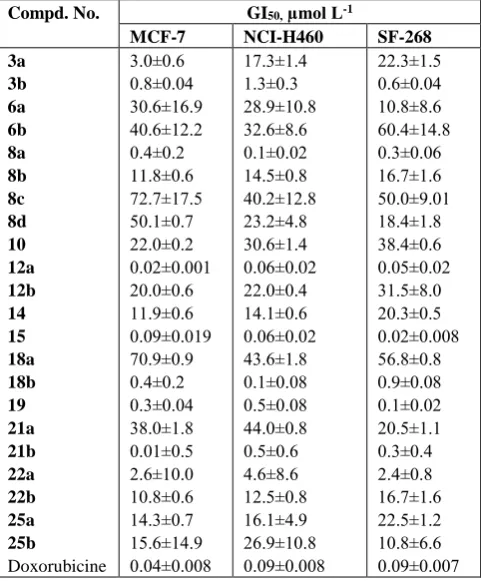
Briefly, cells growing exponentially in 96-well plates were then exposed for 48 h. The results are summarized in
Table 1. GI50 concentrations of the synthesized compounds
were calculated as described before compared to positive control Doxorubicin against three human tumor cell lines.26
Scheme 5. Synthesis of compounds 22a, b-25a, b
All the compounds were able to inhibit the growth of the human tumor cell lines in a dose-dependent manner from the data represented in table 1, benzylidine derivative 3b, pyridine derivatives 8a, 12a, 15, 21b and 22a,
pyrazolo[3,4-b]pyridine derivative 18b and thieno[3,4-c]pyridine
derivative 19 were showed the highest inhibitory effect towards the three cell lines relative to the other tested compounds . On the other hand, pyridine derivatives 8b,
12b and 22b, thieno[3,4-c]pyridine derivative 10,
isoquinoline derivative 14, pyrido[3,4-d]pyridazine
derivatives 25a and 25b showed moderated growth
inhibitory effect. Comparing the activities of 3a and 3b it is
observed that compound 3b with its substituted
4-methoxybanzal moiety showed stronger inhibitory effect than compound 3a with its benzal moiety towards the three cell lines. Comparing the inhibitory effect of compounds 8a, 8b, 8c and 8d, it is obvious that 5-benzylidene-2-imino-4- methyl-6-oxo-1-phenyl-1,2,5,6-tetrahydro-pyridine-3-carbo-nitrile (8a) showed highest inhibitory effect among the four compounds it may be due to NH group, moreover, substituting the C=NH group by C=O group decreases the inhibitory effect as in the case of 8b. Compounds 6a, 6b, 8c, 8d, 18a and 21a showed the lowest inhibitory effect towards the three cell line where their GI50 is higher than 30 µmol L-1.
CH C
COCH3
CONHPh R
+ CH2
CN
CN
H3C
CN CONH2
CONHPh R
R
3a,R= H b,R= 4-OCH3
(4a)
EtOH/Et3N
11a, R= H
b, R= 4-OCH3
N
O OH
CN CH3
12a, R= H
b, R= 4-OCH3
-NH2Ph
N
O OH
CN CH3
12a
+ CH2
CN
CN
(4a)
EtOH/Et3N
N
O OH
CH3H2N CN
CN 13 N O OH 14 NH2 CN NH2 N O OH CN CH3 12a + PhCHO (2a) Piperidine 140 oC
N O OH CN Ph 15 N O OH CN CH3 12a
+ Z-NHNH2
16a, Z= H b, Z= Ph
N
HO OH
CN CH3
NHNHZ
17a, Z= H b, Z= Ph
-H2O
N NZ N
OH NC
H3C
18a, Z= H b, Z= Ph
N
O OH
CN CH3
12a
+ S Et3N/EtOH
N S O NH2 OH 19 CH C COCH3 CONHPh R
+ CH2
COOEt
CN
H3C
COOEt CONH2
CONHPh R
3a,R= H b,R= 4-OCH3
(4b)
EtOH/Et3N
20a, R= H
b, R= 4-OCH3 -EtOH
NPh
O O
H3C H2NOC
R
21a, R= H
b, R= 4-OCH3
NPh
O O
H3C
H2NOC
21a
+ CHO
R
2a, R= H c, R= 2-OH
NPh
O O H2NOC
22a, R= H b, R= 2-OH
R
NPh
O O
H3C
H2NOC
21a
+ ArN N Cl
23a, Ar = C6H5
b, Ar = p-C6H4 Cl
NPh
O O H2NOC
ArHN-N
24a, Ar = C6H5
b, Ar = p-C6H4 Cl NPh Ar-N N O O O
25a, Ar = C6H5
Table 1. Effect of compounds 3a, b-25a, b on the growth of three human tumor cell lines
Compd. No. GI50, µmol L-1
MCF-7 NCI-H460 SF-268
3a 3b 6a 6b 8a 8b 8c 8d 10 12a 12b 14 15 18a 18b 19 21a 21b 22a 22b 25a 25b
Doxorubicine
3.0±0.6 0.8±0.04 30.6±16.9 40.6±12.2 0.4±0.2 11.8±0.6 72.7±17.5 50.1±0.7 22.0±0.2 0.02±0.001 20.0±0.6 11.9±0.6 0.09±0.019 70.9±0.9 0.4±0.2 0.3±0.04 38.0±1.8 0.01±0.5 2.6±10.0 10.8±0.6 14.3±0.7 15.6±14.9 0.04±0.008
17.3±1.4 1.3±0.3 28.9±10.8 32.6±8.6 0.1±0.02 14.5±0.8 40.2±12.8 23.2±4.8 30.6±1.4 0.06±0.02 22.0±0.4 14.1±0.6 0.06±0.02 43.6±1.8 0.1±0.08 0.5±0.08 44.0±0.8 0.5±0.6 4.6±8.6 12.5±0.8 16.1±4.9 26.9±10.8 0.09±0.008
22.3±1.5 0.6±0.04 10.8±8.6 60.4±14.8 0.3±0.06 16.7±1.6 50.0±9.01 18.4±1.8 38.4±0.6 0.05±0.02 31.5±8.0 20.3±0.5 0.02±0.008 56.8±0.8 0.9±0.08 0.1±0.02 20.5±1.1 0.3±0.4 2.4±0.8 16.7±1.6 22.5±1.2 10.8±6.6 0.09±0.007
From the results listed in Table 1 its very clear that compounds
(5-benzylidene-2-hydroxy-4-methyl-6-oxo-5,6-dihydro-pyridine-3-carbonitrile (12a), 5-benzylidene
2-hydroxy-6-oxo-4-styryl-5,6-dihydro-pyridine-3-carbonitrile (15) and 5-(4-methoxy-benzylidene)-4-methyl-2,6-dioxo-1-phenyl-1,2,5,6-tetrahydro-pyridine-3-carboxylic acid amide (21b) showed the maximum inhibitory effect among the three cell lines.
Figure 1. GI50 concentrations of the synthesized compounds
compared to positive control Doxorubicin against MCF-7, NCI-H460 and SF-268.
Figure 2 GI50 concentrations of the highly active synthesized
compounds compared to positive control Doxorubicin against MCF-7, NCI-H460 and SF-268.
The growth inhibitory of the newly synthesized products against the cancer cell lines are presented above through Figures 1 and 2.
Experimental
All melting points were determined in open capillaries and are uncorrected. IR spectra were measured using (KBr) discs
on a Pye Unicam Sp-1000 Spectro- photometer. 1HNMR
spectra were measured on a Varian EM-390-200 MHz instrument in (DMSO-d6) as solvent using TMS as internal
standard and chemical shifts are expressed as ppm. Mass spectra were measured on a Shimadzu GCMS QP- 1000 EX mass spectrometer at 70 eV. Synthetic pathways are presented in Schemes 1-5.
General procedure for synthesis of 2-benzylidene-3-oxo-N-phenylbutyramide (3a) and 2-(4-methoxy-benzylidene)-3-oxo-N-phenyl-butyramide (3b)
To a mixture of acetoacetanilide (1) (5.31 g, 0.03 mol) and
either benzaldehyde (2a) (3.18 g, 0.03 mol) or p
-anisaldehyde (2b) (4.08 g, 0.03 mol), a catalytic amount of piperdine (0.5 ml) was added. The reaction mixture was fused at 140 C for 15 minute. Then left to cool, whereby, the solid product formed after boiling in ethanol was collected by filtration, dried and crystallized from ethanol.
Compound 3a: Dark yellow crystals, 6.44 g. (81%),
mp.108 C 16.
Compound 3b: Dark orange crystals, 7.52 g. (85%),
mp.72-74 C 16.
General procedure for synthesis of 2-amino-6-oxo-1,4-diphenyl-1,6-dihydropyridine-3-carbonitrile (6a) and 5-acetyl- 2-amino-4-(4-methoxyphenyl)-6-oxo-1-phenyl-1,6-dihydropyri-dine-3-carbonitrile (6b)
To a suspension of either 3a (0.53 g, 0.002 mol) or 3b (0.59 g, 0.002 mol) in sodium ethoxide solution [prepared by dissolving sodium metal (0.046 g, 0.002 mol) in absolute ethanol (50 ml)], malononitrile (4a) (0.132 g, 0.002 mol) was added. The reaction mixture in each case was heated for 4 h, then poured on an ice/water mixture containing few drops of hydrochloric acid. The formed solid product, in each case, was collected by filtration, recrystallized from ethanol.
Compound 6a: 0.33 g (50%), m.p. 82-84 oC , IR (KBr,
cm-1): 3450, 3298 (NH
2), 3059 (CH aromatic), 2920 (CH3),
2218, (CN), 1714, 1673 (2C=O), 1656, (C=C). 1H-NMR
(200 MHz, DMSO-d6: δ, ppm): 2.39 (s, 3H, CH3), 4.20 (s,
2H, NH2, D2O-exchangeable ), 6.95-7.42 (m, 10H, 2C6H5).
MS: m/z (%) 329 (M+, 15.2), Anal.Calcd. for C
20H15N3O2
(329.35): C, 72.93; H, 4.59; N, 12.76. found: C, 72.68; H, 4.82; N, 12.66.
Compound 6b: 0.596 g (83%), m.p. 85-86 oC, IR (KBr,
cm-1): 3363, 3250 (NH
2210, (CN), 1698, 1685 (2C=O), 1633(C=C).1H-NMR (200
MHz, DMSO-d6: δ, ppm): 2.23, 3.22 (2s, 6H, 2CH3), 3.80 (s,
2H, NH2, D2O-exchangeable), 6.85-7.46 (m, 9H, C6H5,
C6H4). MS: m/z (%) 359 (M+, 11.4), Anal.Calcd. for
C21H17N3O3 (359.376): C, 70.17; H, 4.76; N, 11.69. found: C,
70.46; H, 4.98; N, 11.38.
General procedure for synthesis of 5-benzylidene-2-imino-4- methyl-6-oxo-1-phenyl-1,2,5,6-tetrahydropyridine-3-carbonit-rile (8a), 5-benzylidene-4-methyl-2,6-dioxo-1-phenyl-1,2,5,6-tetrahydropyridine-3-carbonitrile (8b), 2-imino-5-(4-methoxy- benzylidene)-4-methyl-6-oxo-1-phenyl-1,2,5,6-tetrahydropyri-dine-3-carbonitrile (8c) and 5-(4-Methoxy-benzylidene)-4-methyl-2,6-dioxo-1-phenyl-1,2,5,6-tetrahydro-pyridine -3-carbonitrile (8d)
To a mixture of either 3a (1.06 g, 0.004 mol) or 3b (1.18 g, 0.004 mol), either malononitrile (4a) (0.264 g, 0.004 mol) or
ethyl cyanoacetate (4b) (0.452 g, 0.004 mol) and anhydrous
ammonium acetate (0.5 g) were added. The reaction mixture in each case was fused at 140 C for 20 minute. Then left to cool, the solid product so formed, in each case, dried, recrystallized from ethanol.
Compound 8a: 1.07 g (86%), m.p. 118-120 oC , IR (KBr,
cm-1): 3490-3320 (NH), 3059 (CH aromatic), 2924, (CH 3),
2198 (CN), 1690 (C=O), 1660 (exocyclic C=N), 1599
(C=C). 1H-NMR (200 MHz, DMSO-d
6: δ, ppm): 2.32 (s, 3H,
CH3), 6.48 (s, 1H, CH=C), 7.24-7.46 (m,10H, 2C6H5), 9.39
(s, 1H, NH, D2O-exchangeable). MS: m/z (%) 313 (M+,
10.8), Anal.Calcd. for C20H15N3O(313.35): C, 76.65; H,
4.82; N, 13.41. found: C, 76.43; H, 4.91; N, 13.14.
Compound 8b: 0.654 g (52%), m.p. 140-141 oC , IR (KBr,
cm-1): 3060 (CH aromatic), 2928 (CH
3), 2194 (CN), 1685,
1680 (2C=O), 1673 (C=C). 1H-NMR (200 MHz, DMSO-d
6:
δ, ppm): 2.21 (s, 3H, CH3), 6.85 (s, 1H, CH =C), 7.23-7.46
(m, 10H, 2C6H5). MS: m/z (%) 314 (M+, 27.1), Anal.Calcd.
for C20H14N2O2 (314.332): C, 76.41; H, 4.48; N, 8.91 found:
C, 76.30; H, 4.34; N, 8.73.
Compound 8c: 1.03 g (75%), m.p. 72-74 oC , IR (KBr,
cm-1): 3480–3366 (NH), 3035 (CH aromatic), 2933 (CH 3),
2199 (CN), 1687 (C=O), 1660 (C=N), 1633 (C=C). 1
H-NMR (200 MHz, DMSO-d6: δ, ppm): 2.18, 3.11 (2s, 6H,
2CH3), 6.72 (s, 1H, CH=C), 6.86-7.37 (m, 9H, C6H5 , C6H4),
9.90 (s, 1H, NH, D2O-exchangeable). MS: m/z (%) 343 (M+,
23.5), Anal.Calcd. for C21H17N3O2 (343.376): C, 73.45; H,
4.99; N, 12.24 found: C, 73.33; H, 4.66; N, 11.99.
Compound 8d: 0.84 g (61%), m.p. 80-81 oC, IR (KBr,
cm-1): 3033 (CH aromatic), 2931(CH
3), 2202 (CN), 1688,
1685 (2C=O), 1640 (C=C). 1H-NMR (200 MHz, DMSO-d
6:
δ, ppm): 2.44, 3.31 (2s, 6H, 2CH3), 6.71 (s, 1H, CH=C),
6.86-7.36 (m, 9H, C6H5, C6H4). MS: m/z (%) 344 (M+, 9.8),
Anal.Calcd. for C21H16N2O3 (344.358): C, 73.24; H, 4.68; N,
8.13 found: C, 73.40; H, 4.87; N, 7.83.
3-Amino-7-benzylidene-4-imino-5-phenyl-4,5-dihydro-7H-thieno[3,4-c]pyridin-6-one (10)
To a solution of compound 8a (0.313 g, 0.001 mol) in ethanol (50 ml) containing a catalytic amount of
triethylamine (0.5 ml), elemental sulfur (0.032 g, 0.001 mol) was added. The reaction mixture was heated under reflux for 3 h. It was allowed to cool then poured on an ice/water mixture containing few drops of hydrochloric acid. The reaction mixture was left overnight to settle and the formed solid product so formed was collected by filtration, recrystallized from ethanol.
0.29 g (84%), m.p. 125-126 oC, IR (KBr, cm-1): 3540–
3312 (NH2, NH), 3030 (CH aromatic) , 1690 (C=O), 1673
(exocylcic C = N), 1635 (C=C). 1H-NMR (200 MHz,
DMSO-d6: δ, ppm): 4.1 (s, 2H, NH2 , D2O-exchangeable),
6.98, 7.02 (s, br, 2H, thiophene H-5, CH=C), 7.21–7.58 (m, 10H, 2C6H5), 9.80 (s, br, 1H, NH, D2O-exchangeable).
MS: m/z (%) 345 (M+, 23.4), Anal.Calcd. for C
20H15N3OS
(345.42): C, 69.53; H, 4.37; N, 12.16; S, 9.28 found: C, 69.43; H, 4.09; N, 11.89; S, 9.02.
General procedure for synthesis 5-benzylidene-2-hydroxy-4-methyl-6-oxo-5,6-dihydro-pyridine-3-carbonitrile (12a)and 2- hydroxy-5-(4-methoxy-benzylidene)-4-methyl-6-oxo-5,6-di-hydro-pyridine-3-carbonitrile (12b)
To a solution of either 3a (0.53 g, 0.002 mol) or 3b (0.59 g, 0.002 mol) in ethanol (50 ml) containing a catalytic amount of triethylamine (0.5 ml), malononitrile (4a) (0.132 g, 0.002 mol) was added. The reaction mixture in each case was heated under reflux for 4 h, then poured on an ice/water mixture containing few drops of hydrochloric acid. The solid product, so formed in each case, was collected by filtration, dried and recrystallized from ethanol.
Compound 12a: 0.391g (82%), m.p. 98-100 oC, IR (KBr,
cm-1): 3460-3381 (OH), 3059 (CH aromatic), 2927 (CH 3),
2204 (CN), 1688 (C=O), 1660 (C=N), 1635 (C=C). 1
H-NMR (200 MHz, DMSO-d6: δ, ppm): 2.25 (s, 3H, CH3),
4.15 (s, 1H, OH D2O-exchange- able), 6.88 (s, 1H, CH=C),
7.13-7.44 (m, 5H, C6H5). MS: m/z (%) 238 (M+, 33.6), Anal.
Calcd. for C14H10N2O2 (238.24): C, 70.57; H, 4.23; N,
11.76; found: C, 70.60; H, 4.14; N, 11.52.
Compound 12b: 0.241g (90%), m.p. 102-104 oC , IR (KBr,
cm-1): 3450–3361 (OH), 3061 (CH aromatic), 2933 (CH 3),
2206 (CN), 1685 (C=O), 1667 (C=N), 1634 (C=C). 1H-NMR (200 MHz, DMSO-d6: δ, ppm): 2.3, 2.95 (2s, 6H,
2CH3), 4.08 (s, 1H, OH, D2O-exchangeable ), 6.62 (s, 1H,
CH=C), 7.12–7.45 (m, 4H, C6H4). MS: m/z (%) 268 (M+,
37.9), Anal. Calcd. for C15H12N2O3 (268.266): C, 67.15; H,
4.50; N, 10.44; found: C, 67.10; H, 4.81; N, 10.23.
6,8-Diamino-4-benzylidene-1-hydroxy-3-oxo-3,4-dihydro-isoquinoline-7-carbonitrile (14)
To a solution of compound 12a (0.238 g, 0.001 mol) in ethanol (50 ml) containing a catalytic amount of triethylamine (0.5 ml), malononitrile (4a) (0.066 g, 0.001 mol) was added. The reaction mixture was heated under reflux for 6 h, then poured on an ice/water mixture containing few drops of hydrochloric acid. The solid product, so formed, was collected by filtration, dried, recrystallized from ethanol.
Yield: 0.18 g (59%), m.p. 136-137 oC, IR (KBr, cm-1):
2240 (CN),1687 (C=O), 1658 (C=N), 1648 (C=C).1H-NMR
(200 MHz, DMSO-d6: δ, ppm): 3.47, 3.76 (2s, 4H, 2NH2
D2O-exchangeable), 4.15 (s,1H, OH, D2O- exchangeable ),
6.48, 6.64 (2s, 2H, CH=C, isoquinoline H5), 7.23–7.62 (m, 5H, C6H5 ). MS: m/z (%) 304 (M+, 18.3), Anal. Calcd . for
C17H12N4O2 (304.306): C, 67.09; H, 3.97; N, 18.41; found:
C, 66.89; H, 4.22; N,18.21.
5-(Benzylidine)2-Hydroxy--6-oxo-4-styryl-5,6-dihydro-pyridine -3-carbonitrile (15)
To a mixture of compound 12a (0.476 g, 0.002 mol) and
benzaldehyde (2a) (0.212 g, 0.002 mol), a catalytic amount of piperidine (0.5 ml) was added. The reaction mixture was fused at 140 C for 35 minute, then left to cool. The solid product formed after boiling in ethanol was poured on an ice/water mixture containing few drops of hydrochloric acid, collected by filtration, recrystallized from ethanol.
0.379 g (58%), m.p. 65-66 oC, IR (KBr, cm-1): 3540-3200
(OH), 3060 (CH aromatic), 2928 (CH=CH), 2199 (CN),
1685 (C=O), 1663(C=N), 1636 (C=C). 1H-NMR (200 MHz,
DMSO-d6: δ, ppm): 2.85(s, 1H, OH, D2O-exchangeable),
7.18-7.21 (m, 3H, CH=CH, CH=C), 7.26–7.43 (m, 10H, 2C6H5). MS: m/z (%) 326 (M+, 41.2), Anal. Calcd. for
C21H14N2O2 (326.342): C, 77.28; H, 4.32; N, 8.58; found: C,
77.14; H, 4.17; N, 8.32.
General procedure for synthesis of 6-hydroxy-4-methyl-3-phe-nyl-1H-pyrazolo[3,4-b]pyridine-5-carbonitrile (18a)and 6-hyd- roxy-4-methyl-1,3-diphenyl-1H-pyrazolo[3,4-b]pyridine-5-car-bonitrile (18b)
To a solution of compound 12a (0.238 g, 0.001 mol) in ethanol (50 ml), either hydrazine hydrate (16a) (0.05 ml,
0.001 mol) or phenylhydrazine (16b) (0.108 ml, 0.001 mol)
was added. The reaction mixture in each case was heated under reflux for 6 h, left to cool at room temperature, then poured on an ice/water mixture containing few drops of hydrochloric acid. The formed solid product, in each case, was collected by filtration, dried, recrystallized from ethanol.
Compound 18a: 0.18 g (72%), m.p. 130-131 oC, IR (KBr,
cm-1): 3545-3320 (OH), 3480-3240 (NH), 3045 (CH
aromatic), 2930 (CH3), 2225 (CN), 1630 (C=C). 1H-NMR
(200 MHz, DMSO-d6: δ, ppm): 2.45 (s, 3H, CH3), 4.53 (s,
1H, OH, D2O-exchangeable), 7.05–7.39 (m, 5H, C6H5,) 9.43
(s, 1H, NH, D2O-exchangeable). MS: m/z (%) 250 (M+,
19.1), Anal. Calcd. for C14H10N4O(250.26): C, 67.18; H,
4.02; N, 22.39; found: C, 66.89; H, 4.18; N, 22.07.
Compound 18b: 0.222 g (68%), m.p. 110-112 oC, IR (KBr,
cm-1): 3540-3250 (OH), 3060 (CH aromatic), 2942 (CH 3),
2232 (CN), 1644 (C=C). 1H-NMR (200 MHz, DMSO-d
6: δ,
ppm): 2.39 (s, 3H, CH3), 4.32 (s, 1H, OH, D2O-exchange-
able), 7.16–7.48 (m, 10H, 2C6H5). MS: m/z (%) 326 (M+,
28.8), Anal. Calcd. for C20H14N4O(326.352): C, 73.6; H,
4.32; N, 17.17; found: C, 73.51; H, 4.12; N, 17.01.
3-Amino-7-benzylidene-4-hydroxy-7H-thieno[3,4-c]pyridin-6-one (19)
To a solution of compound 12a (0.476 g, 0.002 mol) in ethanol (50 ml) containing a catalytic amount of triethylamine (0.5 ml), elemental sulfur (0.064 g, 0.002 mol) was added. The reaction mixture was heated under reflux for 3h. It was allowed to cool, then poured on an ice/water mixture containing few drops of hydrochloric acid. The reaction mixture was left overnight to settle and the formed solid product was collected by filtration, dried, recrystallized from ethanol.
Yield: 0.378 g (70%), m.p. 147-149 oC, IR (KBr, cm-1):
3550-3150 (OH), 3383-3314 (NH2), 3058 (CH aromatic),
1688 (C=O), 1670 (C=N), 1634 (C=C). 1H-NMR (200 MHz,
DMSO-d6: δ, ppm): 2.89 (s, 2H, NH2, D2O-exchangeable),
3.32(s, 1H, OH, D2O-exchangeable), 7.17(s, 2H, CH=C,
thiophene H-5), 7.20-7.49 (m, 5H, C6H5). MS: m/z (%) 270
(M+, 30.7), Anal. Calcd. for C
14H10N2O2S (270.31): C,
62.20; H, 3.72; N, 10.36; S, 11.86 found: C, 62.34; H, 3.51; N, 10.13; S, 11.71.
General procedure for synthesis of 5-benzylidene-4-methyl-2,6-dioxo-1-phenyl-1,2,5,6-tetrahydro-pyridine-3-carboxylic acid amide (21a) and 5-(4-methoxy-benzylidene)-4-methyl -2,6-di-oxo-1-phenyl-1,2,5,6-tetrahydro-pyridine-3-carboxylic acid amide (21b):
To a solution of either 3a (0.265 g, 0.001 mol) or 3b (0.295 g, 0.001 mol) in ethanol (50 ml) containing a catalytic amount of triethylamine (0.5 ml), ethyl cyanoacetate (4b) (0.113 g, 0.001 mol) was added. The reaction mixture was heated under reflux for 3h, then poured on an ice/water mixture containing few drops of hydrochloric acid. The formed solid product, in each case was collected by filtration, dried, recrystallized from ethanol.
Compound 21a: Yield: 0.269 g (81%), m.p. 93-95 oC, IR
(KBr, cm-1): 3583–3132 (NH
2), 3060 (CH aromatic), 2924
(CH3), 1690, 1687, 1680 (3C=O), 1654 (C=C). 1H-NMR
(200 MHz, DMSO-d6: δ, ppm): 2.29 (s, 3H, CH3), 3.40 (s,
2H, NH2 D2O-exchangeable), 6.76 (s, 1H, CH=C), 7.13–
7.58 (m, 10H, 2C6H5 ). MS: m/z (%) 332 (M+, 17.9), Anal.
Calcd. for C20H16N2O3 (332.342): C, 72.27; H, 4.85; N,
8.43; found: C, 71.96; H, 4.64; N, 8.51.
Compound 21b: Yield: 0.221g (61%), m.p. 53-54 oC, IR
(KBr, cm-1): 3434–3200 (NH
2), 3034 (CH aromatic), 2932
(CH3), 1688, 1685, 1680 (3C=O), 1645(C=C). 1H-NMR
(200 MHz, DMSO-d6: δ, ppm): 2.12, 3.28 (2s, 6H, 2CH3),
4.21 (s, 2H, NH2 D2O-exchangeable), 6.85 (s, 1H, CH=C),
7.17-7.36 (m, 9H, C6H5, C6H4). MS: m/z (%) 362 (M+, 13.4),
Anal. Calcd. for C21H18N2O4 (362.374): C, 69.59; H, 5.00;
N, 7.73; found: C, 69.24; H, 4.78; N, 7.87.
5-Benzylidene-2,6-dioxo-1-phenyl-4-styryl-1,2,5,6-tetrahydro-pyridine-3-carboxylic acid amide (22a):
To a mixture of compound 21a (0.332 g, 0.001 mol) and
Compound 22a: Yield: 0.32g (76%), m.p. 88-89 oC, IR
(KBr, cm-1): 3450–3167 (NH
2) , 3058 (CH aromatic) ,1695,
1689, 1675(3C=O), 1638 (C=C). 1H-NMR (200 MHz,
DMSO-d6: δ, ppm): 3.32 (s, 2H, NH2, D2O-exchangeable),
6.95-7.22(m, 3H, CH=CH, CH=C), 7.28-7.43 (m, 15H, 3C6H5). MS: m/z (%) 420 (M+, 38.7), Anal. Calcd. for
C27H20N2O3 (420.45): C, 77.12; H, 4.79; N, 6.66; found: C,
77.33; H, 4.53; N, 6.63.
5-Benzylidene-4-[2-(2-hydroxy-phenyl)-vinyl]-2,6-dioxo-1-phe-nyl-1,2,5,6-tetrahydro-pyridine-3-carboxylic acid amide (22b):
A mixture of compound 21a (0.332 g, 0.001 mol) and
salicylaldehyde (2c) (0.122 g, 0.001 mol) in dry
dimethylformamide (30 ml) containing a catalytic amount of piperdine (0.5 ml), was heated under reflux for 5 h, then poured on an ice/water mixture containing few drops of hydrochloric acid. The solid product, so formed, was collected by filtration, dried, recrystallized from ethanol.
Compound 22b: Yield: 0.271 g (62%), m.p. 69-70 oC, IR
(KBr, cm-1): 3480–3259 (OH), 3367-3151(NH
2), 3057 (CH
aromatic), 1714, 1685, 1682 (3C=O), 1635(C=C). 1H-NMR
(200 MHz, DMSO-d6: δ, ppm): 3.88 (s, 2H, NH2, D2
O-exchangeable), 6.79-7.11(m, 3H, CH=CH, CH=C), 7.16-7.54 (m, 14H, 2C6H5, C6H4), 10.09(s, 1H, OH, D2
O-exchangeable). MS: m/z (%) 436 (M+, 22.2), Anal. Calcd.
for C27H20N2O4 (436.45): C, 74.29; H, 4.61; N, 6.41; found:
C, 74.03; H, 4.32; N, 6.31.
General procedure for synthesis of 8-benzylidene-3,6-diphenyl -3H, 8H-pyrido[3,4-d]pyridazine-4,5,7-trione (25a) and8-benz- ylidene-3-(4-chloro-phenyl)-6-phenyl-3H,8H-pyrido[3,4-d] pyridazine-4,5,7-trione (25b):
To a cold solution (0-5 C) of compound 21a (0.332 g, 0.001mol) in ethanol (50 ml) containing sodium hydroxide (0.04 g, 0.001 mol), arenediazonium chlorides 23a, b (0.001 mol) [prepared by adding an aqueous sodium nitrite solution (0.069 g, 0.001 mol) to a cold solution of the appropriate primary aromatic amine (0.001 mol) in the appropriate amount of conc. HCl at (0-5 C) with continuous stirring] was added with continuous stirring, the reaction mixture was stirred at room temperature for an additional 4 h and the solid product, so formed, was collected by filtration, dried, recrystallized from ethanol.
Compound 25a: Yield: 0.31 g (74%), m.p. 105-107 oC, IR
(KBr, cm-1): 3055 (CH aromatic), 1695, 1687, 1682 (3C=O),
1677 (C=N), 1640 (C=C). 1H-NMR (200 MHz, DMSO-d
6: δ,
ppm): 6.99(s, 1H, CH=C), 7.09(s, 1H, pyridazine H-3), 7.18-7.58 (m, 15H, 3C6H5). MS: m/z (%) 419 (M+, 40.1),
Anal. Calcd. for C26H17N3O3 (419.426): C, 74.44; H, 4.08;
N, 10.02; found: C, 74.35; H, 3.82; N, 9.92.
Compound 25b: Yield: 0.349 g (77%), m.p. 116-118 oC,
IR (KBr, cm-1): 3059 (CH aromatic), 1692, 1685, 1680
(3C=O), 1670 (C=N), 1643(C=C). 1H-NMR (200 MHz,
DMSO-d6: δ, ppm): 6.87 (s, 1H, CH=C), 7.13 (s, 1H,
pyridazine H-3), 7.15-7.60 (m, 14H, 2C6H5, C6H4). MS: m/z
(%) 453 (M+, 35.5), Anal. Calcd. for C
26H16ClN3O3
(453.868): C, 68.79; H, 3.55; N, 9.26; found: C, 68.66; H, 3.44; N, 9.02.
Antitumor Activity
Fetal bovine serum (FBS) and L-glutamine, were from Gibco Invitrogen Co. (Scotland, UK). RPMI-1640 medium was from Cambrex (New Jersey, USA). Dimethylsulfoxide
(DMSO), doxorubicin, penicillin, streptomycin and
sulforhodamine B (SRB) were from Sigma Chemical Co. (Saint Louis, USA). Samples: Stock solutions of new compounds through 3a-25b were prepared in DMSO and kept at -20 oC. Appropriate dilutions of the compounds were
freshly prepared just prior the assays. Final concentrations of DMSO did not interfere with the cell growth.
Cell cultures, three human tumor cell lines, MCF-7 (breast adenocarcinoma), NCI-H460 (non-small cell lung cancer), and SF-268 (CNS cancer) were used. MCF-7 was obtained from the European Collection of Cell Cultures (ECACC, Salisbury, UK) and NCI-H460 and SF-268 were kindly provided by the National Cancer Institute (NCI, Cairo, Egypt). They grow as monolayer and routinely maintained in RPMI-1640 medium supplemented with 5% heat inactivated FBS, 2 mM glutamine and antibiotics (penicillin 100 g mL-1, streptomycin 100 g mL-1), at 37 oC in a
humidified atmosphere containing 5% CO2. Exponentially
growing cells were obtained by plating 1.5 X 10⁵ cells/mL
for MCF-7 and SF-268 and 0.75 X 10⁴ cells/mL for
NCI-H460, followed by 24 h of incubation. The effect of the vehicle solvent (DMSO) on the growth of these cell lines was evaluated in all the experiments by exposing untreated control cells to the maximum concentration (0.5%) of DMSO used in each assay.
Results are given in concentrations that were able to cause 50 % of cell growth inhibition (GI50) after a continuous
exposure of 48 h and show means ± SEM of three-independent experiments performed in duplicate.
Conclusion
A convenient method was described for the synthesis of heterocyclic arylideneaceto- acetanilides. They have been shown to be useful building blocks for the synthesis of pyridine, thieno[3,4-c]pyridine, pyrazolo-[3,4-b]pyridine and pyrido[3,4-d]-pyridazine derivatives, for which we might expect a wide spectrum of bioresponses. Antitumor evaluation of the newly synthesized products showed in table1.
Acknowledgment
The authors would like to thank the research group at the National Research center "Hormones Department" and the National Cancer Institute at Cairo University for recording the antitumor evaluations for the newly synthesized products.
1Gaston, M. A., Osaria, D. L. S., Freitas, C. A. C., Miranda, P. A.
and Barreiro, J. E., Pharm. Acta. Helv., 1996, 71, 213.
2El-Gamal, M. I., Jung, M. H., Lee, W. S., Sim, T. Y. K. H. and
Oh, C. H., Eur. J. Med. Chem., 2011, , 3218. 46
3Foks, H., Ksepko, D. P., Kędzia, A., Zwolska, Z., Janowiec, M.
and Kopeć, E. A., Il Farmaco., 2005, 60, 513.
4Ali, T. E., Eur. J. Med. Chem.,2009, 44, 4385.
5Lacerda, R. B., De Lima, C. K. F., Da Silva, L. L., Romeiro, N. C.,
Miranda, A. L. P., Barreiro, E. J. and Fraga, C. A. M., Biol. Med. Chem., 2009, 17, 74.
6Dias, L. R. S., Alvim, M. J. F., Freitas, A. C. C., Barreiro, E. J.
and Miranda, A. L. P., Pharm.Acta Helv., 1994, 69, 163.
7Queiroz, M. R. P., Calhelha, R. C., Silva, L. A., Pinto, E., Lima, R.
T. and Vasconcelos, M. H., Eur. J. Med. Chem., 2010, 45, 5628.
8Bahekar, R. H., Jain, M. R., Jadav, P. A., Prajapati, V. M., Patel,
D. N., Gupta, A. A., Sharma, A., Tom, R., Bandyopadhya, D., Modi, H. and Patel, P. R., Bioorg. Med. Chem., 2007, 15, 6782.
9De Sarro, A., De Sarro, G., Chimirri, A., Grasso, S., Monforte, A.
M. and Zappala, M., Gen. Pharm: The Vascular System.,
1994, 25, 1027.
10Carla, M. S. M., Carlos, M. R. S. A., Carlos, R. R. and Eliezer, J.
B., J. Mol. Struct. (Theochem.),2002, 579, 31.
11Poreba, K., Opolski, A., Wietrzyk, J. and Kowalska, M., Arch.
Pharm . (Weinheim),2001, 334, 219.
12Poreba, K., Opolski, A. and Wietrzyk, J., J. Acta. Pol. Pharm.,
2002, 59, 215.
13Copo, J., Sanchez, A., Nogueras, M. and De Clercq, E.,
Tetrahedron,1997, 53, 8225.
14Zhuravel', I. O., Kovalenko, S. M., Ivachtchenko, A. V., Balakin,
K. V. and Kazmirchuk, V. V., Biol. Med. Chem. Lett., 2005, 15, 5483.
15Elkholy, M. Y., Heterocyclic Comm., 2011, 11, 89.
16Khalil, Z. H. and Yanni, A. S., J. Indian Chem. Soc., 1981, 58,
168.
17Lima, P. C., Avery, M. A., Tekwani, B. L., Alves, H. D.
M., Barreiro, E. J. and Fraga, C. A. M., Il Farmaco.,2002, 57, 825.
18Stuart, T. H., Lisa, P., Juiwanna, K., Kathryn, W., Thomas, H. C.
and Jerome, P. H., Bioorg. Med. Chem., 2006, Part 5, 14, 2462.
19Murata, T., Shimada, M., Sakakibara, S., Yoshino, T., Masuda, T.,
Shintani, T., Sato, H., Koriyama,Y., Fukushima, K., Nunami, N., Yamauchi, M., Fuchikami, K., Komura H., Watanabe, A., Ziegelbauer, K., Bacon, K. B. and Lowinger, T. B., Bioorg. Med. Chem., 2004,14, 4019.
20Elnagdy, M. H., Mohareb, R. M., Abd El-Aal, F. A. and
Mohamed, H. A., Phosphorus, Sulfur Silicon Related Elements, 1993, 82,195.
21Gewald, K., Schinke, E. and Böttcher, H., Chem. Ber., 1966, 99,
94.
22Gewald, K., Schnbert, A. and Martin, G., J. Prakt. Chem., 1975,
317, 561.
23Sabnis, R. W., Sulfur Rep., 1994,16, 1.
24Sabnis, R. W., Rangnekar, D. W. and Sonawane, N. D., J.
Heterocyclic Chem.,1999, 36, 333.
25Skehan, P., Storeng, R., Scudiero, D., Monks, A., McMahon, J.,
Vistica, D., Warren, J. T., Bokesch, H., Kenny, S. and Boyd, M. R., J. Natl. Cancer Inst., 1990,82, 1107.
26Monks, A., Scudiero, D., Skehan, P., Shoemaker, R., Paul, K.,
Vistica, D., Hose, C., Langley, J., Cronise, P., Vaigro-Wolff, A., Gray-Goodrich, M., Campbell, H., Mayo, J. and Boyd, J. M., J. Natl. Cancer Inst., 1991, 83, 757.