SYNTHESIS, STRUCTURE AND MAGNETIC BEHAVIOR OF
[Cu
2(2-AMINO-5-TRIFLUOROMETHYLPYRIDINE)
4(OH)
2](ClO
4)
2·
BIS(2-AMINO-5-TRIFLUOROMETHYLPYRIDINE) ADDUCT
R. Louise Forman,
[a]Christopher P. Landee,
[b]Jan L. Wikaira
[c]and
Mark M. Turnbull
[a]*Keywords: Copper(II) complexes, magnetic susceptibility, X-ray structure
The reaction of Cu(ClO4)2∙6H2O with 2-amino-5-(trifluoromethyl)pyridine (5-TFMAP) in 1-propanol/water solution gave the product
[Cu2(5-TFMAP)4(OH)2](ClO4)2·(5-TFMAP)2. The complex forms as a dihydroxide briged Cu(II) dimer with two coordinated 5-TFMAP
on each copper ion and two non-coordinated 5TFMAP molecules in the asymmetric unit. Although hydroxide bridged Cu(II) dimers generally exhibit strong magnetic exchange, the compound shows only very weak antiferromagnetic interactions (~ -1.7 K) which is attributed to the Cu-O-Cu bridging angles.
*Corresponding Authors Fax: +1-508-793-2014 E-mail: [email protected]
[a] Carlson School of Chemistry and Biochemistry, Clark University, 950 Main Street, Worcester, Massachusetts 01610
[b] Department of Physics, Clark University, 950 Main Street, Worcester, Massachusetts 01610
[c] Department of Chemistry, University of Canterbury, Private Bag 4800, Christchurch, New ZealandChapters
INTRODUCTION
In the field of molecular magnetism, there is an interest in copper(II) complexes because the Cu(II) ion possesses a single unpaired electron, regardless of its geometry, as well as a g-factor of approximately 2.00.1 These two properties of copper make it of particular interest for the study of quantum magnetism and allow for observation of the effects of the ligands on magnetic exchange within the complexes and how the steric and electronic properties of the ligand influence the molecular complex as a whole.2-5
Our research in this field has led us to investigate a wide variety of ligands, each one of which affects the magnetic superexchange and crystal lattice in a unique way. In this field, we focus on complexes involving copper halide complexes and copper(II) salts, such as those involving copper(II) perchlorate which has yielded magnetically interesting and significant 2-dimensional quantum Heisenberg antiferromagnets (2D-QHAF), as well as a highly isolated 2-dimensional layer.6 It has been observed that 2-amino-5-substituted pyridines have a tendency to form such 2-dimensional magnetic layers.4 One particularly interesting ligand for such study is 2-amino-5-trifluoromethylpyridine (5-TFMAP), which has a similar structure to that of the corresponding methyl-substituted compound, but with significant electronic differences. We have previously reported the synthesis, structure and magnetic properties of two tetrahalocuprate salts of 5-TFMAP which occurred as a magnetic ladder and a
honeycomb-like lattice.2 We were particularly interested in the effect of replacing the halide ions with non-coordinating anions, and as such examined the reaction of 5-TFMAP with Cu(ClO4)2∙6(H2O). The resulting compound, [Cu2(trifluoromethyl)pyridine)4(OH)2] (ClO4)2· (2-amino-5-(trifluoromethyl)pyridine)2, is an unusual example of a hydroxide bridged Cu(II)-dimer which exhibits only very weak antiferromagnetic interactions . It has lead us to a family of di-μ-hydroxo-copper(II) dimers in which the Cu−O−Cu angle, along with the Cu...Cu distance is significant in the magnetic exchange. The synthesis, structure, and magnetic properties of this compound are reported.
EXPERIMENTAL
Copper perchlorate hexahydrate and 1-propanol were purchased from Aldrich Chemical Company and used without further purification. 2-Amino-5-(trifluoromethyl)-pyridine (5-TFMAP) was purchased from Matrix Scientific and used without further purification. IR spectra were recorded as KBr pellets on a Perkin-Elmer Spectrum 100.
Synthesis of [Cu2(5-TFMAP)4(OH)2](ClO4)2·(5-TFMAP)2 (1)
X-ray Structure Analysis
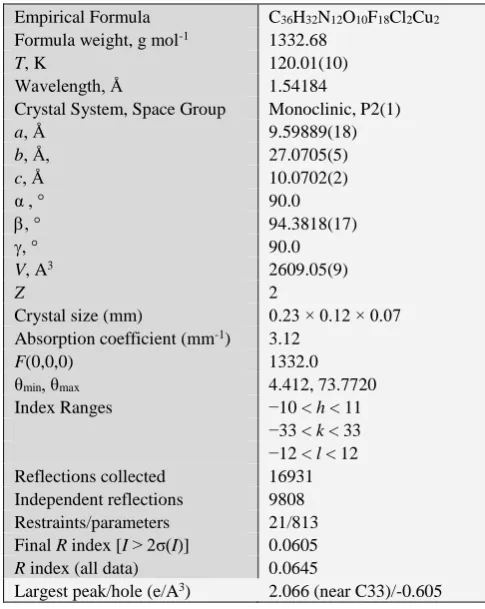
Data for 1 was collected on an Agilent Technologies diffractometer using the CrysAlisPro software with CuKα radiation (λ = 1.54184 Å) with ω-scans at 120.01(10) K employing a mirror monochomator. Cell parameters were refined using CrysAlisPro7 and absorption corrections using spherical harmonics were made using SCALE3 ABSPACK scaling algorithm.7 The crystal structure was solved and refined via least-square analysis using SHELX97-2.8 All non-hydrogen atoms were refined anisotropically. Hydrogen atoms bonded to carbon atoms were added in calculated positions and refined using a riding model with fixed isotropic thermal parameters. Hydrogen atoms bonded to N- or O-atoms were located in the difference map and their positions refined using fixed isotropic thermal parameters. Crystallographic information and collection details can be found in Table 1.
Magnetic Susceptibility of Data Collection
Magnetic susceptibility data for 1 were collected using a Quantum Design MPMS-XL SQUID magnetometer. A sample of the crystal was finely ground and packed into a gelatin capsule. The moment was measured using magnetic fields from 0 to 50 kOe at 1.8 K. Several data points were collected as the field returned to 0 kOe to check for hysteresis effects; none were observed. Magnetization was then measured from 1.8 to 310 K in a 2kOe field. Data were corrected for the background signal of the gelatin capsule and sample holder. The data was also corrected for the temperature independent paramagnetism of the copper(II) ion (60 × 10-6 emu/mol·Oe) as well as the diamagnetism of the constituent atoms (−500 × 10-6 emu/mol·Oe) which was estimated using Pascal’s constants.1
Table 1. X-ray data for 1.
Empirical Formula C36H32N12O10F18Cl2Cu2
Formula weight, g mol-1 1332.68
T, K 120.01(10)
Wavelength, Å 1.54184
Crystal System, Space Group Monoclinic, P2(1)
a, Å 9.59889(18)
b, Å, 27.0705(5)
c, Å 10.0702(2)
α , ° 90.0
, ° 94.3818(17)
, ° 90.0
V, A3 2609.05(9)
Z 2
Crystal size (mm) 0.23 × 0.12 × 0.07 Absorption coefficient (mm-1) 3.12
F(0,0,0) 1332.0
θmin, θmax 4.412, 73.7720
Index Ranges −10 < h < 11
−33 < k < 33
−12 < l < 12
Reflections collected 16931 Independent reflections 9808 Restraints/parameters 21/813 Final R index [I > 2σ(I)] 0.0605
R index (all data) 0.0645
Largest peak/hole (e/A3) 2.066 (near C33)/-0.605
RESULTS AND DISCUSSION
Reaction of two equivalents of 5-TFMAP and one equivalent of copper(II) perchlorate in a 50 % water /1-propanol solution over a week produced dark blue crystals of [(5-TFMAP)4Cu2(OH)2](ClO4)2·(5-TFMAP)2 (1) in 12.5 % yield.
Scheme 1. Preparation of compound 1.
Attempts to prepare the complex in either pure water or pure 1-propanol proved to be ineffective. This is most likely due to the necessary insertion of a hydroxyl group which bridges the two copper ions and the deprotonation of the hydronium-like ion formed by coordination of a water molecule to the Cu(II) ions. The propyl group may act as a hydrophobic buffer which reduces the hydrogen bonding occurring in a pure water solution and the OH-groups in both the water and 1-propanol can act as a proton donor or acceptor.9
Crystal Structure Analysis
Compound 1 crystallizes in the monoclinic space group P21. The asymmetric unit is shown in Figure 1. A non-symmetric hydroxide-bridged dimer was formed. The six 5-TFMAP molecules are numbered with successive addition of 10 (N11, N21, N31…) to facilitate comparisons between them.
Figure 1. Thermal ellipsoid plot of the asymmetric unit of 1
showing 50% probability ellipsoids. Only H-atoms whose positions were refined are labeled. Only the major occupancy fluorine atoms are shown.
N21 and N31 rings are virtually perpendicular with a canting angle of 90.3° as are the N11 and N41 rings which display a canting angle of 81.4°. The Cu1…Cu2 coordination plane has a maximum mean deviation of 0.091Å with a fold angle of 1.4°.
The trifluoromethyl groups on five of the 5-TFMAP molecules (in the 21, 31, 41, 51, and 61 number sequence) exhibit disorder in the position of the fluorine atoms. This disorder was resolved on ligands 30 and 60, as seen in Figure 2A and Figure 2B, respectively. Attempts to resolve the disorder in the remaining trifluoromethyl groups failed to converge and did not improve the overall refinement; these groups were treated as non-disordered and exhibit large thermal ellipsoids in the final refinement.
Figure 2. Thermal ellipsoid plot of disordered 5-TFMAP molecules of 1 showing 50% probability ellipsoids. H atoms placed in calculated positions are not labeled.
(A) Ligand 30. The major F occupancy atoms are labeled A and the minor F occupancy are labeled B with a refined occupancy for F31 and F32 of 0.72 and 0.50 respectively. Attempts to resolve the disorder of F33 were unsuccessful.
(B) Ligand 60. The major occupancy F atoms are labeled A and the minor occupancy of F atoms are labeled B. The refined occupancy of the major component was 0.64. Attempts to refine a three-site disorder model were unsuccessful and not used in the final refinement.
Table 2. Selected bond lengths (Å) and angles (°) for 1.
Bond lengths, Å Bond angles, °
Cu1-O1 1.934(3) Cu1-O1-Cu2 97.22(16) Cu1-O2 1.925(3) Cu1-O2-Cu2 96.48(15) Cu1-N11 2.023(4) O1-Cu1-O2 83.35(14) Cu1-N21 2.016(4) O1-Cu2-O2 82.94(14) Cu2-O1 1.922(3) O1-Cu1-N11 92.65(16) Cu2-O2 1.953(3) O1-Cu1-N21 169.3(17) Cu2-N31 2.001(4) O2-Cu1-N11 174.1 (17) Cu2-N41 2.028(4) O2-Cu1-N21 95.04(16) Cu1…Cu2 2.8936(8) O1-Cu2-N31 174.88(18)
O1-Cu2-N41 94.70(16)
O2-Cu2-N31 92.57(16)
O2-Cu2-N41 168.64(17)
The crystal structure of 1 is stabilized by multiple hydrogen bonds (see Table 3). The hydroxide ions form hydrogen bonds to the pyridine nitrogen atoms of the free 5-TFMAP molecules in the adjacent unit cell which generates a chain of dimers and may explain the presence of the uncoordinated 5-TFMAP molecules in the structure. There is also significant hydrogen bonding between three of the amino groups to oxygen atoms of the perchlorate ions and from N42 to one bridging hydroxide ion. These contacts can be observed in Figure 3. Hydrogen bonds are further displayed in Figure 4 where the packing structure of the compound is viewed parallel to the c-axis. The hydrogen bonded chains are well isolated parallel to the b-axis and a zigzag pattern parallel to the b-axis is observed.
Figure 3. Chain packing of 1. There are no significant interactions along the a or c axis. The perchlorate ions are removed for clarity. Dashed lines represent hydrogen bonds.
Table 3. Significant hydrogen bond lengths (Å) and angles (°) for 1.
D - H A d(D-H) d(H···A) d(D···A) (DHA) Symmetry code
O1 - H1 N51 0.82(7) 2.16(7) 2.904(6) 151(7) x, y, z-1
O2 - H2 N61 0.88(7) 2.26(7) 2.976(6) 139(6) x, y, z+1
N12 -H12A O21 0.88(8) 2.20(8) 3.007(6) 153(7)
N22 - H22A O21 0.86(2) 2.08(4) 2.868(6) 153(7)
N22 - H22B O14 0.84(2) 2.19(3) 2.988(6) 157(6) x-1, y, z
N32 - H32B O12 0.84(9) 2.24(9) 3.024(6) 156(8)
N42 - H42A O1 0.81(8) 2.31(8) 2.918(6) 133(7)
Magnetic Study
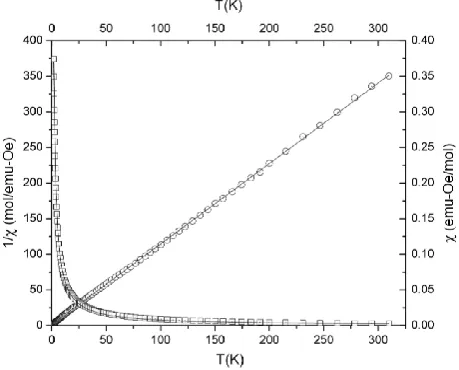
Magnetization of 1 as a function of applied field showed a uniform increase with increasing field reaching a value of approximately 8000 emu-Oe mol-1 at 5.0 T and 1.8 K. This value is approximately two-thirds of the saturation magnetization for two Cu(II) ions and agrees well with the predicted value for a copper dimer with weak antiferromagnetic interactions.1 Magnetic susceptibility data were collected for compound 1 from 1.8 to 310 K in a 0.2 T field (Figure 5).
Figure 5. mvs. T (□) and 1/χmvs. T (○) for 1 in a 0.2 T field. The
solid line represents the best fit to a dimer antiferromagnet model with an R2-value of 0.99971 (for χ
mvs. T) and the Curie-Weiss
model (for 1/χmvs. T ) with an R2-value of 0.99999.
No maximum is found in the susceptibility above 1.8 K. χm(T) was fit with the Bleaney-Bowers equation (where ρ represents a paramagnetic impurity, and Nα represents the
temperature independent paramagnetism, eqn 1). The best fit yielded, 2J=-1.69(5) K, g=2.160 again in agreement with a weak antiferromagnetic interaction. Attempts to fit the percent paramagnetic impurity led to unphysical results as is common for very weakly interacting antiferromagnetic materials. No impurity was detected in the powder X-ray diffraction pattern of the material used for magnetic data collection, so the impurity fraction was fixed at 1 % (=0.01)in the final fitting, a value below that detectable via our powder diffraction experiment.
(1)
A fit of the 1/m vs. T data (Figure 5) to the Curie-Weiss expression (Eqn 2) yielded C=0.8852(1) mol emu-Oe-1 and =-1.3982(1)° in good agreement with the Bleaney-Bowers fitting results.
(2)
A wide variety of bis-hydroxide bridged Cu(II) dimers have been prepared using pyridine-derived ligands such as di(3-pyridyl)amine,10 2,2’-bypyridine11 and phenanth-roline,12 but there are no structures available where the ancillary ligands are simple substituted pyridine compounds for comparison with 1. The closest analogues are those of dipyridylamine with perchlorate,13 or bipyridine with tetrafluoroborate as the counter ions.14 In the µ-OH Cu(II) dimer family, it is typical for the exchange to exhibit strong antiferromagnetic, and ferromagnetic interactions.15-17 However, in a study done by Crawford et al., the relationship between the Cu−O−Cu bridging angle, Cu…Cu distance, and the magnetic exchange value for hydroxide-bridged Cu(II) dimers was reported.17 It was shown that between the angles of 97.0 and 99.5, the interactions switch from ferromagnetic exchange to antiferromagnetic exchange as seen. Their 2J values respectively +49 and -130 cm-1 with a paramagnetic exchange intermediate.18,19 The calculated crossover angle was calculated to be 97.5°. The bond angle of the Cu−O1−Cu in [(5-TFMAP)4Cu2(OH)2](ClO4)2·(5-TFMAP)2 is 97.22(16)° which lies in the region of where it was predicted to cross between ferromagnetic and antiferromagnet exchange. The Cu-O2-Cu angle is 96.48(15)° is similar and suggests that the contributions from the two superexchange pathways are either nearly zero, or serve to cancel the exchange via each pathway. Either option provides a viable explanation of the lack of strong exchange in 1. Further work is in progress to extend this family of compounds through the use of additional substituted 2-aminopyridine ligands.
1 m
T C
1 2 2
m
2 2
2 1 2
1 exp (1 )
3 3
4
N g J
kT kT
N g
N kT
ACKNOWLEDGEMENTS
The MPMS-XL SQUID magnetometer was purchased with the assistance of funds from the National Science Foundation (IMR-0314773) and the Kresge Foundation. The Bruker D8-Advance powder X-ray diffractometer was purchased with the assistance of Funds from the Kresge Foundation and PCISynthesis, Inc.
APPENDIX A. SUPPLEMENTARY DATA
CCDC (974812) contains the supplementary crystallographic data for 1, respectively. These data can be
obtained free of charge via
http://www.ccdc.cam.ac.uk/conts/retrieving html, or from the Cambridge Crystallographic Data Centre, 12Union Road, Cambridge CB2 1EZ, UK; fax: (+44) 1223-336-033; or e-mail: [email protected].
REFERENCES
1Carlin, R. L., Magnetochemistry, Springer-Verlag, 1986.
2Gale, A. J., Landee, C. P., Turnbull, M. M., Wikaira, J. L., Polyhedron,2013, 52, 986.
3Zhao, J. P., Hu, B. W., Sanudo, E., Yang, Q., Zeng, Y.F,. Bu, X.
H., Inorg. Chem. 2009, 48, 2482.
4Abdalrahhman, M., Landee, C. P., Telfer, S. G., Turnbull, M. M.,
Wikaira, J. L., Inorg. Chem. Acta2012, 389, 66.
5Solomon, B. L., Landee, C. P., Jasinski, J. P., Turnbull, M. M., Eur. Chem. Bull.2013, 2, 845.
6Selmani, V., Landee, C. P., Turnbull M. M., Wikaira, J. L., Xiao,
F., Inorg. Chem. Comm. 2010, 13, 1399.
7CrysAlisPro Oxford Diffraction Ltd., Version 1.171.35.19 (release
27-10-2011 CrysAlis171.NET).
8Sheldrick, G. M., Acta Cryst. A2008, 64, 112.
9Hossen, S. M. M., Islam, S., Hossain, M. M.,Hoque, M. E.,
Akteruzzaman, G., Der Pharma Chemica, 2012, 4, 1375.
10a)Youngme, S., Chailuecha, C., van Albada, G. A., Pakawatchai,
C., Chaichit, N., Reedijk, J., Inorg. Chim. Acta, 2004, 357, 2532. b) Allen, J. J., Hamilton, C. E., Barron, A. R., Dalton Trans., 2010, 39, 11451. c) Wu, L., Keniry, M. E., Hathaway, B., Acta Crystallogr., Sect.C: Cryst. Struct. Commun., 1992,
48, 35.
11a)Castro, I., Faus, J., Julve, M., Bois, C., Real, J. A., Lloret, F., J. Chem. Soc., Dalton Trans., 1992, 47. b) Doyle, R. P., Julve, M., Lloret, F., Nieuwenhuyzen, M., Kruger, P. E., Dalton Trans., 2006, 2081. c) Figgis, B. N., Mason, R., Smith, A. R. P., Verghese, J. N., Williams G. A., J. Chem.Soc., Dalton Trans., 1983, 703.
12a)Maldonado, C. R., Quiros, M., Salas J. M., Inorg. Chem. Commun., 2010, 13, 399. b) Zheng, Y., Sun, J., Lin, J., Z. Anorg. Allgem. Chem., 2000, 626, 613.
13Youngme, S., van Albada, G.A., Kooijman, H., Roubeau, O.,
Somjitsripunya, W., Spek, A. L., Pakawatchai, C., Reedijk, J.,
Eur. J. Inorg. Chem., 2002, 2367.
14Prescimone, A., Sanchez-Benitez, J., Kamenev, K. K., Moggach,
S. A., Warren, J. E., Lennie, A. R., Murrie, M., Parsons, S., Brechin, E. K., Dalton Trans., 2009, 39, 113.
15Massoud, S. S., Louka, F. R., Xu, W., Perkins, R. S., Vicente, R.,
Albering, J. H., Mautner, F. A., Eur. J. Inorg. Chem., 2011,
50, 3469.
16Cvetkovic, M., Batten, S. R., Moubaraki, B., Murray, K. S.,
Spiccia, L., Inorg. Chim. Acta, 2001, 324, 131.
17Crawford, V. H., Richardson, H. W., Wasson, J. R., Hodgson, D.
J., Hatfield, W. E., Inorg. Chem., 1976, 15, 2107.
18Barnes, J. A., Hodgson, D. J., Whillans, F. D., Inorg. Chem., 1972, 74, 144.
19Hoskins, B. F., Whillans, F. D., J. Chem. Soc., Dalton Trans., 1975, 1267.