Proceedings of the
Tenth International Workshop on
Graph Transformation and
Visual Modeling Techniques
(GTVMT 2011)
Decidability and Expressiveness of Finitely Representable Recognizable
Graph Languages
H.J. Sander Bruggink and Mathias H¨ulsbusch
12 pages
Guest Editors: Fabio Gadducci, Leonardo Mariani
Managing Editors: Tiziana Margaria, Julia Padberg, Gabriele Taentzer
Decidability and Expressiveness of Finitely Representable
Recognizable Graph Languages
H.J. Sander Bruggink and Mathias H ¨ulsbusch∗
Universit¨at Duisburg-Essen, Germany
[email protected], [email protected]
Abstract:Recognizable graph languages are a generalization of regular (word)
lan-guages to graphs (as well as arbitrary categories). Recently automaton functors were proposed as acceptors of recognizable graph languages. They promise to be a use-ful tool for the verification of dynamic systems, for example for invariant checking. Since automaton functors may contain an infinite number of finite state sets, one must restrict to finitely representable ones for implementation reasons. In this paper we take into account two such finite representations:primitive recursive automaton functors– in which the automaton functor can be constructed on-the-fly by a prim-itive recursive function –, andbounded automaton functors– in which the interface size of the graphs (cf. path width) is bounded, so that the automaton functor can be explicitly represented. We show that the language classes of both kinds of automa-ton functor are closed under boolean operations, and compare the expressiveness of the two paradigms with hyperedge replacement grammars. In addition we show that the emptiness and equivalence problem are decidable for bounded automaton functors, but undecidable for primitive recursive automaton functors.
Keywords: recognizable graph languages, automaton functors, verification, graph
transformation
1
Introduction
In [BK08] automaton functors were introduced as an automaton model to accept recognizable graph languages, and it was shown that this notion is equivalent to Courcelle’s [Cou90]. Au-tomaton functors can be seen as a generalization of finite (word) automata to graphs (and other categories): graphs are decomposed into a sequence ofcospans(which, intuitively, can be seen as graphs with interfaces or external nodes), which are then input into an automaton to decide whether they are accepted. Such an automaton model for graph languages is useful in practice to verify properties of graph transformation systems; in [BBK10] for example, automaton functors were used for invariant checking.
However, in general, automaton functors are infinite structures. For implementation purposes, we need to impose restrictions to automaton functors in order to ensure that they have finite representations. In this paper, we will explore two possible such restrictions:primitive recursive automaton functors(Section 3) andbounded automaton functors(Section 4).
∗This work was supported by the
In the case of primitive recursive automaton functors, we require that the automaton functor can be generated “on-the-fly” by a primitive recursive function. Although other computability classes would be possible (and interesting), the requirement that the function is primitive recur-sive ensures that the function is computable and total.
In the case of bounded recursive automaton functors, we bound the size of the interfaces of the cospans in the decomposition (which amounts to bounding the number of external nodes). Thereby we bound the pathwidth of the graphs which can be generated. If we bound the interface size in this way, we can specify finitely many cospans from which all (bounded) cospans can be composed. Thus, every bounded automaton functor can be explicitly represented.
Of these two restricted forms of automaton functor, we are particularly interested in: a) the expressive power of the formalisms in relation to each other, and in relation to hyperedge re-placement grammars; and b) what decision problems of the restricted automaton functors are decidable, and how automaton functors can be constructively combined into other automaton functors.
2
Preliminaries
In this section we briefly recall some concepts of category theory, recognizable graph languages and computability theory, mainly in order to fix terminology and notation.
2.1 Categories and recognizable arrow languages
We presuppose a basic knowledge of category theory. For arrows f:A→Bandg:B→C, the composition of f andg is denoted (f;g): A→C. The category Relhas sets as objects and relations as arrows. Its subcategorySethas only the functional relations (functions) as arrows.
LetCbe a category in which all pushouts exist. Acospan inCis a pairhcL,cRiofC-arrows J−cL
G cR−K. In such a cospan,J will be called the left orinner interface, whileK will be
called the right orouter interface. Composition of two cospanshcL,cRi,hdL,dRiis computed by taking the pushout of the arrowscR anddL. Cospans are isomorphic if their middle objects are (such that the isomorphism commutes with the component morphisms of the cospan). Isomor-phism classes of cospans are the arrows of so-called cospan categories. That is, for a category Cwith pushouts, the categoryCsp(C) has the same objects asC. The isomorphism class of a cospanJ−cL
G cR−KinCis an arrow fromJtoKinCsp(C).
In [BK08], anautomaton functor, which is an acceptor for recognizable languages of arrows in a category, was defined as follows:
Definition 1 Let a categoryCwith initial object∅be given. An automaton functor is a functor
A:C→Rel, which maps every objectX∈Cto a finite setA(X)(thestate set of X) and every arrow f ∈C(X,Y) to a relation A(f)⊆ A(X)× A(Y), together with two distinguished sets IA⊆ A(∅)andFA⊆ A(∅)ofinitialandfinal states, respectively.
An arrow f∈C(∅,∅)is accepted by an automaton functorA, ifhs,ti ∈ A(f), for somes∈IA andt∈FA. The language L(A)ofAcontains exactly those arrows which are accepted by it. A languageLof arrows from∅to∅is arecognizable languageifL=L(A)for some automaton
The rationale behind the notion of automaton functor is that objects (the arrows of the cate-gory) are decomposed in “smaller” objects, and then read sequentially by the automaton functor, like in the case of word automata. As such decompositions are in general not unique, the functor property is needed to make sure the result is independent of the decomposition.
Note, that we will later apply this definition to the category of graphs and restrict ourselves to discreteinterfaces. SeeSubsection 2.3.
2.2 Graphs
Ahypergraphover a set of labels Σ(in the following also simply calledgraph) is a structure G=hV,E,att,labi, whereV is a finite set of nodes, E is a finite set of edges, att:E →V∗ maps each edge to a finite sequence of nodes attached to it, andlab:E→Σassigns a label to each edge. Adiscrete graphis a graph without edges; the discrete graph withk nodes (which is unique up to isomorphism) is denoted by Dk. A graph morphism is a structure preserving map between two graphs. The category of graphs and graph morphisms is denoted byGraph. Recall, that themonomorphisms (monos) andepimorphisms(epis) of the category Graph are the injective and surjective graph morphisms, respectively. Unless otherwise indicated, we will identify isomorphic graphs. Because of this, the collections of all graphs is a set rather than a proper class.
Graphically, nodes are represented by black circles. Edges are represented by a box with the label of the edge written in it. Open circles on the border of an edge denote “ports”, where the edge must be connected to a node. For example:
two nodes; a two nodes connected by aa-labeled edge.
A cospanJ−cLG cR−KinGraphcan be viewed as a graph (G) with two interfaces (Jand
K), called theinner interfaceandouter interfacerespectively. Informally said, only elements of Gwhich are in the image of one of the interfaces can be “touched”, in the sense that they can be connected to or fused with other elements. By[G]we denote the trivial cospan∅→G←∅, the
graphGwith two empty interfaces.
Cospans of graphs are intimately connected with the double pushout approach to graph rewrit-ing [SS05]. A rewriting rule p=h`,ri can be defined as a pair of cospans`:∅→L←I and
r: ∅→R←Iwith the same outer interface. A graphGrewrites toHby applying rulepif and
only if[G] =`;cand[H] =r;cfor some cospanc:I→K←∅(whereKis an arbitrary graph). This approach to graph transformation is easily seen to be equivalent to the double pushout ap-proach.
Assume the label setΣis partitioned into a setN ofnon-terminalsand a setT ofterminals. A handle of a non-terminalA∈Nis a cospanhA:∅−`EA r−J, whereJ is a discrete graph,
EA=hV,E,att,labiis a graph with|V|=ar(A),E={e},lab(e) =Aand the elements ofatt(e) are pairwise unequal, and the morphismr is injective and surjective on nodes. A hyperedge replacement grammar(HRG) is a set of rules in which the left-hand side is a handle, together with a start symbolS∈N. The language generated by anHRGG is defined as the reachable graphs containing only terminals: L(G) ={G=hV,E,att,labi |ES⇒∗Gfor alle∈E:lab(e)∈T}.1 The class of languages expressible by hyperedge replacement grammars is denoted byHR.
We define the categoryCGas the subcategory ofCsp(Graph) which has discrete graphs as objects and (isomorphism classes of) cospans of graphs with discrete interfaces as arrows. Its subcategoriesCGk (fork∈N) have as objects only the discrete graphs with less thanknodes, and as arrows only the cospans which can be decomposed in atomic cospans with interfaces of size at mostk.
2.3 Recognizable graph languages
When we applyDefinition 1to the category of cospans of graphs, we obtain an automaton model for recognizing graph languages. In [BK08], two important facts about this model where shown: first, that the model is equivalent to Courcelle’s notion of recognizability [Cou90], in that the two paradigms recognize the same class of graph languages; and second, that restricting to discrete interfaces does not change the expressiveness of the model. In view of the latter, we will restrict to discrete interfaces in the rest of the paper (that is, we use the categoryCGin the definition below).
Definition 2 A set of graphs L is a recognizable graph languageif there exists an
automa-ton functorA: CG→Relsuch that L={G|[G]∈L(A)}. The class of recognizable graph languages is denoted byRec.
Examples of recognizable graph languages are: graphs containing a graphGas a subgraph, connected graphs,k-colorable graphs (seeExample 1), etc.
Example 1 (k-colorability) Let Nk ={0, . . . ,k−1} and G a graph. A k-coloring of G is a functionf:VG→Nksuch that for alle∈EGand for allv1,v2∈attG(e)it holds that f(v1)6=f(v2) ifv16=v2. The following automaton functorC:CG→Relrecognizes thek-colorable graphs:
– Every discrete graphJ is mapped toA(J), the set of all validk-colorings ofJ. SinceJ is discrete, this amounts to the entire function space fromVJtoNk:C(J) =NVkJ.
– For a cospanc:J→G←Kthe relationC(c)relates two colorings fJ,fK, whenever there exists a coloring f forGsuch that f(cL(v)) = fJ(v)for every nodev∈VJ and f(cR(v)) =
fK(v)for every nodev∈VK.
Specifically we have thatC(∅) ={∅}where∅is the empty coloring. Then in order to accept all
k-colorable graphs with empty interfaces we takeIC(∅) =FC(∅) ={∅}: a cospan∅→G←∅
is accepted whenever the two empty mappings are related.
The working of the automaton functor can be understood as follows. The automaton functor sequentially reads (a decomposition of) the graph. For each new node it encounters, it non-deterministically chooses a color. The graph is k-colorable if this is possible until the entire graph has been read.
In the context of the decidability results in this paper, we investigate the following decision problems concerning graph languages:
– Word problem. Given an automaton functorAand a graphG, decide whetherG∈L(A). (In the present context, maybe this problem should be calledgraph problem, but we chose to stay consistent with the present formal languages literature.)
n n n
transn fusen vertexn
n n n
a
rotn 2 resn connectna
Figure 1: The atomic cospans.
– Equivalence problem. Given two automaton functors AandB, decide whether L(A) =
L(B).
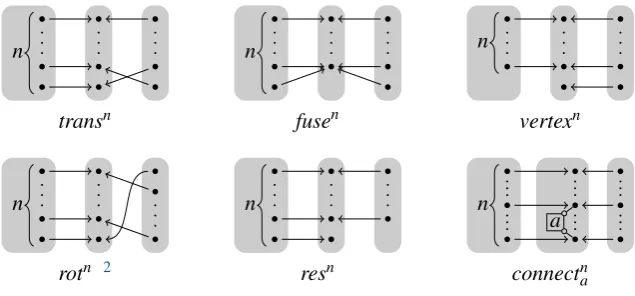
Even between two fixed interfaces there exist infinitely many cospans. However, we can define a restricted set of cospans from which any graph can be composed, such that there is a finite amount of cospans for each pair of inner and outer interface. We call the cospans in this restricted set atomic cospans. There are different possible sets of atomic cospans; the specific version which is of use depends on the application. The atomic cospans we present here are similar to the atomic graphs of [GH97]. They have the advantage that not only everygraph, but even everycospan can be composed from them. A slightly different set of atomic cospans, which ensures that the right morphism of the cospan is always injective, is presented in [BBK10].
The atomic cospans are presented in Figure 1. All atomic cospans are parametrized by the number of nodes in the inner (left) interface; theconnectcospan is additionally parametrized by the label of the edge.
Cospans (and atomic cospans in particular) can be seen as operations on graphs. When we consider a graph with one interfaceJ, modeled by a cospan∅→G←J, post-composing with
a cospanJ→H←K changes it into a graph with interfaceKby taking the disjoint union ofG andHand fusing corresponding nodes. The atomic cospans correspond to the following actions: transandrotchange the positions of the node of the graph in the interface;fusefuses two nodes to one;resremoves one node from the interface (it stays in the graph); andvertexandconnect add a node and an edge, respectively.
Definition 3
(i) An atomic cospan decomposition of a graph G is a sequence c=c1, . . . ,cn of atomic cospans, such thatcod(ci) =dom(ci+1), for 1≤i<n, and c1;· · ·;cn= [G]. If c is an atomic cospan composition ofG, we will writeGraph(c) =G.
(ii) The interface size of an (atomic) cospanc:Dj→G←Dk is defined as|c|I=max{j,k}. The interface size of an atomic cospan decompositioncis defined as|c|I=max{|c|I|c∈
3
Primitive Recursive Recognizable Graph Languages
We first study primitive recursive recognizable graph languages. The idea is that the automaton functor which accepts the language is required to be primitive recursive, that is, given an arrow c, the relation it maps to can be calculated on-the-fly by a primitive recursive function. Thus, an automaton functor can be specified as a finite program in some suitable programming language.
Definition 4 A language Lisprimitive recursive recognizable, ifL=L(A) for some
primi-tive recursive automaton functorA: CG→Rel. The class of primitive recursive recognizable languages is denoted byPRRec.
3.1 Closure properties and decidability
We begin our discussion of primitive recursive graph languages by exploring their closure prop-erties and decidability, which are both fundamental to their usefulness in practice.
The following two positive results (closure under boolean operations and decidability of the word problem) are easily proved.
Proposition 1 The class of primitive recursive recognizable languages is closed under union,
intersection and complement.
Proof. It is easily seen, that the constructions used in the proof of Prop. 4.2 of [BK08] are all primitive recursive, and therefore the compositions are also primitive recursive.
Proposition 2 The word problem for primitive recursive recognizable languages is decidable,
that is, given a primitive recursive automaton functorAand a graph cospan c, it is decidable whether or not c is accepted byA.
Proof. Since the automaton functor is primitive recursive, an thus computable, we can obtain
A(c)and check whether it relates an initial with a final state.
The main result of this section is that the emptiness, equivalence and finiteness problems for primitive recursive recognizable languages arenotdecidable, even in the categoryCGof cospans of graphs.
Theorem 1 The emptiness problem for primitive recursive recognizable languages is not
de-cidable, that is, given a primitive recursive automaton functor A, it is undecidable whether L(A) =∅.
Proof. We reduce the undecidable problem of satisfiability in first-order logic (with equality) to the emptiness problem, thus showing undecidability of that.
A model of first-order logic is represented as a graph in the straight-forward way, that is, objects are represented by nodes and relations by (hyper)edges.
A formulaϕ of first-order logic is easily translated into first-order graph logic, or, which is
more convenient in this case, into a formulaϕ0of (the first-order fragment of) the subobject logic of [BK10]. Using the construction in the before-mentioned paper, we can construct an equivalent automaton functorAϕ. Since all constructions are primitive recursive, this automaton functor is primitive recursive. Now,ϕ is unsatisfiable (that is,¬ϕis valid) if and only if L(Aϕ) =∅.
Corollary 1 The equivalence problem for primitive recursive recognizable graph languages
(given as primitive recursive automaton functors) is undecidable.
Proof. The language of a computable automaton functor is empty if and only if the automaton functor is equivalent to a computable automaton functor which accepts the empty language. The latter is easily given, so that we have reduced emptiness to equivalence. Thus, by Theorem1, the equivalence problem for primitive recursive recognizable languages is undecidable.
3.2 Expressiveness
In this subsection, we explore the expressiveness of primitive recurse automaton functors. In particular, we show thatPRRecandHRare incomparable with respect to set inclusion. To this end, we first state and prove a pumping lemma forPRRec.
First, let abe an arbitrary atomic cospan other thanconnect. There exists a cospana0 such thata;a0=id. That is, every atomic cospan exceptconnectcan be undone. We will therefore measure an atomic cospan decompositioncas follows:
|c|A=number ofconnectA-cospans inc
|c|E=
∑
A∈Σ|c|A
Lemma 1 Letcbe an atomic cospan decomposition, and G=Graph(c). Let G=hV,E,att,labi.
|c|A=|{e∈E|lab(e) =A}|
|c|E=|E|.
Proof. By the observation that, since interfaces are discrete by definition,connect-cospans add a single edge to the graph and no other atomic cospan changes the number of edges in the graph.
If we restrict an automaton functor3 to atomic cospans of bounded interface size (see also
Section 4, we obtain a structure which is basically a finite automaton. It is therefore not surprising that we can prove a similar pumping lemma. Compared to the usual pumping lemma for regular word languages, the pumping lemma below has an additional quantification (to deal with the restriction to a bounded interface size) and some notational clutter (to deal with the difference between graphs and atomic cospan decompositions).
Lemma 2 (Pumping Lemma) Let L be a recognizable graph language. For all k∈N there
exists a pumping constant n∈N such that all atomic cospan decompositions c with |c|I ≤k,
|c|E>n and Graph(c)∈L can be written asc=uvwsuch that
– |uv|E≤n, – |v|E≥1and
– for all i,viis well-defined and Graph(uviw)∈L.
Proof. The proof proceeds analogously to the proof of the pumping lemma for regular word languages. Let an automaton functor A with L(A) =L and a k ∈N be given. We assume, without loss of generality, that the state setsA(Di), for 0≤i≤k, are mutually disjoint.
LetT ={hq1,a,q2i | hq1,q2i ∈ A(a)for some atomic cospana}.Fort=hq1,a,q2i ∈T, we definesrc(t) =q1, tgt(t) =q2,ac(t) =a. ApathofAis a sequencet1, . . . ,tm, where, for 1≤ i<m,tgt(ti) =src(ti+1). Clearly, a graphGis accepted byAif and only if there exists a path t1, . . . ,tmsuch thatsrc(t1)is an initial state,tgt(tm)is a final state andac(t1). . .ac(tm)is an atomic cospan decomposition ofG.
LetU={t∈T|ac(t) =connectiafor somei≤kanda∈Σ}. We choose the pumping lemma constantn=|U|.
Letc=c1, . . . ,cmbe an atomic cospan decomposition with|c|I≤k,|c|E>nandGraph(c)∈L. By the previous observation, there exists a patht=t1, . . . ,tmfrom an initial to a final state labeled with the atomic cospans ofc. By constructiontcontains|c|Eelements ofU. Since|c|E>|U|, one some of those elements must occur inttwice. Letpandqbe the smallest indices (with p6=q) such thattp=tq. We takeu=ac(t1). . .ac(tp−1),v=ac(tp). . .ac(tq−1)andw=ac(tq). . .ac(tm). Since pandqare the smallest indices,uvdoes not contain duplicateconnects, so|uv|E≤n. Since ac(tp) =connecta, for some a∈Σ, |v|E ≥1. Finally, sincetp =tq, it must hold that tgt(tp−1) =src(tp) =src(tq) =tgt(tq−1), and thereforet1. . .tp−1(tp. . .tq−1)itq. . .tmmust also be a path from an initial to a final state, for alli∈N. ThusGraph(uviw)∈Lfor alli∈N.
Theorem 2 The language classes PRRec and HR are not comparable with respect to set
inclu-sion, that is: (i) PRRec6⊆HR (ii) HR6⊆PRRec
Proof. (i) The class of all graphs is not generated by aHRG (see Theorems IV.3.3, IV.3.4 and IV.3.9 of [Hab92]). On the other hand, it is primitive recursive recognizable by the automaton functor which maps each cospancto the complete relation of the respective state sets.
(ii) The (string-)graph language L={anbncn|n≥1}is generated by anHRG (see Example I.3.6 of [Hab92]). As we will show by means of the pumping lemma, it is however not recog-nizable. Note that the path width of every graph inLis 2. Choose any k≥2, and letnbe the constant given by the pumping lemma. We choose the following atomic cospan decomposition ofG=anbncn:
vertex0,(vertex1,connect2a,res2)n,(vertex1,connect2b,res2)n,(vertex1,connect2c,res2)n,res1
Since the pumping will take place within the firstn connect cospans, it follows together with
4
Bounded Recognizable Graph Languages
Bounded recognizable graph languages are accepted by bounded automaton functors, automaton functors for graph cospans which are only defined on interfaces of bounded size. By listing the relations for the atomic cospans (of which there are finitely many for each interface size) it is possible to explicitly represent this kind of automaton functor.
Definition 5(Bounded automaton functor)
(i) A k-bounded automaton functoris an automaton functor A, for the categoryCGk, such that there exists an automaton functorA0forCGsuch thatA(X) =A0(X), for allX∈CGk, andA(c) =A0(c), for allc∈CGk(X,Y), whereX,Y ∈CGk.
(ii) A language L of graph cospans is k-bounded recognizable, if there exists a k-bounded automaton functorAsuch thatL=L(A). Lisbounded recognizable, if it isk-bounded recognizable for somek∈N.
The class of k-bounded recognizable languages is denoted by BReck and the class of bounded recognizable graph languages byBRec.
Example2 We can restrict the automaton functor ofExample 1to cospans which are compos-able from atomic cospans of size mand less. Now the automaton functor can be represented explicitly by storing the transition relations for the atomic cospans only. The result will be that we only be able to recognizek-colorable graphs with pathwidth less thanm.
4.1 Closure properties and decidability
As in the last section, we start by studying the closure properties and decidability of bounded recognizable graph languages. Since a bounded automaton functor is basically a large finite automaton, all well-known constructions from formal (word) language theory still work.
Proposition 3 If L1∈BReckand L2∈BReck then:
(i) L1∪L2∈BReck (ii) L1∩L2∈BReck (iii) L1∈BReck
Proof. We can use the constructions of Prop. 4.2 of [BK08] to obtain a bounded automaton functor for the new language.
Proposition 4 All of the following decision problems are decidable for bounded recognizable
graph languages (where a bounded recognizable graph language is given as a bounded automa-ton functor):
(i) The word problem. (ii) The emptiness problem. (iii) The equivalence problem.
automaton labeled with atomic cospans. It is therefore not surprising, that the proofs ideas from automata theory can be used.
(i) Solving the word problem amounts to decomposing the input cospan to atomic cospans and looking up and composing the respective transition relations, all of which are computable.
(ii) The language of a finite automaton functor is empty if and only if there is no path from an initial state to a final state. Since the searching space is finite, this is decidable using Dijkstra’s algorithm.
(iii) We can employ an algorithm similar to finite automata: construct two equivalent, deter-ministic minimal automaton functors and check if they are isomorphic. The minimization and determinization procedure of [BK08] also work for bounded automaton functors.
4.2 Expressiveness
We conclude the discussion on bounded recognizable graph languages by exploring their expres-siveness. Not surprisingly, they form a proper subset of both the primitive recursive recognizable graph languages and the languages generated byHRGs.
Because we need this result in the proof ofTheorem 3, which is in turn needed for an easy proof of strict inclusion ofBRecinRec, we first show the (not necessarily strict) inclusion.
Proposition 5 BRec⊆PRRec.
Proof. Follows from the fact that, by definition, BRec=S
k∈NBReck and the fact that a
k-bounded automaton functor can be finitely represented by explicitly storing the transition re-lations for a finite set of atomic cospans (see [BBK10]).
Theorem 3 The class of bounded recognizable graph languages is properly contained in the
class of graph languages generated byHRGs; that is BRec⊂HR.
Proof. The fact that BRec6=HR directly follows from Proposition 5 and Theorem 2 (ii). It remains to show thatBRec⊆HR.
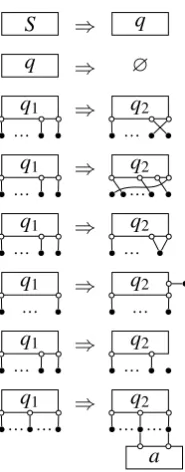
Let A be an automaton functor bounded by k. We will construct a (linear) HRG G which generates the same language. Assume, without loss of generality, that the state setsA(Di)(for i≤k) are mutually disjoint. We define the set of non-terminalsN asN =Sk
i=0A(Di)∪ {S}, whereS∈/Sk
i=0A(Di).
The rules of the grammarGare presented inFigure 2. Now every execution path ofA(starting from an initial state) corresponds to a derivation ofG(starting fromS) and vice versa. The only way to remove a non-terminal in the grammar, is to have a non-terminal labeled with a final state and apply the second rule. Thus, L(A) =L(G).
Theorem 4 The class of bounded recognizable languages is properly contained in the class of
primitive recursive recognizable languages; that is BRec⊂PRRec.
S ⇒ q for all initial statesq∈ A(D0)
q ⇒ ∅ for all final statesq∈ A(D
0) q1 ⇒ q2 ifhq1,q2i ∈ A(transar(q1))
q1 ⇒ q2 ifhq1,q2i ∈ A(rotar(q1))
q1 ⇒ q2 ifhq
1,q2i ∈ A(fusear(q1))
q1 ⇒ q2 ifhq1,q2i ∈ A(vertexar(q1))
q1 ⇒ q2 ifhq1,q2i ∈ A(resar(q1))
q1 ⇒ q2
a
ifhq1,q2i ∈ A(connect ar(q1) a )
Figure 2: Rules of theGfrom the proof ofTheorem 3.
proper follows fromTheorem 2(i) andTheorem 3.
5
Conclusion
In this paper we considered two restrictions of automaton functors for graphs that make them representable in a finite way, and as such implementable:primitive recursive automaton functors, which can be generated on-the-fly by a primitive recursive function, andbounded automaton functors, in which the interface size of the graphs is bounded.
We showed that the graph language classes accepted by both kinds of automaton functor are closed under the boolean operations and that the word problem of both kinds is decidable. How-ever, of bounded automaton functors the emptiness and language equivalence problems are de-cidable, while these problems are undecidable for primitive recursive automaton functors. An-other advantage of bounded automaton functors is that they can beexplicitlyrepresented, which is convenient when we want to apply certain algorithms on them.
BRec PRRec Rec
MSOL FOL
HR
As is clear from the diagram, primitive recursive automaton functors are strictly more expressive than bounded automaton functors. Which of the representations is more convenient in practice depends on which of the above properties one needs for a given application.
Bibliography
[BBK10] C. Blume, S. Bruggink, B. K¨onig. Recognizable Graph Languages for Checking In-variants. InProc. of GT-VMT ’10. Electronic Communications of the EASST. 2010.
[BK08] S. Bruggink, B. K¨onig. On the Recognizability of Arrow and Graph Languages. In Proc. of ICGT ’08. Pp. 336–350. Springer, 2008. LNCS 5214.
[BK10] S. Bruggink, B. K¨onig. A Logic on Subobjects and Recognizability. InProc. of IFIP-TCS ’10. Springer, 2010.
[Cou90] B. Courcelle. The Monadic Second-Order Logic of Graphs I. Recognizable Sets of Finite Graphs.Information and Computation85:12–75, 1990.
[GH97] F. Gadducci, R. Heckel. An inductive view of graph transformation. InProceedings of WADT ’97. Pp. 223–237. 1997.
[Hab92] A. Habel.Hyperedge Replacement: Grammars and Languages. Springer, 1992.