AUSTRALIAN JOURNAL OF BASIC AND
APPLIED SCIENCES
ISSN:1991-8178 EISSN: 2309-8414 Journal home page: www.ajbasweb.com
Open Access Journal
Published BY AENSI Publication
© 2017 AENSI Publisher All rights reserved
This work is licensed under the Creative Commons Attribution International License (CC BY).
http://creativecommons.org/licenses/by/4.0/
To Cite This Article: T. K. Abhiraj, Bon Mathew Jos, P. Aravindhababu., Elegant Reconfiguration Strategy for Loss Minimization using Dragonfly Optimization. Aust. J. Basic & Appl. Sci., 11(1): 78-82, 2017
Elegant Reconfiguration Strategy for Loss Minimization using Dragonfly
Optimization
1T. K. Abhiraj, 2Bon Mathew Jos, 3P. Aravindhababu
1Assistant professor, Department of EEE, Ilahia School of Science and Technology, Pezhakkappilly, Muvattupuzha, Ernakulam,
Kerala-685573, INDIA.
2Professor of Electrical and Electronics Engineerin,Mar Athanasius College of Engineering, Kothamangalam 686 666, Kerala, India. 3Professor of Electrical Engineering, Annamalai University, Tamil Nadu, INDIA
Address For Correspondence:
T. K. Abhiraj, Assistant professor, Department of EEE, Ilahia School of Science and Technology, Pezhakkappilly, Muvattupuzha, Ernakulam, Kerala-685573, INDIA.
A R T I C L E I N F O A B S T R A C T Article history:
Received 18 September 2016 Accepted 1 January 2017
Available online 26 January 2017
Keywords:
distribution networks, network reconfiguration, Dragonfly optimization
Background: Network reconfiguration alters the topological structures of the distribution feeders by changing the open/close status of the sectionalizing and tie switches with a view of minimizing the network real power loss (RPL). Objective: The paper aims to develop a Dragonfly Optimization (DO) based reconfiguration scheme that reduces the RPL without incurring any additional cost for installation of capacitors and tap-changing transformers. DO is a nature inspired optimization technique that imitates the static and dynamic swarming activities of dragonflies. Conclusion: Test results on two distribution networks illustrate that developed method is robust in minimizing the RPL.
Nomenclature:
BBO biogeography based optimization DO dragonfly optimization
DOS DO based strategy
C branch-to-node matrix that describes the topological structure of the distribution networkkm
i current through a branch connected between node-k and -m
max
km
i maximum permissible current through a branch connected between node-k and -m
nn number of nodes
nb number of branches
km
r resistance of a branch connected between node-k and -m RPL real power loss
j
T binary variable that represents the topological status of j-th branch. It equals ‘1’, if the tie/sectionalizing switch is closed, else its value is set as ‘0’
m
V voltage at node-m
Vmin lowest node voltage seen in the network
c
a set of branches, whose current flow exceed the respective thermalINTRODUCTION
Distribution networks that use primary or main feeders and lateral distributors, provide the final link between the high voltage transmission network and the consumers. The main feeder originates from the substation and passes through the major load centers, while the lateral distributors connect the individual load points to the main feeder through distribution transformers. Radial networks are popular because of their simple design and low cost. There are two types of switches in distribution networks, sectionalizing switches that are used to isolate the faulty network and tie switches are utilized to restore power to customers through another route in order to reduce interruption duration abnormal operation conditions. Each load point of the distribution network is fed by a route through the network components to the substation. Therefore changing the status of these switches will alter the power flow to loads and consequently affect the power loss.
Network reconfiguration is an operation problem, which entails altering the topological structure of the distribution feeders by rearranging the status of open switches in order to obtain an optimal configuration that minimizes the network real power loss (RPL). A host of algorithms have been suggested for solving reconfiguration problem since Merlin and Back developed branch-and-bound technique (Merlin, 1975). Deterministic mathematical approaches involving Benders decomposition (Khodr et al., 2009), mixed-integer programming (Jabr et al., 2012; Taylor et al., 2012), switch exchange method (Civanlar et al., 1988; Goswami et al., 1992) and heuristic algorithm (Shirmohammadi et al., 1989), which are usually fast but may not yield robust solution, have then been outlined. In addition, bio-inspired algorithms such as hyper-cube ant colony optimization (Abdelaziz et al., 2012), bacterial foraging optimization algorithm (Sathish Kumar et al., 2012), particles swarm optimization (Andervazh et al., 2013), artificial immune systems (Oliveira et al., 2014), adaptive imperialist competitive algorithm (Mirhoseini et al., 2014), genetic algorithms (Gupta et al., 2014) and biogeography based optimization (Aruul Vizhiy et al., 2015) have been applied in solving the reconfiguration problems. These bio-inspired methods do impose fewer restrictions on the search space and do not require derivatives of the functions.
Recently, a Dragonfly Optimization (DO), a meta-heuristic optimization technique imitated from the static and dynamic swarming activities of dragonflies, has been outlined for solving optimization problems (Seyedali, 2015). It has been applied to a variety of optimization problems (Dharmendra et al., 2016, Hamdy et al., 2016, Rakoth Kandan et al., 2016) and found to yield satisfactory results.
This paper endeavors to use DO in solving the reconfiguration problem with a view of minimizing the RPL besides obtaining the global best solution. It presents the results of two radial networks for illustrating the performances.
Proposed Method:
Reconfiguration is necessary in distribution networks not only for minimizing the RPL but also improving the voltage profile (VP). The proposed DO based strategy (DOS) involves representation of a dragonfly with problem variables and formation of a fitness function. The decision variable in DOS is the open-switch numbers. Each habitat of the DO is therefore represented in vector form to denote the open-switches as
OS OS OSn
dragonfly , ,
2 1
(1)
The fitness function can be formed as
nn j j m km km c nb m km km km C i i w r i T Fitness 1 , 1 2 max 1 2 1 1
(2)An initial swarm of dragonflies is formed by generating random values within their respective limits. The fitness function is calculated by altering the network topology according to the status of open-switches of each dragonfly; and the exploration and exploitation phases, which represent social interaction of dragonflies in navigating and searching for foods and avoiding enemies, are performed for all the dragonflies in the swarm with a view of maximizing their finesses. The iterative process is continued till convergence.
Numerical Results:
kW and 2300 kVar, respectively. The initial RPL of this network are 210.97 kW. The second test network is a 12.66 kV, 69 node network comprising of 5 tie-loops. The network data of the initial configuration is available in (Kashem et al., 2001). The total active and reactive network loads are 3802.19 kW and 2694.60 kVar, respectively, and the initial RPL is 225 kW.
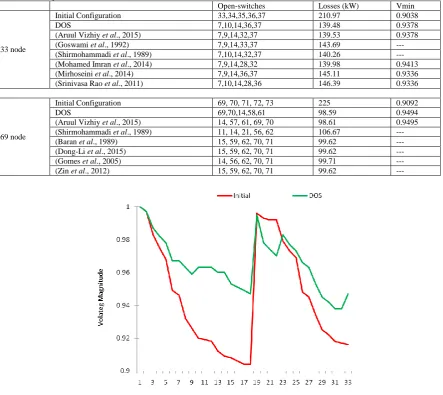
The results for both the networks, containing details of open-switches, RPL, lowest voltage magnitude (Vmin), before and after reconfiguration are compared with those of the existing methods published in (Goswami et al., 1992; Shirmohammadi et al., 1989; Aruul Vizhiy et al., 2015; Mohamed Imran et al., 2014; Srinivasa Rao et al., 2011; Mirhoseini et al., 2014; Dong-Li et al., 2015; Gomes et al., 2005; Zin et al., 2012; Baran et al., 1989) in Table-1. It is very clear from the results that the proposed DOS offers the lowest RPL of 139.48 kW for for 33 node system, while for 69 node system, it is 98.59 kW, which are lower than those of the existing methods. Besides the Vmin is higher than existing methods and lies in between the lower and upper voltage limits.
Table 1: Summary of Results for 33 node network
Open-switches Losses (kW) Vmin
33 node
Initial Configuration 33,34,35,36,37 210.97 0.9038
DOS 7,10,14,36,37 139.48 0.9378
(Aruul Vizhiy et al., 2015) 7,9,14,32,37 139.53 0.9378
(Goswami et al., 1992) 7,9,14,33,37 143.69 ---
(Shirmohammadi et al., 1989) 7,10,14,32,37 140.26 ---
(Mohamed Imran et al., 2014) 7,9,14,28,32 139.98 0.9413
(Mirhoseini et al., 2014) 7,9,14,36,37 145.11 0.9336
(Srinivasa Rao et al., 2011) 7,10,14,28,36 146.39 0.9336
69 node
Initial Configuration 69, 70, 71, 72, 73 225 0.9092
DOS 69,70,14,58,61 98.59 0.9494
(Aruul Vizhiy et al., 2015) 14, 57, 61, 69, 70 98.61 0.9495
(Shirmohammadi et al., 1989) 11, 14, 21, 56, 62 106.67 ---
(Baran et al., 1989) 15, 59, 62, 70, 71 99.62 ---
(Dong-Li et al., 2015) 15, 59, 62, 70, 71 99.62 ---
(Gomes et al., 2005) 14, 56, 62, 70, 71 99.71 ---
(Zin et al., 2012) 15, 59, 62, 70, 71 99.62 ---
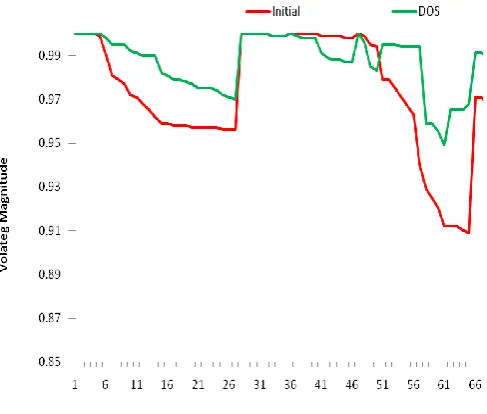
Fig. 2: VP of DOS for 69 node system
The VP for 33 and 69 node systems before and after reconfiguration is graphically plotted in Fig.1 and 2 respectively. It can be observed from the figure that there is significant improvement in the VP after reconfiguration. It is very clear from these results that the proposed DOS offers a better configuration that reduces network RPL for both the test networks. Even though VP is not considered as an objective, the proposed DOS is able to provide a good VP.
Conclusion:
Network reconfiguration alters the topological structures of the distribution feeders by changing the open/close status of the sectionalizing and tie switches with a view of minimizing the network RPL. DO is a nature inspired optimization technique that imitates the static and dynamic swarming activities of dragonflies. A simple DO based reconfiguration scheme for RPL minimization of radial distribution networks has been developed. The method has been applied on two distribution networks. The results have indicated that the method is able to reduce the RPL besides offering a better VP without any additional infrastructural cost. The algorithm is suitable for practical implementation on networks of any size. The suggested method can further be improved by adaptively adjusting the DO parameters.
ACKNOWLEDGEMENT
The authors gratefully acknowledge the authorities of Annamalai University and Ilahia School of Science and Technology for the facilities offered to carry out this work.
REFERENCES
Abdelaziz, A.Y., R.A. Osama and S.M. El-Khodary, 2012. Reconfiguration of distribution systems for loss reduction using the hyper-cube ant colony optimization algorithm, IET Gen. Trans. & Dist., 6(2): 176-187.
Andervazh, M.R., J. Olamaei and M.R. Haghifam, 2013. Adaptive multi-objective distribution network reconfiguration using multi-objective discrete Particles Swarm Optimisation algorithm and graph theory, IET Gen. Trans. & Dist., 7(12): 1367-1382.
Aruul Vizhiy S. and R.K. Santhi, 2015. Robust Reconfiguration Scheme for Distribution Networks using Biogeography Based Optimization, Australian Journal of Basic and Applied Science (AJBAS), 8(35): 336-342.
Baran, M and F. Wu, 1989. Network reconfiguration in distribution systems for loss reduction and load balancing, IEEE Trans on Power Delivery, 4(2): 1401-1407.
Civanlar, S., J. Grainger and H. Yin, S. Lee, 1988. Distribution feeder reconfiguration for loss reduction, IEEE Trans Power Delivery, 3(3): 1217-1223.
Dong-Li Duan, Xiao-Dong Ling, Xiao-Yue Wuc and Bin Zhong, 2015. Reconfiguration of distribution network for loss reduction and reliability improvement based on an enhanced genetic algorithm, Electrical Power and Energy Systems, 64: 88-95.
Goswami, S and S. Basu, 1992. A new algorithm for the reconfiguration of distribution feeders for loss minimization, IEEE Trans Power Delivery, 7(3): 1482-1491.
Gomes, F., S.J. Carneiro, J. Pereira, M. Vinagre, P. Garcia and L. Araujo, 2005. A new heuristic reconfiguration algorithm for large distribution systems, IEEE Trans on Power Systems, 20(3): 1373-1378.
Gupta, N., A. Swarnkar and K.R. Niazi, 2014. Distribution network reconfiguration for power quality and reliability improvement using Genetic Algorithms, Int. J. Electr. Power Energy Syst., 54: 664-671.
Hamdy, M., A.T. Nguyen and J.L.M. Hensen, 2016. A performance comparison of multi-objective optimization algorithms for solving nearly-zero-energy-building design problems, Energy and Buildings. http://dx.doi.org/10.1016/j.enbuild.2016.03.035.
Jabr, R.A., R. Singh and B.C. Pal, 2012. Minimum loss network reconfiguration using mixed-integer convex programming, IEEE Trans on Power Systems, 27(2): 1106-1115.
Kashem, M., V. Ganapathy and G. Jasmon, 2001. A geometrical approach for network reconfiguration based loss minimization in distribution systems, Int J Elect Power Energy Syst, 23(4): 295-304.
Khodr, H.M and J. Martinez-Crespo, 2009. Integral methodology for distribution systems reconfiguration based on optimal power flow using benders decomposition technique, IET Gen. Trans. & Dist., 3(6): 521-534.
Merlin, A and H. Back, 1975. Search for a minimal loss operating spanning tree configuration for an urban power distribution system, Proc of the power systems computation conf (PSCC): 1-18.
Mirhoseini, S.H., S.M. Hosseini, M. Ghanbari and M. Ahmadi, 2014. A new improved adaptive imperialist competitive algorithm to solve the reconfiguration problem of distribution systems for loss reduction and voltage profile improvement, Int. J. Electr. Power Energy Syst., 55: 128-143.
Mohamed Imran, A and M. Kowsalya, 2014. A new power system reconfiguration scheme for power loss minimization and voltage profile enhancement using Fireworks Algorithm, Electr Power Syst Res., 62: 312-322. Oliveira, L.W. de, E.J. de Oliveira, F.V. Gomes, I.C. Silva Jr, A.L.M. Marcato and P. V. C. Resende, 2014. Artificial Immune Systems applied to the reconfiguration of electrical power distribution networks for energy loss minimization, Int. J. Electr. Power Energy Syst., 56: 64-74.
Rakoth Kandan, S and J. Sasikala, 2016. Self-adaptive dragonfly based optimal thresholding for multilevel segmentation of digital images, Journal of King Saud University-Computer and Information Sciences, http://dx.doi.org/10.1016/j.jksuci.2016.11.002
Sathish Kumar, K and T. Jayabarathi, 2012. Power system reconfiguration and loss minimization for distribution systems using Bacterial Foraging optimization algorithm, Int. J. Electr. Power Energy Syst, 36(1): 13-17.
Seyedali, M., 2015. Dragonfly algorithm, A new meta-heuristic optimization technique for solving single-objective, discrete and multi-objective problems, Neural Comput and Applic. DOI. 10.1007/s00521-015-1920-1.
Shirmohammadi, D and H. Hong, 1989. Reconfiguration of electric distribution networks for resistive line loss reduction, IEEE Trans Power Delivery, 4(2): 1492-1498.
Srinivasa Rao, R., Venkata Lakshmi, Narasimham Sadhu, Ramalinga Raju Manyala and Srinivasa Rao A., 2011. Optimal network reconfiguration of large-scale distribution system using harmony search algorithm, IEEE Trans on Power Systems, 26(3): 1080-1088.
Taylor, J.A. and F.S. Hover, 2012. Convex models of distribution system reconfiguration, IEEE Trans. On Power Systems, 27(3): 1407-1413.