
on
Cloud Systems
Research Article
Future Factories – Automated Welding Cell based on
Cloud Computing Technology
Suryanarayanan.R
1,*, V.G.Sridhar
21Research Scholar, School of Mechanical and Building Science, Vellore Institute of Technology, Chennai, India
2Associate Professor, School of Mechanical and Building Science, Vellore Institute of Technology, Chennai, India
Abstract
The advent of cloud technology, machine learning and internet of things (IoT) has foreseen the possibility of completely autonomous factories. Future shop-floor operations are completely automated and controlled by cloud-based manufacturing system. The researchers have made an attempt to use cloud computing to share the welding parameters and maintain a virtual library for ready reference irrespective of the user location. The automated welding cell is a friction stir welding (FSW) machine and its parameters were used as the reference for the cloud database. Cloud database is built by collecting information from several welders and researchers who are working in the various part of the world. The proposed Machine controls as service, MCaaS reduces the downtime of the weld cell by real-time monitoring and also assist the researchers in real-time data sharing among them, irrespective of their geographical location.
Keywords: Cloud computing, MCaaS, Automation, Friction stir welding, Real time monitoring.
Received on 29 March 2018, accepted on 04 October 2018,published on15 November 2018
Copyright © 2018 Suryanarayanan.R et al., licensed to EAI. This is an open access article distributed under the terms of the Creative Commons Attribution licence (http://creativecommons.org/licenses/by/3.0/), which permits unlimited use, distribution and reproduction in any medium so long as the original work is properly cited.
doi: 10.4108/eai.16-5-2018.155883
1. Introduction
The emergence of advanced computing techniques like cloud technology, big data and internet of things has played a major role in globalization plans of various manufacturing organizations. The need of data sharing, data storage between two units of an organization has led to the creation of a database where the required information can be downloaded and updated from any geographical location through any electronic devices. The application of Cloud computing to a manufacturing system was first suggested by Zhang et al., 2014 [1] where the traditional manufacturing systems can be upgraded to smart Manufacturing systems with the help of other technologies like internet of things (IoT), big data coupled with decision making mechanism by which they are capable sharing the manufacturing data and can
operate in autonomous mode. Tao et al., 2014 [2] identified service generation, service management and service applications as three key stages for implementation of a cloud manufacturing system. The author and his team also speak about the application of various sensors in shop floor which enabled the integration of IoT services to machine cells. Hung et al., 2012 [3] proposed a cloud based equipment monitoring system in a CNC machine which composed of two parts; cloud part and equipment part. The equipment part has various sensors fitted to the machine with for the purpose of recording, monitoring and sharing the data to the cloud. The cloud model consisted of features like data acquisition, model creation, model and service management and historical data search. Albrecht et.al, 2018 [4] developed an architecture which integrates cloud services to welding unit. The Cloud system allows a two way communication where the welders are allowed to
download the welding data and upload the updated results.
Since most part of the available literature talks about the cloud manufacturing, the authors wish to focus on studying the application of cloud computing to an automated CNC based friction stir welding cell. An automated welding cell is a single cell welding unit with material identification system and a material handling and retrieval system. The integration of cloud services to an automated CNC based friction stir welding machine cell enables it operate it in autonomous mode and share the data with different welding cells irrespective of their location. The paper is structured into various sections which talk about friction stir welding process, computer numerical control, cnc based fsw cell, cnc based friction stir welding cell operations, cloud database and finally cloud integration and its implementation to the automated welding cell.
2. Friction Stir Welding Process
Friction Stir Welding (FSW), Fig. 1 is a solid state metal joining process where a non consumable rotating tool with specially designed pin is inserted into the butting edges of the sheets and subsequently traversed along the joint line to form the weld joint. The metal joining in this technique is by plastically deforming the material instead of melting it. The energy for plastic deformation is provided by the frictional heat generated by the rotating tool. The plate placed on the welding direction is called advancing side and the plate on the opposite side is known as retreating side. This process doesn’t require the use of filler material and shielding gas, hence the problems in conventional welding process like cracking, porosity caused during solidification are avoided. Friction Stir welding is an eco-friendly process when compared to conventional welding techniques where harmful gases are liberated during welding [7]-[9]. This unique welding technique was invented in the year 1991 by The Welding Institute, United Kingdom. s
Fig. 1 Schematic Diagram of Friction Stir Welding of Aluminum Plates
FSW process was originally invented to join Aluminum based alloys but today it has been expanded to Steel, Titanium alloys, Magnesium alloys, Nickel based alloys and Composite materials [9]. The FSW machines are computer numerically controlled (CNC) machines, which is integrated with sensors to monitor parameters like tool travel length and position, tool change, temperature etc. Hence this system can be easily integrated with Cloud.
3 Computer Numerical Control (CNC)
3.1
CNC based Friction Stir Welding Cell
A CNC based friction stir welding machine is a single station automated cell which can be programmed to perform both linear and non-linear welds capable of welding different materials like aluminium, magnesium, titanium, steels, nickel, plastics and composites in both similar welding and dissimilar welding.. These machines can weld different materials in a single cell, which is assisted with product identification systems and material handling systems. The FSW cell consists of components like product identification systems, material handling systems, and automated tool exchange and tool management.
Product Identification Systems
A product identification system in an automated production unit helps in identifying the product which is to be machined at the correct machining cell. This process is manually carried out in shop-floors where the operator employs the barcode scanner to scan the barcode encoded on the product to find the design and manufacturing attributes of the product. In the FSW cell the product identification system like barcode scanners, RFID tags indentify the product by scanning the information like weld joint configuration, product material, and its geometry, weld length, process parameters etc and communicates the information to the cloud.
Material Handling Systems
For any automated production systems, material handling systems form the lifeline of the supply chain. The functions of these systems include, transporting the raw material from the inventory to the machine cell, transporting the work-in progress parts to the buffer zone and finally delivering the finished product to the inventory. The pick and place robot and the conveyor systems are one of the best examples of the material handling system. For this system the pick and place robot and conveyor in a line layout are the suitable option, where the robot performs the loading and unloading operations. The conveyor system is integrated with online weld inspection systems like X-ray scanner for online weld inspection.
Automated Tool Exchange (ATC)
Automated Tool exchange in a CNC machine forms a helping arm to perform different operations in a single cell. A single CNC based
FSW cell is designed to weld to different materials and perform two or more processes. For example welding aluminium requires different tool material when compared to that of welding Steels in a FSW cell. This problem can be overcome with the help of Automated Tool Exchange (ATC).
The detailed role of automated tool exchange can be explained in two situations.
Situation 1, Welding Operation:
First welding sequence, product- butt welding of Aluminium sheets.
FSW cell downloads the process parameter from the cloud, tool material-Tool steel.
Second welding sequence, product- butt welding of steel sheets.
FSW cell downloads the process parameters from the cloud, Tool material- Tungsten.
FSW cell notifies the automated tool exchange for tool change, which unloads the tool steel, and replaces it with Tungsten tool in the spindle.
Situation 2, Surface composite Fabrication: FSW cell downloads the process parameters
from the cloud for surface fabrication.
Fabrication of groove on the plate’s surface followed by filling of Composite powder. Single pass processing on the groove with a
―Pin-less Tool‖ in-order to prevent the spattering of the powder.
For the next pass the tool must be changed, hence Tool change notification is sent to the weld cell, where the operation is completed with the help of automated tool exchange.
Final pass onto the sheet for fabrication of surface composites.
Tool Management
affected. Thus the data on the tools must be updated back to the cloud on which the vendor management personnel can update the welding database with new tool material data and the shop-floor management can replace the older tools with new tools. The tool management also monitors the CNC machine parts like spindle, motors and the machine table for any malfunctions.
3.3 CNC based FSW Cell Operation
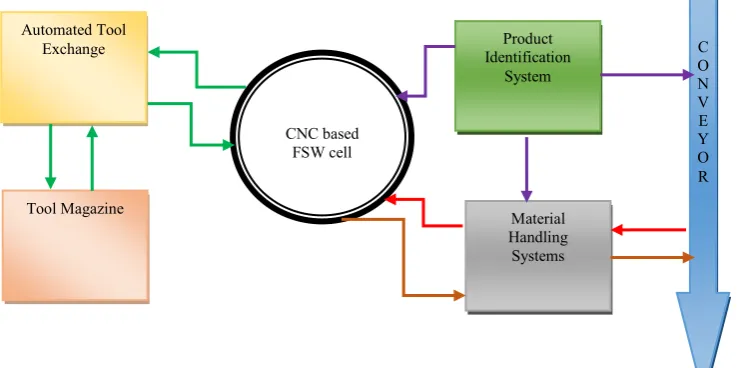
The Friction Stir welding machine is capable of performing two to three operations in a single cell based upon the requirement. The operation sequence of a CNC based FSW cell and its layout are given in Fig. 2 and Fig. 3.
Fig. 2 CNC based Friction Stir Welding Cell Operation
Fig. 3 Automated FSW cell layout
Step1: Product identification system, fix-mounted bar code scanner scans the barcode encoded onto the product. The scanned data is transferred to the Material handling system and the welding cell.
Step 2: The input in the form scanned data is received at the welding cell, and the robot. The robot loads the product from the conveyor and places onto the welding fixture at the specified joint configuration. The welding cell sets itself with the specified process parameters. CNC based
FSW cell
Product Identification
System
C O N V E Y O R Material
Handling Systems Automated Tool
Exchange
Step 3: The welding cell identifies the correct tool
material for the product and notifies the automatic tool changer for tool change.
Step 4: Welding process is started; at the end of the process the robot unloads the weld joint onto the conveyor.
Step 1- Step 4 repeats in a cycle.
2.1. Cloud Database
Process parameters play an important role in obtaining defect free welds in FSW. Friction Stir welding process parameters are tool geometry (shoulder diameter, pin diameter and pin profiles), tool rotational speed, welding speed, axial force and tool tilt angle. The tool rotational
speed provides the stirring action and movement of the material around the pin, whereas the welding speed helps in moving the plasticized material back and forth of the pin and completes the welding process. Higher rotational speed generates high frictional heat input and intense stirring and mixing of materials. The tool tilt angle helps in holding the stirred material and in efficient transport of plasticized material back and forth. The tool pin height or the tool pin length plays an important role in producing defect free welds. Shorter pin length makes less contact with the work and generates reduced frictional heat and inefficient stirring of the plasticized material leading defects in the weld zone. Higher pin length results to high frictional heat which produces flash defects onto the weld joint8. The optimal process parameters and joint configuration forms the main part of the cloud database. The cloud database as seen in Fig. 4 consists of friction stir welding process parameters.
Fig. 4 Cloud Database for CNC based Automated Friction Stir Welding Cell [7]-[14]
Tool Rotational Speed
The tool rotational speed, RPM is the main process parameter in FSW process as it helps in generating the necessary heat input during the process. The rotational speed also helps in effective stirring of the plasticized material. Tool rotational speed is one the important process
parameter which helps in determining the weld joint strength [9]-[14].
Welding/Traverse Speed
Welding or Traverse speed, mm/min or mm/s is one of the important process parameter in FSW process as it helps in transporting the plasticized material along the weld line. The use of optimal welding speed will lead to superior mechanical
FSW
Parameters
Tool
rotational
speed,
RPM
Axial
force,
kN
Tool
material
Tool tilt
angle ˚
Tool
shoulder
geometry
Tool
profile
Welding
properties of the weld joint. Use of excess welding speed will result in turbulence in plasticized material flow which causes voids onto the weld surface and thereby leading to weld joints with void defects [11][12].
Axial/ Thrust Force
The axial or thrust force, kN plays an important role in friction stir welding as it helps in stabilizing the weld zone by actively influencing on plasticized material flow and heat generation [13].
Tool tilt angle
Tool tilt angle is the angle, ˚ deg to which the tool is tilted to the work surface. The tool tilt angle helps in holding the stirred material by the tool pin and helps in moving the material efficiently from front and back of the pin [9].
Tool shoulder geometry
The tool shoulder plays a vital role in heat input; the frictional heat is generated as the shoulder surface comes in contact with the metal surface. The tool rotational speed also supports the tool shoulder in frictional heat input. Higher the surface area, higher the heat input, however for friction stir welding process the heat input should be optimal so that it doesn’t soften the material, i.e. the generated heat shouldn’t weaken the mechanical strength of the material [13].
Tool Profile
The profile is designed to shear the material in contacting work pieces and move the material behind the tool. The amount of deformation and tool travel speed are mainly governed by the tool profile. The pin length chosen for friction stir welding shouldn’t exceed the thickness of the plate which is being welded as it will lead to contact between tool pin and the backing plate or the table surface which result in rapid tool wear [9]. Each tool has its own specific advantage; the right tool profile welding two sheets is selected based on the final weld joint strength. Tool profile plays an important role in transportation of plasticized material along the weld direction. There are different tool profiles available like cylindrical, threaded cylinder, conical pin, threaded conical pin.
Tool Material
Weld quality and tool wear are important considerations in selection of tool material, the tool is chosen based on the tool life and also on user preferences and experiences. In FSW, hardness of the tool is always greater than the hardness of the work. The tool hardness influences the friction between plasticized the material and the tool. The high friction between the tool and the plasticized material helps the tool in pulling the material to advancing side and also in severe plastic deformation and dynamic recrystallization which results in getting superior tensile strengths [15]. Different tool materials like tool Steels, high carbon steels and stainless steels are available for welding softer materials like aluminium and magnesium alloys and plastic, whereas harder tools like tungsten, tungsten rhenium with cobalt, poly cubic boron nitride (PCBN) are used to weld steels, nickel and titanium alloys [12].
4 Case studies on implementation of Cloud
services in Welding cell
manufacturer through cloud which is provided by CISCO [31]. Lincoln Electric integrated their shop floor to the cloud services through which they could track the movements of the consumables related to welding easily [32]. Achenbach a well known German heavy machinery organization integrated their heavy rollers for rolling aluminium to the cloud systems called ―Cloud Plug‖ from SOTEC which communicates the data from the machine’s PLC systems to the cloud. This helped the organization to track the performance of the machinery and the raw material loss during machining [33].
4.1 Proposed implementation of Cloud
computing to automated FSW cell
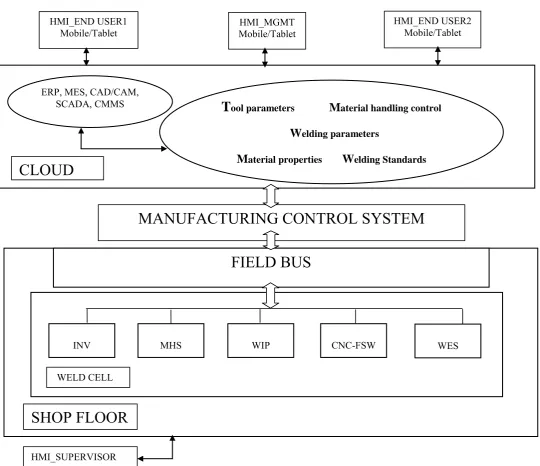
The CNC based FSW machine is integrated to cloud based systems with the help of sensors, i.e. Internet of Things through high speed wireless network. The cloud integrated CNC based FSW cell as seen in Fig. 5 consist of an expert system. The expert system is a software package which is capable of perception, learning, reasoning, interpreting, and communication with decision making capability to solve the problem of interest like optimal process parameters for a particular based on the predicted joint efficiency and tool life of the welding tool through tools like artificial neural networks, genetic algorithm, simulated annealing, fuzzy logic etc [16]-[21]. There are different cloud services available like software as service (SaaS), platform as service (PaaS), control as service (CSaaS) and infrastructure as service (IaaS) etc in the form public clouds, hybrid clouds and community clouds. The private clouds and hybrid clouds are best suited for large scale manufacturing units with distributive manufacturing operations. In the proposed system, machine control as service, (MCaaS), is chosen as it overcomes the obstacle in transfer of real time data through WANs, LANs and sub-networks infrastructures like hubs, repeaters, switches, routers and firewalls between different weld cells is avoided by specific set of protocols [24]. Hence such a control system allows the cell to operate in autonomous mode, where the automated CNC based welding cell is able to download the process parameters for the required joint configuration and
Fig. 5 Proposed MCaaS (Machine Control as Service) of Automated FSW Cell
ERP-Enterprise Resource Management, MES-Manufacturing Execution System, CMMS- Computer Maintenance Management, INV-Inventory, MHS-Material Handling system, WIP- Work in Progress/Buffer,
WES- Weld Evaluation System
Conclusion
This paper introduces the concept of friction stir welding, automated CNC based friction stir welding cell and cloud integration of the automated welding cell. This study identifies the key components in the automated CNC based FSW cell and its mode of operations. The cloud database is mainly composed of friction stir welding process parameters and data related to welding cell components like robot and conveyor. The study proposes the integration of cloud system to an automated CNC
based FSW cell and its real time monitoring by IoT through the embedded sensors in the machine cell in the form of statistical reports or augmented reality, thereby resulting in an autonomous welding unit. The proposed cloud integration can also be enhanced with other advanced computing methods like machine Learning and big data, which enables the weld cell to perform computations and analysis related to welding parameters and weld output, which helps in production of weld joints with superior strengths that matches with the changes in customer requirements. The cloud integration of the HMI_END USER1
Mobile/Tablet
ERP, MES, CAD/CAM,
SCADA, CMMS
T
ool parametersM
aterial handling controlW
elding parametersM
aterial propertiesW
elding StandardsCLOUD
MANUFACTURING CONTROL SYSTEM
FIELD BUS
HMI_MGMT
Mobile/Tablet HMI_END USER2 Mobile/Tablet
MHS WIP CNC-FSW WES
WELD CELL INV
SHOP FLOOR
welding cell allows the industry to explore the various available benefits in terms of reduced labour cost and production cost and allows a smoother operation of the plant with better communication and data sharing between units of an enterprise, partners, educational and research institutions present at different geographical locations. The paper also suggest the integration cloud computing and IoT in FSW machines at research and educational institutions which enables them to share the research findings among different institutions.
References
[1] L. Zhang et al., ―Cloud manufacturing: a new manufacturing paradigm,‖ Enterp. Inf. Syst., 2014. [2] F. Tao, Y. Cheng, L. Da Xu, L. Zhang, and B. H. Li,
―CCIoT-CMfg: Cloud computing and internet of things-based cloud manufacturing service system,‖
IEEE Trans. Ind. Informatics, 2014.
[3] M. H. Hung, Y. C. Lin, T. Quoc Huy, H. C. Yang, and F. T. Cheng, ―Development of a cloud-computing-based equipment monitoring system for machine tool industry,‖ in IEEE International Conference on Automation Science and Engineering, 2012.
[4] Albrecht, B. P., Schartner, Q. W., & Panelli, E. J. (2018). U.S. Patent No. 9,862,051. Washington, DC: U.S. Patent and Trademark Office.
[5] O. Givehchi, H. Trsek, and J. Jasperneite, ―Cloud computing for industrial automation systems — A comprehensive overview,‖ 2013 IEEE 18th Conf. Emerg. Technol. Fact. Autom., 2013.
[6] Y. Zhang, G. Zhang, J. Wang, S. Sun, S. Si, and T. Yang, ―Real-time information capturing and integration framework of the internet of manufacturing things,‖ Int. J. Comput. Integr. Manuf., 2015. Zhong, R. Y., Lan, S., Xu, C., Dai, Q., & Huang, G. Q. (2016). Visualization of RFID-enabled shopfloor logistics Big Data in Cloud Manufacturing. International Journal of Advanced Manufacturing Technology. https://doi.org/10.1007/s00170-015-7702-1
[7] Balasubramanian, V. (2009). Friction Stir Welding : an Environmentally Cleaner Welding Process. Department of Manufacturing Engineering, Annamalai University.
[8] Mishra, R. S., & Ma, Z. Y. (2005). Friction stir welding and processing. Materials Science and
Engineering R: Reports.
https://doi.org/10.1016/j.mser.2005.07.001
[9] Nandan, R., DebRoy, T., & Bhadeshia, H. K. D. H. (2008). Recent advances in frictionstir welding -Process, weldment structure and properties. Progress
in Materials Science.
https://doi.org/10.1016/j.pmatsci.2008.05.001 [10] Karthikeyan, L., Senthilkumar, V. S., &
Padmanabhan, K. A. (2010). On the role of process variables in the friction stir processing of cast aluminum A319 alloy. Materials and Design. https://doi.org/10.1016/j.matdes.2009.08.001
[11] Zhang, H., Lin, S. B., Wu, L., Feng, J. C., & Ma, S. L. (2006). Defects formation procedure and mathematic model for defect free friction stir welding of
magnesium alloy. Materials and Design. https://doi.org/10.1016/j.matdes.2005.01.016
[12] RAZAL ROSE, A., MANISEKAR, K., & BALASUBRAMANIAN, V. (2011). Effect of axial force on microstructure and tensile properties of friction stir welded AZ61A magnesium alloy. Transactions of Nonferrous Metals Society of China. https://doi.org/10.1016/S1003-6326(11)60809-1 [13] Ramesh Babu, S., Pavithran, S., Nithin, M., &
Parameshwaran, B. (2014). Effect of tool shoulder diameter during friction stir processing of AZ31B alloy sheets of various thicknesses. In Procedia Engineering.
https://doi.org/10.1016/j.proeng.2014.12.354
[14] Padmanaban, G., & Balasubramanian, V. (2009). Selection of FSW tool pin profile, shoulder diameter and material for joining AZ31B magnesium alloy - An experimental approach. Materials and Design. https://doi.org/10.1016/j.matdes.2008.10.021
[15]Groover, M. P. (2016). Automation, Production Systems, and Computer Integrated Manufacturing. Pearson Education India
[16] Leo Kumar, S. P. (2018). Knowledge-based expert system in manufacturing planning: state-of-the-art review. International Journal of Production Research. https://doi.org/10.1080/00207543.2018.1424372 [17] Tansel, I. N., Demetgul, M., Okuyucu, H., & Yapici,
A. (2010). Optimizations of friction stir welding of aluminum alloy by using genetically optimized neural network. The International Journal of Advanced
Manufacturing Technology.
https://doi.org/10.1007/s00170-009-2266-6
[18] Shojaeefard, M. H., Behnagh, R. A., Akbari, M., Givi, M. K. B., & Farhani, F. (2013). Modelling and pareto optimization of mechanical properties of friction stir welded AA7075/AA5083 butt joints using neural network and particle swarm algorithm. Materials and Design. https://doi.org/10.1016/j.matdes.2012.07.025 [19] Babajanzade Roshan, S., Behboodi Jooibari, M.,
Teimouri, R., Asgharzadeh-Ahmadi, G., Falahati-Naghibi, M., & Sohrabpoor, H. (2013). Optimization of friction stir welding process of AA7075 aluminum alloy to achieve desirable mechanical properties using ANFIS models and simulated annealing algorithm. International Journal of Advanced Manufacturing Technology. https://doi.org/10.1007/s00170-013-5131-6
[20] De Vuyst, T., D’Alvise, L., Simar, A., De Meester, B., & Pierret, S. (2005). Finite element modelling of friction stir welding of aluminium alloy plates-inverse analysis using a genetic algorithm. In Welding in the World. https://doi.org/10.1007/BF03266475
[21] Yousif, Y. K., Daws, K. M., & Kazem, B. I. (2008). Prediction of Friction Stir Welding Characteristic Using Neural Network. JJMIE Jordan Journal of Mechanical and Industrial Engineering.
[22] Sang, Z., & Xu, X. (2017). The Framework of a Cloud-based CNC System. In Procedia CIRP. https://doi.org/10.1016/j.procir.2017.03.152
[23] Zimmermann, H. (1980). OSI Reference Model-The ISO Model of Architecture for Open Systems Interconnection. IEEE Transactions on Communications.
https://doi.org/10.1109/TCOM.1980.1094702 [24] Schlechtendahl, J., Kretschmer, F., Lechler, A., &
cloud based machine controls. In Procedia CIRP. https://doi.org/10.1016/j.procir.2014.01.074
[25] Zhong, R. Y., Wang, L., & Xu, X. (2017). An IoT-enabled Real-time Machine Status Monitoring Approach for Cloud Manufacturing. In Procedia CIRP. https://doi.org/10.1016/j.procir.2017.03.349 [26] Ridwan, F., & Xu, X. (2013). Advanced CNC system
with in-process feed-rate optimisation. Robotics and Computer-Integrated Manufacturing. https://doi.org/10.1016/j.rcim.2012.04.008
[27] Chen, C., Lv, N., & Chen, S. (2018). Data-Driven Welding Expert System Structure Based on Internet of Things. In Transactions on Intelligent Welding Manufacturing (pp. 45-60). Springer, Singapore. [28] Haffner, Oto & Kucera, Erik & Kozak, Š.Kozák.
(2018). Application of Weld Evaluation in Context of Industry 4.0.
[29] Lina, W., Kang, L., Lie, X., & Haifan, W. (2016). Modeling, control algorithm, and cloud technology application of an automated SAW platform for large-size and thick-wall workpieces. The International Journal of Advanced Manufacturing Technology, 84(1-4), 305-313.
[30] Carter, B. (2013). Introduction to Friction Stir Welding (FSW).
[31] Fortune. (2018). http://fortune.com/2016/01/30/gm-cloud-factory-robots-fanuc/.
[32] Chantry, B. (2018). | Welding Takes to the Cloud. [online] Fabricatingandmetalworking.com. Available at:
http://www.fabricatingandmetalworking.com/2012/03/ welding-takes-to-the-cloud/ [Accessed 6 Sep. 2018]. [33] Google Cloud. (2018). scitis.io Case Study | Google
Cloud. [online] Available at: https://cloud.google.com/customers/scitis/ [Accessed 6 Sep. 2018].

![Fig. 4 Cloud Database for CNC based Automated Friction Stir Welding Cell [7]-[14]](https://thumb-us.123doks.com/thumbv2/123dok_us/8408986.1690213/5.595.168.427.326.582/cloud-database-based-automated-friction-stir-welding-cell.webp)
![Bis{2 [2 (dimethylamino)ethyliminomethyl] 4,6 disulfanylphenolato}cobalt(II) monohydrate](data:image/gif;base64,R0lGODlhAQABAIAAAP///wAAACH5BAEAAAAALAAAAAABAAEAAAICRAEAOw==)