
397
© 2018 by the Serbian Biological Society How to cite this article: Sun X, Xue J, Lei Z, Li M, Zhang Y, Zhou G, Hang Y. Taxonomic and phylogenetic significance of leaf venation characteristics in Dioscorea plants. Arch Biol Sci. 2018;70(2):397-407.
Taxonomic and phylogenetic significance of leaf venation characteristics in
Dioscorea
plants
Xiao-Qin Sun, Jia-Yu Xue, Zhao Lei, Mi-Mi Li, Yan-Mei Zhang, Guang-Can Zhou and Yue-Yu Hang*
Institute of Botany, Jiangsu Province and Chinese Academy of Sciences, Nanjing 210014, China
*Corresponding author: [email protected]
Received: March 22, 2017; Revised: August 24, 2017; Accepted: August 24, 2017; Published online: December 26, 2017
Abstract: We undertook a comparative study of the leaf venation characteristics of Dioscorea species from all seven sections distributed in China (33 species, 1 subspecies and 3 varieties). We established that leaf venation has a taxonomic significance in Dioscorea. The sections Combili, OpsophytonLasiophyton and Shannicorea all show consistent acrodromous venation (a subtype of palmate venation), with Botryosicyosexhibiting consistent pinnate venation. However, sections Stenophora and Enantiophyllum show obvious intrasectional differences. For example, D. simulans and D. biformifolia of section Ste-nophora have acrodromously veined middle leaflets, whereas the side leaflets are pinnately veined; D. cirrhosa and D. cir-rhosa var. cylindrica of section Enantiophyllum show dichotomous veinlets. Other species in the same section show either one-branched veinlets or multiple branched veinlets. In addition to the discrepancy in venation patterns, differences in many other important morphological characteristics and chemical components were also observed. Therefore, D.simulans
and D.biformifolia can be reasonably excluded from section Stenophora,and section Illigerestrum can be rebuilt using these two species. In addition, D. cirrhosa and D. cirrhosa var. cylindrica should be removed from section Enantiophyllum and placed into another new section. D. simulans and D. biformifolia show pinnate venation, and the complexity of their leaf organization (with both simple and compound leaves) also points to variations between the pinnate and acrodromous veins in Dioscorea. The repeated presence of palmate and pinnate venation in multiple angiosperm clades also suggests that the formation and evolution of venation are likely the result of evolutionary adaptation to ecological environments.
Key words: Dioscorea; leaf venation; micromorphology; section; adaptation
INTRODUCTION
Leaf architecture, such as the shape, size, margin, leaf base, tip, veins and petioles, plays an important role in angiosperm classification, systematics and ecol-ogy [1-3]. Compared with other plastic and variable leaf architecture characteristics, venation patterns are significant features for the classification and evolution of angiosperms because their orientation and quan-titative characters are relatively stable at the species level [4-5].
The micromorphology of leaf architecture was first explored by paleobotanists in the 1950s [6]. Hickey [7] developed a comprehensive practical clas-sification system and terminology for the microarchi-tecture of dicot leaves, and proposed the possibility of a stable micromorphological architecture of leaves in plant classification. Since then, leaf venation has been further studied in both dicots and monocots [2,8-12].
Dioscorea plants are a group of monocots widely distributed in tropical and subtropical areas. This group of plants displays many remarkable characteristics that are not often observed in monocots, such as two-fur-rowed pollens, differentiated twin cotyledons, an apical germ and venation similar to dicots in certain species [13-15]. Therefore, Dioscorea is considered a key group in the evolutionary process from dicots to monocots [16,17]. Over 600 species of Dioscorea are found world-wide, and they are divided into 22 sections based on morphology, with seven sections distributed in China. The species from different sections of Dioscorea show significant variations in leaves. For example, the sec-tions Enantiophyllum, Shannicorea, Opsophyton and Combili only have simple leaves, whereas the sections Botryosicyos and Lasiophyton only have compound leaves. Most Stenophora section species have simple leaves, while others have mixed simple and compound leaves. Fang et al. [4] investigated the leaf characteris-tics of 13 species and one variety from four sections of Dioscorea in Fujian, China, and found compound leaves with pinnate venation in D. pentaphylla L. and D. hispida Dennst. They found simple leaves with ac-rodromous venation in D. persimilis Prain & Burkill, D. benthamii Prain, D. opposita Lour., D. gracillima Miq., D. alata L., D. tenuipes Franch, D. japonica Thunb., D. cirrhosa Thunb., D. tokoro Makino, D. collettii Hook. f. var. hypoglauca Pei et Ting, D. futschauensis Uline and D. bulbifera L. Given this variation, leaf morphology, in particular venation, was demonstrated to be promi-nent in the classification of Dioscorea plants. However,
this study only covered a limited number of Dioscorea plants in a narrow distribution that is especially defi-cient in the compound leaf species.
As a pivotal taxon in the evolution of monocotyle-dons, Dioscoreaceae occupies a basal position among all extant monocotyledonous plants. The Himalayan-Hengduan Mountains are proposed to be the center of origin and they harbor 52 (21 endemic) Dioscorea species with a high diversity of leaf morphology. In this study, a collection of Dioscorea species representing all seven sections of distribution in China were used to in-vestigate the characteristics of leaf venation in Dioscorea plants. These leaf venation patterns were found to con-tribute to the taxonomy of Dioscorea, and they also provided benchmark data for the adaptation of leaves to different environments. Here we address the follow-ing issues: (i) variation of leaf venation in Dioscorea by genus, section and species level; (ii) the taxonomic and phylogenetic significance of leaf venation morphology in Dioscorea; and (iii) the relationships of leaf venation morphology in Dioscorea to the ecological environment.
MATERIALS AND METHODS Collection of plant materials
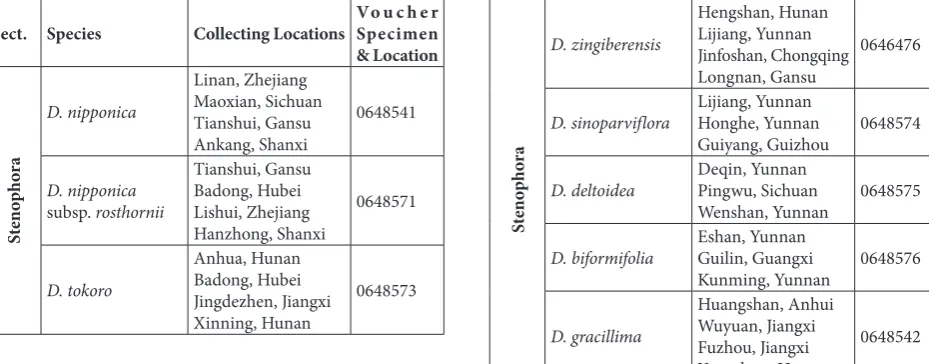
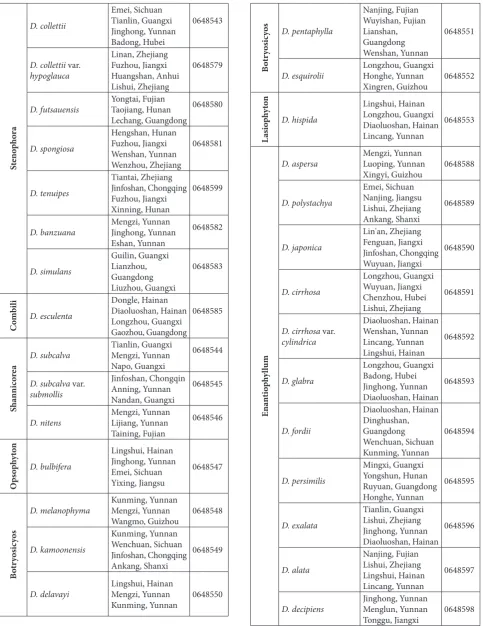
Field collection was conducted for 7 sections, 33 spe-cies, 1 subspecies and 3 varieties of Chinese Dioscorea plants (Table 1). Three to four populations (1-2 indi-viduals per population) per species were investigated,
Sect. Species Collecting Locations Vo u c h e r Specimen
& Location
St
eno
pho
ra
D. nipponica
Linan, Zhejiang Maoxian, Sichuan Tianshui, Gansu Ankang, Shanxi
0648541
D. nipponica
subsp. rosthornii
Tianshui, Gansu Badong, Hubei Lishui, Zhejiang Hanzhong, Shanxi
0648571
D. tokoro
Anhua, Hunan Badong, Hubei Jingdezhen, Jiangxi Xinning, Hunan
0648573
St
eno
pho
ra
D. zingiberensis
Hengshan, Hunan Lijiang, Yunnan Jinfoshan, Chongqing Longnan, Gansu
0646476
D. sinoparviflora Lijiang, Yunnan Honghe, Yunnan
Guiyang, Guizhou 0648574
D. deltoidea Deqin, Yunnan Pingwu, Sichuan
Wenshan, Yunnan 0648575
D. biformifolia Eshan, Yunnan Guilin, Guangxi
Kunming, Yunnan 0648576
D. gracillima
Huangshan, Anhui Wuyuan, Jiangxi Fuzhou, Jiangxi Yongshun, Hunan
0648542
St
eno
pho
ra
D. collettii
Emei, Sichuan Tianlin, Guangxi Jinghong, Yunnan Badong, Hubei
0648543
D. collettii var.
hypoglauca
Linan, Zhejiang Fuzhou, Jiangxi Huangshan, Anhui Lishui, Zhejiang
0648579
D. futsauensis Yongtai, FujianTaojiang, Hunan Lechang, Guangdong
0648580
D. spongiosa
Hengshan, Hunan Fuzhou, Jiangxi Wenshan, Yunnan Wenzhou, Zhejiang
0648581
D. tenuipes
Tiantai, Zhejiang Jinfoshan, Chongqing Fuzhou, Jiangxi Xinning, Hunan
0648599
D. banzuana Mengzi, YunnanJinghong, Yunnan Eshan, Yunnan
0648582
D. simulans
Guilin, Guangxi Lianzhou, Guangdong Liuzhou, Guangxi
0648583
C
om
bi
li
D. esculenta
Dongle, Hainan Diaoluoshan, Hainan Longzhou, Guangxi Gaozhou, Guangdong
0648585
Sha
nni
co
re
a D. subcalva
Tianlin, Guangxi Mengzi, Yunnan Napo, Guangxi
0648544
D. subcalva var.
submollis
Jinfoshan, Chongqin Anning, Yunnan Nandan, Guangxi
0648545
D. nitens Mengzi, YunnanLijiang, Yunnan Taining, Fujian
0648546
O
ps
op
hy
to
n
D. bulbifera
Lingshui, Hainan Jinghong, Yunnan Emei, Sichuan Yixing, Jiangsu
0648547
Bo
tr
yos
ic
yos
D. melanophyma Kunming, YunnanMengzi, Yunnan
Wangmo, Guizhou 0648548
D. kamoonensis
Kunming, Yunnan Wenchuan, Sichuan Jinfoshan, Chongqing Ankang, Shanxi
0648549
D. delavayi Lingshui, HainanMengzi, Yunnan
Kunming, Yunnan 0648550
Bo
tr
yos
ic
yos D. pentaphylla
Nanjing, Fujian Wuyishan, Fujian Lianshan, Guangdong Wenshan, Yunnan
0648551
D. esquirolii Longzhou, GuangxiHonghe, Yunnan
Xingren, Guizhou 0648552
Las
io
ph
yt
on
D. hispida
Lingshui, Hainan Longzhou, Guangxi Diaoluoshan, Hainan Lincang, Yunnan
0648553
Ena
nt
io
ph
yl
lum
D. aspersa Mengzi, YunnanLuoping, Yunnan
Xingyi, Guizhou 0648588
D. polystachya
Emei, Sichuan Nanjing, Jiangsu Lishui, Zhejiang Ankang, Shanxi
0648589
D. japonica
Lin'an, Zhejiang Fenguan, Jiangxi Jinfoshan, Chongqing Wuyuan, Jiangxi
0648590
D. cirrhosa
Longzhou, Guangxi Wuyuan, Jiangxi Chenzhou, Hubei Lishui, Zhejiang
0648591
D. cirrhosa var.
cylindrica
Diaoluoshan, Hainan Wenshan, Yunnan Lincang, Yunnan Lingshui, Hainan
0648592
D. glabra
Longzhou, Guangxi Badong, Hubei Jinghong, Yunnan Diaoluoshan, Hainan
0648593
D. fordii
Diaoluoshan, Hainan Dinghushan, Guangdong Wenchuan, Sichuan Kunming, Yunnan
0648594
D. persimilis
Mingxi, Guangxi Yongshun, Hunan Ruyuan, Guangdong Honghe, Yunnan
0648595
D. exalata
Tianlin, Guangxi Lishui, Zhejiang Jinghong, Yunnan Diaoluoshan, Hainan
0648596
D. alata
Nanjing, Fujian Lishui, Zhejiang Lingshui, Hainan Lincang, Yunnan
0648597
D. decipiens Jinghong, YunnanMenglun, Yunnan
Tonggu, Jiangxi 0648598
and the 5-8 mature leaves close to the lower part of the plant were collected and pressed for drying. After accurate identification, one voucher specimen per spe-cies was prepared and preserved in the herbarium of the Institute of Botany, Chinese Academy of Sciences (NAS), Jiangsu Province.
Experimental methods
The Foster [6] method was used to make the leaves transparent. The items observed and the terminologies used refer to the Manual of Leaf Architecture [1] and studies by Hickey [7] and Yu and Chen [18]. Accord-ing to the manual, there are two fundamental types of leaf venation: palmate and pinnate. Pinnate venation refers to a leaf or leaflet with only one basal vein (mostly midvein) (Fig. 1a1), whereas palmate venation refers to a leaf with three or more basal veins. Acrodromous venation is a subtype of palmate venation where three or more primaries originate from a point and run in convergent arches towards the leaf apex (Fig. 1a2). Per-current tertiary veins are the joined tertiary veins from the opposite secondary veins (Fig. 1B). Veinlet refers to the highest-order vein (Fig. 1C). Veinlet development is classified into five levels according to the branches: freely ending veinlets (FEVs) absent, unbranched, one-branched, dichotomous branching and dendritic branching. Areoles are the smallest areas of leaf tissue that are completely surrounded by veins; taken together, they form a contiguous field of polygons over most of the area of the lamina (Fig. 1D). Any order of venation can form one or more sides of an areole. The degree of development of areoles is divided into five levels: areolation lacking (venation ramifies into the inter-costal area without producing closed meshes), poor development (polygonal areoles and highly irregular size and shapes), moderate development (areoles of ir-regular shape that are more or less variable in size but with fewer sides than in poorly developed areolation), good development (areoles of relatively consistent size and shape and generally with 3-6 sides) and paxillate (areoles occurring in distinct oriented fields) (Fig. 1D). Marginal ultimate veins refer to veins at the margin of the leaf, and they have four types: absent (ultimate veins join perimarginal veins), incomplete (marginal ulti-mate veins recurve to form incomplete loops), spiked (marginal ultimate veins form outward-pointed spikes) and looped (marginal ultimate veins recurved to form loops) (Fig. 1E).
RESULTS
Characteristics of leaf venation in Dioscorea plants
Leaf venation of Dioscorea plants is either
acrodro-mous with 5-11 basal veins, orpinnate in a few
spe-cies/sections. Pinnate venation is mainly observed in species with compound leaves. A number of second-aries of acrodromous venation have branches that form at an angle of approximately 65° with the
pri-Fig. 1. Graphical presentation of the leaf venation characteristics
Ta bl e 2. L ea f v en at io n o f D io sc or ea sp
ecies in C
hin a. Tax on Le af t yp e M ajo r T op ol og y Prima ry V ein(s) H ig hes t V ein Or de r Br anches o f S ec ond-Or de r V eins FEVs A re ol es M arg ina l V ein Br anches N um be r C on ve rge nc e A t A pe x Sha pe D ev el op me nt Se ct. S ten op ho ra D . n ip po ni ca Sim ple Acr odr om ou s 11 Yes 6, 7 M ul tip le M ul tip le Ir regu la r Po or Lo op ed D. n ip po ni ca su bs p. ro sth or ni i Sim ple Acr odr om ou s 11 Yes 6, 7 M ul tip le M ul tip le Ir regu la r Po or Lo op ed D. t ok or o Sim ple Acr odr om ou s 9 Yes 6, 7 M ul tip le M ul tip le -Lac kin g Lo op ed D. zi ng ib er ens is Sim ple Acr odr om ou s 7 Yes 4, 5 M ul tip le On e b ra nc he d -Lac kin g In co m plet e D . s in op ar vi flo ra Sim ple Acr odr om ou s 7 Yes 4, 5 M ul tip le On e b ra nc he d -Lac kin g Lo op ed D. d elt oi de a Sim ple Acr odr om ou s 7 Yes 4, 5 M ul tip le M ul tip le Ir regu la r Po or In co m plet e D. b ifo rm ifo lia Sim
ple & co
m po un d Acr odr om ou
s & P
inn at e 1 a N o 5, 6 M ul tip le On e b ra nc he d Ir regu la r Po or Lo op ed D . g ra cil lim a Sim ple Acr odr om ou s 9 Yes 4, 5 M ul tip le M ul tip le Ir regu la r Po or In co m plet e D. c ol lett ii Sim ple Acr odr om ou s 9 Yes 6, 7 M ul tip le M ul tip le Ir regu la r Po or Lo op ed D. c ol lett ii va r. hy pogl au ca Sim ple Acr odr om ou s 9 Yes 4, 5 M ul tip le On e b ra nc he d Ir regu la r Po or In co m plet e D. f uts au ens is Sim ple Acr odr om ou s 7 Yes 6, 7 M ul tip le M ul tip le Ir regu la r Po or Lo op ed D. s po ng io sa Sim ple Acr odr om ou s 9 Yes 5, 6 M ul tip le On e b ra nc he d Ir regu la r Po or Lo op ed D. t en ui pe s Sim ple Acr odr om ou s 9 Yes 5, 6 M ul tip le M ul tip le Ir regu la r Po or Lo op ed D. b anzu an a Sim ple Acr odr om ou s 7 Yes 5, 6 M ul tip le M ul tip le Ir regu la r Po or Lo op ed D . s im ul ans Sim
ple & co
m po un d Acr odr om ou
s & P
inn at e 1 a N o 5, 6 M ul tip le On e b ra nc he d Ir regu la r Po or Lo op ed Se ct. C om bi li D . e scu len ta Sim ple Acr odr om ou s 7 Yes 6, 7 Fe w M ul tip le Ir regu la r Po or Lo op ed Se ct. S ha nnico re a D . s ub ca lva Sim ple Acr odr om ou s 9 Yes 5, 6 M ul tip le M ul tip le -Lac kin g Lo op ed D . s ub ca lva va r. su bm ol is Sim ple Acr odr om ou s 9 Yes 5, 6 M ul tip le M ul tip le Ir regu la r Po or Lo op ed D. n itens Sim ple Acr odr om ou s 9 Yes 5, 6 M ul tip le M ul tip le Ir regu la r Po or Lo op ed Se ct. O ps op hyt on D. b ul bi fer a Sim ple Acr odr om ou s 11 Yes 4, 5 M ul tip le M ul tip le -Lac kin g In co m plet e Se ct. B ot ry osic yos D . m ela no ph ym a C om po un d Pinn at e 1 a N o 3, 4 M ul tip le On e b ra nc he d Ir regu la r Po or In co m plet e D. k am oo nens is C om po un d Pinn at e 1 a N o 3, 4 M ul tip le On e b ra nc he d -Lac kin g In co m plet e D . d ela va yi C om po un d Pinn at e 1 a N o 5, 6 M ul tip le On e b ra nc he d Ir regu la r Po or Lo op ed D . p en ta ph yl la C om po un d Pinn at e 1 a N o 5, 6 M ul tip le On e b ra nc he d Ir regu la r Po or In co m plet e D. e sq ui ro lii C om po un d Pinn at e 1 a N o 5, 6 M ul tip le On e b ra nc he d Ir regu la r Po or In co m plet e Se ct. L asio ph yt on D. h isp id a C om po un d Acr odr om ou s 5 Yes 5 M ul tip le On e b ra nc he d Ir regu la r Po or Lo op ed Se ct. En an tio ph yl lum D. as per sa Sim ple Acr odr om ou s 9 Yes 4, 5 M ul tip le On e b ra nc he d Q uadra ngu la
r & P
en ta go na l M odera te Lo op ed D. p ol ys ta ch ya Sim ple Acr odr om ou s 7 Yes 4, 5 M ul tip le M ul tip le Q uadra ngu la
r & P
en ta go na l M odera te Lo op ed D . ja po ni ca Sim ple Acr odr om ou s 9 Yes 4, 5 M ul tip le On e b ra nc he d Ir regu la r Po or Lo op ed D. ci rr ho sa Sim ple Acr odr om ou s 5 Yes 5, 6 M ul tip le dic ho to m ou s Q uadra ngu la
r & P
en ta go na l M odera te Lo op ed D. ci rr ho sa va r. cy lin dr ica Sim ple Acr odr om ou s 5 Yes 5, 6 M ul tip le dic ho to m ou s Q uadra ngu la
r & P
en ta go na l M odera te Lo op ed D. gl ab ra Sim ple Acr odr om ou s 7 Yes 4, 6 M ul tip le M ul tip le Q uadra ngu la
r & P
en ta go na l M odera te Lo op ed D. f or di i Sim ple Acr odr om ou s 7 Yes 4, 6 M ul tip le M ul tip le Q uadra ngu la
r & P
en ta go na l M odera te Lo op ed D. p er sim ili s Sim ple Acr odr om ou s 7 Yes 6 M ul tip le M ul tip le Ir regu la r Po or Lo op ed D . ex al at a Sim ple Acr odr om ou s 7 Yes 4, 5 M ul tip le On e b ra nc he d Ir regu la
r & Q
uadra ngu la r M odera te Lo op ed D. a la ta Sim ple Acr odr om ou s 7 Yes 5, 6 M ul tip le M ul tip le Q uadra ngu la
r & P
mary vein. The secondaries of the pinnate venation are curved and form an angle less than 45° with the primary vein. The tertiaries are all percurrent. The
highest order vein in Dioscorea is the 7th. The
vein-let has branches and the number of branches vary among different species. Areoles are present in most of the surveyed species, but poorly or moderately de-veloped, and the shapes of areoles in most species are irregular. Marginal ultimate venations of some species recurve to form loops while in the other species they are incomplete (Table 2). The micromorphological characteristics of leaf venation were conserved within species.
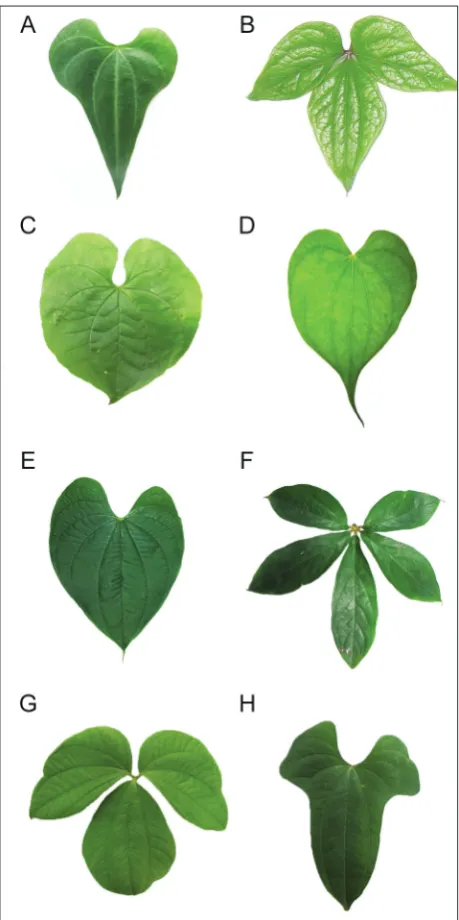
In section Stenophora, most species show simple leaves and acrodromous venation (Fig. 2A) except for D. biformifolia C. Pei & C. T. Ting and D. simulans Prain & Burkill, which show mixed simple and com-pound leaves. The primary leaves of D. biformifolia and D. simulans have 2-4 simple leaves with acrodro-mous venation, whereas the metaphylls have 3 or 5 small leaflets. The two small leaflets at both sides show pinnate venation and semicraspedodromous second-aries (secondsecond-aries that branch near the margin) that extend towards the apex, and 1 or 3 middle leaflets show acrodromous venation (Fig. 2B). Seven to 11 primary veins originate from the base of the acrodro-mous venation, and multiple secondary veins have branches that form an angle of approximately 65° with
the primary veins. The highest vein order is the 7th.
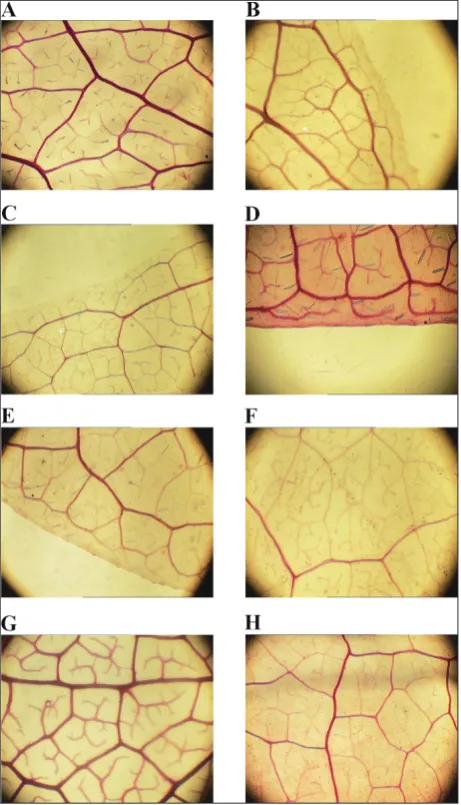
The veinlet of this section forms multiple branches, although D. zingiberensis C. H. Wright, D. sinoparvi-flora C. T. Ting et al., D. biformifolia, D. collettii var. hypoglauca C. T. Ting et al., D. spongiosa J. Q. Xi et al. and D. simulans have one branch. Most areoles are poorly developed with irregular shapes (Table 2, Fig. 3A), although D. tokoro Makino, D. zingiberensis and D. sinoparviflora do not show clear areoles. The mar-ginal ultimate veins form either complete or incom-plete loops (Fig. 3B & C).
Section Combili shows simple leaves with acro-dromous venation (Fig. 2C). Seven primaries originate from the base, the secondaries have few branches, and the angle formed with the primaries is larger than 65°.
The highest vein order is the 7th. The veinlets have
many branches and the areoles are poorly developed and show irregular shapes (Fig. 1d2). The marginal ultimate veins are looped (Fig. 1e4).
Fig. 2. Venation of Dioscorea species from seven sections in China
exhibiting acrodromous, pinnate or mixed venation types in dif-ferent sections. A – Sect. Stenophora: acrodromous in species with simple leaves (D. zingiberensis). B – Sect. Stenophora: mixed in species with compound leaves, middle leaflet acrodromous and side leaflets pinnate(D. simulans). C – Sect. Combili:acrodromous (D. esculenta). D – Sect. Shannicorea:acrodromous(D. subcalva).
Section Shannicorea shows simple leaves with acro-dromous venation (Fig. 2D). Nine primaries originate from the base, and there are multiple secondaries that have branches, and the angle formed with the primary
vein is larger than 65°. The highest vein order is the 6th.
The veinlets have many branches, and the areoles are poorly developed with irregular shapes (Fig. 1d2). How-ever, D. subcalva Prain & Burkill does not have areoles and the marginal ultimate veins are looped (Fig. 1e4).
Section Opsophyton shows simple leaves with ac-rodromous venation (Fig. 2E). Eleven primaries origi-nate from the base: there are multiple secondaries with branches and the angle formed with the primary vein
is larger than 65°. The highest vein order is the 5th. The
veinlets have many slender branches, but the areoles are lacking in this section (Fig. 1d1). The marginal ultimate veins form incomplete loops (Fig. 1e2).
Section Botryosicyos shows compound leaves with 3-7 leaflets with pinnate venation (Fig. 2F). There are multiple secondaries with branches and the angle formed by the secondaries with the primaries is
smaller than 45°. The highest vein order is the 6th. The
veinlets have one branch. The areoles are poorly de-veloped with irregular shapes (Fig. 3D), except for D. kamoonensis Kunth, which does not have areoles (Fig. 1d1). The marginal ultimate veins all form incomplete loops (Fig. 1e2), except for D. delavayi Franch., which displays complete loops (Fig. 3E).
Section Lasiophyton shows compound leaves with 3 leaflets with acrodromous venation (Fig. 2G). Five veins originate from the base; there are many second-aries with branches and the angle formed with the primaries is larger than 65°. The highest vein order is
the 5th. The veinlets have one branch, and the areoles
are poorly developed with irregular shapes (Fig. 1d2). The marginal ultimate veins form loops (Fig. 1e4).
Section Enantiophyllum shows simple leaves with acrodromous venation (Fig. 2H). Five to nine veins originate from the base; there are many secondaries with branches, and most angles formed with the
prima-ries are larger than 65°. The highest vein order is the 6th.
The veinlets have complex branches: D. aspersa Prain & Burkill, D. japonica Thunberg and D. exalata C. T. Ting & M. C. Chang have one branch (Fig. 3F), D. cirrhosa Loureiro and its variety D. cirrhosa var. cylindrica C. T. Ting & M. C. Chang have dichotomous branches (Fig.
3G) and other species have multiple branches. The ar-eoles of most species in this section are moderately de-veloped and show quadrangular and pentagonal shapes (Fig. 3H), although those of D. japonica, D. persimilis Prain & Burkill and D. decipiens J. D. Hooker are poorly developed with irregular shapes (Fig. 1d2). The mar-ginal ultimate veins form loops (Fig. 1e4).
Fig. 3. Micromorphology of the leaf architecture of Dioscorea
spe-cies from different sections displaying veinlets, areoles and mar-ginal ultimate veins. A – Irregularly shaped and poorly developed areoles (D. gracillima). B – Looped marginal ultimate veins (D. nipponica). C – Incompletely looped marginal ultimate veins (D. deltoidea). D – Irregularly shaped and poorly developed areoles (D. esquirolii). E – Looped marginal ultimate veins (D. delavayi).
Key to the sections of Dioscorea
The sections of Dioscorea can be distinguished using leaf venation characteristics (see also the key below).
Table 3. Morphological differences between D. simulans, D. biformifolia and other species ofsect. Stenophora [3,19,21].
Morphological characters D. simulans and D. biformifolia Other species of sect. Stenophora
Sex of individuals Androdioecious Dioecious
Arrangement of stamens
(observed from top) 2 laps 1 lap
Seeds wing Winged all round, but wing much wider toward capsule base.
Seeds inserted near the middle of axile placentation, and winged all round in most species; seeds inserted near the base
of axile placentation, and wing pointing towards the capsule apex in other species. Staminodes in female flowers Well developed with intact filaments, anthers and pollens Undeveloped with filament-like shapes
Leaf organization Compound and simple mixed Simple
Trichome hair on leaf epidermis Absent Present
Leaf venation leaves with middle leaflet acrodromous, Simple leaves acrodromous; compound
side leaflets pinnate Acrodromous Ratios of the thickness of internal to
external ground tissue in rhizome 1:0.4 <1:0.2
The average length of rhizomatous
myxocytes 323μm <190μm
Diosgenin content Very little, almost none High
Table 4. Morphological differences between D. cirrhosa, D. cirrhosa var. cylindrica and other species ofsect. Enantiophyllum [22-23].
Morphological characters D. cirrhosa and D. cirrhosa var. cylindrica Other species of sect. Enantiophyllum
Leaf texture Leathery or leathery-like Herbaceous
Stem thorn Present at the lower part of stems Absent except D. fordii
Tuber shape Ovoid, globose, oblong, or gourd-shaped Cylindirc
Production of tannin Yes No
1. Leaves simple
2. Marginal ultimate vein fused, looped and leaf blade margin always entire
Sect. Combili
2. Marginal ultimate vein
incompletely looped Sect. Opsophyton
2. Marginal ultimate vein completely looped
3. Areoles irregular shape; blind
vein multiple branches Sect. Shannicorea
3. Areoles mostly quadrate or polygon; blind vein branches complicated
Sect.
Enantiophyllum
1. Leaves compound and simple mixed
2. Simple leaves all
acrodromously veined; if compound leaves present 3 or 5 leaflets, the middle leaflet acrodromously veined and the side leaflets pinnately veined
Sect. Stenophora
2. Leaflets pinnately veined
with 1 midvein Sect. Botryosicyos
2. Leaflets acrodromously
DISCUSSION
Taxonomic significance of the
micromorphological architecture of Chinese Dioscorea leaves
The morphological architecture of Dioscorea leaf ve-nation shows taxonomic significance. Sections Shan-nicorea and Botryosicyos generally show consistent venation characteristics among species. However, the intrasection variation of venation morphology within sections Stenophora and Enantiophyllum has been illustrated, particularly for controversial species in the traditional taxonomy. For example, D. simulans and D. biformifolia of section Stenophora have acro-dromously veined middle leaflets, whereas the side leaflets are pinnately veined; D. cirrhosa and D. cir-rhosa var. cylindrica of section Enantiophyllum show dichotomous veinlets; and other species in the same section show either one-branched veinlets or multiple-branched veinlets.
D. simulansof section Stenophora was officially
named by Prain and Burkill in 1931 and was once classified into the section Illigerestrum based on char-acteristics including number of flowers in the base cymule of male inflorescence, stamens, wing of seeds and leaves. However, careful observation by Pei et al. [19] suggests that the classification characteristics used by Prain and Burkill were biased, and based on the rhizome and stamens characteristics, D. simulans was placed into section Stenophora, which was further confirmed in “Flora of China”. D. biformifolia, which is from the same section, is a novel species determined by Pei et al. [20] based on characteristics of leaf and petiole; apart from flower color, leaflet texture and male stalk, all other characteristics are essentially the same as in D. simulans. Both D. simulans and D. bi-formifolia have mixed simple and compound leaves. The micromorphological architecture of their leaves indicated that the two small compound leaflets on both sides have pinnate venation and the middle leaf-lets have acrodromous venation; thus, these species present a completely different morphological archi-tecture compared with that of other species in section Stenophora. Considering the apparent morphological differences in the fruits, seed wings, stamens of ma-ture flowers, proportion of androdioecy,
characteris-tics of leaf trichomes, mucous cells of underground stems and amount of diosgenin [3,19,21], we suggest that section Illigerestrum should not be abolished but rather rebuilt by including D. simulans and D. biformi-folia instead of section Stenophora.
D. cirrhosa and D. cirrhosa var. cylindrica belong to the advanced evolved section Enantiophyllum. However, the morphology of their leathery leaves, stem thorns and spherical tubers, as well as produc-tion of tannins differ from other species in the same section [22,23]. Therefore, certain taxonomists have suggested the exclusion of these two species from En-antiophyllum and the construction of a new section [22]. We observed that the veinlet branches of D. cir-rhosa and D. circir-rhosa var. cylindrica are dichotomous and show a distinguishable morphological difference compared with those of other species not only in sec-tion Enantiophyllum but also in Dioscorea. Therefore, our results suggest that D. cirrhosa and its variety D. cirrhosa var. cylindrica should be excluded from sec-tion Enantiophyllum and included in a new indepen-dent section.
Phylogenetic significance of heterophyllous venation in Dioscorea
Dioscorea plants have simple leaves, compound leaves and mixed simple and compound leaves. According to the internationally accepted classification system by Burkill [13], the compound leaves of Dioscorea mainly belong to five sections, with the following three dis-tributed in China: Botryosicyos, Lasiophyton (with compound leaves only) and Stenophora (D. simulans as well as D. biformifolia, with mixed simple and com-pound leaves).
Whether primary veins converge at the apex de-termines the type of venation. In Dioscorea, the deci-sive factor is whether leaves are simple or compound. The primary veins of species with simple leaves con-verge at the apex and all exhibit acrodromous vena-tion, while the species with compound leaves, includ-ing D. simulans, D. biformifolia and section Botryosi-cyos, show pinnate venation.
parallelodro-mous venation, including Dioscoreaceae, Smilacaceae, Alismataceae and Taccaceae, should be the primitive lineages, and this hypothesis was further supported by molecular phylogenetic analyses [24]. Therefore, we propose that the species with pinnate venation was the primitive in Dioscorea, and the evolutionary trend from pinnate to acrodromous venation in Dioscorea plants could be inferred in D. simulans and D. biformi-folia. The venation of side leaflets is pinnate, whereas that of the middle leaflets is acrodromous. Although the degree of development of monocotyledonous pin-nate venation is even below that of poorly developed dicotyledonous venation, obvious characteristic dicot-yledonous venation properties are exhibited compared with that of the typical parallelodromous venation of monocots, such as mesh-like areoles, percurrent in-tercostal tertiaries between secondaries, independent tracheids, a vascular bundle sheath, loops and free ending veinlets [15].
Variations in leaflet number and heterophyllous properties are common among species with com-pound leaves in Dioscorea and typical for D. simulans. Other species, such as D. quartiniana A. Rich, which is distributed in Africa, even exhibit three types of heterophylls [13].
Relationship of leaf architecture and ecological environment
The leaf venation morphology of all angiosperm or-ders was investigated [25] and the results showed that pinnate and palmate venation occurs in Dioscoreales, Liliales, Asparagales and Alismatales of monocots, Myrtales, Gentianales and Lamiales of eudicots, and Piperales and Laurales of magnoliids. Therefore, at the systematic scale, the generation and evolution of vena-tion appears unrelated to the evoluvena-tion of angiosperms. In addition, morphological and molecular analyses all showed that in monocots the characteristics of com-pound leaves did not originate monophyletically but likely resulted from convergent evolution [10,12,26].
Compound leaves were shown to be associated with shady conditions [27]. Compound leaves with a high leaf surface area are more active with respect to photosynthesis and transpiration than simple leaves. In fact, Dioscorea species with compound leaves were more likely to be distributed in tropical region; for
example, section. Lasiophyton was observed in a forest in the Philippines, and it had a leaf surface area of up
to 996 cm2; and D. cochleari-apiculata De Wild of the
section Botryosicyos was observed in the Tanganyika
rainforest, and it had a leaf area of up to 1900 cm2 [13].
In our study, pinnate venation was observed in many species with compound leaves, including D. simulans and D. biformifolia and section Botryosicyos, which could be explained by the observation that broad leaves which favor shady conditions cannot support themselves mechanically and thus require longitudinal and lateral reinforcement from pronounced primary and secondary veins [26]. Therefore, the generation of venation morphology has a closer relationship with the ecological environment. The compound leaves and different venation morphologies in Dioscorea may be the evolutionary result of the plant’s adaptation to environmental conditions.
Acknowledgments: This work was supported by grants from
the Ability Improvement Project of Jiangsu Social Scientific Re-search Institutions to XQS (BM2015019), the Youth Foundation of Jiangsu Province to ZL (BK20160602), and the Key Laboratory Foundation of the Institute of Botany, Jiangsu Province and Chi-nese Academy of Sciences to ZL (JSPKLB201504). The sources of funding had no role in the study design, data collection and analysis, decision to publish, or prepare the manuscript.
Author contributions: Yueyu Hang designed the experiments,
Xiaoqin Sun and Zhao Lei performed the experiments. Jiayu Xue, Xiaoqin Sun and Yueyu Hang analyzed the data and wrote the manuscript, Yanmei Zhang, Mimi Li and Guangcan Zhou carried out the accession collection.
Conflicts of interest disclosure: The authors have declared that
no competing interests exist.
REFERENCES
1. Ellis B, Daly D, Hickey L, Johnson K, Mitchell J, Wilf P, Wing S. Manual of leaf architecture. Ithaca: Cornell University Press; 2009. 190 p.
2. Zhou G, Wei Y, Zhang L. Leaf venation characteristics and its taxonomic significance of Brassicaceae. J Xinjiang Agr Univ. 1997;20:5-11.
3. Li M. Micro-morphological characteristics of leaf epidermis and its taxonomic significance in Dioscorea from China. Acta Bot Boreali-Occidentalia Sin. 2012;43:32.
4. Fang Y, Liu J, Jiang Y. Characteristics and significance for the delimitation of species on the leaf venation of Chinese yam in Fujian. J Fujian Norm Univ (Nat Sci ed). 2002;18:65-9. 5. Huang C, Huang A. The leaf venation structure of Piper Linn.
6. Foster A. Leaf differentiation in angiosperms. Bot Rev. 1936;2:349-72.
7. Hickey L. Classification of the architecture of dicotyledonous leaves. Am J Bot. 1973;60:17-33.
8. Pan K, Lu A, Wen G. Leaf architecture and systematics of the Hamamelidaceae sensu lato. J Syst Evol. 1988;2:96-100. 9. Tian J, Yu X, Li J. Characteristics of leaf venation for species
of Styrax from Hunan and their significances on plant clas-sification. J Cent South Univ For Technol. 2010;30:101-4. 10. Conover M. Epidermal patterns of the reticulate-veined
Liliiflorae and their parallel-veined allies. Bot J Linn Soc. 1991;107:295-312.
11. Chen J. The development of vein in Zea mays L. J Guangxi Plants. 1999;19:65-9.
12. Cameron K, Dickison W. Foliar architecture of vanilloid orchids: insights into the evolution of reticulate leaf venation in monocotyledons. Bot J Linn Soc. 1998;128:45-70. 13. Burkill I. The organography and the evolution of the
Diosco-reaceae, the family of the yams. Bot J Linn Soc. 1960;56:319-412.
14. Shu P. Pollen morphology of Dioscorea in China. J Syst Evol. 1987;25:357-65.
15. Inamdar J, Shenoy K, Rao N. Leaf architecture of some mono-cotyledons with reticulate venation. Ann Bot. 1983;52:725-35. 16. Dahlgren G. An undated angiosperm classification. Bot J
Linn Soc. 1989;100:197-203.
17. Mignouna H, Abang M, Asiedu R, Geeta R. True yams (Dioscorea): a biological and evolutionary link between eudi-cots and grasses. Cold Spring Harbor Protocols. 2009;11:pdb. emo136.
18. Yu C, Chen Z. Data of the macro structure of dicotyledon-ous woody plant leaf in south China 1, terms and methods. Guangzhou: Guangdong Sci Tech Press; 1986. 231p. 19. Pei J, Ding Z, Qin H, Shu P, Tang S, Zhang H. A preliminary
systematic study of Dioscorea L. sect. Stenophora Uline. J Syst Evol. 1979;17:61-72.
20. The Research Group of Dioscorea, Kiangsu Institute of Botany. Studies on Chinese Dioscorea sect. Stenophora Pr. et Burk. and their chromosome numbers. J Syst Evol. 1976;14:65-72. 21. Hang Y. Study of Chinese medicine Dioscorea septemloba
Thunbt, its identification and quality evaluation. [dissertation]. [Nanjing]: China Pharmaceutical University. 2007. 116 p. 22. Hang Y, Xu L, Shi D, Qin H, Zhou Y. Morphological features
and its taxonomic significance of starch grain in the subterra-nean organ of Dioscorea L. in China. J Plant Resour Environ. 2006;15:1-8.
23. Zhao W, Mao Z, Yang J. A Study on numerical taxonomy of Dioscoreaceae plants in Zhejiang Province. J Syst Evol. 1990;28:442-51.
24. Qiu Y, Li L, Wang B, Chen Z, Knoop V, Groth-Malonek M, Dombrovska O, Lee J, Kent L, Rest J, Estabrook G, Hendry T, Taylor D, Testa C, Ambros M, Crandall-Stotler B, Duff R, Stech M, Frey W, Quandt D, Davis C. The deepest divergences in land plants inferred from phylogenomic evidence. P Natl Acad Sci USA. 2006;103:15511-6.
25. Angiosperm Phylogeny Group. An update of the Angiosperm Phylogeny Group classification for the orders and families of flowering plants: APG III. Bot J Linn Soc. 2009;161:105-21. 26. Givnish T, Pires J, Graham S, McPherson M, Prince L,
Patter-son T, Rai H, RoalPatter-son E, Evans T, Hahn W, Millam K, Meerow A, Molvray M, Kores P, O’Brien H, Hall J, Kress W, Sytsma K. Repeated evolution of net venation and fleshy fruits among monocots in shaded habitats confirms a priori predictions: evidence from an ndhF phylogeny. P Roy Soc B-Biol Sci. 2005;272:1481-1490.
27. Xu F, Guo W, Xu W, Wei Y, Wang R. Leaf morphology corre-lates with water and light availability: What consequences for simple and compound leaves. Prog Nat Sci. 2009;19:1789-98.
Supplementary Data
Fig S1. The venation of angiosperms (phylogeny based on
![Fig. 1. Graphical presentation of the leaf venation characteristics and terms [11]. A – Two types of leaf venation: a1, pinnate vena-tion (Carrierea calycina, Salicaceae); and a2, acrodromous venation (Sarcorhachis naranjoana, Piperaceae); B – Percurrent tertiaries crossing between adjacent secondaries; C – Five levels of veinlet de-velopment: c1, freely ending veinlets (FEVs) absent; c2, unbranched; c3, one branched; c4, dichotomous branching; and c5, dendritic branching; D – Development of areoles: d1, areolation lacking; d2, poor development; d3, moderate development; d4, good develop-ment; and d5, paxillate; E – Four types of marginal ultimate veins: e1, absent; e2, incomplete; e3, spiked; and e4, looped.](https://thumb-us.123doks.com/thumbv2/123dok_us/7812561.2086318/4.595.309.539.84.446/presentation-characteristics-salicaceae-sarcorhachis-percurrent-dichotomous-development-development.webp)

![Fig S1. The venation of angiosperms (phylogeny based on An-giosperm Phylogeny Group III) [25]](https://thumb-us.123doks.com/thumbv2/123dok_us/7812561.2086318/11.595.309.541.350.623/fig-venation-angiosperms-phylogeny-based-giosperm-phylogeny-group.webp)
