Consult
ation
P
aper
Financial Services Authority
Alternative trading
systems
October 2002
1 Executive summary 3
2 Introduction 6
3 Scope and timing 11
4 Standard-by-standard proposals 16
5 Statutory requirements 28
Annex A:Cost-benefit analysis
Annex B:Compatibility with our general duties
Annex C:CESR Standards and selected commentary
Annex D:Glossary
Annex E:List of questions
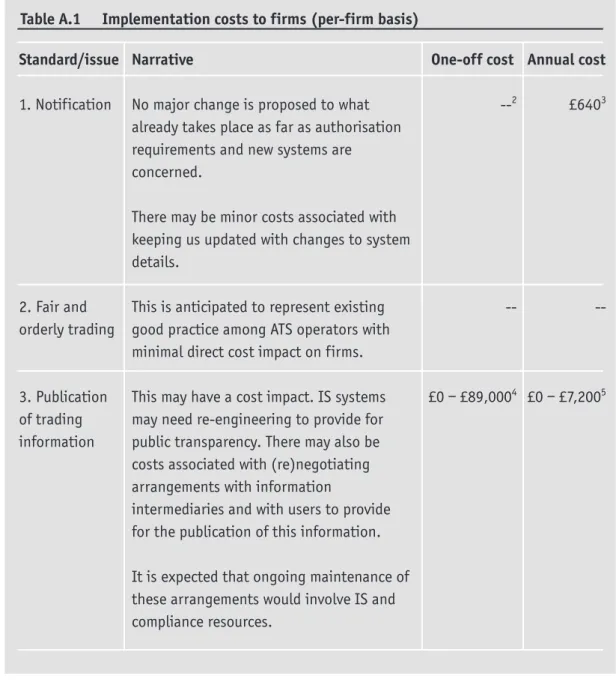
Annex F:Proposed Handbook text
Contents
Copies of this consultation paper are available for download from our website – www.fsa.gov.uk. Alternatively, paper copies can be obtained by calling the FSA order line: 0845 608 2372.
The Financial Services Authority invites comments on this Consultation Paper. Comments should reach us by 31 January 2003.
You can send your response by electronic submission using the form on our website (at www.fsa.gov.uk/pubs/cp/cp153_response.html), by e-mail ([email protected]) or in writing to:
Laurence White
Markets and Exchanges Division The Financial Services Authority 25 The North Colonnade
Canary Wharf London E14 5HS
Telephone: 020 7676 3354 Fax: 020 7676 3355
It is our policy to make all responses to formal consultation available for public inspection unless the respondent requests otherwise. The names of all respondents will be published.
Executive summary
1
1 previously, the Forum of European Securities Commissions (FESCO)
1.1 Alternative Trading Systems (ATSs) have risen in importance in several
securities markets around the world, as an alternative to traditional exchanges. The UK has been no different, and today is host to around 25 ATSs, active in markets for equities, bonds, financial derivatives and commodities.
1.2 They are currently subject to the same UK regulatory regime as applies to all securities firms. The regime is not tailored for their kind of operation, which is somewhere between that of an exchange and an ordinary firm. By contrast, jurisdictions around the world have introduced regulatory changes designed to deal specifically with ATSs, either as a separate category or as part of a wider ‘marketplace’ concept.
1.3 In January 2000, partly prompted by these developments, we issued a
Discussion Paper on the regulation of market infrastructure providers (MIPs). That paper discussed issues that might arise from market trends such as the emergence of electronic trading platforms and their impact on the markets in which they operate. We sought views on several possible courses of action, and other ways in which it might be necessary to revise our regulatory regime for MIPs to respond to market developments.
1.4 Responses to the Discussion Paper urged us to concentrate our efforts in the European arena rather than to act unilaterally. In line with these comments, we chaired the ATS Experts Group of the Committee of European Securities Regulators (CESR).1The Experts Group began its work in 2000 and
proceeded through two consultations to publish its final Standards for ATSs in July 2002.
1.5 This Consultation Paper sets out our proposals for implementing the CESR Standards for ATSs. The text of the Standards and selected commentary is set out in Annex C. We are seeking input from firms, trade bodies and other interested parties, in a consultation that finishes at the end of January 2003.
2 i.e., their permission to carry on regulated activities under Part IV of the Financial Services and Markets Act 2000 (FSMA)
1.6 Our proposals for implementing the Standards are discussed in Chapters 3 and 4, and are set out as proposed Handbook changes in Annex F. Broadly speaking, we propose to:
• issue clarifying guidance on the need for ATSs to provide us with material information and provide satisfactory clearing and settlement
arrangements;
• require ATS operators to facilitate fair and orderly trading on their system, make details of prices and trades publicly available, monitor user compliance with trading rules, and have arrangements to detect and report abusive trades;
• require ATS operators to give specified information to private and intermediate customers about their systems; and
• require ATS operators to provide, or satisfy themselves there is publicly available, information about securities traded on their system.
1.7 We are also consulting on an option for implementing some of the Standards by using our powers to impose requirements on firms’ Part IV permission2
instead of using rules and guidance. One potential advantage of this course is that it allows us the flexibility to tailor requirements to particular systems. 1.8 In this paper we also consult on the correct scope of the regime, in terms of
type of legal entities, instruments traded, territorial aspects and the definition of ATS. In our implementation proposals, we are seeking to build on the foundations laid by CESR, but with a close eye on our domestic market structure and regulatory regime as well as the forthcoming revision of the Investment Services Directive (ISD).
1.9 We recognise that our proposed regime would impose some costs on ATSs. However, we think those costs would be manageable and we do not believe they would place ATSs at a material disadvantage to their competitors: exchanges, voice brokers, overseas firms and the like. Most importantly, we think there would be significant benefits in terms of greater use of ATSs, increased competition between ATSs and other execution venues and between intermediaries, and other benefits. We believe these benefits would outweigh the costs.
1.10 We will formulate our final proposals in light of responses to this Consultation Paper and ongoing ISD developments. At this stage we
anticipate issuing final text in May 2003, with Handbook provisions to come into effect in August 2003. However, we are consulting on this
implementation timetable, and may need to delay the coming into effect of at least some of the Standards to enable firms to comply.
Consumers
The ATSs we are aware of in the UK deal principally with non-private customers, i.e. with intermediate customers and market counterparties. So, we do not expect the Standards to be of direct relevance to retail consumers and consumer groups. We do however think that implementing the Standards will support our consumer protection objective. Further details are in Annex B (Compatibility with our general duties).
Introduction
2
3 Our regulatory objectives under FSMA are:
• market confidence, i.e. maintaining confidence in the financial system; • public awareness, i.e. promoting public understanding of the financial system;
• consumer protection, i.e. securing the appropriate degree of protection for consumers; and
• reduction of financial crime, i.e. reducing the extent to which it is possible for a business carried on by a regulated person, or in contravention of the general prohibition, to be used for a purpose connected with financial crime.
Background
2.1 The last decade has seen the development of a wide range of alternative trading systems (ATSs) in many of the world’s main financial markets. These new platforms have been made possible by rapid advances in information technology. This has enabled the creation of new market places which have no need for physical trading floors. As such, they can be readily accessed from anywhere in the world, can handle large trading volumes in an orderly manner, and link seamlessly into back office and settlement processes.
Risks to our objectives posed by ATS activity
2.2 We have attempted an analysis of comparative volumes figures in the respective major markets for exchange traded, ATS and traditional over the counter (OTC) activity. This is difficult, as ATS and OTC volumes are not regularly and consistently collected and published, either by participants or by regulators. 2.3 Our research shows that the importance of ATSs varies significantly between
different major markets. In equities, for instances, ATS volumes are not very significant compared with on-exchange activity. In the bond markets they are not very significant compared with OTC trading, but they are significant compared to the limited exchange trading. On the other hand, ATSs facilitate the majority of trading in the repo and spot FX markets, and facilitate
significant proportions of the gas, power and metals derivatives markets. 2.4 In Chapter 5 we state that our proposals are compatible with all four of our
4 As used in FSMA, the term ‘consumer’ is not limited to retail investor and broadly covers any (potential) consumer of a financial service.
regulatory requirements pose risks to our market confidence, consumer protection and reduction of financial crime objectives.
2.5 The main risks to the market confidence objective posed by ATSs under the present regime are from:
• little public transparency of ATS activity leading to possible inefficiencies in the price formation process and so higher trading costs;
• variations in the extent to which operators comply with good practice in systems and controls, the monitoring of user activity, and arrangements for reporting of suspect transactions; and
• the possibility of traders trading in transparent markets on the basis of information from trades only known to direct users of non-transparent ATSs, to the disadvantage of participants in the wider market.
2.6 The main risks to consumer protection are from:
• difficulties for clients in asserting their rights to best execution where some activity is conducted on non-transparent ATSs; and
• variations in the extent to which operators provide system and investment information, including clarity about clearing and settlement arrangements, leading to the possibility of consumers4mis-buying ATS services.
2.7 The main risk to the reduction of financial crime objective is the lack of transparency of ATS trading, and the lack of a systematic approach to the monitoring and reporting of suspect transactions.
Responses in other jurisdictions
2.8 ATSs, many of which have the basic trading characteristics of an exchange market, have posed new issues for securities market regulators in many countries. The fundamental issue has been the appropriate way to modify regulation to underpin market integrity and investor protection. In addressing this issue, regulators have also been conscious of the need to mitigate risk in a way that does not discourage innovation and fair competition.
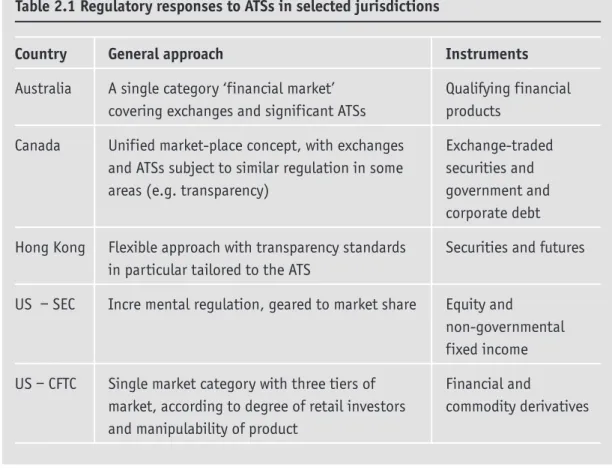
2.9 A number of countries have already introduced regulation in this area. Their approaches are summarised in table 2.1.
CESR Standards for ATSs
2.10 We initiated a public discussion on ATS regulation in a Discussion Paper,
The FSA’s approach to regulation of the market infrastructure, published in January 2000. In that paper, we floated the idea that, in broad terms, we should take a more functional approach to the regulation of market
infrastructure providers (MIPs) and tailor regulation to the characteristics of each asset class.
2.11 Responses to the Discussion Paper urged us to ensure that development of UK regulation for MIPs took proper account of cross-border issues and the
development of parallel regulation in the EU. With that in mind, we decided that we would not bring forward specific proposals for the UK at that time but first focus our attention on contributing to the development of policy at the EU level.
2.12 The predecessor body to the Committee of European Securities Regulators (CESR) set up an Experts Group in 2000 to develop Standards for ATSs that member regulators could agree to implement ahead of the revised Investment Services Directive (ISD). CESR published draft Standards in June 2001 and revised proposals in January 2002. It issued its final Standards for Alternative Trading Systems(the CESR Standards) in July 2002.
Table 2.1 Regulatory responses to ATSs in selected jurisdictions
Country General approach Instruments
Australia A single category ‘financial market’ Qualifying financial covering exchanges and significant ATSs products
Canada Unified market-place concept, with exchanges Exchange-traded and ATSs subject to similar regulation in some securities and areas (e.g. transparency) government and
corporate debt Hong Kong Flexible approach with transparency standards Securities and futures
in particular tailored to the ATS
US – SEC Incre mental regulation, geared to market share Equity and
non-governmental fixed income US – CFTC Single market category with three tiers of Financial and
market, according to degree of retail investors commodity derivatives and manipulability of product
2.13 The text of the CESR Standards and selected commentary is in Annex C. The Standards broadly address:
• issues relating to ATS operators, such as keeping regulators informed about ATSs, systems standards, and clearing and settlement arrangements (Standards 1, 6 and 7);
• issues relating to trading on an ATS including transparency, monitoring and reporting of trading (Standards 2–5); and
• issues relating to customers of ATSs including providing information about ATSs and about securities traded on them (conduct of business issues (a)–(c)).
2.14 At this stage, we are not aware of any other regulators that have implemented the CESR Standards by changing legislation. However, a number of other regulators have told us that they are proceeding to implementation, or are actively investigating whether there is a need to implement the Standards against the background of their existing provisions.
Purpose of paper
2.15 In this Consultation Paper, we set out our proposals for firms operating ATSs and describe in detail how we think the CESR Standards should be implemented in the UK. We welcome comments from all those directly affected by the proposals as well as other interested parties, including exchanges and investor groups. We would be grateful if respondents could concentrate on our questions in their responses, but we are also happy to receive comments on the issues raised more generally.
2.16 In determining our proposed response to the Standards, we have taken care to compare each Standard with existing relevant Handbook material. In some instances, we propose no changes since the Standard is sufficiently covered. In others, we seek to build on existing Handbook material.
Structure of paper
2.17 Chapter 3 tackles a number of issues relating to the scope and timing of our proposals.
2.18 Chapter 4 addresses the CESR Standards in detail and sets out our proposals for implementing each Standard (or our reasons for thinking no change is necessary).
2.19 Chapter 5 discusses the costs and benefits of implementing the ATS regime and why we think, on balance, the benefits of the proposed regime as a whole, would outweigh the respective costs. It also describes the compatibility of the ATS regime with our regulatory objectives and the principles of good
Scope and timing
3
5 i.e., specified investments as defined in the Financial Services and Markets Act 2000 (Regulated Activities) Order 2001, Statutory Instrument No. 2001/544, as amended (the RAO)
6 Footnote 2 to the CESR Standards.
Scope
Instruments
3.1 The CESR Standards apply to ATSs facilitating trading in financial
instruments within the ISD (ISD instruments). However, CESR left open the possibility of national regulators extending the scope to commodity
derivatives.
3.2 We propose to apply the ATS Standards to entities operating ATSs that facilitate trading in most designated investments (broadly, ISD instruments and commodity derivatives), but not other kinds of investment5such as rights
under contracts of insurance.
3.3 We think that commodity derivatives should be covered. We believe ATSs facilitating trading in commodity derivatives present similar levels of risk to our regulatory objectives to those presented by other kinds of ATSs. Given that we regulate commodity derivatives exchanges and the wider trading in those derivatives, we see no good reason to exclude such ATSs from the Standards. This conclusion is borne out by our cost-benefit analysis (see Chapter 5).
Operating entities
3.4 The CESR Standards apply to investment firms and to ‘other entities which are authorised to provide investment services, such as credit institutions’.6
3.5 We propose to cover firms authorised under FSMA (including service
companies, credit institutions and other firms) operating an ATS as defined. We do not propose to cover exempt entities such as recognised investment exchanges (RIEs).
7 Service companies are firms which are permitted only to make arrangements with a view to transactions in investments, within article 25(2) of the RAO, and to agree to carry on that activity. They also have certain standard restrictions on their permission, such as the inability to hold client money and to approve financial promotions for others.
3.6 We propose to adopt this scope because we do not believe a platform facilitating trading in, say, credit derivatives that is operated by a credit institution would present materially different risks to our objectives than the same platform operated by a securities firm.
3.7 By contrast, we think there are a small number of service companies7that
operate ATSs within our proposed definition. We think that service companies operating ATSs do not pose significantly different risks to our objectives simply by being service companies, although in practice such firms tend to be fairly low-risk on our impact and probability metrics.
3.8 As there are some service companies that operate ATSs on the CESR definition, there are three options for dealing with them:
• exempt service companies from the ATS Standards;
• require such companies to become ordinary firms and subject them to full conduct of business regulation plus the ATS Standards;
• impose the ATS Standards on such firms without otherwise changing the regime that applies to them.
3.9 The last option is the one we are consulting on. We think the first option might encourage ATS operators to restructure as service companies. We think the second would be an overreaction to the risks posed.
3.10 On our proposals for implementation, some of the ATS Standards would be imposed on firms that operate ATSs through new provisions in the Conduct of Business sourcebook(COB 1.2 and 4.2) and in Chapter 3 of the Market Conduct sourcebook(MAR 3). These provisions do not currently apply to service companies. So, we would have to amend the application provisions of COB and MAR 3 to ensure that, to the extent necessary to comply with the Standards, both those sets of provisions apply to service companies. Many of the Standards would, on our proposals, be imposed under MAR 5, which would also apply to service companies operating an ATS.
3.11 Broadly speaking, the same options present themselves for ATS operators who happen also to qualify as energy market participants or oil market
participants. We propose a similar approach to such firms that operate ATSs as we propose for service companies.
Territorial scope
3.12 CESR has stated that the market-facing Standards (i.e., Standards 1–7) should be applied on a home state basis. Our draft Handbook text implementing
those Standards will ordinarily have this effect. The only exceptions are unusual cases dictated by the strict legal effect of the E-commerce Directive. We plan to take a similar approach to firms based outside the EEA as to those based in other EEA states.
Q 3.1 Do you agree with the proposed scope of the ATS regime?
Q 3.2 In particular, do you agree with the proposed treatment of service companies and commodities firms?
Definition of ATS
3.13 We have not built territorial scope into the definition of ATS, other than by requiring that the operator of the ATS be a ‘firm’, i.e. an entity authorised under FSMA. Obviously, this excludes entities that do not need to be
authorised in the UK because they are exempt (such as RIEs). Importantly, it also excludes firms making use of the overseas persons exclusion in article 72 of the RAO. This exclusion, broadly, relieves overseas persons from the need to be authorised under FSMA when conducting what would otherwise be regulated activities in the UK, in certain circumstances.
3.14 In defining an ATS, we have chosen not to define further the key terms ‘system’ and ‘operate’, preferring to let them bear their ordinary meaning. Our thinking here has been to leave a degree of flexibility open, since if the definition is too specific, it may not be capable of being applied to future developments.
3.15 We also propose to adopt CESR’s own guidance on the definition of an ATS to clarify for firms whether or not they will be covered by the definition. At this stage we do not propose to reproduce CESR’s guidance table of different kinds of systems, as we think it is already adequately covered in the definition and the guidance text itself.
Q 3.3 Do you have any comment on the proposed definition of ATS and its accompanying guidance?
Voice brokers
3.16 Trading on an ATS is only one way in which trading interests of a variety of parties can be brought together. In many markets, traditional telephone trading is still prominent, despite technological advances that would allow movement of a large proportion of this trading activity onto an electronic platform. The key players in the traditional phone trading market are the so-called voice brokers.
3.17 Many operators of ATS and, indeed, exchanges regard voice brokers as a significant competitive force. They argue that voice brokers provide the same kind of services as they do and that the only distinguishing feature is
technology. So, the view expressed by some ATS operators and other market players is that voice brokers should be subject to similar standards as those proposed in this paper for ATSs. Other market players express the opposite view and argue that voice brokers can be clearly distinguished from ATSs. 3.18 Some voice brokers operate computerised bulletin boards or screens that are
used to disseminate trading interests appearing on their order books to their clients. Clients with access to the bulletin boards or screens can then ring up the voice broker to place or accept orders or other interests. The voice broker will then update the screen to reflect the client’s instructions. Other voice brokers go one step further and allow direct client access to the screen, allowing clients to post or hit orders directly.
3.19 In carrying out our research for this paper, we applied a general approach to distinguish voice brokers from ATSs: where a broker allowed direct client access to its system, it would be counted as an ATS.
3.20 However, it might be considered that a voice broker operating a bulletin board to disseminate current positions would be covered by the definition of ATS, even in the absence of direct access. This is because in such an operation, the voice broker would ordinarily have no discretion as to how interests interact (although there may be some discretion whether to enter interests on the system).
Q 3.4 How, if at all, do you think ATSs should be distinguished from voice brokers?
Timing and related policy processes
3.21 Consultation on this paper runs until the end of January 2003. We propose to issue any final rules early in May 2003, coming into force in August 2003. 3.22 This timetable would give firms three months to comply with the Standards.
We accept that some firms might consider that this timetable should be lengthened for some Standards, particularly where there is a need to
implement systems changes. Our cost-benefit analysis assumes that in order to comply with the proposed timetable, firms may need to employ IT and
compliance consultants rather than rely purely on in-house resources.
3.23 We also considered the issue of timing carefully in the context of the proposed revision of the ISD. There is some uncertainty over the timetable for the
revision of the ISD, but the likelihood is that the final wording of a revised ISD will not be settled for some considerable time. We propose to implement the Standards next year, however, believing that there are present risks that require addressing.
3.24 We recognise that there are risks involved in this approach, but believe that issuing this Consultation Paper now will allow respondents to consider the proposals in the light of the formal draft of a revised ISD. We expect the European Commission (EC) to issue the draft before the end of this year. 3.25 We think that careful monitoring of progress in the EU context should allow
us to ensure that firms affected by the proposed new UK regime will not be subject to two significant changes to the regulatory regime applying to them. Instead, we hope to achieve a seamless transition, which means that firms subject to the UK regime will automatically meet the requirements the UK would have to implement under a revised ISD.
Transparency
3.26 In our proposals for implementation of the transparency provisions, we have left the requirements as flexible and open as possible. This will allow us to take account of the continuing European discussions in this area and take the specific characteristics of the different systems into account.
3.27 Given our active involvement in the CESR Experts Group on Market
Transparency and Efficiency, we will be able to monitor developments in this area closely. We will need to consider on an on-going basis whether any of the developments in the context of this CESR work should feed into the
finalisation of our regime for ATSs.
3.28 While the CESR Standards impose transparency requirements on ATSs in wider asset classes, the current proposals of the EC for the revision of the ISD restrict transparency to equity instruments. In this paper we propose to
implement transparency requirements for ATSs facilitating trading of instruments traded on EEA exchanges, not just for those trading equity instruments. We do not believe that the risks to our objectives in the equities market are materially different than those posed in others.
Q 3.5 Do you have any comment on the proposed timetable and its links with related policy processes?
Introduction
4.1 In this Chapter, we take each Standard (or conduct of business issue) in turn and set out our proposals, where we are proposing changes to our Handbook. In the case of Standard 6, we have concluded that no change is necessary. 4.2 The full text of the CESR Standards, and selected CESR commentary, is set
out in Annex C.
4.3 There are already provisions of the Handbook that are relevant in a general way to the issues addressed by the Standards. These provisions are found in: • Principles for Businesses(PRIN);
• Threshold Conditions(COND);
• Senior Management Arrangements, Systems and Controls(SYSC); • theAuthorisation manual(AUTH); and
• theSupervision manual(SUP).
4.4 Of particular relevance to some of the Standards are the following Principles: • Principle 2 – a firm must conduct its business with due skill, care and
diligence;
• Principle 3 – a firm must take reasonable care to organise and controls its affairs responsibly and effectively, with adequate risk management
systems;
• Principle 5 – a firm must observe proper standards of market conduct; • Principle 6 – a firm must pay due regard to the interests of its customers
and treat them fairly;
Standard-by-standard
proposals
• Principle 7 – a firm must pay due regard to the information needs of its clients, and communicate information to them in a way which is clear, fair and not misleading; and
• Principle 8 – a firm must manage conflicts of interest fairly, both between itself and its customers and between a customer and another client. 4.5 In relation to market counterparty clients of ATSs (i.e., broadly, investment
professionals), some of these Principles do not apply. The term ‘customer’ as used in the Principles excludes market counterparties, so Principles 6 and 8 do not apply. Principle 7 only requires communications to market counterparties to not be misleading (see PRIN 3.4.1).
Implementation options
4.6 In relation to ATS operators who engage only in inter-professional business with other market counterparties (and so would usually be covered by MAR 3), we considered implementing some of the Standards with guidance only, without the use of rules. However, we concluded that it is doubtful whether there are relevant principles (such as the Principles for Businesses) that we could use to underpin this guidance. This is largely because, as explained, where the clients are market counterparties, the relevant Principles do not apply, or only apply to a limited extent.
4.7 We considered extending the Principles so as to apply to market counterparty clients of ATSs as a way of implementing some of the Standards. However we concluded this would not be a sufficiently specific way of implementing the Standards, and would in any case disturb the general treatment of market counterparties. For this reason we are not proposing this in our draft Handbook text.
4.8 It was also decided not to make operating an ATS a separate sub-activity of arranging deals in investments (art. 25 of the RAO) for Handbook and permission purposes. Creating such an activity would pre-empt the ongoing debate on this question in the context of the revision to the ISD. Implementing such a change would also introduce significant cost and administrative burden for us and for regulated firms.
4.9 In relation to the Standards discussed in this Chapter, we propose fairly high-level rules and general guidance. The rules and general guidance are drafted to reflect CESR’s discussion of the differentiation of Standards across different systems. We acknowledge that this may require us to give individual guidance in particular cases. In our proposed rules in MAR 5.4, addressing Standards 2–5 and conduct of business issue (c), we also make use of evidential provisions, which link a high-level rule to lower-level compliance obligations.
8 i.e., their permission to carry on specified regulated activities given under Part IV of FSMA 9 The application pack for new ATSs includes the systems form as a matter of course.
4.10 We are also consulting on an alternative version of MAR 5.4. This would contain guidance to the effect that we would be minded to impose
requirements on ATS operators’ Part IV permission8under sections 43 (for
new permissions), 44 and 45 (for existing permissions). These requirements would be designed to reflect the CESR Standards. The main advantage of this course is that the precise content of requirements could be tailored for
particular firms, if necessary, while remaining legally enforceable and clear for firms. The primary drawback is that requirements are not transparent, either to consumers or to other firms, as they are not available on the Register. In theory, they could also lead to inconsistent treatment of firms similarly placed.
Standard 1: Notifications
4.11 This Standard requires notice to be given of new ATSs, information to be updated, and provides for statistics to be required by regulators.
Notification of new ATSs
4.12 For new applicants for Part IV permission who are proposing to operate an ATS, there is no need for substantive change, as the information required by the Standard is covered in the application pack.9We also have powers under
FSMA to require additional information, referred to in AUTH 3.9.13. The requirement to complete an application pack is brought to the attention of firms in proposed guidance in MAR 5.3.1G.
4.13 For existing firms proposing to operate an ATS who require a variation of their Part IV permission, we can require the firm to complete appropriate parts of the full application pack (see SUP 6.3). This will normally be the case where the application would cause a significant change to the firm’s business or risk profile. We propose to clarify that this would ordinarily be triggered in MAR 5.3.2G.
4.14 For existing firms not needing to vary their Part IV permission to operate an ATS, SUP 15.3.8G requires firms to give us notice of any business expansion that would have a significant impact on their risk profile or resources. Again, in MAR 5.3.3G, we propose to clarify that this would be triggered for a firm that proposes to operate an ATS and that we may request further information from the firm at this point.
Updating information
4.15 Some of the information required to be updated by this aspect of the Standard would be updated in any case under existing SUP 15.3.8G. This requires firms to give us notice of certain changes which would have a significant impact on the firm’s risk profile or resources. In proposed MAR 5.3.4G, we issue
guidance specifically about giving notice of significant changes to the operation of the ATS. We have not sought to specify in the guidance the
detailed list of topics mentioned in the CESR Standard, thinking this would be unnecessarily prescriptive.
Statistics
4.16 We do not think it appropriate to write a new supervision rule to require ATS operators to provide us with statistics. CESR has stated that regulators ‘may’ require this information. Our need for this kind of information will evolve over time and in the course of the supervisory relationship. We would expect firms to co-operate with our requests for statistical information as and when they arise.
Q 4.1 Do you have any comments on our proposals on Standard 1?
Standard 2: Fair and orderly trading
4.17 This Standard focuses on ensuring fair and orderly trading on ATSs, including dissemination of pre- and post-trade information to direct users.
4.18 We do not believe the issues discussed by the Standard are currently specifically addressed in the Handbook. The issue of facilitating orderly trading, as opposed to fair treatment of customers, is not directly addressed by the Principles.
4.19 We are consulting on two preferred options for implementing the Standard: • a high level fair and orderly trading rule together with evidential
provisions and guidance reflecting the CESR Standard; or
• guidance about imposing requirements on ATS operators’ Part IV permissions under sections 43, 44 and 45 of FSMA in line with the Standard.
4.20 The proposed high-level rule (MAR 5.4.1R) is somewhat similar to the orderly business requirement in the Recognised Investment Exchanges and Recognised Clearing Houses sourcebook(REC). However, care has been taken to ensure that the rule, evidential provisions and guidance do not go beyond the CESR Standard, and are tailored to ATSs. The provisions have been drafted to allow them to be applied in a differentiated way, depending on particular factors such as the nature of the system concerned.
4.21 As to the specific requirements in CESR’s commentary, they are expressed as evidential provisions (MAR 5.4.2E) under the broader fair and orderly trading rule. As far as the requirement to provide information on orders and completed transactions is concerned, CESR has made clear that the extent of this requirement will depend on the type of users involved and the
characteristics of the system. Added to that, for some systems, such as price-taking systems, it may not be appropriate to provide pre-trade information. This is reflected in proposed guidance (MAR 5.4.4G).
4.22 The second option consists of imposing requirements on Part IV permission (see MAR A5.4). For new firms, we would intend to impose the requirements on Part IV permission under section 43 of the Act. This section empowers us to include any requirements on permission we consider appropriate. For existing authorised firms, new requirements could be imposed under section 44 and 45(1) of the Act, where it appears that it is desirable to protect the interests of (potential) consumers. We consider that imposing Standard 2 through requirements would ordinarily satisfy this test.
Q 4.2 Do you have any comments on our proposals on Standard 2?
Standard 3: Publication of trading information
4.23 In contrast to Standard 2, this Standard relates to publication of pre- and post-trade information for the public and market as a whole.
4.24 The Handbook does not include provisions applying to firms that are directly relevant to the Standard. On the other hand, where firms that are exchange members trade on ATSs, they may be under an obligation to trade report to the exchange under the exchange’s rules, and the exchange may publish the trade. To this extent, a degree of post-trade transparency for ATSs is already in place for some instruments.
4.25 The preferred options for implementation of the Standard are broadly the same as for Standard 2: a rule together with guidance, or requirements on Part IV permission embodying the CESR Standard.
4.26 The draft rule (MAR 5.4.5R) is similar to the Standard itself. The CESR commentary is reflected in the drafting of the rule to allow differentiation, and in the guidance on the rule: see proposed MAR 5.4.6G–9G. So, for example, the guidance states that publication of pre-trade information is unlikely to be appropriate for crossing networks.
4.27 We have limited the scope of the rule to instruments traded on an ATS that are also traded on EEA exchanges. This is not limited to regulated markets but includes commodities exchanges. So, some financial derivatives ATSs in particular (whose instruments are not exchange traded) would not be covered
by the Standard. We will need to review whether this continues to be appropriate in light of developing proposals for a revised ISD.
4.28 As a second option, we have drafted guidance setting out that we would be minded to employ our powers to impose the transparency Standards by way of requirements on Part IV permissions of ATS operators (see MAR A5.4). Requirements that could be tailored to firms might be particularly useful in respect of Standard 3, where the precise content of the transparency
requirement depend on so many factors.
4.29 We have not sought to translate the high-level principles in the CESR Standard into detailed rules for each type of instrument and system. We do not think this is appropriate, given the variety of ATS systems and the varying levels of transparency in each market. Where firms need additional clarity, we would be able to use our regulatory tools of individual guidance or more detailed requirements on permission, depending on which option is chosen. 4.30 CESR has made it clear that it favours ‘non-duplicative’ implementation of
the Standards. So, the guidance allows for a choice of method for complying with the Standard (see MAR 5.4.7G). Where a trade is trade reported to an exchange and the price and volume is published by the exchange in a timely fashion (or exempt from immediate publication as a block trade), the post-trade transparency obligations would be discharged.
Q 4.3 Do you have any comments on our proposals on Standard 3?
Standard 4: Monitoring
4.31 Standard 4 requires firms to monitor user compliance with the contractual rules of the system. This is to be contrasted with Standard 5, which addresses market abuse, whether or not it amounts to a breach of the system’s rules. 4.32 The requirements imposed by Standard 4 are not covered in the Handbook. 4.33 We considered taking no action, but believe that this would inappropriately
expose users of ATSs to the risk of poor practice on the part of system operators, and indirectly to the possibility of losses arising from trading in breach of system rules by other users of ATSs. System operators will usually, but not always, have adequate incentives to ensure that breaches of trading rules do not occur and are corrected.
4.34 The options proposed to implement the Standard are to reflect it in a rule with guidance (see MAR 5.4.10R and 5.4.11G), or to impose a requirement on Part IV permissions of ATS operators that reflects the Standard (see MAR A5.4).
4.35 The draft provisions are closely based on the CESR Standard. They recognise that what amounts to adequate monitoring will vary depending on the
circumstances of the particular ATS. For example, closer monitoring may be required when retail users have direct access to the system or if the system plays an important role in the price formation process.
Q 4.4 Do you have any comments on our proposals on Standard 4?
Standard 5: Arrangements with regulators facilitating market
integrity and investor protection
4.36 This Standard requires firms operating ATSs to establish arrangements to facilitate satisfactory monitoring of the markets in the instruments traded and the detection of market abuse, where regulators require it.
4.37 A firm is already under an obligation to take reasonable care to establish and maintain effective systems and controls for compliance with applicable requirements and standards under the regulatory system and for countering the risk that the firm might be used to further financial crime: see SYSC 3.2.6G. However, this provision does not specifically address market abuse that does not amount to a financial crime as defined.
4.38 Principle 11 of the Principles for Businessesrequires firms to deal with regulators in an open and co-operative way and to disclose to us
appropriately anything relating to the firm of which we would reasonably expect notice. Again, this provision may not always require a firm to bring all the matters contemplated by the Standard to our attention.
4.39 One option considered was to extend SYSC 3.2.6, so that it applied to market abuse more generally. The advantage of this would be that it could apply both to existing firms operating ATSs and new firms. Nevertheless, this alternative would be still not cover all the requirements. SYSC 3.2.6 does not address the element of the CESR commentary on supplying information to the home state regulator.
4.40 We also considered implementation by putting in place operating
arrangements with firms operating ATSs, similar to those in place between us and recognised investment exchanges on market misconduct. Such an
alternative would be flexible and would allow us to work with firms on a ‘firm-by-firm’ basis. However, our operating arrangements with exchanges do not impose substantive obligations. They discuss how we will cooperate on enforcement issues where behaviour might amount to market abuse as well as a breach of an exchange's rulebook. As such, this option was not considered a suitable vehicle for implementing Standard 5.
10 Common Position on the draft Directive on Insider Dealing and Market Manipulation (Market Abuse) adopted by the Council of Ministers on 8 July 2002 (Common Position draft).
11 Article 6.6 of the Common Position draft. 12 Article 6.9 of the Common Position draft.
4.41 Our two preferred options are:
• to make a new high level rule with evidential provisions and guidance; or • to impose individual requirements on Part IV permissions of ATS
operators to similar effect.
4.42 The proposed draft rule, in MAR 5.4.12R, provides that an ATS operator must have arrangements in place to reduce the extent to which the system may be used for a purpose connected with market abuse. The evidential provisions in proposed MAR 5.4.13E then provide for:
• monitoring of the use made of a system;
• detection of possible instances of market abuse; and
• communication of information about suspected market abuse to us and other appropriate organisations.
4.43 The proposed provisions are modelled to some extent on the requirements on exchanges in relation to market abuse and financial crime in REC 2.10. The proposed requirements on Part IV permission in MAR A5.4 are drafted in a similar way to the proposed rule and evidential provisions.
4.44 The proposed Market Abuse Directive10will be relevant for market operators
offering trading in instruments that are admitted to trading on regulated markets. It sets out various systems requirements for market operators11and
requires those professionally arranging transactions to notify regulators if they reasonably suspect market abuse.12We have drafted the alternatives so that,
as far as possible, they will be in line with the proposed directive. This will avoid unnecessary further changes when the directive is implemented. We will keep developments in this sphere under review during the consultation period and when finalising our response to consultation.
Q 4.5 Do you have any comments on our proposals on Standard 5?
Standard 6: Systems
4.45 This Standard requires an ATS operator to be able to demonstrate that: • the system is capable of delivering the proposed service;
• there are satisfactory arrangements for the management of the technical operation of the system; and
• there are satisfactory contingency arrangements in the event of system disruption.
13 Firms should note that we are currently consulting (Consultation Paper 142 – Operational Risk Systems and Controls) on parts of SYSC.
4.46 There are provisions in the current Handbook that fully address the issues raised by this Standard, so we propose no change. These existing provisions are:
• SYSC 3.1.1R, which states that a firm must take reasonable care to establish and maintain such systems and controls as are appropriate to its business;13
• SYSC 3.2.19G, which states that a firm should have appropriate arrangements, having regard to the nature, scale and complexity of its business, to ensure that it can continue to function and meet its regulatory obligations in the event of an unforeseen interruption;
• Threshold Condition 4, which requires a firm to have adequate resources to carry on its regulated activities; and
• Principle 3, which states that a firm must take reasonable care to organise and control its affairs responsibly and effectively, with adequate risk management systems.
Q 4.6 Do you agree that the existing Handbook material adequately covers Standard 6?
Standard 7: Clearing and settlement
4.47 Standard 7 requires an ATS operator to ensure that there is clarity of obligations and responsibilities for the clearing (where applicable) and settlement of transactions.
4.48 While some Handbook provisions (notably, Principles 2, 3, 6 and 7) go some way towards addressing the Standard, they do not address the Standard specifically. We propose to:
• insert new guidance in the Authorisation manual. This will state that any applicant for Part IV permission who wishes to operate an ATS that will have private customers as users should provide sufficient information with its application to demonstrate that there are arrangements in place to ensure efficient clearing (where applicable) and settlement of transactions effected using the ATS (proposed AUTH 3.24.1G);
• require ATS operators that have private or intermediate customers to include information about arrangements for the clearing and settlement of trades in their terms of business (see proposed COB 4.2.17E); and
• insert new guidance for ATSs that have market counterparties as direct users, stating that firms should consider giving similar information to their clients (proposed MAR 3.4.10AG).
Q 4.7 Do you have any comments on our proposals on Standard 7?
Conduct of business issues
4.49 In the remainder of this Chapter we discuss the additional material in section 2.2 of the CESR Standards, on conduct of business. This material was
presented by CESR not as substantive Standards but as ‘its interpretation of the application of the disclosure requirements applying under existing conduct of business rules for those investment firms operating qualifying systems.’ 4.50 In line with this, where possible in our proposals for addressing these issues
we have made use of, or built on, existing conduct of business rules, to
minimise the changes that firms would face. However, we do not think that all the issues raised are addressed by existing material, as discussed below.
Conduct of business issues (a) and (b): Clarity of relationship and system information
4.51 These issues state that ATS operators should make clear the nature of the relationship between operator and user, and should supply sufficient
information about the system to enable a user to use the system efficiently and to understand any risks arising in using the system. In its commentary, CESR has stated that ATS operators should have agreements with clients and has specified a number of matters which should be made clear to ATSs clients. Customers
4.52 Most operators of ATSs dealing with users that are private or intermediate customers are covered by COB 4.2 (Terms of business and client agreements with customers). COB 4.2 requires the provision of terms of business to the customer setting out the basis on which the firm is to conduct designated investment business with or for the customer. Provision of the terms of business referred to in COB 4.2 will ordinarily result in an agreement, as required by issue (a). So, we do not propose to amend COB 4.2 to address issue (a).
4.53 COB 4.2.15E details the contents of the terms of business provided to
customers. However, COB 4.2.15E does not contain the same details as those in issue (b). So, we propose to supplement the terms of business with a further table of information addressing the matters in issue (b). This table (in proposed COB 4.2.17E) would be an evidential provision relating to COB 4.2.10R and 4.2.11E, requiring sufficient information to be given to customers.
14 See COB 1.2.1R(2) and COB 1.6.6R – COB 1.6.11G. 15 See MAR 3.1.1R.
Market counterparties
4.54 As noted above, Principle 7 requires only that communications to market counterparties not be misleading. There is no positive obligation to provide market counterparties with particular information.
4.55 We think guidance in MAR 3 (Inter-professional Conduct) already fully addresses issue (a) for relationships within its scope (broadly, between ATSs and market counterparty users). MAR 3.4.10G states that firms should take reasonable steps to ensure that the nature of the capacity in which the firm is acting is clear to market counterparties e.g. as a principal, agent or arranger. We are satisfied that in practice it is inevitable that ATSs will have agreements with market counterparty users. We therefore do not propose any change to MAR 3 to address issue (a).
4.56 To address issue (b), we propose new guidance in MAR 3 (see proposed MAR 3.4.10AG). This would state that an ATS operator should take
reasonable steps to ensure that the responsibilities of the firm and the market counterparty in the use of the ATS are clear. It would also state that an ATS operator may wish to consider whether some, or all, of the information required by COB 4.2.17E for private and intermediate customers should be given to market counterparties. It should be noted that MAR 3 would keep its guidance status and the cross-reference to COB is not intended to alter the status of MAR 3 as guidance.
Service Companies, Oil Market Participants and Energy Market Participants 4.57 COB 4.2 does not apply to service companies, oil market participants and
energy market participants.14MAR 3 does not apply to service companies.15
With regard to service companies, oil market participants and energy market participants operating ATSs, we propose to apply COB 4.2 to the extent necessary to address the issue with regards to their activities as ATS operators: see proposed COB 1.2.1R(2A) and 1.6.12R. We also propose to apply the new guidance in MAR 3 to service companies: see proposed MAR 3.1.1R. Transitional provisions
4.58 In respect of the proposed changes to customer information requirements, we propose transitional provisions so that the requirements will only apply to new customers (see Part 2 of Annex F).
Other options
4.59 In addition to the proposals detailed above, we considered and rejected other ways in which issues (a) and (b) could be addressed:
• applying COB 4.2 to market counterparties. COB 4.2 does not currently apply to customers who are market counterparties and it would be inconsistent with the light touch approach in MAR 3 to apply COB 4.2; • writing further guidance in MAR 3 requiring firms to enter into written
agreements with market counterparty clients. We consider this
unnecessary, since as stated we think it inevitable that ATSs will have agreements with users.
Q 4.8 Do you have any comments on our proposals on conduct of business issues (a) and (b)?
Conduct of business issue (c): Publicly available information
4.60 This issue states that ATS operators should provide, or be satisfied that there is access to, sufficient publicly available information to enable users to form an investment judgement, taking into account both the nature of the users and the type of instruments traded.
4.61 The issue is not directly addressed in the Handbook. As a consequence, we propose a new rule requiring firms to provide, or be reasonably satisfied that users have access to, enough publicly available information to enable them to make a reasonably informed investment judgement about the value of each investment traded on the system. This must also allow them to make a reasonably informed judgement about the risks associated with that investment: see proposed MAR 5.4.15R.
4.62 The accompanying guidance goes on to say that users will usually be taken to have access to enough publicly available information about an investment if the investment is admitted to trading on an exchange and is not suspended from trading.
4.63 As an alternative, we are also consulting on the application of an equivalent requirement on a firm’s Part IV permission which we would be minded to impose under sections 43, 44 or 45 of FSMA: see MAR A5.4.
4.64 For ATSs offering facilities for dealing in unlisted investments to users that are private or intermediate customers, the proposed table of terms of business (see para 4.53) would contain additional information addressing some of the matters discussed in issue (c): see COB 4.2.17E(8) and (9).
Other options
4.65 In addition to the proposals detailed above, we considered making a rule requiring trading in securities to be limited to securities in which there is a proper market. We felt this would go well beyond the CESR issue and raise potentially complex issues.
Q 4.9 Do you have any comments on our proposals on conduct of business issue (c)?
Statutory requirements
5
Costs and benefits
5.1 Annex A contains our detailed cost-benefit analysis of the imposition of the Standards.
5.2 The main benefits we foresee from implementing the Standards are:
• greater use of ATSs generally, arising from increased confidence among potential users that operators comply with good practice;
• increased competition between ATSs and between ATSs and other execution venues (such as recognised investment exchanges or regulated markets);
• greater competition between intermediaries on quoted spreads and on method and timeliness of execution;
• an increase in informational efficiency, which will result in a lessening of trading in transparent markets on the basis of information about trades only known to direct users of opaque ATSs;
• an expanded market for order, quote and trade information and the consolidation of this information with similar information from other execution venues; and
• a reduction in the risk of clients mis-buying ATS services and securities generally.
5.3 We think the main potential costs of implementing the Standards would be as follows:
• costs to ATSs, in particular: a) implementation costs; and
b) potentially, costs associated with loss of business, as users who seek to continue to trade in secrecy move their business from ATSs to other trading venues including voice brokers and trading platforms in offshore jurisdictions;
• user costs, particularly:
a) trading costs to firms (whether direct or indirect users of ATSs) arising from potential ‘leakage’ of information about large positions to the market generally via transparency requirements and consequent market movements; and
b) possibly, higher trading costs arising from a reduction in liquidity on ATSs, if there is significant diversion of order flow away from ATSs and towards more costly execution platforms;
• potential market impacts, specifically:
a) a lesser number of trades conducted overall if trading costs (including costs arising from market movements) increase appreciably; and b) diminished variety of services on offer as similar transparency and
other standards lower service differentiation between ATSs and between ATSs and exchanges; and
• FSA costs including supervisory and policy costs.
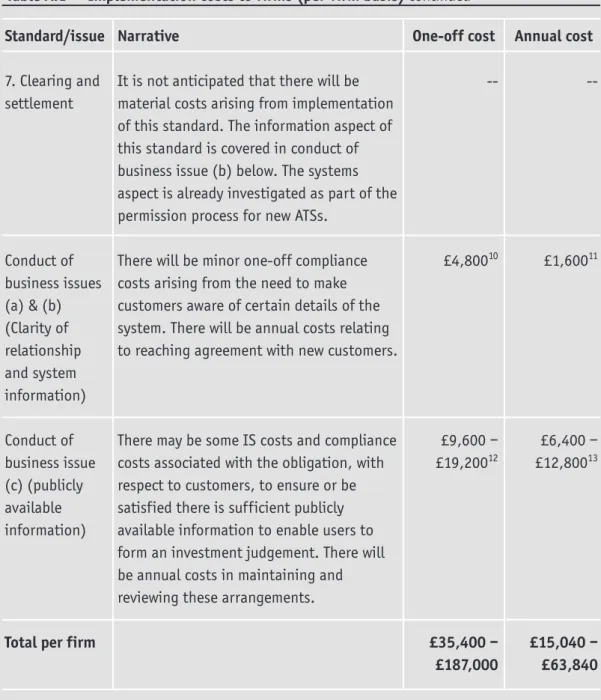
5.4 For implementation costs to firms, we estimate the cost of the Standards for each firm as within the ranges £35,400–£187,000 one-off costs, and
£15,040–£63,840 per annum. We consider the likely costs for commodities firms, service companies and other kinds of firms operating ATSs to be similar.
5.5 On balance, we believe that the benefits of imposing the Standards would outweigh the costs.
Q 5.1 Do you have any comment on the cost-benefit analysis contained in Annex A?
The compatibility of the ATS regime with our general duties
5.6 Annex B contains a statement of why we think that imposing the Standards is compatible with our general duties, i.e. with our duties:
• to act, so far as is reasonably possible, in a way which:
a) is compatible with the regulatory objectives as set out in section 2 of FSMA; and
b) we consider the most appropriate for the purpose of meeting those objectives; and
• to have regard to the principles of good regulation as set out in section 2. Q 5.2 Do you have any comment on the compatibility statement
Cost-benefit analysis
Annex A
Introduction
1 Cost-benefit analysis (CBA) assesses the economic costs and benefits of a proposed policy. In proposing new rules or general guidance on rules, we are obliged (under section 155 of FSMA) to publish a CBA, unless we consider that, making the appropriate comparison, there will be no increase in costs, or that any increase in costs will be of minimal significance. The appropriate comparison in this instance requires a comparison between the overall position if the rules are made and the overall position if they are not. The CBA should contain an estimate of the costs, and an analysis of the benefits, arising from the proposals. We seek to give quantitative estimates of costs, unless it is not reasonably possible to do so.
Benefits
2 We expect the main benefits of implementing the standards as proposed would be as follows.
3 We anticipate greater use of ATSs generally. This would arise from increased confidence among potential users that operators comply with good practice in respect of systems and controls, the monitoring of user activity, arrangements for reporting of suspect transactions, clarity of clearing and settlement
arrangements and provision of system and investment information. The standards relevant to this expected benefit are Standards 4, 5, 6, 7 and conduct of business issue (b).
4 We would anticipate increased competition between ATSs and between ATSs and other execution venues (such as recognised investment exchanges or regulated markets). This would arise from greater comparability of prices and spreads, and from greater awareness on the part of market participants and
end users of the different possibilities for execution. The relevant standards here are Standards 2 and 3.
5 Eventually, we expect greater transparency of ATSs to result in greater competition between intermediaries on quoted spreads and on method and timeliness of execution. This would lead to lower transaction costs to end users including retail investors. Again, the relevant standard here is
Standard 3.
6 We also expect an increase in informational efficiency through a lessening of trading in transparent markets on the basis of information about trades only known to direct users of opaque ATSs. This trading is done at the expense of direct and indirect users of transparent venues who do not have access to prices discovered on such ATSs. We would anticipate increased trading volumes across execution platforms to the extent that investors would have minimised trade for this reason in the past. Note, however, that this benefit will be lessened to the extent that ATSs take advantage of block trading exceptions (see proposed MAR 5.4.8G). Relevant standards here are Standards 3, 4 and 5.
7 We expect ATS operators and financial information intermediaries and consumers to benefit from an expanded market for order, quote and trade information and the consolidation of this information with similar
information from other execution venues. ATSs themselves will benefit from increased revenues arising from publication of trade information, where they use the option to make it available at commercial rates. We think such publication may also stimulate the provision of new data aggregation and intermediation services. Standard 3 is relevant to this benefit.
8 We believe that addressing the conduct of business issues will lead to a reduction in the risk of clients mis-buying ATS services and securities
generally. This is because ATS operators will be required to provide standard information about their firms and services, and to ensure that investors have adequate access to information about traded securities. Conduct of business issues (a), (b) and (c) are all relevant here.
Costs
9 Costs arising from the proposals can be broken down into costs to ATSs, costs to users, market impacts, and our costs, as set out in more detail below.
10 Many ATSs already embrace all or some of the standards as good practice; to that extent costs already incurred are not attributable to the standards
Costs to ATSs
11 ATSs can be expected to incur some costs as a result of our proposals, in particular:
• implementation costs, i.e., changes to support the requirements on notification, publication of trading information, monitoring of improper trading activity, arrangements with the regulator, user agreements and publicly available information; and
• potentially, costs associated with loss of business, as users who seek to continue to trade in secrecy move their business from ATSs to other trading venues including voice brokers and trading platforms in non-EEA jurisdictions.
User costs
12 There may be certain costs incurred directly by users associated with the proposals, including:
• trading costs to firms (whether direct or indirect users of ATSs) arising from potential ‘leakage’ of information about large positions to the market generally via transparency requirements and consequent market movements; and
• potentially, higher trading costs arising from any reduction in liquidity on ATSs, if there is significant diversion of order flow away from ATSs and towards more costly execution platforms.
Market impacts
13 More generally, there may potentially be some negative market impacts, such as:
• a lesser number of trades conducted on ATS if trading costs (including costs arising from market movements) increase appreciably; and • reduced variety of services on offer as similar transparency and other
standards lower service differentiation between ATSs and between ATSs and exchanges.
FSA costs
14 We already supervise ATSs, but expect to incur additional costs in servicing the more detailed requirements to be placed on them as a result of our proposals. We expect our main additional costs to be in the areas of:
• policy support and revision in relation to implementing and maintaining the standards;
1 For the purposes of these calculations, we have assumed the use of external contractors, with employee salary levels of £40,000 per annum for a compliance officer, £50,000 per annum for an IT consultant, and £60,000 per annum for a lawyer. To arrive at a per-diem rate for each of these contractors, we have assumed an overhead factor of 100% and a 250 day working year, as well as a total cost plus profit mark-up of 50%. Where we assume the use of in-house personnel, the 50% profit mark-up does not apply.
These assumptions give contractor per-diem rates of £480 per day (= (£40,000+ (1.00*£40,000))*1.5)/250) for a compliance officer, £600 per day for an IT consultant and £720 per day for a lawyer. For in-house staff, the assumptions give a per-diem rate of £320 (= (£40,000+(1.00*£40,000))/250) for a compliance officer, £400 for an IT consultant and £480 for a lawyer.
• determining the practical content of high-level arrangements (by way of tools such as individual guidance or requirements on a firm’s Part IV permission) to supplement high-level rules, particularly transparency rules and arrangements with firms; and
• day-to-day supervision of new requirements, such as answering queries and correspondence, handling complaints and (if necessary) conducting investigations as to any breach of the requirements.
Estimate of costs
Size of sector
15 In part, arriving at an estimate of the costs and benefits of the proposed ATS regime depends on how large the sector is. The scope of the regime is, of course, a subject for consultation in this paper.
16 We believe there are around 25 ATSs currently under our supervision that are UK based that would be covered by the proposed regime. For the purpose of this CBA, this is what we take as the relevant group.
Quantifiable costs
17 We have estimated the implementation costs to firms associated with the standards, as well as the costs to ourselves. We set these out below in turn, analysed on a standard-by-standard basis. We base our figures on our best estimate of the additional costs, in terms of professional time and equipment,1
taken to implement these standards. The additional assumptions we make in relation to these estimates are that: (a) our relevant ATS group incorporates commodities derivative firms; (b) impacts on all ATSs are broadly similar; (c) the effect of the requirements on permission and rules options as discussed in chapter 4 is the same. Assumptions we make are discussed further below.
18 We estimate the implementation costs to firms as follows:
Table A.1 Implementation costs to firms (per-firm basis) Standard/issue 1. Notification 2. Fair and orderly trading 3. Publication of trading information Narrative
No major change is proposed to what already takes place as far as authorisation requirements and new systems are concerned.
There may be minor costs associated with keeping us updated with changes to system details.
This is anticipated to represent existing good practice among ATS operators with minimal direct cost impact on firms. This may have a cost impact. IS systems may need re-engineering to provide for public transparency. There may also be costs associated with (re)negotiating arrangements with information
intermediaries and with users to provide for the publication of this information. It is expected that ongoing maintenance of these arrangements would involve IS and compliance resources. One-off cost --2 --£0 – £89,0004 Annual cost £6403 --£0 – £7,2005
2 In the table, ‘--’ indicates that we estimate the cost as of no more than minimal significance.
3 Annual costs are estimated at two day’s in-house compliance officer time per annum, for updating existing information only.
4 Estimated one-off cost of engineering a feed to a website or information intermediary, and (re)negotiating
arrangements with information intermediary (where applicable) is up to 25 days of in-house IT consultant time, plus up to 50 days of contractor IT consultant time, plus up to 50 days of contractor compliance officer time, plus up to £25,000 equipment costs. Significantly lower figures could be expected where an ATS already provides a price and/or trade feed to an information intermediary or on a website, which merely requires ‘tweaking’. Note that the cost will be zero where the ATS operator is exempt from transparency requirements, i.e. where instruments are not traded elsewhere on an EEA exchange (see proposed MAR 5.4.5R(1)).
5 Estimated at up to 10 days of in-house compliance officer time, and up to 10 days in-house IT consultant time. Note that no account is taken here of any offsetting receipts of feed fees from information intermediaries. Note again that the cost will be zero to the extent that the ATS operator is exempt from transparency requirements.
6 One-off costs are estimated at up to 20 days contractor legal time and up to 20 days contractor compliance officer time. Firms that already comply with the standard will incur zero costs.
7 Annual costs are estimated at up to 20 days in-house legal time and up to 20 days in-house compliance officer time. Firms that already comply with the standard will incur zero costs.
8 Estimated at 10 to 25 days in-house IT consultant time, plus 20 to 50 days of contractor IT consultant time, plus between £5,000 and £10,000 equipment costs. The lower figures could be expected where an ATS already provides a monitoring service under an arrangement with an exchange, which merely requires ‘tweaking’.
9 Estimated at between 20 and 80 days in-house compliance officer time. This would be mainly in administration of any monitoring and reporting system, and in the processing of notifications to us. Note that we would expect these costs to come about from the implementation of the MA Directive in any case.
Table A.1 Implementation costs to firms (per-firm basis) continued Standard/issue 4. Monitoring of contractual rules 5. Arrangements with regulators 6. Systems Narrative
We anticipate some relevant firms are already in a position to monitor compliance with contractual rules. There may in some cases be re-documentation costs associated with enabling ATS operators to take action (such as discontinuing access) against users for misuse of the system.
There may also be annual costs associated with the compliance and legal functions so as to be able to monitor for and investigate breaches of contractual rules, where this does not already happen.
There are potential IS and compliance officer costs associated with installing software and systems to support this standard.
There are also potential ongoing costs in terms of extra compliance officer time for identifying and communicating suspected market abuse matters.
No change is proposed to existing Handbook material. One-off cost £0 – £24,0006 £21,000 – £50,0008 --Annual cost £0 – £16,0007 £6,400 -£25,6009