OCCI-WG Andy Edmonds, Intel April 7, 2011 Errata Update: June 21, 2011
Open Cloud Computing Interface - Infrastructure
Status of this Document
This document provides information to the community regarding the specification of the Open Cloud Com-puting Interface. Distribution is unlimited.
Copyright Notice
Copyright cOpen Grid Forum (2009-2011). All Rights Reserved. Trademarks
OCCI is a trademark of the Open Grid Forum. Abstract
This document, part of a document series, produced by the OCCI working group within the Open Grid Forum (OGF), provides a high-level definition of a Protocol and API. The document is based upon previously gathered requirements and focuses on the scope of important capabilities required to support modern service offerings.
Contents
1 Introduction 3 2 Notational Conventions 3 3 Infrastructure 4 3.1 Compute . . . 5 3.2 Network . . . 5 3.2.1 IPNetworking Mixin . . . 6 3.3 Storage . . . 73.4 Linking Infrastructure Resources . . . 8
3.4.1 Linking to Network . . . 8
3.4.2 Linking to Storage . . . 9
3.4.3 Linking to CDMI Managed Storage . . . 10
3.5 Infrastructure Templates . . . 10 3.5.1 OS Template . . . 10 3.5.2 Resource Template . . . 11 4 Security Considerations 12 5 Glossary 13 6 Contributors 13
7 Intellectual Property Statement 15
8 Disclaimer 15
1
Introduction
The Open Cloud Computing Interface (OCCI) is a RESTful Protocol and API for all kinds of management tasks. OCCI was originally initiated to create a remote management API for IaaS1 model-based services, allowing for the development of interoperable tools for common tasks including deployment, autonomic scaling and monitoring. It has since evolved into a flexible API with a strong focus on interoperability while still offering a high degree of extensibility. The current release of the Open Cloud Computing Interface is suitable to serve many other models in addition to IaaS, including PaaS and SaaS.
In order to be modular and extensible the current OCCI specification is released as a suite of complimentary documents, which together form the complete specification. The documents are divided into three categories consisting of the OCCI Core, the OCCI Renderings and the OCCI Extensions.
• The OCCI Core specification consists of a single document defining the OCCI Core Model. The OCCI Core Model can be interacted withrenderings (including associated behaviours) and expanded through
extensions.
• The OCCI Rendering specifications consist of multiple documents each describing a particular rendering of the OCCI Core Model. Multiple renderings can interact with the same instance of the OCCI Core Model and will automatically support any additions to the model which follow the extension rules defined in OCCI Core.
• The OCCI Extension specifications consist of multiple documents each describing a particular extension of the OCCI Core Model. The extension documents describe additions to the OCCI Core Model defined within the OCCI specification suite. They do not require changes to the HTTP Rendering specifications as of this version of the specification.
The current specification consists of three documents. This specification describes version 1.1 of OCCI. Future releases of OCCI may include additional rendering and extension specifications. The documents of the current OCCI specification suite are:
OCCI Core describes the formal definition of the the OCCI Core Model [1].
OCCI HTTP Rendering defines how to interact with the OCCI Core Model using the RESTful OCCI API
[2]. The document defines how the OCCI Core Model can be communicated and thus serialised using the HTTP protocol.
OCCI Infrastructure contains the definition of the OCCI Infrastructure extension for the IaaS domain [3].
The document defines additional resource types, their attributes and the actions that can be taken on each resource type.
OCCI makes an ideal interoperable boundary interface between the web and the internal resource management system of infrastructure providers.
2
Notational Conventions
All these parts and the information within are mandatory for implementors (unless otherwise specified). The key words ”MUST”, ”MUST NOT”, ”REQUIRED”, ”SHALL”, ”SHALL NOT”, ”SHOULD”, ”SHOULD NOT”, ”RECOMMENDED”, ”MAY”, and ”OPTIONAL” in this document are to be interpreted as described in RFC 2119 [4].
3
Infrastructure
The OCCI Infrastructure document details how an OCCI implementation can model and implement an In-frastructure as a Service API offering by utilising the OCCI Core Model. This API allows for the creation and management of typical resources associated with an IaaS service, for example, creating a Computeinstance andStorageinstance and then linking them with StorageLink. The main infrastructure types defined within OCCI Infrastructure are:
Compute Information processing resources.
Network Interconnection resource and represents a L2 networking resource. This is complimented by the
IPNetwork Mixin.
Storage Information recording resources.
Supporting these Resource types are the followingLinksub-types:
NetworkInterface connects a Compute instance to a Network instance. This complimented by an
IPNet-workInterface Mixin.
StorageLink connects a Computeinstance to aStorageinstance.
Link (from occi :: core ) Resource
(from occi ::core )
+ summary :String [0..1 ] StorageLink + occi.storagelink.deviceid :String + occi.storagelink.mountpoint :String [0..1 ] + occi.storagelink.state :Enum Storage + occi.storage.size :int + occi.storage.state :Enum NetworkInterface + occi.networkinterface.interface :String + occi.networkinterface.mac :String + occi.networkinterface.state :Enum Network + occi.network.vlan :Integer [0..1 ] + occi.network.label :Token [0..1 ] + occi.network.state :Enum Compute + occi.compute.architecture :Enum [0..1 ] + occi.compute.cores :Integer [0..1 ] + occi.compute.hostname :String [0..1 ] + occi.compute.speed :Float [0..1 ] + occi.compute.memory :Float [0..1 ] + occi.compute.state :Enum cd: Infrastructure target source + * links
Figure 1. Overview Diagram of OCCI Infrastructure Types.
These infrastructure types inherit the OCCI Core ModelResourcebase type and all their attributes. The HTTP Rendering document [2] defines how to serialise and interact with these types using RESTful communication. Implementers are free to choose what ResourceandLinksub-types to implement. Those that are supported by an implementation will be discoverable through the OCCI Query Interface.
As REQUIRED by the OCCI Core Model specification, every type instantiated that is a sub-type ofResource or Link MUST be assigned a Kind that identifies the instantiated type. Each such Kind instance MUST be related to the Resource or Link base type’s Kind. That assigned Kind instance MUST always remain immutable to any client.
Table 1 describes theKind instances defined for each of the infrastructure Resource orLink sub-types. For information on extending these types, please refer to the OCCI Core Model document [1].
The following sections on Compute, Storage and Network types detail the attributes, Actions and states defined for each of them, including type-specific mixins (IPNetwork and IPNetworkInterface) where appro-priate. Following those, the definition of infrastructure-related Link sub-types are given and finally OS and Resource Templates are defined. Figure 1 gives an overview of the various types involved in this infrastructure specification.
Table 1. TheKindinstances defined for the infrastructure sub-types ofResource,Linkand relatedMixins. The base URL http://schemas.ogf.org/occihas been replaced with<schema>in this table for a better readability experience.
Term Scheme Title RelatedKind
compute <schema>/infrastructure# ComputeResource <schema>/core#resource
storage <schema>/infrastructure# StorageResource <schema>/core#resource
storagelink <schema>/infrastructure# StorageLinkLink <schema>/core#link
network <schema>/infrastructure# NetworkResource <schema>/core#resource
ipnetworking <schema>/infrastructure/network# IP NetworkingMixin –
networkinterface <schema>/infrastructure# NetworkInterfaceLink <schema>/core#link ipnetworkinterface <schema>/infrastucture/networkinterface# IP NetworkInterfaceMixin –
3.1
Compute
The Compute type represents a generic information processing resource, e.g. a virtual machine. Compute inherits the Resource base type defined in OCCI Core Model [1]. Compute is assigned the Kind instance
http://schemas.ogf.org/occi/infrastructure#compute. AComputeinstance MUST use and expose thisKind.
Table 2. Attributes defined for theComputetype.
Attribute Type
Multi-plicity
Mutability Description
occi.compute.architecture Enum{x86, x64} 0. . . 1 Mutable CPU Architecture of the instance.
occi.compute.cores Integer 0. . . 1 Mutable Number of CPU cores assigned to the instance.
occi.compute.hostname String 0. . . 1 Mutable Fully Qualified DNS hostname for the instance.
occi.compute.speed Float,109(GHz) 0. . . 1 Mutable CPU Clock frequency (speed) in gigahertz.
occi.compute.memory Float,109(GiB) 0. . . 1 Mutable Maximum RAM in gigabytes allocated to the
in-stance.
occi.compute.state Enum{active,
inac-tive, suspended}
1 Immutable Current state of the instance.
Table 2 describes the attributes2 defined byCompute through itsKind instance. These attributes MUST be exposed by an instance of theComputetype.
Table 3. Actions applicable to instances of the Compute type. The Actions are defined by the Kind instance
http://schemas.ogf.org/occi/infrastructure#compute. EveryActionin the table is identified by aCategoryinstance using the
http://schemas.ogf.org/occi/infrastructure/compute/action# categorisation scheme. “Action Term” below refers to the term of theAction’sCategoryidentifier.
Action Term Target state Attributes
start active –
stop inactive method={graceful, acpioff, poweroff}
restart active (via stop and start chain) method={graceful, warm, cold}
suspend suspended method={hibernate, suspend}
Table 3 describes the Actions defined forCompute by its Kind instance. These Actions MUST be exposed by an instance of theComputetype of an OCCI implementation. Figure 2 illustrates the state diagram for a Computeinstance.
3.2
Network
The Network type represents a L2 networking entity (e.g. a virtual switch). It can be extended using the mixin mechanism (or sub-typed) to support L3/L4 capabilities such as TCP/IP etc. For the purposes of this specification we define an OCCI mixin so that IP networking can be supported where required. Network inherits theResourcebase type defined in OCCI Core Model [1].
Figure 2. State Diagram for aComputeinstance.
The Network type is assigned the http://schemas.ogf.org/occi/infrastructure#network Kind. A Network instance MUST use and expose thisKind.
Table 4. Attributes defined for theNetworktype.
Attribute Type Multiplicity Mutability Description
occi.network.vlan Integer: 0-4095 0. . . 1 Mutable 802.1q VLAN Ientifier (e.g. 343).
occi.network.label Token 0. . . 1 Mutable Tag based VLANs (e.g. external-dmz).
occi.network.state Enum{active, inactive} 1 Immutable Current state of the instance.
Table 4 describes the attributes3 defined byNetwork through itsKind instance. These attributes MUST be exposed by an instance of theNetworktype.
Table 5. Actions applicable to instances of the Network type. The Actions are defined by the Kind instance
http://schemas.ogf.org/occi/infrastructure#network. EveryActionin the table is identified by a Categoryinstance using the
http://schemas.ogf.org/occi/infrastructure/network/action#categorisation scheme. “Action Term” below refers to the term of theAction’sCategoryidentifier.
Action Term Target State Attributes
up active –
down inactive –
Table 5 describes the Actions defined forNetwork by itsKind instance. These Actions MUST be exposed by an instance of theNetwork type of an OCCI implementation. Figure 3 illustrates the state diagram for a Networkinstance.
Figure 3. State Diagram for aNetworkinstance.
3.2.1 IPNetworking Mixin
In order to support L3/L4 capabilities (e.g. IP, TCP etc.) an OCCI mixin is herewith defined.
TheIPNetworkingmixin is assigned4the “scheme” ofhttp://schemas.ogf.org/occi/infrastructure/network# and the “term” value ipnetwork. AnIPNetworkingmixin MUST support these values.
3See the “attributes” attribute defined by theCategorytype and inherited byKind[1]. 4Both assignments use data members from the inheritedCategorytype [1].
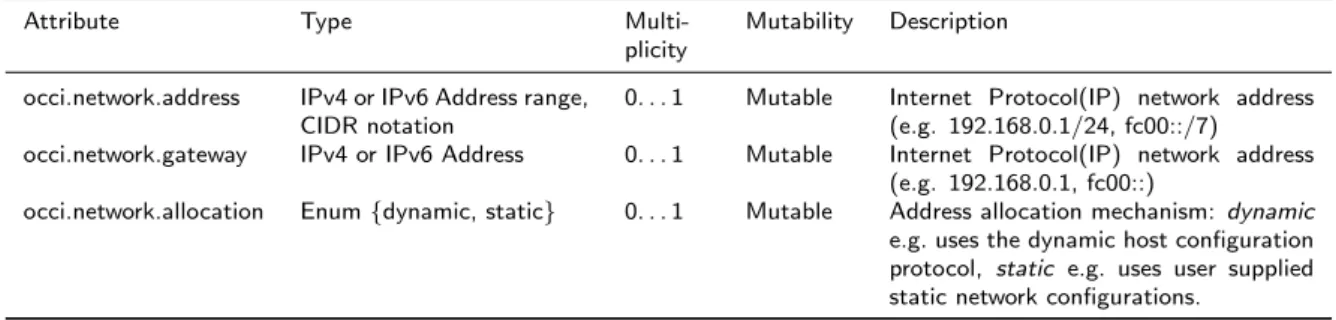
Table 6 define the attributes introduced by theIPNetworkingmixin. ANetworkinstance associated with the IPNetworkingmixinMixininstance MUST implement these attributes.
Table 6. Attributes defined by theIPNetworkingmixin. ANetworkinstance associated with thisMixininstance MUST expose these attributes.
Attribute Type
Multi-plicity
Mutability Description
occi.network.address IPv4 or IPv6 Address range, CIDR notation
0. . . 1 Mutable Internet Protocol(IP) network address (e.g. 192.168.0.1/24, fc00::/7)
occi.network.gateway IPv4 or IPv6 Address 0. . . 1 Mutable Internet Protocol(IP) network address
(e.g. 192.168.0.1, fc00::)
occi.network.allocation Enum{dynamic, static} 0. . . 1 Mutable Address allocation mechanism: dynamic
e.g. uses the dynamic host configuration protocol, static e.g. uses user supplied static network configurations.
In Figure 4 a UML object diagram depicts howNetwork would be associated with an IPNetworkMixinwhen both are instantiated.
occi.network.vlan = 431 occi.network.label = private occi.network.state = active occi.network.address = 192.168.1.1/24 occi.network.gateway = 192.168.1.1 occi.network.allocation = dynamic net2 : Network occi.network.vlan = 332 occi.network.label = dmz occi.network.state = active net1 : Network without Mixin with Mixin term = ipnetwork scheme = http://schemas.ogf.org/occi/ infrastructure/network#
title = "An IP Network Mixin"
IPNetwork : Mixin
Figure 4. Object Diagram of aNetworkInstance and its AssociatedIPNetwork Mixin.
3.3
Storage
TheStoragetype represent resources that record information to a data storage device. Storageinherits the Resource base type defined in the OCCI Core Model [1]. The Storage type is assigned the Kind instance
http://schemas.ogf.org/occi/infrastructure#storage. AStorageinstance MUST use and expose thisKind.
Table 7. Attributes defined for theStoragetype.
Attribute Type Multiplicity Mutability Description
occi.storage.size Float,109 (GiB) 1 Mutable Storage size in gigabytes of the instance.
occi.storage.state Enum{online, offline, backup, snapshot, re-size, degraded}
1 Immutable Current status of the instance.
Table 7 describes the attributes5 defined by Storage through itsKind instance. These attributes MUST be exposed by an instance of theStoragetype.
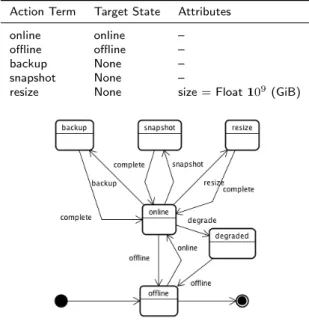
Table 8 describes the Actions defined for Storage by its Kind instance. These Actions MUST be exposed by an instance of the Storagetype of an OCCI implementation. Figure 5 illustrates the state diagram for a Storageinstance.
Table 8. Actions applicable to instances of the Storage type. The Actions are defined by the Kind instance
http://schemas.ogf.org/occi/infrastructure#storage. EveryActionin the table is identified by aCategoryinstance using the
http://schemas.ogf.org/occi/infrastructure/storage/action#categorisation scheme. “Action Term” below refers to the term of theAction’sCategoryidentifier.
Action Term Target State Attributes
online online –
offline offline –
backup None –
snapshot None –
resize None size = Float109(GiB)
Figure 5. State Diagram for aStorageinstance.
OCCI can be used in conjunction with the SNIA cloud storage standard, Cloud Data Management Interface (CDMI) [5] to provide enhanced management of the cloud computing storage and data. For storage managed through CDMI, see the section onStorageLink
3.4
Linking Infrastructure Resources
In order to create entities like virtual data centres or virtual clusters, it is necessary to allow the linkage of the previously defined infrastructureResourcesub-types. This is accomplished by extending (sub-typing) the OCCI Core ModelLinkbase type. This is done as theLinkbase type cannot fully represent specific types of infrastructure links (e.g. links to storage or networks). These infrastructure links require additional attributes (e.g. network interface name) which can only be supported by sub-typing theLinkbase type.
3.4.1 Linking to Network
TheNetworkInterfacetype represents an L2 client device (e.g. network adapter). It can be extended using the mix-in mechanism or sub-typed to support L3/L4 capabilities such as TCP/IP etc. NetworkInterfaceinherits theLinkbase type defined in the OCCI Core Model [1].
TheNetworkInterfacetype is assigned theKindinstancehttp://schemas.ogf.org/occi/infrastructure#networkinterface. ANetworkInterfaceinstance MUST use and expose this Kind. TheKind instance assigned to the
Network-Interfacetype MUST be related to thehttp://schemas.ogf.org/occi/core#link Kind.
Table 9 describes the attributes6 defined by NetworkInterfacethrough its Kind instance. These attributes MUST be exposed by an instance of theNetworkInterfacetype. Figure 6 illustrates the state diagram for a NetworkInterfaceinstance.
3.4.1.1 IPNetworkInterface Mixin In order to support L3/L4 capabilities (e.g. IP, TCP etc.) with the
NetworkInterfacetype, an OCCIMixininstance is herewith defined.
Table 9. Attributes defined for theNetworkInterfacetype.
Attribute Type Multiplicity Mutability Description
occi.networkinterface.interface String 1 Immutable Identifier that relates the link to the
link’s device interface
occi.networkinterface.mac String 1 Mutable MAC address associated with the link’s
device interface occi.networkinterface.state Enum{active,
inactive}
1 Immutable Current status of the instance.
Figure 6. State Diagram for aNetworkInterfaceinstance.
TheIPNetworkInterfacemixin is assigned7the “scheme” ofhttp://schemas.ogf.org/occi/infrastructure/networkinterface#
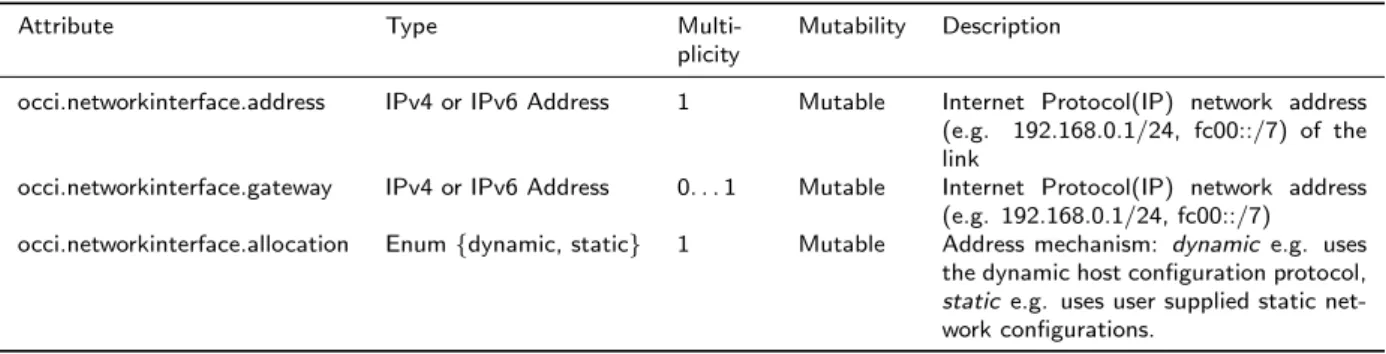
and the “term” value ipnetworkinterface. AnIPNetworkInterface mixin MUST support these attributes. Table 10 define the attributes introduced by the IPNetworkInterface mixin. A NetworkInterface instance associated with theIPNetworkInterfacemixinMixininstance MUST expose these attributes.
Table 10. Attributes defined by theIPNetworkInterfacemixin. ANetworkInterfaceinstance associated with thisMixininstance MUST expose these attributes.
Attribute Type
Multi-plicity
Mutability Description
occi.networkinterface.address IPv4 or IPv6 Address 1 Mutable Internet Protocol(IP) network address
(e.g. 192.168.0.1/24, fc00::/7) of the link
occi.networkinterface.gateway IPv4 or IPv6 Address 0. . . 1 Mutable Internet Protocol(IP) network address (e.g. 192.168.0.1/24, fc00::/7)
occi.networkinterface.allocation Enum{dynamic, static} 1 Mutable Address mechanism: dynamic e.g. uses
the dynamic host configuration protocol,
static e.g. uses user supplied static net-work configurations.
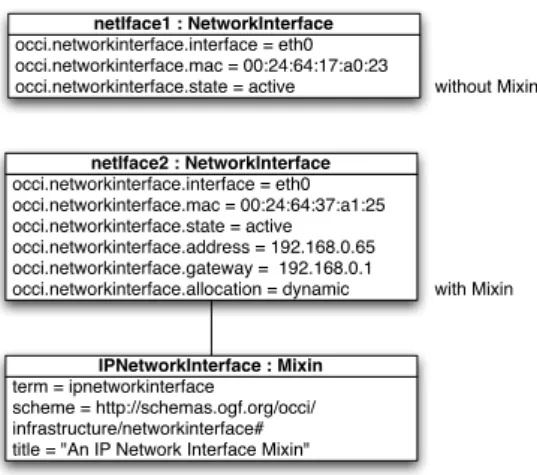
In Figure 7 a UML object diagram depicts howNetworkInterfacewould be associated with an IPNetworkIn-terface Mixinwhen both are instantiated.
3.4.2 Linking to Storage
TheStorageLinktype represents a link from aResourceto a target Storageinstance. This enables a Storage instance be attached to a Compute instance, with all the prerequisite low- level operations handled by the OCCI implementation. Storage inherits theLinkbase type defined in the OCCI Core Model [1].
TheStorageLinktype is assigned theKindinstancehttp://schemas.ogf.org/occi/infrastructure#storagelink. AStorageLinkinstance MUST use and expose thisKind. TheKindinstance assigned to theStorageLinktype MUST be related to thehttp://schemas.ogf.org/occi/core#link Kind.
Table 11 describes the attributes8defined byStorageLinkthrough itsKindinstance. These attributes MUST be exposed by an instance of the StorageLinktype. Figure 8 illustrates the state diagram for aStorageLink instance.
7Both assignments use data members from the inheritedCategorytype [1].
occi.networkinterface.interface = eth0 occi.networkinterface.mac = 00:24:64:37:a1:25 occi.networkinterface.state = active occi.networkinterface.address = 192.168.0.65 occi.networkinterface.gateway = 192.168.0.1 occi.networkinterface.allocation = dynamic netIface2 : NetworkInterface occi.networkinterface.interface = eth0 occi.networkinterface.mac = 00:24:64:17:a0:23 occi.networkinterface.state = active netIface1 : NetworkInterface without Mixin with Mixin term = ipnetworkinterface scheme = http://schemas.ogf.org/occi/ infrastructure/networkinterface# title = "An IP Network Interface Mixin"
IPNetworkInterface : Mixin
Figure 7. Object Diagram of aNetworkInterfaceInstance and its Associated IPNetworkInterfaceMixin.
Table 11. Attributes defined for theStorageLinktype.
Attribute Type
Multi-plicity
Mutability Description
occi.storagelink.deviceid String 1 Mutable Device identifier as defined by the OCCI
service provider.
occi.storagelink.mountpoint String 0. . . 1 Mutable Point to where the storage is mounted in
the guest OS.
occi.storagelink.state Enum{active,
inactive}
1 Immutable Current status of the instance.
Figure 8. State Diagram for aStorageLinkinstance.
3.4.3 Linking to CDMI Managed Storage
As previously stated, OCCI can be used in conjunction with the SNIA cloud storage standard, Cloud Data Management Interface (CDMI) [5] to provide enhanced management of the cloud computing storage and data. In order to integrate the two, the use of StorageLink should be used. This will link OCCI managed Resources to CDMI resources. The ’occi.storagelink.deviceid’ attribute ofStorageLink, defined above, should be set to the CDMI Object ID of an exported CDMI Container.
3.5
Infrastructure Templates
Infrastructure Templates allow clients of an OCCI implementation to quickly and conveniently apply pre-defined configurations to OCCI Infrastructure pre-defined types. They are implemented using Mixininstances. There are 2 supported infrastructure template types in OCCI Infrastructure.
3.5.1 OS Template
OS (Operating System) Templates allow clients specific what operating system must be installed on a re-questedComputeresource. OCCI implementations SHOULD support this, otherwise what they provision will
be merely offerResources without any available execution environment (e.g. operating system). Of the two supported template types, this is the most basic and necessary template that a provider SHOULD offer. Its construction is aMixininstance consisting of a provider specific “scheme” and a descriptive “title” detailing the OS. The “term” value of the templateMixinis a provider-specific identifier that corresponds to a particular virtual machine image configuration. Where an implementation requires additional attributes associated with the OS Template, it can do so using “attributes” value inherited from theCategory type.
A implementation-defined OS TemplateMixinMUST be related to the OCCI OS TemplateMixinin order to give absolute type information.
The OCCI OS Template is defined by thehttp://schemas.ogf.org/occi/infrastructure#os tplMixinand MUST be supported SHOULD OS Templates be offered by the OCCI implementation.
occi.compute.cores = 2 occi.compute.memory = 0.5 c1 : Compute term = ubuntu-9.10 scheme = http://provider.com/templates/os# ubuntu : Mixin term = compute scheme = http://schemas.ogf.org/occi/infrastructure# cmp : Kind term = os_tpl scheme = http://schemas.ogf.org/occi/infrastructure# os_tpl : Mixin related
Figure 9. Object Diagram of aComputeInstance and its Associated OS TemplateMixin.
A typical example of using such aMixinis shown in figure 9 using a UML object diagram. In the example a provider has defined an OS template which offers the ability to run Ubuntu Linux, verson 9.10, upon a client’s provisioned compute resource.
How a provider manages their set of OS templates will be determined by themselves and so implementation-specific.
3.5.2 Resource Template
The Resource TemplateMixinbuilds upon the concept of OS Templates. A Resource Template is a provider-definedMixininstance that refers to a presetResourceconfiguration.
The presetResourceconfiguration is not visable through the OCCI Discovery mechanism. TheMixin.attributes
(inherited from Category) is empty for a Resource Template Mixin. The side-effect of initialisingResource attributes with pre-defined values is handled by the implementation.
The OCCI implementation associates a set of Resource attributes (viaCategory’s ’attributes’) with a particular term identifier.
An implementation-defined Resource TemplateMixinMUST be related to the OCCI Resource TemplateMixin in order to give absolute type information. The OCCI Resource Template is defined by the Mixininstance
http://schemas.ogf.org/occi/infrastructure#resource tpl and MUST be supported SHOULD Resource Tem-plates be offered by the OCCI implementation.
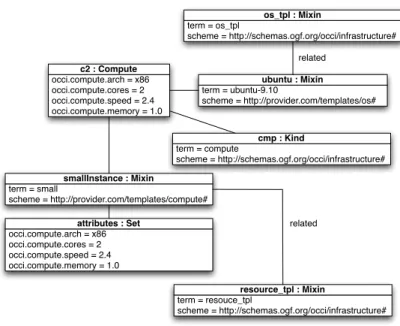
A typical example of such aMixin’s use is shown in figure 10) using a UML object diagram. In this example, the provider offersCompute Resources based on different sizes (i.e. small, medium, large). Each “size” of Compute (i.e. the term) corresponds to a predetermined set of OCCI Resource-specific attributes. In the example below a ’small’ Compute instance is created. Specifying ”small” as the term corresponds to an implementation-specificCompute Resource-specific attribute set9that is shown by the object instance named “attributes” in figure 10.
From the administrative point of view, how an OCCI service provider manages their set ofResourceTemplates will be determined by themselves and so is implementation-specific.
occi.compute.arch = x86 occi.compute.cores = 2 occi.compute.speed = 2.4 occi.compute.memory = 1.0 c2 : Compute term = ubuntu-9.10 scheme = http://provider.com/templates/os# ubuntu : Mixin term = compute scheme = http://schemas.ogf.org/occi/infrastructure# cmp : Kind term = small scheme = http://provider.com/templates/compute# smallInstance : Mixin occi.compute.arch = x86 occi.compute.cores = 2 occi.compute.speed = 2.4 occi.compute.memory = 1.0 attributes : Set term = os_tpl scheme = http://schemas.ogf.org/occi/infrastructure# os_tpl : Mixin related term = resouce_tpl scheme = http://schemas.ogf.org/occi/infrastructure# resource_tpl : Mixin related
Figure 10. Object Diagram of aComputeInstance and its Associated OS TemplateMixinand Resource TemplateMixin.
4
Security Considerations
The OCCI Infrastructure specification is an extension to the OCCI Core and Model specification [1]; thus the same security considerations as for the OCCI Core and Model specification apply here.
5
Glossary
Term Description
Action An OCCI base type. Represent an invocable operation on aEntitysub-type instance or collection thereof.
Category A type in the OCCI model. The parent type ofKind.
Client An OCCI client.
Collection A set of Entity sub-type instances all associated to a particular Kind or Mixin instance.
Entity An OCCI base type. The parent type ofResourceandLink.
Kind A type in the OCCI model. A core component of the OCCI classification system. Link An OCCI base type. ALinkinstance associate oneResourceinstance with another. mixin An instance of theMixintype associated with aresource instance. The “mixin”
concept as used by OCCIonlyapplies to instances, never toEntity types. Mixin A type in the OCCI model. A core component of the OCCI classification system.
OCCI Open Cloud Computing Interface.
OCCI base type One ofEntity,Resource,Linkor Action.
OGF Open Grid Forum.
Resource An OCCI base type. The parent type for all domain-specific resource types. resource instance An instance of a sub-type of Entity. The OCCI model defines two sub-types of
Entity, theResourcetype and theLinktype. However, the termresource instance
is defined to include any instance of asub-typeofResourceorLinkas well. Tag AMixininstance with no attributes or actions defined.
Template A Mixin instance which if associated at resource instantiation time pre-populate certain attributes.
type One of the types defined by the OCCI model. The OCCI model types areCategory, Kind, Mixin, Action,Entity,ResourceandLink.
concrete type/sub-type A concrete type/sub-type is a type that can be instantiated.
URI Uniform Resource Identifier.
URL Uniform Resource Locator.
URN Uniform Resource Name.
We would like to thank the following people who contributed to this document:
Name Affiliation Contact
Michael Behrens R2AD behrens.cloud at r2ad.com
Mark Carlson Oracle mark.carlson at oracle.com
Andy Edmonds Intel - SLA@SOI project andy at edmonds.be
Sam Johnston Google samj at samj.net
Gary Mazzaferro OCCI Counselour - AlloyCloud, Inc. garymazzaferro at gmail.com Thijs Metsch Platform Computing, Sun
Mi-crosystems
tmetsch at platform.com
Ralf Nyr´en Aurenav ralf at nyren.net
Alexander Papaspyrou TU Dortmund University alexander.papaspyrou at tu-dortmund.de
Alexis Richardson RabbitMQ alexis at rabbitmq.com
Shlomo Swidler Orchestratus shlomo.swidler at orchestratus.com Next to these individual contributions we value the contributions from the OCCI working group.
7
Intellectual Property Statement
The OGF takes no position regarding the validity or scope of any intellectual property or other rights that might be claimed to pertain to the implementation or use of the technology described in this document or the extent to which any license under such rights might or might not be available; neither does it represent that it has made any effort to identify any such rights. Copies of claims of rights made available for publication and any assurances of licenses to be made available, or the result of an attempt made to obtain a general license or permission for the use of such proprietary rights by implementers or users of this specification can be obtained from the OGF Secretariat.
The OGF invites any interested party to bring to its attention any copyrights, patents or patent applications, or other proprietary rights which may cover technology that may be required to practice this recommendation. Please address the information to the OGF Executive Director.
8
Disclaimer
This document and the information contained herein is provided on an “As Is” basis and the OGF disclaims all warranties, express or implied, including but not limited to any warranty that the use of the information herein will not infringe any rights or any implied warranties of merchantability or fitness for a particular purpose.
9
Full Copyright Notice
Copyright cOpen Grid Forum (2009-2011). All Rights Reserved.
This document and translations of it may be copied and furnished to others, and derivative works that comment on or otherwise explain it or assist in its implementation may be prepared, copied, published and distributed, in whole or in part, without restriction of any kind, provided that the above copyright notice and this paragraph are included on all such copies and derivative works. However, this document itself may not be modified in any way, such as by removing the copyright notice or references to the OGF or other organizations, except as needed for the purpose of developing Grid Recommendations in which case the procedures for copyrights defined in the OGF Document process must be followed, or as required to translate it into languages other than English.
The limited permissions granted above are perpetual and will not be revoked by the OGF or its successors or assignees.
References
[1] R. Nyr´en, A. Edmonds, A. Papaspyrou, and T. Metsch, “Open Cloud Computing Interface – Core,” GFD-P-R.183, April 2011. [Online]. Available: http://ogf.org/documents/GFD.183.pdf
[2] T. Metsch and A. Edmonds, “Open Cloud Computing Interface – HTTP Rendering,” GFD-P-R.185, April 2011. [Online]. Available: http://ogf.org/documents/GFD.185.pdf
[3] ——, “Open Cloud Computing Interface – Infrastructure,” GFD-P-R.184, April 2011. [Online]. Available: http://ogf.org/documents/GFD.184.pdf
[4] S. Bradner, “Key words for use in RFCs to Indicate Requirement Levels,” RFC 2119 (Best Current Practice), Internet Engineering Task Force, Mar. 1997. [Online]. Available: http://www.ietf.org/rfc/rfc2119.txt
[5] D. Slik, M. Siefer, E. Hibbard, C. Schwarzer, A. Yoder, L. N. Bairavasun-daram, S. Baker, M. Carlson, H. Nguyen, and R. Ramos, “Cloud data man-agement interface (cdmi) v1.0,” http://www.snia.org/, Apr. 2010. [Online]. Available: http://www.snia.org/tech activities/standards/curr standards/cdmi/CDMI SNIA Architecture v1.0.pdf