A P P L I C A T I O N S G U I D E
Laser Technology
Smoke Detector
1
Foreword
The purpose of this guide is to provide information concerning the proper application of smoke detectors used in conjunction with fire alarm systems. It outlines basic principles that should be considered in the application of early warning fire and smoke detection devices. Operating characteristics of detectors and environmental factors, which may aid, delay or prevent their operation, are presented.
Fire protection engineers, mechanical and electrical engineers, fire service personnel, fire alarm designers and installers should find the contents both educational and informa-tive.
Though this information is based upon industry expertise and many years of experience, it is intended to be used only as a technical guide. The requirements of applicable codes and standards, as well as directives of the Authorities Having Jurisdiction (AHJ’s) should be followed. In particular, NFPA 72 for installation and testing of systems is a key element in the effectiveness of smoke detection systems.
A P P L I C A T I O N S G U I D E
Laser Technology
Smoke Detector
Contents
Section 1
Introduction ...2
Section 2
Benefits ...2
Section 3
Applications ...2
Ideal Applications ...2
Applications to Avoid ...2
Section 4
How it Works ...3
The Principles of Laser Detection...3
Section 5
Performance ...4
Section 6
Codes and Standards ... 4–6
Section 7
Testing of Pinnacle ...6
Quality Assurance ...6
UL Gasoline Fire Test ...7
UL Heptane Fire Test ...7
Section 8
Pinnacle vs. Aspirating ...7
Section 9
Myth vs. Reality ...8
2
The rapid growth in tele-communications and com-puter technology and man-ufacturing has fueled a need for extremely early warning fire detection. Today a major fire is not required to create a major catastrophe.
Telecommunications facilities, data processing and com-puter rooms, clean rooms, traffic control centers — all can be easily shut down even in the presence of small amounts of smoke. And, in some of these environments, even a little downtime can mean a big disaster.
The sooner the fire can be detected, the lower the potential loss. That makes archives and museums where irreplace-able documents and artifacts are housed ideal candidates for early warning systems.
Laser technology makes good sense in any environment where there is a substantial cost of downtime or a
signifi-Versatility.
One detector can be used for detection of fast-flaming and slow-smoldering fires.
Pinpoint accuracy.
Identifies the precise location of the fire, reducing time to extinguish it.
Lower overall cost.
Reduced cost in installation and maintenance. The Pinnacle™ Laser Smoke
Detector senses the earliest particles of combustion. And that provides early warning of fire. Its high sensitivity is balanced with high stability to minimize false alarms. Like an ionization detector, Pinnacle quickly senses a fast-flaming fire. Like a photoelectric detector, it quickly senses a slow-smoldering fire. But unlike these detectors, Pinnacle can quickly identify both types of fire.
Its early warning perfor-mance is comparable to aspiration technology. In fact, independent tests have shown that Pinnacle responds as good as or bet-ter than traditional aspirating systems, without the cost of pipe installation. Unlike an aspirating system, Pinnacle can pinpoint the location of the fire. Faster response and pin-point accuracy can make the difference between a minor emergency and a major catastrophe.
A laser diode and precision optics make this detector super-sensitive to smoke — as much as 100 times more sensitive than a standard photoelectric sensor — with minimal potential for false alarms.
One might expect such a sensitive smoke detector to be subject to false alarms. Not so with Pinnacle. It uses pat-ented on-board algorithms to check for the presence of smoke before alarming. The results: super-sensitivity with solid stability.
Laser technology gives you fast response detection
in high sensitivity applications such as clean
rooms, telecommunications centers or computer
rooms — areas where any damage is too much.
Section 2
Benefits
Section 3
Applications
Section 1Introduction
Pinnacle works on the same principle as a photoelectric detector. When a particle of combustion crosses the light beam, it causes the light to scatter — which signals the alarm. But the difference between an LED (light emitting diode) beam and a laser beam is like the difference between a butter knife and a razor. The 100x sensitivity of this product means heads up to the first particle of com-bustion. This in itself is not enough to convince Pinnacle to signal an alarm.That’s where the patented algorithms come into play, dis-tinguishing between transient signals caused by airborne dust...and the first puff of smoke. Before these special algorithms were developed, laser detectors were useful only in extremely clean environments. No longer. By selecting the sensitivity of the detector in the control panel, Pinnacle can protect many environments where rapid response and pinpoint accuracy are critical.
Full adjustability means Pinnacle can be finely tuned to suit each local environment within a global system.
• Day/night sensitivity
• Dust/smoke discrimination
• Automatic test
• Maintenance alert
Rapid • Reliable • Reasonable cost
cant investment in installed equipment. To cut response time even further, this technology is best used where human interface is available.
Application Note: Pinnacle is listed as an open area smoke detector. Unless specific codes or standards exist to the contrary, standard guidelines for spacing and placement should be followed. Ideal Applications Telecommunications switching stations Computer rooms Clean rooms Hospitals Museums, archives and
historic buildings
Applications to avoid Cigar/cigarette smoke
Cooking fumes Condensed water vapor,
steam or fog High levels of airborne dust
Motor vehicle exhaust Welding or other processes that cause combustion particles Sensitivity.
Extremely high sensitivity with superior early warning performance.
Stability.
reflector captures scattered light up to 180 degrees around the beam, at a very low scattering angle. This low angle enhances the detection of smoke by improving the detec-tion signal. It also allows a reducdetec-tion in electronics gain in order to obtain better electrical interference performance while rejecting ambient interference.
Chamber Designed to Eliminate Background Noise
In a typical photoelectric detector, which uses a widely dispersed light beam from an LED, noise levels can be high. The laser beam, conversely, is extremely focused, concentrated and small (see Figure 1). When this light is received by a specially-designed light trap, Pinnacle achieves an even lower noise level.
Software Algorithms to Enhance Performance
In order to achieve rock-steady stability, Pinnacle incor-porates extensive on-board software processing including multi-alert drift compensation, internal self diagnostics, and superior transient signal rejection algorithms. With the use of sophisticated algorithms, the system can reject false alarm signals caused by large airborne particles such as dust, moisture, and small insects — even when set to extremely high sensitivity.
Dust Spike Rejection
If an individual detector registers a large signal spike, the algorithm recalls the values of the two previ-Currently there are two
smoke sensing technologies in wide use: ionization and photoelectric. Both technologies have different strengths. Ionization detectors detect fast-flaming fires well — but are not so quick with slow-smoldering fires. On the other hand, photoelectric detectors detect slow-smoldering fires well — but are not so quick with fast-flaming fires. Pinnacle is highly sensitive to both types of fire.
In order to improve the ability of photoelectric detectors to detect fast-flaming fires, engineers focused on two goals: boosting the signal and reducing noise, i.e., increasing the signal-to-noise ratio. More signal allows earlier warning and increases the ability to detect the extremely small smoke particles of an incipient fire, particles so small they cannot be easily detected by conventional photoelectric detectors. Meanwhile, reducing noise helps reduce the probability of a false alarm.
Pinnacle achieves these dual goals of high sensitivity and high stability by using an extremely bright laser diode — 10,000 times brighter than a standard LED — coupled with an optical amplifier that further concentrates the light into the photo sensor. This combination allows Pinnacle to detect both small and large particles — which allows it to quickly detect both fast-flaming and slow-smoldering fires. The narrow focus of the laser beam reduces the reflected light in the sensing chamber and results in a high signal-to-noise ratio (with noise defined as reflected light). The
S Y S T E M S E N S O R
3 The principles of laser
detection are similar to those of photoelectric tech-nology. In a photoelectric smoke detector, an LED emits light into a sensing chamber that is designed to keep out ambient light while allowing smoke to enter. Any particles of smoke (or dust) entering the chamber will scatter the light and trigger the photodiode sensor.
Pinnacle works on the same light-scattering principle, but with 100x greater sensitivity. This ultra-sensitivity is due to the nature of the laser itself, which is literally amplified light (the word “laser” is an acronym for “Light Amplification by Stimulated Emission of Radiation”). Using an extremely bright, controlled laser diode, the laser beam is transmitted through the chamber to a light trap which eliminates any reflection. If a particle of smoke (or dust) enters the cham-ber, light from the laser is scattered and the detector, using its patented algorithms, checks the nature of the scattered light to determine whether the source is dust or smoke. If a determination of smoke is made, the alarm is signaled. Smoke particles, especially those by-products of an early
fire, are extremely small, hence the need for the high sensitivity of the laser. Dust particles, on the other hand, are a different story. In some smoke detectors, dust can settle in the dark-ened chamber. Over time this dust creates a light-colored floor that gradually increases the amount of reflected light in the cham-ber — making the detector more prone to false alarms. Since Pinnacle uses a focused beam of laser light, reflections are minimized in the chamber. This means that gradual dust accumu-lation is not as much of a problem.
Section 4
How It Works
Section 5Performance
Laser Diode Optical Amplifier Laser BeamRegardless of the industry or application, the ideal
smoke detection system will provide high
sensitiv-ity for the earliest warning of fire, combined with
high stability to reduce false alarms.
Pinnacle™ Photo Receiver LED Laser Sensing Chamber
Settled Dust Particles Noise
Standard Photoelectric Detector
NFPA 318, Standard for the Protection of Clean Rooms This standard applies to all semiconductor facilities con-taining a cleanroom or clean zone.
2-3.1 A listed or approved smoke detection system shall be provided in the cleanroom return air-stream at a point before dilution from make-up air occurs. The system shall have a minimum sensitivity of 0.03 percent per ft. obscuration. Smoke detection systems which are non-air-sam-pling shall be listed for the airflow rate of the return airstream. Where the system is of the light-scattering type, it shall have a minimum sensitiv-ity of 0.03 percent per ft. obscuration.
NFPA 76, Standard for the Protection of Telecommunication Facilities
This standard provides minimum requirements for fire protection of telecommunications facilities, where tele-phone, data, cellular, internet, and video services are ren-dered.
Note: As this application guide goes to print NFPA 76 is only a “recommended practice.”
ous sensor readings. Using a “lowest of three” analysis system, the algorithm chooses the lowest value of the present and two previous readings. It would therefore ignore one or two transient data spikes.
On-board Drift Compensation
Laser algorithms include drift compensation that adjust for gradual dust accumulation to maintain sensitivity and resistance to false alarm. Eventually, so much compensa-tion may be required that the detector must be cleaned. Three fault modes accompany the drift compensation algo-rithm in order to provide advance warning of required maintenance. The first two are “Alert” signals. One “Alert” signal is to be used for high sensitivity setpoints (alarm levels 1-7) and the other is to be used with the lower sen-sitivity setpoints (alarm levels 7-9). These faults indicate that the sensor has accumulated sufficient amounts of dust and should be cleaned in the near term. Separate signals are provided for high and low sensitivities so that the sen-sor may be cleaned before the dust that is accumulated in the chamber compromises stability resulting in a false alarm. The third fault, “Urgent”, indicates that the sensor
has reached the end of its dynamic compensation range. At this point, drift compensation is still operational. However, if the sensor continues to become dirty it will no longer be able to compensate. Its sensitivity thresholds will become more sensitive and it may falsely alarm.
Signal Smoothing
Laser algorithms are designed to take note of any sudden jump in the signal. Because local environments in the sys-tem will vary, the signals can be “smoothed” to adjust the sensitivity setting and prevent false alarms.
Pre-Alarm and Alarm Decisions
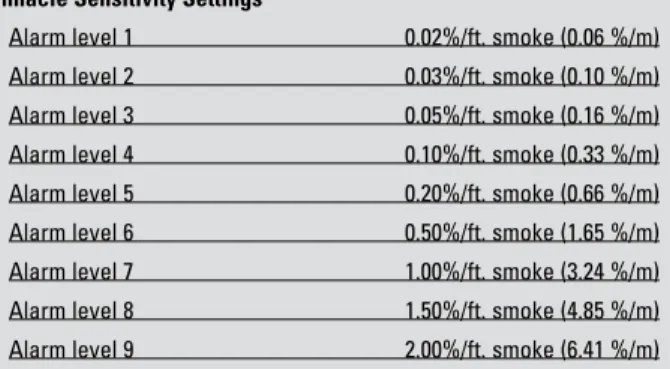
Users can select from nine different sensitivities in the range of 0.02–2% per foot for either pre-alarm or alarm settings. This gives the user enormous flexibility in config-uring a system to a range of different conditions. See Table 1.
Local Use
Certain installations require high sensitivity only in a local area. For example, an office building may require high sensitivity detection in computer and document storage areas, but standard protection would suffice in offices or the lobby. Pinnacle integrates well with other types of smoke detection systems, including photoelectric, ioniza-tion, multi-criteria, and thermal detectors. All of these detectors use the same type of wiring and mounting bases and are maintained in similar ways.
Since ultra high sensitivity spot type detection is relatively new to the fire protection industry, there are few codes and standards that reference the technology directly. In many cases, NFPA 72, The National Fire Alarm Code, will need to be referenced for appropriate spacing and placement considerations. The following are some excerpts of appli-cable standards for high sensitivity detection.
Table 1. Pinnacle Sensitivity Settings
Alarm level 1 0.02%/ft. smoke (0.06 %/m) Alarm level 2 0.03%/ft. smoke (0.10 %/m) Alarm level 3 0.05%/ft. smoke (0.16 %/m) Alarm level 4 0.10%/ft. smoke (0.33 %/m) Alarm level 5 0.20%/ft. smoke (0.66 %/m) Alarm level 6 0.50%/ft. smoke (1.65 %/m) Alarm level 7 1.00%/ft. smoke (3.24 %/m) Alarm level 8 1.50%/ft. smoke (4.85 %/m) Alarm level 9 2.00%/ft. smoke (6.41 %/m)
4
Section 6
Codes and Standards
The standard defines three levels of protection.6-5.1 For telecommunications facilities, fire detection systems shall be designed, installed and main-tained to provide one of three levels of protection: (1) very early warning fire detection (VEWFD), (2) early warning fire detection (EWFD), (3) stan-dard fire detection (SFD). This section establishes requirements for each level of protection, and provides suggested design and installation requirements for meeting the objectives of this standard.
6-5.2.1 EWFD and VEWFD smoke detection systems shall utilize sensors or ports with spacing which is less than that normally required by NFPA 72, National Fire Alarm Code.
Very Early Warning Fire Detection is defined.
6-5.3.1 Very Early Warning Fire Detection (VEWFD). 6-5.3.1.2 Every type of sensor and port installed in a space
shall be limited to a maximum coverage area of 200 sq. ft.
6-5.3.1.3 The sensors or ports need not be located directly in the center of the bay but shall be located so that they are exposed to the movement of smoke. The sensor or port shall not be located within 3
S Y S T E M S E N S O R
5 feet of supply duct registers. Locations selected
shall be visible from the floor and accessible for maintenance.
6-5.3.1.4 Sensors or ports shall be installed to monitor return air from the space. Spacing of sensors or ports shall be installed such that each covers no greater than 4 sq. ft. of the air grille.
6-5.3.1.5 Minimum sensitivity settings above ambient air-borne particulate levels for the VEWFD systems used shall be as follows:
Alert Condition: 0.2% per ft. obscuration Alarm Condition: 1.0% per ft. obscuration Early Warning Fire Detection is defined.
6-5.3.2 Early Warning Fire Detection (EWFD)
6-5.3.2.1.2 The area of coverage for a single sensor or port shall be limited to 400 sq. ft.; spacing at 20 ft. by 20 ft.
6-5.3.2.1.3 The sensors or ports need not be located directly in the center of the bay but shall be located so that they are exposed to the movement of smoke. The sensor or port shall not be located within 3 feet of supply duct registers. Locations selected shall be visible from the floor and accessible for maintenance.
6-5.3.2.1.4 The minimum alarm sensitivity setting at the sen-sor or port used for EWFD in telecommunications equipment spaces shall be 1.5% per ft.
The fire detection requirements vary depending upon the size of the telecommunications facility.
Chapter 4 Large Telecommunication Facilities
4-1 General. A large telecommunications facility includes operations such as switching, transmis-sion, and routing of voice, data and/or video signals within an enclosed area greater than 2500 sq. ft.
4-5.6.1 General. Telecommunications equipment spaces shall be provided with very early warning smoke detection system in accordance with Chapter 6 requirements for detection and alarm process-ing.
4-6.6.1 General. Cable entrance facilities shall be pro-vided with early warning fire detection systems in accordance Chapter 6 requirements for detec-tion and alarm processing.
4-7.6.1 General. Power areas shall be provided with an early warning smoke detection system in accor-dance with Chapter 6 requirements for detection and alarm processing.
4-8.6.1 General. Main distribution frame spaces shall be provided with an early warning smoke detection system in accordance with Chapter 6 require-ments for detection and alarm processing. Chapter 5 Small Telecommunication Facilities
5-1 General. A small telecommunications facility includes operations such as switching, transmis-sion, and routing of voice, data or video signals within an enclosed area of 500-2500 sq ft. Where the performance-based approach of Chapter 3 is not used, the prescriptive requirements of this chapter shall apply.
5-5.6 Fire Detection. Small facilities shall be provided with an early warning fire detection systems, in
accordance with Chapter 6, requirements for detection and alarm processing. Installation and maintenance shall be in accordance with NFPA 72, National Fire Alarm Code.
NFPA 76 allows for the use of performance based approach-es in the dapproach-esign of fire detection systems. When thapproach-ese performance based designs are used, system performance shall be verified by testing. Separate tests are defined for the Very Early Warning Fire Detection and Early Warning Fire Detection systems.
Very Early Warning Fire Detection
The purpose of this test procedure is to prove the perfor-mance of very early warning smoke detection systems in a smoldering fire scenario of much less than 1 kW. The test is intended to simulate a small amount of smoke, barely visible, that would be created in the early stages of an electrical overload in electronic equipment or cables. The test is intended to provide quantitative information useful for a performance-based specification. Prescriptive require-ments, such as detector chamber sensitivity and detector/ port spacing, do not reliably equate to detection response time and do not assure the ability to detect fires during early stages. This test is also intended to meet the follow-ing general objectives:
• It is intended to be repeatable, so that multiple tests can be used to accurately measure the effect of changes in the test environment or changes in the detection system design.
• It is intended to use low cost test equipment that can be quickly set up in actual telecommunications facilities if desired.
• It is intended to prevent or minimize the potential of smoke damage to the equipment in the room under test. It should create little or no corrosive products of com-bustion and no flames.
• It is intended to avoid the creation of large amounts of smoke and gas that could pose a health threat to person-nel in the test area.
The described test using an electrically overloaded PVC-coated wire is intended to simulate the early stages of a fire. Although a PVC wire is used, hydrogen chloride vapor is unlikely to be produced due to the relatively low tem-peratures reached. The off-gases produced by this test are not sufficient to drive off the chlorine in the PVC formula-tions. If the current is applied for a longer time, or if the wire sample is shorter than stated, small quantities of HCl may be generated. In either event, a clearly perceptible odor that should dissipate in short time is produced by the test. The test is essentially identical to the test specified in section A.3 of British Standard BS 6266: 1992, Fire Protection for Electronic Data Processing Installations. Early Warning Fire Detection
EWFD systems should be designed, installed, and main-tained to detect the products of combustion from the lac-tose/chlorate test described in the following sections. The lactose/chlorate test used here is one of the test methods specified in BS 6266, with modifications. This method produces a controlled fire that produces both flame and smoke.
Beyond responding quickly to real fires, a detector also needs to be problem free. That means that it must be false alarm free. Simply creating a highly sensitive smoke detec-tor is not enough, if that means it will create unwanted alarms. We have addressed this concern through the devel-opment of sophisticated algorithms and on-going, long term stability tests.
The Pinnacle laser smoke detector has been and will con-tinue to be tested for fire test response and false and nui-sance alarm avoidance. Ongoing quality assurance testing is the key to the success of this and all smoke detection products.
Laser has been rigorously tested for: Radio frequency interference
Lightning simulation Corrosion Mechanical integrity Detection performance
Dust immunity Humidity extremes and variations Temperature extremes and variations
Static discharge
Radiated radio frequency emissions Laser tests have been
con-ducted at several telephone switching stations in the United States and Europe to determine performance levels under a variety of conditions.
When first introduced, the laser-based photoelectric smoke detector was revolutionary. No one else had successfully developed a spot-type smoke detector using laser technol-ogy. Since the product was so new, extra steps were taken to assure that it met its design objectives — ultra-high sensitivity with false alarm immunity.
The product met all of the necessary regulatory agency requirements worldwide, but the question remained: how would it work in a real world fire scenario? So the product was tested in clean rooms and telecommunications facili-ties. The tests were performed and observed by indepen-dent fire industry professionals. Some of the tests were conducted as head-to-head comparisons with the prevail-ing technologies of the day for those types of facilities. To date, dozens of tests have been conducted, on different days, in different facilities all around the world.
The conclusion is always the same. Spot type laser detec-tion performs as good or better than competing technolo-gies in these types of facilities, but it provides significant additional benefits to the end user.
6
British Standard BS 6266: 1992, Fire Protection for Electronic Data Processing Installations
This British Standard makes recommendations for the pro-tection from fire of electronic data processing (EDP) instal-lations. The standard does not outline specific require-ments for particular types of sensing technologies or sensi-tivities, but does detail the considerations involved in the design of automatic fire detection systems in these types of facilities. The appendix of the standard outlines several system performance test methods. High sensitivity point type detectors, such as Pinnacle, are not addressed. A.1 System performance test method using lactose/
chlorate mixture A.1.1 General
This method is suitable for the testing of standard sensitivity fire detection systems. A controlled fire producing both flame and smoke is initiated by ignition of a mixture of lactose and potassium chlorate.
A.1.4 Requirement
The fire detection system should respond within 120 seconds of ignition.
A.2 System performance test method using polyure-thane mat(s)
A.2.1 General
This method is suitable for the testing of standard sensitivity fire detection systems. A controlled fire is produced by ignition of flexible polyurethane foam mat(s).
A.2.4 Requirement
The fire detection system should respond within 180 seconds of ignition.
A.3 System performance test method using electri-cally overloaded PVC-coated wire (2m)
A.3.1 General
This method is suitable for the testing of high sensitivity fire detection systems. To simulate the early stages of a fire, a length of wire is electri-cally overloaded so that smoke or vapours are driven off. Unlike the test described in A.4, hydrogen chloride vapour is unlikely to be pro-duced due to the relatively low temperatures reached. This test may be undertaken in under-floor spaces or ceiling voids.
NOTE: The wire is subject to cooling if positioned in direct contact with air flows and may need to be shielded.
A.3.4 Requirement
The fire detection system should respond within 120 seconds of the cessation of energization. A.4 System performance test method using
electri-cally overloaded PVC-coated wire (1m) A.4.1 General
This method is suitable for the testing of high sensitivity fire detection systems.
To simulate the early stages of a fire, a length of wire is electrically overloaded so that smoke or vapors are driven off.
Warning: This test produces sufficiently high tem-peratures to generate small quantities of hydrogen chloride but may be undertaken in underfloor spaces or ceiling voids where rapid air flow may render the test described in A.3 unsuitable.
Section 7
S Y S T E M S E N S O R
7 In the past, aspirating
sys-tems were accepted as the standard for high sensitivity and early warning. These tubular networks draw air from fire protection areas to a central sensor, which is typically a single enclosure containing high-sensitivity optics. Filters remove large particles and thus reduce false alarms. The system must be continuously aspirating in order to sample air. For many years, these systems were the only detection solution available.
Aspirating
Limited supervision means system cannot always detect leaks in piping or blockage of a port.
Section 8
Pinnacle vs. Aspirating
UL Gasoline Fire Test
This graph shows the performance of Pinnacle compared to a standard photoelectric and ionization smoke detector in a UL gasoline fire. Pinnacle reaches its full alarm level well before the other types of detection.
UL Heptane Fire Test
This graph shows the performance of Pinnacle compared to a standard photoelectric and ionization smoke detector in a UL Heptane fire, an example of a flaming fire. Pinnacle reaches its full alarm level well before the other types of detection.
Time Detector Signal Photo Ion Time Detector Signal Photo Ion Pinnacle™ Pinnacle™ Sample responses of different detection technologies
Aspirating
Tubular networks can have a lag time for the delivery of smoke to the detection enclo-sure, dilution of smoke, and removal of smoke in the tubes.
Pinnacle
Smoke-assessing optics reside at each sampling location — drastically reducing lag times, dilution, and smoke removal. Aspirating
The system cannot identify which sampling port deliv-ered smoke to the detector.
Pinnacle
Addressable system identi-fies exact location of fire.
Pinnacle
Continuously supervises each detector and wire run in the system.
Aspirating
Tubing requires unconven-tional installations and does not allow other types of detectors within its system.
Pinnacle
Because it is a plug-in spot type detector, Pinnacle can easily be mixed with stan-dard photoelectric or ion-ization detectors on the same loop or system. Aspirating
In the case of a small local-ized fire, most sampling ports draw in clean air, diluting smoke levels in measuring chamber.
Pinnacle
Measurement points away from the fire do not degrade response time, regardless of fire size.
8
Pinnacle Low-Profile Plug-in Intelligent Laser Smoke Detector
Voltage Range 15 – 32 volts DC peak
Standby Current (max. avg.) 230µA @ 24 VDC (without communication)
330µA (one communication every 5 seconds with LED enabled)
LED Current (max.) 6.5mA @ 24 VDC (on)
Height 1.66˝ (4.2 cm)
Diameter 4.0˝ (10.2 cm)
Shipping Weight 5.6 oz. (159 g)
Operating Temperature Range North America: 32° to 100°F (0° to 38°C) Europe: –10°C to 55°C
Velocity Range 0 – 4000 fpm (0 to 20.3 m/s)
Relative Humidity 10% – 93% noncondensing
Self Diagnostics Initiated by control panel; activated by test magnet
Smoke Sensitivity 9 levels: 0.02, 0.03, 0.05, 0.20, 0.20, 0.50, 1.00, 1.50, 2;00%/ft. obscuration (0.06, 0.10, 0.16, 0.33, 0.66, 1.65, 3.24, 4.85, 6.41%/m obscuration)
Drift Compensation High sensitivity maintenance alert signal Low sensitivity maintenance alert signal Maintenance urgent signal
Section 10
Specifications
Pinnacle with Flanged Mounting Base Pinnacle with Flangeless Mounting Base Myth
An aspirating system must be used in areas where regular maintenance cannot be done.
Reality
The National Fire Protection Association (NFPA 72, Chap-ter 7) requires regular maintenance of both the ports in an aspirating system and the detectors in the laser system. Myth
The pinpoint location of the fire is not necessary. Reality
Pinnacle detects smoke at extremely low levels, sometimes before the smoke is visible to the human eye. By knowing which detector is in alarm, you can easily locate the source of the smoke. Thus, the fire can be extinguished quickly to avoid major damage.
Myth
An extremely sensitive spot type detector such as Pinnacle will be prone to false alarms.
Reality
Pinnacle continually runs sophisticated stability and immunity routines to virtually eliminate false alarms.
Section 9
Myth vs. Reality
MythPinnacle is more expensive to install than an aspirating system.Reality
The total installed cost of a laser system can be less than an aspirating system. The cost to install a laser system is comparable to the cost to install any spot type detection system. An aspirating system, however, requires the instal-lation of pipe and fittings by a qualified installer. Myth
A spot type detection system, such as Pinnacle, could never be as sensitive as an aspirating system.
Reality
Since an aspirating system senses smoke at one central unit, the smoke becomes diluted by the time it reaches the detector. Pinnacle is actually more sensitive than an aspi-rating system. A recent draft of proposed changes to NFPA 76 explicitly recognizes this dilution effect by requiring the sensitivity at the central unit in an aspirating system be multiplied by the number of ports. For example, 0.002%/ ft. sensitivity at the central unit with 20 ports is really 0.04%/ft. sensitivity.