Shoulder
and elbow joint
replacement
This booklet provides information and answers to your questions about these surgical procedures.
If you’re thinking about having
a shoulder or elbow joint
replacement then you’ll probably
have a lot of questions. In this
booklet we’ll explain each
procedure in detail, when they’re
necessary and what you can
expect before and after your
surgery. We’ll also point out the
potential complications of these
operations and tell you where
you can find more information.
At the back of this booklet you’ll find a brief glossary of medical words – we’ve underlined these when they’re first used in the booklet.
www.arthritisresearchuk.org
What are shoulder
and elbow joint
What’s inside?
2 Shoulder and elbow joint replacement at a glance 4 Introduction
4 Do I need a shoulder or elbow joint replacement?
5 What are the benefits of shoulder or elbow joint replacement surgery? 5 What are the disadvantages
of shoulder or elbow joint replacement surgery? 6 What are the alternatives
to joint replacement surgery? 7 What are the different types
of shoulder and elbow joint replacement?
– Shoulder replacement – Elbow replacement
10 How should I prepare for surgery?
– Pre-admission clinic – Going into hospital
13 What will my recovery involve?
– After the operation – Physiotherapy and
occupational therapy – Going home
17 Looking after your new joint
– Getting back to normal
– Can I work and drive afterwards?
19 What are the possible complications of shoulder or elbow surgery?
19 How long will my joint replacement last?
– Revision surgery
20 Research and new developments 21 Glossary
22 Where can I find out more? 24 We’re here to help
Shoulder and elbow joints that are affected by arthritis can become painful, swollen and difficult to move. Replacements of the shoulder or elbow joint are procedures where the surfaces of a joint are replaced with parts made of metal and plastic. This operation is sometimes called arthroplasty.
Do I need a shoulder or elbow joint replacement?
A joint replacement may be considered if:
• your pain can’t be relieved by other methods such as drugs, injections or physiotherapy and the pain is affecting your quality of life
• your arthritis stops you using your arm easily
• you have a bone fracture close to the joint that can’t be fixed.
You should consult your orthopaedic surgeon and any other health professionals involved with your arthritis, as well as family and friends, before deciding to have joint replacement surgery.
What should I ask my hospital team?
You might want to ask your hospital team the following questions:
• What can I expect from surgery?
• What can I expect if I don’t have surgery?
• What are the alternatives?
• What are the risks?
• How long will I be in hospital?
• When will I get back to my expected level of activity?
• What if I have problems after surgery?
What are the benefits?
Benefits include:
• pain in the joint will disappear or be much reduced
• improved quality of life.
At a glance
Shoulder and elbow
joint replacement
The main benefit
of surgery is a
reduction in pain.
What are the disadvantages?
Disadvantages include:
• a replacement joint will never be as good as a natural joint
• limited movement compared to a healthy natural joint
• replacement joints will wear out given enough time.
What are the
possible complications?
The main possible complications of surgery include:
• infection
• stiffness
• pain
• loosening of the replacement parts
• fracture of the bone during or after surgery
• poor healing of the wound
• wound haematoma (bleeding)
• damage to nearby nerves causing temporary or, rarely, permanent numbness or weakness.
How long will my joint replacement last?
There’s a very good chance that your shoulder or elbow joint replacement will last for 10 years. After this time it may loosen and wear out. A second joint replacement (revision surgery) may then be possible.
Introduction
Shoulder and elbow joints that are affected by arthritis can become painful, swollen and difficult to move. Often this lack of movement is caused by the joint surfaces not moving smoothly on each other or by contraction (tightening) of the soft tissues (tendons, ligaments) around the joint. The joint may be too painful to allow you to move it. Replacement of the shoulder joint and elbow joint are procedures where the surfaces of the joint, normally made of bone covered with cartilage, are replaced with parts made of metal and plastic. The operation is sometimes called arthroplasty.
In the shoulder, often only the upper arm (humeral) side of the joint is replaced. This is called hemiarthroplasty, meaning replacement of part of the joint.
With the elbow, both sides of the joint are replaced (total arthroplasty).
See Arthritis Research UK booklets Osteoarthritis; Rheumatoid arthritis; What is arthritis?
Do I need a shoulder or
elbow joint replacement?
A joint replacement may be considered if your pain can’t be relieved by other methods such as drugs, injections or physiotherapy and if the pain is affecting your quality of life. Less frequently, a replacement may be carried out to deal with fractures close to the joints. This is only the case if the fracture can’t be fixed and your lifestyle or physical activities are suitable for a shoulder or elbow replacement.Arthritis tends to get worse over time, but this happens at a different rate for everybody. Your surgeon will advise you if waiting would be harmful or make your arthritis more difficult to deal with in the future.
Joint replacement surgery should be considered carefully in consultation with your surgeon and any other health professionals who are helping you (such as a GP, physiotherapist or nurse) and with your family and friends. Your surgeon will be able to advise you on the nature of the surgery and of the pros and cons of having or delaying an operation.
Finding out as much
as you can about
the operation and
understanding the
process will help you
feel less anxious and
more in control.
4What are the benefits
of shoulder or elbow joint
replacement surgery?
In most cases you can expect that your joint pain will disappear or be much reduced once the surgical wound has healed. Because the joint will be less painful, you’ll probably notice that your range of movement increases to some extent. However, this may take a little while and may not happen at all for some people.Shoulder and elbow joint replacements are very successful and most people are delighted with the results and the improvement to their quality of life.
What are the
disadvantages of
shoulder or elbow joint
replacement surgery?
A replacement joint can never be as good as a natural joint. The range of movement will be much reduced compared to a healthy natural joint. The range of movement will usually be enough to allow most of the simple activities of daily living but not extreme movements such as hanging washing or reaching for high shelves. You should discuss with your surgeon before an operation how much they expect your movement to improve, as each case is slightly different.Replacement joints will also wear out after a time, but it’s likely that they’ll last for 10 years.
What are the
alternatives to joint
replacement surgery?
Most people with arthritis of the shoulder or elbow joint will receive other treatments from either their GP or a rheumatologist before they see a surgeon for a joint replacement. These may include:• drug treatments, which usually consists of painkillers such as paracetamol, and non-steroidal anti-inflammatory drugs (NSAIDs) such as diclofenac
• disease-modifying drugs (DMARDs) if you have rheumatoid arthritis
• injections of steroid and other drugs into the joint
• nerve-numbing injections of local anaesthetic
• physiotherapy.
If these treatments don’t relieve the pain then surgery may be considered.
In some cases there are other operations available that are more helpful than joint replacement, such as:
• cleaning out the joint (debridement) to ease pain
• removal of the lining of the joint (synovectomy) if it’s very inflamed (this isn’t usually carried out on the shoulder joint)
• removal of part of the bone at the elbow (the radial head).
See Arthritis Research UK drug leaflets Drugs and arthritis; Local steroid injections; Non-steroidal anti-inflammatory drugs.
Ball of shoulder joint (humeral head) Cup or socket of shoulder joint (glenoid) Shoulder blade (scapula) Upper arm bone (humerus)
Figure 1
Shoulder joint seen from
the front
What are the different
types of shoulder and
elbow joint replacement?
Shoulder replacement
The shoulder is a ball-and-socket joint (see Figure 1). The end of the upper arm bone (the humeral head) forms the ball, while part of the shoulder blade (called the glenoid) forms the socket. Shoulder replacement surgery replaces the ball and sometimes the socket with artificial components (see Figure 2). There are several types of shoulder replacement surgery:
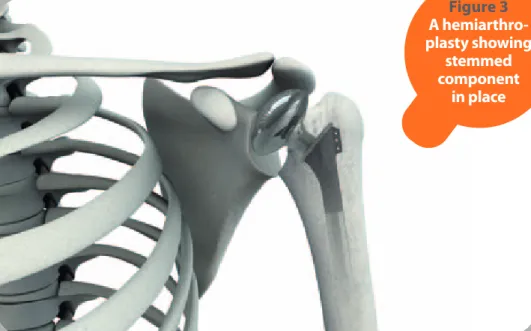
Hemiarthroplasty is where the ball part of the joint (the humeral head) is replaced with an artificial ball component with a stem that extends into the shaft part of the bone (see Figure 3). This is usually used for fractures but is also used in many cases of arthritis.
Shoulder resurfacing is a variant of hemiarthroplasty where, instead of removing the humeral head and replacing it with an artificial ball on a stem, a metal cap is fitted over the ball part of the joint (see Figure 4). This means less bone has to be removed during the operation. Total arthroplasty is where both the ball (of the upper arm) and socket (of the
Figure 2
The parts of an artificial shoulder joint
Head Plastic glenoid Neck
Shaft
Metal humeral component
Figure 3
A hemiarthro-plasty showing
stemmed component
in place
Figure 4
A shoulder resurfacing component
in place
shoulder blade) are replaced with artificial components. This is increasingly used for very specific kinds of arthritis depending on the patient’s age, how badly worn the natural joint is and the state of the tendons around the joint. Occasionally a total arthroplasty will be carried out using a resurfacing component.
Reverse anatomy arthroplasty is where the artificial components are fitted in reverse – that is, the socket to the upper arm bone and the ball to the shoulder blade. Currently this is only used in patients with severe arthritis of the shoulder joint and very poor tendon cover around the joint. It can sometimes be used if a severe joint fracture
is accompanied by poor tendon function. Your surgeon will decide beforehand which type of implant will be most suitable for your shoulder problem.
You’ll be allowed time to consider things, and all possible complications will be discussed with you before you make your decision.
The operation will be carried out using a general anaesthetic (in which case you’ll be asleep) and/or a local anaesthetic (which numbs the nerves to the arm and shoulder). The shoulder joint is normally opened from the front and the muscles pulled out of the way (retracted). The damaged bone of the humeral head is then removed and the remaining bone is prepared for the artificial component to be fitted.
Elbow replacement
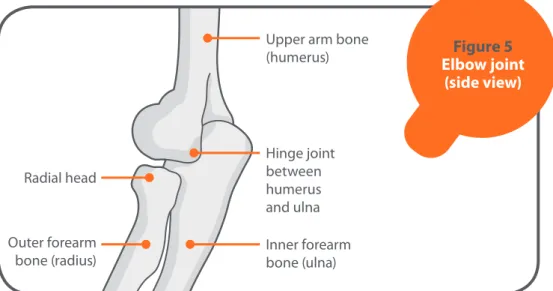
Figure 5 shows a healthy elbow joint. In elbow replacements both sides of the joint are replaced, usually with cement.
Upper arm bone (humerus) Hinge joint between humerus and ulna Inner forearm bone (ulna) Outer forearm bone (radius) Radial head Figure 5 Elbow joint (side view) 9
The upper arm and forearm components (humeral and ulnar components) are made of both metal and plastic. The operation will be carried out using a general anaesthetic (in which case you’ll be asleep) and/or a local anaesthetic (which numbs the nerves to the arm and shoulder).
The elbow joint is usually opened from the back and the muscles retracted. The parts of the bone with damaged joint surfaces are then removed and the shafts of the ulna and humerus prepared have the components inserted, which are usually cemented in. Some designs have a pivot (hinge) between the two halves, while others rely on muscle tension to hold the two parts together (see Figures 6 and 7).
If the disease is affecting only the radial head in the elbow then a metal radial head replacement is occasionally used. This operation leaves the rest of the elbow joint unchanged. This may also be used for some fractures.
How should I prepare
for surgery?
Once you’ve decided to go ahead with surgery, your name will be put on a waiting list and the hospital will contact you, usually in the next 6–12 weeks.
replacement elbow joint
Figure 7
A pivotless replacement
elbow joint Humeral (upper
arm) component
Humeral component
Pivot
No pivot; parts are held together by surrounding muscles Ulnar
(forearm) component
Ulnar component
Pre-admission clinic
Most hospitals invite you to a pre-admission clinic, usually about 2–3 weeks before the surgery. You’ll be examined to make sure you’re generally well enough for the anaesthetic and the operation. This may involve the following tests:
• blood tests to check for anaemia and to make sure your kidneys are working properly
• x-rays of the affected body part
• a urine sample to rule out infection
• an electrocardiogram (ECG) tracing to make sure your heart is healthy. The hospital team will probably tell you at this stage whether the operation will go ahead as planned.
It’s also advisable to have a dental check-up and get any problems dealt with well before your operation. There’s a risk of infection if bacteria from dental problems get into the bloodstream.
A pre-admission clinic is a chance to discuss any worries you have about the operation and to find out more about preparing for, and recovering from, surgery.
You should discuss with your surgeon, anaesthetist or nurse at this
pre-admission clinic whether you should stop taking any of your medications before you have surgery.
At this visit you may also see an
occupational therapist. They’ll discuss with you how you’ll manage at home in the weeks after your operation and advise you
on aids and appliances that might help. If you’re not invited to see an occupational therapist and you’re anxious about coping at home after the operation, you should ask about home help and/or useful aids when you go for your pre-admission clinic. In some hospitals you’ll see
a physiotherapist in this clinic as well. You’ll be able to discuss your exercise regime before and after the operation.
See Arthritis Research UK booklets Meet the rheumatology team;
Occupational therapy and arthritis; Physiotherapy and arthritis.
Going into hospital
You’ll probably be admitted to hospital early on the day of surgery, though it may be earlier if you haven’t attended a pre-admission clinic or if you have another medical condition that needs attention before surgery can go ahead.
Figure 8 Pre-admission checklist – before you go into hospital,
you should think about the following: Do you have someone to take you to and from hospital?
Have you set up your home ready for your return, with everything you need within reach?
Do you have any specialist equipment ready for when you leave hospital? Do you need someone to stay with you for a while after your operation? 12
You’ll be asked to sign a consent form before surgery.
Just before your operation is due to start you’ll be taken (usually in your bed, but you may be walked) from the admission ward to the operating theatre. If necessary, you may be given a sedative medication (a pre-med) while waiting in the admission ward. You’ll then be given an anaesthetic. This may be either a regional block (local anaesthetic) or a general
anaesthetic. If you have the regional block you may also be sedated if necessary during the course of the operation.
The regional block usually involves an injection to the base of the neck or in the armpit. In some hospitals this will be done under ultrasound (jelly scan) control.
What will my
recovery involve?
After the operation
The operations usually take around 2½ hours. Giving the anaesthetic takes about half an hour, and recovery before going back to the ward takes another half an hour to an hour.
You’ll be taken to a recovery room or high-care unit until you’re fully awake and the doctors feel that your general condition is stable. Then you’ll be taken back to the ward.
You’ll usually be in hospital for 2–3 nights after your surgery. During this time medical, nursing, physiotherapy and occupational therapy staff will be involved in your care. You’ll be given drugs after the operation to keep your arm as free from pain as possible. These may include:
• local anaesthetic
• patient-controlled analgesia (PCA) – a system where you can control your own supply of painkiller going into a vein by pressing a button
• painkilling injections or tablets. Sometimes the block wears off in the middle of the first night after the operation. This can cause disturbed sleep and tiredness. You’ll probably be given painkillers before sleeping on the first night after the operation to ensure a more comfortable sleep. The drip and any drains are usually removed within 24 hours. After that you’ll be able to start gently moving your arm again.
X-rays of your new joint will be taken during your stay in the hospital. Your arm will be in a sling or splint to protect it. If a tube was placed in the wound during the operation to allow blood to drain out, it’ll be removed after 1–2 days (this isn’t painful and can be done on the ward). It’s important that during the first few days after your surgery you keep your hand and forearm elevated (preferably above the level of your heart) and exercise your fingers on a regular basis. These exercises are simple to do and include making a full fist and stretching your fingers.
If you had a shoulder replacement you’ll be in a sling to support your shoulder. This is sometimes kept on for up to 4 weeks but different surgeons have different procedures.
After the elbow replacement some surgeons use a plaster support
(called a slab) behind the elbow to keep it in a relatively straight position for a few days. You won’t be able to move your elbow in the slab, but once it’s removed you can start moving your elbow again.
Physiotherapy and
occupational therapy
The physiotherapist will see you
in hospital after the operation to help get you moving and advise you on exercises to strengthen your muscles.
Most people are
ready to leave
hospital within
2–3 days.
The physiotherapist or occupational therapist will tell you the dos and don’ts after your surgery. It’s very important to follow this advice.
In the case of elbow replacement, it’s best to avoid extreme movements until the wound is healed – which is usually within 10 days of the surgery.
Before you leave hospital, the
occupational therapist will assess your physical ability and your circumstances at home, and they may provide you with equipment if you need it.
Because there are several different
types of shoulder and elbow surgery, there’s no specific method of aftercare. Your post-op therapy will differ between procedures, or between units/surgeons, so we can’t recommend specific exercise plans. We suggest that you discuss with your surgeon what to expect after the operation.
Going home
How soon you can go home depends on how well the wound is healing and whether you’ll be able to get about safely. You’ll need to attend the outpatients’ department, usually 2 weeks after the operation, for a routine check-up to make sure your progress is satisfactory and your wound is healed. You may also be offered outpatient physiotherapy if your doctors feel that this will help your recovery. If you stopped taking methotrexate before the operation, it’s very important to remember to start taking it again afterwards to reduce the risk of your arthritis flaring up again. If you’re on other medications, you need to discuss when to re-start your medication with your rheumatologist.
See Arthritis Research UK drug leaflet Methotrexate.
Looking after your
new joint
After elbow replacement surgery, you’re advised not to lift objects heavier than a small bag of sugar for the rest of your life. The current available and recommended artificial elbow joints aren’t designed for any heavier work and you could reduce the effective life span of these joints by over-stressing them. This will mean the joint implant may fail sooner than expected.
If you had both sides of your shoulder replaced (total shoulder replacement), again you should avoid heavy loads to help your new joint last. This is especially important if you’ve had a reverse anatomy arthroplasty.
Getting back to normal
Some patients spend longer in rehab than others. Usually after 6 weeks the pain has subsided enough for you to lift your arm and perform daily activities such as dressing, feeding and washing yourself.
Orthocards™
Any patient in the UK who has had a joint replacement can apply to receive a free Orthocard™. This is a personalised card, the size of a credit card, which will show the details of your joint implant. An Orthocard™ will alert paramedics in the event of a serious injury, and can be shown to staff at security checkpoints (at airports, for example) to make this process easier.
Orthocards™ can be obtained through your rheumatology team, online through the Joint Action website or via post from the British Orthopaedic Association.
Can I work and drive afterwards?
You’ll be able to return to work after your joint replacement, but this may take up to 3 months depending on the type of work you do. Heavy manual activities aren’t recommended at any time following shoulder or elbow replacements. This is because heavy activity can loosen the replaced parts in the bone and damage the artificial joint. You’ll be able to drive after your joint replacement as long as you can safely control the vehicle and do an emergency stop. It’s important to check with your insurance company, and you need to be confident that you can adequately control the vehicle in all circumstances.
See Arthritis Research UK booklets Everyday living and arthritis;
Work and arthritis.
replacement as long
as you can safely
control the vehicle.
What are the possible
complications of
shoulder or elbow joint
replacement surgery?
As with any operation, a very small number of people may have problems after a shoulder or elbow jointreplacement. Most, but not all, of these problems are quite minor and can be treated easily. The main problems include:
• infection
• loosening of the replacement parts
• fracture of the bone during or after the operation
• poor healing of the wound
• wound haematoma (bleeding)
• nerve injury resulting in temporary or, rarely, permanent loss of function. The risks need to be taken into account when deciding whether to have the operation. You should discuss this with your surgeon beforehand. In most cases infections can be cleared up with tablets or, less commonly, with intravenous antibiotics, but in some more serious circumstances you may need to have a further operation to treat the infection and replace the components.
Bleeding and wound haematoma
A wound haematoma is when blood collects in a wound. It’s normal to have a small amount of blood leak from the wound after any surgery. Usually this stops within a couple of days.
But occasionally blood may collect under the skin, causing a swelling. This can either discharge itself, causing a larger but temporary leakage from the wound usually a week or so after surgery, or it may require a smaller second operation to remove the blood collection. Drugs like aspirin and antibiotics can increase the risk of haematoma after surgery.
Your orthopaedic surgeon will discuss all these possible complications with you in detail before asking you to sign written consent to the procedure. You’ll be able to ask any questions addressing any concerns you may have at this stage and prior to the operation itself.
How long will my joint
replacement last?
There’s a very good chance that your shoulder or elbow replacement will last for 10 years. After this time it may loosen and wear out. A second joint replacement (revision surgery) may then be possible, although it’s usually less effective in relieving symptoms.
Revision surgery
In a revision operation the original components will be removed, along with any cement that may have been used. The shaft of the humerus will often have become thinner by the time revision surgery is needed, and because further bone is removed during the operation the humerus is more prone to fracture.
If the original surgery was a shoulder resurfacing operation, revision surgery is usually a little easier because less bone will have been removed in the first operation. In this case the component forming the new bone surface is usually replaced with a stemmed component.
Research and new
developments
The number of reverse shoulder arthroplasty surgeries has increased dramatically over recent years. This type of implant is used mainly because a certain type (the Grammont implant) has
a fairly low failure rate and shows good results when tested shortly after surgery. Because of this many companies have brought out their own, less successful versions of the Grammont implant. Research backed by Arthritis Research UK has found that other implants performed significantly worse than the Grammont, although the success of any implant depends a lot on the skill of the surgeon. Based on this research, surgeons can now have confidence in some of these implants. The research team also identified the best surgical method, which will help standardise the procedure.
Glossary
Arthroplasty – the medical name for a joint replacement operation.
Cartilage – a layer of tough, slippery tissue that covers the ends of the bones in a joint. It acts as a shock-absorber and allows smooth movement between bones. Disease-modifying anti-rheumatoid drugs (DMARDs) – drugs used in rheumatoid arthritis and some other rheumatic diseases to suppress the disease and reduce inflammation. Unlike painkillers and non-steroidal anti-inflammatory drugs (NSAIDs), DMARDs treat the disease itself rather than just reducing the pain and stiffness caused by the disease. Examples of DMARDs are methotrexate, sulfasalazine and leflunomide. Other anti-TNF drugs such as gold, infliximab, etanercept and adalimumab can also be used if you still have active symptoms despite being treated with DMARDs.
Electrocardiogram (ECG) – a test that records the electrical activity of the heart using a machine called an electrocardiograph. The aim of an ECG is to detect unusual heart rhythms and to identify heart problems. Ligaments – tough, fibrous bands which hold two bones together in a joint.
Non-steroidal anti-inflammatory drugs (NSAIDs) – a large family of drugs prescribed for different kinds of arthritis that reduce inflammation and control pain, swelling and stiffness. Common examples include ibuprofen, naproxen and diclofenac.
Occupational therapist – a therapist who helps you to get on with your daily activities (e.g. dressing, eating, bathing) by giving practical advice on aids, appliances and altering your technique. Orthopaedic surgeon – a surgeon who specialises in treating problems affecting the bones, joints and other structures involved in making the body move. Treatments offered include joint replacements and surgical repairs to tendons.
Physiotherapist – a trained specialist who helps to keep your joints and muscles moving, helps ease pain and keeps you mobile.
Rheumatoid arthritis – an inflammatory disease affecting the joints, particularly the lining of the joint. It most commonly starts in the smaller joints in a
symmetrical pattern – that is, for example, in both hands or both wrists at once. Tendon – a strong, fibrous band or cord that anchors muscle to bone.
Where can I find out more?
If you’ve found this information useful you might be interested in these other titles from our range:Conditions
• Osteoarthritis
• Rheumatoid arthritis
• What is arthritis? Therapies
• Meet the rheumatology team
• Occupational therapy and arthritis
• Physiotherapy and arthritis Self-help and daily living
• Everyday living and arthritis
• Work and arthritis Drug leaflets
• Drugs and arthritis
• Local steroid injections
• Methotrexate
• Non-steroidal anti-inflammatory drugs You can download all of our booklets and leaflets from our website or order them by contacting:
Arthritis Research UK PO Box 177
Chesterfield Derbyshire S41 7TQ Phone: 0300 790 0400 www.arthritisresearchuk.org
Related organisations
The following organisations may be able to provide additional advice and information:
Arthritis Care 18 Stephenson Way London NW1 2HD Phone: 020 7380 6500 Helpline: 0808 800 4050 www.arthritiscare.org.uk
Offers self-help support, a helpline service (on both numbers above), and a range of leaflets on arthritis.
Notes
We’re here to help
Arthritis Research UK is the charity leading the fight against arthritis. We’re the UK’s fourth largest medical research charity and fund scientific and medical research into all types of arthritis and musculoskeletal conditions.
We’re working to take the pain away for sufferers with all forms of arthritis and helping people to remain active. We’ll do this by funding high-quality research, providing information and campaigning.
Everything we do is underpinned by research.
We publish over 60 information booklets which help people affected by arthritis to understand more about the condition, its treatment, therapies and how
to help themselves.
We also produce a range of separate leaflets on many of the drugs used for arthritis and related conditions. We recommend that you read the relevant leaflet for more detailed information about your medication. Please also let us know if you’d like to receive our quarterly magazine, Arthritis Today, which keeps you up to date with current research and education news, highlighting key projects that we’re funding and giving
insight into the latest treatment and self-help available.
We often feature case studies and have regular columns for questions and answers, as well as readers’ hints and tips for managing arthritis.
Tell us what you think
of our booklet
Please send your views to:
[email protected] or write to us at:
Arthritis Research UK, PO Box 177, Chesterfield, Derbyshire S41 7TQ.
A team of people contributed to this booklet. The original text was written by consultant trauma and orthopaedic surgeon John Williams, who has expertise in the subject. It was assessed at draft stage by specialist registrar in trauma and orthopaedics Dr Rouin Amirfeyz, consultant rheumatologist Dr Lorraine Croot, clinical nurse specialist Sue Brown, physiotherapist Nigel Mann and upper-limb, shoulder and elbow surgeon David Stanley. An Arthritis
Research UK editor revised the text to make
it easy to read, and a non-medical panel, including interested societies, checked it for understanding. An Arthritis Research UK medical advisor, Mark Wilkinson, is responsible for the content overall.
from millions of people in the UK by:
• Volunteering
• Supporting our campaigns
• Taking part in a fundraising event
• Making a donation
• Asking your company to support us
• Buying gifts from our catalogue
To get more actively involved, please
call us 0300 790 0400 or e-mail us at
[email protected]
Or go to:
Arthritis Research UK
Copeman House, St Mary’s Court,
St Mary’s Gate, Chesterfield, Derbyshire S41 7TD
Tel 0300 790 0400
calls charged at standard rate
www.arthritisresearchuk.org
Registered Charity No 207711 © Arthritis Research UK 2011 Published April 2011 2056/SHEL/11-1