12-Bit, 8-Channel Sampling
ANALOG-TO-DIGITAL CONVERTER
with I
2
C
™
Interface
FEATURES
●
8-CHANNEL MULTIPLEXER
●
50kHz SAMPLING RATE
●
NO MISSING CODES
●
2.7V TO 5V OPERATION
●
INTERNAL 2.5V REFERENCE
●
I
2C INTERFACE SUPPORTS:
Standard, Fast, and High-Speed Modes
●
TSSOP-16 PACKAGE
APPLICATIONS
●
VOLTAGE-SUPPLY MONITORING
●
ISOLATED DATA ACQUISITION
●
TRANSDUCER INTERFACES
●
BATTERY-OPERATED SYSTEMS
●
REMOTE DATA ACQUISITION
DESCRIPTION
The ADS7828 is a single-supply, low-power, 12-bit data acquisition device that features a serial I2C interface and an
8-channel multiplexer. The Analog-to-Digital (A/D) converter features a sample-and-hold amplifier and internal, asynchronous clock. The combination of an I2C serial,
2-wire interface and micropower consumption makes the ADS7828 ideal for applications requiring the A/D converter to be close to the input source in remote locations and for applications requiring isolation. The ADS7828 is available in a TSSOP-16 package.
ADS7828
SBAS181C – NOVEMBER 2001 - REVISED MARCH 2005Please be aware that an important notice concerning availability, standard warranty, and use in critical applications of Texas Instruments semiconductor products and disclaimers thereto appears at the end of this data sheet.
SAR 2.5V VREF Serial Interface SDA Comparator S/H Amp
REFIN/REFOUT
SCL CH0 CH1 CH2 CH3 CH4 CH5 CH6 CH7 COM A0 A1 CDAC 8-Channel MUX Buffer ® ADS7828
MAXIMUM
INTEGRAL SPECIFIED
LINEARITY PACKAGE TEMPERATURE ORDERING TRANSPORT
PRODUCT ERROR (LSB) PACKAGE-LEAD DESIGNATOR RANGE NUMBER MEDIA, QUANTITY
ADS7828E ±2 TSSOP-16 PW –40°C to +85°C ADS7828E/250 Tape and Reel, 250
" " " " " ADS7828E/2K5 Tape and Reel, 2500
ADS7828EB ±1 TSSOP-16 PW –40°C to +85°C ADS7828EB/250 Tape and Reel, 250
" " " " " ADS7828EB/2K5 Tape and Reel, 2500
NOTE: (1) For the most current package and ordering information, see the Package Option Addendum at the end of this data sheet, or see the TI web site at www.ti.com.
PACKAGE/ORDERING INFORMATION
(1)ABSOLUTE MAXIMUM RATINGS
(1)+VDD to GND ... –0.3V to +6V
Digital Input Voltage to GND ... –0.3V to +VDD + 0.3V
Operating Temperature Range ... –40°C to +105°C Storage Temperature Range ... –65°C to +150°C Junction Temperature (TJ max) ... +150°C
TSSOP Package
Power Dissipation ... (TJ max – TA)/θJA
θJA Thermal Impedance ... 240°C/W
Lead Temperature, Soldering
Vapor Phase (60s) ... +215°C Infrared (15s) ... +220°C NOTE: (1) Stresses above those listed under Absolute Maximum Ratings may cause permanent damage to the device. Exposure to absolute maximum conditions for extended periods may affect device reliability.
ELECTROSTATIC
DISCHARGE SENSITIVITY
This integrated circuit can be damaged by ESD. Texas Instruments recommends that all integrated circuits be handled with appropriate precautions. Failure to observe proper han-dling and installation procedures can cause damage. ESD damage can range from subtle performance degradation to complete device failure. Precision integrated circuits may be more susceptible to damage because very small parametric changes could cause the device not to meet its published specifications.PIN CONFIGURATION
Top View TSSOP
PIN DESCRIPTIONS
PIN NAME DESCRIPTION
1 CH0 Analog Input Channel 0 2 CH1 Analog Input Channel 1 3 CH2 Analog Input Channel 2 4 CH3 Analog Input Channel 3 5 CH4 Analog Input Channel 4 6 CH5 Analog Input Channel 5 7 CH6 Analog Input Channel 6 8 CH7 Analog Input Channel 7 9 GND Analog Ground
10 REFIN / REFOUT Internal +2.5V Reference, External Reference Input
11 COM Common to Analog Input Channel 12 A0 Slave Address Bit 0
13 A1 Slave Address Bit 1 14 SCL Serial Clock 15 SDA Serial Data
16 +VDD Power Supply, 3.3V Nominal
1 2 3 4 5 6 7 8 CH0 CH1 CH2 CH3 CH4 CH5 CH6 CH7 +VDD SDA SCL A1 A0 COM REFIN / REFOUT
GND 16 15 14 13 12 11 10 9 ADS7828
ANALOG INPUT
Full-Scale Input Scan Positive Input - Negative Input 0 VREF 0 VREF V
Absolute Input Range Positive Input –0.2 +VDD + 0.2 –0.2 +VDD + 0.2 V
Negative Input –0.2 +0.2 –0.2 +0.2 V
Capacitance 25 25 pF
Leakage Current ±1 ±1 µA
SYSTEM PERFORMANCE
No Missing Codes 12 12 Bits
Integral Linearity Error ±1.0 ±2 ±0.5 ±1 LSB(1)
Differential Linearity Error ±1.0 ±0.5 –1, +2 LSB
Offset Error ±1.0 ±3 ±0.75 ±2 LSB
Offset Error Match ±0.2 ±1 ±0.2 ±1 LSB
Gain Error ±1.0 ±4 ±0.75 ±3 LSB
Gain Error Match ±0.2 ±1 ±0.2 ±1 LSB
Noise 33 33 µVRMS
Power-Supply Rejection 82 82 dB
SAMPLING DYNAMICS
Throughput Frequency High Speed Mode: SCL = 3.4MHz 50 50 kHz
Fast Mode: SCL = 400kHz 8 8
Standard Mode, SCL = 100kHz 2 2 kHz
Conversion Time 6 6 µs
AC ACCURACY
Total Harmonic Distortion VIN = 2.5VPP at 10kHz –82 –82 dB(2)
Signal-to-Ratio VIN = 2.5VPP at 10kHz 72 72 dB
Signal-to-(Noise+Distortion) Ratio VIN = 2.5VPP at 10kHz 71 71 dB
Spurious-Free Dynamic Range VIN = 2.5VPP at 10kHz 86 86 dB
Isolation Channel-to-Channel 120 120 dB
VOLTAGE REFERENCE OUTPUT
Range 2.475 2.5 2.525 2.475 2.5 2.525 V
Internal Reference Drift 15 15 ppm/°C
Output Impedance Internal Reference ON 110 110 Ω
Internal Reference OFF 1 1 GΩ
Quiescent Current Int. Ref. ON, SCL and SDA pulled HIGH 850 850 µA
VOLTAGE REFERENCE INPUT
Range 0.05 VDD 0.05 VDD V
Resistance 1 1 GΩ
Current Drain High Speed Mode: SCL= 3.4MHz 20 20 µA
DIGITAL INPUT/OUTPUT
Logic Family CMOS CMOS
Logic Levels: VIH +VDD • 0.7 +VDD + 0.5 +VDD • 0.7 +VDD + 0.5 V
VIL –0.3 +VDD • 0.3 –0.3 +VDD • 0.3 V
VOL Min. 3mA Sink Current 0.4 0.4 V
Input Leakage: IIH VIH = +VDD +0.5 10 10 µA
IIL VIL = -0.3 –10 –10 µA
Data Format Straight Straight
Binary Binary
ADS7828 HARDWARE ADDRESS 10010 10010 Binary
POWER-SUPPLY REQUIREMENTS
Power-Supply Voltage, +VDD Specified Performance 2.7 3.6 2.7 3.6 V
Quiescent Current High Speed Mode: SCL = 3.4MHz 225 320 225 320 µA
Fast Mode: SCL = 400kHz 100 100 µA
Standard Mode, SCL = 100kHz 60 60 µA
Power Dissipation High Speed Mode: SCL = 3.4MHz 675 1000 675 1000 µW
Fast Mode: SCL = 400kHz 300 300 µW
Standard Mode, SCL = 100kHz 180 180 µW
Power-Down Mode High Speed Mode: SCL = 3.4MHz 70 70 µA
w/Wrong Address Selected Fast Mode: SCL = 400kHz 25 25 µA
Standard Mode, SCL = 100kHz 6 6 µA
Full Power-Down SCL Pulled HIGH, SDA Pulled HIGH 400 3000 400 3000 nA
TEMPERATURE RANGE
Specified Performance –40 85 –40 85 °C
ELECTRICAL CHARACTERISTICS: +2.7V
At TA = –40°C to +85°C, +VDD = +2.7V, VREF = +2.5V, SCL Clock Frequency = 3.4MHz (High-Speed Mode), unless otherwise noted.
ADS7828E ADS7828EB
PARAMETER CONDITIONS MIN TYP MAX MIN TYP MAX UNITS
NOTES: (1) LSB means Least Significant Bit. With VREF equal to 2.5V, 1LSB is 610µV.
NOTES: (1) LSB means Least Significant Bit. With VREF equal to 5.0V, 1LSB is 1.22mV.
(2) THD measured out to the 9th-harmonic. ANALOG INPUT
Full-Scale Input Scan Positive Input - Negative Input 0 VREF 0 VREF V
Absolute Input Range Positive Input –0.2 +VDD + 0.2 –0.2 +VDD + 0.2 V
Negative Input –0.2 +0.2 –0.2 +0.2 V
Capacitance 25 25 pF
Leakage Current ±1 ±1 µA
SYSTEM PERFORMANCE
No Missing Codes 12 12 Bits
Integral Linearity Error ±1.0 ±2 ±0.5 ±1 LSB(1)
Differential Linearity Error ±1.0 ±0.5 –1, +2 LSB
Offset Error ±1.0 ±3 ±0.75 ±2 LSB
Offset Error Match ±1 ±1 LSB
Gain Error ±1.0 ±3 ±0.75 ±2 LSB
Gain Error Match ±1 ±1 LSB
Noise 33 33 µVRMS
Power-Supply Rejection 82 82 dB
SAMPLING DYNAMICS
Throughput Frequency High Speed Mode: SCL = 3.4MHz 50 50 kHz
Fast Mode: SCL = 400kHz 8 8 kHz
Standard Mode, SCL = 100kHz 2 2 kHz
Conversion Time 6 6 µs
AC ACCURACY
Total Harmonic Distortion VIN = 2.5VPP at 10kHz –82 –82 dB(2)
Signal-to-Ratio VIN = 2.5VPP at 10kHz 72 72 dB
Signal-to-(Noise+Distortion) Ratio VIN = 2.5VPP at 10kHz 71 71 dB
Spurious-Free Dynamic Range VIN = 2.5VPP at 10kHz 86 86 dB
Isolation Channel-to-Channel 120 120 dB
VOLTAGE REFERENCE OUTPUT
Range 2.475 2.5 2.525 2.475 2.5 2.525 V
Internal Reference Drift 15 15 ppm/°C
Output Impedance Internal Reference ON 110 110 Ω
Internal Reference OFF 1 1 GΩ
Quiescent Current Int. Ref. ON, SCL and SDA pulled HIGH 1300 1300 µA
VOLTAGE REFERENCE INPUT
Range 0.05 VDD 0.05 VDD V
Resistance 1 1 GΩ
Current Drain High Speed Mode: SCL = 3.4MHz 20 20 µA
DIGITAL INPUT/OUTPUT
Logic Family CMOS CMOS
Logic Levels: VIH +VDD • 0.7 +VDD + 0.5 +VDD • 0.7 +VDD + 0.5 V
VIL –0.3 +VDD • 0.3 –0.3 +VDD • 0.3 V
VOL Min. 3mA Sink Current 0.4 0.4 V
Input Leakage: IIH VIH = +VDD +0.5 10 10 µA
IIL VIL = -0.3 –10 –10 µA
Data Format Straight Straight
Binary Binary
ADS7828 HARDWARE ADDRESS 10010 10010 Binary
POWER-SUPPLY REQUIREMENTS
Power-Supply Voltage, +VDD Specified Performance 4.75 5 5.25 4.75 5 5.25 V
Quiescent Current High Speed Mode: SCL = 3.4MHz 750 1000 750 1000 µA
Fast Mode: SCL = 400kHz 300 300 µA
Standard Mode, SCL = 100kHz 150 150 µA
Power Dissipation High Speed Mode: SCL = 3.4MHz 3.75 5 3.75 5 mW
Fast Mode: SCL = 400kHz 1.5 1.5 mW
Standard Mode, SCL = 100kHz 0.75 0.75 mW
Power-Down Mode High Speed Mode: SCL = 3.4MHz 400 400 µA
w/Wrong Address Selected Fast Mode: SCL = 400kHz 150 150 µA
Standard Mode, SCL = 100kHz 35 35 µA
Full Power-Down SCL Pulled HIGH, SDA Pulled HIGH 400 3000 400 3000 nA
TEMPERATURE RANGE
Specified Performance –40 +85 –40 +85 °C
ELECTRICAL CHARACTERISTICS: +5V
At TA = –40°C to +85°C, +VDD = +5.0V, VREF = External +5.0V, SCL Clock Frequency = 3.4MHz (High-Speed Mode), unless otherwise noted.
ADS7828E ADS7828EB
PARAMETER SYMBOL CONDITIONS MIN MAX UNITS
SCL Clock Frequency fSCL Standard Mode 100 kHz
Fast Mode 400 kHz
High-Speed Mode, CB = 100pF max 3.4 MHz
High-Speed Mode, CB = 400pF max 1.7 MHz
Bus Free Time Between a STOP and tBUF Standard Mode 4.7 µs
START Condition Fast Mode 1.3 µs
Hold Time (Repeated) START tHD;STA Standard Mode 4.0 µs
Condition Fast Mode 600 ns
High-Speed Mode 160 ns
LOW Period of the SCL Clock tLOW Standard Mode 4.7 µs
Fast Mode 1.3 µs
High-Speed Mode, CB = 100pF max(2) 160 ns
High-Speed Mode, CB = 400pF max(2) 320 ns
HIGH Period of the SCL Clock tHIGH Standard Mode 4.0 µs
Fast Mode 600 ns
High-Speed Mode, CB = 100pF max(2) 60 ns
High-Speed Mode, CB = 400pF max(2) 120 ns
Setup Time for a Repeated START tSU;STA Standard Mode 4.7 µs
Condition Fast Mode 600 ns
High-Speed Mode 160 ns
Data Setup Time tSU;DAT Standard Mode 250 ns
Fast Mode 100 ns
High-Speed Mode 10 ns
Data Hold Time tHD;DAT Standard Mode 0 3.45 µs
Fast Mode 0 0.9 µs
High-Speed Mode, CB = 100pF max(2) 0(3) 70 ns
High-Speed Mode, CB = 400pF max(2) 0(3) 150 ns
Rise Time of SCL Signal tRCL Standard Mode 1000 ns
Fast Mode 20 + 0.1CB 300 ns
High-Speed Mode, CB = 100pF max(2) 10 40 ns
High-Speed Mode, CB = 400pF max(2) 20 80 ns
Rise Time of SCL Signal After a tRCL1 Standard Mode 1000 ns
Repeated START Condition and Fast Mode 20 + 0.1CB 300 ns
After an Acknowledge Bit High-Speed Mode, CB = 100pF max(2) 10 80 ns
High-Speed Mode, CB = 400pF max(2) 20 160 ns
Fall Time of SCL Signal tFCL Standard Mode 300 ns
Fast Mode 20 + 0.1CB 300 ns
High-Speed Mode, CB = 100pF max(2) 10 40 ns
High-Speed Mode, CB = 400pF max(2) 20 80 ns
TIMING CHARACTERISTICS
(1)
At TA = –40°C to +85°C, +VDD = +2.7V, unless otherwise noted.
TIMING DIAGRAM
tR tBUF tLOW tF tHD; STA tSP tHD; STA tSU; STAtHD; DAT tHIGH tSU; DAT
tSU; STO SCL SDA START REPEATED START STOP
NOTES: (1) All values referred to VIHMIN and VILMAX levels.
(2) For bus line loads CB between 100pF and 400pF the timing parameters must be linearly interpolated.
(3) A device must internally provide a data hold time to bridge the undefined part between VIH and VIL of the falling edge of the SCLH signal. An
Rise Time of SDA Signal tRDA Standard Mode 1000 ns
Fast Mode 20 + 0.1CB 300 ns
High-Speed Mode, CB = 100pF max(2) 10 80 ns
High-Speed Mode, CB = 400pF max(2) 20 160 ns
Fall Time of SDA Signal tFDA Standard Mode 300 ns
Fast Mode 20 + 0.1CB 300 ns
High-Speed Mode, CB = 100pF max(2) 10 80 ns
High-Speed Mode, CB = 400pF max(2) 20 160 ns
Setup Time for STOP Condition tSU; STO Standard Mode 4.0 µs
Fast Mode 600 ns
High-Speed Mode 160 ns
Capacitive Load for SDA and SCL CB 400 pF
Line
Pulse Width of Spike Suppressed tSP Fast Mode 50 ns
High-Speed Mode 10 ns
Noise Margin at the HIGH Level for Standard Mode
Each Connected Device (Including VNH Fast Mode 0.2VDD V
Hysteresis) High-Speed Mode
Noise Margin at the LOW Level for Standard Mode
Each Connected Device (Including VNL Fast Mode 0.1VDD V
Hysteresis) High-Speed Mode
NOTES: (1) All values referred to VIHMIN and VILMAX levels.
(2) For bus line loads CB between 100pF and 400pF the timing parameters must be linearly interpolated.
(3) A device must internally provide a data hold time to bridge the undefined part between VIH and VIL of the falling edge of the SCLH signal. An
input circuit with a threshold as low as possible for the falling edge of the SCLH signal minimizes this hold time.
TIMING CHARACTERISTICS
(1)
(Cont.)
At TA = –40°C to +85°C, +VDD = +2.7V, unless otherwise noted.
TYPICAL CHARACTERISTICS
TA = +25°C, VDD = +2.7V, VREF= External +2.5V, fSAMPLE = 50kHz, unless otherwise noted.
0.00 –40.00 –80.00 –120.0 Amplitude (dB) 0 10 20 25 Frequency (kHz) FREQUENCY SPECTRUM (4096 Point FFT: fIN = 1kHz, 0dB) 2.00 1.50 1.00 0.50 0.00 –0.50 –1.00 –1.50 –2.00 ILE (LSB) 0 1024 2048 3072 4095 Output Code
INTEGRAL LINEARITY ERROR vs CODE (2.5V Internal Reference) 2.00 1.50 1.00 0.50 0.00 –0.50 –1.00 –1.50 –2.00 DLE (LSB) 0 1024 2048 3072 4095 Output Code
DIFFERENTIAL LINEARITY ERROR vs CODE (2.5V Internal Reference) 2.00 1.50 1.00 0.50 0.00 –0.50 –1.00 –1.50 –2.00 ILE (LSB) 0 1024 2048 3072 4095 Output Code
INTEGRAL LINEARITY ERROR vs CODE (2.5V External Reference) 2.00 1.50 1.00 0.50 0.00 –0.50 –1.00 –1.50 –2.00 DLE (LSB) 0 1024 2048 3072 4095 Output Code
DIFFERENTIAL LINEARITY ERROR vs CODE (2.5V External Reference) 1.5 1.0 0.5 0.0 –0.5 –1.0 –1.5 Delta from 25 ° C (LSB) –50 –25 0 25 50 75 100 Temperature (°C)
TYPICAL CHARACTERISTICS
(Cont.)
TA = +25°C, VDD = +2.7V, VREF= External +2.5V, fSAMPLE = 50kHz, unless otherwise noted.
1.5 1.0 0.5 0.0 –0.5 –1.0 –1.5 Delta from 25 ° C (LSB) –50 –25 0 25 50 75 100 Temperature (°C)
CHANGE IN GAIN vs TEMPERATURE
2.51875 2.51250 2.50625 2.50000 2.49375 2.48750 2.48125 Internal Reference (V) –50 –25 0 25 50 75 100 Temperature (°C)
INTERNAL REFERENCE vs TEMPERATURE
750 600 450 300 150 0 –150
Supply Current (nA)
–50 –25 0 25 50 75 100 125
Temperature (°C) POWER-DOWN SUPPLY CURRENT
vs TEMPERATURE 400 350 300 250 200 150 100 Supply Current ( µ A) –50 –25 0 25 50 75 100 Temperature (°C)
SUPPLY CURRENT vs TEMPERATURE
300 250 200 150 100 50 0 Supply Current ( µ A) 10 100 1k 10k I2C Bus Rate (KHz)
SUPPLY CURRENT vs I2C BUS RATE
INTERNAL VREF vs TURN-ON TIME
0 200 400 600 800 1000 1200 1400 Turn-On Time (µs) Internal V REF (%) 100 80 60 40 20 0 No Cap (42µs) 12-Bit Settling 1µF Cap (1240µs) 12-Bit Settling
FIGURE 1. Simplified I/O of the ADS7828.
THEORY OF OPERATION
The ADS7828 is a classic Successive Approximation Regis-ter (SAR) A/D converRegis-ter. The architecture is based on ca-pacitive redistribution which inherently includes a sample-and-hold function. The converter is fabricated on a 0.6µ CMOS process.
The ADS7828 core is controlled by an internally generated free-running clock. When the ADS7828 is not performing conversions or being addressed, it keeps the A/D converter core powered off, and the internal clock does not operate. The simplified diagram of input and output for the ADS7828 is shown in Figure 1.
ANALOG INPUT
When the converter enters the hold mode, the voltage on the selected CHx pin is captured on the internal capacitor array. The input current on the analog inputs depends on the conversion rate of the device. During the sample period, the source must charge the internal sampling capacitor (typically 25pF). After the capacitor has been fully charged, there is no further input current. The amount of charge transfer from the analog source to the converter is a function of conversion rate.
REFERENCE
The ADS7828 can operate with an internal 2.5V reference or an external reference. If a +5V supply is used, an external +5V reference is required in order to provide full dynamic range for a 0V to +VDD analog input. This external reference can be as low as 50mV. When using a +2.7V supply, the
internal +2.5V reference will provide full dynamic range for a 0V to +VDD analog input.
As the reference voltage is reduced, the analog voltage weight of each digital output code is reduced. This is often referred to as the LSB (least significant bit) size and is equal to the reference voltage divided by 4096. This means that any offset or gain error inherent in the A/D converter will appear to increase, in terms of LSB size, as the reference voltage is reduced.
The noise inherent in the converter will also appear to increase with lower LSB size. With a 2.5V reference, the internal noise of the converter typically contributes only 0.32LSB peak-to-peak of potential error to the output code. When the external reference is 50mV, the potential error contribution from the internal noise will be 50 times larger—16LSBs. The errors due to the internal noise are Gaussian in nature and can be reduced by averaging consecutive conversion results.
DIGITAL INTERFACE
The ADS7828 supports the I2C serial bus and data
transmis-sion protocol, in all three defined modes: standard, fast, and high-speed. A device that sends data onto the bus is defined as a transmitter, and a device receiving data as a receiver. The device that controls the message is called a “master.” The devices that are controlled by the master are “slaves.” The bus must be controlled by a master device that gener-ates the serial clock (SCL), controls the bus access, and generates the START and STOP conditions. The ADS7828 operates as a slave on the I2C bus. Connections to the bus
are made via the open-drain I/O lines SDA and SCL.
Microcontroller +2.7V to +3.6V 1µF to 10µF + 2kΩ 2kΩ 5Ω 1µF to 10µF + 0.1µF ADS7828 REFIN/ REFOUT CH0 VDD SDA SCL A0 A1 GND CH1 CH2 CH3 CH4 CH5 CH6 CH7 COM
FIGURE 2. Basic Operation of the ADS7828.
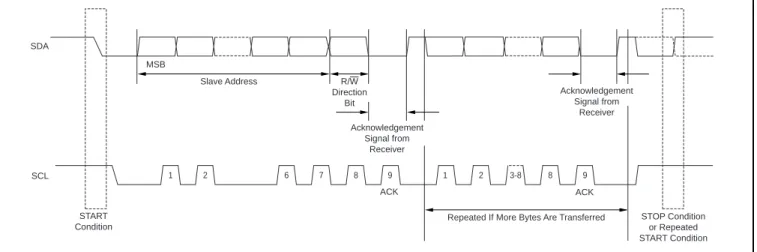
The following bus protocol has been defined (as shown in Figure 2):
• Data transfer may be initiated only when the bus is not busy.
• During data transfer, the data line must remain stable whenever the clock line is HIGH. Changes in the data line while the clock line is HIGH will be interpreted as control signals.
Accordingly, the following bus conditions have been defined:
Bus Not Busy: Both data and clock lines remain HIGH. Start Data Transfer: A change in the state of the data line,
from HIGH to LOW, while the clock is HIGH, defines a START condition.
Stop Data Transfer: A change in the state of the data line,
from LOW to HIGH, while the clock line is HIGH, defines the STOP condition.
Data Valid: The state of the data line represents valid data,
when, after a START condition, the data line is stable for the duration of the HIGH period of the clock signal. There is one clock pulse per bit of data.
Each data transfer is initiated with a START condition and terminated with a STOP condition. The number of data bytes transferred between START and STOP conditions is not limited and is determined by the master device. The informa-tion is transferred byte-wise and each receiver acknowl-edges with a ninth-bit.
Within the I2C bus specifications a standard mode (100kHz
clock rate), a fast mode (400kHz clock rate), and a high-speed mode (3.4MHz clock rate) are defined. The ADS7828 works in all three modes.
Acknowledge: Each receiving device, when addressed, is
obliged to generate an acknowledge after the reception of each byte. The master device must generate an extra clock pulse that is associated with this acknowledge bit.
A device that acknowledges must pull down the SDA line during the acknowledge clock pulse in such a way that the SDA line is stable LOW during the HIGH period of the acknowledge clock pulse. Of course, setup and hold times
must be taken into account. A master must signal an end of data to the slave by not generating an acknowledge bit on the last byte that has been clocked out of the slave. In this case, the slave must leave the data line HIGH to enable the master to generate the STOP condition.
Figure 2 details how data transfer is accomplished on the I2C
bus. Depending upon the state of the R/W bit, two types of data transfer are possible:
1. Data transfer from a master transmitter to a slave receiver. The first byte transmitted by the master is the
slave address. Next follows a number of data bytes. The slave returns an acknowledge bit after the slave address and each received byte.
2. Data transfer from a slave transmitter to a master receiver. The first byte, the slave address, is transmitted
by the master. The slave then returns an acknowledge bit. Next, a number of data bytes are transmitted by the slave to the master. The master returns an acknowledge bit after all received bytes other than the last byte. At the end of the last received byte, a not-acknowledge is returned. The master device generates all of the serial clock pulses and the START and STOP conditions. A transfer is ended with a STOP condition or a repeated START condition. Since a repeated START condition is also the beginning of the next serial transfer, the bus will not be released.
The ADS7828 may operate in the following two modes: • Slave Receiver Mode: Serial data and clock are received
through SDA and SCL. After each byte is received, an acknowledge bit is transmitted. START and STOP condi-tions are recognized as the beginning and end of a serial transfer. Address recognition is performed by hardware after reception of the slave address and direction bit. • Slave Transmitter Mode: The first byte (the slave
ad-dress) is received and handled as in the slave receiver mode. However, in this mode the direction bit will indicate that the transfer direction is reversed. Serial data is trans-mitted on SDA by the ADS7828 while the serial clock is input on SCL. START and STOP conditions are recog-nized as the beginning and end of a serial transfer.
SDA
SCL 1 2 6 7 8 9 1 2 3-8 8 9 Slave Address
MSB
Repeated If More Bytes Are Transferred R/W Direction Bit Acknowledgement Signal from Receiver Acknowledgement Signal from Receiver START Condition ACK ACK STOP Condition or Repeated START Condition
ADDRESS BYTE
COMMAND BYTE
The address byte is the first byte received following the START condition from the master device. The first five bits (MSBs) of the slave address are factory pre-set to 10010. The next two bits of the address byte are the device select bits, A1 and A0. Input pins (A1-A0) on the ADS7828 deter-mine these two bits of the device address for a particular ADS7828. A maximum of four devices with the same pre-set code can therefore be connected on the same bus at one time.
The A1-A0 Address Inputs can be connected to VDD or digital ground. The device address is set by the state of these pins upon power-up of the ADS7828.
The last bit of the address byte (R/W) defines the operation to be performed. When set to a ‘1’ a read operation is selected; when set to a ‘0’ a write operation is selected. Following the START condition the ADS7828 monitors the SDA bus, checking the device type identifier being transmit-ted. Upon receiving the 10010 code, the appropriate device select bits, and the R/W bit, the slave device outputs an acknowledge signal on the SDA line.
MSB 6 5 4 3 2 1 LSB
SD C2 C1 C0 PD1 PD0 X X
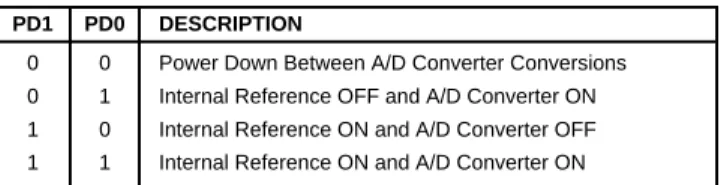
The ADS7828 operating mode is determined by a command byte which is illustrated above.
SD: Single-Ended/Differential Inputs 0: Differential Inputs 1: Single-Ended Inputs C2 - C0: Channel Selections PD1 - 0: Power-Down Selection X: Unused
See Table I for a power-down selection summary. See Table II for a channel selection control summary.
MSB 6 5 4 3 2 1 LSB
1 0 0 1 0 A1 A0 R/W
PD1 PD0 DESCRIPTION
0 0 Power Down Between A/D Converter Conversions 0 1 Internal Reference OFF and A/D Converter ON 1 0 Internal Reference ON and A/D Converter OFF 1 1 Internal Reference ON and A/D Converter ON
CHANNEL SELECTION CONTROL
SD C2 C1 C0 CH0 CH1 CH2 CH3 CH4 CH5 CH6 CH7 COM 0 0 0 0 +IN –IN — — — — — — — 0 0 0 1 — — +IN –IN — — — — — 0 0 1 0 — — — — +IN –IN — — — 0 0 1 1 — — — — — — +IN –IN — 0 1 0 0 –IN +IN — — — — — — — 0 1 0 1 — — –IN +IN — — — — — 0 1 1 0 — — — — –IN +IN — — — 0 1 1 1 — — — — — — –IN +IN — 1 0 0 0 +IN — — — — — — — –IN 1 0 0 1 — — +IN — — — — — –IN 1 0 1 0 — — — — +IN — — — –IN 1 0 1 1 — — — — — — +IN — –IN 1 1 0 0 — +IN — — — — — — –IN 1 1 0 1 — — — +IN — — — — –IN 1 1 1 0 — — — — — +IN — — –IN 1 1 1 1 — — — — — — — +IN –IN
TABLE II. Channel Selection Control Addressed by Command Byte.
INITIATING CONVERSION
Provided the master has write-addressed it, the ADS7828 turns on the A/D converter’s section and begins conversions when it receives BIT 4 of the command byte shown in the Command Byte. If the command byte is correct, the ADS7828 will return an ACK condition.
READING DATA
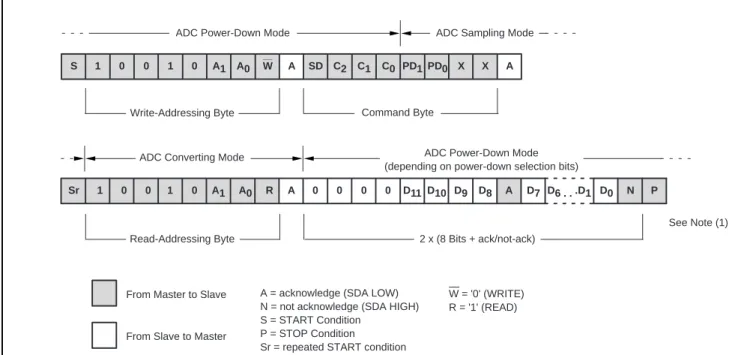
Data can be read from the ADS7828 by read-addressing the part (LSB of address byte set to 1) and receiving the transmitted bytes. Converted data can only be read from the ADS7828 once a conversion has been initiated as described in the preceding section.
Each 12-bit data word is returned in two bytes, as shown below, where D11 is the MSB of the data word, and D0 is the LSB. Byte 0 is sent first, followed by Byte 1.
FIGURE 3. Typical Read Sequence in F/S Mode.
Sr 1 0 0 1 0 A1 A0 R A 0 0 0 0 D11 D10 D9 D8 A D7 D6 . . .D1 D0 N P S 1 0 0 1 0 A1 A0 W A SD C2 C1 C0 PD1 PD0 X X A
From Master to Slave A = acknowledge (SDA LOW) N = not acknowledge (SDA HIGH) S = START Condition
P = STOP Condition
Sr = repeated START condition
W = '0' (WRITE) R = '1' (READ) From Slave to Master
Write-Addressing Byte Command Byte
ADC Power-Down Mode ADC Sampling Mode
ADC Converting Mode ADC Power-Down Mode
(depending on power-down selection bits)
Read-Addressing Byte 2 x (8 Bits + ack/not-ack)
See Note (1)
NOTE: (1) To secure bus operation and loop back to the stage of write-addressing for next conversion, use repeated START.
MSB 6 5 4 3 2 1 LSB
BYTE 0 0 0 0 0 D11 D10 D9 D8
BYTE 1 D7 D6 D5 D4 D3 D2 D1 D0
READING IN F/S MODE
Figure 3 describes the interaction between the master and the slave ADS7828 in Fast or Standard (F/S) mode. At the end of reading conversion data the ADS7828 can be issued a repeated START condition by the master to secure bus operation for subsequent conversions of the A/D converter. This would be the most efficient way to perform continuous conversions.
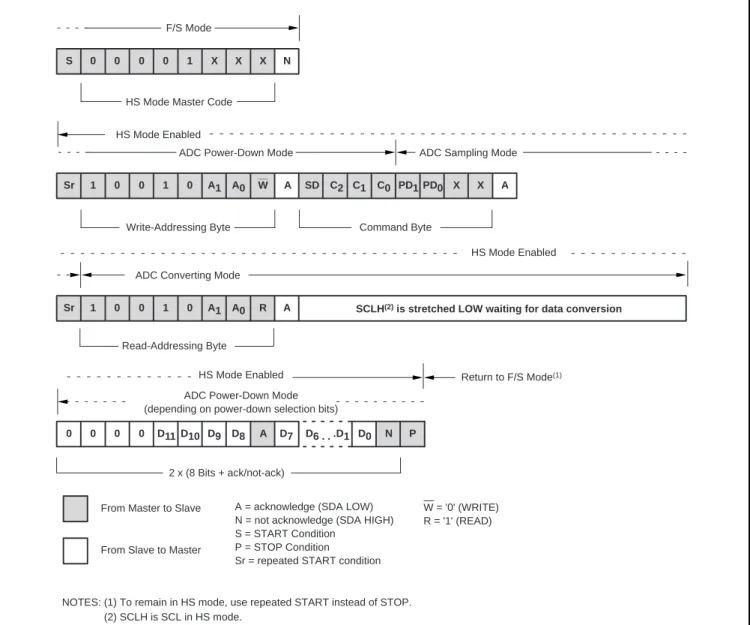
FIGURE 4. Typical Read Sequence in HS Mode.
READING IN HS MODE
High Speed (HS) mode is fast enough that codes can be read outone at a time. In HS mode, there is not enough time for a single conversion to complete between the reception of a repeated START condition and the read-addressing byte, so the ADS7828 stretches the clock after the read-address-ing byte has been fully received, holdread-address-ing it LOW until the conversion is complete.
See Figure 4 for a typical read sequence for HS mode. Included in the read sequence is the shift from F/S to HS modes. It may be desirable to remain in HS mode after reading a conversion; to do this, issue a repeated START instead of a STOP at the end of the read sequence, since a STOP causes the part to return to F/S mode.
Sr 1 0 0 1 0 A1 A0 R A S 0 0 0 0 1 X X X N
Sr 1 0 0 1 0 A1 A0 W A SD C2 C1 C0 PD1 PD0 X X A
0 0 0 0 D11 D10 D9 D8 A D7 D6 . . .D1 D0 N P
F/S Mode
HS Mode Master Code
HS Mode Enabled HS Mode Enabled
ADC Power-Down Mode ADC Sampling Mode
ADC Converting Mode
Command Byte Write-Addressing Byte
Read-Addressing Byte
HS Mode Enabled Return to F/S Mode(1)
ADC Power-Down Mode (depending on power-down selection bits)
2 x (8 Bits + ack/not-ack)
From Master to Slave A = acknowledge (SDA LOW) N = not acknowledge (SDA HIGH) S = START Condition
P = STOP Condition
Sr = repeated START condition
W = '0' (WRITE) R = '1' (READ) From Slave to Master
NOTES: (1) To remain in HS mode, use repeated START instead of STOP. (2) SCLH is SCL in HS mode.
Internal VREF vs Turn-On Time Typical Characteristic plot.
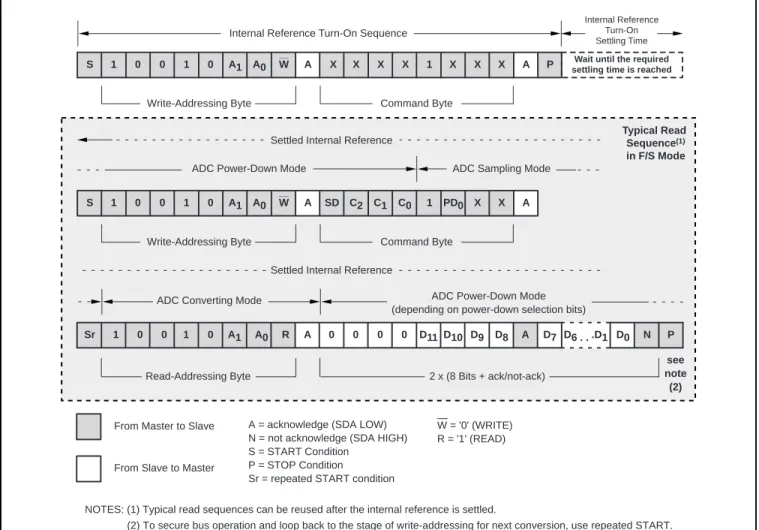
If the PD1 bit has been set to logic ‘0’ while using the ADS7828, then the settling time must be reconsidered after PD1 is set to logic ‘1’. In other words, whenever the internal reference is turned on after it has been turned off, the settling time must be long enough to get 12-bit accu-racy conversion.
3) When the internal reference is off, it is not turned on until both the first Command Byte with PD1 = ‘1’ is sent and then a STOP condition or repeated START condition is issued. (The actual turn-on time occurs once the STOP or repeated START condition is issued.) Any Command Byte with PD1 = ‘1’ issued after the internal reference is turned on serves only to keep the internal reference on. Other-wise, the internal reference would be turned off by any Command Byte with PD1 = ‘0’.
The example in Figure 5 can be generalized for a HS mode conversion cycle by simply swapping the timing of the con-version cycle.
If using an external reference, PD1 must be set to ‘0’, and the external reference must be settled. The typical sequence in Figure 3 or Figure 4 can then be used.
READING WITH REFERENCE ON/OFF
The internal reference defaults to off when the ADS7828 power is on. To turn the internal reference on or off, see Table I. If the reference (internal or external) is constantly turned on and off, a proper amount of settling time must be added before a normal conversion cycle can be started. The exact amount of settling time needed varies depending on the configuration.
See Figure 5 for an example of the proper internal reference turn-on sequence before issuing the typical read sequences required for the F/S mode when an internal reference is used.
When using an internal reference, there are three things that must be done:
1) In order to use the internal reference, the PD1 bit of Command Byte must always be set to logic ‘1’ for each sample conversion that is issued by the sequence, as shown in Figure 3.
2) In order to achieve 12-bit accuracy conversion when using the internal reference, the internal reference settling time must be considered, as shown in the
FIGURE 5. Internal Reference Turn-On Sequence and Typical Read Sequence (F/S mode shown).
Sr 1 0 0 1 0 A1 A0 R A 0 0 0 0 D11 D10 D9 D8 A D7 D6 . . .D1 D0 N P S 1 0 0 1 0 A1 A0 W A SD C2 C1 C0 1 PD0 X X A
S 1 0 0 1 0 A1 A0 W A X X X X 1 X X X A P settling time is reachedWait until the required
Internal Reference Turn-On Sequence
Settled Internal Reference
Settled Internal Reference
Internal Reference Turn-On Settling Time Typical Read Sequence(1) in F/S Mode
From Master to Slave A = acknowledge (SDA LOW) N = not acknowledge (SDA HIGH) S = START Condition
P = STOP Condition
Sr = repeated START condition
W = '0' (WRITE) R = '1' (READ) From Slave to Master
Command Byte Write-Addressing Byte
Command Byte Write-Addressing Byte
ADC Power-Down Mode ADC Sampling Mode
ADC Converting Mode ADC Power-Down Mode
(depending on power-down selection bits)
Read-Addressing Byte 2 x (8 Bits + ack/not-ack)
see note (2)
NOTES: (1) Typical read sequences can be reused after the internal reference is settled.
LAYOUT
For optimum performance, care should be taken with the physical layout of the ADS7828 circuitry. The basic SAR architecture is sensitive to glitches or sudden changes on the power supply, reference, ground connections, and digital inputs that occur just prior to latching the output of the analog comparator. Therefore, during any single conversion for an “n-bit” SAR converter, there are n “windows” in which large external transient voltages can easily affect the conversion result. Such glitches might originate from switching power supplies, nearby digital logic, and high-power devices. With this in mind, power to the ADS7828 should be clean and well-bypassed. A 0.1µF ceramic bypass capacitor should be placed as close to the device as possible. A 1µF to 10µF capacitor may also be needed if the impedance of the connection between +VDD and the power supply is high.
The ADS7828 architecture offers no inherent rejection of noise or voltage variation in regards to using an external reference input. This is of particular concern when the reference input is tied to the power supply. Any noise and ripple from the supply will appear directly in the digital results. While high-frequency noise can be filtered out, voltage varia-tion due to line frequency (50Hz or 60Hz) can be difficult to remove.
The GND pin should be connected to a clean ground point. In many cases, this will be the “analog” ground. Avoid connections that are too near the grounding point of a microcontroller or digital signal processor. The ideal layout will include an analog ground plane dedicated to the con-verter and associated analog circuitry.
PACKAGE OPTION ADDENDUM
www.ti.com 28-Apr-2013
PACKAGING INFORMATION
Orderable Device Status
(1)
Package Type Package Drawing
Pins Package Qty
Eco Plan
(2)
Lead/Ball Finish MSL Peak Temp
(3)
Op Temp (°C) Top-Side Markings
(4)
Samples
ADS7828E/250 ACTIVE TSSOP PW 16 250 Green (RoHS
& no Sb/Br)
CU NIPDAU Level-1-260C-UNLIM -40 to 85 ADS 7828E
ADS7828E/250G4 ACTIVE TSSOP PW 16 250 Green (RoHS
& no Sb/Br)
CU NIPDAU Level-1-260C-UNLIM -40 to 85 ADS 7828E
ADS7828E/2K5 ACTIVE TSSOP PW 16 2500 Green (RoHS
& no Sb/Br)
CU NIPDAU Level-1-260C-UNLIM -40 to 85 ADS 7828E
ADS7828E/2K5G4 ACTIVE TSSOP PW 16 2500 Green (RoHS
& no Sb/Br)
CU NIPDAU Level-1-260C-UNLIM -40 to 85 ADS 7828E
ADS7828EB/250 ACTIVE TSSOP PW 16 250 Green (RoHS
& no Sb/Br)
CU NIPDAU Level-1-260C-UNLIM -40 to 85 ADS 7828E B
ADS7828EB/250G4 ACTIVE TSSOP PW 16 250 Green (RoHS
& no Sb/Br)
CU NIPDAU Level-1-260C-UNLIM -40 to 85 ADS 7828E B
ADS7828EB/2K5 ACTIVE TSSOP PW 16 2500 Green (RoHS
& no Sb/Br)
CU NIPDAU Level-1-260C-UNLIM -40 to 85 ADS 7828E B
ADS7828EB/2K5G4 ACTIVE TSSOP PW 16 2500 Green (RoHS
& no Sb/Br)
CU NIPDAU Level-1-260C-UNLIM -40 to 85 ADS 7828E B
(1)
The marketing status values are defined as follows: ACTIVE: Product device recommended for new designs.
LIFEBUY: TI has announced that the device will be discontinued, and a lifetime-buy period is in effect.
NRND: Not recommended for new designs. Device is in production to support existing customers, but TI does not recommend using this part in a new design. PREVIEW: Device has been announced but is not in production. Samples may or may not be available.
OBSOLETE: TI has discontinued the production of the device.
(2)
Eco Plan - The planned eco-friendly classification: Pb-Free (RoHS), Pb-Free (RoHS Exempt), or Green (RoHS & no Sb/Br) - please check http://www.ti.com/productcontent for the latest availability information and additional product content details.
TBD: The Pb-Free/Green conversion plan has not been defined.
Pb-Free (RoHS): TI's terms "Lead-Free" or "Pb-Free" mean semiconductor products that are compatible with the current RoHS requirements for all 6 substances, including the requirement that lead not exceed 0.1% by weight in homogeneous materials. Where designed to be soldered at high temperatures, TI Pb-Free products are suitable for use in specified lead-free processes. Pb-Free (RoHS Exempt): This component has a RoHS exemption for either 1) lead-based flip-chip solder bumps used between the die and package, or 2) lead-based die adhesive used between the die and leadframe. The component is otherwise considered Pb-Free (RoHS compatible) as defined above.
PACKAGE OPTION ADDENDUM
www.ti.com 28-Apr-2013
(3)
MSL, Peak Temp. -- The Moisture Sensitivity Level rating according to the JEDEC industry standard classifications, and peak solder temperature.
(4)
Multiple Top-Side Markings will be inside parentheses. Only one Top-Side Marking contained in parentheses and separated by a "~" will appear on a device. If a line is indented then it is a continuation of the previous line and the two combined represent the entire Top-Side Marking for that device.
Important Information and Disclaimer:The information provided on this page represents TI's knowledge and belief as of the date that it is provided. TI bases its knowledge and belief on information provided by third parties, and makes no representation or warranty as to the accuracy of such information. Efforts are underway to better integrate information from third parties. TI has taken and continues to take reasonable steps to provide representative and accurate information but may not have conducted destructive testing or chemical analysis on incoming materials and chemicals. TI and TI suppliers consider certain information to be proprietary, and thus CAS numbers and other limited information may not be available for release.
In no event shall TI's liability arising out of such information exceed the total purchase price of the TI part(s) at issue in this document sold by TI to Customer on an annual basis. OTHER QUALIFIED VERSIONS OF ADS7828 :
•
Automotive: ADS7828-Q1NOTE: Qualified Version Definitions:
TAPE AND REEL INFORMATION
*All dimensions are nominal
Device Package Type Package Drawing Pins SPQ Reel Diameter (mm) Reel Width W1 (mm) A0 (mm) B0 (mm) K0 (mm) P1 (mm) W (mm) Pin1 Quadrant ADS7828E/250 TSSOP PW 16 250 180.0 12.4 6.9 5.6 1.6 8.0 12.0 Q1 ADS7828E/2K5 TSSOP PW 16 2500 330.0 12.4 6.9 5.6 1.6 8.0 12.0 Q1 ADS7828EB/250 TSSOP PW 16 250 180.0 12.4 6.9 5.6 1.6 8.0 12.0 Q1 ADS7828EB/2K5 TSSOP PW 16 2500 330.0 12.4 6.9 5.6 1.6 8.0 12.0 Q1
PACKAGE MATERIALS INFORMATION
*All dimensions are nominal
Device Package Type Package Drawing Pins SPQ Length (mm) Width (mm) Height (mm)
ADS7828E/250 TSSOP PW 16 250 210.0 185.0 35.0
ADS7828E/2K5 TSSOP PW 16 2500 367.0 367.0 35.0
ADS7828EB/250 TSSOP PW 16 250 210.0 185.0 35.0
ADS7828EB/2K5 TSSOP PW 16 2500 367.0 367.0 35.0
PACKAGE MATERIALS INFORMATION
IMPORTANT NOTICE
Texas Instruments Incorporated and its subsidiaries (TI) reserve the right to make corrections, enhancements, improvements and other changes to its semiconductor products and services per JESD46, latest issue, and to discontinue any product or service per JESD48, latest issue. Buyers should obtain the latest relevant information before placing orders and should verify that such information is current and complete. All semiconductor products (also referred to herein as “components”) are sold subject to TI’s terms and conditions of sale supplied at the time of order acknowledgment.
TI warrants performance of its components to the specifications applicable at the time of sale, in accordance with the warranty in TI’s terms and conditions of sale of semiconductor products. Testing and other quality control techniques are used to the extent TI deems necessary to support this warranty. Except where mandated by applicable law, testing of all parameters of each component is not necessarily performed.
TI assumes no liability for applications assistance or the design of Buyers’ products. Buyers are responsible for their products and applications using TI components. To minimize the risks associated with Buyers’ products and applications, Buyers should provide adequate design and operating safeguards.
TI does not warrant or represent that any license, either express or implied, is granted under any patent right, copyright, mask work right, or other intellectual property right relating to any combination, machine, or process in which TI components or services are used. Information published by TI regarding third-party products or services does not constitute a license to use such products or services or a warranty or endorsement thereof. Use of such information may require a license from a third party under the patents or other intellectual property of the third party, or a license from TI under the patents or other intellectual property of TI.
Reproduction of significant portions of TI information in TI data books or data sheets is permissible only if reproduction is without alteration and is accompanied by all associated warranties, conditions, limitations, and notices. TI is not responsible or liable for such altered documentation. Information of third parties may be subject to additional restrictions.
Resale of TI components or services with statements different from or beyond the parameters stated by TI for that component or service voids all express and any implied warranties for the associated TI component or service and is an unfair and deceptive business practice. TI is not responsible or liable for any such statements.
Buyer acknowledges and agrees that it is solely responsible for compliance with all legal, regulatory and safety-related requirements concerning its products, and any use of TI components in its applications, notwithstanding any applications-related information or support that may be provided by TI. Buyer represents and agrees that it has all the necessary expertise to create and implement safeguards which anticipate dangerous consequences of failures, monitor failures and their consequences, lessen the likelihood of failures that might cause harm and take appropriate remedial actions. Buyer will fully indemnify TI and its representatives against any damages arising out of the use of any TI components in safety-critical applications.
In some cases, TI components may be promoted specifically to facilitate safety-related applications. With such components, TI’s goal is to help enable customers to design and create their own end-product solutions that meet applicable functional safety standards and requirements. Nonetheless, such components are subject to these terms.
No TI components are authorized for use in FDA Class III (or similar life-critical medical equipment) unless authorized officers of the parties have executed a special agreement specifically governing such use.
Only those TI components which TI has specifically designated as military grade or “enhanced plastic” are designed and intended for use in military/aerospace applications or environments. Buyer acknowledges and agrees that any military or aerospace use of TI components which havenotbeen so designated is solely at the Buyer's risk, and that Buyer is solely responsible for compliance with all legal and regulatory requirements in connection with such use.
TI has specifically designated certain components as meeting ISO/TS16949 requirements, mainly for automotive use. In any case of use of non-designated products, TI will not be responsible for any failure to meet ISO/TS16949.
Products Applications
Audio www.ti.com/audio Automotive and Transportation www.ti.com/automotive
Amplifiers amplifier.ti.com Communications and Telecom www.ti.com/communications
Data Converters dataconverter.ti.com Computers and Peripherals www.ti.com/computers
DLP® Products www.dlp.com Consumer Electronics www.ti.com/consumer-apps
DSP dsp.ti.com Energy and Lighting www.ti.com/energy
Clocks and Timers www.ti.com/clocks Industrial www.ti.com/industrial
Interface interface.ti.com Medical www.ti.com/medical
Logic logic.ti.com Security www.ti.com/security
Power Mgmt power.ti.com Space, Avionics and Defense www.ti.com/space-avionics-defense
Microcontrollers microcontroller.ti.com Video and Imaging www.ti.com/video
RFID www.ti-rfid.com
OMAP Applications Processors www.ti.com/omap TI E2E Community e2e.ti.com
Wireless Connectivity www.ti.com/wirelessconnectivity
Mailing Address: Texas Instruments, Post Office Box 655303, Dallas, Texas 75265 Copyright © 2015, Texas Instruments Incorporated