Optomechanical Micro-Macro Entanglement
R. Ghobadi,1,*S. Kumar,1B. Pepper,2 D. Bouwmeester,2,3A. I. Lvovsky,1,4and C. Simon1 1
Institute for Quantum Science and Technology, Department of Physics and Astronomy, University of Calgary, Calgary T2 N 1N4, Alberta, Canada
2
Department of Physics, University of California, Santa Barbara, California 93106, USA 3
Huygens Laboratory, Leiden University, P.O. Box 9504, 2300 RA Leiden, Netherlands 4
Russian Quantum Center, 100 Novaya Street, Skolkovo, Moscow 143025, Russia
(Received 30 August 2013; published 27 February 2014)
We propose to create and detect optomechanical entanglement by storing one component of an entangled state of light in a mechanical resonator and then retrieving it. Using micro-macro entanglement of light as recently demonstrated experimentally, one can then create optomechanical entangled states where the components of the superposition are macroscopically different. We apply this general approach to two-mode squeezed states where one two-mode has undergone a large displacement. Based on an analysis of the relevant experimental imperfections, the scheme appears feasible with current technology.
DOI:10.1103/PhysRevLett.112.080503 PACS numbers: 03.67.Bg, 03.65.Ta, 42.50.Wk, 42.50.Xa
Vigorous efforts are currently being undertaken to bring quantum effects such as superposition and entanglement to the macroscopic level [1–9]. One prominent goal in this context is the creation of entanglement between a micro-scopic and a macromicro-scopic system [2–9], following Schrödinger’s famous thought experiment that involved a decaying nucleus and a cat[10]. In optomechanical systems the quantum regime has recently been reached [11–14], but optomechanical entanglement has not yet been dem-onstrated. In a certain sense any entanglement of an optomechanical system can be seen as micro-macro entan-glement, because the mechanical system always involves billions of atoms. However, for many proposals[15–17]the different components of the entangled state only differ by (of order) a single phonon.
Here we show how to create optomechanical micro-macro entanglement in a stronger sense by combining two key ideas. First, we propose a convenient method for both creating and detecting optomechanical entanglement, based on mapping one component of an entangled state of light onto the mechanical resonator and then retrieving it [18,19]. Demonstrating entanglement for the retrieved light then demonstrates the existence of optomechanical entan-glement in the intermediate state. Second, we show that this approach makes it possible to create optomechanical “cat states” where there is a macroscopic difference for a physical observable between the different components of the superposition, based on recent work demonstrating micro-macro entanglement of light [3–6]. The physical observable in our case is the variance of the phonon number. Our proposal is thus different from Ref. [20], which aim to create superposition states of mechanical systems with a large separation in position.
We propose to first create purely optical micro-macro entanglement by amplification of one component of an
initial microscopic entangled state [3–8], and to then convert the photons in the amplified component into phonons. The entanglement can be verified by reconverting the phonons into photons and using the deamplification and detection techniques of Refs.[3–6]. Deamplification is advantageous in practice compared to trying to verify micro-macro entanglement by direct detection, which requires extremely high measurement precision[21].
The general approach described above can be applied to different micro-macro entangled states[3–8]. We illustrate it by introducing two-mode squeezed states where one mode has undergone a large displacement. We propose to use displacement as the amplification process because it creates states that are comparatively robust under photon loss[3,4,6]. Displaced two-mode squeezed states further-more have the interesting property that the degree of entanglement and the degree of macroscopicity can be varied almost independently by choosing the amount of squeezing and the size of the displacement. Moreover, these states are Gaussian, making it possible to quantify their entanglement exactly even in the presence of imper-fections. See the Supplemental Material[22]for the appli-cation of our approach to displaced single-photon entanglement[3,4,6].
We start by creating a two-mode squeezed statejψ0i ¼
ffiffiffiffiffiffiffiffiffiffiffiffi 1−t2
p P
∞
n¼0tnjniAjniC witht¼tanhðrÞ where r is the squeezing strength. For moderateronly the first few terms contribute significantly. For example, for r¼0.5 (or 4.3 dB of squeezing) the probabilities for the first terms arep00¼0.786, p11¼0.168, p22¼0.036, and the total weight of the remaining terms is only 0.001. We denote the optical modes A and C, reserving the label B for the mechanical oscillator. We apply the displacement operator DðαÞ ¼eαa†−αa in mode A, generating the state
jψDi ¼
ffiffiffiffiffiffiffiffiffiffiffiffi 1−t2
p X∞
n¼0
tnðDðαÞjniÞ
AjniC. (1)
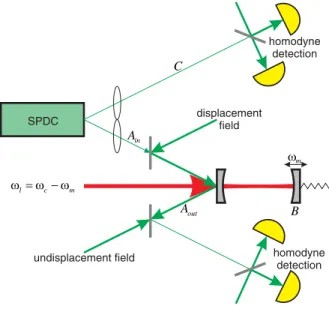
The displacement can be implemented by interference with a strong coherent beam [3,4,6,23,24], see Fig. 1. A displaced Fock stateDðαÞjnihas a photon number variance
ð2nþ1Þjαj2. For moderaterand largeαthe state(1)is thus a superposition of a small number of relevant components that have macroscopically distinct photon number varian-ces. Increasing the displacement α increases the macro-scopicity of the superposition. On the other hand, increasing the squeezing parameterr increases the entan-glement of the state, in particular the number of compo-nents that contribute significantly. Here we focus on the moderate squeezing regime with only a few components, which is also the easiest regime to achieve experimentally. The displaced modeAof the two-mode squeezed state is now fed into a cavity and stored onto the mechanical mode B using the optomechanical coupling between the cavity field and the mechanical mode [18,19], see Fig. 1. The basic optomechanical Hamiltonian is H¼ℏΔa†aþ ℏωmb†bþℏg0a†aðbþb†Þ, where Δ¼ωc−ωL is the detuning between the cavity resonance and the frequency of the control beam (see below), a is the annihilation operator for the cavity mode, ωm is the mechanical
resonance frequency,bis the mechanical mode annihilation operator,g0is the bare optomechanical coupling, and the Hamiltonian is written in the rotating frame with respect to the frequency of the control beam. If the control beam is red detuned byωmwith respect to the cavity resonance (and if ωm ≫κ, the resolved-sideband regime), one obtains the effective beam splitter HamiltonianHeff¼gða†bþab†Þ, whereg is proportional tog0and to the amplitude of the control beam[13,25]. The resulting equations of motion are a: ¼−κa−igbþpffiffiffiffiffi2κain andb: ¼−iga. The input-output relation for the cavity isaout¼−ainþpffiffiffiffiffi2κa. We consider the situation where the cavity decay rate κ≫g (and it is also much greater than the bandwidth of the input light). One can then adiabatically eliminate the cavity mode [25,26], aðtÞ ¼ ð1=κÞð−igbþpffiffiffiffiffi2κainÞ. This gives the
equation of motionb :
¼−Gb−ipffiffiffiffiffiffi2Gain with G¼g2=κ,
and the input-output relation aout¼ain−ipffiffiffiffiffiffi2Gb. The solution is bðtÞ ¼−ipffiffiffiffiffiffi2Ge−GtRt
0eGt 0
ainðt0Þdt0þe−Gtbð0Þ for the mechanical mode andaoutðtÞ ¼−i
ffiffiffiffiffiffi 2G
p
e−Gtbð0Þ þ ainðtÞ−2Ge−Gt
Rt 0eGt
0
ainðt0Þdt0 for the output field.
Both storage and retrieval can be implemented by applying a constant coupling strengthGfor a time duration τ(each). Using techniques similar to those of Ref.[25]one can then show that
Aout¼−ð1−y2ÞðAinþαÞ−iy
ffiffiffiffiffiffiffiffiffiffiffiffiffi 1−y2
q
BinþyδA; (2)
see also the Supplemental Material[22]. Here Aout is the optical output mode after storage and retrieval (but before the eventual displacement back to the microscopic level), y¼e−Gτ, A
in is the optical input mode, Bin is the initial
state of the mechanical oscillator, andδAis an optical noise mode that is in the vacuum state. One can see that the overall storage and retrieval efficiency is ð1−y2Þ2 (in terms of photon number). This is very similar to the expressions obtained for the efficiency in other types of quantum memories[27].
The displaced two-mode squeezed state is Gaussian. Its entanglement can therefore be quantified via the logarith-mic negativity [28]. Expressing Eq. (2) in terms of quadratures one has Xout
A ¼−ð1−y2ÞðXinAþ
ffiffiffi 2 p
αÞ þ
ypffiffiffiffiffiffiffiffiffiffiffiffiffi1−y2Pin
B þyδXA and PoutA ¼−ð1−y2ÞPinA− ypffiffiffiffiffiffiffiffiffiffiffiffiffi1−y2Xin
B þyδPA, where XoutA , PoutA , XB, PB, δXA, δPA are the quadrature operators corresponding to Aout,
respectively. It is then straightforward to determine the covariance matrix for the output modes and calculate the logarithmic negativity, see also the Supplemental Material [22]. Note that in this calculation the covariance matrix does not depend on the displacement, sinceαis fixed and mean values are subtracted in the definition of V. This changes, however, in the presence of phase noise, see below. Figure2shows the entanglement in the final state as
SPDC
homodyne detection
homodyne detection displacement
field
undisplacement field
m in
A
out
A
l c m
C
B
FIG. 1 (color online). Proposed setup. The spontaneous para-metric down-conversion source (SPDC) creates a (microscopic) two-mode squeezed state. One mode is directly detected by homodyne detection. The other mode is displaced by a macro-scopic amount through the interference with a strong displace-ment field and then stored onto a mechanical oscillator using an optomechanical cavity and a strong red-detuned control beam. This creates optomechanical micro-macro entanglement. The state of the mechanical system can subsequently be reconverted into light. The entanglement is detected by first displacing the mode back to the microscopic level, followed by homodyne detection.
a function ofy. One can see that there is a threshold fory above which the entanglement becomes exactly zero. The value of this threshold depends on the initial phonon numberNin ¼ hððXin
BÞ2þ ðPinBÞ2−1Þ=2iof the mechanical oscillator. Precooling the mechanical oscillator close to the ground state is helpful for entanglement detection, but not strictly necessary. Note that the red-detuned control beam that is applied in the present protocol has a cooling effect [14]. Figure2includes the effects of several other imper-fections, namely phase noise, mechanical decoherence, in-and out-coupling loss, in-and loss on the micro side. We now discuss these effects in more detail.
Phase noise can be modeled through the transformation Aout→eiϕAout, with a random phase ϕ with distribution
pðϕÞ. Let us assume thatpðϕÞis symmetric aroundϕ¼0 and has a standard deviationσ, whereσ≪1. The only term contributing to the covariance matrix that is significantly affected by the phase noise is hðPoutA Þ2i, which gets an additional term2jαj2ð1−y2Þ2σ2. All other matrix elements only receiveOðσ2Þ corrections (without the enhancement by the largejαj2factor). However, this change inhðPout
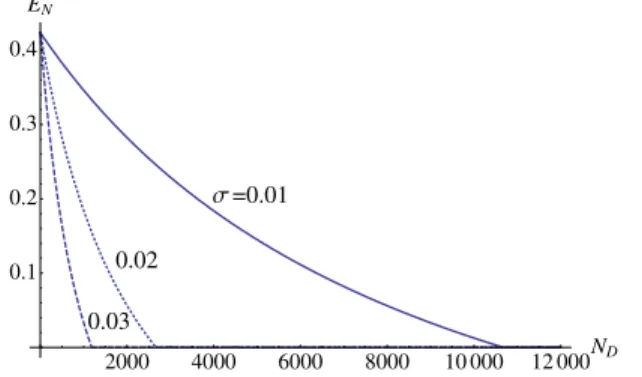
A Þ2i, which is not undone by the final displacement back to the microscopic level, has a significant effect on the entangle-ment, see Fig. 3. Phase noise limits the size of the displacement for which entanglement can be shown. This increasing sensitivity to phase noise for increasing displacement provides further evidence (in addition to the above argument based on the photon or phonon number variances of the displaced Fock states) that the displaced two-mode squeezed state is indeed a macroscopic super-position state, see also Refs. [3,4,6,29,30]. Reference[3] achieved very large displacements (ND>108) by using the
same spatial mode (but orthogonal polarization modes) for the signal and displacement beam, leading to very high stability. This may be more challenging in the optome-chanical context. In our examples we have pickedσvalues more comparable to Ref. [4], where the signal and displacement beam were in separate spatial modes.
We will now take into account the mechanical damping and associated noise. The equation of motion for b is now b
:
¼−γb−igaþpffiffiffiffiffi2γbin, leading to b
:
¼−G0b− ipffiffiffiffiffiffi2Gainþ
ffiffiffiffiffi 2γ
p
binafter adiabatic elimination of the cavity
mode. Here G0¼Gþγ. Using techniques similar to Ref. [25], but keeping all orders of γ, one can show that this equation together with the input-output relation for the cavity leads to the following modified equation for the optical output mode after storage and retrieval:
Aout¼− 1−y2
1þxAin−i
ffiffiffiffiffiffiffiffiffiffiffiffiffi 1−y2
1þx
s
yBinþf1δAþf2δB;
where we have introduced the notationx¼γ=G, andAinis
defined analogously to before, but usingG0 instead ofG. The modes δA and δB correspond to the optical and mechanical noise, respectively, where the former is in the vacuum state, and the latter is in a thermal state at the temperature of the mechanical bath with a mean phonon numberNth. The expressions for the coefficientsf1andf2,
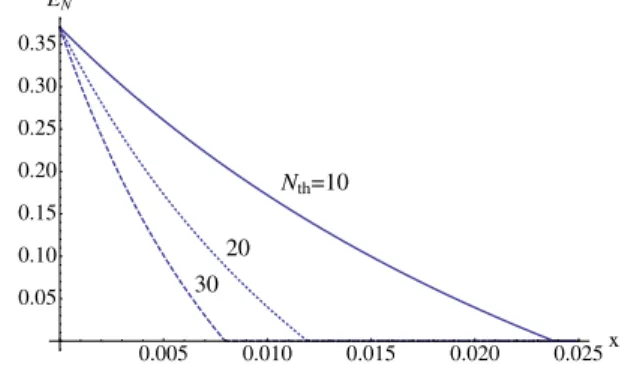
as well as more details on the calculation, are given in the Supplemental Material[22]. Figure 4shows the effect of the mechanical noise on the entanglement in the final state; x has to be below a certain threshold in order for entanglement to be present, where the value of the thresh-old depends onNth. For the parameters of Fig.4one has the conditionNthx¼Nthγ=G≲0.2;Nthγcan be interpreted as
the effective mechanical decoherence rate.
Another important imperfection is photon loss, including coupling losses for the optomechanical cavity and detection inefficiency. These effects are discussed in the
Nin 1
5
10
0.1 0.2 0.3 0.4 0.5y
0.05 0.10 0.15
EN
FIG. 2 (color online). Entanglement in the final state as a function of the optomechanical coupling parametery¼e−Gτ, for
different values of the initial mechanical phonon numberNin. In
all cases y has to be below a certain threshold value for entanglement to be observable, where the value of the threshold depends on Nin. The figure also includes the effect of other
imperfections; the relevant parameter values arex¼γ=G¼0.01 and Nth¼10 (mechanical noise),η1¼η2¼ηc¼0.8 (losses),
σ¼0.01 (phase noise); see the text for more discussion. The photon (or phonon) number corresponding to the displacement is ND¼ jαj2¼5000, and the squeezing parameter isr¼0.5.
=0.01
0.02
0.03
2000 4000 6000 8000 10 000 12 000ND 0.1
0.2 0.3 0.4
EN
FIG. 3 (color online). Entanglement in the final state as a function of the displaced photon (or phonon) numberND¼ jαj2, for different values of the phase noise standard deviationσ. Phase noise limits the size of the displacement for which entanglement can be shown. Herey¼0.1,Nin¼1, and the other parameters
are the same as in Fig.2.
Supplemental Material[22]. Most importantly, Fig.2of the Supplemental Material [22] shows that the cavity in-coupling efficiency has to be above a certain threshold value (of order 0.4 for our choice of parameters) in order to be able to demonstrate entanglement.
We propose an implementation based on the integrated optical and mechanical nanoscale resonator of Ref. [14] and the narrow band cavity-enhanced parametric down-conversion source of Ref.[31]. Takingωm¼2π×3.7GHz, κ¼2π×500MHz, andγ ¼2π×35kHz from Ref. [14] and assuming a bath temperature T¼2K, which is accessible with fairly simple cryostats, one has Nth≈10.
The highest drive power used in Ref. [14]corresponds to g≈2π×40MHz, leading to an effective coupling G¼g2=κ≈2π×3.2MHz. This gives x¼γ=G≈0.01. We propose τ≈100ns, which is in good correspondence with Ref. [31]. This gives y¼e−Gτ≈0.1. Concerning photon loss, Ref.[32]already demonstrated of order 75% in-coupling efficiency and 52% out-coupling efficiency, and even higher values should be possible. We have neglected the effects of the squeezing part of the opto-mechanical Hamiltonian. They are expected to be sup-pressed by a factorðκ=ωmÞ2, which is less than 0.02 for the system parameters given above, justifying the approxima-tion for this proposed implementaapproxima-tion. Beam-splitter type optomechanical coupling was also demonstrated, e.g., in Refs. [11,19]. The creation and detection of optomechan-ical micro-macro entanglement is thus within reach of current technology.
The approach based on optomechanical storage and retrieval also allows one to conceive experiments that would test proposals for quantum gravity induced wave function collapse. For example, using the approach of Ref. [33] it is realistic to fabricate trampoline resonators with an effective mass of 500 ng, a mechanical frequency ωm¼2π×10kHz, and a mechanical quality factor of106. At a temperature of 1 mK the environmentally induced decoherence time scale 1=Nthγ of 7.6 ms is then
significantly longer than the decoherence times predicted for this system by the quantum gravity induced collapse models of Ref.[34](240μs) and of Ref.[35](95μs), see also Ref. [36]. The latter number is obtained using the nuclear radius to define the mass distribution following Ref.[37]. For a cavity length of 10 cm, a cavity finesse of
106, and a control field power of 40 pW one can then have
κ≈2π×1.5 kHz and G≈2π×200Hz, satisfying ωm ≫κ≫G≫γNth≈2π×20Hz, as required for
side-band cooling, adiabatic elimination of the cavity, and entanglement detection, respectively. These parameters require a source of sub-kHz bandwidth two-mode squeezed light, which should be feasible based on parametric down conversion with a narrow band pump laser in combination with filter cavities. Compared to the proposal of Ref.[17], which may also allow testing collapse models with weakly coupled optomechanical systems, the present approach has the advantage of not requiring any postselection.
While the above-mentioned collapse times are not sensitive to the size of the displacement α, varying α and hence the number of phonons involved in the super-position would also allow one to look for other types of deviations from quantum physics that might manifest in the little explored regime of superpositions of macroscopically different quantum numbers.
This work was supported by AITF, NSERC, NSF Grant No. PHY-1206118, and NWO VICI Grant No. 680-47-604. We thank P. Barclay for useful discussions.
Note added.—In the recently published experiment of Ref.[38] optomechanical entanglement in the microwave domain (created via blue-detuned driving, not by storing an entangled signal) is also detected by mapping the state of the mechanical mode onto the microwave field.
*Present address: Institute of Atomic and Subatomic
Physics, TU Wien, Stadionallee 2, 1020 Wien, Austria. [1] C. Monroe, D. M. Meekhof, B. E. King, and D. J. Wineland,
Science 272, 1131 (1996); M. Arndt, O. Nairz, J. Vos-Andreae, C. Keller, G. van der Zouw, and A. Zeilinger,
Nature (London)401, 680 (1999); J. R. Friedman, V. Patel, W. Chen, S. K. Tolpygo, and J. E. Lukens,Nature (London)
406, 43 (2000); B. Julsgaard, A. Kozhekin, and E. S. Polzik,
Nature (London)413, 400 (2001); S. Deléglise, I. Dotsenko, C. Sayrin, J. Bernu, M. Brune, J.-M. Raimond, and S. Haroche,Nature (London)455, 510 (2008); R. Fickler, R. Lapkiewicz, W. N. Plick, M. Krenn, C. Schaeff, S. Ramelow, and A. Zeilinger,Science338, 640 (2012). [2] M. Neeley, M. Ansmann, R. C. Bialczak, M. Hofheinz, N.
Katz, E. Lucero, A. O’Connell, H. Wang, A. N. Cleland, and J. M. Martinis,Nat. Phys.4, 523 (2008); A. D. O’Connell
et al.,Nature (London)464, 697 (2010).
[3] A. I. Lvovsky, R. Ghobadi, A. Chandra, A. S. Prasad, and C. Simon,Nat. Phys.9, 541 (2013).
[4] N. Bruno, A. Martin, P. Sekatski, N. Sangouard, R. T. Thew, and N. Gisin,Nat. Phys. 9, 545 (2013).
Nth=10
20 30
0.005 0.010 0.015 0.020 0.025x 0.05
0.10 0.15 0.20 0.25 0.30 0.35
EN
FIG. 4 (color online). Entanglement in the final state as a function of the mechanical noise parameterx¼γ=G, for different values of the bath mean phonon numberNth. The values of the
other parameters are ND¼ jαj2¼5000, r¼0.5, y¼0.1,
Nin¼1,σ¼0.01, andη1¼η2¼ηc¼0.8.
[5] S. Raeisi, W. Tittel, and C. Simon, Phys. Rev. Lett. 108, 120404 (2012).
[6] P. Sekatski, N. Sangouard, M. Stobińska, F. Bussières, M. Afzelius, and N. Gisin,Phys. Rev. A86, 060301(R) (2012). [7] F. De Martini, F. Sciarrino, and C. Vitelli,Phys. Rev. Lett.
100, 253601 (2008).
[8] R. Ghobadi, A. I. Lvovsky, and C. Simon,Phys. Rev. Lett.
110, 170406 (2013).
[9] F. De Martini, F. Sciarrino, C. Vitelli, and F. S. Cataliotti,
Phys. Rev. Lett.104, 050403 (2010).
[10] E. Schrödinger,Naturwissenschaften 23, 823 (1935). [11] E. Verhagen, S. Deléglise, S. Weis, A. Schliesser, and T. J.
Kippenberg,Nature (London)482, 63 (2012).
[12] A. H. Safavi-Naeini et al., Nature (London) 500, 185 (2013); T. P. Purdy, R. W. Peterson, and C. Regal,Science
339, 801 (2013); T. P. Purdy, P.-L. Yu, R. W. Peterson, N. S. Kampel, and C. A. Regal, Phys. Rev. X 3, 031012 (2013); J. D. Teufel, T. Donner, D. Li, J. W. Harlow, M. S. Allman, K. Cicak, A. J. Sirois, J. D. Whittaker, K. W. Lehnert, and R. W. Simmonds,Nature (London)475, 359 (2011).
[13] M. Aspelmeyer, T. J. Kippenberg, and F. Marquardt,
arXiv:1303.0733.
[14] J. Chan, T. P. Mayer Alegre, A. H. Safavi-Naeini, J. T. Hill, A. Krause, S. Gröblacher, M. Aspelmeyer, and O. Painter,
Nature (London)478, 89 (2011).
[15] W. Marshall, C. Simon, R. Penrose, and D. Bouwmeester,
Phys. Rev. Lett.91, 130401 (2003).
[16] O. Romero-Isart, M. L. Juan, R. Quidant, and J. I. Cirac,
New J. Phys.12, 033015 (2010).
[17] B. Pepper, R. Ghobadi, E. Jeffrey, C. Simon, and D. Bouwmeester,Phys. Rev. Lett.109, 023601 (2012). [18] V. Fiore, Y. Yang, M. C. Kuzyk, R. Barbour, L. Tian, and H.
Wang,Phys. Rev. Lett.107, 133601 (2011).
[19] T. A. Palomaki, J. W. Harlow, J. D. Teufel, R. W. Simmonds, and K. W. Lehnert,Nature (London)495, 210 (2013). [20] O. Romero-Isart, A. C. Pflanzer, F. Blaser, R. Kaltenbaek,
N. Kiesel, M. Aspelmeyer, and J. I. Cirac,Phys. Rev. Lett.
107, 020405 (2011); Z. Q. Yin, T. Li, X. Zhang, and L. M. Duan,Phys. Rev. A88, 033614 (2013).
[21] S. Raeisi, P. Sekatski, and C. Simon,Phys. Rev. Lett.107, 250401 (2011).
[22] See Supplemental Material at http://link.aps.org/ supplemental/10.1103/PhysRevLett.112.080503 for a discussion of displaced single-photon entanglement and for more details on several calculations mentioned in the text.
[23] M. G. A. Paris, Phys. Lett. A 217, 78 (1996); G. M. D'Ariano and M. F. Sacchi,Phys. Rev. A52, R4309 (1995). [24] A. I. Lvovsky and S. A. Babichev,Phys. Rev. A66, 011801
(R) (2002).
[25] S. G. Hofer, W. Wieczorek, M. Aspelmeyer, and K. Ham-merer,Phys. Rev. A84, 052327 (2011).
[26] J. Zhang, K. Peng, and S. L. Braunstein,Phys. Rev. A68, 013808 (2003).
[27] See, e.g., Sec. 6 of C. Simonet al.,Eur. Phys. J. D58, 1 (2010); K. Heshami, A. Green, Y. Han, A. Rispe, E. Saglamyurek, N. Sinclair, W. Tittel, and C. Simon, Phys. Rev. A 86, 013813 (2012).
[28] G. Adesso, A. Serafini, and F. Illuminati,Phys. Rev. A70, 022318 (2004).
[29] W. Dür, C. Simon, and J. I. Cirac, Phys. Rev. Lett. 89, 210402 (2002).
[30] P. Sekatski, N. Sangouard, N. Gisin, andarXiv:1306.0843.
[31] J. Fekete, D. Rieländer, M. Cristiani, and H. de Riedmatten,
Phys. Rev. Lett.110, 220502 (2013).
[32] J. D. Cohen, S. M. Meenehan, and O. Painter,Opt. Express
21, 11227 (2013).
[33] D. Kleckner, B. Pepper, E. Jeffrey, P. Sonin, S. M. Thon, and D. Bouwmeester,Opt. Express19, 19708 (2011). [34] J. Ellis, J. S. Hagelin, D. V. Nanopoulos, and M. Srednicki,
Nucl. Phys.B241, 381 (1984); J. Ellis, S. Mohanty, and D. V. Nanopoulos,Phys. Lett. B221, 113 (1989).
[35] L. Diósi,Phys. Rev. A40, 1165 (1989); R. Penrose,Gen. Relativ. Gravit. 28, 581 (1996).
[36] B. Collett and P. Pearle,Found. Phys.33, 1495 (2003); D. Kleckner, I. Pikovski, E. Jeffrey, L. Ament, E. Eliel, J. van den Brink, and D. Bouwmeester,New J. Phys.10, 095020 (2008); O. Romero-Isart,Phys. Rev. A84, 052121 (2011); B. Pepper, E. Jeffrey, R. Ghobadi, C. Simon, and D. Bouwmeester,New J. Phys.14, 115025 (2012).
[37] L. Diósi,J. Phys. A 40, 2989 (2007).
[38] T. A. Palomaki, J. D. Teufel, R. W. Simmonds, and K. W. Lehnert,Science342, 710 (2013).