A
CCELERATINGH
ASHG
RID ANDS
CREEN-S
PACEP
HOTONM
APPINGIN
3D I
NTERACTIVEA
PPLICATIONS WITHO
PENCL
A Senior Project
presented to the Faculty of the Department of Computer Science
California Polytechnic State University, San Luis Obispo
In Partial Fulfillment
of the Requirements for a Bachelor of Science
by
Nikolai Shkurkin
June 2016
T
ABLEOFC
ONTENTSABSTRACT ...1
1. INTRODUCTION...2
2. BACKGROUND AND RELATED WORK...2
3. ALGORITHM AND IMPLEMENTATION...5
3.1 SCENE DATA REPRESENTATION ...6
3.2. PHOTON EMISSION & SAMPLING...6
3.3. 3D HASH GRID...8
3.4. SCREEN-SPACE TILING...9
4. RESULTS...11
4.1 SINGLE CORE AND OPENCL...11
4.2 RAYTRACING AND OPENGL...17
5. DISCUSSION AND FUTURE WORK...18
6. CONCLUSION...20
7. REFERENCES...20
APPENDIX A: HASH GRID SUDO CODE ...22
APPENDIX B: SCREEN-SPACE TILING SUDO CODE...23
ABSTRACT
Achieving interactive and realistic rendering is only possible with a combination of
rendering algorithms, rendering pipelines, multi-core hardware, and parallelization APIs. This
project explores and implements two photon mapping pipelines based on the work of Mara et. al
[5] and Singh et. al [7] to achieve interactive rendering performance for a set of simple scenes
using OpenCL and C++ to work with a GPU. In particular, both a 3D hash grid and a
screen-space tiling algorithm are parallelized to accelerate photon lookup in order to compute direct and
indirect lighting on visible surfaces in a scene. By using OpenCL with photon mapping
interactive renderings of scenes were produced and updated live as a user moved a virtual
camera. This work with OpenCL paved the way for developing a raytracing pipeline in OpenGL
1. INTRODUCTION
Modern rendering algorithms utilize multicore computation devices, typically GPUs, to
accelerate pixel color computations in a resulting image. The application programmer interfaces
(APIs) that expose access to these devices are complex and merit a great deal of specialized
knowledge and experience in order to utilize them effectively. The main task of this project is to
simultaneously gain experience with a particular API, namely OpenCL, and how it can be used
to implement rendering techniques that are near the forefront of current raytracing research.
Raytracing can be used to realistically render scenes with high visual complexity but at
huge computational cost. For users of CAD applications and in movie production who work on
scenes where visual realism is required, final renders take a substantial period of time to produce
acceptable results. However, engineers, artists, and designers creating objects and scenes need a
good sense of how the scene will look given a complex set of object properties and lighting
conditions as they are creating them. By using photon mapping techniques in conjunction with
GPU programming, fast and reasonable approximations can be delivered to these users at an
interactive rate (~500ms or 2 frames per second) to both speed up workflows and decrease the
time of final renders.
2. BACKGROUNDAND RELATED WORK
Scenes are rendered by using a combination of mathematical descriptions of object
surfaces and formulas for how light is perceived at visible surface points by a viewer. The
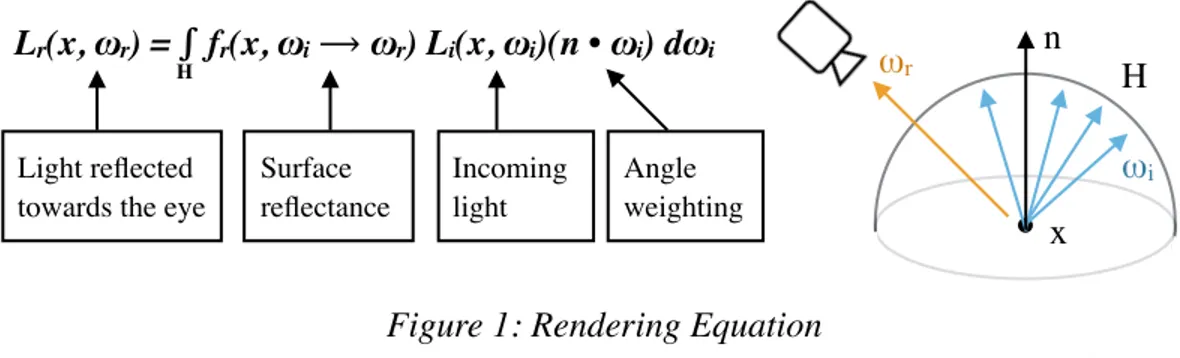
rendering equation, as shown in Figure 1, describes how light reflected towards the viewer, Lr, is
formed by the surface normal n, over the hemisphere H, around a visible surface point x, given
the vector to the viewer ωr.
One way of generating an image using the rendering equation is by raytracing. In general,
raytracing involves splitting a camera’s field of view into a uniform grid of pixels and then
tracing rays from the camera, through the center of those pixels, and into the scene, as shown in
Figure 2. The color of each visible surface hit by a particular ray is then determined by the
rendering equation as described before.
Figuring out the incoming light at a visible surface point, or irradiance, requires
knowledge of how light interacts with the scene and makes its way to the surface to be rendered.
Irradiance can be approximated using a photon map. Using photon maps to approximate Lr(x, ωr) = ∫ fr(x, ωi⟶ωr) Li(x, ωi)(n • ωi) dωi
H
Light reflected towards the eye
Surface reflectance
Incoming light
Angle weighting
H
x
ωr
ωi n
Figure 1: Rendering Equation
Image Plane
irradiance and global illumination effects was first introduced by Henrik Wann Jensen in 1996.
According to Jensen, a photon map is constructed by “emitting photons from light sources in the
model and storing these in the photon map as they hit surfaces,” eventually creating “a rough
representation of the light within the scene.” This photon map is then sampled to determine the
lighting at surface points with respect to the viewer [4]. This photon mapping pipeline is
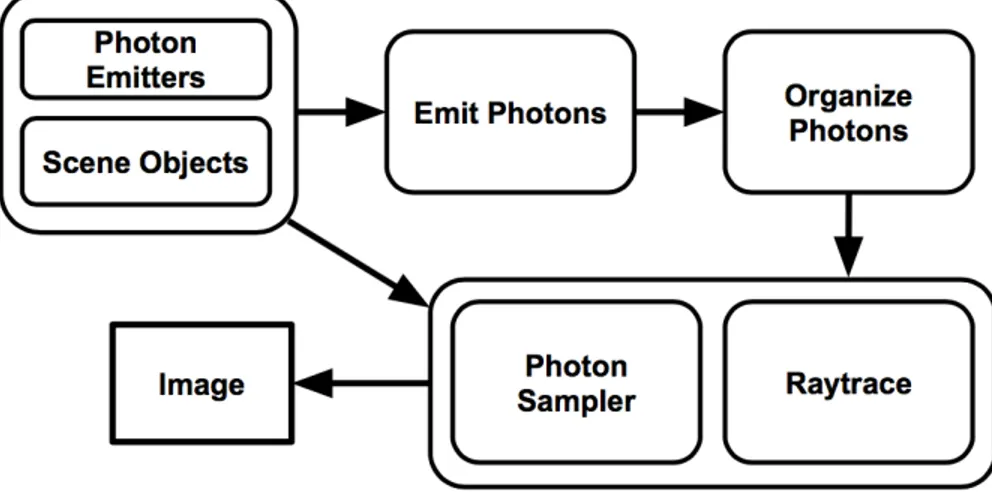
summarized in Figure 3 and discussed further in Section 3.
In general, photon mapping is a good candidate for robust and interactive rendering
(0.2-1.0s) because it captures a wide range of global illumination visual effects and scales very
well as multicore hardware becomes more powerful [5]. This project relies heavily on the work
of Singh et. al and their project “Photon Mapper” which implements an interactive, progressive
hash grid photon mapping raytracer built using CUDA [7]. Additionally, the work of Mara et. al
and their survey of different algorithms for accelerating photon mapping using CUDA [5] is used
to guide the implementation of a screen-space tiling algorithm. Each of these use the GPU to
parallelize the work of their raytracers.
Raytracers are relatively simple to parallelize on a per ray basis provided that a ray trace
does not change the scene and writes to a pixel independently of others [8]. However, for
optimizing a parallel implementation, ensuring memory alignment and buffer size match cache
lanes on the GPU must be considered, as well as using float instead of integers computations
whenever possible [3], using as little kernel memory as possible, and working over larger
datasets [1]. While this level of control is generally present in OpenGL and DirectX, APIs like
OpenCL, CUDA, Vulcan, and Metal have been created to provide the necessary interfaces for
Unlike the projects of Singh and Mara which use CUDA, this project utilizes OpenCL, a
cross-platform parallel programming system, in order to implement a parallelized raytracing
pipeline. APIs like Metal, which are locked to platform, and CUDA, which are locked to specific
hardware, limit the scope of where parallel computing solutions can be applied and who gets
access to these solutions.
3. ALGORITHMAND IMPLEMENTATION
As shown in Figure 3, a photon mapping pipeline utilizes a scene description to emit
photons, to organize photons, and then to raytrace the scene. The hash grid and tiling methods
modify how photons are organized and sampled to accelerate the raytracing step.
This biggest challenge for this project, beyond understanding the photon mapping
pipeline, was organizing key algorithms into OpenCL kernels and communicating information
about the scene from the host CPU to the OpenCL kernels and vice versa. OpenCL 1.2’s kernel
language, which was used to write almost all of the algorithms, is a subset of C and does not
support recursive function calls as well as dynamic memory allocation. The consequences of
these limitations will be discussed throughout the following sections.
3.1 SCENE DATA REPRESENTATION
Point lights, planes, and spheres were the only types of scene objects that were
represented, mainly to simplify intersection testing and keep the project focused on correctness
and usage of OpenCL. Since OpenCL is designed to work with any number of different
computation devices, there is no strict guarantee that structs in an OpenCL kernel will match the
same data layout as on the host CPU (there is a packed attribute that can be applied to the struct
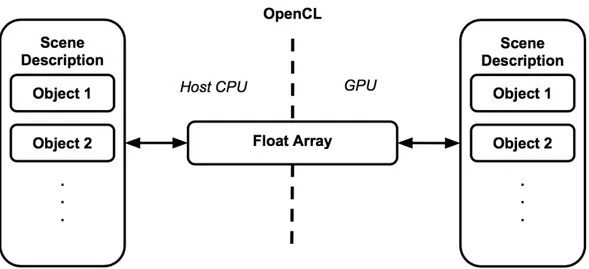
but the OpenCL compiler used did not properly support it). So scene objects on the host device
would be placed into a float array, sent off to the compute device, and then recreated as needed
during execution, as shown in Figure 4.
3.2. PHOTON EMISSION & SAMPLING
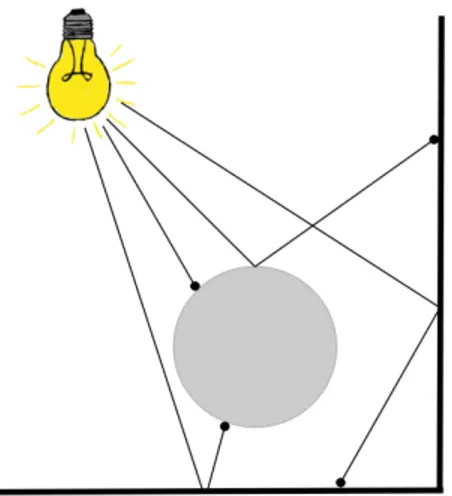
Photon maps are constructed by “emitting a large number of photons (packets of energy)
from the light sources in the scene” [4]. As stated before, this project only considers point lights
when mapping photons into the scene. Photons are given an equal portion of their source light’s
energy when they are emitted and as they bounce the photons alter their energy using the surface
properties of the objects they have hit. As a photon strikes a surface, Russian roulette [2] is used
to determine if the photon bounces off into the scene, where each bounce requires further hit tests
to be performed. Figure 6 shows the result of emitting photons into a sample 2D scene.
Photons are represented using the position of where the photon has stopped bouncing, a
normalized incoming direction of where the photon was headed when it stopped on the surface,
an RGB energy, and the ID of the object that the photon has stopped on, as shown in Figure 5.
Because there is no dynamic memory allocation explicitly supported in OpenCL kernels, a fixed
sized array is allocated to store all the resulting emitted photons. If a photon does not stick onto
any surfaces, the kernel will simply keep emitting photons until all slots in the photon array are
filled.
Once a photon map is constructed we collect a sample of photons around surface points
and use them to estimate the direct and indirect illumination (radiance and irradiance) at each
point. While a K-nearest neighbors algorithm was first used to find a representative sample of
photons at surface points [4], the final implementation uses photon effect radii [5]. A photon
effect radius is the distance that defines the spherical volume of space that a photon can effect
and can be varied across photons in a scene to tweak photon sampling and lighting
approximations as needed.
For purposes of simplicity this project uses a uniform photon effect radius, where every
photon has the same effect sphere, which causes every visible surface point to get an equal
spatial sampling of photons. This allows for both consistent results when shading and far less
memory usage per ray cast since we don’t keep track of K nearest photons. Because shading is
now based on photon density, shadows naturally emerge from regions that are less dense in
photons. Using a uniform effect radius is equivalent to taking a spherical sample of photons
around the visible surface points as we raytrace, which further simplified the implementation. In
practice, K-nearest neighbors required that each kernel have its own chunk of K slots of memory
available for keeping a priority queue of the nearest photons. This extra memory often proved to
far exceed what was available to each kernel and placed a memory bottleneck on the application.
3.3. 3D HASH GRID
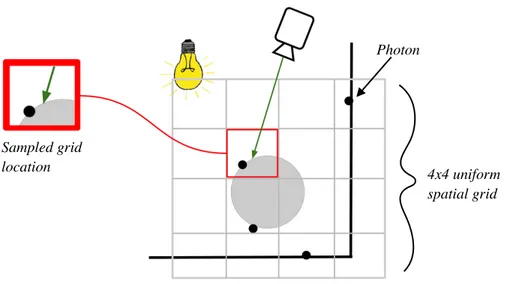
The 3D hash grid algorithm works by sorting sorting photons in the photon map by their
grid location (spatial hash) and then only sampling photons that are within a uniform photon
effect radius ER of the visible surface point, using the spatial grid to limit the search to nearby
photons. Figure 7 shows an example of using a 2D hash grid and Listing 1 and Listing 2 in
Appendix A describe the steps to build and traverse the spatial hash.
The main drawbacks of this approach are that only photons within the grid can be queried
and used for sampling, that all the photons in the scene must be passed to every kernel, and that
the extra data for the grid can be a data bottleneck for higher resolution grids. For static scenes a
generally is not. As with Figure 7, the 4x4 2D grid shown only covers a specific area of the scene
and so only photons within this space will be searched and collected for shading.
In Listing 1 and Listing 2, the variables photonHashes and gridFirstPhotonIndices are
global data arrays that store the information of the hash grid. Since OpenCL does not have a
builtin sort function, the photons were sorted on the host CPU using C++’s std::sort function.
Once sorted, each photonHashes[i] is initialized to the hash of each corresponding photons[i].
Each gridFirstPhotonIndices[j] stores the first time spacial hash j occurs in photonHashes, or
else some default “no first index” value such as -1. Thus a non-negative
gridFirstPhotonIndices[j] indicates there are some photons at that grid location. Notice that
since photons are sampled in a uniform sphere, the hash grid only needs to be sampled in the grid
spaces that touch the sphere.
3.4. SCREEN-SPACE TILING
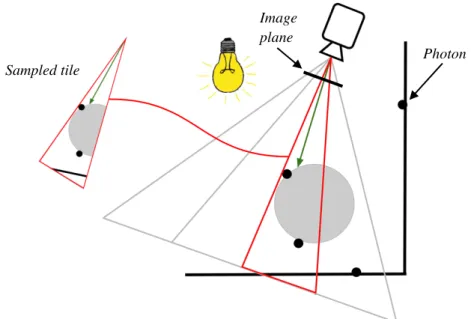
The screen-space tiling algorithm works by grouping rectangles of pixels together into
tiles. Then every render frame the tile’s view frustum is used to place photons into buckets when
Figure 7: 2D Hash Grid formation and sampling
Sampled grid
location 4x4 uniform
they are within ER of the view frustum. When rendering the scene, only the photons for the
current tile are sampled since they are guaranteed to be within the sampling sphere for any
particular visible surface in the tile. Figure 8 shows an example of a 2D tiling algorithm in
action, and Listing 3 and Listing 4 of Appendix B describe the steps of how to fill and use the
tiles.
Although this algorithm requires that the photons be placed into tiles every single render
frame, scenes that add and remove photons dynamically require no special handling for the tiling
method. In practice, the tiling step is about thirty times faster than the tile sampling step, and so
does not present a significant bottleneck to performance. The present implementation does not
cull photons that are behind other objects within the tile frustum leading to excess photons being
left for the sampling step for scenes of large depth variance within a tile.
As described in Listing 3 and Listing 4, tile construction works by first counting how
many photons belong into each tile, then allocating enough space for each tile’s photons, and Sampled tile
Photon Image
plane
finally placing the photons into each tile. While data allocation is handled by the CPU, this
structure for the algorithm is great for GPUs since a single photon can be worked on by its own
kernel without lots of data fetches to disparate parts of memory.
4. RESULTS
This project focused on how to use a parallelization API like OpenCL to implement a
photon mapping pipeline for raytracing. So while there will be a coarse analysis of the
parallelized implementations, there will also be a look at how to use the ideas and techniques
learned from working with OpenCL and applying them to OpenGL.
4.1 SINGLE COREAND OPENCL
The final product includes six different ray tracers, each with its own unique combination
of algorithm (direct illumination/hash grid/tiling) and computing architecture (single-threaded/
OpenCL). The single-threaded implementation ran on a 2.3 GHz Intel Core i7 and then the
massively parallel implementation on an NVIDIA GeForce GT 650M. These raytracers where
written all in C++11 with GPU kernels written in OpenCL 1.2.
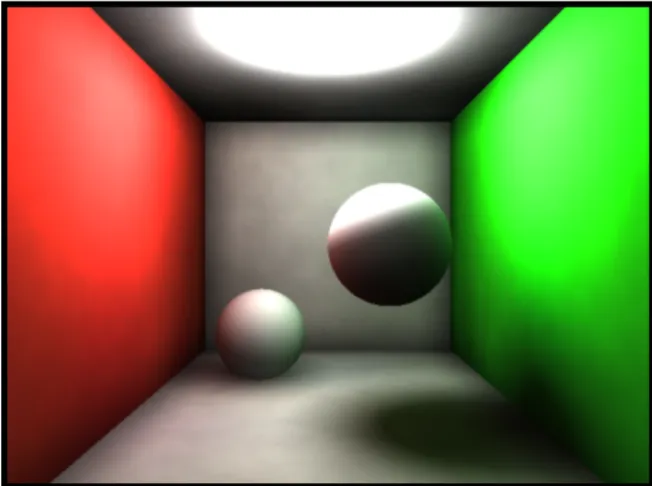
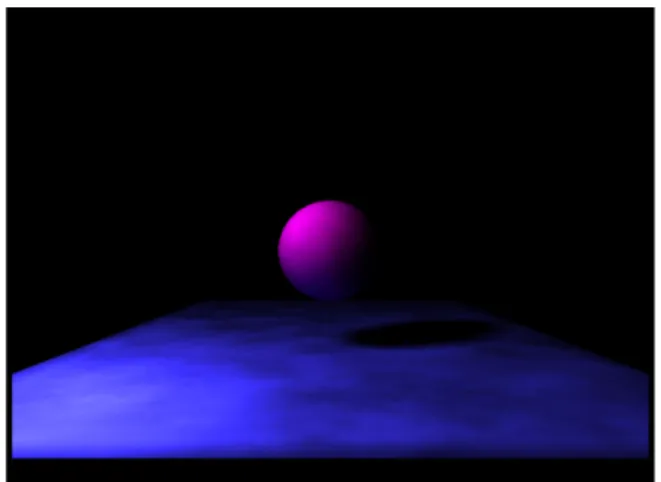
Figures 9 and 10 rendered the two principal scenes GIRefScene (an abbreviation of
“Global Illumination Reference Scene”) and sphere_and_plane using a simplified direct
raytracer where the color of the surface does not take into account irradiance of the scene (other
than if there is a direct path to the light) at 640x480 pixels. These images, which rendered in
realtime, give a baseline time for figuring out the visible surfaces as well as what basic features
Figure 12: GIRefScene with 12k Photons using Screen-Space Tiling
Figure 14: GIRefScene with 200k Photons using Screen-Space Tiling
Figure 11: sphere_and_plane with 12k Photons using Screen-Space Tiling
Figure 13: sphere_and_plane with 200k Photons using Screen-Space Tiling Figure 9: Two colored light sources Photons
using Direct ray tracing
Figure 18: Two colored light sources 200k Photons using Screen-Space Tiling
Figure 17: Color bleeding from walls 200k Photons using Screen-Space Tiling
Figure 16: Two colored light sources Photons using Direct ray tracing
Figure 15: sphere_and_plane 200k Photons using Hash Grid
Re nde r T im e (m s) 0 100 200 300 400 Resolution (pixels)
160x160 320x240 640x480
HashGrid Tiling
Graph 1: Render times for OpenCL HashGrid and Tiling for GIRefScene 12k Photons
Re nde r T im e (m s) 0 1750 3500 5250 7000 Resolution (pixels)
160x160 320x240 640x480
HashGrid Tiling
Figures 11 and 13 show the scene sphere_and_plane rendered at 640x480 using the tiling
algorithm with 12k and 200k photons respectively. The scene is composed of a point light
source, a sphere, and a plane. Half of the scene is complete darkness since there are no objects
above the sphere, leading to significantly higher draw rates for the scene in general. Since
sphere_and_plane is not bounded on all sides like with GIRefScene, notice the speckles that lie
where the light is least intense on the plane. As parts of the scene farther from the light are
Re nde r T im e (m s) 0 200 400 600 800
Configuration (Grid XYZ/ Tile XY)
15x10/80 30x20/40 60x40/20 120x80/10 HashGrid
Tiling
Graph 5: Render times for OpenCL HashGrid and Tiling for sphere_and_plane 12k Photons
over various grid and tile configurations
Re nde r T im e (m s) 0 17.5 35 52.5 70 Resolution (pixels)
160x160 320x240 640x480
HashGrid Tiling
Graph 3: Render times for OpenCL HashGrid and Tiling for sphere_and_plane 12k Photons
Re nde r T im e (m s) 0 150 300 450 600 Resolution (pixels)
160x160 320x240 640x480
HashGrid Tiling
Graph 4: Render times for OpenCL HashGrid and Tiling for sphere_and_plane 200k Photons
Re nde r T im e (m s) 0 750 1500 2250 3000
Configuration (Grid XYZ/ Tile XY)
15x10/80 30x20/40 60x40/20 120x80/10 HashGrid
Tiling
Graph 6: Render times for OpenCL HashGrid and Tiling for GIRefScene12k Photons over
rendered, the level of error in irradiance calculation increases. This can be mitigated by
increasing the number of photons, as is evident in Figure 13.
For the most part, using a hash grid and tiling produce identical results when rendering
parts of the scene within the bounds of the hash grid. However, as shown in Figure 15, when the
rendered view exceeds the extent of the hash grid scene nothing can be rendered. So while
sphere_and_plane cannot easily escape this problem, GIRefScene has a finite region of interest
for rendering everything in the scene.
Figures 12 and 14 show the scene GIRefScene rendered at 640x480 using the tiling
algorithm with 12k and 200k photons respectively. The scene is composed of a point light source
just below the ceiling, six planes, and two spheres, with only the left and right planes’ surface
colors being other than grey. This scene acted as the main benchmark for ensuring correctness
for the algorithms but also performance of each algorithm. Since photons are bounced around a
bounded space, the scene generally has better visual results than with unbounded scenes such as
sphere_and_plane.
Figures 16 and 18 show off the renderer using two point lights of different color. The
point light on the left is a yellowish light, and the one on the right is a blueish light. Adding lights
to a photon mapping system requires no additional effort other than for those new lights to emit
their own photons at the photon emission step. For this implementation, additional lights are
given a random subset of the total number of photons in order to keep the amount of energy in
the scene the same. Note how the plane beneath the central sphere exhibits the differently
colored shadows blending and that the left and right sides take on the color of the light that has a
Figures 17 and 18 show some of the benefits to using photon maps to calculate irradiance
and, in turn, soft shadows and color bleeding. Soft shadows are generated as the result of photon
density varying due to how much of the rendered surface is effected by the light and surrounding
objects. Similarly, color bleeding emerges as photons bounce from one part of the scene to
another allowing the light from some objects, like the wall to the left of the sphere in Figure 17,
to contribute to the color of the object being rendered.
Graphs 1 through 4 show the speed comparison for rendering GIRefScene and
sphere_and_plane with the hash grid keeping a fixed 60x40x40 grid and 80x80 pixels being
gathered into tiles. In this implementation, the performances tradeoffs between each method
depended heavily on the contents of the scene. In general, when the configurations of the tiles
and grid are a good fit for the scene to be rendered, the render times do not usually differ by more
than 20%. While the tiling method tended to have an edge over the hash grid in GIRefScene as
resolution increased, the opposite was true for the simpler sphere_and_plane scene. Under most
circumstances when photons were kept reasonably under 200k the scenes tested always had a
lowest render time that was still interactive.
Finally, Graphs 5 and 6 detail the render times for tiling and the grid approach under
various configurations for the sphere_and_plane scene and GIRefScene, respectively. The x-axis
shows increasing density of the data structures, from 1,500 to 768,000 grid locations and 48 to
3,072 tiles. In general for both scenes the hash grid did not see a significant performance hit in
comparison to tiling. Under the current implementation, it does appear that the hash grid, despite
being limited with respect to where rendering can take place in a scene, does prove to be more
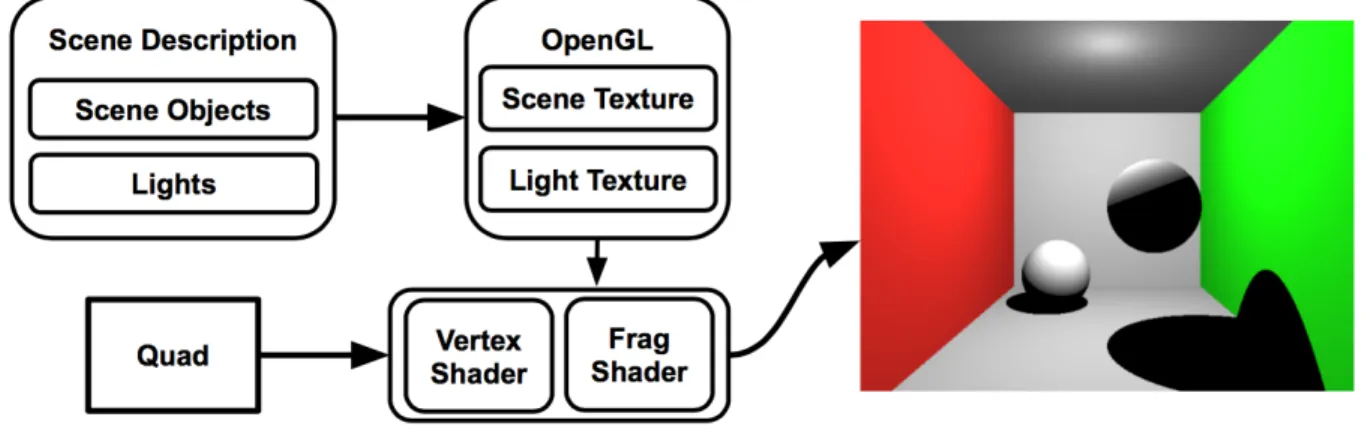
4.2 RAYTRACINGAND OPENGL
OpenGL is a cross-platform 3D graphics API to work with the GPU. Typically its domain
is limited to rasterized graphics. However, OpenGL (> 3.2) can be used to perform raytracing, as
laid out in Figure 19. Creating a raytracer using OpenGL is not new, but here acts more of an
exercise of using the same techniques, namely data packing and unpacking, to leverage this API
to parallelize a rendering algorithm that is not rasterization.
The two main hurdles for raytracing using OpenGL involve generating rays and then
giving every pixel access to the scene representation. For ray generation, a quad from (-1.0, -1.0,
0.0) to (1.0, 1.0, 0.0) is rendered with texture coordinates (0.0, 0.0) on the bottom left and (1.0,
1.0) at the top right. The vertex shader simply passes on the provided texture coordinate to the
fragment shader. In the fragment shader the texture coordinate has now been interpolated and can
be thought of as pointing to the pixel that should be rendered. Using the texture coordinate and
the camera’s basis vectors, a ray is created that points to the center of each pixel in the image
plane.
Scene objects and lights can be accessed in the fragment shader by packing them into a
For example, a sphere and plane need four floats to give basic geometric information (radius and
position for a sphere, normal and distance along the normal for a plane), seven floats for lighting
information (surface color, ambient, diffuse, specular, roughness), and a float for type (sphere or
plane type). If each pixel in the texture only has three float components, then a single object
would fit into four pixels evenly. In order for float values beyond 0 and 1 to be used in the texture
an internal format of GL_RGB32F must be used so that the values will not be clamped when
loaded into the texture. Additionally, the textures should not be mip-mapped and minification and
magnification parameters should be set to GL_NEAREST in order to avoid interpolating data
values when reading samples from the texture.
In the fragment shader, where the scene objects and lights will be reconstructed, the
texture’s width and height must be made available so that the center of each texel can be
accurately sampled. Object reconstruction occurs by reading in the collection of pixels that make
up an object and then reading out the float components into each corresponding property of the
object. With the objects reconstructed in this fashion the entire raytracing pipeline, namely
intersection testing and color computation, is left entirely unchanged.
Surprisingly, this OpenGL raytracer runs with almost identical performance to the
OpenCL direct raytracer discussed earlier in Section 4. This OpenGL raytracer was built over a
weekend and shows how useful learning OpenCL was to making creative and effective use of a
different parallelization API.
5. DISCUSSIONAND FUTURE WORK
The presented implementation looked mainly at building an interactive rendering pipeline
more direct control of parallelization hardware comes at the expense of the time and resources
needed to effectively manage and interface with these APIs. Moving forward, more advanced use
hardware documentation in conjunction with the features present in a parallelization API like
OpenCL will be explored.
Since there was a primary focus on the technologies around enabling parallelization, only
a limited set of rendering features and optimizations were implemented. For example, most ray
tracers support refraction, reflection, caustics, antialiasing, and use acceleration structures such
as a bounding volume hierarchy (BVH). Since GPUs tend to be memory bound, integrating a
BVH to cull out objects that will be not be rendered as well as integrating a z-buffer to
incrementally update the initial closest intersections would help the raytracing algorithms
support larger and more complicated scenes.
Both the hash grid and tiling algorithms can be extended to support a wider set of
rendering features and accelerated using different techniques. The hash grid algorithm can be
modified to use a more advanced search along the gradient of the surface being sampled. By
limiting the search to the surface gradient, only grid spaces that contain the surface will be
searched instead of other nearby objects and empty spaces. Screen-space tiling can be
accelerated by culling off excess photons not needed during the photon sampling step by using a
depth buffer. By removing photons from a tile preemptively, less processing would be needed on
a per-pixel basis and the memory footprint would be reduced per kernel. Finally, photon tiling
and the hash grid method may be hybridized so that photons are sorted on a per-tile basis into a
hash grid bounded by the tile’s frustum. Scenes with large depth variance for a given tile could
possibly see some performance improvements as photons too far away are culled out during the
With a parallelized implementation in hand, this project can now be extended to the
forefront of photon mapping techniques, in particular Image Space Photon Mapping (ISPM)
introduced by McGuire and Luebke in 2009. ISPM uses a combination of the CPU and GPU
simultaneously to achieve realtime and interactive rendering of complicated scenes. In particular,
they make use of OpenGL and its pipeline to calculate irradiance using photon volumes [6].
6. CONCLUSION
Using photon maps and the GPU as a way of achieving realtime and interactive
renderings of scenes is an exciting area of research. This project explored GPU programming
with OpenCL to successfully implement two photon mapping pipelines, namely using a 3D hash
grid and screen-space tiling, in order to achieve interactive rendering of simple scenes. In
addition, this experience has already been applied to using OpenGL, a different parallelization
API, for raytracing. With this experience of working with OpenCL and writing algorithms to run
on the GPU, future work is now possible in exploring the forefront of realtime rendering research
as well as implementing a fully-featured realistic raytracing system on the GPU.
7. REFERENCES
[1] APPLE. 2013. Tuning Performance On the GPU. Online: https://developer.apple.com/library/
mac/documentation/Performance/Conceptual/OpenCL_MacProgGuide/
TuningPerformanceOntheGPU/TuningPerformanceOntheGPU.html
[2] ARVO, J. and KIRK, D. “Particle Transport and Image Synthesis”. Computer Graphics 24
[3] INTEL. 2014. OpenCL Optimization Guide for Intel Atom and Intel Core processors with
Intel Graphics. Online: https://software.intel.com/sites/default/files/managed/72/2c/
gfxOptimizationGuide.pdf
[4] JENSEN, H. W. 1996. Global illumination using photon maps. In Rendering techniques,
Springer-Verlag, London, UK, 21–30.
[5] MARA, M., LUEBKE, D., McGUIRE M. 2013. Toward Practical Real-Time Photon
Mapping: Efficient GPU Density Estimation.
[6] McGUIRE, M., and LUEBKE, D. 2009. Hardware-Accelerated Global Illumination by
Image Space Photon Mapping.
[7] SINGH, I., XIAO, Y., ZHU, X.. 2013. Accelerated Stochastic Progressive Photon Mapping
On GPU. Available via Github under user ishaan13 and the project alias PhotonMapper.
Online: https://github.com/ishaan13/PhotonMapper
[8] SPJUT, J., et. al “TRaX: A Multi-Threaded Architecture for Real-Time Ray Tracing,
Proceedings of the 2008 Symposium on Application Specific Processors, p.108-114, June
APPENDIX A: HASH GRID SUDO CODE
let photons
let photonHashes # array of photons.count() -1’s
let gridFirstPhotonIndices # array of grid.xdim * grid.ydim * grid.zdim -1’s
# Order Photons by Hash
// Use built-in sort available on CPU or GPU
# Map Photons To Grid
for each Photon p at Index i in photons # thread launch
if p is inside the hash grid
photonHashes[i] = hash(p.position)
# Compute Grid First Photon Indices
for each Index i in photons.count() # thread launch
let currHash = photonHashes[i]
if i == 0 and currHash != -1
gridFirstPhotonIndices[currHash] = i
else if currHash is not the same as the previous hash, and is not -1
gridFirstPhotonIndices[currHash] = i
Listing 1: Hash grid construction algorithm
let photons
let photonHashes
let gridFirstPhotonIndices
let ER # Photon effect radius
for each Pixel (x, y) with Point pt on Visible Surface S # thread launch
if pt is in the hash grid
let photonsSampled = 0
let farthestDistance = 0
let contribution = {0, 0, 0}
for each (i, j, k) in the grid that encloses the sphere of radius ER at pt
let gridHash = hash(i,j,k)
if gridFirstPhotonIndices[gridHash] > 0
let pi = gridFirstPhotonIndices[gridHash]
while pi < photons.count() and photonHashes[pi] == gridHash
let p = photons[pi]
let distance = distance from p.position to pt
if p is on S and distance < ER
photonsSampled += 1
farthestDistance = max(distance, farthestDistance)
contribution += contribution of p at pt on S pi += 1
if photonsSampled > 0
contribution = contribution / (PI * distance * distance)
pixels[x, y] += contribution
APPENDIX B: SCREEN-SPACE TILING SUDO CODE
let photons, tiles
let photonCount # array of tiles.count() 0’s
let ER # Photon effect radius
# Counting Pass
for Index p in photons.count()
for Index t in tiles.count()
if tiles[t]’s view frustum intersects or contains photons[p] with radius ER
atomic_increment(photonCount[t])
# Allocation Pass
let tilePhotons # empty arrays of arrays of photons
for Index t in tiles.count()
tilePhotons[t] = array of size photonCount[t] photons
# Copy Pass
let nextPhotonIdx # array of tiles.count() 0’s
for Index p in photons.count()
for Index t in tiles.count()
if tiles[t]’s view frustum intersects or contains photons[p] with radius ER
let tp = atomic_increment(nextPhotonIdx[t])
tilePhotons[t][tp] = photons[p]
Listing 3: Tile construction algorithm
let tiles
let ER # Photon effect radius
for each Pixel (x, y) with Point pt on Visible Surface S # thread launch
let (tile, tilePhotons) = tile and photons that correspond (x, y)
let i = 0, photonsSampled = 0
let farthestDistance = 0
let contribution = {0, 0, 0}
while i < tilePhotons.count()
let p = photons[pi]
let distance = distance from p.position to pt
if p is on S and distance < ER
photonsSampled += 1
farthestDistance = max(distance, farthestDistance)
contribution += contribution of p at pt on S pi += 1
if photonsSampled > 0
contribution = contribution / (PI * distance * distance)
pixels[x, y] += contribution
APPENDIX C: RAYTRACING DATA
Scene Res Config P# SC Direct CL Direct SC HashGrid SC Tiled CL HashGrid CL Tiled
GIRefScene 160x160 60x40x40 / 80x80
12k 13ms 3.2ms 286ms 887ms 61ms 90ms
320x240 32ms 6.3ms 825ms 1508ms 122ms 129ms
640x480 128ms 13.7ms 3.8 4.4 383ms 338ms
160x160 200k 4.2 11.7 980ms 1219ms
320x240 12.6 23.5 1930ms 2000ms
640x480 50.2 76.0 6.1 5.3
sphere_and_plane 160x160 12k 5.7ms 2.5ms 23ms 100ms 18ms 24ms
320x240 14.6ms 4.2ms 75ms 138ms 41ms 35ms
640x480 51ms 15ms 253ms 354ms 54ms 65ms
160x160 200k 170ms 1550ms 54ms 189ms
320x240 490ms 2420ms 110ms 252ms
640x480 1913ms 5.4 325ms 558ms
Scene Res P# Config SC HashGrid SC Tiled CL HashGrid CL Tiled
sphere_and_plane 640x480 12k 15x10x10 / 80x80 214ms 396ms 50ms 70ms
30x20x20 / 40x40 208ms 330ms 46ms 104ms
60x40x40 / 20x20 290ms 472ms 53ms 225ms
120x80x80 / 10x10 678ms 1098ms 92ms 786ms
Scene Res P# Config SC HashGrid SC Tiled CL HashGrid CL Tiled
GIRefScene 640x480 12k 15x10x10 / 80x80 3.2 4.6 400ms 345ms
30x20x20 / 40x40 3.2 3.7 408ms 356ms
60x40x40 / 20x20 4.2 3.7 547ms 826ms