Detecting Node Failures In Mobile Wireless Networks:
A Probabilistic approach
Sareddy Maheswarareddy& V. Sravani
1PG Scholar,2 Assistant Professor
1,2, Department : Computer Science Engineering 1,2 Geethanjali College Of Engineering And Technology
1Email: [email protected]
Abstract
The intermingling of data traffic towards the failure in a remote sensor mastermind makes the near to centers exhaust their batteries speedier than various center points, which leaves the failure stranded and irritates the sensor data uncovering. To ease this issue the utilization of flexible failures is proposed. Flexible failures unquestionably give stack modifying and help achieving uniform imperativeness use over the framework. In any case, the instruments to help the failure transportability (e.g., publicizing the territory of the flexible failure to the framework) present an overhead to the extent essentialness use and bundle delays. With these properties flexible failure coordinating involves a captivating examination field with unique necessities. In this paper, we present an investigation of the current spread adaptable failure controlling traditions. To give an information to the defense and the stresses of a compact failure coordinating tradition, plan requirements and troubles related with the issue of flexible failure controlling are settled and illuminated. With the expansion in the quantity of failure and their arrangement in the system of failure plays a noteworthy guideline in productive information collection.
Introduction
Wireless network access has been embraced over the world as the network vehicle of decision due principally to simplicity of
EXISTING SYSTEM
In Appropriated Versatile Failure Directing conventions in circulated approaches don't depend on a focal substance to oversee courses and decide; in this manner, they are pertinent to unadulterated Remote Sensor applications where the network comprises of mono-type sensor gadgets. Issues which ought to be considered for an effective portable failure steering convention, and call attention to the related difficulties. We first clarify credulous, extraordinary methodologies which may fill in as harsh plan.
At that point set forward the execution prerequisites of a convention regarding different WSN related execution criteria; give the commonplace properties and the examples of the failure portability, and finally present the sensor abilities which represent extra difficulties or empower different basic systems helping or confining the task of the versatile failure directing conventions.
Disservice:
1. This issue is alluded to as the hotspot issue Node passings would prompt interruptions in the topology and decrease of detecting inclusion.
2. Moreover, failures could wind up disconnected and sensor information produced over the network would never again be gotten.
3. Therefore, steering conventions intended for stable failures need to join load-adjusting so as to accomplish consistency of vitality utilization all through the network.
PROPOSED SYSTEM:
Commonplace wireless sensor networks use multi-bounce directing to exchange information toward the base station. In any case, sensor hubs situated in the failure's
region exhaust their vitality quickly than alternate hubs, prompting network corruption, disengagement just as openings. Versatility was acquainted with equalization the vitality utilization and limit disappointments. The portable failure moves in the network and pulls information cushioned in sensor hubs that are inside its correspondence extend. Thusly, the multi-jump correspondence is decreased, and the traffic sending load is spread in the entire network. A few works have been directed to diminish the network vitality utilization by utilizing failure portability. For instance, proposed a method that comprises on repositioning numerous versatile failures towards areas with overwhelming traffic. Another work was presented in [9], in which the creators analyzed how the portability of sensor hubs works in the wireless sensor network. They reasoned that utilizing versatile sensors results in better vitality sparing.
The proposed information failure coordinating process is isolated into a few stages portrayed beneath:
•First period of the versatile failure
In its first stage, the versatile failure moves along the network and communicates intermittently signal messages to advise about its quality. Sensor hubs having gotten the communicated make an impression on the failure to express their application to meet focuses. Amid this round, the versatile failure likewise records its correspondence span with every sensor hub.
most appropriate hubs to be selected as MPs is finished by the versatile failure since it has extremely solid power calculations. Indeed, the gathering focuses ensure the non-disengagement of the network since they act like an extension between the versatile failure and alternate sensors inside the network. They cushion approaching information until the failure goes by to gather it.
The versatile failure chooses the most advantageous hubs to meet focuses; they ought to have a high vitality level, and situated close to the failure's direction to convey information dependably and inside one bounce, lastly they should have an expansive crossing point time with the portable failure to exchange vital measure of information.
Focal points: (Solutions system for the Problems)
Organization of the Sensor Nodes
Dependent upon the concealed application, there may be a couple of choices on sensor framework sending. In an agrarian application, they might be dispersed by the agriculturist, in an about uniform way. In an environmental application like forest fire ID, they might be dropped from a flying machine. In-house applications, they might be presented by the development pros by hand. Incidentally, the grouping figuring used should have the ability to deal with these course of action circumstances.
Literature Review
Natural Wireless Sensor Network. In this paper describes the stress with the utilization of WSN development to a drawn out stretch of time and tremendous scale biological checking. We take areal case to demonstrate the creative inconveniences and challenges
that meet the end customer necessities for social event a great deal of information. Dependability and productivity are a key concern and effect the arrangement choices for system gear and programming. The dialog for the paper is done up with whole deal difficulties for WSN advancement in condition checking and satisfies the requirement for future with the framework. The least complex application decides the deferral in network yet WSNs can in like manner perform in-orchestrate taking care of exercises, for instance, data absolute, event distinguishing proof, or incitation An overview [2], the paper characterizes the worry novel perspective that is rapidly grabs building up in the bleeding edge
circumstance of remote media
WSN. As a rule, the controlling frameworks are orchestrated into three characterizations in light of the concealed framework structure: level, hierarchal, zone based coordinating. Plus, this tradition can be organized into multipath-based, question based, exchange based, Qos based, and coherent develop depending in light of the tradition action. The examination about the arrangement tradeoffs among imperativeness and correspondence overhead saving in each coordinating perspective. A WSN has ability to talk with the outside base station (BS) and the sky is the limit from there
noticeable number of sensor contemplates distinguishing over greater geological regions with increasingly significant precision. On the arranging of wireless sensor network, Energy proficient bunching under the joints directing and inclusion imperative [4], The paper describes the stress of restricting essentialness dispersing and enhancing framework lifetime are fundamental issues in the diagram of the applications and tradition for the sensor mastermind. Vitality effective sensor state orchestrating contains choosing the perfect undertaking of states to sensors remembering the ultimate objective to enlarge the framework lifetime. In this paper we search for imperativeness perfect topology that enlarge the framework lifetime while ensuring synchronous totally covers the district and sensor accessibility to assemble heads. The process of making subset for sensor hubs will put to spare network vitality and increment its lifetime.
System Architecture:
Fig: Diagram of the Wireless Sensor Network
The
Floyed-Warshall
calculation
otherwise called Floyd's calculation,
roy-Warshall
calculation,
Roy
Floyd
Algorithm or the WF! Calculation is an
efficieient calculation to locate the all sets
most limited way on a diagram. The chart
may have negative weight edges, however
no negative weight cycle(for which the
most limited way is indistinct). The Floyd
Warshall calculation is a method for
proficiency and all the while finding the
briefest way between each pair of vertices
in an effectiveness and all the while
finding the most limited way between
each pair of vertices in a weighted and
conceivably diected chart. While the
Floyd
Warshall
calculation
is
a
symptotically as quick as applying
Dijkstra's calculation over and again for
each pair of vertices. In practices, the
Floyd Warshall calculation is a lot quicker
in
view
of
its
succinctness
and
effortlessness. At the end of the day, it is
extremely
proficient
method
for
comprehending the supposed all sets
sortest way issue. A straightforward
execution of the calculation will discover
the lengths (summed wiehgts costs) of the
briefest ways between all sets of vertices
however
subtleties
of
the
ways
themselves. This calculation is a case of
dynamic programming.
•
Floyd Warshall Algorithm is a
dynamic programming formulaton to
explain the all sets most brief way issue
on coordinated diagram.
•
The Floyd – Warshall calculation
finds most brief way between all hubs in a
weighted chart with positive or negative
edge loads (yet with no negative cycles)
A less demanding approach to utilize the
Floyed-Warshall calculation is the regular
portrayal of a chart is a contiguousness
framework. Accept that we are given a
coordinated chart G=(V,E) and that the
vertices in V are numbered 1,2,… .,n.
further expect that we are given a lattice
C(i,j) that discloses to us the expense of
edge (i,j). On the off chance that there is
no edge C(i,j) at that point we accept
C(I,j) is set to endlessness. We expect
every
single
other
expense
are
nonnegative.
The
Floyd-Warshall
calculation figures a least expensive cost
Array A, where A(i,j) gives the least
expensive expense of any way from
vertex I to vertex j. For the calculation to
work effectively it is critical that there is
no negative cost cycles in the
diagram.
Performance of the Floyd-Warshall
Algorithm
We compare now the running time of
Floyd-Warshall Algorithm with that of the
repeatedly performs a DFS n times,
starting at each vertex. If the diagraph is
represented by an ajfacency matrix
structure, then a DFS traversal takes
O(n2) time( we explore the rason for this
in an exercise). Thus, running DFS n
times take O(n3) time, which is no better
than single execution of the
Floyd-Warshall Algorithm.
If the diagraph is represented by an
adjacency list structure then running the
DFS algorithm n times would take
O(n(n+m) time. Even so, if the graph is
desnse, that is, if it has Θ(n
2) edges, then
this approach still runs in o(n3) edges,
then this approach still runs O(n
3) time.
Thus, the only case where algorithm is
better than the Floyed Warshall Algorithm
is when the graph is not dense and is
represent using an adjacency list structure.
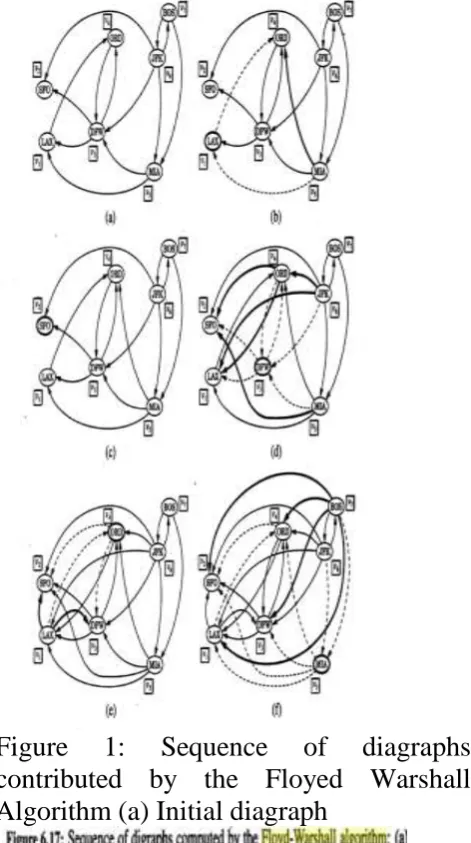
Given below is example run of the
Floyed-Warshall Algorithm in Fig 1
Figure
1:
Sequence
of
diagraphs
contributed by the Floyed Warshall
Algorithm (a) Initial diagraph
Login Page:
Enter Sensor nodes for cluster:
Created Network Nodes with WSN
Checking on prediction Data Report as Enable or Disable:
CONCLUSION
We have introduced an extensive audit of the current conveyed versatile failure directing conventions. The one of a kind difficulties related with portable failures and the plan necessities of a versatile failure steering convention are talked about in detail to give a knowledge into the inspirations and the intrinsic instruments. A precise arrangement of the conventions is given and the points of interest and disadvantages of the conventions are separately decided as for the execution necessities.
The decided classes of conventions have diverse advantages which may give inspirations to new arrangements. The various leveled approaches misuse a virtual structure which fills in as a meeting district for the failure notice and information bundles. The virtual structure diminishes the overhead of the failure ad by limiting it to a subset of the network; notwithstanding, the high-level hubs comprising the structure are vulnerable to getting to be hotspots since they are probably going to convey and process more traffic.
covers the entire network, yet the hotspot alleviation procedure requires more exertion since adjusting such intricate and thick structures has moderately progressively overhead. The tree structure improves the failure commercial process by utilizing the root as a transfer hub for messages; in any case, such a methodology reduces the seriousness of hotspots on the hubs near the root.
Future Scope:
Our future work will concentrate on the vitality perspective; the successive versatility of meeting focuses expends much vitality, just as the retransmission of bundles.
REFERENCES
[1] R. Jaichandran, A. Irudhayaraj, and J. Raja, “Effective strategies and optimal solutions for hot spot problem in wireless sensor networks (WSN),” in Information Sciences Signal Processing and their Applications (ISSPA), 2010 10th Int. Conf. on, 2010, pp. 389 –392.
[2] M. Di Francesco, S. K. Das, and G. Anastasi, “Data collection in wireless sensor networks with mobile elements: A survey,” ACM Trans. Sensor Networks, vol. 8, no. 1, pp. 1–31, 2011.
[3] W. Liang, J. Luo, and X. Xu, “Prolonging network lifetime via a controlled mobile failure in wireless sensor networks,” in
Global Telecommunications Conf. (GLOBECOM 2010), IEEE, 2010, pp. 1 –6.
[4] J. Rao and S. Biswas, “Network-assisted failure navigation for distributed data gathering: Stability and delay-energy trade-offs,” Computer Communications, vol. 33, no. 2, pp. 160–175, 2010.
[5] N. Grammalidis, E. Cetin, K. Dimitropoulos, F. Tsalakanidou, K. Kose, O. Gunay, B. Gouverneur, E. K. D. Torri, S. Tozzi, A. Benazza, F. Chaabane, B. Kosucu, and C. Ersoy, “A multi-sensor network for the protection of cultural heritage,” in 19th European Signal Processing Conf. (EUSIPCO2011), Special Session on Signal processing for disaster management and prevention, 2011.
[6] Y. Yun and Y. Xia, “Maximizing the lifetime of wireless sensor networks with mobile failure in delay-tolerant applications,” IEEE Trans. Mobile Computing, , vol. 9, no. 9, pp. 1308 – 1318, 2010.