Master thesis Psychology, specialization Economic and Consumer Psychology
Institute of Psychology
Faculty of Social and Behavioral Sciences – Leiden University Date: 30.06.2017
Student number: s1649779
First examiner of the university: Henk Staats
Second examiner of the university: Marret Noordewier
How does Nature immersion
affect Pro-social behavior?
Developing a model relating environment,
reflectiveness and pro-social behavior.
Table of Content
Abstract p. 3
Introduction p. 4 Nature and Pro-Social behavior
Theoretical accounts
An alternative evolutionary approach
The broaden and build theory of positive emotions
Proposing a model linking mood, aspirations and pro-social behavior
Method p. 16 Participants
Design
Environmental manipulation Control Measures
Dependent variables Procedure
Results p. 24 Outliers
Control variables and Order-effects Urban vs. Nature effects
Individual Emotions Correlations
Mediation analysis of the partial model
Discussion p. 33 Mood Measures
Individual emotions Methodological flaws
Natural vs. urban environments The Model
Conclusion Future research
References p. 49
Abstract
A growing body of empirical research suggests that contact with natural environments improves overall well-being and affects pro-social behavior intentions. The current study synthesized earlier findings and developed them into a process model, linking and testing several variables. The model was tested empirically using a mixed experimental design, with 113 participants being virtually exposed to a walk through an urban or natural environment, respectively. The independent variable was environment, while the main dependent variable was pro-social behavior. Based on the broaden-and-build theory of positive emotions, the proposed mediators between nature and pro-social behavior were affect, life aspirations and reflectiveness. Although participants showed a clear difference regarding their expectations in the restorative qualities and in terms of liking of the respective environments, we did not find any differences between conditions in pro-social behavior intentions. However, correlational evidence demonstrated that the proposed association between the mediating variables was in line with our predictions, with positive affect being positively related to intrinsic life aspiration and intrinsic aspirations being positively related to pro-social behavior. Moreover, reflectiveness was found to at least partially mediate the relationship between positive affect and intrinsic life aspirations. The implications of these findings for existing theory and research are discussed.
How does Nature immersion affect Pro-social behavior?
Introduction
It is predicted that by 2050 circa 64% of the developing world and 86% of the developed world will be urbanized (United Nations, 2014). With humans increasingly drifting away from living in and with nature - reflected by the worldwide trend of urbanization - the relationship with natural environments and the psychological and physical health benefits that are related to contact with nature continue to play an increasing role in public health issues.
2012). Furthermore, it has been shown that contact with nature generally improves people’s vitality and happiness (Ryan et al., 2010).
Nature and Pro-Social behavior. Not only does being in contact with nature produce positive results on an individual level, but perhaps even more interesting in terms of current societal challenges, is that immersion in natural environments may be linked to pro-social behaviors. For example, recent work on nature and helping behavior yields promising results, which suggest a link between contact with nature and positive outcomes regarding pro-social and environmentally sustainable behaviors (Gueguen, & Stefan, 2014; Irvine, Keniger, Gaston, & Fuller, 2013; Joye, & Bolderdijk, 2015; Weinstein, Przybylski, & Ryan, 2009; Zelenski, Dopko, & Capaldi, 2015; Zhang, Piff, Iyer, Koleva, & Keltner, 2014). In the light of these findings - which may arguably have the potential to guide policy makers in finding solutions to current societal problems and inform urban planning and design - research into the mechanisms underlying these findings is highly needed. Especially since a coherent theory explaining these findings is still lacking in the extant literature. Although several attempts have been made at presenting a theoretical model regarding the accumulating empirical evidence, demonstrating the benefits of natural immersion, no unifying theory has thus far been presented.
of presenting a model linking findings on mood, nature, and pro-social behavior. The proposed model will then be tested empirically.
Theoretical accounts. There are two empirically well-supported theories attempting to explain the positive effects of nature on well-being (Staats, 2012). Both are based on the so called Biophilia hypothesis (Kellert & Wilson, 1993; Wilson, 1984), which functions as the theoretical underpinning of most research on the positive effects of nature.
Stress-reduction theory. One theory that concerns the effect of nature on well-being is the so-called Stress-reduction theory (SRT; Ulrich et al., 1991). According to SRT, exposure to natural environments with water, vegetation, expansive views, and other elements that contributed to the survival of our ancestors produces an unconscious autonomic response characterized by decreased physiological arousal, decreased negative affect, and increased positive affect. Phrased differently, natural environments that provided the resources necessary for survival during our evolutionary history are believed to demonstrate stress reducing properties.
Empirical research has found indicators of less physiological arousal, less negative affect, and higher positive affect in participants exposed to natural environments when compared to those exposed to urban or built environments (e.g. Hartig, Evans, Jamner, Davis, & Gärling, 2003; Lee et al., 2011; Ulrich et al., 1991). These effects have been found in participants who are both physically present in nature (e.g. Hartig et al. 2003; Lee, Park, Tsunetsugu, Kagawa, & Miyazaki, 2009) and those exposed to laboratory simulations of nature (e.g. viewing videos of natural environments; Ulrich et al., 1991). It must be noted however that direct contact in general produces stronger effects (Kjellgren, & Buhrkall, 2010). As such, existing empirical findings provide evidence in line with the predictions of SRT.
itself through difficulties in concentration and higher levels of irritability and negative affect (Kaplan, 1983). In contrast to urban environments, natural environments are suggested to contain elements that are inherently fascinating (e.g. scenic vistas) and draw upon attentional capacities only modestly, thus allowing for the replenishment and restoration of cognitive resources. It is predicted that following exposure to natural environments, individuals will perform better on tasks requiring directed attention (e.g. backwards digit-span tasks) and, importantly, display a significantly improved mood. A lot of research provides empirical support for ART, with participants indicating better cognitive functioning and more positive emotions following exposure to both real and simulated natural environments compared to those exposed to urban/built environments (e.g. Berman et al., 2008; Berman et al., 2012; Berto, 2005; Hartig et al., 2003).
An alternative evolutionary approach. A recent meta-analysis, reviewing findings on the effect of contact with natural environments on positive and negative affect, has produced mixed evidence in relation to the theoretical explanations proposed thus far (Macmahan et al., 2015). Specifically, Macmahan et al. (2015) found that the beneficial effects of nature on emotional well-being are driven primarily by increases in positive affect and only to a lesser extent, decreases in negative affect. This is somewhat inconsistent with the perspective of ART (Kaplan, 1995), which has focused on the reduction of negative affect as the primary source of improvements in emotional well-being during exposure to natural environments.
inconsistency shows that there are effects of nature on affect, which go beyond the predictions of ART (Kaplan, 1995). Empirical findings in contrast support SRT theory directly since it predicts an overall improvement of affect (Ulrich et al., 1991). Positive affectivity is expressed by factors such as increased interest/attention and liking. Increased liking has the same positive relationship to affect than a reduction in negative mood. Therefore, the effects should be highly correlated and could be used as a single variable to model the relationship of nature on affect. The predictions of both theoretical accounts for nature effects on mood are rather broad and thus could benefit in their predictive power if we increase model fit by reducing the number of variables that we measure.
2015). This is in line with our new approach to focus mainly on positive affect, expressing nature’s effects on affect as a unique positive association.
The depletion assumption. This does not imply that ART and SRT are not valid, rather it hints at the possibility that there are ongoing processes, which go beyond what is predicted by ART and STR. Since both ART and STR assume natural environments to have a restorative potential, the former in terms of attention restoration and the latter in terms of stress reduction, these resources would need to be depleted for nature to have an effect. Furthermore, both theories assume cognitive processes to precede any emotional reaction. Although Ulrich and others (1991) mention the possibility that a quick-onset emotional reaction such as fear, dislike, and attention/interest - which would initiate a quick adaptive physiological mobilization based on a minimum of cognitive activity - would most likely have been adaptive for our ancestors. Nevertheless, the main theory is based on the idea that unthreatening natural scenes can function as restorative environments in terms of stress reduction, being reflected in a shift towards a more positively-toned emotional state, and in decreased levels of physiological arousal.
stress, that person is more likely to benefit from spending time in a restorative environment (Staats, Van Gemerden, & Hartig, 2010), which will amongst others be reflected in a heightened preference for restorative environments in individuals suffering from mental fatigue or stress (Staats, Kieviet, & Hartig, 2003). However, if someone were under-stimulated, contact with an urban setting could even be experienced positively, leading to a restorative experience and an increase in positive affect. One implication of this interpretation is that different environments will elicit differential affective responses, depending on the initial state of arousal (e.g. the level of stress or mental fatigue respectively).
According to Macmahan and colleagues (2015) predictions, a direct effect of nature on increased positive affect should be observed in response to natural environments which signal the presence of resources above the restorative properties of nature in general. This is in line with findings showing that certain types of wild nature, can signal danger and consequently increase negative affect (Russell et al., 2013). It follows that the qualitative characteristics of natural environments might illicit different emotional and behavioral responses, such as positive or negative affect, or a combination of the two. It is further possible that evolutionary preferences, attentional restoration as proposed by Kaplan (1989) and stress reduction in Ulrich’s (1986) terms are working simultaneously to produce the observed pattern of findings.
perspective on emotions represents the link we propose to explain the occurrence of pro-social behavior in relation to exposure to natural environments.
The broaden and build theory of positive emotions. According to the broaden-and-build theory of positive emotions (Fredrickson, 2004), positive emotions produce an evolutionary adaptive response, as also seen with negative emotions. However, instead of
triggering narrow action tendencies (e.g. fight-or-flight response), positive emotions
broaden an individual’s momentary thought–action repertoire. The broadened mindset
arising from these positive emotions is contrasted to the narrowed mindset sparked by
experiencing many negative emotions (i.e. specific action tendencies, such as attack or
flee).
A second key proposition concerns the consequences of these broadened
mindsets: By broadening an individual’s momentary thought–action repertoire—whether
through play, exploration or similar activities—positive emotions promote the discovery
of novel and creative actions, ideas and social bonds, which in turn build that individual’s
personal resources; ranging from physical and intellectual resources, to social and
psychological resources.
Emotions a mediating factor between nature and pro-social behavior. Although,
earlier research has shown that pro-environmental and pro-social behavior in response to nature exposure, might be mediated by positive affective states, the empirical evidence
base is incomplete (Collado, Staats, & Corraliza, 2013). It has for instance been shown
that nature experiences increased children’s emotional affinity towards nature, their
ecological beliefs, and willingness to display ecological behavior (Collado, Staats, &
studies claim that nature effects on pro-social behavior are mediated through nature
relatedness and autonomy and not through mood (Weinstein, Przybylski, & Ryan, 2009),
others have found mood to mediate the relationship between pro-social behavior and the
immersion in natural settings (Gueguen, & Stefan, 2014; Joye, & Bolderdijk, 2015).
Additionally, other researchers admit methodological flaws in mood measures and
recommend further research (Van der Wal, Schade, Krabbendam, & van Vugt, 2013).
Life Aspirations. Besides mood, intrinsic vs. extrinsic value orientations have been proposed as a factor influencing pro-social behavior, represented by increased generosity (Weinstein, Przybylski, & Ryan, 2009). Since earlier work on goal activation and social value orientation, has shown that the activation of life aspirations is sensitive to affective states (Maglio, Gollwitzer, & Oettingen, 2014), we propose that the effects of nature on pro-social behavior might be mediated by affective responses. Affective responses are believed to influence the activation of intrinsic vs. extrinsic aspirations, which then in turn affect behavioral outcomes related to social and pro-environmental behavior.
lifestyles, an orientation towards personal growth and is known to promote a focus on building communal resources (Brdar, 2011; Kasser, 2014). Therefore, we propose that the effects on pro-social behavior observed after contact with nature might be driven by an increased activation of intrinsic life aspirations as described by Kasser (2014), due to being in a more open and positive emotional state (for examples of pro-social behavior after nature exposure see: Gueguen, & Stefan, 2014; Weinstein, Przybylski, & Ryan, 2009; Zelenski, Dopko, & Capaldi, 2015; Zhang, Piff, Iyer, Koleva, & Keltner, 2014). This is further in line with findings showing an increase in the feeling of connectedness after exposure to natural environments, since intrinsic life aspirations reflect an understanding of one self being a part of something bigger, not only in terms of being part of a community, but also as being part of nature itself. (Kasser, 2014; Mayer, Frantz, Bruehlman-Senecal, & Dolliver, 2009; Zelenski, & Nisbet, 2014).
Proposing a model linking mood, aspirations and pro-social behavior. To be specific, we believe that exposure to nonthreatening natural environments - signaling resource richness - will lead to an increase in positive affect and a decrease in negative affect. This allows for a broadened mindset, which in turn is hypothesized to increase the endorsement of intrinsic aspirations, while reducing extrinsic aspirations. The activation of intrinsic aspirations is thought to be reflected in behavioral intentions, reflecting an increase in the intention to engage in pro- social and pro-environmental behaviors, following exposure to natural environments (Kasser, 2014; Zelenski, Dopko, & Capaldi.
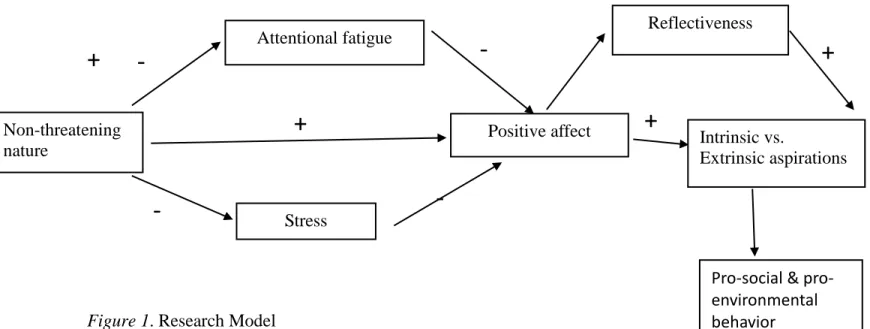
Reflectiveness. Nonetheless, despite a direct link between positive affective states and intrinsic vs. extrinsic life aspirations, it is likely that the relationship between natural environments - eliciting positive affect - and the endorsement of intrinsic vs. extrinsic life aspirations is mediated by reflectiveness. Reflectiveness has been shown to be a distinct component, contributing to the restorative characteristics of natural environments beyond its attention restoration effect (Dumke, 2014;Herzog, Black, Fountaine, & Knotts, 1997). Additionally, it has been demonstrated that reflectiveness increases the endorsement of intrinsic vs. extrinsic life aspirations and consequently is likely involved in the effect of nature on pro-social behavior (Lekes, Hope, Gouveia, Koestner, & Philippe, 2012). We therefore propose reflectiveness as a second possible pathway, possibly mediating the relationship between affect and the endorsement of intrinsic life aspirations. These predictions lead to the following research model:
Figure 1. Research Model
Hypotheses. Affective Responses. Being in nature is assumed to positively affect mood compared to being in an urban environment, reflected by increased positive affect Non-threatening
nature
Attentional fatigue
Stress
Positive affect
Reflectiveness
-+
-Intrinsic vs.
Extrinsic aspirations
+
+
+
(1a) and decreased negative affect (1b) following the exposure to a simulated walk through a forest landscape. We further assume that exposure to an urban setting represented by a virtual walk through a Dutch inner-city environment, will in contrast lead to a decrease in positive affect (2a) and an increase in negative affect (2b). Moreover, we expect positive mood to be positively related to the activation of intrinsic life aspirations (3a) and negatively related to extrinsic life aspirations (3b).
Reflectiveness. The same holds for reflectiveness, hence it is predicted that participants in the nature condition will show higher levels of reflectiveness (4a) compared to participants exposed to an urban environment (4b). It is further assumed that reflectiveness is positively related to intrinsic aspirations (5a) and negatively related to extrinsic aspirations (5b).
Life Aspirations. In addition, intrinsic life aspirations are expected to be the higher in the nature condition, compared to the urban setting (6). We also assume that extrinsic aspirations are higher in the urban setting compared to the nature setting (7).
Pro-Social & Pro-Environmental Behavior. Furthermore, it is expected that participants in the nature setting show higher intentions to engage in social and pro-environmental behavior, compared to the urban setting (8). We additionally predict that this relationship is mediated by changes in affect (9) and reflectiveness (10).
Method
6,50 € or two credits counting towards their undergraduate participant requirement. Of these participants, 55.8% studied psychology, 5.3% studied political science and 38.1% studied another subject at Leiden University.
Design. To test our hypotheses, a 2x2 mixed experimental design (environment: nature/city; time: before/after) was used. The independent variable was environment and the dependent variables were reflectiveness, life aspirations, social and pro-environmental behavior. Several control variables were measured as between subjects’ variables (before the manipulation: stress, attentional fatigue; after: perceived restorativeness, recovery, immersion, liking). Moreover, the mediating variable affect was measured before and after the video - modelled as a within subjects variable - and compared between conditions. Participants were randomly assigned to two different experimental sequences to control for any order-effects. In the first sequence, participants filled out all questionnaires for the dependent measures directly after the manipulation and then completed a creativity tasks, belonging to a second study. This order was reversed for the second sequence.
applied as experimental manipulation in earlier research (Ulrich et al., 1991). We furthermore performed a small pretest to select each video in accordance with the structural characteristics mentioned by Ulrich (1991) (details about the pre-test can be found in Appendix A).
The urban environment was represented through a video showing a walk through a shopping street in Den Haag’s inner city with a length of 4 minutes and 9 seconds. The scenes were taken from a virtual walk video freely available on YouTube. The natural environment was represented by a video showing a walk through a forest landscape, filmed in a wooden area in England with a length of 4 minutes and 2 seconds. The video was taken from a virtual walking DVD and cut and selected to include sequences of dense and more open forest, while trying to keep signs of human influence at a minimum. In all scenes, a path was visible. No people were visible in the forest scenes. (for example pictures, see Figure 2, Appendix A).
Control measures. (i) Stress. Stress levels were measured with a 10-item Stress Adjective Checklist (King, Burrows, & Stanley, 1983), which had a reliability coefficient (alpha) of .583 for both environmental conditions. After deleting one item, reliability was increased to α = .642.
(ii) Attentional fatigue. Attentional fatigue was measured with an eight item self-report scale developed by Staats, Kieviet, and Hartig (2003), consisting of four items measuring affective state directly (feeling irritated, tired, worn out, mentally exhausted), and four behavioral items indirectly measuring attentional fatigue (would you be able to make a well-balanced decision, concentrate, foresee the implications of a complex
much, for the affective states; very well, for the behavioral items). Mean responses for the behavioral subscale were calculated after reversal of responses on the behavioral items, resulting in mean scores ranging from 1 (no attentional fatigue) to 7 (extreme attentional fatigue). However, Principal Component Analysis (PCA) and internal reliability analysis (alpha) revealed that the two subscales cannot be used as an internally consistent scale measuring attentional fatigue, since internal reliability was far from sufficient with an alpha of .267 and factor analysis showed a clear two factor structure differentiating between behavioral and affective items (Staats, Kieviet, & Hartig, 2003). While combining both subscales is not indicated and the internal reliability of the affective subscale is rather low (alpha = .495), the behavioral subscale shows an internal reliability of .722. Consequently, the behavioral subscale only will be used to measure attentional fatigue.
(iii) Core affect. In order to assess core affect a scale developed by Staats, Gatersleben, and Hartig (1997) based on Russell’s model of emotion was used. Six items were selected from the two-dimensional space described by Russell and Snodgrass (1987). The affective items were as follows: pleased, elated, aroused, tense, bored, alone. However, the two-factor structure found by Staats, Gatersleben, and Hartig (1997) could not be replicated. Due to extremely low alpha values we will refrain from using these items in a summarized scale.
environment). The scale permitted scores (mean response on the three items) that range from 1 (not at all preferred) to 7 (extremely preferred). Note that this approach to measuring preference was necessary, given the lack of a simple equivalent for ‘‘I like this place’’ in the Dutch language. The three items all have a very general evaluative character, and, with particular regard to beauty, correlate strongly with liking (e.g. Purcell, 1987; Wohlwill & Harris, 1981).
(v) Perceived restorativeness. Perceived restorativeness was measured using the so called Perceived Resorativeness Scale (PRS) developed by Hartig and colleagues (Hartig, Evans, Korpela & Garling, 1997). The current version of the Perceived Restorativeness Scale (PRS) is comprised of 11 items. Participants made their responses using a 7-point scale to indicate the extent to which each of the given statement described their experience in the respective setting (0 = Not at all; 10 = Completely). Internal validity of the scale was acceptable with Cronbach alpha = 0.70. Items were averaged to form a single Index ranging from Not at all = 0 to Completely = 10, describing the overall perceived restorative qualities of the environment in question.
(vi) Restoration. Likelihood of restoration was measured using a 7-item scale developed by Staats, Kieviet, and Hartig (2003). Participants were instructed to imagine that they would take a walk through the environment depicted in the video for an hour and then had to indicated their agreement with different restorative related statements on a 7-point likert scale (0= very unlikely to 7 = very likely). Examples include: “I can come
(vii) Immersion. Immersion in the respective environments was measured using an adapted version of the Player Experience of Need Satisfaction Physical Presence Scale initially developed for interactive environments (Ryan et al., 2006). Items were modified to reflect immersion in non-interactive environments. Six items were used to assess immersion in the environments presented in the video clips. Responses were made on a 5-point scale ranging from 1 (not at all) to 5 (very much). Internal reliability for this scale was extremely low with α = .324, but improved to α = .521 after removing the reversely scored item.
Dependent variables. (i) Affective state. Two different measures were used to assess affective states before and after the manipulation. The first one was the core affect scale developed by Staats, Gatersleben, and Hartig (1997), which was excluded from further analysis due to reliability issues and a failure to replicate the two-factor structure found by the authors. In addition, the 10-item version of the Positive Affect Negative Affect Scale (PANAS) was used, assessing five distinct positive and five distinct negative emotions that are summarized in a positive and a negative mood index. The 10 items scale, consists of five items per index, with each item assessing a discrete emotion on a five-point scale. An example is: “I feel interested” (1 = not at all to 5 = extremely). Factor analysis supported the two-factor solution found in earlier research. Internal validity for both subscales was good with Cronbach’s alpha of .885 for the negative affect subscale and .741 for the positive affect subscale.
issues, see things in a new perspective, think about myself in relation to other people). The scale showed good reliability with Cronbach alpha = .79 and permitted scores ranging from 1 to 7 (very negative to very positive for the evaluation of psychological outcomes; and not likely to extremely likely for the items assessing the likelihood of psychological outcomes) (Staats, Kieviet, & Hartig, 2003).
(iii) Life aspirations. To assess life aspirations an adapted version of the Aspiration Index was used (Kasser & Ryan, 1993). Participants responded to items assessing the personal importance of each of four life aspirations on a 5-point scale, ranging from 1 (not at all important) to 5 (very important). Internal reliability for the subscales was acceptable with α = .681 for Extrinsic Aspirations and α = .693 for Intrinsic Aspirations. The Extrinsic Aspiration composite was constructed by averaging the Fame and Fortune subscales and Intrinsic aspirations were computed by averaging the Closeness and Community subscales. Sample items were for instance: Wealth: “To be
financially successful”; Fame: “To be admired by many people”; Connectedness: “To
have deep enduring relationships”; Community: “To work toward the betterment of
society.”
others”, “I will be available for volunteer activities to help those who are in need.” Items were averaged to form a single index of Pro-Social Behavior Intentions. Internal reliability was high with α = .859.
(v) Pro-environmental behavior. In order to assess pro-environmental behavior intentions, the Pro-Environmental Behavior Index (PBI) was used, which consists of eight specific pro-environmental behaviors that were summed up to form an Index score (Staats, Harland & Wilke 2004). The PBI consists of the following eight behaviors:
separation of organic waste from solid waste, saving dirty laundry until the washing machine can be fully loaded, leaving the faucet running while doing the dishes, bringing a shopping bag from home when going shopping, using unbleached coffee filter bags,
using detergents in refill packaging, using unbleached toilet paper, and refusing plastic bags or wrappings offered by shopkeepers. Scores on these eight items, all on 7-point Likert-type scales ranging from 1 (never) to 7 (always), were averaged to form an overall score. Internal reliability was acceptable with α = .607.
Procedure. The research took place in the lab at the Faculty of Social Sciences at Leiden University. The lab consisted of five independent cubicles with computers. Participants were greeted and instructed to leave their belongings in the entrance room. Afterwards participants signed the informed consent and were instructed to take place behind one of the computers. We ensured all participants that they could open the door whenever they had a problem or question during the experiment.
was presented, participants saw a short instruction about the scale. They furthermore could not continue to the next item without giving a response to the present item to reduce missing values. Afterwards, participants watched either the city or nature video, respectively for four minutes, while hearing matched natural or urban sounds via headphones. After the manipulation participants were given the Affect Scale and a second version of the PANAS, followed by the dependent measures: The Aspiration Index, the Reflectiveness scale, the Pro-social behavior and the Pro-environmental questionnaires. Afterwards the control measures were administered: The Perceived Restorativeness Scale (PRS), the Recovery Scale and lastly the Immersion Scale. Last, participants completed the manipulation check. All responses were recorded digitally. Participants were instructed to open the door upon completion of all measures and tasks to receive a debriefing and the monetary compensation.
Results
Participants were divided into two groups according to the two experimental conditions: Nature vs. Urban. We then explored the data visually with histograms and boxplots to check for normal distributions and outliers.
mood. Excluding extreme cases on these measures is warranted since they are known to be of influence when it comes to the dependent variables.
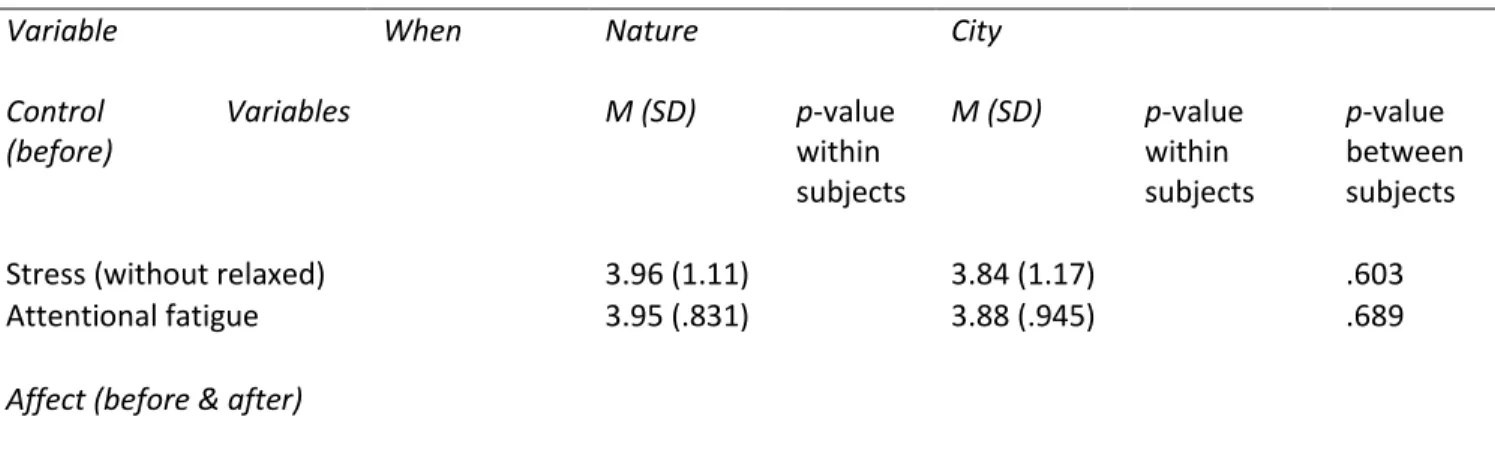
Control variables and Order-effects. No significant differences between the two conditions (nature/urban) on any of the control measures were found prior to the manipulation. For exact values see Table 1. To test for any order effects, we compared whether the dependent measures differed for the different sequences (questions/creativity; creativity/questions) per condition. In the urban condition, no significant differences between these two sequences were found with p-values for the respective t-tests ranging from .487 to .945, thus one can safely assume that order had no effect on the dependent variables in the urban condition. However, it seems that in the nature condition the order of the administration influenced at least some of the dependent variables. To be precise, Positive affect was significantly higher in the first sequence (M = 2.79, SD = .799)with t
(55) = 2.01, p = .05, compared to the second sequence in which the creativity task was administered first (M = 2.40, SD = .646). The same holds for Reflectiveness, after the first sequence (questions/creativity) participants were significantly more reflective (M = 4.47, SD = .967), compared to the second sequence (M = 3.75, SD = .868) with t (55) = 2.95, p = .01. All other measures did not differ for the different sequences with p-values ranging from .169 to .862. However, Perceived Recovery was marginally significant with
t (55) = 1.82, p = .074, showing the same pattern as the other two measures with Perceived Recovery being higher after the first sequence (M = 4.95, SD = .921) compared to the second sequence (M = 4.35, SD = 1.15).
Aspirations (7) and Pro-Social (8) and Pro-Environmental Behavior (9), we conducted a series of t-tests comparing those measures on the two conditions. The respective means and p- values can be found in Table 1. According to Hypothesis 1, we expected positive mood to increase (1a) and negative mood to decrease (1b) after being exposed to a virtual walk through a forest landscape. We found no supporting evidence for any of these assumptions with t(54) = 0.41, p = .680 and t(54) = 0.42, p = .677 respectively. We further expected a decrease in positive mood (2a) and an increase in negative mood (2b) following a virtual walk through an urban environment. Using one-tailed p-values, there was a marginally significant decrease in positive mood with t(54) = 1.64, p = .053 and significant increase in negative mood t(54) = -1.73, p = .045. It was further hypothesized that Reflectiveness (4) would be higher in the nature condition compared to the urban condition, the data did not support this assumption with t(111) = 1.22, p = .225. The same holds for the remaining dependent variables. No differences in Intrinsic or Extrinsic Aspirations were found, with t(111) = 1.00, p = .320 and t(111) = 1.63, p = .106 respectively. Neither did we detect any differences in Pro-Social or Pro-Environmental behavior intentions, with t(111) = .052, p = .959 and t(111) = 1.14, p = .256 respectively. Table 1. Results t-tests for Control Variables, Dependent Variables and Affect
Variable When Nature City
Control Variables (before)
M (SD) p-value within subjects
M (SD) p-value within subjects
p-value between subjects
Stress (without relaxed) 3.96 (1.11) 3.84 (1.17) .603
Attentional fatigue 3.95 (.831) 3.88 (.945) .689
Negative affect before video after video
1.23 (.408)
1.21 (.369) .677
1.23 (.451)
1.38 (.587) .090+
.559 .343 Positive affect before video
after video
2.62 (.667)
2.59 (.734) .680
2.65 (.734)
2.49 (.788) .106
.898 .502
Dependent Variables
Reflectiveness 4.11 (.979) 3.87 (1.08) .225
Intrinsic Aspirations 5.21 (.505) 5.11 (.537) .320
Extrinsic Aspirations 4.35 (1.01) 4.03 (1.08) .106
Pro Social 3.60 (.544) 3.60 (.455) .959
Pro Environmental 4.91 (.911) 4.70 (1.08) .256
Control Variables (after)
Perceived Restorativeness
4.15 (.869) 3.74 (.771) .009*
Perceived Recovery 4.59 (1.06) 3.54 (1.38) .000**
Immersion 3.90 (1.15) 3.70 (1.09) .357
Preference 4.77 (1.01) 3.73 (1.22) .000**
Preference
(including familiarity)
4.66 (.985) 3.85 (1.01) .000**
* significant at the 0.05 level (2-tailed). + significant at the 0.05 level (1-tailed) ** significant at the 0.01 level (2-tailed). ++ significant at the 0.01 level (1-tailed)
Even though there were no significant differences in any of the dependent variables between the two experimental conditions as can be seen in Table 1, there was a significant difference in most of the control measures. Specifically, Perceived Restorativeness, Perceived Recovery and Preference were significantly higher in the nature condition than in the urban condition, with t(111) = 2.66, p = .009, t(111) = 4.54, p
= .000 and t(111) = 4.96, p = .000 respectively.
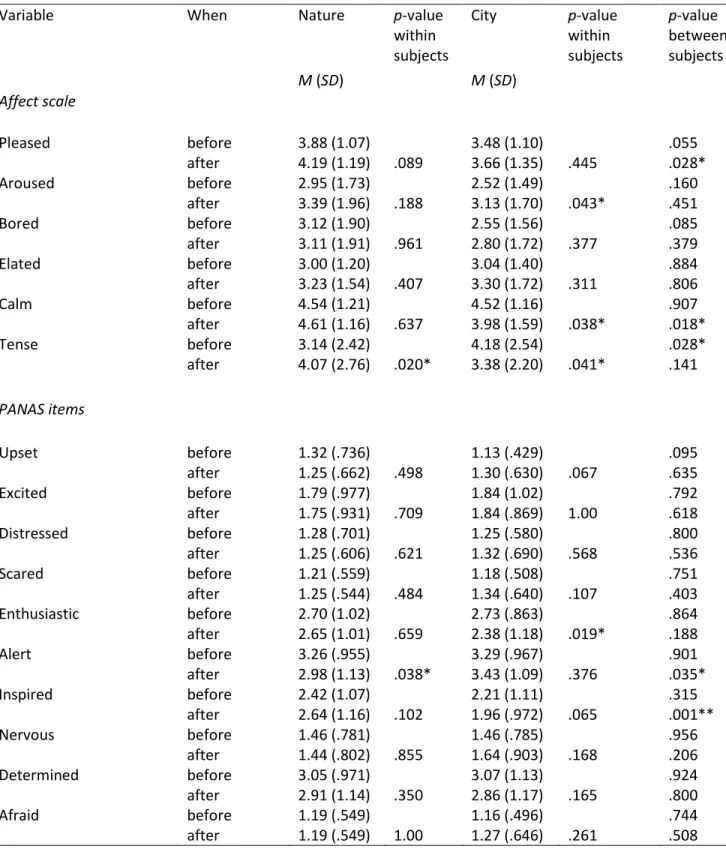
Table 2.Means and t-tests for individual emotions compared before/after and between conditions
Variable When Nature p-value
within subjects
City p-value within subjects
p-value between subjects
M (SD) M (SD)
Affect scale
Pleased before
after
3.88 (1.07)
4.19 (1.19) .089
3.48 (1.10)
3.66 (1.35) .445
.055 .028*
Aroused before
after
2.95 (1.73)
3.39 (1.96) .188
2.52 (1.49)
3.13 (1.70) .043*
.160 .451
Bored before
after
3.12 (1.90)
3.11 (1.91) .961
2.55 (1.56)
2.80 (1.72) .377
.085 .379
Elated before
after
3.00 (1.20)
3.23 (1.54) .407
3.04 (1.40)
3.30 (1.72) .311
.884 .806
Calm before
after
4.54 (1.21)
4.61 (1.16) .637
4.52 (1.16)
3.98 (1.59) .038*
.907 .018*
Tense before
after
3.14 (2.42)
4.07 (2.76) .020*
4.18 (2.54)
3.38 (2.20) .041*
.028* .141
PANAS items
Upset before
after
1.32 (.736)
1.25 (.662) .498
1.13 (.429)
1.30 (.630) .067
.095 .635
Excited before
after
1.79 (.977)
1.75 (.931) .709
1.84 (1.02)
1.84 (.869) 1.00
.792 .618
Distressed before
after
1.28 (.701)
1.25 (.606) .621
1.25 (.580)
1.32 (.690) .568
.800 .536
Scared before
after
1.21 (.559)
1.25 (.544) .484
1.18 (.508)
1.34 (.640) .107
.751 .403 Enthusiastic before
after
2.70 (1.02)
2.65 (1.01) .659
2.73 (.863)
2.38 (1.18) .019*
.864 .188
Alert before
after
3.26 (.955)
2.98 (1.13) .038*
3.29 (.967)
3.43 (1.09) .376
.901 .035*
Inspired before
after
2.42 (1.07)
2.64 (1.16) .102
2.21 (1.11)
1.96 (.972) .065
.315 .001**
Nervous before
after
1.46 (.781)
1.44 (.802) .855
1.46 (.785)
1.64 (.903) .168
.956 .206
Determined before
after
3.05 (.971)
2.91 (1.14) .350
3.07 (1.13)
2.86 (1.17) .165
.924 .800
Afraid before
after
1.19 (.549)
1.19 (.549) 1.00
1.16 (.496)
1.27 (.646) .261
.744 .508
We found that participants in the nature condition were significantly more pleased, calm, inspired and enthusiastic compared to the urban condition. It can also be seen that participants were significantly more alert and aroused, and using one-tailed p -values also significantly more scared, following the urban exposure. We moreover found that participants were tenser in the urban condition prior to our manipulation, which significantly decreased, while tension increased in the nature condition.
Positive Affect
Negative Affect
Reflectiveness Extrinsic Aspirations Intrinsic Aspirations Pro-Social Pro-Environmental Negative Affect -.041
Reflectiveness .244** -.166 Extrinsic
Aspirations
-.233** .040 .146
Intrinsic Aspirations
.156 .100 .234* .085
Pro Social .169 -.108 .247** -.093 .566**
Pro-Environmental
-.021 .040 .071 .228* .069 .077
* significant at the 0.05 level (2-tailed).** significant at the 0.01 level (2-tailed).
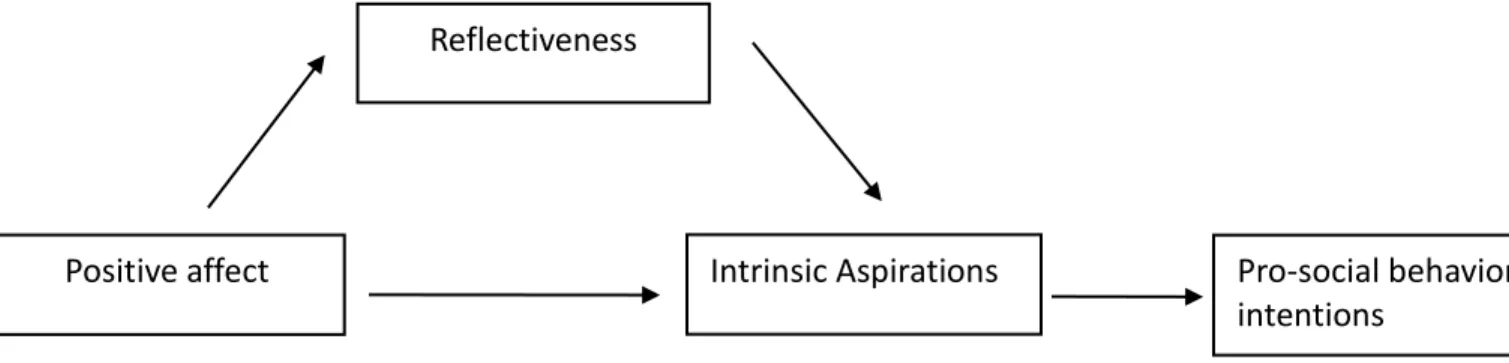
Mediation analysis of the partial model. Since there were no significant differences found in the main dependent variables between conditions and the correlations we found only partly support our model, the preliminaries for testing the whole model with a mediation analysis were not given. However, since the correlations we found at least partially support the proposed relationship between the dependent variables, including Positive affect, Reflectiveness, Intrinsic and Extrinsic aspirations and Pro-Social Behavior intentions, we decided to test that part of our model for exploratory reasons with a stepwise regression approach, following the four steps outlined by Baron, and Kenny (1986) to establish mediation. This leads to the following model to be tested for mediation: Positive affect Reflectiveness Intrinsic Aspirations
a
b
c (c’)
Pro-social behaviorFigure 2. Partial research model
Mediation. 1. In the first step, we will establish that the causal variable is correlated with the outcome. We will use Intrinsic aspirations as the criterion variable in a regression equation and Positive affect as a predictor (estimate and test path c in the above figure). This step establishes that there is an effect that may be mediated. A simple linear regression analysis was performed to predict Intrinsic aspirations based on Positive affect. However, even though Positive affect failed to significantly predict Intrinsic aspiration scores, with β = .156, t (111) = 1.67, p = .098, we will nevertheless perform the analysis for exploratory purposes, especially given the outcome that the relationship is marginally significant which - given the small N - makes it worthwhile to explore effects. Hence, although Positive affect failed to explained a significant proportion of variance in Intrinsic aspiration scores, R2 = .024 F(1, 111) = 2.786, p = .098, we will continue to test
the alternative pathway (a + b).
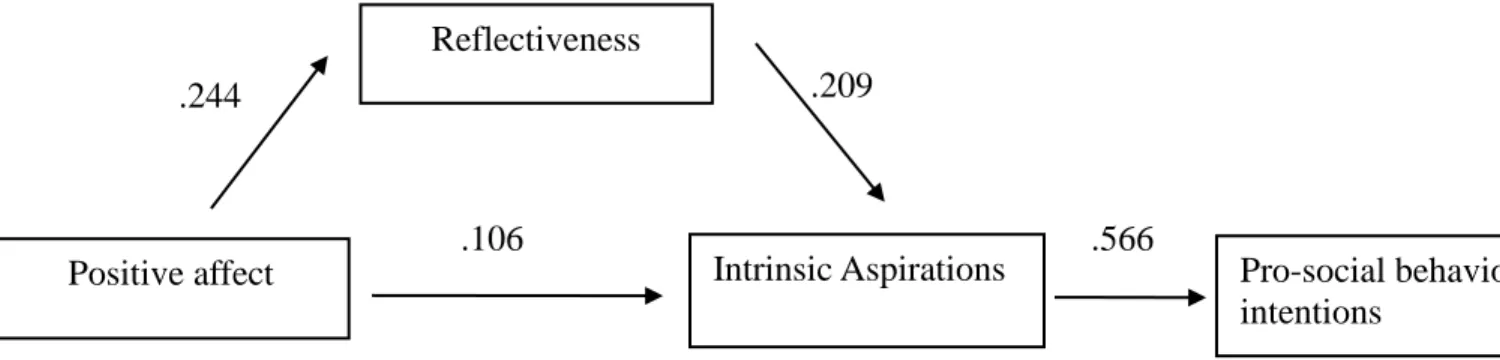
2. Step two aims at showing that the causal variable is correlated with the mediator. We will use Reflectiveness as the criterion variable in the regression equation and Positive affect as a predictor (estimate and test path a). This step essentially involves treating the mediator as if it were an outcome variable. Positive affect significantly predicted Reflectiveness scores, β = .244, t(111) = 2.646, p = .009, and explained a significant proportion of variance in Reflectiveness scores, R2 = .059, F(1, 111) = 6.999, p = .009, thus step two is satisfying the assumptions of mediation.
affect and Reflectiveness as predictors (estimate and test path b). According to Baron, and Kenny (1986), it is not sufficient to simply correlate the mediator with the outcome as the mediator and the outcome may be correlated since they are both caused by the causal variable. Thus, the causal variable must be controlled in establishing the effect of the mediator on the outcome. We performed a multiple regression analysis with Positive affect and Reflectiveness as independent variables, entering Positive affect first and Reflectiveness afterwards. The results do at least partially support the assumption that Reflectiveness mediates the relationship between Positive affect and Intrinsic aspirations. Reflectiveness significantly predicted Intrinsic Aspiration scores, β = .209, t(111) = 2.196, p = .030, while Positive affect was non-significant β = . 106, t(111) = 1.112, p = .269. And the overall fit of the regression model was significant with R2 = .065, F(1, 111) = 3.853 p < .001. Since Step 2 (the test of a) and Step 3 (the test of b) are met, it follows that the indirect effect is likely nonzero. To further establish whether the alternative pathway ab is indeed significantly different from zero, one needs to perform a significance test. We used the Sobel test to establish the significance of the mediation, accordingly the mediation is statistically non-significant (z = 1.69, p = .090) However, given our small N and that the Sobel test works best with large samples, the marginally significant p-value we found indicates that a mediation in the predicted direction is likely.
1.112, p = .269. We can therefore conclude that Reflectiveness if it indeed does function as a mediator, only partially mediates the relationship between Positive affect and Intrinsic Aspirations.
To further validate our model and establish the relationship between Intrinsic Aspirations and Pro-Social behavior intentions (path d in the model), we will perform a regression analysis with Intrinsic Aspirations as predictor and Pro-Social behavior intentions as criterion variable. Intrinsic Aspirations significantly predicted Pro-Social behavior scores, β = .566, t(111) = 7.236, p < .001, and explained a significant proportion of variance in Pro-Social behavior scores, R2 = .321 F(1, 111) = 52.362, p < .001. This results in the following parameter estimates for our partial model:
Figure 3. Partial research model with parameter estimates from two analyses combined (standardized regression coefficients)
Discussion
Based on earlier findings nature has been shown to increase people’s intention to engage in pro-social and pro-environmental behaviors, while several mediators have been introduced and tested, such as mood, intrinsic aspirations, autonomy and immersion (Gueguen, & Stefan, 2014; Joye, & Bolderdijk, 2015; Weinstein, Przybylski, & Ryan, 2009; Zelenski, Dopko, & Capaldi, 2015; Zhang, Piff, Iyer, Koleva, & Keltner, 2014.).
Positive affect
Reflectiveness
Intrinsic Aspirations
.244 .209
.106
Pro-social behavior intentions
The current study’s goal was to integrate and test these findings empirically. The proposed mediators between nature effects and pro-social and pro-environmental behavior were: positive and negative affect, extrinsic vs. intrinsic aspirations and reflectiveness.
Hypotheses. Affective Responses. We predicted that exposure to a simulated natural environment would lead to an increase in positive affect and a decrease in negative affect, however this was not the case. Although some of the effects regarding individual emotions we measured were in line with the predictions, as can be seen by people feeling more pleased, calm, inspired and less alert after having been exposed to a simulated walk through nature, no changes in any of the negatively toned emotions were found, thus contradicting the prediction that contact with nature would lead to a decrease in negative affective states. Hence our findings support the alternative evolutionary approach of Macmahan and colleagues (2015), which predicted a primary increase in positive affect as a reaction to non-threatening natural environments.
We moreover found evidence that exposure to a simulated urban environment leads to an increase in overall negative affect and a decrease in overall positive affect, thus being in line with our predictions. Participants furthermore felt more aroused, less calm and less enthusiastic following the urban exposure. The mood changes we observed were thought to be mediated by a recovery from attentional fatigue (see ART, Kaplan 1995) and stress (see SRT, Ulrich, 1991) in the natural environment and an increase in attentional fatigue and stress following the exposure to an urban environment.
partially supported in so far as positive mood was indeed negatively related to extrinsic aspirations, while the sign of the relationship to intrinsic aspirations was positive as predicted, but not statistically significant.
Reflectiveness. Reflectiveness was predicted to be higher in the nature condition compared to the urban condition. Although the differences in means were not significant, a trend in line with our predictions was visible. We further found that reflectiveness was positively related to intrinsic life aspirations and negatively related to extrinsic life aspirations. However, despite being in line with the predicted direction of association, the relationship between reflectiveness and intrinsic aspirations was not statistically significant.
Life Aspirations. Intrinsic life aspirations were expected to be higher in the nature condition, compared to the urban condition, which was not the case. In addition, we did not find any evidence that extrinsic aspirations were higher in the urban condition compared to the nature condition as we predicted.
Pro-Social & Pro-Environmental Behavior. Furthermore, it was predicted that participants in the nature setting would show higher intentions to engage in pro-social and pro-environmental behavior, compared to the urban setting. This was not the case. We further predicted that this relationship would be mediated by changes in affect and reflectiveness, this assumption was partially supported.
Afterwards we will elaborate in more detail on how the predicted relationships between variables were at least partially supported, despite a failure of our main manipulation regarding the main dependent variables. We will then continue to relate these findings to existing theory and future research outlooks.
Mood Measures. In line with the prevailing theoretical accounts, Attention Restoration Theory (ART) and Stress Reduction Theory (SRT), we predicted that exposure to a virtual walk through a natural forest landscape would lead to an increase in positive affect and a decrease in negative affect, compared to a virtual walk through an urban environment, which was predicted to have the opposite effect on mood. We, however, only found a marginally significant decrease in positive mood and a significant increase in negative mood following the virtual walk through the urban environment.
nature condition showing more positive and less negative affect compared to the urban condition, however this assumption was not supported by our data.
Surprisingly, after a closer look at the individual emotions that make up the affect measures we used (a short version of the PANAS & the core affect scale by Russel), we found some interesting differences and trends, which are in line with our predictions and the general predictions of both ART and SRT.
Individual emotions. Accordingly, participants were significantly more pleased after the virtual nature walk than after the virtual walk through an urban environment. This difference was driven by an increase in feeling pleased following the nature intervention, which is in line with our hypothesis that natural environments increase positive affect. We, in addition, found that participants were significantly more calm following the nature walk compared to the urban condition. This effect was mainly driven by participants feeling less calm after the urban walk, being in line with the predictions of SRT that urban environments cause stress, which in turn leads to a heightened physical arousal that can possibly be reflected by feeling less calm (Ulrich et al., 1991). Moreover, participants were significantly more inspired following the nature walk compared to the urban environment, hence further supporting the notion that contact with natural environments increases positive emotional states (Berman et al., 2008; Berman et al., 2012; Hartig et al., 2003.; Kaplan, 1995; Ryan et al., 2010; Ulrich et al., 1991).
urban walk, while being less alert after the nature walk (Kaplan, 1995; Berman et al., 2008; Berman et al., 2012; Hartig et al., 2003). In terms of SRT one could argue that a lack of stressful or possibly dangerous environmental triggers in the nature condition (in our case being a virtual walk through a forest landscape) helps individuals to relax and consequently makes them less alert (Ulrich, 1995). Moreover, it was found that people were significantly more aroused after the urban walk compared to before the walk, which specifically supports SRT, predicting an increase in physical arousal in urban environments (Hartig, Evans, Jamner, Davis, & Gärling, 2003; Lee at al., 2011; Ulrich et al., 1991). In addition, participants felt significantly less enthusiastic following the urban walk. These findings are in line with our general predictions of an increase in arousal and negatively tuned emotions following urban exposure and a decrease in positively toned emotions, compared to an increase in positive feelings and being more relaxed after nature exposure (represented by being more pleased and inspired).
statistical power, which makes it hard to detect any statistically significant differences in the first place.
Comparing real and simulated exposure. Secondly, as has been pointed out in other studies, a virtual simulation of nature immersion in general tends to produce much smaller effects than an in-situ exposure such as taking a real walk through nature. It has for instance been found that both real and simulated virtual natural environments facilitated stress reduction, while being immersed in real nature additionally lead to altered states of consciousness (ASC) and an increase in energy levels, thus having effects that go beyond the ones of simulated nature (Kjellgren, & Buhrkall, 2010).
This is even more interesting in terms of the proposed role of reflection in our model. Accordingly, experiencing altered states of consciousness while being in nature could possibly be related to a heightened inclination to reflect on one’s life. This assumption is further supported by the finding that participants did express a significant difference in their expectations regarding the restorative qualities and the perceived recovery potential of the respective environments, which required them to imagine themselves physically walking through the respective environment for about an hour. Hence, it would be interesting to investigate whether reflectiveness is indeed higher in real nature immersions compared to virtual exposure and in how far this effect is related to the experience of ASC as described by Kjellgren and Buhrkall (2010).
got to the measurement of our dependent variables. Although we alternated these tasks with our dependent measures to rule out any order effects, we found that there were significant differences between these sequences. This was especially true for the nature condition. To be precise, positive affect and reflectiveness were significantly higher following the sequence in which participants filled out the dependent measures directly after seeing the video than if they had to perform a creativity task first and then filled out our dependent measures.
Since participants had to spend a total of an hour in a small research cubicle, while the virtual exposure to the respective environments only lasted for five minutes, it is quite understandable that the effects of having to perform several computerized tasks, and filling out questionnaires for prolonged periods might have cancelled out any positive effects of being virtually exposed to a natural environment for five minutes. The experimental set-up thus unwillingly introduced several confounding variables, such as prolonged screen exposure, filling out questionnaires for prolonged periods and a possibly frustrating creativity task. Hence, we cannot be sure whether the null-effects we observed are due to any of these confounding factors or to a general failure of our manipulation. However, since earlier research has successfully used photo and video material to produce significant results (e.g. Berman et al., 2008; Ulrich et al., 1991), it is likely that the experimental set-up omitted and canceled out the effects of our manipulation.
negative mood, reflectiveness, intrinsic and extrinsic aspirations, social and/or pro-environmental behavior intentions. However, given the methodical draw backs and our small sample size, which leads to a generally low power to detect effects in the first place, there is at least partial evidence that the respective environments influenced individual emotions in agreement with our predictions. Consequently, we must assume that our manipulation was not sufficiently strong to induce significant outcomes in the remaining dependent variables.
Of course, it could also be the case that the dependent variables are simply not affected by the exposure to natural vs. urban environments, therefore contradicting earlier findings. However, since there is a long history of scientific studies which found plenty of evidence supporting the idea that exposure to natural environments influences the dependent variables, it is rather unlikely that this would be the case (Berman, Jonides, & Kaplan, 2008; Berman et al., 2012; Bowler, 2010; Bratman, Daily, Levy, & Gross, 2015; Capaldi, Dopko, & Zelenski, 2014; Fredrickson & Levenson, 1998; Nisbet & Zelenski, 2011; Mayer, Frantz, Bruehlman-Senecal, & Dolliver 2009; Ryan, et al., 2010). Participants moreover clearly preferred the natural environment and their expectation for recovery and restoration was significantly higher for the natural environment, so the most logical assumption would be that our manipulation was not strong enough to produce significant results.
supports the notion that familiarity with the beneficial effects of immersing oneself in natural environments affects people’s expectations of said environments in terms of restoration and their intention to seek out natural environments in case of a need for restoration (Collado, Staats, & Corraliza, 2013; Nisbet, & Zelenski, 2011; Russell et al., 2013). Consequently, it could be that participants were lacking experience with nature as a restorative environment, which would explain why our simulation failed to produce the anticipated effects. However, since our control measures indicated a significant difference in the expectations of the restorative properties of natural vs. urban environments, this is unlikely.
Restorative Qualities. In all cases, participants rated the natural environment as being preferred, being more restorative and promoting better recovery from stress. Hence, it can be concluded that there indeed is a difference in the restorative qualities between natural and urban environments, but that our manipulation simply was not strong enough to elicit the hypothesized changes in the dependent measures, which consequently lead to a failure to adequately reflect the differences between natural and urban environments.
both found to be elevated after nature exposure in earlier research, we were not able to replicate these findings (Zelenski, Dopko, & Capaldi, 2015). We therefore decided to drop pro-environmental behavior from the analysis and instead focused on pro-social behavior intentions as main dependent variable, since earlier research had already established the connection between nature exposure, the endorsement of intrinsic life aspirations and pro-social behavior intentions (Weinstein, Przybylski, & Ryan, 2009). This led to the following model to be tested for mediation:
Figure 4. Research model
Reflectiveness. Even though not being statistically significant, we found that the relationship between intrinsic aspirations and positive affect, was - despite being statistically non-significant - at least partially mediated by reflectiveness. Hence, there is at least some evidence in the direction of our hypothesis that a broaden-and-build focus, induced by positive emotions in terms of Frederickson (2004), causes an increase of reflective tendencies in people. This is further in line with earlier research, which found reflectiveness to play a distinct role in the recovery process taking place in natural environments (Dumke, 2014; Herzog, Black, Fountaine, & Knotts, 1997). More specifically, we predicted that an increase in positive affect would promote a broaden-and-build focus, which encourages explorative behavior (Frederickson, 2004; Mauss, &
Positive affect
Reflectiveness
Robinson, 2009). Since this broaden-and-build focus does not have to be focused on actual behavior, but instead could also be represented by an increase in mental flexibility or as can be seen in this case in a capacity to be reflective, our findings give some support towards our hypotheses.
Intrinsic aspirations. Furthermore, we found that being more reflective increased the endorsement of intrinsic life aspirations. Since intrinsic life aspirations are basically other- and community focused value orientations, one could assume that reflecting on one’s existence possibly lead people to realize the interconnectedness of life itself and acknowledge their own place in the bigger picture, which in turn could possibly trigger them to be more motivated to engage in pro-social behaviors, although this assumption is purely speculative and would need to be testes empirically (Mauss, & Robinson, 2009; Mayer, & Frantz, 2004; Weinstein, Przybylski, & Ryan, 2009).
Attention. It is additionally possible that being in nature frees up resources such as focused attention (see ART), which might make people more likely to use these freed resources to engage in reflective behavior. This could represent an alternative pathway between nature effects, attention and the findings that nature exposure results in more pro-social value orientations and behaviors.
Conclusion. Taken together the findings of our study indicate that different environments (natural vs. urban) indeed affect the emotional state of people, even though the effects we found were rather small. However, given the small sample size, and the flaws in design and the resulting low power of our study, we have enough evidence to assume that the respective environments produce affective patterns, which are in line with the predictions of both ART and SRT. The findings are therefore adding to the body of evidence supporting these theories. We moreover helped to establish that an increase in positive affect is related to increased levels of reflectiveness. Reflectiveness in turn was shown to be related to the endorsement of intrinsic life aspirations, reflecting the valuing and intention to engage in pro-social behaviors.
moreover can contribute to an increased sense of community and subsequently increase the willingness of people to engage in community supporting activities (Ryan et al., 2010).
Future Research. In order to potentially detect stronger and more valid results regarding the effects of nature on mood and pro-sociality, researchers should be advised to use in situ exposure to natural environments, since a virtual simulation introduces a broad array of confounding factors and simply cannot compete with the real experience of immersing oneself in natural environments. An alternative is creating deeper immersion in simulated environments by using technically better procedures such as using larger screens, administering only one task at a time, or possibly using virtual reality exposure.
Another possibility to avoid lengthy assessments would be the use of short behavioral measures instead of questionnaires to assess outcome variables such as pro-social and/or pro-environmental behavior intentions as it has been done by Guéguen and Stefan (2016). We additionally recommend to experimentally control for attentional fatigue and stress to be able to produce stronger effects and to be able to differentially test the predictions of ART and SRT, and compare them to the alternative evolutionary approach we introduced.
It would also be interesting to investigate the effects of specific emotions in more detail and how they are related to the activation of specific goals. One promising line of research here seems to be the process of reflection, which could furthermore be linked to an existing line of research, which investigates the role awe plays in mediating positive nature experiences. Awe evoking nature has been demonstrated to increase the positive effects of nature immersion and in addition has been shown to increase feelings of humbleness and being small (Joye, & Bolderdijk, 2014). It could for instance be the case that awe-evoking nature specifically increases reflectiveness and thereby promotes a self-concept that is less self-centered. This would fit the experience of being humbled and experiencing altered states of consciousness, while being in extraordinary nature (see Joye, & Bolderdijk, 2014; Kjellgren, & Buhrkall, 2010)
Living in times were everything becomes faster and faster, reflected by instant communication, higher interconnectivity and a general trend of globalization, there seems to be less and less time to reflect on what is truly important to us. One of our basic human needs revolves around the feeling of belonginess. Apparently being in nature helps to relieve the stressors of living in modern urban environments. As such, nature has the potential to increase feelings of being interconnected and consequently could result in a heightened experience of belonging, which might possibly be mediated by an increase in reflectiveness and the endorsement of intrinsic life aspirations.