
Lasers
A Senior Project
By
Noah Caro
Dr. Glen D. Gillen
Department of Physics, California Polytechnic University SLO
Approval Page
Title: Lasers
Author: Noah Caro
Date Submitted: June 07, 2019
Senior Project Advisor: Dr. Glen D. Gillen
Signature
Contents
1 Introduction 5
2 Background 5
2.1 Light-Matter Interaction . . . 5
2.2 Energy Transfer Between EM Waves and Atoms . . . 9
2.2.1 Stimulated Absorption . . . 9
2.2.2 Stimulated Emission . . . 10
2.2.3 Spontaneous Emission . . . 11
2.3 Conclusion . . . 12
3 Laser Elements 14 3.1 What is a Laser? . . . 14
3.1.1 Pump . . . 14
3.1.2 Gain Medium . . . 15
3.1.3 Resonator (Hard Reflector and Soft Coupler) . . . 16
3.1.4 Cooling System . . . 17
3.2 Tying it all Together . . . 18
3.3 Laser Light and its Properties . . . 21
4 Comparison of Different Types of Lasers 23 4.1 Continuous Wave Lasers . . . 24
4.1.1 Broadening . . . 25
4.2 Pulsed Lasers . . . 27
4.2.1 Q-Switching . . . 27
4.2.2 Mode-Locking . . . 28
5 Laser Applications 29 5.1 Medical . . . 30
List of Tables
List of Figures
1 Electromagnetic Spectrum [7]. . . 8
2 Stimulated Absorption [7]. . . 10
3 Stimulated Emission [7]. . . 11
4 Spontaneous Emission [7]. . . 12
5 Distribution at Equilibrium [8]. . . 13
6 Distribution at Population Inversion [8]. . . 14
7 Arrangement of Laser Components [7]. . . 18
8 Standard Four-Step Laser Process [7]. . . 18
9 HeNe energy level diagram [7]. . . 19
10 Wave With Coherence Timeτ0 [10]. . . 22
11 Spatial Coherence [7]. . . 23
12 Two Mirror Laser Cavity [7]. . . 24
1
Introduction
Short for “Light Amplification by Stimulated Emission of Radiation”, the theory of a laser has
gradu-ally transitioned over the last century from being a theoretical possibility to something used in countless
modern, everyday applications and appliances. The idea of a laser is rooted in Einstein’s 1917 paper
pertaining to his theory of radiation [1]. In his paper, Einstein theorized that the possibility of
ther-mal equilibrium being achieved between electromagnetic waves and matter could be explained by three
fundamental processes. These processes are known as spontaneous emission, absorption, and most
im-portantly, stimulated emission. Einstein also made several other predictions regarding the behavior of
photons when interacting with matter that suggested that creating a concentrated, coherent beam of light
would be possible. The groundbreaking nature of these predictions wasn’t revealed until several decades
later when two scientists, Charles Townes and Arthur Schawlow, formulated a plan to improve upon
contemporary molecular spectroscopy technology [2]. At the time only coherent light in the microwave
wavelength range was able to be produced. Townes and Schawlow were interested in generating coherent
light of much higher frequencies through stimulated emission. To do this, they suggested positioning two
parallel-facing mirrors along the optical axis of the cavity of a preliminary laser model. The intended
purpose of these two mirrors was to reflect photons with desired frequencies back-and-forth through
the medium of the laser. This would allow for the production of identical photons via stimulated
emis-sion at a rate that increased with each pass through the medium. Schawlow and Townes published a
paper regarding their idea of implementing parallel mirrors into a laser cavity in 1958 [2]. In 1960,
Theodore Maiman, a Scientist from Stanford University, brought the ideas of Townes and Schawlow to
life. Maiman successfully constructed the first working laser using ruby as the gain medium [3, 4].
2
Background
2.1 Light-Matter Interaction
Another enormously important idea Einstein is credited with postulating is that light comes in discrete,
1905 regarding the photoelectric effect [5]. This paper was of particularly great significance because it
challenged the widely accepted ideas that light was exclusively wave-like in nature and that a mysterious
medium known as “ether” was necessary and fundamental to the propagation of light. Thankfully, light
and its elusive nature is understood at a much deeper level today than at the time of the publication
of Einstein’s paper. For example, the notion of an invisible, intangible medium through which light
propagates has been discarded. The wave-particle duality of light has been reconciled and is accepted
as fact. We also know that photons are elementary, bosonic particles with no internal structure or mass.
Furthermore, photons require no medium to propagate and do so at the speed of light in all reference
frames [6].
Not only has our understanding of photons and their elusive behavior been greatly developed since
Ein-stein’s initial conjecture in 1905, but our ability to mathematically describe the physical properties of
light has been as well. Light is characterized by many things such as its polarization, color, wavelength,
frequency, etc. The relationship between several of these fundamental properties of laser light and other
forms of electromagnetic radiation is illustrated in the equation
c=λv, (1)
wherecis the speed of light (299,792,458ms),λis wavelength, andvis frequency.
As shown in the above equation, the wavelength and frequency of light are directly proportional to the
speed of light in a vacuum (c). This relationship implies that as one quantity, either wavelength or
frequency, increases the other must decrease to compensate. Light of a higher frequency has shorter
wavelengths and carries with it a greater energy, whereas light with a lower frequency has as longer
wavelength and contains less energy. The energy of a photon used in the generation of laser light is
dependent upon the energy levels that the atom responsible for the photon’s emission transitions between,
a principle discussed later in greater detail. The energy of a photon can be found using the equation
whereEis energy in Joules,his Planck’s constant (6.626×10⁻³⁴J oule−Seconds), andvis frequency in Hertz.
The frequency of a photon not only indicates what its energy is, but also what type of electromagnetic
Figure 1: Electromagnetic Spectrum [7].
The electromagnetic spectrum is partitioned into various different sections that correspond to light of
fre-quencies reaching up to3×1024Hz, and on the opposite end of the spectrum there are the low fre-quency radio waves with wavelengths tens of thousands of meters long. The range from roughly380nm
to770nmcomposes the visible spectrum, or the light able to be detected by a human eye. The range
we are most concerned with, that of light emitted by lasers, extends from roughly3×1012Hz in the infrared region up through3×1018Hzin the extreme ultraviolet or x-ray region. Each region is host to electromagnetic radiation of varying energy. This energy can be transferred to and from atoms through
the aforementioned means postulated by Einstein. These three vehicles of energy transfer are described
in the following sections.
2.2 Energy Transfer Between EM Waves and Atoms
There are three main methods by which energy can be transferred between electromagnetic wave and
atoms. The first method we will examine is known as stimulated absorption.
2.2.1 Stimulated Absorption
Stimulated absorption is the first process by which light can interact with atoms. During stimulated
absorption a photon of energyE = hv is absorbed by an atom. The energy of the absorbed photon is
transferred to this atom and as a result the atom becomes excited and its outermost electron populates a
This process may only occur if the energy of the incident photon,E = hv, is equivalent to the energy
gap between the lower and higher energy levels occupied by the electron before and after the absorption.
The rate at which stimulated absorption occurs is given by the equation
RStim.Abs. =B12g(v0)
I
cN1, (3)
whereB12is the first Einstein B coefficient,g(v0)is the lineshape function evaluated at the frequency of the incident photon,Iis the irradiance of the electromagnetic wave,cis the speed of light, andN1is the population density of the lower energy level.
The process of stimulated absorption is illustrated in Fig. 2, where the dot for each energy level represents
the electron’s current state.
Figure 2: Stimulated Absorption [7].
2.2.2 Stimulated Emission
The second process through which light can interact with an atom is known as stimulated emission.
Stimulated emission occurs when a photon of energy equivalent to the gap between adjacent energy
levels is incident upon an atom resident in the higher level. This interaction results in the higher energy
atom shifting down into the lower level and the release of another photon exactly identical to the incident
one. The released photon has the same phase, polarization, energy, propagation, direction, and frequency
of the incident photon. This newly created photon increases the energy of the passing electromagnetic
wave. The uniformity between the incident and resulting photon is what allows for the creation of laser
RSt.Em.=B21g(v0)
I
cN2, (4)
whereI is irradiance of the incident electromagnetic wave, c is the speed of light, N2 is the popula-tion density of the upper energy level,g(v0) is the lineshape function at the frequency of the incident
photon(s), andB21is the Einstein coefficient of stimulated emission.
The process of stimulated emission described above governed by Eq. 4 is shown in Fig. 3.
Figure 3: Stimulated Emission [7].
2.2.3 Spontaneous Emission
The third and final method by which an electromagnetic wave and atoms can exchange energy is known
as spontaneous emission. Spontaneous emission occurs when an atom in an excited energy state
un-leashes a quanta of energy in the form of a photon and subsequently drops down to a lower energy state.
As the name implies, this occurs spontaneously and requires no external motivation as the excited state
is one which is energetically unstable and there exists a lower energy state with an allowed transition.
As seen in stimulated emission, the energy of the photon emitted is equivalent to the energy gap between
the upper and lower levels. However, in contrast to the uniformity of photons emitted via stimulated
emission, each photon emitted in this manner travels in a random direction with a random polarization
and phase constant.
The rate at which spontaneous emission occurs in a given volume is given by the equation
RSponEm =A21N2, (5)
The process of spontaneous emission is shown in Fig. 4.
Figure 4: Spontaneous Emission [7].
2.3 Conclusion
The connections that exist between the three aforementioned processes through which light interacts
with atoms and their corresponding equations and Einstein coefficients help to illuminate the conditions
necessary for laser light to be created. The ratio of the third Einstein coefficient,A21, to the Einstein coefficient of stimulated emission,B21, is given by the equation
RCoef f Ratio =A21N2, (6)
Out of all three types of light-matter interaction we have discussed, stimulated emission is by far the
most critical in the process of creating laser light. Unfortunately, under normal conditions stimulated
emission is uncommon because of the tendency of atoms to decay down to lower energy levels via
spontaneous emission. At equilibrium, the population distribution of atoms across each individual energy
level lessens as energy increases usually following Boltzmann statistics. Because there are significantly
more atoms in lower energy levels, absorption of a photon is much more likely to be observed than
stimulated emission [8]. An illustration of the distribution of atoms across energy levels at equilibrium
Figure 5: Distribution at Equilibrium [8].
As previously stated, stimulated emission is necessary for the creation of laser light. Under the
distribu-tion condidistribu-tions shown in Fig. 5 stimulated emission is not very likely to occur. To rectify this problem
one of the main components of a laser system, the pump, introduces more energy to the system and
excites the atoms to higher energy levels. If sufficiently pumped, and the natural lifetime of the upper
state is significantly longer than the lower state, the number of atoms occupying an upper energy level
will be greater than the number of atoms occupying a lower energy level. When this is observed there is
said to be a population inversion. Achieving a population inversion is the primary purpose of a laser’s
pump and is necessary to produce enough instances of stimulated emission to emit laser light [8]. Fig. 6
Figure 6: Distribution at Population Inversion [8].
3
Laser Elements
3.1 What is a Laser?
A laser is essentially a source of unique and extraordinarily useful light. The light emitted from them
has high levels of both spatial and temporal coherence. Lasers can be designed to emit light anywhere
along the electromagnetic spectrum from the microwave region to the ultraviolet region. They are used
in a variety of practical applications across many different industries such as medicine and defense. All
lasers are made up of several different key components that work in harmony to produce a highly coveted
beam of light.
3.1.1 Pump
The first essential element of a laser that we will discuss is the pump. The pump acts as a source of
energy that excites the atoms found within the laser’s gain medium. This is critical to the operation
of laser because the excitation of these atoms is what establishes the population inversion necessary
to produce laser light. Once a population inversion has been achieved within the gain medium, the
Because a population inversion has been established it is also certain that the rate of stimulated emission
will surpass that of stimulated absorption, meaning that the irradiance of coherent light generated inside
the laser cavity will increase over time. In the absence of a pump one would observe the intensity of the
light within the laser cavity decreasing rather than increasing. There are several different types of pumps
used to excite the atoms within a laser’s gain medium. All of these pumps accomplish the same exact
thing, but the methods by which they do so vary. Several examples of these various pump types include
optical, chemical, thermal, and electrical. Interestingly enough, optical pumps use an external source of
light to excite the atoms of the gain medium that in turn produce light of their own. Lasers equipped
with a chemical pump harness the energy released during a specific chemical reaction and use it to create
the necessary population inversion. Chemical pumps are used in a variety of high-powered continuous
wave lasers that have numerous industrial applications. Thermal pumps work by dissipating heat into the
gain medium. This increase in thermal energy causes the atoms to become excited, again resulting in the
necessary population inversion. Finally, electrical pumping, the kind of pumping used in and many gas
lasers, works by passing an electric current through the gas. The electrons collide with the atoms during
this process. These electron-atom collisions are what excites the electrons in the atom’s lower level into
the upper level [7, 12].
3.1.2 Gain Medium
The next critical component used in the construction of a laser is known as the gain medium. Not only is
the gain medium a crucial constituent piece of the laser, but the material from which it is made normally
determines the name of the laser itself. For example the HeNe laser uses a gain medium that consists
of helium and neon atoms, CO2 lasers use a gain medium of carbon dioxide, and Ti:sapphire lasers
use a sapphire crystal doped with titanium ions as a gain medium. The gain medium of the laser is
housed inside the laser cavity between the hard reflector and output coupler. It hosts the atoms that are
to be excited by the pump and in turn produce photons via stimulated emission. Because the energy
gap between the upper and lower laser levels found in various different gain media varies, so does the
wavelength of laser light produced by them. There are so many different materials from which laser light
infrared regions of the electromagnetic spectrum. Often times the gain medium of a laser has two distinct
parts. These are those host atoms into which the energy generated by the pump is transferred, and the
laser atoms from which light is produced. Selecting a suitable gain medium is imperative because if the
lifetime of the energy levels used to create laser light are not sufficiently long (or short in the case of the
lower level), a population inversion will be unattainable regardless of how intensely it is pumped. As
mentioned previously, gain media come in all three states of matter. Gaseous gain media are observed in
the aforementioned HeNe and CO2 lasers, solid gain media are present in lasers such as the Ti:sapphire
laser, and lasers such as dye lasers with broad wavelength spectra use liquid gain media [7, 12].
3.1.3 Resonator (Hard Reflector and Soft Coupler)
The next integral component that allows amplification of laser light to take place is known as the
res-onator. This component is typically comprised of two planar or slightly curved mirrors that are oriented
meticulously so that the photons created through stimulated emission reflect continuously along the same
path through the gain medium. The first of the two mirrors used to create the resonator is called the hard
reflector. The hard reflector is engineered to have a perfect reflectivity of 100%. This mirror allows
none of the electromagnetic wave generated within the laser cavity to escape and reflects all of it back
through the gain medium. The second mirror is known as the output coupler. This mirror is engineered
to have a slightly less than perfect reflectivity usually around 98-88%. It is called the output coupler
because, due to its imperfect reflectivity, it allows some of the electromagnetic wave to escape the cavity.
This emission is the desired laser light. The distance between the hard reflector and output coupler is
what determines the allowed wavelengths and frequencies of light that exist within the laser cavity. This
relationship is shown in the equation
vm =m
c
2d, (7)
wheredis the distance between the output coupler and hard reflector,m is a positive integer,c is the
”frequency filter” and can be fine-tuned so that only frequencies within a desired range are emitted from
a laser [7].
3.1.4 Cooling System
The efficiency and optimal operation of laser is significantly effected by the temperature at which the
laser runs. In reference to laser systems, efficiency can be described as the ratio of the amount of power
output by the laser to power necessary to operate a laser. Unfortunately, many high-powered lasers with
a variety of uses run at very low (<< 1) efficiencies. The main purpose of a cooling system within a
laser is to dissipate the heat generated when energy from the pump is not used in the creation of laser
light, which, in most cases, is the vast majority of the pump energy. Insufficient cooling of a laser system
can be incredibly detrimental to the components of a laser and should be avoided [7].
As with the gain medium of laser, there are several options when choosing how to best cool a laser. Lasers
with Nd:YAG (neodymium-doped yttrium aluminum garnet), Ti:sapphire (Titanium-Sapphire), and other
solid gain media are often liquid-cooled. The gain medium is encased in a rigid bladder through which
water or another liquid with a high specific-heat flows. This liquid essentially acts as a heat sink for
the heat generated by the pump and prevents overheating. Other ways of cooling laser systems can be
fairly simple like using fans to cool a laser with air, or more complicated as often seen in high-powered
carbon dioxide lasers when the gain medium itself is recycled and cooled before returning to the cavity
to be pumped again [7]. A rudimentary illustration of the typical arrangement of the aforementioned
components can be seen in Fig. 7. The first mirror,M1, is the hard reflector, the second mirror,M2, is the output coupler, the gain medium is the portion between the hard reflector and soft coupler, and the
Figure 7: Arrangement of Laser Components [7].
3.2 Tying it all Together
Now that all of the individual essential elements of a laser have been discussed, the way in which they
op-erate in unison to create laser light can be discussed. The following figures provide visual representations
of the processes that are covered in the following section.
Figure 9: HeNe energy level diagram [7].
The general process of creating a population inversion and achieving laser light can seen in Fig. 8. This
process begins with a large number of atoms in the ground state, orE0 as seen in the figure. This is the lowest energy state able to be occupied by the atoms found within a laser’s gain medium. The laser’s
pump then excites these atoms into a higher energy level through one of the several aforementioned
pumping methods. Fig. 8 shows the atoms being pumped to the third excited state, orE3. At this point there are several routes that the atoms can take back down to the ground state. Some of the atoms decay
are responsible for the creation of laser light. E2 is known as the upper laser level. The upper laser level has a lifetime roughly six orders of magnitude larger than the lifetime of the other levels shown
in Fig. 8. Because of its lifetime is extraordinarily long compared to the other energy levels, E2 acts as a metaphorical red stoplight at which atoms rapidly accumulate. This causes the population density
of the second excited energy level,N2, to become increasingly large. Some atoms stuck at the second excited energy level may spontaneously decay down to the first excited energy level, E1, also known as the lower laser level. Because the lifetime ofE1 is short, the population density of the first excited state,N1 cannot achieve a value anywhere near comparable to that ofN2. Because of this, population inversion, an absolute necessity when creating laser light, is achieved. WheneverN2 > N1 there exists a population inversion in the gain medium [7].
Now that a population inversion between the upper and lower laser levels has been achieved, light
am-plification can finally take place. First, a photon of a specific energy is needed to catalyze the process.
As shown in Fig.8, for stimulated emission to take place, the incident photon must have an energy given
by the equation
Eγ =hv0 =E2−E1, (8)
whereh is Planck’s constant, and v0 is the frequency of the incident photon. Once a photon with an
energy given by Eq. 8 stimulates an atom to transition down fromE2toE1another identical photon via stimulated emission has been created, the process of light amplification has officially begun. Although
a photon with an energy given by Eq. 8 may also be absorbed by an atom in the lower laser level and
excite it to the upper laser level, there still exists a population inversion whereN2 > N1. Because of this and the fact that the Einstein coefficients of stimulated emission and stimulated absorption, B12 andB21 respectively, are equivalent, the rate at which stimulated emission occurs, given by Eq. 4, is greater than the rate at which stimulated absorption occurs, given by Eq. 3. This in turn allows for the
photon population within the laser cavity to be amplified every time it is reflected between the hard
reflector and output coupler. As more and more photons are produced via stimulated emission, the atoms
they can be pumped up toE3 yet again. Each atom repeats this process over and over again so that a population inversion between the upper and lower laser levels always exists, and the output laser beam
is uninterrupted [7].
Because the output coupler is designed to have an imperfect reflectivity so that laser light may escape
the cavity, the irradiance, or power of the light produced by the laser decreases by some amount on each
pass between the two mirrors. For the irradiance of the laser beam to continue to increase, the amount
that the irradiance is increased through stimulated emission needs to be greater than the amount lost
through the output coupler. However, because an increase in irradiance means that more and more atoms
are undergoing stimulated emission and transitioning from the upper laser level to the lower laser level,
it also means thatN2 is decreasing which lessens the severity of the population inversion induced by the pump of the laser. The inverse relationship between the irradiance of the laser and the population
inversion is referred to as gain saturation. Over time the irradiance generated through stimulated emission
asymptotically approaches the rate at which it is lost through the output coupler and can no longer be
increased. When a laser reaches this point in its operation cycle it is said to be in steady-state operating
condition [7].
3.3 Laser Light and its Properties
Laser light is so ubiquitous in modern day technology because of its unique properties not found in any
other light sources. One such property is the high degree of monochromaticity laser light possesses. In
short, monochromaticity is the uniformity of the color of the light emitted by a laser. The linewidth, or
possible frequencies of photons emitted by stimulated emission typically spans over a decent range, but
because the two mirrors that make up the resonator of a laser form a resonant cavity, only photons with
frequencies equivalent to the resonant frequencies of the cavity are amplified. This leads to a significant
narrowing of the range of frequencies that are amplified within the laser cavity and thus the uniformity
of color is heightened. Unfortunately, instances of spontaneous emission are not able to be completely
circumvented. This leads to the emission and amplification of a small, but non-negligible amount of
Another defining property of laser light is its coherence. If a laser or other light source is said to be
coherent it means that the temporal and spatial components of the electromagnetic wave emitted from
the source have a high degree of phase correlation. Temporal coherence defines the level of
monochro-maticity exhibited by a laser beam. In other words, temporal coherence is a measure of how uniform
the frequency of light emitted from a source remains. This type of coherence can be measured in terms
of coherence length, the distance emitted light may travel while remaining monochromatic. Coherence
length can be found using the equation
L= c
δ v, (9)
whereLis the coherence length,cis the speed of light in a vacuum, andδ vis the frequency bandwidth
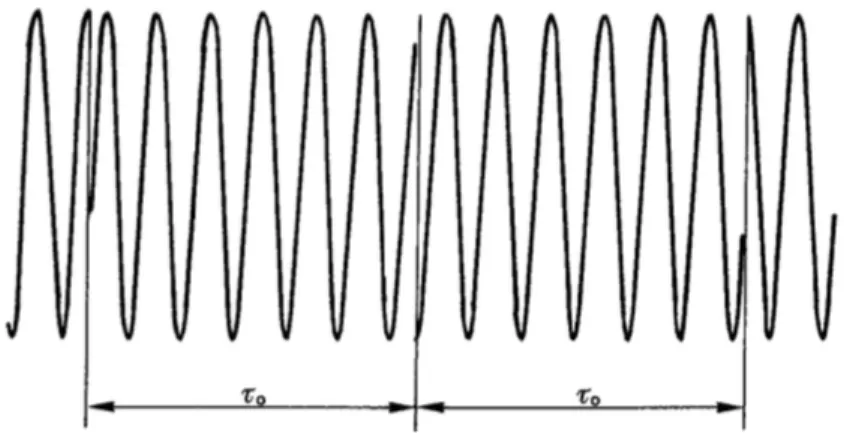
of the laser. You can also describe the temporal coherence of light by its coherence time,τ0, which can be found by dividing the coherence length by the speed of light,c[7, 8, 10].
Fig. 10 shows an electromagnetic wave with a coherence timeτ0. Notice that at precisely each interval of
τ0the light wave experiences a sudden change in phase and no loner retains temporal coherence.
Figure 10: Wave With Coherence Timeτ0 [10].
The second type of coherence observed in laser light is known as spatial coherence. Spatial coherence “is
a measure of the uniformity of phase across the optical wave-front.” [7]. Essentially what this means is
with the phase of light equidistant and emitted from the same source traveling in another direction. For
example, consider the source of light in Fig. 11 to be ideal and monochromatic. PointsP1 andP2 are equidistant from the source meaning they are at the same point on the optical wave-front and are traveling
in different directions. If the light form the source is to be considered spatially coherent then the phase
of the light at pointP1must be exactly that of the phase of the light at pointP2[7].
Figure 11: Spatial Coherence [7].
Emitted light may have one or both characteristics of being spatially and temporally coherent. However,
light that is either spatially or temporally coherent cannot automatically be assumed to be temporally or
spatially coherent as well, respectively. If an electromagnetic field that is both spatially and temporally
coherent is desired the sources of light that constitute the field must emit photons that are of the same
frequency and in phase with each other [7]. The high level of spatial and temporal coherence found
in laser light is yet another property that can be attributed to the process of stimulated emission. In
stimulated emission, the photon elicited by the interaction between an incident photon and an atom
occupying the upper laser level has exactly the same frequency, phase, polarization, energy, and many
other properties as the incident photon. This means that the light amplified with each pass through a
laser’s cavity via stimulated emission is extraordinarily coherent, both spatially and temporally [7, 8,
10].
4
Comparison of Different Types of Lasers
At this point we have covered a sufficient enough amount of theory and background information to
are known as continuous wave (CW) and pulsed lasers.
4.1 Continuous Wave Lasers
Steady-state, or continuous wave lasers are lasers whose outputs are uninterrupted and consistent; i.e.,
light is continuously emitted from the laser. Hence the name “continuous wave”. Whether or not a laser
can be considered a member of the continuous wave family depends on its pump, gain medium, and
resonator. The investigation of continuous wave lasers begins with an analysis of a simple two-mirror
laser cavity. Such a cavity is a shown in Fig. 12.
Figure 12: Two Mirror Laser Cavity [7].
In Fig. 12,M1 is the hard reflector,M2 is the output coupler,Lis the length of the gain medium, and
Ioutis the irradiance of the output laser beam.Ioutcan be found using the equation
Iout=
T2Is
2
γ0(2L)−ln(R11R2)
(1−√R1R2)(1 +
q
R2
R1)
, (10)
whereT2 is the transmittance of the output coupler,R1 andR2 are the reflectivities of the hard reflec-tor and output coupler respectively, L is the length of the gain medium, γ0 is the “small-signal gain coefficient”, andIs is the saturation irradiance [7]. From Eqn. 10 we can determine the threshold gain coefficient of the two-mirror cavity shown in Fig. 12 to be
γth=
1 2Lln(
1
R1R2
). (11)
The threshold gain coefficient is the amount of gain needed just to offset losses experienced by the cavity
gain coefficient must be larger than the threshold gain coefficient [7].
4.1.1 Broadening
Broadening is a complicated topic and to understand it a discussion of the lineshape function,g(v0), is
necessary. The lineshape function is a graphical representation of the probability of an atom’s
interac-tion with a photon resulting in stimulated emission. An example of a lineshape funcinterac-tion can be see in
Fig. 13.
Figure 13: Lineshape function [7].
Although it was stated previously that in order for stimulated emission to occur as a result of the
interac-tion of a photon with an atom the incident photon must have an energy exactly equal to the energy gap
between the upper and lower laser energy levels of the atom, this is not the complete picture. While
pho-tons that propagate with an energy exactly equal to the energy gap are the most likely to elicit stimulated
emission, photons with energies very close to that of the energy gap may also elicit stimulated emission,
albeit at a lower probability. Broadening is a phenomenon through which the lineshape function of the
atoms responsible for the production of laser light are, predictably, broadened. This leads to a breakdown
and degradation of the properties of the output laser light such as its coherence [7].
The first type of broadening we will discuss is known as homogeneous broadening. It is called
homo-geneous because the linewidth of all of the effected atoms are all broadened in the same way. Looking
at Fig. 13 one can see that the typical lineshape function is gaussian in nature. Homogenous broadening
g(v) = ∆vH
2π[(v−v0)2+ (δv2H)2]
, (12)
wherev0 denotes the point along the function whereg(v) is a maximum, and vH is the full-width at half-maximum (FWHM) of the function and is given by the equation
∆vH =
1 2π(
2
τ1
+ 1
τ2
+ 2rcol), (13)
whereτ2andτ1are the lifetimes of the upper and lower laser energy levels respectively andrcolis a term related to the rate of collisions between atoms.
The two terms involvingτ in Eq. 13 are a result of a specific type of homogenous broadening known
as lifetime broadening. Lifetime broadening arises when atoms spontaneously decay from the upper
laser energy level to the lower laser energy level. This disrupts the natural, forced oscillation the atom
normally incurs as a byproduct of interaction with electromagnetic waves. This means that the charge
oscillation of the gain medium is unable to be represented as a single frequency and is better described
by abroadened spectrum of frequencies. This broadening is the origin of the twoτ terms in Eq. 13
[7].
The term involvingrcolin Eq. 13 is a result of another type of homogenous broadening known as pressure broadening. The presence of pressure broadening can be attributed to elastic collisions between atoms
in the gain medium. Unlike lifetime broadening which involves inelastic collisions and the changing of
the internal state of the atoms involved in the collision, these collisions do not change the internal state
of the atoms, but they do disrupt the normal charge oscillation of the atoms in the gain medium. The
severity of the effect that pressure broadening has on the lineshape function is directly proportional the
the pressure and temperature experienced by the atoms in the gain medium. Pressure broadening is of
particularly great concern in the operation of gas lasers [7].
The second type of broadening we will discuss is known as inhomogeneous broadening. It is called
inhomogeneous because the linewidth of the effected atoms differ among the total population of atoms;
frequency,v(0), for a partiuclar atom. Doppler broadening, a common form of inhomogeneous
broad-ening, is a result of the doppler effect. The underlying principle of the doppler effect essentially states
that the perceived frequency or wavelength of a wave depends on the waves velocity relative to the point
from which it is being perceived. Waves that are traveling towards the point from which they are being
perceived appear or sound to the perceiver to be compressed and therefore of a higher frequency than
they are in their own frame of reference. Waves that are traveling away from the point from which they
are being perceived appear or sound to the perceiver to be elongated and therefore of a lower frequency.
Because the atoms in a gaseous gain medium propagate at different velocities, the light incident upon,
and emitted from, each atom will vary slightly in frequency from other atoms because of the doppler
effect. Thus variations in the velocities of the atoms result in variations in the lineshape functions within
the population. This is the driving mechanism behind doppler broadening [7].
4.2 Pulsed Lasers
The second major classification of laser output varieties is pulsed lasers. Pulsed lasers use various
dif-ferent mechanisms to concentrate the output beam of light into a highly compact “pulse”. Pulsed lasers
boast a higher peak intensity than their continuous wave counterparts, but are incapable of emitting the
same amount of electromagnetic energy for obvious reasons. Pulsed lasers are better suited than
contin-uous wave lasers for numerous applications such as industrial cutting and materials processing.
4.2.1 Q-Switching
Pulsing the output of a laser is generally done using either of two primary methods, the first of which
is known as Q-switching. The term Q-switching refers to the process by which the quality factor of the
cavity, Q, is made to oscillate between high and low values. Q is a measure of how well the optical
cavity of a laser contains the electromagnetic energy produced inside of it. A high Q is indicative of an
optical cavity that contains energy with very low losses, whereas a low Q is indicative of the opposite. In
general, if both components of a laser’s resonator (hard reflector; output coupler) have high reflectivity
values then the cavity will have a high quality factor value. If either of the two components of the
the quality factor of an optical cavity is
Q= 2L
λ(1−R), (14)
whereLis the length of the optical cavity,Ris the reflectance, andλis the wavelength of light produced
by the gain media.
The first step to pulsing a laser’s output via Q-switching is to excite the atoms within the gain medium
at a sufficiently low Q. The low Q during this phase is necessary to inhibit the irradiance of the
electro-magnetic wave within the cavity from increasing. This allows the population density of the upper laser
energy level to reach a maximum threshold, establishing a sever population inversion. At this point, no
laser light can be created let alone emitted because of the ratio of the small-signal gain coefficient to the
threshold gain coefficient. Next, the Q of the cavity is instantaneously switched from a low value to a
very high value so that the cavity now experiences minimal loss of irradiance. This causes short,
incred-ibly high irradiance pulses of laser light to be emitted from the soft-coupler. Unfortunately, this causes
the population inversion within the gain medium to rapidly decrease. It is at this point in the process
that the Q is reset back to a very low value. The process described above then starts over and repeats ad
infinitum. Switching the Q of a laser cavity between high and low values can be done through various
different methods. The most simple of these methods involves the insertion of a rotating mirror within
the cavity that only allows lasing to occur when it is perfectly aligned with the adjacent mirror. It is also
possible to Q-switch the output of laser by placing a fan along the optical axis of the resonator which
acts as a physical impediment and thus lowers and raises the Q of the cavity rapidly. Other more
com-mon methods of Q-switching involve acousto-optic and electro-optic techniques, and sometimes even
saturable absorbers that act as irradiance filters [7].
4.2.2 Mode-Locking
While Q-switching is a certainly adequate method of pulsing the output of a laser and typically results
in optical pulses in the nanosecond regime, another method that allows for even narrower pulses to be
ways. First, a Q-switched laser cavity is designed to have a high Q for only a single frequency. The Q
of the cavity only needs to be high for a wavelength range much less than 1 nm. A mode-locked laser
cavity is designed to have a high Q over a very broad range of frequencies. The Q of the cavity needs
to be high for a wavelength range of 10’s to over 100nm. In other words, when a mode-locked laser
is not pulsing it can serve as a tunable continuous-wave laser capable of lasing over a vast wavelength
range. Second, unlike a Q-switched laser system in which the cavity is made to stay in a low Q state for
quite some time so that a population inversion may be established as electromagnetic waves reverberate
between the two mirrors of the resonator millions of times, the Q of a mode-locked laser is switched
from a high value to a low value once during every single reverberation that the electromagnetic wave
makes through the cavity. The switching of the Q happens so quickly that the population inversion of the
gain medium remains the same throughout the entire process as it would in a continuous wave laser. So,
unlike a Q-switched laser, the purpose of mode-locking is not to saturate the population inversion, but
rather to lock the phases of the numerous standing waves. All of the frequencies supported in a
mode-locked laser cavity are harmonics of the fundamental longitudinal cavity mode. When many harmonics
are simultaneously superimposed it is possible for all of them to constructively interfere at a single point
in space and in time. When this happens a light pulse is created where the phases of the waves are
locked. Depending upon the bandwidth of allowed and phase-locked longitudinal modes, laser pulses
in the range of 100’s of femtoseconds down to single digit femtoseconds can be created. Any of the
methods used to Q-switch a laser’s output can be use to mode-lock a laser as well, provided that the
oscillation of the Q from high to low and back again occurs rapidly enough [7].
5
Laser Applications
As stated previously, lasers have a very wide range of practical, real-world applications, some of which
have had monumental impacts on mankind. These applications have only been mentioned briefly thus
far, but are significant enough to warrant delving into them further. The following sections pertain to
5.1 Medical
One field in which the application of lasers to solve or workaround is common is medicine. Laser use
has become so prevalent in the field of medicine because of their ability to output an iincredibly small
point of light in which there is contained a massive amount amount of energy. This allows for lasers
to be used in place of scalpels and other instruments used to cut and cauterize human tissue. There are
two main different types of laser applications found within medicine. The first type of applications are
known asdiagnosticapplications. In diagnostic applications the interaction that a specific type of tissue
has with the incident laser light is observed and then used to discover or determine its physiological or
pathological properties. One example of a diagnostic application of lasers in medicine is the
determina-tion of cancer severity and development. Human tissue can fluoresce when excited by laser light. This
fluorescence is directly correlated to the chemical properties of the tissue and thus can be used to detect
the presence of cancerous masses. The second type of applications are known astherapeutic
applica-tions. These applications are used to permanently alter or correct inadequacies in human tissue. The
most obvious therapeutic application of lasers in medicine is as a cutting instrument instead of a scalpel.
Another example of a therapeutic laser application can be found in the branch of medicine known as
oph-thalmology, a field concerned with the treatment of eye-related deficiencies. Ophthalmologists will often
perform photorefractive laser surgery on patients in an attempt to correct disorders such as hyperopia and
astigmatism by altering the shape of their corneas [12].
5.2 Industrial
Outside of medicine, lasers are also used in wide-range of applications in the industrial, manufacturing,
and materials processing industries. An example of this is the use of a laser as a welding instrument. The
energy from a laser’s output beam is directed onto two pieces of separate, initially unconnected pieces
of metal. This results in the melting of the two pieces of metal at the site of the laser beam’s output. The
melted portions of these metals combine with each other and eventually cool off, solidifying. At the end
of this process the seam along which the laser beam was directed now connects the initially unconnected
in the application of energy as well as where the energy is applied on the weld site. Another advantage
laser welding has over other methods is small seam width. Seams created through laser welding are
much narrower than those created by electric-arc and plasma welding, meaning the physical integrity of
the metals being welded together are better preserved.
Another common application of lasers within industry is drilling. Laser drilling is usually preferred
over traditional methods of drilling because of its ability to quickly and consistently drill tiny holes into
various different materials. Examples of this include drilling holes into circuit boards, cigarette filters,
aerosol can nozzles, and aircraft engine blades [12]. Laser drilling is usually done with a pulsed laser and
the length of the pulses emitted are responsible for a number of properties, such as the depth of the hole
created. The pulsed output of laser can be used to drill in a few different ways. One such way is known as
single-pulse drilling. This style of laser drilling uses one single output pulse to drill through the entirety
of the material. Another method known as percussion drilling uses many pulses to accomplish the same
thing as single-pulse drilling. This style of drilling is employed instead of single-pulse because less
energy is transferred into the material being drilled into, yielding holes of higher quality. As the number
References
[1] A. Einstein,Zur quantentheorie der strahlung.(Phys. Z. 18 (1917): 121-128.)
[2] A. L. Schawlow, C. H. Townes,Infrared and optical masers.(Physical Review 112.6 (1958): 1940.)
[3] A. Chodos, J. Ouelette, and E. Tretkoff,APS News, August/September 2005 (Volume 14, Number
8), (American Physical Society, 2005.)
[4] M. Bertolotti,The History of the Laser, First Edition, (Institute of Physics Publishing, Bristol, BS1
6BE, UK, 2005.)
[5] A. Einstein, Concerning an Heuristic Point of View Toward the Emission and Transformation of
Light.(Annalen der Physik 17 (1905): 132-148.)
[6] C. Roychoudhuri, A.F. Kracklauer, K. Creath,The Nature of Light: What is a Photon?, First
Edi-tion, (CRC Press, 2008.)
[7] F. L. Pedrotti, L. S. Pedrotti, and L. M. Pedrotti, Introduction to Optics, Third Edition, (Person
Prentice Hall, Upper Saddler River, NJ, 2006.)
[8] J. Hecht,The Laser Guidebook, Second Edition, (McGraw-Hill Education,1999)
[9] C. E. Webb, J. D. C. Jones,Handbook of Laser Technology and Applications. Volume 1: Principles,
First Edition, (Institute of Physics Publishing, Bristol, BS1 6BE, UK, 2005.)
[10] O. Svelto,Principles of Lasers, Fifth Edition, (Springer Science+Business Media, New York, NY,
2010)
[11] G. Ahluwalia,Cosmetic Applications of Laser and Light-Based Systems, First Edition, (William
Andrew Inc., Norwich, NY, 2009.)
[12] C. E. Webb, J. D. C. Jones,Handbook of Laser Technology and Applications. Volume 3:
![Figure 1: Electromagnetic Spectrum [7].](https://thumb-us.123doks.com/thumbv2/123dok_us/8229034.2181405/8.918.197.726.171.905/figure-electromagnetic-spectrum.webp)
![Figure 2: Stimulated Absorption [7].](https://thumb-us.123doks.com/thumbv2/123dok_us/8229034.2181405/10.918.346.541.517.638/figure-stimulated-absorption.webp)
![Figure 3: Stimulated Emission [7].](https://thumb-us.123doks.com/thumbv2/123dok_us/8229034.2181405/11.918.333.581.384.473/figure-stimulated-emission.webp)
![Figure 4: Spontaneous Emission [7].](https://thumb-us.123doks.com/thumbv2/123dok_us/8229034.2181405/12.918.370.562.213.327/figure-spontaneous-emission.webp)
![Figure 5: Distribution at Equilibrium [8].](https://thumb-us.123doks.com/thumbv2/123dok_us/8229034.2181405/13.918.329.593.168.460/figure-distribution-at-equilibrium.webp)
![Figure 6: Distribution at Population Inversion [8].](https://thumb-us.123doks.com/thumbv2/123dok_us/8229034.2181405/14.918.316.598.169.450/figure-distribution-at-population-inversion.webp)
![Figure 8: Standard Four-Step Laser Process [7].](https://thumb-us.123doks.com/thumbv2/123dok_us/8229034.2181405/18.918.207.706.602.954/figure-standard-four-step-laser-process.webp)
![Figure 9: HeNe energy level diagram [7].](https://thumb-us.123doks.com/thumbv2/123dok_us/8229034.2181405/19.918.191.747.153.726/figure-hene-energy-level-diagram.webp)
![Figure 11: Spatial Coherence [7].](https://thumb-us.123doks.com/thumbv2/123dok_us/8229034.2181405/23.918.352.557.346.476/figure-spatial-coherence.webp)
