Volume 14, E20 MARCH 2017
TOOLS AND TECHNIQUES
Food Policy Council Self-Assessment Tool:
Development, Testing, and Results
Larissa Calancie, PhD1; Nicole E. Allen, PhD2; Bryan J. Weiner, PhD3; Shu Wen Ng, PhD4;
Dianne S. Ward, EdD5; Alice Ammerman, DrPH5,6
Suggested citation for this article: Calancie L, Allen NE, Weiner BJ, Ng SW, Ward DS, Ammerman A. Food Policy Council Self-Assessment Tool: Development, Testing, and Results. Prev Chronic Dis 2017;14:160281. DOI: https://doi.org/ 10.5888/pcd14.160281.
PEER REVIEWED
Abstract
A large number of food policy councils (FPCs) exist in the United States, Canada, and Tribal Nations (N = 278), yet there are no tools designed to measure their members’ perceptions of organiza-tional capacity, social capital, and council effectiveness. Without such tools, it is challenging to determine best practices for FPCs and to measure change within and across councils over time. This study describes the development, testing, and findings from the Food Policy Council Self-Assessment Tool (FPC-SAT). The as-sessment measures council practices and council members’ per-ceptions of the following concepts: leadership, breadth of active membership, council climate, formality of council structure, knowledge sharing, relationships, member empowerment, com-munity context, synergy, and impacts on the food system. All 278 FPCs listed on the Food Policy Network’s Online Directory were recruited to complete the FPC-SAT. Internal reliability (Cronbach’s α) and inter-rater reliability (AD, rWG(J), ICC
[intra-class correlations][1], ICC[2]) were calculated, and exploratory and a confirmatory factor analyses were conducted. Responses from 354 FPC members from 94 councils were used to test the as-sessment. Cronbach’s α ranged from 0.79 to 0.93 for the scales. FPC members reported the lowest mean scores on the breadth of active membership scale (2.49; standard deviation [SD], 0.62), in-dicating room for improvement, and highest on the leadership scale (3.45; SD, 0.45). The valid FPC-SAT can be used to identi-fy FPC strengths and areas for improvement, measure differences across FPCs, and measure change in FPCs over time.
Introduction
In a 2011 report by the Centers for Disease Control and Preven-tion (CDC), the first strategy recommended to increase fruit and vegetable consumption was to establish food policy councils (FPCs) as a way to improve the food environment at state and loc-al levels (1). FPCs are organizations that bring together diverse members of the community to inform food policy and systems change and to coordinate or implement programs that aim to in-crease food access (2). In 2015, there were 278 FPCs in the United States, Canada, and Tribal Nations (3). FPCs are composed of rep-resentatives from many sectors of a local food system: producers, consumers, distributors, retailers, food processors, policy and de-cision makers, public health practitioners, food waste collectors, and hunger advocacy groups (4). FPCs’ organizational missions vary, but they often aim to inform changes that lead to increased access to nutritious foods for all members of the local food sys-tem through changes to agricultural, economic, environmental, and social programs and policies. FPCs may seek to inform policies and programs within organizations, or more broadly through municipal, county, or state-level policies (2).
im-provement. No validated FPC-specific tools are available to evalu-ate councils.
The purpose of this study was to describe the development, test-ing, and findings from a self-assessment tool that measures FPC members’ perceptions of their council’s organizational capacity, social capital, and council effectiveness. The concepts measured by the self-assessment tool are informed by the literature on health-oriented community coalitions. The self-assessment tool can be used to guide FPC development, tailor capacity-building interventions for FPCs, and measure the internal functioning of FPCs.
Conceptual Framework
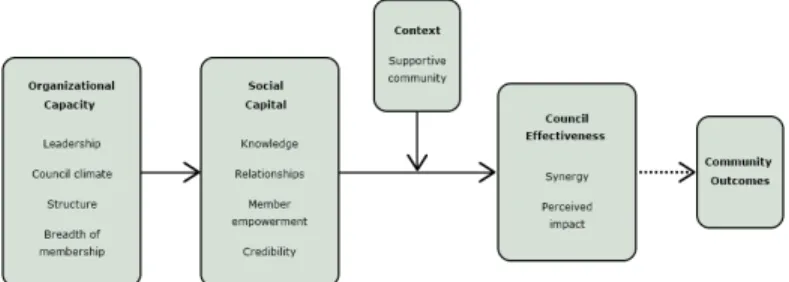
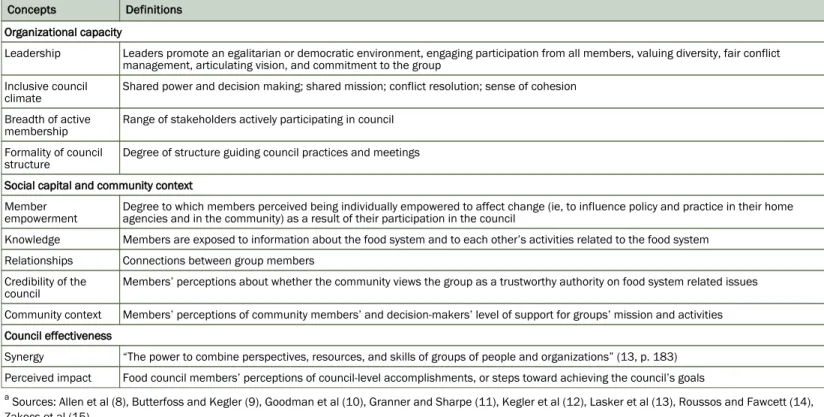
We reviewed the literature on health-oriented community coali-tions and FPCs to identify concepts to measure through the Food Policy Council Self-Assessment Tool (FPC-SAT). In reviewing the literature, we identified a parsimonious model explaining how community collaboratives influence institutionalized change in their communities (8). The concepts in the model aligned with the community coalition literature that we reviewed and depicted a set of relationships between concepts that we could test empirically (8–15). We adapted that model to create the FPC Framework (Fig-ure 1) by including a credibility concept and by defining the out-come of interest as council effectiveness. Council effectiveness is defined as synergy, or the power to combine resources and per-spectives to create new approaches to complex problems (13), and FPC council members’ perceptions of their councils’ impact on their food system. The concepts included in the FPC Framework are listed in Table 1.
Figure 1. Food Policy Council Framework. Source: Allen NE, Javdani S, Lehrner AL, Walden AL. “Changing the text”: modeling council capacity to produce institutionalized change. Am J Community Psychol 2012;49(3-4):317–31.
Food Policy Council Self-Assessment
Tool
Item and scale generation
We drafted a preliminary set of questions for the FPC-SAT Tool based on past studies and the authors’ experience working with FPCs (2,4,8). Nine food council experts who either studied coun-cils or provided technical assistance to councoun-cils provided feed-back about the relevancy, clarity, and comprehensiveness of each question on the assessment (16). Food council experts were re-cruited through the Food Policy Council Working Group of the CDC-funded Nutrition and Obesity Policy Research and Evalu-ation Network (17) and through the North Carolina–based Com-munity Food Strategies group (18). Experts included one who works with Tribal communities and who provided feedback that was specifically relevant to those populations. These experts provided input about the construct validity of the items (19). Two survey methodologists reviewed the questions and recommended simplifying the questions and providing additional question formats. The assessment was revised on the basis of feedback from content and methodology experts and entered into Qualtrics, an online survey platform.
Cognitive response testing
A convenience sample of 4 food council leaders and members was recruited to complete cognitive response interviews. The parti-cipants represented a regional council in Washington State, a mu-nicipal council in New Jersey, and county-level councils in North Carolina and Kansas. Each participant was sent a link to the Qual-trics FPC-SAT immediately before a telephone interview. The in-terviewer conducted cognitive response interviews by asking the participants to read and answer the questions aloud to better un-derstand how participants were interpreting the questions (20,21). Specific questions about response options, phrasing, and cognit-ive burden were also asked. The assessment was revised on the basis of these interviews.
Reliability and validity
Cronbach’s α coefficients were calculated to determine the reliab-ility of assessment items within each scale (22). Average devi-ation (ADM(J)) (23) and a within-group reliability index (rwg(J))
Interclass correlations (ICC[1], ICC[2]) were calculated from a one-way random effects analysis of variance (ANOVA) to quanti-fy the effect of shared council membership on participants’ scale responses (25,26). ICC(1) estimates the amount of variation that can be explained by council membership and a high ICC(2) indic-ates that councils can be differentiated in terms of their members’ responses on a scale (25,27).
Exploratory factor analysis was used to examine whether items grouped together as predicted. Items with factor loadings of 0.3 or higher were grouped into that factor (19). Factors loadings were clarified by using an oblique rotation. Scales were created from the average of all the items measuring concept. “Not applicable” responses were considered missing data. Scales were grouped to-gether into the following factors according to the FPC Framework: 1) Organizational capacity — leadership, breadth of active mem-bership, formality of council structure, and inclusivity of council climate; 2) Social capital — knowledge, relationships, credibility, and member empowerment; and 3) Council effectiveness — syn-ergy and perceived impact on the food system. Confirmatory factor analyses (CFA) were used to test whether scales correlated with these hypothesized factors. The CFA model was estimated by using maximum likelihood with missing values method. Boot-strapping was conducted and FPC members were clustered by their council identification during model estimation. CFA model fit was assessed using the Comparative Fit Index (CFI), the Tuck-er Lewis Index, and the Root Mean Square Error of Approxima-tion (RMSEA) (28). Statistics were calculated by using STATA version 14.0 (StataCorp LLC) and the multilevel package version 2.5 in R (http://CRAN.R-project.org/package=multilevel).
Testing the tool
The 2015 online edition of the Food Policy Network FPC Direct-ory was used to recruit members from all 278 FPCs in the United States, Canada, and Tribal Nations (3). Council members must have attended at least 2 meetings in the past year to be eligible to participate. Council contacts from the FPC Directory were re-cruited via email and asked to share the FPC-SAT link with their council members. Three reminder emails were sent to council con-tact persons, indicating how many council members had com-pleted the assessment. Each participant could opt to receive a $5 Amazon e-gift card to incentivize individual members to particip-ate. Councils with 8 or more participants received a feedback re-port summarizing their council’s aggregate responses as incent-ives for a high number of participants per council. Data were col-lected from July 2014 through October 2015. The institutional re-view board at the University of North Carolina, Chapel Hill, ex-empted this study.
Participant (N = 354) and council (N = 94) characteristics are lis-ted in Table 2. Most participants were female (n = 240, 74%) and white (n = 271, 84%). Most had been members of their councils for 1 to 5 years (n = 237, 66%). The average age of council mem-bers was 6.27 years (standard deviation [SD], 5.10 y), and from 1 to 12 members per council completed the FPC-SAT.
Cognitive response participants said they understood the ques-tions on the FPC-SAT and could easily answer most quesques-tions. Participants recommended some word changes (eg, be more spe-cific about “experts,” remove or define “practitioners”) and adding several more response options to the “perceived impact” section. They also had several formatting suggestions: combining blocks of questions on a page so that the progress bar at the bottom of the survey moved more quickly, seeing a question stem at the top of a set of questions rather than re-reading the stem in a related set of questions, and being sure that the “submit” option is very clear on the last page. The 4 cognitive response participants recommended reducing the length if possible, but did not identify any particular questions or sections that seemed superfluous. One participant re-commended providing an option to opt out of the gift card incent-ive because some government employees are not allowed to ac-cept such incentives. We implemented all suggested changes.
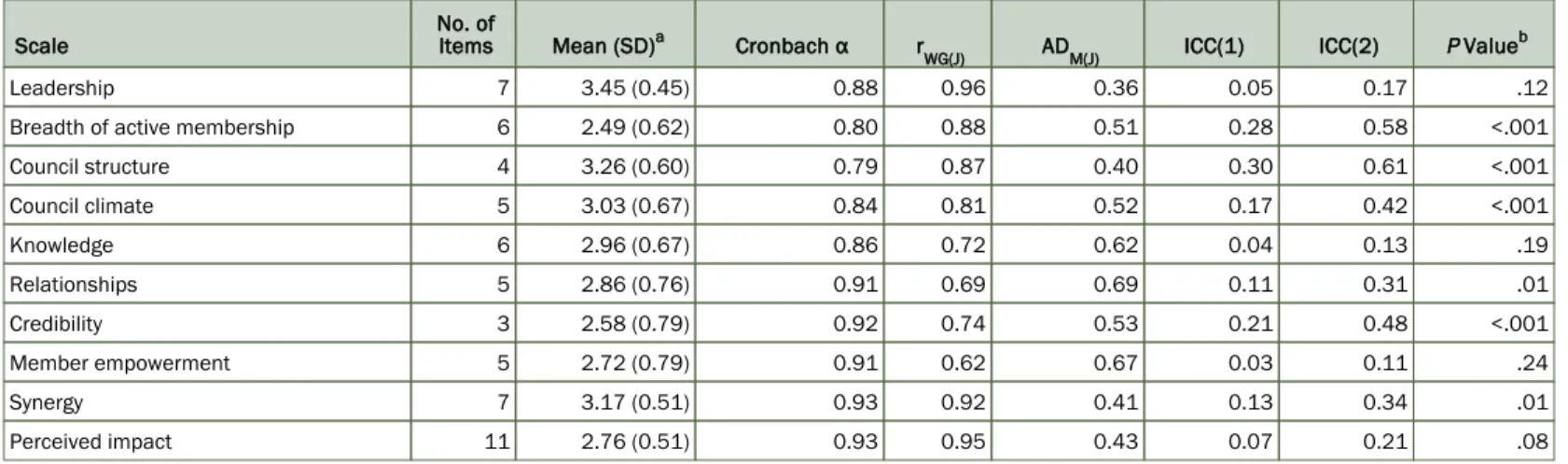
Scale properties are listed on Table 3. From 267 to 353 parti-cipants selected a response other than “not applicable” to each item. Cronbach α ranged from 0.79 to 0.93, indicating high inter-relatedness among items in each scale. Mean within-group agree-ment (rwg(J)) was above 0.70 for most scales, with the exception of
relationships (rwg(J) = 0.69) and member empowerment (rwg(J) =
0.62), indicating that council members within councils generally agreed on their ratings for each scale (Table 3) (27). Mean ADM(J)
values below 0.67 indicate agreement among members within FPCs (Table 3) (27). All scales had mean ADM(J) values of 0.67 or
lower other than relationships (ADM(J) = 0.69) and member
em-powerment (ADM(J) = 0.67).
Exploratory factor analysis indicated that the items grouped to-gether within scales as expected with factor loadings of 0.3 or higher for each item. There was minimal cross loading (factor loadings of 0.3 or higher on more than 1 factor) between items from different scales, with the exception of some cross-loading between leadership and council climate items. Leadership sets the tone for whether a council has an inclusive climate and therefore may be difficult to parse in this assessment. The CFA was a good fit with the data (χ2 = 76.146, df = 32, P = <.001, CFI = 0.970, TLI
= 0.958, RMSEA = 0.062, p-close = 0.121). These results indicate that the observed variables (the scales) were good measures of the hypothesized factors. The covariances between each factor ranged from 0.60 to 0.71 and were significant (P < .001), indicating that the factors are related yet distinct.
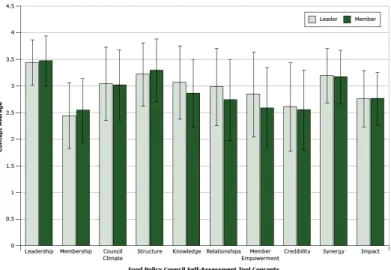
We calculated concept averages from FPC leaders and members (Figure 2). Approximately half of participants reported “member” as their position within their councils (n = 172, 49%). The aver-age concept scores were similar for the 2 groups. In the averaver-aged combined scores of leaders and members, the leadership scale had the highest mean (mean, 3.45; SD, 0.45), followed by formality of council structure (mean, 3.25 SD, 0.60), and synergy (mean, 3.17; SD, 0.51). Breadth of active membership had the lowest scale av-erage (mean, 2.49; SD, 0.62) followed by credibility (mean, 2.58; SD, 0.80, and impact (mean, 2.76; SD, 0.52) (Table 3). Table 4 shows the number of respondents, mean, and standard deviation for each of the 59 separate items in the scales.
Figure 2. Concept means and standard deviations measured by the Food Policy Council Self-Assessment Tool (FPC-SAT) (range 1–4) for a sample (N = 354) of food policy council leaders and members. Leaders (formal or informal) (n = 51, 15%), administration or staff (secretary, coordinator) (n = 49, 14%), and working group chairs or members of steering committee (n = 77, 22%) were grouped together as leaders because of their additional investment in the councils.
The FPC-SAT asked participants to indicate their level of agree-ment with stateagree-ments about their FPC’s impact on the food sys-tem in which they work (Table 4). Participants reported the areas of most impact as the following: facilitating changes in policy or practice that will promote our council's mission (mean, 3.13; SD, 0.62), increasing opportunities to purchase locally produced agri-cultural products (mean, 3.05; SD, 0.71), promoting social justice in the food system (mean, 3.03; SD, 0.69), and increasing access to healthy food in our community (mean, 3.02; SD, 0.70). Parti-cipants reported the lowest impact in the following areas: promot-ing occupational safety in the agricultural sector (mean, 2.22; SD, 0.71) and promoting humane treatment of animals in the agricul-tural sector (mean, 2.25; SD, 0.67). Additional research is needed to understand how FPCs prioritize which impact areas to pursue.
To make the tool more practical for repeated use by FPCs, we sug-gest abbreviating the tool. Table 4 shows sugsug-gested items to re-move based on their effect on scale α values and their conceptual contribution to the concept scale. Table 5 shows the reliability of the abbreviated tool. The reliability measures are very similar in the original and abbreviated tool.
Summary and Applications
This study described the development and testing of the first self-assessment tool adapted for FPCs to measure their members’ per-ceptions of their council’s organizational capacity, social capital, synergy, and impact on their food system. The FPC-SAT was ad-apted from Allen and colleague’s work and informed by literature on FPCs and community-based collaborations (4,8,15). Feedback from FPC members and experts was incorporated into the assess-ment. A final version of the assessment tool was tested with 354 council members from 94 councils in the United States, Canada, and Tribal Nations. Item reliability was high for all concept scales.
The FPC-SAT is a tool that council members and technical assist-ance groups can use to strengthen councils. In one study, authors interviewed and surveyed participants in an FPC and then provided feedback to the FPC regarding organizational capacity factors such as leadership (29). They reported an increase in coun-cil activity (eg, produced more media releases) following the pro-vision of feedback (29). Training and technical assistance should be tailored to collaboratives’ needs (30), which can be illuminated by the FPC-SAT. For example, FPCs with high scores in certain areas on the FPC-SAT can focus improvement efforts on other areas that have more room for improvement. The FPC-SAT can also be used to measure the impact of training and technical assist-ance on specific items within scales or on scale averages.
In testing this assessment tool, we found several important pat-terns. Most FPC members are white women aged 35 to 65 years. A study of the relationship between community coalition factors and community impact found that greater racial diversity was as-sociated with coalitions’ ability to change public policy and im-prove community prevention systems (31). FPCs may consider strategies for increasing diversity among their members. More re-search is needed to determine what member engagement strategies are effective at increasing member diversity. When looking at the mean scores for each concept scale, breadth of active membership, credibility, and impact had the lowest means. These are areas where councils may choose to direct more energy or seek external support such as training, technical support, and resources. Coun-cils with low breadth of active membership scores, for example, may consider engaging potential members in a variety of settings. Councils can hold public forums where community members can provide input on the councils’ activities, or they can boost active participation by aligning council priorities with members’ goals and values.
Another interesting finding was the variability in inter-rater agree-ment and interclass correlation statistics among the scales. Inter-rater agreement and interclass correlations were both low for the member empowerment scale. Therefore, the member empower-ment scale appears to capture perceptions that vary more among individuals, independent of their council affiliation, than the per-ceptions captured in the other scales. Researchers have found that community collaboratives can be empowering environments for their members but that members’ perceptions of empowerment can be influenced by other factors as well, such as the climate in their home organizations (32). Additional research into what factors explain variation in participants’ perceptions of empower-ment in FPCs is warranted.
To our knowledge, this is the first study to recruit all members from all FPCs listed in the Food Policy Network’s FPC Directory (3). However, members from one-third of all councils listed in the directory submitted a survey. More than one member responded from only 35 councils, or 12% of total councils. FPC members who completed the assessment may be more invested in their councils or more motivated to see evaluation findings than those who did not complete the survey. The limited response rate may indicate that the survey was too long or that FPC members did not see the value in completing the assessment. The abbreviated tool may be more appealing to these members. Future work will test the use of the abbreviated FPC-SAT.
In conclusion, this study describes the Food Policy Council Self-Assessment Tool development, testing, and findings from council members in the United States, Canada, and Tribal Nations. Re-searchers, public health practitioners, and FPC members can use the tool to identify strengths and areas for improvement within councils and to measure change in these areas over time. Using the tool to understand council members’ perceptions of their councils’ organizational capacity, social capital, and council effectiveness can provide insight for researchers trying to determine how coun-cils affect change in their food system. More research is needed to explore whether factors associated with FPC impact are not cap-tured in the FPC-SAT. Empirical research is needed to test the re-lationships between the factors measured in the assessment to de-velop a theory or framework explaining how FPCs function.
Acknowledgments
We thank CDC’s Nutrition and Obesity Policy Research and Eval-uation Network for its support (3-U48-DP001944-05S1). The project described was also supported by the National Center for Advancing Translational Sciences, National Institutes of Health (NIH), through grant award no. UL1TR001111. The content is solely the responsibility of the authors and does not necessarily represent the official views of NIH. This work was conducted at the Center for Health Promotion and Disease Prevention at the University of North Carolina at Chapel Hill, a Prevention Re-search Center (5U48DP001944).
Author Information
Author Affiliations: 1Center for Health Equity Research,
Department of Social Medicine, School of Medicine, University of North Carolina at Chapel Hill, Chapel Hill, North Carolina.
2Department of Psychology, University of Illinois at
Urbana-Champaign, Urbana-Champaign, Illinois. 3Department of Global Health,
School of Public Health, University of Washington, Seattle, Washington. 4Carolina Population Center, University of North
Carolina at Chapel Hill, Chapel Hill, North Carolina. 5Department
of Nutrition, Gillings School of Global Public Health, University of North Carolina at Chapel Hill, Chapel Hill, North Carolina.
6Center for Health Promotion and Disease Prevention, University
of North Carolina at Chapel Hill, 1700 Martin Luther King Jr. Blvd., CB# 7426, Chapel Hill, NC, 27599-7426.
References
Centers for Disease Control and Prevention. Strategies to prevent obesity and other chronic diseases: the CDC guide to strategies to increase the consumption of fruits and vegetables. Atlanta (GA): US. Department of Health and Human Services; 2011. http://www.cdc.gov/obesity/downloads/fandv_2011_ web_tag508.pdf. Accessed February 4, 2017.
1.
Harper A, Alkon A, Shattuck A, Holt-Giménez E, Lambrick F. Food policy councils: lessons learned. Inst Food Dev Policy; 2009;1–63. https://foodfirst.org/publication/food-policy-councils-lessons-learned/. Accessed February 4, 2017.
2.
Food Policy Network. Food Policy Council Directory. Johns Hopkins Bloomberg School of Public Health; 2015. http:// www.jhsph.edu/research/centers-and-institutes/johns-hopkins-center-for-a-livable-future/projects/FPN/directory/online/. Accessed January 5, 2016.
3.
Scherb A, Palmer A, Frattaroli S, Pollack K. Exploring food system policy: a survey of food policy councils in the United States. J Agric Food Syst Community Dev 2012;2(4):1–12. 4.
Ventura S. A working white paper: Wisconsin Food Systems Council; 2013p. 1–23.
5.
DiLisio C. Food Policy Councils: helping local, regional, and state governments address food system challenges. American P l a n n i n g A s s o c i a t i o n ; 2 0 1 1 . h t t p : / / u c a n r . e d u / s i t e s / MarinFoodPolicyCouncil/files/178441.pdf. Accessed February 4, 2017.
6.
Walsh CC, Taggart M, Freedman DA, Trapl ES, Borawski EA. The Cleveland-Cuyahoga County Food Policy Coalition: “we have evolved.” Prev Chronic Dis 2015;12:E86.
7.
Allen NE, Javdani S, Lehrner AL, Walden AL. “Changing the text”: modeling council capacity to produce institutionalized change. Am J Community Psychol 2012;49(3-4):317–31. 8.
Butterfoss F, Kegler M. The community coalition action theory. In: Emerging theories in health promotion practice and research. 2nd edition. Hoboken (NJ): John Wiley and Sons; 2009.
9.
Goodman RM, Speers MA, McLeroy K, Fawcett S, Kegler M, Parker E, et al. Identifying and defining the dimensions of community capacity to provide a basis for measurement. Health Educ Behav 1998;25(3):258–78.
10.
Granner ML, Sharpe PA. Evaluating community coalition characteristics and functioning: a summary of measurement tools. Health Educ Res 2004;19(5):514–32.
11.
Kegler MC, Steckler A, McLeroy K, Malek SH;American Stop Smoking Intervention Study for Cancer Prevention. Factors that contribute to effective community health promotion coalitions: a study of 10 Project ASSIST coalitions in North Carolina. Health Educ Behav 1998;25(3):338–53.
12.
Lasker RD, Weiss ES, Miller R. Partnership synergy: a practical framework for studying and strengthening the collaborative advantage. Milbank Q 2001;79(2):179–205, III–IV.
13.
Roussos ST, Fawcett SB. A review of collaborative partnerships as a strategy for improving community health. Annu Rev Public Health 2000;21(1):369–402.
14.
Zakocs RC, Edwards EM. What explains community coalition effectiveness? A review of the literature. Am J Prev Med 2006; 30(4):351–61.
15.
DeVellis RF. Scale development: theory and applications. Vol. 26. Sage Publications; 2011.
16.
Blanck HM, Kim SA. Creating supportive nutrition environments for population health impact and health equity: an overview of the Nutrition and Obesity Policy Research and Evaluation Network’s efforts. Am J Prev Med 2012;43(3,Suppl 2):S85–90. . Accessed January 5, 2016.
17.
C o m m u n i t y f o o d s t r a t e g i e s . 2 0 1 4 . h t t p : / / communityfoodstrategies.com/. Accessed January 5, 2016. 18.
Kline RB. Principles and practice of structural equation modeling. Guilford press; 2011.
19.
Carbone ET, Campbell MK, Honess-Morreale L. Use of cognitive interview techniques in the development of nutrition surveys and interactive nutrition messages for low-income populations. J Am Diet Assoc 2002;102(5):690–6.
20.
Willis GB. Cognitive interviewing and questionnaire design: a training manual. US Department of Health and Human Services, Centers for Disease Control and Prevention, National Center for Health Statistics; 1994.
21.
Nunnally J. Psychometric methods. New York (NY): McGraw; 1978.
22.
Burke MJ, Finkelstein LM, Dusig MS. On average deviation indices for estimating interrater agreement. Organ Res Methods 1999;2(1):49–68.
James LR, Demaree RG, Wolf G. Estimating within-group interrater reliability with and without response bias. J Appl Psychol 1984;69(1):85–98.
24.
Bliese PD. Within-group agreement, non-independence, and reliability: implications for data aggregation and analysis. In: Klein KJ, Kozlowski SW. Multilevel theory, research, and methods in organizations: foundations, extensions, and new directions. New York (NY): Jossey-Bass; 2000. p. 349–381. 25.
Shea CM, Jacobs SR, Esserman DA, Bruce K, Weiner BJ. Organizational readiness for implementing change: a psychometric assessment of a new measure. Implement Sci 2014;9(1):7.
26.
Bliese P. Multilevel Modeling in R (2.5) — A Brief Introduction to R, the multilevel package and the nlme package. 2013. http://www.oalib.com/references/19892921. Accessed February 4, 2017.
27.
Hu L, Bentler PM. Cutoff criteria for fit indexes in covariance structure analysis: Conventional criteria versus new alternatives. Struct Equ Model Multidiscip J. 1999;6(1):1–55. 28.
Hawe P, Stickney EK. Developing the effectiveness of an intersectoral food policy coalition through formative evaluation. Health Educ Res 1997;12(2):213–25.
29.
Wandersman A, Duffy J, Flaspohler P, Noonan R, Lubell K, Stillman L, et al. Bridging the gap between prevention research and practice: the interactive systems framework for dissemination and implementation. Am J Community Psychol 2008;41(3-4):171–81.
30.
Hays C, Hays S, DeVille J, Mulhall P. Capacity for effectiveness: the relationship between coalition structure and community impact. Eval Program Plann 2000;23(3):373–9. 31.
Javdani S, Allen NE. Councils as empowering contexts: mobilizing the front line to foster systems change in the response to intimate partner violence. Am J Community Psychol 2011;48(3-4):208–21.
Tables
Table 1. Concept Definitions for the Food Policy Council Frameworka
Concepts Definitions
Organizational capacity
Leadership Leaders promote an egalitarian or democratic environment, engaging participation from all members, valuing diversity, fair conflict management, articulating vision, and commitment to the group
Inclusive council climate
Shared power and decision making; shared mission; conflict resolution; sense of cohesion
Breadth of active membership
Range of stakeholders actively participating in council
Formality of council structure
Degree of structure guiding council practices and meetings
Social capital and community context
Member empowerment
Degree to which members perceived being individually empowered to affect change (ie, to influence policy and practice in their home agencies and in the community) as a result of their participation in the council
Knowledge Members are exposed to information about the food system and to each other’s activities related to the food system
Relationships Connections between group members
Credibility of the council
Members’ perceptions about whether the community views the group as a trustworthy authority on food system related issues
Community context Members’ perceptions of community members’ and decision-makers’ level of support for groups’ mission and activities
Council effectiveness
Synergy “The power to combine perspectives, resources, and skills of groups of people and organizations” (13, p. 183)
Perceived impact Food council members’ perceptions of council-level accomplishments, or steps toward achieving the council’s goals
Table 2. Participant (N = 354) and Council (N = 94) Characteristics, Food Policy Council Self-Assessment Tool
Characteristic N (%)
Participants
Age, y
18–34 91 (27)
35–44 83 (25)
45–54 58 (18)
55–64 76 (23)
>65 20 (6)
Sex
Male 86 (26)
Female 240 (74)
Race/ethnicity
White 271 (84)
Hispanic 18 (6)
Black 13 (4)
American Indian or Aboriginal 4 (1)
Other 28 (8)
Sector (participants could select >1)
Nonprofit 129 (36)
Agriculture 71 (20)
Community member 64 (18)
Education 62 (18)
Public health 60 (17)
Government 60 (17)
Other 40 (12)
Economic development 38 (11)
Academia 31 (9)
Poverty alleviation 26 (7)
Food security 26 (7)
Health care 18 (5)
Conservation 13 (4)
Faith 7 (2)
Position
Leader (formal or informal) 51 (15)
Administration or staff (Secretary, Treasurer, Coordinator) 49 (14)
Chair of a working group or on a steering committee 77 (22)
Member 172 (49)
Years as a member
(continued)
Table 2. Participant (N = 354) and Council (N = 94) Characteristics, Food Policy Council Self-Assessment Tool
Characteristic N (%)
1 to <3 122 (34)
3 to <5 115 (32)
5 to <10 58 (16)
≥10 5 (1)
General Council Characteristics
Average council age in years (range 1–34) 6.27 (5.10)
Country
United States 82 (88)
Canada 11 (12)
Tribal nation (United States) 3 (3)
Region
West 29 (32)
Midwest 16 (17)
South 23 (25)
Northeast 12 (13)
West (Canada) 2 (2)
Table 3. Reliability and Validity of Items in the Food Policy Council Self-Assessment Tool Scale (N = 354)
Scale
No. of
Items Mean (SD)a Cronbach α rWG(J) ADM(J) ICC(1) ICC(2) P Valueb
Leadership 7 3.45 (0.45) 0.88 0.96 0.36 0.05 0.17 .12
Breadth of active membership 6 2.49 (0.62) 0.80 0.88 0.51 0.28 0.58 <.001
Council structure 4 3.26 (0.60) 0.79 0.87 0.40 0.30 0.61 <.001
Council climate 5 3.03 (0.67) 0.84 0.81 0.52 0.17 0.42 <.001
Knowledge 6 2.96 (0.67) 0.86 0.72 0.62 0.04 0.13 .19
Relationships 5 2.86 (0.76) 0.91 0.69 0.69 0.11 0.31 .01
Credibility 3 2.58 (0.79) 0.92 0.74 0.53 0.21 0.48 <.001
Member empowerment 5 2.72 (0.79) 0.91 0.62 0.67 0.03 0.11 .24
Synergy 7 3.17 (0.51) 0.93 0.92 0.41 0.13 0.34 .01
Perceived impact 11 2.76 (0.51) 0.93 0.95 0.43 0.07 0.21 .08
Abbreviations: ICC, intraclass correlation; SD, standard deviation.
a Ratings are based on a scale of 1 to 4 where 1 is low and 4 is high.
Table 4. Respondents’ (N = 354) Ratings of Items on the Food Policy Council Self-Assessment Tool
Item No. of Respondents
Ratinga, Mean (SD)
Leadership: In my opinion, the formal/informal leader(s) of our council . . .
Run effective meetings 352 3.33 (0.59)
Appear to devote adequate time to their positionb 350 3.37 (0.58)
Are receptive to new ideas 351 3.54 (0.53)
Encourage all members to participate, not just loud or popular voices 352 3.49 (0.62)
Manage conflicts fairly 303 3.41 (0.59)
Encourage the council to move toward consensus on decisionsb 345 3.50 (0.61)
Value diversity 349 3.56 (0.62)
Breadth of active membership: In your opinion, to what extent . . .
Does your council include representatives from diverse sectors of the food system 354 2.94 (0.87)
Do the majority of the members in your council actively participate in the work of the council 352 2.41 (0.87)
Do you think your council has representation from the populations that council activities target 352 2.26 (0.90)
Does your council include a broad set of perspectivesb 278 2.74 (0.81)
Is work shared evenly within the council 276 1.98 (0.77)
Do members actively get involved in the council 274 2.44 (0.76)
Formality of council structure: In your opinion, how often does your council . . .
Seem well organized 354 3.13 (0.62)
Use written by-laws or guiding principles 342 2.97 (0.90)
Follow an agreed upon process for admitting new members into the council 323 3.34 (0.91)
Maintain records (eg, meeting minutes, time line of important events) 351 3.62 (0.62)
Inclusivity of council climate: In your opinion, to what extent . . .
Is there a shared vision for the council among your councils' members 351 3.00 (0.84)
Do members in your council share power in decision-making 350 3.16 (0.84)
Is disagreement within your council resolved fairly 296 3.26 (0.80)
Do you think new members in your council feel welcome 342 3.07 (0.84)
Are you satisfied with the way your council functions 351 2.75 (0.94)
Knowledge: To what extent has your participation in your council helped you learn about . . .
Policies that govern various aspects of the food system 352 3.01 (0.85)
Strategies to affect food system-related policies 351 2.87 (0.88)
The roles that other council members play in the food system 350 3.13 (0.84)
Food system-related needs or problems 353 3.11 (0.83)
The complexity of the food systemb 350 3.17 (0.89)
The work of other food councils in your state or elsewhereb 352 2.49 (0.98)
Relationships: To what extent has your participation in your council . . .
Improved your communication with other council membersb 348 2.98 (0.83)
Improved your communication with the organizations that other council members belong to or represent 348 2.71 (0.92)
a Ratings are based on a scale of 1 to 4 where 1 is low and 4 is high.
b Recommend removing these items from the abbreviated self-assessment tool.
(continued)
Table 4. Respondents’ (N = 354) Ratings of Items on the Food Policy Council Self-Assessment Tool
Item No. of Respondents
Ratinga, Mean (SD)
Helped you build trust with other council members 350 3.04 (0.84)
Helped you build trust with the organizations that other council members belong to or represent 345 2.81 (0.91)
Helped you coordinate efforts between your home organization and the organizations that other council members belong to or represent
328 2.77 (0.93)
Credibility: To what extent . . .
Is your council viewed as a credible group within your community 342 2.60 (0.86)
Has your council established a positive reputation within your community 339 2.66 (0.85)
Is your council a group that the public views as a trustworthy source of information 332 2.55 (0.86)
Member empowerment: To what extent has your participation in your council . . .
Helped you feel empowered to make food-related changes in your community or your home organizationb 339 2.70 (0.93)
Led to opportunities to influence food system-related policies? 325 2.83 (0.96)
Led to opportunities to influence food system-related issues through programs or other non-policy efforts 337 2.81 (0.94)
Helped you become a champion for food-related issues in your community 334 2.64 (0.92)
Improved your confidence in your ability to make food-related suggestions to decision-makers in your home organizations
339 2.65 (0.87)
Synergy: In my opinion, our council . . .
Has synergy, defined as “the power to combine the perspectives, resources, and skills of groups of people and organizations”
335 3.19 (0.60)
Develops creative solutions to food system-related issuesb 330 2.99 (0.66)
Fosters holistic thinking related to the food system 335 3.18 (0.63)
Accomplishes goals that couldn't be achieved by a single organizationb 330 3.23 (0.68)
Encourages practical solutions to food systems-related issues 333 3.18 (0.63)
Encourages comprehensive approaches to solving food system-related issues (eg, solutions that involve partners or that target multiple root causes of a problem)
335 3.17 (0.67)
Connects multiple food-related services, programs, or systems 336 3.26 (0.62)
Impact: In my opinion, our council has . . .
Facilitated changes in policy or practice that will promote our council's mission 318 3.13 (0.62)
Stimulated policy change within my own organization 270 2.58 (0.73)
Increased access to healthy food in our community 318 3.02 (0.69)
Promoted social justice within the food system 324 3.03 (0.69)
Increased opportunities to purchase locally produced agricultural products 316 3.05 (0.71)
Increased the use of environmentally sustainable farming practices 301 2.63 (0.72)
Promoted occupational safety within the agricultural sector 269 2.22 (0.71)
Promoted humane treatment of animals within the agricultural sector 267 2.25 (0.67)
Facilitated distribution changes in our food system 288 2.46 (0.70)
Improved food safety practices in our community 308 2.84 (0.70)
Stimulated economic development in our community 304 2.77 (0.71)
a Ratings are based on a scale of 1 to 4 where 1 is low and 4 is high.
Table 5. Cronbach α of the Abbreviated Food Policy Council Self-Assessment Tool
Scale No. of Items Cronbach α
Leadership 5 0.85
Breadth of active membership 5 0.76
Formality of council structure 4 0.78
Inclusivity of council climate 5 0.84
Knowledge 4 0.85
Relationships 4 0.90
Member empowerment 4 0.90
Credibility 3 0.92
Synergy 5 0.87
Perceived impact 11 0.91
Total 50 NA