INTERRUPTING ‘GREEN CAPITAL’: TRANSFORMATIVE POLITICAL PRACTICE AT THE FRONTIERS OF WIND ENERGY IN MEXICO
Scott A. Sellwood
A thesis submitted to the faculty of the University of North Carolina at Chapel Hill in partial fulfillment of the requirements for degree of Master of Arts in the Department of Geography
Chapel Hill 2014
ABSTRACT
Scott. A. Sellwood: Interrupting ‘green capital’: transformative political practice at the frontiers of wind energy in Mexico
(Under the direction of Gabriela Valdivia)
This thesis examines how contestations over the large-scale production of wind energy are transforming political life in the Isthmus of Tehuantepec, Mexico. In the 1980s, the Mexican state and international actors targeted the Isthmus as a place for investing in green energy development. Today, wind farms occupy between 10,000 and 15,000 hectares, but could extend to between 40,000 and 50,000 hectares if the 'full' wind energy potential of the Isthmus is developed. Indigenous social movements are interrupting this ‘greening’ of the Isthmus, however, sustaining that the expansion of green energy, despite its associations with the greater ecological good, is detrimental to their survival. How is the harnessing of wind in the Isthmus becoming a new frontier of green capitalism? And how are indigenous
ACKNOWLEDGEMENTS
I would like to begin by acknowledging the Occaneechi Band of the Saponi Nation who are the traditional custodians of the land which the University of North Carolina at Chapel Hill occupies today, and to pay respect to their Elders both past and present. I extend that respect to other first nations people past and present.
In Australia, acknowledging the traditional custodians is an important political practice that recognizes the long histories (and continuities) of marginalization and exclusion of indigenous peoples that continue to shape relations in the present. This is the case not only in Australia, but here in the US, in Mexico (as it is in too many other parts of the world).
I want to extend a special thanks to Gaby, Elizabeth and Altha for their endless support and guidance. Gaby in particular gleaned quickly that I have a tendency to keep reading, and reading, and reading. Her guidance helped me frame my research questions and limit its scope.
Aron, Eloisa, Amy, Willie and Jim, your insights during our many conversations at Linda’s and Med Deli, in our seminars, are reflected here. Coming from Australia, it has been a pleasure to be part of a group of remarkable geography graduates. Thank you.
My studies here at UNC would not have been possible without the support of the Rotary World Peace Fellowship provided by the Rotary Foundation. This Fellowship has allowed me to work with an incredible group of peacebuilders from all over the world. I want to acknowledge Negaya and Natasha in particular. They have supported me in ways that cannot be captured in words, during some tough times.
The financial support of the Peace Fellowship made my first phase of fieldwork possible: a three-month research position with an NGO in Mexico City. It was during this time that I was introduced to the people, places and things that are the actors in this thesis. I am indebted to my Mexican colleagues and friends for their remarkable hospitality. I want to extend an extra special thanks to Luis Gómez-Chow for his friendship.
The interviews I conducted during this short time period were incredibly rich and provocative, and have played a vital part in the analysis. All of these participants expressed strong interest in reading and commenting on my findings. I look forward to sharing this analysis with them. I hope I have reflected their intense commitments to social and environmental justice in Mexico, and their visions that other worlds are possible.
TABLE OF CONTENTS
TABLE OF FIGURES ... ix
CHAPTER 1: INTRODUCTION ... 1
1.1 Green energy through a critical peace theoretical framework ... 5
1.2 Research questions and objectives ... 8
1.3 Methods ... 10
1.4 Organization of the thesis ... 14
CHAPTER 2: CONTESTING THE VALUE OF WIND ... 17
2.1 Frontiers of wind power ... 17
2.2 Global ecologies of green energy capital ... 20
2.3 Violence of ‘green’ commodification and enclosure ... 21
2.4 Creative destruction of non-capitalist value ... 25
2.5 ‘Green’ energy frontier as a form of ‘virtual’ peace ... 27
CHAPTER 3: ‘VIRTUAL PEACE’ AT THE FRONTIERS OF ‘GREEN’ CAPITAL ... 31
3.1 The post-politics of climate change and green energy ... 33
3.2 Mexico’s harmless ‘farming’ of limitless wind ... 35
CHAPTER 4: A CAPITALIST WIND ENERGY LANDSCAPE ... 40
4.1 A new extractive frontier ... 41
4.2 “One of the world’s best wind resources” ... 42
4.4 It’s waste that makes capitalist value possible ... 51
CHAPTER 5: INTERRUPTING ‘GREEN ENERGY’ IN SOUTHERN MEXICO ... 54
5.1 Sedimented histories of indigenous political struggles ... 56
5.2 Shifting spatial-political practices of contestation ... 62
5.3 Radical politics in Álvaro Obregón ... 65
CHAPTER 6: MAKING SPACE FOR PEACE ... 69
APPENDIX 1: WIND FARMING IN THE ISTHMUS OF TEHUANTEPEC (1994 – 2013) ... 76
APPENDIX 2: INTERVIEW QUESTIONNAIRE ... 77
TABLE OF FIGURES
Figure 1: Location of the San Dionisio Project (IADB, 2011) ... 2
Figure 2: Waste as Energy (HSBC, 2013) ... 31
Figure 3: State-based Electricity consumption 2011 (by author) ... 37
Figure 4: Wind Resources Tehuantepec, Oaxaca (by author) ... 43
Figure 5: Staking claims to the Isthmus' wind (Oceransky, 2010, p. 514) ... 45
Figure 6: Indigenous peoples' territories, Isthmus of Tehuantepec (Boege, 2008, p. 79) ... 46
Figure 7: Tierra y Libertad (Anon.), Casa de las Culturas, Juchitán (Photo by author) ... 54
CHAPTER 1: INTRODUCTION
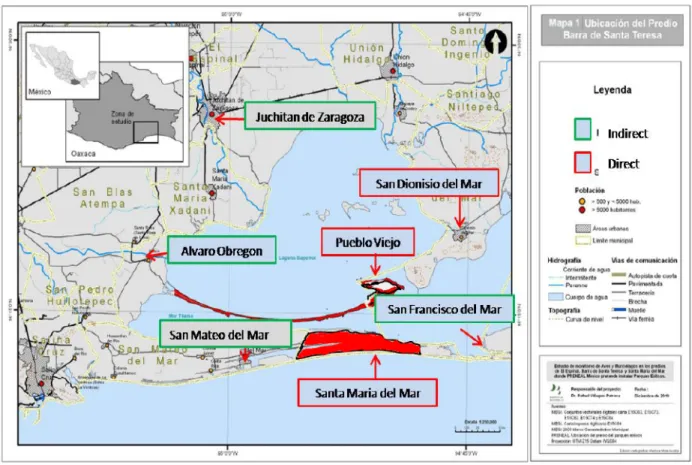
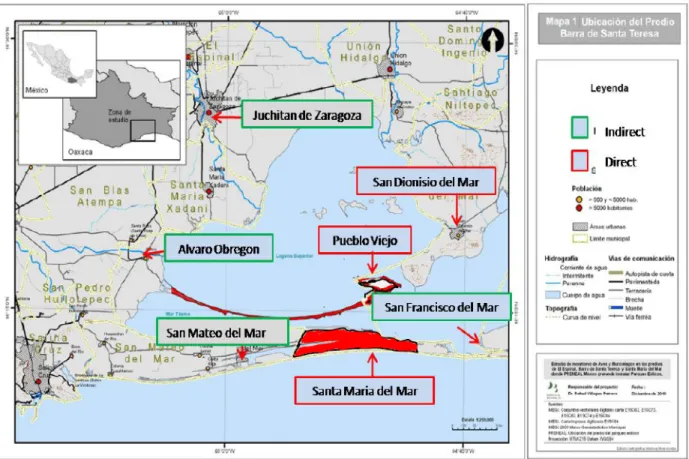
We sit in the ruins of an old hacienda in Álvaro Obregón, in the municipality of Juchitán, Oaxaca, in the southern Isthmus of Tehuantepec. We sit where we can: on old palm stumps in the shade. The July sun was intense, even for an Australian born in subtropical Queensland. Local fishermen and farmers, some young, others not so young, share their views on life at the Isthmus. It had been a hard year. Harvest had been poor. Last year the fishing had been excellent. This year they wait. Maria and I are visiting Álvaro Obregón to speak with these farmers and fishermen about why they are opposing the expansion of wind farming in this region. Maria works for a human rights advocacy NGO in Mexico City. We were in Juchitán to attend a conference, organized by local indigenous activists, on the history of local struggles against wind farming in the Isthmus. We asked to visit Álvaro Obregón because here women, men and children are blocking the only access road to the Barra de Santa Teresa, a thin strip of sand and mangroves that separates the Mar Superior from the Mar Inferior, on the Pacific coast of the Isthmus (see Figure 1 below). They are blocking construction of a large-scale wind-farm, the San Dionisio project. If built, it would be the largest wind farm in Latin America. Their fears about future harvests, about their survival, are exacerbated by the possibility that if the wind farm is built, they won’t be able to fish from the Barra or tend the milpa (harvest their corn). If built, the Barra and the surrounding lands will be fenced off. They say they are afraid they will have to move to the city to find work, to the city where,
for most, there is hunger. They are one of seven communities protesting this project1.
Six months later, on 26 January 2014, foreign investors announced they would not proceed with the San Dionisio project in the Barra (Rojas, 2014). The announcement to relocate the project (to a still unknown location in the Isthmus) came more than one-year after these farmers put their bodies on the
line to stall construction activities and prevent any and all government, developer or other pro-wind representatives from gaining further access to the Barra. Even though state police and sicarios (assassins, hired thugs) made numerous attempts to dismantle the blockade, using tactics of direct violence, threats against community leaders and their families and attempts to arrest community leaders, the blockade endured. Rather than diminish resistance, the conflict catalyzed a community-wide effort to reassert everyday forms of agency over their traditional decision making processes (sistema normativa indígena) and activate their rights to self-determination, which they voice through the political “defense of land and territory”. The “defense of land and territory” is the organizing mission of the main Indigenous social movement in the Isthmus, the Asamblea de los Pueblos Indígenas del Istmo de Tehuantepec en la Defensa de la Tierra y el Territorio (APIITDTT).
Figure 1: Location of the San Dionisio Project (IADB, 2011)
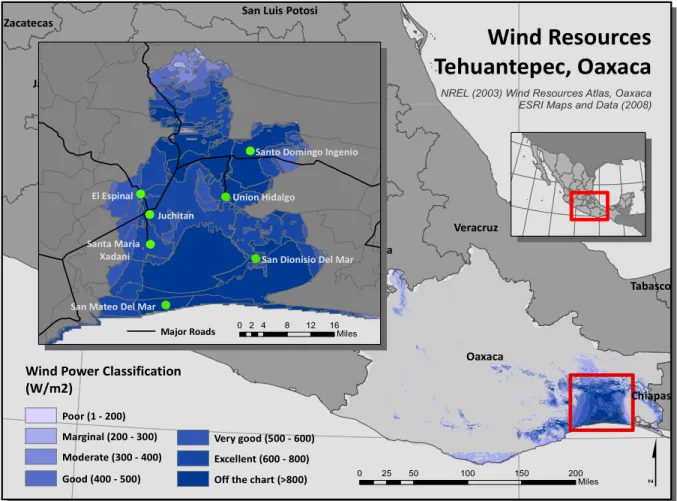
(Galtung, 1969; Nixon, 2011) – and the promises of the ‘green economy’ for modern Mexico. While wind energy represents only a small fraction (1,500MW or 8.9%) of total renewable energy production in Mexico today (SENER, 2013), it is estimated that Mexico is ‘gifted’ with between 40,000MW and 77,000MW of economically viable wind energy resources, with roughly half of this ‘free gift’ located in the Isthmus, and the ‘best’ resources located along the Barra (Elliot et al., 2003). By seeking to interrupt the expansion of large-scale wind farming in the Isthmus, indigenous peoples are simultaneously interrupting the Mexican governments broader policy and regulatory strategy to accelerate the development of domestic wind energy production systems for the purposes of ‘climate friendly’ economic growth (Gobierno Federal de México, 2013).
Why and how are ‘clean’ and ‘green’ energy systems generating conflicts and catalyzing
the case study of indigenous-led resistance to the construction of the San Dionisio project along the Barra de Santa Teresa, in the southern Isthmus, I examine the increasingly sustained and increasingly political grassroots opposition to the expansion of large-scale, predominantly privately owned, capitalist wind farming. At this site of contestation, resistance, which involves the collective reproduction of socionatural relations, challenges the legitimacy (and hegemony) of neoliberal environmental governance while simultaneously creating spaces for alternative livelihood possibilities and new political communities.
frontier) have fundamentally excluded indigenous peoples perspectives and do not recognize the non-capitalist values of their existing socio-ecological (or biocultural) systems.
1.1 Green energy through a critical peace theoretical framework
While environmental and resource conflict has received significant attention among geographers (see Horowitz, 2009; Le Billon, 2001; Martínez Alier, 2005; Peluso & Watts, 2001; Perreault & Valdivia, 2010; Turner, 2004), peace-building in relation to environmental contestations has not been significantly theorized. This thesis weaves two distinct bodies of work, critical resource geography and critical peace studies, to examine the contested construction of peace at a resource frontier, a frontier that is often examined as spaces of conflict and violence. The Isthmus of Tehuantepec has long been a frontier, an object of control under different historical modes of capital expansion (Baletti, 2012). Resource geographies provide important theoretical and methodological insights that highlight the politics of peacebuilding in the contemporary context of the expansion of ‘green’ capital with and through wind.
and others as wasted (and, therefore, unsustainable) (Gidwani & Reddy, 2011). Value and waste; that which separates the productive from the idle; the tangible from the mercurial; the rational from the irrational and, borrowing from Mexican anthropologist Guillermo Bonfil (2005) – the modern imaginary from México profundo. The interplay between value and waste reproduces patterns of exclusion and marginalization that indigenous Istmeños have resisted throughout history.
While critical resource geography has focused on the generation and generative aspects of environmental conflict, less critical attention has been paid to the contexts and violences of seemingly benign frontiers of ‘green’ energy extraction. The benign construction of the ‘green energy’ frontier in Mexico ignores the material and discursive dimensions of power and justice, and disguises the violence of dispossession and alienation that follow the commodification and enclosure of socionature (Bridge, 2011). Critical peace studies (specifically the literatures on post-liberal peace) decenter questions of agency and resistance in relation to peacebuilding theory and practice (A. Mitchell & Richmond, 2012; Richmond, 2010, 2011). Here, I use it to explain how the place-based struggles of indigenous peoples – those everyday practices that seek to “break the shackles of historic and current relational patterns of repeated violence” (Lederach, 2005, p. 37) – are distinguishable from violence and are, potentially, generative of new sociopolitical relations between conflicting actors. Following Audra Mitchell, I frame the conflictual tactics of Zapotec and Ikjoots peoples to interrupt wind farming not as the cause of violence but as everyday political practices of “creating, asserting and protecting elements of plural worlds” (2011, p. 24) in settings of real or apprehended violence. This framing engages in dialogue with Reyes (2012) and Zibechi (2012), whose works on autonomous social movements in Latin America provide continuous inspiration and hope.
because of its entanglement within a neoliberal State that privileges ‘consensus’ and ‘Science’ over and above contestation and situated knowledges. Not only do industry produce the technical documentation, non-experts require specialist assistance to translate complex legal, regulatory, and scientific data (Pellow, 1999). It is this dominant articulation of liberal peacebuilding with sustainable development that according to Latour (2002) represents a ‘sociality yet to come’, where ‘difference’ is flattened, where conflict occupies an historical past, and the neutrality of Science renders the world as one-dimensional. In the context of this liberal or “virtual” peace, “meaning the empty shell of a state with little relevance to the everyday lives of most of its peoples” (Richmond, 2011, p. 16), the ‘sociality yet to come’ is one where conflict no longer exists. If ‘difference’ produces conflict, then the homogenization of ‘difference’ produces peace. By contrast, I argue that a truly emancipatory peace is not characterized by the erasure of conflict but rather, the erasure of all forms of violence.
In light of the emerging hegemony of ‘green economy’, I draw on resource geographies to politicize the frictions produced at the new ‘renewable energy’ frontier in Southern Mexico. This engages with Feminist political geographers (see Koopman, 2011; Loyd, 2012; Megoran, 2011) who push geography to engage more closely with peace by theorizing “specific economic, political and social relations of oppression and domination [violence] and how they articulate (or intersect) in particular historical and geographical moments” (Loyd, 2012, p. 480). Resource geographies provide the theoretical and methodological tools to do this. Like critical peace studies, resource geography scholarship is concerned with reducing violence in all its forms and contributing to transformative social and political practice (see also Watkins & Shulman, 2008). In addition, both literatures seek to understand how status quo experiences of ‘peace’ or ‘sustainable development’ can, in fact, be built upon, and therefore reproduce, political ecological conditions of oppression, exploitation and marginalization in specific historical and geographical contexts. Both literatures place importance on the generative possibilities of conflict.
infliction of harm over which those harmed have no control, ability to intervene or capacity to resist” (A. Mitchell, 2011, p. 25). Johan Galtung first theorized structural violence as the harm inflicted by particular social, political or economic structures (1964, 1969, 1971). In environmental contexts, Nixon (2011) has used the concept of ‘slow violence’ as a way to conceptualize the less discernible forms of violence that are associated with contemporary socioenvironmental transformations. Slow violence, he argues, “occurs gradually and out of sight, [it is] a violence of delayed destruction that is dispersed across time and space, an attritional violence that is typically not viewed as violence at all” (2011, p. 2). He argues that these forms of violence disproportionally affect those who have historically been marginalized (see also Martínez Alier, 2005). I argue that struggles in the Isthmus against wind farming are attempting to resist the structural and slow violence of the ‘green energy’ frontier in Mexico.
In the current context of the expansion of ‘green energy’ in Mexico I extend Mitchell’s conceptualization of direct violence, “as purely instrumental and reactive, [occurring] only when human action is impossible” (2011, p. 24), to theorize structural or slow violence as that which attempts to erase possibilities for nonviolent conflict. I use this to bridge these two bodies of literature in order to highlight two things. First, that the unreflexive benevolence of this ‘green energy’ frontier operates politically as a space of ‘virtual’ peace, a smooth and abstract space, that attempts to depoliticize conflict. Second, that the depoliticization of conflicts explains how and why place-based struggles are being rendered as the object of conflict resolution interventions, which under neoliberal environmental governance, center on avoiding, managing or resolving conflict. By that, I mean, conflict interventions into sites of environmental violence, whether led by states or non-state actors like NGOs, risk framing place-based resistance tactics as the cause of conflict to be managed and resolved (Mac Ginty, 2012). If community based resistance is misunderstand and dismissed as the cause of conflict, interventions that are designed to transform environmental conflicts risk erroneously trying to manage communities in resistance, through direct repression or through consent (Gramsci, 1971; Lukes, 1974), while leaving intact the deep structures of violence their struggles make visible. The goal of conflict transformation interventions needs to focus on dismantling structures of violence, not smoothing out of the complex politics of resource conflicts.
1.2 Research questions and objectives
i. How are wind resources in the Isthmus imagined and realized as a new frontier of capitalist expansion? What are the political ecological effects of framing large-scale private wind farming as ‘green’ and ‘sustainable’ developments?
ii. How are social movements resisting the ‘green’ narrative? What do their interventions tell us about political practice in the context of ‘clean energy transition’?
This thesis develops an understanding of the current trends, objectives, discourses and political/social dynamics of (a) claims to land, territory and identity in the region of Isthmus de Tehuantepec, Mexico and (b) of non-governmental organizations (NGOs) interventions in relation to socio-environmental conflicts within this region. The aims of the thesis are to:
• Identify the current trends, objectives, discourses and broad political/social dynamics of social
mobilizations against the existing and proposed large-scale wind farms and associated renewable energy infrastructure across the region of the Isthmus de Tehuantepec, Mexico.
• Identify the everyday activities (creative, intellectual, physical) that people across the Isthmus are
engaged in as part of their opposition to existing and proposed large-scale wind farms and associated renewable energy infrastructure
• Identify the objectives, motivations, expectations and different forms of assistance being provided
by NGOs working in relation to socio-environmental conflicts in the region of Tehuantepec;
• Identify the different relationships between NGOs and governments, other actors, and
community-led groups that are mobilizing against existing and proposed large-scale wind farms and associated renewable energy infrastructure across the region of the Isthmus de Tehuantepec, Mexico.
1.3 Methods
The data collection for this thesis took place in two phases of fieldwork in Mexico.2 The first period
took place between May and August 2013. During this time I worked as a volunteer research associate with a Mexican NGO based in Mexico City. For more than eight years now the NGO had been involved in consensus building processes, designing and facilitating processes that bring people together in generative dialogue, in relation to some of Mexico’s most pressing social and environmental justice issues. My primary task was to conduct secondary research regarding the application of international human rights laws, access to justice and conflict sensitivity principles that were relevant to the emerging social conflicts being generated by renewable energy projects in Mexico. This NGO had received funding from an international donor to design and implement a consensus-building project for the purposes of documenting lessons from wind conflicts in the Isthmus.
This experience highlighted the challenges for NGOs who seek to intervene in development and
natural resource conflicts. These conflicts are complex and are embedded in long histories of
environmental and social change. The biggest challenges I observed related to how NGO workers3,
understand conflicts and how this understanding translates into program design, how NGOs position
themselves in relation to actors in conflicts and how they frame their interventions. Reliance on incomplete analyses means that well-intentioned interventions risk making conditions worse There is almost no empirical research that attempts to understand the effects of these non-state interventions (In Mexico, forms of “soft” technical assistance have shown the potential to intersect with the neoliberal development projects see M. Walker, Roberts, Jones, & Froehling, 2008). This is problematic because an extensive body of literature demonstrates that mainstream environmental conflict resolution approaches (increasingly led by NGOs) fail to take seriously the politics of environmental injustice that lie at the root of violent conflicts over access, control and governance of natural resources. These
2 IRB approval was granted 29 July 2013, see application 13-2478.
experiences and reflections shaped the research design for this thesis.
During the first period of fieldwork I developed a descriptive history of the current conflict dynamics in the Isthmus, as well as established networks of local and regional contacts. Following Hall, I used secondary materials (such as policy documents, legal analyses, industry authored project descriptions,
media reports from local, state, national and independent media and one documentary4) to analyze “the
context, the motives and intentions of protagonists and other actors, and the social processes, conjunctures and contingencies that shape current situation and future possibilities” (2007, p. 95). These secondary materials provided the primary means through which to trace (and triangulate) domestic legislative and regulatory changes relating to land reform in Mexico, to changes to Mexico’s electricity system, to the current reforma energética, to the assessment and approval of the operating and proposed new wind farms, to allegations of human rights violations, and the processes of Clean Development Mechanism (CDM) registration. I traced the history of these political-economic and legal processes, the actors involved, their motivations, objectives and goals in order to understand how these processes express different dimensions of power (Lukes, 1974).
I also relied upon my experiences in a workshop at the Comisión del Derechos Humanos del Distrito Federal (Human Rights Commission, District Federal) that brought together human rights advocates and academics from across Mexico to explore, through a series of roundtable discussions, the operationalization of the World Bank and International Finance Corporation human rights and environmental safeguard policies. Particular emphasis was placed on how these policies were being implemented in relation to specific development projects in Mexico, including examples of wind energy projects from the Isthmus, and how human rights advocates could influence policy.
Between 26 and 28 July 2013, I participated in a three day conference5 organized by the Asamblea de los Pueblos Indígenas en Defensa de la Tierra y el Territorio del Istmo de Tehuantepec (APIDTTI) regarding wind conflicts in this region. Over one hundred indigenous activists and campesinos/campesinas, academics, NGO representatives and students attended. Day one of the conference was held in the community of Álvaro Obregón. The final two days of plenary were held in the
4 ‘Somos Viento’ (2013). Available http://somosvientodocumental.wordpress.com/
Casa de las Culturas in Juchitán. Activists and academics presented short discussions about the history and ongoing political advocacy in the Isthmus. In addition to attending the conference, my colleagues and I drove around the region to inspect the existing wind farms in action. With a colleague from another NGO, I returned to Álvaro Obregón after the conference and stayed two full days in the community. We met with representatives of the Consejo de Ancianos and Policia Comunitaria and discussed the social conflicts in depth, as well as questions about daily life in the region. Local activists (who were fishermen and farmers) took us to visit the Barra and the site of the proposed San Dionisio project. We stayed the night with the family of a local activist. I have continued to receive media releases issued by the Asamblea and rely on these secondary documents in my analysis.
The second period of fieldwork took place over three weeks in January 2014. This fieldwork consisted of targeted interviews with NGO representatives working in the Isthmus on advocacy or conflict resolution programs regarding their organizations goals and objectives, and how and why they are involved in these conflicts. Interviews with participants focused on how these institutions conceive or understand wind conflicts in order to compare and contrast these remarks with official discourses. A copy of the interview guide is Appendix A. In total, I conducted eight semi-structured interviews in Spanish (between one and two hours each) with representatives of six NGOs currently working in the Isthmus in relation to social conflicts, one social anthropologist who had more than twenty years experience working with Ikjoots peoples in the region of the San Dionisio project, and the one of the spokespersons for the APIDTTI.
As an investigative and open-ended research program, case study research involves a fine grained analysis that focuses on “disentangling complex relationships, and tracing sequences of events” (Poteete, Janssen, & Ostrom, 2010, p. 35). Understanding the discursive and material dimensions of large-scale wind farming in southern Mexico foregrounds questions about the relations between capital, nature, the state and non-state actors like NGOs and social movements. Following Escobar (2008), I investigated these questions through tracing the ways in which people, places and things become entangled and in conflict in particular historical contexts in order to identify the material and ideological implications of relations of power in the development and management of wind resources.
Research findings will be shared with research participants. In relation to organizational participants (NGOs), the purpose of participant observation and the sharing of research findings will be to support them, where necessary, in refining project goals and future program interventions.
1.4 Organization of the thesis
This thesis is organized in five chapters. In Chapter Two I explain the theoretical framework used. It integrates resource geographies and critical peace studies to theorize the frontiers of wind power, that is, how the conflicts produced by the enclosure of lands and the reconfiguration of territories for the purposes of large-scale, capitalist, wind farming in southern Mexico illustrate the frictions of green capital. These literatures provide the framework for the environmental political history of wind farming and the analysis of how indigenous political actions contest ‘green’ neoliberal development in this region. Under conditions of neoliberal environmental governance, conflict resolution interventions by non-state actors like NGOs must effectively navigate this complex terrain of power in order to avoid the trap of becoming unsuspecting vehicles that contribute to flatten politics at this ‘green energy’ frontier, leaving intact the deeper structures of violence these projects are at risk of exacerbating.
In Chapter Four I present an environmental history of the Isthmus as a capitalist wind energy landscape. By explaining the successive reconfigurations of land and territory of the Isthmus through which wind resources in the Isthmus came to bear capitalist value, e.g., through relations of production, enclosures, and shifting conceptualizations of waste/value, I illustrate how this new energy landscape is leading to the proliferation of direct, indirect and structural violence. I show that by failing to deliver material environmental and social gains, the promises of the ‘green economy’ in Mexico remain unrealized. In terms of environmental benefits, the recent reforma energética is likely to massively increase Mexico’s total greenhouse gas emissions, erasing any of the purported ‘climate’ benefits gained from increasing the proportion of electricity produced by renewable energies. In terms of social benefits, social inequalities in southern Mexico, where the bulk of large-scale wind energy projects are located, have increased. In particular, even though there are now eighteen wind farms operating in the southern Isthmus, residential electricity tariffs in this region have increased (Interview 7, 24 January 2014). This is an unsurprising conclusion given fourteen of these wind farms produce electricity wholly for private industrial and retail consumers.
provided by NGOs, particularly in terms of information gathering and legal representation, although still important, has been superseded by indigenous led efforts to strengthen their internal cohesion and the performance of their alternative development visions.
CHAPTER 2: CONTESTING THE VALUE OF WIND
This chapter integrates critical resource geographies and critical peace studies to theorize wind power as a ‘green energy’ frontier. It explains how the conflicts produced by the enclosure of lands and the reconfiguration of territories for the purposes of large-scale, capitalist, wind farming in southern Mexico illustrate the frictions of green capital. These literatures provide the framework for the environmental political history of wind farming and the analysis of the ways in which indigenous political actions contest this form of ‘green’ neoliberal development. Under conditions of neoliberal environmental governance, conflict resolution interventions by non-state actors like social movements and NGOs must effectively navigate this increasingly complex terrain of power in order to avoid the trap of becoming unsuspecting vehicles that contribute to flatten the complex politics at this ‘green energy’ frontier, leaving intact the deeper structures of violence these projects exacerbate.
2.1 Frontiers of wind power
through which to understand environmental conflict dynamics and new tools are being developed in order to work through the deficiencies of resource curse, environmental security and common property theories
of environmental conflict (Escobar, 2010)6. The two central deficiencies Escobar (2010) identifies relate to essentialist concepts of nature and the persistent failure to include theorizations of power. I use these markers to synthesize the main contributions of political ecology to the study of environmental conflicts broadly, and apply them to understand the frictions produced by the expansion of ‘green capital’ in southern Mexico.
‘Green economy’ represents the master discourse of neoliberal environmental governance that promises to restrict the massive global hemorrhaging of biodiversity and irreversible warming of the atmosphere, without interrupting economic growth. It reproduces a realist or essentialist epistemology
that is implicit in the three main policy responses to environmental conflicts7. Realist or essentialist
epistemologies treat ‘nature’ as an unproblematic object – a natural resource – that is always already external to society, unchanged across space, and time. Nature and society in this reading are conceived in Cartesian duality (what Latour (1993) describes as the ‘modern constitution’). Natural resources, like wind, are out there to be discovered (and appropriated and transformed for the purposes of human progress – while mitigating the worst extremes of climate change) through (economic) rational and scientific (technological) endeavors. The success or failure of its management (and the management of those who interrupt it) is determined simply by the ‘quality’ of the governing institutions. Donna Haraway describes the erasure of history and politics, and in this case environmental political history, as “the god trick of seeing everything from nowhere (1988, p. 581). Purporting to be ahistorical and apolitical is, of course, a political act that attempts to flatten the complex politics of resource geographies, and, fail to get
6 While Escobar does not suggest that political ecology is limited to the study of environmental conflicts, these social phenomena have been a central focus.
to the roots of the problem (that it ostensibly seeks to address), namely the conditions of oppression, marginalization and exclusion – structures of violence – that underpin the uneven development of global capitalism (Arsel, 2011). This results in a critical, though strategic, omission – any discussion of “the unsustainability of the prevailing industrial consumerist approach to development and the resulting myriad of economic, political and ecological conflicts it creates” is quickly dismissed as irrelevant (Arsel, 2011, p. 453).
Reframing nature/society as mutually constitutive (socionature) has significant ontological and epistemological implications that inform the ways in which environmental problems in general and, in this case, conflicts over wind farming, are conceptualized. History and politics matter! These alternative conceptualizations of environmental conflicts can be framed around two tenets: first, that nature-society be studied not as separate categories – divorced from histories and geographies – but “in terms of the constitutive processes and relations – biological, social, cultural, political, discursive – that go into its making” and, second, that researchers resist reducing nature to a unified, essential, pre-given order (Escobar, 2010, p. 95). Further, “there cannot be a materialist analysis that is not, at the same time, a discursive analysis” because discourse “is the process through which social reality comes into being” (Escobar, 2010, pp. 92–93). This thesis engages, rather than avoids, the complexities of socionatural relations at this ‘green’ energy frontier and challenges the essentialist epistemology of economic reductionism and its implicit neoliberal political ideology.
is marked by a different discursive, symbolic and material usefulness that is articulated with ongoing processes of neoliberalization, associated with the operationalization of the North American Free Trade Agreement (NAFTA), the emerging ‘urgency’ of anthropogenic climate change, and with the increasing energy costs associated with fossil fuels.
As existing reserves of fossil fuels are depleted and new ‘sources’ of value are identified in ‘green’ renewable resources (and their commodification and circulation in the global economy made possible through new socio-technical and market-based devices), the ‘resource frontier’ of capital extends into previously unimagined areas. It’s discursive construction as a ‘green’ and ‘sustainable’ frontier has two significant consequences. First, it depoliticizes the forms of violence that are constitutive of processes of commodification and enclosure of nature. Second, it attempts to produce a smooth, abstract, or ‘virtual peace’ where structural violence is ignored, political conflict no longer exists and disputes are understood in terms of competing ‘interests’ that can be evaluated around a common (equivalent) economic denominator, promising ‘win-win’ resolutions for the relevant liberal subjects involved. In the following sections I develop this argument fully.
2.2 Global Ecologies of Green Energy Capital
Today’s wind energy production in the Isthmus captures wind and puts it to work for the benefit of predominately private companies both in Mexico and internationally. By harnessing its movement ‘effort’ through complex assemblages of turbines, towers, cables, transmission lines and substations – surplus value is extracted and embodied in commodities that can be exchanged in local and global markets. In this case the commodities appear as mega-watts (MW) and carbon-credits. Both of these commodities are exchangeable via the money form. They are also embedded in other systems of capitalism production, through the retail and industrial activities of the private firms that are currently benefiting from the ‘clean’ electricity and carbon offsets generated in the Isthmus, and therefore represent capital inputs as well as commodities (Henderson, 1998).
extending James O’Connor’s (1998) theorization of the second contradiction of capitalism, John Bellamy Foster’s (2000) theory of the metabolic rift (see also Clark & York, 2005, 2008) and David Harvey’s (1996) work on accumulation by dispossession, this theory “joins the accumulation of capital and the production of nature in dialectical unity” (Moore, 2011, p. 2). I use this to situate Mexico’s wind power frontier and its articulation with the political discourse of ‘clean energy transition’ in the historical context of capitalism and uneven development (Moore, 2010a, 2010b, 2011). Capitalism as world ecology is used here to show how the commodification of wind (and its new configurations of accumulation) is both made possible because of the atmospheric degradation that has been produced through capitalism’s exploitation of ‘cheap’ fossil fuels as well as the way the commodification of wind continues capitalism’s socioenvironmental destructiveness, through failing to reconcile questions of social and environmental injustice (see also Böhm, Misoczky, & Moog, 2012).
2.3 Violence of ‘green’ commodification and enclosure
which land and territory have been reconfigured to enable capital to circulate8. Land and territory are two key analytics used by indigenous social movements in the Isthmus to frame their political struggles against the expansion of large-scale wind farming in this region and signal the creative destruction of non-capitalist values (Harvey, 2006).
In the context of land, I draw on Marx (1978), specifically his theorization of primitive accumulation, and Polanyi (2001), specifically his theory of ‘fictitious commodities’ – those things (land, labor and capital) that are treated as commodities even though they have no material basis in production. Marx defined primitive accumulation “as the historical process of divorcing the producer from the means of production” (Engels & Marx, 1978, p. 432). In the context of the analysis of enclosures in Britain during
the 1700-1800s, Marx argued that these were violent acts of theft9 through which ‘labor’ and ‘land’ were mobilized (literally and figuratively) for the purposes of capital production, circulation and accumulation. Marx analyzed examples of enclosures (the land laws – which Alden-Wily (2012) has recently revisited to historicize contemporary examples of ‘land grabbing’) and the criminalization of ‘vagabonds’ or commoners at a particular historical and geographically specific conjuncture. In The New Imperialism Harvey (2005) argued that primitive accumulation was not a process that was exclusive to periods of historical agrarian transition (from feudalism to capitalism). Rather, it was ‘intrinsic’ to capitalism as a historical system of socionatural organization.
Harvey’s extension of primitive accumulation – what he described as ‘accumulation by dispossession’ – set out to “capture the diverse dispossessions being generated today by fully developed industrial and financial capitalism” (Levien, 2011, p. 456). However, Levien argues, Harvey did not provide an adequate “theory of how, why and with what consequences [accumulation by dispossession] emerged as an important phenomenon” (2011, p. 456). Levien’ defines accumulation by dispossession as “the use of extra-economic coercion [state institutions and processes] to expropriate means of subsistence, production or common social wealth for capital accumulation” (2011, p. 457). He shows accumulation by dispossession to be a political process “through which the state’s coercive power is deployed to make a key condition of production – land – available for capital in a context where
8 The question of subject formation is beyond the scope of this research (see Valdivia, 2008, 2009).
increasing demand confronts the barrier to accumulation represented by smallholding peasants and incompletely capitalist rural land markets” (Levien, 2011, p. 457 my emphasis). Bridge (2013) makes a related argument building on neoliberal natures literatures (see for example Heynen, McCarthy, Prudham, & Robbins, 2007b). Like Levien he argues that the state is an extra-economic actor (Bridge, 2013). However, he suggests that “the significance of neoliberalization lies not in marketization, but in the transformation of property on which market exchange ultimately rests” (Bridge, 2013, p. 7).
I use Levien (2011) and Bridge (2013) to identify the specific political processes deployed by the Mexican state to make land in the Isthmus available for acquisition by private companies for the purposes of capturing wind. This goes part of the way to explain Howe’s (2011) concern that the materiality of wind makes it resistant to enclosure and therefore different from conventional ‘subterranean’ natural resources, where ownership of oil, coal and gas is typically vested in the national government (with the government exercising its ‘territorial sovereignty’ to grant access rights to private or state-owned companies in exchange for ‘royalties’ or tax revenues) (Emel, Huber, & Makene, 2011). She astutely observes that ‘wind’ is not a typical natural resource, “the corpus of the wind, its scant materiality, its mercurial existence, make for a different sort of commons—one that is perhaps particularly resistant to true enclosure” (Howe, 2011, p. 8). Yet wind can be and is being farmed. In the case of wind farming, land must be enclosed for the purposes of fixing electricity infrastructure in place. Without these fixtures and networks of transmission, the usefulness of wind as a source of ‘green capital’ would be stymied. Mitchell (2009, 2011) takes this approach further to illustrate that the materiality of the resource in question produces distinct configurations in terms of how land, labor and capital are mobilized to enable the
extraction of specific resources10, as well as the expressions of political power that are enabled and constrained throughout these processes. What is required, building on these authors, is an understanding of how technologies of measurement, government and exchange have been able to secure or enclose wind’s ‘scant materiality’ as well as the tactics that indigenous peoples (and their collaborators) use to contest these technologies of green governmentality (Goldman, 2005).
The second logic of socionatural transformation examined in this thesis is ‘territory’. According to Bridge, “[r]esource-making activities are fundamentally matters of territorialization – the expression of
social power in geographical form” (2011, p. 825). James C. Scott (1998) argued that statecraft operates through mechanisms of ‘simplification and legibility’. While the figure of the strong/unified state has retreated, Bridge (2013) explains that the “technical devices of measurement and visualization – cartography, calculation and miniaturization – through which resources and the capacities for their control” remain key analytical tools suitable for the study of ‘wind’ in southern Mexico, and which enable “a more complex understanding of the relationship between scientific and political practice” (Bridge, 2013, p. 3). This approach unites ‘technologies of rule’ with Foucauldian understanding of capillary social power. In relation to state making and neoliberal environmental governance specifically, Whitehead et al (2007) argue that the key to understanding how governmental power is realized through the transformation of nature is in focusing on “the processes through which states attempt to frame the natural world” (Whitehead, Jones, & Jones, 2007, p. 14). Framing works to bring focus to that which can be ‘measured and managed’ while simultaneously excluding that which cannot. In other words, the accounting, measurement and regulation of wind via the commodity form – Foucauldian technologies of government that operate via circuits of expert knowledge and institutional legitimacy – have spatial, scalar and political effects.
While the Mexican state plays a key role in the territorialization of the Isthmus associated with the commodification of wind, they are not the only practices of territorialization taking place in this region. I investigate territorialities produced ‘beyond the state’, “in order to problematize understandings of access, control and authority as they relate to natural resources” (Bridge, 2013, p. 6). That is, in in recent works in resource geography, there is an explicit intention to “denaturalize the institutionalization and territorialization at the scale of the state” because state’s institutions and territorialities “do not exhaust the possibilities for how political-ecological life is organized” (Bridge, 2013, p. 6). In the contemporary context of neoliberalization in Mexico, non-state actors, including foreign governments, private companies and indigenous peoples, enact different practices of territoriality that shape the Isthmus as a site of political
conflict today11. It is not that non-state actors replace state rulemaking, but rather that contemporary statecraft always involves a “variegated sovereignty scape” (Bridge, 2013, p. 6 following Ong (2006)).
In the Isthmus, the relational and decentered conceptualization of multiple sovereignties coalescing and hybridizing in particular conjunctures explains the articulations between Mexican law reform processes in the early 1990s – removing Constitutional protection of ejidal lands against privatization and permitting private sector participation in the production of electricity - that enabled subsequent investments by foreign companies in wind energy production. It also emphasizes the extension of foreign and non-state control that is articulated through NAFTA and, specifically in the context of green energy, the registration of wind farm projects via the Clean Development Mechanism (CDM) of the Kyoto
Protocol12. Control, or some measure of it, operates on the basis that these projects would not be
realizable without the financial incentives produced through CDM and the emerging carbon markets in
Europe or Australia13, for example. Indigenous led resistance in Álvaro Obregón, for instance, interrupts these efforts to produce a smooth space for capital expansion. It is an example, contingent or otherwise, of Alvaro Reyes’ hypothesis, in his synthesis of social movement political action in Latin America, that “imaging life beyond the capitalist mode of production has become completely inseparable from the necessity to practice politics beyond the liberal state and representation” (2012, p. 22).
2.4 Creative destruction of non-capitalist value
The violent enclosure of land and the reconfiguration of territory for the purpose of ‘clean energy’ require a legitimizing discourse. Gidwani & Reddy (2011) trace the legitimation of the commodification of nature to the philosophy and political theory of John Locke. For Locke, ownership (of a thing) is created through the act of laboring that removes the ‘thing’ from the ‘state of Nature’. Property, he argued, comes into being through the labor process, specifically with individual, as distinct from collective, labor producing particular ‘rights’ to/in a passive, idle, yet bountiful Nature. This was a selective conceptualization of property and ownership used to justify the enclosure/exclusion and appropriation of the commons that characterized the late 1600s (Macpherson, 1978). To justify his political project Locke deployed the language of ‘rationality’ and ‘industry’ mediated through the Natural law of Christian
uncertain and unpredictable. It is simultaneously a process of hybridization that opens up political possibilities for institutional change (see also Blaser, 2004).
12 A protocol to the United Nations Framework Convention on Climate Change (1992)
theology. This selectivity enabled Locke to distinguish different bodies and different forms of laboring, intentionally misrecognizing the labor of women, servants, slaves or indigenous peoples. As Rose (1990) explains Locke’s narration was designed to naturalize his self-serving theorization of property. Gidwani & Reddy (2011) explain that the Lockean theory of property justifies the commodification of the common through constructing it as ‘waste’ and, therefore, without ‘value’. The demarcation of ‘waste’, and its specific discursive and material construction in relation to land and bodies, “obscures the fact that they are enmeshed in circuits of value and offer critical resources that supplement the income of the poor and marginalized” (Gidwani & Reddy, 2011, p. 1640). In the context of socionatural change under the specific historical configurations of capitalism in the southern Isthmus, this thesis explains how the violence of ‘green capital’ operates discursively and materially by demarcating specific people, places and things as valuable (and, in this case, sustainable), and others as wasted (and, therefore, unsustainable) (Gidwani & Reddy, 2011). As Blaser et al (2004) and others clearly explain, indigenous peoples all over the world continue to demonstrate that this economic reductionism fails to capture the richness by which they claim and sustain their territories through material and embodied practices (in the case of urban struggles see Blomley, 1998). As this thesis will show, indigenous struggles over land and territory in the Isthmus do just this.
The imagination and production of the Isthmus as a ‘green energy frontier’ creates the conditions for new encounters between extractive industries, governments, Indigenous peoples, social movements, NGOs, technical experts, and so on. Increasingly visible through these encounters, communities affected by the expansion of ‘green capital’ are mobilizing against it, claiming rights to land, territory and self-determination (broadly, to social and environmental justice). As part of a broader body of ecological Marxism, I used capitalism as world ecology to describe how contestations over ‘value’ are constitutive of socioenvironmental conflicts (Moore, 2011). Robertson and Wainwright (2013) argue there is a need to take this analysis of socioenvironmental change beyond “the crisis tendencies that emerge downstream
of this abstraction” to an engagement with Marx’s theory of value14. For these authors, the relevance of
Marx’ value theory, in the context of the commodification of nature, is that it focuses attention on the processes through which nature “has come to be understood as bearing value” (rather than on how value in nature is measured) (2013, p. 895). In a related argument, George Henderson suggested that “enduring problem” of value for Marx was not simply the problematic of multiple values (or which ‘value’ is truest). Rather, Marx was preoccupied by the ways in which new political imaginaries are immanent in these struggles” (2013, p. 112). Hence struggles over the different ways in which value in nature is produced are political struggles (Dikec, 2012; Swyngedouw, 2011). This opens questions about the historical and geographical processes and political struggles through which wind came to be understood as bearing capitalist (exchange) value. Specifically, understanding how the creation and circulation of value is contested signals the deep structural violence of capitalist relations of production “that gives priority to labor productivity, and mobilizes extra-human nature without regard for the socio-ecological conditions of its (uncapitalized) reproduction” (Moore, 2011, p. 20). While I focus on the frictions of producing capitalist value in wind, the claims to ‘survival’ and ‘life’ that indigenous Istmeños are highlighting suggest a deeper, more complex, understanding of value (see Graeber, 2013).
2.5 ‘Green’ energy frontier as a form of ‘virtual’ peace
Critical peace studies have developed as a response to the systemic failures of liberal peacebuilding that stem from its un-reflexive pursuit to universalize “liberal institutions, norms, and political, social and economic systems” (Richmond, 2011, p. 1). In The Transformation of Peace, Richmond (2005) provides a critical account of the ways in which discourses on peace have changed over time, and, how these changes relate to (consistent with or divergent from) major philosophical traditions (for example, enlightenment thinking, cosmopolitanism, liberalism), methodological and epistemological approaches. He traces three generations of peace building from conflict management (with its emphasis on avoiding direct violence and war), conflict resolution (with its assumption that conflict can be resolved through inter-state diplomacy) to the post-cold war liberal peace. Richmond’s intervention revolves around a critical reading of the ‘liberal peace’ a discourse and set of institutional practices that have come to dominate contemporary international relations and political theory regarding peace. For Richmond (2005, p. 73), the liberal peace is characterized by super-territorial governance, incorporating local, national and transnational actors (public, private, civil) around national sovereignty. He notes the importance for international relations and international law of the principle of ‘state sovereignty’ as it is codified in the post World War Two UN Charter. It involves a set of dominant discursive and material bordering technologies (liberalization, democratization, development, human rights, free trade) that are represented as “neutral, objective and benevolent” practices of government.
suggest that “global governance aims to increase power over life, rather than death as in geostrategic debates in [international relations], in its attempt to equate good governance with equitable development and neo-liberal economic policy” (Richmond, 2005, p. 73).
The key questions informing this body of critical peace scholarship relate to how peace is conceptualized (and by whom), who is it constructed for, how it is negotiated, what knowledge systems it privileges, and how it frames conflict (Mac Ginty, 2012; Richmond, 2011). Richmond questions whether peace can be conceptualized as an ideal form, a universal and virtuous state of being, or, in fact, whether peace has always been a subjective ontology that is contested and negotiated within different historical and geographically specific moments. For these authors, a central concern is that liberal peacebuilding has focused on neoliberal state-building and bureaucratic efficiency as a way to perfect the nation-state so that conflict is unlikely (Mac Ginty, 2012). Yet conflict is an inevitable and important force of social change.
This project is not limited to warzones (playing a central part of post-conflict reconstruction and development practice), including programs of “marketization, democratization, human rights (supplanting human needs), and rule of law projects (that risk endorsing liberal normativity, elevating private property above other access regimes, and entrenching class, gender and racial segregations). As social movement theorist have illustrated, these projects of neoliberal development have been resisted through various forms of collection action.
This ‘widening’ of liberal peace discourse, leads Richmond to introduce the concept of resistance as peacebuilding. Resistance as peacebuilding, he says, shifts emphasis away from peace as a project of strengthening liberal institutions and norms towards a focus on ‘local agency, the everyday and contingency’. He argues that this directs attention to the ways in which local peoples’ “are resisting aspects of state building or co-opting it, have begun to find ways of claiming ownership of a politics that responds to needs and issues, appropriating liberal peacebuilding, ignoring it or modifying it” (Richmond, 2010, p. 669). Richmond does not, however, situate his discussion of ‘resistance-as-peacebuilding’ in the broader story of social mobilization and collective action.
CHAPTER 3: ‘VIRTUAL PEACE’ AT THE FRONTIERS OF ‘GREEN’ CAPITAL
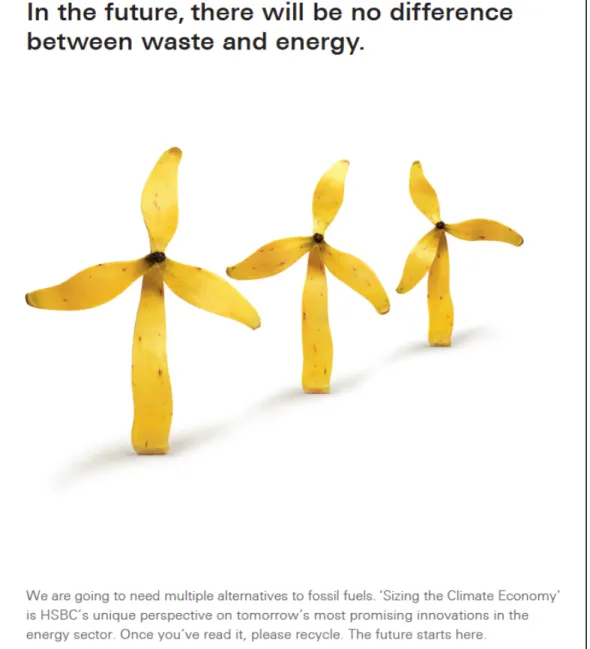
Writing about the expanding frontier of ‘green capital’ in Mexico, I find Figure 2 captivating (and problematic) for the ways in which it communicates the taken-for-granted geographies of ‘green energy’. I was troubled first by the bananas themselves; how they evoke sedimented histories of violence and dispossession related to profit-generating capitalist enterprises in the Americas (Soluri, 2005). I immediately recalled the literary significance of the so-called ‘banana republics’, a colloquialism that describes the violent occupation of the Americas by and for imperial capital. As Pablo Neruda (1991) wrote, in ‘La United Fruit Company’:
…
The United Fruit Company reserved for itself the most juicy piece, the central coast of my world, the delicate waist of America.
It rebaptized these countries Banana Republics,
and over the sleeping dead, over the unquiet heroes who won greatness, liberty, and banners,
it established an opera buffa: it abolished free will,
gave out imperial crowns, encouraged envy, attracted the dictatorship of flies:
…
I expect HSBC did not intend to recall the living history of the exploitation of Latin America’s ‘open veins’ (Galeano, 1997). Perhaps the point is to represent wind farming as a benevolent continuation of otherwise bucolic agrarian landscapes. Perhaps the point has something to do with the ‘biofuel’ revolution.
it) suggests that through the rational discovery of objective ‘knowledge’, through the efficient display of power, we will free ourselves from wasteful ‘desires’ and habits. HSBC invites us (the reader) to work vigorously to transform waste and liberate ourselves from our moral desires and practical habits that are inefficient and left to degenerate. Waste is no longer simply a thing (a peel) that is discarded; it is a quality of human existence, the moral and ethical desires that limit our universal potentials. The continued existence of waste implies the unfulfilled promises of the Enlightenment, where Science, rationality and efficiency are necessary with ever more pressing urgency to render us (the otherwise wasted people, places and things) valuable. For Latour (2002) this is a process of rendering the world one-dimensional. This is the expression of self-liberation and self-transformation (Venn, 2006) that inhabits the potentiality of the ‘green energy’ revolution. In this one-dimensional global ecology of green capital waste ought to be source of ‘valuable’ energy. How can anyone quibble with that?
In this chapter, I present the current international policy debates surrounding the post-2015 development agenda to illustrate the emerging hegemony of ‘green energy’ projects in Mexico. Because they are discursively framed as necessary for the purposes of mitigating the worst extremes of anthropogenic climate change, these projects are being insulated from critical scrutiny. I argue that within the discourse of ‘green economy’, ‘sustainability’ disguises the conditions of oppression, marginalization and exploitation (the structures of violence). The ‘benevolence’ of ‘clean energy’ in the context of dangerous anthropogenic climate change presents an epistemic closure (and the evacuation of the political). This epistemic closure risks producing spaces where conflict is no longer possible and place-based struggles are erroneously framed as the cause of conflict that must be managed. By smoothing out the political, representing wind not only as an abstract or fictitious commodity that has no material basis in production, but also a ‘sustainable’ commodity. This produces a form of ‘virtual’ peace where history and politics are smoothed over.
3.1 The post-politics of climate change and green energy
transition and ‘green capitalism’ (see Newell & Paterson, 2010) occupy a socially constructed and tenuous ‘consensus’, that hovers beyond challenge, outside the realm of the political (Featherstone, 2013; Swyngedouw, 2010, 2013). Geographers and anthropologists argue there is an urgent need to interrogate Western political discourses on the clean energy transition as a way to understand contemporary forms of statecraft, political economy and the operation of power with and through energy (Howe, 2011; T. Mitchell, 2011; Swyngedouw, 2010). While large-scale dam building for electricity generation (and irrigation projects associated with industrial agricultural transformations) has a long history of critique in political geography (Bakker, 1999; Routledge, 2003), cultural anthropology (Ghosh, 2006), political ecology (Kaika, 2006; Mehta, 2011) and political history (T. Mitchell, 2002) among others, similar scale wind and solar energy projects have, notwithstanding their comparatively recent technological viability, by and large escaped similar analysis. In contrast to conventional resource extraction activities (involving, for example, coal, oil, gas, timber or minerals), the harnessing of ‘green energies’ is discursively constructed as nonintrusive and represented as the ‘farming’ of limitless and bountiful, wind and sunshine. Governments, private companies and environmental activist organizations alike represent these projects as inherently different from the destructive excavation of conventional resource extraction activities, insulating them from critical scrutiny. Space to scrutinize ‘green energy’ projects is restricted primarily because they are widely perceived as necessary to avoid the worst extremes of dangerous anthropogenic climate change. This is a form of epistemic closure that that geographers and anthropologists warn against (Swyngedouw, 2010).
consequences that the rapid expansion of large-scale renewable energy projects, in the well-documented case-studies of biofuels (reference) and hydropower, can have in terms of exacerbating socioenvironmental inequalities and triggering localized conflicts. The initiative adopts implicitly a neoliberal free market orthodoxy through which national laws and policies are used to drive private investment in the new ‘green energy economy’, innovation and technological expertise originate and flow from the private to public sectors (often through public-private partnerships); and, civil society provides the ‘socialization’ necessary to effect and sustain these changes. The political discourse driving Mexico’s ‘clean energy’ transition reproduces this neoliberal environmental governance orthodoxy.
3.2 Mexico’s harmless ‘farming’ of limitless wind