ARTICLES
Lindsay D. Nelson, PhD Sergey Tarima, PhD Ashley A. LaRoche, BS Thomas A. Hammeke,
PhD
William B. Barr, PhD Kevin Guskiewicz, PhD,
ATC
Christopher Randolph, PhD
Michael A. McCrea, PhD
Correspondence to Dr. Nelson: [email protected]
Editorial, page 1852
Supplemental data at Neurology.org
Preinjury somatization symptoms
contribute to clinical recovery after
sport-related concussion
ABSTRACT
Objective: To determine the degree to which preinjury and acute postinjury psychosocial and injury-related variables predict symptom duration following sport-related concussion.
Methods:A total of 2,055 high school and collegiate athletes completed preseason evaluations. Con-cussed athletes (n5127) repeated assessments serially (,24 hours and days 8, 15, and 45) post-injury. Cox proportional hazard modeling was used to predict concussive symptom duration (in days). Predictors considered included demographic and history variables; baseline psychological, neurocog-nitive, and balance functioning; acute injury characteristics; and postinjury clinical measures.
Results:Preinjury somatic symptom score (Brief Symptom Inventory–18 somatization scale) was the strongest premorbid predictor of symptom duration. Acute (24-hour) postconcussive symp-tom burden (Sport Concussion Assessment Tool–3 sympsymp-tom severity) was the best injury-related predictor of recovery. These 2 predictors were moderately correlated (r50.51). Path analyses indicated that the relationship between preinjury somatization symptoms and symptom recovery was mediated by postinjury concussive symptoms.
Conclusions:Preinjury somatization symptoms contribute to reported postconcussive symptom recovery via their influence on acute postconcussive symptoms. The findings highlight the rele-vance of premorbid psychological factors in postconcussive recovery, even in a healthy athlete sample relatively free of psychopathology or medical comorbidities. Future research should elu-cidate the neurobiopsychosocial mechanisms that explain the role of this individual difference variable in outcome following concussive injury.Neurology®2016;86:1856–1863
GLOSSARY
BESS5Balance Error Scoring System;BSI-185Brief Symptom Inventory–18;CI5confidence interval;DSM-V5 Diag-nostic and Statistical Manual of Mental Disorders, 5th edition;HR5hazard ratio;ImPACT5Immediate Post-Concussion Assessment and Cognitive Testing;MSVT5Medical Symptom Validity Test;SAC5Standardized Assessment of Concus-sion;SCAT35Sport Concussion Assessment Tool, 3rd edition;SRC5sport-related concussion;SS5standard score;
SWLS5Satisfaction With Life Scale.
As the clinical and neurobiologic sequelae of sport-related concussion (SRC) are becoming
bet-ter understood,
1–6there is increasing interest in understanding individual differences in recovery.
Identifying those at risk for prolonged recovery is critical to developing early interventions that
maximize outcomes. Investigations into predictors of symptom recovery after SRC have largely
focused on demographics, acute injury characteristics, and clinical assessment measures.
Although findings have not been ubiquitous,
7–9the most consistent independent predictor of
recovery is early self-reported concussive symptoms.
10,11Other variables historically thought to
signify traumatic brain injury severity have not been predictive.
3Consequently, acute symptom
burden appears to be the strongest marker of concussion severity and recovery.
12Yet symptom burden likely conflates several distinct factors, including the consequences of
the biomechanical forces during and neurologic processes after injury and one
’
s premorbid
predisposition to experience symptoms. The relevance of preinjury psychological factors in
concussion recovery is accepted for civilian and military patients,
13although studies of these
From the Departments of Neurosurgery & Neurology (L.D.N., M.A.M.), Department of Neurosurgery (A.A.L.), Division of Biostatistics, Institute for Health and Society (S.T.), Department of Psychiatry & Behavioral Medicine (T.A.H.), Medical College of Wisconsin, Milwaukee; Department of Neurology (W.B.B.), New York University School of Medicine, New York; Department of Exercise and Sport Science (K.G.), University of North Carolina, Chapel Hill; and Department of Neurology (C.R.), Loyola University Medical Center, Maywood, IL.
populations have only estimated premorbid
psychological functioning retrospectively.
14–17One sample of personal injury claimants
re-porting chronic symptoms after mild cranial
or cervical injuries has been published where
preinjury psychiatric data were available. All
23 individuals had abnormal psychological
profiles, with somatoform psychopathology
most common.
18The aim of this longitudinal study was to
comprehensively assess the degree to which
pre-injury and acute pre-injury
–
related variables predict
recovery after SRC. We employed preseason and
postinjury assessment of psychological,
neurocog-nitive, and balance functioning. We
hypoth-esized that both premorbid psychological
symptoms and acute postconcussive
symp-toms would predict symptom duration.
METHODS Participants. This longitudinal study of SRC enrolled and followed contact and collision sport athletes from 9 high schools and 4 colleges in southeastern Wisconsin between August 2012 and March 2015.19–21Among the 2,055 athletes who completed preseason baseline assessments, 127 were con-cussed during the study and followed serially postinjury.
Standard protocol approvals, registrations, and patient consents.The study was approved by the Medical College of Wisconsin’s Institutional Review Board. Adult athletes and pa-rents of minor athletes completed written informed consent, and minor participants completed written assent, prior to their first evaluation.
Study design.The definition of concussion was extracted from that of the study sponsor, the US Department of Defense:
mTBI is defined as an injury to the brain resulting from an external force and/or acceleration/deceleration mechanism from an event such as a blast, fall, direct impact, or motor vehi-cle accident which causes an alteration in mental status typi-cally resulting in the temporally related onset of symptoms such as headache, nausea, vomiting, dizziness/balance prob-lems, fatigue, insomnia/sleep disturbances, drowsiness, sensi-tivity to light/noise, blurred vision, difficulty remembering, and/or difficulty concentrating.22
All participants in the sample sustained a sport-related injury involving direct impact to the head and were diagnosed by a licensed athletic trainer.
The study protocol involved completion of a 90-minute pre-season baseline examination and 60-minute postinjury examina-tions conducted within 24 hours of injury and at 8, 15, and 45 days postinjury (appendix e-1 on theNeurology® Web site at
Neurology.org).
Main outcome measures. The primary outcome was self-reported duration of postconcussive symptoms (in days). Predictors of symptom duration were extracted from the baseline and postinjury clinical examinations, which consisted of demographics/ health history, Wechsler Test of Adult Reading (baseline only),23 Standardized Assessment of Concussion (SAC),24Sport Concussion Assessment Tool, 3rd edition (SCAT3) symptom checklist,25Brief Symptom Inventory–18 (BSI-18),26 Balance Error Scoring System
(BESS),27Green’s Medical Symptom Validity Test (MSVT),28and Satisfaction With Life Scale (SWLS).29 In addition, each athlete completed 2 of 3 computerized neurocognitive tests (these were pseudorandomly assigned as discussed in appendix e-1). Because data for Immediate Post-Concussion Assessment and Cognitive Testing (ImPACT) were available on the largest percentage of participants in the concussed study sample (70.6%), it was selected for analyses of computerized neurocognitive performance here.
Statistical analysis.As the primary aim of the study was to identify predictors of symptom duration, time to recovery was analyzed using a Cox proportional hazards model. As years of par-ticipation demonstrated a bimodal distribution, this variable was dichotomized at the valley of the distribution (#9 years vs$10 years). Similarly, several clinical assessment variables had skewed or bimodal distributions. To facilitate interpretation of Cox regression output and avoid nonproportionality of hazards, we dichotomized (via median split) the SCAT3, BSI-18, SWLS, SAC, BESS, and ImPACT variables. The median score for each variable at baseline/24 hours was as follows: SCAT3 symptom severity 3/20, BSI-18 somatization standard score (SS) 97/100, BSI-18 depression SS 93/93, BSI-18 anxiety SS 96/96, BSI-18 global severity index SS 93/97, SWLS 28/28, SAC total score 27/ 26, BESS total score 13/13, ImPACT verbal memory 85.5/81.0, ImPACT visual memory 78.0/71.0, ImPACT visual motor speed 39.2/37.1, and ImPACT reaction time 0.56/.61. Psychiatric diagnostic history was excluded from analyses given its limited prevalence (n51). Sport was grouped into football, soccer, or other categories in order to avoid low-frequency categories. Analyses of ImPACT excluded 3 athletes with invalid baseline profiles. Inclusion of these athletes in other analyses did not alter the results (e.g., the mean difference in tables 1 and 2 hazard ratios [HRs] with vs without these 3 participants was 0.02).
Because of the large number of models being estimated,awas set to 0.01 to limit the rate of false discoveries. For all Cox regres-sion models evaluated, we verified that the proportional hazards assumption was met. Initially, bivariate analyses were performed predicting symptom duration from each predictor. Because of our aim to identify and compare premorbid and injury-related predic-tors, we then underwent development of multivariable prediction models using premorbid and postinjury variables separately. We used forward stepwise elimination variable selection to find parsi-monious multivariate models, with likelihood ratio tests used to determine whether model fit improved with additional predictors. Predictors considered for possible inclusion were those with
pvalues from the unadjusted/bivariate analyses of#0.10. Finally, a parsimonious regression model aggregating the key preinjury and postinjury predictors was developed. In order to evaluate the con-tributions of theoretically related and empirically correlated pre-injury and postpre-injury variables in predicting recovery, a mediation model incorporating both preinjury and postinjury symptom re-porting variables in the prediction of symptom recovery was sec-ondarily explored, as described below.
(95.3%) reported being symptom-free by 1 month postinjury, and 2.4% of the sample required between 1 month and 45 days to achieve symptom remission. The point of recovery was unknown for 3 participants; 2 (1.6%) were symptomatic at their 45-day assessments and 1 (0.8%) was symptomatic at the day 14 assessment and was lost to attrition.
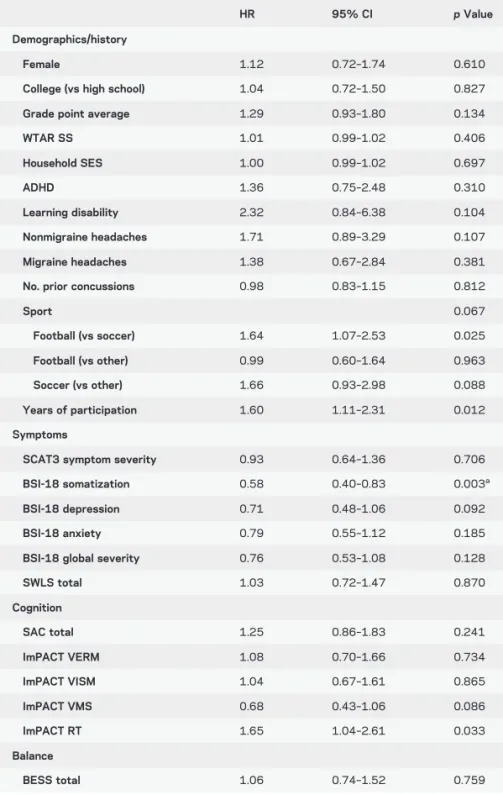
Preinjury predictors of symptom duration. Results of single predictor regression models for symptom dura-tion using variables assessed at preseason examinadura-tions are presented in table 2. Baseline ratings of somatic symptoms (BSI-18 somatization;p50.003) was the only significant predictor (a 5 0.01), with high (vs low) baseline somatic symptom reporting associated with a 42% lower hazard of recovery (i.e., higher base-line somatic symptoms was associated with lower recovery rates). Sport (p5 0.025 football vs soccer) and years of participation (p50.012) predicted recov-ery duration more modestly, with athletes playing soc-cer (vs football) and those reporting more ($10 vs
,10) years of experience demonstrating more rapid recovery. Both of these small effects appeared to be accounted for by especially fast recovery in the more experienced cohort (inclusion of sport and years of participation in a single model rendered sport nonsig-nificant; see appendix e-1 for additional analysis). Con-cussion history, sex, level of competition/age group, attention-deficit/hyperactivity disorder, learning dis-ability, and headache history were not associated with duration of symptom recovery. Among all preinjury variables considered for inclusion in the multivariable model, only one was independently associated with (longer) symptom recovery: (higher) baseline BSI-18 somatization subscale score (see table 2 and figure 1A).
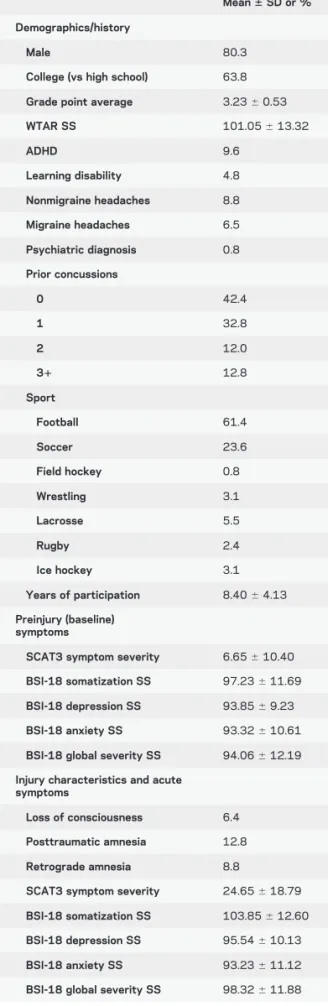
Postinjury predictors of symptom duration.Results of single predictor models for symptom recovery using acute injury characteristics and acute (24-hour) post-injury variables as predictors are presented in table 3. Two predictors were significant: postconcussive (SCAT3) symptom severity (p , 0.001) and BSI-18 somatization score (p 5 0.003). A trend (p5 0.023) was also observed for the BSI-18 global severity index. Consistent with prediction, individuals with high levels of acute (,24 hours) postconcussive (SCAT3) symptoms had a 51% reduction in the hazards of recovery (i.e., slower recovery). Individuals with high levels of acute postinjury (BSI-18) somatic symptoms had a 42% reduction in the hazards of recovery at any given time. Multivariable regression analyses, however, yielded a parsimonious model with only one predictor: 24-hour SCAT3 symptom severity score (HR50.49,p,0.001; see table 3 and figure 1B). Table 1 Sample characteristics (n5127)
Mean6SD or %
Demographics/history
Male 80.3
College (vs high school) 63.8
Grade point average 3.2360.53
WTAR SS 101.05613.32
ADHD 9.6
Learning disability 4.8
Nonmigraine headaches 8.8
Migraine headaches 6.5
Psychiatric diagnosis 0.8
Prior concussions
0 42.4
1 32.8
2 12.0
31 12.8
Sport
Football 61.4
Soccer 23.6
Field hockey 0.8
Wrestling 3.1
Lacrosse 5.5
Rugby 2.4
Ice hockey 3.1
Years of participation 8.4064.13
Preinjury (baseline) symptoms
SCAT3 symptom severity 6.65610.40
BSI-18 somatization SS 97.23611.69
BSI-18 depression SS 93.8569.23
BSI-18 anxiety SS 93.32610.61
BSI-18 global severity SS 94.06612.19
Injury characteristics and acute symptoms
Loss of consciousness 6.4
Posttraumatic amnesia 12.8
Retrograde amnesia 8.8
SCAT3 symptom severity 24.65618.79
BSI-18 somatization SS 103.85612.60
BSI-18 depression SS 95.54610.13
BSI-18 anxiety SS 93.23611.12
BSI-18 global severity SS 98.32611.88
Final multivariate model of symptom duration.Finally, we undertook joint analysis of the 2 key variables iden-tified in the previous models (i.e., preinjury BSI-18 somatization and acute postinjury SCAT3 concussive symptoms, referred to herein as preinjury somatization and postconcussive symptoms, respectively) in order to better understand their relationship in predicting
postinjury symptom recovery. As preinjury somatization and postconcussive symptoms were moderately correlated (point biserial r of the dichotomized variables5 0.36; p, 0.001; Pearson r of log-transformed continuous scores5 0.51) and has been theorized to be strongly associated with concussive symptom reporting and prolonged recovery in nonsport samples,18,30,31 we explored the potential for both
moderation and mediation between these variables in the prediction of symptom recovery. Moderation was ruled out by a lack of interaction between the 2 predictors (p 5 0.208). In the resulting model comprised of each variable’s main effect, postconcussive symptoms remained a significant predictor atp50.001 (HR 0.53, 95% confidence interval [CI] 0.37–0.77), while the significance of preinjury somatization fell to p50.035 (HR 0.66, 95% CI 0.45–0.97).
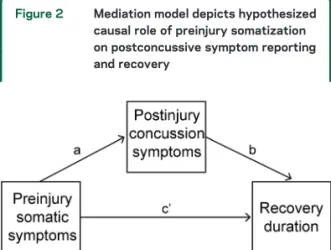
Mediation of baseline somatic symptoms by acute postconcussive symptoms.Because the reduced predic-tive value of preinjury somatization after accounting for postconcussive symptoms suggested that postconcus-sive symptoms might be mediating the effect of somati-zation on symptom recovery, we next tested this mediation model. To clarify, this analysis tested the degree to which preinjury somatization played an important role in the prediction of postinjury symptom recovery through a direct effect on postinjury symptom reporting vs indirectly (through its effect on postconcus-sive symptoms). A visual illustration of the hypothesized model is depicted in figure 2. We took 2 complemen-tary approaches to quantifying the mediated effect (i.e., indirect path of preinjury somatization to symptom recovery through postconcussive symptoms). First, we applied a method proposed by Iacobucci32that allows
for estimation of the significance of a mediated effect when differing statistical models are needed to quantify each model path. This approach involves standardizing each path such that the mediated effect can be com-puted and interpreted as azscore. Although less fre-quently used than more traditional mediation analyses, this approach allowed us to retain the Cox model to the degree possible (i.e., for estimation of pathsbandc),32
with logistic regression used to quantify patha (dichot-omized postconcussive symptoms predicted from prein-jury somatization). Using this approach, the mediated effect (a 3b) was significant,z55.64,p, 0.001. Second, we applied a more popular mediation analysis using linear regression of the continuous predictor and outcome measures. As detailed in appendix e-1, this analysis also found strong evidence that postconcussive symptoms mediated the relationship between preinjury somatization and symptom duration.
DISCUSSION This longitudinal study of SRC re-vealed 2 main findings about the predictors of Table 2 Preinjury (baseline) predictors of postconcussive symptom duration
HR 95% CI pValue
Demographics/history
Female 1.12 0.72–1.74 0.610
College (vs high school) 1.04 0.72–1.50 0.827
Grade point average 1.29 0.93–1.80 0.134
WTAR SS 1.01 0.99–1.02 0.406
Household SES 1.00 0.99–1.02 0.697
ADHD 1.36 0.75–2.48 0.310
Learning disability 2.32 0.84–6.38 0.104
Nonmigraine headaches 1.71 0.89–3.29 0.107
Migraine headaches 1.38 0.67–2.84 0.381
No. prior concussions 0.98 0.83–1.15 0.812
Sport 0.067
Football (vs soccer) 1.64 1.07–2.53 0.025
Football (vs other) 0.99 0.60–1.64 0.963
Soccer (vs other) 1.66 0.93–2.98 0.088
Years of participation 1.60 1.11–2.31 0.012
Symptoms
SCAT3 symptom severity 0.93 0.64–1.36 0.706
BSI-18 somatization 0.58 0.40–0.83 0.003a
BSI-18 depression 0.71 0.48–1.06 0.092
BSI-18 anxiety 0.79 0.55–1.12 0.185
BSI-18 global severity 0.76 0.53–1.08 0.128
SWLS total 1.03 0.72–1.47 0.870
Cognition
SAC total 1.25 0.86–1.83 0.241
ImPACT VERM 1.08 0.70–1.66 0.734
ImPACT VISM 1.04 0.67–1.61 0.865
ImPACT VMS 0.68 0.43–1.06 0.086
ImPACT RT 1.65 1.04–2.61 0.033
Balance
BESS total 1.06 0.74–1.52 0.759
Abbreviations: ADHD5attention-deficit/hyperactivity disorder; BESS5Balance Error Scoring System; BSI-18518-item Brief Symptom Inventory; ImPACT5Immediate Post-Concussion Assessment and Cognitive Testing; RT5reaction time; SAC5Standardized Assessment of Concussion; SCAT35Sport Concussion Assessment Tool–3; SES5Hollingshead household socioeconomic status score; SWLS5Satisfaction With Life Scale; VERM5verbal memory; VISM5visual memory; VMS5visual motor speed; WTAR SS5Wechsler Test of Adult Reading Standard Score.
a
postconcussive symptom recovery. First, acute post-concussive symptom severity is the strongest postin-jury predictor of recovery time. Second, preinpostin-jury somatization symptoms play an important role in recovery by enhancing athletes’experience or report-ing of postconcussive symptoms. This represents an important finding for several reasons. First, although clinicians and those researching nonsport/hospital-based concussion samples have long believed that preinjury psychiatric symptoms play an important role in symptom recovery after concussion,14–18 to
our knowledge psychological symptoms have not been measured before injury in prior studies. Our studied capitalized on the methodologic advantage of the sports concussion research model that enables preinjury baseline assessment. Second, that this sample was relatively healthy physically and psychologically highlights the relevance of variability on preinjury psychological traits for recovery even in healthy populations (only one participant reported a prior psychiatric diagnosis of anxiety disorder at the baseline evaluation, and only 3.9% of the sample scored at or above a T score of 65 at baseline on the BSI-18 somatization scale). Finally, the predictive value of preinjury psychiatric symptoms was restricted to somatization symptoms, while other self-reported psychiatric variables of potential relevance (e.g., depression, anxiety) were not strongly associated with postconcussive symptom reporting and recovery. This finding rules out the possibility that acquiescence or general distress inflate symptom ratings broadly and instead points to a specific influence of somatization on postconcussive symptoms and subsequent recovery.
Figure 1 Cumulative incidence of concussion symptom recovery by preinjury somatization (SOM) and acute postconcussive (CON) symptoms
(A) Preinjury/baseline somatic symptoms (SOMPRE) and (B) acute (,24 hours) postconcussive symptoms (CONPOST).
Table 3 Acute (<24 hours) postinjury predictors of symptom duration
HR 95% CI pValue
Acute injury characteristics
Loss of consciousness 1.08 0.52–2.22 0.836
Posttraumatic amnesia 0.74 0.43–1.28 0.280
Retrograde amnesia 0.55 0.29–1.07 0.077
Symptoms
SCAT3 symptom severity 0.49 0.34–0.70 ,0.001a,b
BSI-18 somatization 0.58 0.40–0.84 0.003a
BSI-18 depression 0.84 0.58–1.21 0.346
BSI-18 anxiety 0.84 0.59–1.19 0.324
BSI-18 global severity 0.66 0.46–0.95 0.023
SWLS total 0.99 0.69–1.42 0.966
Cognition
SAC total 1.20 0.84–1.72 0.314
ImPACT VERM 1.33 0.86–2.07 0.198
ImPACT VISM 1.39 0.89–2.15 0.147
ImPACT VMS 1.11 0.72–1.72 0.641
ImPACT RT 0.97 0.62–1.54 0.911
Balance
BESS total 1.15 0.79–1.66 0.469
Abbreviations: BESS5Balance Error Scoring System; BSI-18518-item Brief Symptom Inventory; ImPACT5Immediate Post-Concussion Assessment and Cognitive Testing; RT5 reaction time; SAC5Standardized Assessment of Concussion; SCAT35Sport Concussion Assessment Tool–3; SWLS5Satisfaction With Life Scale; VERM5verbal memory; VISM5 visual memory; VMS5visual motor speed.
ap,0.01 in single predictor models.
bpValue retained in the final multivariable model (only acute postconcussive symptom
That acute postconcussive symptom burden was the most robust overall predictor of symptom recov-ery is a significant finding, as it demonstrates conver-gence with prior research conducted largely on athletes presenting to outpatient specialty clinics, where samples are biased toward unusually prolonged recovery.10,11,33 Thus, to see convergence between
findings of clinic samples and this prospective sample highlights the robustness of this predictor. Although it is not surprising that early postconcussive symp-toms predict symptom recovery (given the high degree of content overlap between these 2 variables), it is nevertheless important to recognize, as subjective symptom duration is arguably an essential factor in the maintenance of functional impairments and ser-vice utilization after injury.
These findings are consistent with recent trends to recognize and identify the key predictors of concus-sion incidence and recovery across neurobiopsychoso-cial domains.34Despite efforts to pursue a biomarker
of concussion that predicts diagnosis and recovery, it is becoming increasingly recognized that the com-plexity of the injury requires consideration and inte-gration of variables across levels of analysis, including preinjury function (e.g., cognitive, behavioral, and psychosocial function, genotype), injury specifics and context (e.g., severity, frequency, mechanism), immediate postinjury events (e.g., acute characteris-tics, diagnosis, treatment), and intervening life events (e.g., life stressors). These study findings point to somatization as a target for future research on the mechanisms underlying premorbid factors relevant to concussion recovery. These findings also have directly translational significance, suggesting that clinicians should assess psychological health factors in the management of athletes recovering from SRC. A key question is what the construct of somatiza-tion, as operationalized by the BSI-18 and more
generally, reflects from a psychological, behavioral, and neurobiological standpoint. A number of chal-lenges in conceptualizing and studying somatic symp-tom disorders have slowed progress in this area relative to some other neuropsychiatric conditions. For example, many diagnoses appear to involve the historically central feature of somatization (i.e., preoc-cupation with or distress about somatic symptoms beyond what can be explained by recognized medical conditions), resulting in sample heterogeneity across studies.35 Furthermore, many patients presenting
with somatization-like symptoms have comorbid medical conditions, rendering diagnosis of tion symptoms imprecise. Our finding that somatiza-tion has predictive value for an important health outcome in a healthy athlete sample suggests that studying somatic symptoms in athletes could yield important findings about these symptoms apart from medical comorbidities and would be consistent with recent efforts to deemphasize the relative contribution of medical vs psychiatric factors to somatic symp-toms.36 In particular, recent changes to formal
(DSM-V) criteria for somatic symptom disorders were made to deemphasize the mind/body dualism inher-ent in considering to what degree somatic symptoms are medically unexplained. Instead, the current crite-ria emphasize consideration of the symptoms them-selves and their associated impairment.35
Our suggestion to examine the predictive value of psychological traits like somatic symptoms across healthy and psychiatric samples is also consistent with trends in psychopathology research to study core di-mensions of psychopathology across the normal and abnormal ranges as opposed to focusing on traditional diagnostic categories.37 In addition to being more
consistent with data supporting the dimensional structure of many psychiatric constructs,38 this
approach facilitates recruitment of samples with ade-quate statistical power for researching these psycho-logical factors. Incorporating neuroscience research into these efforts may be particularly valuable for understanding the taxonomy of somatic symptom pathology across levels of analysis and identifying the core underlying mechanisms that contribute to somatic symptom pathology and its role in individu-als’ responses to and recovery following concussive injury or other adverse medical events.35,39
Limitations of this study include the limited base rate of psychopathology and reliance on self-reported recovery time. Although we argue that find-ing a significant role of somatic symptoms in this sample speaks to the robustness of this finding, it is nevertheless possible that additional preinjury psy-chological factors would predict recovery in samples with greater variance on those factors. This speaks to the importance of accruing large samples of athletes Figure 2 Mediation model depicts hypothesized
causal role of preinjury somatization on postconcussive symptom reporting and recovery
and more systematically examining somatization and other psychiatric constructs in athlete and nonathlete populations. Additionally, although self-reported recov-ery time could be skewed by athletes’ motivations to return to competition, athletes’ responses to this inter-view question were not available to the athletic trainers who made their return-to-play decisions, and self-reported symptom recovery occurred more slowly than recovery by more objective measures (e.g., neurocogni-tive functioning) in this sample.21Further, as stated
ear-lier, the results of formal neurocognitive effort (MSVT) performance suggested adequate cognitive effort, although no symptom validity scales were administered. This study revealed that preinjury somatization symptoms and acute postconcussive symptoms play sig-nificant roles in the duration of recovery from SRC. This sample yielded evidence for the relevance of preinjury psychiatric symptoms in postconcussive recovery, even among healthy athletes free of serious psychopathology. Future work clarifying the psychological, cognitive, and neurobiological underpinnings of somatization is needed to understand the mechanisms by which this construct contributes to enhanced experience or reporting of post-concussive symptoms and subsequent recovery time.
AUTHOR CONTRIBUTIONS
Dr. Nelson contributed to the management of the study, conceptualization of the manuscript, data analysis and interpretation, drafting of the manu-script, and manuscript revisions. Dr. Tarima contributed to statistical analysis, interpretation, and manuscript revisions. A.A. LaRoche contributed to data collection, study management, data analysis, and manuscript preparation. Drs. Hammeke, Barr, Guskiewicz, and Randolph contributed to study con-ception and design, study management, interpretation of findings, and man-uscript revisions. Dr. McCrea contributed to the conception and design of the study, study management, interpretation of findings, and manuscript re-visions. Statistical analyses were performed by Dr. Nelson and Dr. Tarima.
ACKNOWLEDGMENT
The authors thank Adam Pfaller and Jennifer Hill for their extensive sup-port of study operations.
STUDY FUNDING
Supported by the US Army Medical Research and Materiel Command (award W81XWH-12-1-0004), the Clinical and Translational Science Institute (grant 1UL1-RR031973 [-01]), and the NIH National Center for Advancing Translational Sciences (grant 8UL1TR000055). Opinions, interpretations, conclusions and recommendations are those of the author and are not necessarily endorsed by the US Army. The manuscript’s contents are solely the responsibility of the authors and do not necessarily represent the official views of the NIH.
DISCLOSURE
The authors report no disclosures relevant to the manuscript. Go to Neurology.org for full disclosures.
Received October 22, 2015. Accepted in final form January 12, 2016.
REFERENCES
1. McCrea M, Guskiewicz KM, Marshall SW, et al. Acute effects and recovery time following concussion in collegiate football players: the NCAA Concussion Study. JAMA 2003;290:2556–2563.
2. Macciocchi SN, Barth JT, Alves W, Rimel RW, Jane JA. Neuropsychological functioning and recovery after mild head injury in collegiate athletes. Neurosurg 1996;39:510–514. 3. Nelson LD, Janecek JK, McCrea MA. Acute clinical
recovery from sport-related concussion. Neuropsychol Rev 2013;23:285–299.
4. Jeter CB, Hergenroeder GW, Hylin MJ, Redell JB, Moore AN, Dash PK. Biomarkers for the diagnosis and prognosis of mild traumatic brain injury/concussion. J Neurotrauma 2013;30:657–670.
5. MacFarlane MP, Glenn TC. Neurochemical cascade of concussion. Brain Inj 2015;29:139–153.
6. Yuh EL, Hawryluk GW, Manley GT. Imaging concus-sion: a review. Neurosurg 2014;75(suppl 4):S50–S63. 7. McCrea M, Guskiewicz K, Randolph C, et al. Incidence,
clinical course, and predictors of prolonged recovery time following sport-related concussion in high school and col-lege athletes. J Int Neuropsychol Soc 2013;19:22–33. 8. Collins MW, Iverson GL, Lovell MR, McKeag DB,
Norwig J, Maroon J. On-field predictors of neuropsycho-logical and symptom deficit following sports-related con-cussion. Clin J Sport Med 2003;13:222–229.
9. Hou R, Moss-Morris R, Peveler R, Mogg K, Bradley BP, Belli A. When a minor head injury results in enduring symptoms: a prospective investigation of risk factors for postconcussional syndrome after mild traumatic brain injury. J Neurol Neurosurg Psychiatry 2012;83:217–223. 10. Meehan WP III, Mannix RC, Stracciolini A, Elbin RJ, Collins MW. Symptom severity predicts prolonged recov-ery after sport-related concussion, but age and amnesia do not. J Pediatr 2013;163:721–725.
11. Meehan WP III, Mannix R, Monuteaux MC, Stein CJ, Bachur RG. Early symptom burden predicts recovery after sport-related concussion. Neurology 2014;83:2204–2210. 12. Erlanger D, Kaushik T, Cantu R, et al. Symptom-based assessment of the severity of a concussion. J Neurosurg 2003;98:477–484.
13. Broshek DK, De Marco AP, Freeman JR. A review of post-concussion syndrome and psychological factors asso-ciated with concussion. Brain Inj 2015;29:228–237. 14. Waljas M, Iverson GL, Lange RT, et al. A prospective
biopsy-chosocial study of the persistent post-concussion symptoms following mild traumatic brain injury. J Neurotrauma 2015; 32:534–547.
15. Silverberg ND, Gardner AJ, Brubacher JR, Panenka WJ, Li JJ, Iverson GL. Systematic review of multivariable prog-nostic models for mild traumatic brain injury. J Neurotrauma 2015;32:517–526.
16. Meares S, Shores EA, Taylor AJ, et al. The prospective course of postconcussion syndrome: the role of mild trau-matic brain injury. Neuropsychol 2011;25:454–465. 17. Ponsford J, Cameron P, Fitzgerald M, Grant M,
Mikocka-Walus A, Schonberger M. Predictors of postconcussive symptoms 3 months after mild traumatic brain injury. Neuropsychol 2012;26:304–313.
18. Greiffenstein FM, Baker JW. Comparison of premorbid and postinjury MMPI-2 profiles in late postconcussion claimants. Clin Neuropsychol 2001;15:162–170. 19. LaRoche AA, Nelson LD, Connelly PK, Walter KD,
McCrea MA. Sport-related concussion reporting and state legislative effects. Clin J Sport Med 2016;26:33–39. 20. Nelson LD, Pfaller AY, Rein L, McCrea MA. Rates and
Axon, and ImPACT. Am J Sports Med 2015;43:2018– 2026.
21. Nelson LD, LaRoche AA, Pfaller AY, et al. A prospective, head-to-head study of three computerized neurocognitive assessment tools (CNTs): reliability and validity for the assess-ment of sport-related concussion. J Int Neuropsychol Soc 2016;22:24–37.
22. Helmick K, Guskiewicz K, Barth J, et al. Defense and Veterans Brain Injury Center Working Group on the Acute Management of Mild Traumatic Brain Injury in Military Operational Settings: Clinical Practice Guideline and Recommendations Washington, DC: Defense and Veteran Brain Injury Center; 2006:1–11.
23. Wechsler D. Wechsler Test of Adult Reading: WTAR. San Antonio, TX: The Psychological Corporation; 2001. 24. McCrea M, Kelly JP, Randolph C, et al. Standardized Assess-ment of Concussion (SAC): on-site Assess-mental status evaluation of the athlete. J Head Trauma Rehabil 1998;13:27–35. 25. McCrory P, Meeuwisse W, Aubry M, et al. Consensus
statement on concussion in sport–the 4th International Conference on concussion in sport held in Zurich, November 2012. Clin J Sport Med 2013;23:89–117. 26. Derogatis LR. Brief Symptom Inventory 18 (BSI-18):
Administration, Scoring, and Procedures Manual. Bloo-mington, MN: Pearson; 2001.
27. Guskiewicz KM, Ross SE, Marshall SW. Postural stability and neuropsychological deficits after concussion in colle-giate athletes. J Athl Train 2001;36:263–273.
28. Green’s Medical Symptom Validity Test for Windows [Computer Program]. Edmonton,Canada: Green’s Pub-lishing, Inc.; 2003.
29. Diener E, Emmons RA, Larsen RJ, Griffin S. The Satis-faction with life scale. J Pers Assess 1985;49:71–75. 30. Wood RL, McCabe M, Dawkins J. The role of anxiety
sensitivity in symptom perception after minor head injury: an exploratory study. Brain Inj 2011;25:1296–1299. 31. Whittaker R, Kemp S, House A. Illness perceptions and
outcome in mild head injury: a longitudinal study. J Neu-rol Neurosurg Psychiatry 2007;78:644–646.
32. Iacobucci D. Mediation analysis and categorical variables: the final frontier. J Consum Psychol 2012;22:582–594. 33. Tsao JW, Perry BN, Kennedy CH, Beresford R.
Predict-ing prolonged recovery after concussion. Neurology 2014; 83:2196–2197.
34. McCrea M, Broshek DK, Barth JT. Sports concussion assessment and management: future research directions. Brain Inj 2015;29:276–282.
35. Browning M, Fletcher P, Sharpe M. Can neuroimaging help us to understand and classify somatoform disorders? A system-atic and critical review. Psychosom Med 2011;73:173–184. 36. Dimsdale JE, Creed F, Escobar J, et al. Somatic symptom
disorder: an important change in DSM. J Psychosom Res 2013;75:223–228.
37. Widiger TA, Samuel DB. Diagnostic categories or dimen-sions? A question for the Diagnostic and Statistical Manual of Mental Disorders–fifth edition. J Abnorm Psychol 2005;114:494–504.
38. Krueger RF. The structure of common mental disorders. Arch Gen Psychiatry 1999;56:921–926.
39. Insel T, Cuthbert B, Garvey M, et al. Research domain criteria (RDoC): toward a new classification framework for research on mental disorders. Am J Psychiatry 2010;167:748–751.
This Week
’
s
Neurology
®Podcast
Variability in physician prognosis and recommendations after intracerebral hemorrhage (see p. 1864)
This podcast begins and closes with Dr. Robert Gross, Editor-in-Chief, briefly discussing highlighted articles from the May 17, 2016, issue ofNeurology. In the second segment, Dr. Javier Pro-vencio talks with Dr. Darin Zahuranec about his paper on the variability in physician prognosis and recommendations after intracerebral hemorrhage. Dr. Adam Numis reads the e-Pearl of the week about eye and facial findings in psychogenic nonepileptic seizures. In the next part of the podcast, Dr. Ted Burns focuses his interview with Dr. Chris Holstege on aNeurology Todaystory about the lead crisis in Flint exposing the continuing risk to children nationwide and what neurologists should know and what they can do about it.
Disclosures can be found at Neurology.org.
At Neurology.org, click on “RSS” in the Neurology Podcast box to listen to the most recent podcast and subscribe to the RSS feed.