ELEMENTARY PRESERVICE TEACHERS’ MATHEMATICAL KNOWLEDGE FOR TEACHING: USING SITUATED CASE STUDIES AND EDUCATIVE
EXPERIENCES TO EXAMINE AND IMPROVE THE DEVELOPMENT OF MKT IN TEACHER EDUCATION
Tracy L. Johnson
A dissertation submitted to the faculty of the University of North Carolina at Chapel Hill in partial fulfillment of the requirements for the degree of Doctor of Philosophy in the School of Education.
Chapel Hill 2011
Approved by: Olof Steinthorsdottir Lynda Stone
iii ABSTRACT
TRACY L. JOHNSON: Elementary Preservice Teachers' Mathematical Knowledge For Teaching: Using Situated Case Studies And Educative Experiences To Examine And
Improve the Development of MKT In Teacher Education (Under the direction of Olof Steinthorsdottir)
This study examined pre-service teachers’ development of mathematical knowledge for teaching (MKT) over their final year in a university based teacher education program. This was done through analyzing written reflections, focus group interviews, individual interviews, teaching observations, and post-observation interviews as well as through the use of a quantitative measure, the MKT test (Learning
Mathematics for Teaching, 2005). The study design employed situated case studies, in which tiered participation resulted in extensive data for three focal pre-service teachers as well as a comparison to larger groups of their peers through interviews (n=8), focus groups (n=11), and written reflections and the MKT test (n=35). A new protocol for coding elementary pre-service teachers’ mathematics lessons was developed to extend Rowland et al.’s (2009) work on the Knowledge Quartet (KQ) model.
The study investigated pre-service teachers’ definitions of MKT, demonstrations of MKT in their teaching, and educative experiences that contributed to their
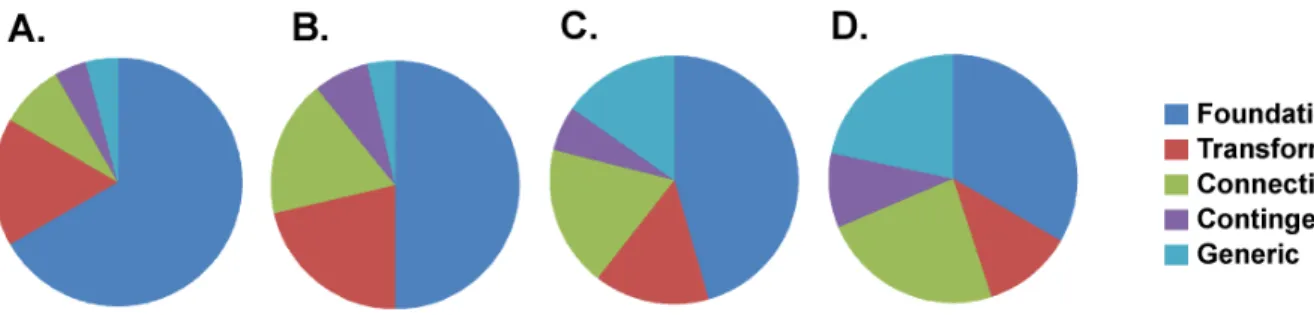
individual, and shared similarities to the aggregate definition only at the end of the year. The KQ category of foundation tended to dominate the pre-service teachers’ definitions of MKT, the transformation category remained vague, connection was an inconsistent category in their definition, and contingency arose late in the year and at a relatively small proportion.
Insights were also gained into pre-service teachers’ demonstration of MKT in their teaching of mathematics. Dimensions of MKT were most often demonstrated at a minimum level, growth on a dimension as indicated by scores that improved over time was extremely rare, scores were more variable than predicted across the four observed lessons, and the connection category was particularly challenging.
This study used the theoretical lenses of cognitive views of learning and Dewey’s (1904/1964; 1916/1985) philosophy of educative experiences. These foundations
enhanced this study and led to more substantial suggestions by which to improve teacher education in order to better develop pre-service teachers’ development of MKT through the methods course, initial field placements, student teaching and content-based
v
ACKNOWLEDGEMENTS
This body of work represents my most substantial academic endeavor to date. There are many people I wish to thank for their support and suggestions throughout the two years I worked on this project. First, I would like to express my sincere appreciation to the preservice teachers who participated in the study that is reported herein. It was a pleasure to work with you, an honor to be entrusted with your experiences and welcomed into your classrooms, and a joy to watch you enter the profession. It is to you to whom this work is dedicated, and I am hopeful that teacher education will be improved because of your openness and honesty throughout our discussions. At the very least, I can
promise that each of you and your stories have significantly impacted me in my work and thinking about teacher education and I pledge to continue to push myself as a teacher educator to make improvements in my practice based on what you taught me.
I would also like to thank each member who served on my committee. I see this work as a genuine synthesis of that which I have learned from each of you. To my advisor, Olof Steinthorsdottir, I thank you for sharing your passion for equity and
to teach and supervise in the elementary education program and work with preservice teachers. To Belinda Gimbert, I thank you for mentoring me for the past ten years and for your thoughtful feedback and careful help with the form of this work. To all of you, I thank you for shaping how I think about teacher education and for the tools and
experiences I have because of you to contribute to such discussions.
I would also like to thank several people who were not formally associated with this work but who nevertheless contributed. I would like to thank Tim Rowland for meeting with me in January 2011 to further clarify the Knowledge Quartet model and for allowing me to interpret his model for use in this study. Thank you to F. Reed Johnson for your help with statistical analysis. I would also like to thank my cohort of fellow PhD students for all that I learned from each of you throughout our time together; what stands out most of all is your kindness and I am grateful to have gone through this experience with the friendship of each of you.
I would like to thank my brother, Tim Weston, and best friends Tracy Frost Knoebel, Bethany Lees Ringer and Sarah Street for their support and encouragement during stressful and overwhelming times. Thank you for celebrating my successes and offering me encouragement. To Sarah, thank you for all of your help. Moreover, thank you for staying up all night with me, reading every word, and being the friend I needed throughout this entire process. May your record of 2:01 always stand.
vii
would entail. As I finish this work, Ainsleigh has recently finished kindergarten and I couldn’t be prouder of the person she is. To Ripken, thank you for being silly and sweet. To both of you, I hope this work and that which comes after it might lead to better
teachers of mathematics for you and all children, because everyone deserves as much. It is for this reason that these pages contain my attempt at not merely conducting and reporting on a study, but at creation: creation of new ideas and new methodologies fueled by an ever present drive to improve that which is and contribute possibilities to that which could be. In the words of G.H. Hardy (1940/2005), a true mathematician:
(T)hat I have created is undeniable: the question is about its value. The case for my (work), then, …is this: that I have added something to knowledge, and helped others to add more; and that these somethings have a value which differs in degree only, and not in kind, from that of the creations of the great mathematicians, or of any of the other artists, great or small, who have left some kind of memorial behind
TABLE OF CONTENTS
LIST OF TABLES ... xvi
LIST OF FIGURES ... xvii
Chapter I. INTRODUCTION ...1
Research Questions ...6
II. LITERATURE REVIEW ...7
Part One: Pedagogical Content Knowledge ...7
Part Two: Two Models of Professional Knowledge for Mathematics Teaching...12
Mathematical Knowledge for Teaching ...12
Knowledge Quartet ...17
Similarities between MKT and KQ models ...22
Building on the MKT and KQ models ...23
Part Three: Teacher Development ...25
III. PHILOSOPHICAL FRAME ...28
Dewey’s Philosophy of Experience ...29
Dewey’s Philosophy of Educative Experience ...31
The concept of continuity ...32
Continuity as criteria ...33
ix
Interaction as criteria...37
Summary ...39
Educative experiences in teacher education ...40
Relation of coursework to field placements...42
Field placements ...44
Focus ...50
IV. METHODOLOGY—STUDY DESIGN AND DATA COLLECTION ...53
Part One: Study Design ...53
Sampling ...55
Participants ...59
University Context ...60
Fall 2009: Methods course ...61
Spring 2010: Student teaching ...62
Focal Preservice Teachers...63
Wendy ...63
McKenzie ...64
Holly ...64
Researcher ...65
Background ...65
Role of the researcher ...68
Credibility ...70
Part Two: Data Collection—Research Question One ...71
Written reflections ...74
Focus group interviews ...75
Lesson plans ...79
Individual interviews ...80
Summary of data collection for research question one ...84
Part Three: Data Collection—Research Question Two ...84
Lesson plans ...85
Teaching observations ...85
Post-observation interviews ...88
Summary of data collection for research question two ...89
Part Four: Data Collection—Research Question Three ...90
Written reflections ...90
Focus group interviews ...90
Individual interviews ...91
Summary of data collection for research question three ...91
V. METHODOLOGY—DATA ANALYSIS ...92
Part One: Data Analysis—Research Question One ...93
MKT instrument...93
Written reflections ...95
Focus group interviews ...98
Individual interviews ...98
Reading across the data for research question one ...99
xi
Lesson plan analysis ...100
Teaching observations ...101
Protocol development ...102
Use of terminology ...108
Choice of examples ...112
Protocol use ...116
Post-observation interviews ...117
Reading across the data for research question two ...118
Part Three: Data Analysis—Research Question Three ...119
Written reflections, focus group interviews and individual interviews ...119
Reading across the data for research question three ...121
VI. FINDINGS—RESEARCH QUESTION ONE...122
MKT Instrument ...123
MKT Definitions ...131
Written reflections ...132
Focus group interviews ...134
Individual interviews ...137
Comparison of data across group sources ...138
Situated Case Studies ...141
Wendy ...147
McKenzie ...155
Holly ...164
VII. FINDINGS—RESEARCH QUESTION TWO ...179
Demonstrated MKT ...179
Translation to practice: Tiers ...193
Translation to practice: Tier One ...194
Questioning ...195
Decisions about sequencing ...203
Choice of examples ...210
Theoretical underpinning ...215
Deviation from agenda ...217
Summary ...226
Translation to practice: Tier Two ...226
Translation to practice: Tier Three ...231
Translation to practice: Tier Four ...235
Summary ...239
VIII. FINDINGS—RESEARCH QUESTION THREE ...243
Initial Coding ...243
Re-teaching ...246
Re-teaching via calendar math ...247
Re-teaching via centers ...248
Re-teaching via two classrooms...249
Re-teaching via a second attempt ...251
Summary ...252
xiii
Continuity ...253
Interaction ...256
Summary ...257
Teaching alone ...257
McKenzie: Teaching centers ...258
Holly: Substitute teaching ...259
Wendy: Math circle...261
Summary ...262
Educative evaluation of teaching alone ...262
Continuity ...263
Interaction ...265
Summary ...266
Teaching experiments ...266
Participation in the study ...267
Personal connection ...270
Connection in the form of support ...271
Connection in the form of idea sharing ...272
Connection to the university ...275
Summary ...275
Study teaching observations ...276
Increased reflection ...276
Math-specific reflection ...277
Continuity ...283
Interaction ...285
Summary of study participation ...290
Summary of educative experiences ...290
IX. PROCEDURAL VERSUS CONCEPTUAL TRAJECTORIES OF TEACHING MATHEMATICS ...291
A Return to Shared Philosophies ...291
Individual Trajectories ...293
McKenzie ...295
Wendy ...303
Holly ...310
X. ACROSS SITUATED CASE ANALYSIS...316
Synthesizing Results ...316
Comparing Theoretical and Enacted MKT ...317
Wendy ...320
McKenzie ...321
Holly ...323
Summary ...324
Challenges with the connection category ...325
Challenging dimensions ...328
XI. DISCUSSION—IMPLICATIONS AND RECOMMENDATIONS FOR TEACHER EDUCATION ...333
Improving Teacher Education...333
xv
Initial field placements ...341
Student teaching ...347
Discussion groups ...352
Educative experiences ...355
Conclusion ...356
Summary ...356
Limitations of study ...357
Areas for further research ...358
Contributions...361
APPENDICES ...364
LIST OF TABLES
Table
1. Categories of Shulman’s (1987) Knowledge Base ...10
2. Rowland et al.’s (2009) KQ model ...19
3. Demographics of each Participation Tier ...60
4. Tier Two Participants: MKT Instrument, Written Reflections, and Focus Group Interviews ...76
5. Tier Three Participants: MKT Instrument, Written Reflections, Focus Group Interviews, and Individual Interviews ...81
6. Tier Four Participants: MKT Instrument, Written Reflections, Focus Group Interviews, Individual Interviews, Teaching Observations, and Post-observation Interviews ...87
7. Data Analysis Code One: Written Reflections, Focus Groups, Individual Interviews, and Post-observation Interviews ...97
8. Descriptive Statistics--Control ...123
9. Correlation Matrix--Control...124
10. Descriptive Statistics ...125
11. MKT Instrument—Mean Scores...130
12. Number of Dimensions included in MKT definition ...173
13. Score Frequencies for Each Lesson ...181
14. Demonstrated MKT Scores...184
15. Percentage of Open Ended Question Asked by Setting ...202
16. Aspects of Sequencing Demonstrated By Each Participant ...204
17. Tiers of MKT Translation to Practice ...240
xvii
LIST OF FIGURES
Figure
1. Mathematical Knowledge for Teaching Model ...14
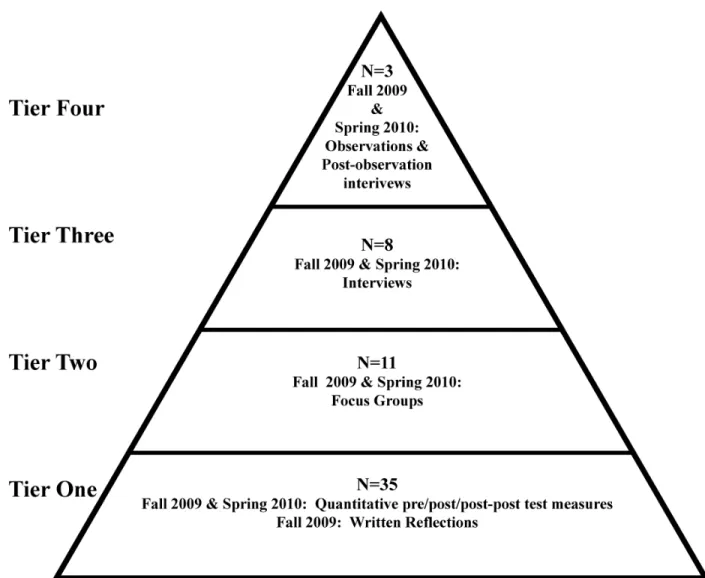
2. Situated Case Study Design: Nested Tiers of Data Collection ...59
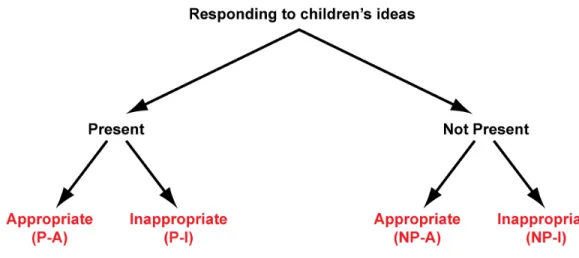
3. Initial Codes for Teaching Observations ...103
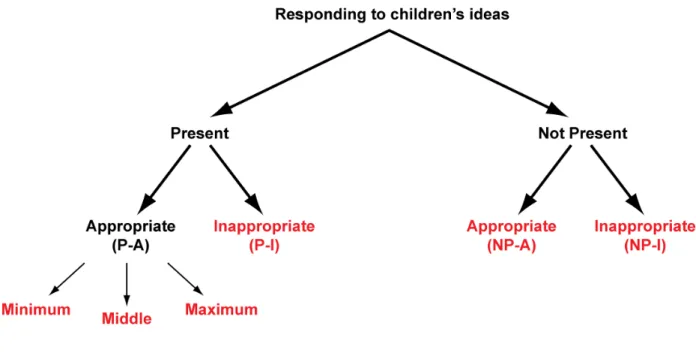
4. Final Codes for Teaching Observations ...105
5. Kernel Smooth Density Plot ...128
6. Category Proportions of the KQ Model ...132
7. Written Reflections—MKT Definition, December ...132
8. Written Reflections—MKT Definition, Fall Semester ...133
9. Written Reflection and Focus Group Comparison, Fall Semester ...135
10. Focus Groups—MKT Definition, Full Year ...136
11. Interviews—MKT Definitions, Full Year...137
12. Comparison of Written Reflection, Focus Group and Interview Data—MKT Definition ...139
13. Comparison of Interview Participants’ Definition of MKT ...141
14. Aggregate and Individual MKT Definitions ...143
15. Wendy’s MKT Definition ...147
16. McKenzie’s MKT Definition ...155
18. MKT Definitions—April 2010 ...177
19. Foundation Category—Demonstrated MKT ...189
20. Transformation Category—Demonstrated MKT ...190
21. Connection Category—Demonstrated MKT ...191
22. Contingency Category—Demonstrated MKT ...192
23. Tier One Dimensions ...195
24. Tier Two Dimensions ...227
25. Tier Three Dimensions ...232
26. Tier Four Dimensions ...236
27. MKT Definition and Demonstration for the Three Focal Preservice Teachers ...318
28. MKT Definition and Demonstration for Wendy ...320
29. MKT Definition and Demonstration for McKenzie ...322
Elementary Preservice Teachers' Mathematical Knowledge For Teaching: Using Situated Case Studies And Educative Experiences To Examine And Improve The
Development Of MKT In Teacher Education
CHAPTER ONE INTRODUCTION
Shulman’s (1986, 1987) work on pedagogical content knowledge (PCK) made a significant contribution to the field of teacher education by re-focusing attention on content knowledge during a time when the primary focus within teacher education research was on pedagogy. Since the construct of PCK was introduced to the field, work has been done to further explicate what PCK entails in various subject matter domains. Within the field of mathematics education, Ball and her colleagues’ work at Michigan and Rowland and his colleagues’ work at University of Cambridge have made significant contributions to teacher education and mathematics education (Ball, Thames & Phelps, 2008; Rowland et al., 2009). Both projects have yielded models of mathematical
Although it could be argued that there is growing consensus in the field as to the “types” of knowledge required to teach elementary mathematics, to date there has been little work done to describe the emergence and growth of this knowledge with novice or
beginning teachers (Leinhardt, 1993). Becoming clearer on expert knowledge is significantly different than becoming aware of how this knowledge comes to be, in the first place. This has resulted in significant gaps in current scholarship surrounding theories about learning to teach elementary mathematics, where such theories tend to be oversimplified and underspecified (Feiman-Nemser & Remillard, 1996; Munby et al., 2001). This lack of knowledge, in turn, is a problematic omission within teacher
education because of the relative lack of theories and research on which to build courses, field work, and programs for preservice teachers.
In addition to gaps in the field of teacher development, I perceive helpful yet underspecified parallels between research in mathematics education about the way young children learn mathematics and the way novice teachers learn to teach. Two such
parallels are foundational to the philosophies of the researcher and therefore influence the assumptions that prefigure the research questions. The first idea is the distinction
First, the National Council for Teachers of Mathematics (NCTM) asserted that students’ school experiences with mathematics should emphasize conceptual
understanding rather than procedural knowledge (NCTM, 2000, 2006; Skemp, 1978). Furthermore, an early emphasis on conceptual understanding in the primary grades lays a foundation for more advanced mathematics in upper elementary school, middle school, and high school. As Kathy Richardson, a well-known researcher and curriculum designer in early-grades learning, said, “If you have a problem in your high school algebra
classrooms, you have a problem in your elementary classrooms” (North Carolina Council of Teachers of Mathematics Conference, October 29, 2009).
I believe that a parallel can be made between these reform-based mathematics beliefs and teacher education: Preservice teachers should have experiences with teaching which emphasize conceptual understanding rather than procedural knowledge. Likewise, if there is a problem with the mathematics teaching in elementary classrooms, teacher educators should look back to preservice classrooms and establish a better foundation for the work necessary to enter and continue in the profession. It can be argued that the work of elementary mathematics teaching can be enhanced by expanding teachers’
mathematical pedagogical content knowledge (Ball et al., 2008; Rowland et al., 2009; Davis & Simmt, 2006). Therefore, better understanding the development of such knowledge and the experiences which promote its development is important to establish stronger foundations in preservice teacher education.
indicates that learning is a process unique to each individual because new knowledge is seen through the lens of an individual’s prior knowledge, background, and beliefs (Greeno, Collins & Resnick, 1996). Thus, in a classroom of twenty-five students there may be as many different interpretations of a concept presented in a lesson. A parallel can be made to teacher education in this domain, as well. Although teacher education and mathematics education researchers have suggested “best-practices” and many teacher education courses and programs are structured according to this research, teacher
educators must acknowledge that their students, too, construct their own knowledge. As Munby, Russell, and Martin (2001) wrote, “constructivism in teacher education seems to apply only to school-age learners and not to the preparation of their teachers” (p.896). Just as it is possible for P-12 students to have multiple interpretations of content
presented in the same lesson, so too is it possible for preservice teachers to interpret the content and experiences they have in courses and field placements in multiple ways.
This is complicated even more by what Lorite (1975) deemed the “apprenticeship of observation.” Since preservice teachers have typically been in schools and observed teachers for approximately thirteen to fifteen years in advance of entering a teacher education program, constructivist learning theory indicates this impacts how they evaluate new knowledge and how they integrate this new knowledge into their future practices as a teacher. Therefore, considering “what works” in teacher education must take into account constructivist learning principles. Just because courses and field placements should result in positive impacts on many domains, including the
knowledge growth occurs over a preservice teacher education program addresses a significant gap in existing studies.
In addition to addressing gaps in the research of teacher knowledge, it was my intent to design a study with a substantial philosophical foundation. The problematic nature of disconnects in teacher education between course work and field placements have been explained by researchers (ref). I perceive a similar problematic divide in content area research void of substantial philosophical grounding. Therefore, Dewey’s (1916/1985; 1938/1963) philosophy of experience and distinctions between experiences that are educative, mis-educative, and non-educative was used as a way to frame content area research in teacher education while enhancing it with a substantial theoretical foundation. Shulman, Ball, Rowland, and Dewey’s work was used in conjunction to make sense of the growth and development that occurred with preservice teachers: Shulman, Ball, and Rowland’s work was used to examine and explain the knowledge growth that occurred over the final year in a preservice teacher program and Dewey’s work was used to identify and describe the preservice teachers’ experiences that contributed to the growth of their knowledge.
Lastly, this study also addressed a gap in current qualitative methodologies. The phenomenon of preservice teachers’ knowledge development seemed best suited to a case study design, however case studies are intended to offer specific rather than general understanding of the phenomenon at hand (Grossman, 1990). Given the significant gaps in current research I wanted to have a way to situate the specific understanding of a smaller group of preservice teachers I gained against a larger number of the other
termed “situated case studies” in which data is collected in a series of nested tiers, thus offering a broader scope of data in which to situate the focal case studies. Developing this new methodology provided a way to research more participants and make more substantial suggestions for teacher education than would have been possible using a traditional case study design.
Research Questions
This study spanned the fields of mathematics education and teacher education and addressed gaps in content, theory, and methodology. The dual purpose was to a) describe preservice teachers’ growth in mathematical knowledge for teaching and b) investigate what experiences contribute to preservice teachers’ development of mathematical knowledge for teaching. Specifically, the research questions for the study were as follows:
1. To what extent does elementary preservice teachers’ mathematical knowledge for teaching develop over their last year in a teacher education program?
2. What aspects of mathematical knowledge for teaching translate into elementary preservice teachers’ practices?
CHAPTER TWO LITERATURE REVIEW
This study investigated mathematical knowledge for teaching, which traces its roots to Shulman’s work. In the mid-1980s Shulman introduced the field of teacher education to a new construct, “pedagogical content knowledge” (Shulman, 1986, 1987; Wilson, Shulman & Richert, 1987). Pedagogical content knowledge refers to the
specialized subject-matter knowledge that is necessary for teaching. To situate the study and the tradition of pedagogical content knowledge upon which it is founded and that it seeks to extend, pedagogical content knowledge (PCK) will first be described. Second, two bodies of work that attempt to explicate PCK within the field of elementary
mathematics education and that the study operationalized for data analysis will be explained (Ball, Thames, & Phelps, 2008; Rowland, Turner, Thwaites, & Huckstep, 2009). Third, the literature on teacher development will be reviewed.
Part One: Pedagogical Content Knowledge
situated within an epistemology of practice1. Research into pedagogical content knowledge has been of particular interest since 1985 (Munby et al., 2001). Lee
Shulman’s (1986, 1987) work is most-often linked with research on pedagogical content knowledge. His work with the Knowledge Growth in Teaching study was based on observations of effective teachers. Shulman (1987) explained that effective teachers not only manage students but also ideas, and do so in ways that are flexible, adaptive, and complex. At the time of his writing Shulman indicated policymakers and even teacher educators generally considered teaching to be comprised of basic skills, content
knowledge, and general pedagogical skills. Shulman contended that this formulation was problematic because “teaching is trivialized, its complexities ignored, and its demands diminished” (p.6). Additionally, a rush to delineate competencies of effectiveness often oversimplifies the complexities of teaching (Shulman, 1987).
Shulman proposed a focus on pedagogical content knowledge at a time when content and pedagogy were viewed separately and pedagogy ruled the day. In the 1980s content was “conspicuously absent” from teacher education programs and research (Shulman, 1986, p.6). Thus, Shulman (1987) identified the absence of subject matter in studying teaching as “the missing paradigm problem” (p.6). Shulman (1987) explained the lack of focus on subject matter as a blind spot that left several important questions
1 Carter (1990) categorized research into three different approaches to address teacher knowledge. First,
information-processing studies of the 1980s, including expert-novice comparison studies, used
unasked.2 Attempts in research and teacher education to make general statements about effective teaching often skipped over “critical features” of teaching including the subject-specific decisions a teacher makes (Shulman, 1987).
To address both oversimplified and underspecified conceptions of teachers’ knowledge, Shulman (1987) described seven categories of teacher knowledge: 1) content knowledge, 2) general pedagogical knowledge, 3) curriculum knowledge, 4) pedagogical content knowledge, 5) knowledge of learners and their characteristics, 6) knowledge of educational contexts, and 7) knowledge of educational ends, purposes, and values. A definition of each of these categories is found in the following table.
2 These questions included, “Where do teacher explanations come from? How do teachers decide what to
Table 1
Categories of Shulman’s (1987) Knowledge Base
Knowledge Base Category Definition
Content knowledge Adequacy and accuracy of the subject matter ideas presented
General pedagogical knowledge Broad principles and strategies of classroom
management and organization that appear to transcend subject matter
Curriculum knowledge Grasp of the materials and programs
that serve as "tools of the trade" for teachers
Pedagogical content knowledge Special amalgam of content and pedagogy that is uniquely the province of teachers, their own special form of professional understanding
Knowledge of learners and their characteristics
Physical and psychological characteristics of students
Knowledge of educational contexts
Ranging from the workings of the group or classroom, the governance and financing of school districts, to the character of communities and cultures
Knowledge of educational ends Purposes, values, and their philosophical and historical grounds
Note: adapted from Shulman, L. S. (1987). Knowledge and teaching: Foundation of the
Of the seven categories he identified, Shulman (1987) described pedagogical content knowledge as the category of “special interest because it identifies the distinctive bodies of knowledge for teaching” (p.8). He explained that it was the intersection of content and pedagogy that contained the heart of a distinct knowledge base for teaching. For Shulman (1987), the combination of content and pedagogy revealed “the capacity of the teacher to transform the content knowledge he or she possesses into forms that are pedagogically powerful and yet adaptive to the variations in ability and background presented by the students” (p.15). Pedagogical content knowledge “goes beyond knowledge of subject matter per se to the dimension of subject matter knowledge for teaching” (Shulman, 1986, p.7, emphasis in original). PCK includes knowing how to use
representations, analogies, illustrations, examples, explanations, and demonstrations so that the content is understandable to the learner. It also includes understanding what makes learning a topic difficult or easy, the pre-conceptions students are likely to have, and strategies that will most likely address students’ (mis)understandings. PCK “places emphasis upon the intellectual basis for teaching performance rather than on behavior alone” (Shulman, 1987, p.20; see also Dewey, 1904/1964).
The aim of Shulman’s (1986, 1987) project was to focus the attention of
mathematics, social studies, and English (Munby et al., 2001). One domain in which there has been an attempt to describe the knowledge base for teaching is elementary mathematics.
Part Two: Two Models of Professional Knowledge for Mathematics Teaching As Munby et al. (2001) noted, “many bridges remain to be built in both directions between practice and knowledge as we seek to understand the nature of teachers’
knowledge and its development” (p.885). There have been a handful of attempts to erect bridges between practice and knowledge in the field of elementary mathematics
education. Two such projects are Ball, Thames, and Phelps (2008) and Rowland, Turner, Thwaites, and Huckstep (2009). 3 Both models conceptualize knowledge for teaching mathematics differently and therefore link practice and knowledge differently, as well. The two models will next be described.
Mathematical Knowledge for Teaching. Ball, Thames, and Phelps (2008) have worked over the last fifteen years to identify and describe the mathematical knowledge required for teaching (Ball, 1990; Ball, 1993; Ball, Hill, & Bass, 2005; Hill, Rowan & Ball, 2005; Phelps & Schilling, 2004). The aim of their project is to further develop Shulman’s (1986, 1987) notion of pedagogical content knowledge4, which they describe as foundational because of the attention to the role of content in teaching as well as contending that teaching requires unique specialized knowledge. However, Ball et al.
3 The discussion of MKT is presented throughout this section in the present tense, because both models of
MKT are part of a present discussion within the field. The current and ongoing nature of this discussion is obscured by using the past tense.
4 Shulman was clear that his work was incomplete and provisional, and that the aim was not to list what
(2008) believe PCK has remained “thinly developed” and “underspecified,” (p.389) noting that the term is used differently across and even within subject areas. They believe the combination of a mushy definition and lack of empirical basis limit its
usefulness (Ball et al., 2008). Overall, Ball et al. (2008) believe “the field has made little progress on Shulman’s initial charge: to develop a coherent theoretical framework for content knowledge for teaching. The ideas remain theoretically scattered, lacking clear definition” (p.394). Still, they acknowledge the significance of Shulman’s work, noting that “the power of the idea…that teaching requires a special kind of content knowledge is worth our collective investment and cultivation” (Ball et al., 2008, p.394).
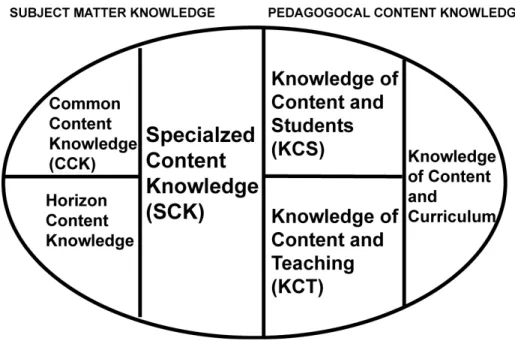
To describe professional knowledge within mathematics Ball and her colleagues use the term “mathematical knowledge for teaching” (MKT). They define MKT as “the mathematical knowledge needed to carry out the work of teaching mathematics”, where teaching is defined as “everything that teachers must do to support the learning of their students” (Ball et al., 2008, p.395). Ball et al. (2008) offer four domains and two categories that comprise MKT. The four domains were empirically generated through factor analysis, and the two categories build off of the researchers’ experiences related to teaching elementary mathematics (Ball et al., 2008).5 Their depiction of the model is provided in the following figure.
5 Ball, Thames, and Phelps attempted to extend Shulman’s work through their research projects entitled
Mathematics Teaching and Learning to Teach Project and Learning Mathematics for Teaching Project. They empirically identified and defined sub-domains of Shulman’s three subject-related categories within elementary mathematics: subject-matter knowledge, pedagogical content knowledge, and curriculum knowledge (Ball et al., 2008). To develop a practice-based theory, Ball et al. (2008) focused on the
Figure 1. Mathematical Knowledge for Teaching Model: adapted from Ball et al. (2008).
This figure shows a visual representation of Ball et al.’s MKT model.
The first domain within MKT is common content knowledge (CCK), which is a sub-domain of Shulman’s subject-matter knowledge category. This is defined as “the mathematical knowledge and skill used in settings other than teaching” (Ball et al., 2008, p.399) and involves the ability to perform calculations, solve mathematical problems, give mathematical definitions, and use terms and notation correctly. By calling this knowledge “common” Ball et al. do not mean that everyone has this knowledge, but rather it is knowledge used in many settings and is not exclusive to teaching. They do not intend to trivialize the importance of this knowledge by calling it common, noting that it is essential because “an understanding of the mathematics in the student curriculum plays a critical role in planning and carrying out instruction” (Ball et al., 2008, p.399).
The second domain of MKT, which is also a sub-domain of Shulman’s (1987) subject-matter knowledge category, is specialized content knowledge (SCK). This
includes the ability to work with mathematical content in a way that is unique to teaching. The SCK domain constitutes knowledge that teachers must have beyond the information they teach to their students. Likewise, these forms of knowledge extend beyond a conceptual understanding of mathematics because they require working with
mathematics with “pedagogically strategic intent” (Ball et al., 2008, p.401). Ball et al. (2008) contend that teaching requires using decompressed and unpacked mathematical knowledge “because teaching involves making features of particular content visible to and learned by students” (p.400). Tasks that Ball et al. (2008) identified as both unique to and routine within teaching mathematics and comprise SCK are found in Appendix A.
The third domain of MKT is knowledge of content and students (KCS), which combines knowing about students and knowing about mathematics. This is a sub-domain of Shulman’s (1987) pedagogical content knowledge category. KCS entails the ability to anticipate the way students will interact with mathematics: conceptions and
misconceptions, likely errors, things that will be easy, hard, confusing, interesting, or motivating, and the ability to interpret student thinking based on their explanations (Ball et al., 2008). As Ball et al. (2008) explained, “each of these tasks requires an interaction between specific mathematical understanding and familiarity with students and their mathematical thinking” (p.401).
instructional design tasks: how to sequence content, how to select and sequence examples, and the selection of representations, methods, and procedures. KCT also involves the ability to lead a mathematical discussion, which includes making decisions about which student comments to pursue or ignore and when to interject a question or task into the discussion. Each of the tasks within KCT involves the intersection of mathematical knowledge with “pedagogical issues that affect student learning” (Ball et al., 2008, p.401).
Although the four empirically-identified domains receive the most explanation in the literature, two more categories exist within MKT. The first is horizon content
knowledge, which is provisionally placed as the third aspect of Shulman’s (1987)
subject-matter knowledge category. Horizon content knowledge is the awareness of the
mathematical trajectory of curriculum. For example, an early grades teacher would know the mathematics of later grades and how the mathematics she teaches relates to that which is to come. Horizon content knowledge entails a “vision useful in seeing connections to much later mathematical ideas” (Ball et al., 2008, p.403).
Ball et al.’s final category of MKT is knowledge of content and curriculum, which is synonymous with Shulman’s third category of curricular knowledge. Ball et al. group this under the broader heading of PCK, noting that in later work Shulman’s
Knowledge Quartet. University of Cambridge researchers Rowland, Turner, Thwaites and Huckstep have explored knowledge for teaching mathematics over the past six years (Rowland, Huckstep, & Thwaites, 2005; Rowland & Turner, 2008; Rowland, Turner, Thwaites & Huckstep, 2009; Thwaites, Huckstep & Rowland, 2005). Their aim is to offer a way to build professional knowledge for mathematics teaching. Rowland and his colleagues wanted to build on Shulman’s work by considering the specific knowledge required for teaching elementary mathematics. Similar to Ball et al. (2008), Rowland et al. (2005, 2009) focused on Shulman’s (1987) three content-specific
categories rather than the four categories that are, as they term, generic.
Rowland et al. (2005, 2009) discussed Ball et al.’s (1990, 2005) work and used it to support their comparable position that teachers’ mathematical content knowledge is important because of the impact on students’ learning and achievement. However, they take a different approach and critique Ball et al.’s development of quantitative measures to ascertain a teacher’s MKT (see Phelps & Schilling, 2004). Rowland et al. (2009) cautioned:
founded on the belief that “mathematical content knowledge for teaching will be most clearly seen in the action of teaching” (p.25). The aim of their project, then, was to “identify different aspects of teacher knowledge that have an impact on teaching from observations of that teaching” (Rowland et al., 2009, p.26). Furthermore, their ultimate goal was to help beginning teachers develop their knowledge for teaching mathematics. They wanted to identify how university supervisors, cooperating teachers, district
coaches, and novice teachers “might observe and reflect on mathematics lessons in a way that helped them identify aspects of content knowledge that affected their teaching” (Rowland et al., 2009, p.33). Their model of teacher knowledge is called the Knowledge Quartet (KQ) 6 and is summarized in the following table.
6 To develop a conception of mathematical content knowledge based in teaching, Rowland et al. (2009)
Table 2
Rowland et al.’s (2009) Knowledge Quartet Model
Category Dimension
Foundation Adheres to textbook
Awareness of purpose Concentration on procedures Identifying errors
Overt subject knowledge Theoretical underpinning Use of terminology
Transformation Choice of examples Choice of representation Demonstration
Connection Anticipation of complexity Decisions about sequencing
Making connections between procedures Making connections between concepts Recognition of conceptual appropriateness
Contingency Deviation from agenda
The first category of the Knowledge Quartet is foundation. As the name indicates, this knowledge serves as the foundation for the remaining three categories. The three components that comprise a teacher’s theoretical background are mathematical content knowledge, knowledge of mathematics pedagogy, and beliefs about how students best learn mathematics. Dimensions of teaching that relate to foundation are the ability to perform calculations and procedures, identify errors, and use terms and notation. This category “has the potential to inform pedagogical choices and strategies in a fundamental way,” where fundamental means “a rational, reasoned approach to making decisions about teaching based on something other than imitation or habit” (Rowland et al., 2009, p.30; see also Dewey, 1904/1964). Foundation incorporates two of Shulman’s
categories: subject-matter knowledge and knowledge of purpose. A theoretical
foundation of knowledge about mathematics and its teaching combines within the KQ’s first category and serves as a foundation for the three subsequent categories (Rowland et al., 2009).
Transformation is the second category of the Knowledge Quartet. This maps
The third category of the Knowledge Quartet is connection, which involves “the coherence of the planning or teaching across an episode, lesson, or series of lessons” (Rowland et al., 2009, p.31). While it does not directly equate with Shulman’s (1987) categories, it incorporates aspects of subject-matter knowledge as well as pedagogical content knowledge. Connection includes teachers’ knowledge of the connectedness of mathematical content as well as the ability to sequence topics within and between lessons and order tasks, exercises, and activities. Such knowledge is demonstrated both in planning and teaching. Rowland et al. (2009) noted that “the ability to sequence teaching effectively involves making choices based on knowledge of structural connections within mathematics itself and as awareness of the relative cognitive demands of different topics and tasks” (p.31). By considering each of these dimensions, a teacher is more likely to provide students with coherent and continuous mathematical experiences (Rowland, 2009; see also Dewey, 1904/1964, 1938/1963).
Contingency is the final ategory of the Knowledge Quartet, which incorporates all
seven of Shulman’s (1987) categories. This dimension acknowledges that students’ responses cannot be planned the way teacher’s actions are planned. Although increased knowledge can improve a teacher’s ability to anticipate challenges and likelihoods that may arise in a given lesson, contingency captures the idea that teachers need to be able to “think on their feet.” The three main dimensions of this dimension are a teacher’s
knowledge that affect teaching and can also be used in observations and reflections to develop teachers’ mathematical knowledge.
Similarities between MKT and KQ models7. Similarities exist between Ball et al.’s (2008) MKT model and Rowland et al.’s (2009) KQ model. One similarity is that both models operate under a positive rather than deficit perspective of teacher
knowledge. Their projects consider the types of mathematics that teachers engage in rather than beginning with gaps in teacher knowledge. A second similarity of the two models is the conceptualization that knowledge for teaching mathematics is unique to mathematics teaching. Each research team argues that knowledge required for teaching mathematics is not simply more or deeper mathematical knowledge than that which is expected of students, but rather that teacher knowledge is qualitatively different (Ball et al., 2008; Rowland et al., 2009). A third similarity is that each research team states its model of teacher knowledge is provisional, tentative, and likely to change. Neither team is claiming their model is correct or complete, but rather that it is an attempt to use their experiences and research to date to describe what teachers need to know and be able to do.
In addition to their orientation to teacher knowledge, the MKT (Ball et al., 2008) and KQ (Rowland et al., 2009) models contain largely the same components of teacher knowledge despite differences in arrangement. Rowland et al.’s KQ model captures a few additional aspects of teaching than Ball et al.’s MKT model. To borrow a phrase from Munby et al. (2001) the researcher “assumes a certain compatibility among the different ways of representing knowledge” (p.883) across the two models.
Building on the MKT and KQ models. While there are significant areas of overlap, the strengths of each model seem to be useful footholds for investigating the still relatively new domain of mathematical teacher knowledge. In terms of quantitative measurement of mathematical knowledge for teaching, the MKT authors have developed a well-vetted instrument. Hill, Schilling, and Ball (2004) conducted a series of studies to investigate how knowledge for teaching mathematics is organized and defined, with a particular focus on mathematics teaching at the elementary school level. From 1999 to 2004 they developed an assessment that was based on existing, well-known theories in the fields of mathematics and teacher education (e.g., Ball & Bass, 2003; Grossman, 1990; Shulman, 1987; Wilson et al., 1987). The authors constructed “survey-based teaching problems thought to represent components of the knowledge of mathematics needed for teaching” (Hill, Schilling & Ball, 2004, p.12). Data analysis, including factor analysis, indicated there were three dimensions within mathematical knowledge for teaching, including knowledge of content in number concepts and operations; knowledge of content in patterns, functions, and algebra; and knowledge of students and content in number concepts an operations (Schilling, 2002; Hill, Schilling & Ball, 2004). The resulting instrument, the Mathematical Knowledge for Teaching (MKT) instrument, is the primary means by which the field of mathematics education assesses teachers’ mathematical knowledge for teaching. Many publications exist detailing the
Although the quantitative offering of the MKT instrument is substantial, there were advantages to building off the KQ model for the qualitative aspects of this study. To begin, the similar language and terms used by Ball et al. (2008) in describing the four domains and two categories would have made it more difficult to make distinctions between the MKT categories when analyzing data. The MKT authors themselves noted, “It is not always easy to discern where one of our categories divides from the next, and this affects the precision (or lack thereof) of our definitions” (Ball et al., 2008, p.403). Alternatively, the four categories of the KQ are arranged into more distinct groupings and therefore its use is preferable for accurate and consistent data analysis.
The KQ model contains an additional aspect of knowledge for teaching that the MKT model does not, found in the KQ “contingency” category. This category
acknowledges the real-time decisions and moves teachers must make. The inclusion of this category is especially important for this study, since contingency is an area of known difficulty for preservice teachers (Rowland et al., 2009). Rowland et al. ‘s (2009) KQ model incorporates the big ideas of teaching elementary mathematics in a way that is complicated enough to provide fruitful data analysis while straightforward enough to consistently analyze data through the four distinct KQ categories. The KQ model is also flexible enough to work across a wide range of elementary school curricula.
A potential pitfall to mapping out knowledge for teaching is thinking categories are the literal means by which knowledge is held in teachers’ minds rather than as a heuristic device for helping us think about teacher knowledge (Borko & Putnam, 1996). Teacher knowledge does not exist in discrete categories but is connected across
elementary mathematics by identifying categories and proposing heuristics, the act of teaching remains entirely more complicated. In mathematical terms, this is an instance where the whole is greater than the sum of its parts; the act of teaching still exceeds the sum of its heuristical parts even as these parts attempt to complicate our views of teaching. Still, the MKT and KQ models offer a window into teacher knowledge. The ultimate goal of expanding teachers’ MKT is to “help to ensure that every child has a qualified teacher” (Hill et al., 2007, p.150). In addition, “Mathematical knowledge for teaching may also act upon…teachers’ ability to motivate students to learn, to organize classrooms for productive instruction, and to produce learning goals” (Hill et al., 2007, p.152). Understanding the development of mathematical knowledge of preservice teachers builds upon the literature related to PCK and also teacher development. The teacher development literature will be reviewed next.
Part Three: Teacher Development
The work on PCK within elementary mathematics teaching has focused attention on the subject-specific aspects of teacher knowledge. Sowder (2007) stated that, “We now have at least some knowledge about what a teacher needs to know to be an effective teacher, and this knowledge should guide us in developing programs for teacher
the map remains void of discernable paths on which to walk en route to the development of the identified knowledge.
The expert teacher, portrayed in studies and teacher education, conveys the image of an autonomous knowledge source. As Britzman (1991) cautioned, “the understanding that all knowledge is a construct and can thus be deconstructed and transformed by the knower is disregarded” (p.230). Leinhardt (1993) argued that “Knowing how experts tend to behave does not help in getting someone to that point, and more importantly, simply copying expertise alone is likely to result in an inappropriate conservatism and lack of innovation” (p. 890; see also Dewey, 1904/1964). Overall, research in teacher education and teacher develop has neglected this crucial aspect. As Munby et al. (2001) explained, “The problem of tracing the path from novice to expert and detailing how expert knowledge is acquired from experience is…a serious omission” (p.890; see also Carter, 1990; Clift, 1989; Munby & Russell, 1994).
While teacher educators often talk about learning to teach, “research insufficiently emphasizes a theory of learning to teach” (Munby et al., 2001, p.893). Here it is helpful to quote Feiman-Nemser and Remillard (1996) at length:
The phrase learning to teach rolls easily off the tongue, giving the impression that it is a straightforward, easily understood process. In fact, we do not have well-developed theories of learning to teach and the phrase itself covers many conceptual complexities…Knowing what good teachers do, how they think, or what they know is not the same as knowing how teachers learn to think and act in particular ways and what contributes to their learning. (p.63)
Two oversimplified assumptions prevail regarding learning to teach, the first that teaching is learned through trial and error and the second that it is learned through
1996). Cochran and Jones (1998) examined preservice teachers’ knowledge and found that the process of teaching itself increased teacher knowledge and its connectedness, although they noted that “we have very little information on how this occurs.” This finding is consistent with constructivist teaching and learning. As Munby et al. (2001) stated, “In the area of science teaching, at least, the sense is that teaching experience makes a substantial contribution to the richness and interconnectedness of teachers’ knowledge. This approach merits extension to all subject areas” (p.882). This study extended this work into the development of elementary mathematics teachers. Munby et al. (2001) acknowledged that, despite progress, “the nature and development of
CHAPTER THREE PHILOSOPHICAL FRAME
Maxine Greene (1986) asserted the contributions philosophy can make to
research. In reference to her work Munby et al. (2001) stated, “philosophic perspectives do not provide guidelines for situation-specific practice. But they can provoke far-reaching questions and more examination of preconceptions and assumptions, opening possibilities for further inquiry and clarification of concepts and terms” (p.879). As Greene (1986) wrote, “If the ‘doing’ of philosophy moves researchers and teachers to do more thinking about their own thinking, it is justified. If it intensifies the wonder with regard to teaching, enhances awareness of what remains unsolved, philosophers may have accomplished what they have set out to do” (p.499).
Munby et al. (2001) noted that the field has acknowledged the importance of experience for the development of teacher knowledge, but tends to do so in an oversimplified way:
Without a treatment of the epistemology of experience and of experiential knowledge, the review implies that the having of an experience is enough for the development of the knowledge of teaching…(This assumes) two unproblematic transfers: an unproblematic transfer of experience to propositional knowledge, and an unproblematic transfer of propositional knowledge to teaching actions. (p.883)
Dewey’s Philosophy of Experience
Current readers of Dewey’s work must take care to not read too superficially, lest we may misappropriate or oversimplify his philosophies. Particular attention must be given to Dewey’s use of terms and language that may sound similar or even the same as present-day language, but may in fact have been used differently by him.8 Integral concepts including education, experience, continuity, and interaction must be understood in order to understand his philosophy of educative experience. This is necessary because, as Archambault (1964) explained, “(Dewey’s) educational principles can only be
understood in the context of his total philosophy” (p.xxix). After establishing a
foundation with Dewey’s integral concepts, the characteristics of educative experiences will be described.
Dewey’s (1916/1985) conception of education is that it is a “reconstruction or reorganization of experience which adds to the meaning of experience, and which increases ability to direct the course of subsequent experience” (p.82). Education, therefore, is experience-based and thus one must take care to understand the way in which Dewey conceptualized experience in order to have an appropriate conception of education. Dewey explained this by stating, “There is an intimate and necessary relation between the processes of actual experience and education. If this be true, then a positive and constructive development of its own basic idea depends upon having a correct idea of experience” (Dewey, 1938/1963, p.20). Dewey conceptualized experience as something distinct from the prevalent notion of “everything or anything that happens to a person” (Hook, 1985, p.x). Additionally, he explained that “mere activity does not constitute
8 Thanks to Lynda Stone and her helpful facilitation of the Dewey reading group in which this idea was
experience” (Dewey, 1916/1985, p.146). Experiences are present-centered interactions between people, objects, and environments such that there is the formation of or impact on habits, attitudes, preferences, aversions, sensitivities, and/or responsiveness. As a result of experiences, future objective conditions are changed and particular ends are easier or harder to attain (Dewey, 1938/1963). Hook (1985) explained, “As Dewey uses the term, (experience) refers to a pattern of events in which the organism is deliberately or with some awareness attending or acting upon something and undergoing or suffering the consequences of the action” (p.x). Although learning can and does happen
unconsciously in a process that begins “almost at birth” (Dewey, 1897/1964, p.427), an experience requires an increased level of consciousness (Dewey, 1916/1985).
It is important to note that although education, growth, and development are interchangeable terms for Dewey, education and experience are not. To be sure education and experience are related concepts, as Dewey (1938/1963) explained that “education is a development within, by, and for experience” (p.28), but they are not synonymous. This is true for two reasons. First, all experiences have an impact, but not all experiences are educational. Dewey (1938/1963) wrote in Experience and Education, “The belief that all genuine education comes about through experience does not mean that all experiences are genuinely or equally educative” (p.25). Second, Dewey believed that learning can occur not only from one’s direct experience but also from the
experiences of others. Therefore there could be learning without a first-hand experience, which would not be captured if one equated education with experience.
between education and experience is that “education is the process by which on the basis of present experiences we make future experiences more accessible, meaningful, or controllable” (Dewey, 1916/1985, p.x). Education serves as the process by which
experiences are reorganized and restructured such that learning, growth, and development can occur (Dewey, 1916/1985, 1938/1963).
Dewey’s Philosophy of Educative Experience
Dewey (1938/1963) explained that a theory or philosophy of experience is necessary to conceive of education based on experience:
If, then, I am asked why I have spent so much time on expounding a rather
abstract philosophy, it is because practical attempts to develop schools based upon the idea that education is found in life-experience are bound to exhibit
inconsistencies and confusions unless they are guided by some conception of what experience is, and what marks off educative from non-educative and mis-educative experience. (p. 51)
If one rushes to develop practical applications too quickly, “they are at the mercy of every intellectual breeze that happens to blow” (Dewey, 1938/1963, p.51). In order to begin developing a conception of experience Dewey (1938/1963) explained, “I have tried to illustrate the need for such a theory by calling attention to two principles which are fundamental in the constitution of experience: the principles of interaction and of
It is important to note that although continuity and interaction are named separately, this is only due to the convention of language and ought not suggest a separation or hierarchy between the two (Dewey, 1938/1963). Dewey (1938/1963) described continuity and interaction as organic wholes that have an intimate and active union. He wrote, “the two principles of continuity and interaction are not separate from each other. They intercept and unite. They are, so to speak, the longitudinal and lateral aspects of experience” (Dewey, 1938/1963, p.44). Additionally, Dewey (1938/1963) believed that the organic whole of continuity and interaction “provide the measure of the educative significance and value of an experience” (p.45). Therefore, continuity and interaction will first be described as concepts and second discussed as criteria for educative experiences.
The concept of continuity. Just as Dewey (1938/1963) described growth and development as continuous processes, so too are experiences continuous (Fishman & McCarthy, 1998; Talisse, 2000; Webb, 1976). Although an experience is not everything that happens, every experience does contain a measure of continuity. Dewey’s
it easier or harder to act for this or that end. Moreover, every experience influences in some degree the objective conditions under which further experiences are had” (p.37).
Dewey’s conception of the continuity of experience has two implications. First, it amplifies the impact of any given experience, as it will live into the future. Second, the forward-feeding nature of experience also requires one to consider the future in order to discuss a present experience. Continuity of experience means that “every means is a temporary end9 until we have attainted it. Every end becomes a means of carrying activity further as soon as it is achieved” (Dewey, 1916/1985, p.113). Using Dewey’s conception of continuity as a basis, its relationship to educative experiences will now be considered.
Continuity as criteria. Although every experience “has” continuity, the quality of the experience determines the way continuity plays out in that and subsequent experiences (Dewey, 1938/1963; Fishman & McCarthy, 1998). As Dewey (1938/1963) wrote, “Every experience is a moving force. Its value can be judged only on the ground of what it moves toward and into” (p.38). Dewey referred to experiences that move a person towards and into positive ends as educative. Although evaluation of an experience ultimately needs to occur on a case by case basis, there are some broad statements that can be made as to the “types” of experiences that Dewey deemed educative.
Related to the concept of continuity, an educative experience is one that promotes growth in knowledge, mental processes, attitudes, and as a cumulative result, expands the
9 Dewey termed the consideration of the fluidity of means and ends as end in view (Webb, 1976). For
possibilities for the future. The primary criterion for educative experiences is that they contribute to growth. As Dewey (1916/1985) wrote, “the educative process is a
continuous process of growth, having as its aim at every stage an added capacity of growth” (p.59). Dewey (1938/1963) explained that “Growth, or growing as developing, not only physically but° intellectually and morally, is one exemplification of the principle of continuity” (p.36). He further explained the link between continuity and growth by stating, “Growing is not something which is completed in odd moments; it is a
continuous leading into the future” (Dewey, 1916/1985, p.61). Dewey (1938/1963) believed that continuity, growth, and reconstruction of experience meant that every experience should prepare a person for deeper and more expansive experiences in the future. Broadly defined across several areas, growth was Dewey’s primary criterion for educative experiences.
Educative experiences result in growth not only in the accumulation of knowledge but also in the development of positive mental processes. Dewey (1916/1985) made a distinction between training and education, where the former is concerned with answers and outward actions and the latter is focused on the development of metal processes. As Dewey (1938/1963) wrote, “no experience is educative that does not tend both to
knowledge of more facts and entertaining of more ideas and to a better, a more orderly, arrangement of them” (p.82). This indicates that not only must one’s factual knowledge increase, but in turn one must be opened up to increased possibilities through the
even fix habits, but in as much as one lacks awareness of his/her responses the experience remains within the realm of training rather than education (Dewey, 1916/1985). The result is that our habits “posses us, rather than we them” (Dewey, 1916/1985, p.34; see also Kestenbaum, 1977; Webb, 1976). It follows that educative experiences are active experiences that lead to growth in mental processes (i.e., critical thinking and reflection).
Educative experiences also contribute to growth in one’s attitude (Webb, 1976). As Dewey (1916/1985) wrote, “the criterion of the value of school education is the extent in which it creates a desire for continued growth and supplies means for making the desire effective in fact” (p.58). The continuity of an educative experience is such that it “arouses curiosity, strengthens initiative, and sets up desires and purposes that are sufficiently intense to carry a person over dead places in the future” (Dewey, 1938/1963, p.38). Educative experiences generate additional positive possibilities because of the way they are carried into the future through one’s attitude, which is “fundamentally what counts in the future” (Dewey, 1938/1963, p.48). Fishman and McCarthy (1998)
summarized Dewey’s ideas on this topic by writing, “For Dewey, continuity is
educationally effective when a sequence of experiences, despite occasional cul-de-sacs and detours, is so driven by deeply held purposes that it coheres, develops, and finds fulfillment; for example, a problem is solved, a discussion is played out, a piece of writing reaches consummation” (p.32). The combination of growing in the moment and for the future embodies Dewey’s conception of educative experiences.
build upon each other or towards a consistent end. This disconnectedness results in the formation of habits that do not help generate self-control or control of future experiences. Instead, these habits have “the effect of arresting or distorting the growth of further experience” (Dewey, 1938/1963, p.25). Mis-educative experiences “engender
callousness” and reduce sensitivity and responsiveness (Dewey, 1938/1963, p.25). It is important to note that using enjoyment as a criterion for experience should be avoided, because “an experience may be immediately enjoyable and yet promote the formation of a slack and careless attitude.” This is problematic because such an attitude will interfere with future growth (Dewey, 1938/1963, p.26). Experiences also mis-educate when too great an appeal is made to preparation for the future, with the false assumption that the acquisition of skills in the present will translate into future application of these skills under new conditions (Dewey, 1938/1963). In sum, the continuity of mis-educative experiences results in a trajectory or cumulative affect that “narrow(s) the field of further experience” (Dewey, 1938/1963, p.26) and causes a “low plane of development, in a way which limits later capacity for growth” (pp.37-38).
The concept of interaction. Just as every experience contains some form of continuity, so too does every experience contain some degree of interaction (Fishman & McCarthy, 1998; Talisse, 2000). As Dewey (1938/1963) explained, “An experience is always what it is because of a transaction taking place between an individual and what, at the time, constitutes his environment”10 (p. 43). Dewey did not believe that experiences
10 The environment includes people, subjects, and/or objects and is any and every condition that “interact(s)
occurred exclusively within an individual (Talisse, 2000). As he stated, “It ought not to be necessary to say that experience does not occur in a vacuum” (Dewey, 1938/1963, p.40). Rather, he believed in conjoint experiences in which each person present is both a participant in and impacted by the experience (Dewey, 1916/1985, 1938/1963; Webb, 1976). Dewey (1934/1964) believed social interaction was crucial, because “the material of genuine development is that of human contacts and associations” (p.11). The quality of interaction, and in particular social interactions, contribute to the educative nature of an experience.
Interaction as criteria. Just as the concept of continuity can be used to inform the distinction between experiences which are educative versus those that are
mis-educative, so too can the concept of interaction be used in this way. One criterion to consider is whether interactions and experience occur in a thoughtfully planned environment. Dewey (1916/1985) explained that “We never educate directly, but indirectly by means of the environment” (p.23). Environments can be carefully planned to encourage experiences therein to be educative, or the environment can be left
Using Dewey’s conception of interaction, a second criterion to consider whether an experience is educative is if there are opportunities for positive social interactions. Similar to the continuity of experience, although every experience “has” interaction the quality of the experience is determined, in part, by the type of interaction that exists. Given Dewey’s conception of education as growth and development arising out of social contexts, social interaction must be considered as a criterion for educative experiences. Dewey (1938/1963) wrote, “The principle that development of experience comes about through interaction means that education is essentially a social process” (p.58). This is not to say that every educative experience must entail social interaction, but Dewey encouraged social interactions to occur whenever possible in order to promote growth.