Małgorzata Kobusiak-Prokopowicz, Maria Pregłowska, Andrzej Mysiak
Admission Glucose Level, Left Ventricular Function
and the Severity of Coronary Atherosclerosis
in Patients with Acute Myocardial Infarction
with and Without Diabetes
Stężenie glukozy podczas przyjęcia u chorych na zawał mięśnia sercowego
a czynność lewej komory i stopień zaawansowania zmian miażdżycowych
w tętnicach wieńcowych
Department of Cardiology, Wroclaw Medical University, Wrocław, Poland
Abstract
Background. Prior studies have suggested that increased admission glucose is an independent predictor of both in-hospital and long-term mortality in patients with acute myocardial infarction (AMI), but the relationship between them is not well defined.
Objectives. This study was undertaken to assess the relationship between increased admission glucose in patients with ST-elevated AMI (STEMI) and left ventricular function and the degree of severity of atherosclerosis in dia-betic/ impaired glucose tolerance (IGT) and non-diabetic patients with STEMI.
Material and Methods. The study group consisted of a total of 100 patients with AMI, 27 women and 73 men (aged 56–86 years), who underwent coronary angiography followed by angioplasty within 12 hours after the onset of chest pain. Plasma glucose level was measured at the time of hospital admission. Either diabetes type II or IGT were diagnosed in 52 patients – Group A. In 48 patients there was neither diabetes nor IGT – Group B. Then the patients were divided into 4 groups: Group 1 consisted of 37 diabetic/IGT patients with admission glucose level < 180 mg%; Group 2 – 15 diabetic/IGT patients with admission glucose level ≥ 180 mg%; Group 3 – 23 non- -diabetic/IGT patients with admission glucose level < 140 mg%; and Group 4 – 25 non-diabetic/IGT patients with admission glucose level ≥ 140 mg%. The severity of atherosclerosis in coronary angiography and left ventricular ejection fraction (LVEF) were assessed.
Results. In Group A, anterior/anterolateral myocardial infarction were confirmed much more frequently than in Group B (p < 0.05). There was no difference between Groups A and B in the number of significantly narrowed coronary vessels; nor was there any significant correlation between admission glucose and the number of arteries blocked by coronary atherosclerosis in any of the groups. LVEF did not differ significantly between Groups A and B, nor was any significant correlation found between LVEF and admission glucose. Admission glucose in Group A showed a positive correlation with the patients’ age (r = 0.318; p < 0.005) and gender (it was higher in men – R = 0.415; p < 0.05), while in Group B a positive correlation was found between admission glucose and BMI (r = = 0.294; p < 0.05). Admission glucose in Group 3 showed a positive correlation with LVEF (r = 0.451; p < 0.005).
Conclusions. Admission glucose level in patients with STEMI does not reveal the severity of coronary atheroscle-rosis. Moreover, in patients with type 2 diabetes/IGT, admission glucose level does not correlate with LVEF in the early phase of myocardial infarction (Adv Clin Exp Med 2011, 20, 1, 57–64).
Key words: admission glucose level, diabetes, impaired glucose tolerance, ST-elevated AMI, acute coronary syn-drome.
Streszczenie
Wprowadzenie. Badania analizujące zależność między podwyższonym stężeniem glukozy podczas przyjęcia do szpitala, występowaniem cukrzycy i rokowaniem przynoszą sprzeczne wyniki. Niektórzy wskazują, że zwiększona glikemia jest równorzędnym czynnikiem złego rokowania zarówno u chorych na cukrzycę, jak i z prawidłową gospodarką węglowodanową, w innych pracach podwyższona glikemia podczas przyjęcia wiązała się z gorszym rokowaniem jedynie u chorych bez uprzednio rozpoznanej cukrzycy.
Adv Clin Exp Med 2011, 20, 1, 57–64 ISSN 1230-025X
oRIGINAL PAPERS
Cel pracy. ocena stężenia glukozy w surowicy podczas przyjęcia do szpitala w odniesieniu do czynności lewej komo-ry serca oraz stopnia zaawansowania zmian miażdżycowych u chokomo-rych na zawał mięśnia sercowego z przetrwałym uniesieniem odcinka ST (STEMI).
Materiał i metody. Do badania zakwalifikowano 100 kolejno przyjętych do kliniki Kardiologii chorych z ostrym zawałem mięśnia sercowego typu STEMI w wieku 41–86 lat, w tym 27 kobiet i 73 mężczyzn. Czas trwania dolegliwoś-ci dławicowych nie przekraczał 12 godz. Bezpośrednio po przyjędolegliwoś-ciu oznaczano stężenie glukozy w surowicy. U 52 chorych rozpoznano cukrzycę typu 2 lub upośledzoną tolerancję glukozy (IGT) – grupa A. U 48 chorych nie stwierdzono zaburzeń gospodarki węglowodanowej – grupa B. Chorych, w zależności od stężenia glukozy w suro-wicy podczas przyjęcia, podzielono na 4 grupy: 1 grupa – 37 chorych z cukrzycą/IGT z glikemią podczas przyjęcia < 180 mg/dl; 2 grupa–15 chorych z cukrzycą /IGT z z glikemią podczas przyjęcia ≥ 180 mg/dl; 3 grupa – 23 osoby bez cukrzycy/IGT z glikemią podczas przyjęcia < 140 mg/dl; 4 grupa – 25 osób bez cukrzycy/IGT z glikemią ≥ 140 mg/dl. Wszystkim chorym wykonywano koronarografię oraz badanie echokardiograficzne z oceną frakcji wyrzutu lewej komory (LVEF).
Wyniki. W grupie A istotnie częściej niż w grupie B stwierdzano zawał ściany przedniej/przednio-bocznej (p < 0,05). W grupie B istotnie częściej niż w grupie A stwierdzano zawał ściany dolnej/dolno-bocznej (p < 0,02). W grupie A wykazano dodatnią korelację między stężeniem glukozy podczas przyjęcia a wiekiem (r = 0,318; p < 0,05) oraz płcią męską (R = 0,415; p < 0,05). W grupie B wykazano dodatnią korelację między stężeniem glukozy podczas przyjęcia a BMI (r = 0,294; p < 0,05). Nie stwierdzono istotnej statystycznie różnicy w liczbie zmian miażdżycowych w naczyniach wieńcowych między chorymi z grupy A a chorymi z grupy B. Nie stwierdzono istotnej statystycznie różnicy LVEF między chorymi z grupy A a chorymi z grupy B (55,3 ± 14,3% vs 56,5 ± 10,7%; pNS). W grupie 3 glikemia podczas przyjęcia korelowała dodatnio z LVEF (r = 0,451; p < 0,005). W żadnej z czterech badanych grup nie wykazano korelacji między stężeniem glukozy podczas przyjęcia a liczbą tętnic wieńcowych objętych zmianami miażdżycowymi.
Wnioski. Stężenia glukozy w surowicy podczas przyjęcia chorych ze STEMI nie identyfikuje stopnia zaawanso-wania miażdżycy naczyń wieńcowych oraz w grupie chorych na cukrzycę typu 2/IGT nie koreluje z czynnością skurczową lewej komory w ostrej fazie zawału (Adv Clin Exp Med 2011, 20, 1, 57–64).
Słowa kluczowe: glikemia, stężenie glukozy w surowicy podczas przyjęcia, cukrzyca, upośledzona tolerancja glu-kozy, zawał mięśnia sercowego, ostry zespół wieńcowy.
According to epidemiologic studies the num-ber of people suffering from diabetes increased worldwide to 61 million between 1994 and 2000; by 2025 it is projected to be an estimated 380 mil-lion, which constitutes 4.5% of the whole popu-lation [1]. It has been established that ischemic heart disease is the main cause of death in diabetic patients. An analysis of the Euro Heart Survey on Diabetes and the Heart shows that 31% of patients with ischemic heart disease had been diagnosed with prior diabetes, while 22% of those with acute myocardial infarction (AMI) developed diabetes de novo [2].
Studies that analyze the relationship between higher admission glucose levels, diabetes presence and prognosis have produced inconsistent results. Some researchers claim that hyperglycemia in pa-tients with acute coronary syndromes (ACS) brings the risk of less optimistic prognostic estimates of survival for both diabetic and non-diabetic pa-tients. In other studies an increased admission glu-cose level is associated with less optimistic progno-ses only for patients without prior diabetes [3, 4]. Lavi et al. have shown that within a group of 431 patients the risk of mortality was not due to diabe-tes, but to glucose level at admission. In-hospital and annual mortality was higher in non-diabetic patients with glucose levels > 126 mg/dl. Elevated plasma glucoseof 1 mg/dl resulted in a 0.6% higher risk of death and a 2% higher risk that the subject
would need revascularization within one year [5]. The negative influence of hyperglycemia on the risk of death in patients with prior infarction, re-gardless of the presence of diabetes, has also been confirmed in studies by Dirkali et al. [6]. Gąsior et al. claim that every 18 mg/dl increase in admis-sion glucose level increases the risk of mortality by about 6% in the course of annual observation [7].
Some scientific investigations emphasize that a 30-day prognosis (including in-hospital short-term prognosis) does not have much impact on long-term prognosis [8]. observations by Ishihara et al. found that both diabetes as well as an increased admission glucose level (regardless of the presence of diabetes) significantly influence the risk of death in various time intervals. Admission glycemia ≥ 200 mg/dl increases the risk of death within a 30-day observation period, while diabetes substantially in-fluences mortality in a three-year observation pe-riod [9]. Thus, during three years of observation the importance of the admission glucose level was less significant than diabetes [9]. The authors suggested that a high glucose level at admission in patients with and without diabetes should be perceived as two distinct sets of syndromes [9].
diabe-tes protects the heart against ischemia and hypoxia [12, 13]. The influence of regulation of antiapop-totic factor Bcl-2 or inactivation of proapopantiapop-totic factor Bad has been discussed in an attempt to ex-plain the cardioprotective effect of hyperglycemia [12, 14]. Nevertheless, the protective influence of hyperglycemia on ischemic heart disease and its functioning remains unexplained.
The aim of the study was to assess left ventric-ular function and the severity of coronary athero-sclerosis in patients with acute myocardial infarc-tion with persistent ST-segment elevainfarc-tion (STEMI) in relation to admission serum glucose levels.
Material and Methods
The study involved 100 patients with acute myocardial infarction with persistent ST-segment elevation (average age: 62.5 ± 11.6 years), including 27 females aged 49–81 (average age: 69.26 ± 9.5) and 73 males aged 41–86 (average age: 60.0 ± 11.3), admitted to Wroclaw Medical University’s Cardi-ology Department. The duration of their angina pectoris symptoms did not exceed 12 hours. The patients’ profiles are presented in Tables 1–2.
A 12-lead electrocardiograph was performed along with a Troponin I (Tnl) test to diagnose myocardial infarction. Myocardial infarction with persistent ST-segment elevation (STEMI) was
di-agnosed in accordance with the standards of the European Society of Cardiology [15].
Patients with severe cardiac insufficiency re-quiring intravenous infusion of inotropic drugs, those with stage 4 or 5 renal failure, those with
Table 1. Patients’ overall profile
Tabela 1. Chrakterystyka badanych chorych
Patients (Pacjenci) (n = 100)
Admission glucose level (Glikemia przy przyjęciu) mg/dl
163.24 ± 63.2
EF % 55.85 ± 12.7
BMI - kg/m2 27.92 ± 4.2
Infarction zone
(Umiejscowienie zawału) anterior, anterolateral, n (%) (przedni, przedsionkowy) inferior, inferolateral, n (%) (dolny, dolno-boczny)
36 (36) 64 (64)
Atherosclerotic changes (Liczba zmian miażdzycowych) 1, n (%)
2, n (%) 3, n (%)
43 (43) 21 (21) 36 (36) Type 2 diabetes, n (%)
(Cukrzyca typu 2) 36 (36)
IGT, n (%) 16 (16)
Table 2. Diabetic and non-diabetic patients’ profiles
Tabela 2. Charakterystyka chorych na cukrzycę i bez cukrzycy Group A
Diabetic/IGT
(Grupa A – cukrzyca/IGT)
Group B
Non-diabetic/IGT
(Grupa B – bez cukrzycy/IG)
Significance of differences (Istotność różnic) Admission glucose level
(Glikemia przy przyjęciu) mg/dl
165.1 ± 59.8 155.2 ± 54.2 n.s.
EF % 55.3 ± 14.4 56.5 ± 10.8 n.s.
Group 1 Group 2 Group 3 Group 4
55.3 ± 14.6 55.2 ± 14.4 57.5 ± 9.7 55.5 ± 11.9 n.s.
BMI – kg/m2 28.2 ± 4.7 27.6 ± 3.7 n.s.
Group 1 Group 2 Group 3 Group 4
28.2 ± 4.4 28.3 ± 5.7 26.9 ± 3.4 28.1 ± 3.9 n.s. Infarction zone
(Umiejscowienie zawału) anterior, anterolateral, n (%) (przedni, przedsionkowy) inferior, inferolateral, n (%) (dolny, dolno-boczny)
24 (46.2)
28 (53.8)
12 (25.0)
36 (75.0)
0.02
0,02
Atherosclerotic changes (Liczba zmian miażdzycowych)
1, n (%) 2, n (%) 3, n (%)
20 (38.5) 10 (19.2) 22 (42.3)
23 (47.9) 11 (22.9) 14 (29.2)
systemic diseases of connective tissue, those with neoplasms, those who were undergoing either im-munosuppressive or steroid treatment, and those with extremely elevated glycemia (> 400 mg/dl) were excluded from the study.
Type 2 diabetes and impaired glucose toler-ance (IGT) were recognized on the basis of medi-cal history: a prior diagnosis of type 2 diabetes or IGT and use of oral antidiabetic drugs and/or in-sulin. A diagnosis of either type 2 diabetes or IGT de novo was based on the standards of the Polish Diabetes Association [5]. The study also excluded the patients whose case history or observed glyce-mia level during hospitalization prevented an un-ambiguous diagnosis of type 2 diabetes/IGT or an absence of carbohydrate metabolism disorders.
The study was accepted by the appropriate Bioethical Committee. The subjects gave written informed consent before entering the study, in ac-cordance with the recommendations of the Bio-ethical Committee, acting on the rules of Good Clinical Practice and the Helsinki Declaration.
Immediately after admission each patient’s se-rum glucose concentration was checked after taking blood from the basilic vein as a standard procedure. All patients underwent coronography and then primary angioplasty in acute myocardial infarct with a stent. In the coronography narrow-ing of the left main coronary artery by ≥ 50%, and narrowing of the right coronary artery and the left coronary artery branches by ≥ 70% were consid-ered significant.
on admission all patients were given 300 mg of acetylsalicylic acid, and either 300 or 600 mg of clopidogrel orally, provided that neither of these drugs had been previously given by the ambulance personnel. During invasive procedures patients were given a 5000 IU dose of unfractionated intra-venous heparin. During the initial 48 in-hospital hours patients underwent treatment in the Inten-sive Cardiac Care Unit. During the 24-hour period following admission, a beta-adrenolitic drug, ACE inhibitor and statin were introduced to the ther-apy unless there were contraindications for their implementation.
Within 48 hours of admission all patients underwent echocardiography using a Vingmed System 5 (General Electric) with a head signaling frequency of 2.5 MHz. The left ventricular ejection fraction was determined using the standard for-mula EF = (LVEDV – LVESV)/LVEDV × 100%. Both LVEDV and LVESV were assessed using the biplane Simpson’s method, during which a com-puter determines the approximate volume of the left ventricle.
Study groups were established on the basis of the criteria described. Group A consisted of 52 pa-
tients, aged 41 to 86, diagnosed with diabetes type 2 or impaired glucose tolerance (IGT).Group B con-sisted of 48 patients, aged 42 to 81, who did not show any symptoms of carbohydrate metabolism disorders.
The patients were stratified into four groups according to diabetes type 2/IGT and admission glycemia level:
Group 1: 37 patients diagnosed with diabetes type 2/IGT, aged 44 to 79 (average age: 62.1), ad-mission glucose < 180 mg/dl;
Group 2: 15 patients diagnosed with diabetes type 2/IGT, aged 41–86 (average age: 70.5), admis-sion glucose ≥ 180 mg/dl;
Group 3: 23 patients without diabetes type 2/IGT, aged 42–81 (average age: 60.6), admission glucose < 140 mg/dl;
Group 4: 25 patients without diabetes type 2/IGT, aged 43–80 (average age: 60.4), admission glucose ≥ 140 mg/dl;
Statistical Analysis
Statistical evaluation was performed using Statistica 5.0 PL software. The statistical analysis of selected parameters was carried out on the ba-sis of the mean values of the determined variables and their standard deviations. In order to confirm normal distribution of data, the distribution of variables was investigated using the Shapiro-Wilks test. With samples that met this criterion, a further analysis was carried out using Student’s t-test for paired and unpaired samples. With samples that did not display normal data distribution, the dif-ferences in distribution were investigated using the non-parametric U Mann-Whitney test. In order to evaluate the statistical significance of the quali-tative changes, the highest reliability c2 test with
Yates’ modification and exact Fisher test were used. The correlation between the investigated variables was assessed, determining Pearson’s linear correla-tion coefficient (Pearson’s r) as well as using non-parametric correlation (Spearman’s r). Differences were considered significant at p < 0.05.
Results
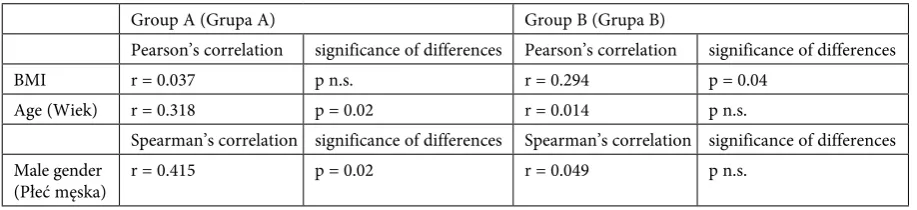
Within Group A, a positive correlation be-tween admission glucose level and age was shown (r = 0.318; p = 0.02). Furthermore, a positive corre-lation between the male sex and admission glucose level (r = 0.415; p = 0.02) was found. In Group B, a positive correlation was found between admis-sion glucose level and BMI (r = 0.294; p = 0.04). No significant difference between Groups A and B was observed in the number of atherosclerotic changes in coronary arteries, nor was there a sig-nificant statistically EF difference between Groups A and B.
In Group 3, admission glucose levels showed a positive correlation with LVEF (r = 0.451; p = 0.003). None of the four groups in the study showed a cor-relation between admission glucose level and the number of coronary atherosclerotic arteries.
Discussion
High glucose concentration at admission may be an independent factor for an unfavorable prognosis in patients with myocardial infarction [3, 16]. However, despite strict regulations about procedures connected with patients suffering from substantially high glycemia during AMI, an increased glucose level in serum is not treated as an independent risk factor either in the risk range
resulting from the In Time II trial or the Morrow-Antman scale created on basis of In Time II [17]. In spite of the acknowledged advantages resulting from the use of insulin during AMI, no precise de-sired glycemia level, nor any tactics for glycemia optimalization in patients with ACS, have been determined yet [18, 19].
Some previous investigations showed that pa-tients with hyperglycemia had multi-vessel coro-nary artery disease and – more frequently – ves-sel reocclusion after angioplasty. In their research, Macín et al. analyzed the influence of glycemia lev-els on the risk of death in 565 patients with ACS [20]. The patients were divided into two groups with a quantified admission glycemia level of 128 mg/dl as the cutoff point. Those authors stated that glycemia levels over 128 mg/dl would mean death within a year of observation at a sensitivity of 85% and specificity of 62%. In addition, it was shown that the group of patients with glycemia levels over 128 mg/dl was at a three times higher risk of death in the long-term observation period [20]. While all the clinical and epidemiology data collected shows a negative influence of hyperglycemia, the data gathered during experimental research is con-troversial, and displays that animals with induced diabetes have significantly increased resistance to ischemic injury [21]. According to Malfitano et al., hyperglycemia within a group of rats with diabetes
Table 3. BMI, age and gender correlation in relation to admission glucose levels stratified into Groups A and B
Tabela 3. Korelacja BMI, wieku i płci ze stężeniem glukozy chorych w grupach A i B
Group A (Grupa A) Group B (Grupa B)
Pearson’s correlation significance of differences Pearson’s correlation significance of differences
BMI r = 0.037 p n.s. r = 0.294 p = 0.04
Age (Wiek) r = 0.318 p = 0.02 r = 0.014 p n.s.
Spearman’s correlation significance of differences Spearman’s correlation significance of differences Male gender
(Płeć męska) r = 0.415 p = 0.02 r = 0.049 p n.s.
Table 4. Correlation between LVEF and atherosclerotic changes in patients and admission glucose level, stratified into Groups 1 to 4
Tabela 4. ocena frakcji wyrzutowej i liczby i zmian miażdżycowych u chorych w odniesieniu do glikemii podczas przyjęcia w grupach 1–4
Group 1 (Grupa 1) Group 2 (Grupa 2) Group 3 (Grupa 3) Group 4 (Grupa 4) significance of
diffe-rences significance of diffe-rences significance of diffe-rences significance of diffe-rences
EF n.s. n.s. r = 0.451
p = 0.003 n.s.
Atherosclerotic changes (Liczba zmian miażdżycowych)
decreased the risk of myocardial infarcted zone by 36%, improved the ejection fraction, lowered pro-inflammatory cytokines and apoptosis activation, and increased cell survival factor concentration, es-timated 15 days after an induced infarction [22].
The aim of the current study was to assess ad-mission glycemia levels in relation to left ventricle function and the severity of coronary atherosclero-sis. In patients with type 2 diabetes/IGT, no corre-lation was found between admission glycemia level and the number of coronary arteries influenced by atherosclerotic changes. In terms of the initial fall in contractility reflecting myocardial injury, there were no significant differences between the groups with and without type 2 diabetes/IGT. A lack of correlation between the size of the infarcted zone and admission glycemia levels in patients with dia-betes was also confirmed by o’Sullivan et al., who analyzed the size of the infarcted zone on the basis of maximum troponin level in serum [8].
The current study is one of a number of re-search studies illustrating the potentially protective impact of hyperglycemia on myocardial injury in the course of myocardial infarction. Patients with carbohydrate disorders probably experience a sort of preconditioning along with the glycemia level changes that occur during their normal lives which results in a greater resilience to glucose level chang-es than non-diabetic patients have [23]. This has been also confirmed by the Japanese authors who compared ejection fraction (EF) changes in pa-tients during acute myocardial infarction and prior to hospital discharge. Although the level of EF was initially the lowest among patients with carbohy-drate metabolism disturbances, the reduction in its level during hospitalization was significantly lower in those patients than in non-diabetic patients. This indicates that patients with diabetes adjust better to changes in carbohydrate metabolism [24]. Similar conclusions were drawn by Stolker et al., who inves-tigated the influence of admission glycemia levels on the presence of contrast-induced nephropathy. Among non-diabetic patients the risk of nephropa-thy increased significantly along with glycemia lev-els, while among diabetic patients no such correla-tion was revealed [25].
Thecurrent study also indicates that in patients without carbohydrate metabolism disturbances and with a normal admission glycemia level,
glu-cose concentration showed a positive correlation with EF. This creates one more aspect requiring further investigation; it may be a coincidence, but may also highlight the significance of the glucose delivery mechanism. King and opie showed that glycolisis is advantageous for an ischemic heart, maintaining cellular membrane function, moder-ating arrhythmia and improving functional recov-ery [26].
In earlier studies it was demonstrated that glucose delivery played an important cardioprotective role in the myocardium’s reaction to ischemia [27]. The key element to the improvement of myocardium func-tion could be increased up-regulafunc-tion of GLUT-1, which allows better glucose delivery in ischemia.
In conclusion it is worth mentioning some American researchers who suggested a cutoff point for hyperglycemia at admission in patients with myocardial infarction, and placed glycemia levels in the category of a continuous variable [28]. In a group of non-diabetic patients, an admission glycemia level over 110 mg/dl was connected with an increase in the 30-day mortality rate, while in a group of diabetic patients an increase in short-term mortality was observed only among those patients who presented with glycemia levels over 240 mg/dl. Annual mortality rates in the study were comparable [28], which is astonishing in the context of previously cited investigations. In their analysis those authors considered whether hyper-glycemia creates a cause-and-effect element of unfavorable prognostic estimates in patients with myocardial infarction, or is merely a coincidental phenomenon. Nevertheless, the controversies sur-rounding hyperglycemia and the inability to deter-mine a correlation between glycemia level, diabetes and prognosis indicate a need for further study.
Study Limitations
The relatively small group of patients limited our investigation, although in terms of both di-agnostic and therapeutic aspects, the population studied was highly homogeneous.
The authors concluded that admission glucose level in patients with STEMI does not reveal the se-verity of coronary atherosclerosis; nor does it cor-relate with LVEF in the early phase of myocardial infarction in patients with type 2 diabetes/IGT.
References
[1] Janeczko D: Epidemiologia chorób układu krążenia u chorych na cukrzycę. Kardiologia na co dzień 2007, 2, 12–16.
[3] Sala J, Masia R, Gonzalez de Molina FJ, Fernández-Real JM, Gil M, Bosch D, Ricart W, Sentí M, Marrugat J: Short-term mortality of myocardial infarction patients with diabetes or hyperglycaemia during admission. J Epidemiol Community Health 2002, 56, 707–712.
[4] Capes SE, Hunt D, Malmberg K, Gerstein HC: Stress hyperglycaemia and increased risk of death after myocardial infarction in patients with and without diabetes: a systematic overview. Lancet 2000, 355, 773–778.
[5] Lavi S, Kapeliovich M, Gruberg L, Roguin A, Boulos M, Grenadier E, Amikam S, Markiewicz W, Beyar R, Hammerman H: Hyperglycemia during acute myocardial infarction in patients who are treated by primary per-cutaneous coronary intervention: impact on long-term prognosis. Int J Cardiol 2008,123, 117–122.
[6] Dirkali A, van der Ploeg T, Nangrahary M, Cornel JH, Umans VA: The impact of admission plasma glucose on long-term mortality after STEMI and NSTEMI myocardial infarction. Int J Cardiol 2007, 121, 215–217.
[7] Gąsior M, Stasik-Pres G, Pres D, Lech P, Gierlotka M, Lekston A, Hawranek M, Tajstra M, Kalarus Z, Poloński L: Relationship between blood glucose on admission and prognosis in patients with acute myocardial infarction treated with percutaneous coronary intervention. Kardiol Pol 2007, 65, 1031–1038.
[8] O’Sullivan JJ, Conroy RM, Robinson K, Hickey N, Mulcahy R: In-hospital prognosis of patients with fasting hyperglycemia after first myocardial infarction. Diabetes Care 1991, 14, 758–760.
[9] Ishihara M, Kagawa E, Inoue I, Kawagoe T, Shimatani Y, Kurisu S, Nakama Y, Maruhashi T, Ookawa K, Dai K, Aokage Y: Impact of admission hyperglycemia and diabetes mellitus on short- and long-term mortality after acute myocardial infarction in the coronary intervention era. Am J Cardiol 2007, 99, 1674–1679.
[10] Iwakura K, Ito H, Ikushima M, Kawano S, Okamura A, Asano K, Kuroda T, Tanaka K, Masuyama T, Hori M, Fujii K: Association between hyperglycemia and the no-reflow phenomenon in patients with acute myocardial infarction. J Am Coll Cardiol 2003, 41, 1–7.
[11] Kersten JR, Toller WG, Tessmer JP, Pagel PS, Warltier DC: Hyperglycemia reduces coronary collateral blood flow through a nitric oxide-mediated mechanism. Am J Physiol Heart Circ Physiol 2001, 281, H2097–2104.
[12] Schaffer SW, Croft CB, Solodushko V: Cardioprotective effect of chronic hyperglycemia: effect on hypoxia-induced apoptosis and necrosis. Am J Physiol Heart Circ Physiol 2000, 278, H1948–H1954.
[13] Xu G, Takashi E, Kudo M, Ishiwata T, Naito Z: Contradictory effects of short- and long-term hyperglycemias on ischemic injury of myocardium via intracellular signaling pathway. Exp Mol Pathol 2004, 76, 57–65.
[14] Ma G, Al-Shabrawey M, Johnson JA, Datar R, Tawfik HE, Guo D, Caldwell RB, Caldwell RW: Protection against myocardial ischemia/reperfusion injury via increased by short-term diabetes: enhancement of VEGF for-mation, capillary density, and activation of cell survival signaling. Naunyn Schmiedebergs Arch Pharmacol 2006, 373, 415–427.
[15] Thygesen K, Alpert JS, White HD on behalf of the Joint ESC/ACCF/AHA/WHF Task Force for the Redefinition of Myocardial Infarction: Universal definition of myocardial infarction. Eur Heart J 2007, 28, 2525–2538.
[16] Foo K, Cooper J, Deaner A, Knight C, Suliman A, Ranjadayalan K, Timmis AD: A single serum glucose measure-ment predicts adverse outcomes across the whole range of acute coronary syndromes. Heart 2003, 89, 512–516.
[17] Morrow DA, Antman EM, Giugliano RP, Cairns R, Charlesworth A, Murphy SA, de Lemos JA, McCabe CH, Braunwald E: A simple risk index for rapid initial triage of patients with ST-elevation myocardial infarction: an InTIME II substudy. Lancet 2001, 358, 1571–1575.
[18] Weston C, Walker L, Birkhead J: National Audit of Myocardial Infarction Project, National Institute for Clinical outcomes Research. Singleton Hospital, Swansea, UK. Early impact of insulin treatment on mortality for hyperglycae-mic patients without known diabetes who present with an acute coronary syndrome. Heart 2007, 93, 1542–1546.
[19] Zalecenia kliniczne dotyczące postępowania u chorych na cukrzycę 2009. Stanowisko Polskiego Towarzystwa Diabetologicznego. Diabetol Dośw Klin 2009, 9, supl. A.
[20] Macín SM, Perna ER, Coronel ML: Influence of admission glucose level on long-term prognosis in patients with acute coronary syndrome. Rev Esp Cardiol 2006, 59, 1268–1275.
[21] Ravingerova T, Neckar J, Kolar F: Ischemic tolerance of rat hearts in acute and chronic phases of experimental diabetes. Mol Cell Biochem 2003, 249, 167–174.
[22] Malfitano Ch, Loureiro TCA, Rodrigues B, Sirvente R, Salemi VMC, Rabechi NB, Lacchini S, Curi R, Irigoyen MCC: Hyperglycaemia protects the heart after myocardial infarction: aspects of programmed cell survival and cell death. Eur J Heart Failure 2010, 12, 659–667.
[23] Zipes DP, Libby P, Bonow R, Braunwald E: Zawał mięśnia serca z uniesieniem ST: patologia, patofizjologia, objawy kliniczne. W: Choroby serca. Red.: Banasiak W, opolski G, Poloński L, Elsevier Urban&Partner, Wrocław 2007, wyd. 7, 1113–1136.
[24] Ishihara M, Inoue I, KawagoeT, Shimatani Y, Kurisu S, Nishioka K, Umemura T, Nakamura S, Yoshida M:
Impact of acute hyperglycemia on left ventricular function after reperfusion therapy in patients with a first anterior wall acute myocardial infarction. Am Heart J 2003, 146, 674–678.
[25] Stolker J, McCullough P, Rao S, Inzucchi SE, Spertus JA, Maddox TM, Masoudi FA, Xiao L, Kosiborod M: Pre-procedural glucose levels and the risk for contrast-induced acute kidney injury in patients undergoing coronary angiography 34. J Am Coll Cardiol 2010, 55, 1433–1440.
[26] King LM, Opie LH: Glucose and glycogen utilization in myocardial ischemia – changes in metabolism and conse-quences for the myocyte. Mol Cell Biochem 1998, 180, 3–26.
[27] Cave AC, Ingwall JS, Friedricj J, Liao R, Saupe KW, Apstein CS, Eberli FR: ATP-synthesis during low-flow ischemia: influence of increased glycolytic substrate. Circulation 2000, 101, 2090–2096.
Address for correspondence:
Małgorzata Kobusiak-Prokopowicz Department of Cardiology
Wroclaw Medical University Pasteura 4
50-367 Wrocław Poland
Tel.: +48 71 784 26 11, +48 71 784 26 12 E-mail: [email protected]
Conflict of interest: None declared