BUILDING AN ALTERNATIVE NCAA DIVISION I COMPETITION MODEL
Shinann Featherston
A thesis submitted to the faculty of the University of North Carolina at Chapel Hill in partial fulfillment of the requirements for the degree of Masters of Arts in the Department of Exercise
and Sport Science (Sport Administration).
Chapel Hill 2017
Approved by: Barbara Osborne Erianne Weight
ABSTRACT
Shinann Featherston: Building an Alternative NCAA Division I Competition Model (Under the direction of Barbara Osborne)
As the costs of athletic departments continue to rise, there is growing concern that the geographical footprint of conferences will not be financially sustainable. In response to this uncertainty, different competition models have been explored at the surface level; however, no clear model has been set forward. Recommendations and lessons learned from thirteen
PREFACE
As a former collegiate athlete at the University of North Carolina at Chapel Hill, I was given a once in a lifetime opportunity with unlimited resources to learn, grow, and ultimately leave the school as a better person than I was when I came, but I am aware and have learned that not all student-athletes are given the same/equal opportunity to pursue a national championship.
As a huge sports fan, I do appreciate the Cinderella story every year in Basketball or in any sport for that matter (Coastal Carolina winning the College World Series). However, as the financial situations continue to look bleak with budget deficits, I believe we need to sit back and ask ourselves the question—where do we want the college landscape/industry to be in ten years? If what we are doing does not seem to help that—things need to change.
At the end of day, there are many children throughout the world whose goal is to play a sport in college. Some may also have professional ambitions, but by and large many are looking for the balanced student-athlete experience to have the opportunity to play a sport and study whatever major they choose at the same time. I have, therefore, felt compelled to find an alternative NCAA Division I (for the purposes of this paper) Competition Model, to allow or to guarantee that upcoming youth will be given the college athlete experience I was given.
TABLE OF CONTENTS
LIST OF TABLES ··· vii
CHAPTER I: INTRODUCTION ··· 1
Purpose of Study ··· 1
Research Question ··· 2
Definition of Terms ··· 2
Limitations ··· 3
Delimitations ··· 3
Assumptions ··· 3
Significance of Study ··· 3
CHAPTER II: REVIEW OF LITERATURE ··· 5
NCAA Division I Autonomy Governance Structure ··· 5
Role of Conferences ··· 7
Conference Realignment ··· 9
Financial Concerns ··· 12
Time Demands ··· 16
Legal Framework ··· 18
CHAPTER III: METHODOLOGY ··· 27
Procedure ··· 28
Data Analysis ··· 30
CHAPTER IV: RESULTS ··· 31
Participant Background ··· 31
Research Question 1 ··· 32
Research Question 2 ··· 45
Research Question 3 ··· 51
CHAPTER V: PROPOSING A NEW NCAA DIVISION I REGIONALIZED COMPETITION MODEL ··· 56
Framework of Model ··· 56
Conclusion ··· 59
Summary ··· 67
APPENDIX A ··· 70
APPENDIX B ··· 71
LIST OF TABLES
Table 1: Revenue Produced by Autonomous Five Conferences (2014- 2015) ... 10
Table 2: Revenue Produced by Group of Five Conferences (2014- 2015) ... 10
Table 3: Top Five Revenue Making Public Schools in the A5 vs. the Group of 5 ... 14
Table 4: Highest Subsidized Public Schools in each of the Group of 5 Conferences ... 15
Table 5: Participant Background ... 32
Table 6: Reasons for building an Alternative Model ... 33
Table 7: Concerns about building an Alternative Model ... 39
Table 8: Thoughts on establishing an Alternative Model ... 46
Table 9: Affiliation with Conference ... 47
Table 10: Characteristics of a Competitive Alliance ... 47
CHAPTER I
INTRODUCTION
Intercollegiate athletics, specifically Football and Men’s Basketball, elicit significant media revenue and publicity for Division I institutions.1 This in turn drives schools to follow the money to conferences that have large media deals. Although institutions greatly benefit from the media rights deals and the national exposure of the Football and Men’s Basketball programs, the question of whether Olympic non-revenue sports should be tied to these conference decisions remains. So much of conference realignment is driven by money, a new approach could be student-athlete centered.
The impetus to change the current NCAA Division I model is to address the financial concerns for Division I institutions and the time demands issues for student athletes.2
Purpose of Study
The purpose of this study is to delineate an alternative NCAA Division I regionalized competition model.
1 Jason R. Lanter & Billy J. Hawkins, The Economic Model of Intercollegiate Athletics and Its Effects on the College Athlete Educational Experience, 6 J. INTERCOLLEGIATE SPORTS 86, 86 (2013),
http://www.humankinetics.com/acucustom/sitename/Documents/DocumentItem/10_lanter_JIS_02130011_ce%2086 -95-ej.pdf.
2 Jeff Smith, Aligning Athletics Within Academic Missions in Division I, FORBES.COM, (Sept. 4, 2014, 4:23 PM),
Research Question
RQ. What are the philosophical, organizational, and managerial components of a regionalized NCAA Division I competition model federated by sport?
Definition of Terms
Conference realignment: When an institution accepts an invitation to join an athletic conference with which it is not already affiliated.3
Division I: The highest level of intercollegiate athletics sponsored by the National Collegiate Athletic Association. In general, Division I institutions have the biggest student bodies, manage the largest athletics budgets and offer the most generous number of scholarships.4
NCAA: A national governing body for collegiate athletic associations.
Athletic Conferences: Voluntary athletic associations in which NCAA member institutions agree to simultaneously cooperate and compete.
Autonomous Five Conferences: Collegiate athletic conferences in the NCAA Division I FBS, comprised of the Atlantic Coast Conference (ACC), the Big Ten Conference (BIG TEN), the Big 12 Conference (BIG 12), the Southeastern Conference (SEC), and the Pacific 12 Conference (PAC-12).
Group of Five Conferences: Collegiate athletic conferences in the NCAA Division I FBS and Non-football subdivision comprised of theAmerican Athletic Conference (AAC), the Big East
3Jeffrey S. Guin, Decision-Making in Higher Education and Intercollegiate Athletics: Case Study on the Big Ten
Conference Realignment (Apr. 14, 2015) (unpublished Ed.D. dissertation, University of Illinois at Urbana-Champaign) (manuscript at 24), https://www.ideals.illinois.edu/bitstream/handle/2142/78387/GUIN-DISSERTATION-2015.pdf?sequence=1&isAllowed=y.
Conference (BIG EAST), Conference USA (CUSA), the Mid-American Conference (MAC), and Mountain West Conference (MWC).5
Limitations
1. The study is limited by the recommendations of the participants interviewed.
2. The study is limited by information describing newly emerging research on alternative competition models, specifically academic journals and the results from NCAA & Knight Commission surveys.
Delimitations
1. The scope of this study is delimited to only the identified alternative NCAA Division I regionalized competition model.
2. The study is further delimited to the legal implications in the current 2016-2017 time-frame as circumstances and legal implications may change over time.
Assumptions
1. The researcher assumes the identified alternative NCAA Division I regionalized competition model is the final blueprint of the model.
Significance of the Study
5 Chris Smith, The Most Valuable Conferences in College Sports: Can the SEC Be Caught? FORBES.COM, (Jul. 18,
As the costs of athletic departments continue to rise, there is growing concern that the geographical footprint of conferences will not be financially sustainable.6 Moreover, a recent survey conducted by the Knight Commission revealed “high levels of anxiety and uncertainty about the Current Division I model among a significant number of key campus leaders.”7 As a response to this uncertainty, different competition models have been explored at the surface level; however, no clear model has been set forward. By delineating a true alternative competition model, this study aims to provide administrators and coaches with a viable alternative structure.
6 Press Release, Knight Comm’n. on Intercollegiate Athletics et al., Knight Commission Studies Interest in
Alternative Division I Competition Models (Jan. 7, 2015),
http://www.knightcommission.org/images/pdfs/2015_01_07_kcia_study_release.pdf.
Chapter II
REVIEW OF LITERATURE
NCAA Division I Autonomy Governance Structure
In August 2014, the NCAA Division I Board of Directors adopted a new governance structure that provides legislative autonomy to the so-called Autonomous Five conferences.8 The new model grants tremendous power to schools in the ACC, BIG 12, BIG TEN, PAC-12, and SEC to self-govern without interference from the other Division I conferences.9 Although conferences outside the Autonomous Five can opt to adopt the same rules, many schools cannot afford these new measures, which highlights the disparity that exists within the current NCAA Division I competition model.
Since the inception of intercollegiate athletics10, the need for regulation existed due to the presence of commercialization and the propensity for schools to seek unfair advantages against opponents.11 Rising concerns regarding the need to control the excesses of intercollegiate athletics and the safety of student-athletes led to the formation of the NCAA in 1905.12 The
8 Michelle B. Hosick, Board Adopts New Division I Structure, NCAA.ORG (Aug. 7, 2014, 11:49AM),
http://www.ncaa.org/about/resources/media-center/news/board-adopts-new-division-i-structure.
9 Anthony Weaver, New Policies, New Structure, New Problems?: Reviewing the NCAA’s Autonomy Model, 5 ELON
L.J. 551, 551 (2015),
https://www.elon.edu/docs/e-web/law/law_review/Issues/Elon_Law_Review_V7_No2_Weaver.pdf.
10 Rodney K. Smith, A Brief History of the National Collegiate Athletic Association's Role in Regulating Intercollegiate Athletics, 11 MARQ. SPORTS L. REV. 9, 10 (2000),
http://scholarship.law.marquette.edu/cgi/viewcontent.cgi?article=1393&context=sportslaw (discussing the 1852 Harvard and Yale crew teams, which competed against each other in a New Hampshire race that was sponsored by a railroad company).
NCAA is a member-led governing body that regulates intercollegiate athletics. As decades have passed and new developments emerged, the NCAA has undergone several structural changes.13
Currently, within the NCAA, there are three divisions- Division I, II, and III.Within Division I there are three subdivisions - Football Bowl Subdivision (FBS), Football
Championship Subdivision (FCS), and Division I.14 Within the FBS, there are eleven (11) conferences all of which belong to the Bowl Championship Series (BCS), but only five of which receive automatic qualification bids to the Bowl games. These five conferences are commonly known as the “Power Five”15 but for the purposes of this paper they are recognized as the Autonomous Five.
Within the Division I Governance structure, the Autonomous Five Conferences have specific legislative areas of autonomy (in the Division I Council) that they may vote upon to amend or adopt. The areas of autonomy include: athletics personnel, insurance and career transition, promotional activities unrelated to athletics participation, recruiting restrictions, pre-enrollment expenses and support, financial aid, awards-benefits-expenses, academic support, health and wellness, meals and nutrition, and time demands.16
Although schools are not required to adopt the policies, some feel the new structure will only increase the financial and competitive gap between the Autonomous Five Conferences and the remaining Division I Conferences.17 The current FBS structure along with the autonomous
13 MATTHEW J. MITTEN, TIMOTHY DAVIS, RODNEY K. SMITH & N. JEREMI DURU, SPORTS LAW AND REGULATION
CASES, MATERIALS, AND PROBLEMS101(3D ED. 2013).
14NCAA Division I, NCAA.ORG, http://www.ncaa.org/about?division=d1 (last visited Mar. 2, 2017).
15 Joe Meyer, Paying to Play (Somewhere Else): An Examination of the Enforceability of Athletic Conferences Liquidated Damages Provision, 20 JEFFREY S.MOORAD SPORTS L.J. 111 (2013).
16 NCAA DIVISION I MANUAL 21 (2016 ed.), http://www.ncaapublications.com/productdownloads/D117.pdf. 17 Jake New, Autonomy Gained, INSIDE HIGHER EDUC. (Aug. 8, 2014),
legislative power both perpetuate the increasing divide amongst Division I institutions which has led to emerging research on alternative competition models.
Role of Conferences
The NCAA Division I membership currently consists of three-hundred and forty-six (346) schools in thirty-two (32) conferences. Intercollegiate athletic conferences have been a part of college athletics for more than a century, actually predating the establishment of the NCAA.18 Bowen and Levin refer to them as “orbits of competition,” that were created primarily for the formulation and enforcement of rules governing student-athlete eligibility, and ease and
convenience of travel and scheduling, which “lift[s]some of the political burden away from the individual member institutions.”19 These voluntary associations are central mechanisms in which institutions agree to simultaneously cooperate and compete. Traditionally, conference member institutions generally share common missions, practices, and policies for the benefit of the universities and their student athletes.20 They often have a common purpose, such as large public research institutions, or common geography.
Within the larger framework of the NCAA, athletic conferences provide further structure to intercollegiate athletics.21 Conference Commissioners, along with member institutions’ Athletic Directors and Faculty Athletic Representatives (FARs) represent the conferences in the NCAA Division I Council. The Council is the primary legislative authority for Division I,
18 Meyer, supra note 15, at 107; Carol A. Barr, History of Faculty Involvement in Collegiate Athletics, NCAA.ORG,
(1999), https://www.ncaa.org/sites/default/files/History%2Bof%2BFaculty%2BInvolvement_final.pdf.
19 DAVID COVELL & CAROL A. BARR, MANAGING INTERCOLLEGIATE ATHLETICS 72 (2010); Jerome Quarterman,
Managerial Role Profiles of Intercollegiate Athletic Conference Commissioners, 8 J. SPORT MGMT. 129, 129–39 (1994).
20 Gregg Katz, Conflicting Fiduciary Duties Within Collegiate Athletic Conferences: A Prescription for Leniency, 47
B.C. L. REV. 345, 348 (2006).
subject to review by the Board of Directors.22 Under this responsibility, the Autonomous Five conference institutions have specific legislative areas of autonomy that they may vote upon to amend or adopt.23 Each conference then adopts independent bylaws based on NCAA
requirements, which are tailored to effectuate their member institutions’ goals.24
In addition, conferences provide further structure to college athletics within the larger framework of the NCAA, because they are associations of NCAA-member institutions in charge of several key organizational activities. Some of their main roles include scheduling
competitions among their members to determine a conference champion in one or more sports,25 managing conference championships, and negotiating football bowl invitations.26 Arguably the most important role of athletic conferences today is negotiating television contracts for their members, a right exclusive to the NCAA just three decades ago.27 The sources of revenue gained from these lucrative television contracts have incentivized schools to abandon their
traditional/regional conference alignments to find the best revenue pipeline available. This has led to the emergence and formation of conferences bound primarily by market rather than geographic ties.
22 NCAA DIVISION I MANUAL, supra note 16, at 21 (2016). (noting that the Division I Board of Directors is the
highest governing body at the Division Level and explaining that the Board’s main responsibilities include
monitoring legislation, setting policy and guiding the direction of the division, assessing operation of the governance structure, and delegating responsibilities to the Council).
23Id.
24 Connor J. Bush, The Legal Shift of The NCAA’s “BIG 5” Member Conferences to Independent Athletic
Associations: Combining NFL and Conference Governance Principles to Maintain the Unique Product of College Athletics, 16 U. DENV. SPORTS & ENT. L.J. 1, 8 (2014).
25Id.
26 Peter Kreher, Antitrust Theory, College Sports, and Interleague Rulemaking: A New Critique of the NCAA’s Amateurism Rules, 6 VA. SPORTS & ENT. L.J 51, 71–72 (2006).
27 Nat’l Collegiate Athletic Ass’n v. Bd. of Regents of Univ. of Okla., 468 U.S. 85, 136 (1984) (holding NCAA
Conference Realignment
Intercollegiate athletics at the Division I level has experienced an enormous shift in conference affiliations leading to rising travel costs for athletic departments and increased time student-athletes are spending away from campus. For example, in 2014, East Carolina University (ECU) left Conference USA to join the American Athletic Conference (AAC).28 As a result, the new conference travel schedule has student-athletes traveling north to Storrs, Connecticut (UCONN), as far west as Dallas, Texas (SMU), and south to Tampa, Florida (USF).29 The expansive geographic footprint of conferences has increased the travel costs significantly, straining athletic budgets and increased travel time which has led to an increase in missed class time for many student-athletes.
Since the NCAA. v. Board of Regents,30 economic reasons have been a major driver in conference realignment.31 As a result of this decision, conferences immediately took the NCAA’s place at the negotiating table for television rights of college football. This has led to constant shifts in conference membership as schools try to maximize profits by moving to a conference with more lucrative television contracts.32 More than forty percent (40%) of major college football teams changed their conferences in the 1990s.33 Since 2010, there has been eighty-four (84) conference moves affecting twenty-eight (28) Division I conferences (see graphic in Appendix A).34 NCAA President, Mark Emmert, has described this conference
28 Pete Volk, Conference Realignment Cheat Sheet 2014: Where College Football Teams Are Now, SB NATION
(Feb. 12, 2014, 9:01 AM), http://www.sbnation.com/college-football/2014/2/13/5404930/college-football-realignment-2014-conference-moves.
29 Am. Athletic Conference, Membership Timeline, AMERICAN,
http://theamerican.org/sports/2013/6/22/Membership.aspx?path=about (last visited Nov. 28, 2016).
30 See supra note 27 and accompanying text. 31 Guin, supra note 3, at 24.
32 Meyer, supra note 15, at 110. 33Id. at 111.
34 Nick Infante & Ashley Greco, Conference Realignment Graphic, COLL. ATHLETIC CLIPS (Mar. 15, 2014),
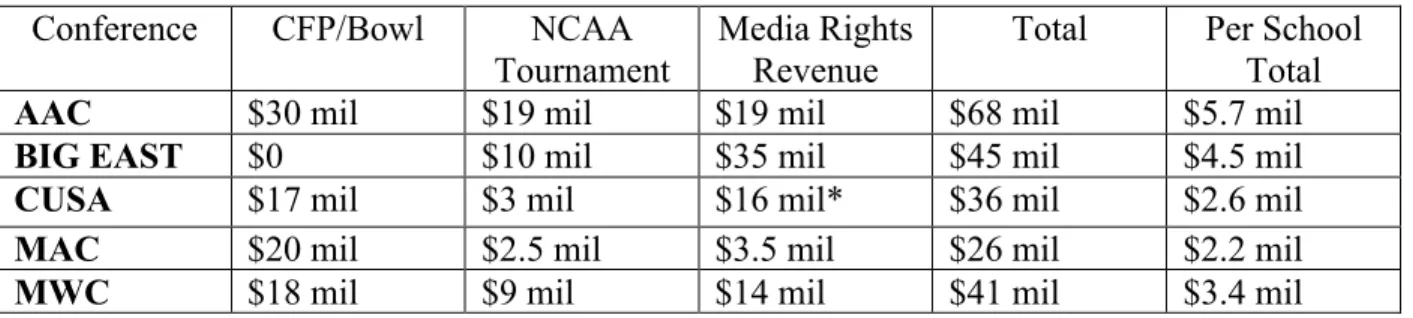
realignment phenomena as a “market shakedown” centered on media rights.35 Table 1 and Table 2 illustrate the impact of media rights revenue.
Tables 1 and 2 compare the Autonomous Five Conferences and Group of Five
Conferences36 by their three biggest generated revenue streams: College Football Playoff and Bowl payouts, NCAA Basketball Tournament revenue distribution, and media rights deals.37 These conferences were selected because they are the ten most valuable in college sports.38
Table 1: Revenue Produced by Autonomous Five Conferences (2014-2015)
Conference CFP/Bowl NCAA
Tournament
Media Rights Revenue
Total Per School Total
ACC $84 mil $21 mil $233 mil $328mil $21.9 mil*
BIG TEN $119 mil $21 mil $291 mil $431 mil $30. 8 mil
BIG 12 $113 mil $19 mil $170 mil $302 mil $30.2 mil
PAC 12 $107 mil $11 mil $233 mil $351 mil $29.3 mil
SEC $123 mil $17 mil $375 mil $515 mil $36.8 mil
* Per school total includes football independent Notre Dame (ND). Omitting ND makes per-school total $23.4 million.
Table 2: Revenue Produced by Group of Five Conferences (2014-2015)
Conference CFP/Bowl NCAA
Tournament
Media Rights Revenue
Total Per School Total
AAC $30 mil $19 mil $19 mil $68 mil $5.7 mil
BIG EAST $0 $10 mil $35 mil $45 mil $4.5 mil
CUSA $17 mil $3 mil $16 mil* $36 mil $2.6 mil
MAC $20 mil $2.5 mil $3.5 mil $26 mil $2.2 mil
MWC $18 mil $9 mil $14 mil $41 mil $3.4 mil
* Includes $6 million in exit fees received in 2015-2016 that were paid by schools that left the conference in 2013 and 2014.
35 Meyer, supra note 15, at 109.
36 Smith, supra note 5 (Collegiate athletic conferences in the NCAA Division I FBS and Non-football subdivision
include: theAmerican Athletic Conference (AAC); the Big East Conference (BIG EAST); the Conference USA (CUSA); the Mid-American Conference (MAC); and the Mountain West Conference (MWC).
37Id. (noting that media right revenues include both rights fees and, for conferences with network ownership stakes,
estimated profit shares, but does not include smaller revenue streams like those garnered from licensing and conference tournament deals).
There are several points worth highlighting: (1) the Autonomous Five conferences receive more revenue for media rights deals than any other form of revenue, (2) the BIG 12 has the least valuable media rights agreement of the Autonomous Five- an average of $200 million per year which is still twice as much as the entire Group of Five combined, (3) CFP/Bowl Payouts for both Autonomous Five and Group of Five schools provide more revenue than the NCAA Basketball Tournament payout (the exception is the BIG EAST which does not sponsor football), and (4) the difference between the lowest per school total payout in the Autonomous Five Conferences (ACC) and highest per school total payout in the Group of Five Conferences (AAC) is $16.2 million.39
As these numbers illustrate, NCAA Division I athletics is truly a world of haves and have-nots. Schools that are currently outside the Autonomous Five are fighting to find a way in to receive the benefits of these media rights payouts. Most recently talks of BIG 12 expansion sent schools into a flurry fluffing their resumes and future plans to get a chance of being invited into the club. According to an Outside the Lines analysis, thirteen (13) public schools reported to have been vying to get into the BIG 12 over the summer;40 however, talks of expansion seem to be at a halt after the BIG 12 announced it has decided to stay at ten members.41
While it is apparent that media rights revenue is driving conference realignment
decisions, other circumstantial reasons mentioned in the literature are: (1) to pursue membership in a more competitive conference, (2) to expose the college or university to new markets and
39Id. (the difference between the ACC per school total of $21.9 million and the AAC per school total of $5.7 million
equals $16.9 million).
40 Paula Lavigne, Rich Get Richer in College Sports as Poorer Schools Struggle to Keep Up, ESPN.COM (Sept. 6,
2016, 9:20 AM), http://www.espn.com/espn/otl/story/_/id/17447429/power-5-conference-schools-made-6-billion-last-year-gap-haves-nots-grows.
41 Stewart Mandel, The Big 12 Owes A Lot of People an Apology, FOXSPORTS.COM (Oct. 17, 2016, 7:35 PM),
increase visibility, (3) to associate with a particular conference’s brand image, (4) to pursue increased prestige, and (5) because the current conference is discontinuing sponsoring a sport (i.e. football).42
Although media rights revenue is necessary to support college athletics programs, conference realignment decisions are being driven by what is best for Football and Men’s Basketball programs. As a result, Olympic non-revenue sports teams are dragged into new conferences, leading to increased travel costs, longer regular seasons (in some cases), and more missed class time for student-athletes. As the costs of athletic programs continue to rise, there is a growing concern that the current geographical footprint of conferences will not be financially sustainable.43 Instead of revenue-driven conference realignment that also creates additional expenses, a new approach could be student-athlete centered.
Financial Concerns
Intercollegiate athletics, specifically Football and Men’s Basketball, generate significant media revenue and publicity for Division I institutions.44 This in turn drives schools to follow the money to conferences that have larger media deals. Although institutions greatly benefit from these media rights deals and the national exposure for the Football and Men’s Basketball programs, the question of whether Olympic non-revenue sports should be tied to these conference decisions remains. A big concern with the expansive geographic footprint of
conferences, caused by conference realignment, is financial sustainability. Moreover, the “out of control expenditures” seen among the Autonomous Five Conference programs are creating a
42 Daphne R. Carr, A Longitudinal Analysis of the Effects of Conference Realignment on College Football Brand Equity, (2014) (unpublished Ed.D. dissertation, University of Alabama), 1 PQDT 3683639.
divide that may eventually force many schools in the Group of Five and some in the Autonomous Five to drop out of the current Football Bowl Subdivision.45
The current economic model of Division I athletics engenders challenges to the sustainability of athletic departments. The nation’s richest athletic departments, all within the Autonomous Five conferences, pulled in a record $6 billion last year -- nearly $4 billion more than all other schools combined.46 These numbers illustrate the gulf between the haves and have-nots in college sport has never been greater. To highlight the disparity, an Outside the Lines
report shows that “in 2008, the gap between the average overall revenue of schools in today’s Autonomous Five conferences and those in the FBS Group of Five conferences was about $43 million. In 2015, it was $65 million.” Moreover, if subsidies are subtracted from that revenue, the gap gets even wider, from an average of $53 million in 2008 to $83 million in 2015.47
Although there is a large disparity between the two groups, Group of Five schools are trying to keep up with the aggressive spending of the Autonomous Five conferences. This phenomenon is known as the athletic arms race wherein athletic administrators outbid one another in spending “in an effort to stockpile ‘arms.’”48 Today, the arms race has become the generic term denoting extravagant operating expenditures by schools to outdo opponents.49 In order to gain a competitive advantage, especially in Football and Men’s Basketball,
45 Jake New, The Have and Have-Not Gap, INSIDE HIGHER EDUC., (Oct. 25, 2016),
https://www.insidehighered.com/news/2016/10/25/knight-commission-meeting-worries-over-spending-and-stability-football-bowl.
46 Lavigne, supra note 40.
47 Lavigne, supra note 40, at 4 (noting that information is limited to data collected from public institutions). 48 Erianne A. Weight, Matthew A. Weight & Raymond Schneider, Confronting the Arms Race: Conference Commissioner Perspectives on Spending Within Intercollegiate Athletics, 14 INT’L J. SPORT MGMT. 1, 2 (2013); Rodney Fort, College Athletics Spending: Principals and Agents v. Arms Race, 2 J. AMATEUR SPORT 119, 121 (2016), https://journals.ku.edu/index.php/jams/article/view/5673/5159.
administrators are building bigger/more advanced facilities, paying coaches exorbitant salaries,50 and giving student athletes more money to cover the cost of attendance. This win-at-all-costs phenomenon has been pursued at all levels of intercollegiate athletics but some of the most detrimental effects of spending are most clearly seen at the Autonomous Five level.51
Group of Five schools are also increasing salaries to lure the best administrators and coaches, building multimillion-dollar stadiums and arenas, and giving student-athletes more money to cover tuition and living expenses.52 However, as noted above, the Group of Five do not have the same revenue streams as the Autonomous Five, making it very difficult to sustain the spending without creating budget deficits. For example, Texas A&M reported making
$192,608,876 in revenue in 2014-2015 year, whereas the highest revenue generated by a Group of Five school was Cincinnati with $52,536,185.53 Table 3 below compares the top five revenue making public schools in the Autonomous Five versus the top five in the Group of Five.
Table 3: Top Five Revenue Making Public Schools in the A5 vs. the Group of 5
Autonomous Five Schools
Revenue for 2014-2015
Group of Five Schools
Revenue for 2014-2015
Texas A&M $192,608,876 Cincinnati $52,536,185 Texas $183,521,028 Central Florida $51,455,603
Ohio State $167,166,065 Air Force $50,191,669
Michigan $152,477,026 San Diego State $49,011,745 Alabama $148,911,674 East Carolina $48,918,30554
Moreover, most of the Group of Five schools’ revenue is largely made up of funds from student fees, university subsidies, and state or local government; whereas subsidized sources
50 Tsistos & Nixon supra note 49, at 69 (describing the “arms race” for coaches’ salaries as “star-wars” like). 51 Fort, supra note 48, at 121.
52 Lavigne, supra note 40, at 4.
53Steve Berkowitz et al., NCAA Finances (2015-2016), USA TODAY SPORTS (Apr. 14, 2016, 7:45 AM),
http://sports.usatoday.com/ncaa/finances/ (last visited Nov. 28, 2016).
make up on average just five percent (5%) of Autonomous Five schools’ budgets.55 The highest subsidized public school in the Autonomous Five is Rutgers University receiving 33.74% or $23,803,903.00 of its $70,558,935 revenue total from subsidies.56 Among Group of 5
institutions, Florida International University receives 82.55% or $23,620,086 of its $28,612,452 revenue total from subsidies. Below Table 4 lists the highest subsidized public school in each of the Group of Five Conferences, excluding the BIG EAST.
Table 4: Highest Subsidized Public Schools in each of the Group of 5 Conferences
Group of Five Schools Revenue Total Subsidy % Subsidy
Florida International $28,613,452 $23,620,086 82.55
Eastern Michigan $33,956,233 $27,309,988 80.43
Houston $44,815,210 $25,994,014 58.00
Air Force $50,191,669 $43,481,337 67.90
Although there is a large disparity between the Autonomous Five and Group of Five schools, it is important to note that Autonomous Five schools are also running budget deficits. According to the NCAA website, only two dozen or so public schools generate more money (does not include subsidy) than they spend.57
While media revenues have increased in recent years, this influx of revenue is not flowing to the Group of Five schools. Furthermore, the geographical footprint of these new conferences has made team travel costs significantly increase. If the trend of schools spending continues to outpace the revenues generated, the future of the current NCAA Division I
competition model appears unsustainable. A regional conference model especially for the non-revenue sports may help relieve the rising travel costs at institutions.
55 Lavigne, supra note 40. 56Id.
57 Brian Burnsed, Athletic Departments That Make More Money Than They Spend Still A Minority, NCAA.ORG
Time Demands
Student-athletes’ time demands have also increased with the rise of media revenue pouring into big-time NCAA Division I intercollegiate sports. Large television contracts have come with academic trade-offs such as more midweek games. Heightened expectations to win have made many coaches reluctant to give their teams much time off, and new conference re-alignments have led to increased travel for students in many programs.58 As a result, questions about time demands have taken center stage over the past few years and were a hot topic during the 2017 NCAA Convention.59
The demands on student-athletes’ time gained more traction when student-athletes were given a seat on the NCAA Division I Board of Directors in 2014.60 Over the past two years, the rise in student-athlete influence, along with the results from the December 2015 Division I SAAC survey61 and the 2015 NCAA GOALS62 study, collectively helped spearhead the time demands conversation at the 2016 NCAA Convention. Although no provisions were voted on, these conversations led to another NCAA survey which garnered nearly 50,000 responses from Division I coaches, athletic administrators and student-athletes. The survey included sport-specific questions and identified solutions for various concerns including countable athletically related activities (CARA), competition time demands, out-of-season time demands, academics and travel.63
58 Brad Wolverton, NCAA Considers Easing Demands on Athletes’ Time, CHRON. HIGHER EDUC. (Jan. 8, 2016),
http://www.chronicle.com/article/NCAA-Considers-Easing-Demands/234840.
59 Michelle Brutlag Hosick, DI Student-Athletes to Have More Time Away From Sports, NCAA.ORG (Jan. 20, 2017,
1:17PM), http://www.ncaa.org/about/resources/media-center/news/di-student-athletes-have-more-time-away-sports.
60 Hosick, supra note 8.
61 Summary of Findings, Division I SAAC Time Commitments Study, NCAA.ORG (Dec. 2015),
http://www.ncaa.org/sites/default/files/DISAAC_time_commitments_summary_20160127.pdf.
62 Initial Summary of Findings, NCAA GOALS Study of the Student-Athlete Experience, NCAA.ORG, (Jan. 2016),
In response to this research and the growing concerns for student-athletes’ experience and well-being, five (5) different time demand proposals were adopted by the Autonomous Five conferences at the 2017 NCAA Convention.64 The changes adopted, effective August 1, 2017, require: the creation and annual review of a time management plan for each sport, a seven-day break after the season and fourteen additional days off during the regular academic year when classes are in session, and one day off per week during preseason and vacation periods.65 Additionally, the changes prohibit athletically related activities during a continuous eight-hour period between 9p.m. and 6a.m., and off-campus practice during vacation periods outside the championship season and unrelated to away-from-home competition.66 In regards to the remaining Division I schools, their conferences can decide individually whether to adopt the proposals. In fact, the IVY League and Mid-American Conference (MAC) institutions have already adopted some of the new proposals.67
MAC commissioner, Jon Steinbrecher, indicated these adopted proposals are just “the starting point not the end point” and that “the next evolution gets into sport-specific
requirements.”68 If what Steinbrecher says turns out to be true, proposals for time demand
63 Tom Yelich, Nearly 50,000 Weigh In on DI Time Demands, NCAA.ORG, (May 9 2016, 3:02 PM),
http://www.ncaa.org/about/resources/media-center/news/nearly-50000-weigh-di-time-demands
(noting that overall a majority of coaches support this concept; however, within some sports, a majority of coaches did not support the idea); see also Summary of Findings, Division I Time Demand Study, NCAA.ORG (Apr. 2016), http://www.ncaa.org/sites/default/files/2016RES_DI-Time-Demands-.
64 Hosick, supra note 60. 65Id.
66Id.
67 Jake New, Ivy League Adopts New Rules Limiting Time Demands on Athletes, INSIDE HIGHER EDUC. (June 10,
2016) https://www.insidehighered.com/news/2016/06/10/ivy-league-adopts-new-rules-limiting-time-demands-athletes (noting that the IVY League rules give student https://www.insidehighered.com/news/2016/06/10/ivy-league-adopts-new-rules-limiting-time-demands-athletes a ten-hour window of no official athletic activity following their return from a road trip and a two-week break following the completion of a team’s season); MAC Adopts Four Proposals to Decrease Time Demands for Athletes, ESPN.COM (Sept. 8, 2016),
legislation may become the new trend. Jack Swarbrick, the athletic director at Notre Dame, believes if the organization is really concerned with student-athletes’ time the focus should be on scheduling and traveling,69 stating, “Nothing is more disruptive than that.”70 As an example, Mr. Swarbrick explains that it takes 10 to 12 hours of travel, at least, each way for his teams to travel from ND, in South Bend, IN, to Blacksburg, VA., to compete against Virginia Tech, an ACC rival.71 He suggests colleges should have multiple teams travel together and compete on the same day, which would justify the cost of chartered flights. Swarbrick believes more coordinated scheduling would eliminate the daylong excursions his teams sometimes make when traveling, therefore cutting down on time away from campus.
Another suggestion, supported by Arkansas State Athletic Director Terry Mohajir, is the idea of realigning the Group of Five conferences (at least for now) to be more geographically matched.72 In addition, the Knight Commission has recommended shortening seasons or reducing games and letting non-revenue sports compete with schools that are more aligned geographically to reduce travel time, scheduling, and financial burdens.73
Legal Framework
Change in competitive frameworks may have legal implications. Three different areas of law are important in creating an alternative Division I regionalized competition model: Title IX of the Educational Amendments Act of 1972 (“Title IX”)74, the Sherman Antitrust Act75, and contract law.
68MAC Adopts Four Proposals to Decrease Time Demands for Athletes, supra note 67. 69 Wolverton, supra note 58.
70Id. 71Id.
Title IX
Title IX is the law most frequently utilized to remedy sex discrimination in intercollegiate athletics. Most cases have involved claims that women are not being provided with equal athletic opportunities in comparison to men.76 The current conference model, driven by decisions that benefit Football and Men’s Basketball, has resulted in inequities for women’s teams. If an institution were to move to a more regionalized competition model for some of its sports but not others, Title IX implications may arise as well.
Title IX of the Educational Amendments Act of 1972 states, “No person in the United States, shall on the basis of sex, be excluded from participation in, be denied the benefits of, or be subject to discrimination under any educational program or activity receiving Federal financial assistance.”77 The statute was created and modeled after the civil rights legislation of the 1960s in response to congressional findings of widespread discrimination against women in educational institutions.78 Similar to its predecessors in form and function, its main objectives were “to avoid use of federal resources to support discriminatory practices and to provide individual citizens effective protection against those practices.”79
In 1975, the Department of Health, Education and Welfare (HEW) promulgated regulations specific to college athletics.80 To provide guidance as to what is considered “equal opportunity for members of both sexes,” Section 106.41(c) lists the following factors:
(1) Whether the selection of sports and levels of competition effectively accommodate the interests and abilities of members of both sexes;
76 Davis, DURU, MITTEN, & SMITH supra note 13. 77 20 U.S.C. § 1681(a) (2012).
78 Deborah L. Rhode & Christopher J. Walker, Gender Equity in College Athletics: Women Coaches as a Case Study, 4 STAN. J. C.R. & C.L. 1, 5 (2008).
(2) The provision of equipment and supplies; (3) Scheduling of games and practice time; (4) Travel and per diem allowance;
(5) Opportunity to receive coaching and academic tutoring; (6) Assignment and compensation of coaches and tutors;
(7) Provision of locker rooms, practice and competitive facilities; (8) Provision of medical and training facilities and services; (9) Provision of housing and dining facilities and services; (10) Publicity81
After the 1975 regulations were released, an influx of Title IX complaints from schools, teams, and individuals were received by the Office of Civil Rights (OCR).82 In order to reduce these complaints and to encourage self-policing, OCR promulgated a Policy Interpretation to clarify the responsibilities of institutions subject to the mandates of Title IX.83 The regulations that define whether schools are in compliance with Title IX fall within three categories: (1) equality in Athletic Financial Assistance (Scholarships)84, (2) Equivalence in Other Athletic Benefits and Opportunities85, and (3) Effective Accommodation of Student Interests and Abilities.86
The Policy Interpretation explains a school must allocate athletically related financial assistance in proportion to the numbers of male and female students participating in
81Id. § 106.41(c).
82 Sara A. Elliot & Daniel S. Mason, Gender Equity in Intercollegiate Athletics: An Alternative Model to Achieving Title IX Compliance, 11 J. LEGAL ASPECTS SPORT 1 (2001),
http://heinonline.org/HOL/Page?handle=hein.journals/jlas11&div=7&g_sent=1&collection=journals.
83 U.S. Dep’t of Educ. OCR, Intercollegiate Athletics Title IX Policy Interpretation, 44 C.F.R. § 71, 413-23 (1979). 84 34 C.F.R. § 106.37(c) (2016).
intercollegiate athletics to satisfy the Athletic Financial Assistance requirement.87 Further, for a school to satisfy the equivalence in other athletic benefits and opportunities requirement, a school should look to the 1975 Regulation Sec 106.4(c)(2 )-(10) laundry list of requirements. Lastly, the OCR issued the Three-Part “Effective Accommodation Test,” to help schools
determine if they were compliant with the equal athletic participation opportunity requirement.88 The test provides three options for a school to demonstrate compliance:
(1) Whether intercollegiate level participation opportunities for male and female students are provided in numbers substantially proportionate to their respective enrollments; or
(2) Where the members of one sex have been and are underrepresented among intercollegiate athletes, whether the institution can show a history and continuing practice of program expansion which is demonstrably responsive to the developing interests and abilities of that sex; or
(3) Where the members of one sex are underrepresented and among intercollegiate athletes, and the institution cannot show a continuing practice of program expansion, whether it can be demonstrated that the interests and abilities of the members of that sex have been fully and effectively accommodated by the present program.89
If a school meets any one of these three prongs, it will be seen as effectively accommodating the interests and abilities of members of both sexes in compliance with that aspect of the
Regulations.
87 U.S. Dep’t of Educ. OCR, Intercollegiate Athletics Title IX Policy Interpretation, 45 C.F.R. § 88.37(c) (1979). 88Id.§ 26 (1979).
Antitrust Law
Congress passed the Sherman Act in 189090 to preserve a competitive marketplace for the
benefit of consumers. The two provisions that will be used to analyze the delineated model are
15 U.S.C. § § 1-2. Section 1 provides that “[E]very contract, combination . . . or conspiracy in
restraint of trade or commerce”91 is illegal, and Section 2 prohibits monopolization or attempts to monopolize trade or commerce.92 For a court to have Sherman Act jurisdiction, the challenged activity must have (1) an interstate nexus or effect, and (2) constitute or affect trade or
commerce.93
Currently the NCAA has no blanket exemption from the federal antitrust laws merely because it is a non-profit organization whose members are predominantly colleges and
universities with educational objectives.94 In NCAA v. Board of Regents, the court did find anti-trust violations for the NCAA’s rules restricting its members television rights; however, the Court acknowledged the NCAA's role "as the guardian of an important American tradition" and its “historic role in the preservation and encouragement of intercollegiate amateur athletics.”95 It is important to note that courts have given deference to the primarily noncommercial NCAA rules to preserve amateurism, academic integrity, and competitive balance.96
90 BUREAU OF COMPETITION, U.S. FED. TRADE COMM’N, GUIDE TO THE ANTITRUST LAWS: THE ANTITRUST LAWS,
https://www.ftc.gov/tips-advice/competition-guidance/guide-antitrust-laws/antitrust-laws (outlining agency guidance on competition) (last visited Nov. 28, 2016).
91 15 U.S.C. § 1 (2012).
92Id. § 2 (“[E]very person who shall monopolize, attempt to monopolize, or combine or conspire with any other
person or persons, to monopolize any part of the trade or commerce among the several States, or with foreign nations, shall be deemed guilty of a felony . . . .”).
93 Summit Health, Ltd. v. Pinhas, 500 U.S. 322 (1991). 94 NCAA v. Bd. of Regents, 468 U.S. 85 (1984). 95Id. at 85.
96 Matthew J. Mitten, Applying Antitrust Law to NCAA Regulation of “Big Time” College Athletics: The Need to Shift from Nostalgic 19th and 20thCentury Ideals of Amateurism to the Economic Realities of the 21st Century, 11 MARQ. SPORTS L. REV. 1, 4 (2000),
Federal antitrust lawsuits against the NCAA generally have been brought under Section 1 of the Sherman Act, which prohibits “concerted activity” that produces unreasonable restraints of trade.97 The NCCA is also subject to Section 2, which bans both unilateral and concerted conduct that produces a monopoly or that constitutes an attempt to achieve a monopoly98, however, historically these claims have been unsuccessful.99 The collective adoption and enforcement of NCAA rules by its member universities as well as other agreements concerning the production, marketing, and regulation of intercollegiate athletics is considered concerted action for purposes of Section 1 of the Sherman Act. This means that virtually all NCAA rules and agreements among NCAA members are potentially subject to antitrust challenge.100 Because the delineated model would require member institutions of the NCAA to agree, there may be antitrust
implications.
Damages awarded for anti-trust violations can be quite costly for an enterprise, whether it is monetary or injunctive relief. The Clayton Act, enacted by Congress in 1914, expanded the ability of private individuals to sue for damages.101 Section 4 of the Clayton Act states that any person, other than foreign nations, whose business or property is injured by a violation of the antitrust laws may recover treble damages, and the cost of the suit, including reasonable attorney’s fees.102 Successful plaintiffs can also obtain a court order (injunctive relief) prohibiting the anticompetitive practice in the future.103 This damages provision gives an incentive for private individuals to bring anti-trust litigation against enterprises.
97 Davis, DURU, MITTEN, & SMITH supra note 13, at 226; 1 JULIAN O. VON KALINOWSKI,MAUREEN MCGUIRL &
PETER SULLIVAN, ANTITRUST LAWS AND TRADE REGULATION (2d ed. Matthew Bender & Co. 2016) (e-book).
98 15 U.S.C. § 2 (2012); see also VON KALINOWSKI, MCGUIRL & SULLIVAN, supra note 97. 99 Ass’n of Intercollegiate Athletics for Women v. NCAA, 735 F.2d 577 (D.C. Cir. 1984). 100 DAVIS, DURU, MITTEN, & SMITH supra note 13, at 226.
101 15 U.S.C. § 12 (2012); id. § 15. 102Id. § 15.
Contract Law
Currently, athletic conferences have contracts with broadcast/cable networks (“Media Contracts”) and member institutions have contracts with their athletic conferences (“Conference Contracts”). If schools were to move to the delineated alternative competition model for certain sports, both schools and athletic conferences may be held financially liable if this move is considered a breach of their existing Media and/or Conference contracts. This paper will focus on the duties & responsibilities clause and liquidated damages clause in Conference contracts and the reconfiguration clause in Media contracts.
A contract is a promise that the law will enforce.104 More specifically, a contract is a promise for the breach of which the law either provides a remedy or recognizes as a duty.105 But not all promises are enforceable. In order for a promise to be enforceable, there needs to be consideration. Consideration is present when the promise was made as part of a “bargain.”106 In this context, “bargain” means that the promise was made as part of an exchange.107 For example, conferences agree to allow broadcast/cable networks to televise the sports programs of their member institutions in exchange for money. Promises are also sometimes enforced based on the alternative doctrine of “promissory estoppel.” Promissory estoppel makes a promise enforceable where the promisee has reasonably and foreseeably relied on the promise to its detriment.108 For example, in 2003 the BIG EAST brought a promissory estoppel claim against Miami and
104 RESTATEMENT (SECOND) OF CONTRACTS § 1(AM. LAW INST. 1981). 105Id.
106 RESTATEMENT (SECOND) OF CONTRACTS § 71(1) (AM. LAW INST. 1981) ; See generally David Gamage & Allon
Kedem, Commodification and Contract Formation: Placing the Consideration Doctrine on Stronger Foundations, 73 U. CHI. L. REV. 1299 (2006).
Virginia Tech, when they decided to leave the conference for the ACC. The BIG EAST argued it relied on their membership to remain a premier football conference.109
Non-performance of a contractual duty is a breach unless non-performance is excused.110 The two potential consequences of a breach of contract are: (1) the injured party is entitled to a remedy, usually monetary damages111, and (2) the injured party may also be entitled to
temporarily suspend its own performance or sometimes even terminate or “rescind” the
contract.112 For example, a school’s decision to leave a conference would likely be considered a material breach of its membership agreement with conference, therefore, it would owe the
conference money (often the amount is set out in a liquidated damages clause or “buy out” clause of the membership agreement). In regards to the second consequence, were a conference’s
membership to change, broadcast/cable networks may have the power rescind some of their promises (amount of programming), re-negotiate payment, or terminate the agreement altogether (often this will be laid out in a reconfiguration clause of the Media contracts).
It is customary for Conference contracts and Media contracts113 to contain clauses describing the remedy for breach of contract in advance. The contract might contain an agreed upon “liquidated” damages provision, or an agreement limiting the injured party’s remedy. A liquidated damages provision specifies an amount of money to be paid as damages for any breach.114 If the amount specified is significantly different from the amount of actual damages, the provision may be unenforceable if found to be a “penalty.”115A limited remedy provision is
109 Katz, supra note 20, at 357.
110 FERRIELL, supra note 108, at 444 (citing RESTATEMENT (SECOND) OF CONTRACTS § 235 & cmt. b (AM. LAW
INST. 1981)).
111 RESTATEMENT (SECOND) OF CONTRACTS § 345(a) (AM. LAW INST. 1981). 112 FERRIELL, supra note 108, at 445.
113 Katz, supra note 20; Meyer, supra note 15.
114 Charles J. Goetz & Robert E. Smith, Liquidated Damages, Penalties and the Just Compensation Principle, 77
COLUM. L. REV. 553 (1977).
one that imposes a barrier on the types of remedies the injured party may receive or on the types of harm for which a remedy may be available.116 Additionally, Media contracts may contain a reconfiguration clause which addresses the remedies available for a broadcast/cable network due to a change in athletic conference membership. For example, “As a result of a reconfiguration clause in its television contracts with ABC and ESPN, the BIG EAST was forced to renegotiate the terms of those deals. The Big EAST was forced to accept less money because three of the preeminent football schools left for the ACC.”117
Chapter III
METHODOLOGY
Personal Interviews
General Methodology
Classic grounded theory is a general methodology that uses the process of induction to develop a theory that is ‘grounded’ in the data from which it has been derived.118 Thus the sampling used is theoretically oriented because it is directed towards the generation and
development of conceptual theory as opposed to creating a descriptive account. The sampling is directed by the emerging theory. In other words, the researcher follows up on leads as they arise in the data and focuses data collection to refine and integrate the theory.119
Theoretical sampling was used to conduct the personal interviews. Theoretical sampling is defined as “the process of data collection for generating theory whereby the analyst jointly collects, codes and analyses his/her data and decides what data to collect next and where to find them, in order to develop his/her theory as it emerges.”120 It is known as a means to focus data collection and increase the analytic abstraction of the theory by illuminating variation and identifying gaps that require elaboration.121
118 Barney G. Glaser, Constructivist Ground Theory?, 3 F: QUALITATIVE SOC. RES., art. 12 (2002),
http://www.qualitative-research.net/index.php/fqs/article/view/825/1792.
119 BARNEY G. GLASER & ANSELM L. STRAUSS,THE DISCOVERY OF GROUNDED THEORY:STRATEGIES FOR
QUALITATIVE RESEARCH (2d ed. 2006), http://www.sxf.uevora.pt/wp-content/uploads/2013/03/Glaser_1967.pdf.
120 Jenna Breckenridge & Derek Jones, Demystifying Theoretical Sampling in Grounded Theory Research, 8
GROUNDED THEORY REV. 113, 115 (2009), http://groundedtheoryreview.com/wp-content/uploads/2012/06/GT-Review-Vol8-no2.pdf (citing GLASER & STRAUSS 1967 supra note 118, at 45).
Unlike conventional sampling, the researcher did not go out and collect the entire set of data before beginning the analysis. Instead, analysis begins after the first day of data gathering. Specifically, data collection led to analysis, analysis led to concepts, and concepts generated more questions to ask. These questions lead to more data collection allowing the researcher to learn more about these concepts.122 This circular process continued until the research reached the point of saturation; that is, the point in the research when all the concepts were well defined and explained.123
Procedure
Semi-structured personal interviews were conducted using the theoretical sampling technique. Email invitations were sent out to four participants who were recommended to the researcher. These initial interviews took place either in person or over the phone. The researcher received recommendations from these initial participants to then send out email invitations for more interviews. The process continued as such until the researcher felt a point of saturation had been reached. The interviews were semi-structured with six questions guiding the conversation based on the study’s research question. Thirteen participants in total were interviewed. The information learned from these interviews helped the researcher delineate the framework for an alternative competition model.
Each interview began with an introduction, brief description of the study, and verbal consent from the participant. Then, based on the review of literature, the following questions were asked:
1. What are your thoughts on establishing an alternative competition model federated by sport and regionalized, particularly for Olympic (non-revenue) sports?
122 JULIET CORBIN & ANSELM STRAUSS, BASICS OF QUALITATIVE RESEARCH: TECHNIQUES AND PROCEDURES FOR
DEVELOPING GROUNDED THEORY 144 (3d ed. 2012).
2. Is it possible to create an alternative model with the current conference structures? If so, what would it look like?
Note: Below are some other areas the researcher asked about if the interviewee did not address them. These bullet points provided the researcher with a structured rubric.
a. Organizational components? b. What sports would use this model? c. Who would organize the scheduling? d. Where would the funding come from? e. Who would the officers be?
f. What would the championships look like?
g. Would the NCAA recognize the teams competing in the model?
h. Would the model consist of subsidiary conferences under the umbrella of the current conferences? Or would it be a completely separate entity?
i. What are the legal implications of creating and implementing this new model? 3. Would you be in favor of establishing regionalized competition models for Olympic
sports?
a. Why or why not?
b. What are your concerns?
4. How will this new model affect college athletics?
Note: Below are some other areas the researcher asked about if the interviewee did not address them. These bullet points provided the researcher with a structured rubric.
a. Strength of schedule? b. Recruiting?
c. Budget?
d. Student-athlete time away from campus? e. Overall athlete experience.
f. Branding of school? g. Funding?
h. Relationships between teams and coaches (w/ Football and Men’s Basketball likely staying in current model)
i. Are you worried about Title IX implications?
Data Analysis
After interviewing each participant, the interview was transcribed from the recording and notes taken during the interview. Each participant was given a subject number to keep their name anonymous. The transcribed interviews involved creating a document for each participant and then going through and comparing each transcription to find commonalities. Those
CHAPTER IV
RESULTS
The purpose of this study was to delineate an alternative NCAA Division I regionalized competition model. Qualitative research based on semi-structured interviews with 13 participants was utilized to explore the philosophical, organizational, and managerial components of a
regionalized NCAA Division I competition model federated by sport.
The findings from the interviews are presented in this chapter beginning with the career background information of each of the participants. The remainder of the chapter is organized by emergent themes.
Participant Career Background Information
Table 5: Participant Background
% n
Sex
Male 70.0% 9
Female 30.0% 4
Division I 6
Group of 5 Commissioner 3 DI Commissioners (non-FB) Associate Commissioner (non-FB) Head Coach
Industry Consultant 5
Knight Commissioner Officer Former NCAA Vice President Former DI (FCS) Commissioner 2 Professors
Division I- Autonomous 5 2
Athletic Director Head Coach
Research Question 1
What are the philosophical components of building a regionalized NCAA Division I competition
model?
In order to understand the philosophical components of building an alternative
competition model.” Throughout the interview, participants addressed only those questions they felt confident answering; therefore, some of the answers below will not have thirteen responses.
Reasons for Building an Alternative Competition Model
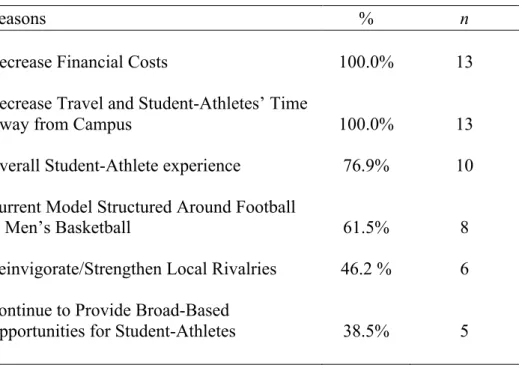
Reasons for building an alternative NCAA Division I competition model include current emergent issues with the current competition model that may be minimized by additional regionalization of competition. Each emergent issue is summarized below. See Table 6 for a complete summary of the findings where n = the number of participants who discussed that specific reason in their interview.
Table 6: Reasons for building an Alternative Model
Reasons % n
Decrease Financial Costs 100.0% 13
Decrease Travel and Student-Athletes’ Time
Away from Campus 100.0% 13
Overall Student-Athlete experience 76.9% 10 Current Model Structured Around Football
& Men’s Basketball 61.5% 8
Reinvigorate/Strengthen Local Rivalries 46.2 % 6 Continue to Provide Broad-Based
Opportunities for Student-Athletes 38.5% 5
1. Decrease Financial Costs
outside the Autonomous Five, revenues have remained stagnant and budget deficits continue to increase. Below are quotes from participants that identify decreasing financial costs as reason to build an alternative regionalized competition model.
“I think the evidence shows it needs to be considered from a financial standpoint from reducing travel costs.” (Subject 2).
“AD’s with whom I talked to outside Autonomous 5 schools. Those schools recognize that it’s a different world now with the money that the Autonomous 5 schools that they don’t have.”
(Subject 2).
“For us honestly, it would probably be better competition and more cost effective to just play teams in the south (our area). And our budget is not like the budget at UNC so it’s brutal and stressful as a coach trying to figure out how you are going to do all of it. I mean I do a ton of fundraising here, you know on top of my job so I definitely meet with a lot of alums trying to raise money you know so they can supplement our money to make sure we have enough to do everything we need to do.” (Subject 7)
2. Decrease Travel and Student-Athletes’ Time Away from Campus
Decreasing travel and student-athletes’ time away from campus was another unanimously mentioned reason to build an alternative regional competition model. All participants shared the idea that time spent traveling to competitions has increased due to the geographic footprint of conferences therefore student-athletes are missing more class and spending less time on campus. Below are quotes from participants that identify decreasing travel and student-athletes' time away from campus as reasons to build an alternative regionalized competition model.
“It would help our budget, help missed class time because we wouldn’t have to travel so much...” (Subject 4)
“When I was approached by the Knight Commission, I thought this was a wonderful idea to bridge/strengthen local rivalries and decrease student time away from campus and decrease financial costs-those are the three main reasons why- that make an alternative model attractive.”
(Subject 3).
“Even for school wise, for academic reasons we are only allowed to miss three M/W/F and three T/Thurs classes per semester. So I mean we are here trying to play all of these teams . . . and for us to only miss so few days it makes it really difficult.” (Subject 7)
3. Overall Student-Athlete Experience
Ten of the thirteen participants cited the overall student-athlete experience as a reason to build an alternative regional competition model. Eight of the ten participants feel like a
regionalized model could improve the current student-athlete experience by saving money on travel and perhaps being able to put the money into two big trips, and facilitating student-athletes’ more on campus; whereas two of the ten believe the regionalized model could be a worse experience for student-athletes. A Head Coach at an Autonomous 5 institution feels like if there are travel limitations then the teams’ budget will decrease making the experience worse.124 A Commissioner of a small-mid major Conference does not feel comfortable giving football and basketball players a different experience by allowing them to continue play a national schedule while limiting the other student-athletes to a regional model.125 Below are quotes from
participants that identify the overall student-athlete experience as a reason to build an alternative regionalized competition model.
“And all of these other sports, we should focus on the experience and there still will be travel and there still will be team bonding, and tremendous competitive experiences but it won’t be quite as extravagant.” (Subject 3)
“These student-athletes get to travel…but it’s much like a business trip. Our goal is to integrate these kids—there are other ways their horizons can be broadened…” (Subject 1).
“I think we would be able to offer a better experience because I think we wouldn’t have to spend so much money on traveling to all these matches through-out the season. I think, I feel like if we did have a conference tournament, we’ve saved money playing in the south so then maybe we could fly to the tournament rather than drive 8 hours and then staying in not so nice of hotel. That would help us save some money to do some great things like taking a really cool spring break trip if we wanted to do that- we would have the money to be able to do it. Or even just having the right amount of equipment. Like I can’t even provide these guys racquets, they have to