R.V. O'Connor, J. Pries-Heje, and R. Messnarz (Eds.): EuroSPI 2011, CCIS 172, pp. 179–190, 2011. © Springer-Verlag Berlin Heidelberg 2011
Model for Enabling SPI in Small Settings
Gonzalo Valdés, Marcello Visconti, and Hernán AstudilloUniversidad Técnica Federico Santa María (UTFSM), Valparaíso, Chile {gvaldes,visconti,hernan}@inf.utfsm.cl
Abstract. The adoption of international standards and models of process quality
is difficult for small organizations due to several issues they face, such as inability to afford the associated costs and unawareness of SPI benefits. This article presents the Tutelkan Reference Process (TRP), a public software process that is conformant to CMMI-DEV v1.2, ISO 9001:2000 and Competisoft, and whose process assets can be reused as baseline for developing specific software process in small organizations. We present the methods we applied to evaluate standard-compliance of TRP, which are based on mapping techniques and methods used to appraise and audit organizations, and discuss how TRP is applied as part of an SPI framework oriented to small settings. When using TRP organizations become aware of their level of compliance with international standards, since each reusable asset contains information about the specific CMMI-DEV v1.2 practices, ISO 9001:2000 clauses and Competisoft activities it conforms to.
Keywords: software process improvement, process quality models, small
settings, Tutelkan, CMMI-DEV v1.2, ISO 9001:2000, Competisoft.
1 Introduction
Software organizations implement best practices contained in standards and models of process quality, assessment and improvement (e.g., CMMI1, ISO/IEC 155042, IDEAL [1]) in order to improve the quality of the software they produce, reduce production cycles, and use their resources more efficiently, among others [2] [3].
However, the adoption of international standards and models remains difficult for small organizations3 due to several issues they face, such as lack of dedicated staff for process improvement, and inability to afford implementation, evaluation and certification costs [4] [6] [7] [8]. Therefore, small organizations often have a negative perception about models and standards, good practices are perceived as too expensive, time consuming, and over-targeted; furthermore, they find hard to relate standards with benefits and match them with their business needs, thus leading to unawareness of their actual benefits [4] [6].
1
Capability Maturity Model Integration, http://www.sei.cmu.edu/cmmi
2
Information technology - Process assessment.
3
Several initiatives worldwide have aimed at helping small organizations to implement software processes based on the most prominent models from ISO/IEC and SEI; mainly by (1) defining assessment methods tailored to their specific context, (2) recommending preselected subsets of processes, and/or (3) adapting and generating SPI models for small settings [4] [8] [9].
Another approach has been to develop new reference processes or standards, based on the prominent models. In Latin America, MoProSoft4 combined and adapted to Mexican settings the recommended practices of the now-retired CMM v1.1, ISO 9001 and other specialized models such as PMBOK (Project Management Body of Knowledge); and in Brazil, the MPS.BR proposal [10] adapted several international standards to the Brazilian reality. Its main products are a reference process and an evaluation method which are conformant with ISO/IEC 15504 and ISO/IEC 12207, and compatible with CMMI. Later on, the Ibero-American project Competisoft [7] borrowed heavily from these models to develop a new region-wide reference improvement framework; indeed, its reference process may be thought of as a successor of MoProSoft.
This article briefly describes the Tutelkan Reference Process (TRP), a central element of the Tutelkan5 SPI Framework (explained in detail in [11]), developed by a joint initiative6 among Chilean universities and local software industry (companies and industry associations), aiming to facilitate the incorporation of internationally accepted process quality standards and models into small software organizations.
Unlike earlier initiatives, Tutelkan does not aim to define a new local software process standard or assessment method, but focuses on creating a mechanism to accelerate the implementation of any (acceptable) standard, through systematic reuse and composition of process assets that are already compliant with those standards. The framework provides a reference set of process assets (e.g., task and roles descriptions, workflow diagrams, templates, etc.) conformant with CMMI, ISO 9001 and Competisoft. Specifically, in this article, we described its design drivers, construction strategy, methodology by which we achieved compliance with the mentioned standards, and discuss how it helps in enabling small organizations to implement prominent international software process models and standards.
The article is organized as follows: section 2 describes the components of the Tutelkan SPI framework; section 3 presents de current version of TRP and its development strategy; section 4 specifies TRP’s process pattern; section 5 maps of TRP and CMMI-DEV v1.2, section 6 maps TRP and ISO 9001:2000, and section 7 maps TRP and Competisoft; and section 9 summarizes and concludes.
2 The Tutelkan Components
Tutelkan aims to provide a framework to streamline and facilitate the adoption of prominent standards and models by small organizations. The main ideas to achieve such goal are: (1) providing a library of reusable process assets, (2) offering composition tools to describe small organizations processes using these assets, and (3)
4
Modelo de Procesos para la Industria del Software (Process Model for Software Industry), http://www.comunidadmoprosoft.org.mx
5
http://www.tutelkan.info
6
systematically training small organization focused consultants for these library and toolset. Tutelkan ultimately aims to build an informatics ecosystem of SPI tool builders and process asset maintainers (communities of experts, consultants and practitioners). Specifically, the framework includes the following elements:
• The Tutelkan Reference Process (TRP): defines a public software process whose
process assets can be reused and modified by any organization to create its own specific software process. TRP includes practices proven by Chilean small software organizations, and is aligned with CMMI for Development v1.2 [12], ISO 9001:2000 [13] and Competisoft [7].
• The Tutelkan Web Platform (TWP): allows describing, accessing and composing
process assets. Its service-based architecture allows building applications as “mashups” of content services; several applications have been built by internal and third party developers. It currently includes tools to explore and collaboratively build public process assets (TRP), maintenance of social content associated to them, and develop specific “private” processes for organizations (with restricted visibility). It also supports evaluations of private processes with quality models.
• The Tutelkan Process Framework (TPF): a meta-model for software processes,
which defines the valid types and relationships of process assets and processes. All software processes described in Tutelkan, both public and private, are described using TPF. It is based on OPF (Open Process Framework) and is compatible with SPEM (Software & Systems Process Engineering Meta-Model).
• The Tutelkan Implementation Process (TIP): a methodology that facilitates the
implementation of software processes in small organizations. It specifies how to carry out an SPI project using Tutelkan's contents and tools.
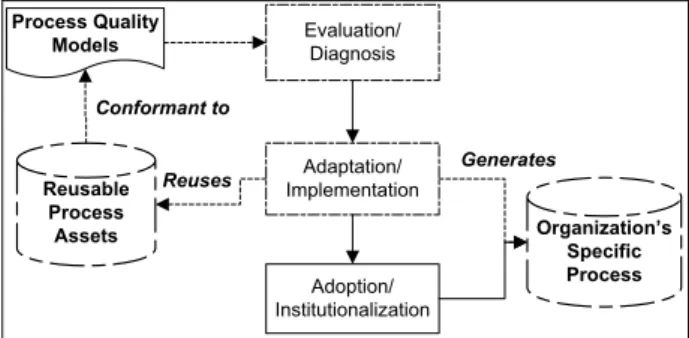
Typical SPI projects include the phases of: Evaluation and Diagnosis against a standard or model, Adaptation and Implementation of best practices and process assets, and Adoption and institutionalization of the adapted practices and assets throughout the organization [11]. Tutelkan streamlines the adaptation/ implementation tasks since it makes available standard-compliant process assets ready for reuse (see Fig. 1 and it aids in the evaluation/diagnosis tasks since each reusable asset contains information about the specific CMMI practices, ISO 9001 clauses and Competisoft activities it conforms to; all of which is additionally supported by a set of Web tools (TWP) and a formalized methodology (TIP).
Evaluation/ Diagnosis Adaptation/ Implementation Adoption/ Institutionalization Process Quality Models Reusable Process Assets Organization’s Specific Process Reuses Conformant to Generates
Several trials have being run in small Chilean software companies to evaluate the ease of application and usefulness of the Tutelkan framework and to determine the effort involved in applying it. For example, we have measured that a small company with an average number of 16 employees, invests approximately 1600 hours of total effort during 10 month to implement all CMMI ML (maturity level) 2 process areas with our framework. Additionally, Tutelkan has already been successfully piloted in conjunction with Competisoft in a Chilean small company [14] (more detail on Tutelkan validation can be found in [11]). All these experiences lead us to value as successful the main goal of the Tutelkan SPI framework, i.e., making accessible the implementation of prominent standards to small organizations.
3 The Development of TRP
TRP’s main purpose is to serve as an actual exemplary software process, compliant to international standards, that organizations could use as baseline to initiate their SPI initiatives. TRP is publicly available in three ways: in the TWP platform, as printed documents, and as EPF (Eclipse Process Framework) plug-in downloadable from the Tutelkan website. The three versions are fully synchronized and have the same process content, this way TRP’s process assets (e.g., task descriptions, workflows, templates, etc.) can be reused by any kind of organizations using the technological medium that best suits them.
3.1 Current Version
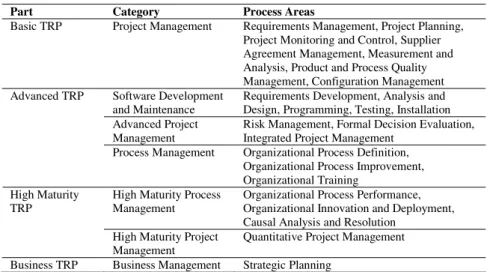
The current version of TRP (2011) is composed of 23 process areas grouped into seven categories, which in turn are grouped into four parts, as shown in Table 1.
Table 1. Components of TRP
Part Category Process Areas
Basic TRP Project Management Requirements Management, Project Planning, Project Monitoring and Control, Supplier Agreement Management, Measurement and Analysis, Product and Process Quality Management, Configuration Management Software Development
and Maintenance
Requirements Development, Analysis and Design, Programming, Testing, Installation Advanced Project
Management
Risk Management, Formal Decision Evaluation, Integrated Project Management
Advanced TRP
Process Management Organizational Process Definition, Organizational Process Improvement, Organizational Training
High Maturity Process Management
Organizational Process Performance, Organizational Innovation and Deployment, Causal Analysis and Resolution
High Maturity TRP
High Maturity Project Management
Quantitative Project Management Business TRP Business Management Strategic Planning
Basic TRP contains recommended practices to make sure that the software projects of the organization are managed effectively. Advanced TRP is focused on assuring that the organization has a software development process that is defined, maintained and continuously improved. High Maturity TRP is concerned with incorporating quantitative analyses to process and project management. And Business TRP focuses on the strategic management capability of the organization.
High Maturity TRP is a superset of Advanced TRP, and the latter is a superset of Basic TRP. We recommend to organizations that are taking their first steps in the field of SPI to start addressing the process areas of Basic TRP, because they are related to establishing basic and effective project management practices, and allow the organization to start using best international software practices in a simple manner and with short-term results. Business TRP is the most independent part, but is recommended to be implemented in parallel whit High Maturity TRP.
3.2 Development Strategy
The TRP development process (started in 2007) took as baseline the software process of a Chilean small software company (Kepler Technology, www.kiteknology.com), who donated its process to the Tutelkan project. This company already had an ISO 9001 certification and was evaluated as CMMI v1.1 ML 2; hence it was reasonable to expect that its software process reflected a high degree of compliance to those models. The baseline process included software process best practices adapted to a small organization; and it was developed, field tested and continuously improved by its owner company through several software projects in Chile and Latin America.
Starting from this baseline process, several steps led to the current TRP version (see Table 1).
(1) A process pattern for TRP was defined, easy to understand and
implement by small organizations, and compatible with the TPF process meta-model (see section 4).
(2) The baseline process was submitted to a normalization process by a group of experts, so the terminology used in the description of contents was understandable by any organization.
(3) A CMMI evaluation was carried out on this normalized process, to identify gaps in order to close them and make TRP compliant with all maturity levels of CMMI (see section 5).
(4) The ISO 9001 compliance of TRP was evaluated to identify and close any existing gap with respect to its requirements (see section 6).
(5) Finally, TRP was evaluated with Competisoft, to make it compliant with the most prominent regional process model (section 7).
In addition, during all these steps the succeeding versions of TRP were implemented in several small companies that were participating in the Tutelkan project, in order to get feedback from actual software organizations and projects.
4 TRP Process Pattern
TRP’s process pattern is simple enough so small organizations can easily understand it and use it to implement their processes, and structured enough to provide the sufficient degree of formality required to implement software processes. Also the process pattern incarnates the TPF meta-model (compatible with SPEM and OPF). The idea is that the pattern allows us to easily incorporate any practice coming from any process in the future.
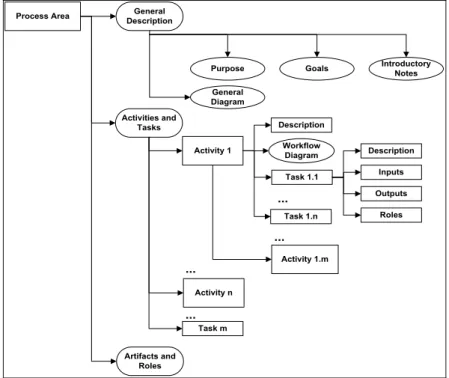
Activities and Tasks Workflow Diagram Task 1.1 Activity 1 Description Inputs Outputs Roles Task 1.n ... Description Activity 1.m Task m ... Activity n ... ... Introductory Notes General Description General Diagram Goals Purpose Process Area Artifacts and Roles
Fig. 2. TRP Process Pattern
The process pattern specifies the components of each TRP process area and their valid relationships. A process area contains the following elements (see Fig. 2):
• General Description: describes the expected outcome of the effective operation of
the process area (Purpose); lists specific objectives aligned with the purpose (Goals); describes concepts important to understand the process area (Intro. Notes); and illustrates the relationships among its activities and tasks (Gral. Diag.)
• Activities and Tasks: detailed specification of:
oActivities: logic groupings of tasks that have a common goal, they can also
contain other activities (sub-activities). Each one contains a general narrative Description and a Workflow diagram.
oTasks: the atomic work unit, every activity is always composed -in the last level- of tasks. Each contains: a narrative text describing it (Description); the names of its input artifacts necessary to perform it (Inputs); the names of its output artifacts (Outputs); and the names of ones responsible for it (Roles).
• Artifacts and Roles: summary of artifacts and roles used in the process area and
their relationships to each activity and task.
5 TRP and CMMI
Our goal was to evaluate whether TRP was conformant to CMMI (initially to CMMI v1.1, later to CMMI-DEV v1.2). To this end, we designed a methodology based on SCAMPI [15], which we adapted and simplified considering that the SCAMPI method is design to evaluate organizations, and our goal is to evaluate a process, i.e., instead of searching for evidence of the implementation of CMMI practices and goals in an organization’s process assets, actual projects and staff, we should look for this evidence only on the process assets of the TRP.
Several aspects were analyzed to characterize the implementation of a CMMI practice in TRP:
• Mapping: extend to which a set of TRP tasks can be mapped to the CMMI
practice.
• Artifacts: extend to which the set of artifacts associated to the previously mapped
set of TRP tasks are compatible with the typical work products of the mapped CMMI practice.
• Weaknesses: extend to which the mapped set of TRP tasks and its set of artifacts
contain deficiencies that might put at risk the proper operation of the mapped CMMI practice.
Using these attributes, we characterized each CMMI practice in TRP as either: fully implemented (FI) if there is a complete mapping, a compatible set of artifacts and no weaknesses; largely implemented (LI), same as FI but presenting some minor weaknesses; partially implemented (PI) if the mapping is incomplete and/or the set of artifacts is not fully compatible and/or there are weaknesses; and not implemented (NI) if there is no mapping.
Also, we rated each CMMI goal as satisfied (S) if all its practices are characterized as FI or LI, and unsatisfied (U) otherwise.
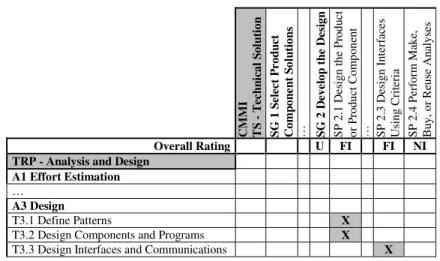
An example is shown in Table 2. TRP’s tasks are mapped to specific practices (SP) of CMMI-DEV v1.2. The CMMI-DEV v1.2 practice TS SP 2.1 is mapped to the tasks T3.1 and T3.2 of TRP, which altogether make that mapping to have an overall rating of FI. This method also allowed us to discover a gap, the practice TS SP 2.4 was not covered by TRP. So we generated a new task (with its template artifacts, roles, etc.) that formalize a procedure to incorporate past experiences in order to decide if some components may be reused or purchased considering established criteria and a repository containing those past decisions.
Our baseline process already covered most of the CMMI-DEV v1.2 process areas of ML 2 and 3, and with this method we were able to close the remaining gaps.
In order to make the process conformant to ML 4 and 5 we had to incorporate many new process assets and extend many of the existing ones. We convoked the local community to collaborate and we reused, adapted and normalized material from many local companies. The final result is the mapping presented in Fig. 3, where TRP is mapped to the process areas and specific goals (SG) of CMMI-DEV v1.2.
Finally, TRP was appraised by an external party, a SEI partner (www.procesix.com), who validated TRP compliance with CMMI-DEV v1.2.
Table 2. Extract of the Mapping between TRP and CMMI
CMMI TS T ec h ni ca l So lu ti o n S G 1 S el ect P rod u ct Co m p o n en t S o lu tio n s … SG 2 D eve lo p the De si g n S P 2. 1 D es ign t h e P ro d u ct o r Produ ct Co m p on ent … SP 2. 3 D es ign I n ter fa ce s U sin g Cr it er ia S P 2. 4 P er for m Ma ke , Bu y, or Re us e A n al ys es Overall Rating U FI FI NI
TRP - Analysis and Design
A1 Effort Estimation
…
A3 Design
T3.1 Define Patterns X
T3.2 Design Components and Programs X T3.3 Design Interfaces and Communications X
6 TRP and ISO 9001
Our goal was to evaluate if TRP was conformant to the ISO 9001:2000 standard. ISO 9001:2000 audits are designed to be performed on organizations [16], not on a set of interrelated process assets; and as we needed a concrete and precise guideline to assess if TRP was conformant to ISO 9001:2000, we decided to take advantage of the work we already did and devised a triangulation scheme in order to obtain a precise evaluation.
Specifically, besides the guidance provided in [17], we used the TRP-CMMI-DEV v1.2 mapping we already had (see section 5) and a mapping between CMMI practices and ISO 9001 requirements developed by Mutafelija and Stromberg [18]. This allowed inferring a concrete mapping between TRP and ISO 9001:2000, shown in the left side of Fig. 4.
They also defined the following values for their CMMI-ISO mappings [18]: strong (S) if there is a strong relationship between the ISO requirement and the CMMI practice; medium (M) if the match is not complete, but with some interpretation, CMMI may satisfy the ISO requirement; weak (W) if the statement in the ISO standard does not clearly correspond to the CMMI practice; and not map (N).
The right side of Fig. 4 shows an example of the triangulation scheme. Suppose we want to know if TRP satisfies the sub-clause 7.3.2 a) of ISO 9001:2000 (concerned with functional and performance requirements), we first find its mapping to CMMI, according to [18] this clause is strongly related to the CMMI-DEV v1.2 specific
practice RD SP 2.1. Then we look our TRP-CMMI mapping and find out that this specific practice is characterize as fully implemented in the TRP tasks T3.1 and T3.2 of the process area Requirements Development. Lastly we can infer that these TRP tasks must be related to the ISO 9001 clause.
Project Management
Requirements Management Project Planning Project Monitoring and Control Supplier Agreement Management
Measurement and Analysis Product and Process Quality Management
Configuration Management Requirements Development
Analysis and Design Programming Testing Installation REQM, ML2 RD, ML3 RD (SG3), TS (SG1, SG2), ML3 TS (SG3), PI (SG2), ML3 VER, VAL, ML3 TS (SG3), VAL (SG2), PI, ML3 PP, ML2 PMC, ML2 SAM, ML2 MA, ML2 PPQA, ML2 CM, ML2 Risk Management Formal Decision Evaluation Integrated Project Management Organizational Process Definition Organizational Process Improvement
Organizational Training RSKM, ML3 DAR, ML3 IPM, ML3 OPD, ML3 OPF, ML3 OT, ML3 Basic TRP Advanced TRP
Organizational Process Performance Organizational Innovation and Deployment
Causal Analysis and Resolution
OPP, ML4 OID, ML5 CAR, ML5 Quantitative Project Management QPM, ML4 Software Development and Maintenance Advanced Project Management Process Management High Maturity Process Management High Maturity Project Management High Maturity TRP
Fig. 3. High-level Mapping between TRP and CMMI
TRP ISO 9001 CMMI Previous Mapping Mutafelija and Stromberg TRP–Requirements Development T3.1 Define Product Requirements T3.2 Define Product Constraints ISO 9001 - 7.3.2 Design and development inputs a) Functional and Performance Requirements CMMI–RD SP 2.1
Establish Product and Product Component Requirements Fully Implements Strong Inferred Relationship Inference
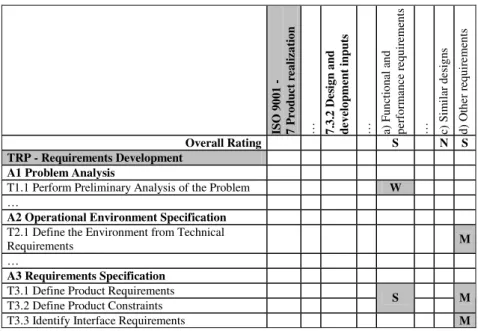
Then, with this guidance at hand we evaluated whether the mapped TRP tasks actually satisfy the mapped ISO requirement (thoroughly examining all related process assets), and we qualify the mapping. For example in Table 3 we can see that the mapping between the sub-clause 7.3.2 a) and tasks T3.1 and T3.2 is qualified as strong (S) (we used the same scheme of [18]), because these tasks and their associated artifacts completely satisfy what is stated in the ISO requirement.
Table 3. Extract of the Mapping between TRP and ISO 9001
IS O 90 01 7 P rod u ct r ea li zat io n … 7.3. 2 D es ign an d de v el o pm en t i nputs … a) F u nc ti on al a n d per fo rm an ce r eq u ir em en ts … c) Si m il ar d esi g n s d) O ther r eq u ir em en ts Overall Rating S N S TRP - Requirements Development A1 Problem Analysis
T1.1 Perform Preliminary Analysis of the Problem W
…
A2 Operational Environment Specification
T2.1 Define the Environment from Technical Requirements
M
…
A3 Requirements Specification
T3.1 Define Product Requirements T3.2 Define Product Constraints S M T3.3 Identify Interface Requirements M Finally, we did a general evaluation to determine the overall rating. If there is at least one mapping that is qualified as strong, then the overall rating is strong. However there may be cases where many non-strong mappings lead a strong overall rating anyway, as those maps may complement themselves in order to satisfy the ISO requirement. This is the case of sub-clause 7.3.2 d), there are three mappings qualified as medium (M), because on their own none of them completely satisfies the sub-clause, but when taken together they do. Finally this method allowed us to discover gaps to close. For example, sub-clause 7.3.2 c) was not covered by TRP at that time.
7 TRP and Competisoft
Our goal was to check if TRP was compliant with the Competisoft model. We mapped TRP tasks to Competisoft activities, and rated if those mapping as satisfied (S) and not satisfied (NS). Competisoft has 9 main processes which are grouped into three categories, namely: Top Management, Middle Management and Operations. TRP was compliant with all the process on the two latter categories, with some minor gaps that we were able to close. MoProSoft (the baseline process of Competisoft) includes many practices of CMMI and ISO 9001, so this was somehow expected.
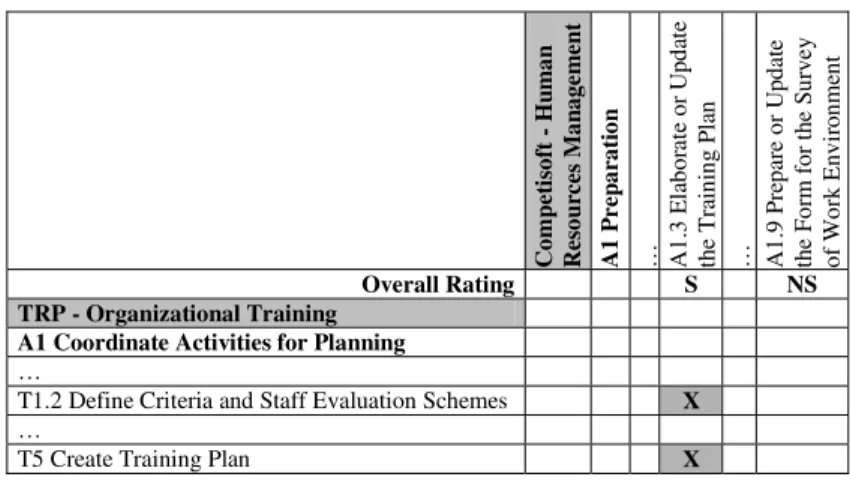
For example, in Table 4 the activity A1.3 of the Competisoft process Human Resources Management is satisfied by the TRP tasks T1.2 and T5 of the process area Organizational Training. A minor gap we found is that we did not have considered carrying out work environment surveys, as suggested by activity A1.9 of Competisoft.
However, we identified a huge gap with respect to the category Top Management, which has only one process, called Business Management. Specifically, TRP did not have any practices related to strategic planning of the organization, such as definition of organizational mission, vision and values and SWOT (Strengths, Weaknesses, Opportunities, and Threats) analyses. Therefore we added an all new process area in TRP called Strategic Planning to include these aspects (the last one listed in Table 1).
Table 4. Extract of the Mapping Between TRP and Competisoft.
Co m p et is o ft - Hu m a n Re so ur ce s Ma n a ge m ent A 1 P rep ar at io n … A1 .3 E la bor ate or U p da te th e T ra ini ng P la n … A1 .9 P rep ar e o r U p d ate th e Fo rm fo r th e S u rve y of W o rk E n vir o nm en t Overall Rating S NS TRP - Organizational Training
A1 Coordinate Activities for Planning
…
T1.2 Define Criteria and Staff Evaluation Schemes X
…
T5 Create Training Plan X
8 Conclusions and Future Work
Tutelkan is a joint effort of Chilean academia, software industry and government, whose general objective is to create a sustainable mechanism to enable small software organizations to incorporate best international practices of prominent models and standards or process quality. One of the project’s main products is the public reference process TRP, whose process assets can be reused as baseline for developing specific software process in small organizations. The Tutelkan framework and TRP has been successfully piloted with several Chilean small organizations.
We presented the methods we applied to evaluate the standard-compliance of TRP, which are based on mapping techniques and methods used to appraise and audit organizations. When using TRP organizations become aware of their level of compliance with international standards, since each reusable asset contains information about the specific CMMI practices, ISO 9001 clauses and Competisoft activities it conforms to.
Future work is intended to update our current mappings and review compliance to the newer versions of CMMI-DEV (v1.3) and ISO 9001 (2008), and to include the new ISO/IEC 29110 standard (SW Eng. - Lifecycle Profiles for Very Small Entities).
Acknowledgments. This work has been partly funded by project Fondef D09I1171 of Conicyt, Chile. The authors would like to thank Carolina Noriel, Claudio Herrera, Felipe Rodríguez and Ricardo Moreno for their work in the project.
References
1. McFeeley, B.: IDEAL: A User’s Guide for Software Process Improvement. Handbook CMU/SEI-96-HB-001. Carnegie Mellon University, Pittsburgh (1996)
2. Gibson, D.L., Goldenson, D.R., Kost, K.: Performance Results of CMMI-Based Process Improvement, Technical Report CMU/SEI-2006-TR-004. Carnegie Mellon University, Pittsburgh, PA (2006)
3. Staples, M., Niazi, M.: Systematic Review of Organizational Motivations for Adopting CMM-based SPI. Information and Software Technology 50, 605–620 (2008)
4. Richardson, I., von Wangenheim, C.G.: Why are Small Software Organizations Different? IEEE Software 24(1), 18–22 (2007)
5. European Commission, New SME Definition: User Guide and Model Declaration (2005), http://ec.europa.eu/enterprise/policies/sme/files/sme_defini tion/sme_user_guide_en.pdf
6. Laporte, C.Y., Alexandre, S., O’Connor, R.V.: A Software Engineering Lifecycle Standard for Very Small Enterprises. In: O’Connor, R.V., Baddoo, N., Smolander, K., Messnarz, R. (eds.) Software Process Improvement, EuroSPI 2008. CCIS, vol. 16, pp. 129–141. Springer, Berlin (2008)
7. Oktaba, H., Garcia, F., Piattini, M., Ruiz, F., Pino, F., Alquicira, C.: Software Process Improvement: The Competisoft Project. IEEE Computer 40(10), 21–28 (2007)
8. Pino, F.J., Garcia, F., Piattini, M.: Software Process Improvement in Small and Medium Software Enterprises: a Systematic Review. Software Quality Journal 16, 237–261 (2008) 9. Pino, F.J., Garcia, F., Piattini, M.: Key Processes to Start Software Process Improvement
in Small Companies. In: Proceedings of the 2009 ACM Symposium on Applied Computing, pp. 509–516. ACM, New York (2009)
10. Weber, K., Araújo, E., Rocha, A., Machado, C., Scalet, D., Salviano, C.: Brazilian software process reference model and assessment method. In: Yolum, P., Güngör, T., Gürgen, F., Özturan, C. (eds.) ISCIS 2005. LNCS, vol. 3733, pp. 402–411. Springer, Heidelberg (2005)
11. Valdes, G., Astudillo, H., Visconti, M., López, C.: The Tutelkan SPI Framework for Small Settings: A Methodology Transfer Vehicle. In: Riel, A., O’Connor, R., Tichkiewitch, S., Messnarz, R. (eds.) EuroSPI 2010. CCIS, vol. 99, pp. 142–152. Springer, Heidelberg (2010)
12. Software Engineering Institute: CMMI for Development, Version 1.2 (2006)
13. International Organization for Standardization: ISO 9001 - Quality management systems - Requirements (2000)
14. Villarroel, R., Gómez, Y., Gajardo, R., Rodríguez, O.: Implementation of an Improvement Cycle using the Competisoft Methodological Framework and the Tutelkan Platform. CLEI Electronic Journal 13(1), paper 2 (2010)
15. Software Engineering Institute: Standard CMMI Appraisal Method for Process Improvement (SCAMPI) A, Version 1.2: Method Definition Document (2006)
16. International Organization for Standardization: ISO 19011 - Guidelines for quality and/or environmental management systems auditing (2002)
17. International Organization for Standardization and International Electrotechnical Commission: ISO/IEC 90003 - Software engineering - Guidelines for the application of ISO 9001:2000 to computer software (2004)
18. Mutafelija, B., Stromberg, H.: Process Improvement with CMMI v1.2 and ISO Standards. Auerbach Publications, Boca Raton (2008)