DOE Shipment Tracking
System Assessment
FINAL REPORT
February 2005 Prepared for: Office of TransportationOffice of Environmental Management U.S. Department of Energy
Washington, DC 20585 By:
Intermodal Logistics Systems Planning & Integration Division Volpe National Transportation Systems Center
U.S. Department of Transportation Cambridge, MA 02142
U.S. DOT/VOLPE CENTER February, 2005
E - 1
Executive Summary
Background
The legacy of nuclear weapons research and production is the accumulation of large quantities of radioactive and hazardous chemical waste. The U.S. Department of Energy (DOE) has
developed and is continuing to develop permanent storage facilities for these wastes so that its former nuclear sites can be safely cleaned and closed. Because of public concerns about transporting these wastes safely to storage sites, DOE has worked for more than 20 years with state and tribal go vernments, particularly in the Western U.S., to implement safe and uneventful transportation programs.
To support these transportation programs, DOE developed the Transportation Tracking and Communications (TRANSCOM) System to monitor and communicate with vehicles transporting “high visibility” unclassified shipments, such as spent nuclear fuel, transuranic waste, and high-level radioactive waste. TRANSCOM is a web-based system that provides the monitoring information needed by the state and tribal governments. Continuing advances in tracking technologies since September 11, 2001 prompted DOE Headquarters to seek an independent assessment of the state-of-the art of TRANSCOM-like technology to help guide its future. In July 2004, the Office of Transportation (EM-11) in the DOE’s Office of Environmental Management asked the John A. Volpe National Transportation Systems Center (Volpe Center) in the U.S. Department of Transportation (DOT) to assess the functional effectiveness of
TRANSCOM. DOE’s goal is to determine whether other tracking systems, methods, or applications might be more cost effective than the current TRANSCOM system in fulfilling its mission.
Shipment Monitoring Requirement
A well- established requirement exists for federal, state, and tribal monitoring of radioactive waste transportation. As a result of pioneering work done by the Western Governors’ Association and the DOE Waste Isolation Pilot Project (WIPP), DOE established formal agreements with the states and tribes affected by its waste shipments. These require DOE to provide advanced notice of shipments and access to near “real- time” monitoring information, a situation that is unique to radioactive waste shipments. Over the years, DOE, the states, and tribal governments have established a model program of federal, state, and tribal cooperation. Four principal system components are required for real-time tracking and monitoring of
radioactive shipments:
• Vehicle Communication System - on-board vehicle equipment with near real- time tracking and two-way communications capability that feeds data and messages to the control center.
• Monitoring Operations Support Center - 24/7 PC-equipped operations center to
administer the system and shipment tracking transaction records, monitor shipments, manage system access, support system users with training and help desk functions, and provide activity reports
U.S. DOT/VOLPE CENTER February, 2005
E - 2
• Monitoring Application - monitoring application software which integrates communications and database functions with web interfaces for operations center and user shipment
monitoring
• System Hardware, Network Security, and Backup - host servers for running the monitoring application with systems, secure networking, and backup support, as well as internet service provider access
Volpe reviewed governmental and commercial off- the-shelf (COTS) systems designed for near real-time shipment tracking and monitoring to determine their applicability to DOE’s tracking requirements.
TRANSCOM employs Qualcomm’s commercial OmniTRACS vehicle equipment, satellite tracking, and communications services. No other operational government or private sector systems examined by the Volpe Center could fulfill DOE’s shipment monitoring mission without significant functionality enhancements. For another commercial sys tem to meet DOE’s special requirement of working with the states, not only would extensive vendor software modifications be required, but also vehicle equipment replacement, replication of the TRANSCOM
Communications Center (TCC) operational function, and user re-training. The table below provides key functional characteristics of TRANSCOM operations.
Characteristics TRANSCOM
Vehicle Tracking System Name Qualcomm OmniTRACS Position Reporting Interval 5 minutes
User Interface Features User maps display vehicle position, geofencing∗ used for WIPP
shipments
Operations Center Personnel in TRANSCOM
Communications Center pro-actively monitor shipments 24/7
Trip Record Keeping Full vehicle communications log and shipment paper records filed and retained per DOE document retention orders
Data Backup Yes
Continuity of Operations Arrangements
Power outage plan, no COOP plan, no remote alternate site yet
Some government systems have a lower per shipment cost than TRANSCOM’s. The Volpe team found that this per shipment cost difference results from the higher costs of TRANSCOM’s more frequent (5 minute) updates, pro-active shipment monitoring, and the extensive DOE record keeping required.
∗ Geofence is a geographic boundary or boundaries (usually a circle or closed polygon around a point or a distance from a defined route), which may trigger an alert when crossed. It may be used to define an area of permissible operation or an exclusion area.
U.S. DOT/VOLPE CENTER February, 2005
E - 3
Recommendations
Current Shipment Monitoring Requirement
TRANSCOM meets its functional requirements and has a large number of satisfied users. TRANSCOM’s state-of-the-art user web site access is well received, used effectively, and important to the states and tribes. The Volpe Center recommends that the system be fully maintained, updated, and improved to meet current DOE requirements and positioned to meet future ones, specifically:
• Update its underlying database software, and possibly its operating system, to current versions and implement high priority “needs” ident ified by its users in August 2004, including automated interfaces with the TCC’s Microsoft Access management information data and, if feasible, DOE’s Automated Traffic Management System (ATMS).
• Fully document the updated system and distribute documentation to key DOE stakeholders
• Establish a back up system and a continuity of operations plan per current federal directives.
Future Shipment Monitoring Needs
New DOE waste shipping campaigns are modeling their transportation monitoring plans on the WIPP program with its state and tribal agreements. DOE has future shipment tracking
requirements that will involve state and tribal oversight, for example, the programs of DOE’s Office of Civilian Radioactive Waste Management (RW). The Volpe Center recommends that the DOE employ the TRANSCOM operational infrastructure to meet its upcoming radioactive shipment monitoring requirements. Because of its long-standing leadership and experience in radioactive site clean up, radioactive materials transportation, and public outreach programs, DOE’s system should be the U.S. focal point for monitoring unclassified radioactive shipments. The Volpe Center recommends that before DOE considers any other system to meet RW’s waste shipment monitoring requirements, that it perform a detailed cost-benefit analysis of
TRANSCOM compared with other alternatives.
Government Interagency Tracking Technologies Coordination
In the aftermath of 9/11, the Departments of Transportation (DOT) and Homeland Security (DHS) have shown a heightened interest in vehicle and container tracking to ensure the safe and secure transportation of hazardous materials, including radioactive shipments. DOE, DOT, DHS, DOD, and other agencies have begun meeting to collaborate on and coordinate their mutual tracking technology interests and activities. The participating agencies seek to avoid duplication of effort and to benefit from each other’s experiences and lessons learned.
The Volpe Center recommends that DOE stay actively involved in the interagency collaboration efforts and the planning of future hazardous materials transportation policies, practices, and systems. DOE has much to contribute to the interagency coordination activities from its longstanding experience in radioactive shipments monitoring, emergency response programs, and public involvement. Other agencies will benefit from DOE’s “lessons learned” by avoiding reinventing the wheel and costly, unnecessary duplication of effort. The multi-agency
U.S. DOT/VOLPE CENTER February, 2005
E - 4
collaboration will surface diverse safety and security requirements, examine current and evolving systems capabilities, and probably focus on the enhancement/development of a few government systems. An enhanced TRANSCOM could be the basis for one of the successor systems, which could result in other agencies using and monetarily supporting TRANSCOM. Near term, at a minimum, Volpe expects that the DHS will request a feed of TRANSCOM data.
U.S. DOT/VOLPE CENTER February, 2005
Acknowledgements
The US DOT/Volpe Center team acknowledges and thanks the following individuals for the invaluable information and assistance that they provided:
Dennis Ashworth, Director, Office of Transportation, Office of Environmental Management, DOE, for sponsoring this interagency cooperative effort.
Tony Lucero, DOE National Transportation Program, for arranging the initial Volpe Center visit to Albuquerque and for making TRANSCOM Communications Center (TCC) operations personnel available to the Volpe team throughout the study.
Ella McNeil, Office of Transportation, Office of Environmental Management, DOE, for her guidance and participation in the review of the DTTS system.
Brady Lester of Oak Ridge, Jim Portsmouth of Hanford, and Casey Gadbury of WIPP for their input on shippers and the UF6 and WIPP shipment campaigns.
Sharon Taylor, Security Consulting Group, manager of the TCC, who provided detailed information about TRANSCOM operation before the study began and during both visits to Albuquerque. Sharon also was an essential resource throughout preparation of the report, in both clarifying issues and providing additional information.
Tammy Ottman, Colorado Emergency Management Program, and William Mackie, Western Governors’ Association, for their insights into the states’ memoranda of agreement with DOE and the state users of the system.
Mario Harley and Kathleen Rockwell, Defense Transportation Tracking System, for their thoroughness and hospitality during Volpe’s visit to DTTS in Norfolk.
Errors or omissions in the report remain the responsibility of the authors: Ruth A. MacFarlane Hunter, Nancy A. Cooney, and Kenneth F. Troup III (retired) of the Intermodal Logistics Systems Planning and Integration Division at the U.S. DOT Volpe Center, Cambridge, Massachusetts
U.S. DOT/VOLPE CENTER December 10, 2004 i
TABLE OF CONTENTS
1. INTRODUCTION... 1
1.1. BACKGROUND... 1
1.2. SCOPE... 1
2. RADIOACTIVE SHIPMENT MONITORING... 2
2.1. WASTE ISOLATION PILOT PLANT (WIPP) CAMPAIGN... 2
2.2. URANIUM FLUORIDE GAS (UF6) CAMPAIGN... 3
2.3. SPENT NUCLEAR FUELS (SNF) ... 4
2.4. OFFICE OF CIVILIAN RADIOACTIVE WASTE MANAGEMENT (OCRWM OR RW) ... 4
2.5. RECORD KEEPING... 5
3. CURRENT TRANSCOM OPERATION ... 5
3.1. TRANSCOM FUNCTIONS... 5
3.1.1. SATELLITE TRACKING AND TWO-WAY COMMUNICATION... 6
3.1.2. TRANSCOM COMMUNICATIONS CENTER (TCC)... 7
3.1.3. SERVERS AND SOFTWARE... 7
3.1.4. USER WEB INTERFACE... 8
3.2. TRANSCOM USER INTERFACE... 8
3.2.1. AVAILABLE SHIPMENTS... 8
3.2.2. STATUS BOARD... 9
3.2.3. BILL OF LADING... 10
3.2.4. MAPPING... 12
3.3. TRANSCOM INFORMATION TECHNOLOGY CONFIGURATION... 13
3.4. TRANSCOM ADMINISTRATIVE FUNCTIONS... 13
3.5. TRANSCOM COMMUNICATIONS CENTER (TCC) OPERATIONS... 14
3.5.1. SHIPMENT MONITORING... 15
3.5.2. RECORD KEEPING... 15
3.5.3. EMERGENCY NOTIFICATION... 15
3.5.4. HELP DESK SUPPORT... 16
3.5.5. TRAINING... 16
3.5.6. TRANSCOM ADMINISTRATION... 16
3.6. TRANSCOM ACCESS DATABASE... 16
3.7. TRANSCOM SHIPMENT DATA... 18
3.8. TRANSCOM OPERATING COSTS... 19
4. TRANSCOM USERS ... 19
4.1. SHIPPERS... 19
4.2. STATE AND TRIBAL EMERGENCY RESPONSE... 20
4.3. PROJECT MANAGEMENT AND ADMINISTRATION... 21
U.S. DOT/VOLPE CENTER December 10, 2004 ii
5. OTHER TRACKING SYSTEMS ... 24
5.1. DEFENSE TRANSPORTATION TRACKING SYSTEM (DTTS)... 25
5.2. INTELLIGENT ROAD AND RAIL INFORMATION SYSTEM (IRRIS) ... 25
5.3. ARMY MOVEMENT TRACKING SYSTEM (MTS)... 25
5.4. INDUSTRY-GOVERNMENT PILOT TESTS AND TRACKING INITIATIVES ... 25
5.5. SURVEY OF COTS TRACKING PRODUCTS... 26
5.6. SUMMARY... 30
6. FINDINGS AND RECOMMENDATIONS ... 31
6.1. GOVERNMENT INTERAGENCY TRACKING TECHNOLOGIES COORDINATION... 31
6.2. MONITORING FUNCTIONAL REQUIREMENT... 32
6.3. FUTURE MONITORING NEEDS... 34
APPENDICES ... 35
APPENDIX A – TERMS AND ACRONYMS... 36
U.S. DOT/VOLPE CENTER February, 2005 1
1. Introduction
1.1. Background
The legacy of nuclear weapons research and production is the accumulation of large quantities of radioactive and hazardous chemical waste. The U.S. Department of Energy (DOE) has
developed and is continuing to develop permanent storage facilities for these wastes so that its former nuclear sites can be safely cleaned and closed.
Because of public concerns about the safety of transporting these wastes to storage sites, DOE has worked for more than 20 years with state governments, particularly in the Western U.S., to implement safe and uneventful transportation programs. To support these transportation programs, DOE developed the Transportation Tracking and Communications (TRANSCOM) System to monitor and communicate with vehicles transporting “high visibility” unclassified shipments, such as spent nuclear fuel, transuranic waste, and high- level radioactive waste. The TRANSCOM System was originally developed in the late 1980s at Oak Ridge under DOE’s National Transportation Program (NTP). Subsequently, the system was upgraded during the 1990s to better utilize improving satellite communications technology. In 2000, a web-based user interface version, called TRANSCOM2000, was implemented upon the system’s move to Albuquerque. Continuing advances in tracking technologies since September 11, 2001 prompted DOE Headquarters to seek an independent assessment of the state-of-the art of the TRANSCOM system to help guide its future.
In July 2004, the Office of Transportation (EM-11) in DOE’s Office of Environmental
Management asked the John A. Volpe National Transportation Systems Center (Volpe Center) in the U.S. Department of Transportation (DOT) to assess the functional effectiveness of
TRANSCOM and to review other government and commercial tracking systems. DOE’s goal is to determine whether other tracking systems, methods, or applications might be more cost effective than the current TRANSCOM System in fulfilling its mission.
1.2. Scope
The Volpe Center’s TRANSCOM assessment involved:
• An examination of the business process of monitoring radioactive shipments in DOE;
• Discussions with DOE shippers, state and Tribal governments, and other users of the TRANSCOM system
• Review of current practices, systems, and state-of-the-art in shipment tracking in both private industry and other parts of the Federal government.
This report provides a description and an assessment of TRANSCOM, including the contractual and regulatory basis for the system, feedback from current TRANSCOM users, and
TRANSCOM costs. It includes an overview of systems used in private and government
transportation. Finally, the report provides the Volpe Center’s findings and recommendations for DOE’s consideration.
U.S. DOT/VOLPE CENTER February, 2005 2
2. Radioactive Shipment Monitoring
DOE Order 460.2, Departmental Materials Transportation and Packaging Management, applies to the transportation and packaging of materials on DOE-owned and leased facilities, and to contractors who work for DOE. The order requires that shipments meet Department of
Transportation hazardous materials transportation regulations embodied in the Code of Federal Regulations (CFR) Section 49 Part 173 Subpart 1, specifically as they relate to Class 7
(radioactive) Materials. Requirement 4.c. of Order 460.2 states:
“DOE Field Elements shall ensure that the DOE Transportation Tracking and Communications (TRANSCOM) System shall be used for tracking and monitoring the following categories of shipments in accordance with the TRANSCOM operations system manuals (controlled documents): Spent nuclear fuel, level waste, and
High-visibility shipments and campaigns as determined by the cognizant Secretarial Officers.”
2.1. Waste Isolation Pilot Plant (WIPP) Campaign
One of those high visibility campaigns involves the disposition and storage of transuranic (TRU) waste.1 These wastes are managed under the Waste Isolation Pilot Plant (WIPP) program
initiated by DOE in the late 1980s. DOE chose a site near Carlsbad, New Mexico for
underground storage of these wastes and developed a 30-year disposal program to move TRU wastes to the WIPP site. In 1989, the Western Governors’ Association (WGA) prepared a Report to Congress (under contract with the Department of Transportation) that laid out issues and concerns of the seven Western states that would be affected by TRU waste shipments moving through or near them. In that Report to Congress, the WGA defined two important requirements related to those shipments:
First, the states “need to know when a shipment is bound for their area…because they must make inspections and offer timely guidance on road conditions.” The states said that they needed DOE to provide annual and six-week schedules of projected shipments and advance and timely notice of shipments.
Second, “state officials must be able to check the status of a shipment in, or bound for, their area. Like advance notice, this is for safe operations and to answer public inquiries.” Following the 1989 Report to Congress and as part of the extensive planning for WIPP, the Western Governors’ Association and DOE entered into a Cooperative Agreement in 1990 that included creation of a technical advisory committee that prepared a report in June 1991 entitled “Safe Transport of Transuranic Wastes to the Waste Isolation Pilot Plant.” Later that agreement resulted in the “WIPP Transportation Safety Program Implementation Guide” that was agreed to by the Western Governors’ Association and the Secretary of Energy. The implementation guide was amended in 2002 and a memorandum of agreement was updated and agreed to in 2003. The updated implementation guide, as with the original Report to Congress, described requirements for “Advance Notice of WIPP Shipments, Shipment Tracking, and Shipment
1
Transuranic (TRU) wastes are radioactive wastes that include discard items, such as gloves, glassware, tools, and rags contaminated with plutonium during weapons production.
U.S. DOT/VOLPE CENTER February, 2005 3
Status Information.” The implementation guide, in Section 5, states:
“States need annual shipment schedules, advance notice of shipment dates, and status of shipments en route, and the ability to communicate directly or indirectly with the
drivers….
TRANSCOM will be used to track shipments. The Western Corridor States have been given computer systems to use the TRANSCOM system. The DOE has provided training for identified TRANSCOM users in each state. The DOE will provide training and TRANSCOM access to new corridor states prior to the beginning of shipments through those states.”
Shipments began in 1999 and will continue through 2030. Annual shipment statistics for WIPP movements tracked by TRANSCOM for the last few years are presented later in this report. In the years 1999 through 2003, WIPP represented a majority of TRANSCOM shipments. However, the concerns of state and tribal governments and their needs for oversight and monitoring of shipments as well as the success of the DOE-state relationship established in WIPP, have prompted other shipping campaigns to follow the WIPP model and work out memoranda of agreement with states and tribes.
2.2. Uranium Fluoride Gas (UF6) Campaign
The largest of those new campaigns involves the movement of uranium fluoride gas (UF6) from Oak Ridge, TN, to Portsmouth, OH. These two sites, along with Paducah, KY, operated gaseous diffusion plants. Operations at Oak Ridge ceased in 1985. DOE ultimately decided to convert the depleted UF6 inventory to a more stable form as quickly as practical. Conversion plants were built at Paducah and Portsmouth, but not Oak Ridge, so it was necessary to transport cylinders to one of the other sites. To balance the amounts stored onsite and converted, DOE chose Portsmouth as the destination of UF6 shipments from Oak Ridge. While a consent order involving the state of Tennessee calls for clean up of the Oak Ridge site by 2009, the UF6 program plans currently have all cylinders being removed by the end of 2007. Cylinders that comply with ANSI standards are to be removed first, with non-compliant cylinders after that (a DOT exemption will be needed for the non-compliant cylinders). UF6 shipments began during 2004, when they constituted approximately 58% of TRANSCOM-managed shipments.
The UF6 transportation plan outlines shipper, carrier, and state responsibilities for UF6 shipments and includes the following:
“Tracking of shipments will rely on DOE’s Tracking and Communications System TRANSCOM. State personnel will be able to track each shipment via TRANSCOM from the time of departure through arrival at Portsmouth”
Carriers are selected by the Oak Ridge site contractor and approved by the DOE representative based on balanced traffic among the carriers, equipment availability, and carrier performance. The specific transportation routes are selected in consultation with the states. The states have the responsibility for emergency response and for providing any weather advisories to
TRANSCOM’s operators and UF6 transportation personnel. The plan requires that states be notified at least two weeks before the start of a shipping campaign and:
U.S. DOT/VOLPE CENTER February, 2005 4
time conveyance position tracking, will be provided via TRANSCOM, and the states will have the opportunity to participate in tracking through use of this technology.”
2.3. Spent Nuclear Fuels (SNF)
There are other DOE radioactive and other high visibility shipments that are tracked by
TRANSCOM. These include spent nuclear fuels, foreign research reactor (FRR) spent fuels, and some classified radioactive shipments. For reporting purposes, TRANSCOM management combines FRR spent fuels and other spent nuclear fuels as SNF (Figure 10 in Section 3.7). FRR shipments are brought into the U.S. primarily at Naval Weapons Station Charleston (SC); from there they move by truck or rail, usually to Savannah River. A small number of non-aluminum-based spent nuclear fuel shipments were moved to the DOE site in Idaho. TRANSCOM tracked 10 FRR shipments in FY04.
The DOE Office of Nuclear Energy, Science and Technology (NE) manages the shipment of radioactive materials involving Nuclear Regulatory Commission (NRC) licensed shipments including spent fuels. The shipments, though small in number, are tracked by TRANSCOM because they must meet reporting and monitoring requirements with the states. These shipments are examples of the role that TRANSCOM plays for DOE beyond that required by the Office of Environmental Management.
2.4. Office of Civilian Radioactive Waste Management (OCRWM or
RW)
One important area of waste shipments, where planning is still underway and transportation plans have not been approved, involves permanent storage of wastes from commercial nuclear power plants at the proposed Yucca Mountain site in Nevada. Current plans call for rail
shipments to begin in 2010. In its November 2003 “Strategic Plan for the Safe Transportation of Spent Nuclear Fuel and High-Level Radioactive Waste to Yucca Mountain: A Guide to
Stakeholder Interactions”, the DOE Office of Civilian Radioactive Waste Management (OCRWM or RW) indicated its intention to build on existing agreements and working
relationships with state and tribal governments. Two items from the plan’s “starting point for discussion” are:
“Selection of Transportation Routes. OCRWM will work collaboratively with state regional groups and tribal governments to identify transportation routes. This will include providing assistance, as requested, to state and tribal governments in identifying routes, consistent with federal procedural and substantive requirements set forth in 49 CFR 397.103, including minimization of radiological risk. States and tribes also must consult with contiguous jurisdictions that may be affected to ensure consideration of all impacts and continuity of designated routes.”
U.S. DOT/VOLPE CENTER February, 2005 5
“Operational Practices. OCRWM will review operational practices as documented in the Radioactive Material Transportation Practices Manual 460.2-1 with state regional groups and tribes and update the Manual if needed. Additionally, OCRWM will work with States, tribes, other federal agencies, and industry to identify enhancements to its existing unclassified tracking satellite system called TRANSCOM, so that the most current generation of tracking systems appropriate to a particular mode is available for shipments to the repository.”
In discussions with RW, the Volpe team found that no decision has yet been made regarding whether or not TRANSCOM will be providing that state information, but that TRANSCOM’s involvement of the states and tribes is a starting point for RW.
2.5. Record Keeping
TRANSCOM operation must address statutory record-keeping requirements for shipments of hazardous and nuclear wastes. As is discussed below in Section 3.5.2, the TRANSCOM
operators maintain hardcopy records of all shipments including messages to and from the driver. The “DOE Records Schedule for Environmental Records,” June 1998, details several relevant retention requirements for waste generator shipping/transporting waste files and for electronic data in waste management systems:
• Low- level radioactive waste management disposal requests and shipment records - Destroy 3 years after waste disposal date.
• High- level and radioactive mixed waste shipment records - Destroy when 75 years old.
• Transuranic shipment records - Destroy after 5 years
• Database and record systems which track wastes through transportation – Delete or destroy when related records are destroyed, or 75 years, whichever occurs later [emphasis added] Independent of these requirements, the DOT regulations for hazardous waste in 49 CFR Part 173 require that shipment records be kept for 3 years.
3. Current TRANSCOM Operation
TRANSCOM was developed as a client server system in 1988 at Oak Ridge and was moved to Albuquerque in 2000. The system was upgraded to the current web-based version, referred to as TRANSCOM2000, upon its move to Albuquerque. This section provides an operational
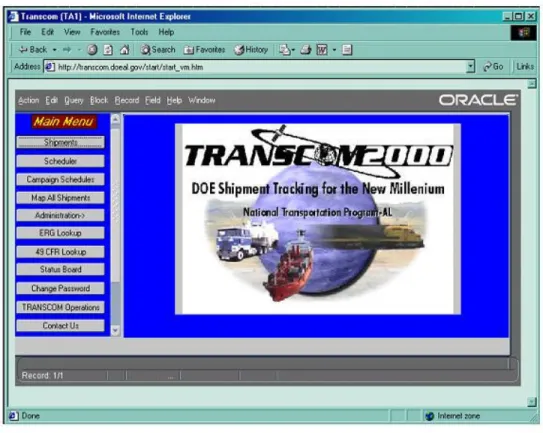
overview of TRANSCOM. Figure 1 shows the current TRANSCOM home page screen.
3.1. TRANSCOM Functions
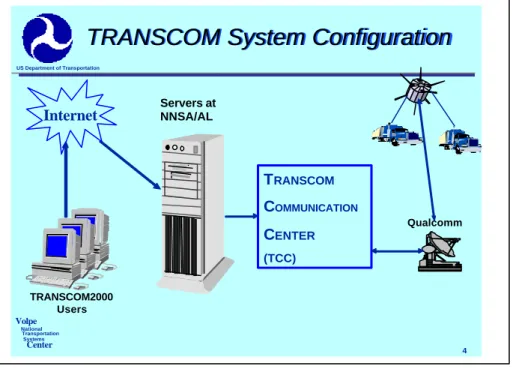
The four principal system components needed to deliver the TRANSCOM shipment monitoring data flow to users, as shown in Figure 2, are:
• Satellite tracking and two-way communications capability that provides vehicle (shipment) position data
U.S. DOT/VOLPE CENTER February, 2005 6
• TRANSCOM Communications Center (TCC) and its 24/7 support operation
• Servers with the software and databases that manage the system communications, data, mapping, and user interfaces.
• Web-based user interface
These four components are required of any shipment monitoring system that DOE might use. TRANSCOM is not just software and an operations center for satellite tracking data from QUALCOMM; it is an integrated system that includes the state and tribal users. Each component function is described in the following sections.
Figure 1 – TRANSCOM2000 Home Page 3.1.1. Satellite Tracking and Two-Way Communication
Two key capabilities of TRANSCOM are provided via satellite feeds from the QUALCOMM onboard vehicle hardware (OmniTRACS units) to its QTRACS software at the TCC, namely, position data reports and two-way communications.
OmniTRACS hardware on trucks or rail cars provides shipment location information via satellite with adjustable data update frequencies. The update interval depends upon the requirements contained in the Transportation Plan for a particular shipment campaign. For the WIPP program, the update frequency is 5 minutes.
U.S. DOT/VOLPE CENTER February, 2005 7
Figure 2 – TRANSCOM Data Flow Interfaces
The two-way communications capability, that QUALCOMM provides, allows the TCC and appropriate DOE personnel to conduct interactive text communications with shipment drivers. In addition, the states, tribes, and other authorized users can employ this capability to
communicate directly with any other user. This allows users to alert the TCC, WIPP, or other users in the event of sudden inclement weather, accidents, traffic delays, or route closures that may be reasons for re-routing. Another feature of the two-way communications capability is a panic button in the truck’s cab that can be activated as required by the truck driver.
3.1.2. TRANSCOM Communications Center (TCC)
The National Transportation Program and its contractor Security Consulting Group (SCG) maintain the TRANSCOM Communications Center (TCC) operations. TCC operations are staffed 24 hours a day, except for major national holidays (only if shippers are not initiating shipments on those holidays). The TCC not only operates and administers TRANSCOM, but also provides personnel who actively monitor shipments and maintain hardcopy records of each shipment, including a copy of each shipment bill of lading (BOL). All users fax BOL copies to the TCC. If a shipper has not previously entered bill of lading information into TRANSCOM, the TCC staff performs that data entry from the faxed copy.
3.1.3. Servers and Software
TRANSCOM software is hosted on dedicated servers running the Windows 2000 operating system and uses Oracle database management system version 8i. The host servers are operated and maintained for TRANSCOM by the co-located National Nuclear Security Agency (NNSA) information systems center. NNSA also provides computer-based communications capabilities
National Transportation Systems Volpe Center US Department of Transportation 4
TRANSCOM System Configuration
TRANSCOM System Configuration
TRANSCOM2000 Users Qualcomm Servers at NNSA/AL TRANSCOM COMMUNICATION CENTER (TCC) Internet
U.S. DOT/VOLPE CENTER February, 2005 8
and a cyber-security infrastructure with a firewall. While the TRANSCOM program purchased the servers and software, all facilities and computer networking costs are provided by NNSA at no cost to TRANSCOM. In addition, the host site provides a dedicated circuit that is used for the network connection between the QUALCOMM satellite tracking system and TRANSCOM. This link provides the QUALCOMM downloads of shipment position updates and messages between the trucks and the TRANSCOM Communication Center.
3.1.4. User Web Interface
TRANSCOM provides access to authorized users via the Internet. The developers recommend Windows Explorer as the user web browser. User passwords are managed through the system. It is possible to establish Super Users at each state or major user organization who manage the authorizations and user privileges for that user organization. The move to the web, allowing users to access TRANSCOM from any PC, was the most important recent enhancement in TRANSCOM. Internet TRANSCOM access significantly improved on- line performance for users, while making user accounts mana gement easier, including the provision of multiple levels of security and user access privileges.
3.2. TRANSCOM User Interface
The key TRANSCOM screens, shown in this section, are used by TCC, DOE, state, and tribal users in monitoring shipments and provide an overview of system operation.
3.2.1. Available Shipments
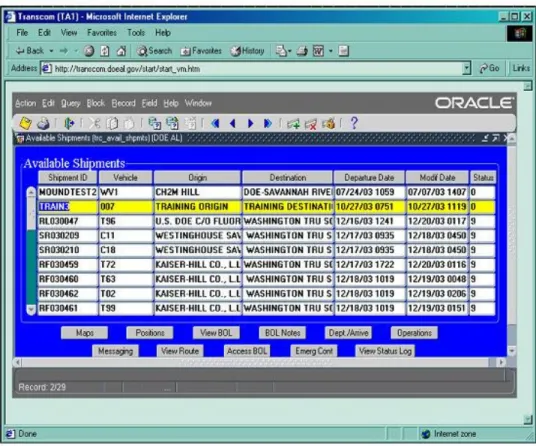
The Available Shipment screen, Figure 3, shows already scheduled or planned, moving, and completed shipments within the preceding 36 hours. From this screen, a user can either view in read only mode or fully access, based on assigned security privileges, the bill of lading for a shipment and can view the map that shows the shipment location. The user can also retrieve emergency contact information for a specific shipment and can create or view a message. The data elements on the Available Shipment screen are:
1. Shipment ID 2. Vehicle number 3. Origin 4. Destination 5. Departure Date 6. Modified Date 7. Status Code
U.S. DOT/VOLPE CENTER February, 2005 9
Figure 3 – Available Shipment Screen 3.2.2. Status Board
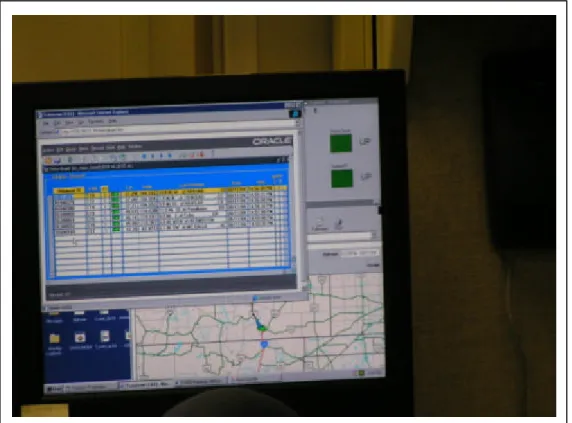
The TRANSCOM Status Board is the screen that the TCC and other users draw on the most. Each line in the table contains a near real time report on an active shipment. In addition, this screen provides links to the bill of lading and other shipment-related information, as well as to messages from the TCC, driver, or other users. The Status Board is a relatively new screen added within the last year or so by the SAIC programmer who maintains and enhances TRANSCOM.
For security reasons, the resolution of the Status Board photograph in the Figure 4 deliberately makes the actual shipment data unidentifiable. At the time when the photograph was taken, there were seven shipments moving.
Data elements shown on the Status Board are: 1. Shipment ID
2. Vehicle Number 3. Shipment Status
4. Shipment Position in Latitude and Longit ude 5. Text Descriptor of Latitude-Longitude Location 6. Date and Time
U.S. DOT/VOLPE CENTER February, 2005 10
Figure 4 – TRANSCOM Status Board Screen
The Shipment status column includes a color-coded truck icon to show the status of in-transit shipments and no icon for those shipme nts that have not yet been dispatched or have arrived at the destination site. The following status code numbers and icon colors are associated with in-transit shipments:
0 - Not in transit (no icon) 1 - In transit (green)
2 - Off Normal Situation (yellow) 3 - Emergency (red)
7 - Message Testing (gray)
9 - Arrived at Destination (no icon)
3.2.3. Bill of Lading
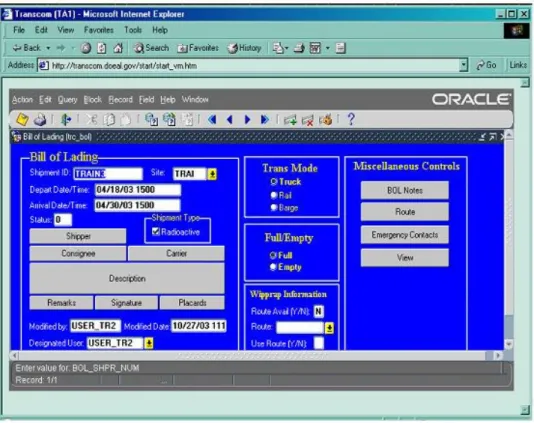
The Bill of Lading screen, Figure 5, shows more information about the shipment. Pop-up windows can be accessed from the Bill of Lading screen that allow entry of additional information such as the shipper, consignee, and description of articles.
U.S. DOT/VOLPE CENTER February, 2005 11
Figure 5 - Bill of Lading Entry and Review Screen
The Bill of Lading data elements, entered by either the shipper or the TCC staff from faxed bills of lading, are listed below. A user can bring up these screens to learn more about the details of a shipment.
1. Shipment ID
2. Site (drop down list) 3. Departure Date and Time 4. Arrival Date and Time 5. Status Code
6. Shipment Type (Radioactive check off) 7. Emergency Contacts* 8. Shipper* 9. Consignee* 10. Carrier* 11. Description* 12. Remarks* 13. Placards* 14. Route*
U.S. DOT/VOLPE CENTER February, 2005 12
15. Notes*
16. Designated User (drop down list)
17. WIPP Route Assurance Program (WIPPRAP) Information
Route Available (Y/N) Route (drop down list) Use Route (Y/N)
* NOTE: Button that brings up windows for additional data entry for the item
The WIPPRAP feature involves off-route alerts or “geofencing” in which certain routes are programmed into TRANSCOM. If a truck strays outside a band around the approved route, TRANSCOM issues an audio alarm when a WIPP shipment on one of the designated routes deviates by 1.5 miles. The alarm sounds at both the TCC and the WIPP Central Monitoring Room, and each must acknowledge the deviation in the TRANSCOM system to turn off the alarm. Five WIPP routes currently have the off-route alert feature programmed into
TRANSCOM and there are at least three routes not yet programmed. According to NTP personnel, programming the route is labor intensive since the programmer must enter latitudes and longitudes all along the route into the system.
3.2.4. Mapping
One of the important features of TRANSCOM, particularly to state and tribal users, is TRANSCOM’s screen displaying shipment movements on a map driven by a geographic information system (Figure 6). The truck icon on the map shows not only the shipment’s location, but also the icon’s color provides the shipment status (per Section 3.2.2).
U.S. DOT/VOLPE CENTER February, 2005 13
The COTS mapping software was acquired from ObjectFX. TRANSCOM builds a new map each time the screen is refreshed with updated information. Users have complained about the slow screen refresh rate and accelerating the screen update was cited by users at the August 2004 User Conference as the most important enhancement needed in TRANSCOM.
3.3. TRANSCOM Information Technology Configuration
TRANSCOM runs on four servers that each manage a specific application or network function required to operate TRANSCOM, as listed below:
• TRANSCOM Application Server - Runs Oracle Forms; mapping software (Spacial FX); and the TRANSCOM Web Server that provides user access
• TRANSCOM Data Server - Runs Oracle Database
• TCC Support Server – Runs the new TRANSCOM administration website which was implemented in the fall of 2004
• NNSA Firewall Server - dedicated to protection of TRANSCOM and the Automated Transportation Management System (ATMS)
The servers are physically located in the secure Information Technology facility at NNSA in Albuquerque. The servers are backed up on a regular basis by NNSA in accordance with
existing NNSA practice, at no cost to the TRANSCOM operation. The TRANSCOM servers are interfaced using a separate, dedicated local network that also links in two QTRACS PCs located in the TCC that receive and process the QUALCOMM satellite tracking data. There is a Primary and a Secondary QTRACS system. The TRANSCOM2000 application is connected to the Internet through the NNSA firewall, operating on a DS3 (Digital Signal Level 3 - 44 millions bytes per second) line.
The TCC workstations are all connected by the NNSA DOE B local area network (LAN). There are two complete sets of workstations within the TCC control room area and several additional PC’s in other staff work areas. Both the NNSA facility and the TCC operate under Department of Energy information security plans.
In addition, there are two development servers, used by the maintenance programmers, at the SAIC offices at Hanford, WA. They can be used as backup servers and there have been discussions of using them as a mirrored backup cont ingency site for TRANSCOM. A preliminary draft Continuity of Operations Plan has been prepared by the TCC contractor support staff members, including the maintenance programmer, and recommends using the Hanford site in the event the Albuquerque site is inoperative.
An SGC-developed Microsoft Access application (Section 3.6), that provides TCC administrative and management reports, runs on a TCC PC and is on the NNSA B LAN.
3.4. TRANSCOM Administrative Functions
In TRANSCOM there is a Designated User for each shipment (or campaign) who can schedule shipments in TRANSCOM, send messages to trucks, and access data about a shipment. The TCC operator on duty, who conducts pre-shipment communications testing with the driver,
U.S. DOT/VOLPE CENTER February, 2005 14
maintains contact with the Designated User throughout the shipment process. For example, the TCC operator would call the Designated User if there were no contact with a driver or no
position update information about a shipment for a specified period of time. Usually the shipper is the Designated User, however, WIPP is the designated user for all WIPP shipments, regardless of where they originate.
User authorization and password control are part of TRANSCOM. There are screens to enter user information and to grant or restrict access to different shipment data items for different users. As described in Section 3.6, the TCC staff uses the Access database to facilitate the process of managing the user database.
Shipment data is archived 36 hours after completion of the shipment and is then retained both electronically in TRANSCOM and in hardcopy by TCC staff. Data about completed shipments is available on- line in TRANSCOM for 36 hours, after which the shipment record is removed from the system automatically. There is no indicator in the system tha t a shipment has been archived, nor is there a way to bring up an archived shipment for on-screen review. The archived data is available to the maintenance programmer who, upon request, can retrieve archived data and provide hardcopy reports to authorized users or DOE managers.
3.5. TRANSCOM Communications Center (TCC) Operations
The TCC is a critical element of the TRANSCOM system as it monitors all shipments as they move from origin to destination. The TCC staff also manages the system and keeps hardcopy records of each shipment.
U.S. DOT/VOLPE CENTER February, 2005 15
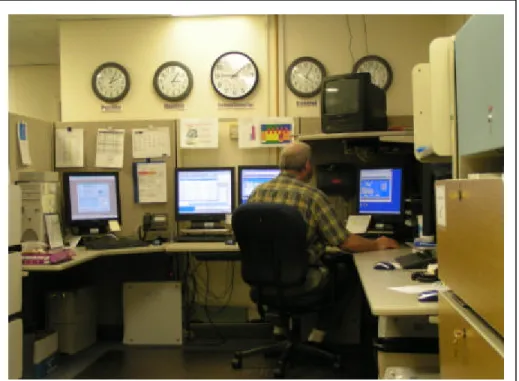
The TCC is located in a one-story building adjacent to the NNSA site on Kirtland Air Force Base in Albuquerque. The TCC contains two complete sets of workstations for TRANSCOM and the Access database, in addition to the QTRACS computers that display the satellite tracking
information received from QUALCOMM.
The major TCC functions - Shipment Monitoring, Record Keeping, Emergency Notification, Help Desk Support, Training, and TRANSCOM System Administration, - are described in Sections 3.5.1 to 3.5.6.
3.5.1. Shipment Monitoring
The TCC is staffed by multiple shifts to assure 24/7 operations except on major holidays when usually there is no planned shipping activity. Historically there has been one person per shift in the TCC with the next shift overlapping by 15-30 minutes so that operational status information and responsibilities can be efficiently passed to the replacement staff. During 2004, when the UF6 shipments more than doubled the TCC workload, an additional operator was added to the day shift.
Shipment monitoring activities begin with vehicle communications testing approximately 2 hours before the departure from the origin. This testing involves interactions between the TCC operator, the shipper’s representative, and the driver. The testing assures that the QUALCOMM transponder on the truck can be read and that position updates are being transmitted. Test messages are sent back and forth to make sure that the link is working correctly. First the identification number of the vehicle OmniTRACS unit is recorded in TRANSCOM for each shipment, and then the TCC operator verifies with the driver that the unit’s data reporting
frequency and the position report are correct. The verification testing documentation is included in the shipment file. For WIPP shipments or UF6 shipments, the pre-shipment testing involves conference calls among TCC, the WIPP or DOE Oak Ridge (UF6) program coordinator, the shipper, and the driver.
3.5.2. Record Keeping
In preparation for a shipment, as well as during and after the shipment movement period, the TCC operator creates, maintains, and archives hardcopy files of all shipment data including message traffic with truck and position updates from shipment origin to final destination. A folder is created with a checklist of various shipment-related documents. A copy of the bill of lading is included in the folder. The shipment folder is then stored in a file cabinet in the TCC for future reference and to meet recordkeeping requirements.
3.5.3. Emergency Notification
Responsibilities for shipment monitoring include notification and emergency response in the event of problems with the shipment. These include interaction with state users who may be monitoring a shipment, as well as contact with local or regional emergency response personnel. These are documented in TRANSCOM protocols for the different types of shipments and the routes that those shipments follow. The TCC operator also monitors the WIPP shipments that are subject to an alarm if the shipment deviates from its specified route.
U.S. DOT/VOLPE CENTER February, 2005 16
3.5.4. Help Desk Support
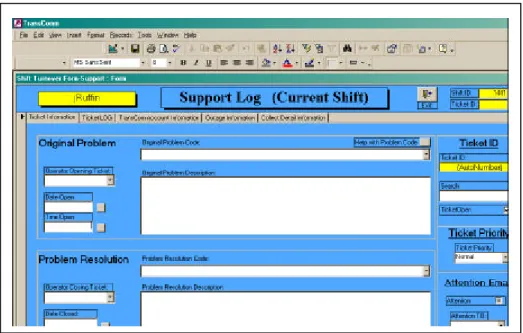
The same TCC operator who monitors shipments provides Help Desk coverage for any problems that users may have with TRANSCOM, its data, or the administration of user accounts and passwords. There is, therefore, frequent telephone contact between the TCC and TRANSCOM users. When users telephone the TCC, the operator checks the user database for authorization and keeps logs of support calls, questions, and resolutions. The automated log is part of the Access database (Figure 8, Section 3.6).
3.5.5. Training
The TCC manager is primarily responsible for TRANSCOM training administration and support. The TCC schedules training for users, develops and refines training cour ses, and occasionally delivers training at state or regional sites to launch new users or to update current users on new system features.
3.5.6. TRANSCOM Administration
TCC administrative duties include conducting a series of monthly quality control inspections, including all equipment operating within the TCC. The staff also supports the NTP managers with the creation and updating of TRANSCOM Protocols, security plans, and other documents required to operate an information system in the DOE Information Technology architecture. The TCC manager works with NTP and the program offices responsible for the shipment campaigns (e.g. WIPP) on access policy for various types and classes of users.
The TCC is equipped with uninterruptible power supplies to keep TRANSCOM operating in case of short-term power failures. If all power from the UPS backup systems were to be exhausted, operators would use a laptop computer to connect, via dial up line to the Internet Service Provider (ISP), to a QUALCOMM virtual private network enabling the shipments to be monitored with updates every 15 minutes. The operator would then provide telephone updates every 30 minutes, unless requested otherwise by the Designated User. The TCC operator phones the WIPP Central Monitoring Room and other authorized users about shipments either moving or scheduled to depart to inform them of the power failure. More details on the procedures to be followed in such circumstances are contained in the TRANSCOM “Operations Contingency Planning Procedure,” dated May 12, 2004.
3.6. TRANSCOM Access Database
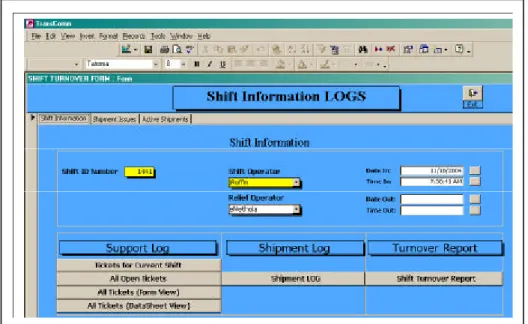
TCC staff has developed a stand-alone program in using Microsoft Access Database Management software to assist with TRANSCOM management and administration.
The primary software development effort was conducted, at no additional cost to TRANSCOM, by a weekend-shift TCC operator during time that he was on duty, but not actively involved in monitoring shipments. The Access program and database have become a critical part of
TRANSCOM management and operation, however it is not part of the system maintained by the SAIC maintenance programmer.
U.S. DOT/VOLPE CENTER February, 2005 17
series of screens for logging shift events, a log of system outages, lists of authorized users with their passwords, summary shipment data, and the ability to create management reports and charts. The system creates a report for shift changeover, in which issues from the previous shift are summarized for use by the new shift operator. Mana gement reports such as the annual shipment volume graph (Figure 10, Section 3.7) are produced from the Access database.
The TCC operators also use the program to access, maintain, and update user profile information (username, password, access privileges). The system also produces mailing labels, templates for user correspondence, and emails to facilitate contact with the user community. The database is particularly useful for tracking whether or not users have completed all the forms required for user training and security certification.
If TRANSCOM were enhanced to export shipment data from its Oracle database to the Access database (currently no link), then TCC operators would not have to enter shipment data manually to prepare management reports. TCC has requested, and the user-proposed enhancements in Section 4.4, include an automated interface by which TRANSCOM can export data to other systems so that the duplicate data entry to Access can be eliminated. Although the Access database came about in an unconventional manner, it is now a critical part of the TRANSCOM system and the functions it performs would have to be available in any replacement system.
U.S. DOT/VOLPE CENTER February, 2005 18
Figure 9 – TRANSCOM Shift Support Log
3.7. TRANSCOM Shipment Data
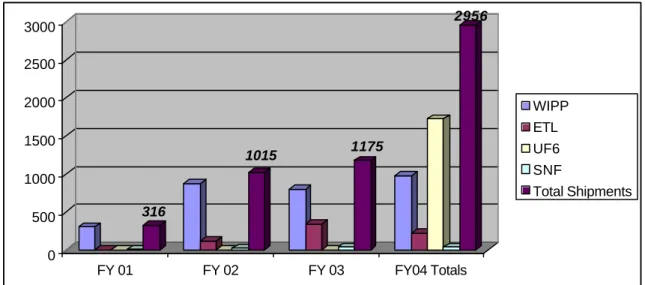
The chart in Figure 10 shows the growth and distribution of TRANSCOM shipments over the last several years. The WIPP campaign had the majority of shipments until the UF6 program started in FY04. The other principal campaigns were spent nuclear fuels (SNF) and East Tech Labs (ETL), which are primarily shipments from Oak Ridge to the Nevada Test Site. For FY04, TRANSCOM shipment distribution statistics are:
UF6 1722 shipments 58%
WIPP 969 shipments 33%
ETL 230 shipments 8%
SNF 35 shipments 1%
SNF shipments are more distributed geographically in terms of both origins and destinations. Since there is no permanent disposal site, the SNF shipments move among various DOE sites. Eventually such shipments will be sent to Yucca Mountain.
U.S. DOT/VOLPE CENTER February, 2005 19 316 1015 1175 2956 0 500 1000 1500 2000 2500 3000 FY 01 FY 02 FY 03 FY04 Totals WIPP ETL UF6 SNF Total Shipments
Figure 10 – TCC- Monitored Shipments by Campaign by Year
3.8. TRANSCOM Operating Costs
NTP staff in Albuquerque provided the following TRANSCOM operating costs: TCC staff costs (SCG contract costs for 24/7 labor) $396,060
QUALCOMM satellite tracking costs $ 49,214
Software licenses $ 22,964
SAIC software maintenance costs $130,000
Estimated Annual Operating Cost $598,238
TRANSCOM server operation, system data backups, and communications are provided by NNSA at no additional cost.
4. TRANSCOM Users
There are three types of principal users of TRANSCOM: shippers (and Designated Users such as WIPP), state and tribal governments, and project management and administrative personnel, including staff of the TCC and Headquarters DOE. Each is described below:
4.1. Shippers
The shippers or their contractors prepare the bill of lading and hazardous materials manifest for a shipment and often participate in conference calls with the TCC to test the operation of
TRANSCOM before a truck departs. Because of the requirement to provide the states with advanced notice of scheduled departures, the schedules are usually set as part of the campaign and the shipper simply abides by the schedule. For example, WIPP maintains a rolling eight-week schedule created by the WIPP office and approved by DOE Headquarters. However, the shipper enters the key shipment information into TRANSCOM.
U.S. DOT/VOLPE CENTER February, 2005 20
The shipper is frequently – but not always – the Designated User and has the ultimate decision-making authority for a shipment once it is in transit. While the TCC operator is continuously monitoring a shipment and acting as a communications conduit between the user and the truck, it is the Designated User who makes decisions about changing a shipment’s status once it is
enroute. The WIPP Central Monitoring Room/TRANSCOM Operator at the WIPP facility near Carlsbad, New Mexico, is the Designated User for WIPP shipments, regardless of their origin. For the UF6 program, the shipper at Oak Ridge is the Designated User.
The Volpe team interviewed shippers and designated users from the key DOE sites and campaigns. They are generally satisfied with TRANSCOM use and input requirements. Universally, the shippers use the Automated Transportation Management System (ATMS) to create the shipping documentation, including the bill of lading that accompanies the truck. These users said they would like an interface between ATMS and TRANSCOM to eliminate duplicate data entry for the basic bill of lading information.
4.2. State and Tribal Emergency Response
The most visible and politically important users of TRANSCOM are the state and tribal
governments. They are required by the various transportation plans and negotiated agreements, discussed in Section 2, to receive an advanced notification at least seven days before a shipment. There are four regional state governors’ associations which each plays a key role in route
planning and shipping campaign approval. On behalf of their states, they negotiate memoranda of agreement with the originating field office and DOE Headquarters. The Western Governors’ Association (WGA) led the way in negotiating the details regarding the states’ monitoring of TRANSCOM shipments. Because it was in everyone’s best interest, the other three associations followed WGA’s lead. The tribal governments have separate memoranda of agreement with DOE and these are also based on the WGA’s work.
In August 2004, when the Volpe team met with NTP and TRANSCOM staff, TRANSCOM had 90 registered users from 35 states. One large state has 59 users (an unusually high number and being reduced by that state for more effective management of the user process), while some states have just a single user.
There is a distinction in TRANSCOM between general users and super users. A general user has read only access to TRANSCOM that is confined to monitoring shipments. A super user is a lead user for a state or tribe (or for group of users within), is more proficient (having received more training), can provide user training, and has administrative duties, e.g., controls passwords of his or her general users.
Users have two types of involvement with TRANSCOM. One is the observation of shipment scheduling including the DOE Prospective Shipment Module. This helps to indicate to the user when a shipment will be arriving at his or her jurisdictional border. It allows the state user to arrange for appropriate inspection resources, law enforcement monitors, and other state resources as agreed upon to provide the oversight as the shipment moves through the state.
In the second type of use, state users monitor the shipment via the TRANSCOM Status Board and the route maps as long as the shipment is within its borders. The state users also have the ability to use TRANSCOM’s communications capability to pass relevant and critical information to the TCC operator and the Designated User. This information could involve changing weather
U.S. DOT/VOLPE CENTER February, 2005 21
conditions, road conditions or hazards, or other things that might affect the movement of a truck through the state’s jurisdiction.
The TRANSCOM User Conference on August 30-31, 2004, in Albuquerque included representatives from 10 states and one New Mexico tribe. Each user discussed his or her
experiences with TRANSCOM and identified potential enhancements to the system. In addition to the discussions at the User Conference, the Volpe team conducted follow- up interviews with several state users.
Users expressed general satisfaction with TRANSCOM operation. The results of a user satisfaction survey, conducted by SCG in July- August 2004, were presented at the meeting. Even users who were seeking improvements to the system emphasized the importance of TRANSCOM to the state and tribal governments. It was clear to the Volpe team from conversations wit h conference participants that the system is vital to these governments. In addition, several state users emphasized to the Volpe team the importance of the governors’ associations and the agreements that have been negotiated with DOE. They noted that, were it not for those agreements, each state could be mandating its own different requirements for shipments transiting its terrain. As it is, the WIPP program has been so successful that states have confidence in DOE’s ability to provide safe transportation and to keep the state
governments informed.
4.3. Project Management and Administration
The TCC staff members administer TRANSCOM and are by far the most intensive users. They not only assist in origination of a shipment through communications interaction with the driver and shipper but also, in many cases, enter the bill of lading information into TRANSCOM for the shipper. The TCC staff also administers passwords and user identification as described in
Section 3.6.
In addition, DOE oversight personnel who use TRANSCOM include staff from the Office of Characterization and Transportation in the Carlsbad Field Office, EM’s Office of Transportation (EM-11), and the DOE HQ Emergency Operations Center (EOC), as well as other DOE and contractor program/project managers and administrative staff. There are also occasional users from other parts of DOE, including NNSA and the Office of Nuclear Energy, Science and Technology (NE). NE manages NRC licensee shipments. On its website, NE-70, the Integrated Safety Organization of NE says:
In order to ensure a timely response during an incident or emergency that occurs when material shipments are in transit, NE has a direct access to DOE’s Transportation Tracking Communication System, an Internet-based real-time shipment tracking and communication system.
The Available Shipment Screen and several others are potentially useful to these program management users since they provide higher- level information about shipments across
campaigns and allow monitoring of any shipments of particular interest. However, management reports, such as those created by the TCC with its Access database, are not available directly from TRANSCOM to such users.
Initial and continuing or refresher training in the use of TRANSCOM is ongoing, particularly for state and tribal users where use may be infrequent and the turnover of user personnel high. NTP
U.S. DOT/VOLPE CENTER February, 2005 22
has developed a training program that the Federal employees and SCG provide to users as required. Sometimes sessions are held in Albuquerque and sometimes the trainers travel to user sites to conduct training. TRANSCOM operations staff provides different levels of training to users. Super users, who administer passwords for general users under their direction, receive more detailed and intensive training than general users. The aforementioned customer satisfaction survey asked about training and found that users are generally satisfied with the caliber of the training that they are receiving.
4.4. User Priorities
At the TRANSCOM User Conference on August 31, 2004, approximately 20 participants identified a set of primarily minor enhancements that they would like to see implemented. The participants categorized these enhancements into Needs and Wants. Within each of these two categories, the users then prioritized each recommended enhancement as shown in Table 1. Each item was defined as a software change, an operational change, or a policy change.
The enhancement list was created as a guide for the expenditure of FY05 TRANSCOM funding. The SAIC programmer, who maintains and enhances TRANSCOM, was tasked to provide cost estimates for each of the software enhancements so that NTP could determine which of the needs and wants could actually be completed. The table is drawn from the NTP minutes of the user conference. The items are shown in order of user-assigned priority with Needs listed before Wants.
The only significant user complaints were related to slow refresh rates experienced by web users in displaying TRANSCOM maps. It was beyond the scope of this analysis to ascertain whether this slowness resulted from streamlining needed in TRANSCOM’s mapping software, a user site’s communications bandwidth limitations, or inadequate user PC memory. The occasional TRANSCOM outages and disruption in its ability to track shipments that had been reported to the Volpe team by DOE HQ were found to be Internet Service Provider (ISP) problems. This type of problem is neither unusual nor uncommon for any Internet-dependent communication system and is beyond TRANSCOM’s immediate control. Any system that relies on the web user access may be struck occasionally with Internet Service Provider (ISP) glitches or outages. Such issues must be addressed in TRANSCOM continuity of operations planning.
U.S. DOT/VOLPE CENTER February, 2005 23
Table 1 - TRANSCOM2000 User Group Recommendations
Recommendation Requirement Change Type
Priority Sequence H=high, M=medium, L=low
Add Maps interface (image based system) with
reduced functionality in exchange for speed. Needed Software H-1 Oracle T2000 application – purchase license to
upgrade Oracle version from 8i to 10G. Needed Software H-2A Disable browser controls, resize Oracle forms. Needed Software H-2B T2000 schedule based on DOE prospective
shipping module. Needed Software H-3
Add function to messaging where TRANSCOM user can see the organization when choosing a message recipient.
Needed Software H-4
Fix bill of lading templates in scheduling/shipper. Wanted Software H Design data export capabilities for TCC and
States from TRANSCOM database. Wanted Software M-1
Provide users capability to de-select message capability without contacting the TCC - Message alerts distracting.
Wanted Software M-2
Rewrite/edit Oracle forms to reflect common user
interface. Wanted Software M-3
Add first responder guides – web link to Transportation Emergency Preparedness Program (TEPP) web site.
Wanted Software L
Messaging capability – Provide users capability to de-select messages without contacting the TCC.
Wanted Operational M
Training issues: establish scheduled training. Wanted Operational L Develop a computer based training program for
T2000. Wanted Policy H
U.S. DOT/VOLPE CENTER February, 2005 24
5. Other Tracking Systems
Part of the Volpe Center’s charge was to review other tracking systems to determine if there is a better or less expensive way for DOE to meet its shipment monitoring requirements. In the aftermath of 9/11, the Departments of Transportation (DOT) and Homeland Security (DHS) have shown a heightened interest in vehicle and container tracking to ensure the safe and secure transportation of hazardous materials, including radioactive shipments. The Department of Defense (DOD) and DOE have significant operational experience in shipment tracking. DOT, DHS, DOE, DOD, and other agencies have begun meeting to collaborate on and coordinate their mutual tracking technology interests and activities. The participating agencies, seeking to avoid duplication of effort and to benefit from each other’s experiences and lessons learned, include:
DHS − Transportation Security Agency (TSA) − U.S. Coast Guard (USCG)
DOD − Office of Assistant Secretary of Defense for Transportation Policy − U.S. Navy
DOE
− Office of Transportation (EM-11) in the Office of Environmental Management’s (EM) Office of Logistics and Waste Disposition Enhancements (EM-10) − National Nuclear Security Administration’s (NNSA’s) Office of Secure
Transportation (NA-15)
DOT
− Office of the Secretary (OST)
− Office of Hazardous Materials Safety (OHM)
− Volpe National Transportation Systems Center (Volpe Center) − Federal Railroad Administration (FRA)
− Federal Motor Carrier Safety Administration (FMCSA)
NRC − Office of Nuclear Security and Incident Response’s Materials, Transportation, and Waste Security Section
Table 2 – Interagency HazMat Tracking Coordination Participants
For example, in the coordination group meetings, DOE and the DOD have provided information about the operational capabilities of TRANSCOM and the Defense Transportation Tracking System (DTTS), respectively, and their long-term operations experience with these systems. FMCSA is sharing the results of its 2004 field operational test of technologies for tracking hazardous materials.
From previous logistics work, the Volpe Center was familiar with DTTS and other freight transportation management systems in the Department of Defense. In addition to DTTS, two other DOD systems were investigated: the Intelligent Road and Rail Information System (IRRIS) and the Movement Tracking System (MTS).
IRRIS is a GIS-based system that is fed by numerous other defense and commercial systems, including DTTS, in order to show the movement of military freight in transit. MTS is used by the Army to keep track of its trucks and personnel carriers in its theater logistics operations. The team also examined industry/government pilot tests of recent years, particularly the
U.S. DOT/VOLPE CENTER February, 2005 25
Hazardous Materials test sponsored by the Federal Motor Carrier Safety Administration (FMCSA). Internet searches identified prior related technology surveys and companies with commercial off the shelf (COTS) products that involve the tracking of transportation vehicles. The key results of these Volpe Center investigations are described below.
5.1. Defense Transportation Tracking System (DTTS)
The Defense Transportation Tracking System (DTTS) is a satellite-based tracking system used by the U.S. Department of Defense (DOD) to track arms, ammunition, and explosives (AA&E) shipments. The system, which was initiated in 1989, now monitors more than 50,000 shipments annually. DTTS tracks shipments throughout the United States, Alaska, and Canada.
Ammunition shipments and other sensitive shipments of all the services (Army, Navy, Air Force and Marine Corps) are tracked in the system. DTTS tracks both truck and barge shipments and will track rail shipments in the future.
5.2. Intelligent Road and Rail Information System (IRRIS)
The Intelligent Road and Rail Information System (IRRIS) was developed in 1999 as a joint effort of the Military Traffic Management Command’s Transportation Engineering Agency (MTMC-TEA), now known as the Surface Deployment and Distribution Command (SDDC) TEA, and GeoDecisions, a commercial GIS company. The original purpose was to track
military general freight shipments for deployments overseas. IRRIS displays container locations on a map based on reading RFID tags at defined nodes along the route. IRRIS now also
incorporates DTTS data on AA&E shipments. IRRIS captures shipment bill of lading data for user display as needed. More information about IRRIS may be found at the Geodecisions web site - http://www.geodecisions.com/.
5.3. Army Movement Tracking System (MTS)
In 1999, the U.S. Army Combined Arms Support Command (CASCOM) contracted with Comtech Mobile Datacom to develop and implement a Movement Tracking System (MTS) to allow secure two-way messaging between Army vehicles and an operations center. The system is a satellite-based tracking and communications system that uses a laptop computer installed in the vehicle cab with two-way packet communications and military GPS-based tracking system for battlefield communication and logistics management. A commercial version of MTS is also operating in Venezuela where it is used to track trucks and to transmit location information to customer’s facilities via satellite. A data center was constructed in Venezuela to monitor the vehicles and communications. The impetus for the installation was high rate of theft. The tracking system has permitted the quick recovery of stolen vehicles and arrest of the thieves.
5.4. Industry-Government Pilot Tests and Tracking Initiatives
In 2003, the DOT Federal Motor Carrier Safety Administration (FMCSA) and other agencies initiated a hazardous materials Field Operational Test (FOT). They chose four operating scenarios: bulk fuel delivery, less-than-truck load high hazard shipments, other bulk hazards,