LM555
Timer
General Description
The LM555 is a highly stable device for generating accurate time delays or oscillation. Additional terminals are provided for triggering or resetting if desired. In the time delay mode of operation, the time is precisely controlled by one external re-sistor and capacitor. For astable operation as an oscillator, the free running frequency and duty cycle are accurately controlled with two external resistors and one capacitor. The circuit may be triggered and reset on falling waveforms, and the output circuit can source or sink up to 200mA or drive TTL circuits.
Features
n Direct replacement for SE555/NE555 n Timing from microseconds through hours n Operates in both astable and monostable modes n Adjustable duty cycle
n Output can source or sink 200 mA n Output and supply TTL compatible
n Temperature stability better than 0.005% per ˚C n Normally on and normally off output
n Available in 8-pin MSOP package
Applications
n Precision timing n Pulse generation n Sequential timing n Time delay generation n Pulse width modulation n Pulse position modulation n Linear ramp generator
Schematic Diagram
DS007851-1 February 2000
LM555
T
imer
Connection Diagram
Ordering Information
Package Part Number Package Marking Media Transport NSC Drawing
8-Pin SOIC LM555CM LM555CM Rails
M08A LM555CMX LM555CM 2.5k Units Tape and Reel
8-Pin MSOP LM555CMM Z55 1k Units Tape and Reel
MUA08A
LM555CMMX Z55 3.5k Units Tape and Reel
8-Pin MDIP LM555CN LM555CN Rails N08E
Dual-In-Line, Small Outline and Molded Mini Small Outline Packages
DS007851-3 Top View
Absolute Maximum Ratings
(Note 2)If Military/Aerospace specified devices are required, please contact the National Semiconductor Sales Office/ Distributors for availability and specifications.
Supply Voltage +18V
Power Dissipation (Note 3)
LM555CM, LM555CN 1180 mW
LM555CMM 613 mW
Operating Temperature Ranges
LM555C 0˚C to +70˚C
Storage Temperature Range −65˚C to +150˚C
Soldering Information Dual-In-Line Package
Soldering (10 Seconds) 260˚C
Small Outline Packages (SOIC and MSOP)
Vapor Phase (60 Seconds) 215˚C
Infrared (15 Seconds) 220˚C
See AN-450 “Surface Mounting Methods and Their Effect on Product Reliability” for other methods of soldering surface mount devices.
Electrical Characteristics
(Notes 1, 2) (TA= 25˚C, VCC= +5V to +15V, unless othewise specified)Parameter Conditions Limits Units
LM555C
Min Typ Max
Supply Voltage 4.5 16 V
Supply Current VCC= 5V, RL=∞
VCC= 15V, RL=∞
(Low State) (Note 4)
3 10
6
15 mA
Timing Error, Monostable
Initial Accuracy 1 %
Drift with Temperature RA= 1k to 100kΩ, 50 ppm/˚C
C = 0.1µF, (Note 5)
Accuracy over Temperature 1.5 %
Drift with Supply 0.1 %/V
Timing Error, Astable
Initial Accuracy 2.25 %
Drift with Temperature RA, RB= 1k to 100kΩ, 150 ppm/˚C
C = 0.1µF, (Note 5)
Accuracy over Temperature 3.0 %
Drift with Supply 0.30 %/V
Threshold Voltage 0.667 x VCC
Trigger Voltage VCC= 15V 5 V
VCC= 5V 1.67 V
Trigger Current 0.5 0.9 µA
Reset Voltage 0.4 0.5 1 V
Reset Current 0.1 0.4 mA
Threshold Current (Note 6) 0.1 0.25 µA
Control Voltage Level VCC= 15V
VCC= 5V
9 2.6 10 3.33 11 4 V
Pin 7 Leakage Output High 1 100 nA
Pin 7 Sat (Note 7)
Output Low VCC= 15V, I7= 15mA 180 mV
Electrical Characteristics
(Notes 1, 2) (Continued) (TA= 25˚C, VCC = +5V to +15V, unless othewise specified)Parameter Conditions Limits Units
LM555C
Min Typ Max
Output Voltage Drop (Low) VCC= 15V
ISINK= 10mA 0.1 0.25 V
ISINK= 50mA 0.4 0.75 V
ISINK= 100mA 2 2.5 V
ISINK= 200mA 2.5 V
VCC= 5V
ISINK= 8mA V
ISINK= 5mA 0.25 0.35 V
Output Voltage Drop (High) ISOURCE= 200mA, VCC= 15V 12.5 V
ISOURCE= 100mA, VCC= 15V 12.75 13.3 V
VCC= 5V 2.75 3.3 V
Rise Time of Output 100 ns
Fall Time of Output 100 ns
Note 1: All voltages are measured with respect to the ground pin, unless otherwise specified.
Note 2: Absolute Maximum Ratings indicate limits beyond which damage to the device may occur. Operating Ratings indicate conditions for which the device is
func-tional, but do not guarantee specific performance limits. Electrical Characteristics state DC and AC electrical specifications under particular test conditions which guar-antee specific performance limits. This assumes that the device is within the Operating Ratings. Specifications are not guarguar-anteed for parameters where no limit is given, however, the typical value is a good indication of device performance.
Note 3: For operating at elevated temperatures the device must be derated above 25˚C based on a +150˚C maximum junction temperature and a thermal resistance
of 106˚C/W (DIP), 170˚C/W (S0-8), and 204˚C/W (MSOP) junction to ambient.
Note 4: Supply current when output high typically 1 mA less at VCC= 5V.
Note 5: Tested at VCC= 5V and VCC= 15V.
Note 6: This will determine the maximum value of RA+ RBfor 15V operation. The maximum total (RA+ RB) is 20MΩ.
Note 7: No protection against excessive pin 7 current is necessary providing the package dissipation rating will not be exceeded. Note 8: Refer to RETS555X drawing of military LM555H and LM555J versions for specifications.
Typical Performance Characteristics
Minimuim Pulse Width Required for Triggering
DS007851-4
Supply Current vs. Supply Voltage
DS007851-19
High Output Voltage vs. Output Source Current
DS007851-20
Low Output Voltage vs. Output Sink Current
DS007851-21
Low Output Voltage vs. Output Sink Current
DS007851-22
Low Output Voltage vs. Output Sink Current
Typical Performance Characteristics
(Continued)Output Propagation Delay vs. Voltage Level of Trigger Pulse
DS007851-24
Output Propagation Delay vs. Voltage Level of Trigger Pulse
DS007851-25
Discharge Transistor (Pin 7) Voltage vs. Sink Current
DS007851-26
Discharge Transistor (Pin 7) Voltage vs. Sink Current
DS007851-27
Applications Information
MONOSTABLE OPERATION
In this mode of operation, the timer functions as a one-shot (Figure 1). The external capacitor is initially held discharged by a transistor inside the timer. Upon application of a nega-tive trigger pulse of less than 1/3 VCCto pin 2, the flip-flop is
set which both releases the short circuit across the capacitor and drives the output high.
The voltage across the capacitor then increases exponen-tially for a period of t = 1.1 RAC, at the end of which time the
voltage equals 2/3 VCC. The comparator then resets the
flip-flop which in turn discharges the capacitor and drives the output to its low state.Figure 2 shows the waveforms gener-ated in this mode of operation. Since the charge and the threshold level of the comparator are both directly propor-tional to supply voltage, the timing internal is independent of supply.
During the timing cycle when the output is high, the further application of a trigger pulse will not effect the circuit so long as the trigger input is returned high at least 10µs before the end of the timing interval. However the circuit can be reset during this time by the application of a negative pulse to the reset terminal (pin 4). The output will then remain in the low state until a trigger pulse is again applied.
When the reset function is not in use, it is recommended that it be connected to VCCto avoid any possibility of false
trig-gering.
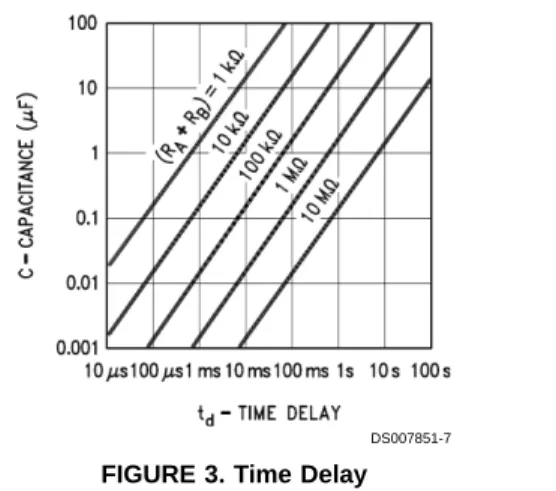
Figure 3 is a nomograph for easy determination of R, C val-ues for various time delays.
NOTE: In monostable operation, the trigger should be driven
high before the end of timing cycle.
ASTABLE OPERATION
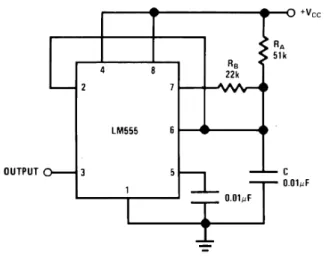
If the circuit is connected as shown inFigure 4 (pins 2 and 6 connected) it will trigger itself and free run as a multivibrator. The external capacitor charges through RA+ RBand
dis-charges through RB. Thus the duty cycle may be precisely
set by the ratio of these two resistors.
In this mode of operation, the capacitor charges and dis-charges between 1/3 VCCand 2/3 VCC. As in the triggered
mode, the charge and discharge times, and therefore the fre-quency are independent of the supply voltage.
DS007851-5 FIGURE 1. Monostable
DS007851-6
VCC= 5V Top Trace: Input 5V/Div.
TIME = 0.1 ms/DIV. Middle Trace: Output 5V/Div.
RA= 9.1kΩ Bottom Trace: Capacitor Voltage 2V/Div.
C = 0.01µF
FIGURE 2. Monostable Waveforms
DS007851-7 FIGURE 3. Time Delay
DS007851-8 FIGURE 4. Astable
Applications Information
(Continued) Figure 5 shows the waveforms generated in this mode of operation.The charge time (output high) is given by: t1= 0.693 (RA+ RB) C
And the discharge time (output low) by: t2= 0.693 (RB) C
Thus the total period is:
T = t1+ t2= 0.693 (RA+2RB) C
The frequency of oscillation is:
Figure 6 may be used for quick determination of these RC values.
The duty cycle is:
FREQUENCY DIVIDER
The monostable circuit ofFigure 1 can be used as a fre-quency divider by adjusting the length of the timing cycle. Figure 7 shows the waveforms generated in a divide by three circuit.
PULSE WIDTH MODULATOR
When the timer is connected in the monostable mode and triggered with a continuous pulse train, the output pulse width can be modulated by a signal applied to pin 5.Figure 8 shows the circuit, and in Figure 9 are some waveform examples.
DS007851-9
VCC= 5V Top Trace: Output 5V/Div.
TIME = 20µs/DIV. Bottom Trace: Capacitor Voltage 1V/Div.
RA= 3.9kΩ
RB= 3kΩ
C = 0.01µF
FIGURE 5. Astable Waveforms
DS007851-10 FIGURE 6. Free Running Frequency
DS007851-11
VCC= 5V Top Trace: Input 4V/Div.
TIME = 20µs/DIV. Middle Trace: Output 2V/Div.
RA= 9.1kΩ Bottom Trace: Capacitor 2V/Div.
C = 0.01µF
FIGURE 7. Frequency Divider
DS007851-12 FIGURE 8. Pulse Width Modulator
DS007851-13
VCC= 5V Top Trace: Modulation 1V/Div.
TIME = 0.2 ms/DIV. Bottom Trace: Output Voltage 2V/Div.
RA= 9.1kΩ
C = 0.01µF
FIGURE 9. Pulse Width Modulator
Applications Information
(Continued)PULSE POSITION MODULATOR
This application uses the timer connected for astable opera-tion, as inFigure 10, with a modulating signal again applied to the control voltage terminal. The pulse position varies with the modulating signal, since the threshold voltage and hence the time delay is varied. Figure 11 shows the waveforms generated for a triangle wave modulation signal.
LINEAR RAMP
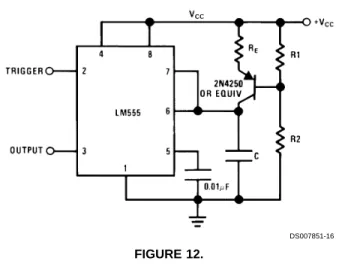
When the pullup resistor, RA, in the monostable circuit is
re-placed by a constant current source, a linear ramp is gener-ated.Figure 12 shows a circuit configuration that will perform this function.
Figure 13 shows waveforms generated by the linear ramp. The time interval is given by:
VBE.0.6V
DS007851-14 FIGURE 10. Pulse Position Modulator
DS007851-15
VCC= 5V Top Trace: Modulation Input 1V/Div.
TIME = 0.1 ms/DIV. Bottom Trace: Output 2V/Div.
RA= 3.9kΩ
RB= 3kΩ
C = 0.01µF
FIGURE 11. Pulse Position Modulator
DS007851-16 FIGURE 12.
DS007851-17
VCC= 5V Top Trace: Input 3V/Div.
TIME = 20µs/DIV. Middle Trace: Output 5V/Div.
R1= 47kΩ Bottom Trace: Capacitor Voltage 1V/Div.
R2= 100kΩ
RE= 2.7 kΩ
C = 0.01 µF
Applications Information
(Continued)50% DUTY CYCLE OSCILLATOR
For a 50% duty cycle, the resistors RAand RBmay be
con-nected as inFigure 14. The time period for the output high is the same as previous, t1= 0.693 RAC. For the output low it
is t2 =
Thus the frequency of oscillation is
Note that this circuit will not oscillate if RBis greater than 1/2
RAbecause the junction of RAand RBcannot bring pin 2
down to 1/3 VCCand trigger the lower comparator.
ADDITIONAL INFORMATION
Adequate power supply bypassing is necessary to protect associated circuitry. Minimum recommended is 0.1µF in par-allel with 1µF electrolytic.
Lower comparator storage time can be as long as 10µs when pin 2 is driven fully to ground for triggering. This limits the monostable pulse width to 10µs minimum.
Delay time reset to output is 0.47µs typical. Minimum reset pulse width must be 0.3µs, typical.
Pin 7 current switches within 30ns of the output (pin 3) volt-age.
DS007851-18 FIGURE 14. 50% Duty Cycle Oscillator
Physical Dimensions
inches (millimeters) unless otherwise notedSmall Outline Package (M) NS Package Number M08A
8-Lead (0.118” Wide) Molded Mini Small Outline Package NS Package Number MUA08A
Physical Dimensions
inches (millimeters) unless otherwise noted (Continued)LIFE SUPPORT POLICY
NATIONAL’S PRODUCTS ARE NOT AUTHORIZED FOR USE AS CRITICAL COMPONENTS IN LIFE SUPPORT DEVICES OR SYSTEMS WITHOUT THE EXPRESS WRITTEN APPROVAL OF THE PRESIDENT AND GENERAL COUNSEL OF NATIONAL SEMICONDUCTOR CORPORATION. As used herein:
1. Life support devices or systems are devices or systems which, (a) are intended for surgical implant into the body, or (b) support or sustain life, and whose failure to perform when properly used in accordance with instructions for use provided in the labeling, can be reasonably expected to result in a significant injury to the user.
2. A critical component is any component of a life support device or system whose failure to perform can be reasonably expected to cause the failure of the life support device or system, or to affect its safety or effectiveness.
National Semiconductor Corporation
Americas
National Semiconductor Europe
Fax: +49 (0) 180-530 85 86
National Semiconductor Asia Pacific Customer Response Group
National Semiconductor Japan Ltd.
Tel: 81-3-5639-7560
Molded Dual-In-Line Package (N) NS Package Number N08E