STEREOSELECTIVE INCORPORATION OF BORON INTO MOLECULES VIA ADDITIONS OF ALPHA-BORYLATED ORGANOMETALLICS TO ELECTROPHILES
Matthew Vincent Joannou
A dissertation submitted to the faculty at the University of North Carolina at Chapel Hill in partial fulfillment of the requirements for the degree of Doctor of Philosophy in the Department of
Chemistry
Chapel Hill 2016
ii © 2016
iii ABSTRACT
MATTHEW VINCENT JOANNOU: Stereoselective Incorporation of Boron into Molecules via Additions of alpha-Borylated Organometallics to Electrophiles
(Under the direction of Simon J. Meek)
Chapter 1: Enantio- and Diastereoselective Synthesis of β-Hydroxyboronates via Cu-catalyzed Addition of gem-Diboronate Esters to Aldehydes. The development of an enantio- and diastereoselective addition of gem-diboronate esters to aryl and alkenyl aldehydes in the presence of stoichiometric LiOt-Am is presented. The reaction proceeds in up to 92% yield, >99:1 d.r., and 96:4 e.r. Mechanistic studies reveal the formation of a lithium tert-butylborate species that stereospecifically transmetallates to a copper catalyst, which then diastereoselectively adds to the aldehyde.
iv
presence of either stoichiometric KOt-Bu or n-BuLi at -25 °C in thf. Mechanistic studies indicate an α-boryl-alkyl silver species as the active nucleophile in the reaction. The hydroxyboronates are isolated in up to 77% yield and 99:1 d.r. favoring the anti diastereomer.
Chapter 3: Enantio- and Diastereoselective Synthesis of 1-Hydroxy-2,3-Bisboronates via a Copper–Catalyzed Multicomponent Reaction. The multicomponent coupling of vinyl boronic acid pinacol ester, B2(pin)2, and various aldehydes in the presence of a copper-bis-phosphine catalyst is
v
ACKNOWLEDGEMENTS
There are many individuals I would like to thank who, not only contributed to the chemistry that resides in this document, but also made my life truly wonderful for the past five years. I would first like to thank my advisor, Simon J. Meek for his patience and guidance over the past five years. From when I arrived in Simon’s lab as a shy, inexperienced inorganic chemist who had almost never given organic chemistry a second thought, to the synthesis-loving organometallic chemist I am today, you have had a profound impact on my academic life. I would also like to thank my labmates, past and present, for their contributions to the chemistry presented here, long talks and “meching-it-out” at the whiteboard, and generally making my lab experience full of fun every day of the week (except Sundays…sometimes). I couldn’t have done it without your constant support and friendship.
To all the teachers I’ve had at UNC, thank you for enriching my mind with chemistry knowledge I didn’t even know existed when I first arrived. To the friends I’ve made at UNC, in the department and outside, I could not have done this without your support, love, and friendship…and your abilities to get me out of lab to have fun! I don’t know what I’m going to do without you all in my life, but you’ll always be in my heart, regardless of where we are in the world.
vi
vii
TABLE OF CONTENTS
LIST OF TABLES………...x
LIST OF ILLUSTRATIONS………..xi
LIST OF ABBREVIATIONS………....xv
Chapter 1: Enantio- and Diastereoselective Synthesis of β-Hydroxyboronates via Cu-catalyzed Addition of gem-Diboronate Esters to Aldehydes………1
1.1 Introduction………..1
1.2 Background………..7
1.3 Reaction Discovery and Optimization………16
1.4 Substrate Scope………..23
1.5 Mechanistic Investigations..………...26
1.6 Conclusions………35
1.7 Experimental………..36
1.7.1 General………...36
1.7.2 Reagents……….37
1.7.3 Synthesis of Reagents……….41
1.7.4 General Procedures……….43
1.7.5 Compound Characterizations……….46
1.7.6 NMR Spectra………..82
1.7.7 NMR Reactions………138
1.8 References………148
viii
2.1 Introduction………..151
2.2 Background………..154
2.3 Reaction Discovery and Optimization………..157
2.4 Substrate Scope……….…...160
2.5 Mechanistic Investigations………164
2.6 Functionalization Reactions……….174
2.7 Enantioselective Ag-Catalyzed 1,2-Addition Reactions………..175
2.8 Conclusions………..179
2.9 Experimental………180
2.9.1 General……….180
2.9.2 Reagents………...181
2.9.3 Synthesis of Reagents………..184
2.9.4 General Procedures………..190
2.9.5 Compound Characterizations………...192
2.9.6 NMR Spectra………213
2.9.7 NMR Reactions………285
2.10 References………...303
Chapter 3: Enantio- and Diastereoselective Synthesis of 1-Hydroxy-2,3-Bisboronates via a Copper– Catalyzed Multicomponent Reaction………...305
3.1 Introduction………..305
3.2 Background………..308
3.3 Diastereoselective Copper-Catalyzed Multicomponent Reaction………311
3.4 Optimization of Enantio- an Diastereoselective Reaction………313
3.5 Substrate Scope and Limitations of Cu(MeCN)4PF6 as a Copper Source………316
3.6 Isolation of Cu-Phosphine Complexes/Effect of Nitrile Ligands on Multicomponent Reaction………...319
ix
3.8 Cu-Catalyzed Borylation/1,2-Addition to Alkyl Aldehydes………....330
3.9 Functionalization Reactions…...………..332
3.10Conclusion………...332
3.11Experimental………...333
3.10.1 General……….333
3.10.2 Reagents………...334
3.10.3 General Procedures………..338
3.10.4 Compound Characterizations………...341
3.10.5 NMR Spectra………380
x
LIST OF TABLES
Table 1.1 Counterion effect on the background reaction of diborylethane and benzaldehyde promoted by alkali alkoxides………...17 Table 1.2 Copper-catalyzed addition of diborylethane to benzaldehyde: ligand screen with
LiOt-Bu………...19 Table 1.3 Copper-catalyzed addition of diborylethane to benzaldehyde: copper salt screen and
xi
LIST OF ILLUSTRATIONS
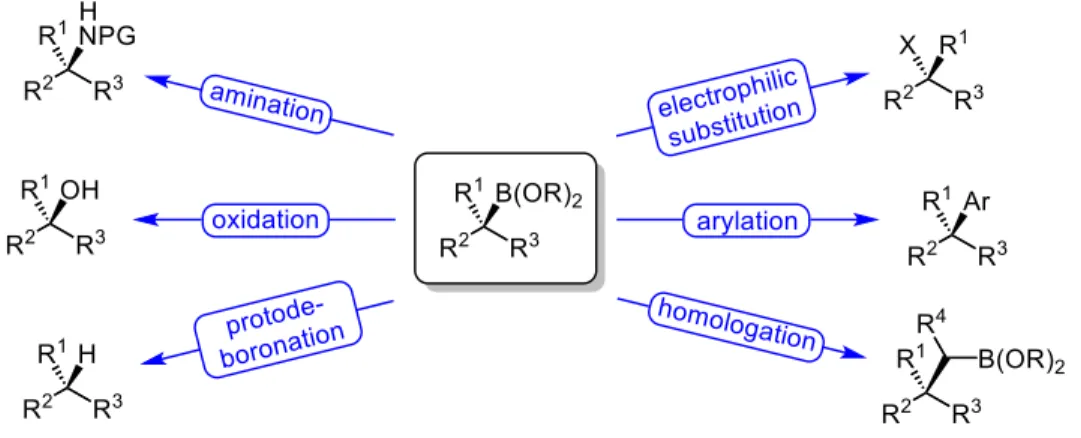
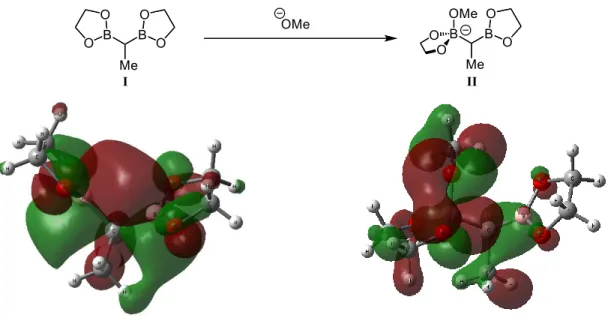
Figure 1.1 List of Stereospecific Functionalizations of Boronic Acid Esters………..2 Figure 1.2 Strategy and application for the additions of α-boryl organometallic species to aldehydes: concomitant C-C bond formation and boron incorporation for further synthetic functionalizations………...6 Figure 1.3 Catalytic generation and addition of α-boryl metal species through stereoselective transmetallation of gem-diboronate esters to transition metal catalysts………...7 Figure 1.4 Different reactivity patterns of gem-diboronate esters: α-deprotonation vs borate formation dependent on the Lewis base, i.e. non-coordinating vs. coordinating…….12 Figure 1.5 Left: LUMO of truncated diborylethane. Right: HOMO of truncated diborylethane activated with a methoxide anion. Both were generated using Gaussian09 with a B3LYP level of theory with a 6-31G** basis set for the left structure, and a 6-31++G** basis set for the right structure………..14 Figure 1.6 Proposed catalytic cycle for the copper-catalyzed addition of diborylethane to aldehydes……….26 Figure 1.7 Activation of diborylethane with LiOtBu monitored by 1H and 11B NMR spectroscopy.
Pictured above is the 1H NMR spectrum of the reaction after 2.5 hours. The 11B NMR
spectrum contains two signals: δ 32.3 ppm (sp2
-hybridized B(pin) groups on 1.28 and 1.70) and δ 6.9 ppm (borate B(pin) group of 1.70)………..28
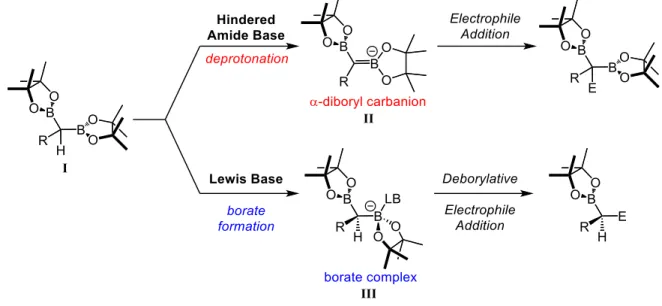
Figure 1.8 Proposed stereochemical model for the copper-catalyzed addition of diborylethane to aldehydes: controlled enantioselective transmetallation, followed by catalyst-controlled diastereoselective addition. L = thf, ArCHO, OtAm………..33 Figure 2.1 Switching from copper to silver α-boryl alkyl species to increase nucleophilicity and to tolerate larger R groups in additions to aldehydes……….153 Figure 2.2 Silver and copper phosphorus bond distances in binap(M) complexes: Ag – P > Cu – P……….153 Figure 2.3 Equilibrium between α-boryl alkyllithium and boron-stabilized carbanion………..156 Figure 2.4 Activation of diborylethane with KOtBu monitored by 1H and 11B NMR spectroscopy.
Pictured above are 1H NMR spectra of the reaction at 15, 45, 60 min, and 18 h. The 11B NMR spectra contains 3 signals: δ 36.1 (sp2
-hybridized B(pin) groups of 2.49 and 2.50); δ 7.8 (borate B(pin) group of 2.49); and δ 4.9 (bis(tert-butoxy)pinacolborate)………...167 Figure 2.5 Reaction of 2.48 with AgOAc monitored by 1H and 11B NMR spectroscopy from -80
xii
Figure 2.6 Proposed catalytic cycle for the silver-catalyzed addition of gem-diboronate esters to aldehydes. R' = OtBu or OAc………...172 Figure 2.7 Left: HOMO of truncated α-borylethylargenate acetate. The orbitals were generated using Gaussian09 with a B3LYP level of theory, with a LANL2DZ basis set for Ag and 6-31++G** basis set for all other atoms. Right: Proposed mechanism/stereochemical model for the addition of α-boryl alkyl silver to aldehydes………...174 Figure 3.1 General schematic of a multicomponent reaction (MCR)………..305 Figure 3.2 Previous and current methods for stereoselectively generating α-boryl copper alkyls……….306 Figure 3.3 Mechanism of Cu-catalyzed multicomponent reaction: boryl-cupration followed by
diastereoselective 1,2-addition………..307 Figure 3.4 Potential side-products from Cu-catalyzed multicomponent reaction: vinyl or boryl addition, polymerization, or different regioselectivity………..308 Figure 3.5 Explanation for enantioselectivity variances when using isolated acetonitrile or keteneimide copper complexes………..324 Figure 3.6 All possible stereoisomers of 3.50, the boxed in molecules are those favored by the Felkin-Anh model of stereocontrol………331 Scheme 1.1 Stereoselective Conjugate Boration of α,β-Unsaturated Esters and Thioesters with
B2(pin)2………..3
Scheme 1.2 Platinum-Catalyzed Enantioselective Diboration of Terminal Olefins……….4 Scheme 1.3 Enantioselective Hydroboration of Styrenyl Olefins………...5 Scheme 1.4 Preparation of di-, tris-, and tetraborylmethane via lithiation of chloromethanes and subsequent alkylation with bis(methoxy)chloroborate………..8 Scheme 1.5 Preparation of substituted and unsubstituted gem-diboronate esters………..9 Scheme 1.6 Synthesis of diborylmethane using isopropylmagnesium chloride and B2(pin)2………9
Scheme 1.7 Synthesis of substituted gem-diboronate esters through alkylation of diborylmethane………11 Scheme 1.8 First example of gem-diboronate esters being used in transition metal catalysis:
xiii
Scheme 1.11 Evidence for catalyst controlled, stereoinvertive transmetallation of gem-diboronate ester……….16 Scheme 1.12 Copper-catalyzed addition of diborylethane to benzaldehyde: phosphoramidite ligand
screen (original NMe2-Monophos is the optimal ligand)……….22
Scheme 1.13 Substrate scope for copper-catalyzed addition of diborylethane to aryl aldehydes….24 Scheme 1.14 Substrate scope for copper-catalyzed addition of diborylethane to alkenyl aldehydes……….25 Scheme 1.15 Isolation of a catalytically active copper-phosphoramidite-alkoxide complex………29 Scheme 1.16 Allylic reduction of substrate 1.65: confirmation that the stereocenter derived from the α-boryl Cu-alkyl nucleophile is enantio-enriched………31 Scheme 1.17 Functionalizations of the C-B sp3 bonds of the 1,2-hydroxyboronate products: one carbon homologation and amination………34 Scheme 1.18 Additions of higher substituted gem-diborylalkanes to benzaldehyde: limitations to larger substituents………35 Scheme 2.1 Cu-catalyzed additions of diborylethane to aryl and alkenyl aldehydes………152 Scheme 2.2 Cu-catalyzed additions of more highly substituted gem-diboronate esters to benzaldehyde……….152 Scheme 2.3 Knochel's α-boryl cyanocuprate in 1,2-addition reactions: only examples have limited substitution at α position (H and methyl only)………..155 Scheme 2.4 In situ generation of α-boryl alkyllithiums from alkylboranes and their additions to aldehydes………...156 Scheme 2.5 Substrate scope of Ag-catalyzed addition of diborylethane to aryl and alkenyl aldehydes………...…161 Scheme 2.6 Ag-catalyzed additions of substituted gem-diboronate esters to benzaldehyde…….162 Scheme 2.7 n-BuLi promoted, Ag-catalyzed additions of gem-diboronate esters to alkyl and aryl aldehydes………...164 Scheme 2.8 Activation of diborylethane with n-butyllithium: isolation of stable n-butylborate compound………..165 Scheme 2.9 Activation of diborylbutane with KOtBu: near quantitative conversion at 22 °C…168 Scheme 2.10 Activation of diborylethane with KOtBu in the presence of AgOAc: observation of a
xiv
Scheme 2.12 No observed interaction between AgOAc or binapAgOAc with benzaldehyde observed at 22 °C………..173 Scheme 2.13 Arylation of TBS-protected 1,2-hydroxyboronate……….175 Scheme 2.14 Ag-catalyzed enantioselective 1,2-addition of diborylethane to benzaldehyde…….176 Scheme 2.15 Ag-catalyzed enantioselective 1,2-addition of diborylethane to benzaldehyde: phosphoramidite ligand screen………..177 Scheme 2.16 Solution-state behavior of silver-binap complexes. Ratios were determined using 31P
NMR………..179 Scheme 3.1 Hydrocupration of alkenyl boronates: isolation of an α-boryl alkyl copper NHC complex……….309 Scheme 3.2 Cu-catalyzed enantioselective hydroboration of alkenyl boronate esters with
pinacolborane………310 Scheme 3.3 Cu-catalyzed enantioselective borylation/protonation of styrenyl olefins: net
hydroboration reaction………..311 Scheme 3.4 Diastereoselective Cu-catalyzed multicomponent addition of α,β-bisboryl alkyl copper
species to aldehydes………..312 Scheme 3.5 Substrate scope of enantio- and diastereoselective multicomponent coupling of 3.2,
B2(pin)2, and aryl/alkenyl aldehydes: limitations of enantioselectivity in
fluorobenzene………317 Scheme 3.6 Isolation of Cl-OMe-biphep-copper acetonitrile complex……….320 Scheme 3.7 Isolation of Cl-OMe-biphep-copper keteneimide complex from deprotonation of 3.42...321 Scheme 3.8 Isolation of Cl-OMe-biphep-copper tert-butoxide complex………..322 Scheme 3.9 Synthesis of cuprous tert-butoxide………....325 Scheme 3.10 Substrate scope of enantio- and diastereoselective multicomponent coupling of 3.2, B2(pin)2, and aryl/alkenyl aldehydes: consistent yields and enantioselectivities
xv
LIST OF ABBREVIATIONS
12-crown-4 1,4,7,10-tetraoxacyclododecane
(R)-binap (R)-(+)-2,2′-bis(diphenylphosphino)-1,1′-binaphthyl (R)-Cl-OMe-biphep
(R)-(+)-5,5'-Dichloro-6,6'-dimethoxy-2,2'-bis(diphenylphosphino)1,1'-biphenyl
(R)-dtbm-segphos (R)-(−)-5,5′-bis[di(3,5-di-tert-butyl-4-methoxyphenyl)phosphino]-4,4′-bi-1,3-benzodioxole
(R)-Monophos (R)-(-)-(3,5-Dioxa-4-phospha-cyclohepta[2,1-a;3,4-a']dinaphthalen-4-yl)dimethylamine
(R,R)-BOX (+)-2,2′-Isopropylidenebis[(4R)-4-phenyl-2-oxazoline] (R,R)-Me-duphos (−)-1,2-bis[(2R,5R)-2,5-dimethylphospholano]benzene (R,S)-josiphos
(R)-(-)-1-[(S)-2-(diphenylphosphino)ferrocenyl]ethyldicyclohexylphosphine [Rh(COD)Cl]2 chloro(1,5-cyclooctadiene)rhodium(I)
° C degrees Celsius
Å angstrom
AgBF4 silver(I) tetrafluoroborate
AgCl silver(I) chloride
AgClO4 silver(I) perchlorate
AgNO3 silver(I) nitrate
AgOAc silver(I) acetate
AgOTf silver(I) trifluoromethanesulfonate
AgOTs silver(I) tosylate
AgSbF6 silver(I) hexafluoroantimonate
Ar generic aryl group
B2H6 borane
xvi
BCl3 borontrichloride
B(dan) 1,8-diaminonaphthyl boryl group
BF3·OEt2 boron trifluoride diethyl etherate
Boc tert-butyl carbonate group Boc2O di-tert-butyl dicarbonate
cat catecholato group
CDI carbodiimidazole
CH2 methylene group
CH2Br2 dibromomethane
CH2=N2 diazomethane
Cu(MeCN)4PF6 tetrakis(acetonitrile)copper hexafluorophosphate
Cu(OAc)2 copper(II) acetate
Cu(OMe)2 copper(II) methoxide
Cu(OTf)2 copper(II) trifluoromethanesulfonate
CuCl copper(I) chloride
CuI copper(I) iodide
d.r. diastereomeric ratio
dce 1,2-dichloroethane
dme 1,2-dimethoxyethane
dmf N,N’-dimethylformamide
dppb 1,2-diphenylphosphinobutane
e.r. enantiomeric ratio
E+ generic electrophile
ee% enantiomeric excess
Et ethyl group
xvii
Et2O diethyl ether
h hour(s)
H2 hydrogen (diatomic)
HCOOH formic acid
H2O water
H2O2 hydrogen peroxide
HB(pin) pinacolborane
HOMO highest occupied molecular orbital
iPr isopropyl group
KIE Kinetic Isotope Effect
KOH potassium hydroxide
LiOMe lithium methoxide
LiOtAm lithium tert-amylate
LiOtBu lithium tert-butoxide
LiTMP lithium 2,2,6,6-tetramethylpiperidide
Ln generic ligands on a metal center
LUMO lowest unoccupied molecular orbital
M generic metal
Me methyl group
MeCN acetonitrile
MeOH methanol
MeONH2 methoxyamine
Mes mesityl group (2,4,6-trimethylphenyl)
MesLi mesityl lithium
min minute(s)
xviii
NaBO3·4H2O sodium perborate tetrahydrate
NaOH sodium hydroxide
NaOtBu sodium tert-butoxide
Na2S2O3 sodium thiosulfate
NBS N-bromosuccinamide
NMR nuclear magnetic resonance
OR generic alkoxy group
Pd/C palladium supported on activated carbon
Pd2(dba)3 tris(dibenzylideneacetone)dipalladium
Pd(OAc)2 palladium(II) acetate
Pd[P(tBu3)]2 bis[tri(tert-butyl)phosphine]palladium(0)
Ph phenyl group
pin pinacolato group
PCy3 tricyclohexylphosphine
P(n-Bu)3 tri(n-butyl)phosphine
PPh3 triphenylphosphine
Pt(dba)3 tris(dibenzylideneacetone)platinum(0)
Pt(PPh3)4 tetrakis(triphenylphosphine)platinum(0)
R generic organic group
rac-binap racemic 2,2′-bis(diphenylphosphino)-1,1′-binaphthyl SiMes·HCl 1,3-bis(2,4,6-trimethylphenyl)imidazolinium chloride TBS tert-butyldimethylsilyl group
t
Bu tert-butyl group
thf tetrahydrofuran
thf-d8 octadeuteriotetrahydrofuran
Chapter 1: Enantio- and Diastereoselective Synthesis of β-Hydroxyboronates via Cu-catalyzed Addition of gem-Diboronate Esters to Aldehydes*1
1.1 Introduction
Enantiopure organoboron compounds are an extremely important class of molecules in chemical synthesis. They are configurationally stable and can be stereospecifically transformed into a plethora of different functional groups, making them useful synthetic intermediates (Figure 1.1).1
Carbon-boron bonds are most commonly oxidized to the corresponding alcohols or amines, but several carbon-carbon bond forming transformations have been developed, with the field still growing. Besides being valuable building blocks in chemical synthesis, there are a number of boron-containing biologically active molecules and pharmaceutical products in use today. Most notably Bortezomib (Velcade®), which is an FDA-approved drug for the treatment of several types of blood cancers (multiple myeloma, lymphoma, etc.), contains a stereogenic organoboron moiety in the molecule.2
Stereoselective preparation of sp3-organoborons, therefore, is a valuable method in chemical synthesis worthy of further investigation and development.
The enantioselective preparation of sp3-alkyl organoboron compounds has been accomplished via a number of methods, including: hydroboration3, diboration4, and conjugate boration5, among
several others. These approaches directly generate a carbon-boron bond through a metal-boryl intermediate. These methodologies have been showcased in the efficient synthesis of several biologically active molecules, and highlights the utility of the alkyl organoboron products formed.
2
Figure 1.1 List of Stereospecific Functionalizations of Boronic Acid Esters
Over the past decade, Hoveyda and co-workers have developed a number of methodologies for the asymmetric conjugate addition of various nucleophiles to α,β-unsaturated carbonyls. In 2010, the group developed an enantioselective conjugate boration of α,β-unsaturated esters and thioesters with chiral N-heterocyclic carbene copper catalysts.6 The tertiary boronate esters (1.2, 1.3, and 1.4) are
produced in good to excellent yields, with good to excellent enantioselectivities. The authors propose a mechanism that involves a copper-boryl intermediate (1.6) (formed from the transmetallation of a copper-alkoxide and B2(pin)2) inserting across the bound α,β-unsaturated esters (an activated alkene).
These organoboron products have been used by Hoveyda and co-workers as intermediates in the synthesis of several biologically active molecules, most notably crassinervic acid, a potent antifungal compound.7 This demonstrates the utility of enantiopure organoboron compounds as synthetic
3
Scheme 1.1 Stereoselective Conjugate Boration of α,β-Unsaturated Esters and Thioesters with
B2(pin)2
Diboration of alkenes is another useful method for installing boron into molecules which has the added advantage of incorporating two boron moieties into a molecule, which in some cases may be selectively transformed into different groups. Morken and co-workers disclosed an enantioselective diboration of terminal aryl and alkyl alkenes with bis(pinacolato)diboron, utilizing a platinum-phosphoramidite catalyst system.4e The 1,2-diboronate ester products are able to be isolated by silica
gel column chromatography. For ease of isolation and determination of enantioselectivity, the products were oxidized to the corresponding diols. The diols are produced in good to excellent yields with varying levels of enantioselectivity; alkyl olefins produce the highest ee% values (90-96%), while styrenyl olefins give between 80-90% ee. The mechanism of the reaction was elucidated through combined KIE, kinetics analysis, and computational studies. The Pt(0) catalyst undergoes oxidative addition of B2(pin)2 to form the platinum bis-boryl compound (1.11). Boryl insertion onto the bound
4
Scheme 1.2 Platinum-Catalyzed Enantioselective Diboration of Terminal Olefins
One of the oldest and most well-studied methods for incorporating boron into molecules is hydroboration. There are multiple variants with and without a transition metal catalyst, but most enantioselective hydroborations utilize a transition metal catalyst.3a Regioselectivity is often a problem
and careful selection of both the borane and the olefin help to address these problems. Hayashi and co-workers developed a protocol for the enantioselective hydroboration of styrenes using a cationic rhodium bis-phosphine catalyst.9 With catecholborane (1.14) and 2 mol% of the cationic rhodium
complex, styrene can undergo hydroboration in up to 96% ee and 92% yield. The mechanism of the reaction is as follows: The initial Rh(I)-phosphine complex undergoes oxidative addition of catecholborane to form the cationic Rh(III) complex 1.15. This species undergoes migratory insertion of the bound styrene with the hydride ligand to produce 1.16. Reductive elimination of the benzyl and boryl ligands produces the carbon-boron bond and furnishes the product.
5
unit. While there are countless ways to synthesize olefins, what if there was a methodology that could combine the synthesis of C-C bonds (i.e. the carbon skeleton of a molecule) with the stereoselective incorporation of boron into a single process? One way to accomplish this is through the stereoselective synthesis and addition of alpha-borylated organometallics to carbonyl compounds.
Scheme 1.3 Enantioselective Hydroboration of Styrenyl Olefins
Figure 1.2 depicts a representative example of the addition of a substituted alpha-borylated organometallic species, I, to benzaldehyde. The transformation produces the 1,2-hydroxyboronate ester, II which contains a new carbon-carbon bond and two vicinal stereogenic centers. One of those stereocenters contains a boronate ester group which can be functionalized into a number of different molecules. Illustrated in the figure are three common and useful functionalizations. Cross-coupling a vinyl bromide with II produces the α-stereogenic alcohol III. These types of products are usually formed by diastereoselective addition to α-chiral aldehydes, substrates that are oftentimes laborious to synthesize. While Suzuki-Miyaura cross-couplings of secondary sp3-organoboron groups is a difficult problem in synthetic chemistry, recently, methodologies have emerged where this carbon-carbon bond forming reaction can be carried out under relatively mild conditions.10 Oxidation, a well-known
6
dihydroxylation, but with different chemoselectivity and bond disconnections.11 One-carbon
homologation of organoboron compounds is another well-studied functionalization; first developed by Matteson and co-workers, homologation inserts a methylene unit (and other CH2R groups) into the
boron-carbon bond.12 Oxidation of organoborons to the corresponding amine derivative has gained
attention in recent years and a useful protocol for this transformation has been developed by Morken and co-workers.13 One-carbon homologation of II, followed by oxidation to the amine produces the
aminoalcohol V, a moiety which is found a number of biologically active molecules.13 All of these
transformations are stereospecific, meaning that any stereochemical purity gained in the initial formation of II is retained upon functionalization of the boron group.
Figure 1.2 Strategy and application for the additions of α-boryl organometallic species to aldehydes: concomitant C-C bond formation and boron incorporation for further synthetic functionalizations
7
air/water sensitive reagents to generate them, and have only been shown in stoichiometric reactions with electrophiles. Our strategy, depicted in Figure 1.3, involves catalytically generating α-boryl organometallic species from gem-diboronate esters. These reagents are air and water stable and can be synthesized through a number of different methods, some developed by our own lab. Utilizing a chiral transition metal catalyst, the gem-diboronate ester undergoes a stereoselective transmetallation to form the enantioenriched α-boryl metal species, which then reacts with an electrophile to form chiral sp3 -organoboron products and regenerate the catalyst. The combined strategies depicted in Figures 1.2 and 1.3 were applied to many of the reactions I studied throughout my graduate work and form the basis of my first two publications.
Figure 1.3 Catalytic generation and addition of α-boryl metal species through stereoselective transmetallation of gem-diboronate esters to transition metal catalysts
1.2 Background
Polyborylated compounds have gained much attention in recent years, as they can be utilized in the synthesis of complex, multiple functional group-containing molecules. Gem-diboronate esters have been shown to undergo several useful C – C bond forming reactions such as cross-coupling, alkylation, 1,2-addition, and allylic substitution both racemically and stereoselectively.14-20 While their
8
synthesized di, tri, and tetraborylmethane utilizing a novel bis(methoxy)chloroborate species, 1.19.21
Two equivalents of trimethylborate react with BCl3 gas to form 1.19, which then reacts with a lithiated
chloromethane to form a new boron – carbon bond (releasing LiCl as a byproduct). The lithiation and alkylation process is then repeated m-1 times (m=number of chlorines in the starting chloromethane) to form the desired borylated methane. While the yields are low, the synthesis is amenable to large scales and allowed Matteson and co-workers to explore the properties and reactivity of these compounds (vide infra).
Scheme 1.4 Preparation of di-, tris-, and tetraborylmethane via lithiation of chloromethanes and subsequent alkylation with bis(methoxy)chloroborate
In the last decade, a number of syntheses of substituted and unsubstituted gem-diboronate esters have been published (Scheme 1.5). In 2001, Srebnik and co-workers synthesized diborylmethane, 1.24, through a platinum catalyzed insertion of diazomethane into bis(pinacolato)diboron, 1.23.22 The yield
is good, but the high platinum catalyst loading and excess diazomethane (a toxic and highly explosive reagent) prevent this reaction from being conducted on large, synthetically relevant scales (i.e. >500 mg). Shibata and co-workers developed a rhodium-catalyzed synthesis of gem-diboronate esters through the regioselective dihydroboration of terminal alkynes.23 The reaction has a broad substrate
scope, but a limitation is that the substituents on the alkyne have to be aryl or large alkyl groups (e.g. tert-butyl, benzyl, etc.) to ensure good yields and high regioselectivity (1,1-hydroboration over
9
1,1-dibromoalkanes to generate a number of gem-diboronate esters.20 The products are generated in
good to excellent yields, and despite some limitations (excess 1.23 and 2 step synthesis of the dibromide starting material) it is still a useful methodology that can access a variety of gem-diboronate esters.
Scheme 1.5 Preparation of substituted and unsubstituted gem-diboronate esters
10
During my graduate work, I developed an efficient, cost-effective, and scalable synthesis of diborylmethane, which could be further functionalized to other substituted variants.24 Reacting
diiodomethane with isopropylmagnesium chloride at -78 °C results in magnesium-halogen exchange to form the α-iodomethyl Grignard, 1.27. This then complexes to a boron on bis(pinacolato)diboron and enacts a 1,2 borotropic shift, releasing the iodide and generating diborylmethane. The reaction is efficient and amenable to large scale syntheses, with an 86% yield on a 15 g scale (relative to B2(pin)2
used). Diborylmethane can also be used to generate substituted gem-diboronate esters utilizing a deprotonation/alkylation strategy. The α-protons of diborylmethane are much more acidic than normal alkanes (pKa ~ 30), due to the stabilizing effect of the boryl groups, and can be deprotonated using
hindered lithium amides.25 The resulting α-diboryl carbanion can be quenched with a variety of alkyl
halides to produce substituted gem-diboronate esters in excellent yields. This methodology has good functional group tolerance, as the alkylation is tolerant of arenes (1.29), alkenes (1.32), alkynes (1.31), esters (1.33), and silylethers (1.30) (Scheme 1.6).26 The reaction is limited to primary alkyl halides, as
11
Scheme 1.7 Synthesis of substituted gem-diboronate esters through alkylation of diborylmethane
Gem-diboronate esters are stable to both air and moisture, but are readily activated by Lewis bases. Figure 1.4 demonstrates that, when reacted with Lewis bases such as hydroxide, fluoride, and alkoxides, gem-diboronate esters form borate complexes, III, which can react with electrophiles in a deborylative fashion. Electrophiles include alkyl halides, carbonyls, epoxides, transition metals, etc. Under certain conditions, III has been known to deborylate in solution and form α-boryl carbanions, which can also react with electrophiles similar to III.20 Gem-diboronate esters can also be deprotonated
at the base of the two boryl groups (α-position) when large amide bases are used (e.g. LiTMP, LiNCy2,
LDA, etc.) which prevent complexation of the base to the boron through steric repulsion.25 The
12
electrophiles as borate complexes, however both boryl groups are retained in the product. This is the species that is generated during the synthesis of substituted gem-diboronate esters in Scheme 1.7, where the electrophile is an alkyl iodide or bromide.
Figure 1.4 Different reactivity patterns of gem-diboronate esters: α-deprotonation vs borate formation dependent on the Lewis base, i.e. non-coordinating vs. coordinating.
Even though gem-diboronate esters have been known for decades, their utilization in transition metal catalyzed processes has been a relatively recent development. The first instance of their use in a transition metal catalyzed reaction was from the labs of Takanori Shibata in 2010.27 In their J. Am.
Chem. Soc. communication, various substituted gem-diboronate esters are cross-coupled to aryl iodides
13
1.34 with 1.35 produced 1.36 in 84% yield with >98% chemoselectivity for coupling the gem-diboronate ester over the alkyl boronate ester (Scheme 1.8).
Scheme 1.8 First example of gem-diboronate esters being used in transition metal catalysis: Pd-catalyzed Suzuki-Miyaura cross coupling.
14
Figure 1.5 Left: LUMO of truncated diborylethane. Right: HOMO of truncated diborylethane activated with a methoxide anion. Both were generated using Gaussian09 with a B3LYP level of
theory with a 6-31G** basis set for the left structure, and a 6-31++G** basis set for the right structure.
I generated the optimized geometries and molecular orbitals for the methoxide-activated diborylethane II using a similar basis set: 6-31++G** (see Experimental Section for details). The “++” is a diffuse functional on heavy atoms and hydrogen and assists in calculations involving anions such as borates. The HOMO of II is depicted in Figure 1.5 on the right. It contains a large coefficient along the boron-carbon bond (expected for a borate, which is nucleophilic at carbon) but also has large lobes at the methoxy and ethylene glycoxy oxygens. This might indicate that transmetallation of a borate like II would involve initial coordination of the borate to the metal complex through an oxygen donor, followed by metal-carbon bond formation. This is the mechanism that Shibata proposes for the Suzuki-Miyaura reaction and is presented in Scheme 1.9. Complex 1.37 is formed after phosphine dissociation and oxidative addition of the aryl iodide to the palladium pre-catalyst. Borate 1.38 (which Shibata observes through 11B NMR studies) binds to the palladium catalyst and undergoes transmetallation to
15
Scheme 1.9 Activation of gem-diboronate ester and mechanism of transmetallation to palladium(II) phosphine catalyst
In 2014, Morken and co-workers published a stereoselective version of the reaction Shibata disclosed in 2010. Using a chiral phosphoramidite-bound palladium catalyst, Morken could cross-couple a number of different substituted gem-diboronate esters to aryl iodides in good to excellent yields in good enantioselectivities (Scheme 1.10)20. The use of 15 equivalents of KOH is essential for
high yield and enantioselectivity, which Morken attributes to hydrolysis of the pinacol ester to the gem-diboronic acid. Boronic acids transmetallate faster and at lower temperatures than boronate esters. Dennis Hall and co-workers confirmed this hypothesis in a subsequent cross-coupling paper using similar ligands and substrates.28
Scheme 1.10 Enantioselective cross-coupling of gem-diboronate esters to aryl halides. Catalyst controlled stereoselective transmetallation of gem-diboronate ester.
16
enriched (>99%) with 10B, while the other boron contains a natural abundance of both 10B and 11B (~1:4
ratio). Using high resolution mass spectrometry, they were able to calculate which type of boron was contained within the product, i.e. solely 10B or the natural abundance of both 10B and 11B. Under
standard reaction conditions with the (R,R) enantiomer of the ligand, the (R)-enantiomer of the product is formed (R-1.44) in 92:8 e.r. When the (S,S) enantiomer of the ligand is used, the (S)-enantiomer of the product is formed (S-1.44), also in 92:8 e.r. and with the boron containing solely the 10B isotope.
This shows that the catalyst controls which boron is transmetallated to the meta center and that the transmetallation occurs with inversion about the stereocenter at the base of the two boryl groups.
Scheme 1.11 Evidence for catalyst controlled, stereoinvertive transmetallation of gem-diboronate ester
1.3 Reaction Discovery and Optimization
17
Table 1.1 Counterion effect on the background reaction of diborylethane and benzaldehyde promoted by alkali alkoxidesa
Tert-butoxide is a common base in organic chemistry that is readily soluble in a number of
18
reaction with KOtBu (Entry 6). With these data, lithium tert-butoxide was chosen as the optimal activator for the 1,2-addition reaction. Since there is no background reaction with LiOtBu, any product formed in a transition metal catalyzed reaction can only be derived from a catalyzed process.
With the activator selected, I screened a number of transition metal catalysts (Groups 8, 9, 10, 11) for the 1,2 addition reaction of diborylethane with benzaldehyde. With a broad scope of ligands and metals, I obtained <2% conversion to product in all cases. Based on previous work by Knochel and Suzuki, copper was selected as the metal most likely promote the reaction and a more extensive ligand screen with copper(II) triflate was conducted (Table 1.2). Chiral biaryl phosphines such as (R)-binap and (R)-dtbm-segphos do not promote the reaction (Entries 1 and 2), nor do mixed alkyl/aryl phosphines such as (R,R)-Me-duphos and (R,S)-josiphos (Entries 3 and 4). Bis-oxazolines are common ligands employed in a myriad of copper-catalyzed processes29, but (R,R)-BOX does not deliver the
1,2-addition product (Entry 5). N-heterocyclic carbenes are another common ligand class in transition metal catalysis, but SIMes fails to produce any product (Entry 6). Gratifyingly, treatment of benzaldehyde and 1.28 with 10 mol % Cu(OTf)2 and 11 mol % (R)-Monophos affords 1.46 in 31%
NMR yield as a 91:9 mixture of diastereomers (favoring the syn) and 88:12 enantiomeric ratio (for the syn diastereomer). While the initial yield was low, it was promising to observe both high
19
20
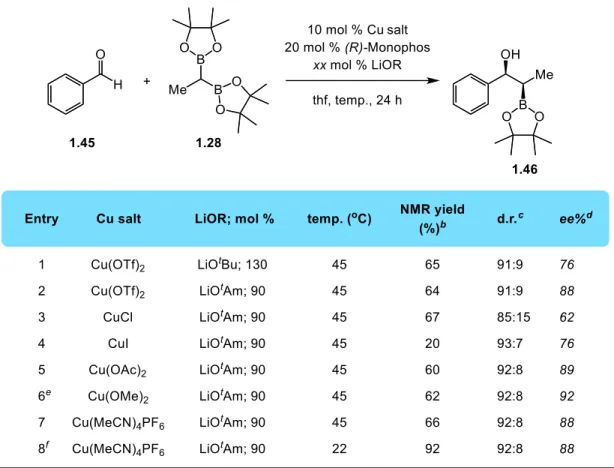
With a promising catalyst discovered, I moved on to optimizing the reaction conditions including: copper source, ligand equivalents, base equivalents, temperature, etc. (summarized in Table 1.3). Increasing the amount of ligand to 20 mol % more than doubles the amount of product formed, as 1.46 is produced in 64% NMR yield, 91:9 diastereoselectivity, and 76% ee (Entry 1), selectivity values identical to the 11 mol % result (Table 1.2, Entry 7). Since the alkoxide base is intimately involved in the activation and transmetallation of 1.28 to the copper catalyst, I reasoned that increasing the size of the activator would increase the enantioselectivity of the reaction. Using 90 mol % lithium tert-amylate as the activator, 1.46 forms in nearly identical NMR yield and diastereoselectivity to Entry
1, but with a dramatic increase in enantioselectivity to 88% ee (Entry 2). The drop in amount of activator from 130 mol % to 90 mol % helps to prevent decomposition of the aldehyde during the reaction. I next conducted a screen of different copper sources to determine which formed the optimal precatalyst. Employing 10 mol % CuCl in the reaction results in lower diastereo and enantioselectivities (85:15 d.r. and 62% ee, Entry 3) while 10 mol % CuI results in a decrease in NMR yield and enantioselectivity (20% NMR yield and 76% ee, Entry 4). Copper(II) derived precatalysts proved to be more active and selective:10 mol % Cu(OAc)2 provides the product in 60% yield, 92:8
d.r., and 89% ee while 10 mol % Cu(OMe)2 affords the product in 62% yield, 92:8 d.r., and 92% ee.
These results, however, were not reproducible and often gave varying conversions and diastereoselectivities, most likely due to the low solubility of copper(II) salts in thf. Moving to a more soluble and stable copper(I) salt, Cu(MeCN)4PF6 provided reproducible yields and
21
Table 1.3 Copper-catalyzed addition of diborylethane to benzaldehyde: copper salt screen and lithium alkoxide optimizationa
22
proceeded to screen ligands with alterations to the binaphthyl backbone. Substituting the 3 and 3’ positions of the binaphthyl rings with either methyl groups, 1.50, or bromine, 1.51, completely shuts down the reaction and no product is formed. Ligand 1.52, which contains a partially hydrogenated binaphthyl ring, produces the product in diminished yield and d.r., with a complete erosion of ee% (46% conv.; 84:16 d.r.; 3% ee). Based on these data, the original (R)-Monophos with an NMe2 group
bound to phosphorus was the most optimal ligand for copper to catalyze the reaction between diborylethane and benzaldehyde.
23 1.4 Substrate Scope
With the optimal copper salt, ligand, activator, and conditions obtained, I set out to expand the substrate scope of the 1,2-addition reaction of diborylethane to aryl aldehydes. Due to the varying stability of the 1,2-hydroxyboronate products (aside from 1.46), all of the products were isolated and characterized after oxidation to the 1,2-diol. The list of aryl aldehyde substrates is presented in Scheme 1.13. All reactions are conducted in the presence of 10 mol % Cu(MeCN)4PF6, 20 mol %
(R)-Monophos, and 90 mol % LiOtAm. The reactions occur at ambient temperature for 48 hours with thf as the solvent. All oxidations are performed using excess NaBO3.4H2O in a 1:1 mixture of thf:H2O for
2.5 hours at ambient temperature. Benzaldehyde-derived 1,2-diol 1.53 is isolated in 67% yield, 92:8 d.r., and 94:6 e.r. The reaction is tolerant of halogen substituents at the para position; as 1.54 and 1.55 form in 77% yield (92:8 d.r.; 94:6 e.r.) and 91% yield (93:7 d.r.; 95:5 e.r.), respectively. Electron-donating groups work well in the 1,2-addition reaction, producing para-methoxy containing 1.56 in 69% yield, 97:3 d.r., and 93:7 e.r. Nitro groups at the para and meta positions of the aryl ring form products 1.57 and 1.60, respectively, but in lower yields (34% and 35% respectively) yet still with high selectivity (95:5 e.r. for both substrates). Substrates containing m-Me and m-CF3 groups are also
tolerated, producing 1,2-hydroxyboronates 1.58 and 1.59 in 76% yield (92:8 d.r.; 98:2 e.r.) and 59% yield (90:10 d.r.; 94:6 e.r.), respectively. Products derived from aldehydes with substituents in the ortho position form as a single diastereoisomer in good yields and enantioselectivities: 1.61 is afforded
24
Scheme 1.13 Substrate scope for copper-catalyzed addition of diborylethane to aryl aldehydes
Alkenyl aldehydes may also undergo 1,2-additions with diborylethane under similar conditions as aryl aldehydes. The diastereoselectivities are lower than those of the aryl aldehyde addition products, but the enantioselectivity remains high for most substrates. The substrates form in the presence of 7.5 mol % Cu(MeCN)4PF6, 15 mol % (R)-Monophos, and 60-80 mol % LiOtAm at ambient temperature.
The 1,2-hydroxyboronates are oxidized to the 1,2-diols with an excess of NaOH/H2O2 mixture at 0 °C
p-Cl-25
cinnamaldehyde-derived product 1.66 is afforded in 38% yield, 54:46 d.r., and 97:3 e.r. (syn)/94:6 e.r. (anti); p-NO2-cinnamaldehyde derived product 1.67 is afforded in 46% yield, 45:55 d.r., and 95:5 e.r.
(syn and anti). Installing substitution at the α-position of alkenyl aldehydes restores the diastereoselectivity of the reaction, with only a slight decrease in enantioselectivity: 1.68 forms in 54% yield, 97:3 d.r., and 80% ee, while 1.69 forms in only 34% yield, 96:4 d.r., and 66% ee.
26 1.5 Mechanistic Investigations
Figure 1.6 depicts our proposed catalytic cycle for the 1,2-addition reaction between diborylethane and aldehydes. Initial activation of 1.28 forms a borate complex, I, which transmetallates to the copper precatalyst to form α-boryl alkyl copper species II. This complex can bind the aldehyde and undergo 1,2-addition to form the copper-bound hydroxyboronate IV. After product dissociation as the lithium alkoxide salt, V (a structure that helps to prevent olefination through the Boron-Wittig mechanism), and regeneration of the copper catalyst, another equivalent of I transmetallates to copper and repeats the cycle. Throughout the course of my studies on these reactions, I conducted a number of experiments that corroborate the mechanism proposed in Figure 1.6: how the gem-diboryl reagent is activated, the identity of the copper precatalyst, and the nature of the transmetallation of the gem-diboryl reagent/stereoselection of the 1,2-addition.
27
To gain insight into the activation of diborylethane by lithium alkoxides, I monitored a reaction between diborylethane and lithium tert-butoxide by 1H and 11B NMR spectroscopy. As depicted in
Figure 1.7, treatment of 1.28 with 1.7 equivalents of lithium tert-butoxide in thf-d8 at ambient temperature results in 21% conversion to the tert-butoxy borate 1.70 after 2.5 hours, as judged by 1H
and 11B NMR chemical shifts. The most prominent signal is the upfield shift corresponding to the
proton geminal to the boryl groups, from δ 0.54 for 1.28 to δ 0.06 ppm for 1.70. This drastic shift is likely due to the increased electron density at the now negatively charged boron, which inductively increases electron density at the neighboring carbon. A new signal in the 11B NMR spectrum also
appears at δ 6.9 which corresponds to the four-coordinate borate boron of 1.70. The signals for the sp2 -hybridized B(pin) groups on 1.70 and 1.28 coalesce to one broad signal at δ 32.3. Morken and co-workers have shown that gem-diboronate esters deborylate at room temperature in the presence of sodium tert-butoxide to produce boron-stabilized carbanions.20 Boron-stabilized carbanion 1.71,
however, was not detected by either 1H or 11B NMR spectroscopy during the course of the reaction
(even at 50 °C). This demonstrates that the counterion to the borate has a huge effect on its stability and reactivity in solution. Lithium is smaller, more electropositive, and forms stronger bonds to oxygen than sodium. This might lead to lithium chelation between oxygen atoms within 1.70, which could stabilize the compound and prevent deborylation to 1.71.
While the NMR experiment illustrated Figure 1.7 is informative, it does not necessarily prove that 1.71 is what transmetallates to the copper catalyst. To explore this processes and delineate what species is actually transmetallating to copper, I conducted two experiments using Cu(OtAm)2 as the
copper source for the reaction (Scheme 1.15). In the presence of 20 mol % Cu(OtAm)2 and 40 mol %
28
Association of 1.28 to a copper alkoxide complex is not enough to form the copper-carbon bond, likely due to the high copper-oxygen bond strength, which is not nucleophilic enough to add to 1.28 and activate it for transmetallation.
Figure 1.7 Activation of diborylethane with LiOtBu monitored by 1H and 11B NMR spectroscopy.
Pictured above is the 1H NMR spectrum of the reaction after 2.5 hours. The 11B NMR spectrum
29
Copper(I) (d10 electron count) normally forms 18 electron tetrahedral complexes, unless
ligated with strongly σ-donating or sterically encumbered ligands such as N-heterocyclic carbenes or bis-phosphines. Several phosphoramidite-copper(I) complexes are known and have been characterized by X-Ray crystallography and NMR spectroscopy.30-33 Of these complexes, most are either tetrahedral
or trigonal planar, and usually contain two to three phosphoramidite ligands per copper. First, I set out to determine the number of (R)-Monophos ligands bound to the copper catalyst vaguely depicted in Figure 1.6. The conditions of Entry 7, Table 1.2 and Entry 1, Table 1.3 differ only in the mol % of (R)-Monophos used in the reaction: 11 mol % and 20 mol%, respectively. The diastereo- and enantioselectivities of 1.46 for both reactions are identical (91:9 d.r. and 76% ee), but the NMR yield of the 20 mol % (R)-Monophos reaction is 65%, while the 11 mol % reaction is only 31%. Since the selectivities are identical for both amounts of (R)-Monophos, it indicates that the same catalyst is being generated in both reactions and most likely has one phosphoramidite ligand bound to copper. The differences in yield are likely attributed to more of the copper-(R)-Monophos catalyst forming in situ when 20 mol % of ligand is used. The extra equivalent of (R)-Monophos could also help to prevent catalyst decomposition throughout the reaction by preventing dissociation of the ligand.
Scheme 1.15 Isolation of a catalytically active copper-phosphoramidite-alkoxide complex
With a 1:1 ratio of copper to ligand being the probable identity of the catalyst, I set out to synthesize the copper-phosphoramidite-alkoxide complex that I generate in situ during the reaction. Stirring an equimolar mixture of Cu(MeCN)4PF6 and (R)-Monophos together in thf at 22 °C for 1 hour,
30
complex 1.72 95% yield. The complex was characterized by 1H and 31P NMR spectroscopy. The 31P
NMR spectrum displays a single broad resonance at δ 124.6 ppm and is most likely broadened due to quadrupoloar relaxation of the 63/65Cu coupling to the 31P nucleus. The 1H NMR spectrum displays
resonances that indicate a 1:1 ratio of phosphoramidite:tert-amylate ligands bound to copper. Two molecules of thf occupy the other two coordination sites at copper, as the resonances for thf are shifted downfield in reference to the residual proteo-thf in the NMR solvent. Complex 1.72 is catalytically active under the conditions depicted in Scheme 1.13 for the addition of diborylethane to benzaldehyde and 1.46 is formed in 91:9 d.r. and 88% ee. It is unknown whether the alkoxide ligand remains on copper after the transmetallation step. While an α-boryl alkyl cuprate complex would be more nucleophilic than a neutral organocopper variant, the negative charge on copper might disfavor aldehyde binding and result in external addition, possibly eroding diastereoselectivity. It is, however, only speculation and I have no evidence to prove either. It is also unknown whether or not the aldehyde is bound to copper during the transmetallation step, however this would explain the small variations in enantioselectivity with different aldehyde substrates (1.58: 92% ee; 1.62: 86% ee) and other carbonyl electrophiles.34
Recalling that in the Cu-(R)-Monophos catalyzed addition of diborylethane to alkenyl aldehydes, products are formed with high enantioselectivity but poor diastereoselectivity (cf. Scheme 1.14). I wanted to asses which stereocenter is responsible for the poor diastereoselectivity of the product and to determine which stereocenter is being set by the copper catalyst during the transmetallation step. To address this, we removed the allylic alcohol from 1,2-allylic diol 1.65, which exists as 52% syn diastereomer (90:10 e.r.) and 48% anti diastereomer (97:3 e.r.). The diol was reacted with carbodiimidazole to form an allylic carbonate which was then exposed to allylic reduction conditions: 1 mol % Pd2(dba)3, 2 mol % PPh3 with NEt3 and formic acid in thf from 0 to 22 °C. The
resulting homoallylic alcohol (which oftentimes was isolated as a mixture with the hydrogenated product) was hydrogenated with Pd/C under an H2 atmosphere in MeOH to produce the secondary
31
enantiomeric ratio of 92:8, which is an exact average of the two enantioselectivities of the starting diastereomers. This shows that the stereocenter of alcohol 1.73 corresponds to the secondary boronate ester stereocenter generated in high enantioselectivity during the 1,2-addition reaction. These data suggest that an α-boryl alkyl copper nucleophile is being generated in high stereopurity (transmetallation) through differentiation of the two boron units of prochiral 1.28. The low diastereoselectivity observed for less sterically hindered alkenyl aldehydes is likely a result of poor facial discrimination of the aldehyde by the copper catalyst during the 1,2-addition step.
Scheme 1.16 Allylic reduction of substrate 1.65: confirmation that the stereocenter derived from the α-boryl Cu-alkyl nucleophile is enantio-enriched
32
(R,R) diastereomer over the (R,S)). Since the borate can equilibrate between the R and S enantiomer
33
Figure 1.8 Proposed stereochemical model for the copper-catalyzed addition of diborylethane to aldehydes: catalyst-controlled enantioselective transmetallation, followed by catalyst-controlled
34
The 1,2-hydroxyboronate products formed in this study are amenable to transformations into useful synthetic building blocks through functionalization of the organoboron moiety. Oxidations and carbon-carbon bond formations are tolerated after protection of the hydroxyl group (Scheme 1.18). TBS-protection of 1.46 with TBSCl and imidazole furnishes the TBS-protected-1,2-hydroxyboronate 1.74 (in 76% yield), which is then homologated by one carbon with in situ generated bromomethyllithium at -78 °C for 2 hours. The TBS-protected 1,3-hydroxyboronate ester 1.75 is afforded in 75% yield and 91:9 diastereoselectivity. Similarly, TBS-protection of the 1,2-hydroxyboronate generated from addition to α-Me-cinnamaldehyde with TBSCl and imidazole affords 1.76 in 64% yield. Amination of 1.76 in the presence of n-BuLi and MeONH2 produces the
aminoalcohol 1.77 in 57% yield and >98:2 d.r. after quenching with di-tert-butyl dicarbonate. Scheme 1.17 Functionalizations of the C-B sp3 bonds of the 1,2-hydroxyboronate products: one
carbon homologation and amination
A limitation of this methodology lies in the scope of the gem-diboronate ester that react effectively with aldehydes under the reaction conditions. While diborylethane is effective in the transformation, adding any substituents to the β-position of the gem-diboronate ester reduces the reactivity drastically. For instance, under standard reaction conditions for the addition of diborylethane to benzaldehyde (10 mol % Cu(MeCN)4PF6, 20 mol % (R)-Monophos, 90 mol % LiOtAm at 45 °C in
35
NMR yield but in high diastereo- and enantioselectivity (92:8 d.r.; 90% ee). The use of other substituted gem-diboronate esters lead to even lower yields, most not even forming product. For example,
1,2-hydroxyboronate 1.78 is not observed from the addition of 1.32 and benzaldehyde, while hydroxyboronate 1.79 is produced in <10% NMR yield and 95:5 d.r. (from the addition of 1.30 and benzaldehyde). While these more highly substituted reagents cannot react with aldehydes, recent data collected by other lab members suggests that these larger boron reagents do indeed transmetallate to the copper catalyst, but they simply do not add to aldehydes effectively and require more electrophilic carbonyl substrates to add to (e.g. α-ketoesters and CF3-ketones).
Scheme 1.18 Additions of higher substituted gem-diborylalkanes to benzaldehyde: limitations to larger substituents
1.6 Conclusions
36
yields and diastereoselectivities: up to 59% yield, 97:3 d.r., and 94% ee (for the major diastereomer). Mechanistic studies suggest that an α-boryl alkyl copper species is generated via stereoselective transmetallation of alkoxide-activated diborylethane. This copper alkyl species then adds to aldehydes in a diastereoselective fashion, where the facial selectivity is dictated by the steric interactions of the aldehyde and the catalyst. The hydroxyboronates generated in this methodology are also amenable to functionalization reactions of the organoboron group and can be oxidized to alcohols and amines, and homologated by one methylene unit. This reaction manifold is currently limited to only diborylethane, as other more highly substituted gem-diboronate esters are formed in reduced yields, but high diastereo- and enantioselectivity (up to 30% NMR yield, 95:5 d.r., and 90% ee).
1.7 Experimental
General: All reactions were carried out in oven-dried (150 ˚C) or flame-dried glassware under an inert atmosphere of dried N2 unless otherwise noted. Analytical thin-layer chromatography was performed on glass plates coated with 0.25 mm of 60 Å mesh silica gel. Plates were visualized by exposure to UV light (254 nm) and/or immersion into Seebach’s or KMnO4 stain followed by heating.
Column chromatography was performed using silica gel P60 (mesh 230-400) supplied by Silicycle. All solvents were sparged with argon and then purified under a positive pressure of argon through an SG Water, USA Solvent Purification System. Tetrahydrofuran (OmniSolv) was passed successively through two columns of neutral alumina. 1,4-dioxane was distilled from Na/benzophenone, sparged with N2 and stored over 4Å molecular sieves. The ambient temperature in the laboratory was approximately 22 ˚C.
Instrumentation: All 1H NMR spectra were recorded on Bruker Spectrometers (AVANCE-600
37
(s = singlet, d = doublet, t = triplet, qu = quartet, quint = quinttet, br = broad, m = multiplet, app = apparent), integration, and coupling constants are given in Hz. 13C NMR spectra were recorded on
Bruker Spectrometers (AVANCE-600 and AVANCE-400) with carbon and proton decoupling. Chemical shifts are reported in ppm from tetramethylsilane and referenced to the residual protio solvent peak (CDCl3: δ 77.16). All IR Spectra were recorded on a Jasco 260 Plus Fourier transform infrared
spectrometer. Mass Spectrometry was performed on a Thermo Scientific LTQ-FT-ICR Mass Spectrometer. Optical rotations were determined using a Jasco P1010 polarimeter and concentrations are reported in g/100mL. Enantiomeric ratios were determined on an Agilent Technologies 1220 Infinity LC using the following columns: Diacel CHIRALPAK IA (4.6 mm x 250 mmL x 5 μm), Diacel CHIRALPAK IB (4.6 mm x 250 mmL x 5 μm), and Diacel CHIRALPAK IC (4.6 mm x 250 mmL x 5 μm). Enantiomeric ratios for compound 18 were determined on a Berger Instruments Supercritical Fluid Chromatograph using a Regis RegisPack Column (25 cm x 4.6 mm x 5 μm).
Reagents: All liquid aldehydes were distilled from CaH2 under vacuum and then sparged with dry N2. Solid aldehydes were purified via recrystallization, followed by azeotropic drying with benzene. (R)-Me-Monophos (L2), (R)-Et-Monophos (L3), and (R)-MorphPhos (L4) and L5 were synthesized according to published literature procedures.35,36 (R)-binap, (R)-dtbm segphos, and (R,R)-josiphos (L1)
were purchased from Strem Chemicals and stored in an N2 filled glovebox. Copper(II) methoxide,
copper(I) chloride, copper(II) triflate, were purchased from Strem Chemicals and kept in a N2 filled glove box. Copper(I) tetrakisacetonitrile hexafluorophosphate was purchased from Sigma-Aldrich and kept in an N2-filled glovebox.
38
Benzaldehyde was purchased from Alfa-Aesar, vacuum distilled from CaH2, and then sparged with dry N2
Benzene-d6 was purchased from Cambridge Isotope Laboratories and distilled over Na/benzophenone, sparged with dry N2, and kept in an N2-filled glove box over 3Å molecular sieves
4-Bromobenzaldehyde was purchased from Alfa-Aesar, recrystallized from methanol, and then azeotropically dried with benzene three times prior to use
Dibromomethane was purchased from Alfa Aesar and passed through a short column of neutral alumina and then sparged with dry N2 before use
Calcium hydride was purchased from Strem and used without further purification Calcium sulfate was purchased from Fisher and used without further purification
Chloroform-d3 was purchased from Cambridge Isotope Laboratories and used without further purification
1-Cyclohexene-1-carboxyaldehyde was purchased from Alfa-Aesar, vacuum distilled from CaH2, and then sparged with dry N2
4-Fluorobenzaldehyde was purchased from Alfa-Aesar, vacuum distilled from CaH2, and then sparged with dry N2
2-Furylaldehyde was purchased from Acros Organics, vacuum distilled from CaH2, and then sparged with dry N2 and kept in an amber vial
Iodomethane was purchased from Alfa-Aesar, and passed through a short column of neutral alumina and purged with dry N2 prior to use
Imidazole was purchased from Alfa-Aesar and used as received
Lithium tert-butoxide were purchased from Strem and used as received
39
n-Butyllithium was purchased from Strem as a 1.6M solution in hexanes and titrated with 1,10-phenanthroline/sec-butanol before use
Nicotinaldehyde was purchased from Alfa-Aesar, vacuum distilled from CaH2, and then sparged with dry N2
3-Nitrobenzaldehyde was purchased from Alfa-Aesar, and azeotropically dried with benzene prior to use
4-Nitrobenzaldehyde was purchased from Alfa-Aesar, and azeotropically dried with benzene prior to use
Potassium tert-butoxide was purchased from Strem and used as received
Sodium perborate tetrahydrate was purchased from Sigma Aldrich and used as received Sodium tert-butoxide was purchased from Strem and used as received
tert-Amyl alcohol was purchased from Alfa Aesar, refluxed over CaH2, distilled onto 4Å molecular sieves, and then sparged with dry N2
tert-butyldimethylsilyl chloride was purchased from Sigma-Aldrich and used as received
2-Tolualdehyde was purchased from Alfa-Aesar, vacuum distilled from CaH2, and then sparged with dry N2
3-Tolualdehyde was purchased from Alfa-Aesar, vacuum distilled from CaH2, and then sparged with dry N2
trans-Cinnamaldehyde was purchased from Alfa-Aesar, vacuum distilled from CaH2, and then sparged with dry N2
trans-2-Methoxycinnamaldehyde was purchased from Alfa-Aesar, and azeotropically dried with benzene prior to use
40
trans-4-Nitrocinnamaldehyde was purchased from Alfa-Aesar and azeotropically dried with benzene prior to use
trans-α-Methylcinnamaldehyde was purchased from Alfa-Aesar, vacuum distilled from CaH2, and then sparged with dry N2
Synthesis of Lithium tert-amylate
Procedure: A flame-dried round-bottom flask equipped with a magnetic stir bar was charged with anhydrous tert-amyl alcohol (8.7 mL, 79 mmol) and 20 mL of anhydrous thf. The reaction was allowed to cool to 0 ˚C (ice/water bath) and n-BuLi (44.6 mL of a 1.62 M solution in hexanes, 72.2 mmol) was added drop-wise. After the addition, the reaction was allowed to stir at 0 ˚C for 10 minutes and then allowed to warm up to ambient temperature with stirring for 1 h. The solvent was removed under a positive pressure of N2 and the residue dried under vacuum. The flask was brought into an N2-filled glove box where the residue was taken up in hexanes and filtered twice through Celite®. Concentration of the filtrate produced a fluffy, white powder in 97% yield (6.6 g). 1H NMR (C
6D6, 400 MHz): δ 1.50
(qu, 2H, J = 7.5 Hz), 1.23 (s, 6H), 0.98 (tr, 3H, J = 5.8 Hz). 13C NMR (C
6D6, 120 MHz): δ 68.9, 41.1,
41 Synthesis of Diborylmethane
42 Synthesis of Diborylethane (1.28)
Procedure: In an N2-filled glove box, an oven-dried round-bottom flask was charged with diboryl methane (3.00 g, 11.2 mmol) and a magnetic stir-bar, capped with a rubber septum, and sealed with electrical tape. A separate oven-dried, conical flask was charged with lithium 2,2,6,6-tetramethylpiperidide (1.73 mg, 11.8 mmol), capped with a rubber septum, and sealed with electrical tape. The two flasks were brought out of the glove box, where the diboryl methane flask was charged with 47.0 mL of dry thf and the LiTMP-containing flask was charged with 93.0 mL of thf (0.17M total). Both flasks were allowed to cool to 0 ˚C (ice/water-baths). The LiTMP solution was then cannula transferred to the diboryl methane flask with stirring. After the transfer, the reaction was allowed to stir for 10 min at 0 ˚C. Iodomethane (1.74 mL, 28.0 mmol) was then added to the reaction via a syringe and allowed to warm up to 22 ˚C over 18 hours with stirring. The reaction was quenched with 50 mL of a saturated aqueous solution of NH4Cl. The biphasic mixture was extracted 3 times with diethyl ether (900 mL total), and the combined organic extracts were dried over MgSO4, filtered, and concentrated in vacuo. The crude reaction mixture was purified by silica gel column chromatography (20:1 hexanes:EtOAc; Rf=0.20) to give the desired diboryl reagent in 89% yield (2.8 g). The spectral
data of the diboronate ester matched those previously reported.37
43
General Procedures for Cu-Catalyzed 1,2-Addition Reaction:
Procedure A (aryl aldehydes): In an N2-filled glove box, an 8-mL vial equipped with a magnetic stir bar was charged with Cu(MeCN)4PF6 (3.7 mg, 0.010 mmol) and (R)-Monophos (7.2 mg, 0.020 mmol) and dissolved in 0.50 mL of thf. After allowing the reaction to stir for 5 min, LiOtAm (0.90 mg, 0.010 mmol) was added to the reaction as a solution in thf (0.10 mL). After an additional 15 min of stirring, diboryl ethane (56 mg, 0.20 mmol) was added to the vial via syringe, followed by LiOtAm (7.5 mg, 0.080 mmol) as a solution in thf (0.20 mL). The resulting solution was allowed to stir at ambient temperature for 5 minutes, after which time the aldehyde (0.10 mmol) was added to the reaction. The vial was capped, sealed, and then removed from the glove box and allowed to stir at ambient temperature for 48 hours. The reaction was quenched with 1.5 mL of a saturated aqueous solution of NH4Cl, and the aqueous layer extracted three times with diethyl ether. The combined organic extracts were dried over MgSO4, filtered, and concentrated in vacuo. Conversion and diastereomeric ratios were determined by 1H NMR using hexamethyldisiloxane as an internal standard.
Procedure B (α-substituted vinyl aldehydes): In an N2-filled glove box, an 8-mL vial equipped with