Address for correspondence Dr. Shazia Zubair
Consultant Dermatologist City Hospital, Multan
Email: [email protected]
Original Article
Brimonidine tartrate 0.1% eyedrops new and
effective treatment of rosacea
Shazia Zubair*, Ghulam Mujtaba**
* Consultant Dermatologist, City Hospital, Multan
** Dermatology Department, Nishtar Medical College/Nishtar Hospital, Multan
Abstract Objective To determine the efficacy of brimonidine tartrate eye drops for treatment of erythema associated with rosacea.
Methods Fifty patients with rosacea (41 females and 9 males, mean age 35 years) were randomized to receive once daily single application of BT or vehicle for 4 weeks. Evaluation at 8 weeks included clinician’s erythema assessment (CEA), patient’s self-assessments (PSA) and photographic documentation.
Results Based on CEA and PSA, clinical response of 96.5% was seen with BT eyedrops as compared to 20.8% with placebo (p<0.05). Increased burning sensation and dermatitis was seen with BT in 2 (8.7%) patients, while rebound erythema occurred in 1 (4.3%) after BT use.
Conclusion Single daily application of BT eye drops provides significantly greater efficacy than vehicle for treatment of moderate to severe erythema of rosacea.
Key words
Rosacea, brimonidine tartarate.
Introduction
Rosacea is a chronic cutaneous disorder that typically presents in middle age.1 It predominantly affects the central face and is characterized by congestion, flushing and marked nodular swelling of tissue. It is a skin condition of abnormal inflammation and vascular dysfunction. Emotional stress, spicy food, hot beverages, sun exposure, alcohol and certain drugs exacerbate the disease.2,3
Even though fair skinned Caucasians are the main sufferers of the disease. Asians also frequently have rosacea due to topical
application of potent steroids.3
The disease undergoes the course of recurrent exacerbations and remission. Several therapeutic modalities are available for papules and pustules of rosacea. Erythema is the most challenging clinical sign.4 The exact cause of erythema is not known but it is hypothesized that erythema results from dysregulation in cutaneous vasomotor response.4 Therefore, agents with vasoconstrictive activity may have a symptomatic effect on erythema.5,6,7
costly and not available in Pakistan. BT eye drops are a cheap alternative.
We planned this study to compare the efficacy of BT eyedrops with a placebo in the treatment of erythematous rosacea
Methods
Fifty patients, 41 females and 9 males, age range 18 to 52 years, (mean 35 years) were enrolled in a single center. Informed consent was taken from all patients. Patients of erythematous rosacea only were enrolled. Patients with any of the following were excluded: papulopustular lesions on face, acne, photosensitive disorders, dermatitis on face, oral corticosteroid treatment, a previous history of facial laser treatment or other surgical procedures within 4 weeks prior to study enrolment. Patients with a history of glaucoma, pregnant and lactating women were also excluded.
All patients were randomly segregated into two groups. Patients in both groups were given oral doxycycline 100 mg and sunscreen to apply. Group A received Alphagan P (containing 0.1% BT) eyedrops to be applied once a day in the morning, only on areas having erythema. Group B received PhysioGel lotion (moisturizer as placebo) to apply every morning only on the affected area. Similar packing was used to hide the identity of BT and placebo.
All subjects received 4 weeks of either BT eye drops or placebo and then followed up after another 4 weeks without treatment.
At baseline, 4 and 8 weeks, photographs were taken with mobile camera (Samsung Galaxy S4, 13 mega pixel), using same light intensity and postures and Clinician Erythema Assessment (CEA) and Patients Self-Assessments (PSA)
Table1 Grades of improvement used in the study. Grades of
improvement
CEA PSA
1 Clear Clear
2 Almost clear Nearly clear
3 Persistent mild
redness
More redness than I prefer
4 Persistent
moderate redness
Definite redness
5 Severe Unacceptable
CEA, Clinician erythema assessment PSA, Patients self-assessments
Table 2 Treatment response week 8 assessed by 2-grade improvement.
Group A Group B
Lost to follow-up 2 1
Evaluable patients 23 24
Improvement by CEA 23 (100%) 8 (33.3%) Improvement by PSA 22 (95.6%%) 5 (20.8%) CEA, clinician erythema assessment
PSA, patients self-assessment
were noted. The primary efficacy endpoint (successful treatment) was defined as the proportion of subjects with a 2-grade improvement in both CEA and PSA measured at week 4 and week 8 (Table 1). Any side effects were also noted.
Results
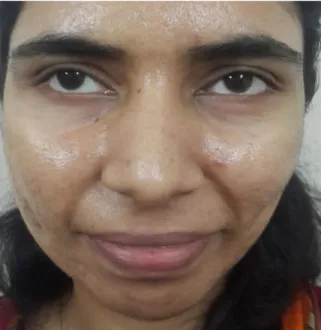
Study was completed in 47 subjects, 2 patients of group A and 1 patient of group B were lost to follow-up (Table 2). BT eyedrops were effective in reducing erythema for up to 12 hours after a single application. Efficacy of BT eye drops was noted in all patients. At 8 weeks, the greatest effect was noted in group A (Figures 1 and 2).
Figure 1 Visible erythema on face of a 23-year-old girl.
Figure 2 Marked improvement after 4-week therapy with topical brimonidine tartarate.
Two (8.7%) patients in group A reported increased burning sensation and dermatitis. Rebound erythema i.e. worsening of erythema was noted in one (4.3%) patient of group A. None of the patient in group B noted any side effects.
Discussion
Rosacea is relatively uncommon in our country but steroid-induced rosacea is becoming the
most common dermatitis and is usually caused by the prolonged application of topical corticosteroid to the face.1,4 Steroids are mostly applied to achieve lightening of skin. Prolonged corticosteroid use in this manner leads to persistent erythema, papules and pustules, telangiectasia with an itching and burning sensation. The pathogenesis of steroid-induced rosacea differs from that of rosacea and is thought to be multifactorial.1,2
Rosacea patients with erythema and flushing may also have papules and pustules on the central portion of the face.14 Several medications including topical metronidazole, azelaic acid and oral antibiotics have been used successfully to reduce inflammatory lesion counts, but their effect on the erythema of rosacea has not been successfully demonstrated.5,6,7 This study focused on facial erythema of rosacea and its management with topical brimonidine tartarate. Topical brimonidine 0.33% gel was approved by FDA for treatment of erythema of rosacea and it is available in Western countries as Mirvaso.9 Due to non-availability and high cost of topical gel, we studied a cheap alternative of brimonidine eyedrops (Alphagan P). It is quite affordable and freely available locally.
In the present study, treatment with topical BT was successful. We measured the improvement in the degree of erythema by using two statistically validated scales CEA and PSA. It was well-tolerated by all patients. Only a marginal number of subjects showed side effects. Only one patient showed rebound erythema.
BT gel reduced facial erythema in a dose-dependent manner. They observed a significant difference between BT 0·5% gel and vehicle in Chroma Meter redness value from 30 min to 12 h after application. In the second part of study, they also demonstrated that BT 0·5% gel once daily had a statistically superior success profile (defined as a two-grade improvement on both CEA and PSA over 12 h) compared with vehicle once daily on days 1, 15 and 29 (all P <0·001). No tachyphylaxis, rebound of erythema or aggravation of other disease signs (telangiectasia, inflammatory lesions) was observed. All regimens were safe and well-tolerated with similarly low incidence of adverse events.
Similarly, Jackson et al.13 treated 260 patients and reported that 1-grade improvement in both CEA and PSA was significantly increased at 30 minutes post-dosing with BT 0.5% gel compared to vehicle gel day 1 (27.9 vs. 6.9%, P <0.001), day 15 (55.9 vs. 21.1%, P <0.001) and day 29 (58.3 vs. 32.0%, P <0.001) for BT 0.5% gel vs. vehicle). They concluded that once-daily topical BT gel 0.5% is not only efficacious at reducing facial erythema but also exhibits response within 30 minutes of application in a significant number of patients.
The effectiveness of BT is supported by the pathogenetic mechanism involved in the disease. Diffuse central facial erythema is a very common feature in rosacea and steroid-induced rosacea. Erythema intensifies during flares and persists to varying degrees between flares.4 This background facial redness develops secondary to vasodilation and fixed vascular changes that develop over time. These fixed changes in superficial cutaneous vasculature do not remit with tetracyclines, metronidazole, azelaic acid
etc.5,6,7 which are more effective in inflammatory
stages of rosacea. However, these enlarged
superficial cutaneous vessels remain vasoactive to sympathetic nervous system innervation, topical α-adrenergic receptor agonists, namely brimonidine and oxymetazoline, have shown promising results in facial erythema of rosacea.5,6,7 Oxymetazoline (1-receptor agonist)13 and nadolol14 and propranolol ( -adrenergic receptor antagonist)15 have been used in isolated cases for the treatment of flushing⁄erythema among patients with rosacea. In subcutaneous tissue, vasoconstriction of the small vessels depends mainly on postsynaptic 2-adrenergic receptor stimulation of vascular smooth muscle.16 Therefore, topical application of a highly selective 2-adrenergic receptor agonist like BT should be more efficacious than 1-agonist and -adrenergic antagonists, with fewer systemic safety issues.16
BT gel is considered to a safe and tolerable drug. The reported side effects are rebound eythema17 and contact dermatitis.18 The side effects were more during the initial phase of treatment and gradually decreased subsequently.19
Conclusion
Topical brimonidine tatarate brimonidine is an effective and safe remedy for erythematous rosacea.
References
1. Crawford GH, Pelle MT, James WD. Rosacea: I. Etiology, pathogenesis, and subtype classification. J Am Acad Dermatol. 2004;51:327-41.
2. Gupta AK, Chaudhry MM. Rosacea and its management: an overview. J Eur Acad Dermatol Venereol. 2005;19:273-85. 3. Aksoy B, Altaykan-Hapa A, Egemen D et
modalities. Br J Dermatol. 2010;163:719-25.
4. Schwab V, Sulk M, Seeliger S et al. Neurovascular and neuroimmune aspects in the pathophysiology of rosacea. J Investig Dermatol Symp Proc. 2011;15:53-62. 5. Odom R, Dahl M, Dover J et al. Standard
management options for rosacea. Part I: overview and broad spectrum of care. Cutis. 2009;84:43-7.
6. Odom R, Dahl M, Dover J et al. Standard management options for rosacea. Part II: option according to subtype. Cutis. 2009;84:97-104.
7. Chang BP, Kurian A, Barankin B. Rosacea: an update on medical therapies. Skin Therapy Lett. 2014;19(3):1-4.
8. Rahman MQ, Ramaesh K, Montgomery DNI. Brimonidine for glaucoma. Expert Opin Drug Saf. 2010;9:483-91.
9. Abramovits W, Prato A, Vincent KD et al.
MIRVASO (brimonidine tartrate) topical gel 0.33%.Skinmed. 2014;12:41-3.
10. Fowler J Jr, Jackson M, Moore A et al.
Efficacy and safety of once-daily topical brimonidine tartrate gel 0.5% for the treatment of moderate to severe facial erythema of rosacea: results of two randomized, double-blind, and vehicle-controlled pivotal studies. J Drugs Dermatol. 2013;12:650-6.
11. Fowler J, Jarratt M, Moore A et al. Once-daily topical brimonidine tartrate gel 0·5% is a novel treatment for moderate to severe facial erythema of rosacea: results of two multicentre, randomized and vehicle-controlled studies. Br J Dermatol.
2012;166:633-41
12. Jackson JM, Fowler J, Moore A et al. Improvement in facial erythema within 30 minutes of initial application of brimonidine
tartrate in patients with rosacea. J Drugs Dermatol. 2014;13:699-704.
13. Shanler SD, Ondo AL. Successful treatment of the erythema and flushing of rosacea using a topically applied selective 1-adrenergic receptor agonist, oxymetazoline. Arch Dermatol. 2007;143:1369-71.
14. Wilkin JK. Effect of nadolol on flushing reactions in rosacea. J Am Acad Dermatol. 1989;20:202-5.
15. Craige H, Cohen JB. Symptomatic treatment of idiopathic and rosacea-associated cutaneous flushing with propranolol. J Am Acad Dermatol. 2005;53:881-4.
16. Piwnica D, Rosignoli C, de Ménonville ST.
Vasoconstriction and anti-inflammatory properties of the selective α-adrenergic receptor agonist brimonidine. J Dermatol Sci. 2014;75:49-54.
17. Routt ET, Levitt JO. Rebound erythema and burning sensation from a new topical brimonidine tartrate gel 0.33%. J Am Acad Dermatol. 2014;70:e37-8.
18. Swanson LA, Warshaw EM. Allergic contact dermatitis to topical brimonidine tartrate gel 0.33% for treatment of rosacea.J Am Acad Dermatol. 2014;71:832-3.
19. Moore A, Kempers S, Murakawa G et al. Long-term safety and efficacy of once-daily topical brimonidine tartrate gel 0.5% for the treatment of moderate to severe facial erythema of rosacea: results of a 1-year open-label study. J Drugs Dermatol.
2014;13:56-61.