On the Capacity of Great Powers
to Influence Nuclear Proliferation
Christopher R. Dittmeier
A dissertation submitted to the faculty of the University of North Carolina at Chapel Hill in partial fulfillment of the requirements for the degree of Doctor of Philosophy in the Department of Political Science (International Relations).
Chapel Hill 2011
Approved by:
Mark J.C. Crescenzi Navin A. Bapat Anna Bassi
c
2011
ABSTRACT
Christopher R. Dittmeier:
On the Capacity of Great Powers to Influence Nuclear Proliferation (Under the direction of Mark J.C. Crescenzi)
Nuclear proliferation is an important contemporary security issue, yet is a different problem
than the one faced during the Cold War. The diffusion of nuclear weapons beyond the great
powers invites a new analysis of structural effects on proliferation outcomes. The
second-tier states—those for which the nuclear debate is currently playing out—do not interact in a
strictly-anarchic system, but in a system conditioned by the preferences and behaviors of the
tier of great-power states. The great powers’ capacity (or lack thereof) to make concessions,
enforce commitments, or otherwise alter the expected consequences of second-tier behavior
changes the rational decisionmaking process for these states. This dissertation examines how
the structural differences experienced by second-tier states affect the problem of nuclear
pro-liferation, providing insights for the extent of great-power ability to influence future diffusion.
Keywords: commitment problem; extended deterrence; great powers; nuclear proliferation;
ACKNOWLEDGEMENTS
I would like to thank several people for their roles in the successful completion of this project.
Mark Crescenzi has been my guiding hand for the past three years, and is largely responsible
for this research being of the quality that it is. Stephen Gent has been a particularly
thorough reviewer, and has spent several sessions helping me to refine and integrate the
theories presented within, and has tested my academic mettle in more ways than anyone
else. Navin Bapat, Skyler Cranmer, and Anna Bassi have all served admirably as members
of my committee and have demonstrably improved my analytic capabilities during the course
of this project.
I would also like to thank Sarah Bauerle Danzman, Art Gibb, Elizabeth Grasmeder,
Timothy McKeown, Thomas Oatley, Andy Pennock, Andrew Richter, Alissandra Stoyan,
Seamus Sullivan, and Austin Williams, who have offered to review numerous drafts of my
work. Chapter 2 has also benefited from the comments of two anonymous reviewers for the
Journal of Theoretical Politics.
My journey through graduate school would not have even started without the guidance
and mentorship of Chris Joyner, Charles King, Jeff Matson, Peter Santanello, and Betsi
Stephen. I would like to thank them for their belief in my abilities and dedication to my
success.
I would like to thank my parents, Ed and Lisa, who have been my best copy-editors, as
well as a sanity check for my research endeavours.
Most importantly, I would like to thank my wife, Cristina, who is—above all else—my
DISCLAIMER
This research has benefited from historical documents and other information in the public
domain provided by the following United States Government sources: the Arms Control
and Disarmament Agency, the Central Intelligence Agency, the Department of Defense, the
Department of Energy, the Department of State, the Executive Office of the President, the
House of Representatives, the National Intelligence Council, the National Security Council,
the Office of the Director of National Intelligence, and the Senate. The analytic conclusions
of this research are solely those of the author and do not represent the official position or
policy of these organizations or of any other agency of the United States Government. Any
TABLE OF CONTENTS
List of Tables . . . viii
List of Figures . . . ix
Introduction . . . 1
1. Great-Power Nuclear Strategy and the Question of Second-Tier Proliferation . 6 2. Proliferation, Preemption, and Intervention . . . 37
3. Great-Power Protection and Nuclearization Outcomes . . . 74
A. Additional Graphics for Chapter 1 . . . 102
B. Derivation of the Formal Model in Chapter 2 . . . 103
LIST OF TABLES
1 Nuclear Weapons Programs and States . . . 18
2 Systemic Effects on Proliferation . . . 21
3 Net Effects of Interaction forNPT Era = 1 . . . 21
4 Control Variable Operationalizations . . . 27
5 Country-Level Effects on Proliferation . . . 29
6 Descriptions of Parameters . . . 48
7 Move Order for Two-Player Game (Γ0) . . . 49
8 Comparative Statics for Critical Level of Power (p′ c) in Two-Player Game (Γ0) 51 9 Move Order for Three-Player Game (Γ1) . . . 59
10 Three-Player Nuclearization SGPE as a Function of Great-Power Ideal Point 63 11 List of Potential Nuclearization Cases, 1950–Present . . . 79
12 Chronology of India’s Nuclear Weapons Program . . . 84
LIST OF FIGURES
1 US and Russian Nuclear Arsenals, 1939–2002 . . . 19
2 Actual and Predicted Diffusion of Nuclear Weapons . . . 24
3 Marginal Effects of Nuclear Arsenal Size on Pursuit (Model 3B) . . . 28
4 Marginal Effects of Nuclear Arsenal Size on Acquisition (Model 4B) . . . 31
5 First-Round Interaction for Two-Player Game (Γ0) . . . 49
6 Effect of Starting Distribution and Risk-Aversion on Critical Level of Power 53 7 First-Round Interaction for Three-Player Game (Γ1) . . . 58
8 Marginal Effects of Nuclear Arsenal Size on Pursuit (Model 3A) . . . 102
Nuclear weapons remain an important concern for the stability of the international
com-munity as the world moves toward a post-American order. The ranks of de facto nuclear
weapons states continues to grow. The might imparted by these weapons to each future
nuclear state fundamentally affects the balance of power on which the international system
depends. However, the problem of nuclear proliferation in the 21st century is not the same
as the issue faced during the height of the Cold War. Nuclear proliferation is no longer
the domain of the superpowers, subject to Kennedy’s infamous “balance of terror.” Since
the 1970s, the nuclear issue has crept beyond the great powers into the realm of
second-tier politics. Scholars and policymakers of the time argued that only great-power politics
could affect the fundamental stability of the international system.1 However, the diffusion
of nuclear weapons gives substantial power outside the clique of states responsible for
main-taining the system. Understanding the drivers of these states’ behaviors is an essential—and
underdeveloped—component of addressing the problem of nuclear proliferation
The interactions of middle-level powers are mediated by the same rationalist
expecta-tions and strategic incentives that mediate great-power behavior.2 The difference lies in the
structure, or environment, in which those interactions occur. Modern great-power behavior
is dominated by the anarchic structure of the broader international system (Waltz 1979;
Keohane 1984). Interactions beyond the great powers are not anarchic in the strict sense,
but rather are structured by the great powers, who have the ability to impose constraints
on the behaviors of less-powerful states. This ability is not unlimited in scope—it does not
approach the level of institutionalization seen in most domestic politics—but great-power
1cf. Kissinger (1974); Waltz (1979); Organski and Kugler (1981); Levy (1983); Porter (1994); Kennedy
(2004).
constraints can materially affect the behavior of the second tier when doing so favors the
great powers’ interests. Under these conditions, problems that result from anarchy,
includ-ing the security dilemma and dynamic commitment problems, may be avoided through the
exercise of great-power influence to structure second-tier states’ behaviors.
The following essays address two ways in which great-power structure alter the behavior
of second-tier states within the substantive field of nuclear proliferation. They discuss the
influence of great powers both on the direct incentives for states to pursue nuclear weapons
as well as on the expected consequences of that pursuit for regional balances of power.
Great-Power Promises and Nonproliferation
Great-Power Nuclear Strategy
The first essay examines changes in nuclear proliferation behavior resulting from the
formal nonproliferation regime, embodied by the 1968 Nuclear Nonproliferation Treaty. The
regime centered on a “grand bargain:” states that did not possess nuclear weapons at the time
of the treaty would forswear their acquisition, while the five declared nuclear powers agreed
to eventually eliminate their nuclear arsenals.3 This bargain is believed to have politically
linked the proliferation impetus (the likelihood of further nuclear proliferation) to the number
of outstanding nuclear weapons. Using data on American and Soviet nuclear arsenals during
the period 1951–2000, a statistical analysis finds that a correlation between great-power
nuclear arsenal size and nuclear proliferation does exist. Furthermore, this relationship
becomes stronger after the creation of the formal nonproliferation regime, indicating that
American and Soviet commitments to nuclear disarmament (however unfaithful they may
have been intended) are taken seriously by the broader international community.
In linking nuclear disarmament to nonproliferation, the United States and Soviet Union
created a mechanism with which to leverage other states that may be considering
tion. Real movements toward the reduction of nuclear weapons among the great powers,
notably the series of START treaties, are shown to coincide with decreases in the number
of states pursuing nuclear weapons, while the nuclear buildups of the “balance of terror”
coincided with an inability of the great powers to impede nuclear proliferation.
Great-Power Influence and Dynamic Commitment in Proliferation
Proliferation, Preemption, & Intervention
The second essay examines nuclear proliferation as an instance of a dynamic commitment
problem.4 Because nuclear proliferation imparts a substantial amount of military power to
new proliferators, it threatens to upset the local balance of power. Because this change
can be anticipated, states that stand to lose from this change have an incentive to strike
preemptively in order to maintain their position within the system. Using a formal model,
this essay shows that—under conditions of anarchy—nuclear proliferation should result in
many more preventive wars than have been observed historically. A model extension explains
that the lack of military action may be due to the presence of great-power influence over the
interactions of second-tier states. When their own foreign policy interests give them incentive
to do so, great powers can extend a deterrent influence over their allies. The intention of
extended deterrence is to protect friendly states from aggression, but it also increases the
protected state’s tolerance for risky behavior. Whereas the pursuit of nuclear weapons may
have previously resulted in war, the shadow of great-power protection allows nuclearization
to occur isolated from these natural consequences.
Great Power Patronage
The third essay, building on the findings of the formal model, analyze its implications in
two historical case studies. India—in the 1960s a large, though weak, regional power in South
Asia—developed nuclear weapons in response to the perceived threat emanating from China.
Technologically, India had few problems developing the necessary industries to support a
nuclear weapons program. Its success, however, was based in its growing alignment with the
Soviet Union, which had grown disenchanted with China’s “revolutionary” communism. As
China was both a nuclear weapons state in its own right and conventionally-superior to India,
New Delhi relied on Soviet political and material support to prevent Beijing from exploiting
regional issues to prevent Indian nuclearization. In contrast, Syria failed to acquire political
support for its nuclear weapons program from any of the great powers. Forced to the nuclear
black market, Syria acquired the technical means of beginning a nuclear weapons program,
but could not deter its regional adversary—Israel—from attacking that program. In 2007,
an Israeli Air Force strike on Dar ez-Zour set back Syria’s program by a decade, as well as
brought international attention to bear on Syria’s surreptitious activity, effectively (if not
actually) bringing an end to its nuclear pursuit.
Research Value
For International Relations Theory
These essays contribute to the theoretical development of the international relations field
by drawing attention to the differential structure of the international system and its effects
on state behavior. More research is being conducted on the behavior of second-tier states,
as economic and military power—as well as the problems associated with these forms of
power—become more diffused. However, the assumption of a purely-anarchic international
system, central to the discipline for thirty years, does not hold true for all states. The great
powers do deal with anarchy, as even formal international institutions are only effective as
long as they reflect these states’ underlying preferences.5 However, the framework used to
analyze these states is not appropriate when discussing the tier of states that exist below
the great powers. Multilevel modeling and the structuring ability of larger actors to enforce
(or undermine) commitments and provide information, has been important in the civil war
literature; however, this same dynamic exists within interstate politics as well.
For Nonproliferation Policy
These essays should also lead policymakers to expand their perception of how to deal
with the problem of nuclear proliferation (as well as other international security issues). A
majority of recent counterproliferation policy has focused on direct coercive or military
in-struments.6 However, the range of tools available to the United States, Russia, and China
also extends to the indirect pressures of international structure. Risky behaviors such as
nu-clear proliferation are undertaken when they are protected from consequences. Undermining
these sources of extended deterrence, a diplomatic task that lies outside of the “target”
pro-liferating state, can be sufficient to undermine the process of proliferation. The majority of
states that have given up the pursuit of nuclear weapons have done so through their own loss
of political will, rather than direct action. Creating the conditions that lead to that decision
are less costly and more effective than preemptive military action will likely be.
Chapter 1
Great-Power Nuclear Strategy and the Question
of Second-Tier Proliferation
Some argue... that we are destined to live in a world where more nations and
more people possess the ultimate tools of destruction. Such fatalism is a deadly
adversary, for if we believe that the spread of nuclear weapons is inevitable, then
in some way we are admitting to ourselves that the use of nuclear weapons is
in-evitable... As the only nuclear power to have used a nuclear weapon, the United
States has a moral responsibility to act. We cannot succeed in this endeavor
alone, but we can lead it, we can start it. So today, I state clearly and with
con-viction America’s commitment to seek the peace and security of a world without
nuclear weapons.
—Barack Obama, Prague, 5 April 2009
Nuclear nonproliferation has been an increasing stumbling block for US foreign policy. In
the past fifteen years, two states (Pakistan in 1998 and North Korea in 2006) have joined the
ranks of the declared non-treaty nuclear powers, while a third—Iran—is flouting US and UN
sanctions in pursuit of a domestic nuclear-weapons capability. In the midst of this failure
of coercion to stem the expansion of the nuclear ranks into second-tier states, the Obama
Administration’s 2010 Nuclear Posture Review (NPR) calls for the United States to lead by
weapons—meeting our NPT [Nuclear Nonproliferation Treaty] Article VI obligation to make
progress toward nuclear disarmament—we can put ourselves in a much stronger position to
persuade our NPT partners to join with us in reinvigorating the non-proliferation regime
and secure nuclear materials worldwide” (U.S. Department of Defense 2010b: v–vi).7 A
similar message is included in the preamble of New START, the strategic arms reduction
treaty negotiated with Russia in early 2010. By taking serious action toward satisfying the
United States’ Article VI disarmament obligation, the new US nuclear policy aims to induce
non-nuclear states to renounce their own nuclear ambitions.
However, the connection between Article VI (disarmament) and Article II
(nonprolifer-ation) has not yet been established in practice. This chapter examines the historical record
since 1945 in two respects, by evaluating the effect of the size of US and Russian/Soviet
nuclear arsenals on states’ decisions to initiate nuclear weapons programs and to acquire a
nuclear weapons capability through both system- and country-level analysis. The chapter
concludes with a discussion of the evolution of nonproliferation strategy and an evaluation
of the Obama administration’s strategy of linking Article VI and Article II commitments
and its consequences for future policy.
Causes of Nuclear Proliferation
The debate over the causes of nuclear proliferation and nonproliferation has long centered
on three principal factors: the technological conditions for proliferation, external political
considerations, and domestic political incentives, with a fourth factor—the role of
interna-tional norms and status-seeking—being raised in the constructivist response to this puzzle.
The first, dubbed technological determinism by Ogilvie-White (1996), centers on the
op-portunity to acquire nuclear weapons-related technology. This hypothesis argues that if
this technology—especially the ability to enrich uranium—is developed, the progression to
weaponization is teleological (Kegley 1980; Lavoy 1993). While technological barriers are
important considerations in evaluating the set of possible proliferators,8
the deterministic
perspective has largely been abandoned in favor of the latter two hypotheses, which examine
the political and decisionmaking factors that contribute to a state’s policy to “go nuclear.”
Meyer (1984: 6) argues that “nuclear weapons do not generate spontaneously from
stock-piles of fissile material.” Rather, some political incentive moves states’ leaders to transform
the latent technological capacity to develop a nuclear weapon into an active proliferation
effort. These incentives can be either external or domestic. Waltz (1990), Davis (1993),
and Betts (1993) argue that the logic of rational deterrence theory incentivizes states to
pursue nuclear weapons to offset power asymmetries with a conventionally-stronger rival.
There also appears to be a proliferation domino effect, as each state that goes nuclear
in-centivizes its rival states to pursue nuclearization (Bergenas 2010). The participation in
an enduring rivalry appears to play heavily into decisions to pursue nuclear weapons, while
recognition of a dyadic security interdependence is central to nuclear-capable states’
forbear-ance of weapons (Dunn and Kahn 1976; Paul 2000). Conversely, a state’s alignment with
a great-power patron, in the form of a security guarantee (most notably the US “nuclear
umbrella”) is argued to have a dampening effect on nuclear proliferation (Betts 1993). To
the extent that allies serve as an imperfect substitute for domestic armament (cf. Morrow
1993), security guarantees can assuage states’ sense of insecurity and make the resort to
nuclearization less enticing.
Alternatively, characteristics of domestic politics are argued to affect the proliferation
de-cision. Solingen (1994) and Paul (2000) note that democratic states with liberal economies
are likely to avoid crossing the threshold from a latent nuclear-weapons ability to an overt
arsenal. This is because the democratic leadership likely views economic policy as a more
certain path to public welfare (and its own political survival) than the unsanctioned
pur-suit of nuclear weapons (cf. Bueno de Mesquita et al. 2003). Jalonen (1995) argues that
8The discovery of the Abdul Qadeer Khan network and the nuclear proliferation market has lessened
Ukraine’s forbearance of its inherited post-Soviet arsenal and 1994 signing of the NPT were
seen as conditions for the new regime’s recognition as part of the European core of liberal
democracies, with the economic benefits that accompanied that recognition being used as
positive incentives for the Kuchma administration. By the same logic, states that are run by
an insular or parochial elite have fewer constraints on their ability to support nuclearization
efforts (Elworthy and Beyer 1986; Lavoy 1993; Sagan 1997).
A fourth hypothesis, which has grown out of the constructivist framework, argues that
international norms and the drive for status have further effects on the likelihood of
prolifer-ation. This framework puts a heavy emphasis on the effect of the 1968 Nuclear
Nonprolifer-ation Treaty as an internNonprolifer-ational regime that dampens the proliferNonprolifer-ation incentive (Scheinman
1990; Sagan 1997; Jo and Gartzke 2007; cf. Oye 1985; Wendt 1992 more generally).
How-ever, possession of nuclear weapons also produces important status gains for states that
acquire them. Great-power status was officially accorded to Communist China shortly after
it developed a nuclear-weapons capability, and many second-tier states view nuclearization
as an important step toward “regional paramountcy” (Dunn and Kahn 1976).
Singh and Way (2004) and Jo and Gartzke (2007) attempt to quantitatively evaluate the
veracity of these four factors. Singh and Way (2004: 873) find that technological capability
and external political incentives (participation in an enduring rivalry and recent MID
in-volvement) both have positive effects at all levels of nuclear proliferation, from exploration
to pursuit to acquisition. Internal characteristics, such as democracy, are found to have
positive effects up to the decision to pursue nuclearization, but do not affect the ultimate
acquisition of nuclear weapons. Jo and Gartzke (2007) do not differentiate the proliferation
process as finely as do Singh and Way, but generally corroborate these findings, with the
addition of positive incentives for regional and global powers to pursue and acquire nuclear
weapons and a negative incentive for NPT members attempt nuclearization.9
9Jo and Gartzke find no systemic effect of the NPT on proliferation decisions, but do not control for
Linking Disarmament and Nonproliferation
Previous studies of nuclearization have tended to look at the factors that directly affect
states’ pursuit of and acquiring nuclear weapons, without engaging the systemic dynamics
that shape the decisions to pursue these weapons. Great powers, which constitute the first
generation of nuclear-weapons states, actively attempt to condition less-powerful states’
be-havior with regard to nuclear proliferation. Neorealists consider these states to be security
providers—substitutes for domestic nuclear production—while neoliberals link
nonprolifera-tion to economic engagement only as a signaling or typing mechanism. With the excepnonprolifera-tion of
the American “nuclear umbrella,” possession of nuclear weapons has not been differentiated
from these states’ status as great powers. By considering the great powers’ possession of
nuclear weapons as a distinct characteristic of the great powers’ participation in the
nonpro-liferation regime, one can evaluate the independent effect of Article VI nuclear disarmament
on Article II nonproliferation efforts.
The connection between Article VI and Article II is apparent in the 2010 Nuclear
Pos-ture Review, the American government’s third-ever comprehensive statement on nuclear
strategy, which guides the United States’ development, maintenance, and deployment of
its nuclear arsenal. The Review states that “[b]y demonstrating that we take seriously our
NPT obligation to pursue nuclear disarmament, we strengthen our ability to mobilize broad
international support for the measures needed to reinforce the non-proliferation regime”
(U.S. Department of Defense 2010b: 12). The Review further argues that concrete
disar-mament steps, including ratification of New START, the Comprehensive Test Ban Treaty,
and the reduction of weapons-grade plutonium stockpiles, will provide the political capital
necessary to reverse the nuclear ambitions of states such as Iran and North Korea. Former
Director of Central Intelligence and Secretary of Defense James Schlesinger similarly noted
in hearings on New START that “the principal defect, if the Senate does not ratify [the
treaty], lies in the political arena. . . To wit, for the United States at this juncture to fail to
on our ability to influence others with regard to particularly the nonproliferation issue.”10
Statements linking the reduction of the United States’ nuclear arsenal to the success of the
nonproliferation regime were made fifty-nine times during Senate debate on New START,11
and figured into the op-ed signed by five Republican Secretaries of State in support of the
treaty.12
This argument follows the logic of issue-linkage (cf. Haas 1980; McGinnis 1986; Lohmann
1997), the connection of two issues of negotiation (in this case nuclear proliferation and
nuclear disarmament) that are not directly predicated on each other in order to produce
cooperation through “horse-trading,” or distributing the gains of cooperation from one issue
to one group, while distributing the gains of cooperation on the other issue to a second group.
Haas (1980: 371–372) argues that issues are linked only when “the process [of cooperation]
seemed to pass out of [the dominant group’s] control” and a quid pro quo is necessary to
entice the non-dominant group’s participation. As the diffusion of nuclear technology began
making its way from the superpowers to other countries (France in 1960, China in 1964), the
need to create a nonproliferation regime became more pressing. Placing Article VI in the
NPT, therefore linking nonproliferation to the reduction and eventual elimination of nuclear
arsenals, provided the promise of gains to those states that forswore nuclear weapons by
entering the regime, increasing the appeal of cooperation to the non-dominant group.
President Kennedy saw the need for a regime to limit the diffusion of nuclear weapons
early in his term (Allison 2010), although the development of a formal nonproliferation
regime did not enter the national discourse until Johnson appointed Roswell Gilpatric to
head a task force on the issue in 1964, after both France and (Communist) China detonated
their first nuclear bombs. Early attempts at reining in attempts at nuclearization focused on
10Testimony given by James Schlesinger before the Committee on Foreign Relations, US Senate, 29 April
2010.
11Based on a reading of The Congressional Record between the treaty’s signing on 8 April 2010 and
ratification on 22 December 2010.
12Henry A. Kissinger, George P. Schultz, James A. Baker III, Lawrence S. Eagleberger, and Colin L.
either direct military action or NATO-based weapons-sharing; treaty-based nonproliferation
grew out of the combination of these plans’ inadequacies and the practical need to engage
the Soviet Union in any counter-proliferation activities—political, diplomatic, or military—
that dealt with the emerging class of second-tier nuclear states (Brands 2006). The Soviets’
contemporaneous acknowledgment that nuclear weapons proliferation was more of a strategic
liability than a military asset made superpower agreement a relatively easy accomplishment
for the era (Carranza 2006; Coe and Vaynman 2011).13
While the great powers saw the prevention of further proliferation as an appropriate
end in its own right, with an aim toward collective security, the non-nuclear states would
not agree to unilateral restraint, even as a group. The Non-Aligned Movement (NAM) in
particular expected “just recompense” for their concession on nonproliferation, which took
the form in negotiations of both eventual disarmament by the nuclear weapons states and
assured interim access to civilian nuclear energy (Leslie 2008: 480–483).14
The idea of a
dis-criminatory regime—one that legitimated the possession of nuclear weapons by some states,
while prohibiting them to others—could only be justified in the short-term, as an interim
state leading to eventual disarmament.15 Ultimately, the United States and the other nuclear
weapons states acquiesced to a number of the NAM’s concerns during the development of
the NPT. A promise to negotiate nuclear disarmament was made, and in exchange all
states-parties that had not tested nuclear weapons before 1967 agreed to forego their development.
Carranza (2006: 490) notes that the “special circumstance” of the Cold War temporarily
justified the unequal burdens imposed by the NPT regime, as well as the initial failures by
the United States and the Soviet Union to move toward disarmament.16 Early post-Cold
13Gilpatric himself was adamant about the need for a multilateral approach to nonproliferation, calling
Soviet cooperation “the ‘sine qua non’ of U.S. strategy” (Brands 2006: 99).
14cf. also statements by Ambassadors Augustine P. Mahiga (Tanzania) and Le Luong Minh (Vietnam) to
the United Nations during the 2005 NPT Review Conference (Leslie 2008: fn. 8, 9).
15cf. Nye (1981); Singh (1998).
16cf. also Nye (1981, 1985). The United States did reduce its total operational stockpile (including both
War arms control agreements (including the START series) provided a legitimizing stimulus
to the nonproliferation regime at a time when previous systemic constraints had dissolved
and India and Pakistan had just crossed the nuclear threshold.17
However, the mere assertion of the connection between nuclear disarmament and
nonpro-liferation does not empirically ordain it. Sagan argues that linkages of Article VI and Article
II are “merely sops to public opinion in non-nuclear countries. The degree to which the
nu-clear states follow through on these Article VI commitments will not significantly influence
the actual behavior of non-nuclear states, since it will not change their security status” (1997:
62).18 Former Nuclear Weapons Council Chairman and Director of Central Intelligence John
Deutch (2005), however, argues that the double standard enacted by the NPT is harmful to
nonproliferation efforts, as failures by the nuclear powers to credibly reduce their arsenals
undermines their ability to promote nonproliferation, even if good-faith efforts toward
dis-armament do not affect prospective proliferators’ willingness in se to acquire nuclear arms
(Cortright and V¨ayrynen 2009).19
Some critics of the grand bargain note that the great powers manipulated the
nonprolif-eration regime’s multidimensional approach, transforming “the discourse of nonprolifnonprolif-eration
found in the NPT [into] a discourse of nondissemination,” such that the great powers’ own
obligations became of minor concern (Keeley 1990: 103). The unequal burden is a prime
point of contention among the non-nuclear states, and has been used as a justification by
India and Pakistan to remain outside the formal international nuclear regime.20 Nye
ar-gues that “a disdain for the arms control institutions and concerns expressed by nonweapons
states can exacerbate the discrimination issue that is the central dilemma in nonproliferation
17cf. Blackaby (1996); Carranza (2006).
18cf. also Joffe and Davis (2011), who argue that nuclear disarmament is likely to reopen the problems
associated with conventional asymmetries, particularly with regard to Israel (vis-`a-vis the Arab world) and Pakistan (vis-`a-vis India).
19Deutch states the United States did not enter into this arrangement in good faith, and has “no intention of
pursuing” nuclear disarmament. As a result, he argues that the underlying hypocrisy of the nonproliferation regime must be dealt with in a delicate political balancing act (2005: 51–52).
policy” (1981: 35). This indicates that—even if the great powers behind the
nonprolifera-tion regime initially failed to enforce this aspect of the grand bargain—the connecnonprolifera-tion has
become entrenched in the dialogue between nuclear and non-nuclear states.
To the extent that the NPT regime acts as an equilibrium rather than as a constraining
agency (cf. Simmons 2000; Coe and Vaynman 2011), great-power action should increase as
non-nuclear states’ behavior begins to deviate from the equilibrium.21 While access to civilian
technology could incentivize cooperative behavior among non-nuclear states, that concession
alone began to fail in the 1980s. Article VI disarmament then became a more important
tool as proliferation events begin to occur at increasing frequency, and as the non-nuclear
states began to exercise leverage short of defection in the five-year review conferences.22
Additionally, the easing of Cold War tensions made this concession by the great powers less
costly than it had previously been, lessening the great powers’ incentives to defect from the
coordination game vis-`a-vis the non-nuclear states.23
Despite the recent occurrence of proliferation in North Korea and the threat of Iran’s
ac-quiring nuclear weapons, the NPT’s track record at preventing the dissemination of nuclear
weapons cannot be understated in comparison to the dire predictions of the Kennedy and
Johnson administrations. Every country that has acquired nuclear weapons since the NPT
came into force resulted from “long-standing regional and bilateral political issues that the
NPT was not necessarily designed to address,” rather than from an intrinsic drive toward
nu-clearization (du Preez 2006: 6).24 The presence of the NPT regime and associated safeguards
was also central to several countries’ decisions to abandon their nuclear weapons programs.25
21
ie. the great powers should make disarmament gesturesin addition to the preexisting policy of making civilian technology available under Article IV as the risk of proliferation increases.
22cf. Paul (2003). 23
cf. Miller (2007).
24North Korea, which performed a nuclear test shortly before du Preez’ article was published, behaves
similarly to the four prior cases noted by du Preez.
25Brazil, Argentina, South Korea, and Egypt are examples of such nuclear reversal. Additionally, the
The grand bargain’s demands toward disarmament continued to remain nominally linked to
the nonproliferation regime, and remained part of the justification for post-Cold War arms
control treaties. This impetus has resulted in a 45% overall decrease in strategic nuclear
weapons during the period 1990–2002, corresponding with the longest continuous period
since 1945 without a new state entering the nuclear club.
If the link between nuclear disarmament and nonproliferation posited by the NPT and
the Nuclear Posture Review does exist, then previous movements by the Nuclear Weapons
States (NWS) toward arms reduction should translate into a reduced likelihood that
non-Nuclear Weapons States (NNWS) will pursue or acquire nuclear weapons, as measured by
the presence of a nuclear weapons program or existing arsenal. This theory presents the
following hypotheses relating to nonproliferation effects:
H1: The reduction in nuclear arsenals by a NWS should reduce the probability that a NNWS
initiates a nuclear weapons program,ceteris paribus.
H2: The reduction in nuclear arsenals by a NWS should reduce the probability that a NNWS
acquires nuclear weapons, ceteris paribus.
Furthermore, if this issue-linkage resulted from the NPT regime-formation process, this
effect should be seen principally in the period after 1968. Conversely, if nonproliferation and
nuclear disarmament were linked independently of the NPT, no such change in relationship
would be seen.
H3: The correlations described in H1 and H2 should be stronger after the adoption of the
NPT than prior to the adoption of the NPT, ceteris paribus.
An opposing hypothesis promoted by several scholars and policy experts states that
nu-clear disarmament will incentivize proliferation, as it weakens the United States’ ability to
deter potential proliferators. This is connected to the role of the great powers as providers of
the “nuclear umbrella”—a security guarantee in exchange for states’ renouncing a domestic
(Carpenter 1994). In response, states without the support of strong allies are likely to
bal-ance against their adversaries through internal military buildup, including nuclearization
(Morrow 1993; Conybeare 1994; McNiel 2010; cf. also Quester 1983; Cohen and Miller 2010
regarding Israel’s response to the evolution of the US security guarantee.) If it is the
nu-clear umbrella, and not linkage to nunu-clear disarmament that is driving nonproliferation, the
hypothesized effects would run counter to the above assertions, with stronger great-power
arsenals decreasing the likelihood of proliferation, and nuclear disarmament leading to a
world of more de facto nuclear weapons states.
Analysis
Method & Data
The choice of the appropriate analytical method with which to test these hypotheses is
important, and remains highly contested. Nuclear proliferation has long been the domain of
qualitative, case-oriented histories, with only a recent strain of research in this field
embrac-ing statistical analysis of proliferation. Sembrac-ingh and Way (2004: 860–861) find three reasons
to justify moving away from qualitative research in this field (or at least to move toward
a more holistic multi-method approach). First, by ignoring the instances of non-events of
nuclear proliferation (ie. those states that do not pursue or acquire nuclear weapons),
qual-itative research runs the risk of erroneous inference. Second, Millian methods are often
treated as being deterministic, while statistical models are more explicitly probabilistic in
their inferences. Thus, qualitative methods are useful for establishing necessity or sufficiency
of a cause, but not for testing probabilistic theories.26
Third, statistical methods are more
suited to multicausal relationships than are comparative analyses.27
This particular research
puzzle adds a fourth justification: by examining the effect of a particular structure on
in-ternational outcomes, the examination of this relationship cannot properly be reduced to
26cf. Bleek (2010). 27
individual cases. All potential proliferators inhabit the same system and are affected by the
same structure, therefore, a case study must examine the system history and its structural
development, which can be accomplished more effectively through quantitative analysis.
The remainder of this chapter analyzes the above hypotheses through a systematic
quan-titative analysis using data covering the international system between 1951 and 2000. The
key independent variables—the size of the great powers’ nuclear arsenals—are effectively
system-level, in that they are not observed to vary across space, but do vary from year to
year. It is therefore logical to first examine the relationship between great-power nuclear
ar-senals and proliferation at this level of analysis. The analysis is performed on two dependent
variables: nuclear weapons programs and nuclear weapons states. At this level of analysis,
each yearly observation of the dependent variables represents the total number of states in the
international system that are either pursuing or possess nuclear weapons. Increased numbers
of great-power nuclear weapons is predicted to positively affect the rate of the diffusion of
nuclear weapons throughout the system; all else being equal, there are predicted to be more
nuclear weapons programs and more nuclear weapons states when high levels of US and
So-viet nuclear arms are observed than when lower levels of arms are observed. Singh and Way
(2004) construct a four-tiered variable of proliferation, ranging from nonproliferation to
ex-ploration to pursuit to the acquiring of nuclear weapons. This is the most finely-defined
operationalization of proliferation activity to date. Reconciling Singh and Way’s measures
of nuclear program and nuclearization dates with those of Jo and Gartzke (2007) and other
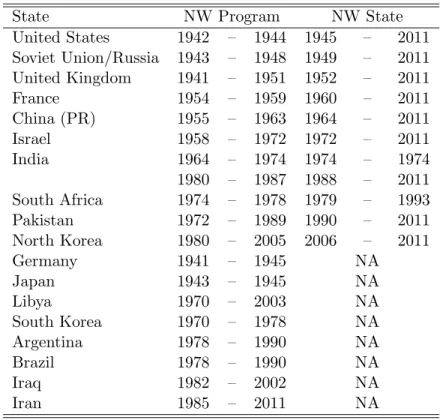
qualitative research, Table 1 describes the full universe of nuclear weapons-pursuing states
and the periods for which any of these states arede facto possessors of nuclear weapons.
Be-cause the dependent variables are both counts, a Poisson-style regression is the appropriate
method for the analysis (Faraway 2006).28
The principal explanatory variables are the number of operational strategic and
tacti-28Specifically, a quasi-Poisson model is used. This relaxation parameterizes the factor of difference between
Table 1: Nuclear Weapons Programs and States
State NW Program NW State
United States 1942 – 1944 1945 – 2011
Soviet Union/Russia 1943 – 1948 1949 – 2011
United Kingdom 1941 – 1951 1952 – 2011
France 1954 – 1959 1960 – 2011
China (PR) 1955 – 1963 1964 – 2011
Israel 1958 – 1972 1972 – 2011
India 1964 – 1974 1974 – 1974
1980 – 1987 1988 – 2011
South Africa 1974 – 1978 1979 – 1993
Pakistan 1972 – 1989 1990 – 2011
North Korea 1980 – 2005 2006 – 2011
Germany 1941 – 1945 NA
Japan 1943 – 1945 NA
Libya 1970 – 2003 NA
South Korea 1970 – 1978 NA
Argentina 1978 – 1990 NA
Brazil 1978 – 1990 NA
Iraq 1982 – 2002 NA
Iran 1985 – 2011 NA
cal nuclear warheads possessed by the United States and the Soviet Union (Russia for the
period 1992–2000).29
The National Defense Research Council has compiled information on
nuclear arsenal sizes for both great powers, using Department of Energy and Department
of Defense declassifications for US nuclear forces information and the SIPRI Yearbook for
Soviet and Russian nuclear forces information.30 The use of a warhead count, rather than
a measure that directly includes delivery systems (such as used by Lieber and Press 2006a),
is justified by both practical and theoretical concerns. First, the diversification of delivery
systems, including the makeup of air-, sea-, and missile-borne nuclear weapons, and their
geographic deployment was—and remains—classified, and therefore unavailable with any
29Arsenals of other nuclear weapons states are not included, as the United States and Soviet Union together
possess the overwhelming majority of nuclear weapons at all times. In 1985, the year with the largest number of nuclear weapons in the international system, the United States and Soviet Union collectively possessed 98% of them—62,565 of 63,632 (Norris and Kristensen 2010: 81).
30
Seehttp://www.nrdc.org/nuclear/nudb/datainx.aspfor these data. The US figures are statistically
consistent with data released directly by the Department of Defense on 3 May 2010, cf.http://www.defense.
Figure 1: US and Russian Nuclear Arsenals, 1939–2002
(a) United States
1940 1950 1960 1970 1980 1990 2000
0
10000
20000
30000
40000
50000
Year
Number of W
arheads
(b) Soviet Union/Russia
1940 1950 1960 1970 1980 1990 2000
0
10000
20000
30000
40000
50000
Year
Number of W
arheads
Solid line represents strategic warheads, while dotted line represents total operational stockpile.
degree of precision or thoroughness. Second, the hypotheses depend on an issue linkage
between disarmament and nonproliferation. Warhead count has been the measuring stick of
nuclear disarmament since START I, and played an important role in the earlier Strategic
Arms Limitation Talks. The data are also widely available. Even before formal
declassifica-tion, informed observers (such as theBulletin of the Atomic Scientists) were able to estimate
the number of American and Soviet nuclear warheads with a substantial degree of accuracy
(Norris and Arkin 1999a,b; Norris and Kristensen 2009). Different models consider the
ef-fects of arsenal movement independently (as individual state efef-fects on the system structure)
and jointly (as a collective great-power effect). Lastly, the levels are transformed by a base-2
logarithm. (Thus, an increase of one in the variable’s value represents a doubling of arsenal
size, while a decrease of one represents halving the arsenal.) This is done in order to weaken
the anticipated effect of movements around a large base value while increasing the
antici-pated effect of movement around a smaller base: eliminating the last thousand weapons in
an arsenal ought to have a much stronger effect on nonproliferation than should eliminating
one thousand weapons from a base of 40,000.
To address the concerns in the third hypothesis, a dummy variable representing the
This variable is interacted with the arsenal size variables in order to determine changes in
the linear relationship between nuclear arsenal size and proliferation resulting from the
for-malization of the nonproliferation norm. Additionally, early versions of the research design
also included a number of atheoretic temporal lags (Cranmer, Rice and Siverson 2011) to
account for lagged effects, as well as controls for diffusion and contagion effects (cf. Oatley
2011); however, none of these provided sufficient explanatory power to justify their
inclu-sion in the system-level analysis. However, a cubic spline (cf. Marsh and Cormier 2002) is
included to compensate for temporal autoregression.
Results of System-Level Analysis
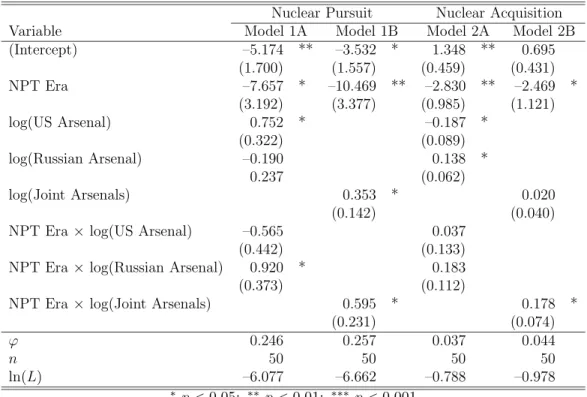
Table 2 shows the results of the quasi-Poisson regression. Models 1A and 2A analyze
the effects of the size of American and Russian nuclear arsenals separately on the pursuit
and acquisition of nuclear weapons, respectively, while Models 1B and 2B examine a joint
effect on the dependent variables. As expected, NPT Era has significant and negative effects
throughout all models, indicating that the formalization of the nonproliferation regime in
1968 has deterred some potential proliferants, and that the baseline of nuclear weapons
aspirants and de facto nuclear weapons states would have been higher had the NPT not
come into existence. However, the nonproliferation regime has also effected an empirical
relationship due to the “grand bargain” of nonproliferation and disarmament.
Prior to the implementation of the NPT, there did exist a small, yet significant positive
relationship between nuclear arsenal size and the likelihood of proliferation. This effect,
which was present during the period immediately following great-power nuclearization and
during the strong expansion of both US and Russian nuclear arsenals, showed that doubling
of the US nuclear weapons would result in a 113% increase in the number of states pursuing
nuclear weapons,ceteris paribus. This effect would be seen much more strongly in the 1950s,
when the United States was starting from a small baseline, and decrease over time, as the
Table 2: Systemic Effects on Proliferation
Nuclear Pursuit Nuclear Acquisition Variable Model 1A Model 1B Model 2A Model 2B (Intercept) –5.174 ** –3.532 * 1.348 ** 0.695
(1.700) (1.557) (0.459) (0.431) NPT Era –7.657 * –10.469 ** –2.830 ** –2.469 *
(3.192) (3.377) (0.985) (1.121) log(US Arsenal) 0.752 * –0.187 *
(0.322) (0.089) log(Russian Arsenal) –0.190 0.138 *
0.237 (0.062)
log(Joint Arsenals) 0.353 * 0.020 (0.142) (0.040) NPT Era×log(US Arsenal) –0.565 0.037
(0.442) (0.133) NPT Era×log(Russian Arsenal) 0.920 * 0.183 (0.373) (0.112)
NPT Era×log(Joint Arsenals) 0.595 * 0.178 * (0.231) (0.074)
ϕ 0.246 0.257 0.037 0.044
n 50 50 50 50
ln(L) –6.077 –6.662 –0.788 –0.978
∗ p <0.05; ∗∗ p <0.01; ∗∗∗ p <0.001
Coefficients reflect quasi-Poisson count regression (ϕ= dispersion parameter). Heteroskedasticity/Autocorrelation-Consistent Robust Standard Errors in parentheses.
Time effects computed with cubic spline (not displayed).
Table 3: Net Effects of Interaction forNPT Era = 1
Nuclear Pursuit Nuclear Acquisition
Variable Model 1A Model 1B Model 2A Model 2B
log(US Arsenal) 0.186 –0.149
(0.302) (0.098)
log(Russian Arsenal) 0.730 ** 0.320 ***
(0.289) (0.092)
log(Joint Arsenals) 0.948 *** 0.198 ***
similar effect prior to 1968 on the likelihood of nuclear weapon pursuit, though the positive
effect derived from the US arsenal continues to be seen when the great power arsenals are
considered jointly.
When considering these effects against the number of successful nuclear weapons
pro-grams, there appears on the surface to be no significant relationship between nuclear arsenal
size and the number of nuclear weapons states in the system; however, Model 2A presents
more nuanced results. An increase in the size of the American nuclear arsenal, ceteris
paribus, exerts a negative pressure on the number of nuclear weapons states in the system,
while an increase in the size of the Soviet nuclear arsenal exerts a positive pressure of a
similar magnitude. This similarly divides the pre-NPT era into two subperiods: the 1950s,
when American technological dominance restricted nuclear technology to NATO, and the
1960s, when the Cold War stalemate allowed for a wider range of developing states to bring
a nuclear weapons program to fruition.
However, the empirical relationship is markedly different after the implementation of
the Nuclear Nonproliferation Treaty. The joint effect of great-power nuclear arsenal size on
the number of nuclear weapons aspirants doubles. Whereas halving the number of nuclear
weapons among great powers would reduce the number of nuclear aspirants by 30.2% prior to
the NPT, after the formalization of the nonproliferation regime that effect would be 61.3%.31
More interestingly, the originating force behind this effect changes. Whereas prior to the
formalization of the nonproliferation regime the United States’ arsenal had a significant
positive effect on proliferation (and the Soviets did not), Model 1A shows that during the
post-NPT era the positive impetus originates from the Soviet Union, and the size of the
American nuclear arsenal does not significantly affect the number of ongoing nuclear weapons
programs. A 50% reduction in the Russian nuclear arsenal,ceteris paribus, creates sufficient
political pressure to reduce the number of nuclear aspirants by 51.8%.
This change in the empirical relationship continues with regard to nuclear weapons
ac-31For the reader’s convenience, Table 3 shows the coefficients and standard errors of all quasi-Poisson
quisition. The effect of the Soviet nuclear arsenal size on successful nuclearization increases
substantially; a 50% decrease in the Soviet nuclear arsenal correlates with a change in the
attrition rate of successful nuclear programs, from 12.9%ex ante pactumto 27.4% after 1968.
This effect is both significant in se and differs significantly from its levels ex ante pactum.
The United States’ arsenal, by contrast, exhibits a negative, yet insignificant correlation.
As with the relationship vis-`a-vis nuclear pursuit, the Soviet-based effect is controlling when
considering the relationship jointly. Both sets of models show that after the formalization of
the nonproliferation regime, the relationships between great-power nuclear arsenal size and
proliferation outcomes became rationalized, with similar directional effects, originating from
the Soviet Union, on both the pursuit and acquisition of nuclear weapons.
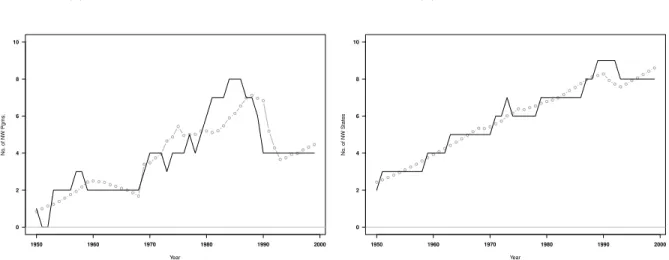
These simple models track the actual growth of both nuclear weapons programs and
nuclear weapons states rather well. Figure 2 plots the predicted number of nuclear weapons
programs and nuclear weapons states, using the joint nuclear arsenal figures for each year
(as well as the cubic spline to control for time effects). The model time series accurately
tracks two trends in nuclear pursuit: the relative stagnancy of the 1960s and the expansion
of interest in nuclear weapons in the early 1970s. Additionally, the model predicts a second
expansion in the 1980s followed by a sharp dropoff in the early 1990s; however, both of
these trends trail their actual counterparts by a few years. With regard to successful nuclear
proliferation, the model accurately follows the steady climb in nuclearization throughout the
Cold War, while predicting a small decrease in the early 1990s (anticipating by a few years
South Africa’s renunciation of its nuclear arsenal in 1993).
Model Expansion: Country-Level Analysis
The above count models show that—at various times—the United States’ and Soviet
nuclear arsenals had differing effects on the overall likelihood of nuclear proliferation in the
international system. While further proliferation was much less likely to occur after 1968 than
Figure 2: Actual and Predicted Diffusion of Nuclear Weapons
(a) Nuclear Weapons Programs
1950 1960 1970 1980 1990 2000
0 2 4 6 8 10
Year
No
. of NW Pgms
.
(b) Nuclear Weapons States
1950 1960 1970 1980 1990 2000
0 2 4 6 8 10
Year
No
. of NW States
Gray dots: mean predicted values using coefficients from Models 1B and 2B, respectively. Black line: actual values (cf. Table 1).
disarmament (particularly on the part of the Soviets) and the expansion of nuclear weapons
in the system became much more consistent. However, as an inherent constraint on the
sta-tistical methods used to exploit system-level variation, the above models can only provide
insight on the overall presence of nuclear weapons in the international system; they provide
little leverage on which states within the system will be most likely to nuclearize, and how
these states in particular react to great-power nuclear disarmament. Previous quantitative
studies have focused on the individual country-level incentives for states to pursue nuclear
weapons, and the current policy debate is concerned with the expected behaviors of a few
specific proliferators.32 While a system-level understanding of great-power structure is
im-portant by itself, augmenting it with an analysis of country-level variation provides greater
specificity that can be directly applicable to the current policy environment.
Furthermore, a country-level analysis can assist in determining the differences in how
in-dividual countries react to the system-level stimulus of great-power nuclear strategy. Wagner
(1988) and Crescenzi (2003, 2007) find that a state’s behavior is conditioned on its relative
re-lationships with other actors in the international system, and Oatley (2011) and Oatley et al.
(2011) find that this behavior is further influenced by state position in the international
net-work, which affects the opportunities to exploit relationships with other states as well as
the costs of doing so. This conditioning undergirds contemporary understanding of alliances
(cf. Walt 1985; Leeds 2003a) and third-party mediation and intervention (cf. Regan 2002;
Kydd 2003, 2006; Kathman 2010), as well as conflict origination. A traditional realist
ar-gument, such as that proposed by Joffe and Davis (2011), argues that nuclear disarmament
by the great powers should increase the likelihood of proliferation both among those states
affiliated with great powers (which now doubt the viability of alliance protection) and those
states unaffiliated with a great power (which now stand to gain from a weaker adversary).
However, the logic at the foundation of New START and the NPR begins from a different
assumption: the grand bargain should be most effective among states with close ties to the
system leaders (and therefore to the international regime sponsored by the great powers),
while its effect should be felt less by those with weaker ties to the great powers.
This relationship is tested by modifying the Nuclear arsenal variable by a directed
affili-ation with each of the great powers, or—when comparing against the Joint arsenal of both
great powers—with aBias differential that categorizes the net level of affiliation with either
of the great powers.33 With respect to each state’s observed alignment with an individual
great power, Signorino and Ritter’s (1999) S-score is the standard accepted
operational-ization (Bennett and Stam 2004). The generalized Bias variable is constructed using the
difference between a state’s observed alignment with the United States and its alignment
with the Soviet Union in a given year. This measure has a range of [–2, +2], where –2
indicates the greatest possible level of pro-Soviet bias, and +2 indicates the greatest level of
pro-American bias. Because the effect of great power behavior should be greatest on those
states that are most closely aligned with it, the variable is squared to create a scalar measure
of the magnitude of each observation’s alignment with one great power patron or the other.
33As the United States and Russia represented opposite foreign policy poles during the Cold War, a state
The effect of great-power nuclear arsenals on proliferation outcomes, modified by the
observed state’s bias, is evaluated using a logistic switching model. Unlike a categorical
multinomial regression, which analyzes the probability that a country is in a particular
outcome state at a particular time, the switching model takes the subset of observations in
a state at timet−1 (non-nuclear, pursuing, or nuclear-armed) and evaluates the probability that the country in question moves to a different state at time t. Model 3 addresses the
likelihood that a non-nuclear state initiates a nuclear weapons program (ie. that the country
moves from a state of “non-nuclear” at timet−1 to a state of “pursuing” at time t). Model 4 addresses the likelihood that a nuclear weapons program is successfully concluded with the
acquisition of weapons (ie. that the country moves from a state of “pursuing” at timet−1 to a state of “nuclear-armed” at timet). The subsetted data for each model are analyzed using
a traditional logistic regression, as the dependent variable (switching state) is now binary.34
The models described below in Table 5 use the modified independent variable, as well as
control variables used in prior quantitative analyses of proliferation by Singh and Way (2004)
and Jo and Gartzke (2007).35 Rather than attempt a comprehensive control for all possible
explanations, as previous studies have done, Models 3 and 4 are specified for the greatest
model fit. Only those variables that provide statistical explanatory power as controls are
included; those that do not provide value-added to the explanation are removed to prevent
over-specification of the model.36 The interpretation of the principal variable of interest—
the interaction between great-power nuclear arsenal size, the Bias or S alignment variable,
and the dummy variable for the NPT Era—is conducted using the method established by
34Model 3 contains a rare-events correction, as the number of switches account for 0.22% of the subsetted
population; Model 4, for which 3.72% of the population constitute switches, does not necessitate a rare-events correction. King and Zeng (2001) recommend using a correction for rare-event logits when the number of positive results is less than approximately three percent of the sample size.
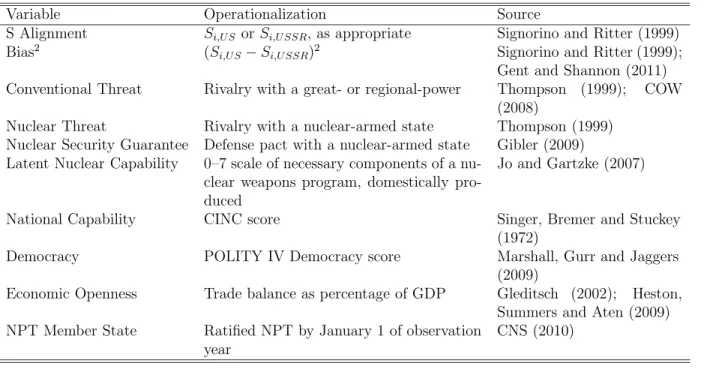
35Table 4 describes the operationalization of the control variables. Missingness in two of these variables—
DemocracyandEconomic openness—is corrected for using multiple imputation (cf. Honaker and King 2010).
36The models’ explanatory power are calculated through an iterative AIC-reduction algorithm
Table 4: Control Variable Operationalizations
Variable Operationalization Source
S Alignment Si,U S orSi,U SSR, as appropriate Signorino and Ritter (1999)
Bias2 (S
i,U S−Si,U SSR)2 Signorino and Ritter (1999);
Gent and Shannon (2011) Conventional Threat Rivalry with a great- or regional-power Thompson (1999); COW
(2008)
Nuclear Threat Rivalry with a nuclear-armed state Thompson (1999) Nuclear Security Guarantee Defense pact with a nuclear-armed state Gibler (2009) Latent Nuclear Capability 0–7 scale of necessary components of a
nu-clear weapons program, domestically pro-duced
Jo and Gartzke (2007)
National Capability CINC score Singer, Bremer and Stuckey (1972)
Democracy POLITY IV Democracy score Marshall, Gurr and Jaggers (2009)
Economic Openness Trade balance as percentage of GDP Gleditsch (2002); Heston, Summers and Aten (2009) NPT Member State Ratified NPT by January 1 of observation
year
CNS (2010)
Preacher, Curran and Bauer (2006).
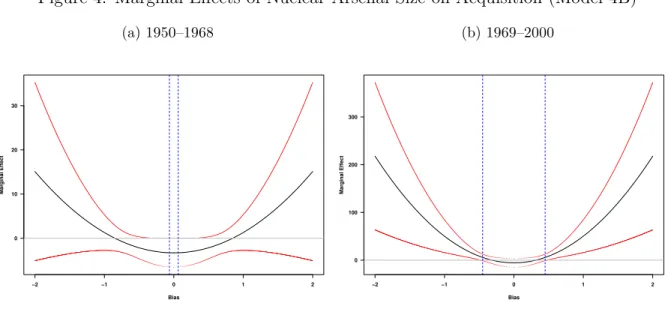
The three-way interactions used in each of these models—which are constituted by seven
distinct statistical terms—are not directly interpretable, so the marginal effects of nuclear
arsenal size—modified by Bias and NPT Era—have been displayed graphically in Figures
3 (for Model 3B) and 4 (for Model 4B). (Models 3A and 4A, which break out the effect of
nuclear arsenal size by great power, are shown in Figures 8 and 3.)Model 3B shows that,
prior to the institution of the nonproliferation regime, great-power nuclear arsenals exhibited
a deterrent effect for those states most likely to enjoy a nuclear security guarantee—those
exhibiting the greatest Bias toward one of the great powers. While the overwhelming
ma-jority of states saw no significant effect during this period, the 10% of observations with the
greatest level of association with a great power saw a significant negative correlation
be-tween nuclear arsenal size and the likelihood of initiating nuclear pursuit. A 10% reduction
in nuclear arms by the great powers during the early Cold War would correspond, ceteris
paribus with a 3.2–6.4% increase in the likelihood of one of these states beginning a nuclear
rela-Figure 3: Marginal Effects of Nuclear Arsenal Size on Pursuit (Model 3B)
(a) 1950–1968
−2 −1 0 1 2
−4 −2 0 2
Bias
Mar
ginal Eff
ect
(b) 1969–2000
−2 −1 0 1 2
−30 −20 −10 0
Bias
Mar
ginal Eff
ect
Red lines represent 95% confidence interval.
tionship between movements in great-power nuclear arsenals and the likelihood of successful
acquisition by a second-tier state, except for a small subset of observations with the greatest
balance in their international alignments, which would experience a deterrent effect. Only
China, during the period 1960-64, would have experienced pressure to hedge its acquisition
strategy in response to nuclear buildup by the United States or Soviet Union. However, the
plateauing of the US strategic buildup during this period failed to deter China’s first nuclear
test in 1964.
The relationship between great power nuclear strategy and proliferation changes markedly
after the introduction of the formal nonproliferation regime, which codified the “grand
bar-gain” between nuclear reduction and nonproliferation. The bargain had a dual effect on
the empirical record. The stimulative effect of nuclear reduction on the pursuit of nuclear
weapons—the realist argument seen in the early Cold War period—is reinforced. Whereas
a 10% decrease in great power nuclear arsenals would previously increase the likelihood of
initiating a nuclear program by 3.2–6.4%, the effect of a similar decrease after 1968 would
increase the likelihood of initiating a nuclear program by between 13.7% and 71.9%, varying
only the level ofBias. Furthermore, the subset of states affected by this relationship increases
Table 5: Country-Level Effects on Proliferation
Nuclear Pursuit Nuclear Acquisition
Variable Model 3A Model 3B Model 4A Model 4B
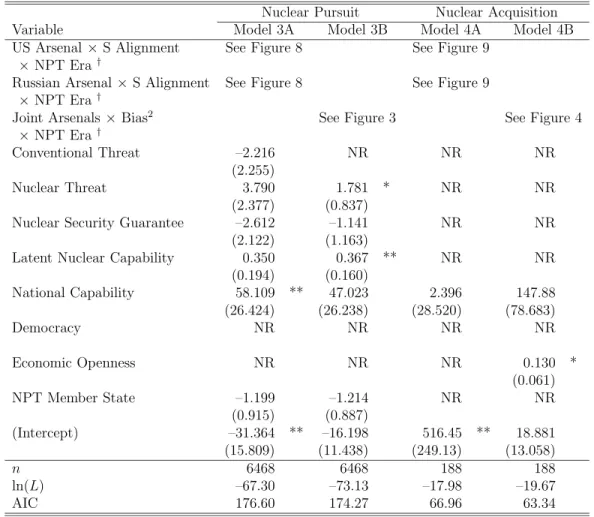
US Arsenal×S Alignment See Figure 8 See Figure 9
×NPT Era †
Russian Arsenal×S Alignment See Figure 8 See Figure 9
×NPT Era †
Joint Arsenals×Bias2 See Figure 3 See Figure 4
×NPT Era †
Conventional Threat –2.216 NR NR NR
(2.255)
Nuclear Threat 3.790 1.781 * NR NR
(2.377) (0.837)
Nuclear Security Guarantee –2.612 –1.141 NR NR
(2.122) (1.163)
Latent Nuclear Capability 0.350 0.367 ** NR NR
(0.194) (0.160)
National Capability 58.109 ** 47.023 2.396 147.88
(26.424) (26.238) (28.520) (78.683)
Democracy NR NR NR NR
Economic Openness NR NR NR 0.130 *
(0.061)
NPT Member State –1.199 –1.214 NR NR
(0.915) (0.887)
(Intercept) –31.364 ** –16.198 516.45 ** 18.881
(15.809) (11.438) (249.13) (13.058)
n 6468 6468 188 188
ln(L) –67.30 –73.13 –17.98 –19.67
AIC 176.60 174.27 66.96 63.34
∗p <0.05; ∗∗p <0.01; ∗∗∗p <0.001; NR: not a relevant control variable.
Heteroskedasticity/Autocorrelation-Consistent Robust Standard Errors in parentheses. Coefficients reflect logistic regression. Time effects computed with cubic spline (not displayed).
† All seven constituent components of three-way interactions are included in the model, but are not
bargain reinforces the deterrent nature of great-power nuclear arsenals, and that the promise
by the Article IX nuclear weapons states to eventually eliminate their arsenals increases their
allies’ perception of threat even as the promise of disarmament was formalized.
The correlation is different in how those states’ likelihood of nuclear acquisition responds
to great-power nuclear strategy. Prior to the formalization of the nonproliferation regime
in 1968, there is no statistical correlation between the size of great-power nuclear arsenals
and the likelihood that a nuclear program is successfully completed. However, the predicted
positive relationship exists in the period after the creation of the NPT for a subset of the
population. The 17.2% of the observed population with the greatest level ofBias (that with
a magnitude of Bias greater than 0.45) shows a significant positive correlation between the
size of great-power nuclear arsenals and the likelihood of successful nuclear acquisition.37 A
10% reduction in great-power nuclear arsenals,ceteris paribus, would decrease the likelihood
of successful acquisition of nuclear weapons by between 38.9% and 99.9%, varying only
the level of Bias. The grand bargain shows evidence of strong returns on investment, as
even though reduced great-power arsenals invite the pursuit of nuclear weapons, it radically
decreases the likelihood that these programs are successful.
Beside the effect of great-power nuclear arsenals and the grand bargain of the NPT,
the likelihood of nuclear proliferation is also affected by other country-level characteristics.
Those states most directly threatened by a nuclear weapons state have the strongest
incen-tive to respond in kind: an average state with a nuclear-armed rival has a 44.5% greater
likelihood of pursuing a nuclear weapons program than does an equivalent state that lacks
such a political impetus. Similarly, a state that has a preexisting latent nuclear capability—
whether developed clandestinely or through an overt civilian nuclear program—has a greater
likelihood of pursuing nuclear weapons, than does a state that must developex nulla. A state
that already has all necessary prerequisites is 36.2% more likely to pursue nuclear weapons,
ceteris paribus than is a state that has only two of the seven capabilities, the median level,