THE EFFECTS OF BIOLOGICAL SEX ON FATIGUE DURING AND RECOVERY FROM RESISTANCE EXERCISE
Gregory Nuckols
A thesis submitted to the faculty at the University of North Carolina at Chapel Hill in partial fulfillment of the requirements for the degree of Master of Arts in the Department of Exercise
and Sport Science (Exercise Physiology).
Chapel Hill 2019
Approved by:
ABSTRACT
Gregory Nuckols: The effects of biological sex on fatigue during and recovery from resistance exercise
(Under the direction of Claudio L. Battaglini)
The purpose of this study was to investigate sex differences in fatigability and recovery from resistance exercise. Male and female subjects with at least one year of bench press experience (N = 21 males and 21 females) performed a fatigue protocol consisting of barbell bench press with 75% 1RM loads for sets of 5 repetitions, with 90 seconds between sets, until concentric failure. Recovery was monitored for the subsequent 72 hours using subjective ratings of soreness and estimated 1RM strength derived from load-velocity profiles. The female
ACKNOWLEDGMENTS
I would like to thank my wife, Lyndsey Nuckols, for everything she’s done to help me out over the past two years of grad school. Without her, I probably would have either failed out of the program, died, or (probably) both. I’d like to thank Dr. Battaglini for his patience, understanding, and mentorship thoughout my whole time in the Master’s program. I’d like to thank the other members of my committee, Drs. Hackney and Hanson, for their help with designing and refining the protocols used in this study. I’d like to thank the people who
participated in this study; they were all a joy to work with, and they were willing to sink several hours of their lives into participating without any financial compensation. I’d like to thank all my friends in the graduate program for the large amount of emotional support they may or may not have realized they were providing, especially Stephanie Sullivan, Jordan Lee, Chad
TABLE OF CONTENTS
LIST OF TABLES………...viii
LIST OF FIGURES………ix
CHAPTER I: INTRODUCTION……….………...1
Statement of purpose……….………..5
Hypotheses……….………..6
Limitations……….………..6
Delimitations……….………...7
Definition of terms……….………...………...8
Assumptions……….………..10
Significance………..………..11
CHAPTER II: REVIEW OF LITERATURE……….………...12
Sex differences in fatigue during resistance training...………..12
Potential mechanisms…….………12
Studies investigating sex differences in fatigue……….15
Sex differences in recovery from resistance training...………..21
Potential mechanisms…….………21
Studies using conventional isotonic resistance exercise and resistance-trained subjects……….………....22
CHAPTER III: METHODS……….………...27
Subjects….……….………27
Experimental design……….……….27
Data collection and instrumentation……….………28
Forms……….………....28
Measurements during sessions 1 and 2.……….28
Measurements during session 3….………....30
Measurements during sessions 4-6….………...31
Visits 1 and 2: Baseline assessments.…...……….31
Visit 3: Fatiguing resistance exercise protocol..………..………...33
Visits 4-6: Recovery assessments…………...………...33
Statistical analyses….……….………...34
CHAPTER IV: RESULTS………..………..37
Subjects………..………37
Hypothesis 1………...………39
Hypothesis 2A………...…….40
Hypothesis 2B………...…….43
Hypothesis 3………...………44
Exploratory analyses………...………...44
CHAPTER V: DISCUSSION………...…………47
Hypothesis 1………...………47
Hypothesis 2...………...…….51
Conclusions………...…….…53
Recommendations for future research………...………....53
APPENDIX A: INFORMED CONSENT FORM………...55
APPENDIX B: SURVEYS AND QUESTIONNAIRES………..63
APPENDIX C: DATA COLLECTION SHEETS………73
LIST OF TABLES
TABLE 1: Descriptive Characteristics of the Subjects………...……..…….………44
LIST OF FIGURES
FIGURE 1: Sex Differences in Reps Completed……….……….……….45
FIGURE 2: Recovery of Predicted 1RM Strength……….…………...47
CHAPTER I: INTRODUCTION
Resistance training is commonly employed by strength and conditioning professionals to increase athletic performance, and by recreational athletes to increase strength and improve body composition. Most guidelines for resistance training prescription, including those of the ACSM (ACSM, 2014), do not consider sex, even though sex may influence responses and adaptations to resistance training. Most research in exercise science is performed on men (Costello, 2014), so the current resistance training guidelines may not be optimal for females.
Meta-analyses have demonstrated that higher training volumes are associated with larger strength gains (Schoenfeld, 2017) and more muscular hypertrophy (Ralston, 2017). However, some research indicates that excessive training volume can hinder strength gains (González-Badillo, 2006) or muscular hypertrophy (Amirthalingham, 2017). It’s thought that excessive training volume compromises positive adaptations by exceeding the body’s capacity to recover from exercise. Thus, resistance exercise prescription must balance the benefits of higher
resistance exercise training volume, against the risk of decreasing adaptations by exceeding the individual’s capacity to recover from training. If there are sex differences in the rate at which men and women fatigue during a resistance training session, or the rate at which they recover from resistance training, that may indicate that optimal resistance training volume differs between the sexes.
inorganic phosphate is a primary contributor (Metzger, 1990; Westerblad, 2002; Allen, 2012). The anaerobic fatigue induced by resistance training is influenced by muscle blood flow. Intense muscular contractions can partially occlude arteries (Hunter, 2001), limiting blood flow and oxygen delivery; when this occurs, anaerobic glycolysis must increase to match the energetic demands of exercise (Russ, 2003), leading to a drop in pH and accumulation of inorganic phosphase. The drop in pH and accumulation in muscle phosphate attenuates Ca2+ release from the sarcoplasmic reticulum, decreases the affinity of troponin C for Ca2+, and interferes with cross bridge cycling, thus decreasing muscle force (Metzger, 1990; Westerblad, 2002; Allen, 2012; Wan, 2017). Since women have smaller muscles than men, on average, they experience less arterial occlusion during forceful contractions, possibly decreasing the rate of fatigue during resistance exercise (Hunter, 2014).
The factors contributing to neuromuscular recovery after a resistance training session are not fully delineated, but it is known that full neuromuscular recovery takes longer to accomplish in the presence of higher muscle damage (Byrne, 2004). This is illustrated by the fact that trained lifters recover their strength after training faster than untrained lifters, due to the collection of adaptations known as the repeated bout effect, which work to limit muscle damage (Hyldahl, 2017). It is thought that women experience less muscle damage than men after exercise, and that women repair muscle damage after faster than men, as higher estrogen levels have been shown to attenuate muscle damage and accelerate muscular regeneration. This evidence was summarized by Enns and Tiidus (2010). However, this is not a unanimous finding in the literature (Stupka, 2000).
2016). In general, women seem to fatigue more slowly than men during resistance exercise. The primary mechanism seems to be greater preservation of muscle blood flow due to lower levels of muscle mass (Hunter, 2001), but other potential reasons for lower fatigability in women include a greater proportion of type I muscle fibers (Hunter, 2014), and a lower reliance on anaerobic metabolism during submaximal exercise (Bunt, 1990; McCracken, 1994; Hackney, 1999; Lundsgaard, 2014). However, most of the studies examining sex differences in fatigability during resistance exercise involve the use of submaximal isometric contractions, which is not reflective of typical practices in strength and conditioning. Less is known about sex differences in fatigability during dynamic, isotonic resistance exercise. Of the studies examining sex differences in fatigability during dynamic, isotonic resistance exercise, many confirm that women are less fatigable (Lanning, 2017; Senefeld 2013; Maughan, 1986; Yoon, 2015; Ribeiro, 2014; Flanagan, 2014), while others find that men and women fatigue at similar rates
(Mendonca, 2018; Reynolds, 2006; Pincivero, 2004; Clark, 2003), though only one study with a multi-set protocol has found that men are less fatigable than women (Monteiro, 2017).
performed during a full-body workout was similarly suppressed 24-hours after resistance training in both men and women (Baggett, 2015). Finally a more recent study found that isokinetic
concentric knee extension torque and countermovement jump height were suppressed to a greater extent in women than in men 24 hours after a squat training (Davies, 2018). Thus, it remains unclear if men and women recover from resistance training at different rates.
One challenge when the studying recovery of strength after resistance exercise is that maximal strength testing after fatiguing exercise imposes ethical and methodological dilemmas. Testing 1RMs may be dangerous when a subject is already fatigued. Furthermore, any maximal strength testing could also induce further fatigue, and thus repeated maximal testing to monitor the progression of recovery could impact the rate of recovery after training, revealing a pattern of recovery that differs the recovery rate that would have occurred had repeated maximal strength testing not been performed. An alternate approach for monitoring strength recovery is the use of submaximal testing, which should be safer for the subjects, and should not induce as much additional fatigue as repeated maximal strength testing. Load-velocity profiles, established using submaximal intensities, have been shown to accurately predict 1RM strength (Jidovtseff, 2011; Pestaña-Melero, 2018), and within-lifter load-velocity profiles have been shown to be stable and reliable (Banyard, 2018). Thus, changes in load-velocity profiles after a resistance training session can be used to monitor strength recovery without the need for repeated maximal strength testing.
fatigability and recovery, summarized by Hunter (2014), has either used isometric or isokinetic exercise, or has employed training protocols where all sets are performed to failure. Thus, the generalizability of this prior research to practice by strength and conditioning professionals is limited. Therefore, this study will add to the literature by examining sex differences in
fatigability during resistance training and recovery from resistance exercise using a protocol that is more reflective of current practices among strength and conditioning professionals.
STATEMENT OF PURPOSE
HYPOTHESES
H1: Women will fatigue slower than men during a single resistance exercise session, as assessed by completing more total reps when performing submaximal sets of resistance exercise until the point of failure
H2a: If women fatigue slower than men during a single resistance exercise session, and thus complete more reps during the session, they will recover from the session at the same rate as men, as assessed by estimated 1RM returning to baseline and muscle soreness attenuating at a comparable rate in both sexes.
H2b: If women do not fatigue slower than men during a single resistance exercise session, and thus complete a comparable number of reps during the session, they will recover from the session faster than men, as assessed by estimated 1RM returning to baseline sooner and muscle soreness attenuating faster in women than in men.
H3: Differences in arm lean mass will explain the sex differences in fatigability.
LIMITATIONS
• Recovery was assessed by estimating 1RM from load-velocity profiles using a submaximal test, not by actually testing 1RM.
• Reported delayed onset muscle soreness (DOMS) is a subjective assessment, and may be subject to differing perceptions of pain between sexes.
• Since the subjects needed to be available for testing on four consecutive days, it was not possible to test all subjects at the same time of day for every session due to scheduling conflicts. Thus, diurnal fluctuations in strength may not be fully controlled for.
• Hormonal contraception usage and menstrual cycle phase for the female subjects was not controlled.
DELIMITATIONS
• All subjects had at least one year of bench press experience but were not required to be high-level bench pressers, and thus the results of this study may not generalize to untrained lifters or elite-level lifters.
• All subjects were between the ages of 18-35 years old, and thus the results may not generalize to younger or older lifters.
• Load-velocity profiles can be used to estimate 1RM and velocity with submaximal loads. However, ability to maintain force output over multiple reps may recover at a different rate, so strength recovery should not be assumed to reflect recovery of all aspects of neuromuscular performance.
DEFINITION OF TERMS
• Fatigability - the rate at which performance declines during exercise, or the total decrease in performance observed following a prescribed workload.
• Repeated bout effect - a set of physiological and neurological adaptations
to exercise which limit muscle damage when the same exercise stimulus is repeated.
• Creatine kinase - an enzyme that aid in bonding creatine and inorganic
phosphate. Assessments of creatine kinase are used as indirect indicators of muscle damage.
• DOMS - delayed onset muscle soreness. The feelings of muscle soreness that generally peak 24-48 hours after exercise.
• Load-velocity profile - the relationship between resistance exercise
intensity and mean concentric velocity. Load-velocity profiles can be used to estimate 1RM strength from submaximal testing.
• Isometric contraction - a muscle contraction that occurs without the
muscle changing in length.
• Isokinetic contraction - a muscle contraction performed at a fixed speed,
generally aided by the use of a dynamometer.
• Isotonic contraction - a muscle contraction performed against the same
external force, but (typically) with varying speeds throughout the contraction. Isotonic exercise generally involves an eccentric and concentric component.
• Eccentric contraction - a muscle contraction during which the muscle
• Concentric contraction - a muscle contraction during which the muscle shortens
• Muscle perfusion - blood flow to the muscle
• Type I muscle fiber - a muscle fiber type characterized by high aerobic
metabolism, low anaerobic metabolism, low fatigability, and slow shortening velocity.
• Type II muscle fiber - a muscle fiber type characterized by low aerobic
metabolism, high anaerobic metabolism, higher fatigability, and fast shortening velocity.
• Aerobic metabolism - the production of ATP in mitochondria in the
presence of oxygen. Aerobic metabolism is associated with a slower rate of fatigue accumulation during exercise than anaerobic metabolism
• Anaerobic metabolism - the production of ATP within the sarcoplasm
without the use of oxygen. Anaerobic metabolism is associated with a faster rate of fatigue during exercise than aerobic metabolism.
• Lactate threshold - the exercise intensity at which lactate appearance in the blood exceeds lactate clearance. Exceeding the lactate threshold indicates increased reliance on anaerobic metabolism.
• Vasodilation - an increase in blood vessel circumference.
• Occlusion - decreasing blood flow through a blood vessel by increasing
the external pressure on the vessel.
• Fatigue Index - a measure of fatigue accumulated during resistance
fatigue index indicates a greater decrease in volume completed from the first set to the last set, and thus greater fatigue accumulation.
• Visual analog scale - a scale that can be used for subjective assessments of various perceptions. In this study, visual analog scales will be used to assess perceived soreness. Higher values will indicate more soreness, and lower values will indicate less soreness.
• Sarcolemma - the cell membrane of a muscle fiber.
• Macrophage - an immune cell. When macrophage levels increase in a
muscle, it generally indicates that muscle damage has occured and that local inflammation is present.
• DEXA - dual energy x-ray absorptiometry. DEXA scans can be used to
assess body composition with relative ease, and considerably accuracy compared to most other methods of assessing body composition.
ASSUMPTIONS
• It is assumed that subjects were not using supplements or pharmacological agents that could enhance or decrease performance while enrolled in this study.They were asked about their usage of such substances, but lab testing was not performed to guarantee their honesty.
• It is assumed that subjects put forth their full effort and reached true concentric failure during the fatiguing exercise session. They were reminded and encouraged to do so.
SIGNIFICANCE
Resistance exercise prescription should be informed by the rate at which lifters fatigue during a resistance training session, and the rate at which they recover from exercise. These factors inform differing recommendations for untrained versus trained lifters, and for young versus older adults. However, sex is rarely considered when making guidelines for exercise prescription, thought there may be sex differences in fatiguability during resistance training or recovery from resistance training.
CHAPTER II: REVIEW OF LITERATURE
This literature review is organized into three sections. The first section reviews the research on sex differences in fatigue during resistance exercise. The second section discusses the research on sex differences in recovery from resistance exercise. The last section addresses the ways in which training background, muscle mass, sleep, and stress can affect fatigue during resistance training and recovery from resistance training.
SEX DIFFERENCES IN FATIGUE DURING RESISTANCE TRAINING
Potential mechanisms
Women tend to fatigue during resistance training at a slower rate than men (Hunter, 2014). Sex differences in fatigue may be driven differences in fiber type, differences in reliance on anaerobic metabolism, and differences in muscle perfusion.
Many studies have compared fiber type ratios in men and women (Simoneau, 1985; Simoneau, 1989; Miller, 1993; Esbjörnsson-Liljedahl, 1999; Staron, 2000; Carter, 2001; Esbjörnsson-Liljedahl, 2002; Porter, 2002; Toft, 2003; Roepstoroff, 2006; Maher, 2009;
60% of 1RM, but not 80% of 1RM (Hickson, 1994). However, Terzis et al. found no relationship between proportion of type I muscle fibers and leg press reps to failure with 75% and 85% of 1RM (Terzis, 2008). Thus, there is mechanistic reason to believe that women may be less
fatigable during resistance training, in part, due to a higher proportion of type I muscle fibers, but research directly investigating the relationship between muscle fiber type and fatigability during resistance training is equivocal.
Differences in reliance on anaerobic metabolism may contribute to women being less fatigable during resistance training than men. Increased anaerobic energy production is associated with decreases in muscle pH and accumulation of inorganic phosphate, which
interfere with muscle contraction (Metzger, 1990; Westerblad, 2002; Allen, 2012). In studies on aerobic exercise, women are found to have a lower reliance on anerobic metabolism at
found that force declines during a prolonged isometric contraction were negatively associated with lactate threshold, providing more direct evidence that decreased reliance on anaerobic metabolism decreases fatigability during resistance exercise (Morris, 2008).
Studies investigating sex differences in fatigue
More than 60 studies have examined sex differences in fatigue during resistance exercise. However, as discussed, most of the protocols used have low ecological validity. Most of the studies employed isometric exercise, and most of the studies using dynamic exercise used either concentric or eccentric isokinetic exercise. Fifteen studies were found that examined sex
differences in fatiguability during resistance training using dynamic, isotonic exercise. Furthermore, two more studies employing isokinetic exercise will be discussed, as they were important when designing the protocol for this study.
In a study by Reynolds et al., the subjects were 34 men and 36 women with “varied degrees of resistance training experience” (Reynolds, 2006). The exercise protocol involved working up to each individual's 1RM, 5RM, 10RM, and 20RM chest press and leg press on different days. Each multi-rep max was a similar percentage of 1RM in both sexes for both chest press and leg press, indicating that if there are sex differences in fatigability during isotonic resistance exercise, they may not be related to fatigability during a single set of resistance exercise taken to failure.
Similarly, a study by Pincivero et al. had 15 male and 15 female subjects perform as many knee extension repetitions and possible with 50% of 1RM (Pincivero, 2004). There was no significant difference in the number of reps performed.
105.4 seconds). This illustrates the importance of differentiating between isometric and isotonic contractions.
Similar results were obtained in a study by Mendonca et al (Mendonca, 2018). This study tested decrements in maximal isometric elbow flexion force in 31 men and 31 women following four sets of ten repetitions with 75% of 1RM. Absolute torque decrements were significantly larger in men, but the men were also significantly stronger than the women. Relative (%) decrements were similar between the sexes.
A study by Lanning et al. had equivocal findings (Lanning, 2017). Eight male and 9 female subjects completed 200 reps of plantar flexion against a load equal to 30% of maximum voluntary contraction force. Post-exercise decreases in maximum voluntary force were similar between sexes, but peak power decreased significantly less (~15%) in women.
A study by Senefeld et al. also had equivocal findings (Senefeld, 2013). Sixteen men and 19 women completed 90 reps of biceps curls and knee extensions with a load equal to 20% of maximal voluntary isometric contraction force. Maximal isometric force for the elbow flexors decreased in both sexes to a similar degree pre- to post-exercise, but knee extension force decreased to a significantly greater degree in men than women.
A study by Maughan et al. found that exercise intensity influences sex differences in fatigability (Maughan, 1986). Twelve untrained men and 11 untrained women completed as many reps as possible in the biceps curl with 50%, 60%, 70%, 80%, and 90% of 1RM. Women completed significantly more reps with 50%, 60%, and 70% of 1RM, but there were no
significant differences at 80% or 90% of 1RM.
A study by Yoon et al. also found lower fatigability in women with low intensity
using 3-second isotonic biceps curls with a load equal to 20% of elbow flexion MVIC. Time to task failure was significantly longer is women than men (9.7 versus 6.1 minutes).
Ribeiro et al. found sex differences in fatigability with higher loads using a multi-set protocol (Ribeiro, 2014). The subjects were 58 untrained men and 65 untrained women. The testing protocol involved 4 sets of bench press to failure with 80% of 1RM before and after a training intervention. A similar number of bench press reps were performed across 4 sets both pre- and post-training in both sexes. Significantly more arm curl reps were performed in women than in men (20.2 vs. 15.4 pre-training and 19.7 vs. 15.8 post-training). Fatigue index - a
measure of how many fewer reps could be performed on the last set of an exercise, relative to the first set of that exercise - was lower in women for both exercises both pre- and post- training, indicating lower fatigability.
Fatigue index is calculated: Fatigue index = [(volume load of the first set – volume load of the last set)/volume load of the first set]*100.
Volume load is calculated: Volume load = reps performed * absolute external resistance used.
may be related to sex differences in the ability to utilize the stretch shortening cycle (Miyaguchi, 2009; Edwén, 2014), as men may make greater use of the stretch shortening cycle than women.
Häkkinen found that when men and women performed 20 1RM squats within a single training session, decrements in squat 1RM and isometric knee extension force were similar between sets (Häkkinen, 1993).
In a separate study, Häkkinen also found that after performing 10x10RM squats, women had a significantly smaller decrease in isometric knee extension torque than men (Häkkinen, 1994). To ensure that each set would be a 10RM, loads were adjusted throughout the training session. Changes in those loads weren’t statistically analyzed, but the decrease in 10RM loads used from the first set to the tenth set was likely significantly greater in men (-27.2% for men versus -14.5% for women).
Salvador et al. examined the decrease in reps completed in the bench press, curl, and squat from the first set to the fourth set to failure with 80% 1RM loads (Salvador, 2005). Women had a significantly smaller decrease in bench reps performed than men, but there were no
significant differences for the squat or curl.
Miller et al. used a protocol consisting of curls and knee extensions with 60% of 1RM, with a fixed cadence of six reps per minute (Miller, 1993). Time to task failure for biceps curls was greater for women, but there was no significant difference between the sexes for knee extensions.
exercise came first, and whether a rest interval was allowed between exercises). When pooling across all four conditions, the decrease in reps from the first to fourth sets was 25.5% smaller for bench, and 24.5% smaller for leg press in men.
Moving on to studies using isokinetic exercise that are relevant to the protocol for this study, Hill et al. found that sex differences in fatigability during dynamic contractions may be driven by baseline differences in muscle mass and strength (Hill, 2018). The subjects were 12 men and 12 women with >6 months of resistance training experience. The exercise protocol involved 50 isokinetic concentric contractions at 65% MVIC and 60 deg/sec. Elbow flexion peak torque significantly decreased more in men (23.8%) than women (18.5%) from the beginning to end of the protocol. However, this difference was no longer significant when covarying for peak torque values, indicating the higher baseline strength and muscularity in the men explained the majority of the difference. The other studies finding that sex differences in fatigability were driven by differences in muscle mass and/or strength used isometric exercise; this study is significant for finding this same relationship with dynamic resistance exercise.
Lastly, Gentil et al. demonstrated that fatigability during resistance exercise is affected by training status, which is why this study will be restricted to only trained subjects (Gentil, 2017). The subjects were 34 men and 34 women. Half of the subjects had at least 6 months of training experience, while half were untrained. The exercise protocol involved 30 maximal isokinetic repetitions at 180 deg/sec. Fatigue index was lowest for trained women (37.86%), followed by untrained women (45.74%) and trained men (45.89%), with untrained men (51.92%) having the highest fatigue index. In terms of significant differences, resistance trained women had a
similar fatigue indices that were significantly lower than untrained men, and untrained men a fatigue index higher than all other groups.
Of the studies using isotonic exercise, two found that at least one measure of fatigability was lower in men (Monteiro, 2017; Flanagan, 2014), nine found that at least one measure of fatigability was lower in women (Lanning, 2017; Senefeld, 2013; Maughan, 1986; Yoon, 2015; Ribeiro, 2014; Flanagan, 2014; Miller, 1993; Salvador, 2005; Häkkinen, 1994), and twelve found no sex differences in fatigability during isotonic resistance training in at least one measure
(Reynolds, 2006; Pincivero, 2004; Clark, 2003; Mendonca, 2018; Lanning, 2017; Senefeld, 2013; Maughan, 1986; Ribeiro, 2014; Flanagan, 2014; Miller, 1993; Häkkinen, 1993; Salvador, 2005). Thus, while there is clear evidence that women are less fatigable than men during
isometric exercise, the literature using dynamic exercise, and isotonic dynamic exercise in particular, is much less clear. Furthermore, most of the studies using isotonic exercise employed either a single set to failure, multiple sets to failure, or very low loads. The sole exception was the study by Mendonca et al. (4 sets of 10 reps with 75% of 1RM). However, the authors of that study report that not all subjects could complete all four sets, and that some subjects were given assistance on their final reps, while other subjects could complete the protocol without assistance (Mendonca, 2018). Thus, actual execution of the protocol differed between subjects, which harms the internal validity of the study. None have examined fatigability using a multi-set
SEX DIFFERENCES IN RECOVERY FROM RESISTANCE TRAINING
Potential mechanisms
There is much debate about whether women experience less muscle damage than men, and whether women recover faster than men after resistance training. On one hand, mechanistic evidence reviewed by Enns and Tiidus (2010) indicates that estrogen is protective against muscle damage by helping to stabilize the sarcolemma, that it limits macrophage infiltration after
damaging exercise, and that it may promote skeletal muscle recovery after exercise by increasing satellite cell activation. On the other hand, direct evidence in humans tends to indicate that women do not experience less muscle damage after eccentric exercise than men (Stupka, 2000; Stupka, 2001, and that men and women recover strength at a similar rate following eccentric exercise (Sayers, 2001; Sewright, 2008). Eccentric exercise is typically used, as it causes more muscle damage than concentric exercise (Proske, 2001). However, studies on eccentric exercise may not be directly relevant in strength and conditioning contexts involving isotonic exercises employing both eccentric and concentric components. Performance in such contexts will by limited by concentric strength, as muscles can produce more force eccentrically than
Furthermore, muscle damage after exercise is attenuated by training through a collection of adaptations known as the repeated bouts effect (Hyldahl, 2017). Many of the studies assessing muscle damage and recovery after resistance exercise used untrained subjects. However,
epidemiological studies consistently show that men have higher rates of leisure time physical activity than women (Azevedo, 2007; Beville, 2014), and are more likely that women to have jobs that involve manual labor (Gabriel, 2007). Thus, in subjects who aren’t specifically
resistance-trained, men may, on average, have a greater baseline level of the repeated bout effect adaptations that protect against muscle damage. Consistent with this idea, a larger proportion of untrained women demonstrate extreme reductions in maximal contractile force (>70%) following eccentric exercise (Sayers, 2001). Studies on resistance-trained male and female subjects
mitigate this possible confounder.
Studies using conventional isotonic resistance exercise and resistance-trained subjects Eight studies using isotonic resistance exercise and trained subjects that assessed sex differences in muscle damage or recovery after resistance training were identified in this review and are presented below:
Judge et al. investigated recovery after resistance exercise in 6 men and 6 women who were highly trained (Judge, 2010). The exercise protocol involved working up to 5RM bench press. It took 48hr for 1RM strength to return to baseline in men. In women, strength was not significantly suppressed post-exercise at any time point, indicating that one set with a 5RM load was sufficient to suppress performance for up to 48 hours in men, but was insufficient to
suppress performance in women.
90% of 1RM. Men experienced a larger increase in creatine kinase levels at 6 and 24hr post-training than women. Creatine kinase in an indirect marker of muscle damage.
Amorim et al. also assessed sex differences in creatine kinase after resistance exercise (Amorim, 2014). Eleven trained men and eleven trained women completed an exercise circuit involving 17 different resistance exercises for 3 sets of 12 reps. Creatine kinase activity
increased more in men than in women post-exercise, and the difference was still present up to 72 hours post-training.
In contrast, Benini et al. had 8 recreationally trained male and 8 recreationally trained female subjects complete 3 sets of 8-10 reps for 10 different exercises (Benini, 2015). This study found no sex differences in creatine kinase levels 24 hours post-training.
Baggett et al. assessed soreness and performance recovery in 14 trained men and 14 trained women (Baggett, 2015). The exercise protocol involved 3 sets of 8-12 reps for 3 upper body and 3 lower body exercises for two sessions, separated by 24 hours. There were similar decreases in reps performed in the second session in both sexes. Delayed onset muscle soreness 24 hours after the first workout was significantly higher in men than women, but both sexes reported similar discomfort during the second workout.
In the most recently study in this topic of research, Davies et al. assessed multiple markers of fatigue and recovery in 11 men and 8 women (Davies, 2018). The exercise protocol involved squatting 5 sets of 5 reps with 80% of 1RM, followed by one set to failure. Isometric, concentric, and eccentric knee extension strength, countermovement jump height, creatine kinase, and lower body muscle pain were assessed for three days following the training session. Women had larger decrements than men in concentric isokinetic knee extension strength and countermovement jump height at 24 hours post-training, and no other measures were
significantly different between the sexes.
Of these studies, five looked at performance recovery (Häkkinen, 1993; Häkkinen, 1994; Judge, 2010; Baggett, 2015; Davies, 2018), and five examined indirect markers of muscle damage (Wolf, 2012; Amorim, 2014; Benini, 2015; Baggett, 2015; Davies, 2018). Judge et al. found that 1RM strength recovered significantly faster in women, Baggett et al. found that performance during an entire exercise session was similarly suppressed 24 hours post-training in both men and women, and Davies et al. found that concentric strength and countermovement jump height were suppressed more in women 24 hours following a squat training session. However, Judge et al. only used a single set of resistance exercise, and Baggett et al. only
FACTORS BEYOND SEX THAT MAY AFFECT FATIGUE OR RECOVERY
Other factors beyond sex and training status may influence fatigue during resistance exercise and recovery from resistance exercise. Assessing these possible confounders will help with determining whether any significant differences observed in this study are truly driven by sex, rather than some other factor.
Research is surprisingly mixed concerning the effects of sleep restriction on exercise performance, and the weight of the evidence suggests that sleep restriction does not negatively impact strength acutely (Knowles, 2018). However, some studies do show that sleep restriction or sleep deprivation negatively impacts time to exhaustion during isometric resistance exercise (Arnal, 2016), or volume that can be completed during isotonic exercise (Reilly, 1994; Cook, 2012). Furthermore, a study on rowers found a positive relationship between sleep disturbances and elevation in pro-inflammatory cytokines (Main, 2010), which may be related to
compromised muscular recovery from exercise. The relationship between sleep and fatigue during resistance training or recovery from resistance training isn’t clear. However, some evidence indicates that insufficient sleep may negatively impact resistance training performance or recovery.
perceived stress that could moderate the relationship between sex and recovery from resistance exercise.
It’s a consistent finding that high-repetition training increases strength endurance (Anderson, 1982; Campos, 2002; Schoenfeld, 2015). This is in line with the tenants of training specificity and the SAID (specific adaptations to imposed demands) principle. Collecting data on the subjects’ training backgrounds, with an emphasis on training volume and frequency of high-repetition training, will help us determine if any of the potential sex differences in fatigability may be moderated by differences in approaches to resistance exercise.
SUMMARY
CHAPTER III: METHODS
SUBJECTS
The subjects were 22 males and 22 females, aged 18-35 years old. To be included in the study, the subjects must have had at least one year of consecutive bench press experience.
Subjects were free of any injury within the past six months that would have dpreclued them from safely participating or putting forth their best effort during 1RM bench press testing or during a fatiguing bench press protocol. Furthermore, female subjects were pregnancy tested to verify that they were not pregnant. Due to the prevalence of hormonal contraceptive usage in the target population, hormonal contraceptive usage was not an exclusion criterion for female subjects.
EXPERIMENTAL DESIGN
This was a quasi-experimental study utilizing a parallel groups design, as group assignment was based on sex, not random allocation, but both groups underwent the same intervention and testing.
1RM testing, load-velocity testing, and assessment of reps to failure with 75% of 1RM. The third visit took place 48-96 hours after the second visit, and involved blood lactate assessments, the fatiguing exercise protocol, and load-velocity profile testing. The fourth through sixth visits took place 24 hours after the preceding visit, and involved load-velocity profile testing and
assessments of muscle soreness. To the greatest extent as was feasible, visits took place within a four-hour time window for each subject in order to minimize fluctuations in performance that could be attributed to diurnal fluctuations in strength.
DATA COLLECTION AND INSTRUMENTATION
Forms
Informed consent was obtained using the form in Appendix A. Sleep quality was assessed using the Pittsburgh Sleep Quality Index (Buysse, 1988). Nutritional intake was assessed using 3-day food records. Stress was assessed using the Perceived Stress Scale (Cohen, 1983). Training practices were assessed using a simple questionnaire. Soreness was assessed using 100mm visual analog scales. (Appendix B). Data collection forms for all sessions are in Appendix C.
Measurements during sessions 1 and 2
Height measurements were made using a stadiometer that measures height to the nearest millimeter (Detecto, Webb City, MO, USA).
Body mass was recorded to the nearest quarter pound using a calibrated (Detecto, Webb City, MO, USA). Weights were then converted into kilograms for analysis.
urinate in a cup in order to collect the urine, and a member of the research team used the testing strip.
Arm lean mass was assessed via DEXA (Hologic, Inc., Bedford, MA). The arm segment was separated from the torso segment of the DEXA scan by ensuring that the line that separates these segments passes directly through the axilla and the midpoint of the acromioclavicular joint.
Sleep duration and quality were estimated using the Pittsburgh Sleep Quality Assessment (Chronbach’s α = 0.83). The subject was asked to fill out the assessment, and the assessment was scored using the scoring scale recommended by the assessment.
Stress levels were estimated using the Perceived Stress Questionnaire (reliability: r = 0.84-0.86). The subject was asked to fill out the questionnaire, which was scored using the scoring scale recommended by the questionnaire.
Aspects of the subjects’ training histories were assessed via questionnaire. The subject were asked to fill out the questionnaire. Each question was assessed independently.
Dietary intake was assessed via 3-day food logs. Subjects were instructed about how to fill out the food logs, told to include portion sizes and brand names whenever possible, and asked to record two week days and one weekend day of nutritional intake. This data was collected to help with the interpretation of the results if there were large differences in recovery rate, to ensure those differences were not due to drastic sex differences in nutrient intake.
1RM bench press testing was performed on a standard bench press (Life Fitness,
subject’s shoulders and gluteal region needed to maintain contact with the bench, and their feet needed to remain on the floor and not move throughout the repetition. The bar started at full elbow extension, was lowered until it made contact with the chest, was paused briefly on the chest, and was then pressed until full elbow extension was attained.
Bench press load-velocity profiles were assessed using the GymAware Power Tool (Kinetic Performance Technology, Canberra, Australia), measuring mean concentric velocity. This device has been shown to have excellent validity and reliability with the loads used to establish load-velocity profiles in this study (relationship with gold-standard measure r > 0.9; CV < 10%) (Banyard, 2017; Banyard, 2018). Criteria for a successful bench press rep was the same as for 1RM testing. The subjects were instructed to press each repetition as fast and hard as possible. Estimated 1RM was assessed by calculating a linear trendline for the load-velocity profile, and solving for load when velocity is equal to the observed velocity during that subject’s 1RM (Jovanović, 2014).
Bench press reps to failure were performed using 75% of the subject’s 1RM. The criteria for a successful rep was the same as for 1RM testing. This test was terminated when a subject failed to complete a rep.
Measurements in session 3
Load-velocity testing and estimated 1RM were assessed as previously described (Jovanović, 2014).
protocol was terminated when concentric failure occurred. Total reps completed during the protocol were then counted.
Blood lactate levels were assessed using a Lactate Plus blood lactate analyzer (Sports Resource Group, Hawthorne, NY, USA), requiring blood from a fingerstick.
Vertical displacement of the barbell each rep was measured by the GymAware. Average vertical displacement for each subject was calculated by averaging all reps during sets that were completed successfully during the fatigue protocol.
Measurements in sessions 4-6
Load-velocity testing and estimated 1RM were assessed as previously described. Soreness of the bench press prime movers (pectoralis major, triceps brachialis, and anterior deltoid) were assessed using a visual analog scale (Kanda, 2013).
VISITS 1 AND 2: BASELINE ASSESSMENTS
estimate their one-repetition maximum (1RM) bench press. The initial load used for testing was 30% of estimated 1RM if possible, or 33lbs if 30% of estimated 1RM was less than 33lbs. Load was increased in increments of 10% of estimated 1RM until reaching approximately 80% of 1RM estimated. At 80% of 1RM, smaller load increases took place, until a 1RM has been attained, ideally within 5 attempts. Subjects rested for 2-3 minutes between each warm-up set, and for 2-5 minutes between each 1RM testing attempt until a 1RM was achieved. Subjects performed 3 repetitions per set until reaching 80% of their estimated 1RM, and performed single repetitions with all loads above 80% of estimated 1RM in order to minimize fatigue, which could hinder 1RM performance. Each rep was performed through a full range of motion, touching the chest at the bottom of the rep, and locking out the elbows at the top of the rep. There needed to be a clear pause between eccentric and concentric portions of the rep, and the butt and shoulders needed to maintain contact with the bench at all times. If subjects struggled with sufficiently pausing the bar on their chest, they were told to wait for a “press” command, provided by a member of the research team. The subjects were instructed to control the eccentric portion of each repetition, and to perform the concentric portion of each repetition as fast as possible. At the end of this visit, subjects were given 3-day food logs with instructions for how to fill them out, and were asked to record two week days and one weekend day of eating and drinking.
adequate interval between sessions. Judge et al. found that 48 hours was long enough for bench press strength to return to baseline in both men and women after maximal strength testing (Judge, 2010), and allowing up to 96 hours allowed for more scheduling flexibility.
VISIT 3: FATIGUING RESISTANCE EXERCISE PROTOCOL
During the third visit, the subjects were put through a fatiguing exercise protocol. This visit began with a finger prick to assess pre-exercise lactate concentrations. Following a five-minute self-selected general warm-up, the subjects worked up from 30% of 1RM to 80% of their 1RM, performing sets of 3 repetitions, with 2-3 minutes between sets. Then, the bar was loaded to 75% of the subject's 1RM, and they performed sets of 5 repetitions, with 90 seconds between sets, until they reached the point of concentric failure. Five minutes after the end of the last set, there was another finger prick to assess post-exercise blood lactate. Ten minutes after the end of the last set, the subjects again worked up from 30% of 1RM to 80% of their 1RM, performing sets of 3 repetitions, with 2-3 minutes between sets.
VISITS 4-6: RECOVERY ASSESSMENTS
For three consecutive days following the fatiguing exercise protocol, recovery from the fatiguing exercise protocol was assessed. The subjects began with a five-minute self-selected warm-up, and worked up from 30% of 1RM to 80% of their 1RM in 10% increments,
questionnaires to assess their sleep duration, sleep quality, and the soreness of their pectoral muscles, triceps, and anterior deltoids.
STATISTICAL ANALYSES
All data were reduced and analyzed using SPSS Version 25.0 for Microsoft Windows (SPSS, Inc., Chicago, IL) or JASP version 0.8.6.0. Means and 95% confidence intervals are reported for all major variables.
Total reps completed during the fatiguing exercise protocol was compared between sexes using both Welch’s t-test and a 1x2 ANCOVA, covarying for arm lean mass. The t-test was used to determine whether there's a difference in acute fatigability between sexes; since there was a significant difference, the ANCOVA was used to assess whether differences in baseline arm lean mass account for a significant proportion of those differences. Previous research (Hill, 2018) has used a similar statistical approach.
Slope of the load/velocity curve and predicted 1RM from the subjects' load/velocity profile was analyzed using 2x5 ANOVAs, with two levels of sex (male and female), and five time points (pre-exercise, post-exercise, 24-hours post, 48-hours post, and 72-hours post). Perceived muscle soreness was analyzed using a 2x3 ANOVA, with the same factors and the levels for sex, but only three time points (24-hours post, 48-hours post, and 72-hours post). A Greenhouse-Geisser correction was applied to all ANOVAs in an effort to limit the false discovery rate.
All other data collected (training histories, sleep, stress, etc.) were only be used for exploratory analyses, for descriptive purposes, or for sensitivity analyses to ensure that any significant findings remain significant after covarying for other factors that could conceivably influence fatigability or recoverability.
To detect a group x time interaction in any of the recovery measures, a sample size of 40 subjects (20 per group) would be sufficient to detect a partial eta squared effect size of 0.03, given a power of 0.8, an alpha of 0.05, and a correlation among within-subject measures of 0.5 (GPower ver. 3.1). For reps completed during the fatigue protocol, we anticipated that women would complete approximately 15 more reps than men, and we anticipated that the standard deviation within each sex would be approximately 10 reps. Given a sample size of 20 men and 20 women, we anticipated that the SE for both sexes would be approximately 2.24 reps, and the standard error for the difference between sexes would be approximately 3.2 reps.
Effect sizes are reported to contextualize results and group differences. For descriptive characteristics and the t-tests, effect sizes are reported as Cohen’s d. For correlations, effect sizes are reported as Pearson’s r. For ANOVAs, effect sizes are reported as ηp2.
• H1: Women will fatigue slower than men during a single resistance
exercise session, as assessed by completing more total reps when performing submaximal sets of resistance exercise until the point of failure
• H2b: If women fatigue slower than men during a single resistance exercise session, and thus complete more reps during the session, they will recover from the session at the same rate as men, as assessed by estimated 1RM returning to baseline and muscle soreness attenuating at a comparable rate in both sexes.
CHAPTER IV: RESULTS
The primary purpose of this study was to examine whether women fatigue at a slower rate than men when performing submaximal sets of bench press, consisting of sets of 5
repetitions at 75% of 1RM with 90 seconds between sets. The secondary purpose was to examine whether men and women recover from fatiguing exercise at different rates by assessing muscle soreness and estimated 1RMs for 72 hours following the fatiguing exercise session.
SUBJECTS
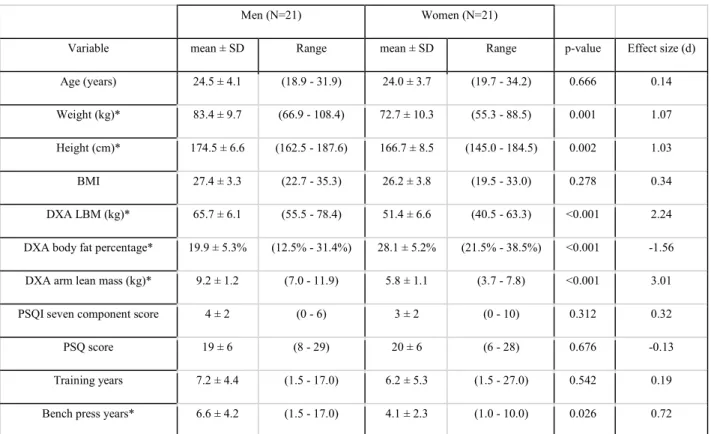
TABLE 1: DESCRIPTIVE CHARACTERISTICS OF THE SUBJECTS
Men (N=21) Women (N=21)
Variable mean ± SD Range mean ± SD Range p-value Effect size (d)
Age (years) 24.5 ± 4.1 (18.9 - 31.9) 24.0 ± 3.7 (19.7 - 34.2) 0.666 0.14
Weight (kg)* 83.4 ± 9.7 (66.9 - 108.4) 72.7 ± 10.3 (55.3 - 88.5) 0.001 1.07
Height (cm)* 174.5 ± 6.6 (162.5 - 187.6) 166.7 ± 8.5 (145.0 - 184.5) 0.002 1.03
BMI 27.4 ± 3.3 (22.7 - 35.3) 26.2 ± 3.8 (19.5 - 33.0) 0.278 0.34
DXA LBM (kg)* 65.7 ± 6.1 (55.5 - 78.4) 51.4 ± 6.6 (40.5 - 63.3) <0.001 2.24
DXA body fat percentage* 19.9 ± 5.3% (12.5% - 31.4%) 28.1 ± 5.2% (21.5% - 38.5%) <0.001 -1.56
DXA arm lean mass (kg)* 9.2 ± 1.2 (7.0 - 11.9) 5.8 ± 1.1 (3.7 - 7.8) <0.001 3.01
PSQI seven component score 4 ± 2 (0 - 6) 3 ± 2 (0 - 10) 0.312 0.32
PSQ score 19 ± 6 (8 - 29) 20 ± 6 (6 - 28) 0.676 -0.13
Training years 7.2 ± 4.4 (1.5 - 17.0) 6.2 ± 5.3 (1.5 - 27.0) 0.542 0.19
Bench press years* 6.6 ± 4.2 (1.5 - 17.0) 4.1 ± 2.3 (1.0 - 10.0) 0.026 0.72
All data are mean ± SD (range). * denotes a statistically significant difference between sexes (p<0.05). A positive effect size (Cohen's d) indicates
a larger value for the male subjects. BMI = body mass index. DXA = Dual Energy X-Ray Absorptiometry. LBM = Lean body mass. PSQI =
Pittsburgh Sleep Quality Index. PSQ = Perceived Stress Questionnaire.
The males were taller, heavier, had more lean body mass, a lower body fat percentage, more arm lean mass (p<0.01 for all), and more years of bench press experience (p = 0.03). However, age, indicators of sleep quality (PSQI scores) and stress (PSQ scores), years of
resistance training experience, all variables related to the subjects’ habitual bench press training, and scaled strength (IPF points) were not significantly different between sexes (p>0.05).
The men and women completed a similar number of reps during a single set to failure with 75% of 1RM in session 2 [women: 9.0 ± 2.0; men: 8.6 ± 1.7; t(39.035)=0.743; p=0.462;
HYPOTHESIS 1: Women will fatigue slower than men during a single resistance exercise
session, as assessed by completing more total reps when performing submaximal sets of
resistance exercise until the point of failure.
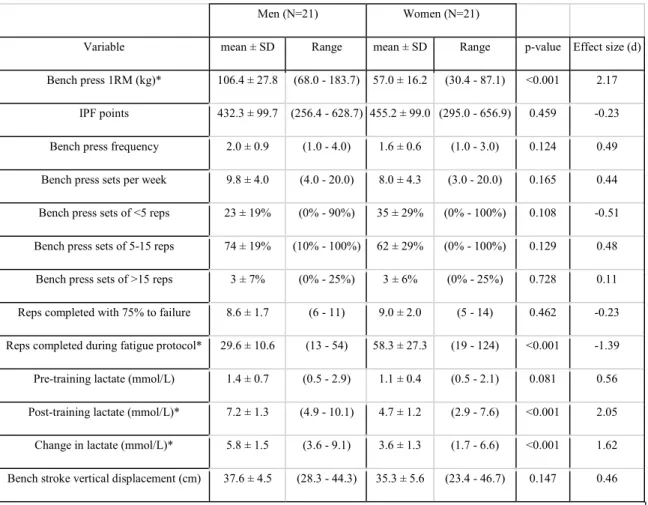
The women completed more total reps during the fatigue protocol in session 3 [women: 58.3 ± 27.3; men: 29.6 ± 10.6; t(25.923)=4.489; p=0.0001; d=1.39 95% CI = 0.66-2.09]. The mean difference was 28.7 reps (95% CI = 15.5-41.8; Figure 1). One outlier was detected in the female cohort (reps completed > Q3 + 1.5 x IQR). The difference was still significant with this data point removed [t(26.26)=4.447; p=0.0001; d=1.40 (0.66-2.10)], though the mean difference decreased to 25.4 reps (95% CI = 13.7-37.1). Table 2 presents the performance and training characteristics of the subjects. Figure 1 is a graphic representation of the results of the analyses for hypothesis 1.
FIGURE 1
TABLE 2: PERFORMANCE AND TRAINING CHARACTERISTICS
Men (N=21) Women (N=21)
Variable mean ± SD Range mean ± SD Range p-value Effect size (d)
Bench press 1RM (kg)* 106.4 ± 27.8 (68.0 - 183.7) 57.0 ± 16.2 (30.4 - 87.1) <0.001 2.17
IPF points 432.3 ± 99.7 (256.4 - 628.7) 455.2 ± 99.0 (295.0 - 656.9) 0.459 -0.23
Bench press frequency 2.0 ± 0.9 (1.0 - 4.0) 1.6 ± 0.6 (1.0 - 3.0) 0.124 0.49
Bench press sets per week 9.8 ± 4.0 (4.0 - 20.0) 8.0 ± 4.3 (3.0 - 20.0) 0.165 0.44
Bench press sets of <5 reps 23 ± 19% (0% - 90%) 35 ± 29% (0% - 100%) 0.108 -0.51
Bench press sets of 5-15 reps 74 ± 19% (10% - 100%) 62 ± 29% (0% - 100%) 0.129 0.48
Bench press sets of >15 reps 3 ± 7% (0% - 25%) 3 ± 6% (0% - 25%) 0.728 0.11
Reps completed with 75% to failure 8.6 ± 1.7 (6 - 11) 9.0 ± 2.0 (5 - 14) 0.462 -0.23
Reps completed during fatigue protocol* 29.6 ± 10.6 (13 - 54) 58.3 ± 27.3 (19 - 124) <0.001 -1.39
Pre-training lactate (mmol/L) 1.4 ± 0.7 (0.5 - 2.9) 1.1 ± 0.4 (0.5 - 2.1) 0.081 0.56
Post-training lactate (mmol/L)* 7.2 ± 1.3 (4.9 - 10.1) 4.7 ± 1.2 (2.9 - 7.6) <0.001 2.05
Change in lactate (mmol/L)* 5.8 ± 1.5 (3.6 - 9.1) 3.6 ± 1.3 (1.7 - 6.6) <0.001 1.62
Bench stroke vertical displacement (cm) 37.6 ± 4.5 (28.3 - 44.3) 35.3 ± 5.6 (23.4 - 46.7) 0.147 0.46
All data are mean ± SD (range). * denotes a statistically significant difference between sexes (p<0.05). A positive effect size
(Cohen's d) indicates a larger value for the male subjects. The bench press sets <5 reps, 5-15 reps, >15, and >5 reps are proportions
of weekly sets within those respective rep ranges. Bench press frequency is sessions per week. IPF Points = bench press scoring
system of the International Powerlifting Federation.
HYPOTHESIS 2A: If women fatigue slower than men during a single resistance exercise
session, and thus complete more reps during the session, they will recover from the session
at the same rate as men, as assessed by estimated 1RM returning to baseline and muscle
soreness attenuating at a comparable rate in both sexes.
significant sex × time interaction ([F(2.772,110.880) = 2.131; p = 0.105; ηp2 = 0.051). When normalizing predicted 1RMs to the predicted 1RMs recorded prior to the fatigue protocol in session 3, there was still a significant main effect for time [F(3.491,139.640) = 15.096; p<0.001; ηp2 = 0.274; Figure 2], but no main effect for sex [F(1,40) = 0.837; p = 0.366; ηp2 = 0.020] nor a sex × time interaction [F(3.491,139.640) = 0.907; p = 0.452; ηp2 = 0.022]. Normalized predicted 1RM was significantly lower at the post-exercise time point in session 3 than at the pre-exercise time point in session 3 (pbonf = 0.01), or sessions 5 and 6 (pbonf < 0.001). It was also significantly lower in session 4 than in sessions 5 and 6 (pbonf < 0.001). Figure 2 depicts the recovery of normalized predicted 1RM strength in males and females.
FIGURE 2
A 2×5 (sex × time) ANOVA for slope of the load-velocity relationship found a
significant main effect for time [F(3.373,134.909) = 3.740; p = 0.010; ηp2 = 0.086], but no main effect for sex [F(1,40) = 3.330; p = 0.075; ηp2 = 0.077] and no significant sex × time interaction ([F(3.373,134.909) = 2.254; p = 0.078; ηp2 = 0.053). Post-hoc testing revealed that the slope of the load-velocity relationship was steeper 24 hours post-training than immediately post-training (pbonf = 0.010).
FIGURE 3
Summed soreness of the pectorals, triceps, and anterior deltoids assessed using a 100mm visual analog scale. Data are mean and 95% CI. * denotes a significant difference from 24 hours post-exercise, and + denotes a significant difference from 48 hours post-exercise.
HYPOTHESIS 2B: If women do not fatigue slower than men during a single resistance
exercise session, and thus complete a comparable number of reps during the session, they
will recover from the session faster than men, as assessed by estimated 1RM returning to
baseline sooner and muscle soreness attenuating faster in women than in men.
no significant main effects for sex, nor any sex × time interactions for any of the soreness assessments (p > 0.10 for all). Thus, it appears hypothesis 2a would have been incorrect, had its assumption been met.
HYPOTHESIS 3: Differences in arm lean mass will explain the sex differences in
fatigability.
Due to high collinearity between sex and arm lean mass (r = 0.839) and lack of
relationship between arm lean mass and reps completed during the fatigue protocol in the male and female samples independently (men: r = -0.25; p = 0.27; women: r = -0.22; p = 0.34), an ANCOVA covarying for arm lean mass was deemed inappropriate. However, since it was pre-specified in the data analysis plan, this ANCOVA was still run. Neither sex nor arm lean mass were significant predictors of reps performed during the fatigue protocol when included in the same ANCOVA model (p = 0.184 for sex, and p = 0.194 for arm lean mass).
EXPLORATORY ANALYSES
entire cohort, and post-training lactate was non-significantly correlated with 1RM bench press in both sexes independently (men: r = 0.42; p = 0.06; women: r = 0.36; p = 0.11), though the relationships between bench press 1RM and change in lactate were weaker (men: r = 0.35; p = 0.12 ; women: r = 0.29; p = 0.20).
In an effort to see whether any other variables contributed to reps completed during the fatigue protocol, all background training variables were individually tested as covariates in a multiple regression model also accounting for sex. Bench press sets per week was the only background training variable that was significantly predictive of reps completed during the fatigue protocol (p=0.029) when also accounting for sex.
Reps completed during a single set to failure at 75% 1RM was significantly, albeit weakly, associated with reps completed during the fatigue protocol (r = 0.352; p = 0.022). Similar correlations were seen within each sex independently, though they were not significant since the degrees of freedom were lower (r = 0.41; p = 0.06 for men and r = 0.37; p = 0.10 for women).
Using summed soreness and relative decreases in predicted 1RM 24 hours post-training as proxies for the stress imposed by the fatigue protocol, soreness was significantly, albeit weakly, positively associated with hours of sleep the preceding night (r=0.366; p=0.017), though that’s likely a spurious correlation (as it’s unlikely that sleeping for longer would be predictive of greater soreness). For the male subjects, soreness 24 hours post-training was moderately
Velocity loss during each set of the fatigue protocol increased as the subjects approached failure. During the first set, average velocity loss per rep was 0.030 ± 0.014 m/s. During the last successful set, average velocity loss per rep was 0.047 ± 0.015m/s. This was a significant difference [t(41)=6.912; p<0.001; d=1.07 95% CI = 0.68-1.44].
CHAPTER V: DISCUSSION
The key findings of this study were that male and female lifters completed a similar number of reps to failure with 75% of their 1RM, but women completed almost twice as many total reps during a fatigue protocol consisting of sets of 5 reps with 75% of 1RM and 90 seconds between sets, taken to the point of failure. In spite of completing more reps during the fatigue protocol, recovery following the fatigue protocol was similar between the sexes, assessed via muscular soreness and predicted 1RMs from load-velocity profiles.
The finding that male and female lifters completed a similar number of reps to failure during a single set with 75% of their 1RM is consistent with previous literature (Flanagan, 2014; Maughan, 1986; Reynolds, 2006). Women tend to complete more reps during a single set to failure or have a longer time to task failure during isometric exercise when using low loads (< 70% of 1RM or MVIC), but the difference between the sexes is not significant with heavier loads.
HYPOTHESIS 1
The fatigue protocol used in this study is unique in the literature, as it consisted of
Salvador, 2005), or it has prescribed a predetermined workload (Mendonca, 2018; Lanning, 2017; Senefeld, 2013) while assessing decrements in performance pre- to post-exercise. Since resistance trainees do not always train to failure, it is important to know whether men and women fatigue at different rates during submaximal training stopping shy of concentric failure. While some research indicates that women complete more reps during sets to failure or
experience smaller decrements in strength after completing a fixed relative workload (Lanning, 2017; Senefeld, 2013; Maughan, 1986; Yoon, 2015; Ribeiro, 2014; Flanagan, 2014; Miller, 1993; Salvador, 2005; Häkkinen, 1994), most studies find no difference between the sexes (Reynolds, 2006; Pincivero, 2004; Clark, 2003; Mendonca, 2018; Lanning, 2017; Senefeld, 2013; Maughan, 1986; Ribeiro, 2014; Flanagan, 2014; Miller, 1993; Häkkinen, 1993; Salvador, 2005), and two studies found more reps were completed by men during sets to failure (Flanagan, 2014; Monteiro, 2017).
set-to-set, while women were approximately 93% recovered. Using a protocol that allows for more sets, women are able to better advantage of their superior set-to-set recovery.
If women recover faster between sets than men, the difference may be due to differences in metabolism and substrate utilization. In spite of completing almost twice as many sets during the fatigue protocol, post-exercise lactate was substantially lower in the female subjects,
suggesting less reliance on anaerobic glycolysis. This may be related to differences in fiber type composition (Hunter, 2014) or the effects of estrogen (Bunt, 1990; McCracken, 1994; Hackney, 1999; Lundsgaard, 2014). However, the sex differences in lactate may instead by driven by strength difference between the sexes since less total work is required to lift lighter loads, though the lack of significant relationship between post-training lactate and bench press 1RM within each sex calls this explanation into question. Finally, the difference may be due to more efficient clearance of metabolic waste between sets in women. In a prior pair of studies using strength-matched men and women (Hunter 2004a; Hunter 2004b), time to task failure was the same between the sexes during continuous isometric contractions, but time to task failure was
significantly greater for women during intermittent isometric contractions, even though the rest interval between contractions was only four seconds. If this was due to metabolic differences, one would expect a difference in time to task failure during continuous isometric contractions as well; the difference may instead by due to the women clearing the metabolic byproducts related to fatigue and force decrements – including hydrogen ions and free phosphate – more effectively than men, even during very limited rest intervals.
take longer to recover from training, compared to stopping sets prior to failure or further from failure (Morán-Navarro, 2017; Pareja-Blanco, 2018). This may be related to muscle damage as a result of neuromuscular fatigue and technique alterations as lifters approach failure. If the set-to-set decrements in performance in studies that involve training to failure are driven by muscle damage, and if the women in the present study were able to outperform men by recovering more between sets due to metabolic differences, training to failure may nullify (or at least decrease) the effects of that metabolic advantage.
The third hypothesis for why the sex difference in performance during a fatigue protocol was larger in this study compared to prior studies relates to the similarity between the sexes in reps performed during a single set to failure with relatively high loads. Multi-set fatigue
between-set recovery but not strength endurance, a protocol like the one used in this study will be more likely to find large sex differences in performance during the fatigue protocol.
HYPOTHESIS 2
In spite of the fact women completed nearly twice as many reps as men during the fatigue protocol, recovery of predicted 1RM and post-training muscular soreness was similar between the sexes. While much of the prior research suggests that women recover faster than men (Judge, 2010; Häkkinen 1994; Wolf, 2012; Amorim, 2014; Baggett, 2015) or that men and women recover at similar rates (Baggett, 2015, Häkkinen, 1993, Benini), all of those studies equated either the reps or sets performed by the subjects, meaning this is a novel finding.
It may be that reaching the point of failure has an outsized effect on training-induced fatigue and muscle damage. Since all subjects only reached failure once, that may explain the similarities in recovery between the sexes. However, that seems to be an unlikely explanation, as the variability in soreness and changes in projected 1RM was relatively high within the cohort. Furthermore, soreness 24 hours post-training was significantly associated with the total reps performed during the fatigue protocol in men, suggesting that training volume – not just reaching the point of concentric failure – also influences post-training fatigue in men. However, there wasn’t any relationship between reps performed in session 3 and post-training soreness in
women. We also did not find any significant differences between the male and female cohorts in their bench press training variables (sets per week, training frequency, reps per set, or rest
similarities in recovery, in spite of large difference in reps performed, may simply be due to intrinsic differences between the sexes, due to the protective effects of estrogen.
However, the results of this study contrast with those of Davies et al. (2018). They found that men recovered faster after five sets of five squats with 80% of 1RM, followed by one set to failure, as assessed by concentric knee extension torque and countermovement jump height. The difference may be due to the different exercises used. Women may recover faster from bench press per unit of training volume, while men may recover faster from squats. More research is needed to clarify these conflicting results.
LOAD-VELOCITY PROFILES
more highly trained lifters have lower velocities with 1RM loads. In the studies that have found sex differences in load-velocity profiles, the male subjects tend to have more training experience and tend to be more proficient benchers. For example, a study by Torrejón et al. (Torrejón, 2018) included male subjects with an average of 6.2 years of bench press experience, compared to 1.2 years for women, and the average female bench press was just 39.9kg; the sex differences in that study may have been driven by differences in bench press experience moreso than sex.
CONCLUSIONS
In spite of completing a similar number of reps during a single set to failure at 75% of 1RM, women were able to complete almost twice as many total reps during a fatigue protocol resembling normal resistance training practice. In spite of the fact that women completed more reps during the fatigue protocol, recovery of muscle soreness and predicted 1RM following training was similar between sexes. In aggregate, these findings suggest that women engaged in resistance training can likely train the bench press with higher per-session relative training volumes than men, while still recovering at approximately the same rate. Since this study used a fatigue protocol that differed considerably from prior research, further studies are warranted to confirm or refute these findings using similar protocols, so training practices can by optimized for both sexes.
RECOMMENDATIONS FOR FUTURE RESEARCH