HEAD FAITHFULNESS IN LEXICAL BLENDS: A
POSITIONAL APPROACH TO BLEND FORMATION
Katherine Shaw
A thesis submitted to the faculty of the University of North Carolina at Chapel Hill in partial fulfillment of the requirements for the degree of Master
of Arts in the Department of Linguistics
Chapel Hill 2013
Approved by:
Elliott Moreton
Jennifer Smith
ABSTRACT
KATHERINE SHAW: Head Faithfulness in Lexical Blends: A Positional Approach to Blend Formation
(Under the direction of Elliott Moreton)
This thesis applies Positional Faithfulness theory (Beckman 1998) to the problem of lexical blending in English. Lexical blends, like brunch or motel, contract multiple source words into a single lexical item shaped by competing sets of phonological and psycholinguistic constraints. Existing studies of blend structure (e.g., Bat-El & Cohen 2012, Gries 2004a,b) focus on the contributions of each source word relative to their linear order, positions that have little relevance outside of blend formation.
ACKNOWLEDGEMENTS
It is often said that many hands make light work, and many hands deserve recognition for making this process a much lighter undertaking. I am deeply indebted to my advisor, Elliott Moreton, for shaping this thesis since its in-ception into a far more interesting project than I would have devised alone, for balancing enthusiasm with patience, and for teaching me to think through problems from a wider range of perspectives. Jen Smith and Katya Pertsova have provided helpful feedback as members of my thesis committee, and lab meeting suggestions from Fabian Monrose and Andy White have also im-proved the project tremendously. Thanks also go to Josiah McCoy for his help with corpus assembly, and to Chris Wiesen for an admirable job implementing and explaining the statistical analyses employed.
I’m grateful to the family, friends, and fellow grad students who volun-teered their time as pilot subjects and pronunciation consultants, or who at least forgave me for conscripting them. I’m grateful to everyone who not only participated in these experiments but recruited others to participate as well. I’m grateful for constant encouragement from parents, friends, colleagues, and my extended family at Grace Community Church throughout this process. I’m especially grateful to Amy Reynolds for generously sharing ideas, advice, ex-perience, and cupcakes, all at just the right moments.
An exhaustive list of acknowledgements would easily add a chapter or three to an already unwieldy document, so let me summarize: to the many individuals whose contributions are reflected in this thesis—or in the mere fact of its completion—thank you. All of you are godsends, and I’m grateful for every one of you.
TABLE OF CONTENTS
List of Tables
. . . viList of Figures
. . . vii1 Introduction . . . 1
1.1 Positional Faithfulness . . . 3
1.2 Blend Formation . . . 6
1.3 A Note on Representations . . . 9
2 Stress Placement . . . 12
2.1 Predictions . . . 12
2.1.1 Head faithfulness predictions . . . 13
2.1.2 Linear order predictions . . . 15
2.1.3 Compound stress predictions . . . 17
2.2 Stress Placement in Attested Blends . . . 19
2.2.1 Blends with equal length source words . . . 21
2.2.2 Full corpus analysis . . . 22
2.3 Stress Placement in Novel Blends . . . 24
2.3.1 Methodology . . . 25
2.3.2 Results . . . 29
2.4 Discussion . . . 31
2.4.1 Headedness as a determinant of blend structure . . . 32
2.4.2 Unpacking Faith(stress) . . . 33
2.4.3 Blending as distinct from compounding . . . 35
3.1 Predictions . . . 38
3.1.1 Head faithfulness predictions . . . 38
3.1.2 Linear order predictions . . . 40
3.2 Segment retention in attested blends . . . 41
3.2.1 Source words of equal length . . . 41
3.2.2 Full corpus . . . 43
3.3 Segment Deletion in Novel Blends . . . 45
3.3.1 Methods . . . 46
3.3.2 Results . . . 50
3.4 Discussion . . . 52
4 Conclusion . . . 54
4.1 Positional faithfulness implications . . . 54
4.2 Blend formation implications . . . 55
4.3 Concluding Remarks . . . 57
A Left-Headed Blends . . . 58
References . . . 60
LIST OF TABLES
1.1 Linear blend structures . . . 1
1.2 Nonlinear blend structures . . . 2
1.3 Privileged positions . . . 3
2.1 Blend categories excluded from corpus analysis . . . 20
2.2 Length-controlled blends by head and stress preservation . . . . 21
2.3 Left-stressed blends . . . 22
2.4 All blends by head and stress preservation . . . 23
2.5 Logistic regression coefficients: Stress placement . . . 23
2.6 Stress placement experiment stimuli . . . 26
2.7 Stress placement results by item . . . 30
2.8 Blends with secondary stress . . . 34
3.1 Length-controlled blends by head and segment retention . . . . 42
3.2 Length-controlled blends by head and full word retention . . . . 42
3.3 All blends by head and segment retention . . . 43
3.4 Multiple regression coefficients: Segment retention . . . 44
3.5 Blends with attested variation . . . 45
3.6 Segment deletion experiment stimuli . . . 48
3.7 Segment deletion results by item . . . 51
LIST OF FIGURES
2.1 A typical trial: Stress placement . . . 28
2.2 Stress placement results by subject . . . 31
3.1 A sample rating calculation . . . 47
3.2 A typical trial: Segment deletion . . . 49
3.3 Segment deletion results by subject . . . 52
CHAPTER 1
INTRODUCTION
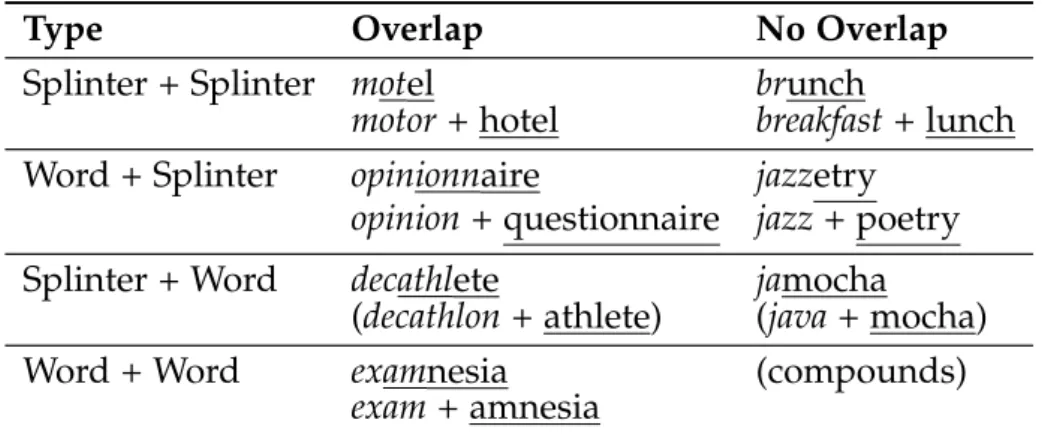
Despite its frequent use in lighthearted wordplay, lexical blending is a com-plex morphophonological process that combines elements of subtractive and concatenative morphology, shaped by competing sets of phonological and psy-cholinguistic constraints. Prototypical blends like brunch and motel contract phonological material from two source words into a single output through a combination of truncation and overlapping. In some cases, the blend’s source words are phonologically similar enough that they overlap without deleting any material. This yields blends like examnesia and kangarooster that contain both source words in their entirety. More often, one or both source words appears as a splinter, a truncated form that contains enough phonological ma-terial to identify the original source word (Lehrer 1996). Tables 1.1 and 1.2 give examples of each of the blend structures found in the literature. Although the nonlinear blends in Table 1.2 are all attested, the linear blends in Table 1.1 are by far the more common and more uniform class; they consequently form the
Type Overlap No Overlap
Splinter + Splinter motel brunch
motor+ hotel breakfast+ lunch Word + Splinter opinionnaire jazzetry
opinion+ questionnaire jazz+ poetry
Splinter + Word decathlete jamocha
(decathlon+ athlete) (java+ mocha)
Word + Word examnesia (compounds)
exam+ amnesia
Type Example
Embedded Blend adverteasement advertisement + tease Orthographic Blend sinema sin+ cinema
Three Source Words brunner breakfast+lunch+ dinner Metathesized Blends smokolotive smoke+ locomotive
Table 1.2: Nonlinear blend structures
basis of the present discussion.
The relative contributions of each source word are a key question in blend formation studies. Blends that undergo truncation do not delete material at random, but it is far from obvious what constraints determine the resulting blend’s phonological form. Some factors are phonological: phonological sim-ilarity determines how much the two source words can overlap (e.g., Gries 2004a), and source word length determines what proportion of the source word can be deleted without sacrificing the ability to decode the blend (Kau-nisto 2000). When these factors are insufficient—when two source words have no segments in common, for instance, or when they are the same length— authors look at the contributions of the left and right words (e.g., Bat-El & Co-hen 2012, Gries 2004a,b, Kubozono 1990). However, neither “left” nor “right” is a privileged position in any domain beyond blend formation.
In this thesis, I propose that blend formation should be analyzed in terms of existing positional faithfulness constraints. This theoretical goal serves two purposes: enriching our knowledge not only of blending but also of positional faithfulness. First, it contributes to our understanding of blend formation by illuminating not only the mechanics of blending but their relationship to other morphological phenomena and to the linguistics literature more broadly. Second, it demonstrates that positional faithfulness constraints are active in English despite its lack of strong positional effects outside of unstressed vowel reduction, arguing for their inclusion in the constraint set.
The remainder of this chapter provides relevant background on both
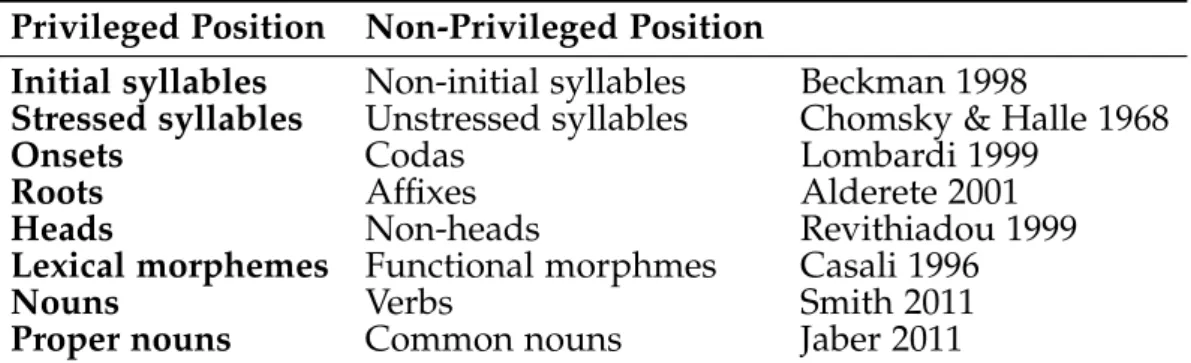
Privileged Position Non-Privileged Position
Initial syllables Non-initial syllables Beckman 1998
Stressed syllables Unstressed syllables Chomsky & Halle 1968
Onsets Codas Lombardi 1999
Roots Affixes Alderete 2001
Heads Non-heads Revithiadou 1999
Lexical morphemes Functional morphmes Casali 1996
Nouns Verbs Smith 2011
Proper nouns Common nouns Jaber 2011
Table 1.3: Privileged positions
sitional faithfulness (§1.1) and blend formation (§1.2). In the following chap-ters I argue that blending is subject to head faithfulness constraints, positional faithfulness constraints that privilege morphological heads. Chapter 2 demon-strates the effects of head faithfulness on stress placement in blends; Chapter 3 extends the analysis to blends’ segmental content. In Chapter 4 I summa-rize the head faithfulness effects observed and present suggestions for further research.
1.1
Positional Faithfulness
Positional faithfulness theory states that phonetically and psycholinguisti-cally prominent positions are privileged over less prominent positions and consequently are subject to more stringent faithfulness requirements (e.g., Alderete 2001, Beckman 1998, Lombardi 1999). This insight, formalized in Optimality Theory as part of faithfulness constraint schemata that target par-ticular privileged positions, facilitates a unified analysis of a variety of phe-nomena in a wide range of languages. Some of these positions are listed with their non-privileged counterparts in Table 1.3.
1998). Morphologically privileged positions—heads (Revithiadou 1999, Roon 2006), roots (Alderete 2001, McCarthy & Prince 1995), and privileged lexi-cal categories (Casali 1996, Jaber 2011, Smith 2011)—are more relevant to the present study. In particular, Revithiadou (1999) demonstrates that morpho-logical heads are privileged over non-heads in Greek and Russian stress as-signment. In these languages, both roots and suffixes can carry lexical accent, realized as stress. In words with multiple accents, however, only the accent on the head receives stress. This is illustrated in (1), from Revithiadou’s example 10 (1999, p.180):
(1) staf´ıD-´onraisin-gen.pl
/staf´ıD- + -´on/ HeadFaith(LA) Faith(LA)
+a. staf´ıDon *
b.stafiD´on *! *
For Revithiadou, roots are heads of words that have inflection only; deriva-tional affixes, when present, are heads by virtue of determining the word’s syntactic and semantic features. When an accented derivational affix is present, it receives stress even when attached to an accented root:
(2) a. papaG´al-osparrot-nom.sg
b. papaGal-´ak-uparrot-dim-gen.sg
Alderete (2001), in contrast, examines lexical accent in terms of root rather than head faithfulness, identifying root faithfulness effects in Cupeño, Rus-sian, and Japanese. Roon (2006) notes that root faithfulness is uninformative when confronted with words like compounds, composed of multiple roots. Nevertheless, he applies both Revithiadou’s and Alderete’s accounts to com-pound stress in Russian, finding that head faithfulness to the surface form of the words in a compound correctly predicts the compound stress data. This
is the approach taken in this thesis: while applying Revithiadou’s head faith-fulness proposal to English blend formation, I assume that the input to which blends are faithful is the surface, not underlying, representation of their source words.
Other morphologically privileged positions are not directly addressed here, though they are certainly germane to the exploration of positional faithfulness in blend formation. Given the head faithfulness effects outlined in subsequent chapters, it is not unreasonable to look for blends that display faithfulness to nouns over verbs (Smith 2001, 2011)1 or to proper nouns over common nouns (Jaber 2011), and indeed the methods used here could easily be adapted for such an investigation.2 The majority of the phenomena influenced by these morphological positions are prosodic, with effects appearing in phenomena such as stress and accent placement, tone, and syllable structure (Smith 2011). This need not always be the case, though, as Chapter 3 demonstrates head faithfulness effects in determining a blend’s segmental content in addition to the head-faithful stress placement presented in Chapter 2.
Although recognized positional effects in English are limited to unstressed vowel reduction, the universality of the constraint set predicts that positional faithfulness constraints are present in English as well. This thesis presents ev-idence that head faithfulness is an active pressure in lexical blend formation, demonstrating that English does display faithfulness to morphological posi-tions and offering a new phenomenon through which to explore other aspects of PF theory.
1Many cases of noun privilege are augmentation processes—that is, positional markedness, not positional faithfulness. However, if nouns are indeed privileged, we would expect them to be valid targets of positional faithfulness constraints as well.
1.2
Blend Formation
Recent work on blends falls into two major lines of inquiry: the mechanics of blend formation and the relationship between blending and other mor-phological processes like compounding and abbreviation. The present study addresses both of these. First, it demonstrates that head faithfulness accounts for both the corpus data and the experimental results more accurately than existing accounts that rely on the source words’ linear order. Second, it identi-fies two clear but previously unnoted distinctions between blending and com-pounding.
A blend’s phonological form is determined in part by purely phonological considerations; both stress placement and segmental content are influenced, for example, by the relative length of the two source words. Blends tend to take their stress from the longer source word, measured in number of syl-lables, (e.g., Bat-El & Cohen 2012, Cannon 1986, Gries 2004a,b) but retain a larger percentage of the shorter word’s segments so that listeners can identify the words used to form the blend (Gries 2004a,b, Kaunisto 2000). When the two source words are the same length, these studies look at what material typically comes from the left word and what typically comes from the right. In these cases, blends frequently preserve the stress of the right-hand word (Bat-El 2006, Bat-El & Cohen 2012, Gries 2004a,b), even when its stressed seg-ments have been deleted (Arndt-Lappe & Plag 2012); the right word also seems to contribute a larger percent of its segments (Gries 2004a,b). Because most blends are right-headed (Kubozono 1990), these effects are plausible under a head faithfulness account as well. However, there are a substantial number of non-headed blends, and even a few that are left-headed, so the two analyses make testably different predictions in many cases; chapters 2 and 3 present evidence that head faithfulness, not linear order, makes predictions consistent with the facts of blending.
The relationship between blending and other morphological processes is also not obvious. Most authors agree that blending is a distinct process from derivation with bound morphemes (e.g., Algeo 1977, Frath 2005, Lehrer 2007), so forms like meritocracy, for example, are more aptly analyzed as merit + -ocracy than as a blend of merit and aristocracy. However, it is often difficult to distinguish between the two. The truncated portions of words (“splinters”) that make up blends may be full morphemes (Algeo 1977) or not (Lehrer 2007), and those that are not morphemic may become so if they are used frequently (Frath 2005, Hamans 2010, Lehrer 2007). Examples using these morphologized splinters are listed in (3) below; while the earliest of these forms may be blends, those coined later are likely derived rather than blended.
(3) Splinters morphologized through frequent blending3
a. (Water)-gate
Monicagate
Fajitagate
Benghazigate
b. (alco)-(a)holic
workaholic
shopaholic
controlaholic
c. Mc-(Donald’s) McMuffin
McJobs
McGarbage
Many authors claim that blends are morphologically compounds that have been phonologically reduced. Arcodia & Montermini (2012), for example, find that blending in Russian and Chinese strongly resembles compounding, based on the strong phonological regularities exhibited by the two processes. However, all of the blends they consider contain two left splinters (i.e., the be-ginning of both source words) where typical blends contain a left splinter and a right splinter (i.e., the beginning of the first word and the end of the second). Arcodia & Montermini’s examples are analogous to the English examples in (4):
(4) a. agitprop: agitation+ propaganda
b. sitcom: situational+ comedy
In English, these reduced compounds behave differently from typical blends: they do not overlap their source words, and they follow the compound stress rule (Chomsky & Halle 1968, Liberman & Prince 1977) rather than blend stress assignment (see section 2.4.3 for more discussion). Consequently, many au-thors either background them (e.g., Lehrer 2007) or exclude them entirely (e.g., Bat-El 2006, Bat-El & Cohen 2012). Plag (2003) and Mattiello (2013) adopt a semantic criterion that effectively considers all headed blends to be reduced compounds by stipulating that a blend has an “autonomous sense which is entirely retained in the final form” where reduced compounds display “a composite meaning, often of the type determinant-determinatum” (Mattiello 2013). Nearly all explicit definitions of blending still refer to it as a type of compounding (e.g., Bat-El 2006, Lehrer 2007).
Very few studies have investigated blends’ morphological structure, and those that have consider a limited subset of blend types. Kelly (1998) ac-knowledges that blends, like compounds, can be headed or non-headed; his analysis extends patterns of conjunct ordering to blend source word order, and so he considers only coordinating blends. Kubozono (1990), on the other hand, looks specifically at headed blends to find that they, like English compounds, are always right-headed. As mentioned above, however, this generalization does not hold in a larger dataset: while the majority of headed blends are indeed right-headed, section 2.4 presents a set of left-headed blends, with a reading not available to the equivalent compound. This, along with the stress facts presented in Chapter 2, argues that blending is not simply a form of com-pounding with truncation, despite the assumptions in much of the literature.
1.3
A Note on Representations
There are two key aspects of blend representation that require clarification: headedness and stress assignment. Throughout this thesis, I determine head-edness morphologically where possible; when a blend’s source words belong to different parts of speech, the source word that determines the blend’s lex-ical category is considered the head. Thus a blend like gawkward (‘awkward or stupid’, from gawk + awkward) is right-headed because its morphological behavior is dictated by its right source word, while a blend likehomonymble (‘a clever pun that plays on distinct meanings of the same word’, from homonym
+ nimble) shares the lexical category of its left source word and is conse-quently left-headed. Most blends, however, are blends of two nouns and can-not be classified in this manner. In these cases, head is a semantic matter: a
cafetorium is both a cafeteria and an auditorium and is therefore non-headed, but a goditorium (slang term for a church) is right-headed because it is only an auditorium and not typically agod.
In analyzing stress assignment, previous studies have employed a narrow standard to determine whether a blend has the same pattern as its source words: a blend’s stress matches a source word’s when the two words have the same number of syllables, with stress on the same syllable in both (Bat-El & Cohen 2012, Gries 2004b). To maximize the similarity observed between blends and their source words, I follow these analyses in treating stress as a suprasegmental feature, but I assume that is matched by alignment rather than by identity. Many blends consist of a monosyllable superimposed on the stressed syllable of the longer source word, like bellcony (bell + balcony,
under-states the degree of similarity between the blends and their source words, so I consider stress abstracted away from the segments that host it.
The rationale for implementing stress matching as alignment is similar. Re-quiring identical stress patterns means that blends like the three above would match only the second word; the first has only one syllable, while the blend is trisyllabic, so the two are not identical. Although in these cases it suffices to say that both words have initial stress, other blends demonstrate that the stress of second source word should be compared in terms of distance from the end. A clear example is abhorrible, which preserves both words in their entirety, without moving, deleting, or reducing the stress in either word. Comparing the entire stress pattern of the blend to that of the source words misses this fact and categorizes abhorrible as deleting both source words’ stress. Comparing both source word patterns from the left edge of the blend’s similarly ignores the commonality between the second source word and the blend. The most informative comparison notes that both abhor and abhorrible have stress on the second syllable, while abhorrible and horrible both have antepenultimate stress. Accordingly, in the analyses that follow, I identify which source word stresses appear in the blend by aligning the left source word from the left edge and the right source word from the right edge.4
The remainder of the thesis presents evidence that blending is not com-pounding and that it is subject to independently motivated positional faithful-ness constraints, in the form of head faithfulfaithful-ness. Chapter 2 uses stress place-ment to argue both in favor of positional faithfulness and against the conflation of blending and compounding by comparing the predictions of Revithiadou’s (1999) head faith analysis of lexical accent, Bat-El & Cohen’s (2012) model of blend stress, and the Compound Stress Rule (e.g., Chomsky & Halle 1968,
4Not coincidentally, this also reflects the segmental properties of these blends, which pre-serve a left-aligned substring of the left source word and a right-aligned substring of the right source word.
CHAPTER 2
STRESS PLACEMENT
Because existing head faithfulness accounts address the placement of lexi-cal accent (Revithiadou 1999, Roon 2006), I begin by examining the role of head faithfulness in determining blend stress. Recall that existing analyses of stress placement in blends consider both the source words’ length and their linear order to determine which source word’s stress will appear in the blend (Bat-El & Cohen 2012, Gries 2004a). In this chapter, I demonstrate through both cor-pus and experimental data that a blend’s phonological form is also affected by its morphological headedness. Section 2.1 outlines the predictions of three different stress assignment theories: positional faithfulness, linear order, and compound stress. Section 2.2 describes the corpus analysis, and section 2.3 presents the experimental results. Section 2.4 summarizes the findings from the preceding sections and discusses their theoretical implications.
2.1
Predictions
com-pounding. I predict that head faithfulness affects blend stress both in the cor-pus and in experimental data, while compound stress affects only the group of sitcom-type “blends” composed of two left splinters. If head faithfulness affects stress assignment, then the previously observed linear order effects are likely derived from a combination of length and head faithfulness.
2.1.1
Head faithfulness predictions
Revithiadou’s (1999) head faithfulness account of lexical accent applies straightforwardly to blends: when one of the two source words functions as the head of a blend, the blend should preserve that word’s source pattern. This is enforced by the constraints in (5):1
(5) Lexical Accent Constraints: Head Faithfulness
a. Max(stress): assign a violation for every stress in the input that does not have an output correspondent
b. Max(stress)Head: assign a violation for every stress in an input head that does not have an output correspondent
c. Ident(stress): assign a violation for every primary stress in the input whose output correspondent is a secondary stress
d. Ident(stress)Head: assign a violation for every primary stress in an input head whose output correspondent is a secondary stress
The Max(stress) constraints penalize blends that delete either source word’s stress outright; the Ident(stress) constraints penalize those that demote a source word’s primary stress to a secondary stress. For space, throughout this
section I use the combined constraints Faith(stress) and Faith(stress)Head to penalize any change in stress between input and output:
(6) Combined Lexical Accent Constraints: Head Faithfulness
a. Faith(stress): assign a violation for every primary stress in the input that does not have an output correspondent with primary stress
b. Faith(stress)
Head: assign a violation for every primary stress in
an input head that does not have an output correspondent with primary stress
Note that a violation of Faith(stress)Headentails a violation of Faith(stress) and that a blend can only violate Faith(stress) once per source word. Conse-quently, in blends with two source words, Faith(stress)
Head will either assign
no violations, fail to apply, or break a tie between candidates that each violate Faith(stress) once. Blends with two source words simply do not provide a means to rank the two.2 Blends with more than two source words are, how-ever, exceedingly rare and are not included in any of the present analyses; therefore the inclusion of head faithfulness constraints is sufficient, regardless of the ranking between general and head faithfulness.
In blends that preserve both stresses, of course, neither constraint assigns violations to the winning candidate. In headed blends, when one source word’s stress is deleted, Faith(stress)
Head eliminates the candidate that
pre-serves non-head rather than head stress:
2 Given an appropriate blend with three source words, it would be possible to devise sce-narios that do provide a ranking argument; for example:
σ´σσ+σ´σ+σσσ´ head Faith(stress)Head Faith(stress)
a.σσσ´ * *
b.σσσ´ **
(7) σσ´ +σσ´head Faith(stress)Head Faith(stress)
+ a. σσ´ *
b.´σσ *! *
In non-headed blends, Faith(stress)Head assigns no violations even when the blend deletes stress, leaving Faith(stress) to distinguish between them. However, when the two source words have conflicting stress patterns, Faith(stress) assigns one violation to each candidate:
(8) σσ´ +σσ´ Faith(stress)
Head Faith(stress)
+ a. σσ´ *
+ b.´σσ *
In non-headed blends, then, head faithfulness predicts stress assignment according to default stress rules. Alternately, the failure of head faithfulness to distinguish between the two may indicate that non-headed blends should display more variation than headed blends do.
2.1.2
Linear order predictions
In a linear order account, like that of Bat-El & Cohen (2012), the second source word should contribute its stress to the blend whenever length differ-ences between source words do not dictate left stress. The appropriate com-bined constraints are listed in (9); as before, each of these includes the relevant Max(stress) and Ident(stress) constraints.
(9) Lexical Accent Constraints: Linear Order (Bat-El & Cohen 2012)
b. Faith(stress)-R: assign a violation for every primary stress in the right source word that does not have a primary-stressed correspon-dent in the blend
c. Ranking: Faith(stress)-R≫Faith(stress)-L
Because left and right are the only positions referenced by these constraints, this predicts the same blend regardless of morphological context. For right-headed blends, linear order makes the same predictions as the head faith-fulness analysis: the blend will exhibit the right-hand source word’s stress pattern, at the expense of the left word stress if necessary:
(10) σσ´ +σσ´head Faith(stress)-R Faith(stress)-L
+ a. σσ´ *
b.´σσ *!
In the linear order analysis, however, this has nothing to do with the right word’s status as head. Non-headed blends are also predicted to show right-stress:
(11) σσ´ +σσ´ Faith(stress)-R Faith(stress)-L
+ a. σσ´ *
b.´σσ *!
This does not allow for variation, instead predicting a single output for every blend. It predicts that blends should follow the left word’s stress only when the left word is longer, and that all blends should pattern together re-gardless of their morphological structure.
2.1.3
Compound stress predictions
Stress in compounds usually falls on the left element (e.g., Chomsky & Halle 1968, Cinque 1993, Liberman & Prince 1977). This is especially true of headed compounds; non-headed compounds, like sìnger-sóngwriter, have a greater tendency to be right-stressed than headed compounds like bláckbìrd
do (Plag 2006). Accordingly, the compound stress rule could apply in a weak version or a strong version:
(12) Compound Stress Rule
a. Strong CSR: assign a violation for every compound without pri-mary stress on the left word
b. Weak CSR: assign a violation for every headed compound without primary stress on the left word
Liberman & Prince (1977) and those following them integrate the Com-pound Stress Rule and the Nuclear Stress Rule governing stress placement in phrases by noting that the right-hand element of a phrase or compound is stressed iff it branches. This characterization is substantially harder to apply to blends: if the constraints assigned violations to blends that placed stress on the second source word, it is unclear whether this would penalize blends that preserve the stress of both source words, or whose stressed syllable contains segments from both source words. Here I use the versions in (12); if a more theoretically sound formulation penalizes full prosodic faithfulness to both source words, that fact provides more evidence that the CSR is either ranked below the relevant faithfulness constraints or not relevant to blending.
In most cases, these formulations of the CSR serve as inverses of the linear order and head faithfulness analyses, respectively.3 In a strong CSR analysis,
blends should be left-stressed regardless of their morphological structure. As long as the stressed syllable of the left word is not deleted, it assigns exactly the same violations as Faith(stress)-L, which reverses the predictions of the linear order analysis:
(13) σσ´ +σσ´ S-CSR Faith(stress)
a. σσ´ * *
+ b.´σσ *
A weak CSR analysis, on the other hand, predicts stress on the first source word when the blend is headed ((14a)), with no prediction when it is not ((14b)). This is a theoretically strange constraint, acting as a positional marked-ness constraint that reduces rather than augments the target position. This inverts the head faithfulness predictions by demanding that heads not be stressed:
(14) a. Headed blends
´
σσ+ σσ´head W-CSR Faith(stress)
a. σ´σ *! *
+ b.σσ´ *
b. Non-headed blends
´
σσ+ σσ´ W-CSR Faith(stress)
+ a. σ´σ *
+ b.σσ´ *
Both the weak and strong forms of the CSR predict a large proportion of blends with left stress, among right-headed blends under the weak version and in all blends according to the strong version. This depends, however,
would predict the same form. This is far from a typical case, however, as it does not occur at all within my corpus.
not only on the CSR itself but on its applicability to blends. A lack of CSR effects criticizes not the CSR itself but its relevance in blending; failure to con-form to these predictions likely indicates that blends are not morphologically compounds, and therefore the CSR does not apply at all.
2.2
Stress Placement in Attested Blends
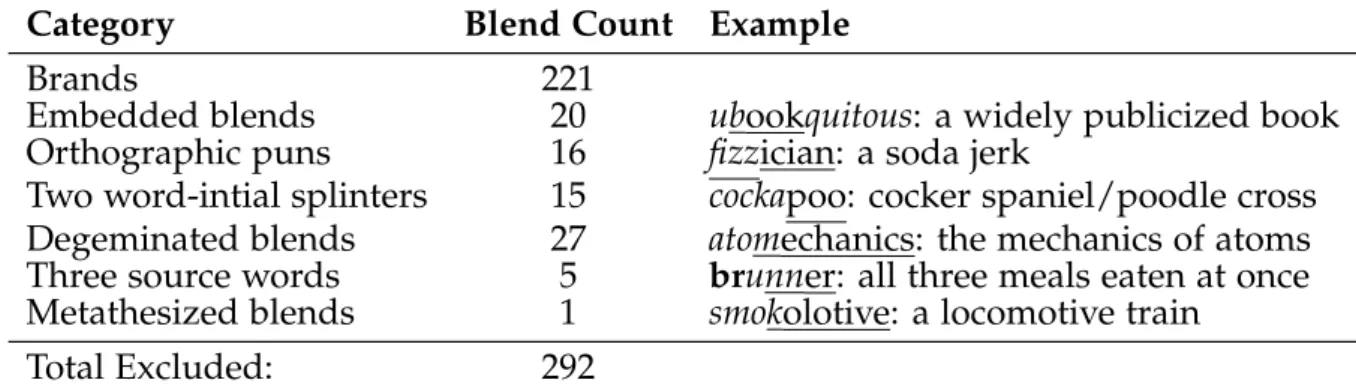
Category Blend Count Example
Brands 221
Embedded blends 20 ubookquitous: a widely publicized book
Orthographic puns 16 fizzician: a soda jerk
Two word-intial splinters 15 cockapoo: cocker spaniel/poodle cross
Degeminated blends 27 atomechanics: the mechanics of atoms
Three source words 5 brunner: all three meals eaten at once Metathesized blends 1 smokolotive: a locomotive train
Total Excluded: 292
Table 2.1: Blend categories excluded from corpus analysis
Some brand names also belong to other excluded categories, so the total excluded is less than the sum of each category.
Thurner’s (1993) dictionary does not indicate pronunciations; where possi-ble, pronunciations were taken from an existing dictionary, typically the CMU Pronouncing Dictionary (CMUdict 1998), the online edition of the OEDOnline (2012), or the online edition of Merriam-Webster.com (2011). Many of the blends were not listed in dictionaries, however, so I and another linguistically trained native English speaker, who was not aware of the experimental hy-pothesis, provided phonetic transcriptions of our pronunciations. These tran-scriptions disagreed in just 38 cases; for these, 2-4 linguistically naive English speakers were asked to read the blend, and the consensus pronunciation was added to the corpus. Of particular interest, 17 of these disagreements were about the stress placement in right-headed blends whose left source word is longer, like geriatrickster or ubiquinone; in 12 of those cases, most speakers pronounced the blend with head stress.
Section 2.2.1 looks at the subcorpus of blends whose source words are the same length, in number of syllables; section 2.2.2 turns to an analysis of the full corpus.
Right-headed Non-headed Left-headed Total
Preserves both 59 129 7 191
Preserves right 59 22 0 81
Preserves left 4 2 0 6
Total 122 149 7 278
Table 2.2: Length-controlled blends by head and stress preservation
2.2.1
Blends with equal length source words
Because longer source words are known to contribute their stress to blends (Bat-El & Cohen 2012, Gries 2004a,b), I look first at only the subset of blends whose source words have the same syllabic length. This subcorpus contains just 278 blends, 191 of which preserve both source words’ primary stress. While this is not a sufficiently large sample for statistically significant con-clusions, examining the numerical results provides a useful example of the patterns seen in the full corpus, without the confounding influence of length. To that end, table 2.2 summarizes the number of blends in each stress and headedness category.
This subcorpus, perhaps surprisingly, includes six left-headed blends. These are blends like smealth, a person’ssmellused as a determinant of their health, and tamboo, a tambour made of bamboo. Five of the six preserve both source words’ stress. The sixth, támboo, preserves the stress of its head, although in dialects that forestress nouns like bamboo, both words’ stresses are preserved here as well. At any rate, there are few enough examples of this category that they are not significant in any analysis, though I discuss them in §2.4 and provide a full list in Appendix A.
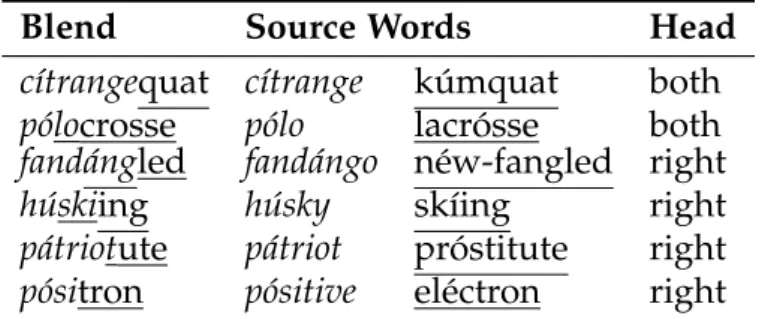
Blend Source Words Head
cítrangequat cítrange kúmquat both
pólocrosse pólo lacrósse both
fandángled fandángo néw-fangled right
húskiing húsky skíing right
pátriotute pátriot próstitute right
pósitron pósitive eléctron right
Table 2.3: Left-stressed blends
also very few blends that preserve only the stress of the left source word: six in this subcorpus, listed in Table 2.3. The fact that so few the blends that dis-play a stress conflict preserve the left word’s stress argues strongly that the compound stress rule is irrelevant in determining blend stress placement.
It does not, however, support the linear order hypothesis over the head faithfulness hypothesis. While most of these blends that preserve only one stress do preserve that of the right word, there is a striking difference across headedness categories in the percentage of blends that preserve both source word stresses: 84% of non-headed blends preserve both stresses (126 of 150), compared to just 48.3% of right-headed blends (59 of 122). According to a two-sample test of proportions conducted in R, this difference is highly significant (χ2=39.3, p<0.0001), which suggests that headedness affects blend formation in even more ways than hypothesized.
2.2.2
Full corpus analysis
The same difference can be found in the full corpus: 261 of 392 non-headed blends (66.6%) have the primary stress of both source words, which is true of only 338 of 707 right-headed blends (47.8%). The difference is again highly sig-nificant (χ2 = 35.84, p<0.0001). Unlike the subcorpus of the previous section, the full corpus also shows a significant difference in blends with conflicting input stress. 78.9% of right-headed blends that preserve only one source word
Right-headed Non-headed Left-headed Total
Preserves both 338 261 15 614
Preserves right 291 87 3 381
Preserves left 78 44 3 125
Total 707 392 21 1120
Table 2.4: All blends by head and stress preservation
Indicator β z p
Length difference 0.90 9.024 <0.001 *** Right-headed 0.71 2.828 0.005 **
Table 2.5: Logistic regression coefficients: Stress placement Significance Levels: 0.05: * 0.01: ** 0.001: ***
stress preserve the right word’s, compared with 66.4% of non-headed blends (χ2 = 8.12, p=0.004). Table 2.4 provides a breakdown of the full corpus by stress and head.
When analyzing blends whose source words differ in length, it is impor-tant to consider length effects as well. Each blend was coded with the length difference between its left and right source word, measured as the number of syllables in the left source word subtracted from the number of syllables in the right. This value ranged from -3 in acceleread (from accelerate + read) to 5 in
Eurosclerosis (from Europe + arteriosclerosis). A two-indicator logistic regres-sion on the blends that preserve only once source word’s stress, performed with R’s GLM procedure, found significant effects of both length and head-edness in determining whether a blend preserved the stress of the right-hand source word. Table 2.5 summarizes the logistic regression results.
present an experiment designed to probe the relationship between headedness and stress placement more directly.
2.3
Stress Placement in Novel Blends
The experiment tested whether participants inferred morphological struc-ture from a novel blend’s phonological strucstruc-ture through a definition match-ing task. Participants were presented with a pair of novel blends, identical except in which source word’s stress the blend preserves, and asked to map them to a pair of definitions. Each definition pair contained one subordinating (right-headed) definition and one coordinating (non-headed) definition, and participants were forced to assign one blend to each definition. Because the experiment included only right- and non-headed blends, participants using head faithfulness match the subordinating definition with the blend that pre-serves right word stress. If linear order were the only active principle in blend stress placement, subjects should prefer the right-preserving blend for both definitions, leading to chance performance, with about half of their judgments following the head faithfulness predictions and half in opposition; instead, the results fit the predicted head faithfulness pattern.
Section 2.3.1 outlines the experimental methods; section 2.3.2 presents the results.
2.3.1
Methodology
Stimulus Creation
The stimulus blends were all created from disyllabic noun pairs, where the left word has initial stress and the right has final stress. The two blends in each pair were segmentally identical (aside from the effects of vowel reduc-tion), with one blend preserving the trochaic stress of the first word and one following the iambic stress of the right. To ensure that the blends had a single optimal segmental form, I selected pairs with a shared consonant between the two syllables’ nuclei to reduce the number of plausible segmental blends.
I selected eight of these pairs as test items based on the pronunciations in the CMU Pronouncing Dictionary (CMUdict, syllabified by Bartlett et al. 2009). To limit the search space, I considered only the words found in both CMUdict and CELEX (Baayen et al. 1995), which removed most of the proper nouns found in CMUdict. This produced a list of 36,216 words, from which I identified 2,600,363 word pairs that matched the phonological criteria out-lined above. For simplicity, I removed all pairs that consisted of another pair on the list plus affixes: because cookie bouquet was included, for example,
cookies bouquet,cookie bouquets, and cookiesbouquetswere all excluded. This reduced the list to 704,652 pairs.
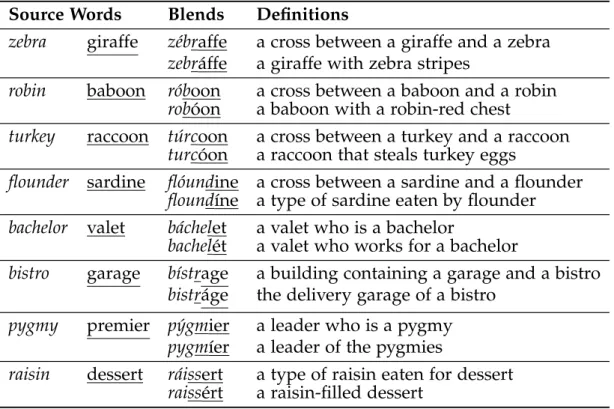
From these, I selected 12 noun-noun pairs with plausible coordinating and subordinating definitions. After pilot testing, I discarded two pairs that were subject to southern stress retraction4 and two that pilot subjects found diffi-cult to intepret correctly in both coordinating and subordinating contexts. I recorded myself5 reading each blend in the remaining eight test pairs in a
4Words likepolicethat are pronounced with final stress in standard American English but with initial stress in some southern dialects
Source Words Blends Definitions
zebra giraffe zébraffe a cross between a giraffe and a zebra
zebráffe a giraffe with zebra stripes
robin baboon róboon a cross between a baboon and a robin
robóon a baboon with a robin-red chest
turkey raccoon túrcoon a cross between a turkey and a raccoon
turcóon a raccoon that steals turkey eggs
flounder sardine flóundine a cross between a sardine and a flounder
floundíne a type of sardine eaten by flounder
bachelor valet báchelet a valet who is a bachelor
bachelét a valet who works for a bachelor
bistro garage bístrage a building containing a garage and a bistro
bistráge the delivery garage of a bistro
pygmy premier pýgmier a leader who is a pygmy
pygmíer a leader of the pygmies
raisin dessert ráissert a type of raisin eaten for dessert
raissért a raisin-filled dessert
Table 2.6: Stress placement experiment stimuli
soundproof booth using a Windows 7 PC, a headset mic, and the Audacity audio editing program with a sampling rate of 44100Hz. To maximize the nat-uralness of each token while maintaining similarity between the recordings for each pair, I recorded 8-12 audio tokens of each blend and eliminated those that linguistically naïve native speakers of English judged to be unnatural. I measured the duration and the pitch difference between syllables in each re-maining token and selected the tokens for each pair whose duration and pitch difference were the most similar. These I concatenated in both orders, with 0.5s of silence on either side of each token. Table 2.6 lists the eight pairs used in the experiment.
Survey Administration
The experiment was administered as an anonymous online survey using LimeSurvey v1.92+. It consisted of four sections: demographics, instructions and example, the test items, and a post-questionnaire. The demographics
cluded basic questions about age, sex, education level, native language and dialect, and familiarity with other languages, plus a question about participa-tion in the segment retenparticipa-tion experiment described in secparticipa-tion 3.3. The example asked subjects to select the correct definitions for ínsult and insúlt. This was intended to familiarize them with the survey interface, with the use of or-thographic stress marking, and with stress as a contrastive feature; because it used real words rather than novel, it included only the orthographic stress marking and no accompanying audio.
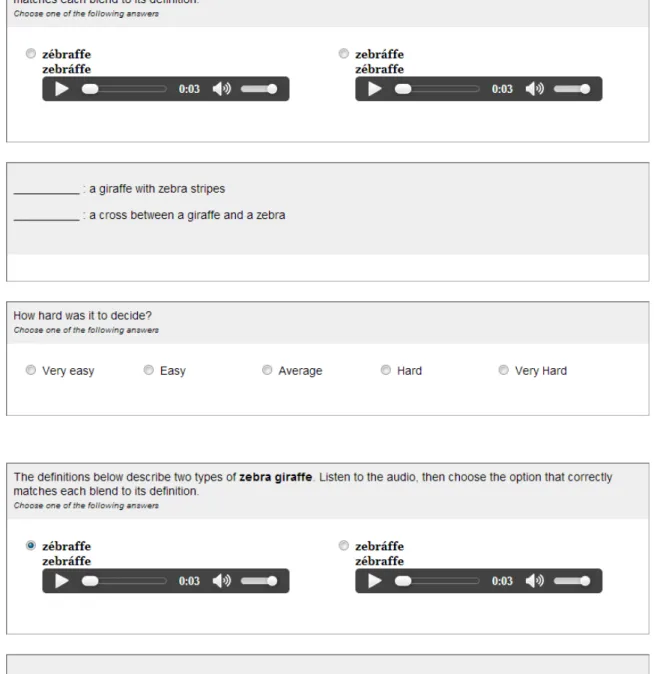
Figure 2.1 shows a typical trial. The question text presented the pair of words to be blended, written as a compound. The two blends were listed be-low, once with the initial-stressed blend first and once with the final-stressed blend first, with accompanying audio; the definitions appeared below the blends. Subjects used radio buttons to assign each blend to a definition and to assign the question a difficulty rating from “Very Easy” (1) to “Very Hard” (5).
There were four permutations of each question, depending on which blend and which definition were presented first. Each subject was randomly as-signed to one of four groups to determine which version of each question they answered; all subjects received two questions of each order type. After all eight test items, subjects answered a post-questionnaire about the strategy they employed; whether they made their judgments based on the audio, the orthography, or both; and which pairs they found hardest.
Participants
Figure 2.1: A typical trial: Stress placement before (top) and after (bottom) answer selection
36.3, S.D. = 14.83), with 30 female and 13 male respondents. One participant was a native English/Spanish bilingual; all others were monolingual Amer-ican English speakers. Seventeen reported themselves as southern or south-eastern dialect speakers, while three more said they speak a standard dialect with “some southern influence.” Thirteen participants answered the example incorrectly; however, I retained their data, as there was no observable differ-ence between their performance and that of the participants who correctly answered the example question (p=0.22 on a two-sample means comparison). Further, the 13 who answered incorrectly all reported relying primarily on the audio for their test item judgments, while the example was the one question without an accompanying recording.
2.3.2
Results
The experiment results clearly support the head faithfulness hypothesis: in 65.8% of the 344 individual trials, participants paired the right-stressed blend with the right-headed definition as predicted. This is significantly above chance (t[294] = 4.77, p<0.001) according to a generalized linear mixed model with subject as a random effect.6 Six of the eight word pairs also had head faith rates significantly above chance, as detailed in Table 2.7. Neither robinbaboon nor bachelor valet reached significance, although both had a mean predicted response rate of more than 50%. This corresponds neatly with participants’ responses to the post-questionnaire: eight subjects commented that the two
robin baboon blend tokens sounded similar, and fifteen remarked that they foundbachelorvalet especially difficult. Despite these comments, robinbaboon had the lowest average difficulty rating, and overall, an item’s average diffi-culty rating did not correlate with the rate of head faithful definition mapping.
Pair % Head Faithful t p
bistro garage 74.7 3.01 0.002
turkey raccoon 70.0 2.48 0.008
raisin dessert 67.7 2.20 0.02
zebra giraffe 65.4 1.92 0.03
flounder sardine 65.4 1.92 0.03
pygmy premier 63.0 1.63 0.05
robin baboon 60.6 1.34 0.09
bachelor valet 58.3 1.04 0.15
Overall 65.8 4.77 <0.001
Table 2.7: Stress placement results by item
Based on the comments in the post-questionnaire, I conclude that these two pairs received the fewest head faithful responses because they were the hard-est for participants to distinguish, interfering with participants’ ability to form consistent definition mappings.
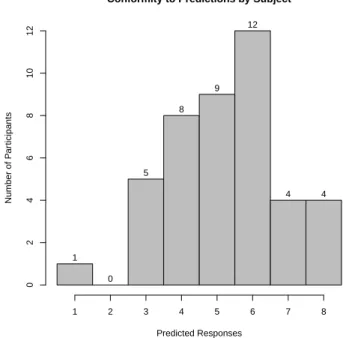
Twenty-nine subjects answered more than half of the questions as pre-dicted by head faithfulness. Eight answered exactly half as prepre-dicted, and six answered fewer than half head-faithfully. Figure 2.2 gives the number of subjects who answered each number of questions as predicted. There was no significant variation between subjects, nor was there any correlation with any of the demographic information collected.
Because there were no filler items, it is possible that this was a conscious strategy rather than a genuine headedness effect. However, only nine par-ticipants reported using a strategy related to headedness. Nearly half – 20 subjects out of 43 – reported that they based their judgments on intuition or aesthetics; eight either did not have or did not report a strategy. A further six reported a strategy, but without enough detail to classify it: four simply responded “Yes,” while two responded more thoroughly but too vaguely to be informative. Further, not all respondents who claimed to match definitions to the blend that stressed the “dominant” or “most important” word did so consistently, making it even less likely that these results are merely due to an
Conformity to Predictions by Subject
Predicted Responses
Number of P
ar
ticipants
0
2
4
6
8
10
12
1 0
5 8
9 12
4 4
1 2 3 4 5 6 7 8
Figure 2.2: Stress placement results by subject
experiment strategy.
2.4
Discussion
2.4.1
Headedness as a determinant of blend structure
Both experimental and corpus results clearly show that head faithfulness affects stress placement in blends. Although phonological factors such as length and the availability of overlap have a greater influence on stress place-ment, a multiple regression analysis confirms that whether a blend is right-headed serves as a significant predictor of whether it will preserve its second source word’s primary stress. This effect is strong enough that it appears even in the proportions of right- and non-headed blends that preserve right stress only, with significantly higher right stress retention in right-headed blends. This matches the head faithfulness predictions but is not explained by either the linear order or compound stress hypotheses.
Another, more unexpected, piece of evidence for head faith in the cor-pus is in the drastically higher proportion of non-headed blends than right-headed blends that preserve both source word stresses: 80% of non-right-headed blends in the subcorpus from section 2.2.1, compared to just 46% of right-headed blends from the same subcorpus. The difference is smaller (66.6% v. 47.8%), but still significant, with the length factors introduced in the full corpus. Preserving both stresses avoids violations of both the positional and general faithfulness constraints, and so both types of blends should preserve both source words’ stress when possible. The significant asymmetry between right- and non-headed blends suggests that a blend’s morphological structure affects its phonological form even when headedness does not directly deter-mine the optimal candidate. One way to model this asymmetry would be to allow non-headed blends to re-order their source words to maximize overlap. This could be implemented by not specifying an order for non-headed blend-sor by including a low-ranked constraint against source word metathesis. Both the existence and the rarity of left-headed blends support this analysis. How-ever, if headed and non-headed blends both undergo this metathesis but at
significantly different rates, it clearly requires a careful implementation.
The experiment results indicate that speakers also use head faithfulness to interpret novel blends. Participants matched the blend that preserved more of the right source word to the right-headed definition in nearly two-thirds of the trials, significantly more than the chance performance predicted if lin-ear order is the key determinant of stress placement. All of the words tested were disyllabic, and each pair had exactly one shared segment, located in the middle of both words, to use as a switch-point; the effect therefore cannot be due to length differences or to the degree or location of segmental overlap, purely phonological factors that influence stress placement in blends. Fur-ther, the fact that only one in five participants reported using headedness in their judgments, while nearly half relied on intuition or “guessing,” argues that the observed preference for head-faithful definition mappings is indeed a linguistic effect and not merely a strategy developed for the experiment.
2.4.2
Unpacking Faith(stress)
Before discussing compound stress as it (fails to) apply to blends, it is helpful to look briefly at the role of the individual constraints that I have so far combined into Faith(stress). In 331 of the 497 blends that violate Faith(stress), the violation is a result of reducing one source word’s stress, not removing it completely. In these blends, primary stress comes from one source word; the other source word’s primary stress surfaces as a secondary stress in the blend. Table 2.8 lists a few examples.
Blend Source Words
àlibiógraphy álibi + biógraphy
Ìbsénity Íbsen + obsénity
pópulùxe pópular+ delúxe
sàccharinóceros sáccharine + rhinóceros
Table 2.8: Blends with secondary stress
using the component constraints of Faith(stress):
(15) Relevant Stress Faithfulness Constraints (repeated from 5)
a. Max(stress): assign a violation for every stress in the input that does not have an output correspondent
b. Ident(stress): assign a violation for every primary stress in the input whose output correspondent is a secondary stress7
Ranking Max(stress)≫Ident(stress) produces the partial reduction pat-tern seen in the blends in Table 2.8:
(16) Partial stress reduction in different-length blends
pópular+ delúxe Max(str) Ident(str)
+a. p´opul`uxe *
b.p´opuluxe *!
(17) Partial stress reduction in same-length blends
álibi+ biógraphyhead Faith(str)head Max(str) Ident(str)
+a. `alibi´ography *
b. ´alibi`ography *! *
c. ´alibiography *(!) *(!)
d.alibi´ography *!
7Note that this differs from the Ident-Stressconstraint used in Pater 2000, which penalizes correspondents when one is stressed and the other is unstressed but does not assign violations for a primary stress that surfaces as secondary stress.
Ident(stress) also prevents the reversal of primary and secondary stresses once they have been assigned, a fact relevant to the comparison between blends and compounds in the next section.
2.4.3
Blending as distinct from compounding
Both the experimental and corpus results further support a distinction be-tween blending and compounding. Despite the predictions of the Compound Stress Rule, there are only a handful of blends that preserve just the left stress in the corpus, and none of the test pairs used in the stress placement experi-ment show a pattern consistent with either the weak or strong formulations of the CSR. The strong CSR, mandating that all compounds have left stress, incor-rectly predicted chance assignment in the experiment by virtue of predicting the same blend for both definitions. The weak CSR demands left stress only from headed blends; this is precisely the opposite of the experimental results, which instead preferentially assign right stress to headed blends, following the head faithfulness predictions outlined in section 2.1.1.
The same problem arises if we try to derive the blends used in the exper-iment from the corresponding compounds instead of forming them directly from the source words. The tableaux in (18) illustrate the process: in (18a), the compound stress rule applies tozebraand giraffe to form the compound zébra
(18) Deriving a blend from an underlying compound
a. Compound stress
zébra+ giráffehead CSR Max(stress) Ident(stress)
+ a. z´ebra gir´affe *
b.z`ebra gir´affe *! *
b. Subsequent blending
zébragiràffehead HeadFaith Max Ident
a. z`ebr´affe *! **
7 b.z´ebr`affe *
The existence of left-headed blends highlights a further difference between blends and compounds: while compounds follow the Righthand Head Rule (Williams 1981) with very few exceptions, the ordering facts mentioned in §2.4.1 suggest that word order in blends is secondary to phonological consid-erations. In light of these differences, it seems appropriate to abandon the notion that blends are a form of truncated compound and to examine the re-lationship between blending and compounding more closely. This distinction necessitates a more careful delineation of what should and should not be con-sidered a blend. For example, some authors include words like agitprop or
napalm that contain two left splinters, rather than the typical left and right, in lists of blends, when they share a much greater resemblence to compounds. These reduced compounds rarely if ever display the segmental overlap so com-mon in blends, and they invariably follow the CSR. This provides justification for excluding them from analyses of more typical blends, though a systematic investigation of their similarities to as well as their differences from more typ-ical blends would offer a more detailed view on the morphologtyp-ical status of blending.
CHAPTER 3
SEGMENTAL CONTENT
In the previous chapter, I demonstrated that head faithfulness is one of the factors that affects stress placement in English blends. Although most posi-tional faithfulness effects involving morphological positions involve prosodic phenomena (§1.1), there is no theoretical reason to stipulate that they can-not influence segmental processes. Indeed, this type of positional faithfulness seems ideally suited to determine which segments are retained or deleted in a blend; while most of the possible blends for a given word pair are pro-hibited by phonological well-formedness constraints, many pairs of source words produce more than one acceptable blend by transitioning from the first word to the second at different points. For example, blue and green can com-bine to form either bleen or breen (Arndt-Lappe & Plag 2012); Hufflepuff and Gryffindor can form Huffledor or Huffindor; alpaca and apocalypse produce both alpacalypse andalpocalypse. I argue that this variation is another mani-festation of head faithfulness, and that the phonological form of these blends reflects the morphological structure speakers assign them.
3.1
Predictions
The segmental content of a blend, much like its stress placement, is deter-mined to large degree by the relative length and potential overlap of its source words. Shorter words generally contribute proportionally more segments to a blend than long words do (Gries 2004a,b, Kaunisto 2000), while overlapping in such a way as to maximize the similarity between the blend and both source words (Gries 2004a,b) minimizes the number of segments that are deleted. However, just as these criteria are not sufficient to determine the stress place-ment of all blends, they are not always sufficient to determine segplace-mental con-tent. Not all blends have source words of the same length, and not all word pairs have a single blend that would maximize overlap. Head faithfulness and linear order offer competing explanations for which segments are deleted when phonological constraints alone do not determine the optimal blend.
3.1.1
Head faithfulness predictions
As in stress placement, head faithfulness predicts that headed blends will preserve their heads more faithfully than they preserve their other source word. This means we expect higher deletion rates in non-heads, as well as more heads than non-heads that are preserved in their entirety. Formally, Maxand Max
head, defined in (19), can be used to model these predictions.
(19) Segment retention constraints: Head faithfulness
a. Max: assign a violation for every segment in the input that does not have an output correspondent
b. Max
head: assign a violation for every segment in the input of the
head word that does not have an output correspondent
Unlike in stress placement, it is possible to violate general faithfulness more than once per source word. This makes it possible to create blends that could provide a ranking argument by identifying a source word pair that deletes either a single segment from the head or a pair of segments from the non-head. None of the blends in the corpus display an appropriate overlap to make such a ranking argument, however; nor do those used as test pairs in the segment deletion experiment. Consequently it is again enough for present purposes to include Maxhead without ranking it relative to the general Max, though future work may wish to explore this ranking further.
In the sort of blends seen in the corpus, then, where this ranking is not crucial, head faithfulness predicts that blends with a morphological head will delete segments from their non-head source word rather than from the head:
(20) /bu.tik+ tæk.sihead/ Maxhead Max
+ a. butæksi *
b.butiksi *! *
In headed blends composed of a word and a splinter, we expect the head to be the whole word, with the non-head surfacing as a splinter. Headed blends containing two splinters should preserve proportionally more of the head than of the non-head.
Head faithfulness makes no predictions for non-headed blends, leaving them to chance or to speakers’ preference:
(21) /bu.tik+ tæk.si/ Max
head Max
+ a. butæksi *
+ b.butiksi *
3.1.2
Linear order predictions
Segment deletion based on the linear order of the source words predicts that all blends preferentially preserve the same source word regardless of their morphological structure. As before, this utilizes a pair of positional faithful-ness constraints, one for each source word:
(22) Segment Retention Constraints: Linear Order
a. Max-L: assign a violation for every segment in the left source word that does not have a correspondent in the blend
b. Max-R: assign a violation for every segment in the right source word that does not have a correspondent in the blend
According to Gries (2004a,b), blends usually retain more segments from the second source word. This implies the ranking Max-R≫Max-L, shown in (23a) and (23b).
(23) a. Headed blend
/bu.tik+ tæk.sihead/ Max-R Max-L
+ a. butæksi *
b.butiksi *!
b. Non-headed blend
/bu.tik+ tæk.si/ Max-R Max-L
+ a. butæksi *
b.butiksi *!
A preponderance of left-preserving blends, from the reverse ranking Max -L ≫ Max-R, would provide equal support for the linear order hypothesis, although they would be more surprising in light of Gries’ results.
3.2
Segment retention in attested blends
This section examines the relationship between segment deletion and head-edness using the corpus described in section 2.2. The corpus contains 188 blends in which both source words surface intact and 37 more that delete the same percentage of both source words; this leaves 897 blends that are relevant to the present investigation. Section 3.2.1 describes the subcorpus of blends whose source words are the same length, while section 3.2.2 presents an anal-ysis of the full corpus.
3.2.1
Source words of equal length
When a blend’s source words are the same length, other factors—including morphological structure—play a larger role in determining the blend’s phono-logical form. Blends with same-length source words, measured in number of syllables, are therefore a promising place to look for positional faithfulness effects. Unfortunately, this is a very small subset of the full corpus. Only 82 blends have source words of the same length and delete segments from both of them. This is a sufficiently small sample size that none of the differences identified in this section are significant, but as in the stress analysis, it provides a more intuitive survey of some of the patterns seen in the corpus.
right-Right-headed Non-headed Left-headed Total
Preserves both equally 7 22 2 31
Preserves more of right 16 26 0 42
Preserves more of left 3 6 0 9
Total 26 54 2 82
Table 3.1: Length-controlled blends by head and segment retention
Right-headed Non-headed Left-headed Total
Preserves more of left 8 7 1 16
Preserves more of right 19 9 1 29
Total 27 16 2 45
Table 3.2: Length-controlled blends by head and full word retention
headed blends, the crucial comparison is in the non-headed blends’ behavior. Of the 54 non-headed blends, 22 preserve equal amounts of both source words (40.7%), while 26 preserve more of the right source word (48.1%) and six pre-serve more of the left word (11.1%). By contrast, 16 of the 26 right-headed blends preserve more of the right source word (61.5%), with seven preserv-ing their source words equally (26.9%) and three preservpreserv-ing more of the left word (15.8%). A larger percentage of right-headed blends than of non-headed blends preferentially preserves the right source word—61.5 v. 48.1—but with such a small sample size the difference is not significant (p=0.26 in a two-sample test for equality of proportions).
Looking at blends that preserve one source word fully and reduce the other (Table 3.2), we see a stronger pattern: 7 of 16 non-headed blends pre-serve the right word (43.75%), compared to 19 of 27 (70.4%) of right-headed blends. Again, the effect is not significant (p=0.08), and an analysis of all 82 blends1 reveals no main effects of head (χ2=2.01, p=0.157) or degree of reduc-tion (χ2=0.78, p=0.378), or any interaction between the two.
Still, the numerical patterns are promising for such a small data set: as in
1Performed using the GENMOD procedure in SAS
Right-headed Non-headed Left-headed Total
Preserves both 163 55 6 224
Preserves right 231 183 10 424
Preserves left 313 152 7 472
Total 707 390 23 1120
Table 3.3: All blends by head and segment retention
the analogous stress corpus, right-headed blends tend to exhibit head faithful-ness, while non-headed blends are more likely to preserve both source words equally. We also see head faithfulness protecting the word from deletion, just as predicted.
3.2.2
Full corpus
The headedness effects in the full corpus are dwarfed by the effects of source word length and segmental overlap. Table 3.3 gives the number of blends in the corpus with each head and deletion pattern, but in this case the counts alone do little to demonstrate any effect of positional faithfulness, either head faith or linear order. In all headedness categories, there is a nearly even split between blends that preserve more of the left word and blends that preserve more of the right, so a more qualitative exploration of the number of blends in each group serves little purpose.