BREASTFEEDING AMONG U.S. LATINAS: SUBGROUP ANALYSIS OF THE NATIONAL IMMUNIZATION SURVEY
Diana N. Derige
A dissertation submitted to the faculty at the University of North Carolina at Chapel Hill in partial fulfillment of the requirements for the degree of Doctor of Public Health in the Department of
Health Management and Policy in the Gillings School of Global Public Health.
Chapel Hill 2016
Approved by: Bruce Fried Vijaya K. Hogan
ABSTRACT
Diana N. Derige: Breastfeeding among U.S. Latinas: Subgroup Analysis of the National Immunization Survey
(Under the direction of Bruce Fried)
In 2011, the U.S. Surgeon General, Dr. Regina Benjamin, released the Call to Action to Support Breastfeeding (Call to Action). The Call to Action documents the positive maternal and infant health impacts associated with breastfeeding, and recommends a series of steps aimed at increasing breastfeeding initiation and duration in the United States. While Latino women currently have the highest breastfeeding initiation and duration rates in the United States1, little investigation has been conducted to understand differences in breastfeeding practices among Latina subgroups.
Using secondary data from the National Immunization Survey 2011-2013, this study sought to:
1. To examine differences in breastfeeding behaviors (initiation and optimal breastfeeding) among U.S. Latino women subgroups using a national sample.
2. To explore the intervening factors associated (acculturation, education, income and WIC participation) with breastfeeding behaviors (initiation and optimal breastfeeding) among U.S. Latino women.
3. To develop a plan to inform public health policy makers and advocates on U.S. Latino breastfeeding behavior and its implication.
likelihood of breastfeeding when all other variables were controlled. Non-Hispanic/Latina mothers were less likely to breastfeed than all other groups except Puerto Rican mothers. Mexicano mothers were more likely to breastfeed than Mexican American or Puerto Rican mothers. Puerto Rican mothers were less likely to breastfeed than Central American, South American, and Spanish Caribbean mothers.
With regards to optimal breastfeeding, the overall analysis found: WIC usage is associated with less likelihood of optimal breastfeeding, while greater income was associated with a higher likelihood of optimal breastfeeding. Looking at pairwise differences between levels of Hispanic origin, only two differences was statistically significant, indicating that
To Alia and Mia, my breastfeeding babies for keeping me real, Luis for his undying support and to my grandfather
ACKNOWLEDGEMENTS
This dissertation was a journey and I owe a great deal of thanks to many people. I would first like to express my deep gratitude to my committee, who went outside their comfort zone to support me. Thank you to Bruce Fried for taking me and my topic on and supporting me from proposal to defense; Asheley Skinner for walking me through my quantitative methods and for supporting me all the way; Luis Torres who held my hand through the data gathering process; and, Melissa Valerio who inspired me in the first place and continues to push me.
TABLE OF CONTENTS
LIST OF TABLES ... ix
LIST OF FIGURES ... x
LIST OF ABBREVIATIONS ... xi
CHAPTER 1: INTRODUCTION ... 1
Breastfeeding ... 1
Latinos in the United States ... 3
This Hispanic Paradox ... 4
U.S. Latino Women and Breastfeeding ... 5
Research Purpose and Specific Aims ... 7
CHAPTER 2: REVIEW OF LITERATURE ... 8
Terminology used in literature search ... 8
Literature Review Methodology ... 8
Literature Review Results ... 9
Literature Review Discussion ... 10
Literature Review Conclusion ... 11
CHAPTER 3: RESEARCH DESIGN AND METHODOLOGY ... 17
Conceptual Model and Hypotheses ... 17
Study Design ... 20
Survey Instrument ... 22
Data Analysis Plan ... 23
Data Management Plan ... 25
Aims ... 29
Ever Breastfed ... 31
Optimal Breastfeeding ... 32
Overall Analysis ... 37
Study Limitations ... 38
CHAPTER 5: DISCUSSION ... 41
Individual Level Factors ... 42
Community/Family Factors ... 42
Policy Level Factors ... 43
Policy Implications by Ecological Level ... 44
Health System Level Policy Implications ... 45
Public Policy ... 47
CHAPTER 6: PLAN OF CHANGE ... 49
APPENDIX I DATA DICTIONARY ... 56
LIST OF TABLES
Table 1: Literature Review Summary ...13
Table 2: Percent of Mothers Who Initiated Breastfeeding ...21
Table 3: Percent of mothers who Exclusively Breastfeeding at 6 months (Optimal) ...22
Table 4: Dependent and Independent Variables ...26
Table 5: Dichotomous Variables ...27
Table 6: Subgroup Variables ...28
Table 7: Percent of mothers initiating Breastfeeding ...32
Table 8: Pairwise differences Ever Breastfed between levels of origin univariate analysis p-values ...32
Table 9: Percent of mother who Breastfeed Exclusively at 6 months (Optimal Breastfed) by Latino Subgroup ...33
Table 10: Pairwise differences Optimal Breastfeeding between levels of origin univariate analysis p-values ...34
Table 11: Multivariate analysis of Ever Breastfed ...36
Table 12: Multivariate analysis of Optimal Breastfeeding ...37
LIST OF FIGURES
Figure 1: The Ecological Model ...17 Figure 2: Intervening Factors of U.S. Latina Breastfeeding Behavior ...18 Figure 3: Intervening Factor of U.S. Latina Breastfeeding Behavior
(Ever Breastfed)………44 Figure 4: Intervening Factors of U.S. Latina Breastfeeding Behavior
LIST OF ABBREVIATIONS
CDC Centers for Disease Control and Prevention
MCH Maternal and Child Health
NIS National Immunization Survey
PRAMS Pregnancy Risk Assessment Monitoring System
CHAPTER 1: INTRODUCTION
Breastfeeding is both an immediate and long-term protective factor for infants and mothers.2 While Latino women currently have the highest breastfeeding initiation and duration rates in the United States3, little investigation has been conducted to understand differences in
breastfeeding practices among Latina subgroups.
Breastfeeding
In 2011, the U.S. Surgeon General, Dr. Regina Benjamin, released the Call to Action to Support Breastfeeding (Call to Action, 2011). Supported by the 2007 systematic review and meta-analyses of breastfeeding and maternal and infant health published by the Agency for Healthcare Research and Quality (AHRQ), the Call to Action documents the positive maternal and infant health impacts associated with breastfeeding, and recommends a series of steps aimed at increasing breastfeeding initiation and duration in the United States. In 2012, the American Academy of Pediatrics (AAP) reissued its policy on breastfeeding.4 The AAP
recommends exclusive breastfeeding for the first six months of life and continuation for at least the first year after birth. The Healthy People 2020 goal for 6-month exclusive breastfeeding is 25.5%.5
preterm infants.6 In addition, a recent analysis identified a reduction of breast and ovarian cancer, Type 2 diabetes mellitus, and hypertension in mothers as a result of appropriate breastfeeding.7
Optimal breastfeeding has also been found to have economic benefits. A pediatric cost analysis conducted by Bartick and Reinhold found that “If 90% of U.S. families could comply with the medical recommendations to breastfeed exclusively for 6 months, the United States could save $13 billion/year and prevent an excess 911 deaths annually…”8
The Call to Action outlined 20 strategic steps to support increased breastfeeding in the United States. These steps focused on changing cultural norms, and developing and
implementing processes to support mothers, infants, and families. Special emphasis was placed on reducing the disparity in breastfeeding rates among African American mothers. The 2013 Morbidity and Mortality Weekly Review of 2008 data reported that while “ever” breastfeeding rates among African Americans increased 11% over an eight-year period, disparities among racial and ethnic groups still exist and more targeted programs need to be in place to support breastfeeding.9
Research has confirmed that breastfeeding practices (initiation and duration) are positively associated with increased education of the mother, increased family income, and most recently, enrollment in the Women Infant and Children’s program (WIC).10 The National Center for Data Statistics found that breastfeeding rates in 1999-2006 were significantly higher among those with higher income (74%) compared with those who had lower income (57%).11 Between 2003 and 2006, 85% of mothers who were four-year college graduates and 75% of mothers with some college or an associate degree ever breastfed, compared to 65% of high
school graduates. Further, a 1992 review of the national WIC program found that WIC
breastfeeding models.
There are disparities in breastfeeding rates between African Americans and their White counterparts. Eight percent of African American women report exclusive breastfeeding to six months compared to 16% of White woman.13 While over the last decade breastfeeding rates have increased overall, there has not been a decline in the level of disparity in 6-month exclusivity between African American women and White women. 14
Latinos in the United States
The 2010 U.S. Census defines Hispanic or Latino as a person of Cuban, Mexican, Puerto Rican, South or Central American, or other Spanish culture or origin, regardless of race. This definition incorporates at least 28 distinct countries with unique cultural and social
practices, as well as different modes of immigration to the United States. Similarly, the terms “Hispanic” and “Latino” refer to an ethnicity, meaning that a person can be of one or more races and still identify as Latino. Important to any health conversation is the recognition that people identified as Latino are not a homogenous group. Differences among groups are important in understanding the unique health histories of Latino women, and developing programs that address their cultural norms and experiences.
According to the 2010 Census, there were 50.5 million Latinos in the United States, accounting for 16% of the total population. They self-identified as falling into several groups: Mexican (63%), Puerto Rican (9.6%), and Cuban (3.5%). The other 28.4% were from other countries of origin. Latinos represent a relatively young demographic group compared to their non-Latino counterparts with nearly one in three Latinos in the United States under the age of thirty. While the Pew Research Institute noted a decline in the birth rate of foreign and U.S.-born Latino women between 2007 and 2010, the 2008 birth rate for Latino women was still
considerably higher than the national birth rate: 22.2 births per 1,000 compared to the national
will be Latino.
The Hispanic Paradox
There is a general understanding that the association between race and socioeconomic disadvantage leads to increased risk of poor birth outcomes.16 However, in general, this does not hold true for most U.S. Latino women, specifically newly immigrated Mexican women. This phenomenon of relatively positive Latino birth outcomes (compared to African American counterparts) despite social disadvantage is often referred to as the Hispanic Paradox. 17 Likewise, the Healthy Immigrant Theory posits that the healthiest Latinos are those most likely to emigrate to the U.S., thus resulting in positive birth outcomes regardless of poverty and barriers to healthcare. Both theories recognize those protective factors associated with healthy birth outcomes seem to erode with subsequent generations. 18
Research has found that favorable birth outcomes (including but not limited to optimal birth weight and lower infant mortality) are associated with protective factors, in particular, culture and social support networks that lessen the stressors and risk behaviors associated with poverty. 19 Further, the idea of both informal and formal support networks that reduce stress and support positive birth outcomes are asserted through the Life Course Perspective20. The model is one of cumulative impact and maintains that a woman’s cumulative level of chronic stress (allostatic load) results in the depression of the body’s adaptive system, thus resulting in declining health of the woman and increases her offspring’s vulnerability to poor birth outcomes, pre term labor and low birth weight.21 This cumulative stress is often linked to factors
Acculturation is thought to play an important role in determining health outcomes. According to several scholars and a report from the Institute of Medicine, the acculturation process plays a key role in understanding ethnic disparities in health, making measures of acculturation just as important as measures of race and ethnicity.2223Acculturation has been associated with a number of negative health outcomes and health risk factors including poor diet, smoking, substance abuse, and reduction in breastfeeding. A phenomenon documented and associated with acculturation is “los dos,” which refers to the combination feeding practice found particularly among Mexican immigrants. This is characterized by the idea that formula provides needed nutrients missing from breastmilk.24
U.S. Latino Women and Breastfeeding
Aggregate national data show that Latino women overall have higher rates of
breastfeeding initiation and duration than the general population.25 However, these rates differ among Latina subgroups. For example, breastfeeding rates on the island of Puerto Rico are lower than rates of Puerto Rican women living on the United States mainland.26 Similarly, breastfeeding initiation and duration rates are lower among Puerto Rican mothers living in the United States in comparison with other U.S. Latina mothers. In addition, while breastfeeding initiation rose by 3.4 percentage points for Whites and 9 percentage points for Blacks between 2000 and 2008, there was only a 2.4 percentage point increase among Hispanics during the same time period.
Therefore, breastfeeding initiation and duration have not been considered problems in this population. However, the breastfeeding data available for Latino women are heavily skewed due to the over-representation of Mexican Americans in the Latino population.27 When
breastfeeding practices, similar to those of African Americans, which are consistently lower than non-Latino Whites.28 I hypothesize that this same variation will emerge from national survey data with Latina subgroup delineation.
Hispanic Paradox 29 contends that Latino women, particularly newly immigrated Mexican women, have relatively positive birth outcomes when compared with African American women with similar social economic status and facing similar barriers to health services. In addition, the Healthy Immigrant theory posits that the healthiest immigrants (in this case Latinos) are those most likely best able to emigrate to the U.S. Those health benefits are often associated with protective factors, which seem to erode with subsequent generations.30 If we suggest the relatively large number of Mexican American Latino women hide sub-group differences in breastfeeding practices, and if we apply the Healthy Immigrant and Hispanic Paradox Theory to breastfeeding, as well as the understanding that chronic stress experienced by women of color in the U.S. can have generational impacts in both health outcomes and behavior, we could conclude that the U.S. may see significant increases in morbidity among Latinos as they continue to be acculturated into American society.
Research shows a link between acculturation and breastfeeding among Latino women.31 32 Compared with U.S.-born mothers, foreign-born mothers have been shown to have
significantly higher rates of intention to breastfeed exclusively. Previous research has also shown that less acculturated women were more likely to initiate breastfeeding and breastfeed for longer.33
Research Purpose and Specific Aims
The intent of this research is to add to the field of knowledge about breastfeeding practices by examining these practices among Latina subgroups. Through this formative research, it may be possible to build a more fully developed model for Latino maternal child health policy. This first step seeks to identify differences in breastfeeding using a national sample in breastfeeding of U.S. Latino women.
Using secondary data, from the National Immunization Survey, the aims of this research are:
1. To examine differences in breastfeeding behaviors (initiation and optimal breastfeeding - six months exclusive) among U.S. Latino women subgroups using a national sample. 2. To explore the intervening factors associated (acculturation, education, income and WIC
participation) with breastfeeding behaviors (initiation and optimal breastfeeding -6 months exclusive) among U.S. Latino women.
CHAPTER 2: REVIEW OF LITERATURE
Terminology used in literature search
Latino(s): referring to Latino/Hispanic women with ancestry in Central and South American, islands of the Caribbean and/or the Iberian Peninsula.
U.S. Latinas: Latino women residing in the United States its commonwealths and territories. Acculturation: a continuous process where individuals simultaneously learn and adopt aspects of a new culture while modifying facets of their culture of origin35
Infant nutrition: feeding associated with a child 0-3 years
Breastfeeding: human milk feeding, often discussed in terms of initiation, duration, and exclusivity
Optimal breastfeeding: 6 months exclusive breastmilk as recommended by the American Academy of Pediatrics and the United States Breastfeeding Committee
Literature Review Methodology
To facilitate a literature review, I searched the literature for the term Latino and/or Hispanic. I also included a search for the sub-population “Mexican American.”
Latinos/Hispanics who identify as Mexican or of Mexican origin represent over 60% of the total U.S. Latino population. Further, I concluded that searching both for the term “breastfeeding” as well as the general term “infant nutrition” increased the number of scholarly articles and offered a fuller perspective of the effects of acculturation on early feeding habits of infants.
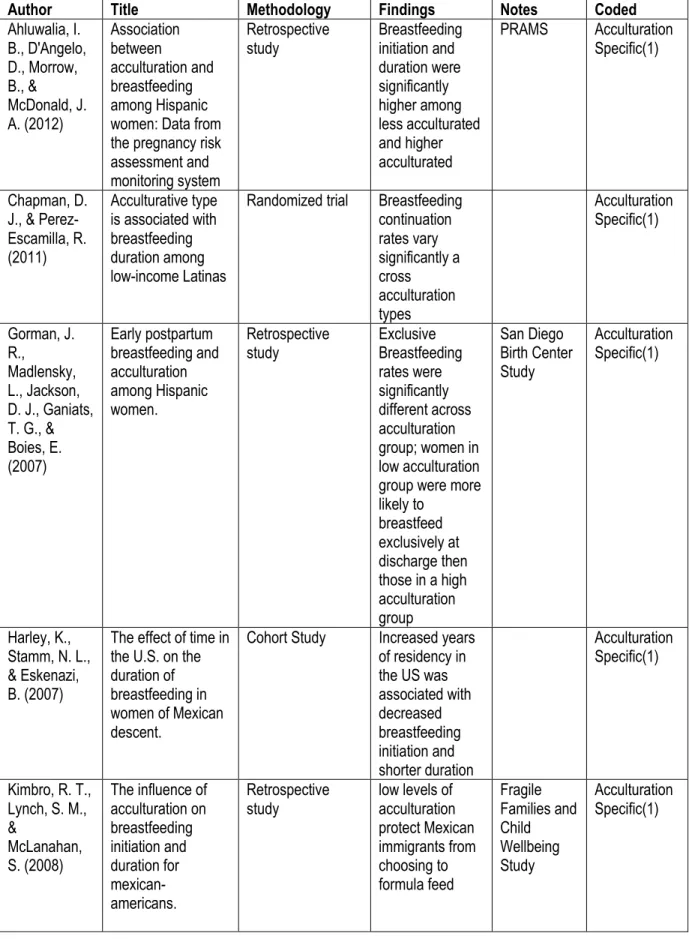
control trials, meta-analyses, and comparative studies, as well as scholarly commentary on the relationship of acculturation and U.S. Latino women on initiation, duration and exclusivity of breastfeeding. A summary of the studies is included in Table 1. Inclusion criteria for this literature review include publication in peer-reviewed journals.
Publications were excluded if they were published in a language other than English, or were based on a non-U.S. population. The exclusion criteria are specific to the author’s native language and acknowledge that language plays an important role in nuance, culture and meaning; thus, any translated materials may lose some content due to translation. Further, exclusion of studies conducted outside the United States support the tenet of acculturation: a process in which members of one cultural group adopt the beliefs and behaviors of the dominant group. In this case, the dominant culture being examined is U.S. based, and thus study location is relevant.
Literature Review Results
Most of the information has limited generalizability since it focused primarily on the experiences of Mexican Americans, as they are the largest of the U.S. Latino subgroups. However, over time researchers have come to recognize that Latinos are not monolithic. Of note, Chapman and Escamilla Perez assessed the effects of acculturation on breastfeeding behavior among low-income Latino women.36 Using a multidimensional assessment of
acculturation, the authors examined the acculturative type and breastfeeding behaviors among low-income U.S. Latino women. The authors identified three specific subgroups: Mexican, Puerto Rican, and other. The authors found that the low acculturation group was significantly more likely to continue breastfeeding than the traditional Hispanic, assimilated, and integrated-acculturation groups. They further noted, “Multidimensional assessments of integrated-acculturation may prove useful in better tailoring future breastfeeding promotion interventions.”
because breastfeeding rates in the Latino population are already considerably higher than rates in the general population. As a result, the assumption may be that there is limited need to develop new interventions to encourage breastfeeding. However, as the acculturated population begins to show variations or disparities in morbidity and mortality associated with suboptimal breastfeeding, we may expect to see more funded prevention studies.
Hopkinson and Konefal Gallagher conducted a RCT and found that breastfeeding practices could be influenced through programming and support regardless of acculturation level.37 This suggests that more research should be conducted to build the evidence base around best practices in breastfeeding promotion within the Latino community to counter some of the negative implications associated with acculturation and maximize the health benefits of breastfeeding for this population.
Literature Review Discussion
As noted earlier, studies of breastfeeding practices have been primarily focused on Latino women of Mexican descent. Table 1 includes the results of the literature review including findings, methodology, and data set. This limits the ability to make generalizations and broad recommendations for Latino women and breastfeeding. The lack of diversity among the participants in the extant research suggests a general acceptance among health services researchers of continuing to view Latinos as a homogenous group. The insights into Latino health offered by disaggregated data are rarely available. The use of aggregated data limits our ability to fully understand variations among subgroups and begin to compare to contrast and understand those differences. While Mexican Americans constitute over 80% of the Latino population in the U.S., we know that the diversity of the population is growing.38 Further, Latino subgroups are often clustered in geographic areas, which create subgroup cohorts and could be easily included in study designs.
move from home of origin to a society of settlement as outlined by Redfield and Berry. Acculturation theory as it relates to public health also asserts that through acculturation the immigrant group’s health status worsens with each consecutive generation. Acculturation has been measured using a variety of different methodologies from Marin’s acculturation scale39 to proxy acculturation measures. Acculturation was most often measured using static models and common proxies such as: dominant language spoken by family; years of residency in the United States; primary language spoken at home; and generational status in the U.S. Language spoken remains the most consistent way of measuring acculturation
Both the study results and commentary in this literature review indicate a common understanding that acculturation of Latino women has some association with the initiation and duration of breastfeeding. Gorman et al 40 was the only article included that associated
breastfeeding exclusivity with acculturation. The information found in this literature review regarding the association between acculturation and breastfeeding, coupled with data on the health benefits of breastfeeding, the growing Latino population, and the relatively high fertility rate among Latinos, has both research and policy implications. There is a potential for increased morbidity within the Latino community should acculturation continue to dictate breastfeeding practices.
Literature Review Conclusion
been little discussion of the implications of these differences. An anthropologic hypothesis suggests Puerto Ricans are further along the spectrum of acculturation, thus increasing their level of acculturative stress, including exposure to racism. One explanation for the negative health behaviors and outcomes (e.g., substance use, low birth weight) associated with the acculturation process is the acculturative stress.41 Acculturative stress refers to the
Table 1: Literature Summary Table
Author Title Methodology Findings Notes Coded
Ahluwalia, I. B., D'Angelo, D., Morrow, B., & McDonald, J. A. (2012) Association between acculturation and breastfeeding among Hispanic women: Data from the pregnancy risk assessment and monitoring system
Retrospective
study Breastfeeding initiation and duration were significantly higher among less acculturated and higher acculturated
PRAMS Acculturation Specific(1)
Chapman, D. J., & Perez-Escamilla, R. (2011)
Acculturative type is associated with breastfeeding duration among low-income Latinas
Randomized trial Breastfeeding continuation rates vary significantly a cross acculturation types Acculturation Specific(1) Gorman, J. R., Madlensky, L., Jackson, D. J., Ganiats, T. G., & Boies, E. (2007) Early postpartum breastfeeding and acculturation among Hispanic women. Retrospective
study Exclusive Breastfeeding rates were significantly different across acculturation group; women in low acculturation group were more likely to
breastfeed exclusively at discharge then those in a high acculturation group San Diego Birth Center Study Acculturation Specific(1) Harley, K., Stamm, N. L., & Eskenazi, B. (2007)
The effect of time in the U.S. on the duration of breastfeeding in women of Mexican descent.
Cohort Study Increased years of residency in the US was associated with decreased breastfeeding initiation and shorter duration Acculturation Specific(1)
Kimbro, R. T., Lynch, S. M., &
McLanahan, S. (2008)
The influence of acculturation on breastfeeding initiation and duration for mexican-americans. Retrospective
Sussner, K. M., Lindsay, A. C., Greaney, M. L., & Peterson, K. E. (2008)
The influence of immigrant status and acculturation on the development of overweight in Latino families: A qualitative study
Cohort Study Difference in breastfeeding practices compared to their native country Acculturation Specific(1) Sussner, K. M., Lindsay, A. C., & Peterson, K. E. (2008)
The influence of acculturation on breast-feeding initiation and duration in low-income women in the US.
Cohort Study Mother's exclusive use of their native language were ore likely to breastfeed and Mother's parent's nativity significant predictor of breastfeeding duration Acculturation Specific(1)
Bartick, M., & Reyes, C. (2012)
Las dos cosas: An analysis of attitudes of Latina women on non-exclusive breastfeeding.
Cohort Study Common reasons for introducing formula were treatment for insufficient milk, to keep the baby fuller longer, and planning to return to work
Dominican
women Latina/Hispanic Specific (2)
Faraz, A.
(2009) Clinical recommendations for promoting breastfeeding among Hispanic women.
Literature Review Imperative to develop culturally specific
guidelines.
Latina/Hispan
ic Specific (2)
Gill, S. L.
(2009) Breastfeeding by Hispanic women. Systematic Literature Review Newly immigrated women have longer initiation and duration of breastfeeding than more acculturated women
Latina/Hispan
ic Specific (2)
Kaufman, L., Deenadayala n, S., & Karpati, A. (2010) Breastfeeding ambivalence among low-income African American and Puerto Rican women in north and central Brooklyn
Ethnographic
review Women's intention does not systematically explain breastfeeding explain Puerto Rican
breastfeeding outcomes Newton, K. N., Chaudhuri, J., Grossman, X., & Merewood, A. (2009) Factors associated with exclusive breastfeeding among Latina women giving birth at an inner-city baby-friendly hospital.
Retrospective
study Factors associated with exclusive breastfeeding included maternal age, us-born mother, and birth sister
Latina/Hispan
ic Specific (2)
Rios, E.
(2009) Promoting breastfeeding in the Hispanic
community.
Conference
Address Overview of the needs of breastfeeding in the Hispanic Community
Latina/Hispan
ic Specific (2)
Vaughn, L. M., Ireton, C., Geraghty, S. R., Diers, T., Nino, V., Falciglia, G. A., Mosbaugh, C. (2010) Sociocultural influences on the determinants of breast-feeding by Latina mothers in the Cincinnati area
Cohort Study foreign-born Latina women share similar breastfeeding determinants with the general population
Cincinnati
Area Latina/Hispanic Specific (2)
Anderson, A. K., Damio, G., Chapman, D. J., & Perez-Escamilla, R. (2007)
Differential response to an exclusive
breastfeeding peer counseling intervention: The role of ethnicity.
Retrospective
review of RCT non-Puerto Ricans had a significantly great response to the intervention than Puerto Ricans
Puerto Rican
population Latina/Hispanic Intervention (3)
Hopkinson, J., & Konefal Gallagher, M. (2009)
Assignment to a hospital-based breastfeeding clinic and exclusive breastfeeding among immigrant Hispanic mothers: A randomized, controlled trial. Randomized
control trial Intervention group was more likely to
exclusively breastfeeding compared to the control group regardless of acculturation level Latina/Hispan ic Intervention (3)
Sandy, J. M., Anisfeld, E., & Ramirez, E. (2009)
Effects of a prenatal intervention on breastfeeding initiation rates in a Latina immigrant sample.
Cohort Study Intervention had no effect on reported
breastfeeding but an effect on exclusive breastfeeding
Latina/Hispan
Forste, R., & Hoffmann, J. P. (2008)
Are US mothers meeting the healthy people 2010 breastfeeding targets for initiation, duration, and exclusivity? the 2003 and 2004 national immunization surveys.
Retrospective
study (NIS) Hispanic children had higher odds of breastfeeding
NIS Racial/Ethnic difference (4)
Sparks, P. J.
(2011) Racial/ethnic differences in breastfeeding duration among WIC-eligible families.
Retrospective
study WIC-eligible foreign-born Mexican origin Hispanics mothers were most likely to breastfeed for 6 months
WIC Racial/Ethnic difference (4)
Nommsen-Rivers, L. A., Chantry, C. J., Cohen, R. J., & Dewey, K. G. (2010)
Comfort with the idea of formula feeding helps explain ethnic disparity in breastfeeding intentions among expectant first-time mothers.
Cohort Study Formula feeding comfort had the greatest impact on breastfeeding initiation Racial/Ethnic difference (4) Ogbuanu, C. A., Probst, J., Laditka, S. B., Liu, J., Baek, J., & Glover, S. (2009)
Reasons why women do not initiate
breastfeeding: A southeastern state study.
Retrospective
study Hispanics had 3x the odds of citing circumstances then whites
Arkansas
PRAMS Racial/Ethnic difference (4)
Lee, H. J., Elo, I. T., McCollum, K. F., & Culhane, J. F. (2009)
Racial/Ethnic differences in breastfeeding initiation and duration among low-income, inner city mothers. Retrospective
study Both foreign born black and Hispanic mothers were significantly more likely to breastfeed their infants
Philadelphia
CHAPTER 3: RESEARCH DESIGN AND METHODOLOGY
Conceptual Model and Hypotheses Figure 1. The Ecological Model
individual health response. Further, the model recognizes that an individual exists within a family and community structure (ethnic social relations have been noted as part of the Marin acculturation scale).43
Understanding the ecological model will help to better conceptualize breastfeeding among U.S. Latino women. Figure 2 recognizes that acculturation may occur at the individual family and community level to create social networks and collective behavior that influence individual behaviors such as attitudes. Although acculturation occurs at multiple levels, it will ultimately have an intervening effect on optimal breastfeeding, as will income, education, and WIC participation. Of direct impact on community/family is the concept of group membership
history (subgroup membership), which may create a subconscious or collective behavior that has been developed as a coping mechanism for current or prior trauma. This could but does not always manifest as an expression of the cultural norms from the origin homeland. This group membership history may influence help seeking, trust, and other interpersonal relationships all of which are important elements in understanding health behavior in this case breastfeeding behavior. The current data set does not let us explore this concept but should be considered for further development in later inquiries.
My analysis of breastfeeding behaviors among U.S. Latino women will be informed by national data that, to date, has been restricted and unavailable for public use. I will use a multi-stage methodological approach to support my thesis through:
Examining differences in breastfeeding behaviors (initiation and optimal breastfeeding (6
months exclusive)) among U.S. Latino women subgroups, and
Exploring the intervening factors associated (education, WIC participation, income and
acculturation) with breastfeeding behaviors among U.S. Latino women My hypotheses are as follows:
1) U.S. Latina subgroups will have differing breastfeeding behaviors
2) Increased educational attainment is associated with increased initiation and optimal breastfeeding behavior in U.S. Latino women.
3) WIC participation is associated with increased initiation and optimal breastfeeding behavior in U.S. Latino women.
4) Increased family income is associated with increased initiation and optimal breastfeeding among U.S. Latino women.
Study Design
To examine these hypotheses, it was necessary to perform an individual analysis of the breastfeeding behaviors of each Latina subgroup as well as a comparative one across all of the subgroups. To account for the multi-level modeling and to establish a sample size that supports the analysis, a three year combined NIS survey dataset was employed. Using multiple years (2011, 2012, 2013), the secondary data source provided a large enough sample to allow for some generalizable and comparable assertions about Latina breastfeeding behaviors and was used for completion of the proposed analysis.
Since 1994, the National Immunization Survey (NIS) has monitored childhood immunization coverage in the United States. NIS is sponsored by the National Center for Immunizations and Respiratory Diseases (NCIRD) and conducted jointly by NCIRD and the National Center for Health Statistics (NCHS), Centers for Disease Control and Prevention. The NIS is a list-assisted random-digit-dialing telephone survey followed by a mailed survey to children’s immunization providers and their parents. The target population for the NIS survey is children 19-35 months of age living in the United States. And its original intent was to monitor childhood immunization coverage. NIS does include specific questions related to breastfeeding initiation, duration and exclusivity as well as demographic information including but not limited to race, ethnicity, education and household income. It is important to note that no data for the commonwealth of Puerto Rico is included in the NIS.
As part of the formative development of this research and to have comparable
breastfeeding data by which to develop some commentary based on national standards, I made a special request to the Center for Disease Control- National Center for Chronic Disease
following eight breastfeeding indicators: ever breastfeeding, any breastfeeding at six months and at 12 months, exclusive breastfeeding through three months and exclusive breastfeeding through six months, formula supplementation within two days, three and six months. The variables identified are part of the CDC Breastfeeding Report Card and are national measurers in Healthy People 2020 but this run has never been conducted or published prior to this request. Preliminary findings are shown in Table 2 and Table 3.
Table 2: Percent of Mothers Who Initiated Breastfeeding
Demographic Total % Initiate BF
NATIONAL 25163 76.8
Non-Hispanic White 14695 78.6
Non-Hispanic Black 2582 61.8
Hispanic 4906 80.3
MEXICAN 1000 82.1
MEXICAN/AMERICAN 2121 80.6
CENTRAL
AMERICAN 408 82.2
SOUTH AMERICAN 286 91.6
PUERTO RICAN 525 71.9
CUBAN/AMERICAN 90 90.6
SPANISH
CARIBBEAN 100 85
Table 3: Percent of mothers who Exclusively Breastfeeding at 6 months (Optimal)
Demographic Total % Exclusive BF at 6 months
NATIONAL 24712 17.1
Non-Hispanic White 14429 18.4
Non-Hispanic Black 2540 13.2
Hispanic 4826 16.4
MEXICAN 986 14.2
MEXICAN/AMERICAN 2089 17.6
CENTRAL AMERICAN 399 14.9
SOUTH AMERICAN 281 15.7
PUERTO RICAN 518 14.4
CUBAN/AMERICAN 88 14.6
SPANISH CARIBBEAN 101 14
Latino Subgroups shaded
Survey Instrument
The NIS 2011-2013 data sets were collected the year prior and include an annual
approximate total sample of 27,305 respondents. The 2012 survey results included 4,735 (17%) self-identified as Hispanic and a total of 1,834 (6.7%) of the surveys were conducted in Spanish, which can serve as a proxy for acculturation. The NIS data sets proposed for this research 2011-2013 include the following variables related to the analysis:
Mother’s education
WIC enrollment
Family Income
Acculturation proxy (survey conducted in Spanish)
Data Analysis Plan
As the Latina subgroup data was a restricted data set, a special application and review process took place to access the data. Once the application and investigators were approved, a data analysis plan was submitted as all analysis runs were conducted by a NCHS/Research Data Center associate. All output was then reviewed and released to the third party (myself.) It
should be noted this process from initiation to final receipt of data was in excess of five months.
There was considerable missing data. In addition, the data is from a complex survey design with weights and strata taken into account in order to account for the sampling design. When weights are missing or negative, then the analysis excludes these cases. This was true for the
Dominican subjects in the survey analysis. While there at least 59 in the data set, the analyses using the weights and strata eliminate them due to missing weight values.
The research design consisted of three distinct parts: (1) univariate analysis of each variable to identify central tendency and other descriptive statistics; (2) bivariate regression to understand the strength and directions of the relationships between the dependent variable, Latina breastfeeding behavior, and each of the independent variables, mother’s education, WIC participation, and acculturation; (3) and multivariate analysis to examine the performance of the independent variables as explanatory factors for the dependent variable.
As the examination of breastfeeding practices is the primary interest of this analysis, I used the categorical data provided in the National Immunization Survey to create a dichotomous variable to represent: optimal breastfeeding (exclusive and <6months; yes-1) and ever
breastfed (initiated breastfeeding and non-exclusive and/or and >6months; no-0). The measures used to assess breastfeeding are: “Was (child) ever breastfeed or fed breastmilk?”
(Dichotomous, 0-No, 1-Yes; “How old was (child) when (child) completely stopped breastfeeding or being fed breast milk?” (Continuous); “How old was (child) when (child) was first fed
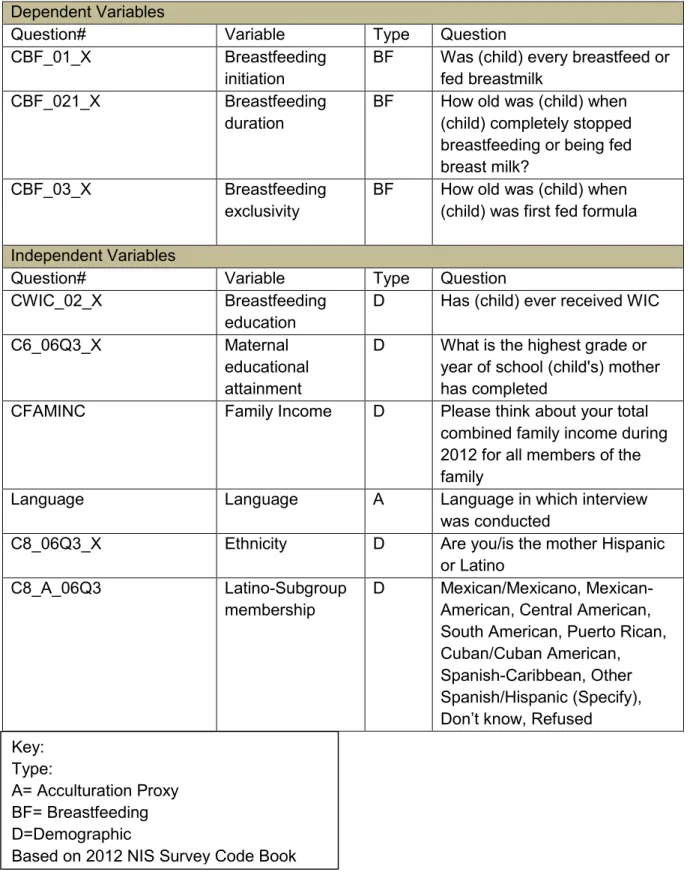
formula?” (Continuous) information on these data points can be found in Table 4.
aims.
Aim 1: To examine differences in breastfeeding behaviors among Latina subgroups in the U.S. Hypothesis (1): U.S. Latino subgroups will have differing breastfeeding behaviors.
Data Analysis
Breastfeeding initiation rates were calculated for each subgroup and compared
Breastfeeding exclusivity at six months was calculated for each subgroup and
compared. These data were used to test the hypotheses of whether differing
breastfeeding behaviors exist among U.S. Latino subgroups. Data from the survey used to identify Latina participants and construct subgroups came from a question on
participant ethnicity: “Are you/is the mother Hispanic or Latino?” (Dichotomous, 0-No, 1-Yes). The restricted data set included ten variables on ethnicity information about the mother, as noted above the weighting scheme eliminated the Dominican group from analysis. In order to have clear comparisons among subgroups I created a nine level variable: Not Latina/Hispanic=1, Mexicano/Mexican =2, Mexican-American=3, Central American=4, South American=5, Puerto Rican=6, Cuban/Cuban American=7, Spanish Caribbean=8, Other Spanish=9 (see Table 7). Given the weighted scheme of the data I
performed pairwise tests for “ever breastfed” and “optimal breastfeed” to find out the
statistical significance of these differences between sub- groups using Rao-Scott χ2 and
Benjamini-Hochenberg.
Aim 2: To explore the intervening factors associated (e.g., acculturation, education, income, and WIC enrollment) with initiation and less than optimal breastfeeding among U.S. Latino women.
and optimal breastfeeding among U.S. Latino women.
Hypothesis (3): WIC participation is associated with increased initiation and optimal breastfeeding among U.S. Latino women. WIC participation will have the strongest association with breastfeeding initiation among US Latina subgroups.
Hypothesis (4): Increased family income is associated with increased initiation and optimal breastfeeding among U.S. Latino women.
Hypothesis (5): Acculturation will have the strongest association with optimal breastfeeding among US Latina subgroups. Increased acculturation is associated with a decreased level of optimal breastfeeding (>6 months exclusive) among U.S. Latino women.
Data Analysis
Multiple-stage (i.e. univariate, and multivariate) analyses were used to understand factors influencing Latina breastfeeding behaviors and contributing to differences across subgroups. Given the weighted scheme of the data, significance was established using Rao-Scott χ2. Income and maternal education attainment were treated as continuous variables in the analysis. Data from the survey used for single variable and multivariable analysis are listed and defined in Tables 4 and 5.
Data Management Plan
All data was analyzed in collaboration with a contracted statistician, I managed all analysis, and my methods advisors, Drs. Torres and Skinner, provided insight and guidance as it relates to the contract statistician. The statistician’s primary function was to review the CDC data request and perform the multi-level logistic regression modeling. In addition to directing specific data manipulation requests to the statistician, I interpreted and analyzed the
Table 4: Dependent and Independent Variables
Dependent Variables
Question# Variable Type Question
CBF_01_X Breastfeeding
initiation
BF Was (child) every breastfeed or fed breastmilk
CBF_021_X Breastfeeding
duration
BF How old was (child) when (child) completely stopped breastfeeding or being fed breast milk?
CBF_03_X Breastfeeding
exclusivity
BF How old was (child) when (child) was first fed formula
Independent Variables
Question# Variable Type Question
CWIC_02_X Breastfeeding
education
D Has (child) ever received WIC
C6_06Q3_X Maternal
educational attainment
D What is the highest grade or year of school (child's) mother has completed
CFAMINC Family Income D Please think about your total
combined family income during 2012 for all members of the family
Language Language A Language in which interview
was conducted
C8_06Q3_X Ethnicity D Are you/is the mother Hispanic
or Latino
C8_A_06Q3 Latino-Subgroup
membership
D Mexican/Mexicano,
Mexican-American, Central Mexican-American, South American, Puerto Rican, Cuban/Cuban American, Spanish-Caribbean, Other Spanish/Hispanic (Specify), Don’t know, Refused Key:
Type:
A= Acculturation Proxy BF= Breastfeeding D=Demographic
Table 5: Dichotomous Variables
Variable Code
Initiation Did not initiate breastfeeding
0
Initiated Breastfeeding 1 Optimal Breastfeeding
Less then optimal 0
Optimal 1
Latino Ethnicity
Not Latina 0
Latina 1
WIC Participation
Ever used WIC 0
Never Used WIC 1
Acculturation
Acculturation Low 0
Acculturation High 1
The univariate analysis consisted of descriptive statistics and measures of association was completed to summarize demographic and acculturation characteristics and breastfeeding behaviors, including measures of central tendency and of dispersion. The analysis supported the construction of categorical variables for appropriate levels of “Mother’s education.” As noted earlier only income remained a continuous variable.
“ever used WIC” and “currently use WIC.” Given that the hypothesis was to explore WIC
membership as an intervening factor, I concluded “ever used WIC” was the best variable. Thus, I created a dichotomous variable (0=no, 1=yes). I used the language preference in which the survey was conducted as a proxy for acculturation. A dichotomous variable was created to represent low acculturation (Conducted in Spanish; yes-1) and high acculturation (Conducted in English; no-0.) I performed a bivariate regression and used the findings to identify and interpret the data for all Latinas and Latina subgroups with each factor to determine the direction and strength of the relationship (based on the R-squared, coefficient of determination) between the intervening factor and the breastfeeding behavior for each subgroup.
This multivariate analysis examined the impact of each variable (education, WIC
participation, income, and acculturation) using logistic regression modeling to better identify the constellation of factors that impact 1) breastfeeding initiation and 2) optimal breastfeeding among U.S. Latinas and within subgroup membership.
Table 6: Subgroup Variables 1 Not Latino/Hispanic 2 Mexican/Mexicano 3 Mexican-American 4 Central American 5 South American 6 Puerto Rican
7 Cuban/Cuban American 8 Spanish-Caribbean 9 Other Spanish
CHAPTER 4: RESULTS
This chapter provides the results of my analysis of U.S. Latino women breastfeeding behaviors. Specifically, this chapter covers the data analysis related to meeting the aims of this study:
Aims
1. To examine differences in breastfeeding behaviors (initiation and optimal breastfeeding) among U.S. Latino women subgroups using a national sample.
2. To explore the intervening factors associated (including acculturation, education, income and WIC participation) with breastfeeding behaviors (initiation and optimal
breastfeeding) among U.S. Latino women.
3. To develop a plan to inform public health policy and advocacy on U.S. Latino breastfeeding behavior and its implications.
The individual data analysis corresponds to the following hypotheses:
Hypothesis (1): U.S. Latino subgroups will have differing breastfeeding behaviors. Hypothesis (2): Increased educational attainment is associated with increased initiation and optimal breastfeeding among U.S. Latino women.
breastfeeding initiation among US Latina subgroups.
Hypothesis (4): Increased family income is associated with increased initiation and optimal breastfeeding among U.S. Latino women. Hypothesis (5): Acculturation will be associated with Latina breastfeeding in the following manner: (a) Acculturation will have the strongest association with optimal breastfeeding among US Latina subgroups and (b) increased acculturation is associated with a decreased level of optimal breastfeeding (>6 months
exclusive) among U.S. Latino women.
Most of the information about Latina breastfeeding behavior has limited generalizability since it is primarily focused on the experiences of Mexican Americans, as they are the largest of the U.S. Latino subgroups. However, over time, researchers have come to recognize that Latinos are not monolithic. Of note, Chapman and Escamilla Perez assessed the effects of acculturation on breastfeeding behavior among low-income Latino women. 44 Using a
multidimensional assessment of acculturation, the authors examined the acculturative type and breastfeeding behaviors among low-income U.S. Latino women. The authors identified three specific subgroups: Mexican, Puerto Rican, and other. The authors found that the low
acculturation group was significantly more likely to continue breastfeeding than the traditional Hispanic, assimilated, and integrated-acculturation groups. They further noted,
“Multidimensional assessments of acculturation may prove useful in better tailoring future breastfeeding promotion interventions.”
The data analysis from this dissertation study confirms these prior findings and seeks to tease out less statically verified but important factors for future exploration. In addition, this study examines the impact of maternal educational attainment, income and WIC participation on initial and optimal breastfeeding rates. Data limitations remain an issue for this study, especially in terms of using weighted data to compare Latina subgroups.
only in a closed system and all analysis, was done within the NIS closed system, reviewed and approved by an internal NIS team, and the results released to the researcher. The data set is large but there is considerable missing data. In addition, the data is from a complex survey design with weights and strata to be taken into account in order to account for the sampling design. When weights are missing or negative, then the analysis excludes these cases. The CDC provided the weight scheme. Also, due to restrictions from the data source (CDC),
categories with observed frequencies of 5 or less are not reported in order to protect the identity of respondents.
Aim 1: To examine differences in breastfeeding behaviors among Latina subgroups in the U.S.
Hypothesis (1): U.S. Latino subgroups will have differing breastfeeding behaviors.
Ever Breastfed
The weighted logistic regression for Hispanic Origin was also significant, χ2 (8) =
31780.8662; p < 0.0001. This analysis found that non-Hispanic/Latina mothers breastfeed less than everyone, although the difference with Puerto Rican mothers is not significant at a 95% confidence interval. (Table 7)
Table 7: Percent of mothers initiating Breastfeeding (Ever Breastfed) by Latino Subgroup
Origin N Ever Breast fed %
1. Not Hispanic/Latina 2577 72.41
2. Mexicano 4203 85.97
3. Mexican American 2728 77.72
4. Central American 1025 80.60
5. South American 670 90.79
6. Puerto Rican 885 72.41
7. Cuban/ Cuban American 132 85.72
8. Spanish Caribbean 190 84.95
9. Other Spanish 712 80.88
Table 8: Pairwise differences Ever Breastfed between levels of origin univariate analysis p-values
Origin 1 2 3 4 5 6 7 8
1. Not Hispanic/ Latina 2. Mexicano <0.000 1# 3. Mexican American 0.0201 # <0.000 1# 4. Central American 0.0063 # 0.0170 # 5. South
American <0.0001 # 0.0562 <0.0001 # 0.0018 # 6. Puerto
Rican
0.9964 <.0001 #
0.0624 0.0164
# <0.0001 # 7. Cuban/ Cuban American
0.0369 0.9586 0.1694 0.3713 0.2727 0.0421
8. Spanish
Caribbean 0.0112 # 0.7828 0.1102 0.3419 0.1354 0.0153 # 0.8978 9. Other
Spanish
0.0135 #
0.0496 0.3147 0.9345 0.0038 # 0.0256
0.4082 0.3919
Significant =p < 0.05
#: significant using Benjamini-Hochberg
Optimal Breastfeeding
Hispanic origin was significant related to optimal breastfeeding (Rao-Scott χ2 (8) = 19.5793; p = 0.0121).
Mothers who were not Hispanic/Latina were more likely to optimally breastfeed as were mothers from South America, the Spanish Caribbean, and other Spanish/Hispanic mothers whereas all others were less likely to do so. Using the Benjamini-Hochberg method, which minimizes the number of false positives, the findings subsequently suggest that
non-Hispanic/Latina mothers were also more likely to optimally breastfeed than Mexican American mothers.
Table 9: Percent of mother who Breastfeed Exclusively at 6 months (Optimal Breastfed) by Latino Subgroup
Origin N
Optimal Breastfeeding %
1. Not Hispanic/Latina 1826 35.37
2. Mexicano 3444 31.23
3. Mexican American 1999 25.69
4. Central American 817 25.61
5. South American 593 33.55
6. Puerto Rican 631 22.22
7. Cuban/ Cuban American 106 28.43
8. Spanish Caribbean 156 30.25
Table 10: Pairwise differences Optimal Breastfeeding between levels of origin univariate analysis p-values
Origin 1 2 3 4 5 6 7 8
1. Not
Hispanic/Latina
2. Mexicano 0.1220
3. Mexican American
0.0019 # 0.0360
4. Central American
0.0150 0.0966 0.9810
5. South
American 0.6680 0.5452 0.0521 0.0833
6. Puerto Rican 0.0004 # 0.0060 0.3137 0.3892 0.0106 7. Cuban/ Cuban
American
0.3925 0.7159 0.7135 0.7150 0.5446 0.4021
8. Spanish Caribbean
0.5078 0.8931 0.5227 0.5318 0.6842 0.2609 0.8590
9. Other Spanish 0.4813 0.8418 0.1457 0.1851 0.7857 0.0364 0.6694 0.8241 Significant =p < 0.05
# : Benjamini-Hochberg correction
Aim 2: To explore the intervening factors associated (e.g., acculturation, education, income, and WIC enrollment) with initiation and less than optimal breastfeeding among U.S. Latino women.
Hypothesis (2): Increased educational attainment is associated with increased initiation and optimal breastfeeding among U.S. Latino women.
The education of the Latina mother was significantly related to ever breastfed using the weighted (Rao-Scott χ2 (3) = 45.5906; p < 0.0001) analyses. Mothers with more education were more likely to breastfeed while mothers with less education were less likely to breastfeed.
The education of the Latina mother was significantly associated with optimal breastfeeding (Rao-Scott χ2 (3) = 33.9658; p < 0.0001) Those with less than a high school education were less likely to optimally breastfeed while mothers with college degrees were more likely to optimally breastfeed.
Hypothesis (3): (a) WIC participation is associated with increased initiation and optimal breastfeeding among U.S. Latino women.
(Rao-Scott χ2 (1) = 22.5539; p < 0.0001). Mothers who had never used WIC were more likely to breastfeed than would be expected by chance while mothers who had used WIC were less likely to breastfeed.
Latina mothers and Ever used WIC was significantly associated with optimal
breastfeeding (Rao-Scott χ2 (1) = 46.9110; p < 0.0001) Mothers who said they had ever used WIC were less likely to optimally breastfeed while mothers who had not ever used WIC were more like to breastfeed.
(b) WIC participation will have the strongest association with breastfeeding initiation among US Latina subgroups.
It was determined that it was not possible to measure the variable with the strongest association. The association of WIC for a larger subgroup could have been examined using interaction terms or simultaneous models to draw some assumptions, however, I did not conduct that analysis. I did determine how subgroups related to optimal breastfeeding and how acculturation could relate to optimal breastfeeding.
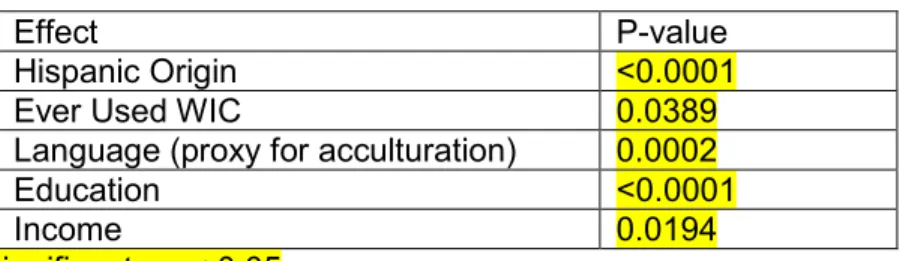
Table 11: Multivariate analysis of Ever Breastfed
Effect P-value
Hispanic Origin <0.0001
Ever Used WIC 0.0389
Language (proxy for acculturation) 0.0002
Education <0.0001
Income 0.0194
Significant =p < 0.05
Hypothesis (4): Increased family income is associated with increased initiation and optimal breastfeeding among U.S. Latino women.
Income was significantly associated with ever breastfed (Rao-Scott χ2 (11) = 40.335; p < 0.0001) analyses. The Mantel-Haenszel test was also significant (χ2 (1) = 87.9685; p < 0.0001), indicating some linearity in the relation, but the difference in chi-squares also indicated some deviations form linearity (χ2 (10) = 33.5148; p = 0.0002). In general, those with higher incomes were more likely to breastfeed and those with lower incomes were less likely to breastfeed.
There was a significant association of income with optimal breastfeeding (Rao=Scott χ2 (11) = 34.9316; p = 0.0003). The difference between the Pearson Chi-square and the Mantel-Haenszel Chi-square was not significant (χ2 (10) = 15.1077; p = 0.1282), meaning that the relation was fairly linear, i.e. there were no significant deviations from linearity. Higher levels of income were associated with more optimal breastfeeding whereas less income was associated with less optimal breastfeeding.
Hypothesis (5):
(a) Acculturation will have the strongest association with optimal breastfeeding among US Latina subgroups.
acculturation (using language as a proxy) educational attainment of the mother, WIC
participation, income, age group, and child gender to see if any variable has greater explanatory power compared to the other variables. All of these variables, with the exception of age group and child gender, language and education were statistically significant in the analysis. This analysis indicated that acculturation was not significant at a 95% confidence level.
Table 12: Multivariate analysis of Optimal Breastfeeding
Effect P-value
Hispanic Origin 0.0077
Ever Used WIC 0.0361
Language (proxy for acculturation) 0.0831
Education 0.0715
Income 0.0451
Significant =p < 0.05
(b) Increased acculturation is associated with a decreased level of optimal breastfeeding (>6 months exclusive) among U.S. Latino women.
Language (proxy for acculturation) was not significantly associated with optimal breastfeeding.
Overall Analysis
Ever Breastfed
With regards to ever breastfed the overall analysis found that for Latina mothers WIC was associated with less breastfeeding, speaking English was associated with less
breast-feed less than everyone except Puerto Rican mothers. Mexicano mothers breast-breast-feed significantly more than Mexican American, Central American, and Puerto Rican mothers and Other Spanish mothers. Mexican American mothers breastfeed less than South American mothers. Central American mothers breast-feed more than Puerto Rican mothers but less than South American mothers. South American mothers breastfeed more than Puerto Rican or other Spanish mothers. Puerto Rican mothers breast-feed less than Cuban/Cuban American, Spanish Caribbean, or other Spanish mothers. (Table 8)
Optimal Breastfeeding
With regards to optimal breastfeeding the overall analysis found that for Latina mothers optimally breastfeed when the weighted analysis model controlling for the design effects is used, the findings are that the likelihood ratio Chi-square is also significant (χ2 (16) =
16950.7411; p < 0.0001). Hispanic origin (χ2 (8) = 20.7868; p = 0.0077), Current WIC usage (χ2 (1) = 4.3938; p < 0.0361), and Income (χ2 (1) = 4.0157; p = 0.0451) were still significant
predictors. The remaining variables were not. WIC usage is still associated with less likelihood of optimal breastfeeding while greater income was associated with more likelihood of optimal breastfeeding. Looking at pairwise differences between levels of Hispanic origin, only two differences was statistically significant using the Benjamini-Hochberg procedure indicating that Non-Hispanic/Latina mothers were more likely to optimally breastfeed than Puerto Rican and Mexican American mothers. Four more comparisons were significant at less than the .05 level, Mexicano mothers were more likely to optimally breastfeed than Puerto Rican or Mexican American mothers, and non-Hispanic/Latina mothers were more likely to optimally breastfeed than Mexican American or Central American mothers.
Study limitations
probability sample, significant sample size, and capturing subgroup identification. The data also allow for conducting analyses based on demographic characteristics including mother’s
education and WIC participation.
At the same time, the secondary data analysis as presented has many limitations. Specifically, the survey questions were not specifically designed to map onto the study’s conceptual model. There is an inexact relationship between variables and the conceptual model. This is a common problem with secondary data analysis. For example, the survey does not include direct measures of acculturation and, thus, language is to be used as a proxy. Also, the proxy of language available for the NIS only allows for the creation of a dichotomous
variable (i.e. high acculturation and low acculturation.) While this dichotomous variable has precedent and is appropriate as a standard measure of acculturation in health analysis, it does not support a more dynamic nor comprehensive measure, which Chapman and Escamilla Perez suggested was the optimal measure of acculturation.45 Therefore, my research explored
correlating relationships of acculturation and breastfeeding behaviors, and this study provides new directions for further examination rather than definitive explanations of behavior.
An additional limitation of the research is that the survey does not provide data or proxy data (except for WIC participation) on other potentially important contributing factors, such as social support, breastfeeding education, and environment. Given the ecological model of behavior change, we would expect to find that such factors as increased familial support (interpersonal networks) and/or community/cultural traditions (social institutional factors) supportive of breastfeeding would have a positive relationship with initiation and optimal breastfeeding. Likewise, community factors, such as linguistically and culturally relevant breastfeeding support groups, or Baby Friendly designated hospitals, would also show a positive relationship with breastfeeding initiation and optimal breastfeeding.
Mexican American, Central American, South American, Puerto Rican, Cuban, and Spanish-Caribbean sub-groups and Other Spanish. These categories aggregate Central American and South American subgroups. The ability to disaggregate to the country of origin level, specifically among those Latino women of Central and South American origin, may have allowed for better understanding of both culturally- specific issues (as noted in the ecological model) as well as issues associated with colonization (interpersonal networks in the form of group memory.)
CHAPTER 5: DISCUSSION
The study findings generally confirm the hypotheses. Significant differences in breastfeeding behavior across U.S. Latino women subgroups were observed in the study sample. These differences were particularly desperate in looking at initiation rates across
subgroups compared to optimal breastfeeding rates across subgroups. In some of the analyses, these differences across subgroups remained even after controlling for sample size and
intervening factors. In other instances, weighted data analyses made some variable
insignificant or change direction of impact. Additionally, more exploration of acculturation needs to be done, as language alone is not robust enough as a proxy for this factor.
The U.S. Latino breastfeeding behavior data used in this study demonstrated that Latina mothers are not monolithic. All Latina subgroups, with the exception of Puerto Rican and
rates. Therefore, there is varying and significant differences across Latino subgroups. The analysis and process findings can be further grouped using the levels of the ecological model to understand their relationship to the individual and help better develop a plan of action to support healthy behaviors in breastfeeding.
Individual Level Factors
Intervening factors, such as maternal education attainment and household income, play a role in determining breastfeeding behavior for Latina mothers. Data analysis confirmed that U.S. Latino mothers with more education were more likely to initiate breastfeeding while U.S. Latino mothers with less education were less likely to report ever breastfeeding.
Correspondingly, U.S. Latino mothers with a college degree were more likely to optimally breastfeed, while U.S. Latino mothers with less than a high school education were less likely to optimally breastfeed.
Income was also significantly associated with ever breastfed. In general, those with higher incomes were more likely to breastfeed and those with lower incomes were less likely to breastfeed. There was also a significant association of income with optimal breastfeeding. There were no significant deviations from linearity; higher levels of income were associated with more optimal breastfeeding whereas less income was associated with less optimal
breastfeeding.
Community/Family Factors
Mexico, newly arrived or who feel akin to specific cultural traditions, beliefs and practices and we assume that women who identified as Mexican American are women born in the U.S. or of Mexican descent and hold themselves to American traditions then the following is an interesting finding related to acculturation. In this study, the initiation and optimal breastfeeding rates of Mexicano mothers compared to Mexican American mothers varies and remains statistically significant. Also, Mexicano mothers have higher initiation and
optimal rates of breastfeeding than Mexican American mothers. This would coincide with previous findings in which women with low acculturation initiated breastfeeding at higher rates then those with high acculturation.46 Further, studies comparing specific groups, particularly when there is more specificity about acculturation and cultural nuances, may be more useful than proxy variables (e.g. language) in identifying and applying appropriate interventions to achieve public health goals.47
Policy Level Factors
This study obtained unexpected results in terms of WIC participation. Data disproved the hypothesis that WIC participation is associated with increased initiation rates among U.S. Latino mothers. U.S. Latino mothers who had never participated in WIC were more likely to initiate breastfeeding and more likely to optimally breastfeed, while U.S. Latino mothers who had used WIC were less likely to report either ever or optimally breastfeeding. Available data did not allow a comparison across Latina subgroups of variances in breastfeeding behavior.
Figure 3: Intervening Factors of U.S. Latina Breastfeeding Behavior (ever Breastfeed)
Policy Implications by Ecological Level
Individual Level Policy Implications (Interpersonal/Interpersonal Networks)
While breastfeeding offers us some insight into the larger arena of Latina maternal and child health, we recognize that the lack of Latino specific interventions is not limited to
consequences of this disinvestment could have similar dire outcomes for the health and well being of the Latino community, and the U.S as a whole. Addressing larger public policy, offers us a way to correct the structural barriers that impede proper support of U.S. Latino women.
Figure 4: Intervening Factors of U.S. Latina Breastfeeding Behavior (Optimal Breastfeeding)
Health System Level Policy Implications (Social Institutional) Baby Friendly Designated Hospitals