CRISIS COMMUNICATION IN AUTHORITARIAN REGIMES: THE CASE OF ANDIJAN TRAGEDY IN UZBEKISTAN
Behzod A. Mamadiev
A thesis submitted to the faculty of the University of North Carolina at Chapel Hill in partial fulfillment of the requirements for the degree of Master of Arts in Mass Communication
in The School of Journalism and Mass Communication.
Chapel Hill 2011
Approved by:
Napoleon Byars
© 2011
ABSTRACT
Behzod A. Mamadiev: Crisis Communication in Authoritarian Regimes: The Case of Andjan Tragedy in Uzbekistan
(Under the direction of Napoleon Byars, Queenie Byars and Odil Ruzaliev )
On May 13, 2005, Andijan, eastern city of Uzbekistan, a former Soviet republic of
Central Asia, attracted the world’s attention. News ran through the channels of mass media from
BBC to CNN reporting that the Uzbek government crushed a civilian demonstration and killed
several hundreds of people.
The international community, including the U.S. and the EU, harshly condemned the acts
of the government. The crisis communication strategies applied by the government to justify its
actions and to diminish the damages of the tragedy as well as to repair its broken image failed.
In this thesis project, I analyzed the Uzbek government’s crisis communication strategies
through the lens of Benoit’s Image Restoration Theory. By identifying the factors responsible for
the failure, I proposed that the government could have reduced the damage of the crisis if the
communication strategies had been carried out properly in accordance with the Image
Restoration theory principles.
ACKNOWLEDGMENTS
I would like to extend my heartfelt gratitude to the members of my thesis project
committee for their involvement and encouragement. First and foremost, I wish to thank Prof.
Napoleon Byars for his unwavering encouragement and support during my thesis project. He
taught me how to make the time-consuming process of thesis writing easy and enjoyable. I also
thank Prof. Queenie Byars for her constant support and understanding as well as her help and
influence on how to select research methods. I wish to thank Mr. Odil Ruzaliev for his rewarding
commitment to direct my thesis as an expert of this field from Uzbekistan.
In addition, I would also like to express my appreciation to my all professors at the
School of Journalism and Mass Communication who taught me knowledge of Mass
Communication and Public Relations during my two years of master’s studies. Especially, I am
very grateful to Dr. Cathy Packer, who was source of help for me whenever I needed anything in
my life and in my studies. I am also deeply thankful to Dr. Lois Boynton, who instilled love of
Public Relations in my heart. Finally, I would like to thank my wife, Dilorom. Without her faith
TABLE OF CONTENTS
LIST OF TABLES... vii
CHAPTER I: INTRODUCTION……….1
CHAPTER II: BACKGROUND………..4
Uzbekistan:………..4
Communist Uzbekistan………....4
Post-Communist Uzbekistan………5
Democracy in Uzbekistan………6
Andijan Tragedy:……….7
Andijan………...….……….7
Situation in Andijan on the Eve of Tragedy……….…………7
Andijan on May 13, 2005……….…………9
What is it: Terrorist Act or Civilian Uprising?...11
CHAPTER III: LITERATURE REVIEW AND THEORIES………..……14
Crisis………..……..14
Crisis Communication………..…...14
Situational Crisis Communication Theory……….……….16
Image Restoration Theory……….………..16
Crisis Communication in Authoritarian Regimes……….……..19
Method………...23
CHAPTER V: CRISIS COMMUNICATION ASSESSMENT………...27
The Government’s Image Repair Strategies:……….34
Denial……….36
Evasion of Responsibility………..37
Reducing Offensiveness of the Event………38
Corrective Actions……….41
Mortification………..43
The World’s Reaction:………...44
Severe Criticism from the United States and the EU……….44
Support from Russia, China and Neighboring Countries…………...46
Factors Responsible for the Failure of Crisis Communication……..47
Implications of This Case for Authoritarian Regimes………...52
CHAPTER VI: CONCLUSION……….54
Recommendations………..55
A Dilemma in Authoritarian Regimes’ Crisis Communication Strategies....59
APPENDICES………..62
A. Press conference by the President of the Republic of Uzbekistan Islam Karimov on events in Andijan Tashkent (May 14, 2005)……..………….……..62
B. Press release on the situation in Andijan (May 23, 2005)……...………76
C. Comments of Uzbekistan on EU Draft Resolution on Human Rights Situation in Uzbekistan Tabled in the Third Committee (November 15, 2005)....78
LIST OF TABLES
Table Page
1. Image Restoration Strategies ...19
2. Primary and Secondary Data Sources ...26
3. Classification of publications at Khalq Suzi based on story types…………...…32
CHAPTER I INTRODUCTION
On May 13, 2005, Andijan, the most densely populated city in eastern Uzbekistan, a
former Soviet republic of Central Asia, attracted the world’s attention. News ran through the
channels of mass media from BBC to CNN reporting that the Uzbek government crushed a
civilian demonstration and killed thousands of people. Various sources reported that the number
of those killed ranged from between 500 and 5,000 (IWPR, 2005).
The demonstration had started several days before the tragedy. The protesters were
asking for the release of 23 local businessmen who were arrested on June 23, 2004, and charged
with extremism, fundamentalism and separatism. They were also charged with membership in
Akromiya, allegedly a parted division of “Hizb-ut-tahrir,” a banned Islamist organization in
Uzbekistan.
On the night of May 12, 2005, around 50 unidentified armed men attacked a military base
in Andijan and seized automatic rifles. They then broke in to the prison where the 23
businessmen were held and, in an action that resulted in the deaths of dozens of prison guards,
the self-appointed liberators freed the 23 target captives together with hundreds of other
prisoners (Human Rights Watch, 2005). The next day, the insurgents who freed the jailed men
attacked the regional government building and took it under their control. Hearing the news,
thousands of people gathered in the square where the insurgents were reportedly entrenched.
complain about their nation’s economic conditions, and to demand the president’s resignation
(Human Rights Watch, 2006).
The government troops blocked the streets to the square to flush out the insurgents.
Around 5 or 6 p.m., the army launched a major offensive on the square to make the insurgents
surrender. In the ensuing battle, hundreds of civilians including women and children were killed
(OSCE & ODIHR, 2005).
In defense of the dramatic and deadly military action, the Uzbek government said the
insurgents were terrorists who refused to negotiate and cynically used civilians as human shields.
The armed men who broke the jail and occupied the regional government building were declared
as members of a banned terrorist organization in Uzbekistan (Embassy of Uzbekistan to the
United States, 2005). The version of the story produced by the government did not convince the
international community. Other than Russia, China and some neighboring Asian countries, most
of the world, including the United States and the EU, harshly condemned the acts of the
government. The crisis communication strategies applied by the government to justify its actions
and to diminish the damages of the tragedy as well as to repair its broken image failed almost in
their entirety. Even though the lengthy videotape released by the government, which depicted the
day of demonstration, confirmed the government’s version of events, the government failed to
escape from the world’s harsh condemnation and international isolation. This was mainly
because Uzbekistan already had a bad reputation with regard to human rights protection and the
condition of democracy. The government’s refusal for the calls to establish an independent
international investigation also contributed to the failure of its crisis communication.
I contend that this failure can be explained using western crisis communication literature
I will then explore the scholarly literature in order to identify theoretical and practical
framework, through which this case will be analyzed. I will then compare the government
responses with the strategies proposed by the theory of Image Restoration. In all strategies, the
government completely failed except in efforts directed to local population inside the country.
This limited success can be largely attributed to the fact that people within Uzbekistan did not
have access to information from independent sources but only censored local news media of the
country. On the other hand, Akromiya, the group, which was allegedly responsible for the
uprising, did not have a popular support from the Muslim majority population of the country.
The attempts of the insurgents, who thought the insurgency would make the Muslim population
join them, failed.
In conclusion, I propose that the government could have reduced the international impact
of the crisis if the communication strategies had been carried out carefully in accordance with the
principles of Image Restoration theory and Situational Crisis Communication Theory. There are
factors associated with the tragedy, such as, involvement of terrorists in the escalation of crisis,
CHAPTER II BACKGROUND
Uzbekistan: Communist Uzbekistan
Uzbekistan is the most populous country in Central Asia with 28 million people and is
the third largest territory (447,400 km2) in the region after Kazakhstan and Turkmenistan. The
country is divided into 12 regions and one autonomic republic, Karakalpakstan. The capital of
Uzbekistan is Tashkent.
Once the center of great Timurid Empire in the 14th and 15th centuries, which spread its
rule to three continents, Asia, Europe and Africa, the region was later conquered by Russians in
the late 19th century. After the Bolshevik revolution of Russia in 1917, Turkistan, a unified
territory that included all current countries of Central Asia and a part of western China, declared
its autonomy. This autonomous government was soon violently overthrown by Bolsheviks,
resulting in the death of thousands of civilians. As a result, Turkistan was forcibly annexed by
the Soviet Union (Chokayev, 1926).
In the early 1920s, the territory of Central Asia was redrawn based on ethnic nationalities,
which resulted in the creation of five new Soviet Socialist Republics, namely, Uzbekistan SSR,
Kazakhstan SSR, Turkmenistan SSR, Tajikistan SSR and Kyrgyzstan SSR (Country studies,
1991).
of the Communist Party. The country served mainly as the source of cotton production and other
raw materials. Technically, every member state had the right to leave the Union, according to the
Constitution of the Soviet Union, but practically no country exercised this right until the policy
of Perestroika (Reformation) and Glasnost (Transparency) was initiated by Gorbachev, the last
Secretary and the leader of Communist Party of the Soviet Union (A Dictionary of World
History, 2000).
Post-Communist Uzbekistan
Uzbekistan declared its independence on August 31, 1991, amid the collapse of the
Soviet Union in early 1990s. Uzbekistan SSR was renamed Republic of Uzbekistan, and the
country announced that it would pursue open market economy with a democratic system of the
government.
Uzbekistan is a presidential republic, where the president is both head of state and
government. The president is also chief of the military forces and holds the power to appoint the
governors of the regions and all ministers, including heads of Interior Affairs Ministry (Police)
and National Security Service (NSS), the government’s two main security forces. Executive
power is exercised by the government, while legislative power is vested in both the government
and the two chambers of Parliament, the Legislative Chamber and Senate.
Although the Uzbek government claims that democracy is fully recognized and endorsed
in the country, in practice the authoritarian legacy of Soviet rule widely prevails in all levels of
the government. The country is infamous for records of human rights violations, corruption, and
suppression of freedom of speech and religious practice (U.S. Department of State, 2009). The
government has justified its restraint of public assembly, opposition parties, and the media by
period, citing the conflict and chaos in other former Soviet republics (U.S. Department of State,
2009).
Democracy in Uzbekistan
With a bad record of corruption, human rights violations and systematic abuse of human
rights activists, as well as religious groups, Uzbekistan’s rating, with respect to democracy, is
one of the worst in the world. The Constitution of the Republic of Uzbekistan declares that
"Democracy in the Republic of Uzbekistan shall be based upon common human principles,
according to which the highest value shall be the human being, his life, freedom, honor, dignity
and other inalienable rights." (The Constitution of Uzbekistan, 1992).
However, human rights organizations, such as Human Rights Watch, Amnesty
International, as well as government bodies like United States Department of State and Council
of the European Union define Uzbekistan as "an authoritarian state with limited civil rights" and
document "wide-scale violation of basic human rights" (U.S. Department of State, 2009).
According to these reports, the most widespread violations are torture, arbitrary arrests, and
various restrictions of freedoms of religion, speech and press (OMCT-Europe and the Legal Aid
Society report, 2005).
On February 16, 1999, a failed attempt to kill Islam Karimov, the first and the only
president of Uzbekistan since 1991, was allegedly organized by Islamic Movement of
Uzbekistan (IMU). This incident caused a shift in internal politics of Uzbekistan towards
oppositional forces. The government felt a rise of terrorism in the region and sought immediate
action to prevent further escalation. As a result, remnants of democracy, which existed in
pre-1999 period, were rooted out altogether, and a new policy was implemented to suppress human
Since then, the reputation of the country in terms of democracy has been further eroding
gradually every year. Reported violations of human rights are most often committed against
members of religious organizations, independent journalists, human rights activists and political
activists, including members of banned opposition parties.
Since 2005, Uzbekistan is continuously included into Freedom House's annual report,
titled "The Worst of the Worst: The World's Most Repressive Societies" (Freedom House, 2005–
2009). Uzbekistan was also ranked 166 out of 180 countries surveyed in Transparency
International’s 2008 Corruption Perceptions Index for its worst records of corruption
(Transparency International, 2008).
Andijan tragedy: Andijan
Andijan city is the capital of Andijan province, one of the three regions situated in a
famous Ferghana valley in the east of Uzbekistan. It is the fourth largest city in Uzbekistan with
half a million population and the most densely populated city in the country (Usmonov, 2008).
Local population in Ferghana valley is regarded more religious than people of other
regions (Human Rights Watch, 2005). Both Tahir Yuldash and Juma Namangani, founders of the
Islamic Movement of Uzbekistan, a terrorist organization banned in Uzbekistan, are from
Ferghana valley. The government fears that underground terrorist organizations such as
Hizb-ut-tahrir and Islamic Movement of Uzbekistan are still active in the valley (Olcot & Ziyayeva,
2008; Beehner, 2006).
Situation in Andijan on the Eve of the Tragedy
The events of Andijan on May 13, 2005, are linked to the trial of a group of 23 local
connections with an extremist group called Akromiya. Akromiya was allegedly founded by
Akrom Yuldoshev, a former member of “Hizb-ut-tahrir”, another banned religious organization
in Uzbekistan. According to the government sources, Yuldoshev instructed his supporters from
prison and was the mastermind behind the Andijan uprising (Embassy of Uzbekistan to the
United States, 2005). He was arrested in the mid-1990s, and then re-arrested in the crackdown on
religious activists that followed the February 16, 1999, bombings in Tashkent. He is still in
prison on a weapons charge, and the Uzbek State Committee for Religious Affairs has branded
his religious activities extremist. (International Crisis Group, 2005).
Yuldoshev has published a 12-page booklet entitled “Iymonga yo’l” (The Path to Faith),
which reportedly defines what steps one should take to lead life as a pure Muslim. He also wrote
about running businesses, setting up community centers as well as humanitarian and social
projects that would benefit the whole community. For some observers, the portrayal of Akromiya
as a violent organization is highly suspect and may have been invented by members of the Uzbek
government and propagated by members of the international scholarly community (Kendzior,
2006). The scarcity of information available on Akromiya raises serious concerns about the
reliability of the group’s public profile. Nearly every piece of information about Akromiya prior
to May 2005 has its origin in books written by Uzbek officials or in documents presented in
Uzbek courts. Therefore, Kendzior (2006) thinks that the current public perception of Akromiya
as a violent and extremist group is based almost entirely on propagandistic works issued by the
government that were then reiterated by both Uzbek and international scholars. She doubts the
group’s very existence and finds that Akromiya appears to have operated far more effectively as
The arrested 23 local businessmen were popular among the local community. They are
said to have created many jobs in the community and to have treated their employees well. They
were also engaged in social activities and charities, donating money to schools, orphanages and
the poor in their communities.
Their trial started on February 10, 2005, in Andijan and lasted for three months (five days
a week). At each court session relatives, employees and friends of the defendants gathered
outside the court building. They peacefully demonstrated against the arrest and trial of the
businessmen and demanded their release.
The verdict was to be announced on May 11; however the large crowd that had gathered
outside the court on that day learnt that the announcement of the verdict would be postponed to
an unknown date. On May 11 and 12, a number of male relatives of the defendants were detained
and questioned by the National Security Service (NSS). Another group of 13 Andijan
businessmen were also in detention on similar charges in early 2005, but their trial had not yet
started at the time of the incident.
Andijan on May 13, 2005
According to a number of different sources, it appears that during the night of May 12, an
unidentified armed group attacked a military unit based in the city of Andijan and seized a
number of automatic rifles (International Crisis Group, 2005).Later the same night this group
stormed Andijan Prisonwhere the 23 businessmen were held and freed them along with other
hundreds of prisoners (BBC News, 2005). In the attack, dozens of guards and several prisoners
who refused to leave their cells were killed (Akiner, 2005). The attackers informed the detainees
that a meeting was being organized on Babur Square. Many freed detainees proceeded to the
of the square and regional branch building of the Ministry of Interior Affairs were seized by the
same armed men, who were also seen at the square throughout the day. In the course of the day,
they took a number of hostages and held them inside the Hokimiyat building. Among the
hostages were the Head of the Prosecutors Office and the Chief of the Tax Inspection Authority
of Andijan region.
In the morning, the whole city quickly learned about the meeting at Babur Square by
word of mouth. During the day, more and more people joined the meeting, and by the afternoon
there was a large crowd at Babur Square.
President Karimov flew to Andijan on May 13 and spent some hours in the town. Talks
between the government and the insurgents continued throughout the day but the groups failed to
reach a consensus (Akiner, 2005). A video later released by the government also includes
excerpts from the phone conversation held between insurgents and the Interior Minister. In this
conversation, insurgents apparently reject the proposed plan that would allow them to leave the
country, but does not give account of what the insurgents’ demands were.
According to some reports, later that day, government security forces fired into the crowd
indiscriminately and without warning several times throughout the day, leading to the death of
civilians including women and children (Human Rights Watch, 2005; International Crisis Group,
2005; OSCE and ODIHR, 2005). Other reports claimed that government forces warned the
crowd to leave the square before starting the massive military operation (Akiner, 2005).
Insurgents were reported to be hiding among the crowd and using civilians as shields (UzA,
2005). Several foreign news sources estimated the death toll in Andijan between 400 to 600
According OSCE report (2005), towards the evening people fled the square in several
groups. Allegedly, the first group used hostages seized earlier in the day as human shields. A
group of more than 600 survivors fled to the Kyrgyzistan, which had a border with Andijan city.
Several people were killed on the way to Kyrgyz border too. Ultimately, after negotiating safe
passage into Kyrgyzstan, the group managed to cross the border safely. A camp was set up for
the refugees on the border inside the Kyrgyz province of Jalal-Abad. In early June, the refugees’
camp was moved deeper into Kyrgyzstan. In late July, all but 15 of the asylum seekers were
evacuated to Romania. Another 11 were evacuated to the United Kingdom in mid-September.
What is it: Terrorist Act or Civilian Uprising?
The day after the tragedy, the Uzbek government rejected claims that this was a peaceful
demonstration. Instead, government framed the incident as a terrorist act committed by armed
extremists. The government said that insurgents killed around 50 people in the attack on the
military unit and the prison, and during the meeting on the square. The government also claimed
that the insurgents drew a crowd to the square by purporting that the president was coming to
talk to them. Civilians were used as a shield in the armed clash between the insurgents and
government security forces (UzA, 2005). The western countries and international NGOs called
the incident a massacre conducted by the government against its own unarmed citizens (HRW,
2005).
The government continuously reiterated that the events of Andijan were a planned act
prepared in advance by terrorists, and the very fact that unknown armed men freed hundreds of
jailed men proved the involvement of extremist groups in the events. On the other hand, some
reports released by international NGOs and independent observers questioned the very existence
extremism (Helsinki Commission hearing, 2005; Kendzior, 2006). While others did not exclude
the participation of terrorists in the events (Akiner, 2005; Beehner, 2006), the main emphasis in
all reports was given to brutal suppression of the demonstration by the government.
It is difficult to find unbiased reports on the nature of Andijan tragedy. The report of the
Organization for Security and Cooperation in Europe (OSCE) and Office for Democratic
Institutions and Human Rights (ODIHR), based on 44 interviews conducted by the ODIHR team
with refugees in the Suzak Camp, near the Uzbek-Kyrgyz border, between May 26 and June 2,
2005, concluded that the government security forces fired into the crowd indiscriminately, killing
hundreds of people including women, children and the elderly. However, the detailed report did
not investigate or try to ascertain the identity of those who attacked the military unit and seized
the automatic rifles. The report mentioned these events once in the beginning and did not give
any further information about it but focused instead on the details of demonstration and killings.
Without undermining the severity of the incident that hundreds of civilians were killed by the
security forces, it is important to know the identity of unknown armed men in order to assess the
government’s crisis communication objectively. Galima Bukharbaeva, then a country director of
Institute for War and Peace Reporting (IWPR) in Uzbekistan, who was present in the crowd
when the tragedy happened, testified to the US Helsinki Commission that the demonstration was
a peaceful uprising organized by the civilians, tired of injustices and economic problems in the
society, and was not religious in nature (Helsinki Commission hearing, 2005). She also said that
she did not hear any “Allahu Akbar” (Allah is Great) chants in the crowd. In a videotape released
by the government after the events, however, it can clearly be heard that people were shouting
saying “Allahu akbar” in many places (Video recording of the events in Andijan, 2006). Even
in the uprising, it gives one reason to doubt how a high-profile witness, who was present in the
demonstration during the whole day, could have missed hearing these religious chants. Contrary
to this, another report prepared by an independent observer, Shirin Akiner, who visited Andijan
after the tragedy and held conversations with witnesses confirmed the government’s position that
terrorists were involved in the uprising (Akiner, 2005). According to this report, the witnesses
testified that some of the armed men were not locals of Andijan, and some people even heard
two of them speaking in Russian, which support the government’s profile of the armed men as
foreign insurgents. Akiner also said that government forces warned the crowd before they started
firing and the exit for unarmed civilians was not blocked. It is important to note that Akiner met
the witnesses in Uzbekistan after the tragecy, and those who talked with her probably had
instructions from the government officers on how to answer sensitive questions. The author of
the report, who often writes about Uzbekistan, is also known for her pro-government position in
her reports about Uzbekistan.
After analyzing both pro-government and anti-government reports on Andijan tragedy, I
came to conclusion that signs of bias are present in both sides’ reports. The government blamed
terrorists for everything in the tragedy, undermining the fact that hundreds of civilians were
killed in the incident due to poorly planned military operation of the government. On the other
hand, anti-government NGOs and international observers harshly condemned the act, even
calling it a massacre, but paid little attention to who-abouts of the armed men that participated in
the incident. The government, while being incapable of protecting its civilians, was responsible
CHAPTER III
LITERATURE REVIEW AND THEORIES Crisis
Pauchant and Mitroff (1992) defined crisis as a “disruption that physically affects a
system as a whole and threatens its basic assumptions, its subjective sense of self, its existential
core” (p. 15). For Faulkner (2001), a crisis is “any action or failure to act that interferes with an
organization’s ongoing functions, the acceptable attainment of its objectives, its viability or
survival, or that has a detrimental personal effect as perceived by the majority of its employees,
clients or constituents.” According to Coombs (2007), a crisis is a perception of an unpredictable
event that threatens the interests of stakeholders and can negatively impact on organization’s
performance and generate negative outcomes. He suggests that a crisis is unpredictable but not
unexpected.
The threat is the damage that a crisis can inflict on an organization, its stakeholders, and
an industry. Threats created by crisis can be of three types: (1) public safety, (2) financial loss,
and (3) reputation loss (Coombs, 2007). Some crises, such as industrial accidents and product
harm, can result in injuries and even loss of lives. Others can cause financial loss by negatively
affecting operations of the organization.
Crisis Communication
One of the many challenges during a crisis is determining how the individual or
of the conflict accelerates dramatically. This means that the affected parties have to react very
quickly to protect their interests. In such situations, effective crisis communication is needed in
order to reduce the damages inflicted by a crisis as much as possible.
Crisis communication is a process of communication designed to prevent or lessen the
damage a crisis can inflict on an organization and its stakeholders. Some authors use the terms
crisis communication and crisis management interchangeably (Gonza´lez-Herrero & Smith,
2008; Lukaszewski, 1999). Lukaszewski (1999) prefers the term crisis communication
management, which includes the whole process related to both crisis communication and crisis
management. According to Roos (2009), crisis communication is part of an overall crisis
management plan designed by upper-level management and public relations professionals to
reduce the potential damage caused by a crisis. Specifically, crisis communication refers to the
flow of information during a crisis among an organization, its employees, the media, the
government, law enforcement, and the general public.
Various scholars (Coombs, 2007; Gonza´lez-Herrero & Pratt, 1995) have divided crisis
communication into several stages. According to the model proposed by Gonza´lez-Herrero and
Pratt (1995), there are four phases of crisis management, namely, issues management,
planning-prevention, the crisis, and the post-crisis situation. Making it simpler, Coombs (2007) divides the
crisis communication into three stages: pre-crisis, crisis response, and post-crisis. The pre-crisis
phase is concerned with prevention and preparation. The crisis response phase includes actions
taken to respond to a crisis. The post-crisis phase looks for ways to better prepare for the next
crisis and fulfills commitments made during the crisis phase including providing follow-up
Situational Crisis Communication Theory
Situational Crisis Communication Theory explains that identifying crisis types,
performance histories, and level of reputational threat is important in order to launch a successful
crisis communication plan (Coombs, 2007). SCCT owes its theoretical background to Attribution
theory. Attribution Theory provides the rationale for the relationship between many of the
variables used in the SCCT, provides a useful framework for conceptualizing crisis management,
and serves as the basis for explaining the relationships between crisis response strategies and
crisis situations (Coombs, 1995, 2007). Because stakeholders make attributions about the cause
of a crisis, attributions are important in determining reputational threat.
SCCT consists of three core elements: (1) the crisis situation, (2) crisis response
strategies, and (3) a system for matching the crisis situations and crisis response strategies
(Coombs, 2006). The belief is that the effectiveness of communication strategies is dependent on
characteristics of the crisis situation. By understanding the crisis situation, a crisis manager can
choose the most-appropriate response. SCCT is an attempt to understand, explain, and provide
prescriptive actions for crisis communication (Heath & Coombs, 2006). SCCT explains how
perceptions of the crisis situation can affect the crisis response and the effects of crisis responses
on outcomes such as reputation, emotions, and purchase intention.
Image Restoration Theory
Another important theory that has necessary tools to analyze crisis communication
strategies is Benoit’s Image Repair or Image Restoration theory. Rather than describing the kinds
of crisis situations or the stages in a crisis, the theory of Image Restoration Discourse focuses on
message options (Benoit, 1997). In other words, this theory teaches what an organization can say
repair strategies is to consider the nature of attacks or complaints that prompt such responses or
instigate a crisis.
Identifying whether the corporation or the government is responsible for the crisis is
important to design a proper message in order to have effective crisis communication strategies.
Benoit (1997) argues that for both conditions, perceptions of the crisis are more important than
reality. Coombs (1998) found in an experimental research study that the level of crisis
responsibility and crisis type affect the reputation of an organization, and as such, they should be
taken into account when image repair strategies are considered.
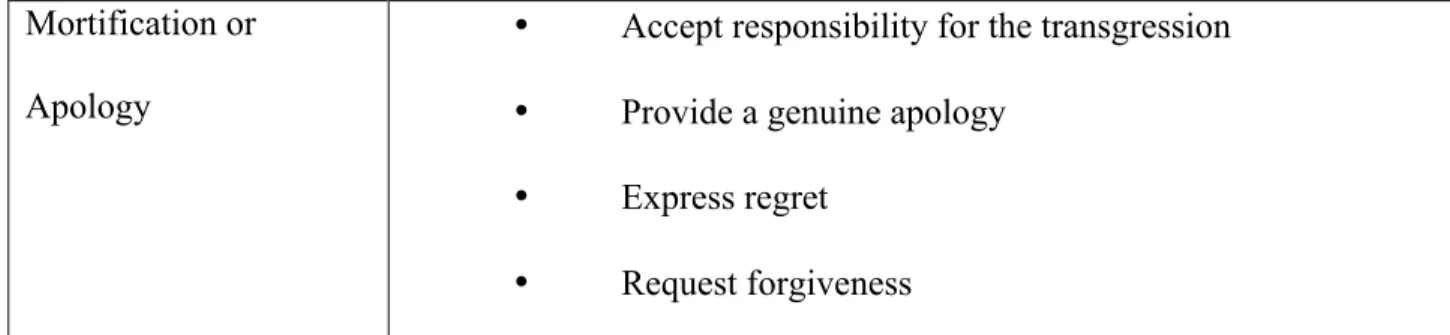
Image Restoration Theory offers five broad categories of image repair strategies, namely,
denial, evasion of responsibility, reducing offensiveness of event, corrective actions, and
mortification or apology for the act (Benoit, 1997). When using denial, an organization or a
government can either use simple denial by claiming that it did not perform the act, or shift the
blame by saying someone else is responsible. In evasion of responsibility, the organization or the
government can argue it was provoked and responded to the act of another, argue that the
incident happened due to a lack of information or ability, or claim that the event was an accident
or that it had good intentions. Organizations or governments can also try to reduce the
offensiveness of an act through bolstering (stressing its own good traits), minimization (the act is
not as serious as presented), differentiation (the act is not as offensive as other similar ones),
transcendence (there are more important considerations), attacking the accuser, or compensating
the victim. When using corrective action as an image repair strategy, the organization or the
government offers a plan to solve or prevent the problem from occurring again. The last strategy
in Image Repair Theory is mortification. When the communicative entity practices mortification,
Image Restoration Strategies – Benoit (1995) Strategy Possible Manifestations of the Strategy
Denial • Deny that an undesirable act occurred
• Shift blame for the crisis
Evasion of
Responsibility
• Claim that the organization was provoked into causing the
crisis
• Claim that the organization lacked sufficient information or
ability to prevent the crisis
• Cite an uncontrollable accident as the cause of the crisis
• Argue that the organization had the best of intentions (despite
the undesirable outcome)
Reducing the
offensiveness of the
event
• Cite the organization’s past good deeds
• Minimize the perceived magnitude of the negative feelings
attributed to the transgression
• Attack the accuser and discredit the accuser’s claims of injury
• Offer remuneration to the victims of the crisis in an effort to
reduce the perceived severity of the injury
Corrective action • Fix the root cause of the crisis
• Take steps to prevent a similar crisis from occurring in the
Table 1 – Selected image restoration strategies as described by Benoit (1995). Crisis Communication in Authoritarian Regimes
Scholars debate whether a uniform public relations theory could be established for global
public relations. Some researchers (Grunig, 2006; Lim, Goh & Sriramesh, 2005; Rhee, 2002;
Sriramesh & Vercic, 2003) proposed that the Excellence theory of public relations is the most-
effective and ethical practice to use globally. However, Kent and Taylor (2007) argued that the
culture is too complex in various parts of the world, and it is impossible to have one set of
principles for every public relations practice in the world.
Kent and Taylor (2007) claimed that the notion that there is a normative model of public
relations for understanding American and international public relations actually limits public
relations theory development. For them, whether or not an organization practices a two-way
symmetrical model of public relations is not essential to understanding the public relations
choices made by organizations in other countries or cultures. Because, they argued, in many
Eastern cultures, the way organizations communicate with their publics is different from the
practices in the United States.
Within a broad context of debates about global public relations scholarship, there are
some attempts to study if crisis communication theory and strategies, which are of western
product, could work in non-western societies too. Falkheimer and Heide (2009) argued that the
current multicultural context makes it difficult for traditional mass communication strategies and Mortification or
Apology
• Accept responsibility for the transgression
• Provide a genuine apology
• Express regret
messages to work, and, thus, crisis communication theory should now move closer to cultural
theory by focusing on publics as interpretive communities. They claimed that cultural theory
provides necessary tools to explain publics better than current crisis communication theories do
in a homogeneous western society.
There are some experimental studies (Chen, 2009; Landry & Stockmann, 2009; Lee,
2007; Xu, 2006) that tested the working of western crisis communication strategies in
non-western societies. For example, Xu (2006) analyzed how non-western multinational corporations in
China applied modern crisis communication strategies when they faced a crisis arising from
unhealthy ingredients found in their products. This study found that while some strategies
yielded a desired result, some others did not. The reason was due to differences in Chinese
culture. However, the author argued that because China is undergoing a rapid social change, it is
too early to deduct a conclusion based on these recent case studies about the relevancy of
western crisis communication strategies in China. That is why, he said, international public
relations research needs to be updated consistently by throwing away outdated knowledge and
perceptions to adapt to new developments.
Landry and Stockmann (2009) studied media effects during the Sichuan Earthquake of
China to see how crisis management works in an authoritarian regime. Even though the authors
did not directly refer to a western type of crisis communication as a comparison in their analyses,
they found that when the government followed the policy of information transparency, which is
an important variable in a crisis communication, it achieved the support of the public. The study
also acknowledged the importance of cultural factors in an overall government crisis
Similarly, Chen (2009) studied the Chinese government’s crisis communication during
the Sichuan earthquake to see how institutionalization of public relations could help the
government achieve its objectives. He found that Chinese government was successful in its
communication due to institutionalized public relations efforts. Unprecedented emphasis placed
on open, timely, and direct communication with the publics helped the government preserve and
enhance its image and reputation amid the crisis. The study also found that the Chinese
government adopted two-way asymmetrical model in its communication with the media and
publics, aiming to take control over the agenda building and issue framing. The Chinese
government employed different strategies and tactics that conform to western crisis
communication norms, and the communication was both persuasive and manipulative in nature.
The case studies that analyzed Chinese government’s crisis communication during
Sichuan earthquake seem to show that even authoritarian regimes like China can benefit from the
application of western crisis communication strategies. However, this case needs further
exploration in order to conclude whether western crisis communication strategies work in
authoritarian regimes without any modification. Whether rejection of western crisis
communication strategies by authoritarian governments would worsen the situation also needs
further evidence-based studies. These issues will be explored more in the next section of the
paper. What would be the case when western crisis strategies are ignored will be explained with
an example of another authoritarian regime, that is, Uzbekistan.
Andijan tragedy of 2005, even though much has been written and spoken about it, has
never been analyzed through the lens of western crisis communication strategies. So far, the
Uzbek government’s use of crisis communication plan and strategies were mainly discussed
The focus of all works on this topic was based on descriptive approach giving only the accounts
of what happened. There is no scholarly study that analyzed Uzbek government’s crisis
communication during and after the tragedy. Whether such regime could have launched a
successful crisis communication if western crisis communication strategies were applied, or
whether lack of accountability and transparency, which are core principles of modern crisis
communication theories, accounts for the failure of the government’s crisis communication has
not been studied. Such study is needed in order to broaden the current scholarly understanding of
crisis communication in authoritarian regimes. As briefly explained above, most literature that
analyzed authoritarian regimes’ crisis communication strategies mainly dealt with the crises that
were caused by natural disasters. Crisis escalated by the government involvement, which could
be an ideal example to test the working of western crisis communication theories in authoritarian
regimes and to deduct more generalizable conclusion to frame broader theoretical frameworks,
was never researched in crisis communication studies of authoritarian regimes. As such, this
study is important in that the analysis of the Uzbek government’s crisis communication during
and after the Andijan tragedy will contribute a valuable knowledge to crisis communication
scholarship in terms of both theoretical and practical applications of western crisis
CHAPTER IV
RESEARCH QUESTIONS AND METHOD Research questions
Based on the review of literature and theories of crisis communication and image
restoration, the following research questions will be addressed in this study:
1. What crisis communication strategies did the Uzbek government take during
Andijan tragedy of 2005?
2. What are the factors responsible for the failure of the government’s crisis
communication?
3. What opportunities for future research about crisis communication and image
restoration in authoritarian regimes are suggested by the case analysis of Uzbekistan?
Method
In this project, case study will be employed as a research method to assess internal and
external crisis communication efforts of Uzbek government during and after the Andijan tragedy.
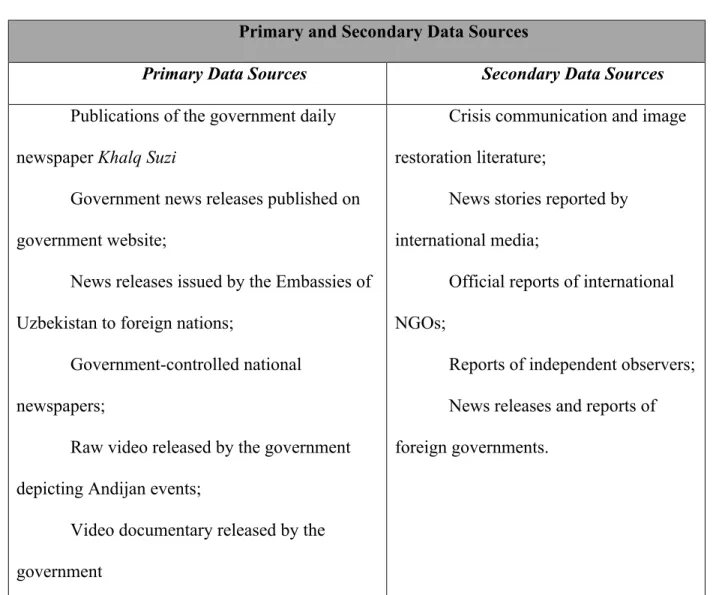
The case analysis will be conducted on the basis of primary and secondary data sources (See
Table 2).
As a research endeavor, the case study contributes uniquely to our understanding of
individual, organizational, social and political phenomena. The case study has been a common
research strategy in psychology, sociology, political science, business, social work and public
social phenomena. In brief, the case study allows an investigation to retain the holistic and
meaningful characteristics of real-life events (Yin, 1994).
The essence of a case study, the central tendency among all types of case study, is that it
tries to illuminate a decision or set of decisions: why they were taken, how they were
implemented, and with what result (Schramm, 1971). A case study is an empirical inquiry that
investigates a contemporary phenomenon within its real-life context, especially when the
boundaries between phenomenon and context are not clearly evident. The case study inquiry
relies on multiple sources of evidence, with data needing to converge in a triangulating fashion,
and as another result benefits from the prior development of theoretical propositions to guide
data collection and analysis. In other words, the case study as a research strategy comprises an
all-encompassing method – with the logic of design incorporating specific approaches to data
collection and to data analysis. In this sense, the case study is not either a data collection tactic or
merely a design feature alone (Stoecker, 1991) but a comprehensive research strategy.
For the purpose of this study, the case study method is the most suitable and relevant
because the case of Andijan tragedy is contemporary real-life event with complex nature that
requires analysis of multiple sources of evidence in a comparative manner in order to produce a
thorough assessment. As explained above, the case study as a comprehensive research method
can explain motives and context of any event beyond a mere exploratory purpose.
Data collected throughout the course of this case analysis include primary and secondary
materials (See Table 2). For primary sources, I analyzed the news releases of the government
distributed during the tragedy. These news releases were retrieved from the archive of the
releases reflect the Uzbek government’s immediate response and position towards the criticism
expressed by the U.S. and international human rights organizations. Textual content analysis was
conducted over the news stories of the government’s daily newspaper Khalq Suzi (People’s
word). Three-months archive of the newspaper was thoroughly scanned reviewing every story
that had mentioned Anijan tragedy. These materials were collected from the archive library of
Khalq Suzi during the author’s trip to Uzbekistan in 2010. Government’s crisis communication strategies were identified and framed mainly on the basis of the analysis of news releases and
newspaper stories.
Two videos depicting the tragic events were also reviewed in order to understand the real
picture of the tragedy. Even though they were edited versions released by the government, they
are relevant and valuable images that speak about, and explain, what really happened on that day.
I categorized all information released by the government as a primary source because
they are the only and the most useful material, through the analysis of which, the government’s
crisis communication strategies could be defined. To assess these strategies through the lens of
western crisis communication strategies, I relied on the secondary data, which comprise, first,
scholarly literature on crisis communication and image restoration theories, and then, NGOs’,
foreign governments’, independent observers’ and news media’s reports about the tragedy. By
analyzing and comparing both types of data, I critically assessed the Uzbek government’s crisis
communication and deducted conclusion summarizing the factors responsible for the failure of
the strategies employed by the government. At the end, I suggested several recommendations, if
properly followed, they could have been of practical help to reduce the reputational damage the
Primary and Secondary Data Sources
Primary Data Sources Secondary Data Sources
Publications of the government daily
newspaper Khalq Suzi
Government news releases published on
government website;
News releases issued by the Embassies of
Uzbekistan to foreign nations;
Government-controlled national
newspapers;
Raw video released by the government
depicting Andijan events;
Video documentary released by the
government
Crisis communication and image
restoration literature;
News stories reported by
international media;
Official reports of international
NGOs;
Reports of independent observers;
News releases and reports of
foreign governments.
CHAPTER V: CRISIS COMMUNICATION ASSESSMENT
Textual content analysis of the three-months archive of the daily newspaper Khalq Suzi,
the main mouthpiece of the government, revealed that the government persistently used the local
media to disseminate its side of story on Andijan tragedy. During the period from May 14 to
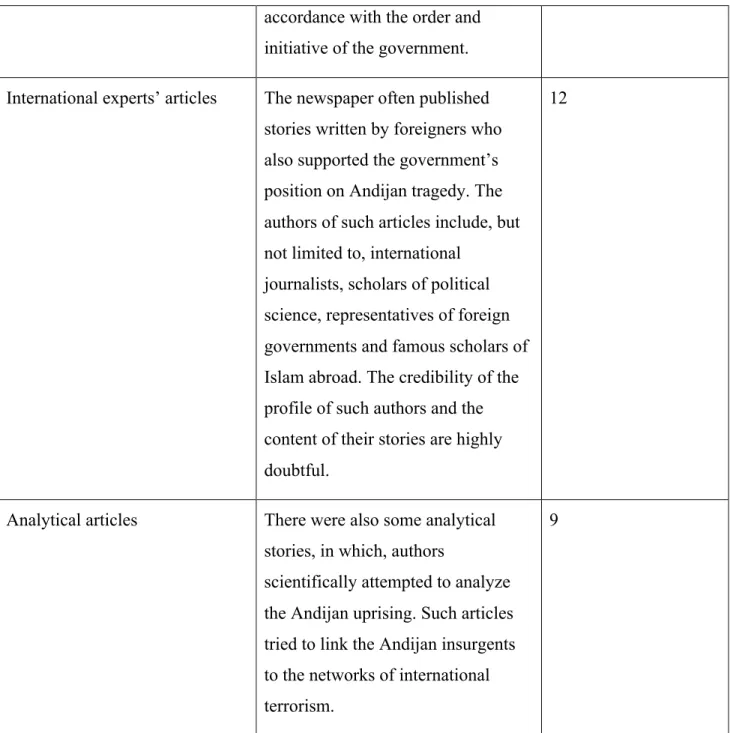
August 23, Khalq Suzi published 111 stories related to Andijan events. By the type of the story,
these stories were placed under the following categories (Table 3):
1. News releases: 27 stories;
2. President’s speeches: 3 stories;
3. President’s decrees: 3 stories;
4. Opinions: 47 stories;
5. International experts’ articles: 12 stories
6. Analytical articles: 9 stories.
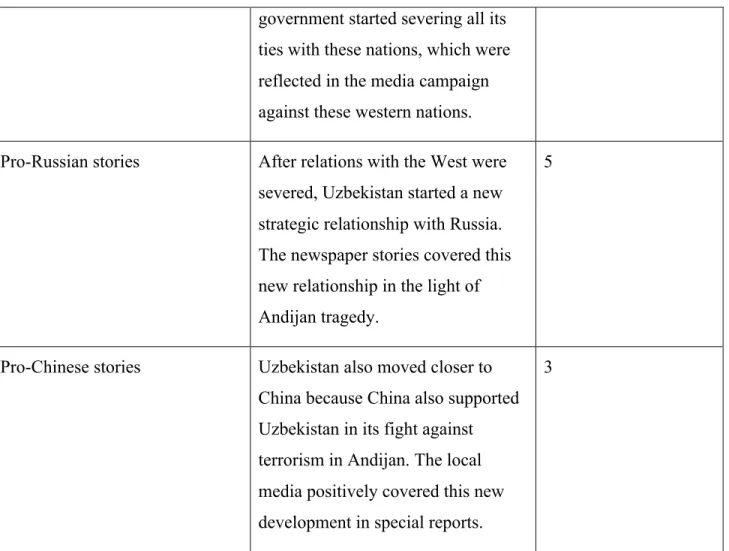
All articles and news stories blamed terrorists for killings. Not even was a singly story
found that attributed some level of responsibility to government forces. Based on the content, the
materials were further placed under the following six categories (Table 4):
1. Accounts of happenings: 22 stories;
2. Response of the local population: 45 stories
3. Response of the government to international criticism: 16 stories
4. Anti-American and anti-western stories: 10 stories;
The stories published at Khalq Suzi targeted mainly the local population. In order to give
an idea that foreign experts are also supporting the position of the government, articles written by
foreign nationals were also often published in the newspaper. Along with these stories, there
were anti-American and anti-western articles that condemned the critical positions of the U.S.
and the members of the EU as countries of double standard and hypocrisy. Also, the newspaper
published several articles that reflected the change in the country’s foreign policy. The stories
that reported about the support Russia and China showed towards the Uzbek government amid
Andijan tragedy explained why Uzbekistan had turned to Russia and China as its new strategic
allies. On the other hand, several stories reflected new tensions between Uzbekistan and the U.S.
and the EU, which meant that Uzbekistan had distanced itself from its traditional allies in “war
on terror”.
It is important to note that none of these stories are written independently by journalists on
their own initiatives. Since the media in the country are under a tight control of the government,
journalists cannot write about sensitive political issues and about foreign policy of the country
without the approval and guidance of the government. Especially, after Andijan tragedy, every
single piece about Andijan events that appeared on the local media came from the editors’ desk
of the government.
This was the case with all media outlets in the country. While local media like Khalq Suzi
published the government’s response to international criticisms, Ministry of Foreign Affairs and
Embassies of Uzbekistan to foreign nations, particularly the Embassy of Uzbekistan to the U.S.
issued special press releases against the critical reports of international human rights
organizations and governments. These reports intended for foreign audiences did not differ much
government produced and disseminated was that certain extremist elements, among which there
were foreign citizens, manipulated the local population of Andijan for their own political agenda
in order to create unrest in the region so that they could achieve their political goals in Ferghana
valley. The terrorists, as government reports said, were behind all killings that happened on that
day in Andijan.
As the government blamed terrorists for the tragedy in Andijan, the national mass media
was effectively used to disseminate government’s version of stories. The immediate actions
taken by the government after the tragedy to diminish the damages of the crisis can be
summarized under the following points:
q After the site of the tragedy was cleaned, several tours to Andijan were
organized for journalists as well as foreign groups, which included representatives of
diplomatic corps and international journalists.
q An independent parliamentary commission was set up to investigate the
events. As the government claims, the international community declined to participate in
the work of this commission.
q Under the direction of the government, national mass media continuously
condemned the events as terrorist acts. Several TV shows, documentaries and special
programs were aired, which depicted members of Akromiya as terrorists and the
responsible group for Andijan events.
q The president and General Prosecutor of Uzbekistan held several press
conferences, where international journalists participated and were presented with the
q The trial of Andijan events was held in public to convince the world that
there was nothing to hide from the public.
q The government republished, retransmitted and re-disseminated through
all available means the news and reports of international journalists and observers, whose
views were in accordance with the government’s position.
q A documentary movie about Andijan events was produced and presented
in many countries abroad.
q In international meetings, the Andijan events were repeatedly
characterized as the work of terrorists.
q The Internet was widely used to disseminate the government reports.
Government information portals such as Uza.uz, press-uz.info, jahon.mfa.uz continuously
published government press releases and reports on Andijan events.
q National Islamic scholars were quoted on mass media blaming terrorists
for the tragedy and labeling the Akromiya group outside the fold of Islam.
These strategies failed in general. Using Image Restoration theory as a lens, I will now
elaborate the government’s response strategies in detail. In sum, the image restoration strategies
applied with varying degrees of effect by the government include denial, evasion of
Types of stories published at Khalq Suzi from May 13 to August 23
Categories Definition of categories Number of stories
News releases After the tragedy, the government regularly issued news releases about new developments with regard to Andijan events. These included the initial accounts of what happened in Andijan and the results of
government investigation over the tragedy.
27
President’s speeches It is a common feature of Uzbek media that the full text of president’s official speeches is published in all national newspapers. This category includes the president’s speeches that are wholly or partly devoted to Andijan events.
3
President’s decrees These are official decrees issued by the President that are related to Andijan events.
3
Opinions The most published works on
Andijan tragedy were opinions written by citizens of various professions in Uzbekistan These are
accordance with the order and initiative of the government.
International experts’ articles The newspaper often published stories written by foreigners who also supported the government’s position on Andijan tragedy. The authors of such articles include, but not limited to, international
journalists, scholars of political science, representatives of foreign governments and famous scholars of Islam abroad. The credibility of the profile of such authors and the content of their stories are highly doubtful.
12
Analytical articles There were also some analytical stories, in which, authors
scientifically attempted to analyze the Andijan uprising. Such articles tried to link the Andijan insurgents to the networks of international terrorism.
9
Content of stories published at Khalq Suzi from May 13 to August 23
Categories Definition of categories Number of stories
Accounts of happenings All stories that gave only accounts of what happened in Andijan tragedy were placed under this category. They mainly included the
government press releases and news releases issued by the government information portal UzA.
22
Response of the local population The most published works on Andijan tragedy were responses of the citizens of Uzbekistan in the form of opinions. These are usually the stories written in accordance with the order and initiative of the government.
45
Response of the government to international criticism
There were stories written under the name of certain individuals, which reflected the position and response of the government towards
international criticism of the Uzbek government.
16
Anti-American and anti-western stories
After the U.S. and the EU harshly condemned the Uzbek government
government started severing all its ties with these nations, which were reflected in the media campaign against these western nations.
Pro-Russian stories After relations with the West were severed, Uzbekistan started a new strategic relationship with Russia. The newspaper stories covered this new relationship in the light of Andijan tragedy.
5
Pro-Chinese stories Uzbekistan also moved closer to China because China also supported Uzbekistan in its fight against terrorism in Andijan. The local media positively covered this new development in special reports.
3
Table 4 – Classification of publications at Khalq Suzi based on story content. The Government’s Image Repair Strategies
Image restoration theory is the main theoretical ground upon which this case study is
based. The strategies such as denial, evasion of responsibility, reducing offensiveness of event
and corrective actions applied by the Uzbek government are some of the principles that will be
elaborated in this theory. Image restoration theory offers five broad categories of image repair
strategies, namely, denial, evasion of responsibility, reducing offensiveness of event, corrective
actions and mortification or apology for act (Benoit, 1997). In this case study, the crisis response
of the Uzbek government was found to be fitting to the first four strategies, which are denial,
government did not use any strategy of mortification or compensation; however we also included
a sub-section to analyze apology because, in our opinion, not using mortification was in itself a
strategy.
Image Restoration theory suggests that the key to understanding image repair strategies is
to consider the nature of attacks or complaints that prompt such responses or instigate a crisis
(Benoit, 1997). An attack has two components:
1. The accused is held responsible for an action. 2. That act is considered offensive.
Identifying whether the corporation or the government is responsible for the crisis is
important to design a proper message in order to have effective crisis communication strategies.
The offensiveness degree of the act is also another important factor to consider. Benoit (1997)
argued that for both conditions, perceptions on the crisis are more important than reality. In the
example of Andijan tragedy, the perception most of the public held was that the government was
responsible for the tragedy, and offensiveness of the act was unprecedentedly high. That is why
Andijan tragedy was such a case in which positive image restoration was hardly possible to
achieve unless well-designed proper strategies were applied. In this situation, using the strategies
of denial and evasion of responsibility would not definitely bring any positive change other than
making the image of the government even worse. Since it appears that the government knew it
could not escape from the responsibility for the act, the government should have at least used
some strategies of mortification such as seeking apology from the victims. However, the Uzbek
government did not employ any of the aforementioned mortification strategies. Instead, it
continuously reiterated its innocence in the act denying and evading the responsibility for the
Denial
One general approach to image repair, with two variants, is denial. An
organization or a government may deny that the act occurred, or that the act was harmful to
anyone. In the case of Andijan tragedy, the government completely denied the fact that its forces
killed civilians.
A second form of denial is shifting the blame, arguing that another person or organization
is actually responsible for the offensive act. In Andijan case, the government has characterized
the Andijan events as an attempt by terrorists, motivated by an Islamist agenda and supported by
foreigners, to seize power in Andijan. (BBC News, 2005) It has attributed all the deaths to the
gunmen and in public has not explicitly acknowledged any casualties caused by government
forces.
The government rejects characterizing the gathering on Bobur Square as a protest. In his
statement to the press on May 19, President Karimov said that after gunmen seized the weapons
and conducted the prison break, they gathered people at the hokimiyat “and used them as human
shields.” (Uzbek Television First Channel in Uzbek, 2005). President Karimov also said that
people were promised up to $3,000 US dollars to go Bobur Square (BBC News, 2005).
President Karimov said that he personally went to Andijan to set up headquarters,
consulted with local leaders, and sought to establish contact with the gunmen. The Minister of
Internal Affairs, Zokirjon Almatov, was then tasked with negotiating with the gunmen (Uzbek
Television First Channel in Uzbek, 2005). As Karimov said at the press conference, the
negotiations continued for the whole day until 5:00 p.m. when the gunmen rejected the last
government proposal that would allow them to leave the country. They left the Hokimiyat
said that after the gunmen left the Hokimiyat building, at about 7:40 p.m., government forces
“pursued” them, and indicated that government forces fired only in response to gunfire from the
gunmen. (Uzbek Television First Channel in Uzbek, 2005).
Evasion of responsibility
Evasion of responsibility has four versions. An organization or a government can say that
its act was merely a response to another's offensive act, and that the behavior can be seen as a
reasonable reaction to that provocation. For example, a company might claim that it moved its
plant to another state because the first state passed a new law reducing its profit margin. The
Uzbek government claimed that its forced started shooting only after the alleged terrorists fired
against them using the civilians as a shield.
Another specific form of evading responsibility is defeasibility. In such case, the
organization or the government alleges there was a lack of information about or control over
important elements of the situation. For instance, a busy executive who missed an important
meeting could claim that he was never told that the meeting had been moved up a day. If true,
the lack of information excuses the absence. In Andijan case, the government said that after all
attempts to negotiate failed, unexpectedly, insurgents started shooting, after which the
government had to exchange fires.
A third option is to claim that the offensive action occurred by accident. If the company
or the government can convince the audience that the act in question happened accidentally, it
should be held less accountable, and the damage to that business or organization’s image should
be reduced. For the Uzbek government, Andijan tragedy was an incident, for which terrorists
yet insurgents wanted the bloodshed to happen because they wanted the scene to be seen as if the
Uzbek government was killing its citizens.
Fourth, the organization or the government can suggest that the offensive behavior was
performed with good intentions. In the case of Andijan tragedy, we could not find any
information for this specific type of evasion of responsibility.
After the Andijan tragedy, in several public statements, President Karimov blamed the
violence on Islamic extremist groups and particularly “Hizb-ut-Tahrir”. In his press conference
on May 14, 2005, he said that the unrest was led by “fanatic and extremist groups” who were
trying to repeat in Uzbekistan the political upheaval that had taken place in Kyrgyzstan in March
2005. Regarding the participation of foreigners, the president said that some of the gunmen and
their weapons came from abroad. He also said “. . . Without help from outside, without foreign
sponsors, they would not be able to commit such a crime. And without the funds they would not
have been able to organize their action.” (BBC News, 2005).
The government denied that military or internal affairs troops shot at fleeing protesters,
and attributed most of the deaths to the gunmen. Minister Almatov told diplomats and journalists
visiting Andijan on May 18 that “the extremists. . .forced their way through the ring of law
enforcement bodies using women and children as a cover. The terrorists shot down dozens of
peaceful people, including three ambulance doctors going by.” (UzReport.com, 2005). As such,
the government, in its every official statement, evaded the responsibility for the tragedy.
Reducing offensiveness of event
A government that is accused of wrongful actions usually tries to reduce the perceived
First, a government may use bolstering to strengthen the audience's positive feelings
towards itself, in order to offset the negative feelings connected with the wrongful act. An
organization or a government may describe positive characteristics they have or positive acts
they have done in the past. These sentiments, if accepted, should bolster its image and offset
damage to its reputation. With its bad record of human right violations, the Uzbek government
could not reduce the offensiveness of Andijan tragedy on the basis of this version of strategy.
A second possibility is to try to minimize the negative feelings associated with the
wrongful act. This statement works to minimize the apparent problem. This is exactly what the
Uzbek government did in in its crisis communication. While independent observers and reports
of international NGOs counted the number of dead bodies near 1000, the government’s death toll
was only 187.
Third, a government can employ differentiation, in which the act is distinguished from
other similar but more offensive actions. The Uzbek government tried to label the tragedy as a
terrorist act and never called the gathering as a peaceful demonstration of the local population.
A fourth way of reducing offensiveness is transcendence, which attempts to place the act
in a more favorable context. A company or a government could claim that the benefits in an
offensive act might be more than harms.
Fifth, those accused of wrongdoing may decide to attack their accusers. This was the
most-used strategy of the Uzbek government against the accusers. It attacked everyone who
criticized the government’s handling of the Andijan uprising.
Compensation is the final form of reducing offensiveness. If it is acceptable to the victim,