Antagonism of dsRNA-Induced Innate Immune Pathways by
NS4a and NS4b Accessory Proteins during MERS Coronavirus
Infection
Courtney E. Comar,
aStephen A. Goldstein,
aYize Li,
aBoyd Yount,
b,cRalph S. Baric,
b,cSusan R. Weiss
aaDepartment of Microbiology, Perelman School of Medicine at the University of Pennsylvania, Philadelphia, Pennsylvania, USA
bDepartment of Epidemiology, University of North Carolina at Chapel Hill, Chapel Hill, North Carolina, USA
cDepartment of Microbiology and Immunology, University of North Carolina at Chapel Hill, Chapel Hill, North Carolina, USA
CitationComar CE, Goldstein SA, Li Y, Yount B, Baric RS, Weiss SR. 2019. Antagonism of dsRNA-induced innate immune pathways by NS4a and NS4b accessory proteins during MERS coronavirus infection. mBio 10:e00319-19. https://doi.org/10.1128/mBio.00319-19.
EditorPeter Palese, Icahn School of Medicine at Mount Sinai
Copyright© 2019 Comar et al. This is an open-access article distributed under the terms of theCreative Commons Attribution 4.0 International license.
Address correspondence to Susan R. Weiss, [email protected]. C.E.C. and S.A.G. contributed equally to this article.
This article is a direct contribution from a Fellow of the American Academy of Microbiology. Solicited external reviewers: Stanley Perlman, University of Iowa; Brenda Hogue, Arizona State University.
Received4 February 2019
Accepted13 February 2019
Published26 March 2019 ABSTRACT
Middle
East
respiratory
syndrome
coronavirus
(MERS-CoV)
was
first
identified
in
2012
as
a
novel
etiological
agent
of
severe
respiratory
disease
in
hu-mans.
As
during
infection
by
other
viruses,
host
sensing
of
viral
double-stranded
RNA
(dsRNA)
induces
several
antiviral
pathways.
These
include
interferon
(IFN),
oli-goadenylate
synthetase
(OAS)-RNase
L,
and
protein
kinase
R
(PKR).
Coronaviruses,
in-cluding
MERS-CoV,
potently
suppress
the
activation
of
these
pathways,
inducing
only
modest
host
responses.
Our
study
describes
the
functions
of
two
accessory
pro-teins
unique
to
MERS-CoV
and
related
viruses,
NS4a
and
NS4b,
during
infection
in
human
airway
epithelium-derived
A549
cells.
NS4a
has
been
previously
characterized
as
a
dsRNA
binding
protein,
while
NS4b
is
a
2
=
,5
=
-phosphodiesterase
with
structural
and
enzymatic
similarity
to
NS2
encoded
by
mouse
hepatitis
virus
(MHV).
We
found
that
deletion
of
NS4a
results
in
increased
interferon
lambda
(
IFNL1
)
expression,
as
does
mutation
of
either
the
catalytic
site
or
nuclear
localization
sequence
of
NS4b.
All
of
the
mutant
viruses
we
tested
exhibited
slight
decreases
in
replication.
We
previously
reported
that,
like
MHV
NS2,
NS4b
antagonizes
OAS-RNase
L,
but
sup-pression
of
IFN
is
a
previously
unidentified
function
for
viral
phosphodiesterases.
Unexpectedly,
deletion
of
NS4a
does
not
result
in
robust
activation
of
the
PKR
or
OAS-RNase
L
pathways.
Therefore,
MERS-CoV
likely
encodes
other
proteins
that
contribute
to
suppression
or
evasion
of
these
antiviral
innate
immune
pathways
that
should
be
an
important
focus
of
future
work.
This
study
provides
additional
insight
into
the
complex
interactions
between
MERS-CoV
and
the
host
immune
response.
IMPORTANCE
Middle
East
respiratory
syndrome
coronavirus
(MERS-CoV)
is
the
second
novel
zoonotic
coronavirus
to
emerge
in
the
21st
century
and
cause
out-breaks
of
severe
respiratory
disease.
More
than
2,200
cases
and
800
deaths
have
been
reported
to
date,
yet
there
are
no
licensed
vaccines
or
treatments.
Corona-viruses
encode
unique
accessory
proteins
that
are
not
required
for
replication
but
most
likely
play
roles
in
immune
antagonism
and/or
pathogenesis.
Our
study
describes
the
functions
of
MERS-CoV
accessory
proteins
NS4a
and
NS4b
during
infection
of
a
human
airway-derived
cell
line.
Loss
of
these
accessory
proteins
during
MERS-CoV
infection
leads
to
host
antiviral
activation
and
modestly
atten-uates
replication.
In
the
case
of
both
NS4a
and
NS4b,
we
have
identified
roles
during
infection
not
previously
described,
yet
the
lack
of
robust
activation
sug-gests
much
remains
to
be
learned
about
the
interactions
between
MERS-CoV
and
the
infected
host.
M
iddle East respiratory syndrome coronavirus (MERS-CoV) is a recently emerged,
highly pathogenic coronavirus first identified in the Middle East in 2012 (1, 2).
Following
the
2002
to
2003
severe
acute
respiratory
syndrome
(SARS)-CoV
pandemic,
MERS-CoV
is
the
second
zoonotic
coronavirus
discovered
in
the
21st
century.
Although
cases
have
been
largely
concentrated
on
the
Arabian
Peninsula,
a
large
travel-associated
outbreak
in
South
Korea
in
2015
highlights
that
MERS-CoV
remains
a
global
concern.
MERS-CoV
circulates
in
dromedary
camels
in
Africa
and
the
Middle
East,
having
established
a
reservoir
in
camels,
while
closely
related
viruses
are
found
in
African
bats,
suggesting
a
bat
origin
for
MERS-CoV
or
its
direct
ancestors
(3–8).
Like
all
coronaviruses,
MERS-CoV
has
a
large
positive-sense
single-stranded
RNA
(ssRNA)
genome
of
30,119
nucleotides
in
length.
The
5
=
two-thirds
of
the
genome
encodes
the
functionally
conserved
replicase
proteins,
while
a
core
set
of
structural
proteins
are
encoded
by
all
viruses
of
the
Betacoronavirus
genus
in
the
3
=
10
kb.
Additionally
found
in
the
3
=
end
of
the
genome
are
accessory
genes
specific
to
each
Betacoronavirus
subgenus,
interspersed
with
structural
genes.
The
MERS-CoV
accessory
genes
are
found
only
in
other
betacoronaviruses
of
the
subgenus
Merbecovirus
(for-merly
lineage
C),
while
betacoronaviruses
of
other
subgenera
such
as
mouse
hepatitis
virus
(MHV)
(
Embecovirus
[lineage
A])
and
SARS-CoV
(
Sarbecovirus
[lineage
B])
carry
unique
accessory
genes.
Several
accessory
proteins
encoded
by
MHV
and
SARS-CoV
have
been
identified
as
antagonists
of
the
innate
immune
response
(9),
as
have
some
MERS-CoV
accessory
proteins
(10–14).
Several
studies
utilizing
ectopically
expressed
protein
and
reporter
systems
have
identified
NS4a,
NS4b,
and
NS5
as
putative
interferon
(IFN)
antagonists,
but
these
studies
may
not
faithfully
recapitulate
the
complex
interactions
between
viral
and
host
factors
present
during
infection
(11,
13,
15–17).
More
recent
studies
utilizing
recombinant
MERS-CoV
have
more
completely
elucidated
the
functions
of
some
of
these
proteins,
but
conflicted
with
early
reporter
studies.
NS4a,
a
double-stranded
RNA
(dsRNA)
binding
protein,
prevents
the
generation
of
protein
kinase
R
(PKR)-induced
stress
granules
in
some
cell
types
(18).
We
reported
previously
that
NS4b
is
a
homolog
of
the
NS2
protein
of
MHV
and
closely
related
betacoronaviruses
of
the
subgenus
Embecovirus
(formerly
lineage
A),
has
2
=
,5
=
-phosphodiesterase
(PDE)
activity,
and
acts
as
an
antagonist
of
the
oligoadenylate
synthetase
(OAS)-RNase
L
pathway
(19).
In
contrast
to
the
Embecovirus
PDEs,
NS4b
has
an
N-terminal
nuclear
localization
signal
(NLS)
and
is
localized
primarily
to
the
nucleus
of
infected
cells
(16,
19).
NS4b
has
also
been
reported
to
antagonize
NF-
B
nuclear
translocation
during
MERS-CoV
(12,
14,
18,
19),
as
has
NS5
(10).
Building
on
our
previous
study
characterizing
NS4b
as
an
OAS-RNase
L
antagonist
(19),
we
have
used
recombinant
MERS-CoV
to
further
elucidate
the
roles
of
NS4a
and
NS4b
during
infection
of
human
airway
epithelium-derived
A549
cells
(20).
Consistent
with
earlier
studies,
NS4a
prevents
phosphorylation
of
PKR
and
the
induction
of
IFN
and
interferon-stimulated
gene
(ISG)
expression.
However,
PKR
activation
in
the
absence
of
NS4a
does
not
result
in
phosphorylation
of
eIF2
␣
(eukaryotic
initiation
factor
2
␣
) or
translation
arrest
in
A549
cells,
in
contrast
to
recent
findings
in
a
different
cell
type
(18).
Unlike
other
viral
dsRNA
binding
proteins
such
as
vaccinia
virus
E3L
(21)
and
influenza
virus
NS1
(22),
NS4a
does
not
play
a
significant
role
in
OAS-RNase
L
antagonism
during
MERS-CoV
infection,
as
deletion
of
NS4a
does
not
result
in
RNase
L
activation
or
enhance
RNase
L
activation
in
the
context
of
MERS-CoV
encoding
catalytically
inactive
NS4b.
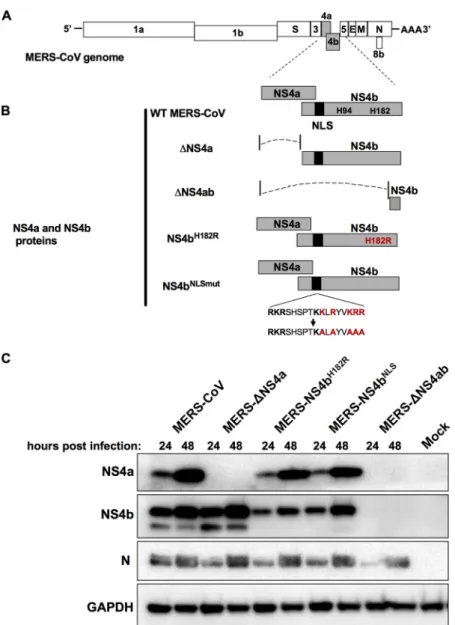
FIG 1 MERS-CoVNS4aandNS4brecombinantmutants.(A)MERS-CoVgenomeRNAwithopenreading framesshown.(B)NS4aandNS4bproteinsexpressedbywild-typeandmutantMERS-CoVs.Thecatalytic HisresiduesofthePDEareshown,andtheverticalblackbarindicatestheNLSofNS4b;theredlettering indicatesaminoacidsubstitutionsofthecatalyticHisresidueandwithintheNLS.(C)Expressionofviral proteinsfromrecombinantMERS-CoVviruses.A549DPP4cellswereinfectedatanMOIof10withWT MERS-CoV,MERS-ΔNS4a,MERS-ΔNS4ab, MERS-NS4bH182R,orMERS-NS4bNLSmutormockinfected.Cell lysateswerepreparedat24and48hpostinfection,analyzedbySDS-PAGE,andprobedbyWestern blottingwithrabbitantiserumagainstNS4aandNS4bormousemonoclonalantibodiesagainstMERS nucleocapsid protein (N)andGAPDH. TheWesternblot dataarefromonerepresentativeof three independentinfections.
of
infection
to
uncover
the
full
range
of
their
interactions
with
the
innate
immune
response.
RESULTS
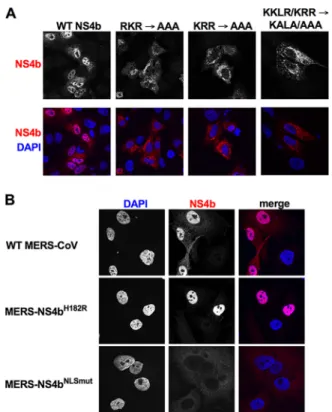
FIG 2 SubcellularlocalizationofMERS-CoVNS4bexpression.(A)Thenuclearlocalizationsignal(NLS)was mappedbymutatingbasicresiduesinpCAGGS-NS4b,andNS4bwasectopicallyexpressedinA549cells byDNAtransfection.Twenty-fourhoursposttransfection,cellswerefixedandstainedforNS4busing anti-NS4brabbitserumandgoatanti-rabbitAF594secondaryantibody.(B)A549DPP4cellswereinfected withWTMERS-CoV,MERS-NS4bH182R,orMERS-NS4bNLSmut(MOI⫽5).Cellswerefixed24hpostinfection andstainedwithanti-NS4brabbitserumandgoatanti-rabbitAF594secondaryantibody.Theimages shown inboth panelsare representative of at least three fields of cells fromthree independent experiments.
NS4a
protein.
MERS-ΔNS4ab
was
generated
by
engineering
a
951-nucleotide
deletion
of
open
reading
frame
4a
(ORF4a)
and
the
majority
of
ORF4b
without
disrupting
the
transcription
regulatory
sequence
(TRS)
of
NS5.
To
verify
the
loss
of
NS4b
and/or
NS4a
expression
by
these
mutants,
human
A549
cells
stably
expressing
the
MERS-CoV
receptor
DPP4
(A549
DPP4)
were
infected
with
MERS-CoV
mutants
at
a
multiplicity
of
infection
(MOI)
of
10,
and
protein
lysates
were
harvested
at
24
and
48
h
postinfection
(hpi)
to
assess
protein
expression
by
Western
blotting.
As
expected,
NS4a
is
not
synthesized
during
infection
with
MERS-ΔNS4a,
and
neither
protein
is
detectable
during
MERS-ΔNS4ab
infection
(Fig.
1C).
To
further
investigate
the
functional
domains
of
NS4b,
we
utilized
two
mutant
viruses
with
targeted
mutations
in
either
the
phosphodiesterase
domain
or
the
NLS.
MERS-NS4b
H182Rencodes
NS4b
with
a
catalytically
inactive
phosphodiesterase
domain,
which
was
generated
from
the
MERS-CoV
infectious
clone
as
previously
described
(19,
27).
The
NS4b
NLS
was
previously
described
as
bipartite
(RKR
11KRR),
with
the
first
basic
motif
more
potently
determining
nuclear
localization
(12,
16).
However,
this
first
motif
overlaps
with
the
upstream
ORF4a,
and
so
mutation
of
the
RKR
motif
without
causing
amino
acid
changes
in
ORF4a
is
impossible.
To
determine
how
to
construct
the
NS4b
NLS
mutant
(NS4b
NLSmut),
we
mapped
the
nuclear
localization
signal
(NLS)
sequence
by
expressing
wild-type
(WT)
and
various
NLS
mutant
NS4b
genes
from
a
pCAGGS
vector
in
A549
cells
and
detecting
NS4b
proteins
by
immunofluorescent
staining
(Fig.
2A).
These
plasmids
expressed
NS4b
proteins
with
mutations
of
the
RKR
motif,
the
down-stream
KRR
motif,
and
a
previously
undescribed
basic
motif
that
lies
between
the
two
previously
characterized
motifs
(RKR
5KKLR
2KRR).
All
mutant
proteins
exhibited
primarily
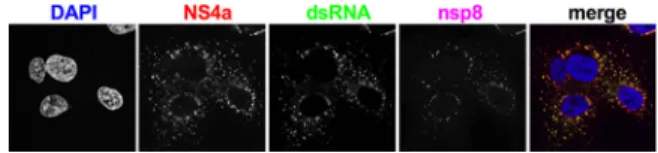
FIG 3 NS4acolocalizeswithdsRNAaroundreplication/transcriptioncomplexes(RTC)duringMERS-CoV infection.A549DPP4cells were infectedwithWTMERS-CoV(MOI⫽5),fixed 24h postinfection,and stainedwithrabbitanti-NS4aserum,mouseanti-dsRNAJ2,andguineapiganti-nsp8serumandthen withsecondaryantibodiesgoatanti-rabbitAF647,goatanti-mouseAF488,andgoatanti-guineapig AF568.Theimagesshownarerepresentativeofatleastthreefieldsofcellsfromthreeindependent experiments.
downstream
(KRR)
motifs
into
the
MERS-CoV
infectious
clone
to
generate
MERS-NS4b
NLSmut(Fig.
1B),
as
described
in
detail
in
Materials
and
Methods
(27).
While
NS4b
expressed
during
MERS-CoV
infection
is
primarily
expressed
in
the
nucleus,
during
infection
with
MERS-NS4b
NLSmut,
NS4b
exhibits
predominantly
cyto-plasmic
localization,
as
expected
(Fig.
2B).
During
infection
with
MERS-NS4b
H182Rand
MERS-NS4b
NLSmut,
slightly
less
NS4b
was
synthesized
than
during
wild-type
(WT)
MERS-CoV
infection
(Fig.
1C),
consistent
with
previous
studies
of
viral
PDEs
in
which
expression
of
mutant
protein
was
less
robust
than
expression
of
wild-type
protein
(19).
We
consistently
detected
an
extra
lower
band
when
probing
for
NS4b.
This
will
be
addressed
in
the
Discussion.
NS4a
colocalizes
with
dsRNA
around
RTCs.
Previous
studies
have
shown
that
overexpressed
NS4a
binds
to
dsRNA
(13,
17).
Additionally,
NS4a
is
broadly
cytoplasmic
when
overexpressed
in
uninfected
cells,
but
colocalizes
with
dsRNA
during
infection
(11–13).
We
infected
A549
DPP4cells
with
MERS-CoV
and
used
immunofluorescent
microscopy
to
determine
NS4a
localization.
NS4a
exhibits
a
primarily
punctate,
peri-nuclear
distribution
with
some
diffuse
distribution
in
the
cytoplasm
(Fig.
3).
Cells
were
costained
for
NS4a
with
J2
antibody
to
detect
dsRNA
and
antiserum
against
the
viral
primase,
nsp8,
a
component
of
the
viral
polymerase
complex
and
therefore
a
marker
for
virus
replication/transcription
complexes
(RTCs)
(28).
NS4a
colocalizes
with
dsRNA,
and
both
are
largely
colocalized
with
nsp8,
though
dsRNA
and
NS4a
appear
more
broadly
distributed
(Fig.
3).
This
may
indicate
that
either
some
dsRNA
and
NS4a
localized
outside
the
RTC
or
the
sensitivity
of
the
assay
is
insufficient
to
detect
all
of
the
nsp8.
NS4a
and
NS4b
deletion
mutants
are
modestly
attenuated
in
A549
DPP4cells.
To
assess
the
impact
of
NS4a
and
NS4b
mutation
on
viral
replication,
we
carried
out
growth
curve
experiments
in
Vero
and
A549
DPP4cells
with
MERS-ΔNS4a
and
MERS-ΔNS4ab.
Vero
cells
lack
a
type
I
IFN
response
and
were
used
to
ensure
recombinant
viruses
are
not
inherently
replication
deficient.
We
infected
both
cell
types
with
WT
or
mutant
MERS-CoV
at
an
MOI
of
1
and
harvested
supernatant
at
predetermined
times
postinfection
for
titration
by
plaque
assay.
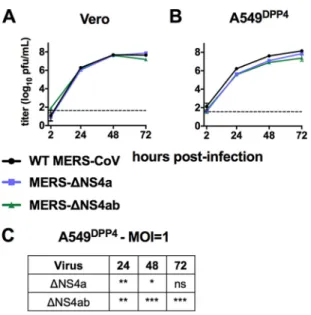
All
viruses
replicated
with
equivalent
kinetics
to
WT
MERS-CoV
and
to
equal
titers
in
Vero
cells,
indicating
that
deletion
of
NS4a
and
NS4b
does
not
disrupt
critical
aspects
of
the
viral
life
cycle
(Fig.
4A).
In
contrast,
deletion
of
NS4a
and/or
NS4b
modestly
attenuated
MERS-CoV
replication
in
A549
DPP4cells
at
an
MOI
of
1,
with
the
reductions
in
titer
significant
at
most
time
points
(Fig.
4B
and
C).
Deletion
of
both
NS4a
and
NS4b
resulted
in
a
slightly
greater
attenuation
than
deletion
of
NS4a
alone,
though
this
difference
was
not
statistically
significant.
That
replication
of
these
mutant
viruses
is
attenuated
in
A549
DPP4cells
and
not
in
permissive
Vero
cells
strongly
suggests
that
the
deficiency
is
linked
to
the
intact
antiviral
responses
in
A549
cells.
NS4a
and
NS4b
modestly
suppress
IFN
expression.
Previous
studies
of
NS4a
and
NS4b
have
conflicted
on
the
role
of
these
proteins
in
suppressing
the
IFN
response
(11–14,
15,
18).
We
aimed
to
systematically
characterize
the
role
of
NS4a
and
NS4b
in
antagonism
of
IFN
induction
during
MERS-CoV
infection.
To
ensure
that
our
newly
generated
A549
DPP4cells
were
a
suitable
platform
for
investigating
MERS-CoV
and WT MERS-CoV. In contrast to SeV and SINV, which robustly induced IFN and ISG
expression by 12 hpi, MERS-CoV induced little
IFNL1
or
IFNB
expression throughout a
36-h course of infection (Fig. 5A and B).
FIG 4 MERS-CoV NS4a and NS4b mutants are attenuated in IFN competent cells. (A) Vero cells were infected in triplicate at an MOI of 1 with WT MERS-CoV, MERS-ΔNS4a, and MERS-ΔNS4ab. Supernatants were collected at indicated times postinfection, and infectious virus was quantified by plaque assay. (B) A549DPP4 cells were infected in triplicate at an MOI of 1 with WT MERS-CoV, MERS-ΔNS4a, and MERS-ΔNS4ab, and replication was quantified as in panel A. (C) Statistical significance for mutant virus replication versus WT was calculated by two-way ANOVA. Data are from one representative of three independent experiments. In panel A, the 72-h postinfection data point was only assessed in one out of three experiments. Data are displayed as means⫾standard deviation (SD).*,Pⱕ0.05;**,Pⱕ0.01;***,
Pⱕ0.001;****,Pⱕ0.0001.
To
determine
if
NS4a
and/or
NS4b
contributes
to
suppression
of
IFN
expression,
we
infected
A549
DPP4cells
with
WT
MERS-CoV,
MERS-ΔNS4a,
and
MERS-ΔNS4ab
and
at
24
and
36
h
postinfection
compared
gene
expression
of
IFN
and
selected
ISGs
by
quan-titative
real-time
PCR
(qRT-PCR).
In
contrast
to
the
minimal
increases
observed
during
WT
MERS-CoV
infection
over
mock-infected
cells,
MERS-ΔNS4a
or
MERS-ΔNS4ab
infec-tion
resulted
in
significantly
elevated
levels
of
IFNL1
mRNA
and
representative
ISG
OAS2
and
IFIT2
mRNAs.
Interestingly
there
was
no
significant
induction
of
type
I
IFN
(Fig.
5C).
We
did
not
observe
any
significant
additive
effect
on
antiviral
gene
expression
from
the
additional
deletion
of
NS4b.
However,
deletion
of
ORF4a
and/or
-b
(Fig.
5C)
did
not
result
in
IFN
induction
approaching
the
levels
we
observed
in
response
to
SeV
and
SINV
infection
(Fig.
5B),
suggesting
MERS-CoV
encodes
additional,
potent
IFN
antagonists
and/or
utilizes
other
mechanisms
such
as
sequestration
of
dsRNA
in
membrane-bound
RTCs
to
avoid
sensing
by
antiviral
receptors.
NS4b
is
a
novel
IFN
antagonist.
We
previously
reported
that
MERS-CoV
NS4b
is
a
member
of
the
2H-phosphoesterase
superfamily
of
proteins
and
antagonizes
OAS-RNase
L
activation
during
MERS-CoV
infection
through
its
2
=
,5
=
-PDE
activity
(19,
29).
Unlike
previously
studied
viral
PDEs
such
as
mouse
hepatitis
virus
(MHV)
NS2,
the
torovirus
pp1a
C-terminal
domain,
and
the
rotavirus
VP3
C-terminal
domain,
which
exhibit
primarily
cytoplasmic
localization
(23,
24),
NS4b
localizes
primarily
to
the
nucleus
(Fig.
2B),
suggesting
additional
functions.
Earlier
studies
suggested
that
NS4b
nuclear
localization
might
be
important
for
suppressing
IFN
expression
(15),
but
no
previous
studies
have
specifically
addressed
the
role
of
its
catalytic
activity
in
IFN
antagonism
(30).
To
characterize
the
function
of
the
NS4b
PDE
domain
and
NLS,
we
used
recombinant
MERS-NS4b
H182Rand
MERS-NS4b
NLSmut.
In
Vero
cells,
both
mutant
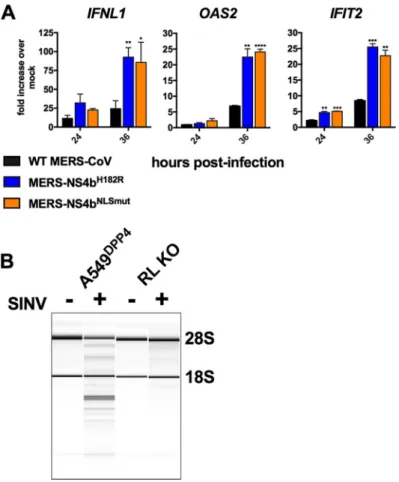
FIG 5 NS4aandNS4bantagonizeIFNexpression.(A)A549DPP4cellsweremockinfectedorinfectedin triplicatewithWTMERS-CoVatanMOIof5.RNAwasharvested,andgeneexpressionwasquantifiedby qRT-PCRandexpressedasfoldchangeovermockinfectedusingthe2⫺Δ(ΔCT)formula.(B)A549DPP4cells wereinfectedintriplicatewithSeVorSINVatanMOIof5,andat12hpostinfection,expressionofthe indicatedgenesininfected/mock-infectedcellswascalculatedasinpanelA.(C)A549DPP4cellswere mockinfectedorinfectedintriplicatewithWTMERS-CoV,MERS-ΔNS4a,andMERS-ΔNS4abatanMOIof 5andRNAwasharvestedattheindicatedtimespostinfection.IFNL1,IFNB,OAS2,andIFIT2 mRNAlevels werequantifiedbyqRT-PCRandcalculatedovermock-infectedcellsasinpanelA.Dataarefromone representativeofthreeindependentexperimentsandaredisplayedasmeans⫾standarderrorsofthe mean(SEM).StatisticalsignificancewascalculatedbyunpairedStudent’st test:*,P ⱕ0.05;**,P ⱕ0.01;
***,P ⱕ0.001;****,P ⱕ0.0001.
at
an
MOI
of
1,
and
throughout
the
course
of
infection
at
an
MOI
of
0.1
where
two
out
of
three
independent
experiments
yielded
significant
differences
(Fig.
6B
and
C).
qRT-PCR
analysis
demonstrated
that
mutation
of
either
the
catalytic
site
or
NLS
results
in
significantly
increased
IFN
and
ISG
expression
during
MERS-CoV
infection
(Fig.
6D).
To
further
investigate
whether
PDE-dependent
IFN
antagonism
is
unique
to
MERS-CoV
NS4b,
we
infected
A549
cells
stably
expressing
the
MHV
receptor
CEACAM-1
(A549
mCEACAM-1)
with
WT
MHV
or
MHV
encoding
catalytically
inactive
NS2
(MHV-NS2
H126R),
its
native
PDE.
Both
viruses
induced
slightly
more
IFNL1
expression
than
we
observed
for
MERS-CoV,
but
MHV-NS2
H126Rdid
so
to
an
identical
degree
as
WT
MHV
(Fig.
6E),
demonstrating
that
the
MHV
PDE
does
not
antagonize
IFN
induction
in
this
cell
type,
consistent
with
our
previous
observation
in
murine
cells
(31).
Finally,
to
confirm
that
NS4b
antagonism
of
IFN
expression
is
a
novel
viral
PDE
function
and
uncoupled
from
its
interaction
with
the
OAS-RNase
L
pathway,
we
assessed
immune
activation
by
MERS-CoV
and
NS4b
mutants
in
A549
DPP4cells
ablated
of
RNase
L
expression
by
CRISPR-Cas9
(i.e.,
clustered
regularly
interspaced
short
palin-dromic
repeats
with
Cas9)
as
previously
described
(32).
Both
MERS-NS4b
H182Rand
MERS-NS4b
NLSmutinduced
greater
IFNL1
,
OAS2
,
and
IFIT2
expression
than
WT
MERS-CoV
(Fig.
7A)
in
RNase
L
knockout
(KO)
cells,
recapitulating
the
results
we
observed
in
wild-type
A549
DPP4cells.
To
confirm
that
these
cells
were
indeed
unable
to
activate
RNase
L,
cells
were
infected
with
SINV,
a
known
potent
activator
of
OAS-RNase
L
(32),
and
rRNA
integrity
was
analyzed
by
Bioanalyzer
(Fig.
7B),
as
previously
described
(19,
23).
FIG 6 MERS-CoVNS4bNLSandPDEcatalyticmutantsareattenuatedinA549cellsandexhibitincreased typeIIIIFNexpression.(A)VerocellswereinfectedintriplicateatanMOI of1withWTMERS-CoV, MERS-ΔNS4a, andMERS-ΔNS4ab. Supernatantswere collected atindicated timespostinfection and infectiousvirusquantifiedbyplaqueassay.(B)A549DPP4cellswereinfectedintriplicateatanMOIof1 or0.1withWTMERS-CoV,MERS-ΔNS4a,andMERS-ΔNS4ab,andreplicationwasquantifiedasinpanelA. Dataarefromonerepresentativeofthreeindependentexperimentsandaredisplayedasmeans⫾ standarddeviation(SD).(C)StatisticalsignificanceformutantvirusreplicationversusWTwasdetermined bytwo-wayANOVA:*,P ⱕ0.05;**,P ⱕ0.01,***,P ⱕ0.001;****,P ⱕ0.0001.(D)A549DPP4cellsweremock infectedorinfectedintriplicateatanMOIof5withWTMERS-CoV,MERS-NS4bNLS,andMERS-NS4bH182R, andRNAwasharvestedattheindicatedtimespostinfection.Geneexpressionovermock-infectedcells wasmeasuredbyRT-qPCRandcalculatedovermock-infectedcellsusingthe2⫺Δ(ΔCT)formula.Dataare fromonerepresentativeofthreeindependentexperimentsandexpressedasmean⫾SEM.Statistical significancewasdeterminedbyunpairedStudent’st test:*,P ⱕ0.05;**,P ⱕ0.01;***,P ⱕ0.001;****,P ⱕ 0.0001.(E)A549mCEACAM-1cellsweremocktreatedorinfectedwithWTMHVorMHV-NS2H126RatanMOI of5,andRNAwasharvestedat6and12hpostinfection.IFNL1 expressionwasdeterminedasinpanel D.Dataarefromonerepresentativeexperimentofthree.
influenza
A
virus
(NS1)
antagonize
activation
of
the
antiviral
OAS-RNase
L
pathway,
presumably
by
sequestration
of
viral
RNA
(21,
22,
33).
Since
RNase
L
activation
by
MERS-NS4b
H182Ris
less
robust
than
by
other
viruses
such
as
SINV
in
A549
DPP4cells
(Fig.
7),
we
hypothesized
that
NS4a
may
contribute
to
antagonism
of
this
pathway
during
MERS-CoV
infection.
To
test
this
hypothesis,
we
infected
A549
DPP4cells
at
an
MOI
of
5,
harvested
RNA
48
h
postinfection,
and
assessed
rRNA
degradation
using
a
Bioanalyzer
(19,
23).
We
included
SINV
as
a
control
for
robust
RNase
L
activation
(32).
RNase
L
activation
is
inferred
from
RNA
degradation
depicted
by
the
banding
pattern
in
the
pseudogel
image.
MERS-NS4b
H182Rand
MERS-ΔNS4ab
induced
more
rRNA
degradation
than
WT
MERS-CoV,
indicating
activation
of
RNase
L
(Fig.
8).
Infection
with
MERS-NS4b
NLSmutalso
did
not
result
in
increased
rRNA
degradation,
as
expected
given
antago-FIG 7 NS4b antagonizes IFN expression independently of RNase L activation. (A) RNase L KO A549DPP4 cells were mock infected or infected in triplicate at an MOI of 5 with MERS-CoV, MERS-NS4bNLS, and MERS-NS4bH182R. RNA was harvested at the indicated times postinfection, mRNA levels expression was quantified by qRT-PCR in and expression in infected/mock-infected cells calculated using the 2⫺Δ(ΔCT) formula. Data are from one representative experiment of three, expressed as mean⫾SEM, and statistical significance was determined by unpaired Student’sttest:*,Pⱕ0.05;**,Pⱕ0.01;***,Pⱕ0.001;****,Pⱕ
0.0001. (B) A549DPP4and RNase L (RL) KO A549DPP4cells were mock treated or infected with SINV at an MOI of 1 with SINV, and RNA was harvested at 24 h postinfection. RNA was assessed for rRNA degradation using an Agilent Bioanalyzer. The positions of 28S and 18S rRNA are indicated.
nism
(34).
However,
infection
with
MERS-ΔNS4a
also
did
not
induce
increased
rRNA
degradation
relative
to
WT
MERS-CoV,
indicating
that
the
absence
of
NS4a
alone
is
not
enough
to
activate
RNase
L
in
this
cell
type
(Fig.
8).
Infection
with
MERS-ΔNS4ab
did
not
induce
more
robust
rRNA
degradation
than
MERS-NS4b
H182R,
suggesting
that
NS4a
does
not
play
a
significant
role
in
antagonism
of
RNase
L
during
MERS-CoV
infection.
This
result
demonstrates
that
NS4a
has
both
functional
similarities
to
and
differences
from
other
viral
dsRNA
binding
proteins.
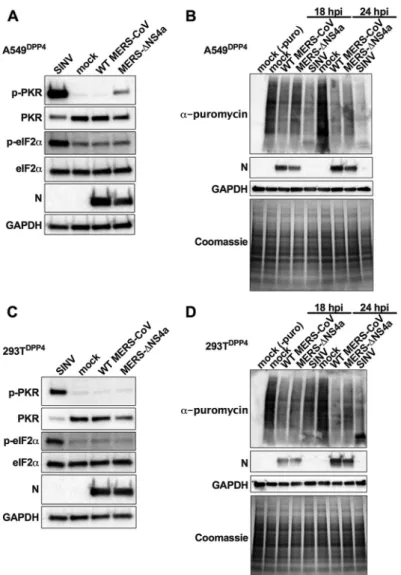
NS4a
antagonizes
PKR
activation,
but
not
protein
synthesis,
during
MERS-CoV
infection.
A
recent
study
showed
that
loss
of
NS4a
during
infection
led
to
PKR
activation,
translational
arrest,
and
stress
granule
formation,
but
only
in
certain
cell
types
(18).
We
investigated
whether
NS4a
antagonizes
the
dsRNA
binding
antiviral
effector
protein
kinase
R
(PKR)
during
MERS-CoV
infection
in
A549
DPP4cells.
A549
DPP4cells
were
infected
with
WT
MERS-CoV
and
MERS-ΔNS4a
at
an
MOI
of
3,
lysed
at
24
h
postinfection
and
analyzed
for
PKR
activation
by
Western
blotting.
MERS-ΔNS4a,
but
not
WT
MERS-CoV,
induced
PKR
phosphorylation
(Fig.
9A).
PKR
phosphorylation
during
MERS-ΔNS4a
infection
was
also
observed
at
16
and
48
h
postinfection
(data
not
shown).
However,
despite
the
activation
of
PKR,
we
did
not
detect
phosphorylation
of
eIF2
␣
above
background
levels,
suggesting
that
activation
of
PKR
by
MERS-ΔNS4a
in
A549
DPP4cells
is
not
sufficient
to
engage
downstream
elements
of
this
pathway
or
that
MERS-CoV
encodes
an
additional
antagonist
that
blocks
steps
downstream
of
PKR
phosphorylation.
In
contrast,
SINV
infection
promotes
robust
phosphorylation
of
PKR
and
eIF2
␣
in
the
same
cells,
indicating
the
lack
of
eIF2
␣
phosphorylation
during
MERS-ΔNS4a
is
not
due
to
a
deficiency
of
this
pathway
in
A549
DPP4cells
(Fig.
9A).
Although
we
did
not
detect
eIF2
␣
phosphorylation
by
immunoblotting,
we
wanted
to
confirm
that
PKR
activation
during
MERS-ΔNS4a
infection
does
not
mediate
trans-lation
arrest
in
A549
DPP4cells.
Thus,
we
compared
protein
synthesis
during
infection
with
MERS-ΔNS4a
and
WT
MERS-CoV.
We
either
mock
infected
or
infected
A549
DPP4cells
with
WT
MERS-CoV
or
MERS-ΔNS4a.
We
treated
cells
18
and
24
h
postinfection
with
puromycin
for
10
min
to
label
nascent
proteins
prior
to
protein
harvest.
We
used
immunoblotting
with
an
antipuromycin
antibody
to
specifically
detect
newly
synthe-sized
proteins
and
used
Coomassie
staining
to
assess
total
protein
levels
(35).
Decrease
in
puromycin
signal
indicates
translation
arrest.
Puromycin
signal
was
not
lower
in
MERS-ΔNS4a-infected
A549
DPP4cells
compared
to
WT
MERS-CoV,
indicating
PKR
phos-phorylation
did
not
induce
downstream
translation
arrest
(Fig.
9B).
In
contrast
to
A549
DPP4cells,
we
observe
no
phosphorylation
of
PKR
during
MERS-ΔNS4a
infection
in
293T
DPP4cells
(Fig.
9C).
Furthermore,
MERS-CoV
shut
down
protein
synthesis
during
infection
of
these
cells
as
previously
reported
with
no
enhancement
of
translation
arrest
from
deletion
of
NS4a
(36) (Fig.
9D).
This
confirms
the
observed
loss
of
protein
synthesis
occurs
by
an
NS4a-independent
mechanism
and
highlights
that
differences
in
cell
type
may
affect
levels
of
activation
of
the
dsRNA-induced
innate
immune
pathways.
DISCUSSION
Studies
from
other
labs
as
well
as
data
presented
herein
have
demonstrated
that
MERS-CoV
only
modestly
induces
three
major
antiviral
pathways:
IFN
production
and
signaling,
OAS-RNase
L,
and
PKR.
This
is
likely
due
largely
to
viral
antagonists
of
dsRNA-induced
host
responses.
Our
study,
as
well
as
recent
reports
from
other
labs,
has
shown
that
deletion
of
MERS-CoV
accessory
proteins
from
recombinant
viruses
leads
to
enhanced
activation
of
antiviral
pathways.
However,
these
effects
are
relatively
small
compared
to
those
in
other
RNA
viruses,
and
deletion
of
these
accessory
proteins
only
mildly
attenuates
replication.
This
is
in
contrast
to
early
studies
utilizing
overexpression
and
reporter
plasmids
or
ectopic
expression
from
heterologous
virus
showing
robust
suppression
of
IFNB
induction
by
NS4a
and
NS4b
(11,
13–16).
Thus,
caution
is
warranted
in
extrapolating
from
studies
that
rely
only
on
ectopic
expression.
FIG 9 LossofNS4aactivatesPKRbutdoesnotleadtoeIF2␣phosphorylationortranslationarrestin A549DPP4.A549DPP4cellsweremockinfectedorinfectedwithWTMERS-CoVandMERS-ΔNS4a(MOI⫽3) orSINV(MOI⫽1).(A)Celllysateswereharvestedat24hpostinfection,andproteinswereseparatedby SDS-PAGEandimmunoblottedwithantibodiesagainstphosphorylatedPKR(p-PKR),PKR, phosphory-latedeIF2␣(p-eIF2␣),eIF2␣,MERS-CoVN,andGAPDH.(B)Priortocelllysateharvest,at18and24h postinfection,cellsweretreatedwithpuromycin(10g/ml)for10min.Proteinswere separatedby SDS-PAGEandanalyzedeitherbyimmunoblottingwithantibodiesagainstpuromycin,MERSNprotein, orGAPDHorCoomassiestainforlabelingoftotalproteins.(C)293TDPP4cellswereinfectedandcell lysatesharvestedasinpanelA.(D)293TDPP4cellswereinfectedandcelllysatesharvestedasinpanelB. Dataarefromonerepresentativeoffour(A),three(B),ortwo(CandD)independentexperiments.