MA Arts & Culture Thesis
Title:
The Social Role of the Museum in Humanitarian Crisis:
Learning from NGOs about the effective management of the Syrian
Refugee Crisis
Student name: Magdalini Ingkempork Zlatkou
Student number: s1778447
Email address: [email protected] & [email protected]
Name of first reader/supervisor: Prof. Nana Leigh
Name of second reader: Prof. Marika Keblusek
Specialization: Museums & Collections
1
Abstract
Museums are institutions whose roles have been changing constantly throughout the history
of their existence. Nowadays, their social role receives an increased importance, as museums
are officially recognised as institutions of social service by the International Council of
Museums (ICOM). The purpose of the present thesis is to examine the museum’s social role in
the case of the Syrian refugee crisis by identifying ways that museums as institutions can
contribute to its relief. In order to approach this topic, a correlation is drawn between museums
and Development NGOs, as the latter have a well-established presence in the provision of
social work. Therefore, as a secondary purpose, this thesis compares and contrasts these two
types of organizations, identifies similarities and seeks aspects of NGOs that museums can
learn from in order to enhance their efficiency in assisting in times of humanitarian crisis, like
2
Acknowledgements
I would like to express my sincere gratitude to my supervisor Dr. Nana Leigh for the useful
3
Table of Contents
Introduction: The Social Role of the Museum and the NGOs in theory ... 4
Syrian Refugees: Undergoing a new humanitarian crisis ... 4
The Social Role of Museums ... 6
Correlating museums to NGOs ... 12
Thesis’ Structure ... 18
Cultural Integration I: The inclusion of refugees in the Hosting Society ... 21
Cultural integration and inclusion initiatives by museums and NGOs ... 21
The culture(s) of the refugees and the challenges of cultural integration introductory programmes ... 25
NGOs and partnership ... 27
Looking into museums and NGO cases for cultural integration projects ... 30
Cultural Integration II: Raising Awareness in the Hosting Society ... 39
Museums raising awareness about the Refugees ... 39
Museums & NGOs as catalysts and the case of Belvedere Museum ... 43
NGOs raising awareness about the Syrians ... 47
Reaching out to the affected areas: Relief and Emergency Work ... 53
Museums contributing to relief and emergency work using volunteers ... 53
Museums and NGOs working as implementers ... 55
Salaam Cultural Museum- A combination between a museum and an NGO ... 56
Conclusion ... 62
4
Introduction: The Social Role of the Museum and the NGOs in
theory
Syrian Refugees: Undergoing a new humanitarian crisis
‘’ This extended conflict has long since crossed the limits of humanity.’’1
The second decade of the 21st century could be considered as a period of World Risk where
wars, ecological threats and different political interests have forced many people to live under
dangerous conditions.2 In the last few years, one more global challenge has emerged; the
Syrian War. This new humanitarian crisis, apart from the sobering number of casualties
(approx. 400,000), has resulted to millions of displaced people to the neighbouring countries
and around the world.
According to the United Nations High Commissioner for Refugees (UNHCR) there are
around 4.8 million of registered Syrian Refugees, a figure that represents more than 50% of
the country’s total population. Globally, around 160.000 Syrian refugees have found a new a
permanent home, resettled in a hosting country; this only covers a very small percentage of
those in need, in comparison to the refugees that have migrated to Lebanon, Jordan, Iraq,
Egypt and Turkey.3 Greece is one of the main points of refugee arrivals coming from Turkey
in an attempt to enter the EU. According to UNHCR statistics, the country so far has received
more than 165.000 refugees by sea in 2016, an addition to the 856.000 of 2015.4 In central
Europe, Germany is one of the countries that has welcomed Syrian refugees, accepting around
40.000. The resettlement places Germany offered make up 54% of the total number of
resettlement places offered across the EU.5 These refugees come from various cultural and
1Finish Red Cross about the situation in Syria,
https://www.redcross.fi/news/20150317/finnish-red-cross-situation-syria-has-crossed-limits-humanity, access 10/09/2016.
2 Silverman 2010.
3 Last Updated 16 Aug 2016 , source UNHCR Government of Turkey,
http://data.unhcr.org/syrianrefugees/regional.php, access 31/08/2016
4 More details about the refugees in Greece are presented in the 3rd chapter.
http://data.unhcr.org/mediterranean/country.php?id=83, access 18/09/2016.
5 Excluding Germany and Sweden, the remaining 26 EU countries have pledged around 30.903 resettlement
places, or around 0.7% of the Syrian refugee population in the main host countries. Source:
5
religious backgrounds and, as journalist Dough Saunders described, many of them are “urban,
educated and determined to travel towards a safer life”, breaking many stereotypes that
portray immigrants in a negative light. 6 In this challenging landscape, this thesis will explore
the possible ways that museums may be able to assist in this humanitarian crisis, and how
they may be able to contribute towards a more effective strategy in managing it.
Museums have valuable assets that can target specific elements of refugee
management. But most importantly perhaps, apart from having the means to help, they carry
the obligation, as institutions of culture that belong to the field of humanities, to actively get
involved with humanitarian crises such as this one. The need for help is quite real; as UNHCR
states, the refugee needs are enormous whereas the sources are limited.7
The ways in which museums can contribute are numerous. First, they can contribute
towards the acceptance of the phenomenon by raising awareness of it and by establishing
programs that aim towards enhancing immigrants’ (mainly cultural) integration as well as
trigger a societal response to their condition.8 Museums can also offer relief work by acting as
coordination hubs for volunteers and charity organisations, therefore facilitating a wider
outreach in the affected areas with the aim of providing immediate humanitarian assistance
through distribution of essential goods and services.
In terms of how museums can enhance their social role, this paper examines the
commonality of capabilities between the museums and the NGOs, identifying points of
improvement and lessons for museums that can be learned from the way NGOs handle
situations such as the Syrian Refugee crisis. Therefore this paper additionally aims to open up
the discourse of the ways the museums can assist in a refugee crisis and highlight their
significant potential. Under these circumstances, museums are best seen as independent
organizations, and therefore it is important to classify them according to size and type, to
got the data from UN Refugee Agency (UNHCR), Office for the Coordination of Humanitarian Affairs (OCHA), International Organization of Migration (IOM), access: 31/08/2016.
6 http://citiesofmigration.ca/ezine_stories/good-ideas-in-refugee-integration/, access 15/09/2016 7
http://www.unhcr.org/partners/partners/41c162d04/ngo-partnerships-refugee-protection-questions-answers-2007-edition.html, access 04/08/2016.
8 Sociologist Richard Alba advices that “we” should rather start accepting immigration and start finding ways of
6
more effectively assess their ability and potential to contribute. Museum types can be, for
example, art, historical, science, folklore, ethnographic, etc.9 The contribution ability of each
museum is dependent on the effectiveness of the sustainable use of the museum’s resources.
These include key aspects that underline the museum’s social role, as suggested by Dr. Lois
Silverman, the museum environment, objects, exhibits, collections-based activities and
programs, creative arts activities, exhibit making and/or contributions, museum making
and/or museum work and lastly special events and initiatives, where relief work could be
included. 10
Before examining the above topics in detail, we should first understand the
development and the state of the art of the social role of museums.
The Social Role of Museums
Museums are institutions recognized for their commitment to serve the society, undertaking
a strong societal role that can include different aspects, such as the museum as contact zone,
the integrated museum, roles that are mentioned throughout the thesis.11 Should, therefore,
humanitarian crises like the Syrian Refugee one be issues that museums should even attempt
to deal with, according to that role? As Silverman wrote: “[In order to] survive and thrive in
the next age, we must evolve new strategies of beneficial coexistence, using every suitable
means to do so.” 12 Following this position, each professional field should have the moral
responsibility to contribute to global issues with any means that are available to it. Thus, it
should be especially important for museums, with their non-profitable character and mission
that benefits the society and protects its cultural treasures, to set humanity as a priority.
Furthermore, according to Alf Hatton, historical and cultural anthropologist, it is
thoroughly healthy for professional, including those in museums, to be in a constant debate
9 Migration museums are also included, even though it is recognized that they have an advantage upon the
approach of migration crisis and therefore it was intended not to be used as an example, in an effort to highlight the possibilities of museums who are not specializing on relevant topics.
10 Silverman 2010, p. 144.
11 According to ICOM definition which is going to be discussed below. (The integrated museum concept was
introduced by Mario Teruggi.)
7
about the purpose of their institutions, utility and their relevance. 13 Based on the statistics
and figures presented earlier in this paper, the Syrian Refugee Crisis is indeed a desperate
situation that requires the use of every suitable means the society has to offer (including
museums). Without doubt, each type of social organization has different capabilities and
museums might not singlehandedly be able to solve crucial societal issues or humanitarian
crises. They can, though, work on those on an institutional level. 14
Having a look at the history of museums, it is consistent that they have always been
connected to social service, either intentionally or not.15 Through the study of their collections
the visitors gained the knowledge they sought and in this respect, museums can be considered
to be institutes for scholarship, even though they were accessible to a limited high-class
audience. As time went by, private collections got catalogued and presented in a way that
could enhance meaning-making, culminating to the modern public museums.16
New developments in the humanity studies during the 1970’s, inspired museums to
focus on the so-called “common people” and members of marginalized social groups.17 Since
approximately the middle of the 1990’s, under the influence of new ideas about society and
culture, the museums rethought their identity, the information they pass on to their audiences
and in general their ethical and social responsibility.18 Likewise, they gradually turned from
being sites of worship into “public services and social agents”19 that among their primary goals
is their service to society.20
These changes in museum practices have opened up the era of the “post museum”, an
institution that as museum professor Janet Marstine has written “[…] has completely
reinvented itself” by being “no longer a ‘museum’ but something new, yet related to the
13 Hatton 2012, p. 130.
14 Argument based on Michelle Obama’s speech about museums, as discussed on “The Incluseum” online
platform about “inclusion and justice in museums”. Source: https://incluseum.com/2015/05/12/michelle-obama-activism-and-museum-employment-part-i/ access: 08/09/2016.
15 Silverman 2010, p. 13. 16 Hatton 2012, p. 134. 17 Johansson 2015, p. 15.
18 Hooper-Greenhill 2007, quoted in Johansson 2015, p. 16 & Crooke, 2006. 19 Lanz 2016, p. 14.
8
‘museum’. […] the post museum can promote social understanding’’21, highlighting its
renewed connection to society. Key elements of this new type of museum are: discourse,
critical understanding and sensitivity to different cultural and historical interpretations
diverging from the perception of the museum as a place of adoration and awe.22 In the post
museum era, according to Silverman, the communication between the museum and the
people can address social problems, promote social justice and equality, while strengthening
social relationships: ‘’Through museum communication, people […] alter key elements of
culture that shape the very operation, quality and experience of social life’’. 23
Yet, despite the noticeable efforts from museums worldwide to engage with social
work, many are not considered institutions of social service by the general public, even in the
2000’s, by funding agencies. 24 Hence, museums have still a long way to go in terms of explicitly
demonstrating their engagement with society and its development.
Hatton explains, that in order to deconstruct museums’ social role, certain questions
need to be asked. One of those is about whether museums have a monopoly in this service to
the society or whether they have “competitors” and in that case how well they are competing
with them.25 Another question is regarding whether different purposes exist for museums in
different societies and whether those need to be re-examined through the passage of time.
Considering as “competitors” the long-established in social work NGOs and recognizing the
Syrian Refugee crisis as a new societal need, this paper introduces the work of
Non-Governmental Organizations (NGOs),in parallel to museums rather than as competitors, and
analyses their actions, as they benefit society, as examples to be set by museums, especially
in the context of the Syrian Refugee Crisis.
This officially recognized social role of the museum, could not leave unexamined the global
societal diversity. Abandoning its former “monolithic” status, the museum began sharing
21 Marstine 2006, p. 19.
22 Marstine 2006, p. 5. 23 Silverman 2010, p. 21.
9
stories with a wider meaning trying to reflect people that have been alienated by mainstream
society, such as the migrants.26
More specifically, the museums today, based on their social role, are attempting apart
from tourists to engage also with the local people (including relocated immigrants and
refugees), constantly in search of new ways to attract them as visitors.27 Migration is a
massive societal phenomenon, present throughout human history, which sociologists, such as
Richard Alba, claim that is has multiple beneficial outcomes for the society. 28
Contrary to the late 19th century, where the museums’ goal was to create “national
unity and foster citizens”29 by shaping a homogenized national identity, nowadays it is
expected from them to expose and exhibit people’s different backgrounds, this time without
neglecting their cultural plurality and the impact of migrant cultures to the dominant one.30
Museums, according James Clifford, an interdisciplinary scholar (including fields such as
history and anthropology) who applied to them languages’ professor Luise Pratt’s idea of
“contact zones”, have the capability to act as places of collaboration where different cultures
meet, exchange opinions and influence the museum’s narrative.31 More specifically Pratt
defines contact zones as “[…] the space in which peoples geographically and historically
separated come into contact with each other and establish ongoing relations”, a concept that
has been adapted to contemporary museums through their inclusionist and collaborative
programmes as well as through the use of source communities, the latter being mostly
applicable to anthropological, historical and archaeological museums.32 Concisely, ‘Contact
Zones’ are places where a dominant culture would provide a negotiated space for certain
cultural exchange, an exchange that is of concern in the chapters to follow. Similarly, the
26 Janes, Museums Without Borders, 2016, p. 211-212. 27 Hatton, 2012, p. 132.
28 Alba 2015. Alba referring to the 2nd World War, points out the fact that the immigrants enabled the hosting
societies to re-build their economies and enrich their culture. He also makes clear that the professional background of them is not of importance, as working force is always valuable. Living again under a financially unstable period, this could be a useful lesson to take under consideration justifying the need of museums’ involvement in that topic.
29 Johansson 2015, p. 9.
30 Lleras 2011 & Ruth Wodak, Rudolf de Cillia, Martin Reisigl 2009, p. 18. 31 Clifford 1997 & Pinna, 2012 & Bennett 2006.
10
contemporary museum’s social role is connected to another concept, the one of the
“integrated museum”, mainly adopted by museum professional and author Mario Teruggi,
that perceives the museum as an organization integrated with its surrounding society and
environment as well as with other organizations that serve the same purposes; in this case the
NGOs. 33 The integrated museum highlights the role of museums in the society and its
development and encourages the cooperation of the museum with other fields in humanities,
such as the social sciences. 34
During the recent years a small, but important, number of museums have made valuable
attempts to represent migration, including the establishment of museums wholly dedicated
to the topic.35 These museums intend to raise awareness about the immigrants and the causes
of their relocation.36 Though, there are also cases where the migrants’ memories and those of
other groups of the population have been ignored by the established historical accounts,
especially in Europe in order to avoid the stigma of “countries of immigration”37. The museums
in those cases seem to be positioned in the middle of two opposite forces: the urge to
represent a multicultural population and reflect the actual needs of the society and at the
same time to remain loyal to the nationalistic past that wants them to represent a certain
national identity.38 Referring to the National Museum of Colombia, Museum professor and
curator Cristina Lleras believes that museums should take action in reflecting migration topics,
independently of any government’s efforts to simplify cultural complexity for the sake of a
33 Davis 2011, p. 60.
34 Ibid., p. 61.
35 Unfortunately, despite some valuable contributions, it is not very common yet, at least for European
museums, to include activities related to migration, although the research on this topic is not in depth. Johansson 2015, p. 21.
36 Ibid., p. 10.
37 Hoerder, D. 2005. “Europe’s many worlds and their global interconnections”. In Konig, M. & Ohliger, R. (eds.)
Enlarging European Memory: Migration Movements in Historical Perspective, Ostfildern: Jan Thorbecke Verlag, quoted in Johansson 2015, p. 14.
38 The museums depending on their location can be “implicated politically” and contribute to the shaping
11
“harmonious nation”.39 Furthermore, many museums are not inspired or motivated to renew
their functions and deal with current societal issues, possibly due to a lack of strategic vision,
resources and staff trained accordingly. One can get a glimpse of how these issues can be
addressed through establishing links to, and a comparing with, NGOs.
Merging the discussion about the social role of museums and their connection to migration,
an important reason why museums should deal with the Syrian Refugees is their social
relevancy. 40 As Hatton explains, museums should be investing in constant efforts to make
appropriate choices regarding their social purpose, at the risk of becoming irrelevant in the
context of this generation’s communications and social media advances.41 According to
Hatton, a well-justified purpose could also extend the budgets available and thus contribute
to the preservation of the museum’s collection as well. For some authors, like professor and
museum professional Robert R. Janes, the museums have already increasingly lost their social
relevance, focusing on visitor numbers (with the implication that counting numbers with the
sole purpose of obtaining more funding has monopolised their interest tactically, distracting
them from seeking strategic ways to become more relevant to the society).42 Silverman
believes that apart from their relevance, it is a general responsibility of museums to
humankind to take part in social action, as they can help in fostering “cultures of caring”43.
Therefore, since museums are in the service of society, they should not remain indifferent to
the current societal issues, especially when these are directly and materially connected to
cultural perspectives, such as an immigration phenomenon or a refugee crisis.44
39 Lleras, X. 2011. “Facing up to diversity: Conversations at the National Museum of Colombia”. In Knell, S.,
Aronsson, P. & Bugge Amundsen, A. (eds.) National Museums: New studies from around the world. London: Routledge, quoted in Johansson 2015, p. 20.
12
Correlating museums to NGOs
The paper discusses the importance of museums contributing to the exposure and action
towards constructive resolution of societal issues, and how the Syrian refugee crisis is such an
issue. It will now be discussed in more detail how museums can contribute to this constructive
relief of the crisis, and how a comparison with the NGOs could assist them and enhance their
efficiency in undertaking this key role.
It is a fact that museums have embraced the practice to borrow ideas and perspectives
from other fields. They have adopted the structure and management principles of companies,
being more efficient while handling funds and organizing their human resources; concepts and
techniques from the fields of education and communication, and approaches and guidance
from the social sciences.45 Museums indeed need to get non-museum perspectives and use
them as a source of “untapped knowledge” according to Janes.46One such source on the topic
of handling humanitarian crises could be the NGOs. We begin by first introducing the
definitions of what a museum is and what an NGO is in the context of this paper.
The International Council of Museums (ICOM) has provided evolving definitions of
what a museum is throughout the years so that it accurately reflects the contemporary
museological drifts.47 The latest update was in 2007:
“Section 1. Museum. A museum is a non-profit, permanent institution in the service of
society and its development, open to the public, which acquires, conserves, researches,
communicates and exhibits the tangible and intangible heritage of humanity and its
environment for the purposes of education, study and enjoyment.”48
It is important to note that the definition of a museum as an organisation serving
society was introduced in 1974. It is also noticeable that the present definition has evolved,
45 Silverman 2010, p. 23.
46 Janes, Museums in a Troubled World: Renewal, Irrelevance Or Collapse? 2009, p. 258. 47 http://archives.icom.museum/hist_def_eng.html, access 10/09/2016.
48 ICOM Statutes, adopted by the 22nd General Assembly (Vienna, Austria, 24 August 2007), Ibid., access
13
so that it offers prominence to the people, instead of the exhibits, clarifying also its connection
to development.
The ICOM definition of a museum is generally accepted by museums globally.49 NGOs,
however, as far as this thesis has researched, have several definitions based on the numerous
types of NGOs, without evidence of a leading one. In an attempt to sum up the definitions
available, NGO (Non-Governmental Organization) is an organization independent of any
government which are by their vast majority also “non-profitable organizations”. The great
diversity of NGO types introduces the necessity of classifying them according to type, which
will then make it possible to compare them to museums.
In general, all organisations can be initially divided into 3 sectors: government,
for-profit, and all others. All NGOs belong to the third sector, which includes some certain
characteristics according to Professor of Social Policy and Development David Lewis and social
policy specialist Nazneen Kanji: they have a legal status, carry a certain organizational
structure and permanence, are private and independent from the government, without
excluding possible cooperation with that and even though they can have income and possibly
profits, they are not profit-driven, nor do these profits accrue to its owners.50 Moreover, they
are self-governing, meaning that they are responsible of managing their affairs and a voluntary
participation of the staff should be present, either wholly or partially. This classification still
encompasses a large and broad category of organizations, which can include organizations
such as education establishments, themed clubs and religious organizations. Museums are
also included in the third sector organizations which, among its other characteristics, is a very
important sector upon which the social capital of a society is dependent. 51
Comparing the definitions for NGOs and museums, we see that they are both
non-profitable organizations that strive for social goals detached from personal interests and from
49 Members of ICOM are more than 20.000 museums and 35.000 museum professionals world-widely,
according to its official website. Source: http://icom.museum/icom-network/35000-experts/, access 06/12/2016.
14
the goal to make profit.52 Apart from a general responsibility to society each museum, just as
an NGO, has different specified goals, area of focus and activity plan. The size, structure and
resources can also differ from case to case in both types of organizations concluding that they
can both be autonomous and self-efficient. Another similarity they share is that they are both
present in a global scale, in both developed and underdeveloped societies, in urban and rural
environments. This diversity highlights how seemingly different organizations, that can be
included under the same category of either museums or NGOs, can find different kinds of
solutions for the same problems; whether these problems are solely about the preservation
and exhibition of a collection, or striving to distribute food and shelter to endangered areas.
One of the many definitions available, describes NGOs as organizations that are working
towards a “social, political or economical change”.53 This focuses on a characteristic of some
NGOs that are engaging with development work, which characterises the majority of them.54
In this thesis we will use this qualification, which refers to the “Non-Governmental
Development Organisations”, as the organisations to be used as a comparison to museums.
We will therefore be using the term NGO to denote these organisations.
Development is a difficult concept to be defined under one generally accepted
definition, according to Lewis.55 In brief, it means an effort towards a positive change or
progress, connected to growth and evolution. The term firstly appeared in literature around
the end of the twentieth century and since then has been used widely. It is, though, considered
to be a problematic term to be accurately defined. It describes a positive change in
52 Though, according to scholars, such as Frey and Meier, organizations with profitable character can also be
recognized as museums: “Museums can be private for-profit organizations, private non-profit organizations, or public organizations run in a non-profitable way.” Bruno S. Frey, Stephan Meier 2006, p.400. The present thesis, though, is using ICOM’s definition and therefore approaches the museum as a non-profitable organization.
53 David Lewis, Nazneen Kanji 2009, p. 11.
54 Other definitions of NGOs mention clearly the development work as one of their characteristics. For instance
an NGO can are described as: […] a citizen-based association that operates independently of government, usually to deliver resources or serve some social or political purpose. […]The World Bank classifies NGOs as either operational NGOs, which are primarily concerned with development projects, or advocacy NGOs, which are primarily concerned with promoting a cause.’’ Source: http://whatis.techtarget.com/definition/NGO-non-governmental-organization, access 10/09/2016.
15
economical, political or social terms upon the lives of the people. It is the work of these
non-profit organisations, alongside museums, which have as an underlying principle to support
and encourage development that this paper considers. People working in development
organizations are typically characterized by an outward sense of altruism and an ability to
think independently of dominant societal, cultural and humanitarian ideologies. Development
work is frequently connected to Relief and Emergency Work, a sector of NGOs’ actions that is
going to be discussed in the third chapter of this thesis, in connection to museums’ work. The
main difference between development and Relief and Emergency work is that the former
strives for a long term beneficial change whereas the latter is associated with tactical
interventions that aim to reinstate any disrupted stability. Relief and Emergency work in other
words, is the immediate, and many times urgent, response to man-made or natural
disasters/crises. Such response includes providing assistance to war victims, like the Syrian
refugees. In general, both development and Relief and Emergency work are connected to
poverty and people in need usually due to a violation of their human rights. Further actions of
these type of NGOs include legal advocacy and defence of vulnerable people in addition to
research on ways to prevent similar violations in the future.56 According to Lewis, NGOs that
deal with development work have 3 main ways to function: as catalysts, implementers and
partners; roles that are going to be further explained later in paper.57 An organization can be
involved in more than one of those functions which frequently overlap. The museums,
similarly, also set development as a goal (as per the ICOM definition and also as part of the
“integrated museum” concept). Their role in development is strongly connected to their
educational purpose with the potential, to be further explored and extended to other areas
beyond education (such as actively contributing to the relief of a refugee crisis), following in
NGOs’ footsteps.58 Moreover, development is strongly linked to museums’ social role since
according to Lewis, development work includes the building of appropriate social systems,
systems that museums are able to contribute towards.59
56 http://www.coe.int/en/web/compass/human-rights-activism-and-the-role-of-ngos, access 11/09/2016. 57 Lewis 2001, p. 68.
16
NGOs can be highly active in working towards ways to secure social and economic
stability for marginalized populations and are included in the “aid industry” agencies which
are searching for alternative interventions to poverty reduction and a general improvement
of life quality. The aid industry works through service delivery, advocacy and campaigning.60
The chapters to follow are going to refer to Development NGOs that do also Relief and
Emergency work. This is important as it offers suggestions of how museums may not only be
able to participate in development work, but also contribute significantly in Relief and
Emergency efforts.
There are many reasons supporting a comparison of museums to NGOs. For starters, NGOs
can reach and encourage in active participation a strata of usually poor population
demographics that is either ignored or impossible to reach by the public social services let
alone museums.61 The reasons behind the inability of government organisations to achieve
the same results, is as Lewis highlights, financial shortage, general social and cultural access
problems, as well as the influence in decision making by elite interests.62 Moreover, NGOs are
able to provide services more cost efficiently than other organizations as their limited budget
has urged them to look for low-cost, yet practical solutions in order to ensure the realisation
of their goals, without the burden of government bureaucracy. Another positive aspect of
NGOs’ work is that they give the opportunity to citizens to include themselves in addressing
and contributing to the abolition of poverty and of other social issues by working as supporters
or volunteers in multiple projects and campaigns. According to Lewis, NGOs are more
connected to the local culture than governmental agencies, recognizing more effectively the
social and cultural needs of the population.63 This paper will expand on the above points in
the following chapters.
60 Lewis 2001, p. 1.
61 The issue of access difficulties by the official social services has been mentioned by both Lewis (Lewis 2001)
and Silverman (Silverman 2010).
17
The correlation between Museums and NGOs is focused on basic similarities that the two
types of organizations already share, and it will form the starting point in a search to identify
more similarities in the following chapters. Apart from both being engaged in development
work, NGOs are also keen on borrowing perspectives and ideas from other fields, as part of
an ongoing effort of improving their organizations with the ultimate objective of enhancing
their impact onto the society, just as is the case with museums.64
Another similarity among the two is that NGOs and museums contribute (at a different
level) to the Social Capital. Social Capital is the maintaining of healthy relationships between
community members/groups. The involvement with Social Capital, as Janes states, has the
potential to increase funding options, since the organizations will start getting paid according
to the value they add to society and its individuals. Social Capital consists of trust, empathy
and meaning, which are also characteristics of several museums and NGOs with the latter
exchanging funding for social services. 65 It is assumed that both governmental and private
museums are interested in finding new ways of receiving funds in order to maintain their daily
operations and therefore should explore further their role in increasing Social Capital. Such
funding options could occur from the government, programmes funded by the EU and other
sponsors, or from donations. NGOs, as it is demonstrated later on, are very effective
fund-raisers and therefore could be a source of knowledge and innovation for museums wanting to
explore financing in that way.
NGOs have both advocates and critics. This is to be expected given the wide remit of NGOs,
and also the marked differences in types, sizes, and sectors of operation. Therefore, it is
important to focus on an appropriate classification prior to making general comments about
the NGOs. Further, due to the sheer number of NGOs, it’s expected that some will not function
effectively, and they will attract disproportionate amounts of criticism. Therefore this thesis
refers only to exemplar NGOs that as far as I am aware contribute positively to society.
64 NGOs are learning from companies how to improve a variety of skills, such as product design, quality control,
marketing and any other area that can enhance their impact to the society. Lewis 2001, p. 4-5.
18
Unfortunately, there are no consistent measurements of NGOs performance in terms of their
contribution to the Social Capital and that is acknowledged as a limitation of the research. 66
On the other hand, there are many advocates of the importance of NGOs and their
contribution to society, with accolades coming from prestigious international organisations
such as the United Nations and the European Commission. These accolades praise NGO for
their assistance towards the effective response and resolution of humanitarian crises. More
specifically, the United Nations High Commissioner for Refugees (UNHCR) has recognized the
importance of NGOs believing that they have special skills and resources to help in the refugee
crisis, mentioning that partnerships with NGOs are providing life-saving assistance.67
Thesis’ Structure
The present thesis is divided into three main chapters that represent the three main areas
that the museums can assist in the Syrian Refugee crisis:
1. Cultural Integration I: The acceptance of the refugees in the Hosting Society
2. Cultural Integration II68: Raising awareness in the Hosting Society
3. Reaching out to the affected areas: Relief and Emergency Work
In order to relate, compare and contrast museums with the NGOs, the three main
dimensions in development work that characterize the NGOs, according to Lewis, are used:
working as partners, catalysts and implementers.69 A brief description of these dimensions
follows:
The NGOs in their roles as partners typically work towards inclusion of disadvantaged
people, or people in need in the hosting society. There is a strong link here with Chapter 1 in
this thesis. When an NGO works as a catalyst, it inspires, facilitates and promotes actions that
aim to bring a positive change in society. An example could be organising campaigns to raise
66 Lewis 2001.
67
http://www.unhcr.org/partners/partners/41c162d04/ngo-partnerships-refugee-protection-questions-answers-2007-edition.html, access 04/08/2016.
68 The numbering of Cultural Integration in I & II reflects the double sides of integration, as a process that
influences both the incoming and local population. Further details are going to be presented in the relevant chapters.
19
awareness, an activity that is connected to Chapter 2 in this thesis. As implementers, the
NGOs are responsible for mobilising goods and services to cater to people in need, and this is
connected to Chapter 3 in this thesis. The NGOs using their effective partnerships are able to
implement a wide range of objectives, one of which is the inclusion of the refugees in the
Hosting Society. These partnerships are usually between the NGOs and government agencies
established for the purpose of maximising the likelihood for a successful delivery of an
initiative or project. It is therefore not a significant departure from this practice that NGOs
could start cooperating more closely with museums as well, with the objective of enhancing
the cultural integration and social inclusion of refugees.
This thesis also sets boundaries on its scope, and therefore there are a number of areas that
will be considered outside the scope of the work presented here.
Firstly it does not consider the political sensitivities and international “macro”
dynamics that play a role in the global landscape. Instead the focus regarding the Syrian War
is on the refugees, who are approached as human beings in need and also as essential
contributors, among all other human beings, to the world culture. Therefore cultural
institutions, including museums, should have a vested interest on their well-being (in this case
societal and cultural).
In addition, while this thesis acknowledges that in cases of war, and war-driven
humanitarian crises, there is a high risk of artefacts being lost, stolen or destroyed, this thesis
will deal solely with the human capital of the disaster/crisis that have elected to escape to
other countries as refugees and their need for emergency, societal and cultural relief.
The thesis demonstrates how museums can respond effectively by tactically responding to a
humanitarian crisis. In particular, this thesis examines the case of the Syrian Refugee crisis
and introduces a discussion around the social role of museums and their position in the society
in the future.
The above topics are going to be approached through a variety of case studies, both
20
from NGOs provided a rich landscape for the underlying research, and the breadth of them
made the selection for inclusion in this work even more difficult. In the case of the museum
case studies, the inclusion of dissimilar organizations was attempted in order to demonstrate
that a variety of museums types are able to contribute effectively. All museums are on
purpose located in areas outside the footprints of the affected zones, so that it could be
possible to examine museums in an environment that their functions and capabilities can be
effectively deployed. The case studies selected include museums both from areas that have
received refugees and from others that have not.70 These museums are approached as sources
of inspiration, innovation and provision of guidelines for other museums to adopt similar
practices indicating that assisting in the refugee crisis can be done effectively and coherently.
As the case studies are presented across the three chapters, there are instances that a case
study applies to the discussion taking place in more than one chapter. In these instances, the
case study will only be discussed in the chapter that it seems to offer better intellectual value.
The paper also includes examples of a variety of NGO structures and sizes, to minimise
unconscious bias in drawing conclusions. The objective of the paper is to demonstrate that
some practices the NGOs follow can be beneficial for museums as novel ways to discharge
their social role. Further, this paper identifies that some museums are already using similar
practices.
To conclude, this thesis based upon the confrontation of the Syrian Refugee crisis,
examines the elements that museums could possibly adopt from NGOs, identify potential
areas of cooperation between the two, compare them side by side in the three main focus
areas of the chapters in order to identify further similarities and differences and ask whether
the future functions of museums are converging towards the direction of NGOs work.
70 Since the 10% of the Syrian Refugees searches for a shelter in Europe (with most popular countries being
21
Cultural Integration I: The inclusion of refugees in the Hosting
Society
“[…] people need more than three meals a day and a roof over their heads. In addition to humanitarian aid, they
also needed cultural aid.”71
Cultural integration and inclusion initiatives by museums and NGOs
When people immigrate they are expected to face a new environment including different
people, locations, rules and culture. From the way people dress, the architecture of the
buildings and the language being spoken to traditions and local celebrations, culture has a big
impact on the new life of any immigrant. When this transition is forced, like in the case of the
Syrian refugees and other population groups displaced by war, typically there has been no
prior preparation time for those people regarding the new society and therefore their
adaptation to it is more challenging.
The refugees though, are not the only ones having to deal with a different culture; the
hosting society must also find a way to handle a new cultural element that may (depending
on volumes) influence the dominant culture.72 As Rima Berns McGown, a diaspora studies
professor, defines it, “this process of immigrants’ adjustment to the new society without the
loss of what they consider essential as identity and the accommodation of the adoptive society
on them” is called cultural integration.73 Contrary to other models, integration is the
appreciation of the impact of the new arrivals on the local population and supports the
exchange of cultural elements from both sides and respect for both backgrounds. For Policy
Analyst Samson Ramona, cultural integration is an open-ended transformation that has the
71 From: “Action for Hope evolved from the 2012 visit by a group of Arabic cultural professionals in the camps
for Syrian refugees in Kilis, Turkey. During their encounters with the people there, the Action for Hope activists came to realize that the people need more than three meals a day and a roof over their heads. In addition to humanitarian aid, they also needed cultural aid.” Source:
http://www.goethe.de/lhr/prj/daz/pfv/aar/en14889570.htm, access 13/09/2016.
22
capability to reconstruct a society and its societal identities while avoiding to form a unified
culture or reproduce a nation-state model. 74
Proper cultural integration is very important for any immigrant. Learning for instance
the language of a hosting society is an essential stepping stone towards achieving
self-sufficiency and confidence to communicate and therefore find a job with more possibilities to
reflect someone’s skills. The ability to communicate with the locals in verbal or other cultural
ways (such as knowing specific behavioural practices) can boost the refugees’ confidence,
morale and dignity.75 Furthermore, through cultural integration the possibilities of the
refugees to experience cultural racism are limited.
A lot of factors can affect the cultural integration of an individual such as their
educational background, age, gender, family, financial situation, relationships and networks
in the new country and experiences of past traumas or tortures such as in the case of the
Syrian Refugees.76 The relevance their culture has to the new one also plays a role, making the
refugees able to adapt more easily to the environment of neighbouring countries that share
similar cultural norms.77 The success of cultural integration depends also on the response of
the hosting country referring to the resources it invests in it, usually by organizing introductory
workshops, sessions, trainings and events and whether those can be applied to the individual
needs that the refugees have. Another important factor apart from the person’s access to the
hosting society without ethnicity restrictions, is their own choices about the cultural types
they want to follow.78 An individual is at a position to decide the elements of their culture (or
other cultures) they want to adopt, meaning that each person is a unique combination of
cultural elements and should be approached as such. Furthermore, special focus needs to be
given to children, who as mentioned in Alba’s book, are more easily affected by culture and
institutions that surround them as they are at a position of forming their cultural identity,
meaning that the museums could play an important role in their integration. 79
74 Samson 2006.
75 Silverman 2010, p. 27 & UNHCR, UNHCR Note on Refugee Integration in Central Europe, 2009, p. 28. 76 Hein 2005, p. 359 & EuroCities 2016
77 UNHCR, UNHCR Note on Refugee Integration in Central Europe 2009, p. 28. 78 Yann Algan, Alberto Bisin, Alan Manning 2012.
23
The integration of the refugees is beneficial not only to them, but also to the economy
of the hosting society. In this case, teaching a refugee the local language could be a useful tool
for introducing them to the local trade market. From this point of view, integration can create
a significant medium to long term economic value for the hosting society in return for its
upfront investment towards cultural integration.80
Museums as cultural organizations preserving cultural heritage, and as social institutionsare
expected to deal with migration, being able also to address cultural integration as well.81
Depending on their type and location though, some museums are more capable of dealing
with these topics than others.82 Since the beginning of human history, migration has been
shaping cultures and societies. Especially, today with the increased mobility and frequent
migration waves, there is a constant change of the socio-cultural strata. Museums have to
face challenges like questions and concerns about migration, ways of holding intercultural
dialogue and portraying cultural differences.83 There are already examples of museums
attempting to design specific programmes for people from different cultural backgrounds,
such as workshops, exhibitions and other kinds of events in order to be inclusive. In that way
the target groups, including newly arrived immigrants, can have a meaningful museum
experience while familiarizing themselves with the culture of the hosting society and the way
this society is approaching other cultures, art and history. At this point, one of the questions
raised is how could museums improve their programmes that aim to enhance the cultural
integration of immigrants.
An important area in refugee management is the design of effective introductory
programmes. In this field, NGOs in order to foster cultural integration organized multiple kinds
of introductory programmes. Such programmes are initiated either by the NGOs themselves
80 Yann Algan, Alberto Bisin, Alan Manning 2012.
81 Network of European Museum Organisations 2016, p. 3.
82 For example, ethnographic and historical museums that own a collection related to specific cultures are
offering more opportunities for intercultural dialogue than a transportation museum or any other museum with a very specific type of collection.
24
or by the government that often collaboratively delivers these programmes. The European
Council also supports introductory programmes agreeing upon the importance of integration.
Particularly, in 2004 it adopted the Common Basic Principles (CBP) on integration that one
year later developed into action points that can be held at national and at European level.
According to CBP, it is of great significance that the immigrants gain basic knowledge of the
language and history of the hosting society, emphasizing the importance of cultural
institutions to the integration process. 84 The European Council is recognizing the NGOs’
contribution to those programmes and highlights other factors that are able to contribute
towards their implementation: educational institutions, private organisations, and museums.
The European Council of Refugees and Exiles (ECRE) states that such programmes are an
important tool of integration and it is a common benefit of both the immigrants and the
hosting society that they are designed and held effectively.85 Furthermore, in the same report
there are suggestions about the nature of those programmes that interested organizations
can follow. For instance, they should be free of charge, without preconditions regarding any
already existing knowledge about the hosting culture and the participation should be
encouraged by positive means of persuasion instead of any kind of sanctions. Lastly, in the
same report, several examples of European countries and their methods of integration are
presented, focusing on specific cases. More precisely, guidelines and successful examples for
introductory programmes do exist; museums need to be proactive and increase their
participation in integration practices.
These programmes can have a positive impact on the museum number of visitors as well. The
immigrants are part of the local population that the museums should have as one of their
main goals to attract as actual visitors, according to Hatton.86 The programmes can also
enhance the museum’s relevance as it contributes via them to one of the most urgent social
84 See Council Conclusions, Immigrant Integration Policy in the European Union, 14615/04 of 19
November 2004 and the Communication from the European Commission on A Common Agenda for Integration – Framework for the Integration of Third-Country Nationals in the European Union, September 2005, COM (2005) 389.
25
issues faced by its society’s inhabitants. Through such programmes the museum is directly
linked to the community by being actively involved with its issues. This “integrated museum”
as Teruggi names it, can also use the problems faced by the local community as a stepping
stone in the curating of exhibitions of relative themes that can contribute to the general
public’s awareness, as it is being examined in the next chapter.87
The benefits of the introductory programmes are not unknown to museums. For
example, the Hull-House Labor Museum in the States has proved at the beginning of the
previous century that through its programme where immigrants from a variety of countries
were demonstrating their craft skills, their self-esteem was increased and their family
relationships got improved.88 Last of all, the museums have the power through selection
choices about their exhibits to include or exclude different cultures. An interaction with
refugees could perhaps teach them about their culture and ways to ensure their inclusion
(refugees as source community).89
The culture(s) of the refugees and the challenges of cultural integration
introductory programmes
The introductory programmes must consider the culture of the immigrants before they are
designed. This culture is closely connected to the culture of the place they were raised and
the fact that one place of origin can include different cultures should be taken into
consideration. In large countries like Syria, there can be several cultural elements that are not
being shared by all of its citizens, from different religions to different language. Mistakenly, in
many hosting societies there is the common belief that there is one homogenous culture of
immigrants, bearing in mind solely the superficial, or phenomenological/normative
differences between them, such as their diet, clothing and social practises. In reality, though,
there are different types of culture that the immigrants adapt.90 As a result of such
87 As quoted in Silverman 2010, p. 12 & Peter 2011, p. 60. 88 Silverman 2010, p. 9.
89 This statement is based on the new museology that states that the community can act as a source of
knowledge for the museum, in an exchange of knowledge and information.
26
misconceptions, many introduction programmes hold activities that people from different
intellectual, educational and other backgrounds are fit in the stereotype approximation of the
“typical refugee”. The ECRE report advices and already mentioned above, the introduction
programmes are more effective when applied to individual needs of the people.91
The Syrian Refugees whose cultural integration is at the centre of this chapter come from a
particularly different background in comparison to the western hosting countries. Their official
language is Arabic and it is spoken by over 90% of the population. Other spoken languages in
Syria are Circassian, Armenian and in the northeast Kurdish. Moreover, many Syrians have
knowledge of English and French mostly for the purposes of communication with the
tourists.92 This cultural variation also coincides with the country’s religious segmentation. As
falsely adopted by the media, not all Syrians are Muslims and not all Muslims follow the same
religious practices or are involved at the same degree with them. The Kurd Muslims have a
different culture and language, influenced by the Middle East, whereas the Circassian Muslims
are of Russian origin and the Beduoin are separated by the urban society, living a more rural
lifestyle. Other religious groups are the Alawite Muslims, the Druze, the Ismailis, Yezidi and
there are also Christians who are Armenians originating from Turkey. These religious
differences should be taken seriously under consideration when placing the refugees into the
same programmes. For example, in the refugee camp of Katsika in Ioannina, Greece, Yezidi
people were in a tense situation with the Muslim population, causing internal conflicts even
to the point that the former decided to leave the camp.93 Lastly, there is also a number of
Palestinian population who tend to be excluded from the Syrian society politically and
socially.94 The challenge of the museums to represent all those different kinds of refugees is
significant. They try to foster a unity inside an apparently irreconcilable diversity and that
91 Caritas Europa. European Council on Refugees and Exiles (ECRE) 2006, p. 7. 92 http://www.everyculture.com/Sa-Th/Syria.html#ixzz4Iuj3jLGk, access 14/09/2016.
27
could be achieved by presenting the common experiences of the refugees, focusing for
instance on storytelling.95
Other challenges for museums and in general for the public social services is the accessibility
of those programmes by the people that they create their services for. 96 Questions such as:
whether and when the people will attend, how they are going to be informed about the
programmes and how they will be motivated to take part, are only some of those being raised
when designing them. Museums are already finding outreach to marginalised populations
challenging, as demonstrated in “The Dream of a Better Life and Crossing Borders” exhibition
in Museum of Work where the curator admitted that the immigrant associations were not
motivated enough in order to participate.97 NGOs, as mentioned above, are believed to find
better ways of reaching out to those people, as it is shown in the case studies below.
NGOs and partnership
This chapter examines the ways museums can contribute towards the successful delivery of
cultural integration programmes following practices similar to NGOs, in the context of one of
the three NGO dimensions: partnership with other organizations.
Looking into the NGO theory there are many elements that apply to museum
partnership as well. For NGOs, a partner is “working together with another and share[s] the
risk or benefit from a joint venture”.98 Partnerships are an emerging trend among the NGOs
and they strive for the development and enhancement of their capabilities as organizations
(capacity-building). Potential partners could be the government, the private sector or other
NGOs and local communities with the aim that those partnerships are “effective, responsive
and non-dependent”99. Particularly, the interest in partnerships between governmental
agencies and NGOs can be spotted since the 1990s where the mutual purpose was already the
efficiency of the resources’ use, as well as the increase of the organizations’ sustainability and
95 Lanz 2016, p. 184.
96 As observed and discussed during the European Social Services Conference in The Hague, June 2016. 97 Johansson 2015, p. 81.
28
the improvement of meaningful participation.100 The partnership involves a division of roles
and a clear description on each partner’s responsibilities usually including involvement of the
partners at different stages of the programme.101 To the question why such partnerships are
important, Lewis replies that when organizations are co-operating they are able to achieve
certain goals that otherwise would not be possible to be achieved.
Returning to the introduction programmes, there is a general concern about use of such
museological tools by governmental or other agencies in order to promote specific interests
and points of view.102 The limitation of such a risk of disproportionate and inequitable efforts
could be one of the benefits of a cooperation between museums and NGOs. Management
theory identifies that the closer an organization is to its official donors, the less autonomous
it becomes and therefore both NGOs and museums as non-profitable organizations are
vulnerable to their donor’s intentions. Though, an important influence to an organization’s
intentions is the ethical decisions of the individuals involved. NGOs’ staff are usually
volunteers with high values and experience in providing unconditional assistance, without any
financial motivation. According to Lewis, NGOs are seemingly more honest than other
governmental organizations and detached by political agendas and sudden political
upheavals.103 Also, the more partners involved the less likely that the ultimate objective may
be influenced by political or other agendas.
Museums may from time to time form limited types of partnerships but they do not explore
the option to its fullest potential. Janes advises them to select their own partners and develop
specific criteria for this process, such as to define what is the desired objective based on the
organization’s mission. 104 This thesis, intends to encourage not only the partnership between
100 Lewis 2001, p. 75.
101 David Lewis, Nazneen Kanji 2009, p. 113.
102 This is an issue that has been brought up in discussions about the thesis’ topic. 103 Lewis 2001, p. 76-77.
29
museums and other organizations, such as the NGOs, but also the partnership among
museums themselves.
Multiple examples of partnership between NGOs and other organizations on the refugee
topic, including museums, can be found under the coordination of UNHCR.105 UNHCR is a
programme sponsored by the UN that aims to protect and support refugees in their
repatriation, integration and resettlement to a hosting country. 106 Member of the United
Nations Development group and twice a Peace Nobel Prize winner UNHCR should be a
desirable partner for museums addressing the refugee challenges.Moreover, it gives 40% of
its income to partner organizations in order for them to undertake projects; an excellent
opportunity for museums, to overcome the funding issue that seems to discourage them from
taking new initiatives.107 Two such examples of museums that cooperated with UNHCR are
discussed in the third chapter, as they are connected to Relief and Emergency work.108 The
programmes being held under the umbrella of UNHCR can vary, from legal assistance and
education (included in the integration area), to immediate relief actions, providing food water
and shelter (that are related to the third chapter).
NGOs are highly capable of fostering strong partnerships that can inspire museums.
One example demonstrating their efficiency on the topic, is the NGO Network of Integration
Focal Points, coordinated by the European Council on Refugees and Exiles (ECRE). This group
of NGOs, based on the implementation skills they have developed due to their experience in
policies of refugee integration, decided to share their knowledge and publish a booklet. This
booklet consists of national reports from 15 European countries on the recognition of skills
and qualifications for the refugees and other immigrants, including many interesting insights
105 https://data.unhcr.org/syrianrefugees/partnerlist.php, access 14/09/2016 &
http://www.unhcr.org/turkey/home.php?lang=en&content=469 14/09/2016.
106 UNHCR, Resettlement Handbook: Division of International Protection 2011.
107 UNHCR in 2010 had announce plans to create a living museum in the refugee camp, an initiative that started
from a project in Mozambique’s Maratane camp in order to promote inter-generational dialogue and cultural exchanges. For such initiatives the museums could be useful providers for resources. Unfortunately, no further updates were found about the project. Source: http://www.unhcr.org/news/latest/2010/5/4c03d7b56/unhcr-unesco-help-create-living-museum-mozambique-camp.html, access 14/09/2016.
30
into NGO work.109 Among the goals of the Network is to better advocate integration policies
for the refugees, as well as to formulate integration action points based on NGOs and
refugee’s experiences. There is no doubt that after the museums gain the necessary
experience on the refugee topic, they could publish similar reports based on a museological
perspective.
Looking into museums and NGO cases for cultural integration projects
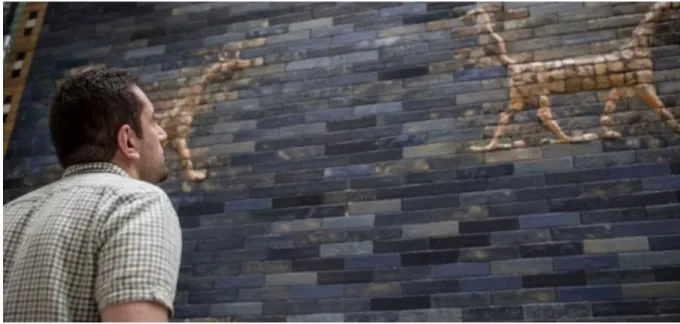
Figure 1: Syrian refugee admires the ancient Babylonian Ishtar Gate at Berlin’s Museum of the Ancient Near East.
Nowadays, many museums initiate or take part in integration programmes, as a result of their
active social role which has a more direct impact on their local society.110 One example, is the
partnership between Berlin museums for the Multaka project. As Hatton has written, a
109 It is part of a series of six on the integration of refugees and migrants in Europe addressing the following
topics: Housing, introductory programmes and language courses, assessment of skills and recognition of qualifications, vocational training and (higher) education, employment and employment support and civic and political participation.
110 Edmund Rice Heritage Center, a museum in Ireland, Museum Magnet and Arts Program that cooperates
with museums and cultural organizations in order to foster integration in school children in Washington, Victoria and Albert Museum (V&A)’s integration programme in London during the Refugee Week almost 10 years ago, are only some of the numerous examples of museums’ initiatives towards the assistance upon the cultural integration of immigrants. Sources: http://citiesofmigration.ca/good_idea/london-making-museums-a-hub-for-integration/,