Towards Rational Dosing Algorithms for Vancomycin in Neonates
and Infants Based on Population Pharmacokinetic Modeling
Esther J. H. Janssen,aPyry A. J. Välitalo,aKarel Allegaert,bRoosmarijn F. W. de Cock,aSinno H. P. Simons,cCatherine M. T. Sherwin,d Johan W. Mouton,eJohannes N. van den Anker,f,g,hCatherijne A. J. Knibbea,i
Division of Pharmacology, Leiden Academic Centre for Drug Research, Leiden University, Leiden, the Netherlandsa
; Neonatal Intensive Care Unit, University Hospital Leuven, Leuven, Belgiumb
; Department of Pediatrics, Division of Neonatology, Erasmus MC-Sophia Children’s Hospital, Rotterdam, the Netherlandsc
; Division of Clinical Pharmacology, Department of Pediatrics, University of Utah School of Medicine, Salt Lake City, Utah, USAd
; Department of Medical Microbiology and Infectious Diseases, Erasmus MC-Sophia Children’s Hospital, Rotterdam, the Netherlandse
; Division of Pediatric Clinical Pharmacology, Children’s National Medical Center, Washington, DC, USAf
; Department of Paediatric Pharmacology, University Children’s Hospital Basel, Basel, Switzerlandg
; Intensive Care and Department of Pediatric Surgery, Erasmus MC-Sophia Children’s Hospital, Rotterdam, the Netherlandsh
; Department of Clinical Pharmacy, St. Antonius Hospital, Nieuwegein, the Netherlandsi
Because of the recent awareness that vancomycin doses should aim to meet a target area under the concentration-time curve
(AUC) instead of trough concentrations, more aggressive dosing regimens are warranted also in the pediatric population. In this
study, both neonatal and pediatric pharmacokinetic models for vancomycin were externally evaluated and subsequently used to
derive model-based dosing algorithms for neonates, infants, and children. For the external validation, predictions from
previ-ously published pharmacokinetic models were compared to new data. Simulations were performed in order to evaluate current
dosing regimens and to propose a model-based dosing algorithm. The AUC/MIC over 24 h (AUC
24/MIC) was evaluated for all
investigated dosing schedules (target of
>
400), without any concentration exceeding 40 mg/liter. Both the neonatal and
pediat-ric models of vancomycin performed well in the external data sets, resulting in concentrations that were predicted correctly and
without bias. For neonates, a dosing algorithm based on body weight at birth and postnatal age is proposed, with daily doses
di-vided over three to four doses. For infants aged
<
1 year, doses between 32 and 60 mg/kg/day over four doses are proposed, while
above 1 year of age, 60 mg/kg/day seems appropriate. As the time to reach steady-state concentrations varies from 155 h in
pre-term infants to 36 h in children aged
>
1 year, an initial loading dose is proposed. Based on the externally validated neonatal and
pediatric vancomycin models, novel dosing algorithms are proposed for neonates and children aged
<
1 year. For children aged 1
year and older, the currently advised maintenance dose of 60 mg/kg/day seems appropriate.
I
n the pediatric population, drugs are often administered in an
off-label or unlicensed manner (
1
). While pediatric dosing
reg-imens are mostly empirically derived using extrapolations based
on body weight (
2
,
3
), it has been shown before that dosing in
children should be guided by the understanding of developmental
changes in the pharmacokinetic and/or pharmacodynamic
rela-tion of drugs (
2
,
4
,
5
). More specifically, translation of results from
pharmacokinetic modeling studies has been shown to result in
individualized dosing guidelines for many different drugs in
pe-diatric clinical practice (
5–9
).
The antibacterial agent vancomycin is commonly used to treat
infections caused by Gram-positive organisms, like
methicillin-resistant
Staphylococcus aureus
(MRSA) and amoxicillin-resistant
Enterococcus
species, in both adults and pediatric patients (
10
). In
neonates, MRSA infection is relatively rare, and
coagulase-nega-tive staphylococci are the most commonly identified infectious
organisms necessitating vancomycin treatment (
11
,
12
). For
van-comycin, it has been shown that bacterial killing of
S. aureus
is best
predicted by the area under the concentration-time curve over 24
h (AUC
24) divided by the MIC for the infecting pathogen (AUC
24/
MIC) (
13–15
). In adult patients, an AUC
24/MIC of
ⱖ
400 resulted
in a superior clinical and bacteriological response (
16
,
17
).
Be-cause of the recent awareness that vancomycin doses should aim
to meet a target AUC or exposure instead of trough
concentra-tions (
18
), more aggressive dosing regimens are warranted also in
the pediatric population. Depending on the population and the
dosing frequency, target trough concentrations that can be used to
adjust the dose in an individual child in clinical practice
(thera-peutic drug monitoring [TDM]) can be derived that will lead to
the target AUC
24(
19–21
).
The exposure or AUC of vancomycin is dependent on the
pri-mary pharmacokinetic parameter total body clearance, which is
known to vary widely between infants and children of different
ages, especially in the heterogeneous group of preterm neonates
(
19
,
20
,
22–36
). Despite the large number of proposed
vanco-mycin dosing regimens currently available for neonates and
infants (
10
,
11
,
37–41
), studies reporting on the results of
ther-apeutic drug monitoring show that the target trough
concen-trations are difficult to attain in clinical practice (
42–45
). In
accordance with reported clinical practice in adults,
continu-Received31 August 2015 Returned for modification2 October 2015 Accepted22 November 2015
Accepted manuscript posted online7 December 2015
CitationJanssen EJH, Välitalo PAJ, Allegaert K, de Cock RFW, Simons SHP, Sherwin CMT, Mouton JW, van den Anker JN, Knibbe CAJ. 2016. Towards rational dosing algorithms for vancomycin in neonates and infants based on population pharmacokinetic modeling. Antimicrob Agents Chemother 60:1013–1021.
doi:10.1128/AAC.01968-15.
Address correspondence to Catherijne A. J. Knibbe, [email protected].
Supplemental material for this article may be found athttp://dx.doi.org/10.1128 /AAC.01968-15.
Copyright © 2016, American Society for Microbiology. All Rights Reserved.
on August 30, 2016 by WALAEUS LIBRARY/BIN 299
http://aac.asm.org/
ous dosing has also been investigated in neonates, infants, and
children (
31
,
34
,
46–49
).
In previous reports, the developmental changes in vancomycin
pharmacokinetics have been characterized in both neonates and
children with normal renal function (defined as serum creatinine
two to three times higher than the age-related reference value) (
22
,
23
). Both models were based on a very large number of patients
and internally validated (
22
,
23
). In order to further investigate the
predictive performance of these models, an external validation
procedure with external data sets is needed (
2–5
). This external
validation is necessary to allow the use of the model for deriving
model-based dosing algorithms (
3–5
).
The aim of the current study is therefore to evaluate the
pre-dictive performance of the previously published neonatal and
pe-diatric pharmacokinetic models (
22
,
23
) against an external
van-comycin data set containing preterm and term neonates and
infants. The model is then used to evaluate currently used dosing
regimens (
37–40
) in terms of target exposure. Based on the results
of these simulations, a model-based vancomycin dosing
algo-rithm for intermittent and continuous dosing will be derived that
can be used in prospective clinical trials to optimize vancomycin
treatment for neonates, infants, and children.
MATERIALS AND METHODS
Original models.Previously, population models both for neonates
(22) and for infants and children (23) have been developed in which
the developmental changes in vancomycin pharmacokinetics in
neo-nates and children were characterized. In the neonatal model (22),
birth body weight (bBW), postnatal age (PNA), and the coadministra-tion of ibuprofen (with ibuprofen set at a value of 1 in the case of ibuprofen coadministration and a value of 0 in the case of no coad-ministration) were identified as covariates for clearance (equation 1) while current body weight (cBW) was found as a covariate for the
central volume of distribution (equation 2). In these equations, Cli
represents the clearance in theith individual,Vc,iis the central volume
of distribution in theith individual, Qiis the intercompartmental
clearance in theith individual, andVp,iis the peripheral volume of
distribution in theith individual.
Cli
共
liters ⁄h兲
⫽0.053⫻冉
bBW1, 750 g
冊
1.34
⫻
冉
1⫹冉
0.213⫻ PNA2 days
冊冊
⫻0.838ibuprofen (1)
Vc,i
共
liters兲
⫽0.913⫻冉
cBW 1, 760 g冊
0.919
(2)
Qi
共
liters ⁄ h兲
⫽0.904⫻Cli (3)Vp,i
共
liters兲
⫽Vc,i (4)In the pediatric model (23), cBW was identified as a covariate for both
clearance (equation 5) and the central volume of distribution (equation 6).
Cli(liters ⁄ h)⫽0.39⫻
冉
cBW4 kg
冊
2.23⫻cBW⫺0.065
(5)
Vc,i(liters ⁄ h)⫽2.22⫻
冉
cBW4 kg
冊
1
(6)
Qi
共
liters ⁄ h兲
⫽Cli (7)Vp,i(liters)⫽Vc,i (8)
External model validation and evaluation.Model validation using
external data sets was performed using NONMEM, version 7.3 (Icon De-velopment Solutions, Hanover, MD). Tools like PsN, version 4.2.0
(Uni-versity of Uppsala, Sweden) (50), and R, version 3.1.1 (R Foundation for
Statistical Computing, Vienna, Austria), were used to visualize data and evaluate the model. External validation was performed with an external data set containing TDM data which were not used for model
develop-ment (42). This external data set (42) consisted of both (pre)term
neo-nates and young infants (PNA up to 169 days;n⫽206). An overview of
the internal (model-building) (23,24,51) and external (42) data sets is
given inTable 1.
For the external validation, previously published pharmacokinetic
models (22,23) were used to simulate each of the observations of the data
sets 1,000 times. Normalized prediction distribution errors (NPDE) (52,
53) were computed for each of the data sets. The NPDE were statistically
and visually evaluated for trends and bias. The NPDE were expected to
follow the normal distribution,N(0, 1).
Simulations.Concentration-time profiles were simulated in
neo-nates and children for different dosing regimens reported in the Dutch
Children’s Formulary (37), British National Formulary for Children
(BNFc) (38), the regimen proposed by the Infectious Diseases Society
of America (IDSA) (39), and the meningitis regimen of the NeoFax
manual (40) (see Table S1 in the supplemental material), using the
parameter estimates from the original models (22,23). Simulations
were performed in six representative individuals (gestational ages [GA] of 24, 34, and 40 weeks and a PNA of 2 weeks and infants/ children aged 6 months, 4, and 12 years (see Table S2). Infusion dura-tion was 1 h (maximum, 10 mg/min), and treatment duradura-tion was 7
days. The AUC24on day 7 was calculated noncompartmentally. For
TABLE 1Overview of the internal data sets used to develop the original neonatal and pediatric models and of the external data set used for the
external validation of the original neonatal and pediatric modelsa
Parameter
Median value (range) for the parameter
Neonatal model Pediatric model
Internal data set External data set Internal data set External data set
No. of patients 273 191 429 206
Gestational age (weeks) 29 (23–34) 32 (24–41) NRb NR
Postmenstrual age (weeks) 30 (24–38) 34 (25–44) NR NR
Postnatal age (days) 14 (1–28) 8 days (1–31) 16 (1–6,205) 8 (1–169)
Current body weight (g) 1,170 (415–2,630) 1,780 (420–4,680) 1,800 (415–85,000) 1,870 (420–5,000)
Birth body weight (g) 1,140 (385–2,550) 1,775 (420–4,680) NR NR
Ibuprofen coadministration (no. [%] of patients)
23 (8.4) 13 (6.8) NR NR
aFor the neonatal model, see reference22; for the pediatric model, see reference23; for the internal data sets, see references23,24, and51; for the external data set, see reference42. b
NR, not relevant for the pediatric model.
on August 30, 2016 by WALAEUS LIBRARY/BIN 299
http://aac.asm.org/
intermittent dosing, a peak concentration was simulated 1 h after the
end of infusion, and a trough concentration (Ctrough) was simulated
just before the next dose was given (10). For continuous dosing, a peak
concentration (1 h after the loading dose) and, every 12 h, a
steady-state concentration (Css) were simulated. Simulations were performed
excluding the interindividual and residual variability. Based on the results, a model-based dosing algorithm was designed for neonates, infants, and children without renal dysfunction (defined as serum cre-atinine two to three times higher than the age-related reference value,
similar to that of the original models [22,23]), aiming for a target
AUC24/MIC of⬎400 (17) without peak concentrations exceeding 40
mg/liter.
RESULTS
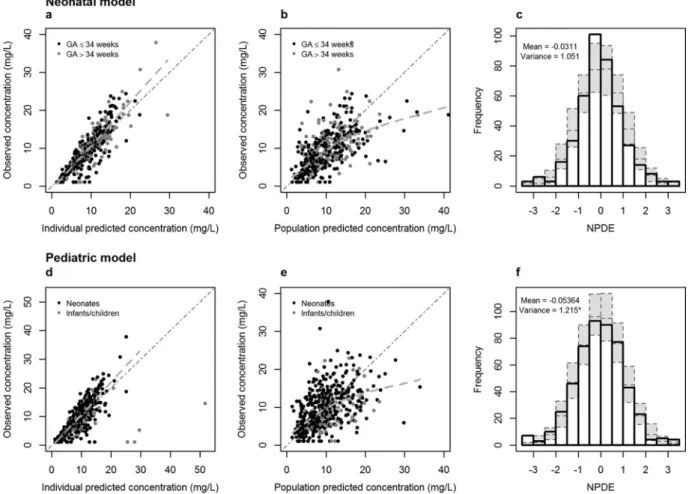
External validation of the neonatal model.
In
Fig. 1a
and
b
, the
observed concentrations versus individual and population
pre-dicted concentrations are given for the neonatal model for the 191
neonates. Since the original model was built on vancomycin data
from neonates with GA of
ⱕ
34 weeks, a distinction was made for
neonates with GA of
ⱕ
34 weeks or
⬎34 weeks. Extrapolation to
neonates with GA of
⬎
34 weeks was evaluated because the
origi-nal model used information on neonates with GA of
⬎34 weeks
from neonates receiving amikacin (
22
). The results of these data,
together with the results of the NPDE analysis (mean,
⫺0.0311;
variance, 1.051) (
Fig. 1c
), show that the neonatal model can
pre-dict the median concentrations accurately and without bias in
both preterm and term neonates. No clear trend was observed
between the NPDE versus time and NPDE versus predicted
con-centrations for neonates with GA of
ⱕ
34 weeks or
⬎
34 weeks
(
Fig. 2
), indicating that no time-dependent or
concentration-de-FIG 1Results of the external validation of the models: observed versus individual predicted concentrations (a and d) and observed versus population predicted concentrations (b and e) for the neonatal model (black dots, preterm neonates; gray dots, term neonates) and the pediatric model (black dots, postnatal age of ⬍31 days; gray dots, postnatal age of⬎30 days). The dotted lines represent the regression lines. The histograms (c and f) show the distributions of the normalized prediction distribution errors (NPDE) for, respectively, the neonatal model and the pediatric model, with mean and variance of NPDE analysis. The gray dotted boxes reflect the variance of the NPDE. *, variance is significantly different from 1 (P⬍0.01).
FIG 2Results of the normalized prediction distribution error (NPDE)
anal-ysis of the neonatal model for individuals with GA ofⱕ34 and of⬎34 weeks
versus time and versus predicted concentration.
on August 30, 2016 by WALAEUS LIBRARY/BIN 299
http://aac.asm.org/
pendent bias is present when predictions are made for new
pa-tients not included in the model-building data set.
External validation of the pediatric model.
In
Fig. 1d
and
e
,
the observed concentrations versus individual and population
predicted concentrations are given for the pediatric model for the
206 patients. The results of these figures and the NPDE analysis
(mean,
⫺0.0536; variance, 1.215) (
Fig. 1f
) show that the pediatric
model can predict the median concentrations accurately.
Simulations of currently used dosing guidelines.
Figure 3
shows concentration-time profiles during vancomycin treatment
for six representative individuals with current body weights
vary-ing between 0.640 kg and 45 kg followvary-ing four different dosvary-ing
regimens currently proposed, i.e., Dutch Children’s Formulary
(
37
), BNFc (
38
), IDSA (
39
), and NeoFax (
40
). In neonates, the
dosing regimens as suggested by the Dutch Children’s Formulary
(
37
), BNFc (
38
), and NeoFax (
40
) generally led to an AUC
24below
400 mg · h/liter, except for some younger individuals (i.e.,
indi-vidual 1, with a cBW of 640 g) for the Dutch Children’s Formulary
(
37
) and individual 2 (cBW of 2.27 kg) for the BNFc regimen (
38
)
(
Fig. 3
). After treatment according to the regimen suggested by
IDSA (
39
), the AUC
24was above 400 mg · h/liter (
Fig. 3
). The
concentrations in the smallest individual (individual 1), treated
according to IDSA (
39
), exceeded 40 mg/liter (
Fig. 3
).
Individuals 4 to 6 treated according to the regimens in the
Dutch Children’s Formulary (
37
) and the BNFc (
38
) generally had
AUC
24values below 400 mg · h/liter at day 7 (
Fig. 3
). Dosing as
suggested by the IDSA (
39
) led to AUC
24values above 400 mg ·
h/liter for all individuals (
Fig. 3
).
Simulations to derive a model-based dosing regimen.
Using
the externally validated neonatal and pediatric models,
simula-tions were performed aiming for individualized dosing guidelines
for neonates, infants, and children. The model-based dosing
algo-rithm is anticipated to result in an AUC
24at day 7 above 400 mg ·
h/liter.
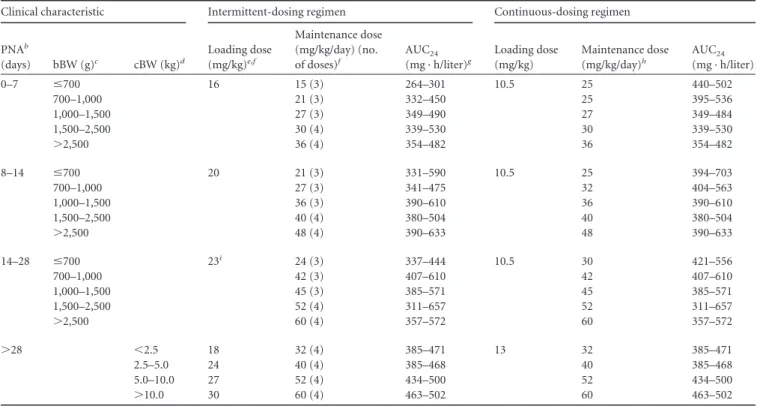
Table 2
shows these model-based dosing algorithms,
FIG 3Model-based predicted concentration-time profiles for six individuals. The Dutch Children’s Formulary (37), British National Formulary for Children (BNFc) (38), Infectious Diseases Society of America (IDSA) (39), and NeoFax (meningitis regimen) (40; see also Table S1 in the supplemental material) dosing guidelines and model-based dosing algorithms (Table 2) were used. GA, gestational age; PNA, postnatal age; cBW, current body weight. The dotted lines indicate the target concen-trations (10 to 15 mg/liter for trough concenconcen-trations upon intermittent dosing and 15 to 25 mg/liter for steady-state concenconcen-trations upon continuous dosing) and concentrations above which toxicity might occur (40 mg/liter). Concentrations outside the target and peak concentrations above 40 mg/liter are indicated by black dots. AUC24h, calculated area under the concentration-time curve (mg · h/liter) on the seventh day of treatment.
on August 30, 2016 by WALAEUS LIBRARY/BIN 299
http://aac.asm.org/
which are based on bBW, PNA, and the coadministration of
ibu-profen for neonates and on cBW for infants and children. To
calculate the dosages, cBW should be used for neonates, infants,
and children. Compared to the currently used dosing regimens
(
37
,
38
,
40
), the dosing frequency is increased to three to four
doses/day for neonates and young infants to prevent high peak
concentrations. For children aged 1 year and older, the dosing as
suggested by IDSA (
39
), 60 mg/kg/day in four doses, is
main-tained.
In neonates, time to steady state varied between approximately
155 h in a 1-week-old preterm neonate to 50 h in a 2-week-old
term neonate (
Fig. 3
). For the pediatric population (
⬎
1 month of
age, irrespective of GA), the data in
Fig. 3
show that the
concen-tration in young infants reaches steady state after approximately
45 h, which decreases to approximately 36 h in children aged 1
year and older. In order to reach steady state more rapidly, a
load-ing dose (
Table 2
) is proposed. After implementation of the
load-ing dose, the AUC
24on the first day of treatment will be above 400
mg · h/liter, which is not the case if no loading dose is given (
Table
3
). Similar results are obtained after implementation of a loading
dose for continuous dosing (results not shown).
DISCUSSION
In this study, both neonatal (
22
) and pediatric (
23
) vancomycin
models have been validated externally. Based on these models,
currently used dosing regimens have been evaluated upon which a
model-based dosing algorithm was proposed for intermittent and
continuous administration of vancomycin in neonates and
chil-dren. An AUC
24/MIC of over 400 was the aim. The results show
that for this AUC, the target
C
troughafter intermittent dosing was
10 to 15 mg/liter, and the target
C
ssafter continuous dosing was 15
to 25 mg/liter.
In order to facilitate the development of rational drug
dos-ing schemes in the pediatric population, new approaches are
TABLE 2Proposed model-based vancomycin dosing algorithms for the neonatal and pediatric populationsa
Clinical characteristic Intermittent-dosing regimen Continuous-dosing regimen
PNAb
(days) bBW (g)c cBW (kg)d
Loading dose (mg/kg)e,f
Maintenance dose (mg/kg/day) (no. of doses)f
AUC24
(mg · h/liter)g
Loading dose (mg/kg)
Maintenance dose
(mg/kg/day)h
AUC24
(mg · h/liter)
0–7 ⱕ700 16 15 (3) 264–301 10.5 25 440–502
700–1,000 21 (3) 332–450 25 395–536
1,000–1,500 27 (3) 349–490 27 349–484
1,500–2,500 30 (4) 339–530 30 339–530
⬎2,500 36 (4) 354–482 36 354–482
8–14 ⱕ700 20 21 (3) 331–590 10.5 25 394–703
700–1,000 27 (3) 341–475 32 404–563
1,000–1,500 36 (3) 390–610 36 390–610
1,500–2,500 40 (4) 380–504 40 380–504
⬎2,500 48 (4) 390–633 48 390–633
14–28 ⱕ700 23i 24 (3) 337–444 10.5 30 421–556
700–1,000 42 (3) 407–610 42 407–610
1,000–1,500 45 (3) 385–571 45 385–571
1,500–2,500 52 (4) 311–657 52 311–657
⬎2,500 60 (4) 357–572 60 357–572
⬎28 ⬍2.5 18 32 (4) 385–471 13 32 385–471
2.5–5.0 24 40 (4) 385–468 40 385–468
5.0–10.0 27 52 (4) 434–500 52 434–500
⬎10.0 30 60 (4) 463–502 60 463–502
a
This dosing algorithm (mg/kg current bodyweight) is based on a target AUC24/MIC of⬎400. bPNA, postnatal age.
c
bBW: birth body weight. dcBW, current body weight.
e
The maximum loading dose is 1,200 mg.
fIf ibuprofen is given and PNA is⬍28 days, decrease the dose by 2 mg/kg/dose. g
AUC24is the noncompartmental calculated area under the concentration-time curve over 24 h. Values are the expected daily AUC range for the different dosing groups. hIf ibuprofen is given and the PNA is⬍28 days, decrease the maintenance dose by 6 mg/kg/day.
i
The loading dose is 26 mg/kg if the PNA is 21 to 28 days.
TABLE 3Expected AUC24at 24h after start of treatment upon intermittent dosing without and with the proposed loading dose
Individual
no. Agea
Expected AUC24
(mg · h/liter)b
Without loading dose
With loading dose
1 GA, 24 weeks; PNA, 14 days 233 411
2 GA, 34 weeks; PNA, 14 days 337 440
3 GA, 40 weeks; PNA, 14 days 362 436
4 PNA, 6 mo 344 457
5 PNA, 4 yr 358 466
6 PNA, 12 yr 351 433
a
GA, gestational age; PNA, postnatal age. bAUC
24,calculated area under the concentration-time curve over 24 h.
on August 30, 2016 by WALAEUS LIBRARY/BIN 299
http://aac.asm.org/
needed (
2–5
). At this moment, several pediatric
pharmacoki-netic models of vancomycin have been published (
19–34
,
36
,
54–59
), but only few individualized, model-based dosing
algo-rithms are available (
25
,
27
,
30
,
34
,
57
,
59
). In clinical practice,
target concentrations and AUC
24/MIC values are hard to
achieve (
42–45
,
60
). Simulations based on two models (
22
,
23
),
that are now validated internally and externally, showed,
in-deed, that adapted doses are needed, especially for neonates
and young infants. In the neonatal model (
22
), clearance is
dependent on birth body weight and postnatal age of the
neo-nates and the coadministration of ibuprofen. In the pediatric
model (
23
), the changes in clearance were described with a
body weight-dependent exponent model based on current
body weight. These clinical characteristics were taken into
ac-count in the developed model-based dosing algorithm (
Table
2
), and simulations showed that the target AUC
24/MIC and
C
troughwere reached (
Fig. 3
). According to several currently
used dosing regimens (
37
,
38
,
40
), the daily dose should be
administered in two to three doses/day. For neonates and
in-fants, this was increased to three to four doses/day in the
mod-el-based dosing algorithm. Four doses/day are needed when
high dosages are needed to remain within the target for
C
trough;
otherwise these high dosages will increase the probability of
concentrations exceeding 40 mg/liter.
An AUC
24/MIC of
⬎
400 has been associated with clinical
suc-cess in adult patients with MRSA infections (
16
,
17
). Whether this
target is directly applicable to children has to be determined (
60
).
For neonates, lower targets may suffice as most of the identified
infectious organisms are coagulase-negative staphylococci instead
of MRSA(
11
,
12
). It has been reported that if the MIC is
⬍1 mg/
liter, 60 mg/kg/day seems necessary to reach an AUC
24/MIC of
⬎400 in children (
20
,
60–62
).
In daily clinical practice the calculation of the AUC
24is not
reliable on the basis of the TDM samples only. Therefore,
C
troughis
mainly used as a surrogate predictor of AUC
24although the
C
troughis dependent on the dosing interval. One can debate what the
proper
C
troughtarget range for neonates and infants is. IDSA
rec-ommends 15 to 20 mg/liter for severe infections after dosing two
to three daily for adults and four times daily for children (
39
).
Frymoyer et al. showed that a
C
troughof 7 to 11 mg/liter after
once/twice-daily dosing is appropriate for reaching an AUC
24/
MIC of
⬎400 in neonates (
19
). Other studies also showed that a
C
troughof around 8 mg/liter is appropriate for reaching the AUC
24/
MIC target in children (
20
,
21
). The currently proposed dosing
algorithm results in target trough concentrations between 10 and
15 mg/liter, with the data in
Fig. 3
showing that the AUC
24/MIC
target of
⬎
400 is reached if the MIC is below 1 mg/liter.
Reaching the target AUC
24/MIC in the first hours of treatment
is associated with better outcomes (
16
). Studies in both adults (
63
)
and neonates (
34
) show that higher concentrations are reached
when a loading dose is given than with conventional dosing. By
the implementation of a loading dose, steady-state concentrations
can be reached sooner, especially in neonates where the
elimina-tion half-life is much longer than that in children and adults. At
this moment, insufficient information is available regarding the
safety of the administration of a vancomycin loading dose.
There-fore, one could consider prolonging the infusion duration when a
loading dose is given to reduce the risk of possible infusion
reac-tions (
17
,
39
). For intermittent dosing, the maximum loading
dose is 1,200 mg to limit the infusion time to 2 h, allowing for the
infusion line to be used for other drugs. The simulations of the
model-based dosing algorithms have shown that the target
con-centrations for both intermittent and continuous dosing were
reached within 24 h after administration of the loading dose (
Ta-ble 3
). The proposed loading dose, especially the loading dose for
intermittent dosing, has to be tested in daily practice to confirm
the safety of these dosages. For continuous dosing, a reduction in
the loading dose compared to the loading dose suggested for
in-termittent dosing is proposed as the maintenance infusion starts
immediately after the loading dose.
Continuous infusion of vancomycin has several advantages
over intermittent infusion, for example, decreased
pharmacoki-netic variability and increased ease of TDM (
18
,
64
). It has been
shown in adults that continuous administration decreases the risk
of nephrotoxicity compared to that with intermittent
administra-tion (
64
). However, although the number of neonates reaching
the target concentrations increased with continuous dosing, TDM
still seemed to be necessary (
34
). On the other hand, continuous
vancomycin dosing might be problematic in neonatal clinical
practice, especially in preterm neonates, because there may not be
intravenous access available for this continuous infusion.
The data used for the external validation of the neonatal model
consisted of both preterm and term neonates (
42
), and the model
proved to be good in terms of predictive performance for both
groups (
Fig. 2
). This is remarkable as the vancomycin data used
for building the neonatal model consisted of preterm neonates
only (GA up to 34 weeks) (
Table 1
) (
51
). However, for the
vanco-mycin model (
22
), a neonatal amikacin covariate model (
6
) was
used for extrapolation, for which data from both preterm and
term neonates were available (
6
). This amikacin covariate model
has been extrapolated not only to vancomycin but also to
tobra-mycin, gentamicin, and netilmicin (
22
). For all other antibiotics,
data were from both preterm and term neonates, and no
predic-tion bias in term neonates could be observed for any of these
antibiotics. Finally, an independent research group has
success-fully used the amikacin covariate model (
6
) to predict vancomycin
clearance in both term and preterm neonates (
36
). Therefore, our
conclusion that the model is valid for both preterm and term
neonates seems justified. As shown in
Table 1
, similar percentages
of the neonates included in model building (8.4%) and validation
(6.8%) received ibuprofen. In the data set used for developing the
amikacin covariate model, 13.5% received ibuprofen (
6
).
There-fore, the proposed dosing algorithm is valid for both neonates
receiving ibuprofen and those not receiving ibuprofen.
The original pediatric model was built using data from
neo-nates, infants, children, and adolescents (
Table 1
). This model was
developed to define a function to describe the maturation in
glo-merular filtration rate (GFR) (
23
). Adult GFR levels, expressed per
unit of body surface area, are reached at approximately 6 to 12
months of age (
65–68
). External validation of this model was
lim-ited to neonates and young infants up to 6 months of age since no
additional data were available. As the GFR approaches adult
val-ues at 6 to 12 months, the period where most developmental
changes happen is covered by this external validation. For older
infants and children, an additional external validation procedure
should be performed. Based on these results, the proposed dosing
algorithm should be adapted when necessary, with particular
fo-cus on infants older than 169 days.
In conclusion, both the neonatal and pediatric models could
describe the data in the external data set well. This study shows
on August 30, 2016 by WALAEUS LIBRARY/BIN 299
http://aac.asm.org/
that with currently used dosing regimens, the target AUC
24/MIC
and trough concentrations are hardly reached in neonates and
young infants, whereas the model-based dosing algorithm results
in the target exposure after both intermittent and continuous
dos-ing. For children aged 1 year and older, the currently used dose of
60 mg/kg/day seems appropriate. In order to reach an AUC
24/
MIC of
⬎
400 on the first day of treatment, a loading dose should
be administered. A prospective clinical study is warranted in order
to validate the model-based dosing algorithm.
ACKNOWLEDGMENTS
This study was performed within the framework of Top Institute Pharma project number D2-501. K.A. is supported by the Fund for Scientific Re-search, Flanders (Fundamental Clinical Investigatorship 1800214N), and by an IWT-SBO project (130033). J.N.V.D.A. is supported by NIH (K24DA027992, R01HD048689, and U54HD071601) and the European Commission (TINN [223614] and TINN2 [260908], and Neurosis [223060]). C.A.J.K. is supported by the Innovational Research Incentives Scheme (Vidi grant, June 2013) of the Dutch Organization for Scientific Research.
FUNDING INFORMATION
Top Institute Pharma (TI Pharma) provided funding to Esther J. H. Jans-sen under grant number D2-501.
The funder had no role in study design, data collection and interpretation, or the decision to submit the work for publication.
REFERENCES
1.Cuzzolin L, Atzei A, Fanos V.2006. Off-label and unlicensed prescribing for newborns and children in different settings: a review of the literature
and a consideration about drug safety. Expert Opin Drug Saf5:703–718.
http://dx.doi.org/10.1517/14740338.5.5.703.
2.Knibbe CAJ, Danhof M.2011. Individualized dosing regimens in chil-dren based on population PKPD modelling: are we ready for it? Int J
Pharm415:9 –14.http://dx.doi.org/10.1016/j.ijpharm.2011.02.056.
3.De Cock RFW, Piana C, Krekels EHJ, Danhof M, Allegaert K, Knibbe
CAJ.2011. The role of population PK-PD modelling in paediatric clinical
research. Eur J Clin Pharmacol 67(Suppl 1):5–16.http://dx.doi.org/10
.1007/s00228-009-0782-9.
4.Ince I, de Wildt SN, Tibboel D, Danhof M, Knibbe CAJ.2009. Tailor-made drug treatment for children: creation of an infrastructure for
data-sharing and population PK-PD modeling. Drug Discov Today14:316 –
320.http://dx.doi.org/10.1016/j.drudis.2008.11.004.
5.Admiraal R, van Kesteren C, Boelens JJ, Bredius RGM, Tibboel D, Knibbe CAJ.2014. Towards evidence-based dosing regimens in children on the basis of population pharmacokinetic pharmacodynamic
model-ling. Arch Dis Child99:267–272.http://dx.doi.org/10.1136/archdischild
-2013-303721.
6.De Cock RF, Allegaert K, Schreuder MF, Sherwin CM, de Hoog M, van den Anker JN, Danhof M, Knibbe CA.2012. Maturation of the glomer-ular filtration rate in neonates, as reflected by amikacin clearance. Clin
Pharmacokinet 51:105–117. http://dx.doi.org/10.2165/11595640-00000
0000-00000.
7.Krekels EHJ, Tibboel D, de Wildt SN, Ceelie I, Dahan A, van Dijk M, Danhof M, Knibbe CAJ. 2014. Evidence-based morphine dosing for
postoperative neonates and infants. Clin Pharmacokinet 53:553–563.
http://dx.doi.org/10.1007/s40262-014-0135-4.
8.Bartelink IH, van Kesteren C, Boelens JJ, Egberts TCG, Bierings MB, Cuvelier GDE, Wynn RF, Slatter MA, Chiesa R, Danhof M, Knibbe
CAJ.2012. Predictive performance of a busulfan pharmacokinetic model
in children and young adults. Ther Drug Monit34:574 –583.http://dx.doi
.org/10.1097/FTD.0b013e31826051bb.
9.Valitalo PAJ, van den Anker JN, Allegaert K, de Cock RFW, de Hoog M, Simons SHP, Mouton JW, Knibbe CAJ.2015. Novel model-based dosing guidelines for gentamicin and tobramycin in preterm and term neonates.
J Antimicrob Chemother 70:2074 –2077. http://dx.doi.org/10.1093/jac
/dkv052.
10. EuroCept BV.2010. Summary of product characteristics: Vancocin. Eu-roCept BV, Ankeveen, the Netherlands.
11. de Hoog M, Mouton JW, van den Anker JN.2004. Vancomycin:
pharma-cokinetics and administration regimens in neonates. Clin Pharmacokinet43:
417– 440.http://dx.doi.org/10.2165/00003088-200443070-00001.
12. Venkatesh MP, Placencia F, Weisman LE. 2006. Coagulase-negative staphylococcal infections in the neonate and child: an update. Semin Pe-diatr Infect Dis17:120 –127.http://dx.doi.org/10.1053/j.spid.2006.06.005. 13. Smirnova MV, Lubenko IY, Portnoy YA, Zinner SH, Firsov AA.2007. Concentration-response relationships as a basis for choice of the optimal endpoints of the antimicrobial effect: daptomycin and vancomycin phar-macodynamics with staphylococci in an in vitro dynamic model. Int J
Antimicrob Agents 29:165–169. http://dx.doi.org/10.1016/j.ijantimicag
.2006.09.011.
14. Rybak MJ.2006. The pharmacokinetic and pharmacodynamic properties of vancomycin. Clin Infect Dis42:S35–9.http://dx.doi.org/10.1086/491712. 15. Craig WA.2003. Basic pharmacodynamics of antibacterials with clinical
applications to the use of beta-lactams, glycopeptides, and linezolid. Infect
Dis Clin North Am17:479 –501.http://dx.doi.org/10.1016/S0891-5520
(03)00065-5.
16. Moise-Broder PA, Forrest A, Birmingham MC, Schentag JJ. 2004. Pharmacodynamics of vancomycin and other antimicrobials in patients with Staphylococcus aureus lower respiratory tract infections. Clin
Phar-macokinet 43:925–942. http://dx.doi.org/10.2165/00003088-200443130
-00005.
17. Rybak M, Lomaestro B, Rotschafer JC, Moellering R, Craig W, Billeter M, Dalovisio JR, Levine DP.2009. Therapeutic monitoring of vancomy-cin in adult patients: a consensus review of the American Society of Health-System Pharmacists, the Infectious Diseases Society of America, and the Society of Infectious Diseases Pharmacists. Am J Health Syst
Pharm66:82–98.http://dx.doi.org/10.2146/ajhp080434.
18. Stockmann C, Roberts JK, Yu T, Constance JE, Knibbe CA, Spigarelli MG, Sherwin CM.2014. Vancomycin pharmacokinetic models: inform-ing the clinical management of drug-resistant bacterial infections. Expert
Rev Anti Infect Ther12:1371–1388.http://dx.doi.org/10.1586/14787210
.2014.966081.
19. Frymoyer A, Hersh AL, El-Komy MH, Gaskari S, Su F, Drover DR, Van Meurs K.2014. Association between vancomycin trough concentration and area under the concentration-time curve in neonates. Antimicrob Agents
Chemother58:6454 – 6461.http://dx.doi.org/10.1128/AAC.03620-14.
20. Le J, Bradley JS, Murray W, Romanowski GL, Tran TT, Nguyen N, Cho S, Natale S, Bui I, Tran TM, Capparelli EV.2013. Improved vancomycin dosing in children using area under the curve exposure. Pediatr Infect Dis
J32:e155– 63.http://dx.doi.org/10.1097/INF.0b013e318286378e.
21. Frymoyer A, Guglielmo BJ, Hersh AL.2013. Desired vancomycin trough serum concentration for treating invasive methicillin-resistant
staphylo-coccal infections. Pediatr Infect Dis J32:1077–1079.http://dx.doi.org/10
.1097/INF.0b013e318299f75c.
22. De Cock RFW, Allegaert K, Sherwin CMT, Nielsen EI, de Hoog M, van den Anker JN, Danhof M, Knibbe CAJ. 2014. A neonatal amikacin covariate model can be used to predict ontogeny of other drugs eliminated
through glomerular filtration in neonates. Pharm Res31:754 –767.http:
//dx.doi.org/10.1007/s11095-013-1197-y.
23. De Cock RFW, Allegaert K, Brussee JM, Sherwin CMT, Mulla H, de Hoog M, van den Anker JN, Danhof M, Knibbe CAJ.2014. Simultane-ous pharmacokinetic modeling of gentamicin, tobramycin and vancomy-cin clearance from neonates to adults: towards a semi-physiological
func-tion for maturafunc-tion in glomerular filtrafunc-tion. Pharm Res31:2643–2654.
http://dx.doi.org/10.1007/s11095-014-1361-z.
24. Anderson BJ, Allegaert K, Van den Anker JN, Cossey V, Holford NHG.
2007. Vancomycin pharmacokinetics in preterm neonates and the
predic-tion of adult clearance. Br J Clin Pharmacol63:75– 84.http://dx.doi.org
/10.1111/j.1365-2125.2006.02725.x.
25. Capparelli EV, Lane JR, Romanowski GL, McFeely EJ, Murray W, Sousa P, Kildoo C, Connor JD.2001. The influences of renal function and maturation
on vancomycin elimination in newborns and infants. J Clin Pharmacol41:
927–934.http://dx.doi.org/10.1177/00912700122010898.
26. Giachetto GA, Telechea HM, Speranza N, Oyarzun M, Nanni L, Menchaca A.2011. Vancomycin pharmacokinetic-pharmacodynamic parameters to optimize dosage administration in critically ill children.
Pediatr Crit Care Med 12:e250 – 4. http://dx.doi.org/10.1097/PCC
.0b013e3181fe4047.
27. Grimsley C, Thomson AH.1999. Pharmacokinetics and dose
on August 30, 2016 by WALAEUS LIBRARY/BIN 299
http://aac.asm.org/
ments of vancomycin in neonates. Arch Dis Child Fetal Neonatal Ed81:
F221-7.http://dx.doi.org/10.1136/fn.81.3.F221.
28. de Hoog M, Schoemaker RC, Mouton JW, van den Anker JN.2000. Vancomycin population pharmacokinetics in neonates. Clin Pharmacol
Ther67:360 –367.http://dx.doi.org/10.1067/mcp.2000.105353.
29. Kimura T, Sunakawa K, Matsuura N, Kubo H, Shimada S, Yago K.
2004. Population pharmacokinetics of arbekacin, vancomycin, and
pan-ipenem in neonates. Antimicrob Agents Chemother48:1159 –1167.http:
//dx.doi.org/10.1128/AAC.48.4.1159-1167.2004.
30. Marqués-Miñana M-R, Saadeddin A, Peris J-E.2010. Population phar-macokinetic analysis of vancomycin in neonates. A new proposal of initial
dosage guideline. Br J Clin Pharmacol70:713–720.http://dx.doi.org/10
.1111/j.1365-2125.2010.03736.x.
31. Oudin C, Vialet R, Boulamery A, Martin C, Simon N.2011. Vancomy-cin prescription in neonates and young infants: toward a simplified
dos-age. Arch Dis Child Fetal Neonatal Ed96:F365-70.http://dx.doi.org/10
.1136/adc.2010.196402.
32. Seay RE, Brundage RC, Jensen PD, Schilling CG, Edgren BE. 1994. Population pharmacokinetics of vancomycin in neonates. Clin Pharmacol
Ther56:169 –175.http://dx.doi.org/10.1038/clpt.1994.120.
33. Yasuhara M, Iga T, Zenda H, Okumura K, Oguma T, Yano Y, Hori R.
1998. Population pharmacokinetics of vancomycin in Japanese pediatric
patients. Ther Drug Monit20:612– 618.http://dx.doi.org/10.1097/00007691
-199812000-00005.
34. Zhao W, Lopez E, Biran V, Durrmeyer X, Fakhoury M, Jacqz-Aigrain
E.2013. Vancomycin continuous infusion in neonates: dosing
optimisa-tion and therapeutic drug monitoring. Arch Dis Child98:449 – 453.http:
//dx.doi.org/10.1136/archdischild-2012-302765.
35. Zhao W, Zhang D, Fakhoury M, Fahd M, Duquesne F, Storme T, Baruchel A, Jacqz-Aigrain E. 2014. Population pharmacokinetics and dosing optimization of vancomycin in children with malignant
hemato-logical disease. Antimicrob Agents Chemother58:3191–3199.http://dx
.doi.org/10.1128/AAC.02564-13.
36. Zhao W, Biran V, Jacqz-Aigrain E.2013. Amikacin maturation model as a marker of renal maturation to predict glomerular filtration rate and
vancomycin clearance in neonates. Clin Pharmacokinet52:1127–1134.
http://dx.doi.org/10.1007/s40262-013-0101-6.
37. Nederlands Kenniscentrum voor Farmacotherpie bij Kinderen.2013. Kinderformularium. Nederlands Kenniscentrum voor Farmacotherpie bij Kinderen, Rotterdam, the Netherlands.
38. Paediatric Formulary Committee.2009. British national formulary for children. BMJ Group, London, United Kingdom.
39. Liu C, Bayer A, Cosgrove SE, Daum RS, Fridkin SK, Gorwitz RJ, Kaplan SL, Karchmer AW, Levine DP, Murray BE, J Rybak M, Talan DA, Chambers HF.2011. Clinical practice guidelines by the Infectious
Dis-eases Society of America for the treatment of methicillin-resistant
Staph-ylococcus aureusinfections in adults and children: executive summary. Clin Infect Dis52:285–292.http://dx.doi.org/10.1093/cid/cir034. 40. Young TE, Mangum B, Thomson Reuters Clinical Editorial Staff.2011.
NeoFax, 24th ed. PDR Network, Montvale, NJ.
41. Hey E, Northern Neonatal Network.2011. Neonatal formulary 6; drug use in pregnancy and the first year of life, 6th ed. BMJ Group, Chichester, United Kingdom.
42. Vandendriessche A, Allegaert K, Cossey V, Naulaers G, Saegeman V, Smits A.2014. Prospective validation of neonatal vancomycin dosing
regimens is urgently needed. Curr Ther Res Clin Exp76:51–57.http://dx
.doi.org/10.1016/j.curtheres.2014.06.001.
43. Eiland LS, English TM, Eiland EH. 2011. Assessment of vancomycin dosing and subsequent serum concentrations in pediatric patients. Ann
Pharmacother45:582–589.http://dx.doi.org/10.1345/aph.1P588.
44. Broome, L., So T-Y.2011. An evaluation of initial vancomycin dosing in infants, children, and adolescents. Int J Pediatr2011:470364.http://dx.doi .org/10.1155/2011/470364.
45. Frymoyer A, Guglielmo BJ, Wilson SD, Scarpace SB, Benet LZ, Hersh
AL.2011. Impact of a hospital-wide increase in empiric pediatric
vanco-mycin dosing on initial trough concentrations. Pharmacotherapy31:871–
876.http://dx.doi.org/10.1592/phco.31.9.871.
46. McKamy S, Chen T, Lee M, Ambrose PJ.2012. Evaluation of a pediatric continuous-infusion vancomycin therapy guideline. Am J Health Syst
Pharm69:2066 –2071.http://dx.doi.org/10.2146/ajhp120072.
47. Pawlotsky F, Thomas A, Kergueris MF, Debillon T, Roze JC. 1998. Constant rate infusion of vancomycin in premature neonates: a new
dos-age schedule. Br J Clin Pharmacol46:163–167.
48. Patel AD, Anand D, Lucas C, Thomson AH.2013. Continuous infusion
of vancomycin in neonates. Arch Dis Child98:478 – 479.http://dx.doi.org
/10.1136/archdischild-2012-303197.
49. Plan O, Cambonie G, Barbotte E, Meyer P, Devine C, Milesi C, Pidoux O, Badr M, Picaud JC.2008. Continuous-infusion vancomycin therapy for preterm neonates with suspected or documented Gram-positive
infec-tions: a new dosage schedule. Arch Dis Child Fetal Neonatal Ed93:
F418-21.http://dx.doi.org/10.1136/adc.2007.128280.
50. Lindbom L, Ribbing J, Jonsson EN.2004. Perl-speaks-NONMEM (PsN): a Perl module for NONMEM related programming. Comput Methods
Pro-grams Biomed75:85–94.http://dx.doi.org/10.1016/j.cmpb.2003.11.003.
51. Allegaert K, Anderson BJ, van den Anker JN, Vanhaesebrouck S, de Zegher F.2007. Renal drug clearance in preterm neonates: relation to
prenatal growth. Ther Drug Monit29:284 –291.http://dx.doi.org/10.1097
/FTD.0b013e31806db3f5.
52. Comets E, Brendel K, Mentré F.2008. Computing normalised prediction distribution errors to evaluate nonlinear mixed-effect models: the NPDE
add-on package for R. Comput Methods Programs Biomed90:154 –166.
http://dx.doi.org/10.1016/j.cmpb.2007.12.002.
53. Brendel K, Comets E, Laffont C, Laveille C, Mentré F.2006. Metrics for external model evaluation with an application to the population
pharma-cokinetics of gliclazide. Pharm Res23:2036 –2049.http://dx.doi.org/10
.1007/s11095-006-9067-5.
54. Lamarre P, Lebel D, Ducharme MP.2000. A population pharmaco-kinetic model for vancomycin in pediatric patients and its predictive
value in a naive population. Antimicrob Agents Chemother44:278 –
282.http://dx.doi.org/10.1128/AAC.44.2.278-282.2000.
55. Lim H-S, Chong YP, Noh Y-H, Jung J-A, Kim YS.2014. Exploration of optimal dosing regimens of vancomycin in patients infected with
methi-cillin-resistantStaphylococcus aureusby modeling and simulation. J Clin
Pharm Ther39:196 –203.http://dx.doi.org/10.1111/jcpt.12123.
56. Zhao W, Kaguelidou F, Biran V, Zhang D, Allegaert K, Capparelli EV, Holford N, Kimura T, Lo Y-L, Peris J-E, Thomson A, van den Anker JN, Fakhoury M, Jacqz-Aigrain E.2013. External evaluation of population pharmacokinetic models of vancomycin in neonates: the transferability of
published models to different clinical settings. Br J Clin Pharmacol75:
1068 –1080.http://dx.doi.org/10.1111/j.1365-2125.2012.04406.x.
57. Lo Y-L, van Hasselt JGC, Heng S-C, Lim C-T, Lee T-C, Charles BG.
2010. Population pharmacokinetics of vancomycin in premature Malay-sian neonates: identification of predictors for dosing determination.
An-timicrob Agents Chemother 54:2626 –2632. http://dx.doi.org/10.1128
/AAC.01370-09.
58. Revilla N, Martín-Suárez A, Pérez MP, González FM, Fernández de Gatta MDM.2010. Vancomycin dosing assessment in intensive care unit patients based on a population pharmacokinetic/pharmacodynamic
sim-ulation. Br J Clin Pharmacol70:201–212.http://dx.doi.org/10.1111/j.1365
-2125.2010.03679.x.
59. James A, Koren G, Milliken J, Soldin S, Prober C.1987. Vancomycin pharmacokinetics and dose recommendations for preterm infants.
An-timicrob Agents Chemother31:52–54.http://dx.doi.org/10.1128/AAC
.31.1.52.
60. Frymoyer A, Hersh AL, Benet LZ, Guglielmo BJ.2009. Current recom-mended dosing of vancomycin for children with invasive methicillin-resistantStaphylococcus aureusinfections is inadequate. Pediatr Infect Dis
J28:398 – 402.http://dx.doi.org/10.1097/INF.0b013e3181906e40.
61. Demirjian A, Finkelstein Y, Nava-Ocampo A, Arnold A, Jones S, Monuteaux M, Sandora TJ, Patterson A, Harper MB.2013. A ran-domized controlled trial of a vancomycin loading dose in children.
Pediatr Infect Dis J32:1217–1223.http://dx.doi.org/10.1097/INF.0b013
e3182a26774.
62. Frymoyer A, Hersh AL, Coralic Z, Benet LZ, Joseph Guglielmo B.2010. Prediction of vancomycin pharmacodynamics in children with invasive me-thicillin-resistantStaphylococcus aureusinfections: a Monte Carlo simulation. Clin Ther32:534–542.http://dx.doi.org/10.1016/j.clinthera.2010.03.005. 63. Rosini JM, Laughner J, Levine BJ, Papas MA, Reinhardt JF, Jasani NB.
2015. A randomized trial of loading vancomycin in the emergency
depart-ment. Ann Pharmacother49:6 –13. http://dx.doi.org/10.1177/10600
28014556813.
64. Cataldo MA, Tacconelli E, Grilli E, Pea F, Petrosillo N.2012. Contin-uous versus intermittent infusion of vancomycin for the treatment of Gram-positive infections: systematic review and meta-analysis. J
Antimi-crob Chemother67:17–24.http://dx.doi.org/10.1093/jac/dkr442.
65. Alcorn J, McNamara PJ.2002. Ontogeny of hepatic and renal systemic
on August 30, 2016 by WALAEUS LIBRARY/BIN 299
http://aac.asm.org/
clearance pathways in infants: part II. Clin Pharmacokinet41:1077–1094.
http://dx.doi.org/10.2165/00003088-200241130-00005.
66. Kearns GL, Abdel-Rahman SM, Alander SW, Blowey DL, Leeder JS, Kauffman RE.2003. Developmental pharmacology— drug disposition,
action, and therapy in infants and children. N Engl J Med349:1157–1167.
http://dx.doi.org/10.1056/NEJMra035092.
67. Rhodin MM, Anderson BJ, Peters AM, Coulthard MG, Wilkins B, Cole
M, Chatelut E, Grubb A, Veal GJ, Keir MJ, Holford NHG.2009. Human renal function maturation: a quantitative description using weight and
postmenstrual age. Pediatr Nephrol24:67–76.http://dx.doi.org/10.1007
/s00467-008-0997-5.
68. Chen N, Aleksa K, Woodland C, Rieder M, Koren G.2006. Ontogeny of
drug elimination by the human kidney. Pediatr Nephrol21:160 –168.http:
//dx.doi.org/10.1007/s00467-005-2105-4.