Munich Personal RePEc Archive
A factor-augemented model of markup
on mortgage loans in Poland
Bystrov, Victor
University of Lodz
9 September 2013
Online at
https://mpra.ub.uni-muenchen.de/49683/
A Factor-Augmented Model of Markup
on Mortgage Loans in Poland
Abstract
The paper describes the results of estimation of a factor-augmented vec-tor auvec-toregressive model that relates the markup on mortgage loans in na-tional currency, granted to households by monetary financial institutions, and 1-month inter-bank rate that represents the cost of funds for financial institutions. The factors by which the model is augmented, summarize in-formation that can be used by banks to forecast interest rates and evaluate macroeconomic risks. The estimation results indicate that there is a sig-nificant relation between the markup and the changes in 1-month WIBOR. This relation can be interpreted as evidence of incomplete transmission of the monetary policy shocks to mortgage rates set by monetary financial institutions. The policy shocks are partially absorbed by changes in the markup.
JEL: C32, C53, E43, E44
Keywords: factor models, interest rates, pass-through, markup
1
Introduction
An interest rate pass-through model represents a relation between retail rates set
by monetary financial institutions for households and firms and a policy rate or a
wholesale market rate representing cost of funds for financial institutions. Before
the emergence of the financial crisis, the empirical literature on the interest rate
pass-through focused on the estimation of bivariate models relating a retail rate
speed of the pass-through were considered as indicators of the effectiveness of
monetary policy.
Under conditions of financial turmoil, the effect of policy rates and short-term
market rates on retail rates has become weaker, and the conventional models of the
pass-through have become poor representations of the monetary policy
transmis-sion. An augmentation of the conventional models is needed in order to account for
additional information that monetary financial institutions consider when settting
retail rates for households and firms.
In this paper we consider a factor-augmented vector autoregressive (FAVAR)
model that explains deviations from the long-run equilibrium defined by a
con-ventional model of the pass-through for mortgage rates in Poland. A concon-ventional
model is based on the assumption of a constant markup of a retail rate over a
wholesale rate. Persistence changes in the markup imply deviations from the
equilibrium. The FAVAR estimated in this paper, measures relations between the
markup, changes in a wholesale rate, and a few common factors that are estimated
using a large panel of macroeconomic and financial indicators.
The empirical model is motivated by a theoretical forward-looking model which
describes a relation between the markup and the expectations formed by monetary
financial institutions. The common factors summarize information that can be
used by monetary financial institutions in the evaluation of macroeconomic risks
and the forecasting of future interest rates.
The paper is organized as follows. In the next section we describe a simple
theoretical model of the pass-through. Section 3 includes a description of the
econometric model. Data description is given in Section 4. The estimation results
2
Aggregation, expectations and the pass-through
Monetary Financial Institutions (MFI) Interest Rates (MIR) statistics adopted in
the EU countries, including Poland, provides synthetic retail bank rates that are
aggregated into a few broad categories defined by the type of a product and its
maturity (e.g., loans for house purchases over 1 year and up to 5 years maturity).
The aggregation is performed by reporting agents (monetary financial institutions).
Therefore, no systematic statistical data are available for individual products of
exact maturity.
The economic literature on the interest rate pass-through uses these retail rates
to match them with money market rates or government bond yields (wholesale
rates) defined for specific maturities (see, e.g., de Bondt 2005). As there is no exact
matching of maturities between retail rates and wholesale rates, two approaches
are commonly used: either a retail rate is matched to a short-term money market
rate approximating a policy rate (like 1 or 3-month EURIBOR), or an appropriate
wholesale rate is chosen on the basis of correlation analysis among those rates
which are closest to a given retail rate in maturity. A notable exception is the
study by Sorensen and Werner (2006) who construct synthetic wholesale rates.
The first approach ignores the maturity transformation and is only valid if there
is a stable relation between short-term money market rates and long-term bond
yields. The second approach uses an ad hoc method which may match different
wholesale rates over different sub-samples of data.
A MIR rate is a synthetic rate representing a weighted average of retail rates
rt = τ
∑
τ=τ
ωτrt(τ),
where rt(τ) is a retail rate of maturity τ (here, maturity means period of interest
rate fixation), τ is the minimal maturity and τ is the maximal maturity of retail
rates which are included in the synthetic rate rt, ωτ is the weight of a rate of
maturity τ. The weights ωτ, τ =τ , τ + 1, ...τ, are not systematically reported by
MFIs.
If monetary financial institutions were matching maturities of retail and
whole-sale rates, then the baseline pass-through equation would have the form,
rt=ν+β τ
∑
τ=τ
ωτmt(τ), (1)
where mt(τ) is a wholesale rate on a debt obligation of maturity τ, β is the
pass-through coefficient, andνis the bank mark-up. The parametersνandβare said to
be determined by the demand elasticity and the market structure (de Bondt 2005).
If β < 1, then the through is said to be incomplete. The incomplete
pass-through is explained by microeconomic factors such as low market competitiveness
and credit rationing (see, inter alia, Winker 1999; Kot 2003; Chmielewski 2004;
Gambacorta 2006; Sorensen and Werner 2006). However, in this paper we consider
a macroeconomic model of the incomplete pass-through.
If MFIs do not match maturities, but rely on the short-term financing, then
they have to forecast a short-term wholesale rate and determine a risk premium
in order to set a retail rate. Let us consider a modification of the linearized
expectations model proposed by Shiller (1979), which relates a wholesale rate
mt(τ) =φt(τ) +
1−γ 1−γτ
τ−1 ∑
h=0
γhEtmt+h(1), (2)
whereφt(τ) is a time-varying risk premium,γ is a discount factor, and Etmt+h(1)
is the expectation of the one-period rate.
Substituting (2) in (1), we obtain
rt=ν+β τ
∑
τ=τ
ωτ
[
φt(τ) +
1−γ 1−γτ
τ−1 ∑
h=0
γhEtmt+h(1)
]
.
After rearrangement, using ∆(h)m
t+h(1) =mt+h(1)−mt(1):
rt=
[
ν+β
τ
∑
τ=τ
ωτφt(τ)
]
+βmt(1) +β
[∑τ
τ=τ
ωτ
1−γ 1−γτ
τ−1 ∑
h=1
γhEt∆(h)mt+h(1)
]
.
The equation can be rewritten as
rt=µt+βmt(1) + τ−1 ∑
h=1
δhEt∆(h)mt+h(1),
where
µt=
[
ν+β
τ
∑
τ=τ
ωτφt(τ)
]
, and δh =
β∑ττ=τωτ11−−γγτγ
h, h≤τ −1
β∑ττ=h+1ωτ11−−γγτγ
h, h≥τ
.
The synthetic retail rate rt can be expressed as a function of a spot short-term
rate and expected changes in the short term rate up to the maximal maturity of
retail products included in the synthetic rate rt. The residual variability of the
retail rate can be explained by the fluctuations in the risk premium.
In the Polish market of mortgage loans, the predominant pricing mechanism
WIBOR (Warsaw Inter-Bank Offered Rate) plus a markup. Such pricing
mech-anism implies that the long-term value of the pass-through coefficient β should
be equal to one. The markup, defined as a difference between the retail rate on
mortgage loans and a 1-period WIBOR, is given by
zt=rt−mt(1) =µt+ τ−1 ∑
h=1
δhEt∆(h)mt+h(1),
where τ is the maximal period of interest rate fixation.
In this model, persistent changes in the markup zt are caused by changes in
the evaluation of risk and revisions of forecasts by monetary financial institutions.
The persistent changes in the markup mean ineffectiveness of the monetary policy
based on the regulation of interest rates, as monetary financial institutions do not
fully transmit changes in wholesale (market) rates to retail rates, but partially
absorb those changes through changes in the markup.
3
Econometric Model
In this paper a dynamic factor model is employed to summarize information that
can be used by MFIs in making projections of future interest rates and evaluation
of risk. In a similar study, Banerjee, Bystrov and Mizen (2013) estimated a
pass-through model where recursive forecasts of a market rate were included into a
dynamic regression. The forecasts were based on a factor model of the yield curve.
Though the study confirmed the importance of forecasts in the retail rate setting,
the forecasts were based on the information contained in the yield curve only and
the risk premium was assumed to be constant. The performance of the model
financial variables that might be useful in the forecasting of market rates and the
evaluation of risk.
We model expectations of MFIs as based on a dynamic factor model which
represents an extensive set of macroeconomic and financial variables by a few
common factors:
Xt= ΛtFt+et,
where Xt is (N ×1) vector of observed stationary macroeconomic and financial
indicators, Ft is (R ×1) vector of unobserved common factors (R << N), Λt is
(N×R) matrix of loadings, and et is (N ×1) vector of idiosyncratic components.
A factor forecast can be constructed as a direct projection on the estimated
common factors, their lags and lags of the forecast variable:
∆(h) b
mt+h|t(1) =a
(h)
t + K
∑
k=0
b(kth)′Fbt(−t)k+
L
∑
l=0
c(lth)∆mt−l(1), h= 1,2, ..., τ −1,
where ∆(h)mb
t+h|t(1) is a forecast of h-period change in a one-period market rate
conditional on the information available at time t.
MFIs can use a variety of macroeconomic and financial indicators to forecast
future interest rates. The information contained in these indicators can be
parsi-moniously summarized by few common factors, and the factor forecasts can serve
an approximation of the expectations formed by MFIs. However, the
informa-tion, summarized by the common factors, may also be used in the evaluation of
macroeconomic risks and the determination of the risk premium (µt).
Therefore, the inclusion of factor forecasts in a pass-through model, while
can be time-varying and dependent on the macroeconomic indicators which are
included in the factor model. In this paper, a dynamic model of the pass-through
is augmented by the estimated common factors, assuming that the information,
which is summarized by these factors, may determine both expectations and the
risk premium.
A bivariate vector autoregression, including a measure of markup, zt, and a
change in a market rate, ∆mt(1), is augmented by a few factorsFbtextracted from
a large number of macroeconomic and financial indicators:
Fb
(T)
t
∆mt(1)
zt
=
αΦ((LL))′ a(0L) b(0L)
β(L)′ c(L) d(L)
Fb
(T)
t−1
∆mt−1(1)
zt−1 +
εη1tt
ε2t
,
whereFbt(T) is (R×1) vector of estimated common factors; Φ(L) is (R×R) matrix
lag polynomial;α(L) andβ(L) are (R×1) vector polynomials;a(L),b(L),c(L), and
d(L) are scalar polynomials. The common factorsFtare assumed to be exogenous
with respect to markup zt and differenced market rate ∆mt(1). Therefore, zero
restrictions are imposed on the lags of zt and ∆mt(1) in the equations for the
common factors.
The common factors are estimated using the principal components
estima-tor. Bai and Ng (2006) provide central limit theorems and confidence intervals
for inference in factor-augmented regressions. We implement Bai and Ng (2006)
methodology: parameters of the factor-augmented regressions are estimated
us-ing the least squares estimator and heteroscedasticity-consistent standard errors
are computed to account for consequences of including generated regressors in the
4
Data Description
The FAVAR model is estimated using monthly data from January 2004 to
De-cember 2012. The markup is computed as a difference between the average rate
on outstanding amounts on mortgage loans granted in national currency and the
monthly average of 1-month WIBOR. It is a synthetic measure of markup that
can only be interpreted as an approximation of the actual markup set by MFIs.
The mortgage rate is extracted from the Monetary and Financial Statistics of the
National Bank of Poland. Figure 1 shows the time series plot of two series (with
means subtracted).
The dynamic factor model is estimated using monthly data from January 2001
to December 2012. The data include 49 time series covering industrial production,
prices, exchange rates, interest rates, monetary aggregates, stock exchange indices
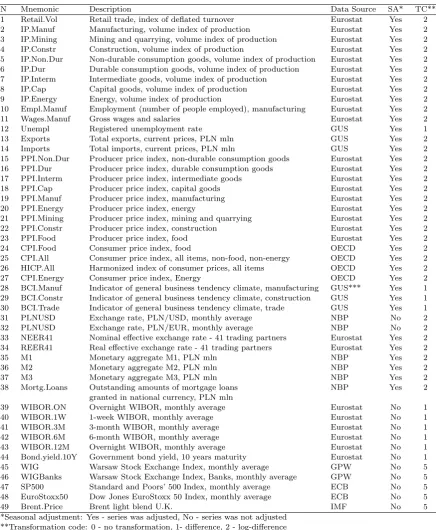
and leading business indicators (see Table 1 in the Appendix). The series were
extracted from a databases of a few institutions: the National Bank of Poland
(NBP), the Central Statistical Office of Poland (GUS), the Warsaw Stock Exchange
(GPW), Eurostat, the European Central Bank (ECB), the OECD, and the IMF.
The composition of the data panel is aimed to provide a balanced representation
of all sectors of the Polish economy.
Prior to estimation of the factor model, the data were processed using Stock
and Watson (1999) methodology. First, all series that were modelled as generated
by integrated processes, were transformed to stationary series, using differences
or log-differences. Second, all non-financial time series were seasonally adjusted
using Census X12-ARIMA procedure. Third, outliers exceeding the interquartile
sub-sequently substituted by estimates obtained using the expectation-maximization
(EM) algorithm. Fourth, all series were standardized to have zero mean and unit
variance.
5
Estimation Results
The common factors were estimated using the principal component estimator.
First, the estimation was performed a panel of series including no missing values.
Second, missing values were interpolated using the EM algorithm and the factors
were estimated using the whole panel.
Initially, ten common factors were estimated. Of those, six factors were selected
using a threshold of at least 5 percent of the total variance explained by each
se-lected factor (for an application of such criterion, see Forni and Reichlin 1998).
The final FAVAR obtained in the model selection process, included only four
fac-tors. These four factors explain 50 percent of the total variance in 49 time series.
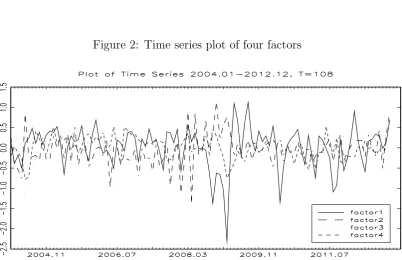
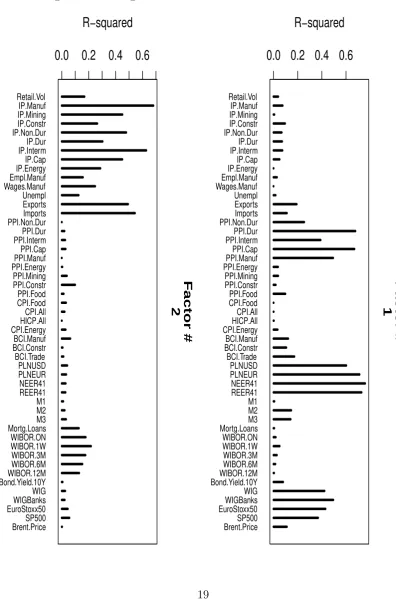
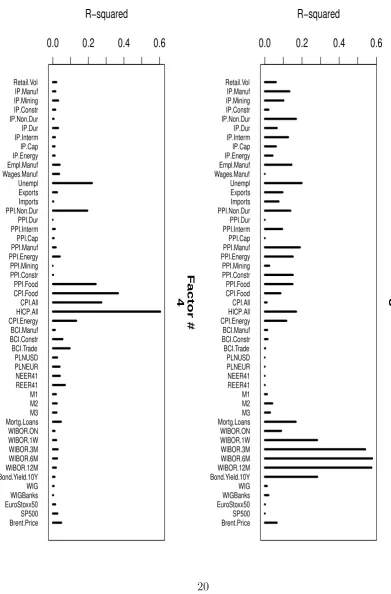
The time series plot of these factors is shown in Figure 2 and the loadings of these
factors onto individual time series are presented in Figures 3-4. The first factor
loads on nominal indicators: producer price inflation, returns on exchange rates
and stock indices. The second factor loads on indicators of industrial production
and foreign trade. The third factor is correlated with interest rates and the fourth
factor has the highest correlation with indicators of consumer price inflation.
The selection of the FAVAR model was carried out using System SER
(Se-quential Elimination of Regressors) procedure based on the Bayesian Information
Criterion (Br¨uggemann and L¨utkepohl 2001). The initial model included six
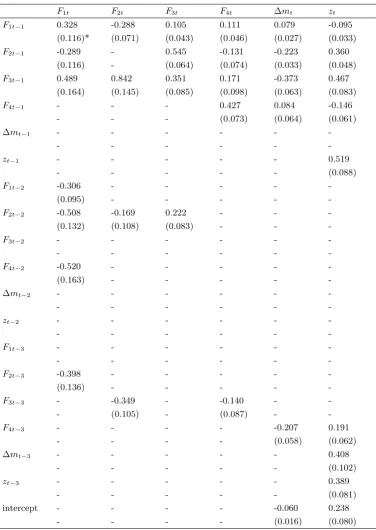
fac-tors and six lags of facfac-tors, the markup and the difference of 1-month WIBOR.
Table 2).
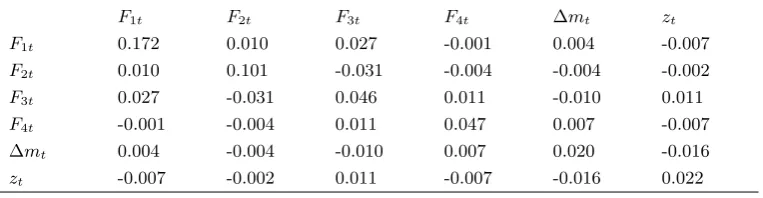
The eigenvalues of the companion matrix of the estimated FAVAR and the
covariance matrix of disturbances are reported in Table 3. All eigenvalues of the
companion matrix are less than one in modulus, which means that the estimated
FAVAR is stable (there are no unit or explosive roots).
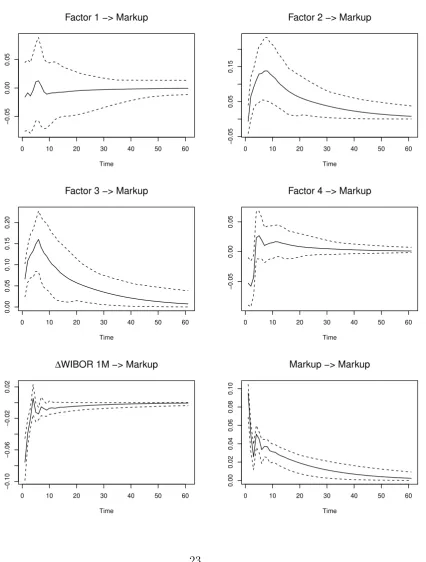
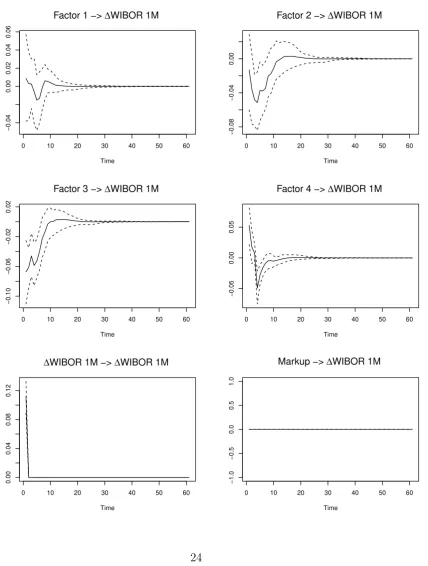
The orthogonalized impulse responses of the differenced 1-month WIBOR and
the mortgage markup are presented in Figures 5 and 6. The figures show the 95
percent joint bootstrap confidence bands obtained using the neighbouring paths
method proposed by Staszewska (2007) (see also Staszewska-Bystrova 2011). The
joint band contains the entire response function constructed for a given response
horizon with probability 0.95.
The assumed ordering of variables in the FAVAR means that common factors
can have an immediate effect onto the 1-month WIBOR and the markup. However,
the 1-month WIBOR and the markup have no immediate effect on the common
factors. This is consistent with the interpretation of the common factors as
ex-ogenous latent variables that describe a state of the economy. The ordering of the
variables also implies that the 1-month WIBOR may have an immediate impact
onto the markup, but not vice versa.
Figure 5 shows the orthogonalized impulse responses of the markup, zt, to
shocks in the common factorsF1t,F2t,F3t, andF4t, and in the differenced 1-month
WIBOR, ∆mt(1). Each shock is equal to one standard deviation of residuals in
the estimated equation for a corresponding variable. An impulse to the differenced
1-month WIBOR, ∆mt(1), implies a significant negative shock to the markup, zt,
which slowly converges to the previous level afterwards. It means that if the level
decreases temporarily: a part of the increase in the WIBOR is not transferred to
an increase in mortgage rates - it is absorbed by a decrease in the markup.
There are significant impulse responses of the markup to factors 2, 3, and
4, which are correlated with the growth rates of industrial production, changes in
interest rates, and consumer price inflation correspondingly. The direction of these
effects should be interpreted with a precaution though, as factors are identified
up to a linear transformation, and additional restrictions have to be imposed to
admit a structural interpretation of these impulse responses. However, it can
be concluded that one has to control for other macroeconomic indicators when
measuring the response of the markup to a short-term market rate.
The orthogonal impulse responses of the 1-month WIBOR are shown in Figure
6. There are significant responses of the differenced 1-month WIBOR to shocks
in factors correlated with growth rates of industrial production, changes in other
interest rates, and consumer price inflation. These factors summarize information
of potential use in the forecasting of 1-month WIBOR and the determination of
the markup which is set on mortgage loans by MFIs. There is no feedback from
the markup to 1-month WIBOR, as lags of the markup are excluded from the
equation for the differenced WIBOR by the model selection procedure, and the
markup is assumed to have no instantaneous effect on the WIBOR.
In order to investigate the parameter stability of the estimated FAVAR model,
we implement the Andrews (1993) and the Andrews-Ploberger (1994) tests, which
are based on the supremum Wald statistic and the average exponential Wald
statis-tic respectively. It was demonstrated in several studies (see Stock and Watson
1998; Hansen 2000; Cogley and Sargent 2005) that these tests have the highest
dy-namic regressions.
Following Stock and Watson (1996), we implement a heteroscedasticity-robust
version of these tests and compute bootstrapped critical values to account for a
small sample size. The Andrews the Andrews-Ploberger tests are not based on
the assumption of a specific date of structural change, but evaluate stability of
the parameters over a window of observations. We selected a symmetric window,
trimming 25 percent of the observations at the beginning and at the end of the
estimation sample. As a result, the stability of parameters was tested over the
period from May 2006 to September 2010. A choice of a larger window would lead
to computational instability of the least square estimator.
Table 4 reports computed test statistics together with bootstrapped and
asymp-totic critical values for the 5 percent level of significance. The results are provided
for each equation of the FAVAR model and for the model as a whole. The test
statistics of both tests are smaller than bootstrapped and asymptotic critical
val-ues for all equations of the model. Therefore, the null hypothesis of parameter
stability cannot be rejected given the significance level of 5 percent. No evidence
of parameter instability in the FAVAR model is found.
6
Conclusions
In this paper, a factor-augmented VAR model is used to explain the relation
be-tween changes in 1-month WIBOR and the markup on mortgage loans in national
currency, which are granted to households by monetary financial institutions. The
augmentation of a simple VAR model is motivated by the forward-looking
be-haviour of monetary financial institutions that determine the markup on mortgage
evalu-ation of risk. The common factors, which are computed using a large panel of
economic and financial time series, summarize, in a parsimonious way, the
infor-mation used by monetary financial institutions.
The estimation results confirm that there is a significant relation between
the markup and changes in 1-month WIBOR. It implies that monetary policy
shocks transmitted to changes in 1-month WIBOR are only partially transmitted
to changes in rates paid by households on housing loans. The changes in 1-month
WIBOR are partially absorbed by changes in the markup. The common factors
are found to be significant in the model, which means that additional information
summarized by the factors influences the pricing behavior of financial institutions.
A few extensions of the research are possible. First, additional assumptions
can be imposed and a structural FAVAR can be estimated in order to provide a
more profound economic interpretation of the impulse response analysis. Second,
instead of considering heteroscedasticity-robust estimator, the direct modelling of
heteroscedasticity can be implemented. Third, an explicit measure of the risk
premium can be derived, using the dynamic factor model, and its effect onto the
markup can be evaluated.
7
Literature
Andrews D. W. (1993), Testing for parameter instability and structural change
with unknown change point, Econometrica, Vol. 61, No. 4, pp. 821-856.
Andrews D. W., Ploberger W. (1994), Optimal tests when a nuisance parameter is
presented only under the alternative, Econometrica, Vol. 62, No. 6, pp. 1383-1414.
Bai J., Ng S. (2006), Confidence intervals for diffusion index forecasts and inference
Banerjee A., Bystrov V., Mizen P. (2012), How do anticipated changes to
short-term market rates influence banks’ retail rates? Evidence from the four major
euro area economies, Forthcoming in Journal of Money, Banking and Credit.
Br¨uggemann R., L¨utkepohl, H. (2001), Lag selection in subset VAR models with
an application to a U.S. monetary system, in R.Friedmann, L. K¨uppel and H.
L¨utkepohl (eds.), Econometric Studies: a Festscgrift in Honour of Joachim Frohn,
LIT Verlag, M¨uster, pp. 107-128.
Chmielewski T. (2004), Interest rate pass-through in the Polish banking sector and
bank-specific financial disturbances, In: Papers Presented at the ECB Workshop
on Asset Prices and Monetary Policy, Frankfurt, December 11-12, 2003.
de Bondt G. (2005), Interest rate pass through in the euro area, German Economic
Review, 6, pp. 37-78.
Forni M., Reichlin L. (1998), Let’s Get Real: A Factor Analytical Approach to
Disaggregated Business Cycle Dynamics, Review of Economic Studies, 65, 3, pp.
453-473.
Gambacorta L. (2008), How Do Banks Set Interest Rates?, European Economic
Review, 52, pp 792-819.
Hansen B. E. (2000), Testing for structural change in conditional models, Journal
of Econometrics, 97, 1, pp. 93-115.
Kok-Sørensen, C., Werner T. (2006), Bank interest rate pass through in the euro
area, ECB Working Paper No 580.
Kot A. (2004), Is interest rates pass-through related to banking sector
competitive-ness? Paper presented at the Third Macroeconomic Policy Research Workshop on
Monetary Transmission in the New and Old Members of the EU, October 29-30,
Cogley T., Sargent T. J. (2005), Drifts and volatilities: monetary policy and
out-comes in the post WWII US, Review of Economic Dynamics, 8, pp. 262-302.
Shiller R. J. (1979), The volatility of long-term interest rates and the expectations
models of the term structure, Journal of Political Economy, Vol. 87, No. 6, pp.
1190-1219.
Staszewska A. (2007), Representing uncertainty about response paths: the use of
heuristic optimization methods, Computational Statistics and Data Analysis, 52,
1, pp. 121-132.
Staszewska-Bystrova A. (2011), Bootstrap prediction bands for forecast paths from
vector autoregressive models, Journal of Forecasting, 30, 8, pp. 721-735.
Stock, J. H., Watson M. W.(1998), Median unbiased estimation of coefficient
vari-ance in a time-varying parameter model, Journal of American Statistical
Associa-tion, Vol. 93, No. 441, pp. 349-358.
Winker P. (1999), Sluggish adjustment of interest rates and credit rationing: an
application of unit root testing and error correction modelling, Applied Economics
Appendix
Figure 1: Time series plot of markup and ∆mt
[image:18.595.100.503.400.660.2]Table 1: Description of data panel
N Mnemonic Description Data Source SA* TC** 1 Retail.Vol Retail trade, index of deflated turnover Eurostat Yes 2 2 IP.Manuf Manufacturing, volume index of production Eurostat Yes 2 3 IP.Mining Mining and quarrying, volume index of production Eurostat Yes 2 4 IP.Constr Construction, volume index of production Eurostat Yes 2 5 IP.Non.Dur Non-durable consumption goods, volume index of production Eurostat Yes 2 6 IP.Dur Durable consumption goods, volume index of production Eurostat Yes 2 7 IP.Interm Intermediate goods, volume index of production Eurostat Yes 2 8 IP.Cap Capital goods, volume index of production Eurostat Yes 2 9 IP.Energy Energy, volume index of production Eurostat Yes 2 10 Empl.Manuf Employment (number of people employed), manufacturing Eurostat Yes 2 11 Wages.Manuf Gross wages and salaries Eurostat Yes 2 12 Unempl Registered unemployment rate GUS Yes 1 13 Exports Total exports, current prices, PLN mln GUS Yes 2 14 Imports Total imports, current prices, PLN mln GUS Yes 2 15 PPI.Non.Dur Producer price index, non-durable consumption goods Eurostat Yes 2 16 PPI.Dur Producer price index, durable consumption goods Eurostat Yes 2 17 PPI.Interm Producer price index, intermediate goods Eurostat Yes 2 18 PPI.Cap Producer price index, capital goods Eurostat Yes 2 19 PPI.Manuf Producer price index, manufacturing Eurostat Yes 2 20 PPI.Energy Producer price index, energy Eurostat Yes 2 21 PPI.Mining Producer price index, mining and quarrying Eurostat Yes 2 22 PPI.Constr Producer price index, construction Eurostat Yes 2 23 PPI.Food Producer price index, food Eurostat Yes 2 24 CPI.Food Consumer price index, food OECD Yes 2 25 CPI.All Consumer price index, all items, non-food, non-energy OECD Yes 2 26 HICP.All Harmonized index of consumer prices, all items OECD Yes 2 27 CPI.Energy Consumer price index, Energy OECD Yes 2 28 BCI.Manuf Indicator of general business tendency climate, manufacturing GUS*** Yes 1 29 BCI.Constr Indicator of general business tendency climate, construction GUS Yes 1 30 BCI.Trade Indicator of general business tendency climate, trade GUS Yes 1 31 PLNUSD Exchange rate, PLN/USD, monthly average NBP No 2 32 PLNUSD Exchange rate, PLN/EUR, monthly average NBP No 2 33 NEER41 Nominal effective exchange rate - 41 trading partners Eurostat Yes 2 34 REER41 Real effective exchange rate - 41 trading partners Eurostat Yes 2 35 M1 Monetary aggregate M1, PLN mln NBP Yes 2 36 M2 Monetary aggregate M2, PLN mln NBP Yes 2 37 M3 Monetary aggregate M3, PLN mln NBP Yes 2 38 Mortg.Loans Outstanding amounts of mortgage loans NBP Yes 2
granted in national currency, PLN mln
39 WIBOR.ON Overnight WIBOR, monthly average Eurostat No 1 40 WIBOR.1W 1-week WIBOR, monthly average Eurostat No 1 41 WIBOR.3M 3-month WIBOR, monthly average Eurostat No 1 42 WIBOR.6M 6-month WIBOR, monthly average Eurostat No 1 43 WIBOR.12M Overnight WIBOR, monthly average Eurostat No 1 44 Bond.yield.10Y Government bond yield, 10 years maturity Eurostat No 1 45 WIG Warsaw Stock Exchange Index, monthly average GPW No 5 46 WIGBanks Warsaw Stock Exchange Index, Banks, monthly average GPW No 5 47 SP500 Standard and Poors’ 500 Index, monthly average ECB No 5 48 EuroStoxx50 Dow Jones EuroStoxx 50 Index, monthly average ECB No 5 49 Brent.Price Brent light blend U.K. IMF No 5 *Seasonal adjustment: Yes - series was adjusted, No - series was not adjusted
**Transformation code: 0 - no transformation, 1- difference, 2 - log-difference
Figure 3: Loadings of factors 1 and 2 on individual time series
0.0 0.2 0.4 0.6
F actor # 1
R−squared
Retail.Vol IP.Manuf IP.Mining IP.Constr IP.Non.Dur IP.Dur IP.Interm IP.Cap IP.Energy Empl.Manuf Wages.Manuf Unempl Exports Imports PPI.Non.Dur PPI.Dur PPI.Interm PPI.Cap PPI.Manuf PPI.Energy PPI.Mining PPI.Constr PPI.Food CPI.Food CPI.All HICP.All CPI.Energy BCI.Manuf BCI.Constr BCI.Trade PLNUSD PLNEUR NEER41 REER41 M1 M2 M3 Mortg.Loans WIBOR.ON WIBOR.1W WIBOR.3M WIBOR.6M WIBOR.12M Bond.Yield.10Y WIG WIGBanks EuroStoxx50 SP500 Brent.Price0.0 0.2 0.4 0.6
Figure 4: Loadings of factors 3 and 4 on individual time series
0.0 0.2 0.4 0.6
F actor # 3 R−squared Retail.Vol IP.Manuf IP.Mining IP.Constr IP.Non.Dur IP.Dur IP.Interm IP.Cap IP.Energy Empl.Manuf Wages.Manuf Unempl Exports Imports PPI.Non.Dur PPI.Dur PPI.Interm PPI.Cap PPI.Manuf PPI.Energy PPI.Mining PPI.Constr PPI.Food CPI.Food CPI.All HICP.All CPI.Energy BCI.Manuf BCI.Constr BCI.Trade PLNUSD PLNEUR NEER41 REER41 M1 M2 M3 Mortg.Loans WIBOR.ON WIBOR.1W WIBOR.3M WIBOR.6M WIBOR.12M Bond.Yield.10Y WIG WIGBanks EuroStoxx50 SP500 Brent.Price
0.0 0.2 0.4 0.6
Table 2: Estimates of Factor-Augmented Vector Autoregression
F1t F2t F3t F4t ∆mt zt
F1t−1 0.328 -0.288 0.105 0.111 0.079 -0.095
(0.116)* (0.071) (0.043) (0.046) (0.027) (0.033)
F2t−1 -0.289 - 0.545 -0.131 -0.223 0.360
(0.116) - (0.064) (0.074) (0.033) (0.048)
F3t−1 0.489 0.842 0.351 0.171 -0.373 0.467
(0.164) (0.145) (0.085) (0.098) (0.063) (0.083)
F4t−1 - - - 0.427 0.084 -0.146
- - - (0.073) (0.064) (0.061)
∆mt−1 - - -
-- - -
-zt−1 - - - 0.519
- - - (0.088)
F1t−2 -0.306 - - - -
-(0.095) - - - -
-F2t−2 -0.508 -0.169 0.222 - -
-(0.132) (0.108) (0.083) - -
-F3t−2 - - -
-- - -
-F4t−2 -0.520 - - - -
-(0.163) - - - -
-∆mt−2 - - -
-- - -
-zt−2 - - -
-- - -
-F1t−3 - - -
-- - -
-F2t−3 -0.398 - - - -
-(0.136) - - - -
-F3t−3 - -0.349 - -0.140 -
-- (0.105) - (0.087) -
-F4t−3 - - - - -0.207 0.191
- - - - (0.058) (0.062)
∆mt−3 - - - 0.408
- - - (0.102)
zt−3 - - - 0.389
- - - (0.081)
intercept - - - - -0.060 0.238
- - - - (0.016) (0.080)
Table 3: Estimates of Factor-Augmented Vector Autoregression
Estimated Covariance Matrix of Residuals
F1t F2t F3t F4t ∆mt zt
F1t 0.172 0.010 0.027 -0.001 0.004 -0.007
F2t 0.010 0.101 -0.031 -0.004 -0.004 -0.002
F3t 0.027 -0.031 0.046 0.011 -0.010 0.011
F4t -0.001 -0.004 0.011 0.047 0.007 -0.007
∆mt 0.004 -0.004 -0.010 0.007 0.020 -0.016
zt -0.007 -0.002 0.011 -0.007 -0.016 0.022
Six Largest Roots of Companion Matrix
Figure 5: Orthogonalized Impulse Responses of Markup
Factor 1 −> Markup
Time
0 10 20 30 40 50 60
−0.05
0.00
0.05
Factor 2 −> Markup
Time
0 10 20 30 40 50 60
−0.05
0.05
0.15
Factor 3 −> Markup
Time
0 10 20 30 40 50 60
0.00
0.05
0.10
0.15
0.20
Factor 4 −> Markup
Time
0 10 20 30 40 50 60
−0.05
0.00
0.05
∆WIBOR 1M −> Markup
Time
0 10 20 30 40 50 60
−0.10
−0.06
−0.02
0.02
Markup −> Markup
Time
0 10 20 30 40 50 60
0.00
0.02
0.04
0.06
0.08
Figure 6: Orthogonalized Impulse Responses of ∆ WIBOR 1M
Factor 1 −> ∆WIBOR 1M
Time
0 10 20 30 40 50 60
−0.04
0.00
0.02
0.04
0.06
Factor 2 −> ∆WIBOR 1M
Time
0 10 20 30 40 50 60
−0.08
−0.04
0.00
Factor 3 −> ∆WIBOR 1M
Time
0 10 20 30 40 50 60
−0.10
−0.06
−0.02
0.02
Factor 4 −> ∆WIBOR 1M
Time
0 10 20 30 40 50 60
−0.05
0.00
0.05
∆WIBOR 1M −> ∆WIBOR 1M
Time
0 10 20 30 40 50 60
0.00
0.04
0.08
0.12
Markup −> ∆WIBOR 1M
Time
0 10 20 30 40 50 60
−1.0
−0.5
0.0
0.5
Table 4: Stability Tests, 5-percent level of significance
Andrews Test
Equation Test Statistic Bootstrap Critical Value Asymptotic Critical Value
F1t 8.348 14.126 20.630
F2t 5.973 8.444 15.340
F3t 2.918 8.581 15.340
F4t 5.544 10.112 17.250
∆mt 8.075 12.193 19.070
zt 16.380 21.520 24.310
All 36.318 43.461 NA
Andrews-Ploberger Test
Equation Test Statistic Bootstrap Critical Value Asymptotic Critical Value
F1t 1.813 4.918 7.490
F2t 2.096 2.504 5.110
F3t 0.732 2.622 5.110
F4t 1.595 3.350 5.960
∆mt 2.442 4.117 6.790
zt 5.612 7.935 9.200