Munich Personal RePEc Archive
THE SAME AS ABOVE.
CEESAY, EBRIMA K.
25 March 2013
EBRIMA K. CEESAY
Telephone: 0039 3888 224 113 email: [email protected]
or [email protected]
The Effects of Gender Inequality in Education (Human capita proxy), Employment
(labor market participation Proxy) and its impacts on Economic Growth
Abstract
The paper study cross country analysis for 18 countries to see the effects of gender inequality in education (human capita proxy), Labor force participation (employment proxy) and its impacts on constant growth of Gdp. The regressions are run individual country at a time. The approach is necessary and sufficient conditions to identify the determinants of inequality of each country and the effects on country’s growth from 1980 to 2010.The results Shaw that in most countries if we control the direct impacts of gender inequality like openness, pop-growth, and investment, the labor force participation female-male ratios have highest impacts on growth than others employment variables. The results also found out that education with secondary female-male ratios have greater impacts on growth compared to education with tertiary female-male ratios. Another important point to note is that in most of these 18 countries of the world their appeared a problems of collinearity in employment data. This is due to the facts that employment data’s are insufficient. Overall, the finding needs further research, but the final results after checking in sampling and outer sampling approaches is that educational impacts on growth is high except for only one employment variable(i.e. LFPFM) have the highest impacts on growth in most of the 18 countries in our analysis.
Introduction
Education is one of the most powerful instrument for reducing poverty and inequality and lays
a foundation for sustained economic growth (World Bank 2012)
“
There is now a shared understanding within the development community that
development policies and actions that fail to take gender inequality into account and fail to
address disparities between males and females will have limited effectiveness and serious cost
implication.”
Reports from world Bank 2003
poorer region of the world. Further, many international organization have had taken notice of
gender inequalities. One of the United Nation Millennium Development Goals targets gender
inequality specifically. There goals is to eliminate gender disparity in primary and secondary
education preferable by 2005 and at all level 2015(United Nation, 2006 by Quentin Brummet
2008)
There is little denying the fact that investing in human capital is one of the most effective
means of reducing poverty and encouraging sustainable development. Yet, women in
developing countries usually receive less education than men. More so, women in general
enjoy far less employment opportunities than men the world over. Any claims and efforts
then, to remove poverty, can show results only if they address the issue of gender
inequality. In recent decades, there have been large gains, no doubt on comparable levels,
in basic rights and opportunities, in life expectancy and enrolment ratios for women. But
despite these gains, the stark reality has not changed.
There still are large gender disparities in basic human rights, resources, and economic
opportunity, and in political rights- the world over. In South Asia, women have only half as
many years of schooling as men. In much of Sub-Saharan Africa women obtain land rights,
chiefly through their husbands as long as the marriage endures and women account for
only ten percent of seats in Parliaments worldwide.
So until nations are able to address this issue of gender inequality and resolve it, the
vicious cycle of poverty will continue to pervade. This is because poverty leads to and
aggravates gender discrimination
–
it is in the poorer sections and nations that instances of
gender biases and inequality are more evident. Women and girls, who are at the bottom of
the social, economic and political ladder in these societies, get even lesser opportunities to
have a command over productive resources such as land or credit. Access to the means to
influence the development process is a rare and difficult possibility.
A significant focus of that literature has been to examine the impact of gender inequality in
education on economic growth. A number of theoretical contributions have suggested a
negative link between gender inequality and economic growth (e.g. Ode Galor and David Weil
1996; Nils-Petter Lagerlof 2003). This literature shows that, largely due to the impact of
female’s
education on fertility and the creation of human capital of the next generation, a
lower gender gap will spur economic development. The next section will briefly summarize the
main findings from that literature. In parallel, an empirical literature has also examined these
effects. While some earlier studies had suggested that gender inequality in education might
actually increases economic growth (Robert Barro and Jong-Wha Lee 1994; Barro and Xavier
Sala-I-Martin,1995), more recent work has shown that the opposite appears to be the case
(Anne Hill and Elizabeth King 1995; David Dollar and Roberta Gatti 1999; Kristin
Forbes2000;Stephen Knowles, Paula Lorgelly and Dorian Owen 2002; Stephan Klasen 2002;
StevenYamarik and Sucharita Ghosh 2003; Dina Abu-Ghaida and Klasen 2004).
This study is differ from Klasen and Francesca, 2009, 2003, because the numbers of country
where reduces and the variables where different about gender inequality in education,
employment on economic growth, but also were able to explain why earlier studies had found
the opposite effect and why more careful econometric techniques like R by running regression
will straight year that gender inequality in education reduces economic growth. There are
many reasons to be concerned about existing gender inequalities is an important
well-being related dimensions such as education, health, employment, or pay. From a well-well-being
as well as an equity perspective, such gender inequalities are problematic as they lower
well-being and are a form of injustice in most conceptions of equity or justice.
In the principle of transparency and no discrimination principle, there must not be any
discriminate in gender or otherwise(EU LAW, NATIONAL LAW ).For instance, we can see how
Kaldor(1963) Empirical regularities about economic growth as per capital outputs over time,
and its growth rate does not tend to diminish, physical capital per capital grows over time, The
rate of returns to capital is nearly constant, the ratio of physical capital to output is nearly
constant, the shares of labor and physical capital in national income are nearly constant, the
growth rate of output per worker differs substantially across countries(Economic growth
second edition 2003, Robert J. Barro and Xavier Sala-i-Martin 1:12) However, during the 1970s
both political and economic matters in Africa deteriorated. The leadership of many African
nations hardened into autocracy and dictatorship. Africa's economies first faltered and then
started to decline. While Africa experienced a growth collapse, nations of south Asia modestly
improved their economic performance. A good example of this divergence is the comparison of
Nigeria and Indonesia.
Until around 1970, the economic performance of Nigeria was broadly superior to that of
Indonesia, but over the next quarter-century outcomes diverged markedly, despite the
common experience for both countries of an oil boom in a predominantly agricultural
economy. Since 1980, aggregate per capita GDP in sub-Saharan Africa has declined at almost 1
percent per annum. The decline has been widespread: 32 countries are poorer now than in
1980. (Collier. Paul and Jan Willen Gunning. 1999).This is a serious impacts of gender
inequality in education, even employment In most African countries and they term women as
their function is only at home as house wife, caring children, productivity. In that case women
lack to saw case there talents in decision making and in education sectors as well. All of this
have stagnate the growth rate of Africa. The institutions also lack to promote gender equality,
because the leaders do not have quality education and it affects quality of democracy and
totally affect the growth level of the continent.
I can notice that growth rate in regions are different, because gender inequality affect sectors
performance and this in turn reduce the national GDP and overall decreases the growth. We
notice that sector that did not have legal advice and selection for competition for male and
female are not take into consideration, they massively have reduction in their daily outcome
and its affect the financial statement at the end of the financial year. In this case, sectors will
collapse or make solution to take equality into consideration based on employment.
of two persons within an area of EU competence, such as in the context of staff policy. Even in
the economic perspectives, we can see the application for single market in EU will also be
fruitful if we take gender equality in this region likewise America and sub-Saharan Africa.
Positive impacts on economics rationale and positive impact on growth level will occur. In the
poorest quartile of countries in 1990, only 5% of adults women had any secondary education,
one-half of the level for men. In the richest quartile, on the other hand, 51% of adult women
had at least some secondary education, 88% of the level for men (Dollar and Gatti, 1990).Other
measures of gender inequality (like health or legal rights also depict the similar situation. The
gender inequality affect female than their male counterpart in that case most countries
slowdown in productivity of economic growth.
Essay: 2
ndsession Report from World Bank’s E
course: Gender, Employment and poverty
reduction G. Moheyuddin.
Some researchers have reported the existence of a positive relationship between gender
inequality in wages and economic growth (Cagatay and Ozler 1995; standing 1990; Seguino
2000).For example, seguino(2000) uses panel data from semi-industrialized economies and
various econometric specifications and shows that GDP growth is positively related to gender
wage inequality. So the gender differential in wage rates can to be a large extent is explained
by the fact that women tend to be crowded into lower paying jobs (Seguino, 2000).
[image:6.605.66.541.650.742.2]All this is reflected that employments for female are not equal to male and the female are
mostly employed in lower wages despite their qualification. If that continue to happen Africans
countries growth rate will be affected and in generally we will deep to loss in total output. The
relationship among gender inequality, employment, and growth are paramount. The following
table contains female to male ratios of primary and secondary enrollment average over
2000-2005, broken down by World Bank Income Classification. As can be seen in Table 1, below low
income countries have much less female education relative to male than lower middle income
countries, while upper middle income and high income countries have no inequality in
primarily and secondary education.
Table 1: Gender Inequality by Income
World Bank Classification
Female to Male ratio of primary and
secondary enrollment
Low Income
84.4
Lower Middle Income
97.8
Upper Middle Income
100.0
High Income
100.0
Source: World Development Indicator (2008)
Classifications are as follows: Low Income-per capita GNI<$905US; Lower Middle-$906 US <
per capita GNI < $3565; Upper Middle -$3566 US < per capita GNI < 11,115; High Income
–
per
capita GNI>11116 US. Note all figures are in 2006 US dollars.
From the regression using Ordinary least square Estimation across section of countries,
examine the impact if any the gender inequality in primary and total education on growth.
Most of the results if not all show that inequality in primary education has significant effect on
growth(Quentin Brummet,2008).This is true because many of earlier and current studied found
a negative linkage between gender inequality and economic growth(e.g. Galor and Weil,
1996;Lager1of,1999).Actually many of the study done had concluded gender inequality in
education might have positive increment in economic growth(Barro,1991;Barro and
Xala-I-Matin,1995;Barro and Lee,1994).This is differed from others studies because there were data
error and may be some insufficient data tools that can closely check the impacts of education
on growth. In no small way, most recent study found the opposite case, therefore they
concluded that gender inequality in education reducing economics growth than increasing it
(e.g. Knowles, Lorgelly, and Owen,2002; Forbes,2000,Hill and King;1995 Dollar and
Gatti,1999;Klasen,2002;Abu-Ghaida and Klasen,2002).In this study therefore reducing the
numbers of countries to 52, and duration from 1980 to 2010 and to explain why the earlier
study like found the opposite effects.
Moreover the econometric tools that helps to make the specification more easier is R version
2011 to run the as panel regression. The finding is consistent with earlier study that gender
inequality in education reduces growth over a long time interval and is difficult to recover.
More so, the rule governing in this paper will be keenly look at from Klasen and updating the
data as explained above, but the similar econometric specification used by Klasen,2002,
Stephan Klasen and Francesca Lamanna,2003).The primary aim of this paper is to investigating
the impact of gender inequality in education its effect on economic growth. For instance,
according to Klasen 2002, Middle East and North African region, the update is particular
changing because gender gaps in education have being closing more rapidly recently so that
one would expect smaller but still remarkable costs for the existing gender gap in education.
These negative impacts in education will not have negative effects on growth but some
externalities have great impact in economics growth and development. In this instance, the
reduction in women education or improve women education has positive and negative impact
of the societies in that it increases fertility rate negative impacts, increases population growth
negative impacts, increases household consumption, reduces investment and even purchasing
power parity.
and improve the GDP (gross domestic product) level and overall standards of living for the next
generation. Much evidence about gender inequality in school will automatically affect taxes,
land reform, investment by the poor and to name but a few. In no small ways, this in turns
causes higher level of reduction in growth. The economics growth rate is showing to fall with
interest rate of wage gap between male and female. The wage differential is from the level of
education and training achieve.
In capital market context the inequality and growth can leads to social conflict in some areas
and this in turns causes drastically reduction the level of growth both in the short term
phenomenon and long term basis respectively. The paper also point out that several factors
hiding female from attaining education like productivity, religious reasons, cultural trends or
set up, early marriage make some countries to growth less than the others. This links us how
Pakistan has lower GDP(Gross domestic product) than western countries, is because lower
values of directly involve that women are not required to receive the same education than
male, gives room for the great decline in economic growth. Thus, the growth theories state
that human capita is the key foundation for growth. If it mixed, then economic growth will be
stagnated.
The Gini coefficient sometime has impacts on economic
growth. Let’s
say for example larger
population without equal education will growth lesser than small population that reduces the
educational gaps. This takes us to according to Ronald Benabou for example inequality and
growth allows for explicit departures from even perfect democracy and embodies the tradeoff
between growth cost and benefits of redistribution through taxes, land reform or public school;
such policy simultaneously depress savings incentives and ameliorate the wealth constraints
which impede investment by the poor (Ronald Benabou,july 1996).Further more according to
him inequality is detrimental to long run growth. The magnitude of the effects of inequality is
consistent across most studies that a one standard deviation decrease in inequality raises the
annual growth rate of GDP per capita by 0.5 to 0.8 percentage points (Ronald Benabou, 1996).
simultaneously will increases growth and development. Education is the key tools in both
domestic and international level to eradicate malnutrition, hunger and to name but a few from
the growing population by the equal treatment for both male and female at all level, in rural
and to urban areas respectively. This will raise nutrition and even the standard of living and
bettering the condition of the population. The vulnerable are mostly women and girl suffered
geographical and gender discrimination. The strategies to control this is by ways of boost girls
participation in educational arena and removing cost barriers, strengthening school as gender
sensitive Centre of quality learning, developing gender-sensitive learning content and school
environment equally to all.
The education shock yesterday say for example
affect us today. If inequality continuous to
exist then growth average for the next generation will continuous to have negative correlation
with past. At the same vein, the focus is on education because Illiteracy is strongly correlated
with hunger and its hindering the development and wealth of the nation especially the
marginalized countries. This in turn threatens productivity and health and limits opportunities
to improve livelihood. The paper point out literacy and formal education are linked in that they
reduced fertility drastically, improved health and sanitation practices and an increased ability
to access information and participate in various social and economic processes (FAO,
UNESCO-IIEP,2002, P.25)
and reduced poverty has being demonstrated many time, although not all types of growth do
so to the same extend According to(Dreze and Sen,1989;UNDP,1996;Bruno,Squire, and
Ravallion,1996;Pritchett and Summers,1996).
Further, The economist both at growth studies and household studies should be more concern
for the policies that improve economic growth and do not harms any of others development
goals such as the health(well-being) , investment in human capita(labor force participation) and
so on.
Educations impacts on gender inequality are higher and have longevity for the next generation
than employment. This is because human capita are difficult to replace. If it replaced, though it
takes a numbers of years to regain. As they involve in growth, they can makes a fast changes
through the skills, expertise and innovation in knowledge building. Gender inequality in
education causes lot of problem in women for example early marriage, at age 14-16 years. This
causes problem both psychologically and physically. Psychologically, meaning they are not
mature enough to takes the rule as a mother and to takes care of the children. This leads them
to frustration, unplanned etc .For physically, is that they are strong to bear children, in that
many died at the pregnancy stage. Maternal mortality ratio is the number of women who die
during pregnancy and childbirth, per 100,000 live births. The data are estimated with a
regression model using information on fertility, birth attendants, and HIV prevalence. Trends in
Maternal Mortality: 1990-2010. Estimates Developed by WHO, UNICEF, UNFPA and the World
Bank. (Sources World Development Indicators).
More so, if women are educated as the male they will be able to manage and take a maximum
care of their family. These will positive have impacts on the child both within and out of the
family. As such, the responsibility of the child starts at this stage. This will increases the growth
in the society as a whole. The education inequality impacts is difficult to answer as it pointed
out by Abhijit V. Banerjee and Esther Duflo in the introduction of their paper that it is often
that the most basic questions in economics turn out to be the hardest to answer and the most
provocative answers end up being the bravest and most suspect. This is certain gender
inequality education affects growth in all the corners as one can see it in clear direction. As
saying goes no country is an Island, meaning no one can stand and do all without the
involvement of the partner, Therefore women are our partner and they must takes part in
growth and developments as the male. This bring us to the level that inequality in any direction
reduces growth paramount. The point is that small change inequality can leads economy to
move away from the steady state value and the relationship tend to be non-linear.
write. With education, people flourish. Without education world remains trapped in poverty
and growth stagnates like stagnant water.
Notwithstanding, employment participation is vital for the growth. This is because with
employment indicate that female and male should participate equally in decision making and
both should show case their talent. Thus, in certain
African’s
country there are no equalities in
taking jobs at academics level or private organization. For example, hence people are from
different background therefore according to those from rich background are easily to find
employment compared with those from poor family. This
happen because the rich’s are
inherited their parent position. Though, they replace their son and daughter to a position that
should be based on merit, than self-selection criteria. The society should be keenly understand
that equality is the foundation for growth because women contributions has positive impacts
to GDP, child’ welfare and the entire family
fraternity .This brings to women should participates
in public debate, public affairs and to implement of what they said. Employment is a
fundamental right.
The Sub-Saharan Africa and Middle East and North Africa women encountering structural and
future disturbance. And yet, by the same logic, gender discrimination hinders development. So
while denial of basic rights ( be it education, employment or health care for women) is
detrimental to women, this denial, ultimately also harms the society, the nations at large too,
by hampering development(by Geeta Sharma, ). This may be due to social, cultural, religious
and economics norms. To make it short, for social, it may be that female are not require to
participation in employment opportunities, because of factors that hindering her from
education. In this case for growth to rich at maximum level of growth and development will be
difficult. In particular, it might be the case draws women into the labor force rather than
increasing female participation increasing economic growth (Stephan Klasen and Francesca
Lamanna,2003).
Clearly, then gender gaps that are widespread in access to basic rights, access to and
control of resources, in economic opportunities and also in power and political voice are an
impediment to development. The only solution to this is gender equality, which
strengthens a
country’s ability
to grow, to reduce poverty and provide its people
–
men,
women and children a better life. The issue of gender equality then, needs to be at the
core of development policies- both in national and international arenas. Just because
gender inequality is inextricably linked to societal norms, religion or cultural traditions, it
should not be either a deterrent or an excuse to gender sensitive development planning.
This paper is divided into the following format. The next section will identify the gender
inequality around the world. The third parts will reviews from theoretical and empirical
evidence growth literatures the impacts of inequality on economic growth from numbers of
different sources. The fourth will look at the factors hindering the gender inequality in
education and employment. Section five describes, analysis, and discusses the final results of
the regression (Descriptive statistics, data set uses Methodology, results). Section six
conclusions. Section seven Appendixes.
2. Gender Inequality around the World
"No society treats its women as well as its men." That's the conclusion from the United Nations
Development Programmed, as written in its 1997 Human Development Report [source: UNDP].
Almost 50 years earlier, in 1948, the United Nations General Assembly had adopted the
Universal Declaration of Human Rights, which specified that everyone, regardless of sex, was
entitled to the same rights and freedoms.
The 1997 Human Development Report, as well as every Human Development Report that
followed, has highlighted that each country falls short of achieving that goal. The severity of the
shortfall varies by country; Nordic countries such as Sweden, Norway and Iceland, for example,
are routinely hailed as having the smallest gender gaps. In the developing world, however,
women face unfairness that can be hard to fathom. In the world at large there is a huge
difference between male and female and this serious impact on growth theories especially
developing nations.
Despite important gains in education among young women, their employment outcomes
continue to lag behind those of young men. Globally, in 2010, 56.3 per cent of young males
participated in the labor force, against 40.8 per cent of young females (International Labor
Organization, 2011b, p. 10). Where young women do participate in the labor market, they
generally confront greater challenges in accessing jobs than do young men, i.e. they face higher
unemployment compared to their male counterparts.
When employed, they are also more likely to be in traditionally female occupations and unstable,
part-time and lower-paid jobs. In several parts of the world, there remain significant gaps
between young men’s and young women’s earnings. For instance, the h
ourly earnings of young
women aged 15 to 24 are only 82 per cent and 84 per cent of men’s in sub
-Saharan Africa and
East Asia and the Pacific, respectively. In some regions, however, young women are closing the
wage gap with men faster than are older women due to their expanded access to educational
opportunities over the last several years (World Bank, 2010). The recent economic crisis reduced
the unemployment gap between young males and young females in most developed regions. In
some of these countries, male-dominated industries were harder hit by the crisis (e.g. building
construction).Most of this were basically of women working with less paid work, in the school,
at home as a domestic workers, cleaning the house.
Most young workers in developing countries are in the informal economy, which includes
unpaid family work to which young people often contribute (International Labor Organization,
2010, p. 3). Work in the informal economy does not provide access to entitlements such as
health insurance, social security and other social protection measures.
The women are the majority that is harassed by both public private sector employers, this is
because they lack skill and expertise and are vulnerable. Meaning they cannot sustain
themselves. If women are educated, they will be self-sufficiency and be far from the
harassments and malnutrition that affects them. The research shows that majority of the poor
people in the world are women, due to lack of basis necessity in life like education.
Education will leads to employment and employment will leads to sustained and
self-sustained will leads to growth and development of the country economics performance at the
short, medium and long term. The evidence is numerous that women are busy but earn less
that the work they do, due to lack training and education. For
example “The officials of the
social assistance department are impolite and even crude with ordinary people from the
village. I go there for my social benefits for my children. I have to wait for two hours; they treat
ne very badly. If I cry and shout that my child is ill, they will give me something. But it happens
seldom
”
(-Women, Novy Gordok, Russian Federation).This indicated that women are
marginalized at home and even in the society. We should treat women that they are equal with
men in all the development oriented. Thus, the world should say no to condemnation of
violence, harassment, discrimination
,
exclusion
,
stigmatization, and prejudice based on sexual
orientation and gender identity that undermine personal integrity and dignity
Women are the domestic worker and they wake up early to take care of the child and sell at
the market. This evidence is true in many countries of the world. For example, According to this
mother,” we in the country get up at 6
a.m. to take the collective bus. We arrive. We go to the
doctor at the hospital. You arrive at 8 a.m. or sometimes not until 1 p.m. You are stuck there
until the afternoon, without eating, without being able to drink…..you spend hours and hour
hungry. You have to go back before the doctor has seen you. You miss the bus. You have to go
however
you can…..(
-Twenty-five-year-old mother ,Los Juries,
Argentina)”.If they are educated
this will not happen, because the will be able to plan their time effective and efficiency and
they will plan the number of children and how they can manage and take good care of the
family without going any much defaults. The nurse, the legal services, and so on treats them
badly, due to illiteracy level.
point. The table shows that in three countries in the region by around 2000 nearly 90 per cent or
more girls of the appropriate age were in primary school. In another two between two-thirds and
three quarters of all girls in this age group were in school, indicating considerable difficulties in
enrolling all girls in school. In Pakistan there appeared to have been a fall in NER with only 50
per cent of girls in the age group enrolled. It also shows that through the 1990s all countries in
the region for which there is data, with the exception of Pakistan, made percentage gains in the
levels of girls' enrolment.
[image:15.605.65.540.538.753.2]For some countries like Nepal, despite the decade being marked by conflict, these gains were
enormous. For India and Bangladesh the percentage gain was sizeable. Only in Pakistan is there
a large percentage fall. From the data held by UN bodies we cannot determine whether this is
because of incomplete data or data that has been wrongly processed. With the exception of
Pakistan, using only girls' NER the picture for the region would be one of steady growth and
reasonable optimism. However, the problems with NER outlined above entail some doubts about
whether this is an adequate enough picture of levels of gender equality in education.
TABLE 2: Percentage gain in girls’ NER(Net Enrollment Ratio), in South Asia: 1990–
2003
Country
Girls' NER c.1990
%
Girls' NER c.2001
%
Percentage
Improvement
of Girls' NER
c.1990
–
c.2001
%
Sri Lanka
90
100
11
Bangladesh
66
87.5
33
India
61
75.7
24
Nepal
41
66
61
Pakistan
62
50
19.5
World Bank, 2005.Note: NER is the net enrollment ratio for girls.
* 2003 figure
Women fought for decades to take their place in the workplace alongside men, but that fight isn't
over yet. According to the most recent statistics from the U.S. Census, women earn just 77
percent of what men earn for the same amount of work (source: National Committee on Pay
Equity). In addition to this gender wage gap, women often face a glass ceiling when it comes to
promotions, which is evident when you survey the lack of women in leadership positions at
major companies. Women who have children often find themselves penalized for taking time
off; if they're not dismissed, they may face discrimination and outdated ideas of what a woman
can accomplish if she's pregnant or a mother. And jobs that are considered traditional women's
work, such as nursing and teaching, are often some of the lowest-paying fields. This is referred
to as professional obstacle. It distracts both careers, education or otherwise (labor force
participation etc).
Still, women in the workplace have one right that women in other countries lack -- the right to
leave their own homes.
The World Economic Forum measures gender equity through a series of economic, educational,
and political benchmarks. It has ranked the United States as 19th (up from 31st in 2009) in
terms of achieving gender equity. Household and intra-household knowledge and resources are
key influences in
individual’s
abilities to take advantage of external livelihood opportunities to
threats high education levels and socials integration significantly improve the productivity of all
members of the household and improve equity throughout society.
The inequality were categories as follows, violence against women is rampant in many societies
which make women vulnerable and its open doors to many internal and external opportunities
like access to quality education, employment opportunities to be in decision making process to
participate both domestic and international to give their views about the structural framework
of the world and what are some of the measures that we need to combats gender inequality
amongst at home in the societies and so on. All of this cannot be achieved if women are left
behind without human capital like skill, training, education, experience technological oriented
individuals etc.
and countries in which the two shares are roughly similar (Congo, Fiji, Gambia, Mexico,
Thailand, Uruguay and Venezuela).Still female are vulnerable in employment
opportunities. They contribute the lion shares of the family’s sustainability. Female engage
in different jobs to make sure their family is saving and children are not hungry. Doing so,
if they are educated what will be there contribution to growth and development the
answer is it will be numerous.
The discrimination amongst others are the majors determinants that causes inequality and
it’s
reduce the economic growth, the output and even contributes to high inflation (stagflation)
fluctuation level. The discrimination is not only based on education but the wages gaps between
male and female is widening day by day.
According Barrie Thorne 1993.”Boy and girls
together----
but mostly apart”(In gender
play: Girls and Boys in school).Meaning the separation
start at an early age in the school.
Therefore, we must start to fight for no discrimination from home to school, school to the
societies and so on. At the end the world will be free from gender biased in education and
employment, in that all the countries will converge at the same steady state level of
development. This takes to Myra Sadker and David Sadker.1994 Failing at Fairness: How our
school Cheat girls? We should
be aware that “From development
perspective, investing in the
education of females has the highest rate of return of any possible investment in developing
countries”(David Acker and Lavinia Gasperini,2009).There is an evidence in the United State
that male receive income level is higher than female, education and even to be hired more than
female. The table 3 below supports this point.
According to Shelley and J. Correl; The Medium Annual income of the year round full time
workers, by years of school completd and sex, 1990.
Table3:
Year
Women($)
Men
Women/Men
< 9yrs
12,251
17,394
.70
1-3yrs high school
14,429
20,902
.69
4 yrs high school
18,319
26,653
.69
1-3 yrs college
22,227
31,734
.70
4 yrs college
28,017
39,238
.61
>4 yrs college
33,750
49,304
.68
Source US Bureau of census, “Money income of families and person in the United State”,
current population reports, series p-60,no: 174.1991
earner, but higher income depending on the skills and knowledge of the individuals. Thus, there
contribution will boost the revenues of the country and this in turn will raise the GDP.
Increases the equality to the access for education and employment meaning that households,
markets, and the society, right and resources will be managed and utilize in direct manner.
Likewise, in that they will have positive correlation between the past economics phenomenon
and the future. For sure, saving, investment, consumption will increase. This to say overall
poverty will reduce and productivity of the current and future generation will increase.
Table4: Indicated the literacy Rate, youth total (% of people ages 15-24)
Regions
%-years
East Asia and Pacific
99-2010
Euro Area
100-2010
Sub-Saharan Africa
73-2010
South Asia
79-2010
Middle East and Noth Africa
91-2010
Latin America and Caribbean
97-2010
World
90 in 2010
Sources; reports WDI ( World Development Indicator) 2010.
Finally, according to table 4 , still there are gender biased in access to primary school in
sub-Saharan Africa, compared to the others regions of the world in which 67 percent of female
completed primary education. Compared to Arab region and even Euro area in which 81 and
100 percent complete the primary education. In no small way, Euro areas is free from any
discriminations at lower level in terms providing education for both male and female
decided to note whether more women were agreeing to sign on to a pledge to send their
daughters to school, and whether training in hand-pump repair was organized
for women’s
groups. To tell if they were getting where they wanted to go, the women counted any
increase in the number of days of agricultural work for women, and increases in the
number of girls enrolled in school. These are all indicators to measure changes
.”Annalise
Moser
” Adopted from “Menon
-
Sen” 2006.
This is clear indication that the world could be free from gender discrimination, if the men
see that they equally can participate in the office, at household jobs, in farming, at the
garden, equally with female. This is achieved in many parts of Europe per se, so far
because female and male mostly equally participate in household jobs, like taking care of
the children, takes him/her to school, cooking and so on. This is why those countries are
far ahead of the countries that treat women as only to be at domestic workers at home, or
bearing children etc. The evidence above could be reduces if policy makers and publics
works hand in hand together to reduce gender discrimination at all level, education and
employment alike.
Literature Review
The relation between gender inequality and economic growth is complex and
covers several plausible direct and indirect links. There are several studied done inequality in
education, labor market participation (employment) and their linkages with growth and
economic performance. The discussion will be summarized below from following the paper of
Stephan Klasen and Francesca Lamanna ( 2003, 2009) and Stephan Klansmen (,1999,2002) and
various papers like Abhijit Banerjee and Esther Duplo (june,2003) on inequality and growth,
follow by Ronald Benabou (July, 1996) inequality and growth using econometrics tools what the
data said. Thus, according to Stephan Klansmen and Francesca Lamina the first point is that
gender inequality has negative impacts on human capital and therefore reduces the education
level of the societies and in turn affects the societal growth level for the long period of time.
they are equally educated the more the competition for the labor market will realized and the
more the outcome will show and the gender inequality will reduces small by small. Thus, the
center stages of this paper is the relationship of inequality in education employment impacts
on growth-
The lost for education is the loss of the economic well-being for the societies and can even put
the economics to downturn for long periods of time before regaining back thereto. The
reduction happened if you excluded girls that brilliant and talent to contributes more that the
selected boys, then obviously this affect the growth, as the saying goes the best will deliver the
best and the worst will delivered the worst. More so as the scale of preference told us that as
an economist you should select according to the most important for the societies. The marginal
benefits for the qualified girls are far higher than qualified boys and vice versa. This takes us to
the details explanation see Dollar and Gatti(1999).This is follow by the second point is that of
externalities, basically increases female education will reduces fertility level, reduces child
mortality rate, increases the revenues of the overall population, increases productivity, reduces
the gender gaps and promotes the education for the next generation.
At the same vein, it points the lag operators of today economics performance was due to the
past values and therefore the today reducing gender gaps in education, employment will boost
the human capital and will make the female to be self-sufficiency and it will reduces poverty,
hunger, malnutrition, income gaps and overall positive economic growth will prevail in the
future. On one hand, the reduction in gender gaps in education increases the labor force
participation rate for female, increases the employment for female after tertiary education,
avoid vulnerable employment for female, and so on, will increases the growth level in the
societies. For details see, Galor and Weil (1996), Francesca and Stephan Klansmen (2009),
Lagerlof (2003) World Bank (2001).
The finally argument for the Stephan and Francesca Lamina, is that education performance may
leads to international competiveness. This is, because in East Asia countries like China, japan,
north Korea, South Korea, Hong- Kong, Taiwan etc, has being competitive in the world market
through the use of women intensive export oriented manufacturing industries (example
follows Stephanie Seguino, 2000), the strategies is now follow by south Asia and individuals
countries across the east, northern and western Europe and even the United states. This
opportunity to be actually achieves in the long run women needs to be well educated and well
informs and for sure there will be no barrier to their employment in such sectors (details see
Stephen Klasen and Francesca Lamina, 2009).The gender. Thus, gender equality in education
and employment will make the countries to uses wisely this opportunities and it will improve
growth performance.
For the Stephan Klasen (1999) point out that if one belief that boys and girls have similar inner
abilities, then in that case less inabilities boys will be equal to more ability girls and in that it
will reduces the growth for the societies. This in turns will lower the human capital basis for the
societies and will lower the economics growth. The selection should not be based on gender
but should be based on quality and the quantity of the individuals, in that there will be positive
outcome in economics growth variables like education and employments. It should lower the
impacts of male education has on economic growth and raises the impacts of female education
(Stephan Klansmen, 1999 found by Dollar and Gatti (1999).This misallocation of economics
growth leads to the lower growth in the economics (Dollar and Gatti, 1999).This will
automatically reduce the investment rate, will reduces the consumption and will reduces the
overall human capital and will reduces the economics growth.
Moreover, the similarities in education level in the household level generates positive external
effects on the quality of education, reduces gender inequality may be one way to promote such
external effects (Stephan Klasen, 1999).To add on this point is that people of the same
educational quality are likely to support their children to be more educated than they are and
those children will over admired their parents through education. As saying goes you like more
what you see every day. If you are seeing your dad and mum is learning and encouraging being
educated then obviously you will do. Thus, educated households already there will be no
gender biased in education and even employment opportunities, because they know how
education and employment can contributes to the wellbeing of their children and how that has
positive impacts on in the societies through by the reflection and meditation of themselves. As
saying said low schooling for girls not to attained school, slow growth for all. Providing
education for female and male equally, reduces crime rate and increases the employment and
growth.
This take me to the indirect effects via demographic effects, reduces fertility reduces the
dependency ratios, and thereby increase saving and investment. For example, Africa there is
high dependency ratios amongst youth. If all of those youth were educated, then that will
reduce the burden to the individuals and it will boost growth in the economics.
From the point of early marriage simultaneously early pregnancy. A pregnant woman
has all the rights that someone who is not pregnant has, but employers may try to push
her out of the jobs unfairly or treat her badly.
For this end, the evidence that women are easily sympatric than male, is that they make sure to
contributes their counters to the development of the sectors by ways of self-disciplinary, self-
services, interaction. For banks for example, they interacts with customers to increase the
profits. Overall satisfies household and workplace. This improves growth through peace
building into societies and encouragements of investors to invest and turns to have positive
impacts in the level of consumption and transmission mechanism of growth propagation.
The gender gaps in education and employment are closely related. The male and female
education has positive and negative impacts in their participation in employment
opportunities. The lower rate of female education will leads to the lower rates in competition
at labor markets. We should also examine if there were no gender inequality in education in
some parts of the world, so are, they receives the same treatment when
it’s
come to
participation on labor force? The negative impacts may also exist sometime, because the
longevity or the length of the schooling may affect female fertility level and may over affects
population growth and economics growth simultaneously. This is to say, there is also a time
frame for the female to bear quality and mature kids, if that time frame is past it may be
difficult to bear mature kids and will also involvement negatives impacts to the
society’s
growth.
Further, the empirical literature for Klasen and Lamanna, 2003 genders gaps in education have
fewer effects than gender gaps in employments. This is because the gender gaps in educations
lead to gender gaps in employments. Further According to Klasen and Lamanna, 2003, gender
gaps in education affects the economics performance and as such it has decreasing order of
insignificant level. There is empirical evidence that many literature done showing that gender
gaps in education reduces growth. King, Hill 1993, Knowles et al. 2002,Dollar and Gatti 1999,
Forbes 2000, Appiah and McMahon 2002, Stephan Klansmen 2002 and Stephan Klansmen
Francesca Lamanna 2003 and 2009 respectively. In their 2003 finding gender gaps in
employment have larger impacts than gender gaps in education all on economics growth
(Stephan and Francesca, 2003).
Moreover, According to Stephan Klasen 1999, gender inequality in education prevents female
progress in reducing fertility and child mortality rates thereby compromising progress in well-
being in developing countries. There were many finding that indicated a negative effects of
inequality in cross-country regressions and by Alesina, and Rodrik, 1994 and Persson and
Tabellini 1994, by perotti’s 1992, 1994 and 1996, methodical testing of the main theories (from
Ronald Benabou, 1996).Some factors may have even more impacts on growth like productivity,
fertility, openness (export plus import), investment, political situation, quality of democracy
and governance, conflicts etc. The above may leads both to the positive and negative impacts
on growth. Initial inequality can have marginal effects well in excess of the average slope
estimated by linear regression and significantly influence long run outcomes, as it was pointed
out by (Ronald Benabou, 1996 growth and inequality).
Thus, according to some literature indicated the gender gaps in employments appear to have
increasing effects than gender gaps in education(Klasen and Francesca(2003).In no small way,
less female participation rate in the labor markets may be due to discrimination, it may be
productivity or fertility, it may early marriage it may also be the environment. This is true
because some countries female are not allow to work in the offices, private and public alike or
even to work at all.
So in that case female case female education will be fruitless at the end of the long terms
academics education. Therefore, as rational economists, in that types of environment to
educate the female child will be useless. These problems can be solving by ways of addressing
the population that the gender inequality hurt growth.
Thus, gender discrimination is a great issues to the whole world both nationally, internationally,
governments, private, NGO’s(
Non-Governmental Organization), international organization like
UN, UNHCR, UNICEF, WB, IM FAO,WTO and many more. Larger literature examines the effects
of gender inequality on productive efficiency (Quentin Brummet,2008).Adeoti and
Awoyemi(2006) examine the effects that gender inequality in employment has on productive
efficiency for the rural cassava farmers in southwest Nigeria. They concluded that increased in
gender inequality decreases productivity. This takes to if country regions have different gender
inequality; those with higher inequality have lower GDP. This is true from the findings of
Esteve-Volart(2004), finds that when studying different states in India, those with higher rates
of gender discrimination exhibits lower GDP growth rates compared to others(From, Quentin
Brummet,2008).
were requested for the positions at included households and domestic workers stenographers,
secretaries, typist, bookkeepers, occasionally accountants (
“for girls good at figure”) and
waitresses.
These small changes can leads to larger effects on economics growth to be far away from the
steady state level or maximum level of growth. This now very clear countries that growth lesser
are those that have larger inequality ration in terms of literacy and employment (e.g.
Sub-Saharan Africa).
For instance the gender gaps in employment and investment in education and others
investments oriented strategies, simultaneously increase the growth performance. Positive
increases growth, negatives reduces growth. According to, Tzannatos(1999) investigated the
effects o
f underinvestment in women’s employment on productive efficiency in the economy
group Latin American countries. He found out that if no segregation biased in employment
ended by gender, then incomes for males will reduces slightly. This is true, if the wages of
female rises then the country growth will rises as well statistically through paying taxes that will
add value to GDP to be surplus in the short and long run.
Nevertheless, the direct and indirect effects of gender inequality in education and employment
have both significant impacts and insignificant impacts. Significant in the case if the rate of
education and employment based on gender is consistent. The results will be that countries
will converge at the same level. In contrast cases, if the results are statistically insignificant,
meaning not enough evidence to support that gender inequality has significant effects on
growth. Likewise in the latter case, there countries will be divergence in growth. Meaning in
perpendicular in direction. In that case it will be stable or unstable for the growth to push back
at the normal maximum level. At this point it can be briefly interpreted that efficiency related
to equality in employment and inefficiency related to discrimination and in turns to slow
growth.
impacts of on education if you regress with it like investment level, labor force participation
rate. You will see that the histogram are normally distributed and with means zero.
Thus, still no clear evidence were found because some said education reduces growth or said it
decreases growth. On the others hand, if they control some variables some said employments
have larger impacts on growth. This indicated that the results for previously finding were not
consistent this may be due to the data being collect from different sources. In no small ways,
different controls variables that are added by different authors also cause this inconsistency in
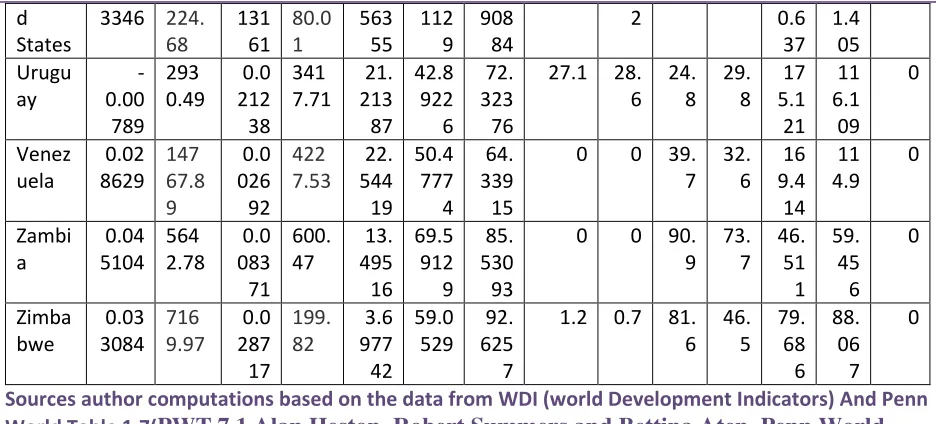
results. Carefully, controlling the variable is the key foundation for this study. The data are
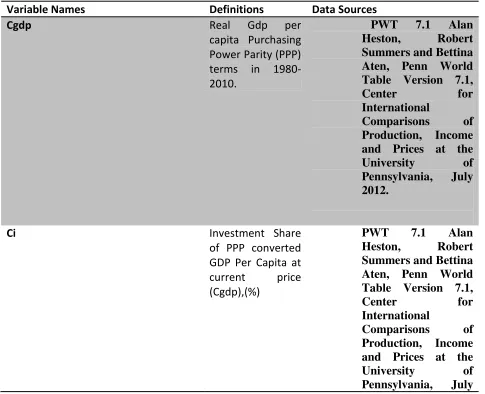
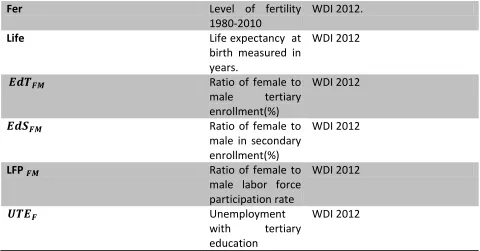
collected from two mains data sources
PWT 7.1 Alan Heston, Robert Summers and Bettina
Aten, Penn World Table Version 7.1, Center for International Comparisons of Production,
Income and Prices at the University of Pennsylvania, July 2012 and WDI (World Development
Indicator).
The theoretical literature suggests that gender inequality will reduce average human capital
and this will harm economic growth. Given different talents of children, declining education
equally-talented female must mean that marginal returns to educating girls must be higher
than boys. Which is inefficient (Knowles et al.,2002).While Barro and Lee(1994) found negative
coefficients for female education in growth regressions, the subsequent literature showed that
this result was due to the inclusion of some outliers(Dollar and Gatti,1999) and multicollinearity
between male and female school attainment(Klasen,2002). If education quality will be
considered in that case we avoid gender inequality and give equal treatment for both male and
female to attainment higher level and that must be justified in there employments status and
will increase the growth.
education and it will affect their employments opportunities and this will continue to have
detrimental effect on growth.
Somewhat less robust are results concerning females’
access to employment. Klasen and
Lamanna(2008) investigate the growth implications of employment gaps. In a cross- country
study covering the time period 1960-2000 they point out the high costs of low female labor
force participation for Middle East and North Africa, which is found to be a major factor
explaining growth difference with East Asia. Esteve-Voltart (2009) shows for Indian regions that
gender gaps in access to managerial positions and to employment more general distorts the
optimal allocation of talent and reduces growth. This is applied if female did not have access to
education to the same level as male and if law is not justifiable to make equal treatment for
both.
There is a large amount of literature on unequal access of female to education, the labor
market and other productive assets(such as land, credit, etc,), there is less literature on direct
effects of gender wage differentials or discrimination on growth. One argument in favor of
gender wage equality invokes market distortions because of wage discrimination. There are
efficiency losses concerning the potential of an economy’
s workforce: If discriminated against,
women might hesitate to participate in the labor market because their reservation wage is not
met (Baldwin and Johnson, 1992). It will take female to hide and to have a barrier not to enter
competition with male, because they will notice that there application have not outcome at the
end. So will they take part? Furthermore, existing wage gaps in employment could affect
human capital investment negatively.
The macro studies are also consistent using micro data showing that girls have higher marginal
returns to education which is even higher if the impact of female education on fertility and
education of the next generation is included (Hill and King 1995, World bank 2001; King,
Klansmen and Maria porter 2008)
How? see household play a part ( Sinha, Raju and Morrison (2007)), Thomas(1997), Galor and
Weil 1996); compared it with Seguino (2000) , Blecker and seguino, 2002). Standing (1999), as
well as Mitra-Kahn and Mitra-Kahn (2009)
Factors and causes affecting gender inequality in education
1. Fertility rate/Productivity:
The fertility rate for the female in some parts of the world is different from the others. For
instance, women are highly fertile in bearing the children. The research shown that this is
due to the early marriage. Moreover, the earlier the female marriage the higher the rate of
fertility and vice-versa. The literacy level and education affect fertility and this in turn
causes the biased in gender inequality. In that such a society parents gives priorities to
male than female to go to school. That being a case female have unequal treatment with
male child and there were dispersion in inequality. In some countries for example female
bearded two children per year. In that population rising at increases rate and the labor
force participation rate will be lowered. This true because for details see Klasen 2003,
2009 etc.
The fertility with gender inequality are related either positivity or otherwise. In that
increases in fertility reduces growth in most countries that have of gender inequality.
Likewise decreases raises growth, according to Malthus, The term "paradox" comes from
the notion that greater means would necessitate the production of more offspring as
suggested by the influential Malthus. Roughly speaking, nations or subpopulations with
higher GDP per capita are observed to have fewer children, even though a richer
population can support more children.
restraint" (which included abstinence) was required. The demographic-economic paradox
suggests that reproductive restraint arises naturally as a consequence of economic
progress.
The notice is that sometime women bearer lots of children in her life time .The
management and planning nature for those children are difficult. This is another point that
raises inequality. To that end the planning methods of the families significantly reduces.
Nay of those children cannot attain education equally with their counter. In the same vein,
some authors argue that fertility is related to the intelligence and that gives some women
to be less active in sciences and mathematically related courses. See for details explanation
from (Weyl and Possony, 1963, Daniel Vining 1982, Retherford and Sewell 1988).All of
these found negative linkages between fertility and intelligence in education, and all.
Notwithstanding, the higher the education for female, the lower the fertility and the lower
the inequality and the simultaneously the higher the growth. See some details in the
WorldFactbooks, 2012).
2. Social
–
Economics Situation:
The social status domain and economics condition may interplay a positive and negative
impacts of inequality in education. Thus, education plays important roles in skill sets for
acquiring jobs. This social economics situation affects education in two main ways. First,
those with higher social and economic status in the societies have the positive
opportunities to learn at higher level despite gender inequality. In this regards, those with
lower social and economic condition will be affects. This is because the societies look at the
values of the incoming status, as pointed out by economics the marginal benefits marginal
cost approach. This takes to the for example male that cannot pays school fees but
intelligence and women that can pays school fees but not intelligence.