Deadlock Detection and Avoidance in Static Step Topology
under Distributed Environment
Taskeen Zaidi1, Vipin Saxena2
Department of Computer Science, Babasaheb Bhimrao Ambedkar University, Lucknow, India. Email: [email protected], [email protected]
Received December 6th, 2012; revised January 5th, 2013; accepted January 14th, 2013
ABSTRACT
During the past years, the distributed computing approach has become very popular due to various advantages over centralized approach. In the distributed approach, the execution of a process has reduced and also it requires low cost for installation. Many of the researchers are using the modeling approach for solution of the software and hardware ar- chitecture research problems. The most popular approach of modeling is known as Unified Modeling Language based on the object-oriented technology. In the present work, a method of deadlock detection is explained for the newly pro- posed static step topology for the distributed network. In the step topology, the processes are taken as a task, sub task, macro, subroutine, etc which are executed in reflexive and symmetric manners when the systems are interconnected to each other under distributed environment and avoidance technique is also presented for the same. The deadlock detec- tion technique is presented through a UML class model.
Keywords: Distributed System;UML Class Model; Step Topology; Deadlock Detection; Deadlock Avoidance
1. Introduction
In the current scenario, many of the software companies are changing the layout of computing labs from the old centralized computing approach towards the distributed computing approach as it involves low cost and saves the execution time of the tasks. Another advantage is that distributed computing system does not share the global clock. In the centralized approach, computing time of the tasks is much more in comparison of the distributed ap- proach as the deadlock occurs frequently in the central- ized approach. In the distributed computing approach deadlock situation can be handled by the use of mutual exclusion i.e. synchronization of the tasks. The present
work is based upon a distributed kind of network con- nected through the static step topology designed by the authors; deadlock situations are detected and methods for avoidance of these situations are elaborated. In the pre- sent work, a static step topology is used for the high speed National Knowledge Network (NKN) connectivity and deadlock detection technique is defined for the exe- cution of the processes/tasks or one transmits the infor- mation in terms of files from one device to another de- vice attached through the topology. A method of avoid- ance is also explained. On the another aspects, modeling is necessary before executing the research problems as it saves the time and errors can be detected at the early stages of the software development, therefore, in the cur- rent scenario, many of the researchers are using the ob-
ject-oriented Unified Modeling Language to construct the various models for the solution of the research prob- lems, therefore, in the present work UML class model is also designed for finding the conditions of deadlock and a procedure to minimize the deadlock situations occur- ring in the distributed environment.
2. Related Work
when executed on the devices and obviously deadlock will occur according to the conditions of deadlock and these are well described by Milenkovic [5] and it consists of necessary conditions for deadlock as well as avoid- ance, prevention and detection of deadlock under distrib- uted computing environment. For execution of the proc- esses under distributed environment, mutual exclusion takes place and processes are executed according to the clock of the device and one of the important references is Lamports [6] which has explained the execution of proc- esses under distributed environment using time, clock and ordering of events. Later on Ricart and Agrawala [7] have modified the Lamport’s algorithm. Symmetric exe- cution of processes using parallel operations is explained by Maekawa [8]. Various Scientists have solved the prob- lem of mutual exclusion for the distributed environment by taking the concepts of graphs, sets, etc. By the use of set theory, it is solved by Agrawal [9]. Suzuki and Ka- sami [10] have described a token-based ring algorithm for execution of processes.
Modeling plays an important role for the solution of the research problem. Many of the researchers have used the latest modeling language known as Unified Modeling Language (UML) based on the object-oriented technol- ogy to solve the software and hardware architecture problems. First time in the literature, Unified Modeling Language for solution of the hardware architecture prob- lem is proposed by Gomma [11] for designing the con- current, distributed, and real-time applications with UML. Later on Pllana and Fahringer [12,13] have suggested profiles for modeling of distributed and parallel applica- tions by using UML. Let us describe some of the impor- tant references based on the present aspects. Saxena and Arora [14] have proposed UML modeling of a protocol for establishing mutual exclusion in the distributed sys- tem. Recently, Saxena and Zaidi [15] have proposed a new topology called as static step topology for intercon- nection of systems under distributed environment. Then, UML Modeling of newly developed static topology call- ed as step topology is done by Saxena and Zaidi [16] and also compared with the well known bus topology. Saxena and Zaidi [17] have also studied objective and impact of NKN project as well as advantages, disadvantages and difficulty faced by this project. A case study has also been done by authors to compute percentage utilization of NKN over the step topology. The authors [18] have also modified the Lamport’s algorithm for the step to- pology for execution of processes in reflexive and sym- metric manners.
3. Background
3.1. Distributed System
A distributed system is an autonomous collection of com- puter systems, which connects the resources and users
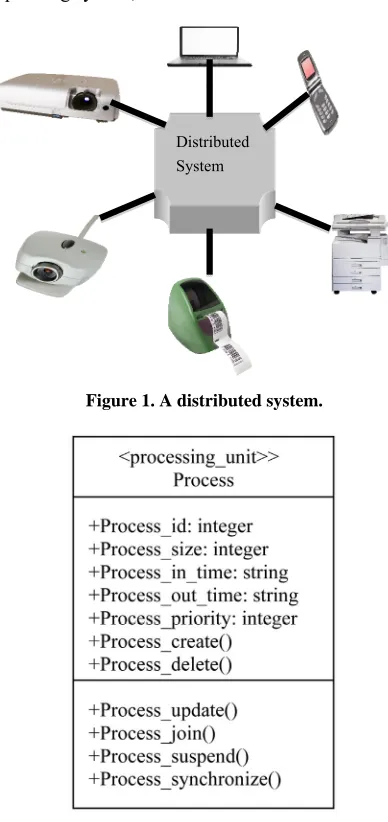
through message passing technique. It provides trans- parency, openness, reliability, scalability to the devices connected and also allows data sharing, resource sharing, audio and video sharing and reduces the cost of infra- structure. A representation of devices under distributed environment is shown in Figure 1.
3.2. A Process/Task
A Process as shown in Figure 2 is defined as tasks, sub- tasks, macro, subroutine, and a computer program run- ning concurrently with other programs executed by using processor. Process Execution Controller (PEC) i.e. proc-
essing_unit is fully responsible to execute the processes/ tasks. A UML class diagram of process is represented below with attributes and methods.
3.3. Deadlock
In operating system, deadlock is defined as a condition in
[image:2.595.321.515.312.723.2]Distributed System
[image:2.595.317.531.324.497.2]Figure 1. A distributed system.
[image:2.595.341.490.465.714.2]which two or more processes are competing for resources and each waits for other to finish its task and thus dead- lock occurs. It arises because one process is requesting for resources which is already taken by another waiting process and which in turn is requesting for resource that is held by another waiting process. It is a common prob- lem occurs in distributed system. The necessary and suf- ficient conditions of deadlock [5] are given below:
1) Mutual Exclusion—only one process is allowed to use the resources at one time; other processes are put in the suspended queue;
2) Hold and Wait—a process is requesting for re- sources which is held by another process;
3) No Preemption—the resources which are held by one process can not release if it is being used by other process;
4) Circular Wait—a process is waiting for resources held by another process which is already waiting for re- source by another process, a cycle formed and deadlock occur.
4. UML Modeling for Deadlock Detection
On the basis of above aspects, a static step topology as shown in the Figure 3 is considered in which one step consists of three nodes and processes can share the re- sources by message passing technique.
In the above Figure N1, N2, …, NM show the devices
which are arranged as per the step. The detailed descrip- tion of the topology can be found in [15]. In this figure, devices are attached on high speed NKN network con- nectivity. The speed of data transfer from one device to another device is 1 Gbps which can be extended up to 10 Gbps.
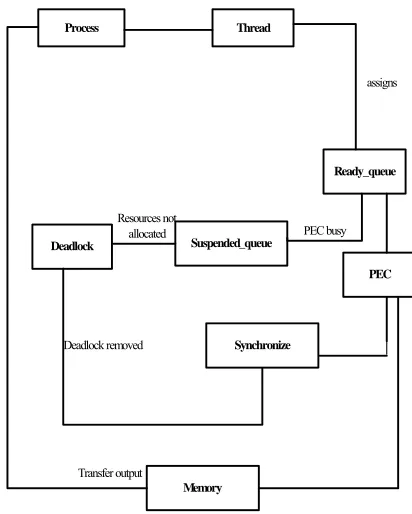
For detecting the deadlock conditions in the step to- pology over NKN network, a general UML class model is proposed in Figure 4 which shows the static behavior of the problem in which attributes and operations are grouped together to form a class. The figure represents the class diagram for deadlock condition, the processes
N’
4 N’M-1
N1
NM
N5
θ M
θ2
θ1 N3
N4 NM-2
[image:3.595.318.524.82.339.2]NM-1
Figure 3. A static step topology.
Process
Synchronize
Ready_queue
Suspended_queue Thread
Deadlock
Memory
PEC assigns
PEC busy Resources not
allocated
Deadlock removed
Transfer output
Figure 4. Class diagram for deadlock detection.
are executed by assigning threads controlled by Thread class, then the process enters into the PEC through a class named as Ready_queue; resources are allocated to each process, if the PEC is busy and resources are not allocated then the processes have to wait in the sus- pended queue controlled by Suspended_queue class; if any process waits for a long time for resources after sometime, time out condition occurs and either older process will die or rollback and then finally deadlock is removed and then process is synchronized and enters into PEC which is responsible for execution of the process and after being executed the resultant sends back to the memory controlled by Memory class.
5. Deadlock Detection and Avoidance
On the basis of the above UML class model, the follow- ing cases arise on the NKN network in which devices are connected through static step topology as shown the Fig- ure 3:
Case 1: Reflexive Situation of Deadlock
This situation of deadlock arises on the single node. Let us consider a single node N1 as shown in Figure 3,
when a process P1 on node N1 needs resources which are
executing on other nodes then the process P1 and other processes in queue on N1 will become in the deadlock
situation. This situation is represented as reflexive situa- tion and the avoidance method from deadlock is given below:
[image:3.595.62.278.568.726.2]in which resources are allocated to the processes as per the incoming request of the resources then at a time only one process can execute inside the critical section and after finishing the execution of process resources are released and next process will enter inside the critical section then in this situation no deadlock will occur. Processes synchronization will occur inside the critical section.
Case 2: Symmetric Situation of Deadlock
The symmetric situation of deadlock arises when two nodes N1 and N2 are participating for execution of the
processes and connected under step topology as shown in Figure 3 and they communicate through message pass- ing technique, then following two cases arise:
1) When multiple processes are going to execute on node N1 as per the scheduling algorithm then if resources
are allocated to the younger processes then older proc- esses which are waiting from a long time for resources will die and deadlock will occur.
2) If the process on the either node N1 or N2 will wait
for a long time for resources then the processes will die (time out) due to wait and die condition after some time and deadlock will occur.
Avoidance: In the first case, the deadlock situation can be handled by making a priority queue of the processes. If the older processes are rolled back by giving priority over younger processes then deadlock can be avoided.
In the second case, if the resources are available, re- sources which are allocated and resources which will be released by other processes are known to the other proc- esses which are trying to execute on either N1 or N2 and
they communicate about the resources as said above through message passing technique, then deadlock will not occur.
6. Conclusion and Future Scope of Work
From the above it is concluded that the Unified Modeling Language (UML) is used to construct a model for the deadlock situation occurring in the static step topology. Two cases in the form of reflexive and symmetric dead- lock are discussed and corresponding avoidance methods are explained. The present work can be extended for validation of the proposed UML model through Markov chain or Finite State methods.
7. Acknowledgements
Our thanks are due to University Grants Commission (UGC), New Delhi, India for providing financial assis- tance to carry out this work.
REFERENCES
[1] A. Siberschatz and P. B. Galvin, “Operating Systems Concepts,” 5th Edition, John Wiley and Sons, Inc., Ho-
boken, 2008.
[2] A. S. Tanenbaum, “Distributed Operating Systems,” Pr- entice Hall, Upper Saddle River, 1995.
[3] N. Minar, “Distributed System Topologies Part 1 and Part 2,” 2012. http://www.open2p.com/lpt/a/1461
[4] K. Hwang, “Advanced Computer Architecture”, McGraw- Hill Series in Computer Engineering, McGraw-Hill Inc., New York City, 1993.
[5] M. Milenkovic, “Operating Systems: Concepts and De- sign,” Tata McGraw-Hill, Noida, 1997.
[6] L. Lamport, “Time, Clocks and Ordering of Events in a Distributed System,” Communications of ACM, Vol. 21,
No. 7, 1978, pp. 558-565. doi:10.1145/359545.359563 [7] G. Ricart and A. Agrawala, “An Optimal Algorithm for
Mutual Exclusion in Computer Networks,” Communica-
tions of the ACM, Vol. 24, No. 1, 1991, pp. 9-17.
[8] M. Maekawa, “A N Algorithm for Mutual Exclusion in Decentralized Systems,” ACM Transactions on Com-
puter Systems, Vol. 3, No. 2, 1985, pp. 145-159.
doi:10.1145/214438.214445
[9] D. Agrawal and A. El Abbadi, “An Efficient and Fault Tolerant Solution for Distributed Mutual Exclusion,”
ACM Transactions on Computer Systems, Vol. 9, No. 1,
1991, pp. 1-20. doi:10.1145/103727.103728
[10] I. Suzuki and T. Kasami, “A Distributed Mutual Exclu- sion Algorithm,” ACM Transactions on Computer Sys- tems, Vol. 3, No. 4, 1985, pp. 344-349.
doi:10.1145/6110.214406
[11] H. Gomma, “Designing Concurrent, Distributed, and Real- Time Applications with UML,” Proceedings of the 23rd International Conference on Software Engineering
(ICSE’01), Toronto, 12-19 May 2001, pp. 2-15.
[12] S. Pllana and T. Fahringer, “On Customizing the UML for Modeling Performance Oriented Applications,” The
Unified Modeling Language, Springer-Verlag, Dresden,
Germany, 2002.
[13] S. Pllana and T. Fahringer, “UML Based Modeling of Performance Oriented Parallel and Distributed Applica- tions”, Winter Simulation Conference, Washington, 8-11
December 2002, pp. 497-505. doi:10.1109/WSC.2002.1172922
[14] V. Saxena and D. Arora, “UML Modeling of a Protocol for Establishing Mutual Exclusion in Distributed Com- puter System,” International Journal of Computer Sci-
ence and Network Security, Vol. 8, No. 6, 2008, pp. 227-
235.
[15] V. Saxena and T. Zaidi, “Step Topology for Static Inter- connection of Computer Systems under Distributed En- vironment,” World Conference of Information Technol- ogy,Barcelona, 14-17 November 2012, in Press.
[16] V. Saxena and T. Zaidi, “Modeling Aspects for Step and Bus Topologies under Distributed Computing System,”
International Journal of Computer Applications, Vol. 53,
No. 6, 2012, pp. 20-24.
[17] V. Saxena and T. Zaidi, “National knowledge Network vs. Information Communication Technology,” Proceedings
zafarfur, 11-12 February 2012, pp. 24-28.
[18] V. Saxena and T. Zaidi, “Modifications in Lamport Algo- rithm for Distributed Computing System,” International
Journal of Computer Applications, Vol. 53, No. 6, 2012,