ISSN Online: 1947-3818 ISSN Print: 1949-243X
Synergetic Dispatch of Power System with
Integration of Large-Scale Renewable Energy
Si Yang
1, Zhongfu Jiang
2, Shan Li
3, Wenbo Li
4, Guojing Liu
5, Xiangyang Cao
1, Nan Wang
1,
Lina Zhang
11Economic & Technology Research Institute, State Grid Shandong Electric Power Company, Jinan, China 2State Grid Shandong Electric Power Company, Jinan, China
3Key Laboratory of Power System Intelligent Dispatch and Control of Ministry of Education (Shandong University), Jinan, China 4State Grid Shandong Electric Power Research Institute, Jinan, China
5Economic & Technology Research Institute, State Grid Jiangsu Electric Power Company, Nanjing, China
Abstract
This paper comes up with a concept of synergetic advanced dispatch in order to deal with the ever-increasing uncertainty in power grid: Decision is made with respecting to AGC units and active load on the basis of synergetic unit combination such that active load’s advantages in regulation speed is put to full use in achieving efficient cooperation with renewable energy power. Meanwhile, factoring in allowable frequency variation range during decision- making may help to reduce AGC units’ regulation load and improve power grid's capacity of accommodating renewable energy power. Calculation exam-ple analysis suggested that the model and technique presented in this paper is capable of efficient coordination between active loads and renewable energy power, delivering friendly transition with day-ahead dispatch and AVC con-trol.
Keywords
Power System, Synergetic Dispatch, Renewable Energy Generation, Frequency
1. Introduction
Advanced dispatch is a link that relates day-ahead dispatch to automatic genera-tion control (AGC). Research on tradigenera-tional power grid advanced dispatch is approaching to its mature stage at present [1]. With the integration of large scale of renewable energy power, however, the uncertainty faced by advanced dispatch becomes greater. The authors in [2] proposed the concept of allowable operation interval of renewable energy generation. References [3] build a dispatch model based on adjustable robust optimization and set an affine decision criteria be-How to cite this paper: Yang, S., Jiang,
Z.F., Li, S., Li, W.B., Liu, G.J., Cao, X.Y., Wang, N. and Zhang, L.N. (2017) Syner-getic Dispatch of Power System with Inte-gration of Large-Scale Renewable Energy. Energy and Power Engineering, 9, 589-597. https://doi.org/10.4236/epe.2017.94B065
tween adjustable variables and uncertain parameters by AGC unit participation factor. A multi-objective optimization model considering both the ability to res-ist dres-isturbance and economic factors is built in [4] whose decision variables in-clude AGC unit basis point and participation factor.
New technologies emerge in recent years, such as electric automobiles, energy storage, controllable load, and interruptible load, allowing changing their own generation or consumption power to a certain extent for what called active loads. Some researchers studied the control methods for active loads participating in primary [5] and secondary [6] frequency regulation of the grid as well as the de-cision-making method for active loads participating in unit combination [7] and dynamic economic dispatch with a 24 h anticipatory period [8]. Most of the re-searches have not considered active loads’ role in reserve [7] [8], a few rere-searches, though having considered that have not, dealt with how to make active load re-sponse decisions in advanced dispatch and how to attain intimate coordination with AGC unit reserve response. To cope with ever-increasing uncertainty, the reserve configuration of day-ahead dispatch should take into account the role played by active loads, the reserve response quantity of active loads shall be de-termined in advanced dispatch, and the AGC control should also consider the effect of active loads.
This paper studies synergetic advanced dispatch with integration of renewable energy. It makes decision for AGC unit and active load response on the basis of the result of synergetic unit combination such that active loads’ advantage in regulation speed may be put to good use in coping with uncertainty associated with renewable energy power generation and conventional loads in order to realize an efficient cooperation. Additionally, the model has taken into account the fact that frequency variation is allowable within a certain limit, which has the effect of expanding the feasible region [9] and improving the grid's adoption ca-pacity of renewable energy power.
2. Description of Synergetic Advanced Dispatch Problem
Synergetic dispatch of power grid requires intimate coordination of decision- making at various time scale such as day-ahead level (unit combination), ad-vanced level, and real time level, among which, synergetic adad-vanced dispatch is the link that relates day-ahead dispatch to AGC control.2.1. Correlation with Synergetic Unit Combination
With non-AGC units, in synergetic dispatch, it is AGC units and active loads that take up reserve and the capability is therefore greater in coping with uncer-tainties; because of this, synergetic advanced dispatch decision-making no long-er considlong-ers the re-decision-making of non-AGC unit output powlong-er, so that non-AGC units are operated according to the power generation schedule speci-fied in day-ahead dispatch.
In synergetic advanced dispatch, the reserve response quantity of AGC units shall be determined according to super-short period prediction outcomes of re-newable energy power generation and conventional loads.
With active loads, synergetic unit combination is a process that allocates this finite dispatch resource and develops a power storage schedule, depending on daily periodic pattern of renewable energy power generation and conventional loads. The conflict shall be avoided that decision-making in synergetic advanced dispatch is contradictory with synergetic unit combination, otherwise the power demand by active loads might not be satisfied.
2.2. Correlation with Synergetic AGC Control
Synergetic advanced dispatch provides a base point which may be used by AGC units and by active loads while participating in AGC control, and dispatch errors as well as power fluctuations occurring in the dispatch period need to be ba-lanced by AGC control.
According to [6], assuming the regulation quantity demand, arising from the discrepancy between the actual power and the expected power, is ΔPt in period t during synergetic advanced dispatch, then the adjustment quantity ΔPA,t of ac-tive loads can be written as:
max ,
, max max
, ,
t t A t
A t
A t t A t
P if P P
P
p if P P
∆ ∆ ≤ ∆
∆ =
∆ ∆ ≥ ∆
(1)
where, max , A t
P
∆ is the maximum regulation capacity of active loads in time period
t.
Then, the adjustment quantity ΔPAGC,t of AGC units can be expressed as be-low: max , , , , max max , , ,
t A t t A t AGC t
AGC t
AGC t t A t AGC t
P P if P P P
P
P if P P P
∆ − ∆ ∆ − ∆ ≤ ∆
∆ =
∆ ∆ − ∆ ≥ ∆
(2)
where, max ,
AGC t P
∆ is the maximum regulation capacity of AGC units in time period t.
After regulation of active loads and AGC unit, if there is:
, , 0
t A t AGC t
P P P
∆ − ∆ − ∆ > (3)
Suppose a system frequency regulation coefficient of βt at time period t, when Equation (3) is valid the power grid frequency deviation Δft is:
, ,
t A t AGC t
t
t
P P P
f
β
∆ − ∆ − ∆
∆ = (4)
Rejection of renewable energy power or switching off loads becomes necessary only when ∆ft is out of the allowable frequency scope.
3. Synergetic Advanced Dispatch Model
3.1. Model Description
power generation and conventional loads, then the power pR of renewable ener-gy power generation and the power pD of conventional loads shall satisfy:
R R D D p p ∈ Ω
∈ Ω
(5) Advanced dispatch decision-making outcomes shall satisfy the uncertainty set of renewable energy power generation and conventional loads so that it is mod-eled as below:
(
)
min f u y, ,Ω ΩR, D (6)
(
)
(
)
(
)
(
)
(
)
, , , , 0
, , , , 0
,
R D R D
R D R D R R
D D
R D
h u y p p p p
g u y p p p p p
u u u p
y y p p y
=
≤ ∀ ∈ Ω
≤ ≤ ∀ ∈ Ω
≤ ≤
(7)
where, in (6) and (7), f is the cost function; u is the control quantity needing ad-vanced decision; y is a buffer quantity designed to cope with potential fluctua-tions; h is the equality constraints, g is the inequality constraints, u and u
are the maximum and minimum regulation scope limits of control quantity re-spectively; y and y are the maximum and minimum regulation scope limits of buffer quantity respectively.
3.2. Mathematical Model
With minimization of AGC units’ operation cost and rejected renewable energy power as the objective, the objective function of this model may be written as:
(
2)
(
max)
, , , , , ,
1 1 1
min
T N T
i G i t i G i t i t R t R t
t i t
a P b P c γ P P
= = =
+ + + −
∑∑
∑
(8)where, T is the number of time periods, N is the number of AGC units, PG,i,t is the base point of AGC unit i at time period t, ai, bi and ci are characteristic coef-ficients of AGC unit i.
Suppose that the predicted interval of renewable energy power generation for time period t is min max
, , , R t R t
P P
. If renewable energy power generation interval in synergetic advanced dispatch is PR t ,,PR t, , where PR t, and PR t, are decision
quantities, then the rejected renewable energy power is written as min
, ,
R t R t
P −P ,
with γt being the penalty coefficient. Constraints mainly include:
1) Base point power equilibrium constraint
*
, , , , ,
1 N
NAGC t G i t R t t A t i
P P P D P
=
+
∑
+ = + (9)active loads are being charged.
2) Operational constraints of active loads
max max
, , ,
A t A t A t
P P P
− ≤ ≤ (10)
1 ,
t t A t
E =E− +P ⋅ ∆t (11)
min max
t t t
E ≤E ≤E (12)
end T
E =E (13)
where, max , A t
P is the maximum charge power allowable in time period t and is assumed to be equal to the peak discharge power; Et is the energy stored by ac-tive loads in time period t; max
t
E and Etmin are the maximum and minimum
stored energy allowed in time period t, end
E is the expected stored energy at the end of dispatch.
3) Coping with uncertainty constraints
Supposing conventional load distribution interval is PD t, ,PD t, in time pe-riod t, it is straightforward to find the net load distribution interval PN t,,PN t, in time period t, with
, , ,
, , ,
N t D t R t
N t D t R t
P P P
P P P
= −
= −
(14)
where, Dt−PR t, in (9) is the reference value PN t, of net load in time period t. An illustration is provided below using the upper boundary PN t, of the net
load distribution interval as an example. In this case, the adjustment quantity is
, ,
N t N t
P −P .
In the case of active loads, the actual adjustment quantity PA t, taken up by
active loads may be written as:
max
, , , , , ,
, max max
, , , , , ,
( ) ( )
+ ( ) ( )
N t N t N t N t A t A t
A t
A t A t N t N t A t A t
P P if P P P P
P
P P if P P P P
− − ≤ +
=
− ≥ +
(15)
with the rest of adjustment quantity demand being PN t, −PN t, −PA t, and the
adjustment quantity corresponding to AGC unit i is:
, , , ,( , , , )
G i t G i t N t N t A t t t
P =
ρ
P −P −P − ⋅ ∆β
f (16)where,
ρ
G i t, , is the participation factor of AGC unit i in time period t.Similarly, when the net load drops to the lower boundary PN t, , there are: max
, , , , , ,
, max max
, , , , , ,
( ) ( )
( ) ( )
N t N t N t N t A t A t
A t
A t A t N t N t A t A t
P P if P P P P
P
P P if P P P P
− − ≤ −
=
− − ≥ −
(17)
, , , ,( , , , )
G i t G i t N t N t A t t t
P =
ρ
P −P −P − ⋅ ∆β
f (18)4) Upper and lower limit constraints of AGC unit output power:
min max
, , , , , , , ,
G i t G i t G i t G i t
P ≤P +P ≤P (19)
min max
, , , , , , , ,
G i t G i t G i t G i t
P ≤P −P ≤P (20)
where, max
P and min
out-put power.
5) Constraint of AGC unit creeping speed:
, , , , , , 1 , , 1 ,
(PG i t+PG i t) (− PG i t− −PG i t−)≤rG i⋅ ∆t (21)
, , 1 , , 1 , , , , ,
(PG i t− +PG i t−) (− PG i t−PG i t)≤rG i⋅ ∆t (22)
where, rG,i is the maximum adjustment speed of unit i, ∆t being the duration of time.
6) Constraint of frequency deviation: max
0≤ ∆ft, ∆ ≤ ∆ft f (23)
where, max
f
∆ is the maximum allowable frequency deviation for power grid
operation.
7) Constraint of renewable energy power generation operation interval:
max
, ,
0≤PR t ≤PR t (24)
min
, ,
0≤PR t ≤PR t (25)
, , ,
R t R t R t
P ≤P ≤P (26)
8) Constraint of AGC unit participation factors:
, , 1
1
N
G i t i
ρ =
=
∑
(27)3.3. Solution Strategy
In the model above, Equation (8) is in quadratic form, Equations (15) and (17) are logical expressions, and Equations (16) and (18) contain nonlinear expres-sion of the product of participation factors. To deal with that, the following measures are taken:
Firstly, the quadratic objective function is piecewise linearized.
Secondly, logical expressions (15) and (17) are converted into a general form by introducing 0 - 1 auxiliary variables. For (15), 0 - 1 quantity ut is
intro-duced:
max max
, , , , , , , ,
( ) ( ) ( ) ( )
1
A t A t N t N t A t A t N t N t
t
P P P P P P P P
u
M M
+ − − + − −
≤ ≤ + (28)
, , ,
(1 u Mt) PA t (PN t PN t) 0
− − ≤ − − ≤ (29)
max
, ( , , ) 0
t A t A t A t
u M P P P
− ≤ − + ≤ (30)
where, M is a constant with a high value and ut is 1 if max
, , , ,
(PA t+PA t )>(PN t−PN t) or 0 if
max
, , , ,
(PA t+PA t )<(PN t−PN t).
Analysis discovers that (15) is equivalent to (28)-(30). Similarly, logical ex-pression (17) can be converted to a general form consisted of (31)-(33).
max max
, , , , , , , ,
( ) ( ) ( ) ( )
1
A t A t N t N t A t A t N t N t
t
P P P P P P P P
u
M M
− − − − − −
≤ ≤ + (31)
(
1 u Mt)
PA t, (PN t, PN t, ) 0− − ≤ − − ≤ (32)
max
, ( , ,) 0
t A t A t A t
u M P P P
Finally, AGC unit participation factors are taken as constant using the follow-ing equation in this paper.
, ,
1
1 / [ ( 1 / )]
N
G i t i j
j
a a
ρ
=
= ×
∑
(34)4. Analysis of Calculation Example
4.1. Description of Calculation Example
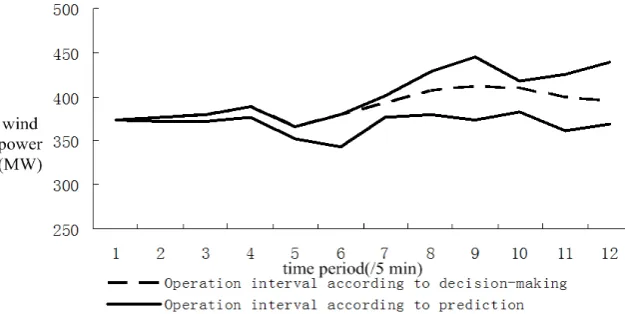
The model described above was simulated using a 10-unit system in which unit 1 - 6 are supposed to be AGC units and units parameters, load curve and day-ahead dispatch results are given by [10]. Batteries were included by way of example of active loads, the peak charge/discharge power is 50 MW and the maximum and minimum values of last time period energy are 110 MWh and 70 MWh. Renewable energy power generation is consisted mainly of wind power and its prediction result is in Figure 1. The system frequency was 50 Hz, with an allowable variation range of 50 ± 0.1 Hz for normal operation. 1% variation in system frequency gave rise to 2.89% variation in active power of conventional loads.
4.2. Conventional Advanced Dispatch Computation Results
Suppose that day-ahead dispatch sets active load power at 25 MW and tradi-tional advanced dispatch does not consider the adjustment for active load so that the charging power is treated as a fixed constant in decision-making. With traditional dispatch, the following figure compares the wind power op-eration interval as predicted and the opop-eration interval as actually established in decision-making.
As is seen from Figure 1, with traditional advanced dispatch, one has to reject wind power when wind power is associated with higher uncertainty, thus unable to satisfy the maximum operation interval predicted.
4.3. Synergetic Advanced Dispatch Computation Results
[image:7.595.213.526.558.715.2]The model and computation method proposed in this paper, in contrast, have
factored in active load reserve response and frequency regulation effect, so it is no longer needed to reject wind power in this example, hence completely satis-fying the predicted wind power operation interval.
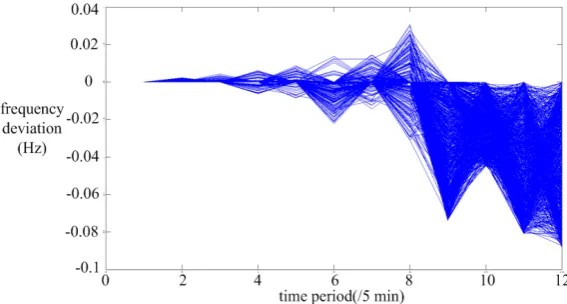
To validate dispatch outcomes, Monte Carlo simulation was performed dur-ing which wind power output power values were generated randomly to simu-late actual charge/discharge power of active loads and variation in power grid frequency.
As is evident from Figure 2, with synergetic advanced dispatch, active load charge/discharge power is no longer locked but is determined by the uncertainty of wind power. Relative to locking active load charge/discharge power used in conventional dispatch, this approach is more likely to produce efficient coopera-tion between the two.
[image:8.595.228.516.358.526.2]In the time period when active loads are unable to satisfy power uncertainty, active power equilibrium may be achieved by readjusting the AGC unit output power or by frequency regulation effect. If in AGC control, the objective is to reduce AGC unit regulation to a minimum and let power fluctuation be prefera-bly taken up by frequency regulation effect, then the simulated frequency is as shown in Figure 3. In time periods with higher uncertainty, the frequency
Figure 2. Simulation results of active load charge/discharge conditions.
[image:8.595.230.514.565.717.2]deviation is larger, but remains within the allowable deviation range.
5. Conclusion
This study investigated synergetic advanced dispatch, coming to the following major conclusions: 1) Coordination with reserve configuration in synergetic unit combination and factoring in adjusting effect of active loads are able to make full use of active load’s advantages in regulation speed and achieve more cooperation with renewable energy power generation; 2) Consideration of active loads and frequency regulation effect in advanced dispatch model is conducive to alleviate AGC units’ regulation pressure in the control process and avoid conservative decision; 3) Synergetic advanced dispatch realizes friendly transition from day- ahead dispatch to AGC control and improves power grid’s adaptation to renew-able energy power.
References
[1] Innorta, M., Marannino, P., Granelli, G. and Montagna, M. (1988) Security Con-strained Dynamic Dispatch of Real power for Thermal Groups. IEEE Transactions on Power Systems, 3, 774-781. https://doi.org/10.1109/59.192934
[2] Zhao, J., Zheng, T. and Litvinov, E. (2014) Variable Resource Dispatch through Do-not-exceed Limit. IEEE Transactions on Power Systems, 30, 1-9.
[3] Jabr, R.A. (2013) Adjustable Robust OPF with Renewable Energy Sources. IEEE Transactions on Power Systems, 28, 4742-4751.
https://doi.org/10.1109/TPWRS.2013.2275013
[4] Yang, M., Cheng, F.L. and Han, X.S. (2015) Real-time Dispatch Based on Effective Steady-state Security Regions of Power System. Proceedings of the CSEE, 35, 1353-1362.
[5] Liu, H., Hu, Z., Song Y. and Lin, J. (2013) Decentralized Vehicle-to-Grid Control for Primary Frequency Regulation Considering Charging Demands. IEEE Transactions on Power Systems, 28, 3480-3489.
https://doi.org/10.1109/TPWRS.2013.2252029
[6] Cheng, Y., Tabrizi, M., Sahni, M. and Povedano, A. (2014) Dynamic Available AGC Based Approach for Enhancing Utility Scale Energy Storage Performance. Smart Grid IEEE Transactions on, 5, 1070-1078.
https://doi.org/10.1109/TSG.2013.2289380
[7] Xie,Y.G. and Jiang, X.D. (2011) Impact of Energy Storage System on the Unit Commitment Problem with Volatile Wind Power. Automation of electric power systems, 35, 19-24.
[8] Zhao, J.H., Wen, F.S., Xue, Y.S, Dong, Z.Y. and Xin, J.B. (2010) Power System Sto-chastic Economic Dispatch Considering Uncertain Outputs from Plug-in Electric Vehicles and Wind Generators. Automation of Electric Power Systems, 34, 22-29. [9] Liu, G.J., Han, X.S. and Yang, M. (2014) Synergetic Economic Dispatch in Power
System Operation. Proceedings of the CSEE, 34, 2668-2675.
Submit or recommend next manuscript to SCIRP and we will provide best service for you:
Accepting pre-submission inquiries through Email, Facebook, LinkedIn, Twitter, etc. A wide selection of journals (inclusive of 9 subjects, more than 200 journals)
Providing 24-hour high-quality service User-friendly online submission system Fair and swift peer-review system
Efficient typesetting and proofreading procedure
Display of the result of downloads and visits, as well as the number of cited articles Maximum dissemination of your research work