On analysis and characterization of the
mean-median compromise method
Ngoie, Ruffin-Benoît M. and Ulungu, Berthold E.-L.
Institut Supérieu Pédagogique (ISP) / Mbanza-Ngungu, Institut
Supérieur des Techniques Appliquées (ISTA)/ Kinshasa
October 2014
Online at
https://mpra.ub.uni-muenchen.de/64154/
56
On analysis and characterization of the mean-median
compromise method
Ruffin-Benoît M. Ngoie
Mathematics and Informatics Department, ISP/Mbanza-Ngungu, Democratic Republic of Congo E-mail: [email protected]
Berthold Ulungu E.-L
ISTA/Kinshasa, Democratic Republic of CongoE-mail: [email protected]
Abstract: Most important results in Social Choice Theory concern impossibility theorems. They claim that no function, as complex as it might be, can satisfy simultaneously a restricted number of fair properties describing a democratic system. However, adopting new voting ideas can push back those limits. Some years ago, such a work was boosted by Balinski and Laraki on the basis of evaluations cast by voters to competitors; this is an alternative to arrovian framework which is based on ranking candidates by voters. Recently, Ngoie and Ulungu have proposed a new voting function – defined in both Balinski and Laraki’s spirit – which hybridizes Majority Judgment (MJ) and Borda Majority Count (BMC): the so-called Mean-Median Compromise Method (MMCM). The method puts at its credit the desired properties of MJ and BMC as well; indeed, it reduces their insufficiencies. The purpose of this paper is double: analyse and characterize MMCM features in comparison to other valuable voting functions.
Keywords: Borda Majority Count, Majority Judgment, Mean-Median Compromise Method,
Paradoxes.
Mathematics Subject Classification:91A80, 91B12, 91B14, 91-02, 91A35
1. INTRODUCTION
The new voting framework boosted by Balinski and Laraki (2007) drew the attention of many researchers in Social Choice Theory. It mainly eliminates insufficiencies of aggregating functions designed in the traditional Arrow’s (1950; 1951; 1963) framework. The famous general possibility theorem (Maskin & Sen, 2014) does not have any more the so harmful effects on the new framework-designed functions than it has on those designed in the arrovian framework.
Thus, Majority Judgment (MJ), Range Voting (RV), Borda Majority Count (BMC), and Approval Voting (AV) are some voting functions which are free from conditions imposed by impossibility theorems. Nevertheless all these functions are also struck by paradoxes.
BMC, and more generally RV, was opposed to the MJ by the final value assigned to
candidates. Final value is the “average” for BMC while it is the “median” for MJ. Mohajan
57
To mitigate insufficiencies of the two above mentioned methods, Mean-Median Compromise Method (MMCM) was proposed (Ngoie et al., 2014; Ngoie et al., 2015; Ngoie & Ulungu, 2015). Latest method puts at its credit the advantages of BMC and MJ. It fulfills many fair criteria sought in a democracy.
This article aims at analyzing MMCM by its properties. It presents also some inherent insufficiencies.
For this purpose, the paper is organized as follows: section 2 outlines the so-called social choice function MMCM, section 3 enumerates some properties of MMCM, section 4 highlights the fact that MMCM, although robust, resists the tyranny of majority better than MJ, section 5 faces some controversial examples in Social Choice Theory with MMCM, section 6 establishes a comparison between MMCM and most valuable social choice functions, section 7 is devoted to concluding remarks.
2. OUTLINES OF MMCM
This section outlines the MMCM method proposed by Ngoie, Ulungu and Savadogo (2014; 2015); there, didactic examples are also developped.
Definition 2.1 (Amplitude of a division) Let N = {1, 2, … , n} be the set of 𝑛 judges, we call amplitude of a division the real number:
ρ =n+12k (1)
with ka whole number called “division degree”.
Definition 2.2 (Intermedian grades) Let ai be a candidate or competitor with grade
gi1, gi2, . . , gin such that gi1 ≥ gi2≥ ⋯ ≥ gin. A grade gij is called “intermedian” if and only if ∃m ∈ ℕ (with 1 ≤ m ≤ 2k− 1) such that [ρ. m] = j verifying [ρ. m] is the whole number that is nearest to ρ. m and ρ the amplitude of division for a fixed division degree k.
We note ℳk the set of non-redundant intermedian grades obtained from a division degree k.
The so-defined ℳk is the set of data involved in the Olympic average1 calculation of points
which are bounds (higher or lower) of 2k intervals obtained after division.
Definition 2.3 (Average Majority Compromise) Let ai be a candidate or competitor with grades gi1, gi2, … , gin where gi1 ≥ gi2≥ ⋯ ≥ gin and ℳk= {gi1∗ , gi2∗ , … , gij∗} the set of his
or her intermedian grades obtained from division degree k. Then the “average majority
compromise”, or “average majority evaluation” fmm(a
i) is by definition:
fmm(a
i) =1j∑jm=1gim∗ (2)
For didactic examples, see (Ngoie et al., 2014), (Ngoie et al., 2015), and (Ngoie & Ulungu, 2015).
1
58 2.1 Tie-Breaking
When average majority grades of two candidates are different, the one with the higher average majority grade naturally ranks ahead of the other. The Mean-Median Majority ranking
≻mm between two candidates evaluated by the same jury is determined by a repeated application of average majority ranking:
start with k = 2
if fkmm(a) > fkmm(b) then a ≻mmb
if fkmm(a) = fkmm(b) then the procedure is repeated for k + 1.
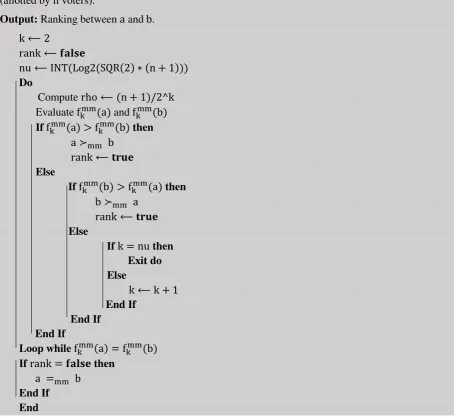
2.2 Ranking candidates with MMCM
MMCM Algorithm
Input: a and b two candidates to rank with grades respectively {g1a, g2a, … , gna } and {g1b, g2b, … , gnb } (allotted by n voters).
Output: Ranking between a and b. k ⟵ 2
rank ⟵ 𝐟𝐚𝐥𝐬𝐞
nu ⟵ INT(Log2(SQR(2) ∗ (n + 1))) Do
Compute rho ⟵ (n + 1)/2^k Evaluate fkmm(a) and fkmm(b) If fkmm(a) > fkmm(b) then
a ≻mm b rank ⟵ 𝐭𝐫𝐮𝐞 Else
If fkmm(b) > fkmm(a) then b ≻mm a
rank ⟵ 𝐭𝐫𝐮𝐞 Else
If k = nu then Exit do Else
k ⟵ k + 1 End If
End If End If
Loop while fkmm(a) = fkmm(b) If rank = 𝐟𝐚𝐥𝐬𝐞 then
a =mm b
[image:4.595.71.529.291.709.2]End If End
Figure 1. MMCM Algorithm. One can verify that for all n, ν = INT(1
2+ log2(n + 1)) where INT(x)
59
Let us take the following example to illustrate this procedure:
Example 2.1 Suppose that a et b are evaluated by a 7-voter jury:
a : 85 73 78 90 69 70 71
b : 77 72 95 83 73 73 66
For k = 2, we have ρ =7+1 22 =
8
4= 2 and then f2mm(a) = f2mm(b) = 76. A tie-break occurs between a and b. By definition, we repeat the procedure for k = 3 and obtain:
f3mm(b) = 77 > f3mm(a) = 76.57. Then b ≻mma. For detailed resolution of this example, see (Ngoie et al., 2014), (Ngoie et al., 2015), and (Ngoie & Ulungu, 2015).
In this example the average majority evaluation returns exactly the same result as the average. That is due to the fact that each candidate’s intermedian grades set is equal her or his grade set (see Theorem 2 in (Ngoie et al., 2014) and (Ngoie et al., 2015)).
Definition 2.4 (Maximum division index) Let ai be a candidate or competitor and Gi =
{gi1, gi2, … , gin} set of ai’s grades with gi1 ≥ gi2≥ ⋯ ≥ gin and ℳk = {gi1∗ , gi2∗ , … , gij∗} the set of her or his intermedian grades obtained with a division degree𝑘. Then, the smallest whole number k such that Gi = ℳk is called “maximum division index” or “total division index”. It is denoted ν.
3. MMCM PROPERTIES AND CHARACTERIZATION
3.1 Properties
Let fmm: ℒm×n→ ℝm be a method of grading. Ngoie and Ulungu (2015) have shown that fmm fulfills the following properties:
- neutral: when the rows or competitors in a profile are permuted, fmm gives the identical answer permuted in the same way.
- anonymous: when the columns or judges in a profile are permuted, fmm gives the same grades to each competitor.
- unanimous: if a competitor is given the same grade g by every judge, then fmm assigns him the same grade g.
- monotonic: if in comparing two profiles, a competitor's grades in the second are all the same or lower than in the first, then fmmcannot assign the competitor a higher grade in the second case than in the first. Moreover, if all the competitor's grades are strictly lower in the second profile, then fmmassigns a strictly lower value in the second case. - Independent from irrelevant alternatives: if the lists of grades assigned by the judges to
a competitor in two profiles are the same, then in both cases fmmassigns the same grade to the competitor in question.
Generalization of approval voting (AV) principle : if the only authorized scores are 0 (to
60 3.2 Characterization
It is easy to see that the Mean-Median Compromise Method satisfies the following properties: - MMCM is choice-monotonic: if a ≻mm b and either a moves strictly higher or b moves
strictly lower in some or more voters' evaluations, then a ≻mm b.
- MMCM is rank-monotonic: if voters' estimations remain the same except that the winner moves up, then not only should she still be the winner, but the final ranking among the others should remain the same.
- MMCM is strongly monotonic: when a non-winner falls in the estimation of the voters, the winning candidate remains the winner.
In this paper, we will show other properties related to MMCM.
Definition 3.1 (see (Smith, 2008) and (balinski & Laraki, 2010))
- Expressiveness: the more kinds of votes you can cast, the more expressivity you have. - A voting system is favorite-safe if it is “safe” to vote for your favorite, i.e., it is never
more strategic to vote a non-favorite ahead of your favorite.
- A voting system is clone-safe if a “clone” of a candidate (rated almost identical to the original by every voter) enters or leaves the race, that should not affect the winner (aside from possible replacement by a clone).
- A voting system is monotonic if
i)somebody increases his vote for candidate c (leaving the rest of their vote unchanged) that should not worsen c's chances of winning the election, and ii)somebody decreases his vote for candidate b (leaving the rest of their vote
unchanged) that should not improve b's chances of winning the election.
- A voting system is remove-loser safe := if some losing candidate x is found to be ineligible to run, then the same ballots should still be usable to conduct an election with
x removed, and should still elect the same winner.
Property 3.1 (see (Ngoie & Ulungu, 2015)) The Mean-Median Compromise Method
(MMCM) is expressive, favorite-safe, clone-safe, monotonic, and remove-loser-safe.
3.3 Comments on MMCM
Below we comment on these properties:
1. With plurality voting in an m-candidate election, every voter has only m possible votes. With approval voting there are 2m possible votes for every voter. With 0 - 4 Range Voting, i.e., with the Borda Majority Count (BMC) [11], Majority Judgment (MJ) (Balinski & Laraki, 2007; 2010), and Mean-Median Compromise Method (MMCM) (Ngoie et al., 2014; Ngoie et al., 2015; Ngoie & Ulungu, 2015), one has 5m possibilities to vote. With 0 - 99 Range Voting one has 100m possible votes. Of course, with rank-order voting systems one has m! possible votes. MMCM then requires less informations from voter since its complexity order is equal to plurality voting one (polynomial).
2. For instance, the Plurality Rule is not favorite-safe. Consider the following profile: 4: a b c
3: b c a 2: c b a
61
Instant Runoff are not favorite-safe. Approval Voting and more generally Mean-Median Compromise Method are favorite-safe. A rational voter does not have to betray his favorite candidate in order to obtain a better outcome. His only best strategy is to allot maximum grade to his favorite. Other candidates he thinks less or equivalent to his favorite can be assigned at most the same grade.
3. Plurality Rule and the Borda Count are not clone-safe in different ways. For the Plurality Rule, if a winning candidate a has too many clones a1, a2, and so on, the votes for a may be distributed over the clones and all may lose. For the Borda Count, suppose 3: ab and 2: ba, then a will have most Borda Points; but if b is replaced by two clones b1 and b2, the situation may become 3: ab1b2 and 2: b1b2a and b1 will have most Borda points. With MMCM, both clones would be assigned the same final grade and a would still be winning (respectively losing) provided he ranks ahead (respectively behind) of b. 4. Plurality Rule, the Borda Count, Majority Judgment, Approval Voting, Range Voting,
Borda Majority Count, and Mean-Median Compromise Method are monotonic, but it is well known that Instant Runoff Voting and related voting systems like the Single Transferable Vote and the Alternative vote are not (see Section 1.5.2. in (Zahid, 2012)). 5. Majority Judgment, Approval Voting, Range Voting, Borda Majority Count and
Mean-Median Compromise Method clearly do have the property of being remove-loser-safe, but Plurality Rule, Pairwise Comparison, the Borda Count and Instant Runoff Voting are not. For instance, given profile 𝑝 with
4: a b c 3: b c a 2: c b a
under Plurality Rule a is the winner and c is the loser, but by removing c, b instead of a becomes the winner. Withdrawal of candidate c does not have to change ranking between a and b when using MMCM since we know that it is independent from irrelevant alternatives.
While Plurality Rule and Instant Runoff Voting may favor extreme candidates, Warren D. Smith (2008) argues that Range Voting, and hence in particular the Borda Majority Count, has little or no bias with respect to centrist/extreme candidates. In Chapter 19 of (Balinski & Laraki, 2010), p. 350, Balinski and Laraki argue on the basis of experimental evidence that also “the Majority Judgment ... seems to be the most balanced with regard to the left-right spectrum”. And so could we argue for Mean-Median Compromise Method.
4. MMCM CONTRIBUTION TO MAJORITY TYRANNY
A typical "tyranny of majority" scenario, according to Smith (2008) is the "kill the Jews" vote. That is, there is a majority of non-Jews, and a minority of Jews, and they all vote on the question "should the Jews be killed and their money stolen and used to reduce taxes for the survivors?"
The same abstract type of scenario arises (fortunately usually in less dramatic form) all the time, e.g. many "ban gay marriage" referenda passed in USA and European countries a couple of years ago, and on 30 March 1855 a Kansas-wide referendum voted to make slavery legal.
62
voting (where by "honest" we mean: each voter honestly says which choice would have the best effect on him alone) kill the Jews.
We can notice that median-based range voting, and particularly Majority Judgment, seems to be more vulnerable to tyranny of majority than average-based range voting. Specifically, imagine with range 0-to-9, that there are exactly two kinds of votes: strong-preference votes "kill=0, live=9" (cast by honest Jews) and weak-preference votes "kill=5, live=4" cast by honest non-Jews. In such a scenario, if the Jews exceed 10% of the population, average based range voting will let them live. However, median-based range voting will always kill the Jews, no matter what percentage they are (provided they are a minority) and no matter what the particular four numerical scores (here 0, 9, 4, and 5) are (Smith, 2008).
But after a meticulous look, we notice that the minority ratio which outweighs the majority is too low. Indeed, 10% of Jews who express strong preferences "kill=0, live=9" outweigh 90% of non-Jews who express weak preferences "kill=5, live=4". This is, rather than fair property, a non-democratic property. Even if we could agree with the idea that tyranny of majority in not a fair property, we must determine an accredited minority to outweigh a majority, 10% is certainly not enough to be an accredited minority.
At first glance, we can notice that with MMCM this minority increases to 25%. This seems to be a fair accredited minority to outweigh the majority rather than 10%. Clearly, MMCM is one of rare voting functions that are simultaneously robust (what Range Voting, and particularly Borda Majority Count, are not) and majority-tyranny-proof (what Majority Judgment is not).
5. PARADOXICAL RESULTS ON MEAN-MEDIAN COMPROMISE METHOD
In this section we show some controversial examples concerning MMCM. We can then notice that MMCM is not a perfect voting function. However, some of those paradoxical examples are too rare that we could question their relevance in voting theory studies.
Example 5.1
Suppose there are two parts of an electorate, say I and II, with two competitors a and b. In part I there are 10 judges, giving their judgments as indicated in Table 1 below:
Table 1. Judgments according to Electorate I
Electorate I 5 4 3 2 1 0
a 3 3 1 1 1 1
b 2 2 4 2 0 0
In electorate I, the average majority compromise of candidate a is 11
3 and the one of b is 10
3. So, in electorate I, a ≻mm b. The MJ agrees with this ranking.
In electorate II there are the same two candidates and 15 judges, giving their evaluations as follows:
Table 2. Judgments according to Electorate II
Electorate II 5 4 3 2 1 0
a 1 2 2 3 4 3
63
In electorate II, the average majority compromise of candidate a is 2 and the one of b is 5 3. So, also in electorate II, a ≻mmb.
Now let us look at the outcome in the combined electorate, as shown in Table 3 below:
Table 3. Judgments according to combined electorate
Electorates I and II 5 4 3 2 1 0
a 4 5 3 4 5 4
b 4 4 6 3 4 4
In the whole electorate, the final average majority compromise of candidate a is 7
3 and the one of b is 8
3. So, while a ≻mmb in both electorates I and II, we have b ≻mm a in the combined electorate. In other words, a wins in each district I and II, while b wins when the evaluations of both districts are joined together. So, Mean-Median Compromise Method is not join-consistent.
Example 5.2
Consider two candidates a and b and six judges with the following results:
a : 10 8 6 6 5 1
b : 10 8 8 5 5 3
So, a is the MMCM winner with average majority compromise 19
3, while b's average majority compromise is only 6. Suppose a seventh judge gives 9 to a and 8 to b. Then we have the following situation:
a : 10 10 8 6 6 5 1
b : 10 9 8 8 5 5 3
b becomes the winner instead of a as his average majority compromise is 22
3 and a’s one is only 7. One may conclude that increased support for a candidate may turn him from a winner into a loser. In this case it is better for the additional voter not to cast his vote, since then his favored candidate a wins, while b wins if he does cast his vote. In the literature this is known as the no-show paradox. The MMCM is then not participant consistent.
6. MMCM VERSUS MOST VALUABLE SOCIAL CHOICE FUNCTIONS
It would be better to introduce here a table comparing representative social choice functions
over some properties. At least, MMCM is compared to BMC and MJ. In table 1 below, “1” in
a box means that the social choice function on the associate column fulfills criterion on the
64
Table 4. Comparing MMCM to most valuable social choice functions
Properties MMCM MJ BMC AV Plurality Voting
Neutrality 1 1 1 1 1
Anonymity 1 1 1 1 1
Unanimity 1 1 1 1 1
Monotonicity 1 1 1 1 0
Independence of Irrelevant Alternative 1 1 1 1 0
Generalizing AV 1 1 1 1 0
Expressiveness 1 1 1 0 0
Robustness 1 1 0 0 0
Majority-Tyranny-Proofness 1 0 1 0 0
Clone-safeness 1 1 1 1 0
Strong monotonicity 1 1 1 1 0
Remove-loser safeness 1 1 1 1 0
Favorite safeness 1 1 1 1 0
Left-Right spectrum balance 1 1 0 0 0
Join-consistency 0 0 1 1 1
Participant consistency 0 0 1 1 0
7. CONCLUDING REMARKS
In this paper, we have shown that MMCM voting function fits in the list of aggregating functions enjoying ideal properties for a democracy. On sixteen selected criteria, MMCM has checked fourteen of them. Such a score is also achieved by no other function but the BMC. The MMCM is neither join-consistent nor participant-consistent. BMC is not robust and favors – in some extent (but not like Plurality Rule) –centrist candidates’ lamination. So to speak, MMCM is at least as better as BMC according to its performance.
If it is necessary to make a compromise between various criteria, we estimate, like Balinski and Laraki (2010), that criteria not filled by MMCM are negligible ones. But acccording to Nurmi (1998; 1999), the No-show paradox is a serious disadvantage for a voting system. If we
apply MMCM to Zahid’s paradoxical examples related to MJ (see (Zahid, 2012)), we find that it returns coherent outcomes. Nevertheless, as we have just seen in this article, it is still vulnerable to the No-show paradox.
BMC is very easy to manipulate. It gives too much power to voters who allot extreme grades. Compared to the No-show paradox, this criterion appears as more significant for a voting function. MMCM would thus be at equal footing as Range Voting – and in particular BMC – in the list of functions filling most of democracy-desired criteria. It shades between the average value and the median one.
It would be advisable, in a forthcoming publication, to experiment MMCM in competition with MJ, BMC and AV to see up to what extent outcomes converge or diverge.
Acknowledgments
65 References
Arrow, K.J. (1950), A difficulty in the concept of social welfare. Journal of Political Economy, 58(4) : 328 – 346.
Arrow, K.J. (1951), Social choice and individual values, Yale University Press, New York.
Arrow, K.J. (1963), Social choice and individual values, 2nd ed. Wiley, Yale University Press.
Balinski, M. and Laraki, R. (2007), A theory of measuring, electing and ranking. Proceedings of the National Academy of Sciences of the United States of America, 104: 8720-8725.
Balinski, M. and Laraki, R. (2010), Majority Judgment: measuring, ranking and electing. MIT Press.
Maskin, E. and Sen, A.K. (2014), The Arrow Impossibility Theorem, Columbia University Press, New York.
Mohajan, H.K. (2012), Majority Judgment in an election with Borda Majority Count. International Journal of Management and Transformation, 6(1):19–31.
Ngoie, R.-B. M. and Ulungu; B. E.-L. (2015), Mean-Median Compromise Method as an innovating voting rule in social choice theory. International Journal of Applied Mathematical Research, 4(1): 177-182.
Ngoie, R.-B. M., Savadogo, Z. and Ulungu, B. E.-L. (2014), Median and average as tools for measuring, electing and ranking: new prospects. Fundamental Journal of Mathematics and Mathematical Sciences, 1(1):9-30.
Ngoie, R.-B. M., Savadogo, Z. and Ulungu, B. E.-L. (2015), New Prospects in Social Choice Theory: Median and average as tools for measuring, electing and ranking. Adanced Studies in Contemporary Mathematics, 25(1): 19-38.
Nurmi, H. (1998), Voting paradoxes and referenda. Social Choice and Welfare, 15: 333 – 350.
Nurmi, H. (1999), Voting Paradoxes and How to Deal with Them. Heidelberg, New-York, Springer-Verlag.
Smith, W. D. (2008), Tilburg Lecture on Range Voting. http://www.rangevoting.org/TBlecture.html
66
AUTHORS’ BIOGRAPHY
Ruffin-Benoît Ngoie Mpoy is Senior Lecturer at Institut Supérieur Pédagogique de Ngungu (High Educational College of Mbanza-Ngungu), Democratic Republic of the Congo. He teaches Computer Programming, Numerical Analysis and Algorithms Theory. His main fields are Computational Social Choice Theory, Multiple Criteria Decision Aiding, and Games Theory. He proposed, in collaboration with Berthold Ulungu, the MMCM to slice between median and mean values.