Munich Personal RePEc Archive
A Template for Analyzing and Projecting
Labor Market Indicators
Abdih, Yasser and Behar, Alberto and Cevik, Serhan and
Chami, Ralph and Dougherty-Choux, Lisa and Furceri,
Davide and Janus, Nick and Zimand, Paul
International Monetary Fund
27 September 2012
Online at
https://mpra.ub.uni-muenchen.de/82682/
A Template for Analyzing and
Projecting Labor Market Indicators
Prepared by a staff team led by Ralph Chami and comprising
Yasser Abdih, Alberto Behar, Serhan Cevik, Lisa Dougherty-Choux,
Davide Furceri, Nick Janus, and Paul Zimand
Middle East and Central Asia Department
INTerNATIoNAl MoNeTAry FUND
Middle east and Central Asia Department
A Template for Analyzing and Projecting Labor Market Indicators
Prepared by a staff team led by ralph Chami and comprising yasser Abdih, Alberto Behar, Serhan Cevik, lisa Dougherty-Choux, Davide Furceri,
Nick Janus, and Paul Zimand
September 2012
JEL Classification Numbers: J08, J01, O5
Keywords: Unemployment, projections, template, labor market
Author’s E-Mail Address: [email protected]; [email protected]; [email protected]; [email protected]; [email protected]; [email protected]; [email protected]; [email protected]
DISCLAIMER: This Technical Guidance Note should not be reported as representing the views of the IMF. The views expressed in this Note are those of the authors and do not necessarily
A Template for Analyzing and Projecting
Labor Market Indicators
1
Yasser Abdih, Alberto Behar, Serhan Cevik, Ralph Chami,
Lisa Dougherty-Choux, Davide Furceri, Nick Janus, and Paul Zimand
I. Introduction
The 2008 great recession has led to a 30 million increase in the number of unemployed people, bringing the global employment rate to its lowest level in two decades. In a recent speech
dur-ing the sprdur-ing of 2012, IMF Managdur-ing Director Christine Lagarde (2012) stressed that “better-functioning labor markets” constituted a fundamental building block of sustainable output growth and employment creation. Consistent with the IMF’s mandate,2 and following
guid-ance from the 2011 Triennial Surveillguid-ance Review to improve coverage of labor market issues while leveraging expertise from elsewhere,3 the IMF’s work on jobs and growth should include
analytical work on the linkages between employment and output growth and should explicitly incorporate labor market issues in the surveillance toolkit (Loungani and Salgado, 2012).
1 The relevant files are available at http://www.imf.org/external/pubs/ft/tnm/2012/data/tnm1201.zip or upon
request from Paul Zimand (email: [email protected]; ext. 36672).
2 Article I of the IMF’s Articles of Agreement lists “the promotion and maintenance of high levels of employment
and income” among the direct purposes of the institution (emphasis added).
3 For example, this would include the International Labor Organization (ILO) and the World Bank.
T e C H N I C A l N o T e S A N D M A N U A l S
The Middle East and Central Asia Department (MCD) has developed and adopted an employ-ment-growth template for the purposes of surveillance, which may be useful across all countries.4
The template uses Excel to generate inputs in the form of user-customized employment and output data for IMF member countries. Specifically, the template produces the following:
• Estimates of employment-growth elasticities: These estimates are produced using a va-riety of econometric methods including individual country time-series regressions and panel data estimation methods. Estimation is performed by means of an easily executed program written using the Stataeconometrics package.5
• Medium-term labor market outcomes table: After the appropriate elasticity has been se-lected, a table of possible labor market outcomes is provided in Excel, with four different scenarios that the user may adjust as needed.
• Projection charts: Using the elasticity estimate, real GDP growth projections, and other
parameters previously customized by the user, two charts are provided in Excel: (1) em-ployment growth projections for the period of interest under a range of elasticities; and (2) unemployment rate projections under baseline and reform assumptions.
II. Suggested Data Inputs
The first step is to customize input parameters in the User Input worksheet for use in the rest of the template. The user is asked to provide the start and end dates for analysis, as well as the be-ginning of the projection period and the country of interest. Next, the user chooses any number of countries to be included in the panel method estimations of elasticity, using the drop-down menus corresponding to the five area departments at the IMF. The countries selected for panel analysis can be specified to use real non-hydrocarbon GDP as the output variable instead of real total GDP, which may distort the relationship with unemployment in countries that are depen-dent on hydrocarbons as the primary source of income. A final input field is provided in which the user may enter any data series for the four main variables of interest (output, employment, unemployment rate, and labor force), by either entering data manually or downloading data from a database.
Once inputs are entered, the template automatically generates a table of the four relevant indicators for each country selected previously, with the main country of interest at the top. The table is set up in the proper format for EcOS (Economic Outlook Suite software) data fields; the user need only connect to EcOS and refresh the worksheet to obtain the data needed for the rest of the template.6 The default source for the EcOS variables is the latest
4 Within MCD, three-quarters of country teams have already used the template or are in the process of
integrat-ing it into their surveillance work. For many countries in MCD, unemployment rates are among the highest in the world and this is seen as perhaps the most important structural challenge facing the region.
5 This exercise can be replicated using other econometrics packages.
World Economic Outlook (WEO) published database, which contains the most recent avail-able country data as submitted by Fund economists.
A. GDP
The template user may choose between two kinds of GDP variables: real GDP at constant prices, and real non-hydrocarbon GDP at constant prices. Both indicators are reported in billions of national currency. Non-hydrocarbon GDP may be preferred by economists studying hydrocarbon-exporting countries where much of the labor used for hydrocarbon production may be performed by foreign workers. Most economists find it more appropriate to use real GDP in the template, making it the default growth series for both the country under analysis and the panel of countries used to calculate panel elasticities.
The GDP time series are used as explanatory variables in all the template’s elasticity regres-sions. The GDP indicator is also used in the country-specific template for some of the labor market scenarios, and in the two charts that are produced at the end of the template file.
B. Employment
The annual number of people employed in each country is submitted regularly to the WEO database by Fund economists. Log employment is used for elasticity estimation as the de-pendent variable. Its lag is a potential explanatory variable. In the medium-term table, the employment time series is not used directly, but it is an input for the growth-employment elasticity, which is a key parameter in all labor market projections made in the template. The employment projection chart plots the previous 10 years of employment growth, after which GDP and the elasticity are used to project future employment.
C. Unemployment Rate
The annual unemployment rate is reported regularly, in percent of the workforce, to the WEO database by Fund economists. This indicator is used in the template where it is combined with labor force estimates to calculate the number of people employed and unemployed for the last year of observed data. Unemployment rate projections are calculated in the template and plotted in one of the two charts.
D. Labor Force
The number of economically active people, which includes both the employed and the unem-ployed, or the labor force, is obtained from the ILO’s EAPEP database. It is reported in thou-sands of people, and data are available from 1980 until 2020 for most countries. Labor force projections are updated infrequently, but unfortunately the IMF does not currently have direct access to this database, and labor force projections cannot be obtained through EcOS.7 Labor
force projections are not used for estimating the elasticity, but this indicator is important for
7 As part of a broader collaborative effort, the IMF is working to establish automatic links to ILO databases and to
all projections made in the template. The labor force projection for the final year in the pro-jection period is used to calculate the cumulative number of people who will be seeking jobs by the end of the period. It is also combined with the employment projections to generate unemployment forecasts.
We have chosen to use the ILO’s labor force series instead of the IMF’s because the ILO’s projections are calculated further into the future, and because of the ILO’s expertise in this area. On the other hand, we do not use the ILO data on employment because they have a lag of several years, while the IMF employment data are more current.8
III. Elasticity
Once data have been selected, the user clicks a button that saves the employment and output data to a .csv file that can be used as an input by Stata. To run the program that computes the elasticity, the user opens Stata and executes the program (“estimation.do”).
For each country selected, the program performs estimates of elasticities, using a variety of econometric methods (Figure 1). The user can inspect the results of the program to find the calculated coefficients from the regressions. Going back to the Excel workbook, the user should go to the “Elasticity” tab and enter the coefficients found by Stata, for example:
8 The four indicators used in the template are closely related. The ILO labor force series and the IMF
employ-ment series both use UN population data as inputs, and the labor force series uses WEO GDP growth rates for its projections.
Figure 1: example of Interaction between Programs in the Template
Stata output: Input entered by the user in Excel:
Once the employment persistence and output coefficient are entered by the user, the short- and long-run elasticities are automatically computed.
A. Estimation
The template includes a Stata program that estimates short- and long-term elasticities us-ing different approaches and econometric techniques. The flexibility of specification and the choice of the methods available offer potentially material improvements in the estimation relative to previous work.9
Employment-output elasticities are estimated using two alternative approaches. The first approach consists of estimating elasticities using time-series regressions. In particular, for each country,the following equation is estimated:
ln(et) = α + ρ1ln (et–1) + β1ln(yt) + 𝛉'X
t + ωt (1)
where e
t is the level of employment at time t, ytis the level of output at time t, and Xt is an
(optional) vector of control variables including time trend, oil prices, inflation, and other country-specific factors that can affect employment. While the main advantage of this ap-proach is that it directly provides country-specific employment estimates, the main limitation is that long time series for employment are not available for some countries, which limits the degrees of freedom in the analysis. This problem, however, is mitigated by the fact that equation (1) is likely to be a co-integration relationship, so the OLS estimates are likely to be “super-consistent,” in the sense that they converge more rapidly than OLS estimates based on I(0) variables. As a guideline, we suggest the time-series approach for countries with employ-ment and GDP data available for at least 15–20 years.
The second approach, which overcomes the problem of short time series, relies on a panel framework in which employment elasticities are estimated using country-specific estimates for output slopes and employment persistence:
ln(eit) = α + ρ0ln(e
it–1) + ρiDiln(eit–1) + β0ln(yit) + βiDiln(yit) + 𝛉'Xit + ωit (2)
The estimates of the country-specific coefficients for output slopes and the lag of employ-ment are then used to compute country-specific measures of elasticities.
9 Islam and Nazara (2000) express concern with using arc elasticities instead of point elasticities for policy advice.
Equations (1) and (2) allow computation of elasticities at different time horizons (k). In particular, for each period k, the k-ahead response of employment to output can be computed as Σik=0βρi, where the long-term employment elasticity (k ∙) is determined as (β/(1–ρ)).
If desks are interested only in long-term employment elasticities, these could be obtained alternatively by estimating the following time-series and panel version of equations (1) and (2):
ln(et) = α + βiDiln(yt) + 𝛉'X
t + ωt (1a)
ln(eit) = α + β0ln(yit) + βiDiln(yit) + 𝛉'X
it + ωit (2a)
where the β coefficients in this case capture the long-term elasticity.
In addition to flexibility regarding the lag specification, the Stata code also allows estima-tion of equaestima-tions (1–1a) and (2–2a) using different estimaestima-tion methods (including OLS, IV, GLS) and specifications (dummy and trend terms).
While the point estimates of the elasticities typically vary across different specifications and econometric techniques, calling therefore for desks’ judgment on what they believe are the most appropriate short- and long-term elasticities for their countries, these point estimates are typically highly correlated across different specifications and econometric techniques (Crivelli et al., 2012).
B. Endogenizing the elasticity
While the elasticities estimated with the code provide an average historical measure of the responsiveness of employment to output, it is likely that this responsiveness varies over time as a function of structural changes in the economy. Indeed, previous theoretical and empirical evidence has identified a possible set of determinants of the employment-output elasticities, including (i) economic openness and export orientation, (ii) product market regulation and competitiveness, (iii) the size of the public sector, and (iv) the rigidity of the labor market.
In particular, Crivelli et al. (2012) find that structural policies aimed at increasing labor and product market flexibility and reducing government size have a significant and positive impact on employment elasticities. Similarly, macroeconomic policies aimed at increasing macroeconomic stability have a significant and positive impact on employment elasticities. In addition, the results suggest that, in order to maximize the positive impact on the responsive-ness of employment to economic activity, structural policies have to be complemented with macroeconomic policies aimed at increasing macroeconomic stability.
The templateaccounts for this feature by allowing desks to practice judgement when ad-justing the forecast future elasticity based on the estimated historical elasticity for the purpos-es of projections under different policy scenarios.10
IV. Medium-term outlook
A. Understanding the inputs and scenarios in the table
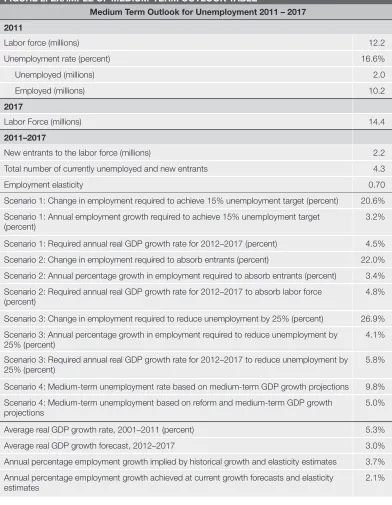
[image:10.612.108.500.90.595.2]With inputs from the user, the template produces and completes a table of labor market outcomes under different scenarios, as illustrated in Figure 2. In the top half of the table, the current labor market of the country of interest is described in terms of the total labor force, unemployment rate, and resulting number of employed and unemployed. Next, the predicted
FIGURE 2. EXAMPLE OF MEDIUM-TERM OUTLOOK TABLE
Medium Term Outlook for Unemployment 2011 – 2017
2011
Labor force (millions) 12.2
Unemployment rate (percent) 16.6%
Unemployed (millions) 2.0
Employed (millions) 10.2
2017
Labor Force (millions) 14.4
2011–2017
New entrants to the labor force (millions) 2.2
Total number of currently unemployed and new entrants 4.3
Employment elasticity 0.70
Scenario 1: Change in employment required to achieve 15% unemployment target (percent) 20.6%
Scenario 1: Annual employment growth required to achieve 15% unemployment target (percent)
3.2%
Scenario 1: Required annual real GDP growth rate for 2012–2017 (percent) 4.5%
Scenario 2: Change in employment required to absorb entrants (percent) 22.0%
Scenario 2: Annual percentage growth in employment required to absorb entrants (percent) 3.4%
Scenario 2: Required annual real GDP growth rate for 2012–2017 to absorb labor force (percent)
4.8%
Scenario 3: Change in employment required to reduce unemployment by 25% (percent) 26.9%
Scenario 3: Annual percentage growth in employment required to reduce unemployment by 25% (percent)
4.1%
Scenario 3: Required annual real GDP growth rate for 2012–2017 to reduce unemployment by 25% (percent)
5.8%
Scenario 4: Medium-term unemployment rate based on medium-term GDP growth projections 9.8%
Scenario 4: Medium-term unemployment based on reform and medium-term GDP growth projections
5.0%
Average real GDP growth rate, 2001–2011 (percent) 5.3%
Average real GDP growth forecast, 2012–2017 3.0%
Annual percentage employment growth implied by historical growth and elasticity estimates 3.7%
Annual percentage employment growth achieved at current growth forecasts and elasticity estimates
labor force for the final projection year is shown, followed by the calculated number of new entrants to the labor force and the total number of currently unemployed and new entrants. The latter is the predicted total number of people in the country who, by 2017, will be seek-ing work. The user should enter the elasticity estimated by the Stata program into the Excel “Elasticity” tab. In addition, the annual trend component, which is the coefficient of the Year variable for those regressions in the Stata program that use a time trend, may be entered.
The following four scenarios for labor market outcomes during the projection period are described in the table:
Scenario 1:Requirements for reaching an unemployment rate target.
The user is asked to enter an unemployment rate target for the final year in the projection pe-riod (if nothing is entered, the default target is 0 percent unemployment). In this scenario, three requirements for reaching this target are displayed: the percent change in employment needed to reach the target, cumulative over the projection period; the annualized growth in employ-ment needed to reach the target; and the average GDP growth rate needed to reach the target, assuming the elasticity entered at the top of the table is constant throughout the period.
Scenario 2: Requirements for absorbing future entrants into the labor market.
This scenario examines what is needed in order to absorb the expected entrants into the labor market over the projection period. The requirements to be specified are exactly the same as in Scenario 1: the percent change in employment, cumulative and yearly, and the required annual real GDP growth needed to absorb the new entrants into the workforce over the projected years.
Scenario 3: Requirements for reducing unemployment by a certain percentage.
Using the same three employment and real GDP growth requirements, this scenario ex-amines what needs to change in order for the unemployment rate to decrease by a specified amount at the end of the projection period. The user may enter any percent amount by which the unemployment rate should be reduced at the end of the projection period. If nothing is entered, the default is a 50 percent reduction in unemployment.
Scenario 4: Projections for end-period unemployment rates.
B. Charts
The template produces two charts based on the previously entered inputs and the calculations made in the medium-term table.
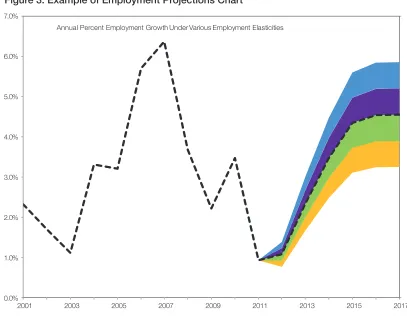
Annual percent employment growth under various employment elasticities.
This fan chart (Figure 3) plots different projections of employment growth. The same GDP growth rates are assumed for each of the plotted series, taken from the user and/or EcOS inputs at the beginning of the file. To obtain different projections of employment growth, the elasticity parameter becomes variable. The baseline elasticity is used for the middle employ-ment growth series in the fan chart, and four other elasticities (equally distributed around the baseline, with two higher and two lower elasticities considered) are used for the other employment growth projections. The user may specify the step size of the different elasticities.
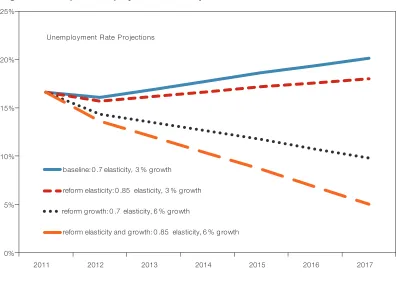
Unemployment rate projections.
Figure 4 is a visual companion to Scenario 4 in the medium-term table. It plots four possible unemployment rate series over the projection period, using the following parameters:
[image:12.612.103.510.84.405.2]1. Baseline growth (from EcOS and/or User Input sheets) and baseline elasticity (from the top of the medium-term table).
Figure 3. Example of Employment Projections Chart
0.0% 1.0% 2.0% 3.0% 4.0% 5.0% 6.0% 7.0%
2001 2003 2005 2007 2009 2011 2013 2015 2017
2. Baseline growth and reform elasticity (baseline + adjustment factor in Scenario 4).
3. Alternate growth (from Scenario 4) and baseline elasticity.
4. Alternate growth and reform elasticity.
C. Further Considerations
The labor force can be endogenous. The labor supply is not perfectly inelastic and may vary according to changes in wages or employment prospects. For example, higher output growth or structural reforms that improve the return on searching for work can expand the size of the labor force. The ILO estimates are based on existing labor force participation, population projections, and, in some part, on economic growth projections. However, when using the template for scenarios that may involve substantially higher growth rates than current fore-casts, it may be worth adjusting the labor force growth rate upwards.
[image:13.612.107.506.89.370.2]Trends can make a big difference. The econometric estimates allow for trend terms. Adopting such a specification implies that there is something other than growth rates (includ-ing potential growth rates) that is systematically affect(includ-ing the rate of employment growth. Such a phenomenon may be easy to explain with sufficient country experience. Trends can have big implications for employment and unemployment rate forecasts as well as for the economic growth rates required to meet targets. When employment is affected by a trend, the elasticity by itself can only be used to conduct ceteris paribus analysis, e.g., “What will the
Figure 4. Example of Employment Rate Projections Chart
0% 5% 10% 15% 20% 25%
2011 2012 2013 2014 2015 2016 2017
baseline: 0 .7 elasticity, 3 % g rowth
reform elasticity: 0 .85 elasticity, 3 % g rowth
reform g rowth: 0 .7 elasticity, 6 % g rowth
downward revision to GDP growth do to unemployment rates?” or “How much faster do I need to grow to generate 50,000 additional jobs?”
Nonlinear behavior results in substantial changes. For very small changes in output, firms may choose to hoard workers or pay overtime such that the elasticity is low. This may become less feasible as output changes get bigger or persist. For very large changes, the matching of workers and vacancies may become less efficient, which can translate to lower output elasticities. The elasticity estimates are generally “in-sample” and based on small to moderate variations in output. This may be relevant if the policy scenario being discussed or the implied required growth rate is much higher than experienced before.
V. Interpreting the Results
The emphasis of the template is on job quantity and not necessarily job quality. Understand-ing the mechanics of estimatUnderstand-ing elasticities and forecastUnderstand-ing labor market outcomes leads to a more comprehensive policy discussion. We have taken it as given that the objective is to increase the number of jobs and not necessarily the quality of jobs or the wages paid, which is associated with productivity. Growth per capita can rise because of technology and higher employment rates. To see this, consider a Cobb-Douglas Production Function of the form:11
Y = AKφ(1–α)Lφα (3)
where α < 1 is the share of labor L in GDP (Y), K is capital, φ is the degree of homogeneity such that φ = 1 implies constant returns to scale, and A is factor-neutral technical progress. This production function assumes all labor is homogeneous and that the share of labor is the same across all types of output. It is clear that GDP can rise because of productivity growth (which leads to higher returns for all factors including wages) or because of more use of fac-tors including labor. Making the simplifying assumption that this is a small open economy such that factor prices (wages W and interest R) are taken as given, the derived demand for labor L*, conditional on output, is:
α
R
1–α Y 1/φL* =
[
––– ––
]
(
––
)
(4)1–α
W
A
and
α
R
Y1n(L*) = (1–α)ln
[
––– ––
]
+1/
φ
ln(
––
)
(5)1–α
W A
11 This draws on Cahuc and Zylberberg (2004). Depending on the structure of the product market—for example,
Interpreting the sign and size of the employment elasticity. In the absence of changes in
A (technical change), a production function with homogeneity of degree φ has factor demand that is homogeneous of degree 1/φ with respect to output, so the employment elasticity, 𝛆, is 1/φ. For example, under constant returns to scale (φ = 1) and if A has not changed, then a rise in output is proportionately matched by increases in factors including labor and 𝛆 = 1. If we observe an elasticity below 1, which seems to be more commonly observed empirically, we must accommodate at least increasing returns to scale or allow for simultaneous productivity growth which has not been fully controlled for. Assuming constant returns to scale:
• 0 < 𝛆< 1 in the case of positive economic growth corresponds with both employment growth and productivity growth.12
• 𝛆 ≥ 1in the case of positive economic growth corresponds with employment growth but no or negative productivity growth.
• 𝛆 < 0 in the case of positive economic growth corresponds with (high) productivity growth and negative employment growth.
A similar analysis is found in Kapsos (2005).
A higher aggregate labor intensity does not imply a higher employment elasticity, but faster growth in a more employment-intensive sector can increase the employment elastici-ty. The employment elasticity is not a function of α. Abstracting from differences in changes in A, this means that, if we were to compare two countries—country A with more labor-in-tensive production methods (higher α) and country B with less labor-intensive methods— country A will have more labor per unit of GDP but will not necessarily exhibit a higher employment elasticity. In contrast, if a country has two sectors N and O with αN > α0 such that sector N is more employment intensive, then faster growth in N will result in a higher overall employment elasticity.13 The elasticity within each sector will be the same for both
sectors, but it is the composition effect that results in the overall elasticity for the country.14
The more unequal the growth between sectors and the more unequal the labor intensities, the bigger the influence is on the overall employment elasticity.
Estimates of employment elasticities permit flexibility in explicit assumptions, but policy discussions may have implicit assumptions. Estimation of employment elasticities by regressing log employment on log output makes no explicit distinction between actual and potential output and, hence, on whether these are short-run or long-run relationships. However, any discussions that involve an increase in potential growth rates over multiple
12 Under the technological assumptions made so far, one can infer TFP growth from the employment elasticity.
For example, it is straightforward to show that ∆ln(A) = (1 – 𝛆) * ∆ln(Y). Alternatively, assumptions can be relaxed and substituted with a growth accounting method.
13 This abstracts from sector-specific technical progress.
14 For evidence that there is not much variation in employment elasticities across sectors, see Crivelli et al.
years rather than cyclical variation implicitly involve the adoption of structural reforms that increase potential growth.
Some structural changes to the labor market can lead to both higher long-run growth and lower unemployment. If the parameters affecting the natural unemployment rate can be changed, for example welfare, labor market efficiency, or skill mismatches, then structural unemployment can be reduced, leading to higher employment and output.
References
Cahuc, P., and A. Zylberberg, 2004, Labor Economics (Cambridge, MA: MIT Press).
Center for Mediterranean Integration, 2012, Transforming Arab Economies: Travelling the Knowl-edge and Innovation Road (Washington: World Bank and CMI).
Crivelli, E., D. Furceri, and J. Toujas-Bernate, 2012, “Can Policies Affect Employment Inten-sity of Growth? A Cross-Country Analysis,” IMF Working Paper 12/218 (Washington: International Monetary Fund).
Islam, I., and S. Nazara, 2000, “Estimating Employment Elasticity for the Indonesian Econ-omy,” Technical Note on the Indonesian Labor Market (Geneva: International Labor Organization).
Kapsos, S., 2005, “The Employment Intensity of Growth: Trends and Macroeconomic Determinants,” ILO Employment Strategy Paper (Geneva: International Labor Organization).
Lagarde, C., 2012, “Seizing the Moment—Thinking Beyond the Crisis,” address at the Brook-ings Institution, Washington DC, April 12.
Loungani, P. and R. Salgado, 2012, “Jobs and Growth Working Group: Progress Report, Memorandum to Management,” May 1. (Washington: International Monetary Fund) World Bank, 2011, “Investing for Growth and Jobs,” Middle East and North Africa Economic
Developments and Prospects (Washington: World Bank).
World Bank, 2012, “Bread, Freedom, and Dignity: Jobs in the Middle East and North Africa,”
TNM/12/01
International Monetary Fund
Middle East and Central Asia Department 700 19th Street NW
Washington, DC 20431 USA