s
DESIGNING AND SIMULATING OF SOFT COMPUTING METHOD
*
Vidyullatha
Department of
ARTICLE INFO ABSTRACT
The expression of ‘fuzzy’ alludes to the capacity of managing uncertain or obscure inputs. Rather than utilizing complex numerical mathematical statements, fuzzy logic utilizes linguistic depictions to characterize the relationship between the input data a
fuzzy logic gives an advantageous and easy to understand front
creators to focus on the functional objectives, not on the mathematics. In this paper the basic content about the way of fuzziness, fuzzy operations and fuzzy rules are performed.
Copyright © 2015 Vidyullatha and Rajeswara Rao. This
unrestricted use, distribution, and reproduction in any medium, provided the original work is properly cited.
INTRODUCTION
The idea of Fuzzy Logic (FL) was brought about by Lotfi Zadeh, (Zadeh, 1965) an professor at the University of California at Berkley, and displayed not as a control technique, but rather as a method for allowing to handling the incomplete set membership as opposed to crisp set (Mamdani and Assilian, 1975) membership or non-membership. In this connection, Fuzzy Logic is a critical thinking control framework approach that fits execution in frameworks extending from straightforward, little, implanted smaller scale controllers to vast, organized, multi-channel Personal Computer or workstation-based information obtaining and control frameworks. It can be actualized in equipment, programming, or a blend of both. Fuzzy Logic gives a straightforward approach to touch base at an unequivocal conclusion based upon ambiguous, vague, noisy, or missing data. Fuzzy Logic's (Takagi and Sugeno, 1985) way to deal with control issues copies how a man would decide, just much quicker. Fuzzy Logic joins a straightforward, rule-based IF X AND Y THEN Z way to deal with a taking care of control issue as opposed to endeavouring to model a framework scientifically. Consider (Ishibuchi et al., 1994) what you do in the shower if the
*Corresponding author: Vidyullatha, P.,
Department of CSE, Kl University, Guntur, Andhra Pradesh, India.
ISSN: 0975-833X
Article History: Received 20th June, 2015 Received in revised form 28th July, 2015
Accepted 19th August, 2015 Published online 30th September,2015
Citation: Vidyullatha, P. and Rajeswara Rao, D. systems”, International Journal of Current Research
Key words:
Fuzzy Logic, Fuzzy Rules,
Fuzzy inference system, Defuzzification.
RESEARCH ARTICLE
DESIGNING AND SIMULATING OF SOFT COMPUTING METHOD ORIENTED ON
FUZZY LOGIC SYSTEMS
Vidyullatha, P. and Rajeswara Rao, D.
Department of CSE, Kl University, Guntur, Andhra Pradesh, India
ABSTRACT
The expression of ‘fuzzy’ alludes to the capacity of managing uncertain or obscure inputs. Rather than utilizing complex numerical mathematical statements, fuzzy logic utilizes linguistic depictions to characterize the relationship between the input data and the output activity. In engineering systems, fuzzy logic gives an advantageous and easy to understand front-end to create control projects, helping creators to focus on the functional objectives, not on the mathematics. In this paper the basic content
bout the way of fuzziness, fuzzy operations and fuzzy rules are performed.
This is an open access article distributed under the Creative Commons Att use, distribution, and reproduction in any medium, provided the original work is properly cited.
The idea of Fuzzy Logic (FL) was brought about by Lotfi an professor at the University of California at Berkley, and displayed not as a control technique, but rather as a method for allowing to handling the incomplete Mamdani and Assilian, membership. In this connection, Fuzzy Logic is a critical thinking control framework approach that fits execution in frameworks extending from straightforward, little, implanted smaller scale controllers to Personal Computer or based information obtaining and control frameworks. It can be actualized in equipment, programming, or a blend of both. Fuzzy Logic gives a straightforward approach to touch base at an unequivocal conclusion based mbiguous, vague, noisy, or missing data. Fuzzy Logic's way to deal with control issues copies how a man would decide, just much quicker. Fuzzy based IF X AND Y THEN are of control issue as opposed to endeavouring to model a framework scientifically. Consider
what you do in the shower if the
University, Guntur, Andhra Pradesh, India.
temperature is excessively cold and make the water agreeable rapidly with little inconvenience. FL is equipped for emulating this kind of conduct however at high rate. Fuzzy Logic obliges some numerical parameters with a specific end goal to work, for example, what is viewed as huge slip and noteworthy rate of-progress of-mistake, however correct estimations of these numbers are typically not discriminating unless exceptionally responsive execution is needed in which case observational tuning would focus them (Rojas
function is a graphical representation of the greatness of support of every data.
It relates a weighting with each of the inputs at are handled, characterize useful cover in the middle of inputs, and eventually decides an output response. The standards utilize the input membership esteem as weighting components to focus their impact on the fuzzy output sets of the final output conclusion. Once the functions are constructed, scaled, and consolidated they are defuzzified
crisp output which drives the framework. There are diverse membership (Wang et al., 1992
input and output response. The membership functions have the different shapes such as triangular which is regular,
bell, trapezoidal, haversine and exponential have been utilized. More complex functions are conceivable however oblige more worthy figuring overhead to execute.
Available online at http://www.journalcra.com
International Journal of Current Research
Vol. 7, Issue, 09, pp.20539-20543, September, 2015
INTERNATIONAL
Vidyullatha, P. and Rajeswara Rao, D. 2015. “Designing and simulating of soft computing method oriented on fuzzy logic
International Journal of Current Research, 7, (9), 20539-20543.
z
ORIENTED ON
, India
The expression of ‘fuzzy’ alludes to the capacity of managing uncertain or obscure inputs. Rather than utilizing complex numerical mathematical statements, fuzzy logic utilizes linguistic depictions nd the output activity. In engineering systems, end to create control projects, helping creators to focus on the functional objectives, not on the mathematics. In this paper the basic content
bout the way of fuzziness, fuzzy operations and fuzzy rules are performed.
distributed under the Creative Commons Attribution License, which permits
is excessively cold and make the water agreeable rapidly with little inconvenience. FL is equipped for emulating this kind of conduct however at high rate. Fuzzy Logic obliges some numerical parameters with a specific end goal to work, s viewed as huge slip and noteworthy rate-mistake, however correct estimations of these numbers are typically not discriminating unless exceptionally responsive execution is needed in which case observational Rojas et al., 2000) . The membership function is a graphical representation of the greatness of
It relates a weighting with each of the inputs at are handled, characterize useful cover in the middle of inputs, and tput response. The standards utilize the input membership esteem as weighting components to focus their impact on the fuzzy output sets of the final output conclusion. Once the functions are constructed, scaled, and consolidated they are defuzzified (Ishibuchi et al., 1995) into a crisp output which drives the framework. There are diverse ., 1992) functions connected with input and output response. The membership functions have the different shapes such as triangular which is regular, however bell, trapezoidal, haversine and exponential have been utilized. More complex functions are conceivable however oblige more worthy figuring overhead to execute.
INTERNATIONAL JOURNAL OF CURRENT RESEARCH
Design of Fuzzy Inference System
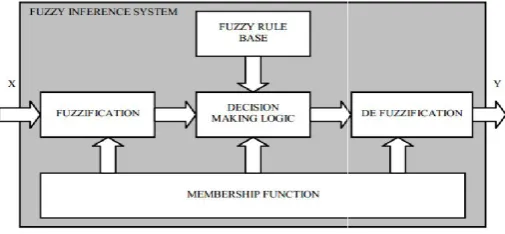
Fuzzy inference is the procedure of defining the map
offered information to a yield utilizing fuzzy logic. The procedure of fuzzy inference (Ramjeet Singh Yadav, 2011 includes the membership functions, fuzzy logic operators, (http://xa.yimg.com) and if-then rules.
There are two sorts of fuzzy inference systems that can be executed in the fuzzy logic toolbox in Matlab are Mamdani type and Sugeno- type. These two sorts of inference systems change to some degree in the way outputs are resolved. Fuzzy inference systems have been effectively connected in fields, for example, programmed control, data classification, decision analysis, expert systems. On account of its multidisciplinary nature, fuzzy inference systems are connected with various names, for example, fuzzy-rule-based systems, fuzzy expert systems, fuzzy modelling, fuzzy associative memory, fuzzy logic controllers, and simply fuzzy systems
Mamdani's fuzzy inference system is the most generally seen fuzzy procedure. Mamdani's technique was among t control frameworks constructed utilizing fuzzy set hypothesis (Berthold and Huber, 1999). It was proposed in 1975 by Ebrahim Mamdani as an endeavour to control a steam motor and boiler combination by synthesizing an arrangement of linguistic control standards acquired from experienced human operators.
Mamdani-type inference, as characterized it for the fuzzy logic toolbox, expects the output membership functions to be fuzzy sets (Bezdek et al., 1999). After the aggregation process, there is a fuzzy set for each output variable that needs defuzzification. It's conceivable, and as a rule a great deal more proficient, to utilize a solitary spike as the output membership function instead of a dispersed fuzzy set (Borgelt, 1998 is now and again known as a singleton output membership function, and it can be considered as a pre
set. It improves the effectiveness of the defuzzification
et al., 1996) process in light of the fact that it extraordinarily rearranges the calculation needed by the more broad Mamdani inference technique, which finds the centroid of a two dimensional function. As opposed to coordinating over the two-dimensional function to discover the centroid, utilize the weighted normal of a few information focus
inference type (Kruse et al., 1994) frameworks support this kind of model. When all is said in done, Sugeno
[image:2.595.41.294.629.746.2]systems can be utilized to display any inference system in which the output membership functions are either direct or consistent (Kruse et al., 1999 ).
Fig. 1. A process of Fuzzy inference system
Fuzzy inference is the procedure of defining the mapping from offered information to a yield utilizing fuzzy logic. The Ramjeet Singh Yadav, 2011) includes the membership functions, fuzzy logic operators,
There are two sorts of fuzzy inference systems that can be executed in the fuzzy logic toolbox in Matlab are Mamdani- type. These two sorts of inference systems change to some degree in the way outputs are resolved. Fuzzy have been effectively connected in fields, for example, programmed control, data classification, decision analysis, expert systems. On account of its multidisciplinary nature, fuzzy inference systems are connected with various based systems, fuzzy expert systems, fuzzy modelling, fuzzy associative memory, fuzzy logic controllers, and simply fuzzy systems (John Yen, ?). Mamdani's fuzzy inference system is the most generally seen fuzzy procedure. Mamdani's technique was among the first control frameworks constructed utilizing fuzzy set hypothesis . It was proposed in 1975 by Ebrahim Mamdani as an endeavour to control a steam motor and boiler combination by synthesizing an arrangement of ol standards acquired from experienced human
type inference, as characterized it for the fuzzy logic toolbox, expects the output membership functions to be fuzzy . After the aggregation process, there zy set for each output variable that needs defuzzification. It's conceivable, and as a rule a great deal more proficient, to utilize a solitary spike as the output membership Borgelt, 1998). This known as a singleton output membership function, and it can be considered as a pre-defuzzified fuzzy set. It improves the effectiveness of the defuzzification (Dubois process in light of the fact that it extraordinarily tion needed by the more broad Mamdani inference technique, which finds the centroid of a two-dimensional function. As opposed to coordinating over the
dimensional function to discover the centroid, utilize the weighted normal of a few information focuses. Sugeno- frameworks support this kind of model. When all is said in done, Sugeno-inference systems can be utilized to display any inference system in which the output membership functions are either direct or
Fig. 1. A process of Fuzzy inference system
Algorithm for Fuzzy Inference System
Step1: Start
Step2: Initialize Name = 'filename' Type = 'mamdani' / ‘Tsugeno’
/ * fuzzification process */
Step3: Initialize the inputs & outputs by giving the functional methods where
NumInputs = 2 NumOutputs = 2
Step4: Mention the variables for fuzzy operators such as ‘And’,’ Or’ where
AndMethod = 'min' OrMethod = 'max' ImpMethod = 'min' AggMethod = 'max'
/* Initialize the defuzzification method */
DefuzzMethod = 'centroid'
Step5: Giving the Input variables their ranges and membership functions such as
Name = 'temp' Range = (-20 20
NumMFs = 3
MF1='cold':'trapmf', (30 30 -MF2='good':'trimf', (-10 0 10 0 MF3='hot':'trapmf', (0 15 30 30
Step6: Repeat the step 4, if there is more than one input variable
Step7: Mention the output variable, its range and membership functions
Name = 'cold' Range = (-1 1)
NumMFs = 5
MF1='closeFast':'trimf', MF2='closeSlow':'trimf', (-0.6
MF3='steady':'trimf', (-0.3 0 0.3 0 0.3 0.6 0)
MF5='openFast':'trimf', (0.3 0.6 1 0
Step8: Repeat the step 6, if there is more than one output variable
Step9: Mention the number of Rules whether in symbolic or indexed format
Step10: End
Algorithm for Fuzzy Inference System
Step2: Initialize Name = 'filename' Type = 'mamdani' /
outputs by giving the functional
NumInputs = 2 NumOutputs = 2
Step4: Mention the variables for fuzzy operators such as
AndMethod = 'min' OrMethod = 'max' ImpMethod = 'min'
defuzzification method */
Step5: Giving the Input variables their ranges and membership
20 20)
-15 0) 10 0 10 0) 0 15 30 30)
Step6: Repeat the step 4, if there is more than one input
Step7: Mention the output variable, its range and membership
MF1='closeFast':'trimf', (-1 -0.6 -0.3 0)
0.6 -0.3 0 0)
0.3 0 0.3 0) MF4='openSlow':'trimf', (0
0.3 0.6 1 0)
Step8: Repeat the step 6, if there is more than one output
µflow = hard = 1.0 µflow = good = 0.5 µflow = soft= 0.0
Fig. 2. The visual representation for the fuzzy values for temperature are shown Whereas the input variable flow consists of member functions shows
[image:3.595.58.548.549.773.2]Fig. 3. The visual representation of fuzzy value ‘flow’ showing membership function
Fig. 4. Rule Evaluation Results
RESULTS
The problem is to estimate the level of risk in a (Wang and Mendel, 1992) shower problem. For sake of simplicity, this paper shows two inputs and two outputs.
Step1: fuzzification
The first step is to convert the crisp input into fuzzy one. Since we have two inputs so, there are two crisp values (Esteva and Godo, 2001) to convert where the first value is the level of temperature and the second value is the level of flow. Suppose the input temperature have membership functions mf1, mf2 and mf 3 (Fodor et al., 1997) which ranges from -20 to 20 so that the fuzzy values for temperature are shown in the following Figure 2.
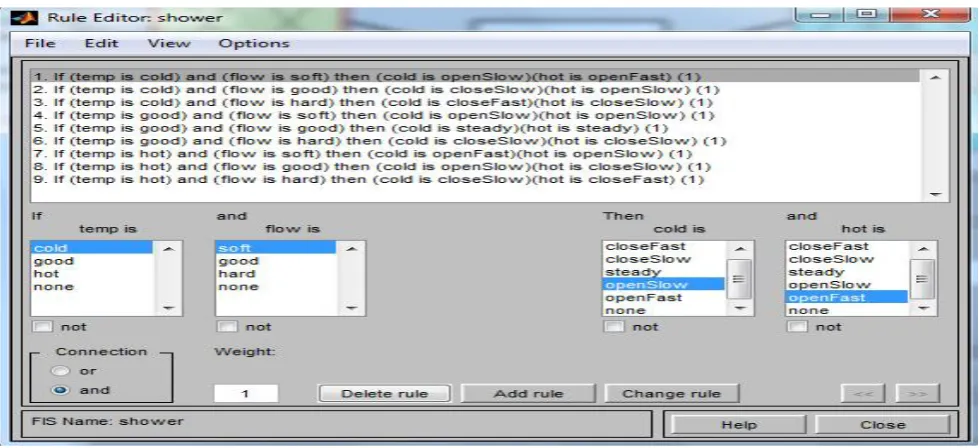
Step 2: The Rules
Now, for the fuzzy values, use the fuzzy rules (Hajek, 1998) to arrive at the final fuzzy value. The rules are as follows:
Step 3: Defuzzification
The defuzzification method (Yager and Rybalov, 1996) can be performed in several different ways.
The most popular method is the centroid method. Centroid method calculates the center of gravity for the area under the curve
COG= ∑xb= aµA(x) x / ∑xb= aµA(x)
Where as in Bisector method the vertical line that divide the region in to sub regions of equal area in sometimes, but not always, coincide with the centroid line. For mean of maximum
(Zimmermann, 1985) method assumes a plateau at the maximum value of the final function take the mean of the value its spans where as in the smallest value of maximum and largest value of maximum, the plateau at the maximum value of the final function take the smallest or largest of the value its spans.
Conclusion
[image:4.595.67.535.61.392.2]Fuzzy logic is a capable instrument that is swarming each field and marking effective usage. FL (Whaley, 1979) was imagined as a superior technique for sorting and taking care of information however has ended up being a great decision for some control framework applications. It utilizes an imprecise yet extremely expressive dialect to manage information more like a human operator. FL does not oblige exact inputs, is innately powerful, and can handle any sensible number of inputs yet framework multifaceted nature increments quickly
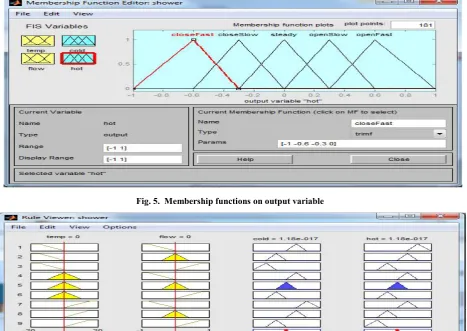
Fig. 5. Membership functions on output variable
with more inputs and outputs. Basic, dialect IF X AND Y THEN Z rules are utilized to depict the desired framework reaction regarding linguistic variables rather than numerical equations (Bellman and Zadeh, 1970). Fuzzy systems are showing great guarantee in purchaser items, mechanical and business frameworks, and decision support systems. Fl (Heshmaty and and Kandel, 1985) gives a totally distinctive, strange approach to approach a control issue. This strategy concentrates on what the framework ought to do as opposed to attempting to see how it functions. One can focus on tackling the issue instead of attempting to display the framework numerically, if that is even conceivable. This perpetually prompts faster, less expensive arrangements. Once comprehended, this innovation is not hard to apply and the outcomes are normally very surprising and satisfying.
REFERENCES
Bellman, R.E. and Zadeh, L.A. 1970."Decision Making in a Fuzzy Environment," Management Science, 17,141-164. Berthold, M. and Huber, K.P. 1999. Constructing Fuzzy
Graphs from Examples. Int. J. of Intelligent Data Analysis, 3(1), Electronic journal (http://www.elsevier.com/ locate/ida)
Bezdek, J.C., Keller, J.M., Krishnapuram, R. and Pal. N. 1999. Fuzzy Models and Algorithms for Pattern Recognition and Image Processing. The Handbooks on Fuzzy Sets. Kluwer, Dordrecht, Netherlands.
Borgelt, C., Gebhardt, J. and Kruse, R. 1998. Chapter F1.2: Inference Methods. In: E. Ruspini, P. Bonissone, and W. Pedrycz, eds. Handbook of Fuzzy Computation. Institute of Physics Publishing Ltd., Philadelphia, PA, USA.
Dubois, D., Prade, H. and Yager, R.R. Information Engineering and Fuzzy Logic. Proc. 5th IEEE International Conference on Fuzzy Systems (FUZZ-IEEE’96, New Orleans, LA, USA), 1525–1531. IEEE Press, Piscataway, NJ, USA 1996
Esteva, F. and Godo, L. 2001. Monoidal t-norm based logic: towards logic for left-continuoust-norms. Fuzzy Sets and Systems, 124:271–288.
Fodor, J., Yager, R. R. and Rybalov, A. 1997. Structure of uni-norms. International Journal of Uncertainty, Fuzziness, and Knowledge-Based Systems, 5:411–427.
Fuzzy Inference System Chapter 4 available: http://xa.yimg.com
Hajek, P. 1998. Metamathematics of Fuzzy Logic. Kluwer, Dordrecht.
Heshmaty, B. and Kandel, A. (March 1985)."Fuzzy linear regressions and its applications to forecasting in uncertain environments," Fuzzy Sets and Systems, 15:2,159-191.
Ishibuchi, H., Nozaki, K., Tanaka, H., Hosaka, Y. and Matsuda, M. 1994. “Empirical study on learning in fuzzy systems by rice test analysis,” Fuzzy Sets Syst., vol. 64, pp. 129–144.
Ishibuchi, H., Nozaki, K., Yamamoto, N. and Tanaka, H. Aug. 1995. “Selecting fuzzy if-then rules for classification problems using genetic algorithms,” IEEE Trans. Fuzzy Syst., vol. 3, pp. 260–270.
John Yen, RezaLangari “Fuzzy Logic –Intelligence, control and Information”, LPE Pearson.
Kruse, R., Borgelt, C. and Nauck, D. 1999. Fuzzy Data Analysis: Challenges and Perspectives. Proc. 8th IEEE International Conference on Fuzzy Systems (FUZZ-IEEE’99, Seoul, Korea). IEEE Press, Piscataway, NJ,USA (to appear)
Kruse, R., Gebhardt, J. and Klawonn, F. 1994. Foundations of Fuzzy Systems. J. Wiley & Sons, Chichester, United Kingdom.
Mamdani, E. H. and Assilian, S. 1975. “An experiment in linguistic synthesis with a fuzzy logic controller,” Int. J. Man-Mach. Stud., vol. 7, pp. 1–13.
Ramjeet Singh Yadav et al. Feb 2011. “Modeling Academic Performance Evaluation Using Soft Computing Techniques: A Fuzzy Logic Approach” International Journal on Computer Science and Engineering (IJCSE) Vol. 3 No. 2.
Rojas, I., Pomares, H., Ortega, J. and Prieto, A. Feb. 2000. “Self-organized fuzzy system generation from training examples,” IEEE Trans. Fuzzy Syst.,vol. 8, pp. 23–26. Takagi, T. and Sugeno, M. 1985. “Fuzzy identification of
systems and its applications to modeling and control,” IEEE Tran. Syst., Man, Cybern., vol.SMC 15, pp. 116–132. Wang, L.X. and Mendel, 1992. Generating Fuzzy Rules by Learning from Examples. IEEE Trans. On Systems, Man, and Cybernetics, 22(6):1414–1427. IEEE Press, Piscataway, NJ, USA.
Wang, L.X. and Mendel, J.M. Nov./Dec. 1992. “Generating fuzzy rules by learning from examples,” IEEE Trans. Syst., Man, Cybern., vol.22, pp. 1414–1427.
Whaley, C.P. (November 1979). "Fuzzy Decision Making," Interface Age, 87-91.
Yager, R. and Rybalov, A. 1996. Uninorm aggregation operators. Fuzzy Sets and Systems, 80:111–120.
Zadeh, L. A. 1965. “Fuzzy sets,” Inform. Control, vol. 8, pp. 338–353.
Zimmermann, H.J. 1985. Fuzzy Set Theory and Its Applications, Kluwer•Nijhoff Publishing, Boston, MA.