R E S E A R C H
Open Access
Updated clinical guidelines experience
major reporting limitations
Robin W.M. Vernooij
1, Laura Martínez García
1*, Ivan Dario Florez
2,3, Laura Hildago Armas
1, Michiel H.F. Poorthuis
4,
Melissa Brouwers
2,5and Pablo Alonso-Coello
1,6Abstract
Background:
The Checklist for the Reporting of Updated Guidelines (CheckUp) was recently developed. However,
so far, no systematic assessment of the reporting of updated clinical guidelines (CGs) exists. We aimed to examine
(1) the completeness of reporting the updating process in CGs and (2) the inter-observer reliability of CheckUp.
Methods:
We conducted a systematic assessment of the reporting of the updating process in a sample of updated
CGs using CheckUp. We performed a systematic search to identify updated CGs published in 2015, developed by a
professional society, reporting a systematic review of the evidence, and containing at least one recommendation.
Three reviewers independently assessed the CGs with CheckUp (16 items). We calculated the median score per
item, per domain, and overall, converting scores to a 10-point scale. Multiple linear regression analyses were used
to identify differences according to country, type of organisation, scope, and health topic of updated CGs. We
calculated the intraclass coefficient (ICC) and 95% confidence interval (95% CI) for domains and overall score.
Results:
We included in total 60 updated CGs. The median domain score on a 10-point scale for presentation was 5.8
(range 1.7 to 10), for editorial independence 8.3 (range 3.3 to 10), and for methodology 5.7 (range 0 to 10). The median
overall score on a 10-point scale was 6.3 (range 3.1 to 10). Presentation and justification items at recommendation level
(respectively reported by 27 and 38% of the CGs) and the methods used for the external review and implementing
changes in practice were particularly poorly reported (both reported by 38% of the CGs). CGs developed by a European
or international institution obtained a statistically significant higher overall score compared to North American or Asian
institutions (
p
= 0.014). Finally, the agreement among the reviewers on the overall score was excellent (ICC 0.88, 95% CI
0.75 to 0.95).
Conclusions:
The reporting of updated CGs varies considerably with significant room for improvement. We recommend
using CheckUp to assess the updating process in updated CGs and as a blueprint to inform methods and
reporting strategies in updating.
Keywords:
Checklist/standards, Guideline [publication type], Publishing/standards
Background
Clinical guidelines (CGs) are defined as
‘
statements that
include recommendations intended to optimise patient
care, that are informed by systematic reviews of evidence
and an assessment of the benefits and harms of alternative
care options
’
[1]. Scientific knowledge is in constant
evo-lution [2, 3]; therefore, surveillance of the new evidence is
required to ensure the trustworthiness of clinical
guide-lines (CGs) [4
–
8].
Updating CGs is an iterative process with a systematic
and explicit methodology that involves identifying and
reviewing new evidence not included in the original
ver-sion of a CG [9]. The fundamental stages of the updating
process are (1) prioritising of CGs and clinical questions
[10, 11], (2) identifying of new evidence [8, 12, 13], (3)
assessing the impact of the new evidence and decision to
update [4, 8], (4) reviewing and
—
if necessary
—
modifying
the recommendations [14
–
16], and (5) reporting
up-dated recommendations [17]. Currently, there is no
* Correspondence:[email protected]1
Iberoamerican Cochrane Centre, Biomedical Research Institute Sant Pau (IIB Sant Pau), Barcelona, Spain
Full list of author information is available at the end of the article
consensus about the optimal methodology to maintain
CGs up-to-date [11, 18, 19].
The reporting of updated CGs is a process within an
up-dating strategy that communicates users about the
methods and changes in an updated CG [9]. So far, there is
limited guidance on the reporting of the updating process
[19]. To address this gap, we recently developed the
Checklist for the Reporting of Updated Guidelines
(CheckUp) [20]. The aim of CheckUp is to evaluate the
completeness of reporting in updated CGs [20]. CheckUp
can be used (1) to inform about strategies for updating
CGs and their reporting requirements (CG developers), (2)
to assess the reporting of updated CGs (interested CG
users), and (3) to complete as a publication requirement of
updated CGs (editors of scientific journals that publish
CGs) [20]. Although CheckUp has been already included
in some methodological handbooks and methodological
studies [21, 22], it has not been yet formally implemented.
To our knowledge, updated CGs have not been
sys-tematically reviewed to assess the completeness of
reporting the updating process. An overview of the
current status could be informative for the CG
commu-nity. Therefore, the objectives of our study were (1) to
assess the completeness of reporting the updating
process of updated CGs using CheckUp and (2) to
ex-plore the inter-observer reliability of CheckUp.
Methods
Study design
We conducted a systematic assessment of the reporting
of the updating process in a sample of updated CGs
using CheckUp. We followed the Preferred Reporting
Items
for
Systematic
Reviews
and
Meta-Analyses
(PRISMA) guideline to the extent it was applicable to
our study [23].
Information sources and search strategy
We searched in MEDLINE (accessed through PubMed),
the G-I-N library (http://www.g-i-n.net), and the National
Guidelines Clearinghouse (NGC)
(https://www.guidelines.-gov) in August 2016 for updated CGs published during
2015. The search strategy can be found in Additional file 1.
Inclusion criteria
We included all updated CGs published in 2015 (as the
most recent year prior to publication of CheckUp) which
met the following criteria: (1) developed by a professional
society, (2) search strategy using at least one bibliographic
database, (3) reporting at least one recommendation, (4)
updated version of a previous version of the same CG
(in-cluding a reference to a previous version of the CG), and
(5) published in English.
Study selection
Two reviewers (RV, IDF, LHA, or MHFP) independently
screened the titles and abstracts to identify potentially
eligible references. We obtained the full-text articles of
the potentially eligible references for further assessment.
Disagreements were solved by consensus and, if
neces-sary, with the help of a third reviewer (LMG).
Data extraction
CheckUp is a checklist consisting of 16 items that
exam-ine the reporting of the updating process in updated
CGs [20]. CheckUp consists of three domains: (1)
pres-entation of the updated CG (6 items), (2) editorial
inde-pendence (3 items), and (3) the methodology of the
updating process (7 items).
Three reviewers (RV, IDF, LHA, or MHFP)
independ-ently evaluated each CG with CheckUp, and whenever
the included CGs referred to supplemental documents
(e.g. methodological manuals or appendices), these
doc-uments were reviewed for additional information.
Furthermore, we collected the following information
regarding: (1) the institution that updated the CG (name,
country, and type of organisation), (2) the scope of the
updated
CG
(diagnosis,
management,
prevention,
screening, or treatment), and (3) the health topic of the
updated CG.
Data analysis
We calculated summary statistics to provide quantitative
information about the institution that updated CGs and
CheckUp scores. We calculated item scores (absolute
frequencies and proportions) by summing up the
up-dated CGs that reported each item. We calculated
do-main scores (median and range) by summing up all
scores of the individual items for each domain:
presenta-tion of the updated CG (6 items), editorial independence
(3 items), and the methodology of the updating process
(7 items). Additionally, we calculated the overall score
(median and range) by summing up all scores of the
in-dividual items. Both domain scores and total scores were
converted to a 10-point scale.
To identify potential predictors, we used multiple linear
regression to test whether the overall score (dependent
variable) differed between CG institution
’
s country, type of
organisation, objective of the CG, and CG topic
(independ-ent variables).
We accepted
p
values of less than 0.05 as significant.
We performed the analyses using SPSS version 22.0
(SPSS Inc., Chicago, IL, USA).
Results
Selection of updated clinical guidelines
The screening process is summarised in a flow diagram
(Fig. 1). We initially identified 1465 references and
ex-cluded 1249 references after examining their titles and
abstracts. We reviewed 216 full-text articles and excluded
156 references (Additional file 2). Finally, we included 60
updated CGs [25
–
84].
Characteristics of included clinical guidelines
Most institutions responsible for updating the CGs were
North American (61.7%; 37/60) and
scientific/profes-sional societies (46.7%; 28/60) or public institutions
(43.3%; 26/60) (Table 1). In total, 25 (41.7%; 25/60) of
the included CGs addressed the management of a
spe-cific disease. Other CGs address solely the treatment
(25.0%; 15/60), screening (15.0%; 9/60), diagnosis (11.7%;
7/60), or prevention (6.7%; 4/60) of a healthcare
prob-lem. The clinical area of the included CGs varied widely,
with oncology (26.7%; 16/60) the most common.
Domain scores
Presentation of the updated CG
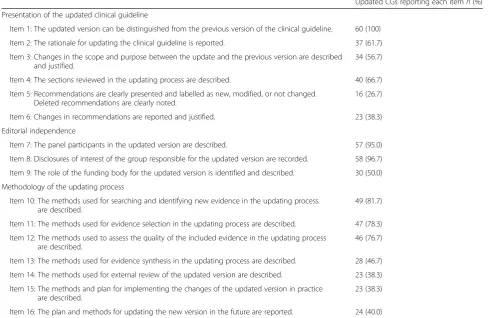
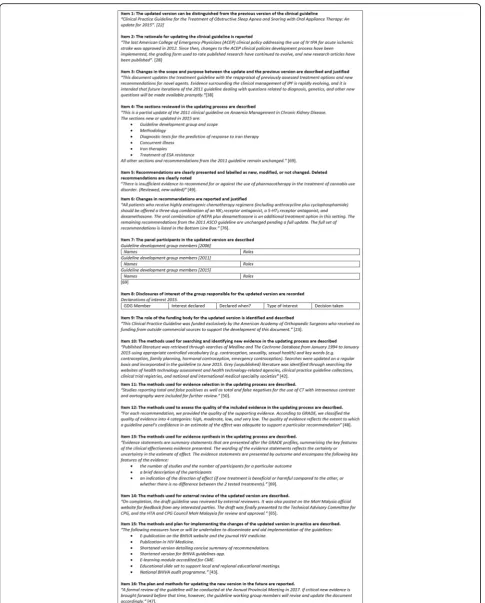
All of the included updated CGs could be distinguished
from their predecessors since this was one of the
eligibil-ity criteria. The included CGs often used the term
‘
up-date
’
,
‘
version
’
, or the year of publication (i.e. 2015) in
their title (Table 2, Fig. 2).
More than half of the updated CGs included the
ra-tionale for updating (61.7%; 37/60), described changes in
the scope and purpose between the updated CG and its
predecessor (56.7%; 34/60), and reported the reviewed
sections (66.7%; 40/60) (Table 2, Fig. 2).
At the recommendation level, 26.7% (16/60) of the
in-cluded CGs clearly labelled the recommendations as
new, modified, or not changed, and 38.3% (23/60)
justi-fied the changes. The justifications for changes
com-monly included a description of the new evidence that
triggered the change in the recommendation and the
changes between the new and old version of the
recom-mendations (Table 2, Fig. 2).
The median score of the presentation domain on a
10-point scale was 5.8 (range 1.7 to 10), and the agreement
among the three reviewers was adequate (ICC 0.854;
95% CI 0.701 to 0.941) (Table 3).
Editorial independence
Almost all included CGs described the panel participants
in the updated version (95.0%; 57/60) and their
respect-ive conflicts of interest (96.7%; 58/60) (Table 2, Fig. 2).
However, half of the updated CGs did not report the
en-tity and/or the role of the funding body that financed
the updated version (50.0%; 30/60).
The median score of the editorial independence
do-main on a 10-point scale was 8.3 (range 3.3 to 10), and
the agreement among the three reviewers was adequate
(ICC 0.724; 95% CI 0.534 to 0.860) (Table 3).
Methodology of the updating process
Most of the included CGs reported the methods used for
searching and identifying new evidence (81.7%; 49/60),
selecting the evidence (78.3%; 47/60), and assessing the
quality of the included evidence (76.7%; 46/60) (Table 2,
Fig. 2). However, the methods for synthesising the
evi-dence (46.7%; 28/60), external review (38.3%; 23/60),
implementing the changes of the updated version in
prac-tice (38.3%; 23/60), or updating the new version (40.0%;
24/60) were reported less often in the included CGs.
The median score of the methodology domain on a
10-point scale was 5.7 (range 0 to 10), and the
agree-ment among the three reviewers was adequate (ICC
0.886; 95% CI 0.771 to 0.952) (Table 3).
Overall score
The median overall score on a 10-point scale was 6.3
(range 3.1 to 10), and the agreement among the three
re-viewers was adequate (ICC 0.880; 95% CI 0.749 to 0.952)
(Table 3).
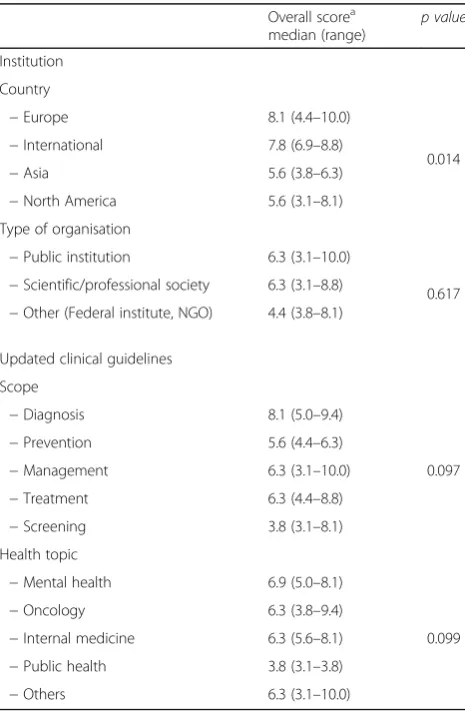
CGs developed by a European or International
institu-tion obtained a higher overall score compared to North
American or Asian institutions (
p
= 0.014) (Table 4). No
significant differences in the overall score were found
between CG differing in the type of organisation, scope,
or topic.
Discussion
Main findings
Our study is the first systematic assessment of the
reporting of the updating process in updated CGs using
CheckUp. The presentation and methodology domains
were reported less completely than the editorial
inde-pendence domain. Particularly, the items regarding the
presentation and justification of the updating process at
recommendation level and the methods used for
evi-dence synthesis, external review, implementing, and
future updating were poorly reported. Both the domains
and overall scores of the included CGs were highly
vari-able. We identified only two (3.3%) CGs with a perfect
score (10-point overall score 10) [60, 74].
We observed an adequate ICC reliability between the
three reviewers. The lowest ICC was found for the
edi-torial independence domain, but the ICC domain score
was still considered adequate. This was mainly due to
some CGs that reported the panel participants and their
conflicts of interest for those that were responsible for
updating the CG; however, they failed to report the same
information for those who were responsible for
develop-ing the preceddevelop-ing CG.
Our results in the context of previous research
Presentation of updated CGs
Previous research showed that there was no clear
im-provement in the reporting or methodological quality after
updating systematic reviews [85]. Similarly, Hasenfield et
al. found that updated CGs were of worse methodological
quality compared to their previous version [86]. Few
stud-ies have evaluated the optimal presentation formats of
CGs in general [87, 88]. Similarly, regarding the updating
process of CGs, a wide variability in the formats used to
present updated recommendations has been reported by
our group [17]. In the field of systematic reviews,
New-berry et al. [89] evaluated different formats for presenting
Table 1
Characteristics of the updated clinical guidelines
n(%) Institution
Country
−North America 37 (61.7)
−Europe 17 (28.3)
−Asia 4 (6.7)
−International 2 (3.3)
Type of organisation
−Scientific/professional society 28 (46.7)
−Public institution 26 (43.3)
−Other (Federal institute, NGO) 6 (10.0)
Updated clinical guidelines
Scope
−Management 25 (41.7)
−Treatment 15 (25.0)
−Screening 9 (15.0)
−Diagnosis 7 (11.7)
−Prevention 4 (6.7)
Health topic
−Oncology 16 (26.7)
−Public health 5 (8.3)
−Internal medicine 3 (5.0)
−Mental health 3 (5.0)
the results of updated systematic reviews. One of their
conclusions was that different interest groups have
differ-ent information needs. For example, health managers
pre-ferred to have access to all data and the analysis of a
systematic review (the original and the updated), whereas
clinicians prefer a synthesis that clearly shows what has
been changed [89].
In our study, we have identified that, in particular, the
presentation of updated recommendations is not
opti-mal, with recommendations often not presented or not
clearly labelled as new, modified, or not changed. This
might confuse readers who might not be able to identify
which recommendations are updated and which ones
re-main identical. Additionally, the modifications
con-ducted in recommendations are often not described nor
justified.
Reporting the editorial independence
The same principle regarding editorial independence for
developing new CGs should be applied to the updating
process [90]. Previous studies, in which the quality of CGs
was reviewed with the Appraisal of Guidelines for
Re-search and Evaluation II (AGREE II) instrument, have
ob-served low scores in the domain of editorial independence
[91, 92]. We found similar results for the source of
fund-ing. However, most of the included updated CGs in our
study reported the panel members and their conflicts of
interest.
Reporting the methodology of the updating process
Until now, most of the methodological research regarding
the updating process of CGs concerned the identification
and assessment of new evidence (described commonly as
the surveillance process) [18]. However, the complete
up-dating process, including the presentation and justification
of the updating process at recommendation level, has
re-ceived less attention. CG developers possibly assume that
the complete updating process is equal to the development
process of the initial CG [19]. This could explain why the
items that have a certain overlap with the development
process (i.e. search strategy, evidence selection, and quality
assessment) have higher scores compared to the updating
items that are methodologically different from the
develop-ment process (i.e. synthesis, external review, impledevelop-menta-
implementa-tion of changes, and updating in the future) of the initial
CG. Although the methods for developing CGs evolve
rap-idly [93], the updating process still does not follow this
progress correspondingly [18, 19, 94, 95].
Table 2
Item scores
Updated CGs reporting each itemn(%) Presentation of the updated clinical guideline
Item 1: The updated version can be distinguished from the previous version of the clinical guideline. 60 (100)
Item 2: The rationale for updating the clinical guideline is reported. 37 (61.7)
Item 3: Changes in the scope and purpose between the update and the previous version are described and justified.
34 (56.7)
Item 4: The sections reviewed in the updating process are described. 40 (66.7)
Item 5: Recommendations are clearly presented and labelled as new, modified, or not changed. Deleted recommendations are clearly noted.
16 (26.7)
Item 6: Changes in recommendations are reported and justified. 23 (38.3)
Editorial independence
Item 7: The panel participants in the updated version are described. 57 (95.0)
Item 8: Disclosures of interest of the group responsible for the updated version are recorded. 58 (96.7)
Item 9: The role of the funding body for the updated version is identified and described. 30 (50.0)
Methodology of the updating process
Item 10: The methods used for searching and identifying new evidence in the updating process are described.
49 (81.7)
Item 11: The methods used for evidence selection in the updating process are described. 47 (78.3)
Item 12: The methods used to assess the quality of the included evidence in the updating process are described.
46 (76.7)
Item 13: The methods used for evidence synthesis in the updating process are described. 28 (46.7)
Item 14: The methods used for external review of the updated version are described. 23 (38.3)
Item 15: The methods and plan for implementing the changes of the updated version in practice are described.
23 (38.3)
Item 16: The plan and methods for updating the new version in the future are reported. 24 (40.0)
When updating CGs, developers need to pay special
attention to the implementation implications of the
changes introduced in updated CGs [96]. This can be
done by exploring facilitators and barriers, by developing
supporting materials, or by providing audit criteria [97].
Recently, GRADE has published Evidence to Decision
frameworks to support developers to systematically
con-sider this aspect and other criteria [98]. As living CGs
become more common practice [99], developers will
need to assess to what extent more frequent changes in
recommendations impact their implementability and
op-timisation of patient care.
Strengths and limitations
Our study has several strengths. We followed a rigorous
and transparent approach and developed a protocol that
is available from the authors on request. Additionally,
three reviewers independently conducted the assessment
of the included CGs and adequate agreement was found.
Our study has some limitations. It is possible that we
did not identify all updated CGs that would meet our
in-clusion criteria due to suboptimal indexing of CGs in
biomedical databases, which may limit the
representa-tiveness of the results. Additionally, one eligibility
criter-ion was also an item from the checklist, which might
have led to the inclusion of more high-quality updated
CGs. Consequently, our results might be an
overesti-mate, and the actual reporting be actually worse than
our findings.
Implications for practice and research
When CG developers are interested in updating CGs, we
suggest firstly assessing the quality of CGs using the
AGREE II instrument. After that, we suggest to (1)
pri-oritise the update of high-quality CGs or (2) improve the
methodological quality of the CG during the updating
process. After the updating process, CG developers can
assess the reporting of the updating process using
CheckUp. Consequently, when both the AGREE II and
CheckUp instruments are properly applied, developers
will have a complete and detailed overview of the quality
of the developing and updating processes. Afterwards, if
applicable, the prioritisation process of updating CGs
can be conducted [11].
There is currently no gold standard for updating CGs
[18, 19, 94, 95]. Although CheckUp does not evaluate
the quality of the updating process, CG developers can
use it to inform their updating processes. Additionally,
CheckUp can be used by interested CG users to assess
whether updated CGs are in alignment with the
CheckUp items, and editors of scientific journals that
publish updated CGs may request the completion of
CheckUp from the CG authors [20].
Table 3
Domains, overall, and agreement scores
Scorea median (range)
Agreement ICC (95% CI)
Domain
−Presentation of the updated CG 5.8 (1.7–10) 0.854 (0.701–0.941)
−Editorial independence 8.3 (3.3–10) 0.724 (0.534–0.860)
−Methodology of the updating process 5.7 (0–10) 0.886 (0.771–0.952)
Overall 6.3 (3.1–10) 0.880 (0.749–0.952)
a
10-point scale (10 as the best possible score) ICCintraclass coefficient,CIconfidence interval
Table 4
Overall scores stratified by characteristics of the
updated clinical guidelines
Overall scorea
median (range) p value Institution
Country
−Europe 8.1 (4.4–10.0)
0.014
−International 7.8 (6.9–8.8)
−Asia 5.6 (3.8–6.3)
−North America 5.6 (3.1–8.1)
Type of organisation
−Public institution 6.3 (3.1–10.0)
0.617 −Scientific/professional society 6.3 (3.1–8.8)
−Other (Federal institute, NGO) 4.4 (3.8–8.1)
Updated clinical guidelines
Scope
−Diagnosis 8.1 (5.0–9.4)
0.097
−Prevention 5.6 (4.4–6.3)
−Management 6.3 (3.1–10.0)
−Treatment 6.3 (4.4–8.8)
−Screening 3.8 (3.1–8.1)
Health topic
−Mental health 6.9 (5.0–8.1)
0.099
−Oncology 6.3 (3.8–9.4)
−Internal medicine 6.3 (5.6–8.1)
−Public health 3.8 (3.1–3.8)
−Others 6.3 (3.1–10.0)
a
It would be relevant to monitor the use and the impact
of CheckUp in the updating CG field over the next few
years, potentially using this study as a baseline evaluation
before the publication of CheckUp. Finally, we invite users
to comment on the items and the usability of CheckUp
contacting the corresponding author of this publication.
We suggest users of CheckUp to assess the reporting
of the updating process in updated CGs by at least three
calibrate reviewers. We involved three reviewers for
con-venience to avoid ties. Further examinations of CheckUp
are required to determine if the inter-observer
agree-ment between two reviewers would be adequate. Clinical
expertise regarding the clinical area of the CG is not
re-quired; however, methodological comprehension on the
updating process of CGs is highly desirable. To facilitate
understanding of the domain scores and overall scores,
we have transformed the domain and overall scores to a
10-point scale score.
Conclusions
The reporting of the updating process in updated CGs is
suboptimal. Presentation of updated CGs and the
method-ology of the updating process where areas where more
work is needed. We advise CG developers to use CheckUp
to improve the reporting of updated CGs. CheckUp can
also be used to assess the updating process in updated
CGs and as a blueprint that could be used to inform
specific updating methods and reporting strategies.
Additional files
Additional file 1:Literature search strategy. (DOCX 27 kb)
Additional file 2:Excluded full text references including reason for exclusion. (DOCX 52 kb)
Abbreviations
AGREE:Appraisal of Guidelines for Research and Evaluation; CG: Clinical guideline; CheckUp: Checklist for the Reporting of Updated Guidelines; CI: Confidence interval; G-I-N: Guidelines International Network; ICC: Interclass Correlations Coefficient
Acknowledgements
Robin W. M. Vernooij is a doctoral candidate at the Paediatrics, Obstetrics and Gynaecology and Preventive Medicine Department, Universitat Autònoma de Barcelona, Barcelona, Spain.
Availability of data and materials
The datasets used and/or analysed during the current study are available from the corresponding author on reasonable request.
Authors’contributions
RV, LM, MB, and PA-C contributed to conceiving the study. All authors de-signed the study. RV conducted the searches. RV, IDF, LHA, and MHFP con-tributed to screening and extracting the data. RV, LM, and PA-C concon-tributed to writing the manuscript. All authors contributed to commenting and edit-ing of review drafts. All authors read and approved the final manuscript.
Funding
This project is funded by research grants from the Instituto de Salud Carlos III through the project‘PI14/02006’(co-funded by European Regional Development
Fund/European Social Fund‘Investing in your future’). LMG is funded by a Juan Rodés contract from the Instituto de Salud Carlos III (JR15/00004). PAC is supported by a Miguel Servet investigator contract from the Instituto de Salud Carlos III (CPII15/0034). The funders had no role in the study design, data collection and analysis, interpretation of data, and writing the manuscript.
Ethics approval and consent to participate
Not applicable
Consent for publication
Not applicable
Competing interests
The authors declare that they have no competing interests.
Publisher
’
s Note
Springer Nature remains neutral with regard to jurisdictional claims in published maps and institutional affiliations.
Author details
1Iberoamerican Cochrane Centre, Biomedical Research Institute Sant Pau (IIB
Sant Pau), Barcelona, Spain.2Department of Health Research Methods, Evidence and Impact; McMaster University, Hamilton, Canada.3Department of Pediatrics, University of Antioquia, Medellin, Colombia.4University Medical Center Utrecht, Utrecht, The Netherlands.5Department of Oncology, McMaster University, Hamilton, Canada.6CIBER of Epidemiology and Public Health (CIBERESP), Madrid, Spain.
Received: 2 June 2017 Accepted: 3 October 2017
References
1. Laine C, Taichman DB, Mulrow C. Trustworthy clinical guidelines. Ann Intern Med. 2011;154(11):774–5.
2. Ioannidis JP. The mass production of redundant, misleading, and conflicted systematic reviews and meta-analyses. Milbank Q. 2016;94(3):485–514. 3. Bastian H, Glasziou P, Chalmers I. Seventy-five trials and eleven systematic
reviews a day: how will we ever keep up? PLoS Med. 2010;7:e1000326. 4. Martínez García L, Sanabria AJ, García Alvarez E, Trujillo-Martín MM,
Etxeandia-Ikobaltzeta I, Kotzeva A, et al. The validity of recommendations from clinical guidelines: a survival analysis. CMAJ. 2014;186(16):1211–9. 5. Alderson LJ, Alderson P, Tan T. Median life span of a cohort of National
Institute for Health and Care Excellence clinical guidelines was about 60 months. J Clin Epidemiol. 2014;67(1):52–5.
6. Neuman MD, Goldstein JN, Cirullo MA, Schwartz JS. Durability of class I American College of Cardiology/American Heart Association clinical practice guideline recommendations. JAMA. 2014;311(20):2092–100.
7. Lyratzopoulos G, Barnes S, Stegenga H, Peden S, Campbell B. Updating clinical practice recommendations: is it worthwhile and when? Int J Technol Assess Health Care. 2012;28(1):29–35.
8. Shekelle PG, Ortiz E, Rhodes S, Morton SC, Eccles MP, Grimshaw JM, et al. Validity of the Agency for Healthcare Research and Quality clinical practice guidelines: how quickly do guidelines become outdated? JAMA. 2001; 286(12):1461–7.
9. Martínez García L, Pardo-Hernandez H, McFarlane E, Sanabria AJ, Sparrow K, Alonso-Coello P, the G-I-N updating guidelines working group OBO. UpGlossary: Guidance on terminology and definitions for updating clinical guidelines. Cape Town: Global Evidence Summit 2017.
10. Agbassi C, Messersmith H, McNair S, Brouwers M. Priority-based initiative for updating existing evidence-based clinical practice guidelines: the results of two iterations. J Clin Epidemiol. 2014;67(12):1335–42.
11. Martínez García L, Pardo H, Superchi C, Niño de Guzman E, Ballesteros M, Ibargoyen Roteta N, et al. Updating health decision-making tools: a systematic review of prioritisation processes. J Clin Epidemiol. 2017;86: 11–24.
12. Martinez Garcia L, Sanabria AJ, Araya I, Lawson J, Solà I, Vernooij RW, et al. Efficiency of pragmatic search strategies to update clinical guidelines recommendations. BMC Med Res Methodol. 2015;15:57.
14. Johnston ME, Brouwers MC, Browman GP. Keeping cancer guidelines current: results of a comprehensive prospective literature monitoring strategy for twenty clinical practice guidelines. Int J Technol Assess Health Care. 2003;19(4):646–55.
15. Eccles M, Rousseau N, Freemantle N. Updating evidence-based clinical guidelines. J Health Serv Res Policy. 2002;7(2):98–103.
16. Parmelli E, Papini D, Moja L, Bandieri E, Belfiglio M, Ciccone G, et al. Updating clinical recommendations for breast, colorectal and lung cancer treatments: an opportunity to improve methodology and clinical relevance. Ann Oncol. 2011;22(1):188–94.
17. Martinez Garcia L, McFarlane E, Barnes S, Sanabria AJ, Alonso-Coello P, Alderson P. Updated recommendations: an assessment of NICE clinical guidelines. Implement Sci. 2014;9:72.
18. Martinez Garcia L, Arevalo-Rodriguez I, Sola I, Haynes RB, Vandvik PO, Alonso-Coello P, et al. Strategies for monitoring and updating clinical practice guidelines: a systematic review. Implement Sci. 7:109.
19. Vernooij RW, Sanabria AJ, Sola I, Alonso-Coello P, Martínez GL. Guidance for updating clinical practice guidelines: a systematic review of methodological handbooks. Implement Sci. 2014;9:3.
20. Vernooij RW, Alonso-Coello P, Brouwers M, CheckUp Panel. Reporting items for updated clinical guidelines: checklist for the reporting of updated guidelines (CheckUp). PLoS medicine. 2017;14: e1002207.
21. Grupo de trabajo para la actualización del Manual de Elaboración de GPC. Elaboración de Guías de Práctica Clínica en el Sistema Nacional de Salud. Actualización del Manual Metodológico. Madrid: Ministerio de Sanidad, Servicios Sociales e Igualdad - GuíaSalud; 2016.
22. Eady EA, Layton AM, Sprakel J, BWM A, Fedorowicz Z, van Zuuren EJ. AGREE II assessments of recent acne treatment guidelines: how well do they reveal trustworthiness as defined by the Institute of Medicine (IOM) criteria? Br J Dermatol. 2017. doi:10.1111/bjd.15777.
23. Moher D, Liberati A, Tetzlaff J, Altman DG, The PRISMA Group. Preferred reporting items for systematic reviews and meta-analyses: the PRISMA statement. BMJ. 2009;339:b2535.
24. Landis JR, Koch GG. The measurement of observer agreement for categorical data. Biometrics. 1977;33:159–74.
25. American Academy of Dental Sleep Medicine/American Academy of Sleep Medicine. Clinical practice guideline for the treatment of obstructive sleep apnea and snoring with oral appliance therapy: an update for 2015:2015. 26. American Academy of Orthopaedic Surgeons. American Academy of
Orthopaedic Surgeons clinical practice guideline on the treatment of pediatric diaphyseal femur fracture; 2015.
27. American Academy of Otolaryngology–Head and Neck Surgery. Clinical practice guideline (update): adult sinusitis; 2015.
28. American Academy of Sleep Medicine. Clinical practice guideline for the treatment of intrinsic circadian rhythm sleep-wake disorders: advanced sleep-wake phase disorder (ASWPD), delayed sleep-wake phase disorder (DSWPD), non-24-hour sleep-wake rhythm disorder (N24SWD), and irregular sleep-wake rhythm disorder (ISWRD). An update for 2015; 2015.
29. American Cancer Society. Breast cancer screening for women at average risk: 2015 guideline update from the American Cancer Society; 2015. 30. American College of Chest Physicians. Somatic cough syndrome (previously
referred to as psychogenic cough) and tic cough (previously referred to as habit cough) in adults and children: CHEST guideline and Expert Panel report; 2015.
31. American College of Emergency Physicians. Clinical policy: use of intravenous tissue plasminogen activator for the management of acute ischemic stroke in the emergency department; 2015.
32. American Dental Association. The use of prophylactic antibiotics prior to dental procedures in patients with prosthetic joints: evidence-based clinical practice guideline for dental practitioners—a report of the American Dental Association Council on Scientific Affairs; 2015.
33. American Geriatrics Society. American Geriatrics Society 2015 updated Beers Criteria for potentially inappropriate medication use in older adults; 2015. 34. Stav W. Occupational therapy Occupational therapy practice guidelines for
driving and community mobility for older adults. Bethesda (MD)Ñ American Occupational Therapy Association (AOTA); 2015.
35. American Psychiatric Association. Practice guidelines for the psychiatric evaluation of adults, third edition; 2015.
36. American Society of Anesthesiologists. Practice guidelines for perioperative blood management: an updated report by the American Society of Anesthesiologists Task Force on Perioperative Blood Management; 2015.
37. American Society of Anesthesiologists. Practice advisory on anesthetic care for magnetic resonance imaging: an updated report by the American Society of Anesthesiologists Task Force on Anesthetic Care for Magnetic Resonance Imaging; 2015.
38. American Society of Clinical Oncology. Recommendations for the use of WBC growth factors: American Society of Clinical Oncology clinical practice guideline update; 2015.
39. American Society of Clinical Oncology. Systemic therapy for stage IV non-small-cell lung cancer: American Society of Clinical Oncology clinical practice guideline update; 2015.
40. American Society of Clinical Oncology. Use of biomarkers to guide decisions on systemic therapy for women with metastatic breast cancer: American Society of Clinical Oncology clinical practice guideline; 2015. 41. Raghu G, Rochwerg B, Zhang Y, Garcia CA, AzumaA BJ, et al. An official ATS/
ERS/JRS/ALAT clinical practice guideline: treatment of idiopathic pulmonary fibrosis. An update of the 2011 clinical practice guideline. Am J Respir Crit Care Med. 2015;192(2):e3–19.
42. American Urological Association. Castration-resistant prostate cancer: AUA guideline; 2015.
43. Atkins DL, Berger S, Duff JP, Gonzales JC, Hunt EA, Joyner BL, et al. Part 11: pediatric basic life support and cardiopulmonary resuscitation quality: 2015 American Heart Association guidelines update for cardiopulmonary resuscitation and emergency cardiovascular care (reprint). Circulation. 2015; 132(18 Suppl 2):S519–25.
44. Black A, Guilbert E, Co Authors, Costescu D, Dunn S, Fisher W, et al. Canadian contraception consensus (part 2 of 4). J Obstet Gyneacol Can 2015;37(11):1033-1039.
45. Black A, Guilbert E, Co Authors, Costescu D, Dunn S, Fisher W, et al. Canadian contraception consensus (part 1 of 4). J Obstet Gyneacol Can. 2015;37(10):936-942.
46. British HIV Association. British HIV Association guidelines for the treatment of HIV-1-positive adults with antiretroviral therapy 2015; 2015.
47. Canadian Task Force on Preventive Health Care. Recommendations for prevention of weight gain and use of behavioural and pharmacological interventions to manage overweight and obesity in adults in primary care; 2015.
48. CancerControl Alberta. Systemic therapy for well and moderately differentiated unresectable pancreatic neuroendocrine tumours; 2015. 49. CancerControl Alberta. Systemic therapy for unresectable stage III or
metastatic cutaneous melanoma; 2015.
50. CancerControl Alberta. Merkel cell carcinoma; 2015.
51. Belgian Health Care Knowledge Centre. What are the recommended clinical assessment and screening tests during pregnancy?; 2015.
52. Department of Defense/Department of Veterans Affairs. VA/DoD clinical practice guideline for the management of substance use disorders; 2015. 53. Eastern Association for the Surgery of Trauma. Evaluation and management
of blunt traumatic aortic injury: a practice management guideline from the Eastern Association for the Surgery of Trauma; 2015.
54. National Institute for Health and Care Excellence. Tuberculosis (CG117); 2015. 55. National Institute for Health and Care Excellence. Diabetes in pregnancy
(CG63); 2015.
56. National Institute for Health and Care Excellence. Diabetes in children and young people (CG); 2015.
57. National Institute for Health and Care Excellence. Type 1 diabetes (CG15); 2015.
58. National Institute for Health and Care Excellence. Referral for suspected cancer (CG27); 2015.
59. National Institute for Health and Care Excellence. Coeliac disease (CG86); 2015.
60. National Institute for Health and Care Excellence. Type 2 diabetes: the management of type 2 diabetes (update) (CG66); 2015.
61. National Institute for Health and Care Excellence. Type 2 diabetes—footcare (CG10); 2015.
62. National Institute for Health and Care Excellence. Violence (CG25); 2015. 63. Siu AL, U.S. Preventive Services Task Force. Screening for iron deficiency
anemia and iron supplementation in pregnant women to improve maternal health and birth outcomes: U.S. Preventive Services Task Force
recommendation statement. Ann Intern Med. 2015;163(7):529–36. 64. Siu AL, U.S. Preventive Services Task Force. Screening for iron deficiency
65. Siu AL, U.S. Preventive Services Task Force. Screening for abnormal blood glucose and type 2 diabetes mellitus: U.S. Preventive Services Task Force recommendation statement. Ann Intern Med. 2015;163(11):861–8. 66. Siu AL, U.S. Preventive Services Task Force. Screening for high blood
pressure in adults: U.S. Preventive Services Task Force recommendation statement. Ann Intern Med. 2015;163(10):778–86.
67. Siu AL, U.S. Preventive Services Task Force. Behavioral and pharmacotherapy interventions for tobacco smoking cessation in adults, including pregnant women: U.S. Preventive Services Task Force recommendation statement. Ann Intern Med. 2015;163(8):622–34.
68. Malaysia Health Technology Assessment Section (MaHTAS). Management of cervical cancer (second edition); 2015.
69. Malaysia Health Technology Assessment Section (MaHTAS). Management of type 2 diabetes mellitus (5th edition); 2015.
70. Malaysia Health Technology Assessment Section (MaHTAS). Management of dengue infection in adults (third edition); 2015.
71. Miyazaki M, Yoshitomi H, Miyakawa S, Uesaka K, Unno M, Endo I, et al. Clinical practice guidelines for the management of biliary tract cancers 2015: the 2nd English edition. J Hepatobiliary Pancreat Sci. 2015;22(4): 249–73.
72. National Clinical Guideline Centre. Anaemia management in people with chronic kidney disease; 2015.
73. National Collaborating Centre for Nursing and Supportive Care. Irritable bowel syndrome in adults: diagnosis and management of irritable bowel syndrome in primary care; 2015.
74. National Collaborating Centre for Women. Diabetes (type 1 and type 2) in children and young people: diagnosis and management; 2015. 75. National Institute for Health and Care Excellence. Prophylaxis against
infective endocarditis: antimicrobial prophylaxis against infective endocarditis in adults and children undergoing interventional procedures; 2015.
76. National Kidney Foundation. KDOQI clinical practice guideline for hemodialysis adequacy: 2015 update; 2015.
77. Scottisch Intercollegiate Guidelines Network (SIGN). Diagnosis and management of epilepsy in adults (SIGN CPG 143); 2015.
78. Lyman GH, Bohlke K, Khorana AA, Kuderer NM, Lee AY, Arcelus JI, et al. Venous thromboembolism prophylaxis and treatment in patients with cancer: American Society of Clinical Oncology practice guideline update 2014. J Clin Oncol. 2015;33(6):654–6.
79. Hesketh PJ, Bohlke K, Lyman GH, Basch E, Chesney M, Clark-Snow RA, et al. Antiemetics: American Society of Clinical Oncology focused guideline update. J Clin Oncol. 2016;34(4):381–6.
80. Hwang JP, Somerfield MR, De A-J, Cryer DR, Feld JJ, Kramer BS, et al. Hepatitis B virus screening for patients with cancer before therapy: American Society of Clinical Oncology provisional clinical opinion update. J Clin Oncol. 2015;33(19):2212–20.
81. Allegra CJ, Rumble RB, Hamilton SR, Mangu PB, Roach N, Hantel A, et al. Extended RAS gene mutation testing in metastatic colorectal carcinoma to predict response to anti-epidermal growth factor receptor monoclonal antibody therapy: American Society of Clinical Oncology provisional clinical opinion update 2015. J Clin Oncol. 2016;34(2):179–85.
82. Park IU, Introcaso C, Dunne EF. Human papillomavirus and genital warts: a review of the evidence for the 2015 Centers for Disease Control and Prevention sexually transmitted diseases treatment guidelines. Clin Infect Dis. 2015;61(Suppl 8):S849–55.
83. Prica A, Baldassarre F, Hicks LK, Imrie K, Kouroukis TC, Cheung M, et al. Rituximab in lymphoma and chronic lymphocytic leukemia: a clinical practice guideline, version 3; 2015.
84. Registered Nurses’Association of Ontario. Person- and family-centred care; 2015.
85. Shea B, Boers M, Grimshaw JM, Hamel C, Bouter LM. Does updating improve the methodological and reporting quality of systematic reviews? BMC Med Res Methodol. 2006;6:27.
86. Hasenfeld R, Shekelle PG. Is the methodological quality of guidelines declining in the US? Comparison of the quality of US Agency for Health Care Policy and Research (AHCPR) guidelines with those published subsequently. Qual Saf Health Care. 2003;12(6):428–34.
87. Brandt L, Vandvik PO, Alonso-Coello P, Akl EA, Thornton J, Rigua D, et al. Multilayered and digitally structured presentation formats of trustworthy recommendations: a combined survey and randomised trial. BMJ Open. 2017;7(2):e011569.
88. Kastner M, Bhattacharyya O, Hayden L, Makarski J, Estey E, Durocher L, et al. Guideline uptake is influenced by six implementability domains for creating and communicating guidelines: a realist review, 498. J Clin Epidemiol. 68(5):–509. 89. Newberry SJ, Shekelle PG, Vaiana M, Motala A. Reporting the findings of
updated systematic reviews of comparative effectiveness: how do users want to view new information? Rockville: Agency for Healthcare Research and Quality; 2013.
90. Schunemann HJ, Al-Ansary LA, Forland F, Kersten S, Komulainen J, Kopp IB, et al. Guidelines international network: principles for disclosure of interests and management of conflicts in guidelines. Ann Intern Med. 2015;163(7): 548–53.
91. Armstrong JJ, Goldfarb AM, Instrum RS, MacDermid JC. Improvement evident but still necessary in clinical practice guideline quality: a systematic review. J Clin Epidemiol. 2017;81:13–21.
92. Alonso-Coello P, Irfan A, Sola I, Gich I, Delgado-Noguera M, Rigau D, et al. The quality of clinical practice guidelines over the last two decades: a systematic review of guideline appraisal studies. Qual Saf Health Care. 2010; 19(6):e58.
93. Murad MH. Clinical practice guidelines: a primer on development and dissemination. Mayo Clin Proc. 2017;92(3):423–33.
94. Alonso-Coello P, Martinez Garcia L, Carrasco JM, Solà I, Qureshi S, Burgers JS, et al. The updating of clinical practice guidelines: insights from an international survey. Implement Sci. 2011;6:107.
95. Becker M, Neugebauer EA, Eikermann M. Partial updating of clinical practice guidelines often makes more sense than full updating: a systematic review on methods and the development of an updating procedure. J Clin Epidemiol. 2014;67(1):33–45.
96. National Institute for Health and Care Excellence. Developing NICE guidelines: the manual [internet]. London: National Institute for Health and Care Excellence (NICE; 2015.
97. Chan WV, Pearson TA, Bennett GC, Cushman WC, Gaziano TA, Gorman PN, et al. ACC/AHA special report: clinical practice guideline implementation strategies: a summary of systematic reviews by the NHLBI implementation science work group: a report of the American College of Cardiology/ American Heart Association Task Force on clinical practice guidelines. J Am Coll Cardiol. 2017;69(8):1076–92.
98. Alonso-Coello P, Oxman AD, Moberg J, Brignardello-Petersen R, Akl EA, Davoli M, et al. GRADE evidence to decision (EtD) frameworks: a systematic and transparent approach to making well informed healthcare choices. 2: clinical practice guidelines. BMJ. 2016;i2089:353.
99. Martínez García L, Pardo-Hernandez H, Sanabria A, Alonso-Coello P, Pregnancy Clinical Guideline Updating Working Group. Continuous surveillance of a pregnancy clinical guideline: an early experience. Systematic Reviews. 2017;6:143.
• We accept pre-submission inquiries
• Our selector tool helps you to find the most relevant journal • We provide round the clock customer support
• Convenient online submission • Thorough peer review
• Inclusion in PubMed and all major indexing services • Maximum visibility for your research
Submit your manuscript at www.biomedcentral.com/submit