ISSN Online: 2331-4249 ISSN Print: 2331-4222
DOI: 10.4236/wjet.2018.64061 Nov. 30, 2018 914 World Journal of Engineering and Technology
Automobile Roof Panel Forming: Prediction
and Compensation of Springback and
Application of Numerical Simulation
Based on Dynaform
Amsalu K. Addis
Fuzhou University, Fuzhou, China
Abstract
The forming of sheet metal in a desired and attractive shape is a process that requires an understanding of materials, mechanics and manufacturing prin-ciples. Manufacturing a consistent sheet metal component is challenging due to the nonlinear interactions of various material and process parameters. One of the major issues in the manufacturing of inconsistent sheet metal parts is springback. Springback is the elastic strain recovery in the material after the tooling is removed and the final shape of the product depends on the spring-back amount formed. In this study according to the result of simulation the inverted compensation method is adopted to optimize die surface design. Si-milarly, to predict and compensate the springback error this study presented an analytical approach of forming process in a stepwise modification of the automobile roof panel. Moreover, based on Dynaform and finite element analysis of sheet metal stamping simulation the sprinback in automobile roof panel is predicted and compensated. In addition, this study examines the sig-nificant requirements of the sheet metal forming precision of automobile body and the simulation of forming, stamping and springback of automobile roof panel is carried out, and the result of simulation also is analyzed.
Keywords
Springback, Sheet Metal Forming, Dynaform, Finite Element Method (FEM), Auto Roof Panel
1. Introduction
In automobile part manufacturing and production process to establish the geo-How to cite this paper: Addis, A.K. (2018)
Automobile Roof Panel Forming: Predic-tion and CompensaPredic-tion of Springback and Application of Numerical Simulation Based on Dynaform. World Journal of Engineer-ing and Technology, 6, 914-928.
https://doi.org/10.4236/wjet.2018.64061
Received: October 20, 2018 Accepted: November 27, 2018 Published: November 30, 2018
Copyright © 2018 by author and Scientific Research Publishing Inc. This work is licensed under the Creative Commons Attribution International License (CC BY 4.0).
DOI: 10.4236/wjet.2018.64061 915 World Journal of Engineering and Technology metry of a part depending on the shape, the material deformation ability and the process condition without any problem, it is absolutely essential to specify the part material property as well as understanding of the materials parameter. This helps to figure out the limit to which the part material can be formulated with-out reaching any kind of fracture and deformation.
With the competition of worldwide automobile industry, the forming of auto body panels becomes more important for the increasing requirements of ap-pearance and feasibility. Due to the variety and complexity of auto body shape and its forming process, the traditional methods of qualitative analysis and “trial and error” method are not suitable for the development of modern automotive industry. However, in die making industries the trial and error method cannot vanish. As several scholars reason out that the utilization of traditional method in die making industries is because of the consideration of die deformation [1]. The present leading global automotive manufacturers have been challenged with applying traditional design practices to sheet metal design and assembly. The goal behind this effort is to help achieve high quality auto bodies with minimal lead-time and development costs. Nevertheless, nowadays modeling and simula-tion are often integrated parts of product and process design in an integrated modernized manufacturing environment.
In sheet metal forming process modeling and simulation can be used for var-ious purposes, such as to predict material flow, to analyses stress, strain and temperature distribution, to determine forming forces, to forecast potential sources of defects and failures, to improve part quality and complexity, to reduce manufacturing costs as well as predicting and eliminating the springback prob-lem. Markedly, springback usually affect the appearance and the quality of the parts. Similarly, it brings different kinds of problems on the geometry, design, assembly and on the final shape of the parts by increasing the tolerance and clearance of the subsequent part forming operation. Consequently, to reduce springback in a sheet metal forming process, it is absolutely essential to apply modeling and simulation in the designing phase.
“The springback is mainly an elastic deformation which occurs after sheet metal forming processes, when the formed part is removed from the forming tools. The springback changes the part’s geometry so it can cause difficulties during a subsequent assembly process, or cause the twisting in the assembled part. An accurate prediction of springback of formed sheets is of vital impor-tance for the design of tools in automotive and aircraft industries” [2].
DOI: 10.4236/wjet.2018.64061 916 World Journal of Engineering and Technology Springback is often correlated with the yield stress of steels, the higher the flow stress the greater the springback. Additionally, in a sheet metal forming op-erations springback will not totally eliminate, there is at least some value of it that is called free springback. Indeed, different scholars investigate different ex-perimental studies to evaluate, predict and compensate springback, which is the common problem of automobile part manufacturing process that involves sheet metal fabrication. For instance, to predict springback in sheet metal forming process scholars investigated a new finite strain model by combining both non-linear kinematic and isotropic hardening [9]. Identically, several scholars inves-tigated the ultra-high strength steel (UHSS), “a widely used steel in automotive structural components to further reduce the weight of the auto body and im-prove the crashworthiness performance” [10], based on a new kinematic har-dening model and inertia relief approach to predict and compensate the spring-back.
Correspondingly, Livatyali and Altan presents the laboratory experiments on prediction and elimination of springback in straight flanging, in which the in-fluence of process variables, such as die shoulder radius, punch nose radius, punch-die clearance, material properties and pad force has been discussed [11]. Other scholars also summarized their study using computer-aided design me-thod and finite element meme-thod (FEM) to predict and eliminate the springback in straight flanging process [12]. According to the study by Chen and Koç, springback is the value related to many factors, such as material property, die radius, blank holding force, blank thickness, tolerance, friction coefficient, and few others [6], thus, Chen and Koç believes that controlling the springback fac-tors will eliminate the problem.
Automobile body parts are the parts of the most difficult forming in sheet metal forming domain for the characters such as complicated shape, high re-quirement of surface quality and large outline dimensions. Wrinkle, rupture and springback are sensitive issues to mechanical property of the sheet metal’s pressing direction, geometry shape, forming and layout of drawing tendon, and friction and lubrication condition. The development of automobile manufactur-ing is restricted by these conditions, thus, the manufacturmanufactur-ing of automobile body parts need much experience and understanding. Furthermore, the strong de-mand for shortened development cycle, cost reduction, high quality production with strong sheet metal has required the development of computer aided engi-neering.
In this study, in order to accurately simulate the forming process of automo-bile roof panel, the simultaneous stamping, forming and springback analysis are employed. Then the structural forming and springback analysis of an automo-tive roof panel is carried out and the springback, fracture, and wrinkling factors will be compared using Dynaform simulations.
2. Methodology and Data
DOI: 10.4236/wjet.2018.64061 917 World Journal of Engineering and Technology simulation and the complexity of automobile body panel forming. Followed by Dynaform and finite element analysis, which is a powerful simulation tool for analyzing complex multi-dimensional sheet metal forming problems. After the FEM model set up this study employ Dynaform to calculate and simulate the stamping process of the auto roof panel. Based on the analysis of the calculating results the prediction and optimization of springback error and the inverted compensation method continued. Thereby the quality product is obtained. The major aim of prediction and optimization is to find ideal process parameters and to avoid the forming difficulties, springback, wrinkling and rupture. This study concludes by briefing the repeated simulation and adjustment, the optimum process parameters and the result obtained.
3. Overview of Springback and Other Common Defects in the
Sheet Metal Forming Process
In the automotive industry springback is one of the major factor influencing the quality of stamping sheet metal parts. In most dynamic metal forming opera-tions, the nonlinear deformation process tends to generate a large amount of elastic strain energy in the blank sheet. This elastic energy that stored in the blank sheet will release while pressure is removed. This release of energy is the driving force of springback, generally causes the blank to deform towards its original geometry. Hence, the final part shape in a sheet metal forming process depends on not only the contours of the dies, but also the amount of elastic energy stored in the part while being plastically deformed.
Springback is the hotspot focused in the field of sheet metal forming and stamping. It causes the inaccuracy of the part shape so that prediction and com-pensation of springback is significant to obtain the final desired shape. The part final shape depends on the springback amount formed. If the springback amount exceeds the tolerance allowed, the part size precision become reduced and failed to satisfy the requirement of assembly. In order to compensate the size deviation caused by the springback, it is needed to use the latest automobile sheet metal forming technology rather than traditional try and error die process.
Correcting the die surface repeatedly through the trial and error method brings high cost and low quality, consumes a lot of manpower and material re-sources. Therefore, to avoid the traditional try-out method the FEM, Dynaform and other updated software and simulation in automotive panel forming re-search is significant. Current initiatives in automotive industries are driving a need for stronger and lighter automotive panels. A successful sheet metal stamping process converts an initially flat metal sheet into a useful part with the complicated and sophisticated desired shape and without deformation and frac-ture.
DOI: 10.4236/wjet.2018.64061 918 World Journal of Engineering and Technology part is due to excessive compressive stresses in the plane of the sheet metal that results the bulking of the sheet metal. Cracking on the other hand is nominally caused by excessive tensile stresses in the plane of the sheet metal. Similarly, scratching is caused by the defects of the tool surface.
Accordingly, to accomplish the desired deformation without failure, there are generally two ways to apply, one is to use materials with better properties that able to resist wrinkling and cracking, which needs to develop new materials with high mechanical properties. Second, use materials that can control the strain distribution of the stamped part. The ideal thickness distribution is uniform without excessive compressive strains and excessive tensile strains. Therefore, the metal sheet can provide sufficient strain for the desired shape and does not reach its limit failure criteria.
4. Numerical Simulation of Auto Body Panel Forming
Before discussing the details of the numerical simulation processes, it is neces-sary to understand the basic concept of simulation. Simulation is the process of designing a model of a real system and conducting experiments with the model for the purpose of understanding the behavior of the system and evaluating var-ious strategies for the operation of the system before production. Furthermore, simulation techniques have significant role in scientific study and occupy im-portant places in education, military, entertainment and almost every field that we can imagine. With the development of computer technology, numerical si-mulation has been widely used in many fields.
Consequently, the numerical simulation is the simulation part that uses nu-merical methods in order to represent the quantitative evolution of the real en-vironment and physical system operation. It pays much attention to the physical content of the simulation and emphasizes the goal that forms the numerical re-sults of the simulation. Practically, numerical simulation uses the values that can best represent the real environment and the evolution of the system also strictly obeys the physical laws that govern the real physical processes in the simulation region. Therefore, the result of the simulation can have a good representation of the real environment and from the result of this simulation one can safely draw proper conclusions and have a better understanding of the system.
5. Formability Analysis
DOI: 10.4236/wjet.2018.64061 919 World Journal of Engineering and Technology paid special attention to the forming process factors in the manufacturing of sheet metal domain, such as wrinkling, rupture, and springback. These factors usually occurred in the manufacturing process due to the sheet metal property.
5.1. The Design of Blank Shape and the Direction of Drawing
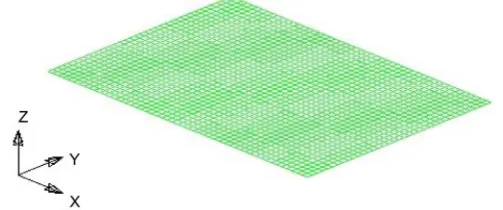
Most automobile panel shapes are complex and difficult to get through to start the initial blank geometry shape. In addition, the geometric expansion factor does not consider plastic deformation. Practically, variations in material proper-ties, thickness distribution, blank dimensions, environmental conditions and springback properties make the reproducibility and predictability of a blank sheet metal forming process quite difficult.The selected part is relatively simple design using Dynaform to estimate the stock load and to get directly through the geometric shape of the initial blank sheet metal. The simplified rectangular blank sheet metal shape model shown in Figure 1 has the maximum die size 30 cm, the smallest cell size 0.5 mm, and the offset rate 0.05 mm mesh parameters.
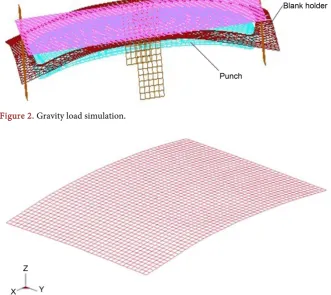
In actual production, sheet metal (blank shape) is placed on the blank holder and the blank holder is the part that holds the sheet metal while the punch force is applied. Punch is a curved and relatively large degree of bending force placed under the blank holder, bounded by gravity. If the simulation set the blank sheet metal without calculating the shape deformation then it will certainly bring some errors. However, it must first set on top of the mold and calculated after the shape deformation due to gravity. In Dynaform, a module used to calculate the gravity load called the gravity loading. The model shown in Figure 2 is the calculated result of rough, coarse and a re-refined mesh of the blank sheet metal.
The result shown in Figure 3 is the blank sheet metal after the gravity load-bounded by gravity to bend.
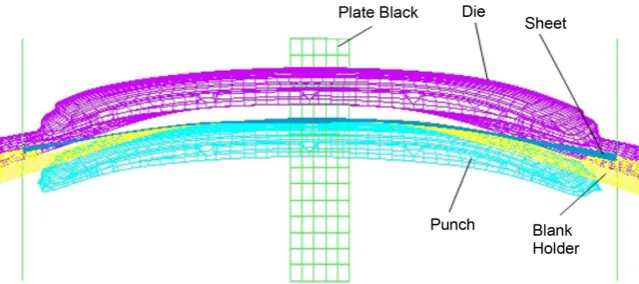
[image:6.595.248.500.600.705.2]The analysis of the forming of the auto roof panel should first determine the direction of drawing. Automobile roof panel is the part of the car body, accord-ing to its installation position and the consistent order the part should be placed at the roof of the car. In most cases when placing the car body parts automobile companies use the press fit in the convenient direction in order to avoid incon-sistent placement of the body parts. Even when designing, choosing the appro-priate direction of the drawing will determine the smooth implementation of the
DOI: 10.4236/wjet.2018.64061 920 World Journal of Engineering and Technology Figure 2. Gravity load simulation.
Figure 3. Blank sheet metal after the gravity load.
direction of stamping process. See Figure 4.
5.2. Blank Sheet and Mold Parameters
After taking stock of the grid model of gravity loading and further refinement take the grid size 10 mm, the billet steel plate thickness is 0.7 mm and the calcu-lation automatically by the program areas of intense deformation re-division of the minimum mesh size 2 mm. The sheet metal parameters are defined as fol-lows, the sheet metal thickness 0.7 mm, Poisson’s ratio (V) 0.3, elastic modulus (E) 207 GPa, tensile strength (TS) 3 MPa, yield strength (σ) 174 MPa,, mass den-sity (ρ) 7.83 × 10⁹ kg/mm3, strain hardening coefficient (K) 518 MPa, thickness anisotropy coefficient 1.91, 1.65 and 2.2 and the hardening coefficient (n) 0.242 Pa.
DOI: 10.4236/wjet.2018.64061 921 World Journal of Engineering and Technology Figure 4. Drawing and stamping direction of auto panel.
Figure 5. Closed stage simulation of automobile roof panel.
Figure 6. Blank sheet metal stamping simulation after the unloading.
5.3. Addendum
DOI: 10.4236/wjet.2018.64061 922 World Journal of Engineering and Technology Figure 7. Simulation model of automobile roof panel.
Figure 8. Stamping process design of auto roof panel with addendum at the fringe.
6. Forming Simulation Results
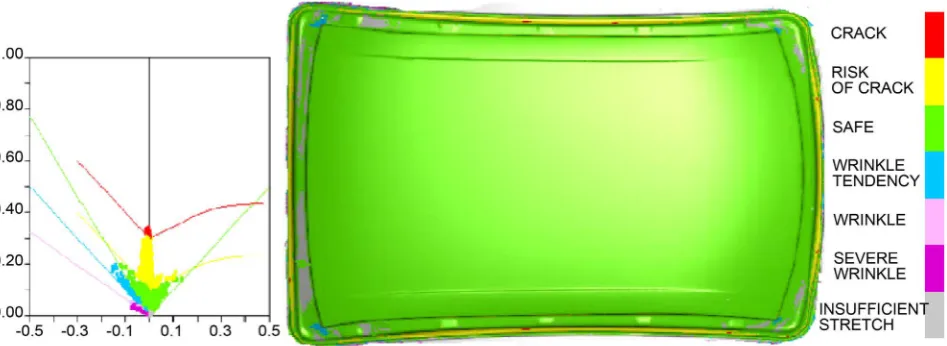
The forming simulation in the automotive industry is used to optimize and de-velop the sheet metal component parts efficiently. Similarly, the sheet metal forming simulation is an accurate and effective simulation in the entire forming operation and it also helps to predict the prevention of springback. Furthermore, the forming limit diagram (FLD) is a convenient and often used tool for the classification of the formability and evaluation of the forming process of sheet metal. The forming limit of sheet metal represents in the forming limit diagram (FLD) and it distinguishes the various deformation states of the part. For in-stance, (Figure 9) FLD indicates that the auto roof panel has a small amount of tendency of wrinkling and risk of crack near the fringe of the panel, whereas the rest areas are in a secure zone.
DOI: 10.4236/wjet.2018.64061 923 World Journal of Engineering and Technology Figure 9. Forming limited diagram—FLD (Modified tooling of forming simulation result).
On the other hand, the thickness distribution of the blank after forming shown in Figure 10, demonstrates some insufficient wrinkling pressure at the fringe of the panel surface. This insufficient wrinkling pressure comes through the subsequent trimming process. However, the impact of this insufficient wrin-kling pressure on the forming part is negligible. Therefore, one can conclude that there is no apparent wrinkling in the forming process found except near the fringe of the panel a slight material accumulation occurs.
Furthermore, forming thickness distribution is not equally distributed and the drawing sheet deformation is not uniform, but still within the limit that most of the regional thickness are between 0.524 - 0.721 mm. Similarly, as can be seen in Figure 10, the maximum thinning ratio of the formed auto roof panel is about 25% that is within the normally acceptable range of 3% to 25%.
In sum, the difference between the initial and the final thickness is small and panel deformation and strain are also insignificant. Although forming thickness distribution is not equally distributed, some parts which will inevitably lead the panel to springback and rupture are negligible.
Similarly, (both Figure 10 and Figure 11) simulation result indicates that the part plastic deformation is sufficient and thinning and springback amounts are small among most areas. There is no crack and wrinkling in the forming process and it indicates that the part plastic deformation is uniform and the rigid re-quirement is ensured. Therefore, the forming simulation results proved that there is no quality defect in the car roof panel forming process.
7. Analysis and Result
DOI: 10.4236/wjet.2018.64061 924 World Journal of Engineering and Technology Figure 10. Thickness distribution.
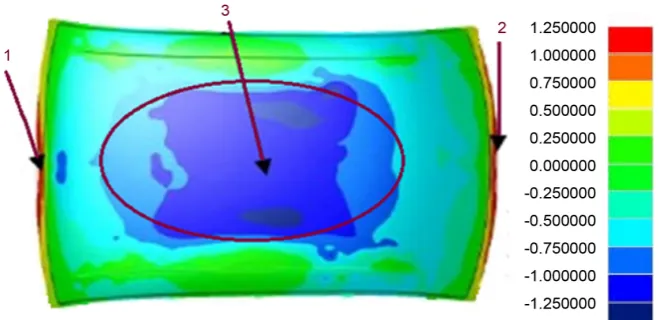
Figure 11. Springback simulation result of roof panel.
part that protects the automobile inner compartment from unfriendly environ-ment. There are regulations regarding the amount of the force that the roof pan-el withstands in case of damage or collusion to sustain without causing injury to the occupants’.
Other than the crashworthiness of the roof panel there are also manufacturing imperfections. As most of scholars described springback is a common manufac-turing imperfections phenomenon in every sheet metal manufacmanufac-turing process and it is a geometrical change of the part after the forming tool force has re-moved and occurs at the end of the forming process [5] [10] [14]. Particularly, Ablat and Qattawi explicitly mention that “Springback refers to the phenome-non of elastic recovery of sheet metal upon unloading during a forming opera-tion” [15].
[image:11.595.207.537.287.447.2]DOI: 10.4236/wjet.2018.64061 925 World Journal of Engineering and Technology stress [5] [16]. The second method is optimizing and controlling the sheet metal forming parameters [17] such as contact friction, forming temperature, tool ra-dius (R/t), blank holder force, and others. The third method is compensation, one of the effective methods for limiting and controlling the impacts of spring-back and residual stress. The forth is the property of the material, it is clearly evident that springback varies linearly with the yield strength, which is the ma-terial of higher yield strength have higher springback [18].
Consequently, it can be concluded that the ductile materials have less spring-back effect than the brittle materials. It is also possible to reduce the amount of springback by increasing the sheet metal thickness. Moreover, in the bending operation the residual stress slightly causes the sheet metal to springback prob-lem, therefore, it is necessary to over bend the sheet metal in a precise amount to achieve the desired bending angle and bending radius [19].
Springback Simulation Result
On the bases of the quality of sheet metal forming springback is a very signifi-cant factor to influence the forming process. Sheet metal stamping process si-mulation is a fundamental aspect for the prediction and compensation of springback. Apparently, an accurate prediction, compensation and elimination of springback are vital for the sheet metal forming design tools. Almost 90% of the automobile parts are made from sheet metal forming this makes the sheet metal forming the most difficult operation in the stamping process domain.
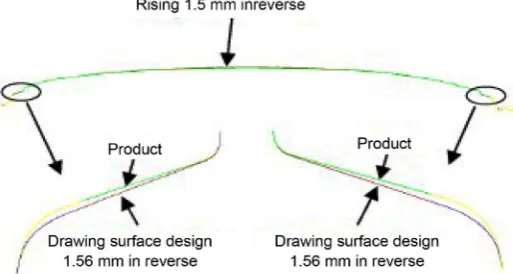
As can be seen from Figure 11, the tendency of the springback displacement distribution with the color code in three differently marked areas, such as Area 1, 2 and 3 indicates that both “Area 1 and 2” displacement of springback is up-ward, which is a positive direction movement. This illustrates that both Area 1 and Area 2 of the auto roof panel is rising (swelling) upward by 1.56 mm. On the other hand, the “Area 3” displacement of the springback is opposite to both the Area 1 and Area 2 movement, which indicates that Area 3 has a negative springback displacement by 1.5 mm.
Moreover, as the color code indicates the value of springback movement va-ries in between ±1.25 mm, this concludes that the roof panel surface quality and final assembly precision will be influenced by the springback amount. Therefore, the springback prediction and compensation must be taken. The following fig-ure (Figfig-ure 11) demonstrates that the springback displacement distribution si-mulation and the calculated result of auto roof panel by the static implicit algo-rithm.
DOI: 10.4236/wjet.2018.64061 926 World Journal of Engineering and Technology Figure 12. 1-2 section result of automated springback compensation compared with the target geometry.
8. Conclusions
The sheet metal stamping process contains a variety of complex phenomena, such as collision, friction, corrosion, elastic-plastic deformation, and few others. Accordingly, the sheet metal behaviors lead complex quality control difficulties to the design of sheet metal and forming. Generally speaking, the forming parts mainly measured their performance based on the three quality defects such as, wrinkling, rupture and springback. One of the most difficult defects is spring-back control. Clearly, different materials properties as well as different shapes have various springback amounts. As a result, springback problem will affect the shape and size of precision stamping parts and surface quality; not to mention that the final shape of the auto body panel depends on the amount of spring-back. When the springback exceeds the sufficient limit the formation of defects will affect the automobile assembly.
In the sheet metal stamping and forming process there are different ways to predict, compensate or eliminate the springback problem. This study analyzed the prediction and compensation of springback error based on Dynaform form-ing, stamping and springback simulation algorism. The result articulately indi-cated that the quality problem does not exist in the forming and stamping process of auto roof panel, but appeared in the springback process. However, the amount of the springback was insignificant. Accordingly, this study obtained the actual and qualified auto roof panel and the experiment test results proved that the springback control measures are rational and the simulation prediction and surface compensation methods are accurate.
Biographical Statement
Amsalu K. Addis has a Master of Engineering degree and currently completing his Ph.D. in the School of Economics and Management at Fuzhou University, Fuzhou, China.
Conflicts of Interest
DOI: 10.4236/wjet.2018.64061 927 World Journal of Engineering and Technology
References
[1] Keum, Y.T., Ahn, I.H., Lee, I.K., Song, M.H., Kwon, S.O. and Park, J.S. (2005) Si-mulation of Stamping Process of Automotive Panel Considering Die Deformation.
AIP Conference Proceedings, 778, 90-95. https://doi.org/10.1063/1.2011199
[2] Behrouzi, A., Dariani, B.M. and Shakeri, M. (2009) A One-Step Analytical Ap-proach for Springback Compensation in Channel Forming Process. Proceedings of the World Congress on Engineering,Vol. II, London, 1-3 July 2009, 1757-1762. [3] Haleem, A. and Azmat, Z. (2010) Young’s Modulus Decrease after Cold Forming in
High Strength Steels: An Investigation into the Mechanism Using Bake Hardenable Steel. LAP Lambert Academic Publishing,Saarbrücken.
[4] Chen, B., Yuan, Q., Wang, J.G., Liao, X.J. and Sun, S.T. (2010) Elastoplastic Consti-tutive Equations Considering Void Evolution. Computational Materials Science, 49, S6-S9.https://doi.org/10.1016/j.commatsci.2010.01.037
[5] Azraq, S.A., Teti, R. and Costa, J. (2006) Springback Prediction with FEM Analysis of Advanced High Strength Steel Stamping Process. Intelligent Production Ma-chines and Systems, 2006, 264-269.
https://doi.org/10.1016/B978-008045157-2/50050-X
[6] Chen, P. and Koç, M. (2007) Simulation of Springback Variation in Forming of Advanced High Strength Steels. Journal of Materials Processing Technology, 190, 189-198. https://doi.org/10.1016/j.jmatprotec.2007.02.046
[7] Wagoner, R.H., Lim, H. and Lee, M.-G. (2013) Advanced Issues in Springback. In-ternational Journal of Plasticity, 45, 3-20.
https://doi.org/10.1016/j.ijplas.2012.08.006
[8] Wagoner, R. and Li, M. (2007) Simulation of Springback: Through-Thickness Inte-gration. International Journal of Plasticity, 23, 345-360.
https://doi.org/10.1016/j.ijplas.2006.04.005
[9] Vladimirov, I.N., Pietryga, M.P. and Reese, S. (2009) Prediction of Springback in Sheet Forming by a New Finite Strain Model with Nonlinear Kinematic and Iso-tropic Hardening. Journal of Materials Processing Technology, 209, 4062-4075.
https://doi.org/10.1016/j.jmatprotec.2008.09.027
[10] Wang, Z., Hu, Q., Yan, J. and Chen, J. (2017) Springback Prediction and Compen-sation for the Third Generation of UHSS Stamping Based on a New Kinematic Hardening Model and Inertia Relief Approach. The International Journal of Ad-vanced Manufacturing Technology, 90, 875-885.
https://doi.org/10.1007/s00170-016-9439-x
[11] Livatyali, H. and Altan, T. (2001) Prediction and Elimination of Springback in Straight Flanging Using Computer Aided Design Methods: Part 1. Experimental Investigations. Journal of Materials Processing Technology, 117, 262-268.
https://doi.org/10.1016/S0924-0136(01)01164-5
[12] Livatyali, H., Wu, H.C. and Altan, T. (2002) Prediction and Elimination of Spring-back in Straight Flanging Using Computer-Aided Design Methods: Part 2: FEM Predictions and Tool Design. Journal of Materials Processing Technology, 120, 348-354. https://doi.org/10.1016/S0924-0136(01)01161-X
[13] Peng, X., Shi, S. and Hu, K. (2013) Comparison of Material Models for Spring Back Prediction in an Automotive Panel Using Finite Element Method. Journal of Mate-rials Engineering and Performance, 22, 2990-2996.
https://doi.org/10.1007/s11665-013-0600-5
Au-DOI: 10.4236/wjet.2018.64061 928 World Journal of Engineering and Technology
tomotive Panel Based on Three-Dimensional Scanning and Reverse Engineering.
The International Journal of Advanced Manufacturing Technology, 85, 1187-1193.
https://doi.org/10.1007/s00170-015-8042-x
[15] Ablat, M.A. and Qattawi, A. (2017) Numerical Simulation of Sheet Metal Forming: A Review. The International Journal of Advanced Manufacturing Technology, 89, 1235-1250.
[16] Lingbeek, R., Huétink, J., Ohnimus, S., Petzoldt, M. and Weiher, J. (2005) The De-velopment of a Finite Elements Based Springback Compensation Tool for Sheet Metal Products. Journal of Materials Processing Technology, 169, 115-125.
https://doi.org/10.1016/j.jmatprotec.2005.04.027
[17] Meinders, T., Burchitz, I.A., Bonte, M.H.A. and Lingbeek, R.A. (2008) Numerical Product Design: Springback Prediction, Compensation and Optimization. Interna-tional Journal of Machine Tools and Manufacture, 48, 499-514.
https://doi.org/10.1016/j.ijmachtools.2007.08.006
[18] Hegde, G.S., Shivaprasad, J. and Sridhar, R. (2009) Interface Driven Optimisation of Springback in Stretch Bending of Autobody Panels. Computational Materials Science and Surface Engineering, 1, 168-173.
[19] Tekıner, Z. (2004) An Experimental Study on the Examination of Springback of Sheet Metals with Several Thicknesses and Properties in Bending Dies. Journal of Materials Processing Technology, 145, 109-117.