EVALUATION OF WORKING POSTURE AMONG THE DENTIST USING RULA AND REBA
1
Jinu Merlin Koshy,
2Archana, R.,
1
Reader, Department of Anatomy, Sree Balaji Dental College and Hospital, Bharath Institute of Higher
and Research, Chennai,
2
Assistant Professor, Department of Anatomy, Sree Balaji Medical College and Hospital, Bharath Institute of
Higher Education and Research, Chennai
3
Research Fellow, Department of Anatomy, Bharath Institute of Higher Education and Research,
4
Professor & H OD, Department of Anatomy, Sree Balaji Medical College and Hospital, Bharath
Higher Education and Research, Chennai, Tamil Nadu
5
Senior Lecturer, Department of Oral Medicine, Sree Balaji Dental College and Hospital, Bharath Institute of
Higher Education and Research, Tamil Nadu
6Reader, Department of Anatomy, Sree Bal
ARTICLE INFO ABSTRACT
Aim & Objective
dentists using the postural analysis tool, Rapid entire body assessment (REBA) and Rapid Upper Limb Assessment (RULA). Materials and Methods: The study was conducted on one hu
seventy five dentists working in different clinics having an experience of 3 to 20 years with age ranging from 25
body assessment (REBA) and Rapid Upper Limb Asse
body posture, forces used, type of movement or action, repetition, and coupling. After the data for each region is collected and scored, tables on the form are then used to compile the risk factor variables, gene
for 85% of the subjects were 7 and above which indicates the risk level is medium to high. RULA Score
investigation and changes may be required in their posture. 47% of subjects were having a left score 4 and right score 5&6
Copyright © 2017, Jinu Merlin Koshy et al. This is an open use, distribution, and reproduction in any medium, provided
INTRODUCTION
People adopt postures mostly without any conscious decision to deal with the work place and the surrounding environments they find. The goal is to perform an action or a task and the posture is chosen to achieve that goal. This adaptability is made possible by the complex anatomy of the musculoskeletal system which has the freedom to adopt numerous postures and postural adjustments. The redundancy provided by the multiple degrees of freedom ensures that for performing a particular task several alternative postures can be adopted.
*Corresponding author: Johnson, W. M. S.
Professor and H OD, Department of Anatomy, Sree Balaji Medical College and Hospital, Bharath Institute of Higher Education and Research, Chennai, Tamil Nadu.
ISSN: 0975-833X
Vol.
Article History:
Received 09th September, 2017
Received in revised form 23rd October, 2017
Accepted 12th November, 2017
Published online 31st December, 2017
Citation: Jinu Merlin Koshy, Archana, R., Bini Markose, Johnson, W.
posture among the dentist using rula and reba”, International Journal of Current Research
Key words: Dental Professionals, Musculoskeletal Disorders
Rapid Entire Body Assessment (REBA) and Rapid Upper Limb Assessment (RULA), Posture.
RESEARCH ARTICLE
EVALUATION OF WORKING POSTURE AMONG THE DENTIST USING RULA AND REBA
Archana, R.,
3Bini Markose,
4,*Johnson, W. M. S.,
5and
6Sathya priya, B.
Reader, Department of Anatomy, Sree Balaji Dental College and Hospital, Bharath Institute of Higher
and Research, Chennai, Tamil Nadu
, Department of Anatomy, Sree Balaji Medical College and Hospital, Bharath Institute of
her Education and Research, Chennai, Tamil Nadu
Department of Anatomy, Bharath Institute of Higher Education and Research,
Chennai, Tamil Nadu
Professor & H OD, Department of Anatomy, Sree Balaji Medical College and Hospital, Bharath
Higher Education and Research, Chennai, Tamil Nadu
Senior Lecturer, Department of Oral Medicine, Sree Balaji Dental College and Hospital, Bharath Institute of
Higher Education and Research, Tamil Nadu
Department of Anatomy, Sree Balaji Dental College and Hospital, Bharath Institute of Higher Education
and Research, Tamil Nadu
ABSTRACT
Aim & Objective The aim of the present study was to assess the unpredictable working postures of dentists using the postural analysis tool, Rapid entire body assessment (REBA) and Rapid Upper Limb Assessment (RULA). Materials and Methods: The study was conducted on one hu
seventy five dentists working in different clinics having an experience of 3 to 20 years with age ranging from 25 – 50 years. Posture was assessed using the posture analysis tools like Rapid entire body assessment (REBA) and Rapid Upper Limb Assessment (RULA). Data are collected about the body posture, forces used, type of movement or action, repetition, and coupling. After the data for each region is collected and scored, tables on the form are then used to compile the risk factor variables, generating a single score that represents the level of MSD risk. Results:
for 85% of the subjects were 7 and above which indicates the risk level is medium to high. RULA Score for most of the subjects (54%) were left 3 and
investigation and changes may be required in their posture. 47% of subjects were having a left score 4 and right score 5&6
open access article distributed under the Creative Commons Attribution provided the original work is properly cited.
People adopt postures mostly without any conscious decision to deal with the work place and the surrounding environments they find. The goal is to perform an action or a task and the posture is chosen to achieve that goal. This adaptability is e by the complex anatomy of the musculoskeletal system which has the freedom to adopt numerous postures and postural adjustments. The redundancy provided by the multiple degrees of freedom ensures that for performing a particular
ostures can be adopted.
H OD, Department of Anatomy, Sree Balaji Medical College and Hospital, Bharath Institute of Higher Education and
All the alternative postures may not be healthy postures, particularly when extended for a period of time, when they cause localized loading on joints, muscles, ligaments or other tissues or when force must be exerted.
work place and work space are outl
any of the influencing factor may vary with an individual worker. This is most obvious when considering the anthropometric effects of body size. The posture that an individual can adopt to perform a task is solely depending upon the interaction between the layout of the work place and his or her own anthropometry.
body mechanics, causing uneven pressure on joint surfaces, ligamentous strain and skeletal muscle disadvantage. Associated soft tissue shortening may cause back pain. Chronic pain is yet another added burden to this patient group,
International Journal of Current Research Vol. 9, Issue, 12, pp.63316-63320, December, 2017
Jinu Merlin Koshy, Archana, R., Bini Markose, Johnson, W. M. S., Sankar Narayanan and Sathya Priya
International Journal of Current Research, 9, (12), 63316-63320.
EVALUATION OF WORKING POSTURE AMONG THE DENTIST USING RULA AND REBA
5
Sankar Narayanan
Reader, Department of Anatomy, Sree Balaji Dental College and Hospital, Bharath Institute of Higher Education
, Department of Anatomy, Sree Balaji Medical College and Hospital, Bharath Institute of
Department of Anatomy, Bharath Institute of Higher Education and Research,
Professor & H OD, Department of Anatomy, Sree Balaji Medical College and Hospital, Bharath Institute of
Senior Lecturer, Department of Oral Medicine, Sree Balaji Dental College and Hospital, Bharath Institute of
aji Dental College and Hospital, Bharath Institute of Higher Education
The aim of the present study was to assess the unpredictable working postures of dentists using the postural analysis tool, Rapid entire body assessment (REBA) and Rapid Upper Limb Assessment (RULA). Materials and Methods: The study was conducted on one hundred and seventy five dentists working in different clinics having an experience of 3 to 20 years with age 50 years. Posture was assessed using the posture analysis tools like Rapid entire ssment (RULA). Data are collected about the body posture, forces used, type of movement or action, repetition, and coupling. After the data for each region is collected and scored, tables on the form are then used to compile the risk factor rating a single score that represents the level of MSD risk. Results: The REBA score for 85% of the subjects were 7 and above which indicates the risk level is medium to high. The and right 5. This score indicates investigation and changes may be required in their posture. 47% of subjects were having a left score
ribution License, which permits unrestricted
postures may not be healthy postures, particularly when extended for a period of time, when they cause localized loading on joints, muscles, ligaments or other tissues or when force must be exerted. General principles for work place and work space are outlined, but it is that effects of any of the influencing factor may vary with an individual worker. This is most obvious when considering the anthropometric effects of body size. The posture that an individual can adopt to perform a task is solely depending upon the interaction between the layout of the work place and his or her own anthropometry. Postural deviation alters the body mechanics, causing uneven pressure on joint surfaces, ligamentous strain and skeletal muscle disadvantage. shortening may cause back pain. Chronic pain is yet another added burden to this patient group,
INTERNATIONAL JOURNAL OF CURRENT RESEARCH
and may exacerbate low mood and decrease motivation. Stiffness and pain in the spine and ribs may inhibit ventilation, and poor posture along with low body weight may reinforce poor body image and reduce self confidence. Global Burden of Diseases’ statistics developed by the World Health Organization (WHO) reveal that musculo skeletal disorders (MSD) contribute 37% of the disease burden attributable to occupational risk factors (WHO, 2004). The posture adopted for a particular task is most directly determined by the work place and the equipments particularly in relation to work height, reach distance, field of view, and space to move freely. The dimensions and arrangements constrain the range of postures that are possible while performing the task.
A person working in an esteem or awkward posture will have to use more force to accomplish the same amount of work compared to using a neutral posture, which in turn affects muscle loading and compressive forces on the intervertebral disc (Anderson, 1986). The dental professionals are more prone for work related musculoskeletal disorders (MSD). Hunching over patients, reaching and stretching in awkward positions, the physical strains and repetitive movements required by the occupation can lead to muscle imbalances, postural dysfunction and compensatory movement patterns
leaving the dentist with pain or chronic discomfort (Leggat et
al., 2007; Pandis et al., 2007; Shenkar et al., 1998). Back pain
was the most common complaint among dentists followed by neck pain (McRea, 1990). Dentists are subjected to a wide variety of physical and psychological ailments that aggravate disorders of the musculoskeletal system and greatly affect the
health of dentists (Rowe, 1969; Ishmael, 1976; Osborn et al.,
1990; Marshall et al., 1997). In order to prevent this, correct
posture must be established by the dentist early in the dental career. Therefore, the correct posture must be stressed in dental schools. Although most schools teach the correct and ideal dentist posture and positions, it is not always applied by the dental students. The most common sites of pain among the dentist are the lumbar and the cervical vertebrae (Ishmael,
1976; Osborn et al., 1990; Marshall et al., 1997).
The musculoskeletal health of dental professionals has been the subject of numerous studies worldwide, and their focus has been on the pain experienced by the practitioner. Because their work area is narrow, dental treatment is performed, in a very inflexible work posture. Studies indicate that back, neck or
shoulder pain is present in 81% of dental operators(Bramson
et al., 1998). Studies highlighted that stress, postural practice
(bending and twisting trying to gain better access and visibility within the oral cavity), as well as prolonged working times
leads to fatigue(Valachi, 2013; Kerosuo et al., 2000). Various
investigators have pointed out the common postural faults among dentists and dental auxiliaries are craning and/or excessive bending and twisting of the neck, bending forward from the waist, elevation of the shoulders, and general bending or twisting of the back and neck (Fox, 1967; Paul, 1979; Bers, 1980; Willee, 1967; Green, 1963; Jinu Merlin, 2016). The present study was to assess the working postures of the dentist using the postural analysis tool like Rapid entire body
assessment (REBA) and Rapid Upper Limb Assessment
(RULA)(Hignett, 2000; Mcatamney, 1993)
Aim and Objective
The aim of the present study was to assess the unpredictable working postures of dentists using the postural analysis tool,
Rapid entire body assessment (REBA) and Rapid Upper Limb Assessment (RULA).
MATERIALS AND METHODS
The study was to assess the unpredictable working postures of dentists in Chennai. One hundred and seventy five dentists working in different clinics were randomly selected and included in this study, over a period of three months. The study proposal was submitted to the Institutional Ethics Committee and due clearance was obtained from them.
Inclusion criteria
Dentists with 3 - 20 years work experience
Age ranging from 25 – 50 years,
Both sexes.
Exclusion Criteria
Individuals with any acute ailments or systemic
diseases
Pregnant women
Those who were not willing
Informed written consent was obtained from each of the participants
Rapid Entire Body Assessment {REBA}
Rapid entire body assessment (REBA) was developed to assess the type of unpredictable working postures found in health-care and other service industries. Data were collected about the body posture, forces used, type of movement or action, repetition, and coupling. A final REBA score was generated to give an indication of the level of risk & urgency with which action should be taken. Wrists, forearms, elbows, shoulders, neck, trunk, back, legs and knees were assessed using REBA employee assessment worksheet (Figure 1).
Rapid Upper Limb Assessment (RULA)
The RULA ergonomic assessment tool considers
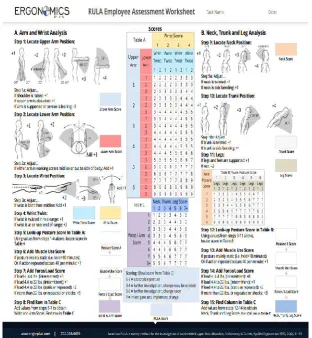
biomechanical and postural load requirements of job tasks/demands on the neck, trunk and upper extremities. RULA assessment worksheet was used to evaluate required body posture, force, and repetition(Figure 2). Based on the evaluations, scores were entered for each body region in section A for the arm and wrist, and section B for the neck and trunk. After the data for each region was collected and scored, tables on the form were then used to compile the risk factor variables, generating a single score that represents the level of MSD risk.
RESULTS
Figure 1. REBA employee assessment worksheet
[image:3.595.139.452.439.778.2]Table 1. General Characteristics of the Study Subjects
Socio demographic variables MALE FEMALE
Age 33 ± 5.0606 32 ±4.23
Work experience 9 ± 5.109 8 ± 4.09
Married 57 78
Unmarried 22 18
Working hrs per day 9 ± 1.448 6 ± 1.35
Working hrs per week 54 ± 8.693 36 ± 8.08
Patients handling per day 20 ± 7.612 12 ± 4.52
Patients per week 120 ± 45.67 72 ± 27.16
Height 172 ± 7.87 158 ± 7.40
Weight 72 ± 8.48 62 ± 5.45
BMI 24.65 ± 1.72 24.80 ± 2.146
Mean ± Standard deviation n=175 M:F 79:96
Table 2. Reba Score of Dentists
REBA SCORE OF DENTISTS N=175
Number of persons SCORE PERCENTAGE
3 11 1.71
18 10 10.29
38 9 21.71
55 8 31.43
37 7 21.14
11 6 6.29
13 5 7.43
[image:4.595.312.552.75.138.2]Graph 1. REBA score
Table 3. Rula Score of Dentists
RULA
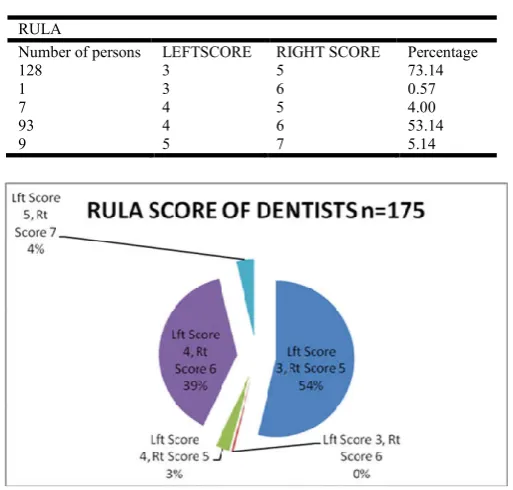
Number of persons LEFTSCORE RIGHT SCORE Percentage
128 3 5 73.14
1 3 6 0.57
7 4 5 4.00
93 4 6 53.14
9 5 7 5.14
[image:4.595.38.291.233.506.2]Graph 2. RULA score
Table 4. Inference of Reba Score
REBA SCORE RISK LEVEL ACTION NEEDED
1 Negligible None necessary
2-3 Low May be necessary
4-7 Medium Necessary
8-10 High Necessary soon
11-15 Very High Necessary now
Table 5. Inference of Rula Score
RULA SCORE ACTION NEEDED
Score = 1-2 Posture acceptable if not maintained or repeated for
long periods
Score = 3-4 Further investigation is needed, and changes may be
required
Score = 5-6 Investigation and changes are required soon
Score = 7 Investigation and changes are required immediately
DISCUSSION
The present study group was conducted in 175 dentists having work experience of minimum 3 years and maximum of 20 years. The sample population included 96 females & 76 males with an average age of 33 years and average work experience of 9 years. The general characteristics of the study population like age, work experience, working hours, height, weight, body mass index (BMI) were assessed. The data collected were tabulated and REBA & RULA scoring were done. The REBA score for 85% of the subjects were 7 and above which indicates the risk level is medium to high. The RULA Score for most of the subjects (54%) were left 3 and right 5. This score indicates investigation and changes may be required in their posture. 47% of subjects were having a left score 4 and right score 5&6. Vilagra (2003) has evaluated working postures with odontology students using the RULA method. The found score average was 5.9, indicating further investigations and changes required soon.
Agreeing with the studies of Vilagra (2003), our sample has presented an average score of postures analyzed by the RULA method of 5.1, with indications of fast changes. While the REBA method has presented an average score of 8 for the postures that have been analyzed, but the indications says only that the changes are necessary soon (Vilagra, 2003). Studying the postural stress in dentists through the RULA method, Silva (2001) found that none of the postures that had been analyzed is acceptable, that means, all postures had a final score above 2
(Silva, 2001). Saquy et al. (1996), affirm that during the work
[image:4.595.36.293.534.779.2]forwards and upwards and the abdominal muscles strained slightly. The shoulders are above the hip joints and the line of gravity runs through the lumbar vertebrae and pelvis in the direction of the seat. This posture facilitates good breathing.
Conclusion
Dental procedures should be carried out in the mouth of the patient whilst maintaining a healthy sitting posture. Adopting symmetrical upright posture without overloading the musculo-skeletal structures should be taught in dental schools itself. Adopting correct posture prevents the high percentage of musculo-skeletal complaints which are known to affect about 65 % of dentists and are also the cause of a high percentage of disability. In order to reduce spine problems, correct postural practices, relaxation interval sessions during work, and weight monitoring could be utilized.
REFERENCES
Anderson CK, Chaffin DB, Herrin GD. A study of
lumbosacral orientation under varied static loads. Spine.
1986 Jun;11(5):456-62.
Bers GS. 1980. The dentist's health. J Am Dent Assoc. Apr;
100(4):507.
Bramson JB, Smith S, Romagnoli G. 1998. Evaluating Dental
Office Ergonomic Risk Factors And Hazards. Journal of
American Dental Association, 129(2):174-183
Fox JG, Jones JM. 1967. Occupational stress in dental practice.
Br Dent J. Nov 21; 123(10):465-73.
Green EJ, Brown ME. 1963. Body mechanics applied to the
practice of dentistry. J Am Dent Assoc. 67:679-97.
Hignett, S., Mcatamney, L. 2000.“Rapid Entire Body Assessment (REBA)”. AppliedErgonomics, .v. 31, n. 2, p. 201-205
Ishmael WK, Shorbe HB. 1976. Care of the back. 2nd ed. J.B. Lippincott Company, Toronto, Canada.
Jinu Merlin et al. 2016. A Study to Evaluate the Prevalance of
Postural Problems in Dentists in Chennai, Tamilnadu, India
in Res. J. Pharm., Biol. Chem. Sci., 7 (3) Pg 2552- 59
Jinu Merlin Koshy, W M S Johnson, B Sathya Priya. 2015. Sedentary Work-A Risk Factor for Diabetes with a Positive Family History. IJSR September 4 (9):812-819
Karwouski W, marras WS. The Occupational ergonomics Hand Book. Boca Raton,FI;CRC Press;1999:69-170 Kerosuo E, Kerosuo H, Kanerva L. 2000. Self-reported health
complaints among general dental practitioners,
orthodontics, and office employees. Acta Odontol Scand.,
58: 207–212.
Leggat PA, Kedjarune U, Smith DR. 2007. Occupational
health problems in modern dentistry: a review. Ind Health,
45, 611–621.
Marshall ED, Duncombe LM, Robinson RQ, Kilbreath SL. 1997. Musculoskeletal symptoms in New South Wales
dentists. Aust Dent J. Aug;42(4):240-6.
Mcatamney, L; Corlett, E. N. 1993. “RULA: A survey method for the investigation of workrelated upper limb disorders”. Applied Ergonomics. v. 24, n. 2, p. 91-99.
McRea R. 1990. Clinical orthopedic examination. 3rd edition. Churchill Livingstone, Longman Group,London, UK. Osborn JB, Newell KJ, Rudney JD, Stoltenberg JL. 1990.
Musculoskeletal pain among Minnesota dental hygienists. J Dent Hyg. Mar;64(3):132-8.
Pandis N, Pandis BD, Pandis V, Eliades T. 2007. Occupational hazards in orthodontics: A review of risks and associated
pathology. Am J OrthodDentofacial Orthop, 132, 280–292.
Paul E. 1979. The technique of seated dentistry. Quint Int Dent
Dig. 10-19.
Rowe ML. 1969. Low back pain in industry. A position paper.
J Occup Med., Apr;11(4):161-9.
Saquy, P. C. et al. 1996. “Ergonomia e as doenças
ocupacionais do cirurgião-dentista- parte II – a ergonomia e os agentes mecânicos”. Revista Odontológica do Brasil Central.
Shenkar O, Mann J, Shevach A, Ever-Hadani P, Weiss PL. 1998. Prevalence and risk factors of upper extremity
cumulative trauma disorder in dental hygienists. Work, 11,
263–275.
Silva, C. R. de C. 2001. “Constrangimentos posturais em ergonomia: Uma análise da atividade do endontista a partir de métodos de avaliação”. Dissertação (Mestrado em Engenharia de Produção) Programa de Pós-Graduação em Engenharia de Produção, UFSC.
Valachi B, Valachi K. 2003. Mechanism leading to
musculoskeletal disorders in dentistry. J Am Dent Assoc.,
134: 1344–1350
Vilagra, J. M. 2003. Análise das posturas de trabalho de acadêmicos de odontologia atravésdos métodos RULA e
MRI: um enfoque ergonômico preventivo.
http://intramed.uol.com.br/cobertura_lista.asp?idevento=5.
Access in 10/03/2005.
Willee AW. 1967. How to avoid the occupational hazards of
dentistry. Aust Dent J., Aug; 12(4):348-59.
World health organisation – Global burden of diseases -http://www.who.int/topics/global_burden_of_disease/en/