INFLUENCE OF DISABILITIES CAUSED BY TUNGIASIS ON SCHOOL ATTENDANCE AMONG SCHOOL
AGE CHILDREN IN MURANG’A
*,1
Dr. Peter N. Keiyoro,
2Josephine W
1School of Continuing and Distance E
2
Institute of Tropical and Infectious Diseases, University of Nairobi, Kenya,
3Professor of Haematology, Institute of Tr
4
School of Continuing and Distance Education, University of Nairobi
ARTICLE INFO ABSTRACT
Tungiasis
causes morbidity and social stigmatization
children and elderly in the endemic areas. It may have negative effects on the economic activities of the infested adults and hence indirectly influence school attendance among children in the affected areas. The study focused on the relationship between the disease and school attendance and a possible cause of high drop
County in Kenya, East Africa. Cross
six schools was used. The questionnaires captured data on disease infestation and school attendance among children. Of the participants 3.8.0% were infested while 96.2% had no infestation. Absenteeism and sch
participation in educational activities
Copyright © 2016, Dr. Peter N. Keiyoro et al. This
unrestricted use, distribution, and reproduction in any medium, provided the original work is properly cited.
INTRODUCTION
The female Tunga penetrans infestations result
which is a tropical parasitic skin disease (Heukelbach 2005). After entering its host epidermis, the
undergoes enlargement, to around 200 times six days. Thereafter, within a week, each female up to 200 eggs onto the ground. These eggs which feed on organic matter in the soil develop, into pupa stage which metamorphoses
grown embedded Tunga penetrans. Ngunjiri,
(2011) in their studies found that the Jigger thrive best in the sandy soils of warm, dry climates. are also commonly found in poorly maintained and public places like; dusty floors in schools and stock farms . The main hosts are human
cats, pigs, and rats (Feldmeier, et al., 2002; Ade
1982; Ade-Serrano et al., 1981; Gonzalez
Community-based studies (Joseph, et al.,
et al., 2006) have revealed that prevalence between 16 and 55% in typical endemic areas
*Corresponding author: Dr. Peter N. Keiyoro,
School of continuing and Distance Education, University of Nairobi, Kenya.
ISSN: 0975-833X
Article History:
Received 21st December, 2015
Received in revised form 25th January, 2016
Accepted 18th February, 2016
Published online 31st March,2016
Key words:
Absenteeism, School attendance, Repetition, Prevalence, Infection, Jigger, Infestation.
Citation: Dr. Peter N. Keiyoro, Josephine W. Ngunjiri
school attendance among school age children in Murang’a county; Kenya
RESEARCH ARTICLE
INFLUENCE OF DISABILITIES CAUSED BY TUNGIASIS ON SCHOOL ATTENDANCE AMONG SCHOOL
AGE CHILDREN IN MURANG’A COUNTY; KENYA
Josephine W. Ngunjiri,
3Walter Mwanda and
School of Continuing and Distance Education, University of Nairobi, Kenya
opical and Infectious Diseases, University of Nairobi, Kenya, P.O. Box 30197, Nairobi
Institute of Tropical and Infectious Diseases, University of Nairobi, Kenya,
P.O. Box 30197, Nairobi
ntinuing and Distance Education, University of Nairobi, Kenya, P.O. Box 30197, Nairobi
ABSTRACT
Tungiasis is caused by female Tunga penetrans that embeds in the hosts
causes morbidity and social stigmatization among the children. It is also a health burden among children and elderly in the endemic areas. It may have negative effects on the economic activities of the infested adults and hence indirectly influence school attendance among children in the affected areas. The study focused on the relationship between the disease and school attendance and a possible cause of high drop-out rates among children of peasant families in Murang County in Kenya, East Africa. Cross-sectional survey involving randomly selected 720 pupils from six schools was used. The questionnaires captured data on disease infestation and school attendance among children. Of the participants 3.8.0% were infested while 96.2% had no infestation. Absenteeism and school dropout due to Tungiasis was found to have negative impact on children participation in educational activities.
This is an open access article distributed under the Creative Commons Att use, distribution, and reproduction in any medium, provided the original work is properly cited.
result in Tungiasis
(Heukelbach et al.,
gravid female flea its normal size in female flea deposits
hatch into larvae soil and thereafter metamorphoses into a fully
Ngunjiri, and Keiyoro Jigger fleas normally climates. The fleas maintained households schools, homes, toilets
human beings, dogs,
Ade-Serrano et al.,
Gonzalez et al., 2005)
2003; Feldmeier prevalence could range
areas with a peak of
Distance Education, University of Nairobi, Kenya.
age-specific disease occurrence the elderly and a great number
(Muehlen et al., 2003). It is postulated
inthe endemic areas cannot afford feet are often in constant contact the people in the endemic areas cemented dusty floors that are
development of Tunga penetrans
also have limited capacity to acquire and fumigation drugs that are
Tunga penetrans in endemic areas.
Although the disease occurs in considered an important public the policy paper on the disease its state of prevalence is not yet neglected by health providers, government administrators for and Keiyoro (2011) may have
studies on T.penetrans in an endemic
demonstrated overall average
County in central Kenya is considered where, a total of over 1350
International Journal of Current Research
Vol. 8, Issue, 03, pp.28826-28830, March, 2016
INTERNATIONAL
Dr. Peter N. Keiyoro, Josephine W. Ngunjiri , Walter Mwanda and Omondi Bowa, 2016. “Influence of disa
school attendance among school age children in Murang’a county; Kenya”, International Journal of Current Research, 8, (03
INFLUENCE OF DISABILITIES CAUSED BY TUNGIASIS ON SCHOOL ATTENDANCE AMONG SCHOOL
Walter Mwanda and
4Omondi Bowa
ducation, University of Nairobi, Kenya
P.O. Box 30197, Nairobi,
opical and Infectious Diseases, University of Nairobi, Kenya,
.O. Box 30197, Nairobi
that embeds in the hosts, epidermis. The disease among the children. It is also a health burden among children and elderly in the endemic areas. It may have negative effects on the economic activities of the infested adults and hence indirectly influence school attendance among children in the affected areas. The study focused on the relationship between the disease and school attendance out rates among children of peasant families in Murang’a ving randomly selected 720 pupils from six schools was used. The questionnaires captured data on disease infestation and school attendance among children. Of the participants 3.8.0% were infested while 96.2% had no infestation.
was found to have negative impact on children
is an open access article distributed under the Creative Commons Attribution License, which permits
occurrence in children 5 to 14 years and number of infestation in the male sex postulated that the peasant farmers afford to buy shoes, hence their contact with dusty soils. Majority of areas live in houses that have
un-are suitable environments for the
penetrans. The infected population may acquire washing soap, pesticides essential for the control of the areas.
in most parts of Kenya it was not public health concern until 2015 when disease was launched. Consequently, yet well known and had remained providers, social workers, politicians and
a long time. Studies by Ngunjiri
have been the first scientific endemic Area in Kenya that
prevalence of 4 .9%. Murang’a considered a focus of tungiasis, people were suffering from
INTERNATIONAL JOURNAL OF CURRENT RESEARCH
tungiasis by 2009. Out of these (1350) 700 were school age children in primary schools while the rest were adults. It was also shown that 50 per cent of the children infested had difficulties in attending classes (Ahadi Trust, 2009). The high illiteracy rates in an area coupled with high degree of poverty may exasperate the spread of tungiasis problem in as shown
by Feldmeier et al. (2006) elsewhere. Severe compilations due
to tungiasis are common in endemic areas where people may suffer from constant pain, inflammation and hinder individuals from normal walking. Bacterial postinfections are often common, inflammations and ulcers in the feet are observed in the body of people who are infected by tungiasis (Feldmeier,
et al., 2004). Other consequences of tungiasis include deformation of the legs and loss of toenails, as well as deformation of digits in the hands. If the individuals are not vaccinated lesions may be become entry points for tetanus
infection (Heukelbach, 2005; Joseph et al., 2006). There are a
number of ways the disease can have an impact on the education sector. These include internal “efficiency” of the education system as measured by drop-out and repetition rates and ways that the school system itself can respond to prevention and treatment of the disease .Other ways include low school attendance due to the Child’s inability to walk to school, the need for children to work or care for family members suffering from tungiasis and inability to afford school fees because infected parents are not able to generate the necessary income due to infestation by the disease in the family. Questions of impact differentials by gender are also relevant as one sex of the children may disproportionately be represented in the numbers of children not attending school as a result of tungiasis infestation.
Objectives of the Study
This research sought to investigate the impact of tungiasis on basic (elementary) education sector in Kenya with a focus
on in Murang’a county by addressing the following
questions. What is the impact of tungiasis on class attendance (absenteeism)?, What is the impact of tungiasis on class repetition? What is the influence of Tungiasis on dropout rates in schools ? What are the relationships between gender and tungiasis infestation? Is there a relationship between age of the children and the disease infestation ?
Location of the Study
The study was conducted in Muranga County in central Kenya. The area is mainly inhabited by a peasantry population where about 39% people live below poverty level. In this area, children drop out of school prematurely due to lack of basic learning resources . Several groups in the community were vulnerable to the disease and included women, unemployed youth, orphans, old persons, the young children and those living in marginal areas in the county. Poverty situation in the area was manifested in form of inaccessibility to health care services, unplanned food security, inadequate water, inadequate shelter, poor sanitation, inaccessibility to education, illiteracy (30%), unemployment, crime rates, poor housing conditions, HIV-AIDS prevalence (17%) and school drop out. The school drop out was reported to be 6% for boys and 11% for girls. Most cases of drop out from schools were assumed to
be related to tungiasis infestations in the primary schools that were located in this area. The selection of the area of study was purposive as it represented a ruralarea in Kenya affected by the disease. This allowed the researchers to use cases that had the required information with respect to the objectives of this study (Kothari, 2014)
METHODOLOGY
Study design
The cross-sectional survey design was chosen because the study involved description of observations made at one point in time. The study was conducted during the dry seasons in November, 2013 to Nov 2015. Previous studies indicated that the highest prevalence of tungiasis occur during the dry
seasons in endemic areas (Heukelbach et al., 2005; Ngunjiri
and Keiyoro, 2011).
Inclusion and Exclusion Criteria
All children aged fifteen years and below were included in the study, provided consent for their participation was obtained from their parents and teachers. All the respondents signed the consent forms after receiving adequate explanations and reading through the ethical approval documents .
Sampling and Data collection
A total of 720 children who met the inclusion criteria were concurrently enrolled during the study. They were interviewed from six simple randomly selected primary (elementary) schools located in the study area. The sample population of 720 school children was selected through simple random sampling. They were then macroscopically examined for embedded female Tunga penetrans in their feet, hands and other parts of the body. This was followed by interviews using a structured questionnaire that captured data on demographic, socio-economic status and behavioral variables, prevalence, school attendance, class repetition and school drop out rates. Home visits were made for those children who were diagnosed with tungiasis in order to detect if other members of the families were also infested as well. Focus group discussions were held with the teachers, parents and children.
Ethical Considerations
The researchers were given permission from the relevant authorities such as Kenyatta National Hospital Ethics and
Research committee (KNH-ERC/A/163); Ministry of
Education, Science and Technology: National Commission for
Science, Technology and Innovations (Kenya,
Statistical analysis
Data were checked for entry errors and analyzed using descriptive and inferential statistics. Social scientist (SPSS) software package (version 17.0) was applied in data processing. The cross tabs - chi-square and regression tests were applied to compute and compare relative frequencies.
RESULTS AND DATA ANALYSIS
Prevalence of Tungiasis among the school age children
Of 720 pupils who participated in this study 54.3% were females and 45.7% were males. Among the total respondents 3.80% had been infested by tungiasis while 96.2.0% had not. The overall prevalence was 3.8%. Although the number of lesions caused by tungiasis varied within the target population an average of two to ten parasites per pupil was found. Most of the lesions caused by tungiasis were localized on the feet and in some cases the hands. Cases of secondary bacterial infections were diagnosed in six pupils.
Relationship between the age of the children and infection of Tungiasis
The rate of tungiasis infestation varied across different age groups. Test results showed that the age of the respondents influenced infestation of the disease (P<0.048). The pupils who were very young had higher concentration of tungiasis infestation than the older pupils. This was possibly due to limited knowledge the younger children had about the parasites, inability to care for themselves or playing in dusty environment where the parasite best thrives (Ngunjiri and Keiyoro, 2011). In this study the infestation rate in the lower classesie Standard one or grade one was at 15.0%,18.1% in class two, while 7.9% infestation rate was recorded in class three. Thisrate of infestation decreased as the level of class increased. This is possibly because as the children ascended in level of class (grade), their age increases and their hygiene awareness level increased thus possibly reducing rates of infection by tungiasis.
Relationship between Gender and infestation of Tungiasis
The disease affected both boys and girls however, more boys 50.9.0% were infested than girls 49.1.%. Arene (1984) made similar observations in similar studies in Niger Delta. Although, the rate of infestation varied among both sexes, the test results shows that there was no statistically significant
relationship between gender and infestation (P= 0.064).
Impact of infestation on school attendance
In this study absenteeism and non-attendance are taken to be synonymous. For each of the selected schools, available class attendance registers were examined for absenteeism. Pupils were also asked to indicate whether they had been absent from school due to Tungiasis related infections. Majority of the pupils (65.4%) who were infected indicated that they had failed to attend their classes at one time or other due to infestations as they could not walk to school due to pain. The
frequency of class absenteeism was found to be valid with majority of them (32.2%) indicating that they had failed to attend classes for more than three times, 13.3% had failed to attend classes for three times while 24.4% failed to attend classes twice per term (semester). However, 30.0% failed to attend classes only once per term. Focus group discussion with pupils and regular class teachers revealed that the failure to attend classes was frequent during the dry season that is January to March and June to September of the year. This con-sided with the period when there was higher prevalence of Tungiasis in the area as indicated by community health workers..
Causes of Absenteeism in schools
Pupils who appeared to be habitual absentees were identified by the researchers and hence were requested through the school administrators to make themselves available for personal interviews. Data from the interviews and class attendance registers revealed that missing classes and other educational activities was common among the pupils during the dry seasons that is January to march and June to September . This is because some of them could barely walk
as their feet were heavily infected by embedded Tunga
penetrans as was also indicated by 23.2% of the pupils. Group discussions with the teachers revealed that some pupils had been forced to drop out of school because they could not walk normally because the pain from their feet was too much to bear. Worse still, they had to cope with social stigma associated with Tungiasis especially when their style of walking changed. Some pupils who are disease free often shunned them, and mimicked their walking style. Lack of school uniform was cited by 6.1% pupils as a reason for failing to attend school while 4.8% indicated other reasons. However, majority of them (65.9%) indicated that they failed to attend classes due to sickness resulting from lesson caused by tungiasis. Further inquiry through focus group discussion revealed that most sicknesses that affected their school attendance were related to secondary infections resulting from infections from Tungiasis.
Impact of Tungiasis infestation on class Repetition
This has not been the case as some children were forced to repeat classes due to diverse reasons.
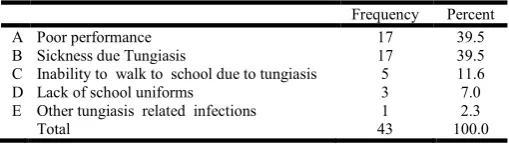
[image:4.595.35.290.202.274.2]Those who indicated sickness as the reason that made them repeat classes were 39.5% while 11.6% indicated inability to walk to school due to Tungiasis infestations. About 7.0% indicated lack of school uniform as a reason while 2.3% indicated that it was due to other Tungiasis related infections. It was observed most of the reasons cited for class repetition were related to Tungiasis infestations, Table 1.
Table 1. All Causes of class repetition
Frequency Percent A Poor performance 17 39.5 B Sickness due Tungiasis 17 39.5 C Inability to walk to school due to tungiasis 5 11.6 D Lack of school uniforms 3 7.0 E Other tungiasis related infections 1 2.3
Total 43 100.0
This study found that, there was a statistical significant relationship between infestation of tungiasis and class repetition (p-value =0.007 (<0.05). This was due to the fact that most pupils failed to proceed to the next grade due to poor
performance resulting from irregular class attendance as a result of tungiasis infestation. These findings show that
tungiasis infestation has an impact on class repetition
Impact of tungiasis infestation on school drop out
The teachers did not have a system for monitoring school drop-outs. However, there was a general assumption among teachers that most children who fail to come to school after sometimes generally transfer to other schools. This study found that 20.5%of the pupils had dropped out of school as a result of tungiasis infestation
DISCUSSION
During this study, the overall prevalence was found to be at 3.8% which is lower than 4.4% recorded by Ngunjiri and Keiyoro (2011) though similar to that reported during the dry season in poor rural communities and urban slums in Brazil,
(Muchlen et al., 2003; Carvalho et al., 2003). Njeumi et al.
(2002) reported a prevalence of about 50% in schoolchildren in different communities in the West Province in Nigeria. Most of the lesions caused by tungiasis were localized on the feet thus making pupils have difficulties in walking due to deformation of the toenails and pain. This study noted that majority of the children walked barefooted to school or at best wore open shoes. Therefore, the high disease prevalence among the children was probably due to their
greater exposure of their feet to Tunga penetrans in the
endemic areas.
Although the rate of jigger infestation varied across different age groups, test results showed that age of the pupils influenced tungiasis infection (P<0.048). The pupils who were very young had higher tungiasis infestation than older ones . This may have been due to limited knowledge about the parasites, inability to care for themselves or playing in
dusty environment where the parasite thrived. These findings
are in agreement those of Muchlen et al. (2003) who also
found high prevalence among children aged between 5–14-years and ≥ 60-year age groups in rural communities in Brazil. One of the possible reason why older children had a lesser prevalence of the disease than younger ones was because most of them were able to take care of their personal hygiene while young children depended on their parents and teachers to directly supervise their personal hygiene. Observations in other studies reveal that skillful older children carry out embedded jigger flea extraction from the feet of their friends and younger children at school (Ugbomoiko
et al., 2008).
Conclusion
In this study majority of the pupils (65.4%) indicated that they had failed to attend their classes due to tungiasis infestation as they could not walk to school due to pain. Discussions with teachers revealed that some pupils had been forced to drop out of school because they could not walk normally and even when they tried, the pain from their feet was too much to bear. Worse still, they had to cope with the stigmatization associated with tungiasis infestation at schools. Our research findings indicated tungiasis related sickness was one of the reasons that made children repeat classes because of poor attendance due to their inability to walk to school. This study found that, there was a significant relationship between infestation of jiggers and class repetition (p-value 0.007 (<0.05). Most pupils failed to proceed to the next grade due to poor performance resulting from irregular class attendance as a result of the disease. More boys dropped out of schools than girls. Majority of the pupils (28.9%) rated their performance as average, 26.4% rated it as poor and 21.5% very poor. The results show that most of the pupils were highly dissatisfied with their performance and had no confidence that they would attain good scores to be admitted in public secondary schools in the country.
Recommendation
The control of tungiasis requires an integrated approach, including clinicians, social workers, public health specialists, veterinarians, and biologists. Furthermore, public policies promoting sustainable changes in the quality of life and improved health will reduce the incidence and parasite burden among the affected communities. Cementing the floors of classrooms and dwelling houses in the communities would
probably interrupt the off host stages of Tunga penetrans
thus reduce prevalence of tungiasis among the children in
endemic areas, also Ade-Serranoet al.(1982).
REFERENCES
Ade-Serrano MA, Olomolehin OG, Adewunmi A. 1982. Treatment of human tungiasis with niridazole (Ambilhar):
a double-blind placebo-controlled trial. Ann Trop Med
Parasitol., 76: 89–92.
Ade-Serrano MA, Ejezie GC, 1981.Prevalence of tungiasis in
Oto-Ijanikinvillage, Badagry, Lagos State, Nigeria. Ann
Ahadi Trust 2009. Africa Health and Development International trust, Jigger menace in Kenya, 2009, Accessed on line on November, 2013 onhttp://www.jigger. ahadi.org/activities.html
Arene FO.1984. The prevalence of sand flea (Tunga
penetrans) among primary and post-primary school pupils
in Choba area of the Niger Delta. Public Health,98:
282–283.
Carvalho RW, Almeida AB, Barbosa-Silva SC. 2003. Thepatternsof tungiasis in Araruama township, stateof Rio
de Janeiro, Brazil. Mem InstOswaldo Cruz,2003; 98:
31–36.
Feldmeier, H, Heukelbach, J., de Oliveira, F.A., Hesse, G., 2006. Tungiasis: a neglected health problem of poor
communities. Trop Med Int Health, 6: 267-72.
Feldmeier, H., Heukelbach, J., Eisele, M., Sousa, A.Q.
2002.Bacterialsuperinfection in human tungiasis. Trop Med
Int Health, 7: 559-64
Feldmeier, H., Heukelbach, J., Costa, A.M., Wilcke, T., Mencke, N. 2004. The animal reservoir of Tunga penetrans in severely affected communities of north-east Brazil.
MedVetEntomol., 18: 329-35.
González A, de Villalobos C, Ranalletta MA2005. Aspectos
adaptativos y biológicos de Tunga penetrans (Linné 1758).
Epidemiología en comunidades aborígenes del norte
argentino. Arch Argent Dermatol,2004; 54: 119–123.
Heukelbach J, Wilcke T, Harms G & Feldmeier,H. 2005. Seasonal variation of tungiasis in an endemic community.
AmericanJournal of Tropical Medicine and Hygiene, 72, 145–149.
Joseph, J.K., Bazile, J., Mutter, J., Shin, S., Ruddle, A., Ivers, L. et al. 2003. Tungiasis in rural Haiti: A community-based
response. Trans R Soc Trop Med Hyg., 100: 970-4.
Kothari,C.R. 2014.Research Methodology: Mathods and
techniques, Newage International, New Dalhi.
Muchlen M. , Heukelbach J, Wilcke T, 2003.Investigations on
the biology, epidemiology, pathology and control of Tunga
penetrans in Brazil II: prevalence, parasite load and topographic distribution of lesions in the population of a
traditional fishing village. Parasitol Res., 90: 449–455.
Njeumi F, Nsangou C, Ndjend AG, 2002. Tunga penetrans au
Cameroun. Rev Méd Vét., 153: 176–180.
Ngunjiri, J. and Keiyoro, P. 2011. Soil factors influencing the
occurrence of Tunga penetrans in Kenya.LAP LAMBERT
Academic publishing GmbH&Co.KG,Germany,7.
Ugbomoiko US, Ariza L, Heukelbach, J. 2008. Pigs are the
most important animal reservoir for Tunga penetrans
(jigger flea) in rural Nigeria. Trop.Doct., 38;266-227.