SPACING EFFECT ON MACRO
*,1
Solange Uwingabire and
1
Department of Soil and Geological Sciences, College of Agriculture, Sokoine University of Agriculture,
2
National Agricultural Export Development (NAEB), P.O. Box 104, Kigali, Rwanda
ARTICLE INFO ABSTRACT
Productivity of pineapple (
material and improved management practices. This study was conducted to determine effect of spacing on growth and development of macro
propagated pineapple plantlets were evaluated at three spacings at RAB Rubona station located in mid-altitude zone of Rwanda during 2011/2012 season; the experimental
randomized complete block (RCBD) with three replications. Data were collected on monthly basis by measuring plant height, length and width of longest leaf and counting the number of functional leaves. The data were analyzed by Microsoft
significant difference test were used to determine if there is any significant difference among micro and macro
analyzed from 258
(P<0.001) differences among propagation modes were found for number of functional leaves, micro propagated pineapple plantlets were found to ha
propagated pineapple plantlets. Significant (P<0.05) differences among macro were observed also for plant height and length of the longest leaf at 379
379th day after transplanting, there were no significant (P>0.05) differences among micro
propagated pineapple plantlets for width of the longest leaf. Analysis of variance showed that there were no significant (P>0.05) differences among spacings for
leaves, length and width of the longest leaf. Interaction between propagation modes and planting densities were found to have no significant (P>0.05) differences for all vegetative parameter. The experiment needs to be co
findings.
Copyright©2016, Solange Uwingabire and Frederic Turinzwenayo.
which permits unrestricted use, distribution, and reproduction in any medium, provided the original work is properly cited.
INTRODUCTION
Horticulture production and consumption dates far back in the pre-colonial era during which native fruits and vegetables formed a considerable proportion of Rwandan’s diets (Rwanda Horticulture Development Authority - RHODA, 2011). New horticultural crops such as pineapple (Ananas comosus Merr) were however later introduced by missionaries during the colonial period (Nyabyenda, 2010). Rwanda needs to diversify its export commodities but farmers are facing problems that limit production, these problems include: lack of high yielding and early maturing planting materials, and in sufficient information about modern agricultur
(RHODA, 2011). Pineapple crop has a very low natural
*Corresponding author: Solange Uwingabire,
Department of Soil and Geological Sciences, College of Agriculture, Sokoine University of Agriculture, P.O. Box 3008, Morogoro, Tanzania.
ISSN: 0975-833X
Article History:
Received 08th August, 2016
Received in revised form
03rd September, 2016
Accepted 12th October, 2016
Published online 30th November,2016
Key words:
Pineapple, Macro-propagated, Micro-propagated, Spacing effect.
Citation: Solange Uwingabire and Frederic Turinzwenayo
Journal of Current Research, 8, (11), 42507-42513.
RESEARCH ARTICLE
SPACING EFFECT ON MACRO- AND MICRO-PROPAGATED PINEAPPLE PLANTLETS
Solange Uwingabire and
2Frederic Turinzwenayo
Department of Soil and Geological Sciences, College of Agriculture, Sokoine University of Agriculture,
P.O. Box 3008, Morogoro, Tanzania
National Agricultural Export Development (NAEB), P.O. Box 104, Kigali, Rwanda
ABSTRACT
Productivity of pineapple (Ananas comosus L. Merr) is primarily limited by unavailability of
material and improved management practices. This study was conducted to determine effect of cing on growth and development of macro- and micro-propagated pineapple. Micro
propagated pineapple plantlets were evaluated at three spacings at RAB Rubona station located in altitude zone of Rwanda during 2011/2012 season; the experimental
randomized complete block (RCBD) with three replications. Data were collected on monthly basis by measuring plant height, length and width of longest leaf and counting the number of functional leaves. The data were analyzed by Microsoft excel and Genstat Discovery Edition 4 Software package, least significant difference test were used to determine if there is any significant difference among micro and macro-propagated pineapple plantlets in their growth resulting from spacing effect. Data analyzed from 258th to 379th day after transplanting; At 379th day after transplanting, highly significant (P<0.001) differences among propagation modes were found for number of functional leaves, micro propagated pineapple plantlets were found to have more number of functional leaves than macro propagated pineapple plantlets. Significant (P<0.05) differences among macro
were observed also for plant height and length of the longest leaf at 379
day after transplanting, there were no significant (P>0.05) differences among micro
propagated pineapple plantlets for width of the longest leaf. Analysis of variance showed that there were no significant (P>0.05) differences among spacings for plant height, number of functional leaves, length and width of the longest leaf. Interaction between propagation modes and planting densities were found to have no significant (P>0.05) differences for all vegetative parameter. The experiment needs to be continued and repeated in other
agro-findings.
Solange Uwingabire and Frederic Turinzwenayo. This is an open access article distributed under the Creative Commons Att use, distribution, and reproduction in any medium, provided the original work is properly cited.
Horticulture production and consumption dates far back in the colonial era during which native fruits and vegetables formed a considerable proportion of Rwandan’s diets (Rwanda RHODA, 2011). New
Ananas comosus L.
) were however later introduced by missionaries during Rwanda needs to diversify its export commodities but farmers are facing problems that limit production, these problems include: lack of high yielding and early maturing planting materials, and in-sufficient information about modern agricultural practices
Pineapple crop has a very low natural
Department of Soil and Geological Sciences, College of Agriculture, Sokoine University of Agriculture, P.O. Box 3008, Morogoro, Tanzania.
multiplication rate; the need to solve this problem has led to
the development of tissue culture (micro
macro-propagation techniques for the pineapple (Rwanda Agriculture Research Institute
pineapple to tolerate prolonged absence of rain and its preference of acid soils makes it an attractive horticultural crop for many parts of Rwanda
Raemaeker, 2001). Considering that horticulture has great potential to alleviate poverty, create employmen
nutritional status, or improves the farming and export capacities its development should be put high on the development agenda of Rwanda (RHODA, 2011 and Ministry of Finance and Economic Planning
Pineapple crop has a very low
about 2 per year, and field grown suckers have a potential risk of propagating diseases (ISAR, 2010 and Ministry of Agriculture and Animal Resources
unequalled alternative for production of planting materi
International Journal of Current Research
Vol. 8, Issue, 11, pp.42507-42513, November, 2016
INTERNATIONAL
Solange Uwingabire and Frederic Turinzwenayo, 2016. “Spacing effect on macro- and micro-propagated pineapple plantlets
PROPAGATED PINEAPPLE PLANTLETS
Frederic Turinzwenayo
Department of Soil and Geological Sciences, College of Agriculture, Sokoine University of Agriculture,
National Agricultural Export Development (NAEB), P.O. Box 104, Kigali, Rwanda
L. Merr) is primarily limited by unavailability of planting
material and improved management practices. This study was conducted to determine effect of propagated pineapple. Micro- and macro-propagated pineapple plantlets were evaluated at three spacings at RAB Rubona station located in
altitude zone of Rwanda during 2011/2012 season; the experimental design used was a randomized complete block (RCBD) with three replications. Data were collected on monthly basis by measuring plant height, length and width of longest leaf and counting the number of functional leaves. excel and Genstat Discovery Edition 4 Software package, least significant difference test were used to determine if there is any significant difference among micro propagated pineapple plantlets in their growth resulting from spacing effect. Data were day after transplanting, highly significant (P<0.001) differences among propagation modes were found for number of functional leaves,
micro-ve more number of functional leamicro-ves than macro-propagated pineapple plantlets. Significant (P<0.05) differences among macro- and micro-macro-propagated were observed also for plant height and length of the longest leaf at 379th day after transplanting. At day after transplanting, there were no significant (P>0.05) differences among micro- and macro-propagated pineapple plantlets for width of the longest leaf. Analysis of variance showed that there
plant height, number of functional leaves, length and width of the longest leaf. Interaction between propagation modes and planting densities were found to have no significant (P>0.05) differences for all vegetative parameter. The -ecological zones to confirm these
is an open access article distributed under the Creative Commons Attribution License, use, distribution, and reproduction in any medium, provided the original work is properly cited.
the need to solve this problem has led to the development of tissue culture (micro-propagation) and propagation techniques for the pineapple (Rwanda Agriculture Research Institute - ISAR, 2010). The ability of
te prolonged absence of rain and its preference of acid soils makes it an attractive horticultural crop for many parts of Rwanda (Izamuhaye, 2010 and
Considering that horticulture has great potential to alleviate poverty, create employment, improve nutritional status, or improves the farming and export capacities its development should be put high on the development agenda of Rwanda (RHODA, 2011 and Ministry of Finance and Economic Planning - MINECOFIN, 2009).
Pineapple crop has a very low natural multiplication rate, about 2 per year, and field grown suckers have a potential risk of propagating diseases (ISAR, 2010 and Ministry of Agriculture and Animal Resources - MINAGRI, 2009). An unequalled alternative for production of planting materials is
INTERNATIONAL JOURNAL OF CURRENT RESEARCH
tissue culture, a technology which has led to the production of large numbers of disease-free planting materials in a short period, and independently of the season (Hawkins et al., 2007). Micro-propagation is used or the establishment of multiplication blocks which then provide conventional planting material for larger production blocks, but macro-propagation will provide ten to 15 planting materials per month (Fitchet, 1990). Farmers need earlier yielding planting material that will continue to give better economic yield;however pineapple is a perennial crop, so optimum spacing between or among plants and better crop management will ensure sustainability in pineapple production that is why it is critically important to evaluate spacing effect on the growth and development of micro-propagated and macro-propagated pineapple plantlets.The goal of this work was to provide recommendations for using the right pineapple planting material at optimum planting density combined with better farming practice.
MATERIALS AND METHODS
Experimental site description
The experiment was carried out at ISAR Rubona station, the actual Rwanda Agricultural Board (RAB) Rubona station, located in Rusatira Sector, Huye District in the Southern Province of Rwanda. It is about 15 km from Huye town along Huye-Kigali road. Rubona station is situated in the
mid-altitude zone with the Geographic coordinates of 2o29’07” S
altitude and 29o47’49” E longitude and about 1650m of
altitude. The daily average temperature is 18oC with annual
rainfall of 1117 mm. The climate is tropical of AW3 type
[image:2.595.314.551.164.236.2]according to Koppen classification. Most of the soil at RAB Rubona station has been classified as clay loam (ISAR, 2010).
Table 1. Meteorological data of RAB Rubona station
Month Rainfall(mm) Temperature (oC)
Tmax Tmin Average
January 11.7 25.7 15.1 20.40
February 74.8 25.4 14.2 19.76
March 77.4 25.3 14.3 19.8
April 214.2 23.8 14.1 18.97
May 241.4 23.3 14.4 18.84
Source: RAB - Rubona Meteological station
Planting material
The tissue culture pineapple plants used for this experiment were obtained from the Rubona tissue culture laboratory, while the macro-propagated plantlets were obtained from a nursery at Rubona. The pineapple cultivar used was smooth cayenne.
Fertilizer used in the experiment was NPK (17-17-17) applied at a
rate of20g per plant. The experimental field was weeded regularly to avoid the development of weed using hand and hoe. Watering and mulching were also done at the beginning and during dry season. A ruler was used to measure the plant height, length and width of the longest leaf. Whereas cablesand bundle wires were used to mark plants sample picked randomly.
Experimental design
Randomized Complete Block Design (RCBD) was used to evaluate treatments. Two propagation modes and three spacings were evaluated in a 2x3 factorial experiment with
three replications at one location. Propagation modes were micro- and macro-propagated pineapple plantlets coded as T and M respectively; and the three spacings weresymbolized by S1 (60x40cm), S2 (45x30cm) and S3 (30x30cm) respectively. Treatment combinations were TS1, TS2, TS3, MS1, MS2, and MS3; Plot size was 1.8 by 4.4m, space between plots was 1m, and 2m between replicates (Table 2).
Table 2. Field layout of 6 treatments randomized in 18 plots
Replication I Replication II Replication III
1001 MS1
004 TS2
2007 TS3
2010 MS1
3013 MS1
3016 TS2 1002
TS1
1005 MS2
2008 TS1
2011 MS3
3014 TS3
3017 MS3 1003
MS3
1006 TS3
2009 MS2
2012 TS2
3015 MS2
3018 TS1 S: spacingsTS1,2,3 and MS1,2,3: Treatment combination
Parameters measured
Variables used to evaluate growth and development of pineapple plantlets were: Plant height (PHT), number of functional leaves (NOFL), length of longest leaf (LLL), and width of longest leaf (WLL). Data were collected on a monthly basis from 10 randomly selected plants from each plot from December to April. Plant height was measured from the soil surface up to the highest leaf tip by straightening all leaves, width was measured at the widest part of the longest leaf. Leaves counted were considered healthy and more than three quarters of the leaf area was green as opposed to yellow and brown leaves.
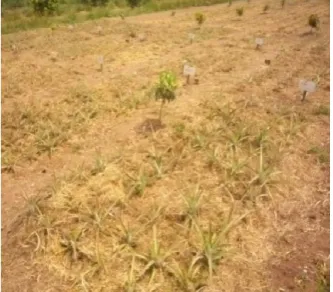
Pineapple trial at RAB Rubona station during 2011/2012 Season
Data analysis
Data were analyzed using Microsoft excel (2007) and Genstat discovery software. Analysis of variance were computed for each trait or parameter and the data were summarized as means of each parameter and presented in figures and tables. Means comparison and separation were done using Least significant difference (LSD at 5% level of probability) to identify significant differences among treatments for the parameters measured.
RESULTS AND DISCUSSION
The analyses of variance indicated that at 258th day after
transplanting there were no significant (p>0.05) differences among micro and macro-propagated pineapple plantlets for plant height and width of the longest leaf; However, significant (P<0.05) differences were observed for number of functional
[image:2.595.351.518.415.561.2]Table 3. Mean squares and their significance levels from the ANOVA for four vegetative parameters evaluated in micro- and macro-propagated plantlets at three planting density at Rubona station during 2011/2012 season
258 th day after transplantation 289 th day after transplantation
Source variation df
Plant height
(cm)
Number of functional
leaves
Length of the longest leaf(cm)
Width of the longest leaf(cm)
Plant height
(cm)
Number of functional leaves
Length of the longest
leaf(cm)
Width of the longest
leaf(cm)
Replication 2 20.0 2.3 14.1 0.3 22.3 0.2 183.4 0.3
Spacing 2 38.9 22.2 84.5 0.4 52.2 5.3 81.4 0.6
Propagation mode 1 7.7 2.4* 3.3* 0.2 1.7* 1.3* 0.6 0.02
Propagation mode× Spacing 2 2.1 1.7 1.2 0.1 1.3 2.1 1.4 0.05
Error 10 9.9 2.4 7.2 0.2 5.7 0.8 6.3 0.15
Total 17 198.5 59.6 193.9 4 160.3 20.6 17.3 3
CV (%) 10.8 9.8 10.1 16.3 7.4 7.6 8.5 12.1
[image:3.595.44.553.268.398.2]df: degree of freedom*, **: Significant at 5% and 1% levels of probability, respectivelyCV: Coefficient of variation
Table 4. Mean squares and their significance levels from the ANOVA for four vegetative parameters evaluated in micro- and macro-propagated plantlets at three planting density at Rubona station during 2011/2012 season
318 th day after transplantation 348 th day after transplantation
Source variation df Plant height
(cm)
Number of functional
leaves
Length of the longest leaf(cm)
Width of the longest leaf(cm)
Plant height (cm)
Number of functional leaves
Length of the longest leaf(cm)
Width of the longest leaf(cm)
Replication 2 35.3 1.2 17.3 0.3 25.7 0.8 7.9 0.2
Spacing 2 102.6 28.3 106.8 1 119.3 18.3 163.8 0.9
Propagation mode 1 2.4* 0.6** 1.6* 0.0032* 4* 0.067* 0.07* 0.11*
Propagation mode× Spacing
2 0.5 1.2 0.1 0.02 3.8 1.4 1.67 0.006
Error 10 14.1 1.2 13.4 0.13 13.8 1.5 9.3 0.07
Total 17 321.2 46.5 279.3 2.8 325.1 38 276.4 2.4
CV (%) 10.5 8.5 11.3 11.2 9.8 9.4 9 8.1
[image:3.595.44.555.451.549.2]df: degree of freedom*, **: Significant at 5% and 1% levels of probability, respectivelyCV: Coefficient of variation
Table 5. Mean squares and their significance levels from the ANOVA for four vegetative parameters evaluated in micro- and macro-propagated plantlets at three planting density at Rubona station during 2011/2012 season
379 th day after transplantation
Source variation df Plant height
(cm)
Number of functional leaves Length of the longest
leaf(cm)
Width of the longest leaf(cm)
Replication 2 29.6 0.7 13.0 0.2
Spacing 2 98.6 31.2 167.2 0.02
Propagation mode 1 2.2* 0.115** 3.8* 1.1
Propagation mode× Spacing 2 8.4 0.08 7.0 1.2
Error 10 17.7 0.7 18.4 1.0
Total 17 356.6 40.5 399.5 15.7
CV (%) 10.5 6.5 11.8 27.9
df: degree of freedom*, **: Significant at 5% and 1% levels of probability, respectivelyCV: Coefficient of variation
Table 6. Means of four vegetative parameters evaluated in micro- and macro-propagated pineapple at Rubona station at 258th day after transplantation during 2011/2012 season
Propagation mode Plant height (cm) Number of functional leaves Length of the longest leaf(cm) Width of the longest leaf(cm)
Micro-propagated pineapple 27.7 17.1 24.3 2.7
Macro-propagated pineapple 30.6 14.9 28.7 3.0
LSD (at 5% level) NS 1.6 2.8 NS
CV% 10.8 9.8 10.1 16.3
CV: Coefficient of variation NS: no significance at 5% level of probabilityLSD: Least significant difference
Table 7. Means of four vegetative parameters evaluated in micro- and macro-propagated pineapple at Rubona station at 289th day after transplantation during 2011/2012 season
Propagation mode Plant height(cm) Number of functional leaves Length of the longest leaf(cm) Width of the longest leaf(cm)
Micro-propagated pineapple 30.6 12.4 27.5 3.0
Macro-propagated pineapple 34.0 11.3 31.8 3.4
LSD (at 5% level) 2.52 0.941 NS NS
CV% 7.4 7.6 8.5 12.1
[image:3.595.33.557.604.656.2] [image:3.595.34.558.708.761.2]Table 8. Means of four vegetative parameters evaluated in micro- and macro-propagated pineapple at Rubona station at 318th day after transplantation during 2011/2012 season
Propagation mode Plant height(cm) Number of functional leaves Length of the longest leaf(cm) Width of the longest leaf(cm)
Micro-propagated pineapple 33.6 14.1 29.9 2.9
Macro-propagated pineapple 38.4 11.6 34.8 3.5
LSD (at 5% level) 3.9 1.1 3.8 0.4
CV% 10.5 8.5 11.3 11.2
[image:4.595.34.553.195.248.2]CV: Coefficient of variation LSD: Least significant difference
Table 9. Means of four vegetative parameters evaluated in micro- and macro-propagated pineapple at Rubona station at 348th day after transplantation during 2011/2012 season
Propagation mode Plant height(cm) Number of functional leaves Length of the longest leaf(cm) Width of the longest leaf(cm)
Micro-propagated pineapple 35.4 14.1 30.9 3.1
Macro-propagated pineapple 40.5 12 37.0 3.5
LSD (at 5% level) 3.9 1.3 3.2 0.3
CV% 9.8 9.4 9 8.1
[image:4.595.36.556.300.351.2]CV: Coefficient of variation LSD: Least significant difference
Table 10. Means of four vegetative parameters evaluated in micro- and macro-propagated pineapple at Rubona station at 379th day after transplantation during 2011/2012 season
Propagation mode Plant height(cm) Number of functional leaves Length of the longest leaf(cm) Width of the longest leaf(cm)
Micro-propagated pineapple 37.9 14.7 33.3 3.7
Macro-propagated pineapple 42.6 12.1 39.4 3.7
LSD (at 5% level) 4.4 0.9 4.51 NS
CV% 10.5 6.5 11.8 27.9
CV: Coefficient of variation LSD: Least significant difference
Table 11. Means of four vegetative parameters measured in the evaluation of spacing effect on micro- and macro-propagated pineapple at Rubona station at 258th and 289th day after transplantation during 2011/2012 season
258 th day after transplantation 289 th day after transplantation
Spacing Plant
height(cm)
Number of functional leaves
Length of the longest leaf(cm)
Width of the longest leaf(cm)
Plant height(cm)
Number of functional leaves
Length of the longest leaf(cm)
Width of the longest leaf(cm)
S1(60x40cm) 27.9 15.3 25.7 2.7 32.3 12.1 29.7 3.2
S2(45x30cm) 29.4 16.6 26.6 2.8 31.8 12.1 29.3 3.2
S3(30x30cm) 30.1 16.0 27.2 3.1 32.8 11.3 30 3.3
LSD (at 5% level) NS NS NS NS NS NS NS NS
CV% 10.8 9.8 10.1 16.3 7.4 7.6 8.5 12.1
LSD: Least significant differenceCV: Coefficient of variation NS: No significant difference at 5% level of probabilityS1,2,3: Spacing
Table 12. Means of four vegetative parameters measured in the evaluation of spacing effect on micro- and macro-propagated pineapple at Rubona station at 318th and 348th day after transplantation during 2011/2012 season
318th day after transplantation 348th day after transplantation
Spacing Plant
height(cm)
Number of functional leaves
Length of the longest leaf(cm)
Width of the longest leaf(cm)
Plant height(cm)
Number of functional leaves
Length of the longest leaf(cm)
Width of the longest leaf(cm)
S1(60x40cm) 36.7 12.6 31.9 3.2 37.0 12.9 34 3.1
S2(45x30cm) 35.4 13.2 32.2 3.2 38.3 13.2 33.9 3.4
S3(30x30cm) 35.9 12.8 33 3.2 38.5 13.0 34.1 3.4
LSD (at 5% level) NS NS NS NS NS NS NS NS
CV% 10.5 8.5 11.3 11.2 9.8 9.4 9 8.1
LSD: Least significant differenceCV: Coefficient of variation NS: No significant difference at 5% level of probabilityS1,2,3: Spacing
Table 13. Means of four vegetative parameters measured in the evaluation of spacing effect on micro- and macro-propagated pineapple at Rubona station at 379th day after transplantation during 2011/2012 season
379 th day after transplantation
Spacing Plant height(cm) Number of functional leaves Length of the longest leaf(cm) Width of the longest leaf(cm)
S1(60x40cm) 39.7 13.3 35.5 3.3
S2(45x30cm) 40.2 13.5 37 4.2
S3(30x30cm) 40.9 13.3 36.6 3.5
LSD (at 5% level) NS NS NS NS
CV% 10.5 6.5 11.8 27.9
LSD: Least significant differenceCV: Coefficient of variation NS: No significant difference at 5% level of probabilityS1,2,3: Spacing
[image:4.595.47.549.404.495.2] [image:4.595.46.548.551.639.2] [image:4.595.41.559.690.761.2]Figure 1. Variation of plant height, number of functional leaves, length and width of the longest leaf in micro
propagated pineapple plantlets evaluated at S1 (60x40 cm) planting density from December 2011 to April 2012 at RAB Rubona station
Figure 2. Variation of plant height, number of functional leaves, length and width of the longest leaf in micro propagated pineapple plantlets evaluated at S2 (45x30 cm) planting density from December 2011 to April 2012 at RAB R station
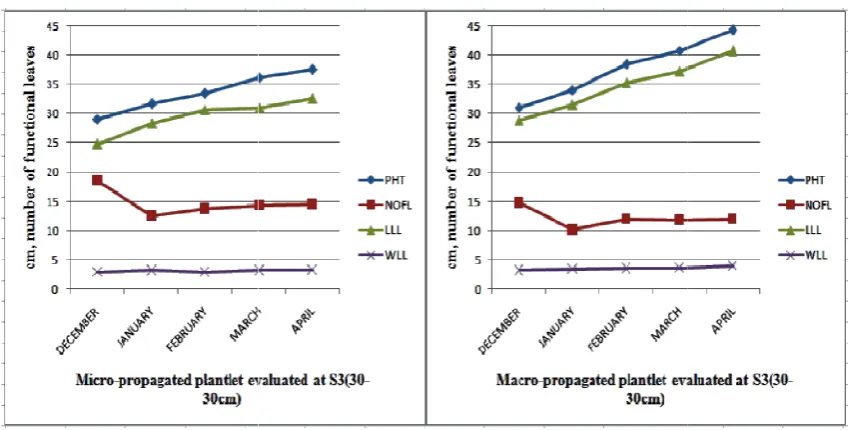
Figure 3. Variation of plant height, number of functional leaves, length and width of the longest leaf in micro propagated pineapple plantlets evaluated at S3 (30x30 cm) planting density from December 2
station
Variation of plant height, number of functional leaves, length and width of the longest leaf in micro
propagated pineapple plantlets evaluated at S1 (60x40 cm) planting density from December 2011 to April 2012 at RAB Rubona
Variation of plant height, number of functional leaves, length and width of the longest leaf in micro propagated pineapple plantlets evaluated at S2 (45x30 cm) planting density from December 2011 to April 2012 at RAB R
. Variation of plant height, number of functional leaves, length and width of the longest leaf in micro
propagated pineapple plantlets evaluated at S3 (30x30 cm) planting density from December 2011 to April 2012 at RAB Rubona Variation of plant height, number of functional leaves, length and width of the longest leaf in micro- and macro-propagated pineapple plantlets evaluated at S1 (60x40 cm) planting density from December 2011 to April 2012 at RAB Rubona
Variation of plant height, number of functional leaves, length and width of the longest leaf in micro- and macro-propagated pineapple plantlets evaluated at S2 (45x30 cm) planting density from December 2011 to April 2012 at RAB Rubona
[image:5.595.80.515.50.247.2] [image:5.595.88.514.298.489.2] [image:5.595.86.513.538.753.2]However, micro-propagated had more number of functional leaves (17) than macro-propagated pineapple plantlets while macro-propagated plantlets were found to have longer leaves
(28.7cm) than micro-propagated pineapple at 258th day after
transplanting (Table 6). Though, Munyaneza (2011) and Bartholomew et al.(2003), reported that macro-propagated pineapple plantlets were found to perform better than micro-propagated at early stage after transplanting. Furthermore, at
289th days after transplanting, analyses of variance revealed
that there were significant (p<0.05) differences among the micro and macro-propagated plantlets for plant height and number of functional leaves (Table 3). Thus from laboratory to experimental field, micro-propagated pineapple plantlets were exposed to harsh environmental condition while macro-propagated were already adapted to field environmental condition this is why at early stage after transplanting macro-propagated were likely to perform better than micro-propagated pineapple. Similar results were obtained by Martha
et al. (2011) and Nguyen et al. (2010), for banana production.
Macro-propagated pineapple height was 34cm while micro-propagated had 30.6cm (Table 7). However, there were no significant (P>0.05) differences for length and width of longest
leaf at 289th day after transplanting (Table 3). The analyses of
variance indicated that at 318th day after transplanting, there
were highly significant (p<0.001) differences among the micro and macro-propagated pineapple for number of functional leaves (Table 4). Pineapples plantlets produced from tissue culture technology were found to have more numbers of
functional leaves than macro-propagated pineapple
(14.1and11.6 leaves respectively) (Table 8). Significant (P<0.05) differences were found for plant height, length and
width of longest leaf at 318th and 348th day after transplanting
(Table 4). Micro-propagated were found to have more number of functional leaves while macro-propagated pineapple plantlets had taller plant height, longer length and wider width of the longest leaf (Table 8 and 9).
At 379th day after transplanting, significant (p<0.05)
differences were observed among micro and macro-propagated pineapple for plant height, length of the longest leaf however highly significant (P<0.001) differences were found for number of functional leaves; However, no significant (P>0.05) differences were observed for width of the longest leaf (Table 5). Taller plant height was found in macro-propagated pineapple (42.6cm) while micro-propagated had more number of functional leaves (14.7) (Table 10). At early stage after transplanting, macro-propagated plantlets perform better than micro-propagated plantlets; but at full vegetative development micro- and macro-propagated plant have no significant difference in their growth and development. Therefore, tissue culture technology can be used in harsh environment and for intensive cropping at initial stage where there is a limited supply of vegetative propagation materials (Turinzwenayo, 2012). Differences observed among planting densities were not significant (p>0.05) neither for plant height, number of functional leaves nor for the length and width of the longest
leaf at 258th, 289th ,318th ,349th and 379th day after
transplanting (Table 3, 4, 5). Nguyen et al. (2010), reported that increasing planting density tended to increase plant height. Spacing of 30cm between rows and 30cm among pineapple plants produced 55,500 plants per hectare. According to Lacoeuilhe (1974), cited by NARI, (2010), a farmer can produce a maximum of pineapple per hectare (77,000/ ha) if he uses 20cm spacing between plants and 40cm spacing among
is obvious because high planting density increase number of plants produced per hectare. The analyses of variance indicated
that from 258thto 379th day after transplanting, there were no
significant (p>0.05) differences among propagation modes and planting density interactions for plant height, number of functional leaves, length and width of the longest leaf (Table 3, 4, 5). Consequently, the start of vegetative growth, statistical analysis also indicated that number of functional leaves decreased, while other vegetative parameters increased linearly
from 258th to 379th day after transplanting for both micro- and
macro-propagated pineapple plantlets (Figure 1, 2, 3). In this study, it was observed that number of functional leaves
decreased from 258th to379th for both micro and
macro-propagated pineapple.
Conclusions and Recommendations
In general, taller plants heights were observed in both micro- and macro-propagated pineapple plantlets at a spacing of 30x30cm (55,500 plants/ha). Micro-propagated pineapple plantlets were found to have more number of functional leaves than macro-propagated ones. Plant vigor was almost the same in micro- and macro-propagated pineapple plantlets; plant height, length and width of the longest leaf increased linearly
from 258th to379th day after transplanting, while number of
functional leaves decreased from earlier stage after transplanting up to 12 months after transplanting. Therefore, Macro-propagated pineapple plantlets should be used as planting material after further evaluation of planting density effect on growth and development of micro-and macro-propagated pineapple. For the fact that pineapple (Ananas
comosus L. Merr) is a perennial crop this research should be
repeated in different agro-ecological zones in order to confirm these results and formulate more valid conclusions. This research should also be continued until the harvesting time when it will be possible to determine the best performing plantlets on growth and yield.
Acknowledgments
The authors are thankful for the financial support provided by Alliance for Green Revolution for Africa (AGRA) and to the valuable guidance and technical assistance received fromISAR Rubona, the actual Rwanda Agricultural Board (RAB) staffs.
REFERENCES
Bartholomew, D.P., Paull, R.E. and Rohrbarch K.G. 2003. The
pineapple, botany, production and uses, CABI Publishing,
New York, Pp. 3: 96 - 263 pp.
Charrier, A., Michel, J., Hamon, S. and Nicolas, D. 1997.
L’amerioration des plantes tropical, CIRAD ET ORSTOM, France, pp 67.
Dalldolf, R. 1990. Pineapple cultivar in South Africa. Pineapple Ser C1. Farming in South Africa, Pp.183. Fitchet, M. 1990. Clonal propagation of Queen and Smooth
Cayenne pineapples. Acta Horticulture275: 261 -266 pp.
Glennie, J.D. 1991. Pineapples – Weed Control. Queensland Farm Note F211. Department of Primary Industries, Brisbane, Australia.
Hawkins, James D. and Richard, 2007. Failure of the
Hawaiian Pineapple Company. Available at http://tpss.hawaii.edu/pineapple/pinegrow.htm. (Accessed on 20/2/2012).
Heenkenda, H.M.S. 1993. Effect of plant size on sucker promotion in Mauritius pineapple by mechanical decapitation. Acta Horticulturae 334: 331–336.
ISAR, 2010. Report of pineapple and passion fruit-APFH, Pp.1, http://www.isar.rw/spip.php?article28(consulted on 22 December 2011).
Izamuhaye, J.C., 2010. Inventory of existing planting material
for target priory horticultural crops. Musanze: ISAE.
Kayitesi, R. 2011. Factors Affecting Small Scale Farmers’
Pineapple Production Rwanda: A Research Project
submitted to Van Hall Larenstein University of Applied Sciences, Netherlands, Pp. 11 - 52.
Leal, F. 1990. On the validity of Ananas monstruosus. Journal of the Bromeliad Society40: 246–249.
Martha, R.K., 2011International e-Conference on Agricultural Biosciences 2011 Proceedings published at http://www.m.
elewa.org/econferenceIeCAB.php Comparing initial
performance of macro-propagated, tissue cultured and naturally regenerated banana seedlings Abstract ID: IeCAB011-418.
MINAGRI, 2006: RHODA business plan 2006 to 2010, Kigali.
MINAGRI, 2009. Imfashanyigisho k’ubuhinzi bwa
kamaramasenge, Inanasi na marakuja, Kigali, 23-43 pp.
MINECOFIN 2011. Rwanda Economic Update, Pp.15, from http://www.minecofin.gov.rw/webfm_send/2234
(consulted on 12 April 2012).
MINICOM, 2009. Moving up the value chain, strategic Plan 2009-2012, Kigali, August 2009, 8-12pp. Available at http://www.minicom.gov.rw/IMG/pdf/MINICOM_STRAT EGIC_PLAN_2009-2012.pdf (consulted on 12 April 2012).
Munyaneza, J. 2011. Evaluation of the performance of the
micro-propagated and macro-propagated pineapple plantlets under field conditions and effect of spacing on growth. Research project submitted in Higher institute of
agriculture and animal husbandry (ISAE- BUSOGO). NARI, 1994. Pineapple production practices. http://
businessafrica.net/africabiz/pineapple_booklet.pdf, (Accessed on 25/3/2012).
NARI, 2010. Pineapple production practices. Available at http://businessafrica.net/africabiz/pineapple_booklet.pdf, Accessed on 25/2/2012.
Nguyen, Q.H., Dao, T.K. and Nguyen, T. H. 2010. Fruit and Vegetable Research Institute. Newsletter of the Pineapple
Working Group, International Society for Horticultural Science, Trauquy, Gialam, Hanoi, and Vietnam. Pp.23,
(available at http://www.ishs-horticulture.org/working
groups/pineapple/PineNews17_addendum.pdf (Accessed
on 25/5/2012).
Nyabyenda, P. 2000. L’ananas, fiches descriptive des variétés. RAB Rubona station.
Okimoto, M.C. 1948. Anatomy and histology of the pineapple inflorescence and fruit. Botanical Gazette 110: 217–231. Raemaeker, R. H. 2001. Crop production in tropical Africa.
Directorate general for international Co-operation (DGIC), Brussels, Belgium, pp.1540.
RHODA, 2011,Horticulture Policy, Business Plan 2006-2010,
1Pp. Available at http://www.naeb.gov.rw/index.
php?option=com_content&view=article&id=71&Itemid=7 6 (consulted on 12 April 2012).
Sanewski, G.M. and Giles, J. 1997. Blackheart resistance in three clones of pineapple (Ananas comosus (L.) Merr.) In
subtropical Queensland. Australia Journal for
Experimental Agriculture 37: 459–461.
Stephen, I. and William, B. M. 1971. Handbook in research
and evaluation: A collection of principles, design, and
evaluation of studies in education and the behavioral Sciences, San Diego, California, 50-51 pp.
Swete Kelly, D. and Bartholomew, D.P. 1993. Other
disorders. In: Broadley, R.H., Wassman, R.C. and Sinclair,
E. (Eds) Pineapple Pests and Disorders. Queensland Department of Primary Industries, Brisbane, 43–52 pp. Thompson, A.K. 2003. Fruits and Vegetables: Harvesting,
Handling and storage, British library, UK, 306-308 pp.
Turinzwenayo, F.2012. Evaluation of spacing effect on macro-
and micro-propagated pineapple plantlets.Dissertation submitted to the Faculty of Agriculture in partial fulfillment of the requirements for the award of the Bachelor of Science with Honours Degree in Crop Science at National University of Rwanda, Butare, Rwanda, pp. 127.
United Nations, 2003. Organic fruits and vegetables from the
tropics. Market, Certification, and production information for producers and international trading companies, New
York and Geneva, 119-125pp.