ISSN Online: 2164-5175 ISSN Print: 2164-5167
DOI: 10.4236/ajibm.2018.811149 Nov. 28, 2018 2231 American Journal of Industrial and Business Management
Innovation Ecosystem Analysis 1986-2017: A
Citation-Based Literature Survey
Yangyi Meng, Yutong Ma
School of Business Administration, South China University of Technology, Guangzhou, China
Abstract
This paper uses the method of main path and content analysis to analyze the important scholars, influential journals and key literatures in the field of in-novation ecosystem. The theoretical development skeleton of inin-novation ecosystem research has been clearly constructed. The study shows that the innovation ecosystem theory, as a new field of research, is developing rapidly. The research focuses on three new fields: business, technology and service innovation ecosystem. The research early focused on strategic management and innovation systems, but it focuses on the ecology of various disciplines now. Value co-creation gradually becomes the main driving force to promote the development of innovation ecosystem. Further, based on the structural analysis of documents, the paper constructs a panoramic theoretical frame-work for the development of the innovation ecosystem from the perspectives of innovation, driving factors, innovation subject, innovation structure, in-novation community and inin-novation risk, putting forward the future research direction of the innovation ecosystem.
Keywords
Innovation Ecosystem, Citation Network Analysis, Main Path Method, Social Network Analysis
1. Introduction
With the increasingly fierce global competition, more and more enterprises realize that they can enhance their core competitiveness and create business val-ue through a healthy ecosystem. American scholar Moore first puts forward the new concept of “business ecosystem” in 1993. The emergence of business eco-system provides a new perspective for enterprises and creates a unique business
How to cite this paper: Meng, Y.Y. and Ma, Y.T. (2018) Innovation Ecosystem Analysis 1986-2017: A Citation-Based
Lite-rature Survey. American Journal of
Indus-trial and Business Management, 8, 2231-2255.
https://doi.org/10.4236/ajibm.2018.811149
Received: October 24, 2018 Accepted: November 25, 2018 Published: November 28, 2018
Copyright © 2018 by authors and Scientific Research Publishing Inc. This work is licensed under the Creative Commons Attribution International License (CC BY 4.0).
DOI: 10.4236/ajibm.2018.811149 2232 American Journal of Industrial and Business Management operation model (Adner, 2006; Singer, 2006; Horn, 2005). In the business eco-system, successful companies can create a “platform” (service, tool, or technolo-gy domain, etc.) that allows technolotechnolo-gy to flow throughout the ecosystem, al-lowing other ecosystem members to use the platform to achieve their business goals (Moore, 1993; Iansiti and Levien, 2004). Subsequently, the concept of technology ecosystem was proposed and used to describe the relationship be-tween technology and organization. Rosenkopf and Tushman use the system view to analyze inter-organizational relationships and study the co-evolution of technology and organization. In addition, some researchers argue that technol-ogy cannot be analyzed in isolation. Dosi’s paradigm, Nelson’s & Winter’s tech-nological systems and Sood’s & Tellis’ platform innovations all emphasize evolu-tionary analysis of technology as a system. Finally, with the concept of service ecosystem emerges, which is defined as “Create interconnected, relatively inde-pendent and self-regulated resource integration systems (Vargo & Akaka, 2012) by sharing institutional logic and common values exchanged through services”, which emphasize that in order to survive, enterprises need to change themselves and resolve conflicts among different roles in the management service ecosys-tem. To manage these conflicts, Lusch and Nambisan (2015) point out that ser-vice ecosystem needs to develop and maintain a “shared worldview” among par-ticipants and implement a “participatory architecture” or a service platform to coordinate. At the same time, some researchers have noted that there may be tensions among participants in the service ecosystem due to lack of coordinated guidance to their institutions (Solomon, Surprenant, Czepiel & Gutman, 1985; Venkatesh, Penaloza & Firat, 2006; Vargo & Lusch, 2011).
Nevertheless, there are still many deficiencies and gaps in the study of innova-tion ecosystem. First of all, the research on innovainnova-tion ecosystem is still focus on case studies, and theoretical research is at the stage of exploration. Secondly, based on the different perspectives chosen by different authors, the research of innovation ecosystem is dispersed, and it is weakly related to the theory, which weakens the possibility of communication between literature and theory. This paper combs the development path of innovation ecosystem knowledge through the main path method and extends the theoretical framework of the knowledge based on existing theories. Finally this paper builds a framework for the devel-opment of innovative ecosystem.
DOI: 10.4236/ajibm.2018.811149 2233 American Journal of Industrial and Business Management
2. Literature Review and Structure
To explore the development and evolution of a field, Bibliometrics is a very basic and effective research method. It involves general statistical analysis of relevant research, such as the overall development trend of the field, national distribu-tion, journal distribution and High-yielding scholars. In addidistribu-tion, Bibliometrics is also widely used in scientific research evaluation. This quantitative analysis is objective and clear [1]. It overcomes the shortage of subjectivity in expert evalu-ation and lays a foundevalu-ation for basic metrology and research in emerging discip-lines. Understanding the development trend of emerging fields is a topic of great
concern for science and technology policy-makers [2]. It helps to optimize the
allocation of scientific and technological resources and carry out reasonable technology forecasting. Based on this, an attractive direction is to explore the evolutionary footprints and hot topics in emerging areas, so as to reveal the theoretical knowledge base and theme development law of the research. In a certain period of time, the most active development direction of research topic representation has attracted more scientific attention. Knowledge base is the knowledge clustering formed by the co-citation relationship derived from the
research topic [3]. At present, many research methods are used to analyze the
theoretical knowledge base and research topics, such as historical mapping, co-citation of literature, co-word Analysis and journal atlas. Generally speaking, scholars at home and abroad generally pay attention to the key driving force of innovation on economic and social development, science and technology and economy. The innovation ecosystem has also become a research focus in the field of innovation. Based on the basic ideas of ecology and organic mode, this paper explores the structure, rules, governance and strategy of innovative eco-system by more efficiency approach, and obtains some research results. Of course, the research on the innovation ecosystem is still in its infancy, and the literature is hard to say. In addition, according to the articles in the main path, it can be seen that the main articles focus on using case or empirical methods to study a specific problem. There are few literatures to sort out the context of this research field. This paper fills the gap and combs the overall framework and theoretical basis for the development of innovative ecosystems. The following
(Figure 1) is the overall framework of this article.
3. Methodologies
This study applies two citation-based methodologies: the main path method and
the measurement of different indexes to reveal the law of its development [4].
DOI: 10.4236/ajibm.2018.811149 2234 American Journal of Industrial and Business Management
Figure 1. The framework of this paper.
3.1. Main Path Analysis
In the course of scientific fields’ development, several ideas and opinions are proposed continuously. Along the way, some ideas stay and some fade away. Those opinions that stay usually raise wide and long-lasting attention. This study can find ideas that are proposed in the course of innovation ecosystem development stay and make a significant influence upon this field.
The main path method is different from the traditional literature coupling and co-citation methods. The main path method is more concerned with the
con-nections among nodes in the citation network. Hummon and Doreian (1989) [5]
first introduced main path method and use citation information in academic li-terature or patents to trace the main idea flow in a scientific discipline. When a publication cites a previous work, relevant knowledge will flow from the pre-vious work to the citing publication. This method is based on the citation net-work and the scientific publications are seen as nodes of a netnet-work. Moreover citation information is used to establish links among nodes. It is difficult to trace the flow of ideas if the network grows larger. Hummon and Doreian (1989) sug-gest an approach to simplify the task in a large citation network: tracing only the “main path”. Identifying the importance of each citation link in the network is the first step in finding the main path. The importance of each citation can be measured by counting the times a citation link has been traversed were one ex-hausts the search from a set of starting nodes to another set of ending nodes. There are several variations of ways to do the count, for example Node pair pro-jection count (NPPC), search path link count (SPLC), search path nodes pair (SPNP), and search path count (SPC). This paper choose to use SPC as it is recommended by Batagelj (2003) [6] as the first choice. In a citation network, a “source” is a node that is cited, but cites no other nodes; a “sink” is a node that cites other nodes, but is not cited. In other words, sources are the origins of
Innovation Ecosystem
Methodologies: Main path, Key index, Growth curve
Researchers and
Journals statistic Key literature statistic Main research countries and institutions Key research areas statistic
Citation chronological chart Local main path and global main path
Multipath analysis
Theoretical framework of innovation ecosystem
DOI: 10.4236/ajibm.2018.811149 2235 American Journal of Industrial and Business Management knowledge, while sinks are the end points of the knowledge dissemination. In this paper, the main path method is used to analyze the key academic papers and the main development of the discipline trend. The local main path algorithm focuses on the maximum SPC value of the current connection, which
emphasiz-es the importance of the local knowledge [7]. Compared with the local main
path, the global main path is more concerned with the overall importance of knowledge dissemination. In fact, the two methods are complementary to each other, and it is more convincing to take into account both than to consider only one. Moreover the multiple global main paths is the expansion of the main path, and the application of these three methods will be more systematic, comprehen-sive and detailed to show the process of the development of innovation ecosys-tem.
3.2. Key Index Selection
In this paper, TLCS (total local citation score), TGCS (total global citation) and h-index were used to measure the innovation ecosystem. The higher the citation frequency, the more important the author is in this field. And then the Authori-ties and Hubs indicators can provide a new perspective which is determine the vertex importance by adjacent points. Authorities are important recipients of the literature and Hubs are important senders which connected with important Au-thorities. The academic paper could become an important node in the innova-tion ecosystem literature, if the node is an important recipient and dissemina-tion point of the literature [8].
3.3. Growth Curve Analysis
In this paper, the growth curve method is commonly used to project the lifecycle of a physical or social system. Moreover, the future development trend of know-ledge is revealed through the analysis of the growth curve of the published lite-ratures in the field of innovation ecosystem. Growth curve analysis is based on the assumption that the growth of objects in a system such as human population growth on earth, bacteria expansion in laboratories. In this approach, when a system develops to a certain degree, resource scarcity and environmental factors will inhibit further growth. It is generally believed that the growth of scientific articles is not at the same rate. It increases a little slow in the beginning. At a certain point, it speeds up exponentially. After passing the “midpoint” (where the growth rate inflects), the growth slows down and eventually reaches a growth limit point. The growth curve has a good match between the logical function and the time series data, so that scholars are able to predict the growth limit, the midpoint, and the life cycle of an S-shaped curve [9].
Mathematically, an S-shaped curve can be represented with a logistic function:
( )
( )
(
)(
)
1 exp ln 81 m
k S t
t t t
=
+ − − (1)
DOI: 10.4236/ajibm.2018.811149 2236 American Journal of Industrial and Business Management the lifecycle, is defined as the time the development takes to grow from 10% to 90% of the growth limit.
4. Data Source and Basic Statistics
4.1. Data Source
The data source of this paper is web of science database, which is the most au-thoritative and important citation information database in the world. Around the theme of innovation ecosystem research, according to the search strategy of “theme = innovation ecosystem*”, “type of literature = Article” “the time span = all year”, “database = SCI-EXPANDED, SSCI, A&HCI, CPCI-S, CPCI-SSH, CCR-EXPANDED, IC”, for data retrieval of relevant literature retrieval. We ob-tained a total of 1655 articles. In order to explore the present and future trends of the innovation ecosystem, this paper makes a statistical analysis of the litera-ture published in the field of innovation ecosystem. On the whole, the number of publications on the theme of innovation ecosystem presents a gradual upward
trend, as shown in Figure 2. Among them, there is a slow rise period in
1993-2006 years, and the average annual number of posts is not more than 50. Since 2006, the number of publications has been increasing, reaching 396 in 2016 (due to the incompleteness of the data in 2017). At the same time, from the TLCS (total local citation score) and TGCS (total global citation score), the im-pact of the literature reflected by the analysis of the relevant literature in the field of influence (TLCS) showed a gradual upward trend. From the overall statistics, the number of papers has been rising steadily. TLCS has been improving steadily and TLGS has been increasing continuously. It shows that more and more scho-lars pay attention to the research of innovation ecosystem, and the influence of different fields and disciplines is more extensive.
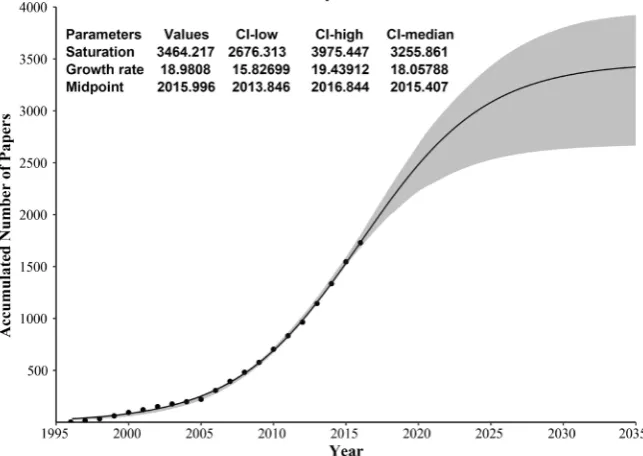
Based on the statistical data of the number of paper published over the years in innovation ecosystem, this paper make full use of the logistic growth curve to predict the trend of papers in the field of innovation ecosystem. From Figure 3, we can obtain that innovation ecosystem experiences an initial stage and now in the process of continuous development period. The logistic growth curve of the trend suggest that innovation ecosystem would enter a rapid development pe-riod after 2015 and then the number of published will be saturated and stable in a certain range.
4.2. Basic Statistic
4.2.1. Researchers and Journals Statistic
DOI: 10.4236/ajibm.2018.811149 2237 American Journal of Industrial and Business Management
[image:7.595.206.540.63.183.2]Figure 2. Published papers per year of innovation ecosystem. Data sources: web of science database.
Figure 3. Growth trend of innovation ecosystem. Data sources: web of science database.
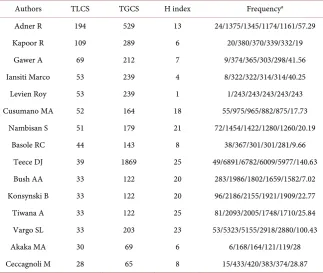
influence. Table 1 lists the top 15 authors in the field of innovation ecosystem according to their TLCS. The TGCS ranking and h-index ranking of these
au-thors is also presented. As we can be seen from Table 1, Adner R, Kapoor R,
Gawer A, Iansiti Marco and Levien Roy are the top 5 researchers by ranking TLCS. Teece DJ, Adner R, Kapoor R, Iansiti Marco and Levien Roy are the top 5 authors on the basis of TGCS ranking (as shown in Table 1) and the result illu-strates the importance of the above authors in the field of innovation ecosystem. At the same time, this paper uses the h-index which means that an author has h articles, each cited at least h times, while the other articles are cited less than h times each. h-index can take into account the quality and quantity of the indi-vidual scientific output to measure so that the evaluation of the influence is more
reasonable [10]. Teece DJ, Tiwana A, Vargo SL, Bush AA, Konsynski have
high-er h-index value in the field of innovation ecosystem. It shows that the scholars have published more quality academic papers in the development of innovative ecosystem, and they have higher academic influence.
0 5 2 7 3 24 1 5 57 14 92 81 84 106 158 75 57 139 174 128 31 10
1 2 7 9 9 9 12 20 18 24 29 67 68
96 80 101 132
185 255 292
396
218
0 200 400 600
0 2000 4000 6000
[image:7.595.212.534.240.468.2]DOI: 10.4236/ajibm.2018.811149 2238 American Journal of Industrial and Business Management
Table 1. Top 15 researchers of innovation ecosystem.
Authors TLCS TGCS H index Frequencya
Adner R 194 529 13 24/1375/1345/1174/1161/57.29
Kapoor R 109 289 6 20/380/370/339/332/19
Gawer A 69 212 7 9/374/365/303/298/41.56
Iansiti Marco 53 239 4 8/322/322/314/314/40.25
Levien Roy 53 239 1 1/243/243/243/243/243
Cusumano MA 52 164 18 55/975/965/882/875/17.73
Nambisan S 51 179 21 72/1454/1422/1280/1260/20.19
Basole RC 44 143 8 38/367/301/301/281/9.66
Teece DJ 39 1869 25 49/6891/6782/6009/5977/140.63
Bush AA 33 122 20 283/1986/1802/1659/1582/7.02
Konsynski B 33 122 20 96/2186/2155/1921/1909/22.77
Tiwana A 33 122 25 81/2093/2005/1748/1710/25.84
Vargo SL 33 203 23 53/5323/5155/2918/2880/100.43
Akaka MA 30 69 6 6/168/164/121/119/28
Ceccagnoli M 28 65 8 15/433/420/383/374/28.87
aFrequency = Total Publications/Sum of Times Cited/Without self citations/Citing articles/Without self
ci-tations/Average citations per item. Data sources: Using Pajek tools to sort out data.
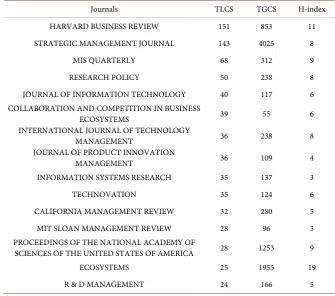
At the same time, these articles are distributed in 1031 journals, mainly in-volving 20 areas, such like economics, management, information science and ecology and so on. It shows that the field of innovation ecosystem is more mul-tidisciplinary. We apply again the TLCS index, TGCS index and h-index to iden-tify the influential journals published in the field of innovation ecosystem (as
shown in Table 2). Havard Business Review ,Strategic Management Journal, Mis
Quarterly, Research Policy, Journal of Information Technology are the top 5 journals according to the rank of TLCS. These journals are important journals in the field of innovation ecosystem.
4.2.2. Key Literature Statistic
In this paper, the key literature in the field of innovation ecosystem is identified by means of set point (Authorities) and dissemination point (Hubs).Authorities refer to the articles that cited by a lot of articles, and that means it is important to spread the knowledge [11]. On the contrary, the article which citing a lot of
articles is the Hubs, and that is an important node to receive knowledge [12].
From Table 3, higher Authorities are: Adner R2010, Adner R2006, Tiwana
[image:8.595.208.532.91.364.2]DOI: 10.4236/ajibm.2018.811149 2239 American Journal of Industrial and Business Management
Table 2. Top 15 most influential journals of innovation ecosystem.
Journals TLCS TGCS H-index
HARVARD BUSINESS REVIEW 151 853 11
STRATEGIC MANAGEMENT JOURNAL 143 4025 8
MIS QUARTERLY 68 312 9
RESEARCH POLICY 50 238 8
JOURNAL OF INFORMATION TECHNOLOGY 40 117 6
COLLABORATION AND COMPETITION IN BUSINESS
ECOSYSTEMS 39 55 6
INTERNATIONAL JOURNAL OF TECHNOLOGY
MANAGEMENT 36 238 8
JOURNAL OF PRODUCT INNOVATION
MANAGEMENT 36 109 4
INFORMATION SYSTEMS RESEARCH 35 137 3
TECHNOVATION 35 124 6
CALIFORNIA MANAGEMENT REVIEW 32 280 5
MIT SLOAN MANAGEMENT REVIEW 28 96 3
PROCEEDINGS OF THE NATIONAL ACADEMY OF
SCIENCES OF THE UNITED STATES OF AMERICA 28 1253 9
ECOSYSTEMS 25 1955 19
R & D MANAGEMENT 24 166 5
Data sources: Using Pajek tools to sort out data.
Hubs and Authorities, Li YR, 2009 The technological roadmap of Cisco’s
busi-ness ecosystem; Basole RC, 2009 Visualization of interfirm relations in a con-verging mobile ecosystem, Adner R, 2010 Value creation in innovation ecosys-tems: how the structure of technological interdependence affects firm perfor-mance in new technology generations, Dedehayir O, 2011 Measuring industry clockspeed in the systemic industry contex, West J, 2013 Evolving An Open Ecosystem: the Risk and Fall of the Synbian Platform, Makinen SJ, 2013 Business Ecosystems’ Evolution—An Ecosystem Clockspeed Perspective etc., have high values of both Authorities and Hubs’ values, which shows that these papers are actually vital nodes in the field of innovation ecosystem.
4.2.3. Main Research Countries and Institutions
DOI: 10.4236/ajibm.2018.811149 2240 American Journal of Industrial and Business Management
Table 3. Most influential papers according to Authorities and Hubs.
Authories Papers Hubs Papers
0.056732 West J, 2013, ADV STRATEG MANAGE, V30, P27 0.652523 West J, 2013, ADV STRATEG MANAGE, V30, P27
0.090003 Li YR, 2009, TECHNOVATION, V29, P379 0.106831 Li YR, 2009, TECHNOVATION, V29, P379
0.094283 TECHNOL, V24, P144 Basole RC, 2009, J INF 0.106831 Basole RC, 2009, J INF TECHNOL, V24, P144
0.704588 Adner R, 2010, STRATEGIC MANAGE J, V31, P306 0.106831 Adner R, 2010, STRATEGIC MANAGE J, V31, P306
0.065454 TECHNOVATION, V31, P627 Dedehayir O, 2011, 0.292808 TECHNOVATION, V31, P627 Dedehayir O, 2011,
0.121507 Makinen SJ, 2013, ADV STRATEG MANAGE, V30, P99 0.351501 STRATEG MANAGE, V30, P99 Makinen SJ, 2013, ADV
0.12048 Ceccagnoli M, 2012, MIS QUART, V36, P263 0.152331 STRATEG MANAGE, V30, P3 Kapoor R, 2013, ADV
0.294151 Tiwana A, 2010, INFORM SYST RES, V21, P675 0.131203 Zahra SA, 2012, BUS HORIZONS, V55, P219
0.040337 Ghazawneh A, 2013, INFORM SYST J, V23, P173 0.260469 THEORY PRACT, V37, P1071 Nambisan S, 2013, ENTREP
0.028818 Chesbrough HW, 2007, CALIF MANAGE REV, V50, P57 0.131899 Selander L, 2013, J INF TECHNOL, V28, P183
0.573709 Adner R, 2006, HARVARD BUS REV, V84, P98 0.131837 MANAGE PERSPECT, V28, P198 Thomas LDW, 2014, ACAD
0.065454 Teece DJ, 2007, STRATEG MANAGE J, V28, P1319 0.14388 INNOVAT MANAG, V31, P417 Gawer A, 2014, J PROD
0.06808 Gawer A, 2008, MIT SLOAN MANAGE REV, V49, P28 0.308062 INNOVAT MANAG, V31, P451 Makinen SJ, 2014, J PROD
0.081914 Iyer B, 2008, HARVARD BUS REV, V86, P58 0.110669 Clarysse B, 2014, RES POLICY, V43, P1164
0.121507 Garnsey E, 2008, IND INNOV, V15, P669 0.185977 Gawer A, 2014, RES POLICY, V43, P1239
Data sources: Using Pajek tools to sort out data.
states that the future leadership of technology and innovation in the United States will be based on a new system model, the Innovation Ecosystem (PCAST, 2004).
DOI: 10.4236/ajibm.2018.811149 2241 American Journal of Industrial and Business Management
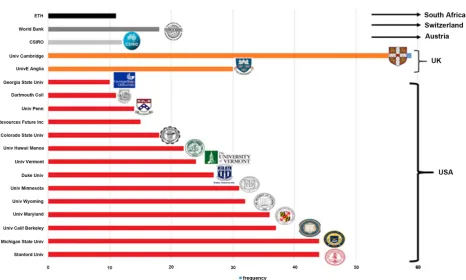
Figure 4. Top 20 research institutes of innovation ecosystem. Data sources: web of science database.
In addition, it is worth noting that there is only one developing country China among the top 10 countries. In China, the economic and social development has entered a “new normal” transition period. The state supports the public’s policy initiatives for innovation and entrepreneurship. In recent years, Chinese scholars have paid more attention to the innovation-driven development policy in order to realize the transformation and upgrading of the real economy. The rest are all developed countries, with 841 articles published in European countries (includ-ing Britain); besides, the main research institutions are mainly concentrated in the United States (14) and the United Kingdom (2). The University of Cam-bridge in the United Kingdom ranks first with 59 articles, while the University of Stanford and the University of Michigan in the United States rank second with 44 articles. Therefore, the research on innovation ecosystem has become the most important research area in developed countries.
4.2.4. Key Research Areas Statistic
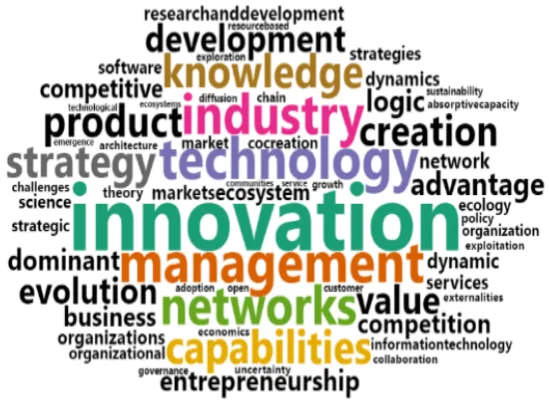
In order to dig out the main development direction of innovation ecosystem, this paper uses co-citation and word clouding technology to do text mining and topic clustering analysis on the literature of innovation ecosystem. As shown in
Figure 5, based on co-citation technology high-frequency keywords in the field
of innovation ecosystems mainly include innovation ecosystem, business eco-system, service ecoeco-system, and the sustainability of technological innovation de-velopment.
DOI: 10.4236/ajibm.2018.811149 2242 American Journal of Industrial and Business Management
Figure 5. The co-citation clustering. Data sources: Using Citespace tools to sort out data.
Figure 6. Text-mining clustering. Data sources: Using word cloud tools to sort out data.
are mainly knowledge, industry, technology, innovation, management, network, capabilities and other fields. Secondly, R&D, product, value creation, system evolution, entrepreneurship and competition are also hot research areas.
5. Main Paths Analysis
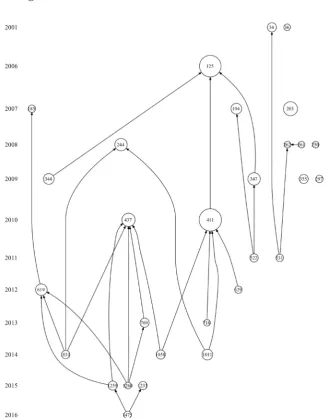
5.1. Citation Chronological Chart
[image:12.595.236.511.338.539.2]DOI: 10.4236/ajibm.2018.811149 2243 American Journal of Industrial and Business Management
Figure 7. Citation chronological chart of innovation ecosystem. Data sources: Using HistciteTM tools to sort out data.
[image:13.595.208.535.79.498.2]DOI: 10.4236/ajibm.2018.811149 2244 American Journal of Industrial and Business Management points and relations. Due to the emerging field of innovation ecosystem itself, it does not form a complete path on the basis of important literature research node in the field of Innovation Ecosystem, and also shows that the innovation ecosys-tem itself is not mature and is still in the expanding process.
5.2. Local Main Path and Global Main Path
Through the combination of local main path and global main path, the whole
process of innovation ecosystem development is systematically discovered.
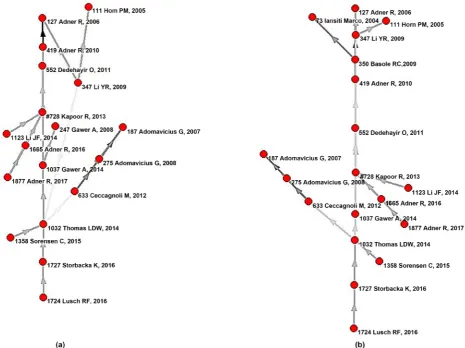
Fig-ure 8(a) shows the local main path of innovation ecosystem development,
namely, the knowledge dissemination of each connection point is the most im-portant node of literature in the field of innovation ecosystem research. Arrows represent the flow of knowledge. The thickness of the middle line represents the size of the SPC value, and the thicker the line, the more important the path is.
The local main path consists of 18 papers. Adner (2006) recognized that the value of an industry ecosystem as a whole far exceeds the sum of business opera-tions or technical specificaopera-tions owned by different enterprises individually [16]. Therefore, in order to meet customers’ needs, enterprises need to enhance inno-vation and value level through complementary collaboration with other enter-prises in the business innovation ecosystem, such as technology, products, ser-vices, and so on. Meanwhile they should consider the integration risks in the system. Subsequently, from the value-driven aspect, Adner (2010) continued his research thinking to study the interdependence of technology in ecosystems and the role of vertical integration in product life cycle. Innovation needs to rely on
the external environment changes and the participation of system members [17].
During the last period of the local main path, Adner (2016) discussed the reason behind the speed of technology substitution from the perspective of technology and organizational evolution on the basis of strategic management theory and
evolutionary economics theory [18]. Adner use case research to consider the
changing process when core technology is embedded in the ecosystem under certain technology level. In 2017, Adner published a structuralist approach to conceptualizing ecosystem construction, providing a clear definition of ecosys-tem structure, describing the semantics of ecosysecosys-tem structure and the characte-ristics of all ecosystem strategy aspects. This approach provides a clear under-standing of the relationships among ecosystems and a range of alternative struc-tures such as business models, platforms, competition, multilateral markets, networks, technology systems, supply chains, and value networks [19].
In the context of the business ecosystem development, from a technical point of view, Dedehayir O (2011) measures the length of time that how long an in-dustry has been replaced by other independent secondary industries who can provide similar technology. It is believed that the continuous change of industry is due to the continuous progress of technology, which is the main driving factor
of innovation [20]. Subsequently, Kapoor R (2013) expanded the research
DOI: 10.4236/ajibm.2018.811149 2245 American Journal of Industrial and Business Management
Figure 8. (a) The local main path; (b) The global main path. Data sources: Using Pajek tools to sort out data.
form in complementary activities affects the investment in new science and technology [21]. On the basis of this study, Li JF (2014) focus on the areas of technology, from a policy-driven perspective, using case studies in China and Britain to illustrate the relationship between biomedical policies and entrepre-neurs’ R&D investment strategies in the business ecosystem [22].
Based on Kapoor R’s research, Gawer (2014) summarized the recent industry platform literature, divided the platform types into two main categories: internal platform (enterprise-specific platform), external platform and industry platform
[23]. In 2008 Gawer explained the significance and methodology of building a
DOI: 10.4236/ajibm.2018.811149 2246 American Journal of Industrial and Business Management different from other flows. From the perspective of strategic management theory, Horn (2005) focused on vertical integration which emphasize on core technology. The focus of research shifted from production to service. And ulti-mately the direction of research transfer from the overall thinking of enterprises, encouraging enterprises to integrate internally, and find strategic partners to
achieve industrial networking [25]. Li YR (2009) emphasized the symbiotic
evo-lution of business ecosystem on the basis of vertical integration, and emphasized that business managers can use the symbiotic, platform, and co-evolution to meet the challenges of the changeable business environment [26].
Adomavicius (2008) understands technology evolution by emphasizing the relationship between multiple technology dynamics and high interdependence relationships. By establishing a technology ecosystem, they describe the interac-tion and evoluinterac-tion of the three role: components, products and applicainterac-tions within an ecosystem [27]. Further, Adomavicius’s (2008) article in 2008 built an IT ecosystem based on the technology ecosystem, providing a formal point of view for structural analysis of IT trends. And this IT ecosystem can reduce IT
complexity for practitioners to make IT investment decisions [27]. Ceccagnoli
(2011) discussed whether independent software vendors (ISVs) can improve their business performance by participating the ecosystems in the enterprise software industry and how to use appropriate mechanisms can benefit partners in the system [28]. Ceccagnoli emphasized that platforms are not just technology exchanges but value co-creation. Sorensen C collated and combed the previous literature through the case of smart phone.
With the further study of Storbacka K (2016), the main body of the study fo-cused on the value creation and how to build a service innovation ecosystem. From the change of micro-foundation of strategic management, the mi-cro-foundation of service innovation ecosystem is the participation of members
[29]. From an interdisciplinary perspective, members are seen not only as
hu-man beings, but also as a combination of machines and a variety of huhu-man and machine. Member participation is considered to be the basis for members’ in-clined attraction and resource interactions in service ecosystems. Lusch RF (2016) continued to study the ecosystem of service innovation with a brief in-troduction and comment on this particular issue from the interdisciplinary perspective of service-led logic [30]. It provides insights into economics, ecosys-tem theory, philosophy, service science, sociology, strategic management and systems science, and shares views and suggestions on resource integration, value creation, institutions and service ecosystems.
Figure 8(b) depicts the global main path. Comparing with the local main
con-DOI: 10.4236/ajibm.2018.811149 2247 American Journal of Industrial and Business Management sisting of mobile terminals from innovation networks and complex systems. Vi-sually explore the complex relationships among them and the relationships that influence their choice of innovation strategies or business models [32].
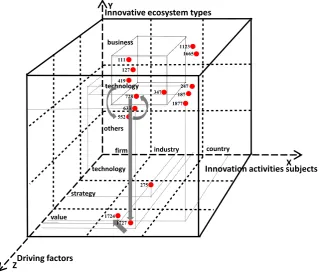
Combining the above local and global main path analysis, the local and global
main paths are identified by three main elements in Figure 9. The number
represents the document position in the complete database, and the arrow represents the process of development and change. The research literature fo-cuses on the main subject of innovation activities, driving factors and the type of innovation ecosystem. First of all, it reflects that the main subject of innovation activities mainly concentrates on the industry level. The key node literature ex-plores the interaction among different enterprises at a certain industry level within the innovation ecosystem. In the evolution and development of the late-stage activity subject, there are also documents related to the national level and the micro-level of the enterprises’ internal environment. Secondly, the types of innovative ecosystem have evolved from business-oriented type, which focus-es on the relationship among enterprisfocus-es in the businfocus-ess community to technol-ogical type. On the basis of business development, the researchers pay more at-tention to the development and change of technology in the ecosystem. And fi-nally shift to service-oriented type, from linear thinking to network thinking. More service-oriented intelligence systems are included in the research area. Fi-nally, the evolution process of the driving factors of the whole innovation
eco-system is discussed. As we can see in Figure 9, the elements which drive the
continuous development of the innovation ecosystem, from strategy-driven de-velopment to key technology-driven dede-velopment, extended to today’s value creation driven. This change reflects the deepening development of innovative ecosystem.
The local main path and global path mentioned above describe the whole de-velopment process of the innovation ecosystem. However the local main path and the global path are based on the SPC value, they may omit some important literature and cannot completely comb the literature in different research zones. On the basis of the local main path and the global main path, this paper forms a multi-path of the innovation ecosystem, which can show the theme and devel-opment of the innovation ecosystem at different stages.
5.3. Multipath Analysis
DOI: 10.4236/ajibm.2018.811149 2248 American Journal of Industrial and Business Management
Figure 9. Local and global main path development trend. Data sources: web of science.
sides fully reflects the formation and development of innovation system from the perspective of ecology which is innovation ecosystem. This paper takes the re-search on the relationship among enterprises in innovation ecosystem as the medium industry level, and the internal interaction among enterprises as the micro enterprise level. Subsequently, this paper further draws a multi-path map to further demonstrate the development stage of the innovation ecosystem. As shown in Figure 10.
From Figure 10, we find that the important development of the innovation
ecosystem start from the business ecosystem. At this stage, scholars have focused their attention on the concept and construction of business ecosystems and the
exploration of relationships among members of business ecosystems. From
Ta-ble 4, we can see that the business innovation ecosystem has a steady and
in-creasing trend. According to the centrality, the key words are: business ecosys-tem, strategy, business model, management, network, development and innova-tion, network, value creainnova-tion, etc. After building the basic structure of the busi-ness ecosystem, the development of the innovation ecosystem enters the tech-nical field of different industries, forming the technological innovation ecosys-tem, including the IT ecosysecosys-tem, payment ecosystem and other development processes in different paths. Finally, develop to the service ecosystem, seen as
Table 4. The amount of technical innovation ecosystem is increasing, the key
words are mainly concentrated in knowledge, management, technology, R&D investment, industry and so on. The number of papers published in the service ecosystem also shows a gradual upward trend. The key words mainly focus on
Innovative ecosystem types
technology business
Driving factors
strategy
value
firm industry country
X
Z
Y
111
247 419
187 127
552
1665 1123
728 347
275
1727 1724
1877
technology others
633
DOI: 10.4236/ajibm.2018.811149 2249 American Journal of Industrial and Business Management
Figure 10. Multiple global main paths of innovative ecosystem. Data sources: Using Pajek tools to sort out data.
sustainability, service ecology, dominant logic, evolution and development. After the technological ecology develops to a certain stage, we have a new under-standing of the business ecosystem, and discuss the new development of the business ecosystem under the situation of transnational corporations and the Internet of Things.
5.4. Theoretical Framework of Innovation Ecosystem
Through the analysis of local main path, global main path and multipath, this paper describes the research of innovation ecosystem from complex to simple, and finally classifies the development of innovation ecosystem into six basic elements. In this paper, the literature on innovative ecosystem is structured. From the perspective of process theory, this paper combs and integrates the lite-rature in this field, and finally gets the theoretical framework of innovation
eco-system, as shown in Figure 11. According to the development and change of the
DOI: 10.4236/ajibm.2018.811149 2250 American Journal of Industrial and Business Management
Table 4. Development zones of innovation ecosystem.
Topic (volume) Development trend Cluster graph
Business innovation ecosystem (513)
Technological innovation ecosystem (766)
Service innovation Ecosystem (619)
Data sources: web of science.
Figure 11. Theoretical framework of innovation ecosystem.
innovation system based on the characteristics of innovation system; the pers-pective of ecology and the perspers-pective of strategic management. According to
1 0 0 0 0 1 3 317 9 1511 25 3243
77 76 117 83 0 20 40 60 80 100 120 140
1999 2001 2003 2005 2007 2009 2011 2013 2015 2017
1 1 1 0 1 3 8 3 9 102422312126 46 8081113 162 123 0 20 40 60 80 100 120 140 160 180
1997 1999 2001 2003 2005 2007 2009 2011 2013 2015 2017
1 0 0 0 1 5 2 5 5 7 102222182232 6375 96 131 102 0 20 40 60 80 100 120 140
1997 1999 2001 2003 2005 2007 2009 2011 2013 2015 2017
Theoretical perspective of Innovation Ecosystem
Evolutionary Economics Perspective
Innovation System Perspective
Ecological Perspective
Strategic Management Perspective
Technology and organizational evolution
system performance of innovation
Knowledge / technology / service ecosystem
Sources of competitive advantage
Driving factors Innovation subject Innovation structure
Organizational strategy Technological development Innovation ability Value creation Policy and others
Macro level
National Innovation Ecosystem Middle level
Industrial Innovation Ecosystem Micro level
Enterprise innovation Ecosystem
Hub spoke structure innovation structure
Symbiotic evolutionary innovation structure
Innovation community of Innovation Ecosystem
Innovation integration community
(industry chain, intermediary, service institution, etc.) Innovative production community
(R & D enterprises, high efficiency, scientific research institutions) Innovative applied community
DOI: 10.4236/ajibm.2018.811149 2251 American Journal of Industrial and Business Management the innovation subject of innovation ecosystem, the innovation subject is divided from macro, middle and micro levels. According to the driving factors of differ-ent innovation subject, the developmdiffer-ent of innovation structure and innovation community is also different. The specific content is shown in Figure 11.
Based on the theoretical framework of innovation ecosystem, this paper ana-lyzes the multi-path node literature from the perspective of innovation, driving factors, innovation subject, innovation structure, innovation community and innovation risk. Firstly, from the perspective of innovation, the review of inno-vation ecosystem based on evolutionary economics mainly explores the evolu-tion and development of technology and organizaevolu-tion. The innovative perspec-tive of early research is mainly from the perspecperspec-tive of innovation system and strategic management. After 2015, the research perspective of scholars has changed to the ecological perspective, which means the perspective of ecology to study the interaction among technology, knowledge process and economic so-ciety. In terms of driving factors, the driving factors have changed from organi-zational strategy driver to diversification drivers, such as innovation ability driving, technology development driving, policy driving and so on, finally to value driving in recent years. The main subject of innovation is still concentrated on the industry innovation ecosystem. Some of the research objects in the key li-terature are targeted at certain industries, such as pharmaceutical industry, pay-ment industry, digital music industry, mobile platform industry and so on. Another is the evaluation of the whole industry. This paper classifies the two types into the industry innovation ecosystem, because it pays more attention to the integration and utilization of resources on the platform among industries. Secondly, the innovation structure evolves from the hub spoke development in the early stage, that is, from the joint development of core enterprises (focus en-terprises) to the symbiotic evolutionary innovation structure of enterprises in the later stage. At the same time, innovation community has been taking inno-vation integration community as the main link of the industrial chain integra-tion. In recent years, scholars have been more in-depth study, focusing on inno-vation production community and innoinno-vation applied community. Think from aspects of the upstream and downstream of innovation ecological ecosystem. Finally, the problem of innovation risk is also an important factor affecting the development of innovation ecosystem. Some of the failure of innovation ecosys-tem is caused by the trust crisis of members in innovation risk. Therefore, scho-lars have strengthened the research on this basic factor. As far as the key litera-ture is concerned, the research of scholars in 2013 will be more involved in in-novation risk. In the following years, the inin-novation risk of articles will be more integrated into the articles rather than independently studied.
6. Conclusions, Limitations and Future Research
conclu-DOI: 10.4236/ajibm.2018.811149 2252 American Journal of Industrial and Business Management sions are drawn. Firstly, based on descriptive statistics, innovative ecosystems, as an emerging field, are developing rapidly and will be further expanded in the fo-reseeable future. Throughout the process, scholars (Adner R, Kapoor R, Gawer A, Iansiti Marco) have made outstanding contribution to the development of innovative ecosystems, leading the direction of development in this field. Based on the main path approach, this paper finds that as a whole, innovative ecosys-tems are widely adapted to different disciplines, and they are not mature and are expanding. However, due to the limitation of the method of calculating the path, some important academic opinions published by scholars such as Moore and Levin have been omitted, so the multi-path method is further extended to refine. This paper divides the development of innovation ecosystem into three parts: business ecosystem, technology ecosystem and service ecosystem. Based on the path analysis, this paper constructs the theoretical framework of innovation ecosystem, and finds that the article in the field of innovation ecosystem devel-ops from commercial innovation ecosystem to service innovation ecosystem. From the perspective of early strategic management and innovation system to the perspective of multi-disciplinary ecology, value co-creation has gradually become the main achieve goal to promote the development of innovation eco-system.
In the future, the research of innovative ecosystem will involve more discip-lines and fields. Innovation ecosystem will pay more attention to the value crea-tion of consumers, such as service ecosystem. For example, from a macro pers-pective, the service ecosystem believes that all economic and social participants are an important part of value creation. At the same time, the collection and ef-fective processing of information data will become an important foundation for building an innovative ecosystem. However, there are still some shortcomings in the research of innovation ecosystem. Most of the nodal literature on the main path is case studies. Case studies can make us understand the application of in-novation ecosystem more clearly, but the comparability of case studies is not strong, and the theoretical expansion is insufficient. In the future, the study of innovation ecosystem should be more in-depth, to open the internal black box of the effective construction of innovation ecosystem, and reveal the core of the in-ternal operation and value creation in innovation ecosystem. Finally, through the open-ended analysis of the innovation ecosystem, we provide a set of system mechanism for innovation development. Use this mechanism in the Chinese market environment in order to form an innovation ecosystem with Chinese characteristics, thereby enhancing the core competitiveness and commercial value of enterprises.
Acknowledgements
DOI: 10.4236/ajibm.2018.811149 2253 American Journal of Industrial and Business Management very grateful for the valuable comments and suggestions from the Reviewers and Editors of the journal, which significantly improved the quality and readability of the paper.
Conflicts of Interest
The authors declare no conflicts of interest regarding the publication of this pa-per.
References
[1] Watanabe, C. and Fukud,a K. (2006) National Innovation Ecosystems: The Similar-ity and DisparSimilar-ity of Japan-US Technology Policy Systems toward a Service Oriented Economy. Journal of Services Research, 6, 159-186.
[2] National Research Council (2012) Rising to the Challenge: U.S. Innovation Policy for the Global Economy. The National Academies Press, Washington DC.
[3] McCarthy, D.J., Puffer, S.M. and Graham, L.R. (2014) Emerging Innovation in Emerging Economies: Can Institutional Reforms Help Russia Break through Its Historical Barriers. Thunderbird International Business Review, 56, 243-260. https://doi.org/10.1002/tie.21619
[4] Liu, J.S., Lu, L.Y.Y., Lu, W.M., et al. (2013) Data Envelopment Analysis 1978-2010: A Citation-Based Literature Survey. Omega, 41, 3-15.
https://doi.org/10.1016/j.omega.2010.12.006
[5] Hummon, N.P. and Dereian P. (1989) Connectivity in a Citation Network: The De-velopment of DNA Theory. Social Networks, 11, 39-63.
https://doi.org/10.1016/0378-8733(89)90017-8
[6] Batagelj, V. (2003) Efficient Algorithms for Citation Network Analysis. Computer Science, arXiv:cs/0309023v1.
[7] Fontana, R., Nuvolari, A. and Verspagen, B. (2009) Mapping Technological Trajec-tories as Patent Citation Networks. An Application to Data Communication Stan-dards. Economics of Innovation & New Technology, 18, 311-336.
https://doi.org/10.1080/10438590801969073
[8] Borodin, A., Roberts, G.O., Rosenthal, J.S., et al. (2002) Finding Authorities and Hubs from Link Structures on the World Wide Web. WWW10, Hong Kong, 1-5 May 2001.
[9] Meyer, P.S., Yung, J.W. and Ausubel, J.H. (1999) A Primer on Logistic Growth and Substitution: The Mathematics of the Loglet Lab Software. Technological Forecast-ing & Social Change, 61, 247-271. https://doi.org/10.1016/S0040-1625(99)00021-9 [10] Hirsch, J.E. (2005) An Index to Quantify an Individual’s Scientific Research Output.
Proceedings of the National Academy of Sciences of the United States of America, 102, 16569-16572. https://doi.org/10.1073/pnas.0507655102
[11] Ding, C.H.Q., Zha, H., He, X., et al. (2004) Link Analysis: Hubs and Authorities on the World Wide Web. Siam Review, 46, 256-268.
https://doi.org/10.1137/S0036144501389218
[12] Lawrence, S., Bollacker, K. and Giles, C.L. (1999) Indexing and Retrieval of Scien-tific Literature. Eighth International Conference on Information and Knowledge Management, Kansas City, 2-6 November 1999, 139-146.
DOI: 10.4236/ajibm.2018.811149 2254 American Journal of Industrial and Business Management 1319-1350. https://doi.org/10.1002/smj.640
[14] Lucio-Arias, D. and Leydesdorff, L. (2008) Main-Path Analysis and Path-Dependent Transitions in HistCite™-Based Historiograms. Journal of the Association for In-formation Science and Technology, 59, 1948-1962.
https://doi.org/10.1002/asi.20903
[15] Sun, F. and Zhu, L. (2012) Citation Genetic Genealogy: A Novel Insight for Citation Analysis in Scientific Literature. Scientometrics, 91, 577-589.
https://doi.org/10.1007/s11192-011-0588-2
[16] Adner, R. (2006) Match Your Innovation Strategy to Your Innovation Ecosystem. Harvard Business Review, 84, 98.
[17] Adner, R. and Kapoor, R. (2010) Value Creation in Innovation Ecosystems: How the Structure of Technological Interdependence Affects Firm Performance in New Technology Generations. Strategic Management Journal, 31, 306-333.
https://doi.org/10.1002/smj.821
[18] Adner, R. and Kapoor, R. (2016) Innovation Ecosystems and the Pace of Substitu-tion: Re-Examining Technology S-Curves. Strategic Management Journal, 37, 625-648. https://doi.org/10.1002/smj.2363
[19] Adner, R. (2017) Ecosystem as Structure: An Actionable Construct for Strategy. Journal of Management, 43, 39-58. https://doi.org/10.1177/0149206316678451 [20] Dedehayir, O. and Mäkinen, S.J. (2011) Measuring Industry Clockspeed in the
Sys-temic Industry Context. Technovation, 31, 627-637. https://doi.org/10.1016/j.technovation.2011.07.008
[21] Kapoor, R. and Lee, J.M. (2013) Coordinating and Competing in Ecosystems: How Organizational Forms Shape New Technology Investments. Strategic Management Journal, 34, 274-296. https://doi.org/10.1002/smj.2010
[22] Li, J.F. and Garnsey, E. (2014) Policy-Driven Ecosystems for New Vaccine Devel-opment. Technovation, 34, 762-772.
https://doi.org/10.1016/j.technovation.2014.07.002
[23] Gawer, A. and Cusumano, M.A. (2014) Industry Platforms and Ecosystem Innova-tion. Journal of Product Innovation Management, 31, 417-433.
https://doi.org/10.1111/jpim.12105
[24] Gawer, A. and Cusumano, M.A. (2008) How Companies Become Platform Leaders. Mit Sloan Management Review, 49, 28-35.
[25] Horn, P.M. (2005) The Changing Nature of Innovation. Research Technology Management, 48, 28-31. https://doi.org/10.1080/08956308.2005.11657345
[26] Li, Y.R. (2009) The Technological Roadmap of Cisco’s Business Ecosystem. Tech-novation, 29, 379-386. https://doi.org/10.1016/j.technovation.2009.01.007
[27] Adomavicius, G., Bockstedt, J.C., Gupta, A., et al. (2008) Making Sense of Technol-ogy Trends in the Information TechnolTechnol-ogy Landscape: A Design Science Approach. Mis Quarterly, 32, 779-809. https://doi.org/10.2307/25148872
[28] Ceccagnoli, M., Forman, C., Huang, P. and Wu, D.J. (2011) Cocreation of Value in a Platform Ecosystem: The Case of Enterprise Software. Mis Quarterly, 36, 263-290. https://doi.org/10.2307/41410417
[29] Storbacka, K., Brodie, R.J., Böhmann, T., et al. (2016) Actor Engagement as a Mi-crofoundation for Value Co-Creation. Journal of Business Research, 69, 3008-3017. https://doi.org/10.1016/j.jbusres.2016.02.034
DOI: 10.4236/ajibm.2018.811149 2255 American Journal of Industrial and Business Management
https://doi.org/10.1016/j.jbusres.2016.02.028
[31] Iansiti, M. and Levien, R. (2004) Strategy as Ecology. Harvard Business Review, 82, 68.
[32] Basole, R.C. (2009) Visualization of Interfirm Relations in a Converging Mobile Ecosystem. Journal of Information Technology, 24, 144-159.