GENDER DIFFERENCES IN THE SELF
Department of Educational Studies, Central
ARTICLE INFO ABSTRACT
The purpose of the present study was to see Gender differences in the Self School Students. The study was conducted on a sample of 200students of 9 Government and Private Schools of Jammu district. Self
by Dr. G.P.Mathur and Dr. Raj Kumar Bhatnagar was used to collect data. The collected data was analyzed with the help of‘t’ test. The resu
exists in the Self
than boys. Significant difference exists in the Self are found to possess higher level of self difference exists in the Self
higher level of self
Copyright©2016, Pooja Bhagat. This is an open access article distributed under the Creative Commons Att distribution, and reproduction in any medium, provided the original work is properly cited.
INTRODUCTION
Human being passes through different stages of development such as infancy, childhood, adolescence and adulthood. Every stage of development has its own distinct features. Of various stages, adolescence is a crucial stage of human life marked by tremendous changes. Adolescence is a period of life between childhood and adulthood, a transition period that involves biological, cognitive and socio-emotional changes. A key task of adolescence is thus preparation for adulthood. This is a period when adolescents are assumed to play new social roles. It is a period of identity formation versus identity crisis as marked by Eric Erikson. According to Erikson, the main task of adolescence is to form a coherent identity (a sense of personal identity). Identity formation involves knowing self that involves developing a sense of self-concept, self
and self-efficacy. A cognitive development theorist Jean Piaget called it as a period of formal operations as adolescents are able to formulate hypothesis and test also.
adolescence begins approximately at 10-12 years of age and ends between the ages of 18-21 years which is further divided into a period of early adolescence, middle adolescence and late adolescence. Tendency to commit various types of crimes ha been increasing during this period. Consequently, it is appropriate to identify the factors which help protect adolescents from negative experiences. At the secondary level
*Corresponding author: Pooja Bhagat,
Department of Educational Studies, Central University of Jammu
ISSN: 0975-833X
Article History:
Received 08th April, 2016
Received in revised form
10th May, 2016
Accepted 15th June, 2016
Published online 16th July,2016
Key words:
Self-efficacy, Gender.
Citation: Pooja Bhagat, 2016. “Gender differences in the self 34469-34474.
RESEARCH ARTICLE
GENDER DIFFERENCES IN THE SELF-EFFICACY OF SECONDARY SCHOOL STUDENTS
*Pooja Bhagat
Department of Educational Studies, Central University of Jammu
ABSTRACT
The purpose of the present study was to see Gender differences in the Self School Students. The study was conducted on a sample of 200students of 9
Government and Private Schools of Jammu district. Self-efficacy scale constructed and standardized by Dr. G.P.Mathur and Dr. Raj Kumar Bhatnagar was used to collect data. The collected data was analyzed with the help of‘t’ test. The results of the present study showed that significant difference exists in the Self-confidence of secondary school boys and girls. Girls are found more self
than boys. Significant difference exists in the Self- esteem of secondary school boys and girl are found to possess higher level of self-esteem in comparison to their counterparts.
difference exists in the Self-cognition of secondary school boys and girls. Boys are found to possess higher level of self-cognition in comparison to their counterparts.
is an open access article distributed under the Creative Commons Attribution License, which distribution, and reproduction in any medium, provided the original work is properly cited.
Human being passes through different stages of development such as infancy, childhood, adolescence and adulthood. Every stage of development has its own distinct features. Of various stages, adolescence is a crucial stage of human life marked by changes. Adolescence is a period of life between childhood and adulthood, a transition period that involves emotional changes. A key task of adolescence is thus preparation for adulthood. This is a re assumed to play new social roles. It is a period of identity formation versus identity crisis as marked by Eric Erikson. According to Erikson, the main task of adolescence is to form a coherent identity (a sense of involves knowing self concept, self-esteem efficacy. A cognitive development theorist Jean Piaget called it as a period of formal operations as adolescents are able to formulate hypothesis and test also. The period of 12 years of age and 21 years which is further divided into a period of early adolescence, middle adolescence and late adolescence. Tendency to commit various types of crimes has been increasing during this period. Consequently, it is appropriate to identify the factors which help protect At the secondary level
l University of Jammu
of education, students pass through middle adolescence (15 17) years. There are various educational needs of adolescents. Education for adolescents must be linked with their empowerment enhancing their self
confidence, academic achievement and social competence etc.
Self-efficacy
Self-efficacy is important aspect of our self and personality. People differ in the extent to which they believe they themselves control their life outcomes or the outcomes are controlled by either luck or fate or other situational factors. A person who faith in his/her ability to accomplish a task in a particular situation are assumed to have high self
concept of self-efficacy has been derived from Albert Bandura’s social learning theory. Bandura’s study reveals that children and adults learned behaviour by imitating and observing others’ behaviour. People’s expectations of mastery or achievement and their convictions about their own effectiveness determine the kinds of behaviour in which they would engage, as also the amount of
undertake. A strong sense of self
select, influence, and even construct the circumstances of their own life. People with strong sense of self
less fearful. Self-efficacy can be developed. Our so parents and our own experiences of life can help in the development of a strong sense of self
positive models during the early years of children’ life. International Journal of Current Research
Vol. 8, Issue, 07, pp.34469-34474, July, 2016
INTERNATIONAL
Gender differences in the self-efficacy of secondary school students”, International Journal of Current Research
EFFICACY OF SECONDARY SCHOOL STUDENTS
University of Jammu
The purpose of the present study was to see Gender differences in the Self-efficacy of Secondary School Students. The study was conducted on a sample of 200students of 9th class studying in efficacy scale constructed and standardized by Dr. G.P.Mathur and Dr. Raj Kumar Bhatnagar was used to collect data. The collected data was lts of the present study showed that significant difference confidence of secondary school boys and girls. Girls are found more self-confident esteem of secondary school boys and girls. Boys esteem in comparison to their counterparts. Significant cognition of secondary school boys and girls. Boys are found to possess
ribution License, which permits unrestricted use,
of education, students pass through middle adolescence (15-There are various educational needs of adolescents. Education for adolescents must be linked with their empowerment enhancing their efficacy, esteem, self-confidence, academic achievement and social competence etc.
efficacy is important aspect of our self and personality. People differ in the extent to which they believe they themselves control their life outcomes or the outcomes are
controlled by either luck or fate or other situational factors. person who faith in his/her ability to accomplish a task in a
particular situation are assumed to have high self-efficacy. The efficacy has been derived from Albert Bandura’s social learning theory. Bandura’s study reveals that d adults learned behaviour by imitating and observing others’ behaviour. People’s expectations of mastery or achievement and their convictions about their own effectiveness determine the kinds of behaviour in which they would engage, as also the amount of risk they would undertake. A strong sense of self-efficacy permits people to select, influence, and even construct the circumstances of their own life. People with strong sense of self-efficacy also feel efficacy can be developed. Our society, parents and our own experiences of life can help in the development of a strong sense of self –efficacy by presenting positive models during the early years of children’ life.
INTERNATIONAL JOURNAL OF CURRENT RESEARCH
Albert Bandura, (1977), the former president of the American Psychological Association, developed one of the most influential cognitive theories of personality, He began with
observational learning theory and the idea that human beings observe, think about, and imitate behaviour. Bandura
argued that people’s expectations of mastery and achievement and their convictions about their own effectiveness determine the types of behaviour they will engage in and the amount of risk they will undertake. He used the term ‘self-efficacy’ to describe a person’s belief about whether he or she can successfully engage in and execute a specific behaviour. Judgment about self-efficacy determines how much effort people will expand and how long they will persist in the face of obstacles. A strong sense of self-efficacy allows people to feel free to influence and even create the circumstance of their own lives. People who have a high level of self-efficacy are more likely than others to attribute success to variables within themselves rather than to change factors and are more likely to pursue their own goals (Bandura, et. al. 1998), and do better at difficult tasks. The term efficacy is synonymous with the term effective, efficacious, control. Self is defined as the identity of a person. Bandura (1977) defines self-efficacy, “The belief in one’s capacity to organize and execute the course of action required managing prospective situations. It is personal judgments about one’s ability to perform a given task”.
Dimensions of self-efficacy
Self-regulatory skills
Self –influence
Self-confidence
Social –achievement
Self-evaluation
Self-esteem
Self-cognition
Review of related literature
Related studies help in acquiring information about the studies done in the field. The knowledge of related literature enable us to know the means of getting to the frontier in the field of our problems until we have learnt what others have done in our area, we cannot develop a research project that will contribute to furthering knowledge in this field. It is through that a review of related literature would develop an insight and interest of investigator. Zajacova, Lynch, and Espenshade (2005) studied Self-Efficacy, Stress, And Academic Success In College and results suggest that academic self-efficacy is a more robust and consistent predictor than stress of academic success. Mahyuddin et al. (2006) studied The Relationship between Students' Self Efficacy and their English Language Achievement and their findings showed that 51 percent of students had high self-efficacy while 48 percent showed low self-efficacy. Correlational analysis showed positive correlations between several dimensions of self-efficacy that is, academic achievement efficacy (r = 0.48, p = 0.001); other expectancy beliefs (r = 0.34, p = 0.005); and self-assertiveness (r = 0.41, p = 0.005) with academic performance in English language. Chowdhury and Shahabuddin (2007) studiedSelf-efficacy, motivation and their relationship to academic performance of Bangladesh College Students and results reveal
motivation respectively. Ahmad and Safaria (2013) investigated Effects of Self-Efficacy on Students’ Academic Performance and found that students with high self-efficacy obtained higher scores on 50 mathematical problems test. Shkullaku (2013) studied Relationship between Self – efficacy and Academic Performance in the Context of Gender among Albanian Students and results of the study showed that there was a significant difference between males and females in self-efficacy. There was no difference between males and females in academic performance. Also, a significant relationship was found between the students’ self-efficacy and academic performance. Tenaw (2013) studied Relationship Between Self-Efficacy, Academic Achievement And Gender In Analytical Chemistry At Debre Markos College Of Teacher Education and analysis of the data indicated that students’ level of self-efficacy is medium (50.08), and there is no
significant difference in their self-efficacy between sexes (t (98) = 0.161, p> 0.1), but there is a statistically significant
difference in achievement between sexes (t (98) = 0.68, p< 0.1) and also a significant relationship exists between self-efficacy and achievement (r=0.385, at 0.01 level with 98 degree of freedom). Mishra and Shanwal (2014) studied. Role of Family Environment in Developing Self Efficacy of Adolescents The results showed positive association between family environment and self-efficacy. Ansari and Khan (2014) studied Self-Efficacy as a Predictor of Life Satisfaction among Undergraduate Students and findings of the present study showed that Self-efficacy and Life Satisfaction significantly correlated with each other and Self-Efficacy had its significant impact on Life Satisfaction among under-graduate students. Kvedere (2014) studied Mathematics efficacy, Self-concept and Anxiety Among 9thGrade Students in Latvia and found Boys have more positive mathematical self than girls and students who come from bigger cities and towns have more negative mathematical self than those from rural areas. Sharma and Rani (2014) studied Self Efficacy – A Comparison among University Postgraduates in Demographic Profiles and findings revealed that university postgraduates were not found to differ significantly by age-groups but significant differences were observed among university postgraduates by gender, locality and faculty. Goulão (2014) studied Relationship between Self-Efficacy and Academic Achievement in Adults’ Learners and analysis of the data indicated that students’ level of self-efficacy is high (average=45) and a significant relationship exists between self-efficacy and academic achievement (r=0.286, at 0.05 level). Ahmadi et al. (2014) studied the Relationship of Academic Efficacy and Self-regulation with Academic Performance among the High School Students with School Refusal Behavior and Normal Students. Findings showed that: 1) the relationship between academic self-efficacy and academic performance in two groups was positive and significant; 2) the relationship between self-regulation and academic performance in two groups was positive and significant; 3) the Fisher-Z test showed no significant difference between two groups regarding to the relationships of the variables to academic performance, 4) the multiple correlation coefficient of predictor variables with academic performance was significant; 5) self-regulation was found as a good predictor of academic performance in two groups. Sharma and Garg (2015) studied Impact of Self-Efficacy on Employee Attrition: a Study
through Structural Equation Modeling and Result indicated that self-efficacy is a significant predictor of employee attrition. Singh (2015) Studied Alienation Among B.Ed. Students In Relation To Self-Efficacy And Emotional Intelligence. The Results of the Study Revealed Significant Negative Relation of alienation with both Self-Efficacy And Emotional Intelligence. Pavani and Agrawal (2015) Studied Self-Efficacy and Academic Achievement among College Students. A significant level of 0.01 was found among high and medium academes. Also a significant level of 0.01 was found among high and low academes. Results indicated that one who has high self-efficacy posses’ high academic achievement.
Objectives
1.To find out significant gender differences in various dimensions of Self-efficacy of secondary school students:
Self-regulatory skills
Self-influence
Self confidence
Social achievement
Self
Self-evaluation
Self-esteem
Self-cognition
2.To find out significant gender differences in the overall Self-efficacy of secondary school students.
Hypotheses
1.There will be no significant gender differences in the various dimensions of Self-efficacy of secondary school students:
Self-regulatory skills
Self-influence
Self confidence
Social achievement
Self
Self-evaluation
Self-esteem
Self-cognition
2.There will be no significant gender differences in the overall Self-efficacy of secondary school students.
Sample
For the present study a sample of 200 (100 girls and 100 boys) students of 9th class studying in government and private schools of Jammu district has been taken up. Random sampling technique was used to draw sample.
Tools employed
Self-regulatory skills, Self-influence, Self-confidence, Social achievement, Self, evaluation, esteem & Self-cognition. Reliability co-efficient of the scale was measured by test-retest on a sample of 600 (300 male and 300 female). In male it ranges between 0.73 to 0.81 and in female 0.79 to 0.86. Validity ranges in male 0.73 to 0.81 and in female 0.76 to 0.83
Statistical techniques used
i.Mean ii.S.D.
iii.Significance of difference between means (t-ratio)
Mean = =∑
S.D. r = . . ( ) = ∑
Where,
N is the number of students.
The Standard Error of mean for all the area calculated with the help of the following Formula.
= √
The Standard error of difference of means is calculated with the help of following formula.
SE = ( M ) + ( M )
M = N
M = N
Where,
stands for the sum of squares of differences of means.
Formula for calculating t =| |
Where,
M = Mean of one group
M = Mean of other group
= Stands for standard error of difference of means.
[image:4.595.70.503.420.781.2]INTERPRETATION AND RESULTS
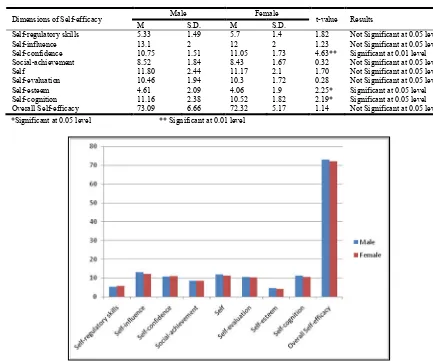
Table 1 indicates that, the mean score of self-regulatory skills of boys is 5.33with S.D. 1.49. The mean score of girls is 5.7 with 1.4. The t- value comes out to be 1.82 which is not significant at 0.05level. So, it can be concluded that there is no significant gender difference in the Self-regulatory skills as one of dimension of self-efficacy.
Table 1. Gender wise comparison of Self-Efficacy of Secondary School Students (N==200, Boys=100 & Girls=100)
Dimensions of Self-efficacy Male Female t-value Results
M S.D. M S.D.
Self-regulatory skills 5.33 1.49 5.7 1.4 1.82 Not Significant at 0.05 level
Self-influence 13.1 2 12 2 1.23 Not Significant at 0.05 level
Self-confidence 10.75 1.51 11.05 1.73 4.63** Significant at 0.01 level
Social-achievement 8.52 1.84 8.43 1.67 0.32 Not Significant at 0.05 level
Self 11.80 2.44 11.17 2.1 1.70 Not Significant at 0.05 level
Self-evaluation 10.46 1.94 10.3 1.72 0.28 Not Significant at 0.05 level
Self-esteem 4.61 2.09 4.06 1.9 2.25* Significant at 0.05 level
Self-cognition 11.16 2.38 10.52 1.82 2.19* Significant at 0.05 level
Overall Self-efficacy 73.09 6.66 72.32 5.17 1.14 Not Significant at 0.05 level
*Significant at 0.05 level ** Significant at 0.01 level
Thus, the Hypothesis stating that “There will be no significant gender difference in the self-regulatory skills of secondary school students”, is accepted. Table 1 indicates that, the mean score of self-influence of boys is 13.1 with S.D. 2. The mean score of girls is 12 with 2. The t- value comes out to be 1.23 which is not significant at 0.05 level. So, it can be concluded that there is no significant gender difference in the Self-influence as one of dimension of self-efficacy. Thus, the Hypothesis stating that “There will be no significant gender difference in the self-influence of secondary school students”, is accepted. Table 1 indicates that, the mean score of self-confidence of boys is 10.75 with S.D. 1.51. The mean score of girls is 11.05 with 1.73. The t- value comes out to be 4.63 which is significant at 0.05 level. So, it can be concluded that there is significant gender difference in the Self-confidenceas one of dimension of self-efficacy. Thus, the Hypothesis stating that “There will be no significant gender difference in the self-confidence of secondary school students”, is rejected. Table 1 indicates that, the mean score of social-achievement of boys is 8.52 with S.D. 1.84. The mean score of girls is 8.43 with 1.67. The t- value comes out to be 0.32 which is not significant at 0.05 level. So, it can be concluded that there is no significant gender difference in the Social-achievementas one of dimension of self-efficacy. Thus, the Hypothesis stating that “There will be no significant gender difference in the social-achievement of secondary school students”, is accepted.
Table 1 indicates that, the mean score of self of boys is 11.80 with S.D. 2.44. The mean score of girls is 11.17 with 2.1. The t- value comes out to be 1.70 which is not significant at 0.05 level. So, it can be concluded that there is no significant gender difference in the Self as one of dimension of self-efficacy. Thus, the Hypothesis stating that “There will be no significant gender difference in the self of secondary school students”, is accepted.
Table 1 indicates that, the mean score of self-evaluation of boys is 10.46 with S.D. 1.94. The mean score of girls is 10.3 with 1.72. The t- value comes out to be 0.28 which is not significant at 0.05 level. So, it can be concluded that there is no significant gender difference in the Self-evaluationas one of dimension of self-efficacy. Thus, the Hypothesis stating that “There will be no significant gender difference in the self- evaluation of secondary school students”, is accepted. Table 1 indicates that, the mean score of self-esteem of boys is 4.61 with S.D. 2.09. The mean score of girls is 4.06 with 1.9. The t- value comes out to be 2.25 which is significant at 0.05 level. So, it can be concluded that there is significant gender difference in the Self- esteem as one of dimension of self-efficacy. Thus, the Hypothesis stating that “There will be no significant gender difference in the self-esteem of secondary school students”, is rejected. Table 1 indicates that, the mean score of self-cognition of boys is 11.16 with S.D. 2.38. The mean score of girls is 10.52 with 1.82. The t- value comes out to be 2.19 which is significant at 0.05 level. So, it can be concluded that there is significant gender difference in the Self-cognitionas one of dimension of self-efficacy. Thus, the Hypothesis stating that “There will be no significant gender difference in the self-cognition of secondary school students”, is rejected.
Table 1 indicates that, the mean score of overall self-efficacy of boys is 73.09 with S.D. 6.66. The mean score of girls is 72.32 with 5.17. The t- value comes out to be 1.14 which is not significant at 0.05 level. So, it can be concluded that there is no significant difference in the overall Self-efficacy of secondary school boys and girls. Thus, the Hypothesis stating that “There will be no significant gender difference in the overall self-efficacy of secondary school students”, is rejected.
Conclusions from the study
No significant difference exists in the Self-regulatory skills of secondary of boys and girls.
No significant difference exists in the Self-influence of secondary school boys and girls.
Significant difference exists in the Self-confidence of secondary school boys and girls. Girls are found more self-confident than boys.
No significant difference exists in the Social-achievement of secondary school boys and girls.
No significant difference exists in the Self of secondary school boys and girls.
No significant difference exists in the Self-evaluation of secondary school boys and girls.
Significant difference exists in the Self- esteem of secondary school boys and girls. Boys are found to possess higher level of self-esteem in comparison to their counterparts.
Significant difference exists in the Self-cognition of secondary school boys and girls. Boys are found to possess higher level of self-cognition in comparison to their counterparts.
No significant difference exists in the overall Self-efficacy of secondary school boys and girls.
REFERENCES
Aggarwal, J.C. 1975. Educational Research: An Introduction. Arya Book Depot, New Delhi.
Ahmad, A. and Safaria, T. 2013. Effects of Self-Efficacy on Students’ Academic Performance. Journal of Educational, Health and Community Psychology, Vol. 2, No. 1. Ahmadi, F. A. T., Najafi, M., Khanehkeshi, A. 2014. The
Relationship of Academic Self-Efficacy and Self-regulation with Academic Performance among the High School Students with School Refusal Behavior and Normal Students. Indian Journal of Education and Information Management, Vol. 3 (4), 19–24.
Akomolafe, M. J., Ogunmakin, A. O. and Fasooto, G. M. 2013. The Role of Academic Self-Efficacy, Academic Motivation and Academic Self Concept in Predicting Secondary School Students’ Academic Performance.
Journal of Educational and Social Research, Vol. 3 (2). Ansari, M. and Khan S. A. 2014. Self-Efficacy as a Predictor
of Life Satisfaction among Undergraduate Students. The International Journal of Indian Psychology, Volume 2, Issue 2,
Bandura, A. 1986. Social Foundations of Thought and Action: A Social Cognitive Theory Englewood Cliffs, NJ: Prentice-Hall.
Bandura, A. 1997. Self-efficacy: The Exercise of Control, New York: W.H. Freeman & Co.
Basavarajappa and Khanehkeshi 2012. The relationship of academic stress, depression, and self-efficacy with academic performance among high school students in Iran.
Indian Streams Research Journal. Vol. 1, Issue. V, pp.1-4. Chaudhary, R., Rangnekar, S. and Barua, M. K. 2012.
Relationships between occupational self-efficacy, human resource development climate, and work engagement. An International Journal, Vol. 18, Iss: 7/8, pp.370 – 383. Chouhan, S.S. 1978. Advanced Educational Psychology. Vikas
Publishing House, Pvt. Ltd. New Delhi.
Chowdhury, M. S. and Shahabuddin, A. M. 2007. Self-efficacy, motivation and their relationship to academic performance of Bangladesh College Students. College
Quarterly, Volume 10, Number 1.
Goulão, M. de.F. 2014. The Relationship between Self-Efficacy and Academic Achievement in Adults’ Learners.
Athens Journal of Education, Vol. 1, No. 3.
Gupta, G. 2012. Spiritual Intelligence and Emotional Intelligence in relation to Self-Efficacy and Self-Regulation among College Students. International Journal of Social Sciences & Interdisciplinary Research, Vol.1 No. 2. Koul, Lokesh. 1989. Methodology of Educational Research.
Vikas Publishing House, New Delhi.
Kvedere, L. 2014. Mathematics Self-efficacy, Self-concept and Anxiety Among 9th Grade Students in Latvia. Procedia - Social and Behavioral Sciences, Volume 116, 21, Pages 2687-2690.
Mahyuddin, et al. 2006. The Relationship between Students' Self Efficacy and their English Language Achievement.
Journal Pendidik dan Pendidikan, Jil. 21, 61–71.
Meral, M., Colak, E., Zereyak, E. 2012. The Relationship between Self-Efficacy and Academic Performance.
Procedia - Social and Behavioral Sciences, Volume 46, Pages 1143-1146.
Mishra, S. and Shanwal, K. 2004. Role of Family Environment in Developing Self Efficacy of Adolescents. Integrated Journal of Social Sciences, 1(11), 28-30.
Pavani, S. and Agrawal, G. 2015. A Study of Self-Efficacy and Academic Achievement among College Students. Online Journal of Multidisciplinary Research (OJMR), 1(1), 28-32.
Ravikumar, S. and Manimozhi, T.K. 2011. Self-efficacy among the students of biological sciences at Cuddalore district, TN, India. Indian Journal of Science and Technology, Vol. 4, No. 1.
Sharma, B. and Garg, N 2015. Impact of Self-Efficacy on Employee Attrition: a Study through Structural Equation Modeling. Indian Journal of Applied Research, Vol. 5, Issue: 3.
Sharma, H. L. and Rani, R. 2014. Self-Efficacy – A Comparison among University Postgraduates in Demographic Profiles. Research Journal of Educational Sciences, Vol. 2(1), 1-7.
Shkullaku, R. 2013. The Relationship between Self – efficacy and Academic Performance in the Context of Gender among Albanian Students. European Academic Research, Vol. I, Issue.
Singh, G. 2015. Alienation Among B.Ed. Students in relation to Self-Efficacy And Emotional Intelligence International Education and Research Journal, vol. 1, No. 5.
Tenaw, Y.A. 2013. Relationship between Self-Efficacy, Academic Achievement and Gender in Analytical Chemistry at Debre Markos College of Teacher Education.
Ajce, 3(1).
Venkatesh G. and Sebastian, L. 2011. Impact of CBT on Self Efficacy and Academic Achievement in Adolescent Students. Journal of the Indian Academy of Applied Psychology, Vol. 37, Special Issue, 134-139.
Waddar, M. S. and Aminabhavi, V. A. 2010. Self-Efficacy and Emotional Intelligence of PG Students. Journal of the
Indian Academy of Applied Psychology, Vol.36, No.2.
Zajacova, A., Lynch, S. M., and Espenshade, T. J. 2005. Self-Efficacy, Stress, and Academic Success in College.
Research in Higher Education, Vol. 46, No. 6.