doi:10.4236/am.2011.212201 Published Online December 2011 (http://www.SciRP.org/journal/am)
The Physical Transient Spectrum for a Multi-Photon
V-Type Three-Level Atom Interacting with a Squeezed
Coherent Field in the Presence of Nonlinearities
Fahmy K. Faramawy1, Abd El-Hameed Abd-Riheem Eied2 1Mathematics Department, Faculty of Science, Al-Azhar University, Cairo, Egypt 2Department of Mathematics, Faculty of Science, Shaqra University, Shaqra, Saudi Arabia
E-mail: [email protected]
Received May 24, 2011; revised June 22, 2011; accepted July 1, 2011
Abstract
We study the interaction of a multi-photon three-level atom with a single mode field in a cavity, taking ex-plicitly into account the existence of forms of nonlinearities of both the field and the intensity-dependent atom-field coupling. The analytical forms of the emission spectrum is calculated using the dressed states of the system. The effects of photon multiplicities, mean photon number, detuning, Kerr-like medium and the intensity-dependent coupling functional on the emission spectrum are analyzed.
Keywords:Emission Spectrum, Nonlinearities, Multi-Photon Process
1. Introduction
The spectrum of spontaneous emission of a V-confi- guration three-level atom, whose two upper levels are coupled by a classical field and their energy spacing is much larger than the spontaneous emission widths has been investigated [1]. It has been shown that the spon- taneously generated interference can induce the spectrum to exhibit six peaks and depend on the phase of the classical field. The effects of a broadband squeezed vacuum on three-level atoms at different configurations (, and configurations) have also been inves- tigated [2-5]. Further work has also been done to study the resonance fluorescence spectra of three-level atoms interacting with two coherent lasers and two independent squeezed vacuum [3-5]. The fluorescence spectrum for a strongly driven three-level system in which one of the two photon transition is coupled to a finite-bandwidth squeezed vacuum field has been examined [4]. Quantum interference effects in resonance fluorescence and ab- sorption spectra of a V-type three-level atom damped by a broadband squeezed vacuum, studied in [6].
V
In recent years, there has been tremendous progress in the ability to generate states of the electromagnetic field with manifestly quantum or nonclassical characteristics experimentally [7-9]. Squeezed states of light are non- classical states for which the fluctuations in one of two quadrature phase amplitudes of the electromagnetic field
drop below the level of fluctuations associated with the vacuum state of the field. Squeezed states therefore pro- vide a field which is in some sense quieter than the va- cuum state and hence can be employed to improve mea- surement precision beyond the standard quantum limits.
The goal of this paper is to shed some light on the emission spectrum for a general three-level system. The model we shall consider is consisting of a single V-type three level atom interacting with a multi-photon one mode field in a perfect cavity, including acceptable kinds of nonlinearities of both the field and the intensity- dependent atom-field coupling. To reach our goal it is more convenient to use exact expression for the unitary operator in the frame of the dressed state for- malism. This will be considered in Section 2. In Section 3 we employ the analytical results obtained to find an analytical expression for the emission spectrum by using the finite double-Fourier transform of the two-time field correlation function. By a numerical computation, we examine the influence of photon multiplicities, mean photon number, detuning parameters,the functional de- pendence of the coupling as well as the nonlinearity pa- rameter on the emission spectrum in Section 4. Finally the conclusions are summarized in Section 5.
( )
U t
2. Formulation of the Problem
roximation is of the form ( = 1) 0
= in
H H H (1)
3
0 ,
=1
ˆ ˆ = j j j
j
H
a a
(2)
The operators and are the boson operators for the field satisfying . Where
ˆ
a aˆ
] =
ˆ ˆ
[ ,a a 1 1, 2 and 3
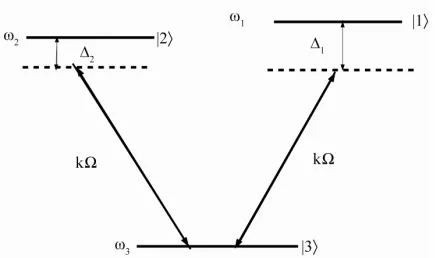
are the atomic levels energies (1>2>3) and is the field frequency, with the detuning parameters 1 and 2 (as shown in Figure 1) given by
1= k ( 1 3), 2= k (2 3)
(3) The interaction part of the Hamiltonian in the presence of an arbitrary nonlinear medium, via multi-photon pro- cess k can be written as
† † †
1 13 1 1 31
† †
2 23 2 2 32
ˆ ˆ ˆ ˆ ˆ ˆ ˆ ˆ = ( ) ( ) ( )
ˆ ˆ ˆ ˆ ˆ ˆ ( ) ( ) .
k k
in
k k
H a a f a a a a f a a
f a a a a f a a
(4)
†
ˆ ˆ (a a
) and f a a(ˆ ˆ† ) are Hermitian operators func-
tions of photon number operators, such that † 1 1f a a(ˆ ˆ) and (ˆ ˆ†
2 2f a a)
ij
represents an arbitrary intensity-de- pendent atom-field coupling, while denotes the one-mode field nonlinearity which can model Kerr-like medium nonlinearity as will be discussed later. The operators
†
ˆ ˆ (a a
)
satisfy the following commutation rela- tions [ ij, l]= il j j il, ˆ[ ,aij] = 0.
The initial state (0)AF of the combined atom-field
system may be written as
(0)AF = (0)A (0)F
(5)
where (0)A = 1 1 the initial state of the atom and
(0)F =
is the initial state of the field. The initial state = ( )n
p n
where the probability am-plitude (n) is defined in the usual manner as
p
= |
n
p n .
The time evolution between the atom and the field is defined by the unitary evolution operator generated by
H . Thus U t( ) is given by:
( ) exp .
U t iHt
This unitary operator U t( ) is written as 1 ( ) ( ) ( ) 03 =0 3 ( ) ( ) ( ) = =1
( ) = exp( )
exp( )
k
s s s
s
n n n
j j j
n k j
U t iE t
iE t
(6)where j = 1, 2, 3 and the eigenvalues ( )
03 = 3 ( ),( = 0,1, , 1)
s
[image:2.595.315.534.79.208.2]E s s s k
Figure 1. Energy level diagram for a V-type three-level atom with k-photon detuning Δ1, Δ2.
( ) 1 2
1 2
2
= 3
3 3
n cos( )
j j
X
E X X (7)
and
3
1 2 1 3
1
3
2 2
1 2
9 2 27
1 2π
= cos (
3 3
2 3
j
X X X X
j X X
1) ,(8)
with
1 1 2 3
2 2
2 1 2 1 2 1 3 2 3
2 2
3 2 1 1 2 1 2 3
1 1
2 2
3 3
1 1 1 2 2 2
= ( ) = = = ( ) = ( ) = ( ) ( ) ( )! ( ) = ( ) , = ( ) ! !
X r r r
X V V r r r r r r
X r V rV r r r
r n n
r n n
r n k n k
n k n k
V f n V f n
n n ! (9)
and ( )s , n j
are the dressed states of the system associated with the eigenvalues ( )
03s
E and (j = 1,
2, 3).
( )n, j E
( )s = ,3 ,( = 0,1, , 1)
s s k
( )n = ( )n ,1 ( )n , 2 ( )n ,
j j n j n j n
k 3 (10)
where
( )
( ) 1 2
( ) ( ) 2 1 ( ) ( ) ( ) 1 2 1 = n n j j n n j j n n n j j j
V r E
V r E
M
r E r E
( ) 2 ( ) 2 2 ( ) 2 2 ( )
1 2 1 2 2 1
=
( n ) ( n ) ( n ) (
j j j j
M
r E r E V r E V r En )2
(12) Having obtained the explicit form of the unitary operator , the eigenvalues and the eigenfunctions for the system under consideration, we are therefore in a position to discuss any property related to the atom or the field.
( )
U t
3. The Physical Transient Spectrum
In this section we derive the physical transient spectrum
( )
S by calculating the Fourier transform of the time
averaged dipole-dipole correlation function
13( )t1 23( )t1
31( )t2 32( )t2
, The physical spe- ctrum ( )S of radiation field emitted by a cavity-bound atom is given by the expression [10].
1 2 1 2
0 0
13 1 23 1 31 2 32 2
( ) = d d exp ( )( ) ( )( )
( ) ( ) ( ) ( ) .
T T
S t t i T t i T
t t t t
t(13) where is the interaction time and is the band- width of the filter. After carrying out the various ope- rations we get
T
1 3 2 2
( ) ( ) ( ) ( )
03 =0 =1
2
( ) *( ) ( ) ( ) *( ) ( )
3 3 2 2 2
( ) ( ) ( ) ( ) ( )
= =1 =1
2 2
( ) *( ) ( ) ( ) *( ) ( )
( ) = ( , )
( ,
k
s s s s
j j
s j
s s s s s s
j j j j j j
n n n k n k n
j i i j
n k i j
n n n n n n
j j j j j j
S p E E
p E
2 ) E (14) where 2 21 exp( 2 ) 2 exp( ) cos( ) ( , ) =
( )
T T x
x y
x y
y T
(15) Thus the time averaged spectrum consists of resonant structures which arise from transitions among different dressed states. The final structure of the time averaged spectrum will depend on the form of the input photon distribution p(n). Due to the quantum interference be- tween component states the oscillations in the cavity field become composed of different component states.
4. Results and Discussion
On the basis of the analytical solution presented in a
previous section, we shall study numerically the physical transient spectrum in a a squeezed coherent initial field. The photon number distribution for a squeezed coherent state [11] can be written as
2 2
2 2
(tanh ) =
2 !cosh 2 cosh sinh exp tanh ( ) ,
n
n n n
r
P s H
n r r r
r Re (16)
where, = coshrsinh ,r = exp( )i and Hn
is the Hermite polynomial. We suppose here the minor axis of the ellipse, representing the direction of squeez- ing, parallel to the coordinate of the field oscillator. The initial phase of is the angle between the dire- ction of coherent excitation and the direction of squeez- ing. The mean photon number of this field is equal to
2 2
= .
n sinh r Putting we get the photon dis- tribution for an initial coherent state with
= 0
r
2
=
n
whereas for = 0 the photon distribution for an initial squeezed vacuum state with = sinh2
n r is recovered.
The latter distribution is oscillatory with zeros for odd .
n
By means of dressed atom states, and quantum beats we know that when the number changes by unit, this coupling describes the spontaneous emission of photon with a frequency close to . Since the dressed
n k
k
state ( ) 3
n k
is totally decoupled from the other dre- ssed states, it can not be populated [12,13]. Then the field can only couple such transitions where the final sta- tes are either 1 or 2 but not 3 [12,14]. So, there are only six possible allowed spontaneous decays from the three perturbed states of ( )n (where
E
( ) ( ) ( ) ( )
1 2 3
= , ,
n n n n
E ) to lower multiplicities
(n k)
j
E [15,16]. Generally they are asymmetric, because
the intensities of the symmetrically placed sidebands are not equal. While at exact resonance the spectrum be- comes symmetric [16]. Due to the non population of the dressed state 3 the two transitions 3 1 and 3 2 vanish [12-14]. Hence, the emission spectrum of -type three-level atom for a single cavity field has four-peak structure. In what follows we shall consider the effect of men photon number, detuning parameters 1 2
V
,
, intensity dependent coupling f ni( )
and the nonlinear Kerr medium parameter on the spectrum of the system under consideration.
4.1. Effect of Multiplicity and Mean Photon Number
For k= 1 small n Rabi vacuum peaks dominate the
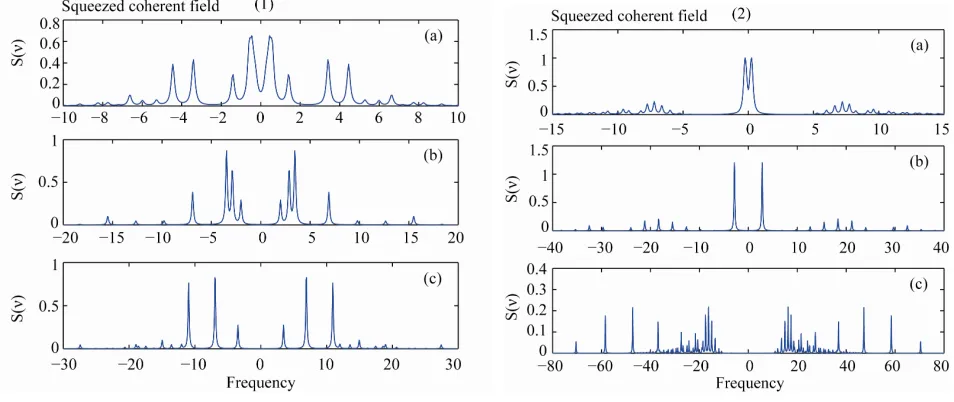
mean photon number of the cavity field the effect of the vacuum state diminishes and we note that there is a central deep gap surrounded by two symmetric spikes beside a two symmetric peaks however with structure appear as one moves away from the center as shown in Figure 2.2(a). This is due to that the central two peaks located at
( ) ( )
and1n k 1n
E E
( ) ( )
2n k 2n
E E
height decrease by increasing the mean photon number see Figure 2.2(c). Finally, as the photon multiplicities number increase, the number of allowed transition be- tween the dressed states increase and hence number of peaks appearing in the spectrum increase as k increase (compare frames in Figures 2.1 and 2.2).
4.2. Effect of Detuning coalescence into each other, giving a single double peak
at the center of the spectrum, while the other two peaks giving the symmetric sidebands around the central struc- ture (see Figure 2.2(a)). With further increase in the mean photon number and hence the variance the spec- trum not only become quite rich, and the gap depth and width decrease because the central two peaks coale- scence into each other further but also, the sidebands move away from the central line, and its height decreases while it gets wider and wider as long as the mean photon number n increases. Hance, at sufficiently large mean
photon number the central two peaks merge to a single peak leading to a three-peak structure. In Figure 2(b) where the situation is completely changed, we note the appearance of two wall separated central spikes surrounded by two symmetric groups of small spikes, which their heights having a maximum for the small middle spikes. Also, the central structure which observed at disappearing here. The two central spikes which nearest to the center becomes higher and narrower as the mean photon number increase. But for the spectra dived in to two symmetric groups of spikes located around the center. By increasing the values of
= 2
k
= 1 k
= 3
k
n
the spectrum is quite rich. Also, we can observe that the side peaks move away from the central line, and its
As we compare the figure Figure 3 and Figure 2.2 where the case of absence of detuning is considered, we generally may say that detuning adds asymmetry to the spectrum and the shape of the spectrum is changed on both sides of the central line. The left spikes is supp- ressed on changing 1, 2, while the right spikes is moving away from the resonant frequency and becomes higher as the values of the detuning parameters 1, 2 increase (compare frames 1, 2 in Figure 3. Also, the peaks at the left hand side decrease gradually, so that it disappear for a large values of the detuning parameters
1, 2
as shown in Figure 3.2. But, these phenomena takes place in a faster way as k decrease (compare frames a,b,c in Figure 3.2. Finally, not only the number of peaks, there position and there maximum heights depends on the detuning parameters but, also the photon number multiplicity k. 1 2
,
4.3. Effect of Kerr Medium
Now we will turn our attention to the effect on the spectrum ( )S of the nonlinearity of the field with a
[image:4.595.61.538.483.684.2]Kerr-type medium due to the term ( )n being taken in
Figure 2. The evolution of the function S(v) in a perfect cavity as a function of (k) 1 2 with 1,2= 1, 1,2= 0,
, , , 1,2
= 0 = 0.1 = 0, ( ) = 1 = 100
Figure 3. The same as Figure 2.2 but with, (1) Δ1 = 5, Δ2 = 4; (2) Δ1 =Δ2 = 20.
the form n n( 1), where is related to the third- order nonlinear susceptibility. In fact the optical Kerr effect is one of the most extensively studied phenomenon in the field of nonlinear optics because of its applications. The addition of the Kerr-like medium parameter to the problem adds asymmetry to the spectrum that can be seen from comparison of the cases considered in Figure 4 with Figures 2.2. The right side peaks are suppressed while the left side peaks gain height and becomes narrower gradually as the values of increased see Figure 4.2. So that the right side hand peaks nearly disappear for a large values of see Figure 4.2. But this phenomena takes place in a slow way as k increase. We may conclude that, the effect of the Kerr-like medium is opposite to the effect of detuning. Further- more, the effect of the nonlinear medium on the spec- trum of the emitted light is the shift of the spectrum to the left and changing the amplitudes of the peaks de- pending on the value of , k. The maximum height of
peaks increase as increases for all values of k. While the maximum height of peaks decrease as k increases for all values of .
4.4. Effect of Intensity Dependent Coupling Functional
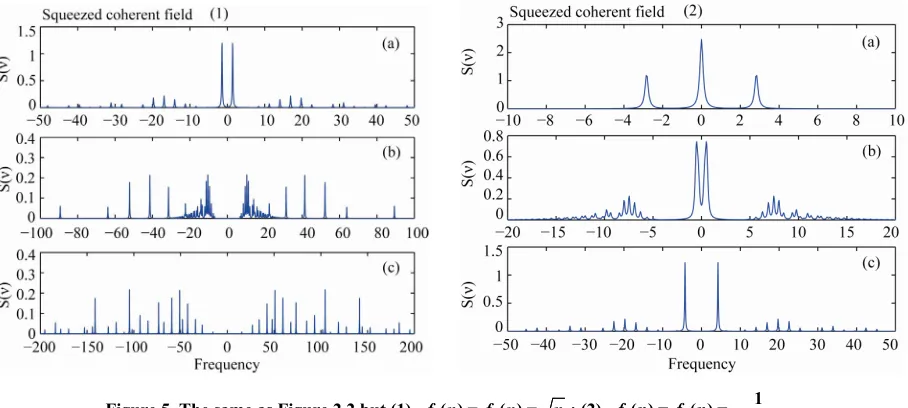
In Figure 5 we study the effect of different functionals of intensity dependent coupling f n1( ), ( )f n2 on the emission spectrum ( )S . When 1( ) = 2( )
these peaks increases as k increase. When we consider
1 2
1 ( ) = ( ) =
1
f n f n
n the stepwise excitation becomes
smaller than that in the case 1 2 . So that the sidebands become closer to each other, hence the number of peaks and the range of the spectrum decreases for all values of k see Figure 5.2. For we get a situation similar to a Mollow spectrum (i.e only three peaks appears)which one gets in semiclassical fields see Figure 5.2(a). While for we note a deep gap between two higher wall spikes at the center surrounded by two lower side bands see Figure 5.2(b). For the two wall spikes which nearest to the center gain height (compare Figure 5.2(c) with Figure 2.2(c)). Finally, the spectrum can be controlled by choosing the right intensity-dependent coupling functional.
( ) = ( ) = 1
f n f n
= 1
k
= 2
k
= 3
k
5. Conclusions
We have investigated the emission spectrum for a multi- photon V-type three-level atom, taking into account arbitrary forms of nonlinearities of both the field and the intensity-dependent atom-field coupling. The spectrum is calculated when the field initially in a squeezed coherent state. We have explored the influence of various para- meters of the system on the emission spectrum. It is observed that
For k= 1 the spectrum of V-type three-level atom
for the cavity field has four-peak structure. But for sufficiently large values of the mean photon number the spectrum tends to a three peak structure.
= 1
f n f n n
the range of the spectrum is extended due to the larger stepwise excitation than that for 1 2 . Also, the spectra divided into two groups of peaks which are symmetrically located around the central frequency for all values k (see Figure 5.1. Furthermore, not only the maximum height of peaks decrease but, the number of
( ) = ( ) =
f n f n 1
[image:6.595.63.534.82.272.2]
Figure 4. The same as Figure 2.2 but with, (1) χ = 0.1; (2) χ = 0.8.
Figure 5. The same as Figure 2.2 but (1) f n1( ) = f n2( ) = n; (2) 1 2
1
( ) = ( ) =
1
f n f n
n .
The peak position is associated with not only the photon number ( )n and the photon multiplicity
number k but also the intensity-dependent atom-field coupling constant if ni( ).
The heights of the spectrum components becomes shorter and the distances between them is larger as the mean photon number increased.
The symmetry shown in the standard three-level atom model for the spectra is no longer present once Kerr effect or detuning is considered.
The effect of detuning on the spectrum of the emitted light is twofold. The first effect is the shift of the spectrum to the right side. The second effect is the dependence of the amplitudes and heights of the peaks on i.
The Kerr medium has an effect opposite to the effect
of the detuning, where the earlier has shorter ele- ments. Also, the heights and widths of the peaks not only depend on the photon multiplicity but also on the value of . Consequently, changes in the detun- ing and the Kerr medium parameters can show in the spectra, and hence the heights of the peaks, their shi- fts and widths are altered compared with the case of resonance.
The strong field effects can be produced by choosing the right parameters for these nonlinearities.
6. References
[image:6.595.73.527.299.503.2]doi:10.1016/S0375-9601(99)00718-5
[2] Z. Ficek and P. D. Drummond, “Three-Level Atom in a Broadband Squeezed Vacuum Field. I. General Theory,” Physical Review A, Vol. 43, No. 11, 1991, pp. 6247-6257. doi:10.1103/PhysRevA.43.6247
[3] S. Smart and S. Swain, “Three-Level Atom in a Squeezed Vacuum II. Resonance Fluorescence,” Journal of Modern Optics, Vol. 41, No. 6, 1994, pp. 1055-1077.
doi:10.1080/09500349414551021
[4] B. J. Dalton, M. R. Ferguson and Z. Ficek, “Resonance Fluorescence Spectra of Three-Level Atoms in a Squeezed Vacuum,” Physical Review A, Vol. 54, No. 3, 1996, pp. 2379-2390. doi:10.1103/PhysRevA.54.2379 [5] B. J. Dalton M. Bostick and Z. Fizec, “Probe Absorption
Spectra for Driven Atomic Systems in a Narrow Band-width Squeezed Vacuum,” Physical Review A, Vol. 53, No. 6, 1996, pp. 4439-4439.
doi:10.1103/PhysRevA.53.4439
[6] O. G. Calderon, F. Carreno and M. A. Anton, “Quantum Interference Effects in Resonance Fluorescence and Ab-sorption Spectra of a-Type Three-Level Atom Damped by a Broadband Squeezed Vacuum,” Optics Communica-tions, Vol. 221, No. 4-6, 2003, pp. 365-385.
doi:10.1016/S0030-4018(03)01490-1
[7] D. F. Walls and G. J. Milburn, “Quantum Optics,” Sprin- ger-Verlag, Berlin, 1994.
[8] C. M. Caves and B. L. Schumaker, “New Formalism for Two-Photon Quantum Optics. I. Quadrature Phase and Squeezed States,” Physical Review A, Vol. 31, No. 5, 1985, pp. 3068-3092. doi:10.1103/PhysRevA.31.3068 [9] V. V. Dodonov, “Nonclassical States in Quantum Optics:
A Squeezed Review of the First 75 Years,” Journal of
Optics B, Vol. 4, No. 1, 2002, p. R1. doi:10.1088/1464-4266/4/1/201
[10] J. H. Eberly and K. Wodkiewicz, “The Time-Dependent Physical Spectrum of Light,” Journal of the Optical Soci-ety of America, Vol. 67, No. 9, 1977, pp. 1252-1261. doi:10.1364/JOSA.67.001252
[11] R. Loudon, “Quantum Statistics of Linear and Nonlinear Optical Phenomena,” Optica Acta: International Journal of Optics, Vol. 31, No. 8, 1984, pp. 847-852.
doi:10.1080/713821593
[12] S.-Y. Zhu, R. C. F. Chan and C. P. Lee, “Spontaneous Emission from a Three-Level Atom,” Physical Review A, Vol. 52, No. 1, 1995, pp. 710-716.
doi:10.1103/PhysRevA.52.710
[13] G. X. Li, K. Allaart, C. Hooijer and D. Lenstra, “Sponta-neous Emission in a V-Type Three-Level Atom Driven by a Classical Field,” Physics Letters A, Vol. 263, No. 4-6, 1999, pp. 250-256.
doi:10.1016/S0375-9601(99)00718-5
[14] P. Dong and S. H. Tang, “Absorption Spectrum of a V-Type Three-Level Atom Driven by a Coherent Field,” Physical Review A, Vol. 65, 2002, Article ID 033816, 10 Pages.
[15] C. Cohen-Tannoudji and S. Reynaud, “Dressed-Atom Description of Resonance Fluorescence and Absorption Spectra of a Multi-Level Atom in an Intense Laser Beam,” Journal of Physics B, Vol. 10, No. 3, 1977, p. 345. doi:10.1088/0022-3700/10/3/005